Submitted on: 2025, 27th March; revised on: 2025, 6th June; accepted on: 2025, 31st July
Bread and cookies: allotriophagy in a worm lizard (Squamata: Amphisbaenia)
1 Programa de Pós-Graduação em Biodiversidade e Conservação da Natureza, Universidade Federal de Juiz de Fora, 36036-900, Juiz de Fora, Minas Gerais, Brasil
2 Coleção Herpetológica do Norte Fluminense, Núcleo de Estudos e Pesquisas em Animais Silvestres, Universidade Estadual do Norte Fluminense Darcy Ribeiro, 28013-602, Campos dos Goytacazes, Rio de Janeiro, Brazil
3 Programa de Pós-Graduação em Ecologia, Instituto de Biologia, Universidade Estadual de Campinas, 13083-970, Campinas, São Paulo, Brazil
*Corresponding author. Email: ccostah@gmail.com
Abstract. Allotriophagy refers to the consumption of food items considered abnormal for a given species. In this note, we report the recurrent consumption of bread and cookie crumbs by a free-ranging worm lizard (Amphisbaena sp.) in Brazil. While there are a few isolated reports of worm lizards consuming unusual food items, this is the first documented case of such behavior in a wild specimen occurring over several months, potentially involving the same individual. Allotriophagy in wild worm lizards may be triggered by nutritional deficiencies or opportunistic feeding. Documenting these cases is important for advancing our understanding of worm lizard behavior, particularly in urban environments.
Keywords. Amphisbaena, diet, food, lizard, trophic ecology.
The diet of burrowing reptiles reflects their morphological adaptations and ecological flexibility (Pianka and Vitt, 2003; Vitt and Caldwell, 2014). Amphisbaenians (worm lizards), a group of snake-like squamates adapted for life underground (Gans, 1978) feeds mainly on arthropods and their larvae (López et al., 1991; Cruz Neto and Abe, 1993; Webb et al., 2000; Esteves et al., 2008; Amorim et al., 2024), although some species may be specialized in particular prey, such as gastropods (Pregill, 1984; Martín et al., 2013). Due to their elusive nature, studies on the diet of worm lizards are conducted through the dissection of preserved specimens from natural history collections, allowing for the examination of gut contents (White et al., 1992; Cruz Neto and Abe, 1993; Esteves et al., 2008). However, occasional observations of live specimens in natural and captive conditions provide insights into their feeding behavior, sometimes revealing unusual food choices (Navas et al., 2004; Moraes and Recchia, 2011; Aragão et al., 2019; Nascimento et al., 2019; Reiche et al., 2021; Bezerra et al., 2022).
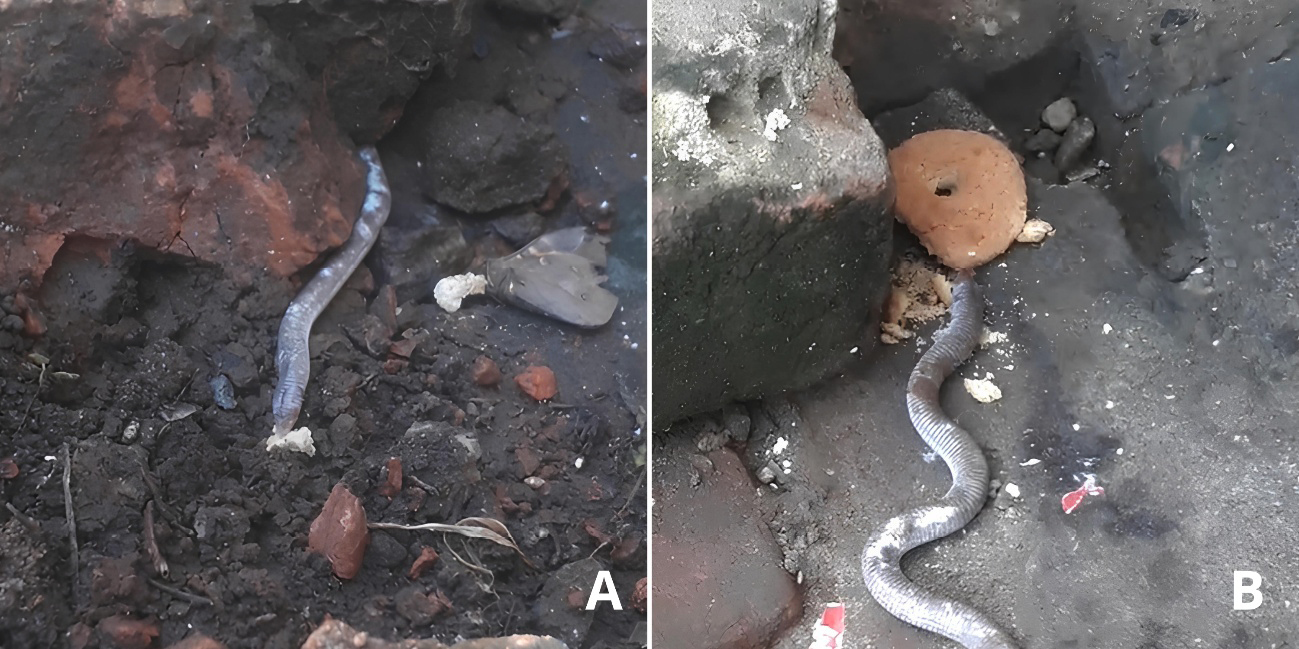
Between April and September 2022, in the Central-West Region of Brazil, Alessandra Sá observed an Amphisbaena sp. individual in Goianésia (15.326°S, 49.120°W), state of Goiás. The animal was regularly seen in the morning near the sidewalk, between Alessandra’s ice cream shop and a house behind it. The first sighting, on April 1st, 2022, was incidental – the worm lizard was found feeding on cookie crumbs scattered on the ground. On several subsequent occasions, the same individual (or likely the same) was seen emerging from an underground tunnel to feed on bread and cookies left on the sidewalk. However, it often remained hidden for 7 to 10 days before reappearing. It appears that, after the initial observation, the observer began intentionally offering food to the animal. It is important to note that these recordings were not part of a scientific experiment, but rather the result of casual observations made by a layperson with no formal training in biology, motivated by curiosity about the animal’s behavior.
Due to the low quality of the images (Fig. 1), it was not possible to confirm the species with certainty. However, based on the animal’s size and coloration, as well as the known distribution of Brazilian amphisbaenians (Colli et al., 2016; Guedes et al., 2020, 2023; Assis et al., 2022), the specimen most likely belongs to Amphisbaena vermicularis or A. mertensii (Gans, 1966; Gans and Amdur, 1966). The videos recorded are available as supplementary material.
Eating unusual food items has been observed in lizards from different regions around the world, such as captive Gekko monarchus eating bread (Weterings and Weterings, 2018), free ranging Hemidactylus platyurus eating rice, cucumber, and eggs from a trash bin (Weterings, 2017), Teira dugesii eating pieces of bread, cake, and other items accidentally dropped to the floor (Lunn, 1991), and Trachylepis atlantica eating cookie crumbs (Gasparini et al., 2007).
There is only one known report of amphisbaenians consuming unusual food items in a natural environment: sea turtle eggs (Nascimento et al., 2019). In contrast, most such observations come from urban settings, where individuals have been seen feeding on atypical materials such as an oil-soaked paper towel (Moraes and Recchia, 2011), chicken eggshells (Aragão et al., 2019), and even a cockroach significantly larger than the animal’s head (Bezerra et al., 2022).
The behavior of consuming food items considered abnormal is known as allotriophagy (Bender, 2006). Allotriophagy is also often referred to as pica syndrome (Lewbart and Christian, 2007) and is better documented in humans (Walker et al., 1997) and domestic animals (Demontigny-Bédard et al., 2016; Santos Campos et al., 2024). In veterinary literature, this term is often used specifically to describe the ingestion of non-food items, distinguishing it from the opportunistic consumption of unusual but edible food items (Lewbart and Christian, 2007; Cardona et al., 2017; Popova and Mano, 2018; Santos Campos et al., 2024). However, considering a broader interpretation of the term (Bender, 2006), the recurrent consumption of unusual food items by Amphisbaena sp., which likely provides little to no nutritional value to the individual, can be classified as allotriophagy.
The consumption of unusual food items may be triggered by nutritional deficiencies or opportunism. In urban areas, the decrease of terrestrial arthropods (Buczkowski and Richmond, 2012; Fenoglio et al., 2020) and the presence of human food waste may push reptiles to explore alternative food sources. Additionally, the strong smells of processed foods can attract these animals, leading them to eat inappropriate materials (Lunn, 1991; Weterings and Weterings, 2018). Individuals of certain species can quickly become accustomed to consuming human-provided food on a regular basis. For instance, in Italy, a Podarcis siculus lizard was observed feeding on bread for five consecutive days at the same location where researchers had placed it (Valerioti and Sperone, 2024). A similar pattern was observed in the Amphisbaena sp. reported here. Although this observation spanned for months and occurred on non-consecutive days, the animal consistently appeared at the same location to feed, suggesting a learned habit of seeking out and consuming food items left by humans.
The consistent consumption of unusual food items can pose health risks to reptiles, potentially leading to death (Lewbart and Christian, 2007). In the case of sugar-rich foods, such as the bread and cookies consumed by the Amphisbaena reported in this study, there is evidence that their intake may cause changes in the immune system and gut microbiota (Ki et al., 2024), as well as other physiological and even behavioral alterations (French et al., 2022, and references therein). Regarding behavioral changes, the available evidence suggests that the presence of anthropogenic food in the environment did, in fact, has altered the foraging behavior of the Amphisbaena, prompting it to seek out these items on the surface with some regularity.
Documenting cases of allotriophagy in wild reptiles is essential, particularly in the Tropics, where such reports remain scarce. The limited availability of published data restricts our understanding of both the frequency of this behavior and the broader occurrence of unusual food consumption within the group. Further investigation into this subject may yield valuable insights into its ecological and physiological implications, enhancing our understanding of reptile feeding behaviors and the effects of unusual food items on trophic interactions. A particularly compelling question emerging from this framework concerns how the indirect consequences of allotriophagy influence both trophic and non-trophic ecological interactions.
SUPPLEMENTARY MATERIAL
Supplementary material associated with this article can be found at: https://oaj.fupress.net/index.php/ah/article/view/17538/14579.
REFERENCES
Amorim, D.M., Ávila, R.W., Perez, R., Moura, G.J.B. de (2024): Diet composition of three amphisbaenian species (Amphisbaena alba, Amphisbaena pretrei, and Amphisbaena vermicularis) from Northeast Brazil. Can. J. Zool. 102: 578-585.
Aragão, M., Brito, E.L.S., Neto, A.M.S.N., Mendes, D.M.M., Sobral, R. (2019): Amphisbaena vermicularis (Wagler’s Worm Lizard). Diet. Herpetol. Rev. 50: 780-781.
Assis, C.L., Mendonça, L.R., Feio, R.N., Costa, H.C. (2022): Amphisbaena mertensii (Squamata: Amphisbaenidae): Notes on natural history, distribution, and morphology. Caldasia 44: 653-660.
Bender, D.A. (2006): Benders’ dictionary of nutrition and food technology. 8th ed. Cambridge, Woodhead Publishing Limited.
Bezerra, L.L., Almeida, L.S., Cavalcante, T., Gonzalez, R.C. (2022): Amphisbaena vermicularis (Wagler’s Worm Lizard). Diet. Herpetol. Rev. 53: 675.
Buczkowski, G., Richmond, D.S. (2012): The effect of urbanization on ant abundance and diversity: A temporal examination of factors affecting biodiversity. PLOS ONE 7: e41729.
Cardona, J., Alvarez, J., Perez, J. (2017): Sudden death by allotriophagy and Haemonchosis in a goat (Capra aegagrus hircus) of Córdoba department, Colombia. Rev. Colomb. Cienc. Anim. 9: 222-226.
Colli, G.R., Fenker, J., Tedeschi, L.G., Barreto-Lima, A.F., Mott, T., Ribeiro, S.L.B. (2016): In the depths of obscurity: Knowledge gaps and extinction risk of Brazilian worm lizards (Squamata, Amphisbaenidae). Biol. Conserv. 204: 51-62.
Cruz Neto, A.P., Abe, A.S. (1993): Diet composition of two syntopic species of Neotropical amphisbaenians, Cercolophia roberti and Amphisbaena mertensii. J. Herpetol. 27: 239-240.
Demontigny-Bédard, I., Beauchamp, G., Bélanger, M.-C., Frank, D. (2016): Characterization of pica and chewing behaviors in privately owned cats: A case-control study. J. Feline Med. Surg. 18: 652-657.
Esteves, F.A., Brandão, C.R.F., Viegas, K. (2008): Subterranean ants (Hymenoptera, Formicidae) as prey of fossorial reptiles (Reptilia, Squamata: Amphisbaenidae) in Central Brazil. Pap. Avulsos Zool. 48: 329–334.
Fenoglio, M.S., Rossetti, M.R., Videla, M. (2020): Negative effects of urbanization on terrestrial arthropod communities: A meta-analysis. Glob. Ecol. Biogeogr. 29: 1412-1429.
French, S.S., Webb, A.C., Wilcoxen, T.E., Iverson, J.B., DeNardo, D.F., Lewis, E.L., Knapp, C.R. (2022): Complex tourism and season interactions contribute to disparate physiologies in an endangered rock iguana. Conserv. Physiol. 10: coac001.
Gans, C. (1966): Redescription of Amphisbaena mertensi Strauch, with comments on its geographic variation and synonymy (Amphisbaenia: Reptilia). Copeia 1966: 534-548.
Gans, C. (1978): The characteristics and affinities of the Amphisbaenia. Trans. Zool. Soc. Lond. 34: 347–416.
Gans, C., Amdur, M.A. (1966): Redescription of Amphisbaena vermicularis Wagler, with comments on its range and synonymy (Amphisbaenia: Reptilia). Proc. Calif. Acad. Sci. 66: 69-90.
Gasparini, J.L., Peloso, P.L.V., Sazima, I. (2007): New opportunities and hazards brought by humans to the island habitat of the skink Euprepis atlanticus. Herpetol. Bull. 100: 30-33.
Guedes, J.J.M., Costa, H.C., Moura, M.R. (2020): A new tale of lost tails: Correlates of tail breakage in the worm lizard Amphisbaena vermicularis. Ecol. Evol. 10: 14247-14255.
Guedes, T.B., Entiauspe-Neto, O.M., Costa, H.C. (2023): Lista de répteis do Brasil: atualização de 2022. Herpetol. Bras. 12: 56-161.
Ki , K.C., Lewis, E.L., Wu, E., Oliaro, F.J., Aubry, L.M., Knapp, C.R., Kapheim, K.M., DeNardo, D., French, S.H. (2024): High sugar diet alters immune function and the gut microbiome in juvenile green iguanas (Iguana iguana). J. Exp. Biol. 227: jeb246981.
Lebart, G.A., Christian, L.S. (2007): “Pica” in amphibians and reptiles. Crissey Zoological Nutrition Symposium. Raleigh, NC State University, College of Veterinary Medicine.
López, P., Martín, J., Salvador, A. (1991): Diet selection by the amphisbaenian Blanus cinereus. Herpetologica 47: 210-218.
Lunn, J. (1991): Scavenging by the Madeira lizard Lacerta dugesii. Br. Herpetol. Soc. Bull. 35: 10-11.
Martín, J., Ortega, J., López, P., Pérez-Cembranos, A., Pérez-Mellado, V. (2013): Fossorial life does not constrain diet selection in the amphisbaenian Trogonophis wiegmanni. J. Zool. 291: 226-233.
Moraes, R.L., Recchia, M.D.P. (2011): Amphisbaena mertensi (NCN) Habitat. Herpetol. Rev. 42: 426.
Nascimento, M.L., Silva, O.B., Silva, E.G., Oitaven, L.P.C., Moura, G.J.B. (2019): Eretmochelys imbricata (Hawksbill Sea Turtle). Egg predation. Herpetol. Rev. 50: 350.
Navas, C.A., Antoniazzi, M.M., Carvalho, J.E., Chaui-Berlink, J.G., James, R.S., Jared, C., Kohlsdorf, T., Dal Pai-Silva, M., Wilson, R.S. (2004): Morphological and physiological specialization for digging in amphisbaenians, an ancient lineage of fossorial vertebrates. J. Exp. Biol. 207: 2433-2441.
Pianka, E.R., Vitt, L.J. (2003): Lizards: Windows to the evolution of diversity. Berkeley, University of California Press.
Popova, T., Mano, V. (2018): Clostridium botulinum in peat litter – cause of deadly disease in reptiles in private terrarium. Tradit. Mod. Vet. Med. 3: 15-20.
Pregill, G. (1984): Durophagous feeding adaptations in an amphisbaenid. J. Herpetol. 18: 186-191.
Reiche, H., Hohl, L.S.L., Rocha-Barbosa, O. (2021): Food capture and escape behavior of Leposternon microcephalum Wagler, 1824 (Squamata: Amphisbaenia). Braz. J. Biol. 84: e251255.
Santos Campos, M., Mendes de Oliveira Silva, A.C., Farias, J., Darklei dos Santos Silva, N., Oliveira Brandão, T., Lima Carneiro, R. (2024): Transtorno do apetite depravado (Síndrome de Pica) em um felino. Pubvet 18: e1654.
Valeriori, C., Sperone, E. (2024): Even lizards have brioche for breakfast: Observations of the Italian wall lizard, Podarcis siculus (Rafinesque-Schmaltz, 1810), feeding on unusual food in Calabria, Italy. Herpetol. Notes 17: 597-598.
Vitt, L.J., Caldwell, J.P. (2014): Herpetology: An introductory biology of amphibians and reptiles. 4th ed. San Diego, Academic Press.
Walker, A.R.P., Walker, B.F., Sookaria, F.I., Cannan, R.J., Cannan, R.J. (1997): Pica. J. R. Soc. Health 117: 280-284.
Webb, J.K., Shine, R., Branch, W.R., Harlow, P.S. (2000): Life underground: Food habits and reproductive biology of two amphisbaenian species from South Africa. J. Herpetol. 34: 520-516.
Weterings, R. (2017): Observations of an adaptive feeding strategy in flat-tailed house geckos (Hemidactylus platyurus) living in buildings. Herpetol. Notes 10: 133-135.
Weterings, R., Weterings, P. (2018): Are geckos the new mice? Observations of the warty house gecko, Gekko monarchus (Schlegel, 1836) feeding on bread. Herpetol. Notes 11: 319-320.
White, L.R., Powell, R., Parmerlee, J.S., Lathrop, A., Smith, D.D. (1992): Food habits of three syntopic reptiles from the Barahona Peninsula, Hispaniola. J. Herpetol. 26: 518-520.