https://doi.org/10.36253/a_h-17681
Submitted on: 2025, 2th April; revised on: 2025, 30th November; accepted on: 2025, 9th December.
The Data Deficient Leptobrachella nokrekensis is a junior synonym of the supposedly range-restricted and Critically Endangered Leptobrachella khasiorum (Amphibia: Anura: Megophryidae)
1 Department of Ecology and Environmental Sciences, School of Life Sciences, Pondicherry University, Puducherry, India
2 Systematics lab, Department of Environmental Studies, University of Delhi, Delhi 110 007, India
*Corresponding author. Email: naveen89240@gmail.com
Abstract. Based on a molecular phylogeny using 16S ribosomal RNA gene fragment and an examination of the external morphology of topotypic specimens we demonstrate that Leptobrachella nokrekensis syn. nov. from Garo hills is a junior synonym of Leptobrachella khasiorum. These data indicate that Leptobrachella khasiorum which was previously considered restricted to the Khasi Hills and Critically Endangered is more widespread than previously known. Genetic evidences also suggests that L. tamdil from Lushai hills may also be conspecific with L. khasiorum, warranting further investigations. A reassessment of its threat status is required based on this taxonomic revision and the consequent extension of L. khasiorum’s distribution and elevational range.
Keywords. 16S rRNA, data deficient, endemism, amphibians, IUCN Red List, Eastern Himalayas, taxonomic revision, threat status reassessment, Darwinian shortfall.
Contents
Introduction
The Khasi, Garo and Lushai hills of Northeast India are disconnected mountain ranges with interesting biogeographical connections to the Eastern Himalayas, the Brahmaputra Valley and the Indo-Malayan region including the Malayan Peninsula (Olson and Dinerstein, 2002; Pawar et al., 2007; Badavath and Sahoo, 2025). The region’s amphibian fauna has been studied since the mid-19th century, yet many taxonomic revisions are ongoing as recent collections continue to provide new insights into species boundaries and diversity (Kamei et al., 2012; Biju et al., 2019; Saikia and Sinha 2019; Mahony et al., 2020; Patel et al., 2021; Saikia et al., 2022; Boruah et al., 2023; Naveen et al., 2023). There are a few examples of congeneric herpetofaunal diversity that are distinct between these ranges, probably due to the geographic disconnectivity (e.g., Lalronunga et al., 2021; Naveen et al., 2023; Mirza et al., 2024) while many others are known to occur across them (e.g., Siammawii et al., 2021; Muansanga et al., 2022; Naveen et al., 2025).
Four species of Leptobrachella Cope, 1865 are known from India, of which the three species dealt with in this study were described within a short span between January and June 2010, from the Khasi, Garo, and Lushai Hills. Leptobrachella khasiorum (Das, Tron, Rangad, and Hooroo, 2010), originally described as Leptolalax khasiorum from Mawphlang Sacred Grove in the Khasi Hills is believed to be endemic to just this region. Consequently, it is categorized as Critically Endangered due to its extremely narrow Extent Of Occurrence. Leptolalax tamdil (Sengupta, Sailo, Lalremsanga, Das, and Das, 2010) was described from the nearby Tamdil wetlands in Mizoram. This species was subsequently transferred to the genus Leptobrachella and reported from a few other locations in central Mizoram, as well as from another more northeastern location in Manipur (Decemson et al., 2021). A third species, described from the Garo hills, Leptobrachium nokrekensis, later transferred to the genus Lepobrachella, although claimed to be described in “2009” by Mathew and Sen (2009), is now considered Leptobrachella nokrekensis (Mathew and Sen, 2010 “2009”), since Das and Deuti (2011) convincingly argued that the name was only made available on June 3, 2010, the official date of distribution of this printed publication.
Leptobrachella is one of the most diverse genera in the family Megophryidae Bonaparte, 1850 with 117 species distributed across southern China, northeastern India, Myanmar, Thailand, Vietnam, Malaya, Borneo, and the Natuna Islands (Frost 2025). The members of this genus exhibit a high degree of localised endemism and morphological overlap (Nguyen et al., 2021; Wu et al., 2025). But despite their cryptic morphology, new species continue to be identified, based on evidence from molecular analyses (Lin et al., 2022; Hoang et al., 2024; Luo et al., 2025; Wu et al., 2025). However, in the case of the northeastern Indian species, Leptobrachella khasiorum, Leptobrachella nokrekensis, and Leptobrachella tamdil, even though all of them exhibit a high degree of morphological similarity, none of their original descriptions included molecular data (Das et al., 2010; Mathew and Sen, 2010 “2009”). In the current study, the taxonomic validity of Leptobrachella nokrekensis is re-examined, based on fresh topotypical material collected from the Garo and Khasi hills, and further studies on Leptobrachella tamdil from Mizoram to assess its status is recommended.
Materials and methods
Sampling
Specimens were collected from two locations of the northeast Indian state of Meghalaya:
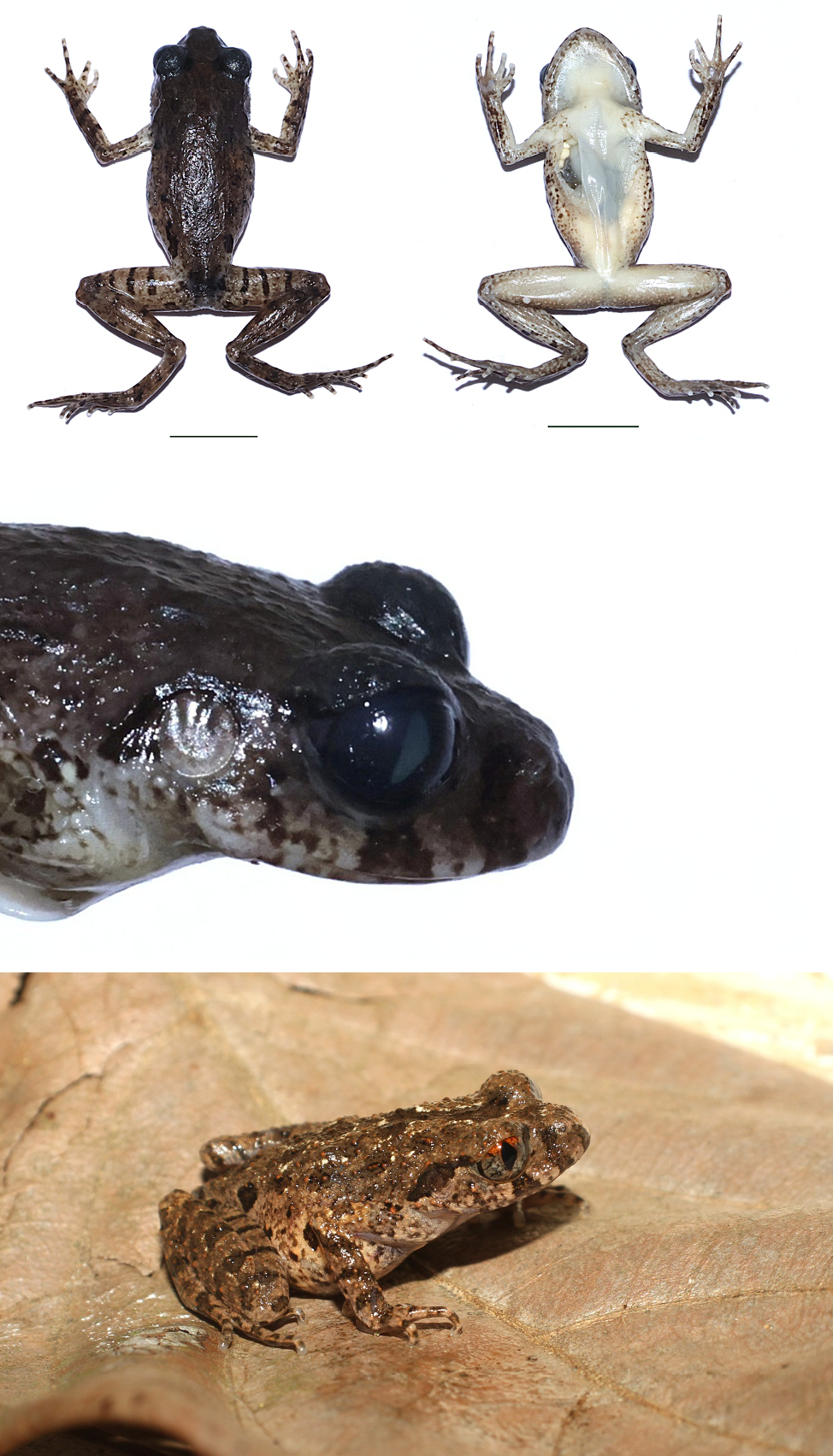
Sakalgre Village, Garo hills (25.515992, 90.381045; 925 m asl): Three specimens – one adult male (PU RSN 23) and two adult females (PU RSN 24, PU RSN 34), collected by RSN from a stream near the village in October 2024.
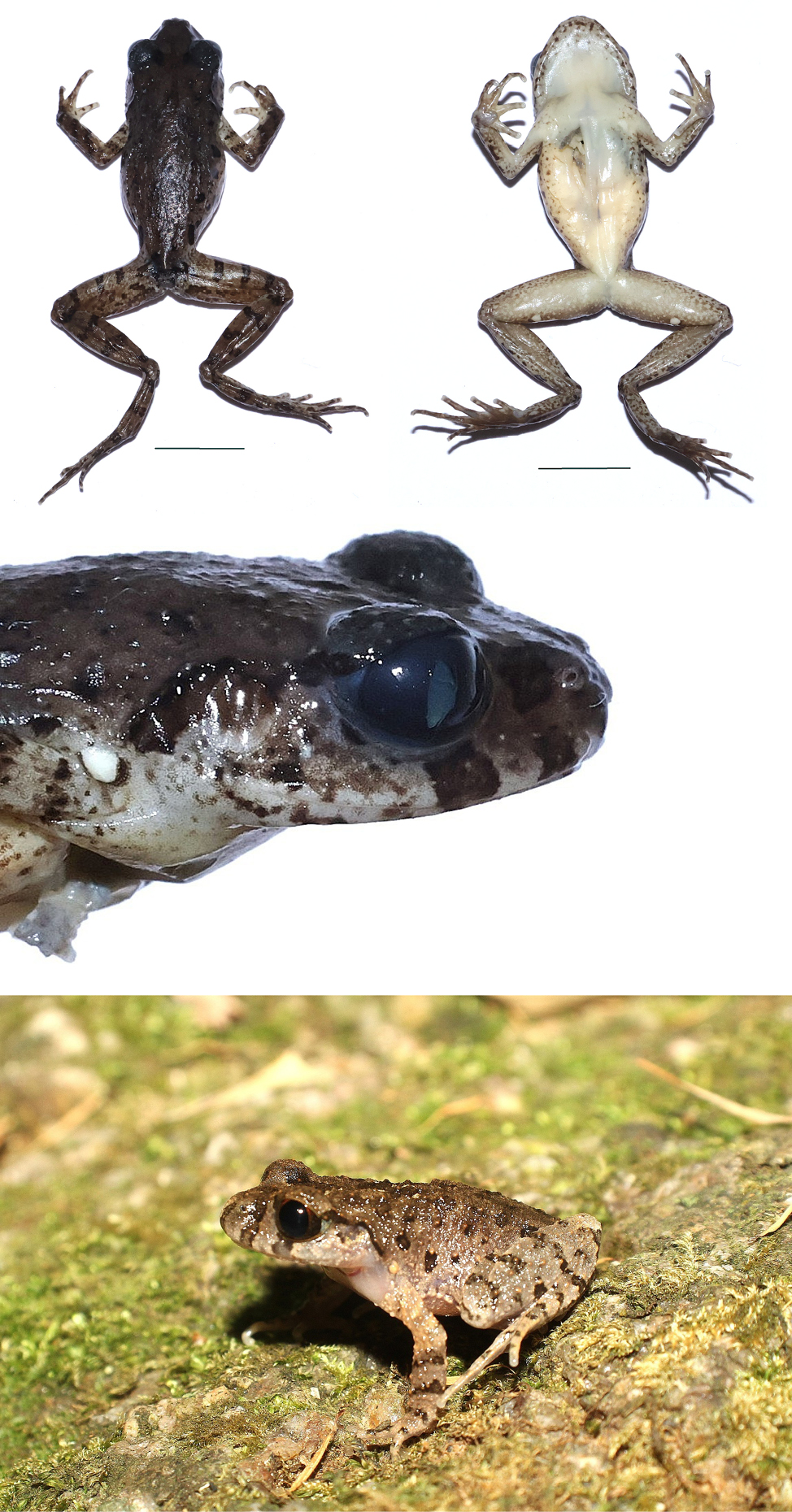
Near Mawphlang Sacred Grove, Khasi hills (25.436459, 91.759246; 1575 m asl): Two specimens – one adult male (PU RSN 32) and one adult female (PU RSN 33), collected by RSN from a stream flowing out of the grove in October 2024.
Specimens were collected under the following permits (No. WC/Research/157/608). They were photographed in life before being euthanized using approximately 0.10 ml of a 20% benzocaine solution applied to the ventral surface. Liver tissues were extracted from freshly euthanized specimens for molecular analyses and stored in 99% molecular-grade ethanol. The specimens were then fixed in 10% buffered formalin and subsequently stored in 75% ethanol. All specimens were deposited in the collections of the Department of Ecology and Environmental Sciences, Pondicherry University (PU).
Measurements
Morphological data from fixed specimens were measured to the nearest 0.02 mm with INSIZE digital callipers. The following measurements were taken: Snout-Vent Length (SVL); Axilla-to-Groin Length (AGL); Mid-Body Width (MBW); Head Width (HW) (measured at the angle of the jaws); Head Length (HLD) (from posterior end of the mouth snout tip); Nostril-to-Snout Distance (NS); Internarial Distance (IN); Maximum Upper Eyelid Width (UEW); Eye Diameter (ED); Interorbital Distance (IO) (shortest distance between the upper eyelids); Eye-to-Nostril Distance (EN); Tympanum Diameter (TYD); Tympanum-to-Posterior Corner of Eye Distance (TE); Upper Arm Length (UAL); Forearm Length (FAL) (previously Forelimb Length) (measured from the elbow to the base of the outer palmar tubercle); Palm Length (PAL) (measured from the base of the outer palmar tubercle to the tip of the third finger); Thigh Length (THL); Shank Length (SL) (approximated by measuring the crus); and, Foot Length (FL) (measured from the base of the inner metatarsal tubercle to the tip of the fourth toe).
Molecular analysis
Total genomic DNA was extracted from two specimens of Leptobrachella from Meghalaya (PU RSN 33 and PU RSN 24) with a DNA extraction and purification kit, following the manufacturer’s protocols. A fragment of the16S rRNA gene was amplified using the primers 16sAR-L (5’ CGCCTGTTTATCAAAAACAT-3’) and 16sBR-H (5’CCGGTCTGAACTCAGATCACGT 3’) respectively (Kocher et al., 1989). Amplifications were performed in an Applied Bio Systems Veriti 96 well thermal cycler: 20 µl reactions with 4 µl of 5X Phusion HF buffer, 0.4 µl of 10mM dNTP, 0.2 µl of Phusion DNA Polymerase, 0.1 µl each of forward and reverse primers, 2.0 µl of DNA template and 13.2 µl of nuclease free water with the following procedure: initial denaturation of DNA at 95°C for 5 min, 35 cycles of: denaturation at 95°C for 1 min, annealing at 55°C for 1 min, extension at 72°C for 1 min and at last, final extension at 72°C for 10 min. The amplicon was checked by running it through an agarose gel electrophoresis for a clear band of the desired region in the amplified PCR product. The amplified PCR product was purified and sequenced commercially at Barcode BioSciences Pvt.Ltd (BBS), Bangalore, India. The new sequences were then checked on the Basic Local Alignment Search Tool, BLAST (The National Centre for Biotechnology Information) (Altschul et al. 1990) to verify their approximate identity.
Phylogenetic analysis
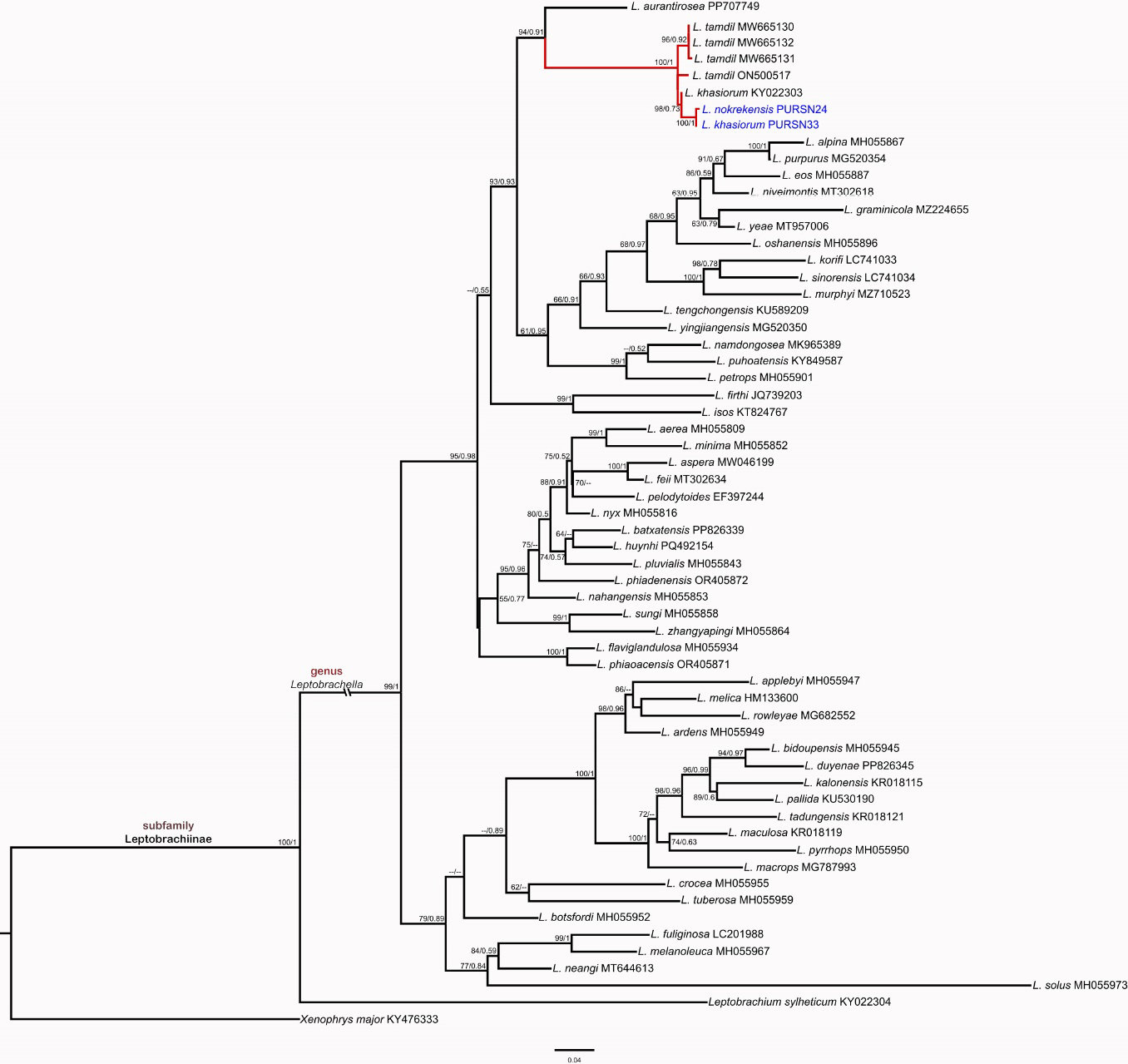
The new topotypic sequences of Leptobrachella khasiorum (PZ625872) and Leptobrachella nokrekensis (PZ625865) were assembled along with 52 other congeners from the Indo-Burma, Indo-China and southwestern China regions, with Leptobrachium sylheticum and Xenophrys major as the outgroups (see Fig. 1). The single existing sequence from the type locality of Leptobrachella khasiorum and all available homologous sequences of Leptobrachella tamdil were also added to the dataset. The resultant dataset of 61 sequences were aligned with Muscle and optimized manually, in MEGA X (Kumar et al., 2018). This alignment was then used to determine the uncorrected pairwise genetic distances between the samples with MEGA X. For the phylogenetic analysis, the best-fit model of nucleotide substitution was selected in jModelTest2 (Darriba et al., 2012). MrBayes v3.1.2 (Ronquist and Huelsenbeck, 2003) was used to perform the Bayesian analysis under the GTR+I+G model. Two independent analyses, each consisting of four Metropolis-coupled Markov chain Monte Carlo (MCMC) chains, were run for 20 million generations, with parameters sampled every 1,000 generations. Convergence was evaluated by ensuring that the average standard deviation of split frequencies fell below 0.01 and that potential scale reduction factors approached 1.0. Stationarity and effective sample sizes (ESS) were monitored within MrBayes. The first 25% of sampled trees were discarded as burn-in following Huelsenbeck et al. (2001), and clade support was assessed using Bayesian posterior probabilities (BPP), with values ≥ 0.95 considered strong (Leaché and Reeder, 2002). Maximum-likelihood (ML) analyses were carried out in IQ-TREE v1.6.12 (Nguyen et al., 2015) under the GTR+F+I+G4 model. Branch support was estimated using 10,000 ultrafast bootstrap (UFB) replicates (Hoang et al., 2018). Nodes with UFB ≥ 95 were considered strongly supported (Minh et al., 2013).
Results
The Bayesian Inference and Maximum Likelihood trees obtained were similar in topology and largely congruent with existing recent large scale phylogenies of Leptobrachella. The relationships between the focal group, comprising Leptobrachella khasiorum, L. nokrekensis and L. tamdil, were well resolved and the new sequences of L. khasiorum and L. nokrekensis grouped together with the sequence of L. khasiorum by Mahony et al., 2017 from the type locality. The Indian taxa formed a strongly supported monophyletic clade (UFB 100; BPP 1) which showed a sister relationship to a recntly described species L. aurantirosea. The uncorrected pairwise genetic distance at the 16S mitochondrial gene between the new samples from this study and the available sequence of L. khasiorum from the GenBank was 0.2-1.3% (Table 1). These shallow divergences fall within the range typically considered conspecific among members of this genus and anurans as a whole for the 16S mtDNA gene.
| Location | 1 | 2 | 3 | 4 | 5 | 6 | 7 | |
|---|---|---|---|---|---|---|---|---|
| L. nokrekensis PZ625865 |
Garo Hills | |||||||
| L. khasiorum PZ625872 |
Khasi Hills | 0.0026 | ||||||
| L. khasiorum KY022303 |
Khasi Hills | 0.0131 | 0.0105 | |||||
| L. tamdil ON500517 |
Mizoram | 0.0236 | 0.0209 | 0.0105 | ||||
| L. tamdil MW665130 |
Mizoram | 0.0236 | 0.0209 | 0.0105 | 0.0157 | |||
| L. tamdil MW665131 |
Mizoram | 0.0262 | 0.0236 | 0.0131 | 0.0183 | 0.0026 | ||
| L. tamdil MW665132 |
Mizoram | 0.0236 | 0.0209 | 0.0105 | 0.0157 | 0.0000 | 0.0026 | - |
Furthermore, morphological characteristics were similar among newly collected specimens. Based on comparative examination of specimens of L. khasiorum with the original descriptions of L. nokrekensis provided in Mathew and Sen, (“2009” 2010), Das and Deuti, (2011) point out, the following differences between these two species, L. nokrekensis (vs. L. khasiorum) “reduced tympanum, being less than half orbit diameter (vs. half orbit diameter); area around pectoral region pale (vs. with dark pattern); paired red tubercles anterior to tympanum (vs. absent); loreal region concave (vs. sloping); and dorsum with longitudinal folds (vs. absent)”.
In contrast, the series of topotypic Leptobrachella specimens collected and examined in this study, including adult specimens from both the Garo and Khasi Hills, consistently show a tympanum size greater than half the orbit diameter, an absence of longitudinal folds on the dorsum, and a consistently concave loreal region in all specimens. Other differences in coloration and tuberculation noted by Das and Deuti, (2011), these traits are now known to be highly polymorphic in this genus and are not always reliable for species delimitation (see intraspecific variation section in Nguyen et al., 2021; Lin et al., 2022; Hoang et al., 2024; Luo et al., 2025; Wu et al., 2025) (Fig. 2, Table 2).
| Voucher number | PU RSN 23 | PU RSN 24 | PU RSN 34 | PU RSN 32 | PU RSN 33 |
|---|---|---|---|---|---|
| Location | Sakalgre Village, Garo Hills | Sakalgre Village, Garo Hills | Sakalgre Village, Garo Hills | Near Mawphlang Sacred Grove, Khasi Hills | Near Mawphlang Sacred Grove, Khasi Hills |
| Sex | Male | Female | Female | Male | Female |
| SVL | 33.1 | 32.25 | 30.65 | 27.85 | 28.05 |
| AGL | 15.7 | 14.14 | 12.18 | 10.6 | 10.04 |
| MBW | 12.34 | 11.78 | 10.02 | 8.06 | 8.37 |
| HW | 11.06 | 11.3 | 10.85 | 9.31 | 9.54 |
| HLD | 11.31 | 11.2 | 10.35 | 10.03 | 9.26 |
| NS | 1.17 | 1.12 | 1.89 | 0.86 | 1.77 |
| IN | 2.34 | 2.66 | 2.34 | 2.91 | 2.63 |
| UEW | 3.38 | 3.04 | 3.02 | 2.9 | 2.94 |
| ED | 4.4 | 3.6 | 3.56 | 3.63 | 3.66 |
| IO | 3 | 3.82 | 3.43 | 2.8 | 3.1 |
| EN | 2.49 | 2.52 | 2.64 | 2.2 | 2.46 |
| TYD | 2.26 | 2.22 | 2.14 | 1.86 | 2 |
| TE | 1.26 | 1.32 | 1.1 | 1.15 | 1.02 |
| UAL | 6.16 | 5.34 | 5.76 | 4.53 | 4.26 |
| FAL | 8.51 | 7.26 | 8.44 | 6.32 | 6.49 |
| PAL | 7.62 | 7.66 | 6.62 | 7.11 | 7.25 |
| THL | 14.87 | 14.14 | 13.96 | 12.08 | 12.49 |
| SL | 14.33 | 15.02 | 14.36 | 12.96 | 12.45 |
| FL | 13.2 | 14.28 | 12.56 | 11.92 | 11.65 |
Based on these morphological and molecular evidences from the topotypes, it’s evident that Leptobrachella khasiorum and L. nokrekensis are not two distinct species. The remaining question then is nomenclatural priority. Although L. nokrekensis was initially believed to have been described earlier, Das and Deuti, (2011) clarified that its official date of availability was on June 3, 2010. Thus, the nomen L. khasiorum, made available on January 10, 2010, in Das et al., (2010), is the first available among the two. Therefore, L. khasiorum is the valid nomen for this species, and Leptobrachella nokrekensis syn. nov. is its junior synonym.
The preliminary molecular data presented here suggest that L. tamdil too is a probable junior synonym of Leptobrachella khasiorum (uncorrected p-distance 1.0 – 2.6%). However, this warrants further studies, as the current study was unable to examine any fresh specimens from Mizoram or the specimens associated with the sequences used from GenBank in this study and also the available GenBank sequences are not from the type locality but from other localities in Mizoram and Manipur. Therefore, this is left unresolved here for further studies to resolve.
Discussion
With the results presented here, Leptobrachella khasiorum, previously thought to be Critically Endangered due to its narrow endemic distribution range, restricted to a small forested area in and around the Mawphlang Community Reserve, is now known to occupy a substantially wider range, including the known occurrence locations of L. nokrekensis syn. nov., across Nokrek National Park. In addition to its previously known occurrences in the Garo Hills, this species was recorded near Sakal Aduma (25.524°N, 90.342°E; 980 m asl) and near Tura Peak (25.515°N, 90.232°E; 820 m asl) during this study. In addition to this, Chandramouli et al. (2022) reported a specimen of Leptobrachella (referred to it as Leptobrachella cf. khasiorum, (SACON VA 115 – an unsexed subadult collected by P. Karthik), from Jirang (25.945°N, 91.567°E, 1280 m asl), approximately 50 km from Mawphlang in a straight line. It is likely that this specimen also belongs to the same species, as the location falls within the now known elevational range of L. khasiorum and is relatively close to Mawphlang. With these new records, the updated Extent of Occurrence for this species is 4,027 km² across an elevational range of 800 m asl to 1,600 m asl. In the locations where this species was recorded during this study, it was found to be abundant. The species is also likely distributed across several other protected areas, in addition to Nokrek National Park and Mawphlang Sacred Forest. Based on this distributional information, the species qualifies for being downlisted from Critically Endangered under the IUCN Red List criteria (see IUCN 2012). This could still be an underestimation of the distribution range of this species and further survey efforts across these regions, as well as the clarification of the taxonomic status of Leptobrachella tamdil is required to accurately define the distribution and conservation status of Leptobrachella khasiorum.
In addition to these three species, Northeast India also harbours another Critically Endangered Leptobrachella, Leptobrachella lateralis (Anderson, 1871), which was originally thought to be from Bhamo but has now been neotypified from the Naga Hills. This species remains poorly documented, with no data on its phylogenetic position or natural history, and continues to be known with confidence only from the neotype locality, with no subsequent confirmed records elsewhere. We did not survey its range during the present study. Based on general biogeographic patterns, we infer that this species is unlikely to be closely related to the Leptobrachella populations of the Khasi, Garo, and Lushai Hills, as the Naga Hills are comparatively less connected to these ranges. Further surveys are therefore necessary to clarify its distribution and taxonomic status.
Acknowledgements
We are extremely grateful for the invaluable assistance to RSN during fieldwork by Mr. Lising G. Momin, Mr. Kelbin Sangma, and Mr. Nite Ryngdoh throughout the course of this study. We are thankful to Dr. Paul Oliver for his feedback on the initial draft, which greatly improved the quality of the manuscript. We sincerely thank the Additional Principal Chief Conservator of Forests (Wildlife) and the Chief Wildlife Warden (CWLW), Meghalaya Forest Department, for granting the necessary permissions (No. FWC/Research/157/608).
References
Badavath, N., Sahoo, S. (2025): Geospatial assessment and mapping landslide susceptibility for the Garo Hills Division, Meghalaya, India. Geol. J. 60: 1184-1201.
Biju, S.D., Garg, S., Kamei, R.G., Maheswaran, G. (2019): A new Microhyla species (Anura: Microhylidae) from riparian evergreen forest in the eastern Himalayan state of Arunachal Pradesh, India. Zootaxa 4674: 100-116.
Boruah, B., Deepak, V., Das, A. (2023): Musicians in the marsh: A new species of music frog (Anura: Ranidae: Nidirana) from Arunachal Pradesh, India. Zootaxa 5374: 51-73.
Chandramouli, S.R., Naveen, R.S., Sureshmarimuthu, S., Babu, S., Karunakaran, P.V., Kumara, H.N. (2021): Catalogue of herpetological specimens from Meghalaya, India at the Salim Ali Centre for Ornithology and Natural History. J. Threat. Taxa 13: 19603-19610.
Darriba, D., Taboada, G.L., Doallo, R., Posada, D. (2012): jModelTest 2: More models, new heuristics and parallel computing. Nat. Methods 9: 772.
Das, I., Deuti, K. (2011): Notes on date of publication and generic identity of Leptobrachium nokrekensis Mathew and Sen, “2009” 2010 (Amphibia: Anura: Megophryidae). Curr. Herpetol. 30: 69-73.
Das, I., Lyngdoh Tron, R.K., Rangad, D., Hooroo, R.N.K. (2010): A new species of Leptolalax (Anura: Megophryidae) from the sacred groves of Mawphlang, Meghalaya, north-eastern India. Zootaxa 2339: 44-56.
Decemson, H., Vanlalsiammawii, Biakzuala, L., Vabeiryureilai, M., Malsawmdawngliana, F., Lalremsanga, H.T. (2021): Occurrence of tamdil leaf-litter frog Leptobrachella tamdil (Sengupta et al., 2010) (Amphibia: Megophryidae) from Manipur, India and its phylogenetic position. J. Threat. Taxa 13: 18624-18630.
Hoang, D.T., Chernomor, O., Von Haeseler, A., Minh, B.Q., Vinh, L.S. (2018): UFBoot2: Improving the ultrafast bootstrap approximation. Mol. Biol. Evol. 35: 518-522.
Hoang, C., Luong, A., Nguyen, T., Nguyen, T., Ninh, H., Le, L.T., Ziegler, T., Pham, C. (2024): A new species of Leptobrachella Smith 1925 (Anura, Megophryidae) from Lai Chau Province, Vietnam. Biodivers. Data J. 12: e136491.
Huelsenbeck, J.P., Ronquist, F., Neilsen, R. Bollback, J.P. (2001): Bayesian inference of phylogeny and its impact on evolutionary biology. Science 294: 2310-2314.
Kamei, R.G., San Mauro, D., Gower, D.J., Bocxlaer, I. Van, Sherratt, E., Thomas, A., Babu, S., Bossuyt, F., Wilkinson, M. Biju, S. D. (2012): Discovery of a new family of amphibians from northeast India with ancient links to Africa. Proc. R. Soc. B Biol. Sci. 279: 2396-2401.
Kocher, T.D., Thomas, W.K., Meyer, A., Edwards, S.V., Pääbo, S., Villablanca, F.X., Wilson, A.C. (1989): Dynamics of mitochondrial DNA evolution in animals: Amplification and sequencing with conserved primers. Proc. Natl. Acad. Sci. U.S.A. 86: 6192-6200.
Kumar, S., Stecher, G., Li, M., Knyaz, C., Tamura, K. (2018): MEGA X: Molecular evolutionary genetics analysis across computing platforms. Mol. Biol. Evol. 35: 1547-1549.
Lalronunga, S., Lalhmangaiha, K., Zosangliana, I., Lalhmingliani, E., Gower, D.J., Das, A., Deepak, V. (2021): A new species of Stoliczkia Jerdon, 1870 (Serpentes: Xenodermidae) from Mizoram, India. Zootaxa 4996: 555-568.
Leaché, A.D. Reeder, T.W. (2002): Molecular systematics of the Eastern fence lizard (Sceloporus undulatus): A comparison of parsimony, likelihood, and bayesian approaches. Syst. Biol. 51: 44-68.
Lin, S.-S., Li, Y.-H., Lu, Y.-H., Su, H.-L., Wu, S.-B., Zhang, Q.-Q., Mo, M.-J., Xiao, S.-J., Pan, Z., Pan, H.-J., Zeng, Z.-C., Wang, J. (2022): A new species of the genus Leptobrachella (Anura, Megophryidae) from northwestern Guangdong Province, China. Herpetozoa 35: 165-178.
Luo, T., Zhao, Z.-F., Wang, Z.-L., Lan, C.-T., Xiao, M.-Y., Deng, H.-Q., Xiao, N., Zhou, J. (2025): Diversification outbreaks and dynamics of Asian leaf-litter frogs, genus Leptobrachella (Anura, Megophryidae), with the description of a new species from Guizhou Province, China. Zoosyst. Evol. 101: 223-243.
Mahony, S., Foley, N.M., Biju, S.D., Teeling, E.C. (2017): Evolutionary history of the Asian horned frogs (Megophryinae): Integrative approaches to timetree dating in the absence of a fossil record. Mol. Biol. Evol. 34: 744-771.
Mahony, S., Kamei, R.G., Teeling, E.C., Biju, S.D. (2020): Taxonomic review of the Asian horned frogs (Amphibia: Megophrys Kuhl & Van Hasselt) of Northeast India and Bangladesh previously misidentified as M. parva (Boulenger), with descriptions of three new species. J. Nat. Hist. 54: 119-194.
Mathew, R., Sen, N. (2009): Description of a new species of Leptobrachium Tschudi, 1838 (Amphibia: Anura: Megophryidae) from Meghalaya, India. Rec. Zool. Surv. India 109: 91-108.
Minh, B.Q., Nguyen, M.A.T., Haeseler, A.V. (2013): Ultra-fast approximation for phylogenetic bootstrap. Mol Biol Evol. 30: 1188-1195.
Mirza, Z.A., Bhardwaj, V.K., Lalmuanwma, J.C., Choure, G., Lalremsanga, H.T., Vabeiryureilai, M., Captain, A., Zagade, A., Patel, H. (2024): A new species of Smithophis Giri et al. 2019 from the Indo-Burma region. Diversity 16: 480.
Muansanga, L., Malsawmdawngliana, F., Vabeiryureilai, M., Bualchhuak, T., Lalremsanga, H.T. (2022): Color polymorphism in Jerdon’s treefrog, Nasutixalus jerdonii (Günther 1876), from Northeast India with notes on diet and distribution in Mizoram, India. Rept. Amphib. 29: 55-58.
Nguyen, L.T., Schmidt, H.A., Von, H.A. Minh, B.Q. (2015): IQ-TREE: A fast and effective stochastic algorithm for estimating maximum likelihood phylogenies. Mol. Biol. Evol. 32: 268-274.
Nguyen, L.T., Tapley, B., Nguyen, C.T., Luong, H.V., Rowley, J.J.L. (2021): A new species of Leptobrachella (Anura, Megophryidae) from Mount Pu Ta Leng, northwest Vietnam. Zootaxa 5016: 301-332.
Patel, N.G., Garg, S., Das, A., Stuart, B.L., Biju, S.D. (2021): Phylogenetic position of the poorly known montane cascade frog Amolops monticola (Ranidae) and description of a new closely related species from Northeast India. J. Nat. Hist. 55: 1403-1440.
Ronquist, F., Huelsenbeck, J.P. (2003): MrBayes 3: Bayesian phylogenetic inference under mixed models. Bioinformatics 19: 1572-1574.
Saikia, B., Sinha, B. (2019): On the Liurana (Anura: Ceratobatrachidae) of India with the description of three new species from Talley Valley Wildlife Sanctuary in Arunachal Pradesh, Eastern Himalayas. Rec. Zool. Surv. India 119: 303-315.
Saikia, B., Laskar, M.A., Dinesh, K.P., Shabnam, A., Sinha, B. (2022): Description of two new species of Amolops (Anura: Ranidae) from Arunachal Pradesh, Northeast India under the morphological ‘Viridimaculatus species group’. Rec. Zool. Surv. India 122: 247-266.