Submitted on: 2025, 18th April; revised on: 2025, 5th July; accepted on: 2025, 2nd September
Men and Snakes: A long-term monitoring of wild caught snakes used in the Rito di San Domenico e dei Serpari (Cocullo, AQ, Italy)
1 Rifcon GmbH, Goldbeckstraße 13, 69493 Hirschberg an der Bergstraße, Germany
2 Department of Veterinary Medicine, University of Bari “Aldo Moro”, Valenzano, Bari, Italy
3 Consultant for the Cocullo municipality, Cocullo (AQ), Italy
4 Department of Veterinary Clinical Sciences, City University of Hong Kong, SAR, China
*Corresponding author. Email: ernesto.flp@gmail.com
Abstract. In Cocullo, a small village in central Italy, the traditional religious rite of San Domenico involves the annual capture and temporary exhibition of wild non-venomous snakes, primarily Elaphe quatuorlineata, Zamenis longissimus, and Hierophis viridiflavus. In 2010 a citizen science project was launched to monitor the captured snakes and evaluate the sustainability of this practice and its potential conservation threats. Over 15 years, data on 1,505 individual snakes have been collected. This project also included PIT-tagging, improvements in temporary housing conditions, regular clinical checks and the release of the snakes at their original capture sites. The monitoring results suggest that based on the collected data, current practices are sustainable and underline the importance of continued survelliance. However, the need for comparative field studies has emerged. This study shows how local cultural traditions can be integrated with evidence-based conservation and long-term monitoring, providing a replicable model for managing human–wildlife interactions involving reptiles.
Keywords. Human-wildlife interaction, snake conservation, citizen science, Elaphe quatuorlineata, Hierophis viridiflavus, Zamenis longissimus.
Index
An ancient traditional religious rite, performed annually in the small mountainous village of Cocullo in Abruzzo, central Italy, involves the capture and temporary housing of local non-venomous snake species. Every year, on the first of May, this well-known religious rite (the Catholic cult of San Domenico, who lived in the area in the 11th century) attracts worldwide attention, draws thousands of visitors, including researchers, and international media (see for example Martinelli and Zavoli, 2023; Martinelli, 2024; Hall, 2025).
Dating back at least four centuries ago, this rite combines cultural, religious, and anthropological aspects (see, for example, Harrison, 1907; Haland, 2011) with important snake conservation implications. Indeed, the central figures are snakes, and the local snake catchers, known as Serpari. The ceremony has mostly remained unchanged for centuries. However, until the early 1900s it is reported that snakes were often killed at the end of the rite or sold (Harrison, 1907). In contrast, over the past decades, the local community has shown increased respect and protection towards snakes (Savoretti, 2016; Pellegrini et al., 2017; Zenoni, 2019), which is something unique in Italy, where snakes are generally among the most ‘unpopular’ animals and often persecuted and killed (Di Nicola et al., 2021).
Serpari are not professional herpetologists, but local inhabitants who preserve the tradition of snake-catching in the weeks before the event (i.e., in the time span between March 19 and April 30).
The snake search by Serpari is carried out close to the Cocullo municipality. Snakes are captured either by hand or using a stick.
Various Colubridae species are used during the celebration. The main target species appears to be Elaphe quatuorlineata (Lacépède, 1789) one of the largest and most vulnerable snake species in central Mediterranean Italy (Filippi, 2003; Filippi et al., 2005; Filippi and Luiselli, 2006; Corti et al., 2011), as it is traditionally the only one destined to be placed on top on the statue of San Domenico (Bruno and Maugeri, 1990; Filippi and Luiselli, 2003; Pellegrini et al., 2017).
Other species, such as Zamenis longissimus (Laurenti, 1768) and Hierophis viridiflavus (Lacépède, 1789), both widespread throughout Italy (Filippi and Luiselli, 2000; Luiselli and Filippi, 2006; Corti et al., 2011) are also caught by Serpari to be shown during the rite of San Domenico. These three species are protected under the EU Directive habitats 92/43/CEE and by national law no. 357/1997. Since 2009, the Italian Ministry of the Environment, with the favorable opinion of the Italian Institute for Environmental Protection and Research (ISPRA), the Societas Herpetologica Italica (SHI) and Roma Tre University has authorized the capture and temporary possession of snakes on a three-year basis.
The first authorization required that the monitoring of the captured snakes included the collection of the following data: species, individual markings, and the names of Serpari. At the end of the ritual, the snakes must be released at their original point of capture.
Since 2010, we have carried out a citizen science project, with the support of the local administration, and the fundamental help of Serpari. This citizen science project has gone beyond the requested monitoring of snakes by collecting biometric parameters, assessing the health status of the snakes and improving housing conditions of snakes, as well as evaluating the sustainability of the number of snakes captured over the years. We have improved the temporary housing conditions of snakes by purchasing and distributing 22 professional terrariums to Serpari. We have provided them with detailed husbandry guidelines (i.e., regular disinfection of the terrarium, accessories such as hiding places and water bowls, differentiation between hot and cold areas). Before 2010, snakes were mainly kept in makeshift containers made of wood or plastic, often lacking the minimum welfare standards required for proper reptile housing.
The project has also involved promotional and scientific outreach activities: setting up a museum space, public meetings (e.g., various editions of the Herpethon by SHI since 2017), and the publication of outreach articles.
Summarizing, this study provides: i) monitoring data of the snakes (number of individuals captured and biometric parameters) collected since 2010, ii) an overview of Serpari community, iii) trends in capture numbers and morphometric parameters to indirectly assess the impact of the conservation measures implemented.
All snakes captured by Serpari were monitored 2–3 days before May 1st. Data were collected between 2010 and 2024, resulting in a total sample of 1,505 snakes. For each snake the following information were recorded: species, sex, age class (juvenile, sub-adult, adult), biometric measurements (weight, snout-vent length, and tail length), and the specific capture location (since 2010, Serpari have recorded GPS coordinates of snake’s capture locations).
Most snakes (n = 1,204) were implanted subcutaneously with a Passive Integrated Transponder (PIT tag) - a small injectable microchip containing a unique alphanumeric code readable by a scanner. Physical examination followed, and bacteriological swabs were collected for laboratory analysis. From 2010 to 2012, samples were processed by the Istituto Zooprofilattico Sperimentale (IZS) of Lazio and Toscana, while in 2013, analyses were conducted by the IZS of Abruzzo and Molise (e.g., Filippi et al., 2010). When necessary, veterinary staff administered appropriate treatments, including disinfection, wound care, hydration, antibiotics, and ectoparasite (e.g., mite) removal. After the event, or within few days, each snake was released at the same site by the Serparo who captured it.
To indirectly evaluate the impact of conservation measures, we have adopted methodologies similar to those used in studies of harvested snakes for the leather industry (Natusch et al., 2016; Natusch et al., 2019; Arida et al., 2024).
Statistical tests (univariate descriptive statistics, χ² test, one-way independent ANOVA several-sample test, Pearson’s correlation coefficient) were calculated with Past 4.09 (Hammer et al., 2001). Statistical significance was accepted at P < 0.05.
From 2010 to 2024, a total of 1,505 snakes (including adults, subadults, and juveniles and recaptures) were brought to us by the Serpari (note that in 2020 and 2021 the ritual did not take place due to the Covid-19 pandemic).
A summary of snakes’ health assessments, including physical examination, controls, oral and cloacal swabs, blood sampling, and microchips implantation, is provided in Fig. 1. Detailed results of clinical and laboratory analyses have been presented in other studies (e.g., Marini et al., 2023; Mendoza-Roldan et al., 2024; Ugochukwu et al., 2024; Alves et al., 2025; Fagundes-Moreira et al., 2025).
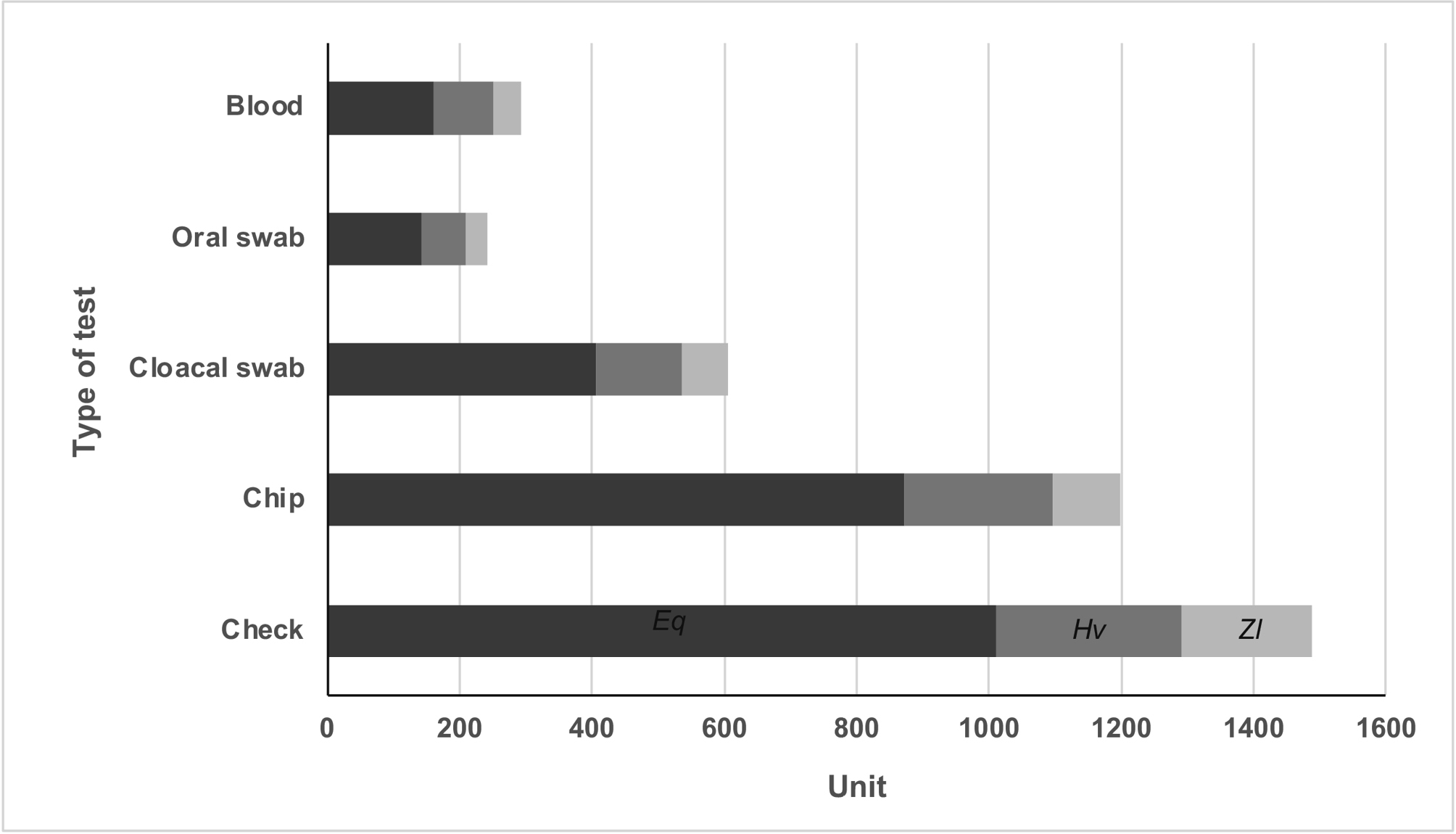
The snakes captured by Serpari were primarily Elaphe quatuorlineata (n = 1,011), with smaller numbers of Hierophis viridiflavus (n = 279) and Zamenis longissimus (n = 198). Other less captured species included, Natrix helvetica (Lacépède, 1789) (n = 10), Coronella austriaca Laurenti, 1768 (n = 5), and Coronella girondica (Daudin, 1803) (n = 2). Although Vipera aspis (Linnaeus, 1758) is syntopic, it is not permitted to capture it due to its venomous nature. Compared to the regional potentiality, Cocullo and the neighboring villages hosted 7 of 9 species (Di Tizio et al., 2024); only Vipera ursinii (Bonaparte, 1835) and Natrix tessellata (Laurenti, 1768) are absent.
The total number of individuals captured annually ranged from 90 to 186 (x = 115.77 ± 23.77) varied significantly among years (χ²= 58.58, df = 12, P < 0.001).
Average morphometric data (snout-vent length - SVL, tail length and body weight) per year of the three most abundant species (E. quatuorlineata, H. viridiflavus and Z. longissimus) are reported in Table 1, 2, 3. Low number of C. austriaca, C. girondica and N. helvetica did not allow a statistical analysis.
| Year | Males (n) | SVL (cm) | Tail (cm) | Weight (gr) | Females (n) | SVL (cm) | Tail (cm) | Weight (gr) |
|---|---|---|---|---|---|---|---|---|
| 2010 | 36 | 129.01±9.23 | 30.44±2.60 | 758.17±168.40 | 17 | 134.44±10.70 | 25.65±3.95 | 719.65±188.24 |
| 2011 | 43 | 123.74±11.66 | 30.47±3.80 | 692.44±192.74* | 18 | 127.28±14.41 | 26.19±2.64 | 704.78±263.93 |
| 2012 | 47 | 124.57±11.19 | 30.14±3.06 | 748.17±185.08 | 23 | 127.43±17.60 | 24.08±6.17 | 757.39±242.67 |
| 2013 | 41 | 123.32±10.61 | 29.17±3.18 | 738.96±214.88 | 24 | 127.54±12.07 | 27.15±3.18*** | 699.47±218.01*** |
| 2014 | 38 | 121.63±8.25 | 29.32±5.43 | 725.92±176.56 | 32 | 126.78±15.07 | 25.11±5.16 | 738.44±229.90 |
| 2015 | 43 | 125.84±9.25 | 29.89±4.07 | 777.02±176.01 | 26 | 130.44±8.57 | 26.67±4.61 | 772.23±169.56 |
| 2016 | 48 | 127.96±9.41 | 29.48±4.72 | 773.94±194.11 | 25 | 133.16±10.83 | 25.92±3.01 | 771.44±202.28 |
| 2017 | 64 | 126.48±10.02 | 29.91±3.50 | 736.68±211.68** | 19 | 134.50±8.67 | 24.50±5.32 | 722.00±181.48 |
| 2018 | 52 | 126.93±11.60 | 30.27±4.11 | 690.12±210.13 | 26 | 135.63±10.38 | 25.12±4.74 | 711.08±197.18 |
| 2019 | 52 | 126.38±10.39 | 30.16±4.14 | 715.37±191.35** | 23 | 134.22±10.82 | 25.80±3.50 | 708.17±187.10 |
| 2022 | 40 | 126.65±9.44 | 29.61±4.66 | 747.68±202.56 | 23 | 131.07±12.80 | 26.17±5.10 | 771.96±230.03 |
| 2023 | 44 | 126.93±14.26 | 29.83±4.78 | 705.80±269.06 | 19 | 134.58±10.36 | 27.00±3.64 | 728.11±148.02 |
| 2024 | 60 | 128.23±13.37 | 30.28±4.10 | 731.98±227.77 | 29 | 131.62±12.16 | 26.66±4.37 | 643.80±228.11***** |
| *n =41 | ***n = 23 | ****n = 23 | ||||||
| **n = 51 | *****n=28 |
| Year | Males | SVL | Tail | Weight | Females | SVL | Tail | Weight |
|---|---|---|---|---|---|---|---|---|
| 2010 | 8 | 87.5±12.30 | 28.81±8.61 | 178.00±83.31* | 3 | 87.33±4.62 | 28.67±0.58 | 166±21.63 |
| 2011 | 7 | 88.79±4.69 | 31.5±1.04 | 199.43±44.30 | 5 | 84.50±8.72 | 26.00±3.52 | 198±89.25 |
| 2012 | 8 | 97.69±6.42 | 32.50±7.22 | 389.88±76.21 | 2 | 93.50±0.71 | 31.50±2.12 | 344±166.88 |
| 2013 | 9 | 94.78±8.21 | 27.44±6.26 | 243.78±76.06 | 2 | 94.50±2.12 | 30.00±1.14 | 188±5.66 |
| 2014 | 17 | 89.76±11.26 | 30.88±3.43 | 259.88±93.61 | 2 | 68.50±3.54 | 21.00±0.00 | 72.00±0.00 |
| 2015 | 10 | 94.60±5.42 | 29.65±5.86 | 320.80±52.02 | 1 | 84.00 | 29.50 | 132.00 |
| 2016 | 7 | 92.00±5.71 | 31.71±1.22 | 236.57±69.62 | - | - | - | - |
| 2017 | 11 | 91.23±9.16 | 31.13±3.52 | 226.73±67.89 | 1 | 84.00 | 27.00 | 122.00 |
| 2018 | 18 | 90.53±8.67 | 30.67±4.44 | 216.59±73.17** | 3 | 87.00±4.58 | 26.50±4.27 | 136.67±30.62 |
| 2019 | 20 | 92.53±5.83 | 29.90±6.46 | 269.20±62.78 | 8 | 89.50±4.81 | 27.75±2.48 | 198.86±57.62* |
| 2022 | 21 | 89.45±11.06 | 30.90±4.69 | 213.73±92.90 | 13 | 89.12±8.32 | 28.85±2.48 | 190.75±68.45 |
| 2023 | 21 | 92.95±8.90 | 30.71±5.88 | 228.95±70.68 | 5 | 79.00±7.97 | 26.60±2.61 | 120.80±48.90 |
| 2024 | 38 | 90.66±9.72 | 31.01±4.81 | 218.00±75.00 | 23 | 83.87±8.61 | 26.85±4.74 | 140.83±43.43 |
| *n=7 | *n=7 | |||||||
| **n=17 |
| Year | Males | SVL | Tail | Weight | Females | SVL | Tail | Weight |
|---|---|---|---|---|---|---|---|---|
| 2010 | 12 | 98.54±21.49 | 21.00±5.31 | 260.00±156.37 | 7 | 84.57±8.81 | 18.21±2.55 | 163.43±54.69 |
| 2011 | 5 | 88.00±11.25 | 20.90±3.05 | 178.40±75.86 | 4 | 82.75±8.18 | 17.88±2.02 | 184.50±38.79 |
| 2012 | 7 | 96.79±11.46 | 23.64±3.47 | 282.29±99.30 | 2 | 79.00±16.97 | 12.00±0.00 | 212.00±84.85 |
| 2013 | 11 | 95.10±13.13 | 22.68±4.29 | 228.00±64.63 | 11 | 85.00±9.33 | 18.64±5.45 | 170.36±50.17 |
| 2014 | 9 | 95.72±11.23 | 22.56±3.57 | 248.00±94.87 | 5 | 86.50±4.56 | 19.10±1.85 | 188.40±44.71 |
| 2015 | 4 | 96.50±12.66 | 22.38±1.25 | 260.50±202.76 | 3 | 84.67±5.51 | 20.33±0.58 | 198.67±23.35 |
| 2016 | 8 | 105.86±14.13 | 23.00±4.87 | 324.50±131.39 | 7 | 83.86±12.06 | 17.58±2.11*** | 220.00±186.23 |
| 2017 | 1 | 140.00±0.00 | 32.50±0.00 | 972.00±0.00 | 5 | 91.00±11.20 | 18.50±6.06 | 210.00±68.69 |
| 2018 | 10 | 106.45±6.86 | 22.45±5.00 | 272.60±62.40 | 6 | 90.42±4.59 | 18.83±2.99 | 171.67±31.17 |
| 2019 | 5 | 102.80±8.50 | 24.00±2.35 | 272.00±94.45 | 8 | 88.63±4.73 | 17.63±3.65 | 191.50±49.13 |
| 2022 | 5 | 94.70±10.29 | 21.80±5.07 | 220.50±56.25* | 1 | 96.00±0.00 | 21.00±0.00 | 228.00±0.00 |
| 2023 | 11 | 89.00±10.77 | 21.73±4.58 | 146.72±57.56 | 3 | 80.00±1.00 | 17.00±1.00 | 101.33±3.06 |
| 2024 | 17 | 96.26±25.11 | 28.65±21.30 | 221.06±134±66** | 9 | 90.67±8.29 | 16.55±4.44 | 171.11±69.47 |
| *n=4 | ***n=6 | |||||||
| **n=16 |
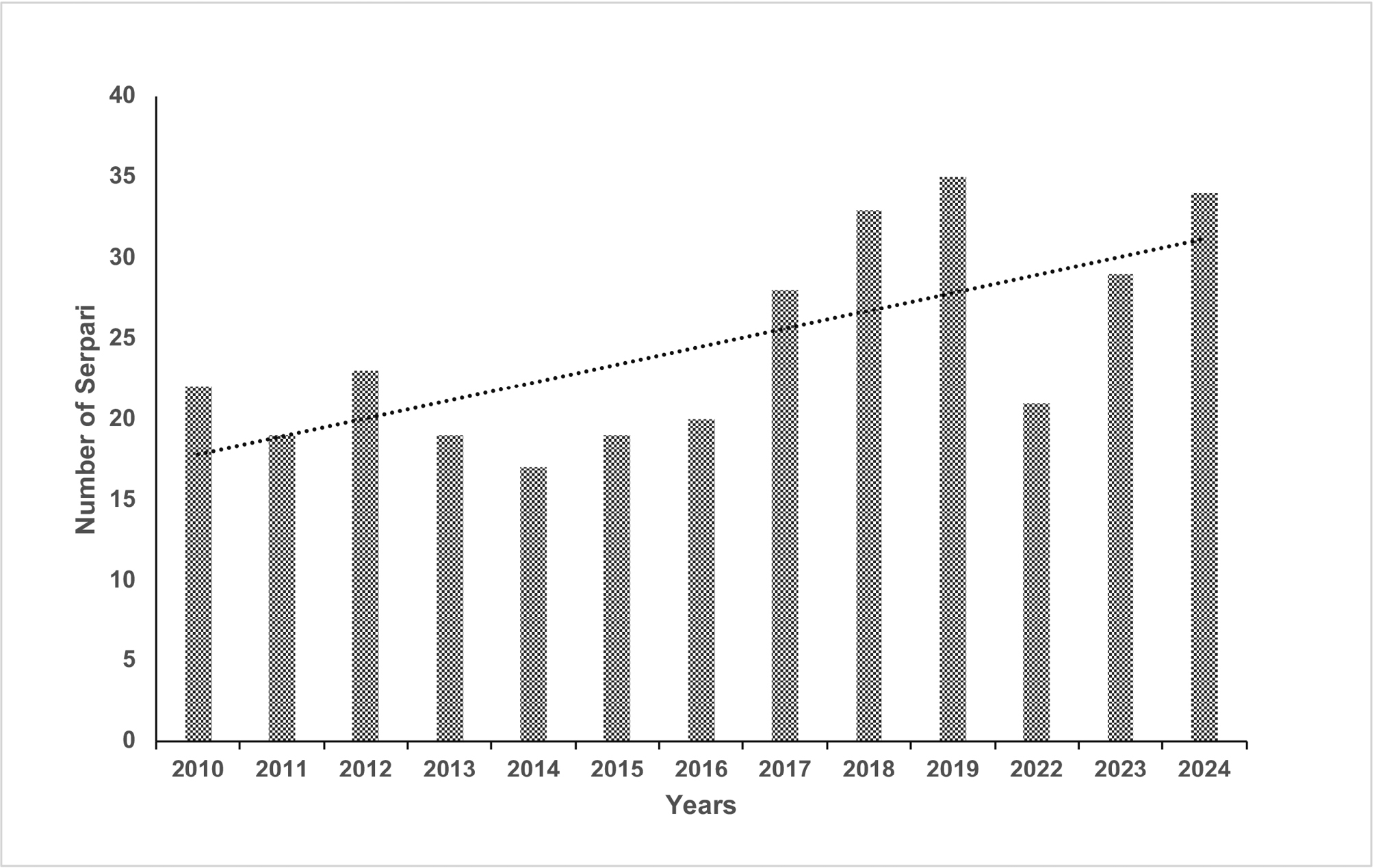
The number of Serpari ranged from 19 to 35 (x = 24.5 ± 6.4) though this variation was not statistically significant (χ² = 20.13, df = 12, P = 0.07) (Fig. 2). The Serpari were mostly men, they ranged from 17 to 29 (x =21.3 ± 3.8), but there were also women (x = 3.2 ± 3.2) that ranged from 0 to 9. The number of Serpari was positively correlated with the number of snakes captured (r (11) = 0.67, P < 0.05).
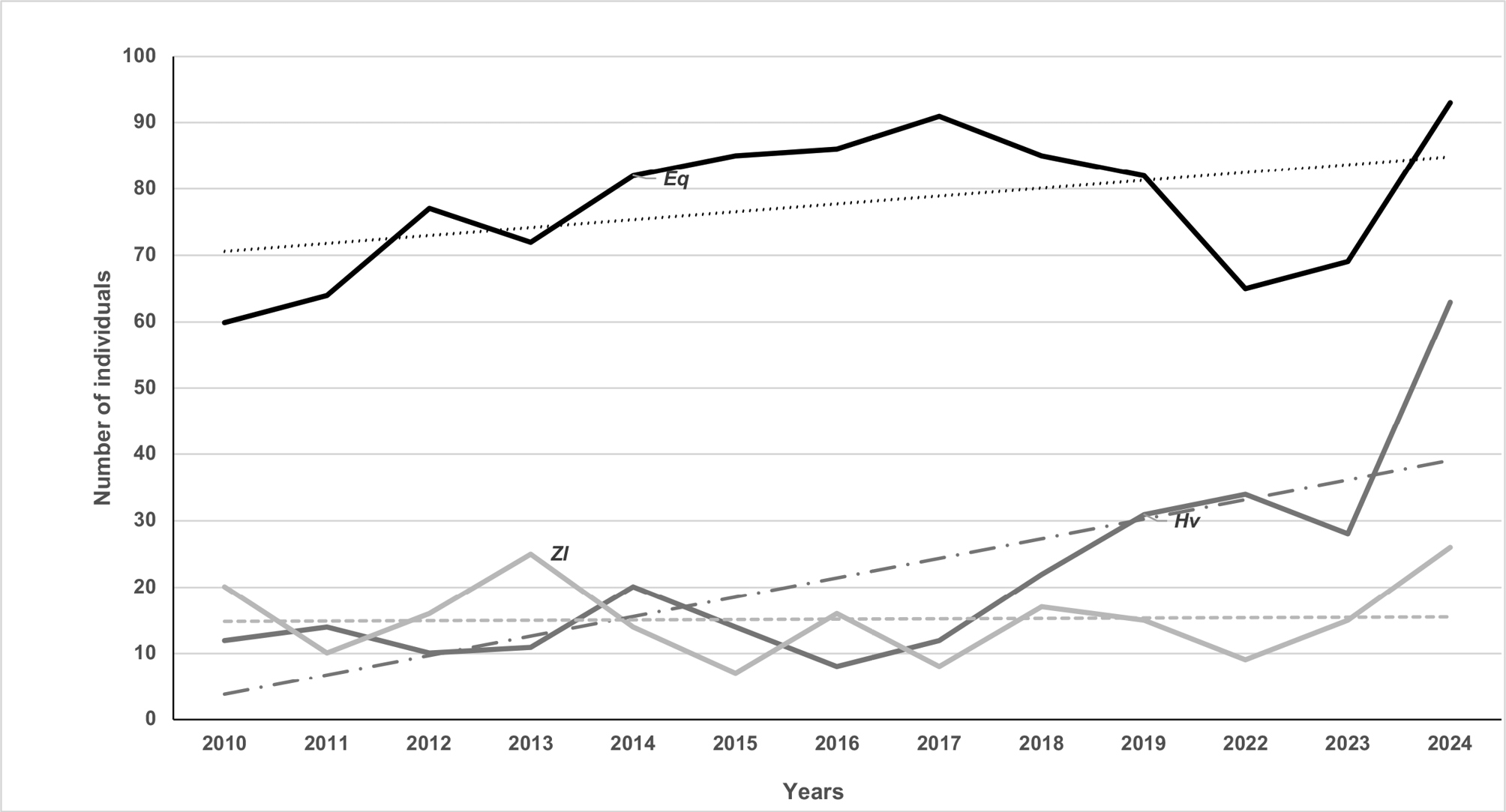
The annual capture numbers of E. quatuorlineata ranged from 60 to 93 (x = 77.77 ± 10.78) and did not vary significantly over the study period (χ² = 17.93, df = 12, P = 0.12), unlike the number of the other two most frequently captured species, H. viridiflavus (range = 8-63, x = 21.46 ± 15.09, χ² = 47.89, df = 12, P > 0.001) and Z. longissimus (range = 7-26, x = 15.23 ± 5.96, χ² = 27.99, df = 12, P = 0.006). The captured numbers of E. quatuorlineata and the combined total of H. viridiflavus and Z. longissimus were negatively correlated (r (10) = -0.34, P > 0.05).
No significant trends were observed in the average number of snake captures per Serparo across years for the three main species: the average number of E. quatuorlineata, H. viridiflavus, and Z. longissimus caught per Serparo each year did not differ significantly (F12,295 = 1.24, P = 0.26; F12,295 = 1.19, P = 0.28; F12,295 = 1.82, P = 0.05). Capture trends are shown in Figure 3. A post-hoc power analysis, performed by G*Power (Faul et al., 2007), achieved sufficient statistical power (0.99 for the three species) to support the conclusion that average capture numbers of E. quatuorlineata, H. viridiflavus, and Z. longissimus captured per Serparo remained stable over time.
There were also no significant differences in the SVL mean between the years, including repeated snake captures, of E. quatuorlineata males (F12,595 = 1.59, P = 0.09), females (F12,591 = 1.67, P = 0.07), or in males of H. viridiflavus (F12,182 = 1.59, P = 0.50), or Z. longissimus males (F11,92 = 1.50, P = 0.14). However, a significant difference was observed in the SVL of female H. viridiflavus (F9,56 = 2.76, P = 0.01).
A χ² test on pooled data showed that sex ratio was similar between years for captured adult E. quatuorlineata (χ² = 10.85, df = 12, P = 0.54), H. viridiflavus (χ² = 19.75, df = 12, P = 0.07) and Z. longissimus (χ² = 112.79, df = 12, P = 0.38).
During the study period, no adverse effects were recorded from microchip implantation, even in individuals recaptured multiple times. For example, a male of E. quatuorlineata was captured for the first time in 2011 (SVL: 118,0 cm; tail: 31,0 cm; weight 678 g) and recaptured with increased measurements in 2014 (SVL: 123,5 cm; tail: 31,0 cm; weight 750 g), in 2016 (SVL: 128,0 cm; tail: 32,0 cm; weight 846 g) and 2023 (SVL: 143,0 cm; tail: 36,0 cm; weight 948 g) indicating healthy development and no adverse impact from tagging. A female of E. quatuorlineata was captured for the first time in 2013 (SVL: 125,0 cm; tail: 28,0 cm; weight 594 g) and recaptured in 2014 (SVL: 135,5 cm; tail: 28,0 cm; weight 896 g) and 2022 (SVL: 140,0 cm; tail: 29,0 cm; weight 1240 g).
The maximum lengths observed in our study are presented in Table 4.
| Species | Sex | SVL (cm) | Tail (cm) | Tl (cm) | Weight (gr) | Year |
|---|---|---|---|---|---|---|
| Eq | M | 154.0 | 37.0 | 191.0 | 1156 | 2015 |
| Eq | F | 159.0 | 31.0 | 190.0 | 1064 | 2023 |
| Zl | M | 140.0 | 32.5 | 172.5 | 972 | 2017 |
| Zl | F | 106.0 | 22.0 | 128.0 | 288 | 2017 |
| Hv | M | 108.0 | 38.5 | 146.5 | 334 | 2022 |
| Hv | F | 105.0 | 25.0 | 130.0 | 368 | 2023 |
This long-term citizen science project generated a substantial dataset and our data confirmed known morphometric patterns. In E. quatuorlineata, females were on average longer than males, supporting the presence of reversed sexual size dimorphism (RSD) in this species (see Rugiero and Luiselli, 1996; Capizzi and Luiselli, 1997; Filippi et al., 2005). Males had longer tail on average, while adult males and females exhibited comparable body weights. In H. viridiflavus and Z. longissimus males attained on average larger sizes and longer tails (see Scali and Montonati, 2000) and weight. Maximum length (record observed in Italy and published) was observed in Elaphe quatuorlineata and Zamenis longissimus (Corti et al, 2011).
We provided the first quantitative characterization of annual snake captures during this traditional ritual. Our results confirmed that the target species of Serpari is E. quatuorlineata, as qualitatively observed in the past (Filippi and Luiselli, 2003; Pellegrini et al 2017) with lower numbers of H. viridiflavus and Z. longissimus also being captured. This is likely due to the attractive appearance, larger size, and docile nature of E. quatuorlineata. Whereas H. viridiflavus and Z. longissimus and rarer species such as N. helvetica, C. austriaca, and C. girondica are typically captured as supplementary species when fewer E. quatuorlineata are caught by Serpari. This selective capture may introduce sampling biases, potentially misrepresenting the true composition and structure of the local snake community. For instance, Elaphe quatuorlineata is not recognized as the dominant species in other areas of central Italy (Filippi, 2003; Filippi and Luiselli, 2001, 2006; Luiselli and Filippi, 2006). Nonetheless, it remains possible that centuries of selective handling have influenced the current structure of the local snake populations.
Moreover, this study enabled a preliminary assessment of capture trends and morphometric stability over time: over this 15-year-old study, based on our results, the average number captured per Serparo of E. quatuorlineata, H. viridiflavus, and Z. longissimus and their morphometric parameters have remained stable. Our results confirmed the reliability and safety of microchip tagging for individual identification in wild colubrids (see Taggart et al., 2021).
Overall, the collected data can indirectly support the conclusion that the activities of capture, temporary detention, and release are currently sustainable for the local snake populations.
It is highly likely that accompanying conservation efforts – such as continuous health monitoring under a One-Health approach and improved temporary housing – have contributed to ensuring the sustainability of the practice (see Mendoza-Roldan et al., 2024; Ugochukwu et al., 2024; F Alves et al., 2025; agundes-Moreira et al. 2025). However, ongoing monitoring remains essential, both to detect potential issues and to guide future conservation or mitigation actions related to the rite and broader environmental changes. In this regard, it will be necessary to combine the current monitoring with standardized field studies, both to observe the emergence of any critical issues, to quantitatively assess the local snake community and to appropriate and/or eventual conservation and/or mitigation actions related to Serpari activities and/or related to the environment (see for example, Filippi and Luiselli, 2002; Edgar et al., 2010; Lelievre et al., 2010; Akresh et al., 2017; Filippi, 2019; Assmann, 2013).
In conclusion, the monitoring of snakes captured by the Serpari of Cocullo represents a unique convergence of traditional cultural practice, citizen science activities and scientific conservation effort. This case study offers a rare opportunity to assess species status and health under a One-Health framework, while promoting public awareness through citizen science and outreach. Continued research and engagement will be essential to maintain this balance and ensure the long-term well-being of both local wildlife and the human communities involved.
All snake captures were performed under the appropriate authorization numbers from the Italian Ministry of Environment: n. 11279/2009, n. 7290/2011, n. 3094/2014, n. 6265/2017, n. 24610/2020, and n. 6271/2023, as well as welfare and safety guidelines. We would like to express our thanks to the Majors Nicola Risio and Sandro Chiocchio, the municipality, all Serpari and the people of Cocullo for supporting conservation actions and preserving this ancient ritual. We would like to thank Gian Lorenzo D’Alterio, Adriano Savoretti, Piero Castellano, Fabio Lofoco, Christoph Otto, Sigrid Lenz, Hubert Laufer, Riccardo Scalera, Stefan Broghammer, Maria Luce Del Vecchio for their support; the researchers of Università di Bari- Dipartimento di Medicina Veterinaria, IZS Lazio e Toscana (I.T. Sez. Viterbo from 2010 to 2012), IZS Abruzzo e Molise for their cooperation in conducting clinical examinations and bacteriological analyses. We are grateful to Rifcon GmbH that sponsored snake bags, PITs, polo shirts, surgical glue and equipped professional terraria to improve the quality of the captivity phase of the snake. The Authors declare no conflict of interest.
Akresh, M.E., King, D.I., Timm, B.C., Brooks, R.T. (2017): Fuels management and habitat restoration activities benefit Eastern hognose snakes (Heterodon platirhinos) in a disturbance-dependent ecosystem. J. Herpetol. 51: 468-476.
Alves, M. H., Mendoza-Roldan, J. A., Carbonara, M., Montinaro, G., Filippi, E., Otranto, D. (2025): From Angitia to Saint Domenico: Detection of vector-borne pathogens in snakes at the “Festa dei Serpari” in Cocullo, Central Italy. Acta Trop. 271: 107878.
Arida, E., Maireda, N.L., Herlambang, A.E.N., Mumpuni, Riyanto, A. Hamidy, A., Shine, R., Natusch, D.J.D. (2024): Life-history of masked water snakes (Homalopsis buccata) in Java: Implications for the sustainability of harvesting. Wildlife Res. 51: 1-10.
Assmann, O. (2013): Artenschutzpraxis: Anlage von Hackschnitzelhaufen als Eiablageplätze für Äskulapnatter und Ringelnatter. ANLiegen Natur 35: 16–21.
Bruno, S., Maugeri, S. (1990). Serpenti d’Italia e d’Europa. Milano, Edit. G. Mondadori.
Capizzi, D., Luiselli, L. (1997): The diet of the four lined snake (Elaphe quatuorlineata) in Mediterranean central Itay. Herpetol. J. 7: 1-5.
Corti, C., Capula, M., Luiselli, L., Mazzetti, E., Sindaco, R., Eds. (2011): Fauna d’Italia Vol. XLV Reptilia. Milano, Calderini.
Di Nicola, M., R., Cavigioli, L., Luiselli, L., Andreone, F. (2021): Anfibi & Rettili d’Italia. Latina, Edizioni Belvedere.
Di Tizio, L., Carafa, M., Cameli, A. (2024): Anfibi e Rettili d’Abruzzo. Atlante e guida. Pescara, Ianieri Edizioni.
Edgar, P., Foster, J. and Baker, J. (2010): Reptile habitat management handbook. Bournemouth, Amphibian and Reptile Conservation.
Fagundes-Moreira, R., Otranto, D., Montinaro, G. Filippi, E., Lorusso, A., Petrini, A., De Fazi, L., Corrente, M.L., Benelli, G., Mendoza-Roldan, J.A. (2025): Cultural human-snake interactions in the festa dei Serpari as an opportunity for the surveillance of bacterial pathogens of zoonotic concern. Comp. Immunol. Microbiol. Infect. Dis. 118: 102325.
Faul, F., Erdfelder, E., Lang, A.G., Buchner, A. (2007): G.* Power 3: A flexible statistical power analysis program for the social, behavioral, and biomedical sciences. Behav. Res. Methods. 39: 175-191.
Filippi, E. (2003): The effects of timbering on the community structure of snakes at a Mediterranean area of central Italy. Amphib.-Reptil. 24: 75-79.
Filippi, E. (2019): Effects of restoration habitat on snake species of Dghoumes National Park (Tunisia). Biodivers. J. 10: 213-220.
Filippi, E., Luiselli, L. (2000): Status of the Italian snake fauna and assessment of conservation threats. Biol. Conserv. 93: 219-225.
Filippi, E., Luiselli, L. (2001): Use of microhabitat and substratum types by sympatric snakes in Mediterranean area of central Italy. Ecol. mediterr. 27: 141-153.
Filippi, E., Luiselli, L. (2002): Negative effect of the wild boar (Sus scrofa) on the populations of snakes at a protected mountainous forest in central Italy. Ecol. mediterr. 28: 93-98.
Filippi, E., Luiselli, L. (2003): Delayed reproduction in snakes subjected to human traditional rituals in central Italy. Vie Milieu 53: 111-118.
Filippi, E., Luiselli, L. (2006): Changes in community composition, habitats and abundance of snakes after 10+ years at a protected area in Italy: Conservation implications. Herpetol. J. 16: 29-36.
Filippi, E., D’Alterio, G.L., Brozzi, A., Micci, M., Politi, P., Mantero, D. (2010): Note on the intestinal bacterial populations of free living snakes in Italy. Herpetol. Notes 3: 263-265.
Filippi, E., Rugiero, L., Capula, M., Capizzi, D., Luiselli, L. (2005): Comparative foods habits and body size of five populations of Elaphe quatuorlineata: The effects of habitat variation, and the consequences of intersexual body size dimorphism on diet divergence. Copeia, 3: 517-525.
Haland, E.J. (2011): Saints and snakes: Death, fertility and healing in modern and ancient Greece and Italy. Performance and Spirituality 2: 111-151.
Hall, S.S. (2025): Slither. New York, Grand Central Publishing.
Hammer, Ø., Harper, D.A.T., Ryan, P.D. (2001): PAST: Paleontological statistics software package for education and data analysis. Paleontol. Electron. 4: 1-9.
Harrison, M.C. (1907): Serpent-procession at Cocullo. Folklore 18: 187-191.
Lelièvre, H., Blouin-Demers, G., Bonnet, X., Lourdais, O. (2010): Thermal benefits of artificial shelters in snakes: A radiotelemetric study of two sympatric colubrids. J. Therm. Biol. 35: 324-331.
Luiselli, L., Filippi, E. (2006): Null models, co-occorrence patterns, and ecological modelling of Mediterranean community of snakes. Amphib.-Reptil. 27: 325-338.
Marini, D, Filippi, E., Montinaro, G., Olivieri, M., Origgi, F.C. (2023): First screening on absence of Ophidiomyces ophiodiicola detection in symptomatic snake community from Rito di San Domenico e dei Serpari (Cocullo, AQ, Italy). Acta Herpetol. 18: 45-52.
Martinelli, F. (2024): Serpents of the people: How a religious festival helps me to monitor snake behaviour - Where I Work. Nature 630: 702.
Martinelli, F., Zavoli, E. (2023): A statue draped with snake? In Italy it happens every year. The New York Times. 29 September 2023.
Mendoza-Roldan, J.A., Perles, L., Filippi, E., Szafranski, N., Montinaro, G., Carbonara, M., Scalera, R., de Abreu Teles, P.P., Walochnik, J. Otranto, D. (2024): Parasites and microorganisms associated with the snakes collected for the “Festa dei Serpari” in Cocullo, Italy. PLOS Neglect. Trop. D. 18: e0011973.
Natusch D.J.D., Lyons JA, Mumpuni, M., Riyanto A, Shine R. (2016): Jungle giants: Assessing sustainable harvesting in a difficult-to-survey species (Python reticulatus). PLOS ONE 11: e0158397.
Natusch, D.J.D. Lyons, J.A., Riyanto, A., Mumpuni, M., Khadiejah, S., Shine, R. (2019): Detailed biological data are informative, but robust trends are needed for informing sustainability of wildlife harvesting: A case study of reptile offtake in Southeast Asia. Biol. Conserv 233: 83-92.
Pellegrini, M., Di Francesco, N., Di Tizio, L., Di Toro, F., D’Amico, M., Cameli, A., Ferri, V., Filippi, E., Montinaro, G., Pinchera, F., Posillico, M. (2017): Action plan per la conservazione di Elaphe quatuorlineata (Lacépède, 1789) in Abruzzo. In: Menegon, M., Rodriguez-Prieto, A., Deflorian, A. M. (Eds) (2017). Atti XI Congresso Nazionale Societas Herpetologica Italica. Pescara, Ianieri Edizioni.
Reading, C. J., Luiselli, L., Akani, G. C., Bonnet, X, Amori, G., Ballouard, J. M., Filippi, E., Naulleau, G. Pearson, D, Rugiero, L. (2010): Are snake populations in widespread decline? Biol. Letters 6: 777-780.
Rugiero, L., Luiselli L. (1996): Ecological notes on an isolated population of the snake Elaphe quatuorlineata. Herpetol. J. 6: 53-55.
Savoretti, A. (2016): Dove amano i serpenti. In: Filippi, E. (ed). La fauna ofidiologica italiana. Roma, Gazzetta ambiente, XII, 4.
Scali, S., Montonati, S. (2000): Analisi multivariata del dimorfismo sessuale in due specie di colubridi italiani (Coluber viridiflavus ed Elaphe longissima: Reptilia, Serpentes, Colubridae) su basi biometriche. In: Giacoma, C. (ed). Atti del I Congresso Nazionale della Societas Herpetologica Italica. Torino, Museo Regionale di Scienze Naturali.
Taggart, P.L., Morris, S., Caraguel, C.G.G. (2021): The impact of PIT tags on the growth and survival of pythons is insignificant in randomised control trial. PeerJ. 9: e11531.
Ugochukwu, I.C.I., Mendoza-Roldan, J.A., Rhimi, W., Ugochukwu, Rhimi, W., Miglianti, M., Odigie, E.A., Mosca, M., Filippi, E., Montinaro, G., Otranto, D., Cafarchia (2024): Snakes as sentinel of zoonotic yeasts and bio-indicators of environmental quality. Sci. Rep. 14: 22491.
Zenoni, A. (2019): Etnofilologia agiografica. Il culto di San Domenico di Sora e la tradizione dei serpari a Cocullo (Appennino abruzzese). QSem. 5: 485-520.