Submitted on: 2025, 29th April; revised on: 2025, 1st May; accepted on: 2025, 14th May
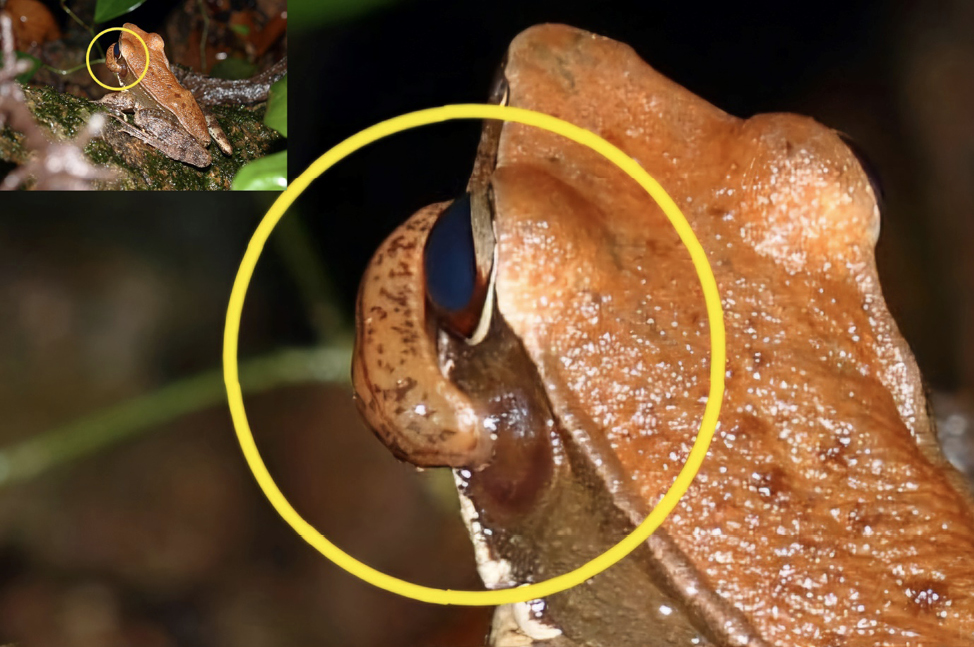
Land leech (Haemadipsa zeylanica) parasitizing Indosylvirana indica (Indian golden-backed frog) in Agumbe, India
1 Department of Environmental Sciences, Savitribai Phule Pune University, Ganeshkhind Road, Pune, 411007, Maharashtra, India
2 Survey No. 112/2/2/2, Opposite Hemgiri Apartment, Baner, Pune -411045, Maharashtra, India
*Corresponding author. Email: rishi08sep@gmail.com
Abstract. This study documents the first recorded instance of ectoparasitism of the Indian golden-backed frog (Indosylvirana indica) by the land leech (Haemadipsa zeylanica) in Agumbe, India. Observation indicates that a specimen of I. indica was infested by H. zeylanica, with the leech attached to the frog’s tympanum. While leeches are known ectoparasites of amphibians and can disrupt their health by serving as vectors for pathogens, this association had not been previously documented for I. indica. Our findings highlight the need for further research into leech-anuran interactions to better understand ecological dynamics and their implications on amphibian health.
Keywords. Anura, brown leech, endemic, Haemadipsidae, jawed land leech, predation, Ranidae, type leech (Cochin).
Empirical evidence of anuran–leech parasitic associations suggests that anurans represent a principal host group for leeches (Berven and Boltz, 2001; Merilä and Sterner, 2002). Leeches are extensively documented as ectoparasites of amphibians, exhibiting parasitic interactions across multiple life stages, including ovum, embryonic (Burgin and Schell, 2005), and adult phases (Merilä and Sterner, 2002). These hematophagous organisms not only inflict direct physiological stress through blood-feeding and tissue damage but also play a potential role as mechanical vectors in pathogen transmission. Notably, leeches have been implicated in the dissemination of protozoan and fungal pathogens, including Ichthyophonus spp. and Trypanosoma spp., thereby contributing to the epidemiology of infectious diseases within amphibian populations (Delima et al., 2024).
In India, the ecological and parasitic associations between leeches and anurans remain insufficiently investigated and represent a relatively underexplored area of research. Numerous field observations have been reported by herpetologists; however, the majority of these accounts remain undocumented in peer-reviewed literature. To date, there are no published accounts documenting leech–anuran interactions involving species of the genus Indosylvirana. Nevertheless, a previously published record reports the presence of leeches affixed to vocalizing male rhacophorid frogs (Raorchestes sp.) within Silent Valley National Park, situated in the Western Ghats of India (Zachariah et al., 2016).
Indosylvirana indica, the Indian golden-backed frog, is a species of frog endemic to Western Ghats, north of the Palghat Gap in the states of Karnataka and Kerala (Biju et al., 2014; Frost, 2019). This species was formerly considered conspecific with Indosylvirana temporalis, but was subsequently recognized as a distinct species based on morphological and molecular evidence (Biju et al., 2014). On 06 June 2024, at 12.43 PM in the Agumbe Forest, Shimoga district, Karnataka, India (13.5087°N, 75.0959°E; elevation 660 m asl), we observed an individual of I. indica being parasitized by a leech (Fig. 1). The posterior end of the leech was attached to the frog’s tympanum and anterior was towards the narrower end of the frog’s mouth. The species of leech was identified as Haemadipsa zeylanica cochiniana, which is considered a land leech (Fogden and Proctor, 1985). This leech is endemic to India, having type locality Cochin (Chandra, 1982; Mandal, 2004). Land leeches (Haemadipsa spp.), known for biting humans and cattle’s (Chandra, 1982), are widely distributed throughout rainforests from Madagascar and India to Southeast Asia, the western Pacific, and Australia. During the 1977-1978 joint expedition to Gunung Mulu National Park, Sarawak, conducted by the Sarawak Forest Department and the Royal Geographical Society, researchers studied leech species in the area. Two of the three Haemadipsa species known from Borneo – Haemadipsa zeylanica and H. picta – were recorded in the park. H. zeylanica was found to be the more abundant and widespread species, primarily occurring at ground level, while the rarer H. picta was often observed climbing up to two metres into the undergrowth. Both species attacked humans, but only a single instance of non-human predation by Haemadipsa species – specifically H. zeylanica Moore and H. picta Moore – on a frog has been reported (Fogden and Proctor, 1985).
However, land leeches, particularly species like Batracobdella algira, have been documented parasitizing various amphibians, including the endemic Sardinian Speleomantes salamanders (Ben Ahmed et al., 2015; Manenti et al., 2016). These leeches feed on amphibians in both aquatic and terrestrial environments, often attaching to their hosts, consuming their blood, and sometimes acting as vectors for micro-parasites such as Trypanosoma and Lankesterella (Jiménez Sánchez, 1997). Despite the limited number of documented cases, the parasitic relationship between land leeches and amphibians, including potential impacts on body condition, warrants further study, as some reports suggest negative effects on the hosts’ health (Elliot and Dobson, 2015). While leech predation on amphibians has generally been seen as opportunistic without causing immediate death, the role of environmental factors, such as stable microclimates in terrestrial habitats, may influence the extent of this parasitism and its long-term consequences for amphibian populations (Rocha et al., 2012). The study performed by Lunghi et al. (2018) also revealed a strong association between environmental features, such as high humidity and water hardness in karst cave systems, and leech prevalence. While B. algira did not significantly reduce the Body Condition Index (BCI) of its salamander hosts overall, individuals carrying heavier parasite loads exhibited a decline in BCI, suggesting cumulative physiological costs (Lunghi et al., 2018). This pattern parallels the potential, yet undocumented, fitness effects that H. zeylanica may have on I. indica when attachment duration or infestation intensity is high. These findings together highlight that leech–amphibian associations, though often overlooked, can be influenced by shared ecological variables and may bear sublethal consequences worthy of further investigation. To the best of our knowledge, this represents the first documented instance of ectoparasitism by a land leech in I. indica, thereby expanding our understanding of host-parasite interactions within this species. While prior observations have reported mosquitoes (Uranotaenia sp.) engaging in hematophagy on I. indica in the Western Ghats (Kalki et al., 2020), there are no published records detailing leech parasitism in this amphibian. This novel finding underscores the need for further research into the ecological dynamics and potential health implications of such parasitic relationships in amphibian populations.
We thank Deepak Deshpande and Amatya Sharma for their assistance in confirming the identification of the species and Virendra Gaikwad for helping us with photo editing.
Ben Ahmed, R., Romdhane, Y., Tekaya, S. (2015): Checklist and distribution of marine and freshwater leeches (Annelida, Clitellata, Hirudinea) in Tunisia with identification key. Ecol. Monogr. 2: 3-19.
Berven, K.A., Boltz, R.S. (2001): Interactive effects of leech (Desserobdella picta) infection on wood frog (Rana sylvatica) tadpole fitness traits. Copeia 4: 907-915.
Biju, S.D., Garg, S., Mahony, S., Wijayathilaka, N., Senevirathne, G., Meegaskumbura, M. (2014): DNA barcoding, phylogeny and systematics of Golden-backed frogs (Hylarana, Ranidae) of the Western Ghats-Sri Lanka biodiversity hotspot, with the description of seven new species. Contr. Zool. 83: 269-335.
Burgin, S., Schell, C.B. (2005): Frog eggs: Unique food source for leech Bassianobdella fusca. Acta Zool. Sin. 51: 349-353.
Chandra, M. (1982): A Check-List of Leeches of India. Rec. Zool. Surv. India 80: 265-290.
Delima-Baron, E.M., Tagoon, M.D., Bosabica, Z.C., Vitor-Maluya, K.C. (2024): First account of a leech attached to Philautus acutirostris (Peters, 1867) in southern Mindanao, Philippines. Herpetol. Notes 17: 499-501.
Elliot, J.M., Dobson, M. (2015): Freshwater leeches of Britain and Ireland: keys to the Hirudinea and a review of their ecology. The Freshwater Biological Association, Ambleside.
Fogden, S. C. L., Proctor, J. (1985): Notes on the Feeding of Land Leeches (Haemadipsa zeylanica Moore and H. picta Moore) in Gunung Mulu National Park, Sarawak. Biotropica 17: 172-174.
Frost, D.R. (2019): “Indosylvirana indica (Biju, Garg, Mahony, Wijayathilaka, Senevirathne, and Meegaskumbura, 2014)”: Amphibian Species of the World: An Online Reference. Version 6.0. American Museum of Natural History.
Jiménez Sánchez, M.S. (1997): Contribución al conocimiento de la parasitofauna de la Rana perezi Seoane, 1885 (Amphibia: Ranidae) de la provincia de Ávila. Parasitología. Universidad Complutense de Madrid- Facultad de Farmacia, Madrid.
Kalki, Y., Huizinga, R., Weiss, M. (2020): Mosquitoes (Uranotaenia sp.) biting an Indian Golden-backed Frog (Indosylvirana indica). Reptil. Amphib. 27: 454-455.
Lunghi, E., Ficetola, G.F., Mulargia, M., Cogoni, R., Veith, M., Corti, C., Manenti, R. (2018): Batracobdella leeches, environmental features and Hydromantes salamanders.vInt. J. Parasitol-Par. 7: 48-53.
Mandal, C.K. (2004): Checklist of the Hirudinea (Leeches) of India. Rec. Zool. Surv. India 102: 41-46.
Manenti, R., Lunghi, E., Canedoli, C., Bonaccorsi, M., Ficetola, G.F. (2016): Parasitism of the leech, Batracobdella algira (Moquin-Tandon, 1846), on Sardinian cave salamanders (genus Hydromantes) (Caudata: plethodontidae). Herpetozoa 29: 27-35.
Merilä, J., Sterner, M. (2002): Medicinal leeches (Hirudo medicinalis) attacking and killing adult amphibians. Ann. Zool. Fenn. 34: 343-346.
Rocha, R., Borda, E., Andreone, F., Rosa, G.M. (2012): First reports of leech parasitism in Malagasy anurans. Comp. Parasitol. 79: 352-356.
Zachariah, A., Cyriac, V.P., Chandramohan, B., Ansil, B.R., Matthew, J.K., Raju, D.V. Abraham, R.K. (2016): Two new species of Raorchestes (Anura: Rhacophoridae) from the Silent Valley National Park in the Nilgiri hills of the Western Ghats, India. Salamandra 52: 63-76.