https://doi.org/10.36253/a_h-17819
Submitted on: 2025, 7th May; revised on: 2026, 28th January; accepted on: 2026, 28th January.
First report of caudal display in the longtail whiptail Aurivela longicauda (Squamata: Teiidae)
1 Laboratorio de Anatomía Comparada y Evolución de los Vertebrados, Museo Argentino de Ciencias Naturales “Bernardino Rivadavia”, Av. Ángel Gallardo 470 (C1405DJR), Buenos Aires, Argentina
2 Consejo Nacional de Investigaciones Científicas y Técnicas – CONICET, Buenos Aires, Argentina
3 Fundación de Historia Natural “Félix de Azara”, Hidalgo 775 (C1405BDB), Buenos Aires, Argentina
*Corresponding author. Email: gastonlococo@gmail.com
Abstract. Squamate tail movements has multiple functions, including intraspecific communication, defense, autotomy, aggression, and feeding. Here we report for the first time the occurrence of unusual caudal behavior in Longtail Whiptail (Aurivela longicauda, Teiidae), an endemic lizard distributed in the Monte Desert region in Patagonia, Argentina. The observed specimen was buried underground, with only the reddish part of the tail was sticking out of the sand. The tail was extended and subvertically oriented, and the individual was wagging and curling the tail laterally, doing a slow tail wag with intermittent “flailing”, resembling the movement that earthworms do out of the ground. Knowing that the Aurivela species are almost exclusively insectivores, with a particular predilection for gregarious insects (e.g., termites and ants), it is not improbable that tail having worm-like coloration and movement may act as a lure to attract prey for consumption.
Keywords. Tail-wagging, caudal behavior, Teiidae, Patagonia, Argentina.
Contents
Squamate tail movements has multiple functions, including intraspecific communication, defense, autotomy, aggression, and feeding (Greene, 1973; Arnold, 1984, 1988; Foster and Martin, 2008; Carvalho, 2016; Peters and Ramos, 2022). Among the latter, tail movements may be used to distract prey by shifting their attention away from the head and toward the caudal end of the predator (Hasson et al., 1989; Foster, 2006; Braun and Baird, 2018), a behavior that is somewhat frequent in snakes (Heatwole and Davison, 1976; Hagman et al., 2008; Reiserer and Schuett, 2008) but very uncommon in lizards (Murray et al., 1991; Pernetta et al., 2005; Foster, 2006; Foster and Martin, 2008; Braun and Baird, 2018).
Here, we report the occurrence of an unusual tail behavior in Longtail Whiptail (Aurivela longicauda; Bell, 1843). This teiid lizard is endemic to the Monte Desert region in Argentina and is distributed along arid and semiarid dunes, scrublands, and areas with scattered vegetation along central and southern provinces in the country (Cei, 1993; Scolaro, 2005).
The observation here reported was made incidentally during fieldwork close to General Roca city, at Río Negro province (Patagonia, Argentina). On 9 October 2024 (spring season) at 10:50 h we observed an adult male individual of the species Aurivela longicauda buried in the sand of a flatland with few grasses and scattered bushes under direct sunshine (39°26’16”S; 67°17’54.4”W). Temperatures were around 22-28°C and the sky was mostly clear. No other individuals of this species or predators were detected in the area near the observation.
The lizard was buried underground, in a concave semicircular area of 15 cm in diameter, and only the reddish part of the tail was sticking out of the sand (Fig. 1A). The tail was extended and subvertically oriented and the individual was wagging and curling the tail laterally, doing a slow tail wag with intermittent “flailing”, resembling the movement that earthworms do out of the ground. No other part of the lizard was visible. Tail movement time interval lasted for 5 minutes of observation. Although numerous ants were moving in the vicinity of the lizard, this individual was not observed capturing or consuming arthropods, as it was partially buried (with its head covered by sand) during the tail movement. Subsequently, as we approached, it detected our presence, uncovered itself (Fig. 1B), remained alert, and then slipped away into the bushy vegetation.
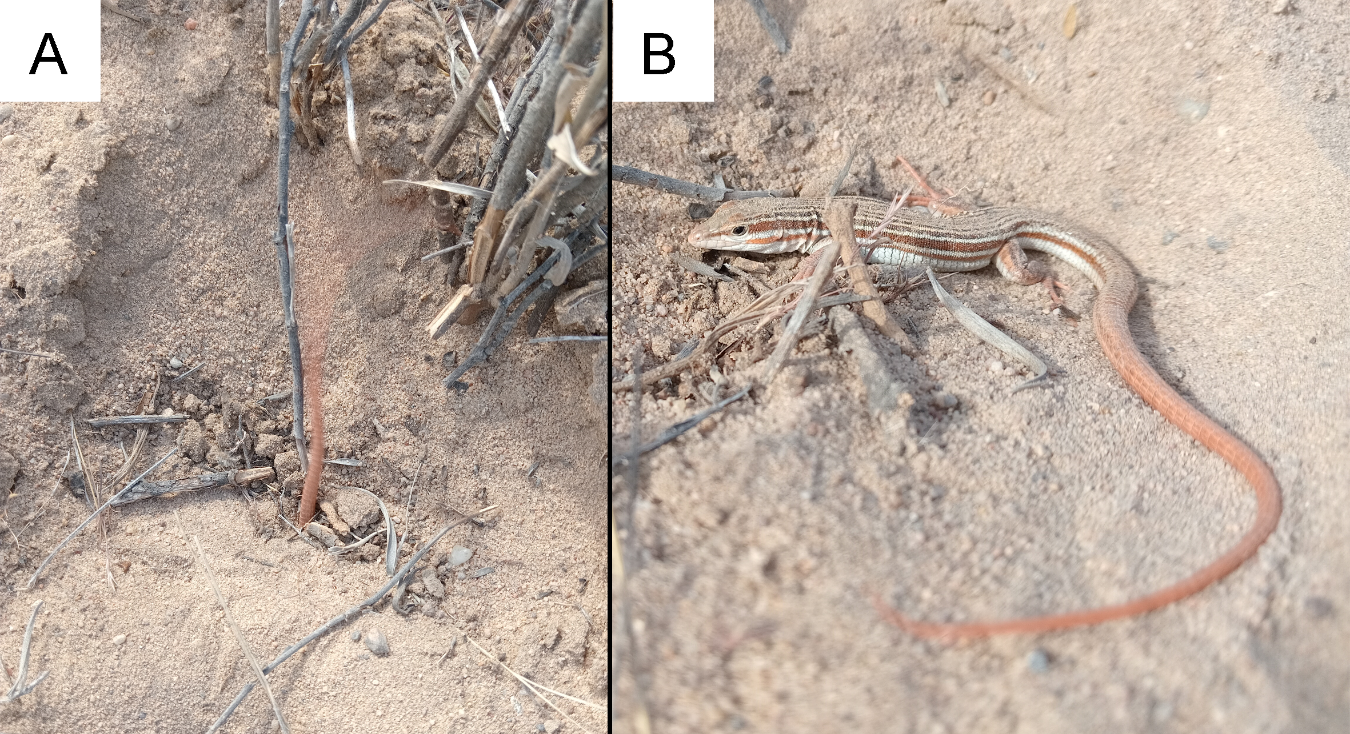
Tail movements in lizards are poorly known and remain poorly reported in literature (e.g., Hasson et al., 1989; Foster, 2006; Foster and Martin, 2008; Telemeco et al., 2011; Braun and Baird, 2018; Peters and Ramos, 2022). The function of these movements is still uncertain, and our knowledge of this mode of signaling in lizards is almost limited by a general lack of basic natural history knowledge (Ramos and Peters, 2016). Future works should aim to determine the purpose, if any (Tinbergen, 1952), that these reported caudal movements serve.
In spite of that, some ambiguous evidence suggests that caudal movements in A. longicauda may be related to prey capture. Tail movement here reported for A. longicauda is more similar to squamate caudal movements associated with prey distraction (Mullin, 1999; Foster, 2006) than to movements associated with defensive behaviors (Foster, 2006; Foster and Martin, 2008). In fact, Collared Lizards of the genus Sceloporus, elevate the stiffened tail and slowly waves it laterally, which directs the attention of prey (in this case flies) away from the lizard head and mouth which are held very close to the ground (Foster and Martin, 2008; Braun and Baird, 2018). This behavior is very similar to that reported here for A. longicauda.
Many lizard species from several unrelated families have tails with conspicuous coloration, that contrasts with the usually cryptic body-color (Murali et al., 2018). In many cases, it may be possible that the tail coloration enhances its distractive effect so that predator or prey attention is more likely to be directed towards the tail rather than to the head and body (Arnold, 1984). Among these taxa, A. longicauda is characterized by its long, pink-colored tail, present in both males and females that contrasts with striped body pattern (Cei, 1993). The gymnophthalmid Vanzosaura multiscutata is very similar in color pattern to A. longicauda (Cei, 1993), and it has been described to move its red tail in a worm-like pattern when poked (Carvalho, 2016). This behavior closely resembles that reported here for A. longicauda, and it is plausible that it may be used in a similar way.
Considering that Aurivela species are almost exclusively insectivores, with a particular predilection for gregarious insects, such termites and ants (Gallardo et al., 2019), our hypothesis is that a tail having worm-like coloration and movement may act as a lure to attract these preferred prey items. Although we did not directly observe prey capture associated with this behavior, it is plausible that such a mechanism may be present in the species. Notably, a large number of ants were observed in the immediate surroundings during our observations.
It should also be noted that we cannot rule out the possibility that the observed caudal movements serve some form of intraspecific communication (e.g., mate attraction). This hypothesis is difficult to substantiate, as no other individuals of A. longicauda were observed in the vicinity exhibiting or responding to this unusual tail behavior.
Acknowledgements
The authors are grateful for the useful and constructive comments of two anonymous reviewers, who have improved the quality of this manuscript. We would also like to thank the Laboratorio de Anatomía Comparada y Evolución de los Vertebrados (LACEV-MACN) crew, for their collaboration during the fieldwork in Patagonia.
References
Arnold, E.N. (1984): Evolutionary aspects of tail shedding in lizards and their relatives. J. Nat. Hist. 18: 127-169.
Arnold, E.N. (1988): Caudal autotomy as a defense. In: Biology of the Reptilia, Vol. 16, pp. 235–273. Gans, C., Huey, R.B., Eds, Alan R. Liss, Inc. New York.
Braun, C.A., Baird, T.A. (2018): Collared lizard juveniles use caudal displays while stalking prey. J. Herpetol. 52: 113-115.
Carvalho, G.A.B. (2016): Avaliaçao da influencia de fatores bióticos e abióticos sobre a seleçao de sinais visuais de cor em lagartos gymnophitalmideos de cauda colorida. MSc. Dissertation. UFRN, Natal, Brazil.
Cei, J.M. (1993): Reptiles del noroeste, nordeste y este de la Argentina: Herpetofauna de las selvas subtropicales, Puna y Pampas. Boll. Mus. Regionale. Sci. Nat. Torino. 14: 1-949.
Foster, C.D. (2006): Sceloporus occidentalis (western fence lizard). Caudal movement. Herpetol. Rev. 37: 471-472.
Foster, C.D., Martin, P. (2008): Caudal movements in western fence lizards (Sceloporus occidentalis) prior to attempted prey capture. West. N. Am. Nat. 68: 257-259.
Gallardo, G.A., Tulli, M.J., Sccrochi, G.J. (2019): Dimorfismo sexual y ecología trófica de Aurivela tergolaevigata (Squamata, Teiidae). Rev. Mus. Argent. Cienc. Nat. 21: 45-50.
Greene, H.W. (1973): Defensive tail display by snakes and amphisbaenians. J. Herpetol. 7: 143-161.
Hagman, M., Phillips, B.L., Shine, R. (2008): Tails of enticement: Caudal luring by an ambush-foraging snake (Acanthophis praelongus, Elapidae). Funct. Ecol. 22: 1134-1139.
Hasson, O., Hibbard, R., Ceballos, G. (1989): The pursuit deterrent function of tail-wagging in the zebra-tailed lizard (Callisaurus draconoides). Can. J. Zool. 67: 1203-1209.
Heatwole, H., Davison, E. (1976): A review of caudal luring in snakes with notes on its occurrence in the Saharan sand viper, Cerastes vipera. Herpetologica. 32: 332-336.
Mullin, S.J. (1999): Caudal distraction by rat snakes (Colubridae, Elaphe): A novel behavior used when capturing mammalian prey. Great Basin Nat. 59: 361-367.
Murali, G., Merilaita, S., Kodandaramaiah, U. (2018): Grab my tail: Evolution of dazzle stripes and colourful tails in lizards. J. Evol. Biol. 31: 1675-1688.
Murray, B.A., Bradshaw, S.D., Edward, D.H. (1991): Feeding behavior and the occurrence of caudal luring in Burton’s pygopodid Lialis burtonis (Sauria: Pygopodidae). Copeia 1991: 509-516.
Pernetta, A.P., Ross, T.N., Jones, C.G. (2005): Leiolopisma telfairii (Telfair’s skink). Caudal luring. Herpetol. Rev. 36(3): 320-321.
Peters, R.A., Ramos, J. (2022): Properties of an attention-grabbing motion signal: A comparison of tail and body movements in a lizard. J. Comp. Physiol. A. 208: 373-385.
Ramos, J.A., Peters, R.A. (2016): Dragon wars: Movement‐based signalling by Australian agamid lizards in relation to species ecology. Austral Ecol. 41: 302-315.
Reiserer, R.S., Schuett, G.W. (2008): Aggressive mimicry in neonates of the sidewinder rattlesnake, Crotalus cerastes (Serpentes: Viperidae): Stimulus control and visual perception of prey luring. Biol. J. Linn. Soc. 95: 81-91.
Scolaro, J.A. (2005): Reptiles patagónicos sur: una guía de campo. Universidad Nacional de la Patagonia San Juan Bosco.
Telemeco, R.S., Baird, T.A., Shine, R. (2011): Tail waving in a lizard (Bassiana duperreyi) functions to deflect attacks rather than as a pursuit-deterrent signal. Anim. Behav. 82: 369-375.
Tinbergen, N. (1952): “Derived” activities: Their causation, biological significance, origin, and emancipation during evolution. Q. Rev. Biol. 27: 1-32.