https://doi.org/10.36253/a_h-18167
Submitted on: 2025, 7th July; revised on: 2025, 9th November; accepted on: 2025, 30th November.
Assessing the climatic vulnerability of the Micrurus sangilensis (Niceforo Maria, 1942) under future scenarios
1 Maestría en Ciencias Biológicas, Universidad de Caldas, Manizales, Colombia
2 Grupo de investigación CENTAURO. Escuela de Medicina Veterinaria. Facultad de Ciencias Agrarias. Universidad de Antioquia, Medellín, Colombia
3 Grupo de Ecología y Evolución de Vertebrados, Instituto de Biología, Universidad de Antioquia, Medellín, Colombia
*Corresponding author. Email: arangolozanoj1@gmail.com
Abstract. The vulnerable Micrurus sangilensis commonly known as the Santander coral snake distributes in dry and montane forests, ecosystems under severe anthropogenic pressure in northeastern Colombia. The habitat of this serpent is fragmented, and climate change may further intensify risks to the vegetation structure. We assessed whether the current distribution of the snake may be altered under different scenarios with climate change in the 2040-2060 years; aiming to recognize conservation priority areas. With ecological niche modeling we calculated current values of stability in the distribution range of the species, for the most conservative emission scenarios of Socio-Economic Pathways (SSP) 126, and 245; and the expected greater emissions 585 within five different global circulation models. We also escalated an index of vulnerability to land use change to 2050 in the remaining areas for the species, detecting prioritizing conservation zones. Our findings reveal a nearly 25% consistency of loss in the three SSP scenarios, while gaining stability varies between different GCMs. Over 37% of remaining suitable areas were categorized as highly vulnerable to land-use change, especially at elevations between 900 and 2000 m. We emphasize the need to integrate M. sangilensis habitats into Colombia’s protected area network, restore degraded ecosystems, and establish ecological corridors to mitigate fragmentation. While the most vulnerable to changing areas appear to be the ones with critical requirements for conservation; We recommend targeting conservation efforts in areas of low to medium vulnerability to change, which are less likely to undergo significant modifications over the next 30–40 years.
Keywords. Biodiversity conservation, climate change, ecological niche modeling, fragmented landscapes, Micrurus sangilensis.
Contents
Occurrences and accessibility area (M)
Ecological niche modeling (ENM)
Ecological niche model selection
Introduction
The rapid changing patterns in climatic regimes have become a central concern in conservation sciences (Lovejoy, 2006; Young et al., 2011; Yu et al., 2014; Upadhyay, 2020; Fuentes et al., 2023). In the Americas, home to multiple biodiversity hotspots, ecosystems are increasingly at risk as altered climatic conditions force species to shift their historical distribution ranges toward new latitudinal and altitudinal zones in search of suitable habitat conditions (Allentoft and O’Brien, 2010; Bellard et al., 2012; Vicenzi et al., 2017; Archis et al., 2018). Furthermore, range-restricted and threatened species often lack the dispersal capacity to cope with these changes across fragmented landscapes with rapid shifting, among others, vegetation structures (Kwak and Freeman, 2010; Bestion et al., 2015; Upadhyay, 2020; Fuentes et al., 2023). While climate change is undoubtedly a major threat to already vulnerable ecosystems, rapid and drastic land-use changes may pose an even more immediate challenge, this compromises the structural integrity of habitats and increases barriers to species movement (Bellard et al., 2012; Kittel, 2013; Staudt, 2013; Bush et al., 2017; Cobos et al., 2018). These combined pressures underscore the urgent need for conservation strategies that enable the most threatened, range-restricted species to respond to both climate and land-use changes, particularly in fragmented landscapes (Heller and Zavaleta, 2009; Mawdsley et al., 2009; Rands et al., 2010).
In South America Andean ecosystems are important reservoirs of rich and complex biodiversity (Sarkar et al., 2009; Ramirez-Villegas et al., 2014; Bax and Francesconi, 2019), where inhabiting hundreds of endemic and range restricted species, some specialized to the typical habitats in ranges and associated environments; however, also among the most threatened ecosystems in the world (Young et al., 2011; Bax and Francesconi, 2019; Noh et al., 2020). Among many other groups affected by the changing landscape conditions in the Andes, reptiles exhibit high sensitivity to climate change and habitat loss, mainly in relation to their reproductive processes (Huey et al., 2009; Gamble, 2010). However, they should be given higher priority, particularly in the context of climate change impacts (Gumbs et al., 2018). Residing in delicate ecosystems already imperiled by deforestation and habitat degradation, many reptile species are categorized as threatened according to the IUCN Red List (Arredondo et al., 2015; Bolívar et al., 2016; Páez et al., 2016; Calderón et al., 2019; Hladki et al., 2019; Rainwater et al., 2022). They confront altered temperature and precipitation patterns, imperiling their ecological niches and reproductive cycles (Brown and Shine, 2006; Gamble, 2010). The ramifications extend to the intricate balance of their habitats, where some with restricted ranges and specialized ecological requirements are particularly susceptible to environmental perturbations (Holt, 1990; Moraes and Recchia, 2011).
Among reptiles, the family Elapidae, which includes coral snakes (Micrurus) have species with wide distributions such as (Micrurus dumerilli and M. dissoleucus), and a high tolerance for climatic regimes, as M. mipartitus inhabiting from 0 to near 2500 m (Rey-Suárez et al., 2016; Herrera-Lopera et al., 2018; Pitalua et al., 2018; Río-Soto et al., 2018). However, there are also some snakes with reduced distribution such as M. sangilensis, which is especially affected by the modification, degradation, and loss of natural habitat (Hladki et al., 2019; Flórez and Montoya-Cruz, 2023).
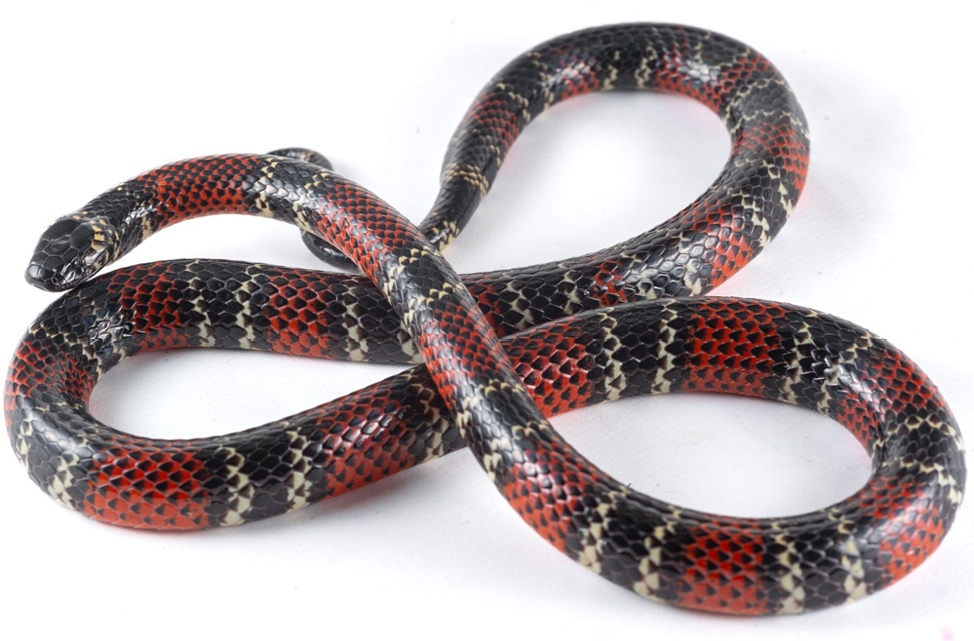
Micrurus sangilensis, commonly known as the Santander coral snake, is a triad-colored species distinguished by specific ring patterns and the absence of supracloacal keels. It differs from its close relatives, M. dissoleucus and M. dumerilli, by having 16–22 triads and a typical length of around 60 cm (Morales-Betancourt et al., 2015) (Fig. 1). Endemic to Colombia, its narrowed distribution within the departments of Cundinamarca, Boyacá, and Santander (Roze, 1996; Campbell et al., 2004; Caicedo-Portilla and Lynch, 2015) and more recently detected in Casanare (Flórez and Montoya-Cruz, 2023). This species limited to moderate elevations (800–2800 above sea level) along the Middle Magdalena River Basin, primarily inhabiting the vulnerable dry forests (Campbell et al., 2004). Currently classified as Vulnerable by the IUCN, its historical records show an estimated extent of occupation near 12000 km² (Caicedo-Portilla and Lynch, 2015; Hladki et al., 2019). Despite its conservation status, critical knowledge gaps remain regarding its population size, reproductive dynamics, and habitat requirements, which are essential knowledge when working for effective conservation planning (Van Teeffelen et al., 2012; Caicedo-Portilla and Lynch, 2015). Species like M. sangilensis may face acute risks not only from climate change but also from rapid structural changes in vegetation due to habitat degradation (Caicedo-Portilla and Lynch, 2015; Hladki et al., 2019; Flórez and Montoya-Cruz, 2023).
Given the ongoing changes in land use and the potentially altered climatic regimes in rainfall and temperature within the degraded dry forests, typical habitat of the restricted distribution of M. sangilensis, it is necessary to develop management strategies predicting the potential shifts in the species’ distribution under future climate scenarios. This research aims to assess the species’ potential distribution under different Shared Socioeconomic Pathways (SSP) under climate change, through a vulnerability to change index for land use, using Ecological Niche Modeling Methodologies (ENM) which are among the most widely used and effective tools for comparing and predicting historical and future scenarios (Peterson et al., 2011; Rangel and Loyola, 2012). By relating environmental and climatic variables with species occurrence data, ENM offers insights into species’ range dynamics (Alvarado‐Serrano and Knowles, 2014; Ramirez-Villegas et al., 2014; Mota-Vargas and Rojas-Soto, 2016; Moreno-Contreras et al., 2020; Sales et al., 2020). This assessment serves as a crucial resource for conservation planning strategies, highlighting areas for immediate and future protection efforts in landscapes increasingly fragmented by agriculture and urbanization.
Materials and methods
Occurrences and accessibility area (M)
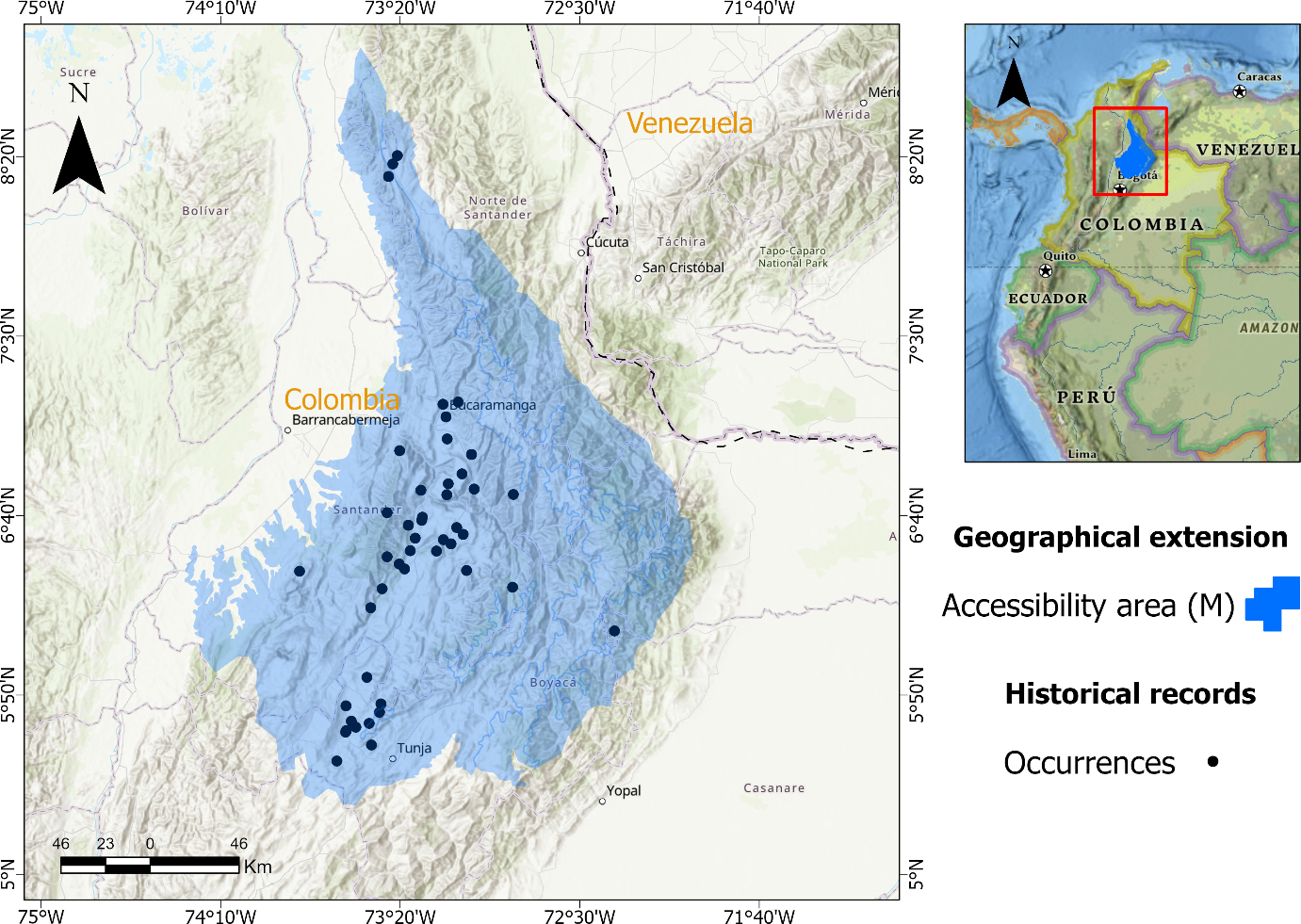
We obtained records of M. sangilensis from the Global Biodiversity Information Facility database (GBIF https://doi.org/10.15468/dl.9cjqyy) and literature (Flórez and Montoya-Cruz, 2023), in total 59 Records were used for analyses after deleting duplicates and reviewing each locality consistency to the known species historical range, following the methodology based on Cobos and Bosch, (2018). The accessible area, commonly named as M (Soberon and Peterson, 2005), represents the geographic region that the species could have potentially occupied over relevant evolutionary time frames, based on its dispersal ability and known biogeographic barriers, this M is the spatial extent from which environmental variables are cropped to calibrate the model and generate predictions; by considering at least one occurrence in terrestrial ecoregions from The Nature Conservancy (Dinerstein et al., 2017), using the ArcMap 10.8 software (Fig. 2).
Environmental variables
We obtained climatic variables to characterize the climatic niche of the M. sangilensis from the WorldClim 2.1 database (Fick and Hijmans, 2017) at a 30 arc-second resolution (~1 km²). We exclusively used 15 biovariables, excluding bio 8 (mean temperature of wettest quarter), bio 9 (mean temperature of driest quarter), bio 18 (precipitation of warmest quarter), and bio 19 (precipitation of coldest quarter); these exclusions reduce redundancy and avoid potential collinearity, overfitting or misrepresenting the species’ niche model (Escobar et al., 2014; Table 1 in supplementary material). Variables were masked and cropped to the extension of the accessible area of M. sangilensis. Because some highly correlated variables can be important for the biology of the species, we created different sets from the 15 biovariables for niche modeling evaluation (Cobos and Bosch, 2018; Echeverry-Cárdenas et al., 2021). The specific sets are shown in Table 2 in supplementary material.
Ecological niche modeling (ENM)
We randomly allocated 80% of the occurrence records for model training and the remaining 20% for evaluation, using the Maxent algorithm (Elith et al., 2011) implemented through the kuenm package in R (Cobos et al., 2019). We assessed multiple levels of model complexity following the approach of Warren and Seifert (2011) by varying the regularization multiplier from 0.1 to 1 in increments of 0.1, and then testing values of 2, 3, 4, and 5. Model selection was based on performance metrics provided by Kuenm, including the AUC ratio, omission rate, and AIC. The AUC (Area Under the Curve) ratio measures the model’s ability to discriminate suitable versus unsuitable areas, while the AICc (corrected Akaike Information Criterion) evaluates model parsimony by balancing goodness-of-fit and complexity (Phillips et al. 2006; Pearson et al. 2007; Warren and Seifert 2011; Arango-Lozano et al., 2025). The selected model was projected without applying extrapolation modes (Extrapolation or Clamping in Maxent algorithm) onto the accessible area under future climate scenarios, specifically Shared Socioeconomic Pathways (SSPs) representing minimal and moderate climatic changes (SSP126 and SSP245), as well as the most extreme scenario (SSP585), a high-emissions scenario associated with continued fossil fuel use and the most severe climate change (Echeverry-Cárdenas et al., 2021; Arango-Lozano et al., 2025) for the cumulative years 2041-2060.
We used five Global Circulation Models (GCMs) for comparing results as: HadGEM3-GC31-LL (GCM1), IPSL-CM6A-LR (GCM2), ACCESS-CM2 (GCM3), EC-Earth3-Veg (GCM4) and UKESM1-0-LL (GCM5). Each GCM was chosen for its unique approach in simulating climate dynamics, using distinct datasets, including land cover, oceanic circulation, and atmospheric processes (Yu et al., 2014; Padhiary et al., 2020). The variety of GCMs enhances model robustness, enabling us to assess areas of agreement and divergence via a broader perspective on future climate variability (Reshmidevi et al., 2018; Padhiary et al., 2020). For example, HadGEM3-GC31-LL focuses on ocean-atmosphere interactions, while UKESM1-0-LL includes comprehensive land-use feedback (Reshmidevi et al., 2018; García-Franco et al., 2020). We reclassified models resulted in presence/absence maps using a consistent threshold across models (10 percentile training presence Cloghold in Maxent algorithm).
Gain, loss, and stability
We evaluated the current and future potential distribution by analyzing pixel counts (and then its scaled values to Km2). First, we calculated the percentage of pixels gained, lost, and stabilized in each scenario (SSP and GCM) relative to the current distribution. We then summarized the gained and stabilized pixels for each SSP, identifying areas that remained stable across future GCMs. To pinpoint regions of consistent stability, we focused on pixels that persisted in four or more GCMs, allowing us to observe the spatial assemblage of stable areas under future conditions across all five GCMs.
Vulnerability to change
Finally, to detect any potential vulnerable areas of habitat lost in the species potential distribution, we superpose the current and future (assembly pixels in four or more GCMs) ranges with a “Vulnerability of land cover to anthropogenic change raster” (Esri, 2024). This layer shows areas where natural vegetation such as forest could be converted to agriculture and urban lands by 2050, based on the predictions of human-induced land changes. Further, the layer includes regions susceptible to expansion of agricultural and urban footprints, excluding forecasts for unchanged land cover types like forests unless they are converted to agriculture or urban areas (available data in: https://livingatlas.arcgis.com/landcover-2050/).
The vulnerability data ranges from zero to one, indicating varying degrees of susceptibility to natural cover transformation. We classified the raster values into three distinct categories: low vulnerability (0.0-0.3), moderate vulnerability (0.3-0.7), and high vulnerability (0.7-1) for the species. Areas with high vulnerability values (0.7-1) are identified as the most critical zones for this snake. These areas are also deemed most at risk of change in future climate scenarios (Arango-Lozano et al., 2025).
Results
Ecological niche model selection
Out of 210 evaluated models, only 3 fulfilled the kuenm criteria, and to streamline niche model comparisons between scenarios, we selected the first exhibiting the lowest AIC and AUC results M_0.7_F_lq_Set 5. Set 5 consists of biovariables 2, 3, 4, 7, 16, and 17, representing a combination of precipitation and temperature conditions. (Table 2, Table 3 in supplementary material).
Gain, loss, and stability
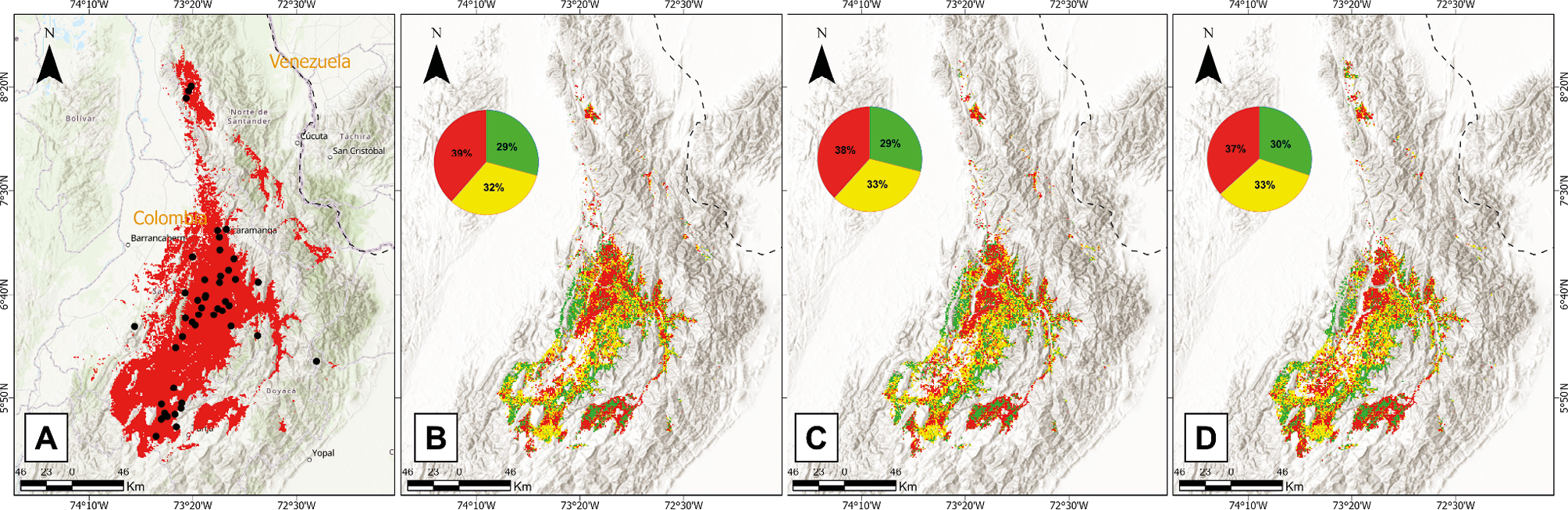
For the current scenario of M. sangilensis, 19873 predicted pixels were identified, which translate into over 16879 km² of suitable environmental conditions (Fig. 4A). Building on this baseline, future projections indicate substantial variability in potential range across General Circulation Models (GCMs) and Shared Socioeconomic Pathways (SSPs), yet certain consistent patterns emerge that strengthen confidence in key findings. Across all scenarios, significant stability areas are consistently predicted, particularly in the lower-emission scenario (SSP126). For instance, stability remains high in models M2 and M4 under SSP126, with over 80% of predicted pixels showing little change (Fig. 3).
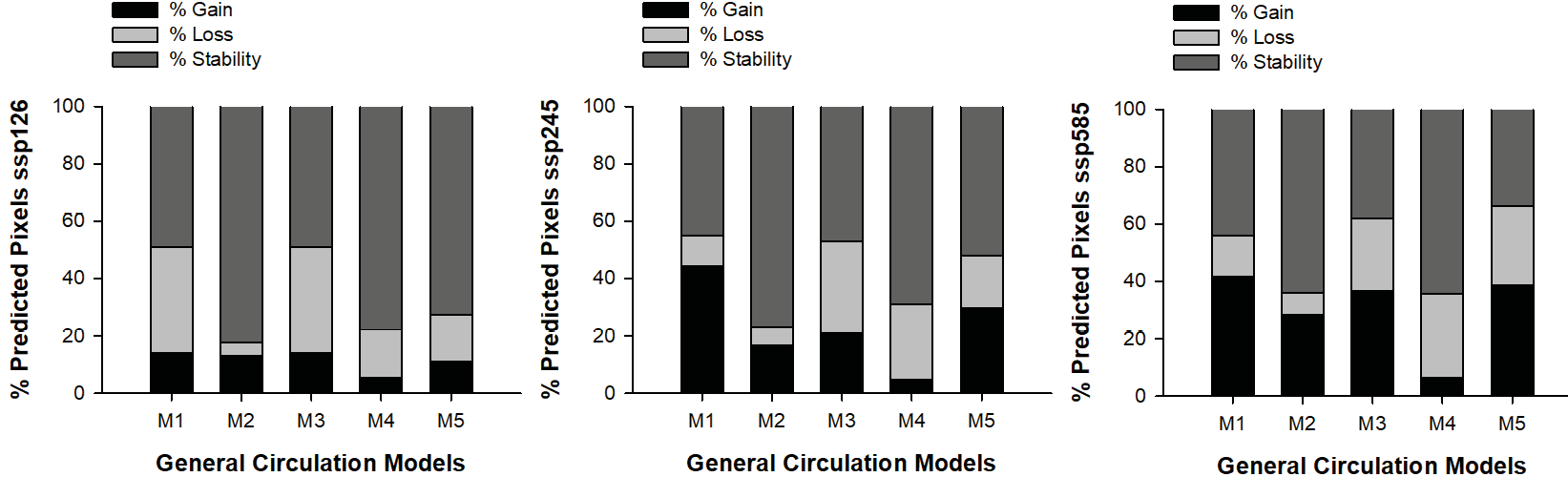
As emissions concentrations increase (SSP245 and SSP585), a marked rise in habitat gain is observed. Under SSP585, models such as M1 and M5 predict substantial habitat gains, with M5 showing a gain of 38.7% of pixels. This indicates possible new areas as climatic conditions shift, though this expansion comes with increased variability in predicted losses, particularly in M3 and M4 (Fig. 3). The appearance of these gained pixels under higher emissions scenarios reflects potential new suitable habitats as the climate changes. While the model variability shows the inherent uncertainties tied to different GCMs, the overall trends of habitat stability and gains under higher emissions scenarios are robust across models.
Vulnerability to change
We identified a mean reduction of at least 25% of suitable future areas for the species with respect to the current scenario. However, when contrasting the stability values with the vulnerability to change 2050 layer, we recognized that at least 37% of the remnant areas in the different future scenarios (each SPP) may be experiencing a high vulnerability, 30% a medium and almost just 23% a low vulnerability (Fig. 4). There was identified loss of areas in all elevation between 900 and 2000 m, Furthermore, these areas consistently show both lost in predicted presence and where not, are the ones with greater vulnerability values (0.7-1).
Discussion
The predictions for Micrurus sangilensis are influenced by the inherent uncertainties associated with the different General Circulation Models (GCMs), each of which makes varying assumptions about climate processes (Reshmidevi et al., 2018; Padhiary et al., 2020). By narrowing our analysis to pixels that remained stable across four or more GCMs, we were able to highlight regions that are likely to maintain suitable conditions for M. sangilensis even under varying future climate scenarios. This method provided a clearer spatial picture of potential refugia and stable areas, ensuring that our findings reflect consistent patterns of stability rather than relying on any single model. The identification of these stable regions across multiple GCMs strengthens the forecasting future conditions for this coral snake.
Our study projects a significant contraction in the potential suitable habitat for Micrurus sangilensis due to climate change across all SSP scenarios. These findings are consistent with other studies on coral snakes, such as M. lemniscatus, where a similar vulnerability to habitat loss in lowland regions was observed (Terribile et al., 2018). For M. fulvius, a potential range shift into unsuitable areas was predicted, highlighting the species’ inability to keep pace with changing climatic conditions (Archis et al., 2018). Similarly, M. brasiliensis faces the potential loss of 60% of its ideal habitat under future climate projections (Caten et al., 2017), further underscoring the widespread impact of climate change on coral snake distributions.
In the case of our study species M. sangilensis, our results indicate a potential loss of 25% of its ideal habitat by 2040–2060, with the species currently occupying degraded dry forest ecosystems, some of the most threatened habitats globally (Miles et al., 2006). Additionally, a 30% increase in the vulnerability of remaining suitable areas, particularly from land-use changes in forests (Galindo-Cruz et al., 2024). Within less than two decades, these critical habitats could undergo significant alterations, threatening the species’ long-term survival (Hladki et al., 2019).
The broader implications of these results become clear when considering that future suitable habitats for this species may be out of reach. As observed in other species, the pace of climate-driven habitat change may exceed the distribution capabilities of an animal (Schloss et al., 2012; Bush and Hoskins, 2017; Sales et al., 2020). Furthermore, factors such as habitat fragmentation and population isolation could further limit the species’ ability to migrate to newly suitable areas (Le Galliard et al., 2012; Bestion et al., 2015). As a result, even with new habitats emerging and stabilizing under future climatic conditions, the species may not be able to reach or colonize them effectively (Loarie et al., 2009; Le Galliard et al., 2012; Sales et al., 2020; Arango-Lozano et al., 2025).
The conservation implications of our results underscore the need for both immediate and long-term strategies. Areas of high vulnerability (with values between 0.7 and 1), as identified in this study, represent critical zones where habitat transformation is likely imminent. However, it is essential to recognize that focusing solely on these high-risk areas may not prevent transformation, as rapid environmental changes might already be underway (Global Forest Review, 2024). This introduces a crucial discussion point: should conservation efforts be prioritized in areas of highest vulnerability, or should a broader approach be taken, including areas with moderate vulnerability?
Given the lack of clear protocols for prioritizing conservation actions in snakes (Terribile et al., 2009; Andrade-Díaz et al., 2019), it might be strategic to include areas across the vulnerability spectrum. For instance, regions with moderate vulnerability (‘yellow zones’) are less likely to undergo immediate change compared to high-risk areas (‘red zones’), but they remain vital for habitat connectivity and the long-term survival of species like Micrurus sangilensis. Conservation efforts in these areas could help buffer against habitat fragmentation and provide refugia as the more vulnerable areas degrade.
In Colombia, existing conservation plans and frameworks provide an opportunity to safeguard the critical habitats for Micrurus sangilensis. The dry forests of Santander, where suitable areas for this species have been identified, are adjacent to over 60 different protected areas (Fig. 5). These areas include National Natural Parks, regional integrated management districts, national reserves, and forest reserves, all recognized under the National Register of Protected Areas (RUNAP). This network of protected zones represents a significant collective effort to preserve the country’s biodiversity.
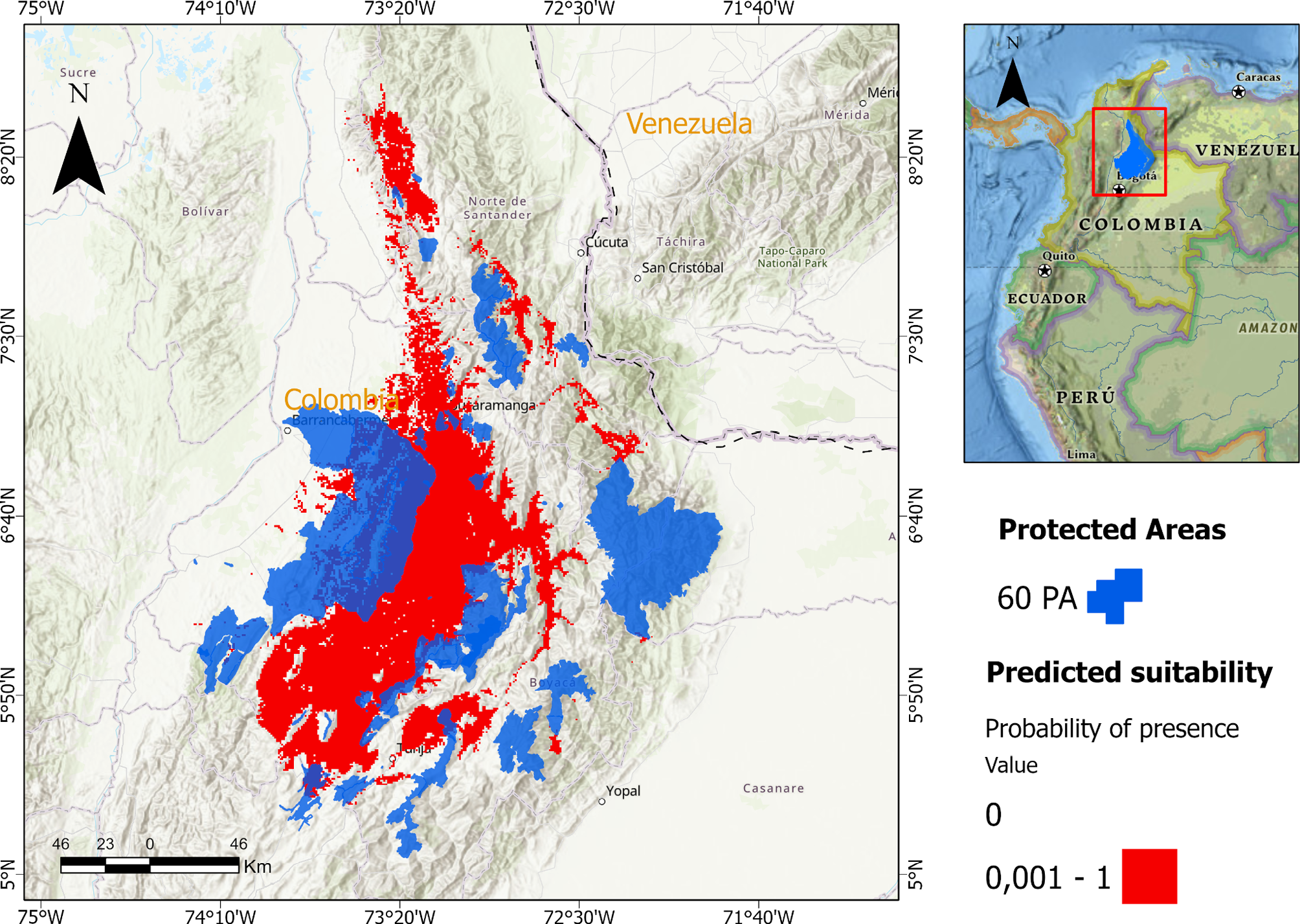
Although M. sangilensis may benefit from the protection offered by some of these existing areas, additional conservation strategies will be vital (Mi et al., 2023). Expanding the coverage of protected areas, restoring degraded habitats, and establishing ecological corridors to link fragmented landscapes are key steps to enhancing the resilience of this species under changing climate conditions (Terribile et al., 2009; Andrade-Díaz et al., 2019). Moreover, incorporating climate-adaptive conservation actions into these plans could help ensure that M. sangilensis can persist in its shrinking habitat. Ongoing monitoring of land-use changes and the potential threats posed by human activities will also be essential in aligning conservation efforts with the species’ emerging vulnerabilities (Fordham et al., 2012; Mi et al., 2023). A collaborative, multidisciplinary approach is crucial to create effective conservation strategies, safeguard the species’ habitat, and ensure the long-term survival of the Santander coral snake.
Acknowledgments
We extend our gratitude to Michel Cabra Parra for guidance and meticulous improvements on earlier versions of this manuscript. We also thank Elson Meneses-Pelayo for generously providing us photographs of the study related snake.
Supplementary material
The supplementary materials include three (3) tables describing the use of climatic variables and the results selected in this study ecological niche models, are avalilable at https://oaj.fupress.net/index.php/ah/article/view/18167/15288. Additionally, we have made available online the resulted raster files with current and projected future species distributions at: OSF https://osf.io/h9srj/.
References
Allentoft, M.E., O’Brien, J. (2010): Global amphibian declines, loss of genetic diversity and fitness: A review. Diversity 2: 47-71.
Alvarado‐Serrano, D.F., Knowles, L.L. (2014): Ecological niche models in phylogeographic studies: Applications, advances and precautions. Mol. Ecol. Resour. 14: 233-248.
Andrade-Díaz, M.S., Sarquis, J.A., Loiselle, B.A., Giraudo, A.R., Díaz-Gómez, J.M. (2019): Expansion of the agricultural frontier in the largest South American Dry Forest: Identifying priority conservation areas for snakes before everything is lost. PloS One 14: e0221901.
Arango-Lozano, J., Toro-Cardona, F.A., Montilla, J.S.O., Ramírez-Chaves, H.E. (2025): Ecological forecasting for night monkeys in the Aotus lemurinus Complex: Climate-driven threats to habitat suitability. Int. J. Primatol. 46: 556-572.
Archis, J.N., Akcali, C., Stuart, B.L., Kikuchi, D., Chunco, A.J. (2018): Is the future already here? The impact of climate change on the distribution of the eastern coral snake (Micrurus fulvius). PeerJ 6: e4647.
Arredondo, J.C., Bolívar, W., Renjifo, J. (2015): Riama laevis (errata version published in 2017). The IUCN Red List of Threatened Species 2015: e.T44578783A115386854. Accessed on 08 October 2024.
Bax, V., Francesconi, W. (2019): Conservation gaps and priorities in the Tropical Andes biodiversity hotspot: Implications for the expansion of protected areas. J. Environ. Manag. 232: 387-396.
Bellard, C., Bertelsmeier, C., Leadley, P., Thuiller, W., Courchamp, F. (2012): Impacts of climate change on the future of biodiversity. Ecol. Lett. 15: 365-377.
Bestion, E., Clobert, J., Cote, J. (2015): Dispersal response to climate change: Scaling down to intraspecific variation. Ecol. Lett. 18: 1226-1233.
Bolívar, W., Velasco, J. Arredondo, J.C. (2016): Synophis plectovertebralis. The IUCN Red List of Threatened Species 2016: e.T44581867A44581870. Accessed on 08 October 2024.
Brown, G.P., Shine, R. (2006): Effects of nest temperature and moisture on phenotypic traits of hatchling snakes (Tropidonophis mairii, Colubridae) from tropical Australia. Biol. J. Linn. Soc. 89: 159-168.
Bush, A., Hoskins, A.J. (2017): Does dispersal capacity matter for freshwater biodiversity under climate change?. Freshw. Biol. 62: 382-396.
Caicedo-Portilla, J., Lynch, JD. (2015): Micrurus sangilensis Nicéforo María, 1942. En: Libro rojo de reptiles de Colombia (2015), pp. 106-108. M.A., Lasso, C.A., Paez, V.P., Bock, B.C., Eds, Instituto de Investigación de Recursos Biológicos Alexander von Humboldt (IAvH), Bogotá, D. C., Colombia, Universidad de Antioquia.
Calderón, M., Caicedo, J.R., Ortega, A. (2019): Micrurus medemi. The IUCN Red List of Threatened Species 2019: e.T44581955A44581962. Accessed on 08 October 2024.
Campbell, J.A., Lamar, W.W., Brodie, E.D. (2004): The venomous reptiles of the western hemisphere (Vol. 1, No. 2). Ithaca, NY, Comstock Pub. Associates.
Caten, C.T., Lima-Ribeiro, M.D.S., da Silva Jr, N.J., Moreno, A.K., Terribile, L.C. (2017): Evaluating the effectiveness of Brazilian protected areas under climate change: A case study of Micrurus brasiliensis (Serpentes: Elapidae). Trop. Conserv. Sci. 10: 1940082917722027.
Cobos, M.E., Alonso Bosch, R. (2018): Breeding sites of a narrowly distributed amphibian, a key element in its conservation in the face of global change. Aquat. Conserv.: Mar. Freshw. Ecosyst. 28: 1089-1098.
Cobos, M.E., Peterson, A.T., Barve, N., Osorio-Olvera, L. (2019): kuenm: An R package for detailed development of ecological niche models using Maxent. PeerJ 7: e6281.
Dinerstein, E., Olson, D., Joshi, A., Vynne, C., Burgess, N.D., Wikramanayake, E., Saleem, M. (2017): An ecoregion-based approach to protecting half the terrestrial realm. Biosci. 67: 534-545.
Echeverry-Cárdenas, E., López-Castañeda, C., Carvajal-Castro, J.D., Aguirre-Obando, O.A. (2021): Potential geographic distribution of the tiger mosquito Aedes albopictus (Skuse, 1894) (Diptera: Culicidae) in current and future conditions for Colombia. PLoS Negl. Trop. Dis. 15: e0008212.
Elith, J., Phillips, S.J., Hastie, T., Dudík, M., Chee, Y.E., Yates, C.J. (2011): A statistical explanation of MaxEnt for ecologists. Divers. Distrib. 17: 43-57.
Escobar, L.E., Lira-Noriega, A., Medina-Vogel, G., Peterson, A.T. (2014): Potential for spread of the white-nose fungus (Pseudogymnoascus destructans) in the Americas: Use of Maxent and NicheA to assure strict model transference. Geospat. Health. 9: 221-229.
Esri. (2024): ArcGIS [online]. Environmental Systems Research Institute, Redlands.
Fick, S.E., Hijmans, R.J. (2017): WorldClim 2: New 1-km spatial reso-lution climate surfaces for global land areas. Int. J. Climatol. 37: 4302-4315.
Flórez, R.A., Montoya-Cruz, A. (2023): Extensión del rango de distribución de Micrurus sangilensis Nicéforo María, 1942 (Squamata: Elapidae) en el departamento de Casanare, Colombia. Rev. Latinoam. Herpetol. 6: 188-189.
Fordham, D.A., Watts, M.J., Delean, S., Brook, B.W., Heard, L.M., Bull, C.M. (2012): Managed relocation as an adaptation strategy for mitigating climate change threats to the persistence of an endangered lizard. Glob Chang Biol. 18: 2743-2755.
Fuentes, M., Cárdenas, J.P., Olivares, G., Rasmussen, E., Salazar, S., Urbina, C., Lawler, D. (2023): Global digital analysis for science diplomacy on climate change and sustainable development. Sustainability 15: 15747.
Galindo-Cruz, A., Sahagún-Sánchez, F.J., López-Barrera, F., Rojas-Soto, O. (2024): Recent changes in tropical-dry-forest connectivity within the Balsas Basin Biogeographic Province: Potential effects on endemic-bird distributions. Nat. Conserv. 55: 177-199.
Gamble, T. (2010): A review of sex determining mechanisms in geckos (Gekkota: Squamata). Sex Dev. 4: 88-103.
García-Franco, J.L., Gray, L.J., Osprey, S. (2020): The American monsoon system in HadGEM3 and UKESM1. Weather Clim. Dyn. 1: 349-371.
Global Forest Review. (2024): Tropical forest loss drops steeply in Brazil and Colombia, but high rates persist overall. Global Forest Review, Washington, DC, World Resources Institute.
Gumbs, R., Gray, C.L., Wearn, O.R., Owen, N.R. (2018): Tetrapods on the EDGE: Overcoming data limitations to identify phylogenetic conservation priorities. PLoS One 13: e0194680.
Heller, N.E., Zavaleta, E.S. (2009): Biodiversity management in the face of climate change: A review of 22 years of recommendations. Biol. Conserv. 142: 14-32.
Herrera-Lopera, J., Ramírez-Castaño, V.A., García-Oviedo, F.A. (2018): Micrurus dumerilii (Dumeril’s coralsnake, Coral de Dumeril). Herpetol. Rev. 49.
Hladki, I.A., Ramírez-Pinilla, M., Renjifo, J., Urbina, N. (2019): Micrurus sangilensis. The IUCN Red List of Threatened Species 2019: e.T44582057A44582066. Accessed on 08 October 2024.
Holt, R.D. (1990): The microevolutionary consequences of climate change. Trends Ecol. Evol. 5: 311-315.
Huey, R.B., Deutsch, C.A., Tewksbury, J.J., Vitt, L.J., Hertz, P.E., Álvarez Pérez, H.J., Garland Jr, T. (2009): Why tropical forest lizards are vulnerable to climate warming. Proc. Roy. Soc. London, Ser. B, Biol. Sci. 276: 1939-1948.
Kittel, T.G. (2013): The vulnerability of biodiversity to rapid climate change. In: Vulnerability of ecosystems to climate, pp. 185-201. Seastedt, TR, Suding, K., Eds, Oxford, UK, Elsevier Inc., Academic Press
Kwak, T.J., Freeman, M.C. (2010): Assessment and management of ecological integrity. In: Inland fisheries management in North America, 3rd edition, pp. 353-394. Hubert, W. A., Quist, M. C., Eds, Bethesda, Maryland, American Fisheries Society.
Le Galliard, J.F., Massot, M., Baron, J.P., Clobert, J. (2012): Ecological effects of climate change on European reptiles. In: Wildlife conservation in a changing climate, p. e203. Post, E., Doak, D., Brodie, J. Eds., Chicago, University of Chicago Press.
Loarie, S.R., Duffy, P.B., Hamilton, H., Asner, G.P., Field, C.B., Ackerly, D.D. (2009): The velocity of climate change. Nature 462: 10521055.
Lovejoy, T.E. (2006): Climate change and biodiversity. The Energy and Resources Institute (TERI).
Mawdsley, J.R., O’MALLEY, R., Ojima, D.S. (2009): A review of climate‐change adaptation strategies for wildlife management and biodiversity conservation. Conserv. Biol. 23: 1080-1089.
Mi, C., Ma, L., Yang, M., Li, X., Meiri, S., Roll, U., Du, W. (2023): Global protected areas as refuges for amphibians and reptiles under climate change. Nat. Commun. 14: 1389.
Miles, L., Newton, A.C., DeFries, R.S., Ravilious, C., May, I., Blyth, S., Kapos, Valerie., Gordon, J. E. (2006): A global overview of the conservation status of tropical dry forests. J. Biogeogr. 33: 491-505.
Moraes, R.L., Recchia, M.D.P. (2011): Amphisbaena mertensi (NCN) Habitat. Herpetol. Rev. 42: 426.
Morales-Betancourt, M.A., Lasso, C. A., Páez V.P., Bock, B.C. (2015): Libro rojo de reptiles de Colombia (2015). Universidad de Antioquia, Bogotá, D. C., Colombia, Instituto de Investigación de Recursos Biológicos Alexander von Humboldt (IAvH).
Moreno-Contreras, I., Sánchez-González, L.A., Arizmendi, M.D.C., Prieto-Torres, D.A., Navarro-Sigüenza, A.G. (2020): Climatic niche evolution in the Arremon brunneinucha complex (Aves: Passerellidae) in a Mesoamerican landscape. Evol. Biol. 47: 123-132.
Mota-Vargas, C., Rojas-Soto, O.R. (2016): Taxonomy and ecological niche modeling: Implications for the conservation of wood partridges (genus Dendrortyx). J. Nat. Conserv. 29: 1-13.
Noh, J.K., Echeverria, C., Kleemann, J., Koo, H., Fürst, C., Cuenca, P. (2020): Warning about conservation status of forest ecosystems in tropical Andes: National assessment based on IUCN criteria. PLoS One 15: e0237877.
Padhiary, J., Patra, K.C., Dash, S.S., Uday Kumar, A. (2020): Climate change impact assessment on hydrological fluxes based on ensemble GCM outputs: A case study in eastern Indian River Basin. JWCC. 11: 1676-1694.
Páez, V., Gallego-Garcia, N., Restrepo, A. (2016): Podocnemis lewyana. The IUCN Red List of Threatened Species 2016: e.T17823A1528580. Accessed on 08 October 2024.
Pearson, R.G., Raxworthy, C.J., Nakamura, M., Townsend Peterson, A. (2007). Predicting species distributions from small numbers of occurrence records: A test case using cryptic geckos in Madagascar. J. Biogeogr. 34: 102-117.
Peterson, A.T., Soberón, J., Pearson, R.G., Anderson, R.P., Martínez-Meyer, E., Nakamura, M., Araújo, M.B. (2011): Ecological niches and geographic distributions (MPB-49). Princeton, New Jersey, Princeton University Press.
Pitalua, Y., Rengifo, J.T., Rivas, L. (2018): Aportes a la distribución del género Micrurus (Serpentes: Elapidae) en el Departamento del Chocó, Colombia. Rev. Colombiana Cienc. Anim Recia. 10: 131-142.
Phillips, S.J., Dudík, M. and Schapire, R.E. (2006): A maximum entropy approach to species distribution modeling. In: Proceedings of the 21st International Conference on Machine Learning, pp. 655–662. Brodley, C. E., Flach, P. A., Eds, New York, NY, ACM Press.
Rainwater, T.R., Platt, S.G., Charruau, P., Balaguera-Reina, S.A., Sigler, L., Cedeño-Vázquez, J.R., Thorbjarnarson, J.B. (2022): Crocodylus acutus (amended version of 2021 assessment). The IUCN Red List of Threatened Species 2022: e.T5659A212805700. Accessed on 08 October 2024.
Ramirez-Villegas, J., Cuesta, F., Devenish, C., Peralvo, M., Jarvis, A., Arnillas, C.A. (2014): Using species distributions models for designing conservation strategies of Tropical Andean biodiversity under climate change. J. Nat. Conserv. 22: 391-404.
Rands, M.R., Adams, W.M., Bennun, L., Butchart, S.H., Clements, A., Coomes, D., Vira, B. (2010): Biodiversity conservation: Challenges beyond 2010. Science 329: 1298-1303.
Rangel, T.F., Loyola, R.D. (2012): Labeling ecological niche models. Nat. Conserv. 10: 119–126.
Reshmidevi, T.V., Kumar, D.N., Mehrotra, R., Sharma, A. (2018): Estimation of the climate change impact on a catchment water balance using an ensemble of GCMs. J. Hydrol. 556: 1192-1204.
Rey-Suárez, P., Núñez, V., Fernández, J., Lomonte, B. (2016): Integrative characterization of the venom of the coral snake Micrurus dumerilii (Elapidae) from Colombia: Proteome, toxicity, and cross-neutralization by antivenom. J. Proteom. 136: 262-273.
Ríos-Soto, J.A., Arango-Lozano, J., Rivera-Molina, F.A. (2018): Micrurus mipartitus (Duméril, Bibron & Duméril, 1854). En: Catálogo de Anfibios y Reptiles de Colombia, pp. 37-44. Antioquia, Colombia, Universidad de Antioquia, Carmen de Viboral.
Roze, J.A. (1996): Coral snakes of the Americas: biology, identification, and venoms. Malabar, Florida, Krieger Publishing Company.
Sarkar, S., Sánchez-Cordero, V., Londoño, M. C., Fuller, T. (2009): Systematic conservation assessment for the Mesoamerica, Chocó, and Tropical Andes biodiversity hotspots: a preliminary analysis. Biodivers. Conserv. 18: 1793-1828.
Sales, L.P., Galetti, M., Pires, M.M. (2020): Climate and land‐use change will lead to a faunal “savannization” on tropical rainforests. Glob. Chang. Biol. 26: 7036-7044.
Schloss, C.A., Nuñez, T.A., Lawler, J.J. (2012): Dispersal will limit ability of mammals to track climate change in the Western Hemisphere. Proc. Natl. Acad. Sci. U.S.A., 109: 8606-8611.
Soberón, J., Peterson, A.T. (2005): Interpretation of models of fundamental ecological niches and species’ distributional areas. BDI. 2: 1–10.
Staudt, A., Leidner, A.K., Howard, J., Brauman, K.A., Dukes, J.S., Hansen, L.J., Solórzano, L.A. (2013): The added complications of climate change: Understanding and managing biodiversity and ecosystems. Front. Ecol. Environ. 11: 494-501.
Terribile, L.C., De Oliveira, G., Albuquerque, F., Rodríguez, M.Á., Diniz‐Filho, J.A. F. (2009): Global conservation strategies for two clades of snakes: Combining taxon‐specific goals with general prioritization schemes. Divers. Distrib. 15: 841-851.
Terribile, L.C., Feitosa, D.T., Pires, M.G., de Almeida, P.C.R., de Oliveira, G., Diniz-Filho, J.A.F., Silva Jr, N.J.D. (2018): Reducing Wallacean shortfalls for the coralsnakes of the Micrurus lemniscatus species complex: Present and future distributions under a changing climate. PloS One 13: e0205164.
Upadhyay, R.K. (2020): Markers for global climate change and its impact on social, biological and ecological systems: A review. Am. J. Clim. Change. 9: 159.
Van Teeffelen, A.J., Vos, C.C., Opdam, P. (2012): Species in a dynamic world: Consequences of habitat network dynamics on conservation planning. Biol. Conserv. 153: 239-253.
Vicenzi, N., Corbalán, V., Miles, D., Sinervo, B., Ibargüengoytía, N. (2017): Range increment or range detriment? Predicting potential changes in distribution caused by climate change for the endemic high-Andean lizard Phymaturus palluma. Biol. Conserv. 206: 151-160.
Young, B., Young, K. R., & Josse, C. (2011). Vulnerability of tropical Andean ecosystems to climate change. In: Climate change and biodiversity in the tropical Andes, pp. 170-181. Herzog, S. K., Martínez, R., Jørgensen, P. M., Tiessen H., Eds, SCOPE, IAI.
Yu, M., Wang, G., Parr, D., Ahmed, K.F. (2014): Future changes of the terrestrial ecosystem based on a dynamic vegetation model driven with RCP8. 5 climate projections from 19 GCMs. Clim. Change. 127: 257-271.
Warren, D.L., Seifert, S.N. (2011): Ecological niche modeling in Maxent: The importance of model complexity and the performance of model selection criteria. Ecol. Appl. 21: 335-342.