Submitted on 2025, 24th July; revised on: 2025, 20th October; accepted on: 2025, 26th October
Trophic plasticity and novel predator-prey interaction between two introduced snakes in a Mediterranean island
Interdisciplinary Ecology Group, University of the Balearic Islands, Ctra. Valldemossa km 7,5, 07122 Palma, Balearic Islands, Spain
*Corresponding author. Email: enriquepantojac@gmail.com
Abstract. We report the first documented case of interspecific ophiophagy by the naturalised false smooth snake (Macroprotodon mauritanicus), preying on the introduced horseshoe whip snake (Hemorrhois hippocrepis) in Mallorca (Balearic Islands, Spain). The event occurred in a suburban garden and was photographically recorded. While M. mauritanicus is known to consume reptiles, interspecific ophiophagy has not previously been documented. This observation represents a novel trophic interaction between two introduced colubrids. It was likely facilitated by the increasing local abundance of H. hippocrepis and by the ecological constraints of insular systems. Together with a previous report of avian predation on H. hippocrepis in Mallorca, it suggests that both native or naturalised predators may be incorporating this species into their diets. This finding adds new information on the trophic ecology of M. mauritanicus and highlights the dynamic nature of predator-prey interactions in island ecosystems, potentially involving juvenile individuals due to size-related constraints.
Keywords. Interspecific ophiophagy, invasion dynamics, insular ecology, biotic resistance, Colubridae.
Introduced snakes are widely recognised as drivers of ecological disruption on islands, where native faunas often lack evolutionary defences against novel predators. Well-documented cases involving invasive colubrids include Boiga irregularis (Bechstein, 1802) in Guam (Rodda and Savidge, 2007), Lampropeltis californiae (Blainville, 1835) in the Canary Islands (Piquet and López-Darias, 2021), and Hemorrhois hippocrepis (Linnaeus, 1758) in Ibiza (Hinckley et al., 2016; Montes et al., 2022). In each case, the arrival of an invasive colubrid had measurable impacts on native species and predator-prey dynamics, illustrating the ability of introduced snakes to establish novel trophic interactions and restructure island ecosystems. Despite this, little is known about interactions between non-native colubrids, particularly when both species are introduced.
The island of Mallorca, part of the Balearic archipelago, has experienced multiple reptile introductions, including the colubrid Macroprotodon mauritanicus (Guichenot, 1850), currently considered naturalised (Pinya and Carretero, 2011). This species was probably introduced to Mallorca and Menorca by the Romans in the 2nd century BCE (Pleguezuelos et al., 1994), as supported by its current distribution, genetic affinity with Northwest African populations (Carranza et al., 2004), and historical land-use patterns. A more recent arrival, H. hippocrepis, is considered an introduced species in Mallorca under Spanish Law 42/2007. First recorded in 2006 and linked to the ornamental olive tree trade (Álvarez et al., 2010), its presence is now well established on the island (Pinya and Carretero, 2011). Beyond the main island, this species has reached several small islets inhabited by endemic and protected species such as Podarcis lilfordi (Günther, 1874) (Ayllón, 2015), and has been implicated in the extinction of at least one population of this endemic lizard in Mallorca (Picó et al., pers. comm.). Unpublished reports from the Government of the Balearic Islands also suggest impacts on other P. lilfordi populations in islets around Ibiza and Mallorca. Management efforts, mainly through snake-trapping campaigns and legislative measures, have so far been ineffective in containing this species (Febrer-Serra, 2023). Meanwhile, ecological interactions among introduced reptiles remain poorly documented and largely overlooked in conservation planning.
On the Iberian Peninsula, predation on H. hippocrepis has been reported primarily from birds of prey (Feriche, 2017), although occasional cases involving reptiles have also been recorded, including Timon lepidus (Daudin, 1802) (Pleguezuelos, 1998) and Malpolon monspessulanus (Hermann, 1804) (Díaz-Paniagua, 1976). In the Balearic Islands, studies indicate that Macroprotodon spp. (Guichenot, 1850) feeds mainly on small mammals (Mus spp. Linnaeus, 1758) and reptiles (Podarcis siculus (Rafinesque-Schmaltz, 1810) and Tarentola mauritanica (Linnaeus, 1758), with occasional records of avian and invertebrate prey (Mayol, 1985; Barbadillo, 1987; Pleguezuelos et al., 1994). Therefore, M. mauritanicus may be considered a euryphagous species, and ophiophagy is not ecologically unexpected. Consistent with this, intraspecific ophiophagy has been previously reported both in Mallorca (Capellà et al., 2011) and Lampedusa, Italy (Faraone, 2020). However, interspecific ophiophagy by M. mauritanicus has never been documented to date.
On 27 May 2025, at approximately 11:30 h, an adult M. mauritanicus was observed preying on a juvenile H. hippocrepis in the garden of a private residence, near a greenhouse in a suburban area of Sa Casa Blanca in Mallorca (39.5835° N, 2.7474° E; WGS84, 23.12 m a.s.l.). The garden features ornamental vegetation and a maintained lawn adjacent to the greenhouse. The two snakes were discovered on the lawn, beside a stone wall bordering the structure, with M. mauritanicus tightly coiled around H. hippocrepis, in an apparent act of constriction. The juvenile H. hippocrepis appeared lifeless, and the predator was initiating ingestion head-first. The snake showed no defensive reaction to the observer’s presence and continued swallowing its prey without interruption. After completing ingestion, it retreated into the stone wall. The observation was made by Arnau, X. and documented photographically (Fig. 1).
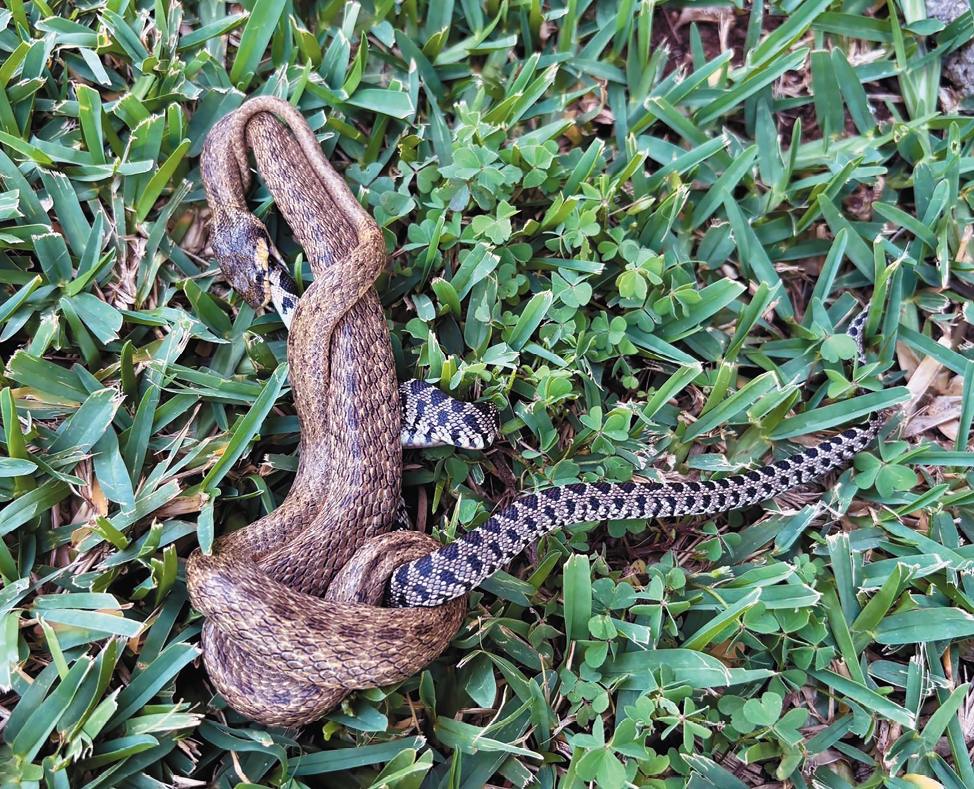
The surrounding area of the observation includes a small area of Mediterranean shrubland and cultivated fields. Less than 250 meters away lies a water reservoir with a storage capacity of 11,000 m³ and an average depth of 3 meters. This reservoir, the largest freshwater body in southwestern Mallorca, is listed in the Balearic Inventory of Wetlands as Bassa de rec de Son Artigues (code MAZHA08; Govern de les Illes Balears, 2023).
This case represents the first documented instance of interspecific ophiophagy by M. mauritanicus. It involved the incorporation of a recently established introduced prey into the diet of a naturalised predator, suggesting a functional trophic response to a novel resource within the insular ecosystem. Such interactions may arise from increased encounter rates and ecological overlap, particularly in simplified island communities. This observation therefore expands the known trophic plasticity of M. mauritanicus and highlights the dynamic nature of predator–prey relationships involving introduced reptile species.
Although both species coexist in parts of North Africa and the Iberian Peninsula, no predation events have been reported from those regions. This may reflect low encounter rates, possibly related to lower population densities or habitat segregation. By contrast, in Mallorca, the expansion of H. hippocrepis has likely increased its local density, enhancing the probability of trophic interactions with resident predators. Notably, the present case involved a juvenile individual, consistent with the pronounced body size disparity between the two species: while adult H. hippocrepis can exceed 1.5 meters in length (Feriche, 2017), Macroprotodon spp. rarely surpasses 60 cm (Pleguezuelos and Vasconcelos, 2015). Thus, such predation events are probably restricted to the juvenile segment of the H. hippocrepis population rather than indicating a generalised dietary shift. This finding highlights how insular contexts, characterised by confined space, simplified food webs, and elevated encounter rates, may facilitate interactions that are rare or absent in continental ecosystems.
This pattern aligns with broader ecological principles observed in insular environments, where limited space, reduced species diversity, and the absence of specialist predators or competitors often promote ecological release and novel interactions (Carlquist, 1974). In such simplified systems, generalist species may expand their dietary niches or adjust behaviours in response to increased encounter rates with available prey (Savidge, 1987; Fritts and Rodda, 1998; Henderson and Powell, 2009). The observation of interspecific ophiophagy in M. mauritanicus may therefore reflect a context-driven shift in foraging strategy, shaped by the ecological constraints and opportunities of Mediterranean islands such as Mallorca.
Although based on a single event, this record suggests that M. mauritanicus could exert some predation pressure on local populations of H. hippocrepis in Mallorca. As a naturalised and generalist predator, it may be exploiting the growing abundance of this alien species. In island ecosystems, it is not uncommon for introduced predators to assume new functional roles, especially when food resources are limited and novel prey becomes available (Fritts and Rodda, 1998). While the ecological impact of this interaction remains uncertain, the incorporation of juvenile H. hippocrepis into the diet of resident predators could influence invasion dynamics if such events occur more frequently. Additional records will be necessary to determine whether this represents a sporadic occurrence or a recurring ecological interaction.
A previous observation of H. hippocrepis predation by a grey heron (Ardea cinerea Linnaeus, 1758) in Mallorca (Solà et al., 2015) supports the idea that native or naturalised predators may be beginning to incorporate this introduced colubrid into their diets. Together, these cases suggest the emergence of novel trophic pathways involving H. hippocrepis, with potential implications for its long-term establishment and spread on the island.
Beyond documenting a single event, this finding contributes to the broader discussion on predator flexibility, the formation of new food-web links, and the dynamics of biological invasions in islands. Continued monitoring and reporting of such interactions will be essential to clarify how introduced species reshape ecological communities and to inform effective conservation and management strategies in insular ecosystems. This case also underscores important conservation implications. The emergence of new trophic interactions among introduced predators and prey can influence invasion trajectories and the stability of insular food webs. Understanding these dynamics is essential for anticipating cascading effects on native fauna and for developing effective management responses in Mediterranean islands.
ACKNOWLEDGEMENTS
We thank A. Fueris for reporting the observation, M. Aranda for facilitating contact with the observer, and X. Arnau for documenting the event as both observer and photographer. This work is done with the support of the CMB-Biodibal from the University of the Balearic Islands.
REFERENCES
Álvarez, C., Mateo, J.A., Oliver, J., Mayol, J. (2010): Los ofidios ibéricos de introducción reciente en las Islas Baleares. Bol. Asoc. Herpetol. Esp. 21: 126-131.
Ayllón, E. (2015): La culebra de herradura (Hemorrhois hippocrepis) en las Islas Baleares. Bol. Asoc. Herpetol. Esp. 26: 88-91.
Barbadillo, L.J. (1987): La guía de Incafo de los anfibios y reptiles de la Península Ibérica, Islas Baleares y Canarias. Guías verdes de Incafo. INCAFO, Madrid.
Capellà, J., Mateo, J.A., Mayol, J., Pleguezuelos, J.M. (2011): Canibalismo en Macroprotodon mauritanicus en la isla de Mallorca. Bol. Asoc. Herpetol. Esp. 22: 44-46.
Carlquist, S.J. (1974): Island Biology. Columbia University Press, New York, USA.
Carranza, S., Arnold, E.N., Wade, E., Fahd, S. (2004): Phylogeography of the false smooth snakes, Macroprotodon (Serpentes, Colubridae): Mitochondrial DNA sequences show European populations arrived recently from Northwest Africa. Mol. Phyl. Evol. 33: 523-532.
Díaz-Paniagua, C. (1976): Alimentación de la culebra bastarda (Malpolon monspessulanus; Ophidia, Colubridae) en el S.O. de España. Doñana. Acta Vertebr. 3: 113-127.
Faraone, F.P. (2020): A case of cannibalism in the false smooth snake Macroprotodon cucullatus on the island of Lampedusa. Herpetol. Bull. 152: 43-44.
Febrer-Serra, M. (2023): Impact of invasive snakes in the balearic islands: An ecological and molecular approach. Doctoral dissertation. Universitat de les Illes Balears, Palma de Mallorca, Spain.
Feriche, M. (2017): Culebra de herradura – Hemorrhois hippocrepis. In: Enciclopedia Virtual de los Vertebrados Españoles. Sanz, J.J., Martínez-Freiría, F., Eds, Madrid, Museo Nacional de Ciencias Naturales. Available at: https://www.vertebradosibericos.org (Accessed on 14 July 2025).
Fritts, T.H., Rodda, G.H. (1998): The role of introduced species in the degradation of island ecosystems: A case history of Guam. Annu. Rev. Ecol. Evol. Syst. 29: 113-140.
Govern de les Illes Balears. (2023): Pla hidrològic de les Illes Balears 2021–2027. Conselleria d’Agricultura, Pesca i Medi Natural. Direcció General de Recursos Hídrics. Available at: https://www.caib.es/sites/aigua/ca/pla_hidrolagic_de_les_illes_balears/ (Accessed on 14 July 2025).
Henderson, R.W., Powell, R. (2009): Natural history of west Indian Reptiles and Amphibians. University Press of Florida, USA.
Hinckley, A., Montes, E., Ayllón, E., Pleguezuelos, J.M. (2016): The fall of a symbol? A high predation rate by the introduced horseshoe whip snake Hemorrhois hippocrepis paints a bleak future for the endemic Ibiza wall lizard Podarcis pityusensis. Eur. J. Wildl. Res. 63: 13.
Mayol, J. (1985): Rèptils i Amfibis de les Balears. Editorial Moll, Palma de Mallorca, Spain.
Montes, E., Kraus, F., Chergui, B., Pleguezuelos, J.M. (2022): Collapse of the endemic lizard Podarcis pityusensis on the island of Ibiza mediated by an invasive snake. Curr. Zool. 68: 295-303.
Pinya, S., Carretero, M.A. (2011): The Balearic herpetofauna: A species update and a review on the evidence. Acta Herpetol. 6: 59-80.
Piquet, J.C., López-Darias, M. (2021): Invasive snake causes massive reduction of all endemic herpetofauna on Gran Canaria. Proc. R. Soc. B. 288: 20211939.
Pleguezuelos, J.M. (1998): Coluber hippocrepis Linnaeus, 1758 In: Fauna Ibérica, Vol. 10, pp. 347–358. Salvador, A. (Coord.), Ramos, M.A. et al., Eds, Madrid, Museo Nacional de Ciencias Naturales, CSIC.
Pleguezuelos, J., Honrubia, S., Castillo, S. (1994): Diet of the false smooth snake, Macroprotodon cucullatus (Serpentes, Colubridae) in the western Mediterranean area. Herpetol. J. 4: 98-105.
Pleguezuelos, J. M., Vasconcelos, R. (2015): Culebra de cogulla argelina – Macroprotodon cucullatus In: Enciclopedia Virtual de los Vertebrados Españoles. Salvador, A., Marco, A., Eds, Madrid, Museo Nacional de Ciencias Naturales. Available at: https://www.vertebradosibericos.org/ (Accessed on 14 July 2025)
Rodda G.H., Savidge, J.A. (2007): Biology and impacts of Pacific Island invasive species. 2. Boiga irregularis, the Brown Tree Snake (Reptilia: Colubridae). Pac. Sci. 61: 307-324.
Savidge, J.A. (1987): Extinction of an island forest avifauna by an introduced snake. Ecology. 68: 660-668.
Solà, J., Blasco, P., Negre, N., Leza, M., Puig, M. (2015): Primera troballa de serp de ferradura Hemorrhois hippocrepis en el contingut estomacal d’un agró blau Ardea cinerea a Mallorca. Anu. Ornitol. Balears. 30: 29-34.