https://doi.org/10.36253/a_h-18500
Submitted on: 2025, 20th August; revised on: 2025, 7th November; accepted on: 2025, 1th December.
First record of attempted predation on the Scaled Dove (Columbina squammata) by the Red-tailed Boa (Boa constrictor) in a Restinga habitat of Northeastern Brazil
1 Programa de Pós Graduação em Ecologia e Monitoramento Ambiental, Universidade Federal da Paraíba,58297-000, Rio Tinto, Paraíba, Brasil
2 Programa de Pós-Graduação em Ciências Biológicas, Universidade Federal da Paraíba, 58051-900, João Pessoa, Paraíba, Brasil
3 Departamento de Engenharia e Meio Ambiente, CCAE, Universidade Federal da Paraíba, 58297-000, Rio Tinto, Paraíba, Brasil
*Corresponding author. Email: nascimentob.vn@gmail.com
Abstract. We report the first documented case of attempted predation on the scaled dove (Columbina squammata) by the Red-tailed Boa (Boa constrictor) in a restinga environment on the north coast of Paraíba, Brazil. This record contributes to the growing knowledge of the species’ diverse diet and highlights the importance of opportunistic and arboreal foraging strategies in snake–bird interactions.
Keywords. Snake–bird interactions, feeding ecology, opportunistic predation.
Contents
Acknowledgements / Authorizations
The Red-tailed Boa (Boa constrictor Linnaeus, 1758) is a large-bodied member of the family Boidae, distributed in areas of the Neotropical region, specifically in South America. It occurs in Brazil, Argentina, Venezuela, Bolivia, Ecuador, French Guiana, Guyana, Paraguay, Peru, Suriname, and Trinidad and Tobago. In Brazil, it inhabits biomes such as the Amazon, Atlantic Forest, Cerrado, and Caatinga (Nogueira et al., 2019). It is a generalist predator, active both diurnally and nocturnally, with semi-arboreal habits and a constriction-based killing method. Its diet includes a broad array of vertebrates – birds, reptiles, amphibians, and small mammals – making it one of the most ecologically versatile snakes in the Americas (Marques et al., 2019; Henderson, 2023). Although the feeding breadth of B. constrictor is well established (Henderson, 2023), records of predation involving certain bird species have been frequently documented over time. Documenting new prey species is important to refine our understanding of the species’ ecological role, especially in coastal ecosystems such as restingas, which are characterized by a mosaic of vegetation types and unique faunal interactions (Marques et al., 2015).
The scaled dove (Columbina squammata Lesson, 1831) is a small columbid bird with predominantly terrestrial foraging behavior, feeding on seeds and insects (León-Lleras, 2021). It occurs widely across South America and parts of the Caribbean (Estela et al., 2005). Despite its broad range, published records of its predation are limited to only two cases: by the green vine snake (Oxybelis fulgidus) (Miranda et al., 2013) and the red-legged seriema (Cariama cristata) (Moreira, 2017). Here, we document the first case of attempted predation on C. squammata by B. constrictor.
On 22 February 2024, at 15:26 h, we observed a juvenile B. constrictor (estimated total length: ~1.2 m) fall from a height of approximately 4 m from a black plum (Syzygium cumini (L.) Skeels) tree while constricting an adult C. squammata. The observation took place in the Barra do Rio Mamanguape Environmental Protection Area, North Coast of Paraíba, Brazil (6°46’2.32”S, 34°55’20.35”W; elevation: 7 m). The fall interrupted the constriction process, and during our photographic documentation, the snake released its prey and retreated into the nearby vegetation; however, it did not return to continue the interaction during the observation period (Fig. 1). Although other Columbina species such as C. minuta and C. talpacoti have been reported in the diet of B. constrictor (Henderson, 2023), this is the first confirmed record of attempted predation on C. squammata. As an opportunistic ambush predator (Greene, 1997; Barbosa et al., 2022), B. constrictor is known to select ambush sites that maximize prey encounter rates, often near fruiting trees visited by birds (Rocha-Santos et al., 2014). While C. squammata is not reported to feed on S. cumini fruits, the tree may provide both shelter and vantage points for hunting. This observation aligns with studies showing that arboreal snakes, including boids, use perches in fruiting trees to exploit the predictable presence of avian prey (Lillywhite and Henderson, 1993; Shine and Li-Xin, 2002).
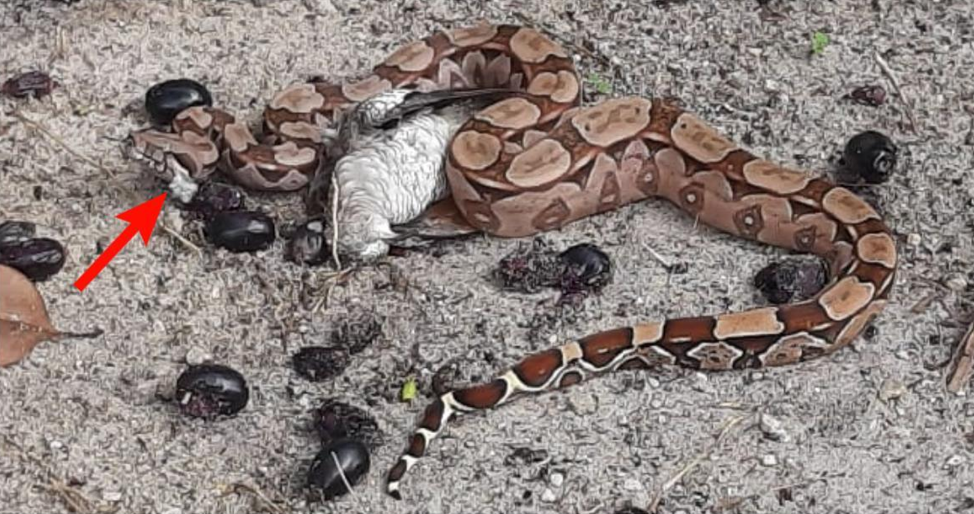
Our record underscores the importance of natural history observations in filling knowledge gaps about snake diets, even for well-studied species such as B. constrictor, which already has over 75 prey species documented (Henderson, 2023). Expanding the known prey list contributes to understanding the species’ ecological impact, informs conservation planning for both predator and prey, and offers insights into predator-prey dynamics in restinga habitats.
Acknowledgements / Authorizations
LNR, VNB, EFS and MLD thank the Coordenação de Aperfeiçoamento de Pessoal de Nível Superior (CAPES) for the master’s and PhD scholarships (grant numbers 88887.956872/2024-00, 88887.713778/2022-00, 88887.935257/2024-00 and 88887.022775/2024-00 respectively). We also thank the Instituto Chico Mendes de Conservação da Biodiversidade (ICMBIO) for the collection permit (SISBIO n° 74327-1).
References
Barbosa, L.A., Almeida-Santos, S.M., Martins, M. (2022): Opportunistic foraging strategies in Neotropical snakes: Implications for prey availability and predator success. J. Zool. 318: 255-266.
Estela, F.A., Jaramillo, J.G., Mejía-Tobón, A. (2005): Ampliación de distribución de la tortolita escamada (Columbina squammata) en el Caribe colombiano. Bol. SAO 15: 105-111.
Greene, H.W. (1997): Snakes: Evolution of Mystery in Nature. Berkeley, University of California Press.
Henderson, R.W. (2023): A review of predation by Boa constrictor (Squamata: Boidae): What, when, and where. Herpetol. Conserv. Biol. 18: 569-578.
León-Lleras, J.S. (2021): Registro superior al ámbito de elevación esperado de la tortolita escamada (Columbina squammata; Columbidae) en Colombia. Ornitol. Colomb. 19: 120-126.
Lillywhite, H.B., Henderson, R.W. (1993): Behavioral and functional ecology of arboreal snakes. In: Snakes: Ecology and behavior, pp. 1-48. Seigel, R.A., Collins, J.T., Eds, New York, McGraw-Hill.
Marques, M.C., Silva, S.M., Liebsch, D. (2015): Coastal plain forests in southern and southeastern Brazil: Ecological drivers, floristic patterns and conservation status. Braz. J. Bot. 38: 1-18.
Marques, O.A.V., Eterovic, A., Sazima, I. (2019): Serpentes da Mata Atlântica: Guia Ilustrado para a Serra do Mar. São Paulo, Editora Ponto A.
Miranda, J.P., Costa, J.C.L., Scarpa, F.M., Rocha, C.F.D. (2013): Predation on Columbina squammata (Aves: Columbidae) by the green vine snake Oxybelis fulgidus (Serpentes: Colubridae) at the Lençóis Maranhenses National Park, Maranhão, Brazil. Herpetol. Notes 6: 187-188.
Moreira, S.G. (2017): Predação de Columbina squammata Lesson, 1831 (Aves: Columbidae) por Cariama cristata Linnaeus, 1766 (Aves: Cariamidae). Bol. Mus. Para. Emílio Goeldi Cienc. Nat. 12: 137-140.
Nogueira, C.C., Argôlo, A.J., Arzamendia, V., Azevedo, J.A., Barbo, F.E., Bérnils, R.S., Borges-Martins, M., Brasil-Godinho, M., Braz, H.B.P., Buononato, M.A., Cisneros-Heredia, D.F., Colli, G.R., Costa, H.C., Franco, F.L., Giraudo, A.R., Gonçalves, U., Hohl, L.E., Hoogmoed, M.S., Marques, O.A.V., Montingelli, G.G., Passos, P., Prudente, A.L.C., Rivas, G.A., Sanchez, P.M., Serrano, F.C., Silva, N.J., Strüssmann, C., Vieira-Alencar, J.P., Zaher, H., Martins, M. (2019): Atlas of Brazilian snakes: Verified point-locality maps to mitigate the Wallacean shortfall in a megadiverse snake fauna. S. Am. J. Herpetol. 14: 1-274.
Rocha-Santos, G., Barbier, E., Bordignon, M.O. (2014): Sweet trap: Boa constrictor preying on passerines on Cecropia pachystachya (Urticales: Cecropiaceae) in fruiting period. Biota Neotrop. 14: e20140003.
Shine, R., Li-Xin, S. (2002): Arboreal ambush site selection by pit-vipers Gloydius shedaoensis. Anim. Behav. 63: 565-576.