https://doi.org/10.36253/a_h-18506
Submitted on: 2025, 6th October; revised on: 2026, 3th February; accepted on: 2026, 4th February
Dinner time in the Atlantic Forest: Trophic niche partitioning of two sympatric Boana species in the Southern Bahia State, Brazil
1 Programa de Pós-graduação em Ecologia e Conservação da Biodiversidade, Universidade Estadual de Santa Cruz, Ilhéus - UESC, Campus Soane Nazaré de Andrade, Rod. Jorge Amado, Km 16 - Salobrinho, CEP 45662-900, Ilhéus, Brasil
2 Universidade Estadual do Maranhão - UEMA, Cidade Universitária Paulo VI, Av. Lourenço Vieira da Silva, n° 1000, Bairro: Jardim São Cristóvão, CEP 65055-310, São Luís, Brasil
3 Universidade de Sorocaba - UNISO, Av. Independência, 210 - Éden, CEP 18087-101, Sorocaba, Brasil
4 Departamento de Ciências Biológicas, Universidade Estadual de Santa Cruz - UESC, Campus Soane Nazaré de Andrade, Rod. Jorge Amado, Km 16 - Salobrinho, CEP 45662-900, Ilhéus, Brasil
5 Universidade Estadual do Sudoeste da Bahia - UESB, Estrada do Bem Querer, km 4, CEP 45083-900, Vitória da Conquista, Brasil
*Corresponding author. Email: kassio.ufpi@gmail.com
Abstract. Understanding the ecological traits of species, such as dietary habits, is important for elucidating their natural history and ecological interactions. Thus, we investigated the trophic ecology and niche partitioning of two treefrog species (Boana atlantica and B. semilineata) in an Atlantic Forest fragment in southern Bahia, northeastern Brazil. In this study, we obtained the diet of 39 B. atlantica and 25 B. semilineata through stomach flushing. We recorded 72 prey items in these two hylids organized into 11 categories. The most consumed prey were plant material and Araneae. Although the niche breadth of B. atlantica was higher than that of B. semilineata, these hylids had a substantial trophic niche overlap (Pianka’s niche overlap index = 0.89). Our findings provide novel insights into the feeding ecology of these endemic Atlantic Forest treefrogs, enhancing our understanding of their ecological roles and trophic resource partitioning in this biodiversity hotspot.
Keywords. Amphibians, diet composition, feeding habit, Hylidae.
Contents
Introduction
To coexist in an environment, a species needs specific resources and conditions that define its ecological niche (Hutchinson, 1957). Processes associated with foraging habitat selection, prey availability, and intraspecific and interspecific competition are crucial to understand the species’ trophic niche (Moser et al., 2017). Beyond ecological interactions, this information is important for comprehending the natural history of the species, population fluctuations, and the effects of environmental change on populations and communities (Anderson et al., 1999; Santos et al., 2004; Richter-Boix et al., 2007).
Anurans play an important role in maintaining environmental stability, participating in different food networks (Poulin et al., 2001; Egeter et al., 2015; Ceron et al., 2019), and contributing to the energy flow and nutrient cycling (Colón-Gaud et al., 2009; Huckembeck et al., 2014). In general, most anuran species are opportunistic and generalist predators consuming a great diversity of invertebrate prey (Solé and Rödder, 2009). However, amphibians’ diets are influenced by various factors, such as prey availability, competition, foraging strategies, ontogeny, morphology, and environmental characteristics (Wells, 2010; Luría-Manzano and Ramírez-Bautista, 2019; Blanco‐Torres et al., 2020; Moroti et al., 2021), making it important to study their trophic ecology. A recent review of Brazilian anuran dietary studies shows that, despite increasing research, only about 19% of species have published diet data, with many endemic and threatened taxa still lacking dietary information, particularly outside the Atlantic Forest ecoregion (Moser et al., 2025).
Anuran communities may be structured according to spatial, temporal, and trophic niches, where ecological factors such as competition and historical factors like phylogeny influence these niche dimensions (Leite-Filho et al., 2017; Caldas et al., 2019). Some studies investigated the trophic niche overlap of congeneric anurans (e.g., Oliveira et al., 2015; Moser et al., 2017; Araújo et al., 2023), including Boana species (Protázio et al., 2017; Moser et al., 2018). It is generally accepted that, in accordance with Gause’s (1932) competitive exclusion principle, species must segregate along at least some niche axes, including trophic niche partitioning, to enable their successful coexistence in sympatry (Kneitel, 2019). Thus, understanding the partitioning of food resources is essential to comprehend species coexistence.
Boana atlantica (Caramaschi and Velosa, 1996) and Boana semilineata (Spix, 1824) are two endemic treefrogs from the Atlantic Forest that occur in sympatry from Alagoas to Bahia (Frost, 2025). Boana semilineata is known to have a generalist diet consisting primarily of coleopterans, acari, orthopterans, and plant fragments (Protázio et al., 2017). While some aspects of B. atlantica’s natural history are known, including its reproductive biology (Camurugi and Juncá, 2013) and advertisement call (Napoli and Cruz, 2005), its trophic ecology remains understudied. Thus, we aimed to (i) describe the diet of two treefrog species that occur in sympatry in a permanent pond within an Atlantic Forest fragment in southern Bahia, Brazil; (ii) test the trophic niche overlap between these hylids; and (iii) evaluate how body mass, body size, and mouth breadth influence prey volume in these anurans. We expected dietary differentiation between the two sympatric hylid species, resulting in low to moderate trophic niche overlap, and a positive relationship between anuran morphology and prey volume.
Materials and methods
Study area
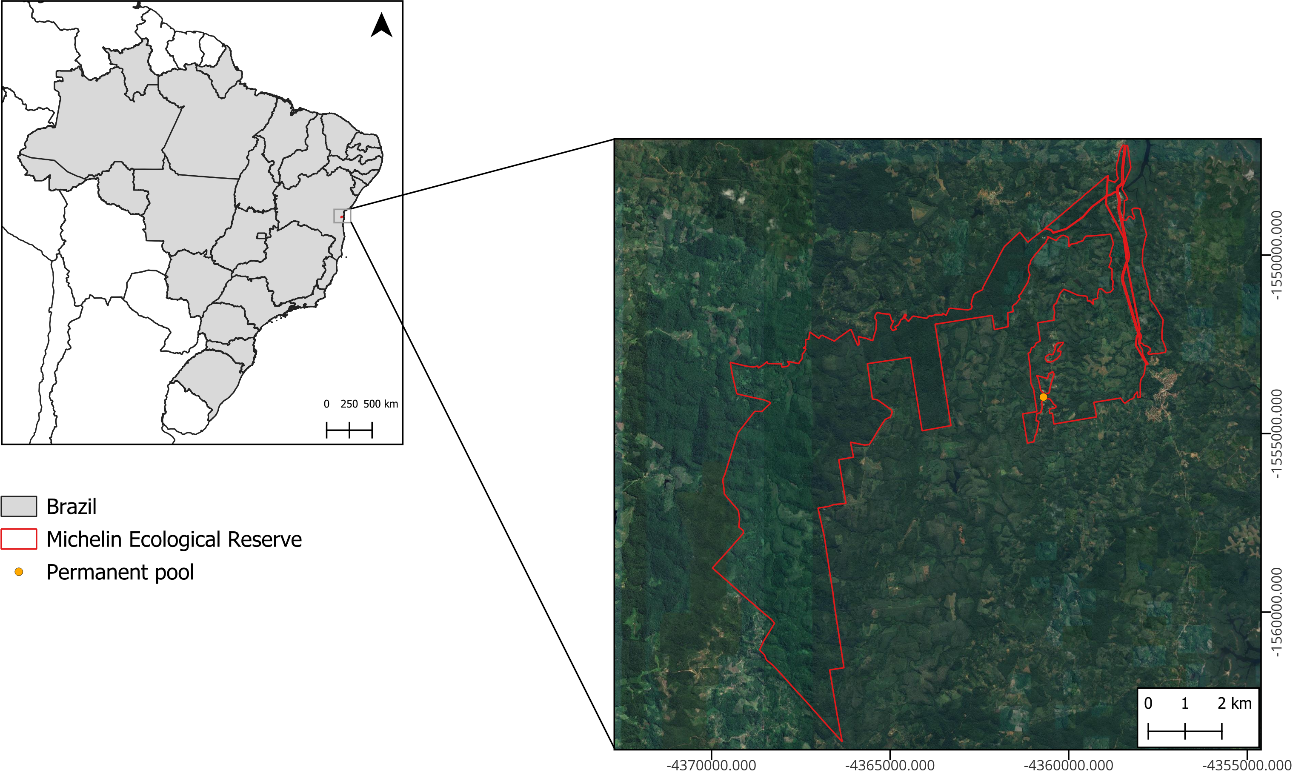
This study was conducted in a permanent pond inside the Michelin Ecological Reserve (-13.82348° S, -39.17286° W, WGS84) in Bahia State, northeastern Brazil (Fig. 1). It encompasses a total area of 3.096 ha within the Atlantic Forest Biome, considered a Dense Ombrophilous Lowland Forest (Veloso et al., 1991), and characterized by the presence of Atlantic Forest fragments at various stages of regeneration (Flesher, 2014). It has an average precipitation of 2000 mm and daily temperatures between 18 °C and 30 °C, with rainfall throughout the year (Flesher, 2014). The area of the pond was ca. 450 m², with a maximum depth of 1.5 m, located in a forest fragment embedded within a rubber tree plantation area. Besides trees, the vegetation around the pond edge is composed of shrubs and herbaceous species.
Sampling design
We conducted fieldwork to search for specimens of B. atlantica and B. semilineata at a permanent pond during the night period (18 to 23 h) between March and May 2011, using auditory and visual searches (Heyer et al., 1994). Individuals were identified based on their advertisement calls, dorsal coloration patterns, and morphological traits (see Caramaschi and Velosa, 1996, for the diagnosis of B. atlantica, and Izecksohn and Carvalho, 2001, for the diagnosis of B. semilineata). We collected and transported the observed individuals in plastic bags to the lab in the Center for Biodiversity Studies of the Michelin Ecological Reserve. To avoid pseudoreplication, specimens were captured and released only at the end of each field campaign, ensuring that no individual was resampled within the same campaign. In the lab, the specimens were weighed on electronic scales and had their snout-vent length (SVL) and mouth breadth (MB) measured with a digital caliper with 0.01 mm precision. Subsequently, they were stomach flushed following the protocol proposed by Solé et al. (2005) and released into the pond, from which they had been collected.
Data analyses
In the laboratory, the stomach contents were separated, and the prey items were identified to the lowest possible taxonomic level (usually order) using the specialized literature (Rafael et al., 2024). Then, we calculated the frequency of occurrence (FO% = number of stomachs containing item i / total number of stomachs × 100), and the numeric abundance (N% = number of individuals of item i / total individuals of all items × 100). Since we did not calculate the volume of each prey item consumed, we used an adapted formula (IRI = (FO% + N%) / 2) for the index of relative importance originally proposed by Pinkas et al. (1971).
Additionally, to measure the total volume of prey consumed by the Boana specimens, we placed each individual’s stomach contents in an oven set to 60 °C to dry and stabilize the mass. We used a GEHAKA AG-200 scale (accuracy of 0.1 mg) to weigh the stomach contents. Collinearity among morphological predictors was evaluated using variance inflation factors (VIF). As all VIF values were below 2, no collinearity issues were detected, and all variables were retained for analysis (James et al., 2013). We then fitted generalized linear models (GLMs) to evaluate whether prey volume was influenced by body mass, snout–vent length (SVL), and mouth breadth (MB) in the two Boana species. We initially fitted a full model including all predictors simultaneously (Volume ~ Mass + SVL + MB), assuming a Gamma error distribution with a log-link function. Model adequacy was assessed through residual diagnostics appropriate for GLMs. In addition, we evaluated alternative models with reduced sets of predictors and compared model performance using Akaike’s Information Criterion (AIC). Models with ΔAICc lower than 2 were interpreted as having the most substantial support (Burnham and Anderson, 2002).
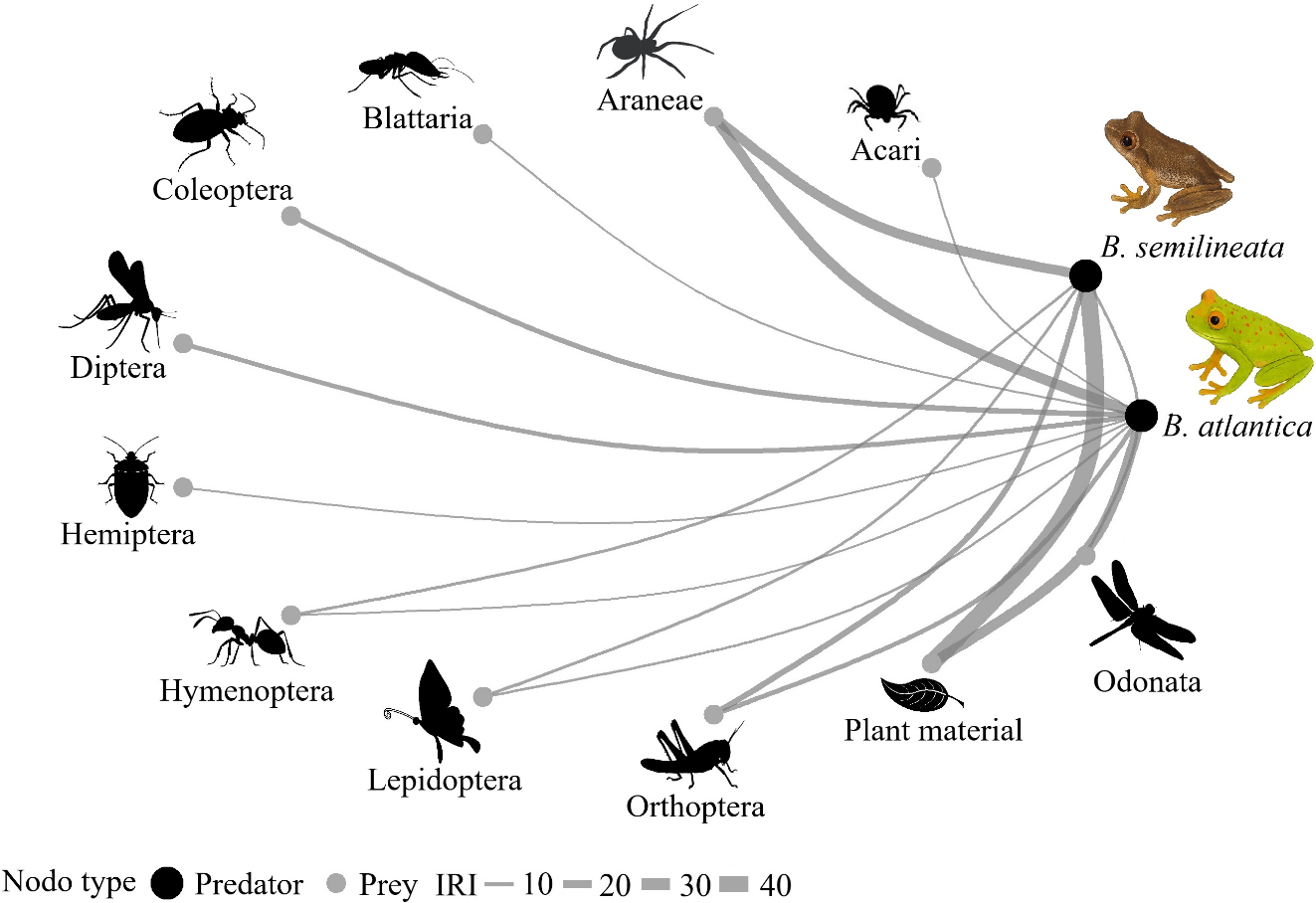
We estimated the numerical trophic niche breadth (Bnum) of the two Boana species using the standardized Levins’ index (Levins, 1968), which ranges from 0, indicating dietary specialization, to 1, indicating a generalist diet. Then, we used Pianka’s niche overlap index (Pianka, 1973) to calculate the trophic niche overlap (Ojk) between B. atlantica and B. semilineata. We used a bipartite network graph as an exploratory tool to visualize prey diversity between the two hylid species, with interaction strength represented by the index of relative importance of each prey item for both Boana species. Statistical analyses were done using the R packages bipartite (Dormann et al., 2009), ggraph (Pedersen et al., 2022), ggplot2 (Wickham, 2016), igraph (Csardi and Nepusz, 2006), spaa (Zhang, 2016), tibble (Müller and Wickham, 2023), vegan (Oksanen et al., 2019), and usdm (Naimi et al., 2014).
Results
We found 64 anuran specimens (39 B. atlantica and 25 B. semilineata), including 48 with stomach contents (30 B. atlantica and 18 B. semilineata). We found 72 prey items grouped into 11 categories, with plant material (N = 23) and Araneae (N = 20) as the most consumed prey. Plant fragments were found in the stomach contents of 23 individuals, while Araneae appeared in 17.
We observed that B. atlantica consumed 10 prey categories (Bnum = 5.31), with plant material (IRI = 27.1) and Araneae (IRI = 27.0) being the most abundant and frequently encountered prey types. In contrast, Acari, Blattaria, Hemiptera, and Hymenoptera were consumed less frequently (IRI = 2.09), with only one individual recorded for each (Table 1). Additionally, we found no support for the influence of anuran weight (T = 0.559, P = 0.580), size (T = -0.584, P = 0.564), and mouth breadth (T = -0.460, P = 0.649) on the volume of the stomach contents.
| Boana atlantica | Boana semilineata | |||||||||
|---|---|---|---|---|---|---|---|---|---|---|
| FO | FO% | N | N% | IRI | FO | FO% | N | N% | IRI | |
| ARACHNIDA | ||||||||||
| Acari | 1 | 2.0 | 1 | 2.17 | 2.09 | - | - | - | - | - |
| Araneae | 14 | 28.0 | 12 | 26.1 | 27.0 | 6 | 27.3 | 5 | 23.8 | 25.5 |
| HEXAPODA | ||||||||||
| Blattaria | 1 | 2.0 | 1 | 2.17 | 2.09 | - | - | - | - | - |
| Coleoptera | 6 | 12.0 | 6 | 13.0 | 12.5 | - | - | - | - | - |
| Diptera | 5 | 10.0 | 5 | 10.9 | 10.4 | - | - | - | - | - |
| Hemiptera | 1 | 2.0 | 1 | 2.17 | 2.09 | - | - | - | - | - |
| Hymenoptera | 1 | 2.0 | 1 | 2.17 | 2.09 | 1 | 4.55 | 1 | 4.76 | 4.65 |
| Lepidoptera | 2 | 4.0 | 2 | 4.35 | 4.17 | 1 | 4.55 | 1 | 4.76 | 4.65 |
| Odonata | - | - | - | - | - | 1 | 4.55 | 1 | 4.76 | 4.65 |
| Orthoptera | 6 | 12.0 | 4 | 8.70 | 10.3 | 3 | 13.6 | 3 | 14.2 | 14.0 |
| OTHER ITEMS | ||||||||||
| Plant material | 13 | 26.0 | 13 | 28.3 | 27.1 | 10 | 45.5 | 10 | 47.6 | 46.5 |
| TOTAL | 50 | 100 | 46 | 100 | 100 | 22 | 100.0 | 21 | 100 | 100 |
Likewise, plant material (IRI = 46.5) and Araneae (IRI = 25.5) were the most prominent prey items in the diet of B. semilineata. This species consumed only six prey categories and had a narrower numerical trophic niche breadth (Bnum = 3.37). Hymenoptera, Lepidoptera, and Odonata were consumed less frequently, with only one individual recorded for each (Table 1).
We also observed that the volume of the stomach contents was not influenced by the anurans’ weight (T = 1.194, P = 0.250), size (T = -1.160, P = 0.263), and mouth breadth (T = 0.978, P = 0.342). Model comparison based on AIC indicated that the null model best fit the data for both species. Models including morphological predictors (SVL, mouth breadth, or body mass), alone or combined, did not improve performance (ΔAIC > 2), indicating no effect of morphology on prey volume.
We observed that the two Boana species consumed different numbers of prey categories. Boana semilineata exhibited a more specialist dietary strategy (Bnum = 0.24), whereas Boana atlantica showed an intermediate to generalist strategy (Bnum = 0.43), indicating a broader trophic niche breadth. In addition, the two species exhibited a high trophic niche overlap (Ojk = 0.89), with five prey categories shared by both species (Fig. 2).
Discussion
We observed that the Boana species studied had a generalist and opportunistic diet, which is a common pattern for most Neotropical anurans (Toft, 1981; Wells, 2010), including the genus Boana (e.g., Araújo et al., 2007; Moser et al., 2018; Rodrigues et al., 2023, Machado et al., 2024). The presence of prey with high mobility in the diet composition of these hylids, such as Araneae, Odonata, Orthoptera, and Diptera, may indicate a sit-and-wait strategy (Parmelee, 1999; Protázio et al., 2017). This foraging strategy pattern seems to be predominant for Hylidae species (e.g., Mahan and Johnson, 2007; Castro et al., 2016; Silva et al., 2021), including the genus Boana (e.g., Protázio et al., 2017; Sant’anna et al., 2022; Rodrigues et al., 2023).
Although some species, such as Xenohyla truncata and Phrynoderma hexadactylum, may exhibit an uncommon frugivory or herbivory pattern (Das, 1996; Oliveira-Nogueira et al., 2023), most studies suggest that anurans consume plant material incidentally while preying on invertebrates (Sabagh et al., 2010; Castro et al., 2016, Araújo et al., 2023). However, we observed that the most consumed prey item by both Boana species was plant fragments. The consumption of plant material can aid in the elimination of intestinal parasites and provide an additional supply of water and nutrients, provided it is digestible (Anderson et al., 1999; Tupy et al., 2021). Additionally, Silva et al. (1989) demonstrated that during the dry season, when invertebrate populations diminished, Xenohyla truncata incorporated fruits and bromeliad seeds into its diet. While the ingestion of plant debris is frequently documented in Boana species (e.g., Moser et al., 2018; Tupy et al., 2021; Rodrigues et al., 2023), further research is necessary to elucidate the significance of plant fragments in the diet of these hylids.
Anuran–prey selection might be mediated by different traits, such as morphology, foraging strategy, prey mobility, and availability (Lima and Moreira, 1993; López et al., 2009; Blanco‐Torres et al., 2020). However, the volume of stomach contents of B. atlantica and B. semilineata was not influenced by their weight, snout-vent length, and mouth breadth. Although some studies support the hypothesis that larger frogs tend to eat a larger prey volume (e.g., Rosa et al., 2011; Pacheco et al., 2017; Araújo et al., 2023), it is still an unclear issue because others do not support this relationship (e.g., Rodrigues et al., 2023; Ferreira et al., 2024). As a result, establishing a link between morphology and prey volume in anurans is difficult, particularly from an intraspecific perspective.
We observed that B. atlantica and B. semilineata had a high trophic niche overlap with opportunist characteristics. These species share five prey categories, including the prey items with the highest IRI such as plant material and spiders (see Fig. 2). Studies encompassing the anuran community (e.g., Protázio et al., 2015; Leite-Filho et al., 2017), as well as investigations focused just on two species (e.g., Sabagh et al., 2010; Araújo et al., 2023), indicate that generalist and opportunistic amphibians frequently share prey items within their diet. Likewise, coexisting Boana species have a substantial trophic niche overlap (Moser et al., 2018; Tupy et al., 2021; Sant’anna et al., 2022), which may be related to their opportunistic trophic strategy. Given limited resources, species must segregate into certain niche axes to coexist (MacArthur and Levins, 1967; Gotelli, 2009). However, it is impossible to determine whether or not these species compete for trophic resources in the study area because we did not perform a prey availability analysis there. Thus, further studies are required to determine the mechanisms and processes that may allow B. atlantica and B. semilineata to coexist.
Overall, the studied hylids consume whatever is available in their surroundings, exhibiting a generalist dietary pattern and, as a result, a high degree of overlap in prey items. However, we cannot state that these species are truly competing for trophic resources. Our findings contribute to the understanding of the trophic ecology of two endemic Boana species from the Atlantic Forest. It is important to highlight the general lack of research on anuran diets, despite diet representing a fundamental aspect of natural history for understanding predator-prey interactions, hypothesis testing, and the assessment of conservation status (Moser et al., 2025). Consequently, natural history studies play a crucial role in informing conservation planning for species and their environments.
Acknowledgments
KCA thanks the Universidade Estadual do Maranhão for granting Institutional Technical Support Scholarships (EDITAL N° 20/2025 - PPG/CP/UEMA). CVMM thanks the Universidade Estadual do Maranhão (UEMA; sênior productivity grant 05/2023-PPG/UEMA). IRD acknowledges financial support from CNPq (PQ 315362/2021-9 and 311511/2025-2). MS also acknowledges CNPq for financial support (PQ 309365/2019-8 and 306397/2025-0). Permits to capture and handle animals were provided by Biodiversity Authorization and Information System – SISBIO Number: #13708-1.
References
Anderson, A.M., Haukos, D.A., Anderson, J.T. (1999): Diet composition of three anurans from the Playa Wetlands of Northwest Texas. Copeia 1999: 515-520.
Araújo, K.C., Cassiano-Lima, D., Brasileiro, A.C., Bezerra, C.H., Ávila, R.W. (2023): What the minute shield frogs Adelophryne eat at a humid forest relict in Ceará state, northeastern Brazil. North-West. J. Zool. 19: e231503.
Araújo, F.R.R.C., Bocchiglieri, A., Holmes, R.M. (2007): Ecological aspects of the Hypsiboas albopunctatus (Anura, Hylidae) in central Brazil. Neotrop. Biol. Conserv. 2: 165-168.
Blanco‐Torres, A., Duré, M.I., Bonilla, M.A., Cagnolo, L. (2020): Predator–prey interactions in anurans of the tropical dry forests of the Colombian Caribbean: A functional approach. Biotropica 2020: 1-8.
Burnham, K.P., Anderson, D.R. (2002): Model selection and multimodel inference: A practical information-theoretic approach. New York, Springer-Verlag.
Caldas, F.L., Garda, A.A., Cavalcanti, L.B., Leite-Filho, E., Faria, R.G., Mesquita, D.O. (2019): Spatial and trophic structure of anuran assemblages in environments with different seasonal regimes in the Brazilian Northeast Region. Copeia. 107: 567-584.
Camurugi, F., Juncá, F. (2013): Reproductive biology of Hypsiboas atlanticus (Anura: Hylidae). Herpetol. Notes 6: 489-495.
Caramaschi, U., Velosa, A. (1996): Nova espécie de Hyla Laurenti, 1768 do leste brasileiro (Amphibia, Anura, Hylidae). Bol. Mus. Nac., N. Ser., Zool. 365:1-7.
Castro, I.M., Rebouças, R., Solé, M. (2016): Diet of Dendropsophus branneri (Cochran, 1948) (Anura: Hylidae) from a cocoa plantation in southern Bahia, Brazil. North-West. J. Zool. 12: 159-165.
Ceron, K., Oliveira‐Santos, L.G.R., Souza, C.S., Mesquita, D.O., Caldas, F.L., Araujo, A.C., Santana, D.J. (2019): Global patterns in anuran–prey networks: structure mediated by latitude. Oikos 128: 1537-1548.
Colón-Gaud, C., Whiles, M.R., Kilham, S.S., Lips, K.R., Pringle, C.M., Connelly, S., Peterson, S.D. (2009): Assessing ecological responses to catastrophic amphibian declines: Patterns of macroinvertebrate production and food web structure in upland Panamanian streams. Limnol. Oceanogr. 54: 331-343.
Csardi, G., Nepusz, T. (2006): The igraph software package for complex network research. InterJ. Complex Syst. 1695: 1-9.
Das, I. (1996): Folivory and seasonal changes in diet in Rana hexadactyla (Anura: Ranidae). J. Zool. 238: 785-794.
Dormann, C.F., Gruber, B., Fründ, J. (2009): Introducing the bipartite package: Analysing ecological networks. R News 8: 8-11.
Egeter, B., Bishop, P.J., Robertson, B.C. (2015): Detecting frogs as prey in the diets of introduced mammals: A comparison between morphological and DNA‐based diet analyses. Mol. Ecol. Resour. 15: 306-316.
Ferreira, J.L.P., Araújo, K.C., Andrade, E.B., Mira-Mendes, C.V. (2024): Are the males of Dendropsophus minutus (Peters, 1872) spider devourers? Cuad. Herpetol. 38:1-5.
Flesher, K.M. (2014): Plano de manejo da RPPN Ouro Verde. Igrapiúna: Reserva Ecológica Michelin. Available at: https://purchasing.michelin.com/wp-content/uploads/2025/01/RPPN-Ouro-Verde-Plano-de-Manejo-Sep-17-2014.pdf. [Accessed 28 July 2025].
Frost, D.R. (2025): Amphibian species of the world 6.2, an online reference. American Museum of Natural History, New York.
Gause, G.F. (1932): Experimental studies on the struggle for existence I. Mixed population of two species of yeast. J. Exp. Biol. 9:389-402.
Gotelli, N.J. (2009): Ecologia. 4th Edition. Londrina, Editora Planta.
Heyer, W.R., Donnelly, M.A., McDiarmid, W., Hayek, L.A.C., Foster, M.S. (1994): Measuring and monitoring biological diversity – Standard methods for amphibians. Washington, Smithsonian Institution Press.
Huckembeck, S., Loebmann, D., Albertoni, E. F., Hefler, S. M., Oliveira, M. C., Garcia, A. M. (2014): Feeding ecology and basal food sources that sustain the Paradoxal frog Pseudis minuta: A multiple approach combining stomach content, prey availability, and stable isotopes. Hydrobiologia 740: 253-264.
Hutchinson, G.E. (1957): Concluding remarks. Cold Spring Harb. Symp. Quant. Biol. 22: 415-427.
Izecksohn, E., Carvalho, S.P. (2001): Anfíbios do município do Rio de Janeiro. Rio de Janeiro, Editora UFRJ.
James, G., Witten, D., Hastie, T., Tibshirani, R. (2013): An introduction to statistical learning: With applications in R. New York, Springer.
Kneitel, J.M. (2019): Gause’s competitive exclusion principle. In: Encyclopedia of ecology, pp. 110-113. Fath, B.D, Eds, Elsevier.
Leite-Filho, E., Oliveira, F.A., Eloi, F.J., Liberal, C.N., Lopes, A.O., Mesquita, D.O. (2017): Evolutionary and ecological factors influencing an anuran community structure in an Atlantic Rainforest urban Fragment. Copeia 105: 64-74.
Levins, R. (1968): Evolution in changing environments: some theoretical explorations. Princeton, Princeton University Press.
Lima, A.P., Moreira, G. (1993): Effects of prey size and foraging mode on the ontogenetic change in feeding niche of Colostethus stepheni (Anura: Dendrobatidae). Oecologia 95: 93-102.
López, J.A., Scarabotti, P.A., Medrano, M.C., Ghirardi, R. (2009): Is the red spotted green frog Hypsiboas punctatus (Anura: Hylidae) selecting its preys?: The importance of prey availability. Rev. Biol. Trop. 57: 847-857.
Luría-Manzano, R., Ramírez-Bautista, A. (2019): Ontogenetic variation in the diet of the anuran community from a semi-arid environment in the southeastern Chihuahuan Desert. PeerJ 7: e7908.
MacArthur, R.H., Levins, R. (1967): The limiting similarity, convergence, and divergence of coexisting species. Am. Nat. 101: 377-385.
Machado, H.T.S., Silva, C.F., Benício, R.A., Ávila, R.W. (2024): Feeding ecology, reproductive biology, and sexual dimorphism of Boana raniceps (Anura: Hylidae) in an area of Caatinga, northeastern Brazil. Caldasia 46: 71-80.
Mahan, R.D., Johnson, J.R. (2007): Diet of the Gray Treefrog (Hyla versicolor) in relation to foraging site location. J. Herpetol. 41: 16-23.
Moroti, M.T., Soares, P.T., Pedrozo, M., Provete, D.B., Santana, D.J. (2021): The effects of morphology, phylogeny and prey availability on trophic resource partitioning in an anuran community. Basic Appl. Ecol. 50: 181-191.
Moser, C.F., Avila, F.R., Oliveira, M., Tozetti, A.M. (2017): Diet composition and trophic niche overlap between two sympatric species of Physalaemus (Anura, Leptodactylidae, Leiuperinae) in a subtemperate forest of southern Brazil. Herpetol. Notes 10: 9-15.
Moser, C.F., Oliveira, M.D., Avila, F.R.D., Dutra-Araújo, D., Farina, R.K., Tozetti, A.M. (2018): Diet and trophic niche overlap of Boana bischoffi and Boana marginata (Anura: Hylidae) in southern Brazil. Biota Neotrop. 19: e20180542.
Moser, C.F., Ceron, C., Schuck, L.K., Santana, D.J., Solé, M., Iop, S., Tozetti, A.M. (2025): Current state of the art in anuran dietary studies in Brazil. Discov. Ecol. 1: 1-9.
Müller, K., Wickham, H. (2023): Tibble: Simple data frames. R package version 3.3.0.
Naimi, B., Hamm, N.A.S., Groen, T.A., Skidmore, A.K., Toxopeus, A.G. (2014): Where is positional uncertainty a problem for species distribution modelling?. Ecography 37:191-203.
Napoli, M.F., Cruz, I.C. (2005): The advertisement call of Hyla atlantica Caramaschi & Velosa, 1996, with considerations on its taxonomic status. Arq. Mus. Nac. 63: 283-288.
Oksanen, J., Blanchet, F.G., Friendly, M., Kindt, R., Legendre, P., McGlinn, D., Minchin, P.R., O’Hara, R.B., Simpson, G.L., Solymos, P., Henry, M., Stevens, H., Szoecs, E., Wagner, H. (2019): Vegan: Community ecology package. R package version 2.5-6.
Oliveira, M., Gottschalk, M.S., Loebmann, D., Santos, M.B., Miranda, S., Rosa, C., Tozetti, A.M. (2015): Diet composition and niche overlap in two sympatric species of Physalaemus (Anura, Leptodactylidae, Leiuperinae) in coastal subtemperate wetlands. Herpetol. Notes 8: 173-177.
Oliveira-Nogueira, C.H., Souza, U.F., Machado, T.M., Figueiredo-de-Andrade, C.A., Mônico, A.T., Sazima, I., Sazima, M., Toledo, L.F. (2023): Between fruits, flowers and nectar: The extraordinary diet of the frog Xenohyla truncata. Food Webs 35: e00281.
Pacheco, E.O., Ferreira, V.G., Carvalho, R.M.H. (2017): Diet of Boana albopunctata (Anura: Hylidae) in an Atlantic Forest fragment of southeastern Brazil. Phyllomedusa 16: 57-62.
Parmelee, J.R. (1999): Trophic ecology of a tropical anuran assemblage. Nat. Hist. Mus. Univ. Kans. 11: 1-59.
Pedersen, T.L. (2022): ggraph: An implementation of grammar of graphics for graphs and networks. R package version 2.2.2.
Pianka, E.R. (1973): The structure of lizard communities. Annu. Rev. Ecol. Syst. 4: 53-74.
Pinkas, L., Oliphant, M.S., Iverson, I.L.K. (1971): Food habits of albacore, bluefin tuna, and bonito in California waters. Fish. Bull. 152: 1-105.
Poulin, B., Lefebvre, G., Ibáñez, R., Jaramillo, C., Hernández, C., Rand, A.S. (2001): Avian predation upon lizards and frogs in a neotropical forest understorey. J. Trop. Ecol. 17: 21-40.
Protázio, A.S., Albuquerque, R.L., Falkenberg, L.M., Mesquita, D.O. (2015): Niche differentiation of an anuran assemblage in temporary ponds in the Brazilian semiarid Caatinga: Influence of ecological and historical factors. Herpetol. J. 25: 109-121.
Protázio, A.S., Vieira, M.V.D.S.A., Braga, H.S.N., Conceição, L.C., Santos, U.G., Ribeiro, A.C., Cruz, S.J., Protázio, A.S. (2017): Relação de nicho espacial e alimentar entre Boana semilineata e Boana pombali (Anura: Hylidae) em fragmentos de Mata Atlântica no Nordeste da Bahia. Magistra. 29: 315-327.
Rafael, J.A., Melo, G.A.R.D., Carvalho, C.J.B.D., Casari, S.A., Constantino, R. (2024): Insetos do Brasil: Diversidade e taxonomia. 2nd ed. Manaus: Instituto Nacional de Pesquisas da Amazônia.
Richter-Boix, A., Llorente, G.A., Montori, A., Garcia, J. (2007): Tadpole diet selection varies with the ecological context in predictable ways. Basic Appl. Ecol. 8: 464-474.
Rodrigues, N.L.A., Araújo, K.C., Ávila, R.W., Andrade, E.B. (2023): Feeding habits of Boana raniceps (Cope, 1862) in three mountains of Brazilian semiarid. Univers. Sci. 28: 257-277.
Rosa, I., Canavero, A., Maneyro, R., Camargo, A. (2011): Trophic niche variation and individual specialization in Hypsiboas pulchellus (Duméril and Bibron, 1841) (Anura, Hylidae) from Uruguay. South Am. J. Herpetol. 6: 98-106.
Rossa-Feres, D.C., Garey, M.V., Caramaschi, U., Napoli, M.F., Nomura, F., Bispo, A.A., Haddad, C. (2017): Anfíbios da Mata Atlântica: Lista de espécies, histórico dos estudos, biologia e conservação. Rev. Zool. Mata Atlântica, Sér. Pesq. 310: 231-314.
Sabagh, L.T., Ferreira, V.L., Rocha, C.F.D. (2010): Living together, sometimes feeding in a similar way: The case of the syntopic hylid frogs Hypsiboas raniceps and Scinax acuminatus (Anura: Hylidae) in the Pantanal of Miranda, Mato Grosso do Sul State, Brazil. Braz. J. Biol. 70: 955-959.
Sant’anna, B.S., Fonseca, A.M., Ferreira, R.F.B. (2022): Diet composition and coexistence of Boana geographica and Boana raniceps (Anura: Hylidae) from Central Amazonia, Brazil. North-West. J. Zool. 18: 170-183.
Santos, E.M., Almeida, A.V., Vasconcelos, S.D. (2004): Feeding habits of six anuran (Amphibia: Anura) species in a rainforest fragment in Northeastern Brazil. Iheringia. S. Zool. 94: 433-438.
Silva, I.C.O., Soares, P., Ribas, A.C.A., Santana, D.J., Campiao, K.M., Tavares, L.E.R. (2021): Scinax fuscovarius (Anura, Hylidae) diet assessment at Serra da Bodoquena, Mato Grosso do Sul, Brazil. North-West. J. Zool. 17: 29-33.
Silva, H.R., Britto-Pereira, M.C., Caramaschi, U. (1989): Frugivory and seed dispersal by Hyla truncata, a Neotropical tree-frog. Copeia 1989: 785-794.
Solé, M., Beckmann, O., Pelz, B., Kwet, A., Engels, W. (2005): Stomach-flushing for diet analysis in anurans: An improved protocol evaluated in a case study in Araucaria forests, southern Brazil. Stud. Neotrop. Fauna Environ. 40: 23-28.
Solé, M., Rödder, D. (2009): Dietary assessments of adult amphibians. In: Amphibian Ecology and Conservation: A Handbook of Techniques, pp. 167-184. Dodd, K.C., Ed, Oxford University Press.
Toft, C.A. (1981): Feeding ecology of Panamanian litter anurans: Patterns in diet and foraging mode. J. Herpetol. 15: 139-144.
Tupy, G.S., Cardoso, G.S., Vilanova-Júnior, J.L., Pinto, R.S.S., Vieira, S.S., Gomes, V.M.S., Rodrigues, W.S., Faria, R.G., Caldas, F.L.S. (2021): Trophic ecology of Boana albomarginata and Boana pombali (Anura: Hylidae) during the dry season in the Serra de Itabaiana National Park, Northeast Brazil, North-West. J. Zool. 17: 220-226.
Veloso, H.P., Rangel-Filho, A.L.R., Lima, J.C. (1991): Classificação da vegetação brasileira, adaptada a um sistema universal. Rio de Janeiro, IBGE.
Wells, K.D. (2010): The ecology and behavior of amphibians. University of Chicago Press.
Wickham H (2016) ggplot2: Elegant graphics for data analysis. 3rd ed. New York, Springer-Verlag, 2016.
Zhang, J. (2016): Spaa: Species association analysis. R package version 0.2.2.