Submitted on: 2025, 13th September; revised on: 2025, 24th September; accepted on: 2025, 27th September
Shadowboxing salamanders: Defensive behavior in two Amazonian Bolitoglossa species (Amphibia: Plethodontidae)
1 Graduate Program in Zoology, Universidade Estadual de Santa Cruz, Ilhéus, Bahia, Brazil
2 Department of Biology, Stanford University, Stanford, California, USA
3 Laboratorio de Ecología y Evolución, Dirección de Investigación en Diversidad Biológica Terrestre Amazónica, Instituto de Investigaciones de la Amazonía Peruana, Huánuco, Perú
4 Museo de Zoología, Pontificia Universidad Católica del Ecuador, Quito, Ecuador
*Corresponding author. Email: danielaparejamejia@gmail.com
Abstract. Salamanders employ diverse anti-predator strategies, yet many tropical species remain poorly documented. We describe a previously unreported defensive display in two Amazonian plethodontids, Bolitoglossa equatoriana and B. altamazonica. During nocturnal surveys in the Apayacu Reserve, Ecuador, an individual of B. equatoriana perched on a leaf performed a striking “shadowboxing” display when illuminated: it repeatedly raised and waved its forelimbs while swaying from side to side for several minutes. A comparable behavior was observed in B. altamazonica in Peru after gentle handling for photography. Neither species exhibited skin secretions or bright warning colors during the display, although anecdotal reports suggest mild cutaneous reactions to B. altamazonica secretions. Shadowboxing may therefore function as a visual deterrent, complementing chemical defenses documented in other species of Bolitoglossa. Similar posturing is rare in salamanders, previously noted only in a few species such as Cryptotriton nasalis. These records expand knowledge of antipredator behavior in neotropical salamanders and underscore the importance of detailed natural-history observations for understanding behavioral diversity and survival strategies in Amazonian amphibians.
Keywords. Antipredator behavior, defensive display, Plethodontidae.
Salamanders use a lot of different ways to avoid being eaten, and these ways vary across species, individuals, and environmental contexts (Brodie, 1977). These strategies include behavioral responses, physical adaptations, and chemical defenses (Brodie, 1977; Arrivillaga and Brown, 2018). For instance, the Northern two-lined salamander, Eurycea bislineata (Green, 1818) responds to predator cues such as snake tongue-flicks by running, jumping, or staying still (Dowdey and Brodie, 1989). Running is the most common strategy in areas with a lot of predators (Ducey and Brodie, 1983). Savage (2002) described body-flipping as a defensive behavior shown by salamanders of the genus Oedipina, especially in reaction to violent disruptions or direct physical contact. To protect important body parts from predators, many salamanders take defensive positions. They commonly focus on their tails, which they can give up to escape (Myette, 2019). Some species also have bright colors on their bellies that act as a warning sign that their skin secretions are poisonous or unpleasant (Brodie et al., 1979). Although the chemical composition of the skin of most Caudata species is unknown (de Vasconcelos et al., 2021), the cyan newt, Hypselotriton cyanurus (Liu, Hu, and Yang, 1962) rolls onto its back to prominently display its warning colors (Brodie, 1977).
The genus Bolitoglossa, part of the family Plethodontidae, is the biggest group of salamanders. It can be found all over tropical America (Frost, 2024). These salamanders live in a wide range of places, from grasslands at high elevations to rainforests in lowlands, and may display a lot of genetic and phenotypic variety (Jaramillo et al., 2020). Many species, including B. ramosi, B. rostrata, and B. subpalmata, produce potent skin toxins that deter predators (Brodie et al., 1991; Medina et al., 2022). Other species in the genus secret viscous substances that may be toxic (B. diaphora, B. conanti, B. dunni; Arrivillaga and Brown, 2018). However, the chemical and behavioral anti-predator strategies of this genus are still not well documented.
This study documents an antipredator behavior not yet described for Bolitoglossa equatoriana and B. altamazonica in the Amazon rainforest of Ecuador and Peru, respectively. The Ecuadorian climbing salamander, Bolitoglossa equatoriana (Brame and Wake, 1972), is endemic to the western Amazon basin and is found in several provinces of Ecuador, including Napo, Orellana, Pastaza, Sucumbíos and Morona Santiago (Almendáriz et al., 2004). This species is common at night in the eastern forests of Ecuador (Raffaëlli, 2013). On the other hand, B. altamazonica (Cope, 1874) is restricted to just a few localities in Loreto, Peru (Cusi et al., 2020). The behavior of these species remains poorly understood, highlighting the need for natural history observations to be documented.
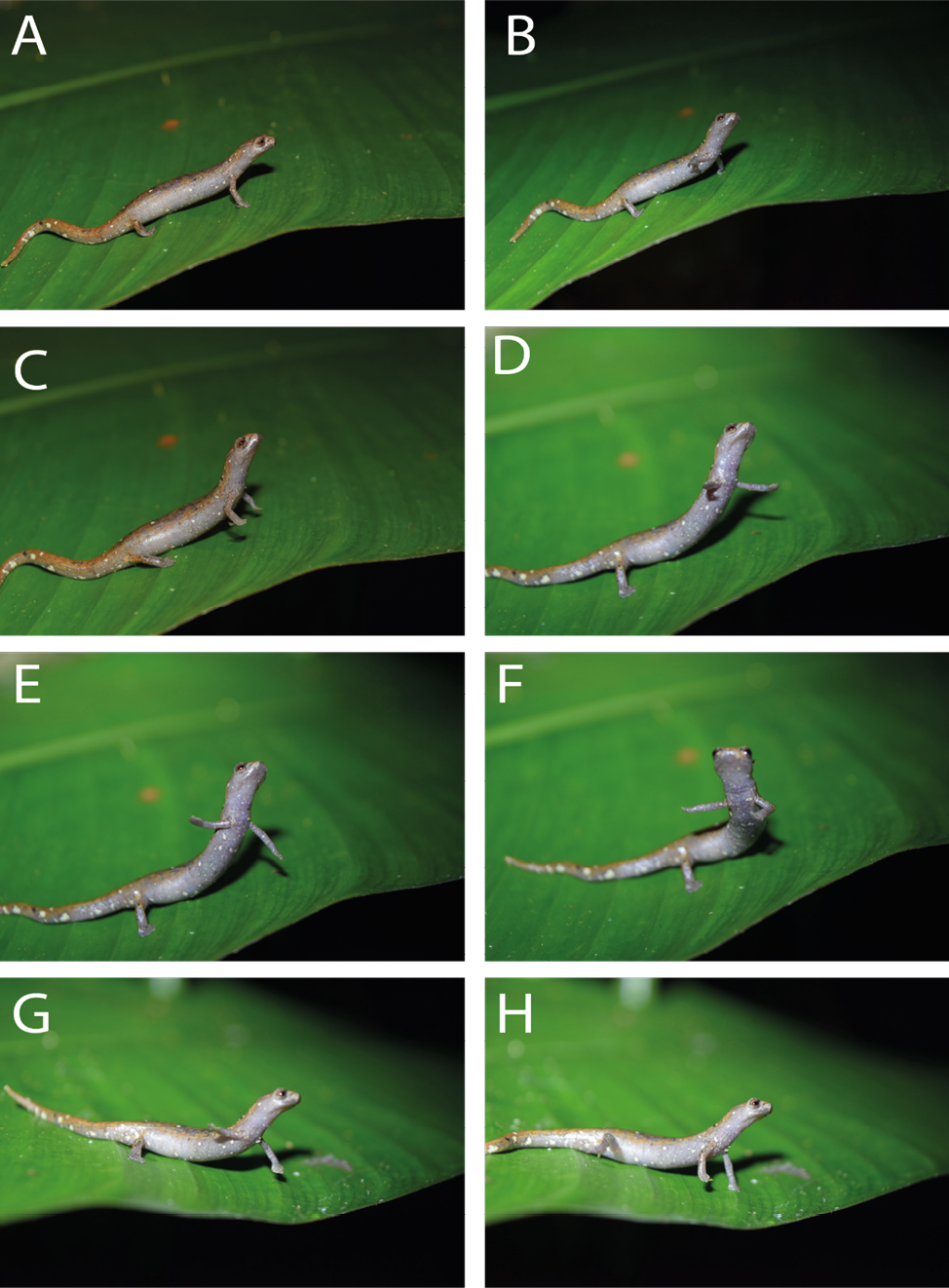
During a field expedition to the Apayacu Reserve (-1.067° S, -77.670° W, 400 m a.s.l.) in Tena Province, Ecuador, in November 2023, we found an individual of Bolitoglossa equatoriana during an active search for amphibians at night. The salamander was perched on a leaf, and as we approached with the light of a headlamp to observe it more closely, it began to perform a fascinating behavior, resembling shadowboxing movement (Fig. 1, Supplementary material Video 1). Shadowboxing refers to the act of striking into the air without an opponent, typically used to practice movements, refine technique, and simulate combat scenarios. The salamander individual raised both front legs and swayed back and forth while holding them up. This behavior continued for several minutes, during which the salamander intermittently rested its legs before starting the movement again. We observed this sequence on at least three occasions, totaling six minutes during the same encounter.
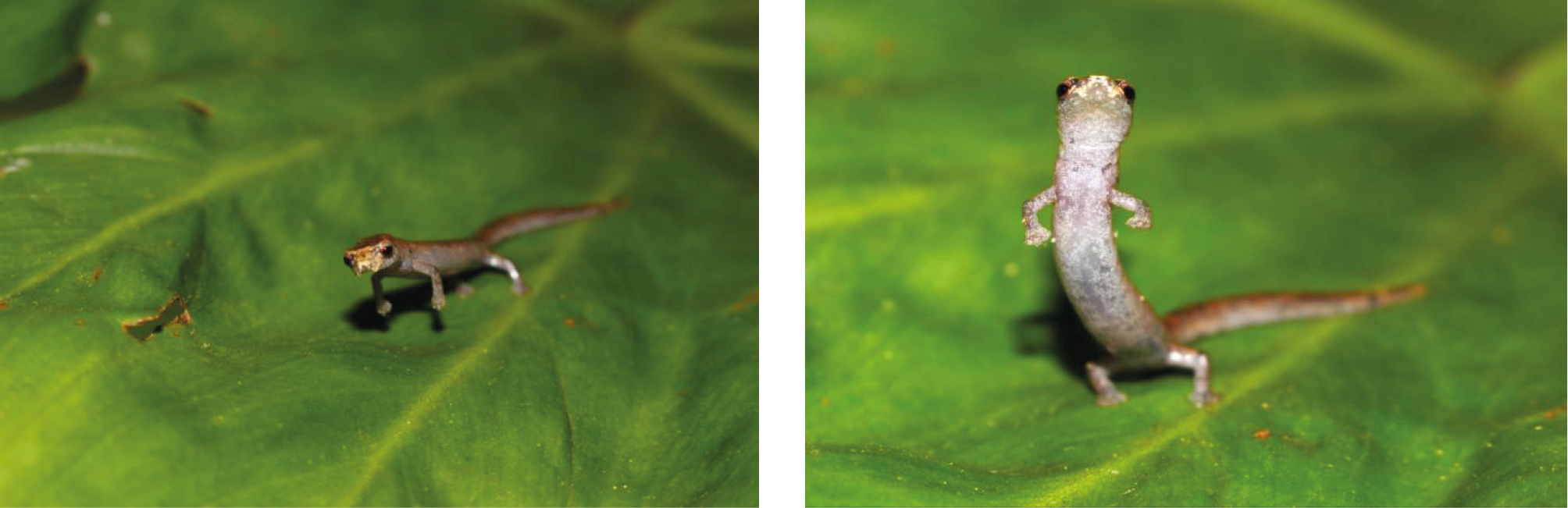
We observed the same behavior in Bolitoglossa altamazonica on 18 February 2014 in the Allpahuayo-Mishana National Reserve (-3.965° S, -73.421° W, 132 m a.s.l.). After handling the individual for laboratory photography (Figure 2), it exhibited the same defensive shadowboxing behavior. The display did not last more than a couple of minutes, and no secretions or other responses were observed after handling.
The present record represents a novel behavior for these species. Similar posturing has also been observed in the Cortes salamander, Cryptotriton nasalis (Dunn, 1924), which adopts and maintains an elevated defensive posture when threatened (Arrivillaga and Brown, 2018). In many terrestrial salamanders, defensive postures are closely tied to the use of skin secretions. These may involve revealing bright warning colors on the underside or directing specialized skin glands toward the predator (Brodie and Gibson, 1969). Although these species lack bright colors, we have anecdotal evidence of allergic reactions to the secretions of B. altamazonica. After handling the reported individual, a localized sensation of heat appeared in the hand, which triggered redness. The sensation lasted from a few minutes to an hour, depending on the length of contact with the animal (comm. pers. Giussepe Gagliardi-Urrutia). This shadowboxing behavior suggests that these species rely on physical positioning to deter predators, emphasizing the role of different strategies in salamander survival. This finding not only enhances our understanding of the behavioral ecology of B. equatoriana and B. altamazonica but also emphasizes the importance of continued field research to uncover the hidden complexities of amphibian life in the Amazon rainforest.
Acknowledgements
We thank Jens Toeniges and the staff of the Apayacu Reserve for granting us permission to conduct our research there and providing invaluable logistical support. We also wish to thank Luis Coloma and Andrea Terán from the Centro Jambatu para la Conservación de Anfibios for their support with logistics and permits. OR-P acknowledges Ariadne Angulo, Ehiko J. Rios-Alva, and Giussepe Gagliardi-Urrutia for their companionship during fieldwork and for kindly sharing with us your account of the allergic reaction; and acknowledges support from the Fundação de Amparo à Pesquisa do Estado da Bahia and the Conselho Nacional de Desenvolvimento Científico e Tecnológico, Brazil (FAPESB 005/2024, CNPq 153414/2024-3) through a postdoctoral fellowship.
SUPPLEMENTARY MATERIAL
Supplementary material associated with this article can be found at: https://oaj.fupress.net/index.php/ah/article/view/18622/14578.
REFERENCES
Arrivillaga, C., Brown, T.W. (2018): Primary descriptions of defense mechanisms employed by Neotropical salamanders (Bolitoglossa, Oedipina, Nototriton, and Cryptotriton sp.: Plethodontidae) in Cusuco National Park, Honduras. Reptiles Amphib. 25: 99-103.
Brodie Jr, E.D. (1977): Salamander antipredator postures. Copeia 1977: 523-535.
Cusi, J.C., Gagliardi-Urrutia, G., Brcko, I.C., Wake, D.B., Von May, R. (2020): Taxonomic status of the Neotropical salamanders Bolitoglossa altamazonica and Bolitoglossa peruviana (Amphibia: Caudata: Plethodontidae), with the description of a new species from Northern Peru. Zootaxa 4834: 365-406.
Dowdey, T., Brodie, E. (1989): Antipredator strategies of salamanders: Individual and geographical variation in responses of Eurycea bislineata to snakes. Anim. Behav. 38: 707-711.
Brodie Jr, E.D., Nowak, R.T., Harvey, W.R. (1979): The effectiveness of antipredator secretions and behavior of selected salamanders against shrews. Copeia 1979: 270-274.
de Vasconcelos, I.A., de Souza, J.O., de Castro, J.S., de Santana, C.J.C., Magalhães, A.C.M., Castro, M.S., Pires, O.R.J. (2021): Salamanders and caecilians, neglected from the chemical point of view. Toxin Rev. 41: 1304-1332.
Ducey, P., Brodie, E. (1983): Salamanders respond selectively to contacts with snakes: Survival advantage of alternative antipredator strategies. Copeia 1983: 1036-1041.
Edmund, D.B., Ronald, A.N., Yang, D.T. (1990): Antipredator behavior of Chinese salamanders (Salamandridae). Zool. Res. 11: 7-16.
Frost, D.R. (2025): Amphibian species of the world: an online reference. Version 6.2 (16/08/2025). Am. Mus. Nat. Hist., New York, USA.
Jaramillo, A.F., De La Riva, I., Guayasamin, J.M., Chaparro, J.C., Gagliardi-Urrutia, G., Gutiérrez, R.C., Brcko, I., Vilá, C., Castroviejo-Fisher, S. (2020): Vastly underestimated species richness of Amazonian salamanders (Plethodontidae: Bolitoglossa) and implications about plethodontid diversification. Mol. Phylogenet. Evol. 149: 106841.
Medina, L., Guzmán, F., Álvarez, C., Delgado, J.P., Carbonell-M, B. (2022): Ramosin: The first antibacterial peptide identified on Bolitoglossa ramosin Colombian Santander. Pharmaceutics 14: 2579.
Myette, A., Hossie, T., Murray, D. (2019): Defensive posture in a terrestrial salamander deflects predatory strikes irrespective of body size. Behav. Ecol. 30: 1691-1699.
Raffaëlli, J. (2013): Les Urodèles du Monde. 2nd Ed. Plumelec, Penclen Éditions.
Savage, J.M. (2002): The amphibians and reptiles of Costa Rica – a herpetofauna between two continents, between two seas. Univ. Chicago Press, Chicago, Illinois, Univ. Chicago Press.