https://doi.org/10.36253/a_h-19377
Submitted on: 2025, 5th December; revised on: 2026, 26th February; accepted on: 2026, 26th February
Home range and breeding ecology of Phasmahyla cruzi (Anura: Phyllomedusidae)
1 Projeto Dacnis, Sertão das Cotias, Ubatuba, São Paulo, Brasil
2 Laboratório de Interações Ecológicas e Biodiversidade (LIEB), Departamento de Biologia, Universidade Federal do Ceará, Fortaleza, Ceará, Brasil
3 Laboratório de História Natural de Anfíbios Brasileiros (LaHNAB), Unicamp, Campinas, São Paulo, Brasil
*Corresponding author. Email: bachurjoao@gmail.com
Abstract. Phasmahyla cruzi is an endemic treefrog species from the Brazilian Atlantic Forest for which basic natural history information is still lacking. In this study, we monitored two populations over a 12-month period in Ubatuba, São Paulo, Brazil, to investigate the species’ ecology, home range, and reproductive patterns. We used non-invasive photographic identification combined with minimum convex polygon (MCP) analysis to estimate home ranges. Based on the monthly sampling, we assessed the influence of abiotic factors (temperature and humidity) on activity patterns. We recorded 920 adult, 2,142 tadpole, and 22 egg clutch encounters. Males vocalized from September to April and showed territorial behaviour. Reproduction occurred through axillary amplexus, with oviposition on folded leaves suspended over streams. Mean home range for P. cruzi males was estimated at 460 m2, with individuals in higher elevations using significantly larger areas. A positive relationship was found between humidity and temperature with both individual abundance and clutch frequency. This study presents the first detailed data on habitat use, reproduction, and spatial ecology of P. cruzi, providing essential information for conservation efforts targeting this poorly known species endemic to the Atlantic Rainforest.
Keywords. Anuran conservation, rainforest, reproductive biology, spatial ecology.
Contents
Introduction
Natural history studies rely on observational data collected in situ without experimental manipulation. They aim to search for and describe patterns through direct observation of the natural world. These studies are the baseline for test hypotheses in different branches of the natural sciences, such as ecology, conservation biology, and evolutionary biology (Nanglu et al., 2023).
Despite the rich diversity of anurans in the Atlantic Forest (Toledo et al., 2014), studies addressing seasonality, population size, and home range remain scarce. The breeding biology of anurans in this biome is relatively well documented, particularly for species within the families Bufonidae, Cycloramphidae, Hylidae, and Phyllomedusidae (e.g., Oliveira et al., 2012; Botelho et al., 2023; Pedrozo et al., 2023). In contrast, research on home range is considerably less common, with only a few published studies focusing on species from the families Hemiphractidae, Hylidae and Leptodactylidae (Tozetti and Toledo, 2005; Moser et al., 2019; Muscat et al., 2020; Moroti et al., 2022). Notwithstanding these contributions, many species still lack fundamental natural history data – information that is crucial for understanding ecological requirements and forming conservation strategies.
Among the poorly known groups in the Atlantic Forest is the genus Phasmahyla Cruz, 1990, charismatic spotted leaf frogs from the family Phyllomedusidae. The monophyly of the clade is well supported by both molecular data (Faivovich et al., 2005, 2010) and possible morphological synapomorphies, such as: indistinct external vocal sacs, cream irises, and tadpoles with specialized oral discs, modified as a funnel-shaped structure (Bokermann and Sazima, 1978; Cruz, 1990; Altig and McDiarmid, 1999; Pereira et al., 2018). Currently, eight species of Phasmahyla are recognized: P. cochranae (Bokermann 1966); P. cruzi Carvalho-e-Silva, Silva & Carvalho-e-Silva, 2009; P. exilis (Cruz, 1980); P. guttata (Lutz, 1924); P. jandaia (Bokermann & Sazima, 1978); P. spectabilis Cruz, Feio & Nascimento, 2008; P. timbo Cruz, Napoli & Fonseca, 2008; and P. lisbella Pereira, Rocha, Folly, Silva & Santana, 2018. The genus is endemic to the Brazilian Atlantic Forest, being found in mountain streams from the south of the state of Bahia to the east of the state of Paraná, including the east of the state of Minas Gerais (Cruz, 1990; Cruz et al., 2008a, 2008b; Frost, 2010).
Phasmahyla cruzi is diagnosed from its congeners by its small body size (less than 5 cm), large eyes with palpebral membranes and pigmented reticulation covering them entirely and males with visible nuptial pad from the base of the first finger to the inner carpal tubercle (Carvalho-e-Silva et al., 2009). Although the species was described in 2009, basic aspects of its natural history are not available (Oliveira et al., 2012). We sampled a population of P. cruzi monthly over the course of a year, recording data on its breeding biology and home range. This type of basic natural history information is key for adequate species conservation status evaluation, contributing to amphibian conservation, a worldwide problem (Toledo et al., 2014).
Materials and methods
The study was conducted at the private reserve of the NGO Projeto Dacnis (23.46°S, 45.13°W; 15-500 m above sea level), a 136-hectare reserve in the Atlantic Forest in Ubatuba, state of São Paulo, Brazil. The area is mainly composed of swamp forests in flat regions and patches of primary and secondary dry forests on steep terrain. The climate in Ubatuba is characterized as humid subtropical, without marked seasonality (Rolim et al., 2007).
We conducted this study in two sites where we had previously recorded the species. Site 1 was in a forested area with shrub and tree vegetation and comprised streams with rapids, rocks, and sandy bottoms, 100 m above sea level (Fig. S1 a); site 2 was 250 a.s.l., in semi-open canopy along the sampling route, also containing streams with the same characteristics as site 1 (Fig. S1 b). The two sites were 350 meters apart from each other in a straight line. Three researchers sampled the populations three to four times per month from April 2023 to March 2024, totaling 46 visits of 3 h/night, resulting in 414 man-hours at site 1, and 47 visits of 3 h/night to site 2, which added up to 423 man-hours.
In nearly 14 years of daily studies and monitoring of the reserve, we did not obtain a single record of the species during the daytime (from 07:00 to 17:30). Therefore, to maximize our chances of encountering P. cruzi, our three-hour sampling period always happened between 18:30 and 23:00. During this time, we collected data on the species’ natural history, more specifically, habitat use and reproductive period, with records of vocalization, amplexus, oviposition, and observations of adults, metamorphs and tadpoles in small pool areas around the stream.
To quantify the population size, we used a non-invasive mark-recapture methodology. All adult individuals encountered were captured, except those in amplexus, and were subsequently released at the same location. To identify each individual, we photographed the dorsal, right lateral, and left lateral regions of the abdomen, as well as the inguinal region. The images were taken with a Xiaomi Note 12s smartphone. Males were identified by the presence of the nuptial pad. To avoid potential ontogenetic changes in natural markings (Bardier et al., 2020), the census only considered fully metamorphosed adult frogs with a snout-vent length (SVL) longer than 3 cm for males and 4 cm for females (Carvalho-e-Silva et al., 2009).
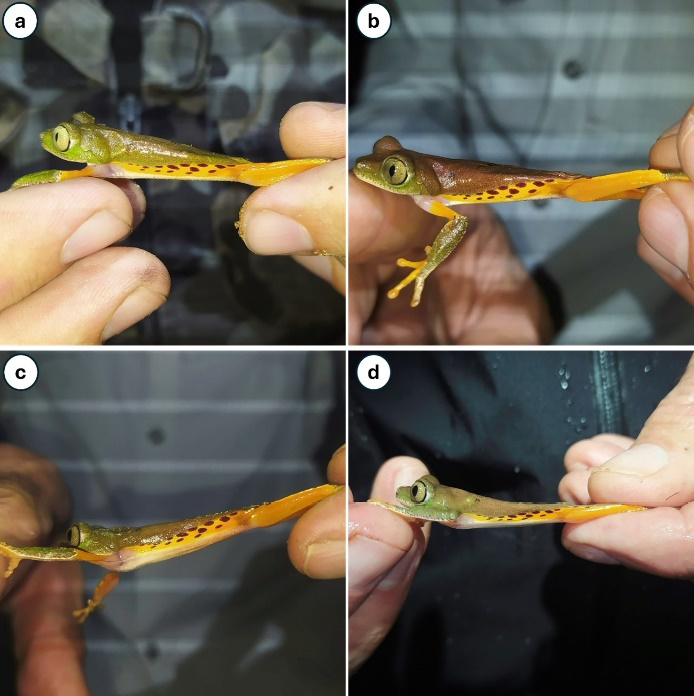
The photographs were added to our image database, and after a more detailed analysis, we decided to use only the left side for individual identification purposes (Fig. 1) following Lima-Araujo et al. (2021). For better visualization, the photos were enlarged, highlighting the individual markings on the lateral abdomen and inguinal region (Lima-Araujo et al., 2021). Each image was assigned a code containing the area, date of record, individual ID, and number of captures (area_date_ID_capture). We then used the HotSpotter software (Nipko et al., 2020) to automate the recognition and matching of similar patterns. From the subset generated by HotSpotter for each individual, a human observer validated the correct match in the image database which was almost 100% correct.
In addition to recording natural history data, we also incorporated a method to evaluate the home range, similar to the one used by Moroti et al. (2022). To analyze the species’ spatial distribution in the study area, we used plastic garden tags (3.2 width × 4.7 height, with a 15 cm tall base) throughout the monitoring period. Each tag was assigned a number and placed exactly where an individual was sighted. If another frog was found within 100 cm of this mark, it was assigned to the same point. If it was found beyond this distance, a new numbered tag was installed at the new location. This procedure allowed us to map the home range of each individual. At the end of the study, we used a Garmin GPS (GPSMAP 64x) to record the coordinates of all the tags. With these data, we determined the home range of each individual.
To estimate male individuals’ home ranges, we used the minimum convex polygon method (MCP 90%) through the adehabitatHR package (Calenge, 2011) in R environment (R Core Team, 2024). We chose MCP as it is a common method used to estimate home ranges with a low number of points per individual (Downs and Horner, 2008), and because it is the best method to represent herpetofauna home range size (Row and Blouin-Demers, 2006). As we didn’t recapture any female enough times we only estimated the home area for male individuals recaptured more than five times (Moroti et al., 2022). Home range maps were built using QGis 3.34.12.
To assess the influence of temperature (°C) and humidity (%), we measured them in situ during each expedition using a thermometer-hygrometer with an accuracy of 1 °C (FEPRO-MUT600s). We tested if these abiotic variables were related to the number of captures of P. cruzi. To do this, we ran a Generalized Linear Model (GLM) using the number of captures as the response variable, and temperature and humidity as predictor variables. The family model was selected after inspecting the distributions of the response variables in the diagnostic plots generated in the DHARMa package in the R environment (Hartig, 2016). The family model that best explained the data was Negative Binomial.
We also tested if abiotic variables were related to the presence of egg masses of P. cruzi. The average monthly temperature, humidity, and monthly accumulated rainfall in Ubatuba were obtained from INMET (Instituto Nacional de Meteorologia (INMET, 2025). Rainfall and humidity showed higher correlation (r > 0.7), so we removed rainfall from the analysis. Once more we ran the Generalized Linear Model (GLM), this time using the number of egg masses found as the response variable, and temperature and humidity as predictor variables. The family model was selected after inspecting the distributions of the response variables in the diagnostic plots generated in the DHARMa package in the R environment (Hartig, 2016). The family model that best explained the data was Quasi-Poisson. We ran the GLM using the glmmTMB package (Brooks et al., 2017) in R environment (R Core Team, 2024).
We collected one adult male as the vocal voucher specimen and six tadpoles under the collecting permit (SISBio #51898-1) provided by the Instituto Chico Mendes de Conservação da Biodiversidade (ICMBio). The specimens were euthanized, preserved in 10% formalin, and deposited in the zoological collection of the Museu de Diversidade Biológica (MDBio), Unicamp, Campinas, São Paulo, Brazil (ZUEC-AMP 26624 – adult male; ZUEC-AMP 26625 – tadpole lot). Calls were recorded with a TASCAM DR-40X and deposited at the Fonoteca Neotropical Jacques Viellard (FNJV), MDBio, Unicamp, Campinas, São Paulo, Brazil (FNJV 59118).
Results
The species became active after dusk. Adult individuals were found on shrubby and arboreal vegetation near the stream bank (200 cm up from the stream was the maximum height of a frog found) or on foliage over the water. There were 158 encounters at site 1, of which 22 were males, and 3 females; 17 males and 2 females were recaptured. At site 2, we observed a larger population: 762 encounters, comprising 83 males and 35 females. Among these individuals, 66 males and 5 females were recaptured. No individuals observed at site 1 were encountered at site 2 or vice-versa. Furthermore, during monitoring of the studied area unrelated to this study, we had three fortuitous encounters with P. cruzi in forested areas away from stream margins. They were all male adults, found on 9 December 2022 (23.45°S, 45.14°W, 196 m a.s.l.; 27 January 2023 (23.45°S, 45.14°W, 33 m a.s.l.); and on 5 June 2024 (23.46°S, 45.13°W, 34 m a.s.l.).
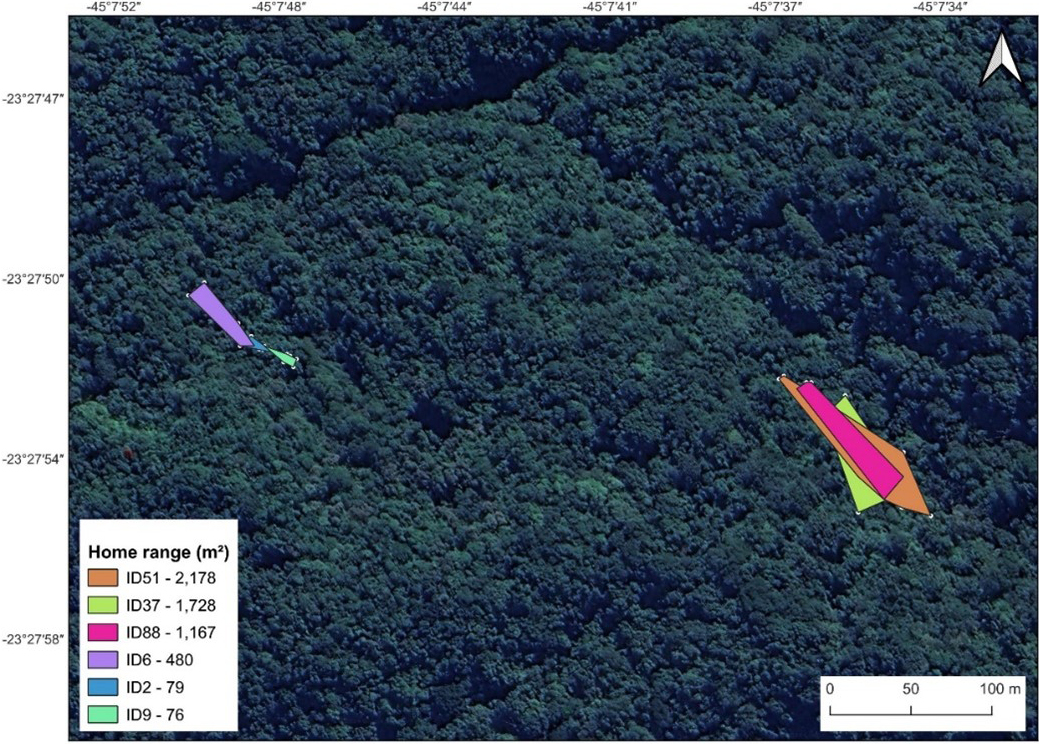
To determine the home range of P. cruzi, 54 points were added along the stream at site 1, while at site 2, 201 points were distributed along the stream. Considering more than five recaptures (Moroti et al., 2022), the frog’s estimated home range was 461.07 ± 477 m2. Site 1 showed an estimated home range of 64.2 ±130 m2 (range: 5.5-454 m²) considering data from 11 individuals and site 2 an estimated home range of 573.0 ± 481.3 m2 (range: 15.5-2269.5 m²) considering data from 39 individuals (Fig. 2) (Table S1).
We observed that males began vocalizing from September, when rain becomes more frequent in Ubatuba, until the end of April. They initiated vocalization after dusk, perched on vegetation on the bank or over the stream at heights ranging from 40 to 320 cm. During this period of activity, males exhibited territorial behavior, vocalizing and approaching in response to call playbacks from the researchers. We only employed this method as a tool to locate individuals that we heard but could not see.
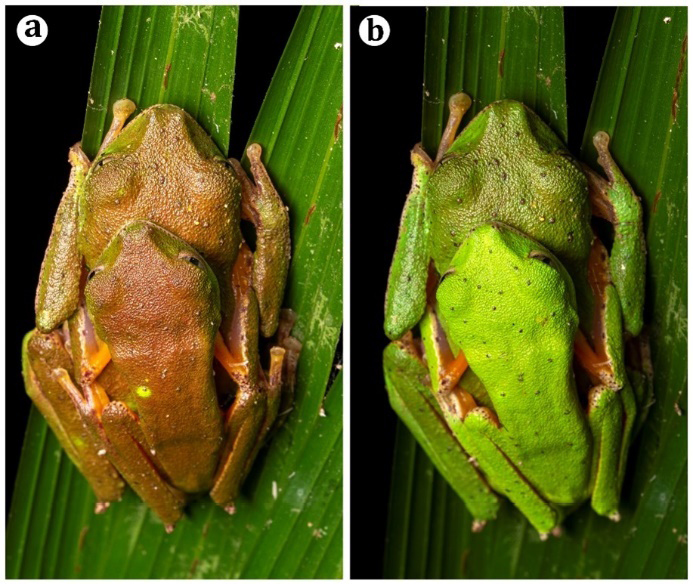
We witnessed six amplexus in site 1 and 15 amplexus in site 2. The month with the highest number of amplexus (n = 7) was November 2023 (Fig. 3). The amplexus was axillary (Fig. 4a), with an approximate duration of two hours. Amplexus were observed on the ground, on rocks along the stream’s edge, and in trees 200 cm tall overhanging the stream. Both males and females changed color during amplexus, becoming bright green after 30 minutes of observation (Fig. 5 a-b). This color change was also observed in individuals that were handled. During amplexus, both male and female collaborated to fold the leaf chosen for egg deposition (Fig. 6a). The female clung to the edges or petiole of the leaf with her arms and used her legs to bend it while releasing the eggs. Meanwhile, the male remained attached to the female with his arms, alternating between pressing her abdominal region with his legs to stimulate egg release and using his legs to assist in folding the leaf. The egg masses likely had between 30 and 60 eggs; due to the shape of the deposition, precise counts were not possible (Fig. 6b). The fertilized eggs were protected by unfertilized gelatinous capsules positioned near the edge of the leaf. These capsules also played a role in keeping the leaf closed by adhering the two surfaces together.
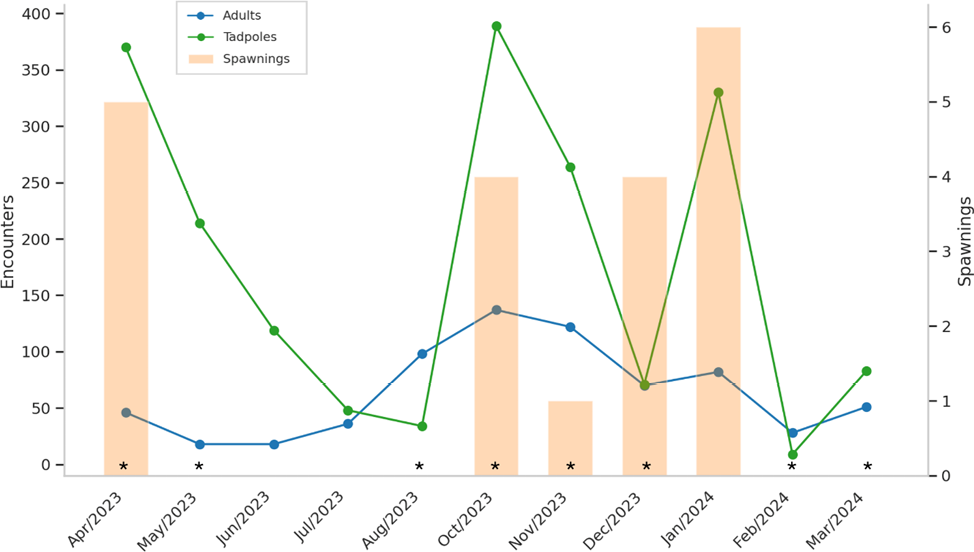
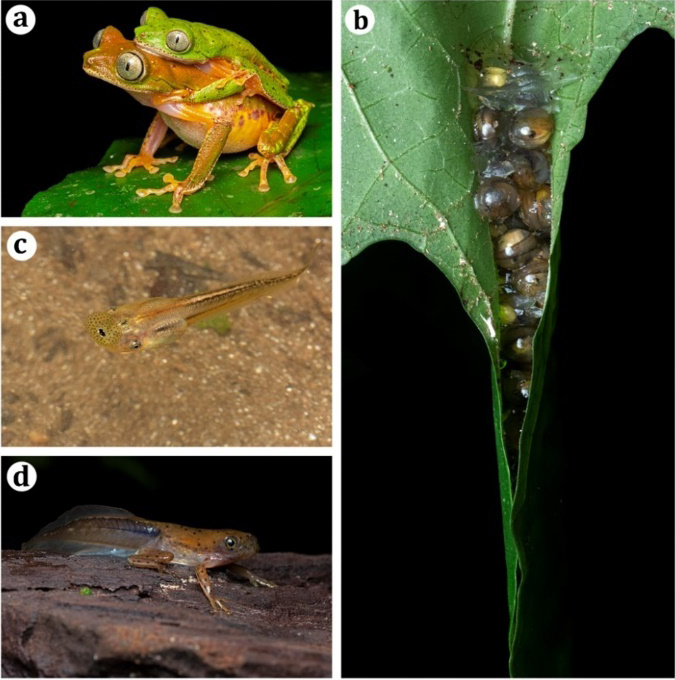
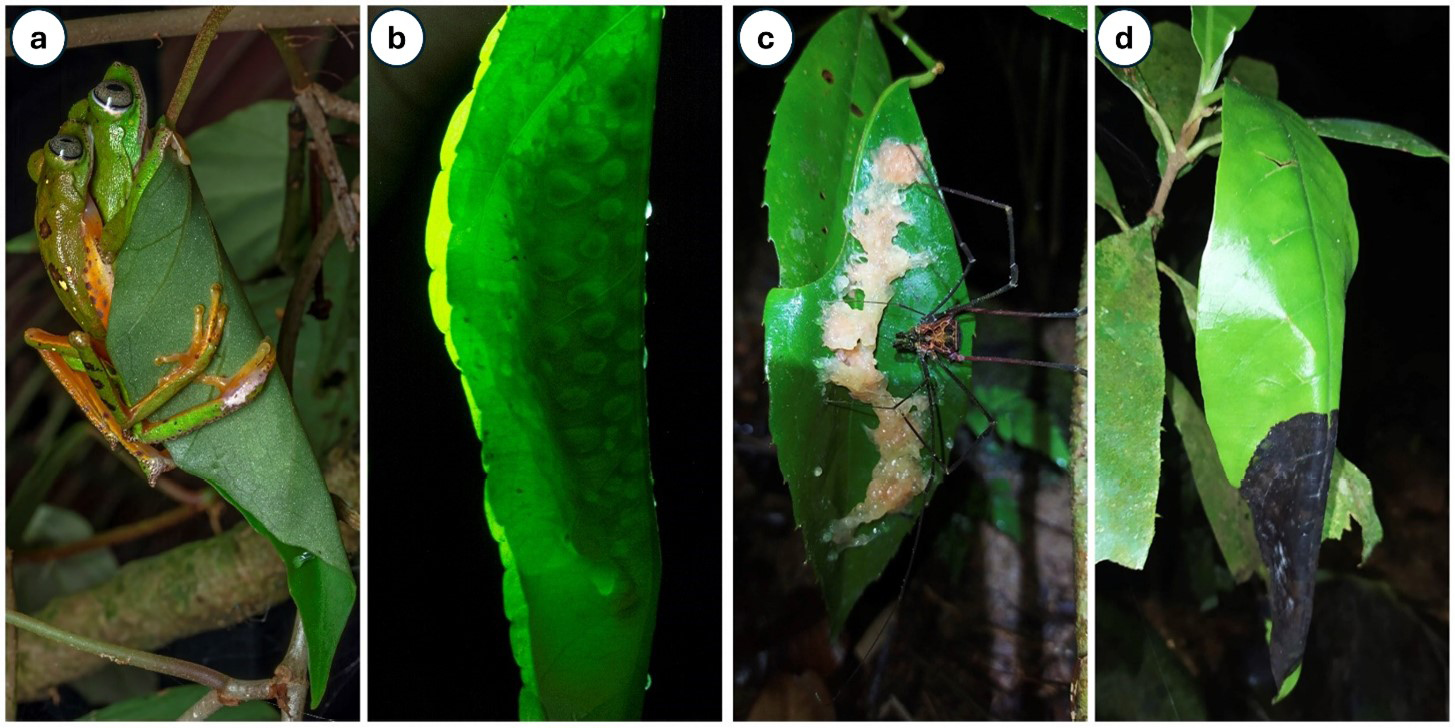
Spawnings were found on both the abaxial and adaxial surfaces of the leaves, at heights ranging from 20 to 180 cm. They were observed both on the water and on rocks with a 45° angle in relation to the water surface. Egg masses were observed on plants from the families Araceae, Fabaceae, Marantaceae, and Moraceae. No preference was noticeable for a specific type of vegetation, nor for the shape or size of the leaves. A total of 22 egg masses were found, with seven in site 1 and 15 in site 2. The month with the highest number of recorded egg masses was January 2024 (Fig. 3), with six egg masses (two in site 1 and four in site 2). We were unable to monitor any egg mass from deposition to hatching. They either failed to develop, were destroyed by heavy rains, preyed upon by harvestmen Acutisoma discolor (Fig. 6c), decayed (with the presence of mosquito larvae) (Fig. 6d), or contained only atresic eggs.
In April 2023 we identified a clutch of P. cruzi on the abaxial surface of a leaf of Dorstenia sp.; the gelatinous capsules kept the leaf folded and glued (Fig. 4b). The spawning was located 62 cm above a rock in the rapids, and 121 cm above the water. The larvae were in an advanced stage of development and hatched after heavy nocturnal rains between the third and fourth day of monitoring. We counted 41 tadpoles in an eddy below the spawn, organized in one shoal. One of the tadpoles was captured for measurement and was 16.8 mm long. Its larval development stage was at stage 25 according to Gosner (1960).
During the monitoring period, we recorded 865 tadpoles at site 1 and 1277 at site 2, totaling 2142 tadpoles. The months with the highest numbers of occurrences were October 2023 (n = 389), followed by April of 2023 (n = 370), and January 2024 (n = 330). Tadpoles were observed throughout the year in various stages of development (Figs 4c and 4d). They were found in pools forming small beaches along the sides of rapids, which shared similar characteristics: sandy bottoms with polymodal granulometry, low organic matter, minimal suspended particles, and rocks of varying sizes both on the streambed and within the rapids. The pool depths ranged from 9.5 to 23 cm. During periods of strong water currents following heavy rainfall or when pools were disturbed by the passage of researchers, we observed tadpoles adhering to rocks using their umbelliform oral disk as a suction cup (ZUEC-VID 1045). Additionally, we frequently saw them feeding on larger particles, capturing and releasing them repeatedly until they were small enough to be ingested (ZUEC-VID 1046).
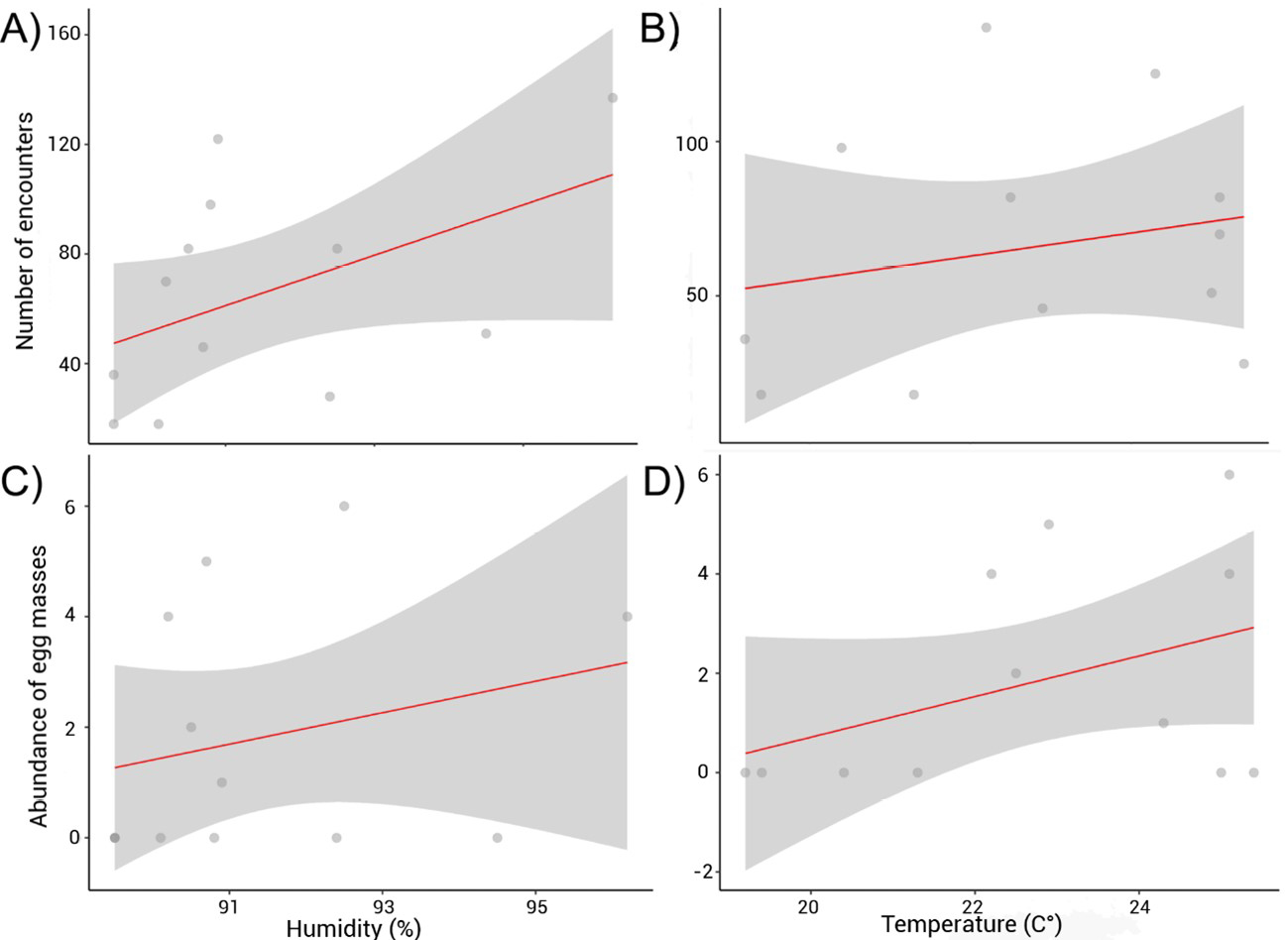
Through the abiotic data obtained in the field, we observed a positive relationship between the number of captures of P. cruzi with humidity (z = 2.69, df = 7, p < 0.01, pseudo-r² = 0.50), temperature (z = 2.55, df =7, p = 0.01) and their interaction (z = -2.54, df = 7, p = 0.01) (Figure 7). We also identified a positive relationship between abundance of P. cruzi egg masses and humidity (z = 2.2, df = 7, p = 0.02, pseudo-r² = 0.54), temperature (z = 2.18, df = 7, p = 0.02, pseudo-r² = 0.17), and their interaction (z = -2.16, df = 7, p = 0.03) (Fig. 7).
Discussion
The present study reveals important aspects about the natural history of Phasmahyla cruzi. Our data provide detailed insights into habitat use, reproductive activity, spatial distribution, and responses to abiotic variables, highlighting the importance of long-term studies.
Absence of diurnal records during 14 years of routine monitoring reinforces the strictly nocturnal activity of the species, corroborating previous observations in a congeneric species Phasmahyla guttata (Pereira et al., 2018). The selection of stream habitats with dense vegetation and semi-open canopy cover appears to be related to the species’ reproductive strategy, which involves calling, amplexus, and oviposition on leaves near the marginal pools of small streams where tadpoles will develop, in a way that the larvae are less susceptible to be carried out due to strong currents. This preference is consistent with patterns observed in other Phyllomedusidae species, which utilize more protected aquatic environments for reproduction (Duellman and Trueb, 1994).
Deposition of eggs on different leaf surfaces (abaxial and adaxial), and at different heights (20-180 cm), suggests ecological plasticity, possibly as an adaptive strategy to minimize predation and avoid direct flooding. The use of plant species from different families (Araceae, Fabaceae, Marantaceae, and Moraceae) and the lack of preference for specific leaf shapes or sizes indicate low plant selectivity, which may be advantageous in densely vegetated and diverse environments such as tropical forests. Moreover, the higher concentration of egg masses recorded between September 2023 and January 2024 suggests potential reproductive seasonality, coinciding with the peak of the rainy season in the region. This is observed in the reproductive ecology of many Neotropical anuran species, which synchronize breeding with intense rainfall to increase tadpole survival chances by enhancing transport to suitable aquatic habitats, coinciding with other studies (e.g., Aichinger, 1987; Pedro and Feio, 2010; Silva et al., 2012). However, challenges during egg mass development – including destruction by heavy rainfall, predation by harvestmen, deterioration by mosquito larvae, and atresia – highlight the vulnerability of this life stage. These observations emphasize the critical influence of biotic and abiotic factors on anuran reproductive success and reinforce that early-stage mortality rates tend to be high – a common pattern in species with indirect development and type-III reproductive strategies (Crump, 1974; Wells, 2007).
The specific case documented in April 2023 in this study, involving the complete development of a P. cruzi clutch, highlights the function of gelatinous capsules in protecting and adhering the eggs to leaves and shows the relationship between heavy rains and hatching. The presence of 41 tadpoles, with one measured and classified at Gosner’s stage 25, confirms that larval development reaches a critical threshold before release into the stream, suggesting a semi-independent developmental strategy that may be advantageous in unstable environments (Dias et al., 2018). In addition, the limited number of egg clutches (22 total) and their uneven distribution between both study sites may reflect microhabitat variations such as vegetation density, humidity, predator presence, or physicochemical characteristics of the site – factors that should be more deeply investigated in future studies.
The use of non-invasive photographic identification and the HotSpotter software proved effective for individual recognition, reducing animal stress and minimizing behavioral interference. This method has been widely applied in recent studies involving anurans and other vertebrates, offering an ethical and sustainable approach to monitoring natural populations (Muscat et al., 2020; Lima-Araujo et al., 2021; Moroti et al., 2022). Based on it, home range analysis revealed relatively small usage areas for recaptured males, fact that is documented in literature about territorial tropical anurans (Wells, 2007). The minimum convex polygon (MCP) method was appropriate, due to the limited number of individual recaptures, allowing for comparisons with other herpetofauna studies.
An important limitation of this study is the reduced number of records and recaptures of females. The considerably lower detectability of females may reflect sex-specific differences in behaviour, mobility, or habitat use, as females are often less conspicuous outside reproductive periods or may occupy microhabitats not routinely surveyed. Consequently, estimates of space use derived primarily from male data may underestimate the actual spatial requirements of the species. This potential bias should be considered when interpreting home range patterns and reinforces the need for future studies specifically designed to assess female movement, habitat use, and detectability in P. cruzi.
Generalized Linear Models indicated that both temperature and humidity influence activity and reproductive output in P. cruzi, as found in other studies (e.g., Oseen and Wassersug, 2002; Saenz et al., 2006). Adult activity, reflected by capture rates, showed a positive relationship with humidity and temperature. This pattern reinforces the dependence of anurans on humid and warm conditions due to their ectotherm habit and permeable skin (Duellman and Trueb, 1994). In addition, the abundance of egg masses was positively associated with both humidity and temperature, suggesting that these variables also influences the reproductive investment of this specie, also found for the majority of species in Atlantic Forest (Silva et al., 2012; Ceron et al., 2020).
The significant interaction between temperature and humidity indicates that the effect of temperature on adult activity and reproductive output is modulated by moisture availability. Higher temperatures appear to favour reproduction primarily when accompanied by high humidity, whereas warmer and drier conditions may limit reproductive success, potentially due to increased desiccation risk during embryonic development. This interaction highlights the importance of considering combined abiotic effects when evaluating reproductive patterns in anurans, particularly in forest environments subject to pronounced seasonal variation (Crump, 1974; Aichnger, 1987; Saenz et al., 2006).
Environmental conditions in this study were assessed at complementary spatial and temporal scales. Temperature and humidity recorded with handheld devices during field surveys reflect local environmental conditions at the stream level, whereas monthly averages obtained from a meteorological station represent broader macroclimatic trends and seasonal context. Although true microclimatic variables were not directly measured, the integration of these data provides a meaningful proxy for the environmental conditions influencing activity and reproduction. In forested riparian systems, broader climatic patterns strongly constrain the availability of suitable microhabitats, supporting our interpretation that the observed abiotic relationships reflect biologically relevant conditions experienced by P. cruzi.
Finally, the results of this study highlight the vulnerability of P. cruzi to habitat and abiotic changes. It also shows, at least to male of the species’, a dependence on specific microhabitats, combined with low mobility and apparent fidelity to small home ranges, making the species particularly sensitive to environmental alterations. Females though need further research to be assessed. Therefore, we emphasize the importance of private reserves (Volenec and Dobson, 2020) such as Projeto Dacnis, for the conservation and maintenance of viable populations of P. cruzi and other endemic Atlantic Forest species.
Acknowledgements
We would like to thank Elsie Rotenberg for her careful text revision; Délio Baêta for his important comments and inputs; Lucas Botelho, Arthur Diesel Abegg, Cinthia Teixeira, José Rubens Costa and Lucas José Alves de Oliveira Simões Ferreira for their committed assistance in the field work; Lucas Botelho and Cinthia Teixeira for recapture validation; Marcus Nadruz for plant identification; and we also thank Lucas Botelho for the photographs. KC thanks Conselho Nacional de Desenvolvimento Científico e Tecnológico (CNPq) for research fellowship (#444240/2024-1). Grants and fellowships were provided to LFT by São Paulo Research Foundation (FAPESP #2022/11096-8) and the National Council for Scientific and Technological Development (CNPq #302834/2020-6).
Supplementary material
Supplementary material associated with this article can be found at https://oaj.fupress.net/index.php/ah/article/view/19377/15290.
References
Aichinger, M. (1987): Annual activity patterns of anurans in a seasonal neotropical environment. Oecologia 71: 583-592.
Altig, R., McDiarmid, R.W. (1999): Body plan: Development and morphology. In: Tadpoles: The biology of anuran larvae, pp. 24–51. McDiarmid, R.W., Altig, R., Eds. Chicago, IL, Univ. Chicago Press.
Bardier, C., Székely, D., Augusto-Alves, G., Matínez-Latorraca, N., Schmidt, B.R., Cruickshank, S.S. (2020): Performance of visual vs. software-assisted photo-identification in mark-recapture studies: A case study examining different life stages of the Pacific horned frog (Ceratophrys stolzmanni). Amphib.-Reptil. 42: 17-28.
Bokermann, W., Sazima, I. (1978): Anfíbios da Serra do Cipó, Minas Gerais, Brasil. 4: Descrição de Phyllomedusa jandaia sp. n. (Anura, Hylidae). Rev. Bras. Biol. 38: 927-930.
Botelho, L.M., Barbosa, A.C.F., Prado, J.S., Pedrozo, M., De Toledo Moroti, M., Toledo, L.F., Muscat, E. (2023): Reproductive biology, tadpole description, and natural history of Dendrophryniscus haddadi (Anura: Bufonidae). J. Nat. Hist. 57: 596-607.
Brooks, M.E., Kristensen, K., van Benthem, K.J., Magnusson, A., Berg, C.W., Nielsen, A., Skaug, H.J., Mächler, M., Bolker, B.M. (2017): glmmTMB balances speed and flexibility among packages for zero-inflated generalized linear mixed modeling. R J. 9: 378.
Calenge, C. (2011): Home range estimation in R: The adehabitatHR package.
Carvalho-e-Silva, A.M.P.T., Da Silva, G.R., Carvalho-e-Silva, S.P. (2009): A new species of Phasmahyla Cruz, 1990 from the Atlantic Forest in the state of Rio de Janeiro, Brazil (Amphibia, Hylidae, Phyllomedusinae). Zootaxa 2120: 15-26.
Ceron, K., Santana, D.J., Lucas, E.M., Zocche, J.J., Provete, D.B. (2020): Climatic variables influence the temporal dynamics of an anuran metacommunity in a nonstationary way. Ecology and Evolution, 10: 4630-4639.
Crump, M.L. (1974): Reproductive strategies in a tropical anuran community. Kansas, Museum of Natural History.
Cruz, C. (1990): Sobre as relações intergenéricas de Phyllomedusinae da floresta Atlântica (Amphibia, Anura, Hylidae). Rev. Bras. Biol. 50: 709-726.
Cruz, C.A., Feio, R., Nascimento, L. (2008a): A new species of Phasmahyla Cruz, 1990 (Anura: Hylidae) from the Atlantic Rain Forest of the States of Minas Gerais and Bahia, Brazil. Amphib. Reptil. 29: 311-318.
Cruz, C.A.G., Napoli, M.F., Fonseca, P.M. (2008b): A new species of Phasmahyla Cruz, 1990 (Anura: Hylidae) from the State of Bahia, Brazil. S. Am. J. Herpetol. 3: 187-195.
Dias, P.H.D.S., Mongin-Aquino, M., Candioti, F.V., Carvalho-e-Silva, A.M.P.T.D., Baêta, D. (2018): Internal larval morphology of two species of shining leaf frogs (Anura: Phyllomedusidae: Phasmahyla). S. Am. J. Herpetol. 13: 44.
Downs, J.A., Horner, M.W. (2008): Effects of point pattern shape on home-range estimates. J. Wildl. Manage. 72: 1813-1818.
Duellman, W.E., Trueb, L. (1994): Biology of Amphibians. Baltimore, Johns Hopkins Univ. Press.
Faivovich, J., Haddad, C.F.B., Garcia, P.C.A., Frost, D.R., Campbell, J.A., Wheeler, W.C. (2005): Systematic review of the frog family Hylidae, with special reference to Hylinae: Phylogenetic analysis and taxonomic revision. Bull. Am. Mus. Nat. Hist. 294: 1.
Faivovich, J., Haddad, C.F.B., Baêta, D., Jungfer, K., Álvares, G.F.R., Brandão, R.A., Sheil, C., Barrientos, L.S., Barrio-Amoròs, C.L., Cruz, C.A.G., Wheeler, W.G. (2010): The phylogenetic relationships of the charismatic poster frogs, Phyllomedusinae (Anura, Hylidae). Cladistics 26: 227-261.
Frost, D.R. (2024): Amphibian species of the world: An online reference. Version 5.4.
Gosner, K.L. (1960): A simplified table for staging anuran embryos and larvae with notes on identification.
Hartig, F. (2016): DHARMa: Residual diagnostics for hierarchical (multi-level/mixed) regression models. CRAN: Contributed Packages.
Lima-Araujo, F., Brasileiro, A.C., Carvalho, E.F.F., Passos, D.C. (2021): Efficiency of photo identification of inguinal color patterns of Pithecopus gonzagai (Anura: Phyllomedusidae) from northeastern Brazil. Phyllomedusa 20: 67-74.
Moroti, M., Severgnini, M.R., Bolovon, J.P., Toledo, L.F., Muscat, E. (2022): Filling the knowledge gaps of Paratelmatobius mantiqueira (Anura: Leptodactylidae): Tadpole, acoustic repertoire, and life history traits. J. Nat. Hist. 56: 1563-1584.
Moser, C.F., Olmedo, G.M., Oliveira, M., Tozetti, A.M. (2019): Movement ecology and habitat use in males of two species of Boana (Anura: Hylidae) during the breeding season. Herpetol. Notes 12: 885-893.
Muscat, E., Menegucci, R.C., Tanaka, R.M., Rotenberg, E., Moroti, M.D.T., Pedrozo, M., Stuginski, D.S., Sazima, I. (2020): Natural history of the marsupial frog Gastrotheca albolineata (Anura: Hemiphractidae) in lowland Brazilian Atlantic Forest. Phyllomedusa 19: 189-200.
Nanglu, K., de Carle, D., Cullen, T.M., Anderson, E.B., Arif, S., Castañeda, R.A., Chang, L.M., Iwama, R.E., Fellin, E., Manglicmot, R.C., Massey, M.D., Astudillo-Clavijo, V., (2023): The nature of science: The fundamental role of natural history in ecology, evolution, conservation, and education. Ecol. Evol. 13: e10621.
Nipko, R.B., Holcombe, B.E., Kelly, M.J. (2020): Identifying individual jaguars and ocelots via pattern-recognition software: Comparing HotSpotter and Wild-ID. Wildl. Soc. Bull. 44: 424-433.
Oliveira, F.F.R., Nogueira, P.A.G., Eterovick, P.C. (2012): Natural history of Phyllomedusa megacephala (Miranda-Ribeiro, 1926) (Anura: Hylidae) in southeastern Brazil, with descriptions of its breeding biology and male territorial behaviour. J. Nat. Hist. 46: 117-129.
Oseen, K.L., Wassersug, R.J. (2002): Environmental factors influencing calling in sympatric anurans. Oecologia 133: 616-625.
Pedro, V.A.S., Feio, R.N. (2010): Distribuição espacial e sazonal de anuros em três ambientes na Serra do Ouro Branco, extremo sul da Cadeia do Espinhaço, Minas Gerais, Brasil.
Pedrozo, M., Botelho, L.M., Moroti, M.D.T., Rotenberg, E.L., Toledo, L.F., Muscat, E. (2023): Natural history of the flattened waterfall frog Cycloramphus boraceiensis (Anura, Cycloramphidae). Caldasia 46: 167-178.
Pereira, E.A., Rocha, L.C.L., Folly, H., Da Silva, H.R., Santana, D.J. (2018): A new species of spotted leaf frog, genus Phasmahyla (Amphibia, Phyllomedusidae) from Southeast Brazil. PeerJ 6: e4900.
R Core Team. (2024): R: A language and environment for statistical computing, v. 4.4.0. R Foundation for Statistical Computing.
Rolim, G.D.S., Camargo, M.B.P., Lania, D.G., Moraes, J.F.L. (2007): Classificação climática de Köppen e de Thornthwaite e sua aplicabilidade na determinação de zonas agroclimáticas para o estado de São Paulo. Bragantia 66: 711-720.
Row, J.R., Blouin-Demers, G. (2006): Kernels are not accurate estimators of home-range size for herpetofauna. Copeia 2006: 797-802.
Saenz, D., Fitzgerald, L.A., Baum, K.A., Conner, R.N. (2006): Abiotic correlates of anuran calling phenology: The importance of rain, temperature, and season. Herpetol. Monogr. 20: 64.
Da Silva, F.R., Almeida-Neto, M., Do Prado, V.H.M., Haddad, C.F.B., De Cerqueira Rossa-Feres, D. (2012): Humidity levels drive reproductive modes and phylogenetic diversity of amphibians in the Brazilian Atlantic Forest. J. Biogeogr. 39: 1720-1732.
Toledo, L.F., Becker, C.G., Haddad, C.F.B., Zamudio, K.R. (2014): Rarity as an indicator of endangerment in neotropical frogs. Biol. Conserv. 179: 54-62.
Tozetti, A.M., Toledo, L.F. (2005): Short-term movement and retreat sites of Leptodactylus labyrinthicus (Anura: Leptodactylidae) during the breeding season: A spool-and-line tracking study. J. Herpetol. 39: 640-644.
Volenec, Z.M., Dobson, A.P. (2020): Conservation value of small reserves. Conserv. Biol. 34: 66-79.
Wells, K.D. (2007): The ecology and behavior of amphibians. Chicago, Univ. Chicago Press.