https://doi.org/10.36253/a_h-19462
Submitted on: 2025, 10th December; revised on: 2026, 24th February; accepted on: 2026, 24th February
North of the wall: First record of Salamandra atra aurorae in the Sella Valley, South-eastern Alps
1 Department of Organisms and Systems Biology, Ecology Unit, University of Oviedo, C/ Valentín Andrés Álvarez s/n, 33006 Oviedo, Spain
2 Research and Museum Collection Office, Conservation Biology Unit, MUSE - Science Museum, Corso del Lavoro e della Scienza 3, 38122 Trento, Italy
3 Department of Earth, Environment and Life Sciences (DISTAV), University of Genova, Corso Europa 26, 16132 Genova, Italy
4 Department of Biology, University of Florence, Via Madonna del Piano 6, 50019 Sesto Fiorentino, Italy
5 National Research Council, Institute of BioEconomy, Via dei Taurini 19, I-00185 Rome, Italy
6 Associazione Cacciatori Trentini (ACT), Via Guardini 41, 38100 Trento, Italy
† Co-first author
*Corresponding authors. Email: LR: lucaroner@gmail.com; AR: antonioromano71@gmail.com; antonio.romano@cnr.it
Abstract. Salamandra atra aurorae is a rare and elusive subspecies endemic to a small area of the southeastern Italian Prealps, typically inhabiting mature mixed forests between 1200 and 1800 m a.s.l. Its detection is challenging due to cryptic behavior and dependence on favorable weather. Since its first record in Trentino in 2008, no new localities had been reported. In summer 2025, following a citizen report, field surveys confirmed a new occurrence in the Sella Valley, extending the known range of S. a. aurorae in Trentino. Two individuals were found at 1825 m and 1395 m a.s.l. New sites represent novel habitats for the subspecies: the uppermost on rocky scree and the lowest in a NNE-facing forest, both deviating from known preferences. Climatic niche analysis showed that these sites lie at the edge of the previously known climatic range, suggesting broader ecological tolerance. The detection of a gravid female at the forest site indicates the presence of a reproductive population, excluding animals in dispersal. The substantial topographical barriers separating the new sites from previously known localities suggest possible long-term isolation; however, the existence of narrow or discontinuous ecological corridors cannot be excluded. This discovery could have important conservation implications, as the detected individuals might be genetically distinct, warranting further genetic and phylogeographic studies. These findings highlight the need for targeted surveys and updated management strategies to protect this vulnerable taxon.
Keywords. Golden Alpine Salamander, endangered species, endemic taxon, distribution, climate niche, amphibian conservation.
Contents
The Golden Alpine Salamander, Salamandra atra aurorae (Trevisan, 1982), is a rare and elusive subspecies of Alpine Salamanders, endemic to a restricted area of the south-eastern Italian Prealps. It is considered as Endangered by the Italian IUCN assessment (Rondinini et al., 2022), and as a prioritary taxon by the “Habitat Directive” of the European Union. This subspecies inhabits forests between 1200 and 1800 m a.s.l. and has been found only in south-facing slopes (Beukema and Brakels, 2008; Romanazzi and Bonato, 2014). The typical habitat consists of mature mixed forests of silver fir and beech (Bonato and Fracasso, 2015; Romano et al., 2018), a pattern recently confirmed by species distribution models (Giachello et al., 2025). Habitat suitability depends on shelters, brushwood piles, and distance from open pasture (Romano et al., 2018), with dead wood also supporting key invertebrate prey (Centomo et al., 2023). This salamander is active from May to mid-October (Bonato et al., 2025), with surface activity closely linked to favorable meteorological conditions (Bonato and Fracasso, 1999; Bonato and Fracasso, 2015).
Its known distribution covers 31 km2 on Sette Comuni and Vezzena plateaus (between Veneto region and the province of Trento, hereafter Trentino; Giachello et al., 2025). As reported for other Alpine Salamanders (Roner et al., 2022), S. a. aurorae is highly cryptic and difficult to detect under unsuitable weather conditions, even where density is high (Lefosse et al., 2016). As a result, knowledge of its fine-scale distribution remains incomplete.
In Trentino, the subspecies was first recorded in 2008, in an area extending from Sparavieri Valley to Postesina Valley (Beukema and Brakels, 2008), and further large-scale surveys on Vezzena plateau yielded no additional occurrences (Romano et al., 2018a). Here we report the first new locality records of S. a. aurorae in Trentino. We performed a multivariate analysis on the habitat and geographic characteristics to compare the newly identified sites with previously known records and evaluate their position within the established climatic niche of the subspecies.
In August 2025, we received a reliable, documented report including a photograph of S. a. aurorae in the Sella Valley, a small side valley located on the south-eastern edge of Trentino, reported by one of the authors (LD; Fig. 1). Of the three surveys carried out in the area in the following weeks, only one (28/08/2025), conducted under optimal conditions, was successful and led to the finding of a pregnant female in a second site. The coordinates of the two new sites were recorded using a Garmin GPSMAP 64s, with an accuracy of ±5 m.
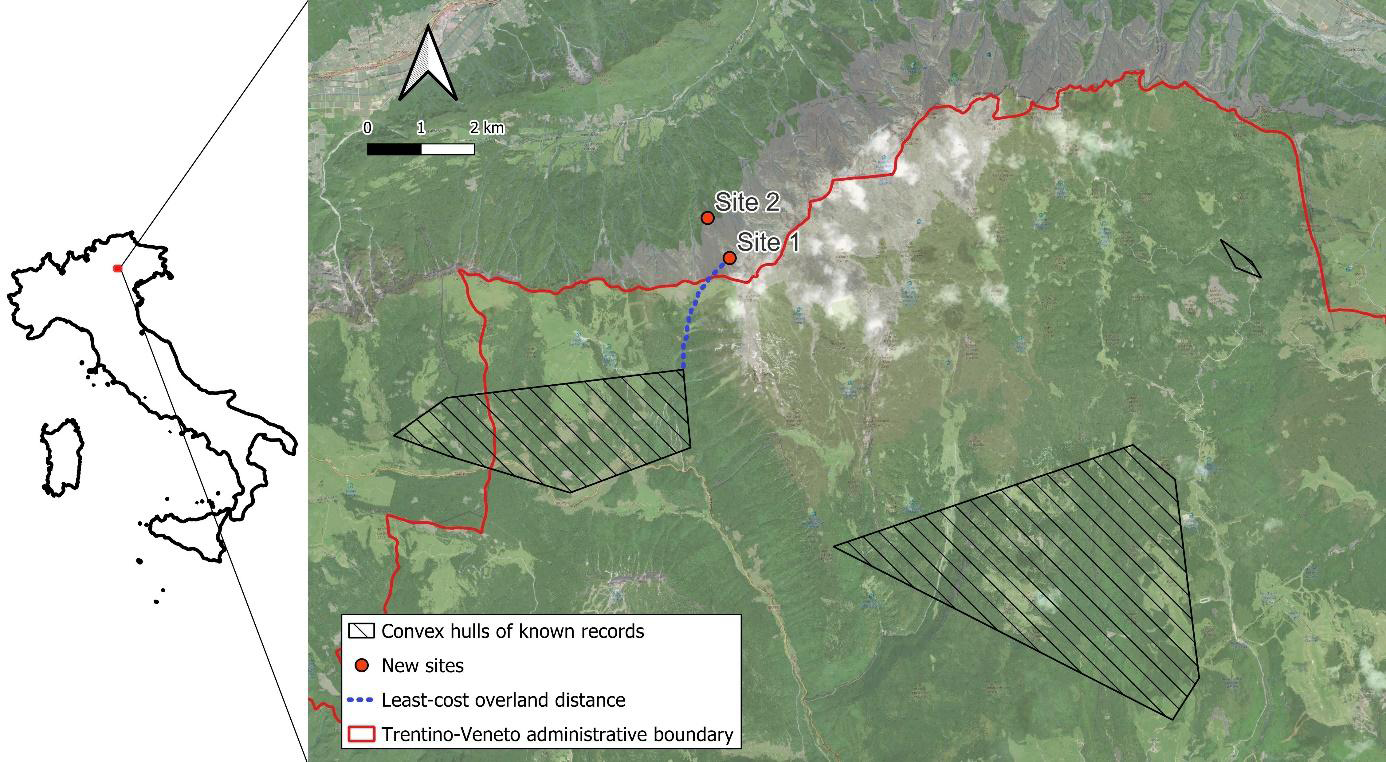
To assess differences between the newly identified sites and those previously reported in the literature, we georeferenced records from Romanazzi and Bonato (2014) using a 1:25.000 IGM map (MASE, 2025) to locate the cited localities and the TINITALY Digital Elevation Model (Tarquini et al., 2007). Each occurrence was positioned at the reported locality and elevation and when multiple elevations were indicated for the same locality, they were treated as separate records. All these points spatially overlap with the occurrence areas shown in the original map from Romanazzi and Bonato (2014), which we digitized and georeferenced in QGIS. We subsequently added 17 representative presence localities from the Veneto region, provided directly by the authors of Giachello et al. (2025) together with presence data collected in Trentino during the monitoring conducted by MUSE – Science Museum between 2017 and 2025 (partially reported in Romano et al., 2018a). We used QGIS (v. 3.40.40) and GRASS GIS (v. 2.12.99) to calculate i) the elevation and the geographic aspect of the new sites, ii) the minimum Euclidean and least-cost overland distance between the new sites and the nearest previously known iii) the positive and negative elevation gain and the minimum pass elevation along the shortest overland distance. These metrics were calculated to provide a conservative estimate of the minimum topographical separation between new sites and nearest previously known localities. To characterize the habitat and forest composition around the new sites, we used a 40 meters buffer, considering the maximum known home range of the subspecies (mean 7.8 m; Bonato and Fracasso, 2003). Subsequently, we classified and quantified the habitat and forest types within the buffer based on a land use map of European Alps for the first (Marsoner et al., 2023), and a regional forest type layer for the second (PAT, 2021).
To evaluate the climatic position of the new sites relative to known localities of S. a. aurorae, we obtained fine-grained climate data for each occurrence location (n = 77). Climate data are usually available at a coarse spatial scale (e.g., 1 km grid), which is too broad to assess differences in micro-endemic species. To overcome this issue, we downscaled 19 bioclimatic variables (Karger et al., 2017) using the ClimateDT downscaling service (Marchi et al., 2024), which performs point-level downscaling of climatic variables and indices, averaging the values of the 19 bioclimatic variables over the last 20 years. Although downscaled data represent an approximation of true fine-scale conditions, which remain unknown and may differ from the values obtained by downscaling, this approach allows a finer spatial resolution than the raw data at 1 km resolution, and has been recognized as a successful technique for several taxa (Lenoir et al., 2017; King et al., 2025), including amphibians (Stickley and Fraterrigo, 2023; Costa et al., 2025).
To control for spatial autocorrelation and to reduce potential biases arising from uneven regional samples’ availability (e.g., fewer records in Veneto more in Trentino) and spatially clustered occurrence data (Borcard et al., 2004; Legendre and Legendre, 2012; Borcard et al., 2018), we implemented a Principal Component Analysis (PCA) based on Moran’s Eigenvector Maps (dbMEM; Borcard and Legendre, 2002; Dray et al., 2006), thereby reducing the risk that spatial clustering biases subsequent climatic niche analyses. Specifically, we first computed the residuals of a multivariate regression of the 19 bioclimatic variables on the dbMEM, derived from the geographic coordinates of the sites, using function ‘dbmem’ in ‘adespatial’ R package (Dray et al., 2018). These residuals, representing the spatially filtered climate variation, were then subjected to a standardized PCA, from which we extracted the scores for the first three principal components, which together explained 95.1% of the variance (PC1 = 77.3%; PC2 = 13.0%; PC3 = 4.8%). To evaluate if the new records displayed different climatic conditions from previously known locations, we calculated the climatic centroid of the 75 known sites representing the central tendency of the subspecies’ realized niche in multivariate climatic space as the mean of the PCA scores (PC1–PC3). We then calculated the Mahalanobis distance, measuring how far each site is from the niche centroid, including the two new occurrences (Etherington, 2021), and compared these distances to those of known sites to assess whether the new sites represent novel climatic conditions.
Along the Sella Valley, two new occurrence sites were identified at 1825 m (Site 1) and 1395 m a.s.l. (Site 2) (Fig. 1). The uppermost site lies on a rocky scree, an atypical environment for the species, while the second site is situated within a typical forested habitat. These two sites are 600 meters apart in a straight line (± 10 m) and differ in altitude by 450 meters.
The aspect of Site 1 is west (258°), whereas Site 2 lies on a north-northeast-facing slope (21°). The nearest previously known site to those we report from the Sella Valley is located in Renzola Valley (Veneto region), at 1450 m a.s.l. (Fig. 1). The minimum Euclidean distance is 2260 m, whereas the least-cost overland distance is 2435 m (± 200 m). In the latter case, the positive and negative elevation gain are 595 m and 225 m, with a minimum pass elevation of 2045 m a.s.l. The habitat within a 40 m buffer, based on a land-use map of the European Alps, is composed as follows: i) Site 1 – mixed tree cover (57%), scrub and shrubland (24%), and managed grasslands/pastures (19%); ii) Site 2 – broadleaf tree cover (60-100% cover class; 83% of the buffer) and coniferous tree cover (60-100% class; 17% of the buffer). Within the same buffer, the forest types are: i) Site 1 – mountain pine and rhododendron scrub; ii) Site 2 – calcicolous silver fir-beech forest, mountain pine and rhododendron scrub.
Regarding the analysis of the subspecies’ climatic niche, visual inspection of the PCA scatterplots (Fig. 2) indicates that the newly discovered sites are located toward the periphery of the previously characterized climatic space. The climatic centroid calculated from the 75 previously known sites was used as a reference representing the core niche of S. a. aurorae. Relative to this centroid, the new sites exhibited relatively elevated Mahalanobis distances compared to the denser central cluster of occurrences, placing them within the subset of sites associated with more peripheral climatic conditions, although they do not represent the most extreme values observed (Fig. 3). Site 1, located at high elevation (1825 m), is slightly above the maximum elevation reported for this subspecies (1800 m a.s.l.; Bonato et al., 2025). Located on a rocky scree, it differs substantially from the typical habitat of the subspecies, dominated by mature mixed forests of silver fir and beech. The habitat of Site 1 resembles the environments occupied by S. a. atra and S. a. pasubiensis. Despite the vicinity to the nearest known site (Renzola Valley), steep topography and large elevation differences likely limits recent dispersal of S. a. aurorae, given its limited mobility and small home range (Bonato and Fracasso, 2003). Site 2 lies in optimal forest habitat, with the gravid female suggesting the existence of a reproductive population, and therefore a wider distribution in the Sella Valley than currently known.
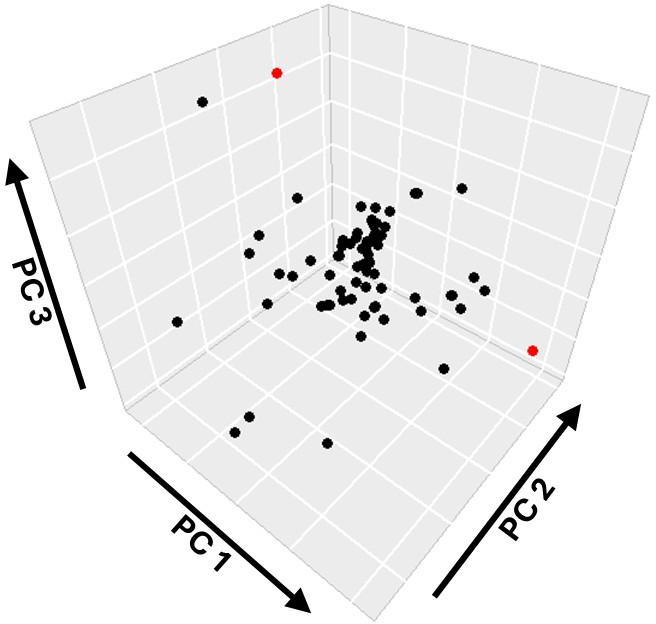
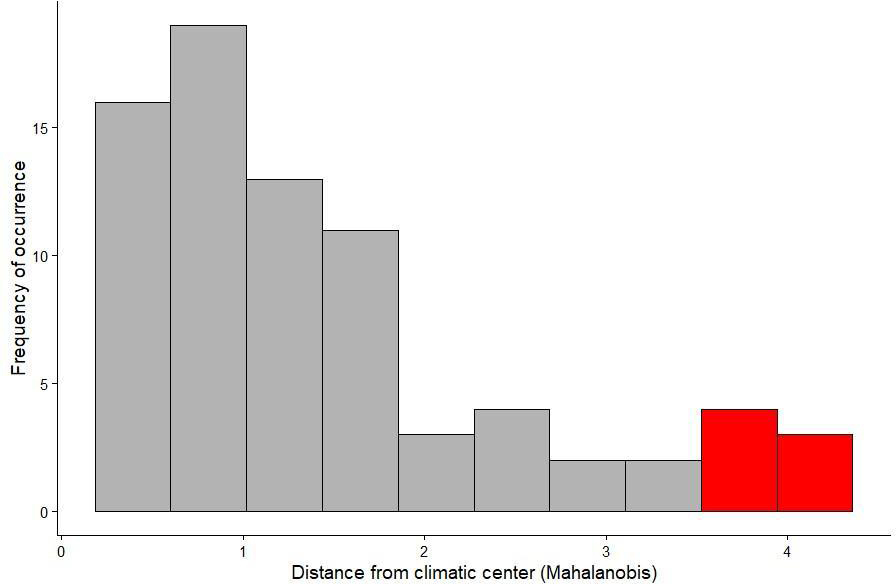
The occurrence of the salamander in climatic conditions positioned toward the periphery of the previously characterized niche, though not representing the most extreme environments observed, suggests two non-mutually exclusive scenarios: (i) the presence of a marginal or partially isolated population occupying peripheral environmental conditions; or (ii) a population largely continuous with others, with the apparent geographic gaps reflecting false negatives due to low detectability rather than true absence.
From a conservation perspective, these findings are noteworthy. Given the extremely low genetic diversity reported for S. a. aurorae (Bonato et al., 2018), the newly detected individuals may represent an important resource for future conservation projects. Genetic analyses will therefore be essential to clarify if they represent a distinct lineage, their phylogenetic origin, and genetic relationships with neighbouring populations.
Moreover, the occurrence of a site in clearly atypical habitat expands current knowledge of the subspecies’ ecological requirements and highlights the need to reconsider survey strategies, especially in peripheral or topographically complex regions. Overall, these findings suggest that the distribution of S. a. aurorae is likely fragmented and more widespread than previously documented, underscoring the need for targeted surveys in areas previously considered unsuitable.
Acknowledgements
We would like to thank the Sustainable Development and Protected Areas Service of the Autonomous Province of Trento (PAT) for funding and providing constant support in the long-term monitoring of the subspecies. We also thank the Forest Service of PAT for the valuable support. We warmly thank Marcello Trentin (forester of the Sella Valley) for his contribution during the initial stages of this work, and Sebastiano Salvidio for his assistance during field sampling. We would like to thank the authors of Giachello et al. (2025) for providing the occurrence data for the Veneto region
References
Beukema, W., Brakles, P. (2008): Discovery of Salamandra atra aurorae (Trevisan, 1982) on the Altopiano di Vezzena, Trentino (Northeastern Italy). Acta Herpetol. 3: 77-81.
Bonato, L., Fracasso, G. (1999): Aspetti morfologici ed ecologici di una popolazione di Salamandra atra aurorae: Risultati preliminari. In: Atti del II Convegno dei Faunisti Veneti (Padova). Boll. Mus. civ. stor. nat. Venezia 48: 31-35.
Bonato, L., Fracasso, G. (2003): Movements, distribution pattern and density in a population of Salamandra atra aurorae (Caudata: Salamandridae). Amphib.-Reptil. 24: 251-260.
Bonato, L., Fracasso, G. (2015): Epigean habitat of a population of Salamandra atra aurorae: A preliminary analysis. In: Atti del X Congresso Nazionale della Societas Herpetologica Italica (Genova), pp. 47–55. Doria, G., Poggi, R., Salvidio, S., Tavano, M., Eds., Pescara, Ianieri Edizioni.
Bonato, L., Corbetta, A., Giovine, G., Romanazzi, E., Sunje, E., Vernesi, C., Crestanello, B. (2018): Diversity among peripheral populations: Genetic and evolutionary differentiation of Salamandra atra at the southern edge of the Alps. J. Zool. Syst. Evo. Res. 56: 533-548.
Bonato, L., Lefosse, S., Romano, A. (2025): Salamandra atra aurorae (Trevisan, 1982): 60-63. In: Atlas of Italian Amphibians and Reptiles, 14, 560 pp. Razzetti, E., Bruni, G., Di Tizio, L., Liuzzi, C., Sindaco, R., Eds, Latina, Societas Herpetologica Italica/Edizioni Belvedere.
Borcard, D., Gillet, F., Legendre, P. (2018): Numerical Ecology with R (2nd edition). Springer.
Borcard, D., Legendre, P., Avois-Jacquet, C., Tuomisto, H. (2004): Dissecting the spatial structure of ecological data at multiple scales. Ecology 85: 1826-1832.
Borcard, D., Legendre, P. (2002): All-scale spatial analysis of ecological data by means of principal coordinates of neighbour matrices. Ecol. Model. 153: 51-68.
Centomo, E., Roner, L., Salvatori, M., Pedrini, P., Romano, A. (2023): Rare and hungry: Feeding ecology of the Golden Alpine Salamander, an endangered amphibian in the Alps. Animals 13: 2135.
Costa, A., Bernabò, I., Rosa, G., Salvidio, S., and Romano, A. (2025): Artificial water sites increase amphibian resilience in a changing Mediterranean landscape. Agric., Ecosyst. Environ. 394: 109912.
Dray, S., Blanchet, G., Borcard, D., Guenard, G., Jombart, T., Larocque, G., Dray, M. S. (2018): Package ‘adespatial’. R package, 3-8.
Dray, S., Legendre, P., and Peres-Neto, P.R. (2006): Spatial modelling: A comprehensive framework for principal coordinates of neighbour matrices (PCNM). Ecol. Model. 196: 483-493.
Etherington, T.R. (2021): Mahalanobis distances for ecological niche modelling and outlier detection: Implications of sample size, error, and bias for selecting and parameterising a multivariate location and scatter method. PeerJ 9: e11436.
Giachello, S., Lefosse, S., Simoncini, A., Bonato, L. (2025): Species distribution models for the conservation of a micro-endemic animal: The contribution of regional land cover. Biodivers. Conserv. 34: 1689-1707.
Karger, D.N., Conrad, O., Böhner, J., Kawohl, T., Kreft, H., Soria-Auza, R.W., Zimmermann, N.E., Linder, H.P., Kessler, M. (2017): Climatologies at high resolution for the earth’s land surface areas. Sci Data 4: 170122.
King, M.R., de Jong, M.V.Z., Cowx, I.G. (2025): Downscaling climate projections to forecast ecological changes in river systems. J. Environ. Manag. 395: 127787.
Legendre, P., Legendre, L. (2012): Numerical ecology, 3rd English edition. Elsevier Science BV, Amsterdam.
Lenoir, J., Hattab, T., and Pierre, G. (2017): Climatic microrefugia under anthropogenic climate change: Implications for species redistribution. Ecograph 40: 253-266.
Lefosse, S., Romanazzi, E., Pedron, V., Bonato, L. (2016): Efficacia di diversi metodi di rilevamento della salamandra di Aurora, Salamandra atra aurorae, nell’Altopiano dei sette Comuni (Caudata). Boll. Mus. Stor. Nat. Venezia, 66: 76-81.
Marchi, M., Bucci, G., Iovieno, P., Ray, D. (2024): ClimateDT: A global scale-free dynamic downscaling portal for historic and future climate data. Environments 11: 82.
Marsoner, T., Simion, H., Giombini, V., Egarter Vigl, L., Candiago, S.(2023): A detailed land use/land cover map for the European alps macro region. Sci. Data 10: 468.
Ministero dell’Ambiente e della Sicurezza Energetica. (2025): IGM 1:25,000 topographic map of Italy. Geoportale Nazionale.
PAT (2021): Tipi forestali PAT integrati – elaborazione statica 2021 (SIGFAT & altre fonti).
Romanazzi, E., Bonato, L. (2014): Updating the range of the narrowly distributed endemites Salamandra atra aurorae and S. atra pasubiensis. Amphib.-Reptil. 35: 123-128.
Romano, A., Costa, A., Salvidio, S., Menegon, M., Garollo, E., Tabarelli de Fatis, K., Miserocchi, D., Matteucci, G., Pedrini, P. (2018): Forest management and conservation of an elusive amphibian in the Alps: Habitat selection by the golden Alpine salamander reveals the importance of fine woody debris. For. Ecol. Manag. 424: 338-344.
Romano, A., Iemma, A., Tabarelli de Fatis, K., Anderle, M., Roner, L., Garollo, E., Matteucci, G., Pedrini, P. (2018a): Salamandra atra aurorae in Trentino: Pianificazione del metodo di campionamento per rilevarne la presenza ed estenderne l’areale di distribuzione. In: Atti del XII° Congresso Nazionale Societas Herpetologica Italica, Rende (Cosenza), pp. 235-239. Tripepi, S., Ed., Ancona, Ventura.
Rondinini, C., Battistoni, A., Teofili, C. (Eds.) (2022): Lista Rossa IUCN Dei Vertebrati Italiani, Comitato Italiano IUCN e Ministero dell’Ambiente e della Sicurezza Energetica.
Roner, L., Trenti, M., Salvidio, S., Costa, C., Pedrini, P., Romano, A. (2022): Il monitoraggio della salamandra alpina Salamandra atra in Trentino: Applicazione e validità del metodo del doppio osservatore in diverse condizioni meteorologiche. In: Atti del XIII Congresso Nazionale Societas Herpetologica Italica (Lipari), pp. 361-368. Biaggini, M., Corti, C., Giacobbe, D., Lo Cascio, P., Restivo, S., Eds, Palermo, Naturalista Siciliano.
Stickley, S.F., Fraterrigo, J.M. (2023): Microclimate species distribution models estimate lower levels of climate-related habitat loss for salamanders. J. Nat. Cons. 72: 126333.
Tarquini, S., Vinci, S., Favalli, M., Doumaz, F., Fornaciai, A., Nannipieri, L. (2007): TINITALY/01: a new Triangular Irregular Network (TIN) digital elevation model of Italy. Ann. Geophys. 50: 407-425.