https://doi.org/10.36253/a_h-19819
Submitted on: 2026, 08th February; revised on: 2026, 13th March; accepted on: 2026, 26th March.
Human-mediated dispersals in the Aegean region: the case of Anatololacerta pelasgiana on Chalki Island (Greece: Dodecanese)
1 Patras 264 42, Achaia, Greece
2 Department of Zoology, Comenius University in Bratislava, Ilkovičova 6, Mlynská dolina, 842 15, Bratislava, Slovakia
3 Herpetological Collection, 1st Zoological Department, Natural History Museum Vienna, Burgring 7, 1010 Vienna, Austria
*Corresponding author. Email: daniel.jablonski@uniba.sk
Abstract. We report the first confirmed occurrence of Anatololacerta pelasgiana on Chalki Island (Dodecanese, Greece). The species was detected exclusively in and around the main settlement and port, within an area of ~0.9 km², suggesting an established population likely originating from a recent human-mediated introduction. To infer source affinity, we sequenced the mitochondrial cytochrome b gene from two individuals and compared these sequences with published ones from Aegean and adjacent Anatolian populations. Based on the analysed length of the cytochrome b fragment, the Chalki specimens share a widespread haplotype known from Rhodes, Kastellorizo, and Athens (Greece), as well as from southwestern Turkey. These results suggest repeated, transport-mediated introductions likely from nearby Rhodes as a recurrent driver of secondary colonization in the southeastern Aegean and underscore local trade links as pathways for small-island translocations, potentially relevant to other reptiles in the region.
Keywords. Lacertidae, Aegean Islands, lizard translocation.
Contents
Lizards of the genus Anatololacerta Arnold, Arribas and Carranza, 2007, are small lacertids present from western to southern Anatolia and many neighbouring islands. Currently, the genus comprises five species (Karakasi et al., 2021), i.e. Anatololacerta anatolica (Werner, 1900), Anatololacerta danfordi (Günther, 1876), Anatololacerta ibrahimi (Eiselt and Schmidtler, 1986), Anatololacerta pelasgiana (Mertens, 1959), and Anatololacerta finikensis (Eiselt and Schmidtler, 1986). Three representatives of the genus occur in Greece, which are found on Aegean islands: A. anatolica on Ikaria and Samos; A. pelasgiana on Rhodes, Symi and nearby islands; and A. finikensis, which is restricted to Psomi islet (Karakasi et al., 2021). Anatololacerta pelasgiana has the widest insular distribution among its sister species, occupying a broad range of different habitats (Şahin et al., 2022), and has already shown the potential to establish new introduced populations in other areas, as shown by the record from Athens in mainland Greece (Christopoulos et al., 2022).
During a series of field surveys to the Dodecanese archipelago, Greece, we visited the island of Chalki (36.230°N, 27.569°E) between 14 and 16 October 2025. Chalki is situated roughly 10 km from the island of Rhodes, which is part of the natural distribution of A. pelasgiana. The island hosts a notably poor herpetofaunal assemblage, comprising species that are widely distributed on nearby islands: Hemidactylus turcicus (Linnaeus, 1758), Mediodactylus oertzeni (Boettger, 1888), Laudakia stellio (Linnaeus, 1758), Ablepharus kitaibelii Bibron and Bory de Saint-Vincent, 1833, Dolichophis jugularis (Linnaeus, 1758), and Zamenis situla (Linnaeus, 1758) (Buttle, 1995; Grano and Cattaneo, 2015). However, A. pelasgiana has never been officially reported from the island despite its common presence in Rhodes and other islands and few previous herpetological investigations on the island (Buttle, 1995; Grano and Cattaneo, 2015).
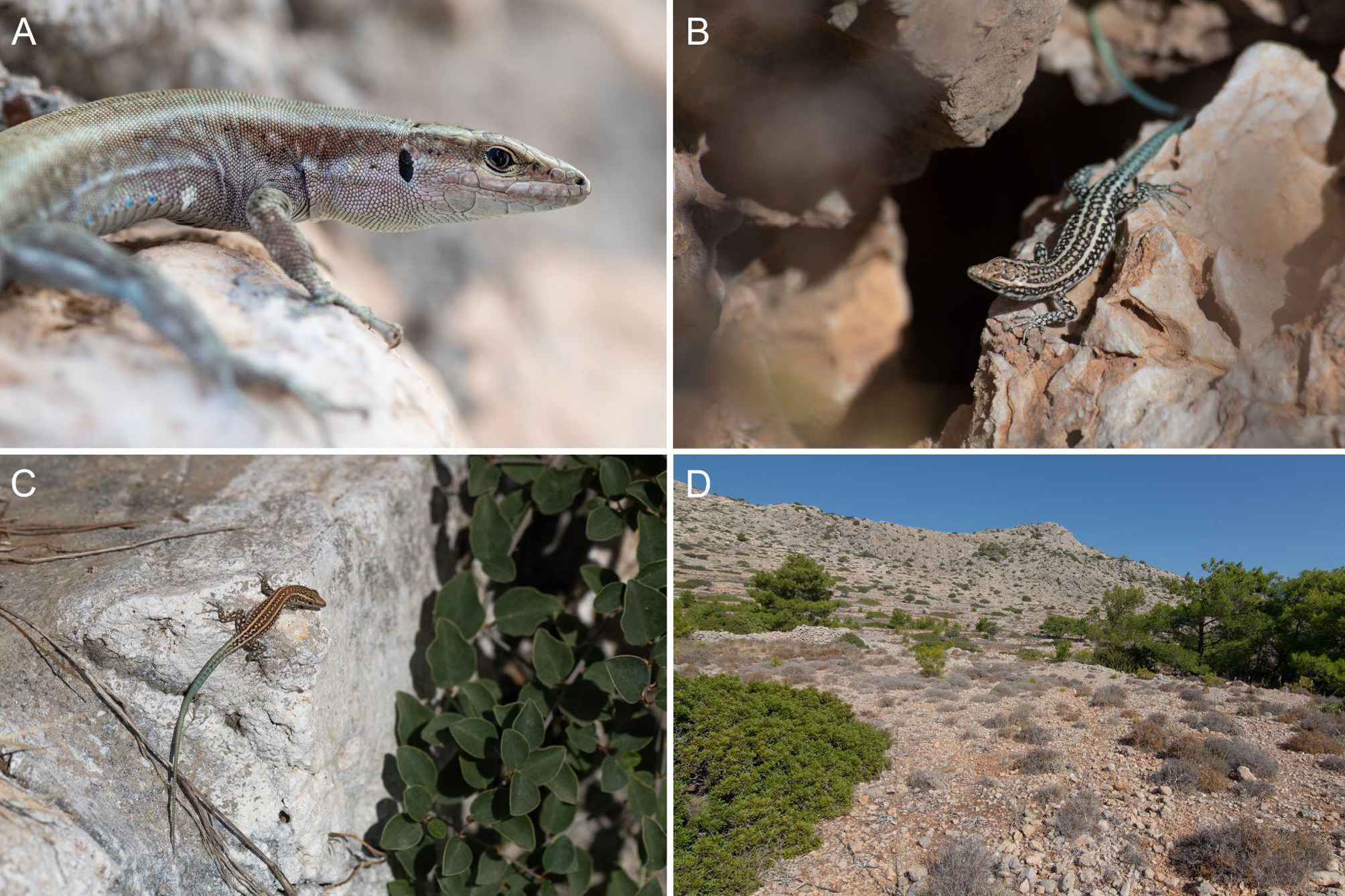
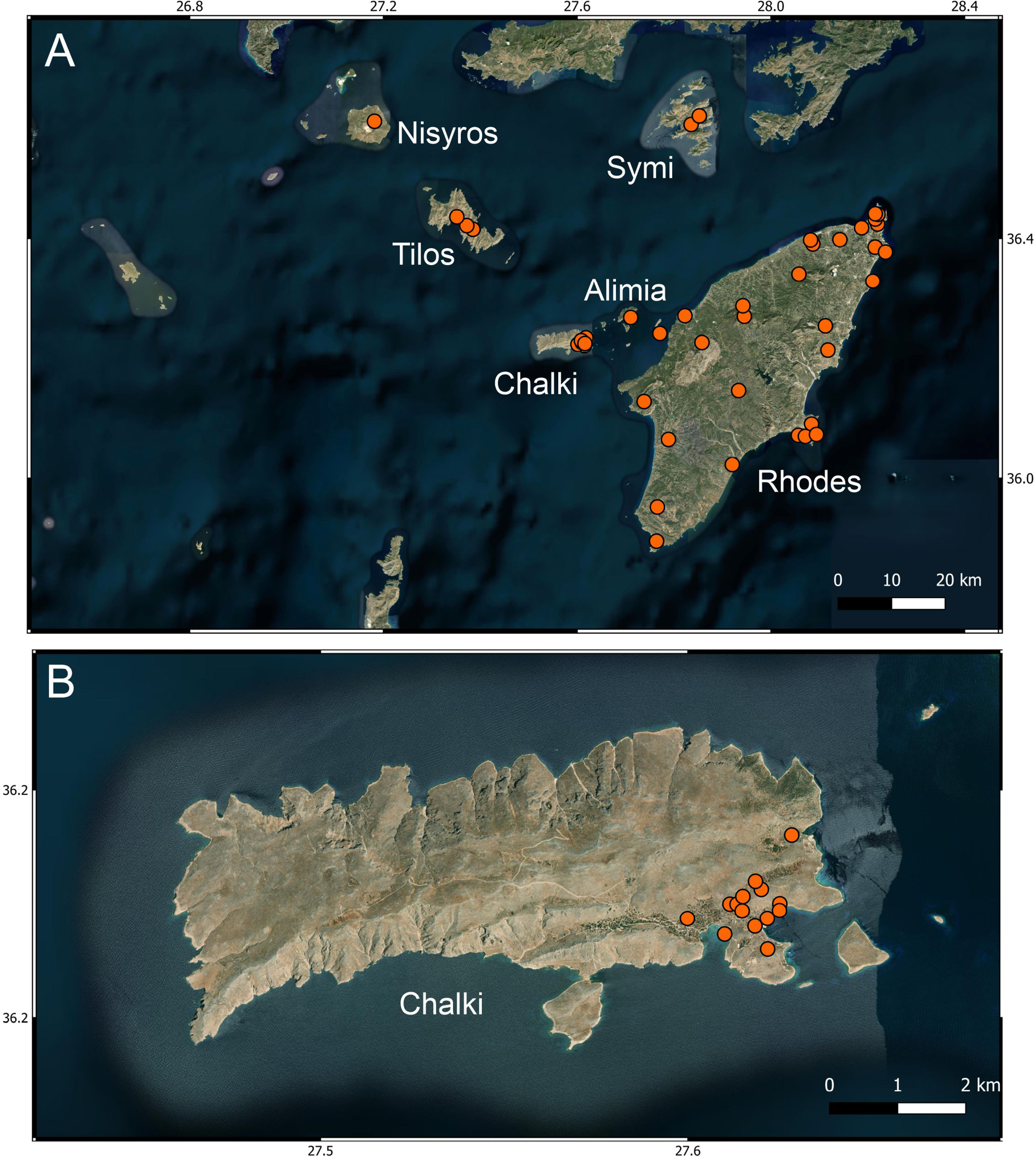
Thus, we conducted random fieldwork along the main roads of the island. Due to its small size, surveys were conducted on foot. We visited both coastal and mountainous areas of the island. Across our survey visits, we recorded 39 individuals of A. pelasgiana of all ontogenetic stages (Fig. 1A-C) inhabiting the main village Chalki and the surrounding biotopes, within an area of approximately 0.9 km² (Fig. 2). Therefore, this record represents an additional reptile species for Chalki Island and likely results from recent human-mediated introduction.
To assess their genetic affinity, we captured two individuals from the main village of Chalki and collected tail-tip tissue samples for genetic analysis. Both individuals were released at their respective capture sites. We extracted total genomic DNA (E.Z.N.A.® Tissue DNA Kit), and amplified a fragment of the mitochondrial cytochrome b (cyt b) gene following the protocol of Karakasi et al. (2021) and using the primer pair (LgluLK/Lacertidae_cytb) described by Pavlicev and Mayer (2009) and Khan et al. (2021). The newly generated sequences ((GenBank accession number PZ147789-90; 693 bp)) were compared with publicly available datasets in GenBank using BLAST to verify genetic/species similarity (100% identity with sequences GQ142137 and KM434522 from Rhodes). To visualize the intraspecific genetic network, we further aligned newly generated sequences with 45 published sequences of A. pelasgiana from Aegean Greece and related Turkey mainland (Bellati et al., 2015; Kalaentzis et al., 2018; Karakasi et al., 2021; Christopoulos et al., 2022; Appendix 1). The final sequence alignment (47 sequences, 420-998 bp) was analysed with a haplotype-network approach (alignment length 1143 bp) in Hapsolutely (Vences et al., 2024). To provide species distribution overview in the region, we compiled distribution data from Broggi (2006), Cattaneo (2006), Bader et al. (2009), Grano et al. (2015, 2018), and Karakasi et al. (2021), presented in Appendix 2. Distribution maps were prepared using QGIS 3.44 Solothurn (QGIS Development Team 2026; https://qgis.org/).
Based on the cyt b dataset, the Chalki population shares a haplotype present in populations from Rhodes and Kastellorizo (Greece), as well as Marmaris and Tavas (Turkey). Notably, the introduced Athens population also falls within this haplotype (Fig. 3).
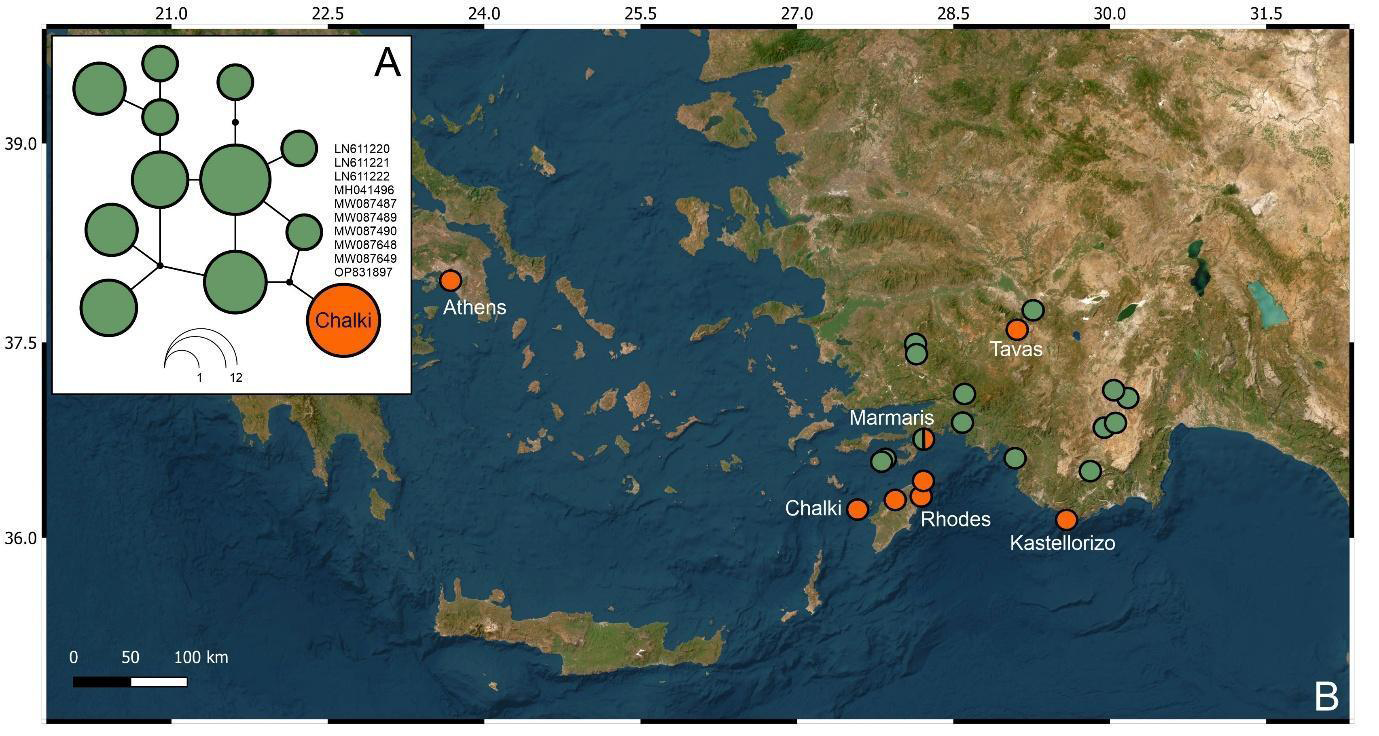
In the Aegean region, A. pelasgiana is naturally distributed in the Dodecanese archipelago, where it inhabits the islands of Nisyros, Symi, Tilos, Rhodes, and Alimia, as well as the islets of Seskli, Pentanisos, and Strogyli (Bader et al., 2009; Cattaneo et al., 2020). In addition to its native range, the species has recently established populations on Kasos and Kastellorizo, two Dodecanese islands where it had not previously been recorded (Kornilios and Thanou, 2016; Kalaentzis et al., 2018). Furthermore, Christopoulos et al. (2022) reported the first colonization within the metropolitan area of Athens in mainland Greece. Interestingly, Grano et al. (2018) suggested that the population found on Tilos Island likely resulted from secondary human activities as the species is restricted to a few established sites. However, this hypothesis has not yet been tested using genetic data. These naturalized populations found on Kasos, Kastellorizo and Athens showed proximity to individuals from Rhodes, suggesting this particular island may have originated the introduced populations (Kornilios and Thanou, 2016; Kalaentzis et al., 2018; Christopoulos et al., 2022; and references therein). We confirm that these populations share the same haplotype that colonized other areas.
Small Dodecanese islands in the vicinity of Rhodes are strongly connected through local trade and frequent transport, which likely facilitates the spread of A. pelasgiana among neighbouring islands. On Chalki, the relatively broad area in which we recorded A. pelasgiana suggests an already established population. Nevertheless, A. pelasgiana has not been reported from Chalki in the most recent herpetological surveys by other researchers (Buttle, 1995; Grano and Cattaneo, 2015, 2017), possibly indicating a rare case of early and recent colonization. If so, the presence of juveniles further supports the rapid establishment of the population after introduction.
Despite this, the population appears spatially restricted and has not expanded across the island beyond the vicinity of the settlements and port area. We detected A. pelasgiana only in suitable habitats near or within human-modified environments, primarily rocky shrublands with scattered trees (Fig. 1D). Most individuals were observed in phrygana scrub associated with short, dry-stone walls and ground-level microhabitats (e.g. fallen logs, rocky shorelines). This pattern is consistent with our additional surveys farther east on the island, where A. pelasgiana was not detected, suggesting that these suitable areas may be colonized in the future.
Similar cases have also been documented in other native lacertids within the Aegean area and broader Greece. Among others, recent examples include the Peloponnese endemic Podarcis peloponnesiacus (Bibron and Bory de Saint-Vincent, 1833), which has established a population on the Attic Peninsula (Hedman et al., 2017), the widely distributed Podarcis muralis (Laurenti, 1768), now reported from Athens and Corfu Island in the Ionian Sea (Hill and Mayer, 2004; Karameta and Pafilis, 2017), the Balkan endemic Algyroides nigropunctatus (Duméril and Bibron, 1839), introduced to Athens, Crete, and the Peloponnese (Deimezis-Tsikoutas et al., 2020; De la Cruz et al., 2024; Prondzynska et al., 2025), as well as Podarcis erhardii livadiacus (Werner, 1902), introduced to a small Cycladic island (Adamopoulou et al., 2025).
Considering the Chalki herpetofaunal composition, coexistence with the endemic Dodecanese M. oertzeni and the Juniper Skink A. kitaibelii, may lead to interspecific competition, as the species may also exhibit potential predation toward smaller lizards (Bader et al., 2009). Nevertheless, this note documents an additional translocation event of A. pelasgiana within the Dodecanese archipelago, resulting from human-mediated activities that are historically and recently reported from the Aegean (e.g. Kornilios and Thanou, 2016; Kalaentzis et al., 2018).
Acknowledgments
Field activities and tissue sampling were performed under authorization from the Greek Ministry of Environment and Energy (ΥΠΕΝ/ΔΔΔ/96343/3547). We also thank the two anonymous reviewers for their helpful comments and corrections, which improved the originally submitted version of the manuscript.
Funding
The research was supported by the EU NextGenerationEU scholarship through the Recovery and Resilience Plan for Slovakia under the project No. 09I03-03-V04-00306.
Supplementary material
Supplementary material associated with this article can be found at: https://oaj.fupress.net/index.php/ah/article/view/19819/15292.
References
Adamopoulou, C., Linardaki, E., Thanou, E. (2025): Revisiting Spanopoula islet: Podarcis erhardii (Bedriaga, 1886) population thriving 45 years after first recorded. Herpetozoa 38: 93-95.
Arnold, E.N., Arribas, O., Carranza, S. (2007): Systematics of the Palaearctic and Oriental lizard tribe Lacertini (Squamata: Lacertidae: Lacertinae), with descriptions of eight new genera. Zootaxa 1430: 1-86.
Bader, T., Riegler, C., Grillitsch, H. (2009): The herpetofauna of the Island of Rhodes (Dodecanese, Greece). Herpetozoa 21: 147-169.
Bellati, A., Carranza, S., Garcia-Porta, J., Fasola, M., Sindaco, R. (2015): Cryptic diversity within the Anatololacerta species complex (Squamata: Lacertidae) in the Anatolian Peninsula: Evidence from a multi-locus approach. Mol. Phylogenet. Evol. 82: 219-233.
Bibron, G., Bory de Saint-Vincent, J.B. (1833): Vertébrés à sang froid. Reptiles et poissons. 9. Lézard du péloponnèse, Lacerta peloponnesiaca Bibron et Bory. In: Expédition Scientifique de Morée, Section des sciences physiques, Tome III, pp. 66-67. Geoffroy, I., Geoffroy É., Eds, Paris, F. G. Levrault.
Boettger, O. (1888): Verzeichniss der von Hrn. E. von Oertzen aus Griechenland und aus Kleinasien mitgebrachten Batrachier und Reptilien. Sitzungsber. Preuß. Akad. Wiss 1: 139-186.
Broggi, M.F. (2006): Isolation und Landnutzungswandel und ihre Einflüsse auf die Herpetofauna–Dargestellt am Beispiel der Insel Tilos (Dodekanes, Griechenland). Herpetozoa 19: 13-16.
Buttle, D. (1995): Herpetological notes on the Dodecanese islands of Chalki and Symi, Greece. Herpetol. Bull. 52: 33-37.
Cattaneo, A. (2006): Contributo alla conoscenza dell’erpetofauna dell’isola egea di Nisyros (Dodecaneso) (Reptilia). Nat. sicil. S. IV, XXX: 485-494.
Cattaneo, A., Cattaneo, C., Grano, M. (2020): Update on the herpetofauna of the Dodecanese Archipelago (Greece). Biodivers. J. 11: 69-84.
Christopoulos, A., Pantagaki, C-F., Poulakakis, N., Pafilis, P. (2022): First record of Anatololacerta pelasgiana (Mertens, 1959) in mainland Greece: Another new species in Athens. Herpetozoa 35: 239-244.
De la Cruz, F., Kawamoto, A., Pérez i de Lanuza, G., Font, E. (2024): First record of Algyroides nigropunctatus (Duméril & Bribon, 1839) from Crete. Bol. Asoc. Herpetol. Esp. 35: 43-45.
Deimezis-Tsikoutas, A., Kapsalas, G., Antonopoulos, A., Strachinis, I., Pafilis, P. (2020): Algyroides nigropunctatus (Squamata: Lacertidae) in the city of Athens: An unexpected finding. Russ. J. Herpetol. 27: 172-174.
Duméril, A.M.C., Bibron, G. (1839): Erpétologie générale ou histoire naturelle complète des reptiles. Paris, Roret/Fain et Thunot.
Eiselt, J., Schmidtler, J.F. (1986): Der Lacerta danfordi-Komplex (Reptilia: Lacertidae). Spixiana 9: 289-328.
Grano, M., Cattaneo, C. (2015): First record of Zamenis situla (Linnaeus, 1758) (Reptilia Serpentes) for the Aegean Island of Chalki (Dodecanese, Greece). Nat. Sicil. 39: 375-381.
Grano, M., Cattaneo, C. (2017): The balkan terrapin Mauremys rivulata (Valenciennes in Bory de Saint-Vincent, 1833) (Testudines Geoemydidae) in the Aegean island of Chalki: Native or introduced? Biodivers. J. 8: 851-854.
Grano, M., Cattaneo, C., Cattaneo, A. (2015): First observations on the herpetological and theriological fauna of Alimia Island (Rhodes Archipelago, Aegean Sea). Biodivers. J. 6: 73-78.
Grano, M., Cattaneo, C., Cattaneo, A. (2018): Nuovo contributo alla conoscenza dell’erpetofauna dell’isola Egea di Tilos (Dodecaneso, Grecia). Nat. Sicil. 42: 261-271.
Günther, A. (1876): Description of a new species of lizard from Asia Minor. Proc. Zool. Soc. London 1876: 818.
Hedman, H., Kapsalas, G., Karameta, E., Psonis, N., Poulakakis, N., Foufopoulos, J., Pafilis, P. (2017): First record of Podarcis peloponnesiacus (Bibron & Bory, 1833) from outside the Peloponnese. Herpetozoa 29: 190-193.
Hill, J., Mayer, W. (2004): First record of the wall lizard Podarcis muralis (Laurenti, 1768), from the Ionian Island of Corfu. Herpetozoa 17: 94-96.
Kalaentzis, K., Strachinis, I., Katsiyiannis, P., Oefinger, P., Kazilas, C. (2018): New records and an updated list of the herpetofauna of Kastellorizo and the adjacent islet Psomi (Dodecanese, SE Greece). Herpetol. Notes 11: 1009-1019.
Karakasi, D., Ilgaz, Ç., Kumlutaş, Y., Candan, K., Güçlü, Ö., Kankılıç, T., Beşer, N., Sindaco, R., Lymberakis, P., Poulakakis, N. (2021): More evidence of cryptic diversity in Anatololacerta species complex Arnold, Arribas and Carranza, 2007 (Squamata: Lacertidae) and re-evaluation of its current taxonomy. Amphib.-Reptil. 42: 201-216.
Karameta, E., Pafilis, P. (2017): First record of Podarcis muralis (Laurenti, 1768) from Athens, Greece. Herpetozoa 30: 87-88.
Khan, M.A., Jablonski, D., Nadeem, M.S., Masroor, R., Kehlmaier, C., Spitzweg, C., Fritz, U. (2021): Molecular phylogeny of Eremias spp. from Pakistan contributes to a better understanding of the diversity of racerunners. J. Zool. Syst. Evol. Res. 59: 466-483.
Kornilios, P., Thanou, E. (2016): Two additions to the herpetofauna of Kasos (Aegean Sea, Greece) and the role of human-mediated dispersals. Herpetol. Rev. 47: 633-635.
Laurenti, J.N. (1768): Specimen medicum, exhibens synopsin reptilium emendatam cum experimentis circa venena et antidota reptilium austracorum, quod authoritate et consensu. Vienna, Joan Thomae.
Linnaeus, C. (1758): Systema naturæ per regna tria naturæ, secundum classes, ordines, genera, species, cum characteribus, differentiis, synonymis, locis. Tomus I. Editio decima, reformata. Stockholm, Laurentii Salvii.
Mertens, R. (1959): Zur Kenntnis der Lacerten auf der Insel Rhodos. Senckenbergiana Biol. 40: 15-24.
Pavlicev, M., Mayer, W. (2009): Fast radiation of the subfamily Lacertinae (Reptilia: Lacertidae): History or methodical artefact? Mol. Phylogenet. Evol. 52: 727-734.
Prondzynska, K.M., Katsiyiannis, P., Tzoras, E. (2025): First record of Algyroides nigropunctatus (Duméril & Bibron, 1839) from the Peloponnese peninsula, Greece. Herpetol. Notes 18: 483-485.
QGIS Development Team (2026): QGIS 3.44 Solothurn, Geographic Information System. Open Source Geospatial Foundation Project. http://qgis.org [Accessed 17 January 2026].
Şahin, K.M., Candan, K., Karakasi, D., Lymberakis, P., Poulakakis, N., Kumlutaş, Y., Yildirim, E., Ilgaz, Ç. (2022): Ecological niche differentiation in the Anatolian rock lizards (Genus: Anatololacerta) (Reptilia: Lacertidae) of the Anatolian Peninsula and Aegean Islands. Acta Herpetol. 17: 165-175.
Vences, M., Patmanidis, S., Schmidt, J.-C., Matschiner, M., Miralles, A., Renner, S.S. (2024): Hapsolutely: A user-friendly tool integrating haplotype phasing, network construction, and haploweb calculation. Bioinform. Adv. 4: vbae083.
Werner, F. (1900): Beschreibung einer bisher noch unbekannten Eidechse aus Kleinasien Lacerta anatolica. Anz. Akad. Wiss. Wien 25: 269-271.
Werner, F. (1902): Reptilien. In: Galvagni, E. (ed.), Beiträge zur Kenntniss der Fauna einiger dalmatinischer Inseln. Verh. K. K. Zool. Bot. Ges. Wien 52: 362-388.