Received: December 6, 2023; Accepted: September 2, 2024; Published: June 13, 2025
Soils and ecosystem services: policy narratives and instruments for soil health in the EU
1 Department of Chemical, Pharmaceutical and Agricultural Sciences (DOCPAS), University of Ferrara, Italy
2 Department of Agriculture, Food and Environment (DAFE), University of Pisa, Italy
*Corresponding author. E-mail: greta.winkler@unife.it
Abstract. European soils and their status is a matter of concern that has entered the policy arena and the objective to restore soil health is part of the Soil strategy to 2030. Aim of this study is to explore the integration of the concept of soil health and the provision of soil ecosystem service by conducting i) a content analysis of EU policies and ii) a scoping review of literature over policy instruments for soil governance. Results show a focus on soil fertility, mainly soil organic matter, while services such as conservation of biodiversity or cultural heritage still appear underrepresented. Findings are reinforced by the gap in literature, providing little evidence of policy instruments contributing to soil health. A more coordinated effort among policy sectors is required to prioritize soil health in the EU; invesitgating the role of market-based instruments could complement what public policies are lacking.
Keywords: soil health, ecosystem services, policy instruments, incentives, soil monitoring law.
JEL Codes: Q10, Q15, Q57.
Index
2. Framing the soil health narrative
3.1. Content analysis of EU instruments
3.2. Review of policy instruments
4.2. Availability of policy instruments’ relating soil health to ES
5.2. Orienting the instruments
Appendix II - References from review
Property rights and use rights
Conservation (easements and concessions)
Soil is a non-renewable and multi-functional resource which contributes significantly to global food security, hosting one of the greatest concentrations of biodiversity on the planet and providing further Ecosystem Services (ES) that include air and water purification, climate regulation and conservation of cultural heritage (FAO and ITPS, 2015). However, soils are under great pressure derived from both bio-physical processes and human-driven processes, such as erosion, floods and landslides, loss of soil organic matter, salinisation, contamination, compaction, sealing, and loss of soil biodiversity (Turpin et al., 2017; IPBES, 2018). When those processes impact soils’ status, their ability to provide ES is reduced or lost, with an estimated cost of around 50 billion euros yearly in the EU (COM 2021/699). Therefore, maintaining and enhancing the capacity of soils to provide ES can bring economic benefits and is critical to sustain ES and ensure human well-being (MEA, 2005).
Acknowledging the interconnectedness between soil, plant, animal (humans included) and ecosystem health as framed by the One Health concept (van Bruggen et al., 2019), soil health can be understood as “the ability of the soil to sustain the productivity, diversity, and environmental services of terrestrial ecosystems”1Primarily drawing from soil quality, the adoption of soil health in scientific literature started in the 1990s and developed by recognizing the role of biological processes in soil formation and functioning, identifying soils as ecosystems, mapping soils’ biodiversity and assigning to it an international scale (Lehmann et al., 2020). Soil health can be a useful metaphor that relates ecosystem functioning to human well-being, but its understanding and interpretation highly depends on the actors, issues, and values at stake in a given context (Janzen et al., 2021).
Recently, the soil health concept has entered the EU policy arena (Panagos et al., 2022) as testified by the Soil Strategy for 2030, included in the European Green Deal proposal to reach carbon neutrality by 2050. The strategy defines healthy soils as in good chemical, biological and physical condition, and thus able to continuously provide as much ES as possible; it also aims at restoring 60 to 70% of European soils, currently considered unhealthy (COM 2021/699). There is increasing evidence of the connection between decreasing soil health and loss of ES (Lehmann et al., 2020; IPBES, 2018); for instance, freshwater availability is affected by a reduction of soil organic matter in agricultural and forest soils (Keesstra et al., 2021); soil sealing in urban areas impacts human physical and mental well-being by hindering access to green areas (McElwee, 2021). However, investigating ES when applied to soil requires a deep understanding of chemical, physical and biological soil properties, additionally recognising benefits derived from soil components at different spatial scales (i.e., plot, field, landscape, regional area, countries, global). Comprehensive studies on valuation of soil ES are rare to be found often addressing methodological limitations derived from need of suitable and comparable indicators (Vysna et al., 2022; Baveye et al., 2016; Dominati et al., 2014).
If the current EU Soil Strategy (COM 2021/699) adopts a definition of soil health that heavily relates to ES, it can prove useful to understand to what extent this definition is integrated into actual soil governance. By soil governance we mean the mix of different policies and set of instruments available for regulating, incentivizing, and informing about the management of soils (Heuser, 2022; Rogge and Reichardt, 2016; Juerges and Hansjürgens, 2018). Recent reviews have investigated available policy instruments to soil governance worldwide (Juerges and Hansjürgens, 2018) and in EU Member States (Ronchi et al., 2019), however without addressing the connection to soil ES.
This study aims to explore how far the concept of soil health and the provision of soil ES is integrated into current policy instruments in the EU by conducting a content analysis of policy documents. To the best of our knowledge, no such works exist at EU level. Moreover, we aim at individuating proof of effective implementation of policy instruments for delivery of ES by fostering soil health.
The topic of soil health holds growing interest both in the scientific and policy community, considering the upcoming EU Soil Monitoring Law. If the law is implemented it will constitute the first binding instrument for soil regulation at EU level and will require MS to achieve responsive agri-environmental interventions within national public policy. Addressing governance gaps and policy needs could contribute in ensuring purposeful action towards soil health. In the next section, the policy narrative of soil health is framed in order to gain an overview of definitions that characterize soil health as well as policy instruments referring to sustainability transition. Following the methodology will be presented. Results and discussions are structured in two sections, to address both research aims.
2. Framing the soil health narrative
Understanding the concept of soil health requires some clarification: while the previously used attributes of soil fertility and soil quality refer to the local/regional level and focus on productivity, nutrients, and water cycles (Bünemann et al., 2018), soil health is told to encompass a larger range of ES. Lehman et al. (2022) include in the description of soil health “public” ES such as climate mitigation and control, access to recreational and spiritual places to improve human wellbeing and provision of habitat for above and below ground biodiversity. Janzen et al. (2021) refer to soil health as a metaphor for an organism in good conditions and suggest considering soil as a (complex) organism, defining its healthy conditions as “[…] the vitality of a soil in sustaining the socio-ecological functions of its enfolding land” (Janzen et al., 2021, p. 2).
Therefore, according to the authors, soil health allows to relate the issue to a broader public of stakeholders – not only farmers and landowners, but also local and national authorities – underlying how far sustainable soil governance goes beyond the field level thus constitutes a policy concern (Juerges and Hansjürgens, 2018).
The body of literature describes how emerging concepts and needs enter the policy agenda and then into policy cycle. Shanahan et al. (2011) claim that policy narratives are central to the policy cycle: being created by a broad set of actors, narratives are the device through which policy programs and the connected values and beliefs are communicated. The process of creating narratives finds its counterpart in the agenda setting, that is the operationalization of (certain) issues into a decisional level, the two phases happen ongoingly and alternately (Gonzalez Lago et al,. 2019).
From a political point of view, as described by Montanarella and Alva (2015), even though soils are essential to sustainable development, they have never been the specific focus of a multilateral environmental agreement. Given the diversity of services that soils can provide, it is no surprise to find a set of policy domains competing for land use, including agriculture, forestry, protected areas, urbanization, and energy production (Löbmann et al., 2022).
Focusing on the EU, after the proposal, discussion, and withdrawal of a Thematic strategy for soil protection in 2014, MS have found themselves lacking a comprehensive framework and have been relying on national regulations (Heuser, 2022).
Authors diversely define policy instruments for environmental governance, nuancing from public to market driven and being more or less voluntary or binding, resulting in a quite large range of options (Vatn, 2018). For instance, Piñeiro et al. (2020) divide incentives for sustainable agricultural practices in regulatory measures, market and non-market based incentives, and cross-compliance between payments and standards. The FAO provides a framework to display the numerous instruments available for environmental protection and remuneration, involving individuals, private and public sector, and considering their level of compulsoriness (Garrett and Neves, 2016). Ronchi et al. (2019) refer to measures for soil protection and individuate: regulatory, economic, information, monitoring and research and innovation. Juerges and Hansjürgens (2018) outline instruments for soil governance as: regulatory, planning, economic, informational, co-operative. For the sake of this study, we adopt the approach of Rogge and Reichardt (2016), that analyzed sustainability transitions and refer to policy instruments as tools to pursue a goal, dividing them into three catheogories: regulations, incentives, and information. Given that pursuit of soil health is currently high on the EU political agenda, we found the approach of linking policy instruments to wider objectives displayed in policy strategies (Rogge and Reichardt, 2016) as better suiting the purpose of this study. Hence, we define regulatory instruments as those applying restrictions, economic as those providing monetary resources and information as those producing and delivering knowledge. Table 1 provides an overview of the adopted definitions of policy instruments for soil governance.
| Instrument category | Typology | Instrument definition Examples (and sources) |
Keyword search |
|---|---|---|---|
| Regulation | Property rights and rights | Privatization of natural resources. Owners can be individuals, private entities, communities, large entities e.g. the state (Bartkowkski et al., 2018) | soil-health AND ecosystem-service* AND property OR property-use OR property-use-right |
| Prohibition of use and mandatory farm set aside | Access to land is limited to certain land uses or partly given up for restoration and conservation (Bartkowkski et al., 2018) | soil-health AND ecosystem-service* AND prohibition-of-use OR prohibition | |
| Taxes / charges | Applied to land use or management practices that are not compatible with agro-environmental principles, e.g. taxation on pesticides (Ronchi et al., 2019) | soil-health AND ecosystem-service* AND tax OR taxes OR charge* | |
| Conservation | Used to reduce or compensate the costs of conservation of portions of land, e.g. by nonprofit organizations like land trust (Vatn, 2018) | soil-health AND ecosystem-service* AND conservation | |
| Permits and quotas | Quantified rights to use a natural resource and eventually trade the quotas, e.g. fishing quotas (Vatn, 2018) | soil-health AND ecosystem-service* AND permit* OR quota* OR cap OR carbon-market | |
| Subsidies | Governments link compliance to agro-environmental standards with direct payments, e.g. GAEC (Runge et al., 2022) | soil-health AND ecosystem-service* AND subsid* | |
| Offsets | Compensation for land development into (on/off) site environmental projects, e.g. planting forests (Vatn, 2018) | soil-health AND ecosystem-service* AND offset* OR offset-program OR emission-offset* | |
| Information | Raising awareness and delivering knowledge by means of research, extension services or certification schemes to farmers, advisers, consumers (Juerges and Hansjürgens, 2018; Bampa et al., 2019) | soil-health AND ecosystem-service* AND research OR research-program* OR advisory OR advisory-service* OR extension-service* IR label* OR certific* OR standard* | |
| Incentive | Payments for ES | Providers of specific ES are compensated for positive outcomes, e.g. farming practices respectful of water bodies (Vatn, 2018) | soil-health AND ecosystem-service AND payment* OR pes |
| Voluntary farm set aside | Landowners give up part of land for restoration and conservation purposes in exchange of payments, e.g. 4% of non-productive arable land (Runge et al., 2022) | soil-health AND ecosystem-service* AND farm-set-aside OR set-aside | |
| Green Public procurement | Public authorities procure goods and services based on environmental requirements, e.g. ecolabel for school canteens (Neto et al., 2018) | soil-health AND ecosystem-service* AND green-public-procurement OR public-procurement | |
| Corporate social responsibility | Declaration of business strategies to contribute in benefitting the environment, e.g. NGO assessing corporations’ activities (Vatn, 2018) | soil-health AND ecosystem-service AND corporate-social-responsibility OR CRS |
The aim of this study is to analyse the level of integration of the soil health narrative in EU soil governance. This broader objective is pursued firstly by exploring the conceptual integration of keywords related to soil health into policies, which can be done by conducting a content analysis on the explicit use of terminology (Neill et al., 2022). Secondly, by reviewing literature over available policy instruments that aim at incentivising soil health and the provision of related ecosystem services. To address these aims was adopted a twofold approach, based on i) content analysis of the integration of soil health along different EU policies and ii) narrative review of literature on existing shreds of evidence linking policy instruments to ES (Grant et al., 2009). The methodology consisting in analysing content of available EU policy instruments and existing evidences over policy instruments’ effect on soil ES allowed to explore and understand the topic of soil health and frame it as the current policy narrative (Gonzalez Lago et al., 2019).
3.1. Content analysis of EU instruments
In the first phase, grey literature on EU regulatory instruments that tackle soil and land related issues was collected to compile a policy inventory. To do so we used as a reference the recent review by Heuser (2022), double checking with laws and strategies related to soil and land as indicated on the EU website (https://environment.ec.europa.eu/topics/soil-and-land_en), and finally integrating further regulations with citation chaining. Three main typologies of regulatory instruments were found: i) laws, directives and regulations, ii) Environment Action Plans (EAP), that set out goals and legislative proposals for EU environment policy and iii) horizontal strategies, that outline how to integrate SDG into EU policy priorities. A total of 28 regulatory instruments was finally included in the inventory.
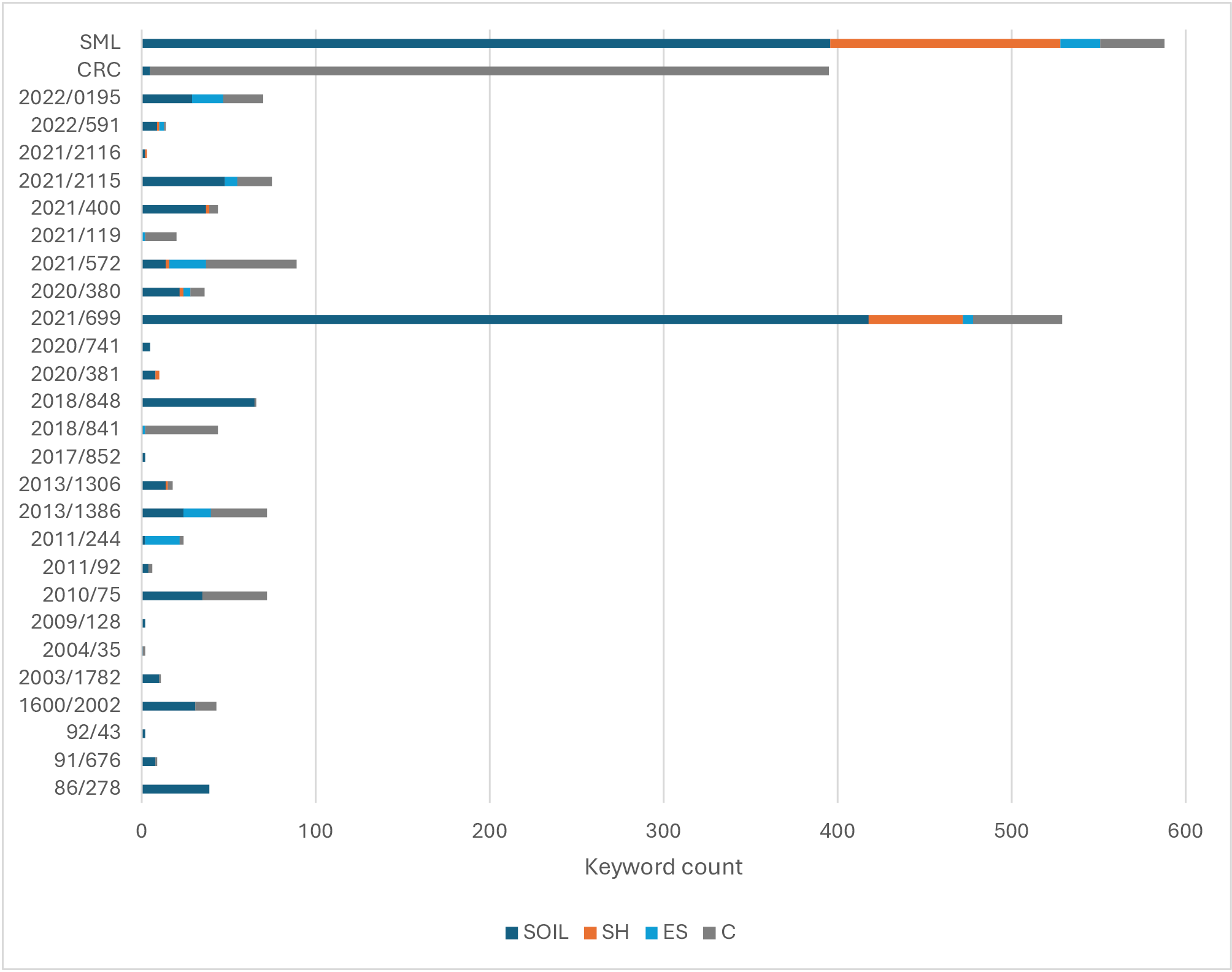
Content analysis of the policy inventory was conducted by deductive coding (Saldaña, 2013) with the \help of SketchEngine (Lexical Computing, 2003), free software for text analysis that allows to analyse frequency of keywords through large text bodies. Sticking to the EU definition of soil health, as the capacity to deliver as many ES as possible, we included three main keywords in the coding, namely ‘soil’, ‘soil health’ and ‘ecosystem services’.One further key word, i.e. ‘carbon’, emerged so frequently associated with soil (e.g. soil organic carbon) during the analysis that was finally added (complete overview in Appendix I, Figure 2).
3.2. Review of policy instruments
In a second phase, a narrative review of literature was conducted, to explore the connection between delivery of ES from healthy soils, and policy instruments to foster these practices. While systematic literature reviews hold a narrow scope and are used for investigating problems that have already been explored in literature, narrative reviews are most frequently applied to explore a topic that has a rather broad coverage and that is evolving through time (Byrne, 2016). Even if systematic review apply a more rigorous methodology, the flexibility of narrative reviews was beetter suitable for addressing the large range of keywords of incentives to be linked to soil ES, as well as the everchanging understanding of the concept of soil health. Peer reviewed papers were searched on the Scopus database, combining the keywords “soil-health” AND “ecosystem-services” AND policy instruments basing on the FAO indications over incentives for ES (Garrett and Neves, 2016); the complete overview of keywords’ search is to be found earlier in Table 1. Searching criteria included search words in title, abstract and keywords, filtering was limited to papers and reviews published until 2023, accessibility and language were first criteria for exclusion . Secondly, relevance of the content was based on a first reading of methodologies and results, assessing whether ES had only been used as keyword in the abstract or also further addressed. Consequently, soil ES where counted as 1 every first mention and example were listed and divided into provisioning, regulating, cultural and supporting ES, following the MEA (2005) classification.
4.1. Content analysis: Integration of the soil health concept from a normative and narrative perspective
Soil in the EU started to be subject of policy almost 40 years ago, often implicitly integrated in different policy instruments during the past decades (Heuser et al., 2022; Ronchi et al., 2019). The timeline below (Figure 1) shows the different types of policy instruments that concern soil governance at EU level. Soils don’t figure in the timespan between 1992 and 2002, thus for graphical purposes the decade was represented as a striped rectangle. As can be observed, integration of soils into several policy instruments increases in the latter part of the timeline, marked by the Green Deal set of policies, that during 2021 and 2022 delivered several strategies aiming to protect, conserve and enhance EU’s natural capital, and safeguard the health and well-being of citizens from environment-related risks and impacts. The Soil Health strategy to 2030 (COM 2021/699) listed objectives that address different policy sectors including agriculture, forestry and urbanization, i.e. to reduce losses of nutrients and use of pesticides, to reduce emissions from land use and land use change and forestry sector (LULUCF); and more broadly natural and environmental management, i.e. to combat desertification, restore degraded carbon rich ecosystems; to improve status of water quality; to remediate contaminated sites).
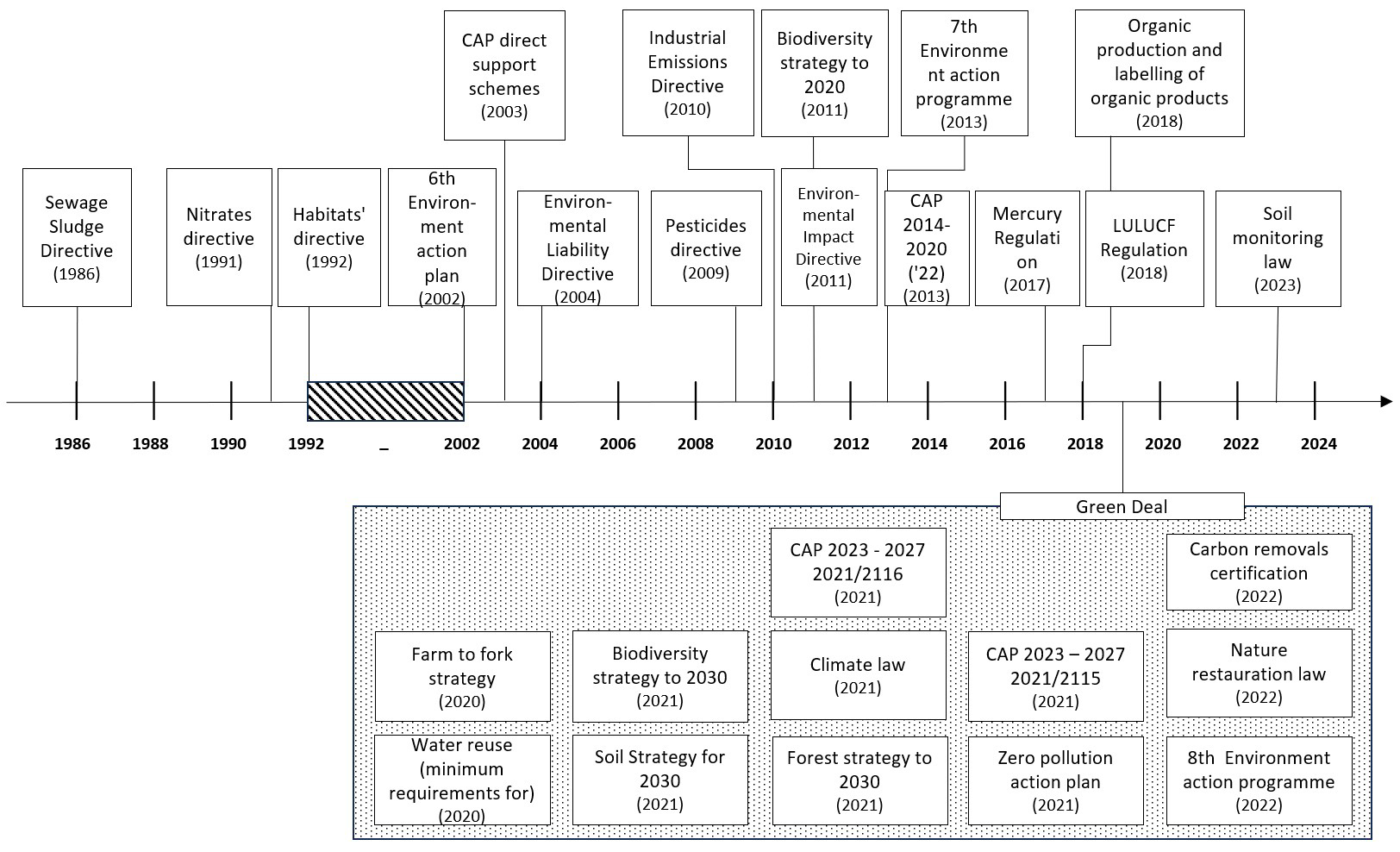
In the upcoming paragraph some key findings on conceptual integration of soil health across different policy sectors will be presented, for a complete graphical overview please see Appendix I.
a. Agricultural sector
Policy instruments have been historically focusing on agricultural soils with two specific objectives: i) to decrease pollution and ii) to protect from erosion and loss of organic matter by enhancing soil fertility. The first directives aimed at protecting human health by preventing and controlling soil pollution from sewage sludge (86/278), nitrates (91/676), pesticides (2009/128) and industrial waste (2010/75). The Common Agricultural Policy (CAP), main instrument to support farmers, primarily focused on soil fertility. The past CAP (2013/1306) listed farming techniques to enhance good agricultural and environmental conditions (GAEC) to be pursued for soils (i.e. reduced tillage and burning, guaranteed minimum soil cover). The current CAP (2021/2115) further included crop rotation among the GAEC to guarantee soil protection and quality, and protection of wetland and peatlands to ensure organic C storage. Soils in the CAP are never explicitly linked to ES, except for one specific objective aiming at enhancement of ES and indicating as impact indicators an increased share of agricultural land covered by landscape features (2021/2116). Monitoring of soil conditions is required in the current CAP (2021/2116).
The organic farming law (848/2018) refers to enhancing soils’ long-term fertility, stability, and biodiversity by reducing tillage and using only allowed fertilizers and conditioners, therefore improving soil ES. The Farm to Fork strategy (COM 2020/381) outlines reduction in use of pesticides and fertilizers and increase of organically farmed land but without listing any specific action connected to soil.
b. Forestry sector
The Forest strategy (COM 2021/572) refers to the contribution of forests to soil stabilization and explicitly relates healthy forest soils to the provision of ES, in particular to carbon sequestration, suggesting to-set up an ecosystem-based management approach and related payment schemes. Specific target to forests soils is also found in the LULUCF regulation (2018/841), addressing soil organic carbon as sink to mitigate GHG emissions, and the current CAP (2021/2115) aiming to support forest protection and management of ES. The older Biodiversity Strategy (COM 2011/244) related multifunctional forest management to payments for ES, albeit not referring their provision to soils.
c. Energy sector
The revised version of the renewable energy directive (2023/2413) contains reference to soils when it comes i) to harvesting forest products by maintaining soil quality (i.e. avoiding compaction) and biodiversity; and ii) to consider improvement of soil carbon and reduced green house gas emission (aka climate mitigation) by measuring or modeling changes in soil carbon amount.
d. Environmental regulations
The Habitat directive (91/676) and the Environmental liability directive (2004/35) marked the first steps for European natural environmental protection, soils however are almost absent from the text. Later on, the Environmental Action Plan (EAP), less binding instruments setting the ground for upcoming environmental policies, did target soils. The 6thEAP (2002/1600) aims at protecting soil from erosion and pollution and calls for a soil strategy, by also mentioning their role as carbon sinks. 7thEAP (1396/2013) lists water erosion, sealing and contamination to compromise soil ES, in particular biodiversity and water cycles, and addresses the need to increase knowledge and data collection on biodiversity to better value ES. The 8th EAP (2022/591) relates an unspecified loss of ES to unsustainable land use management, soil sealing and pollution, and climate change and calls for a soil health law by 2023; furthermore it addresses a full integration on the One Health across all policy levels. Both latter call for improved natural capital accounting tools and market-based instruments – such as payments for ES.
The Zero Pollution action plan (2021/400) aims at reducing soil pollution to levels that are no longer harmful to human health and natural ecosystems, underlining the need to prevent and restore from contamination and regularly assess for their status, specifically agricultural soils for pesticide and nutrient reduction. Yet in the same year the Climate Law (2021/1119), – more legally binding instrument – never explicitly targets to soils, while on the other hand extensively refers to enhancement of carbon sinks by 2030. The recently approved Nature Restoration Law (2022/195) adds a time dimension that is relevant to soil, requiring long-term commitment to address degradation. Specific actions refer to increasing stocks of organic carbon in cropland mineral soils and restoring and rewetting organic carbon in peatlands. As for the Biodiversity Strategy to 2030 (COM 2020/380) points out the need to restore soils and terrestrial ecosystems, and related human wellbeing to specific soil ES provision: fertility, nutrient cycle, climate regulation.
Finally, two further regulations very relevant for soils are currently under discussion at EU level. On the one hand the Certification for Carbon Removals (2022) aims at improving soils’ ES by increasing the stock of organic C in forest ecosystems and in cropland mineral soils in farming ecosystems. On the other hand the Soil Monitoring Law (2023) provides a definition of soil as vital, limited, non-renewable and irreplaceable resource and underlines need of monitoring, sustainable management, restoration of soil health and remediation of contaminated sites, but no definition or reference is made to connected ES.
e. Urbanization
No legally binding regulations exists at EU level, albeit soil sealing has been mentioned among the first causes of soil degradation in the past and current EAP and to minimize soil sealing is among objectives of both the biodiversity (COM 2020/380) and soil strategy (COM 2021/699) to 2030.
4.2. Availability of policy instruments’ relating soil health to ES
Main findings are summarized below (Table 2), keywords that gave no results were not included in the table, namely: prohibition of use; farm set asides (both compulsory and voluntary); any information instrument; green public procurement; corporate social responsibility. The cells’ color indicate a different amount of reference for each pair of ecosystem services and instrument typology. Overall, papers explicitly bridging soil ES to policy instruments for soil health were rather scarce, 23 articles were selected and can be found for a complete overview in Appendix II (since some of theme referered to more than one policy instrument the list comprises a total of 29 references with repetions marked). Most literature was published in the last five years, showing an increasing interest in the topic.
| Instrument typology | Sub-typology | Examples and count of ES, divided according to MEA (2005) | ||||
|---|---|---|---|---|---|---|
| Provisioning | Regulatory | Cultural | Supporting | Total (# of ES) in instrument |
||
| Regulation | Property rights and use rights | Food Fodder (mixed-grazing, rotational grazing and reforestation; grassland) Biofuel (3) |
Water retention Erosion Carbon storage (7) |
- | Microbial biodiversity Nutrients’ cycles (6) |
16 |
| Conservation (easements and concessions) | Crop-livestock systems Forest plantation Biofuel from pastures and cropland (9) |
Flood protection Carbon sequestration Protection of peri-urban green areas (10) |
Land stewardship for socio-cultural wellbeing Educational and recreational purposes Indigenous knowledge (5) |
Nutrients’ cycles Water filtration Biodiversity Wildlife (11) |
35 | |
| Permits and quotas | Carbon farming Pastures (2) |
Carbon sequestration Erosion protection (2) |
Rural livelihood (1) |
Soil organic carbon Soil biodiversity (2) |
7 | |
| Subsidies | Crops Cover crops Biofuel (2) |
Water retention Carbon sequestration (2) |
Adaptive farmers and citizen support (1) |
Native biodiversity Soil organic carbon (3) |
8 | |
| Offsets | Carbon farming (1) |
Carbon sequestration Erosion protection Water retention (3) |
- | Soil organic carbon Biodiversity quality (2) |
6 | |
| Incentive | Payments for ES | Cover crops Pastures Biofuel (3) |
Carbon sequestration Reduced emissions Water retention Erosion protection Flood protection (8) |
Landscape heritage conservation (1) |
Biodiversity Water filtration Phosphorous recycling Soil organic carbon (7) |
19 |
| Total (# of ES) per typology | 20 | 32 | 8 | 31 | 91 | |
Literature on property rights and land use rights mostly refers to ES of healthy soils (16) under different land use types, for instance grassland or forest, crops for food or fuel, but also investigates differences in agricultural practices, e.g. conventional or conservative, and pasture management, mixed or rotational. Those instruments highlight the role of regulating (7) and supporting (6) ES, and address trade-offs derived from different land use types. Conservation instruments show the greatest contribution to all ES (35), examples include governmental programs, at regional or local scale, and often refer to landscape level, i.e. forest, grassland. The regulatory and often compulsory character of conservation programs finds little support in terms of incentive instruments that could complement the action, compensating for the costs through governmental incentives or private buyer of ES. Improvement in market for ES was mentioned as key outlook for conservation easements (Eastburn et al., 2017).
Both property right and conservation instrument literature agree that the weak definition of property rights or poor enforcement of property rights in certain regions (such as South America or Africa), inequalities in the willingness to appropriate resources when new business opportunities emerge (i.e. biofuels or carbon sequestration), or among different farm typologies (i.e. smallholders and large properties), can lead to overconsumption of common-pool resources. Thus, this literature emphasises the importance of improving social capital for enhancing cooperation and common actions (Targetti et al., in press), both horizontally among farmers and vertically among supply chain actors (D’alberto, in press) as well as call for new institutions or enhance the capacity of existing institutions to design rules, and conservation strategies for common-pool resources (Lant et al., 2008).
Other regulation categories show lower amount of literature investigating the interplay between instrument and provision of ecosystem service. Examples of subsidies for soil health address regulating ES (2) and supporting ES (3) with the purpose of reducing erosion and increasing soil organic carbon. Tradeoffs emerged from provision of fuel instead of food (Gomiero, 2018) and from cover crops causing decreased production, having subsidies related to yield losses rather than to improved soil conditions (Deines et al., 2022). Offsets (6) and quotas (7) don’t relate much to soil health but mostly to carbon farming, understood as a set of practices that increase soil organic carbon stored in farmland and should offset agricultural GHG emissions (Keenor et al, 2021).
Payments for ES reward farmers and landowners for improved regulating ES (8) and supporting (7) services, acting as compensatory mechanisms for investments, management practices and/or yield reduction. As for sources of financing, public sector is indicated as key funder, i.e. trough the form of direct payments but also private sector, e.g. industry was mentioned as source of finance, through compensation mechanisms (see for instance Lal et al., 2020).
Cultural ES are the most neglected from research (8), with the exception of conservation programs that provided some valuable insights (5). A recent study highlights the contribution of relating result-based payments also to cultural ES, such as preserving socio-cultural heritage at landscape level (Helena Guimarães et al., 2023). Among supporting services (31), biodiversity is frequently mentioned, though authors lack to specificy if it is below or underground, being the latter more relevant to soil.
Instruments related to information made no explicit reference to soil health as contributing to ecosystem services. Nevertheless, as of certification schemes and marketing labels, if no literature was found explicitly linking the topic of certification to soil health, it is probably a matter of time as increasing interest in carbon certification schemes is on the go (Keenor et al., 2021) and a soil certification is envisioned by the Soil Monitoring Law.
Looking at the current policy setting available for soils in the EU, the agricultural sector has paid much attention to preserve soil fertility, showing a shift in narrative from protection against desertification and erosion towards an increase of soil organic matter in the form of organic carbon. Policy interventions remain rather designed at farms’ level, as proven by the GAEC indicated in the CAP, as well as the approach to individual labeling of organic farmers, lacking to embed forms of coordination at territorial level that are more consistent with the scale of soil health (Janzen et al., 2021; Lehmann et al., 2020). Considering the definition of soil health as encompassing a wide range of ES, little instruments are to be found integrating the concept to the related loss of ES in agriculture, for instance considering the role that ploughing or excessive synthetic fertilizers play on soils’ biodiversity (van Bruggen at al., 2019; Ingram et al., 2022). Moreover, the Farm to Fork strategy’s attempt to broaden linkages between food security and environmental, soil health included, and at food system level by reducing nutrients’ losses and use of pesticide is encountering notable resistance in its enforcement (Coderoni, 2023).
The forestry sector has shown greater linkages between sustainable forest management, increased soil ES – in the form of water retention, climate regulation and, most of all, carbon sequestration – and related incentives. Yet concentrating only on few ES, in particular provision of food and fibres or carbon sequestration, might result in insufficient targeting of other ES (Baveye et al., 2016) thus stepping out of the scale of action and scope of the soil health narrative (Lehmann et al., 2020). Improved forest management together with peatlands’ maintenance and rewetting are depicted as carbon sinks in Forestry Strategy, Biodiversity Strategy, Climate Law, Nature Restauration Law. Those actions all focus prominently on carbon storage, but rarely further provide evidences to improvement of soil health to overall ecosystem health. While acknowledging the important role that carbon plays in key soils’ functions, the risk of this narrow-scoped narrative is to only highlight the marketable and exchangeable value of carbon sequestration, while undermining the wider scope of the economic model for environmental preservation envisioned by ES, that greatly focused on biodiversity and habitat preservation in the beginning (Gómez-Baggethun et al., 2010). Instead of tackling single ES, approaches both in scientific studies and policy instruments encompassing bundles of ES (Bartkowski et al., 2018; Piñeiro et al., 2020) and minimum level of all ES (Bouma et al., 2022) could be more relevant to a soil health perspective.
Our results confirm previous findings claiming that EU policies have kept a rather sectoral approach to soil, mainly focusing on productive sectors and rather neglecting instruments related to natural areas (Löbmann et al., 2022; Ronchi et al., 2019). Moreover, we found that while soil sealing is listed among the causes of loss of soil ES (Panagos et al., 2021) and its reduction as key objective of recent strategies (e.g. COM 2021/699), no binding instruments to target the issue is available yet, while the Strategy for a Sustainable Built Environment is being discussed. A more coordinated approach along policy sectors could play a role in ensuring that soil health is pursued. Authors recently delving in the topic suggested that policy should focus on preserving and restoring actions, paying higher attention to soil protection in both regulatory (Heuser, 2022) and incentive instruments (Vysna et al., 2021). This implies also a greater understanding of EU soils’ status and improvement, as aimed by the Soil monitoring law proposed in 2023. Yet, establishing reasonable and flexible indicators for highly diverse soils remains challenging, for instance when it comes to soil biodiversity (Lehmann et al., 2020) or to soil temporal dynamics that can only be over long-time spans (Baveye et al., 2016), including effects of degradation and conservation.
Last but not least, references to cultural ES, were almost absent from the current policy instruments, showing that much needs to be done to integrate in the soil health narrative a social dimension that attaches societal valuations and preferences over mere land use and functions (Janzen et al., 2021). Authors from various subject fields have suggested that a new understanding of the relationship (and reciprocity) between humans and soils could help tackle this issue. For instance, considering soils as natural cultural system to better value cultural ES provided by them (Costantini, 2023; Guimarães et al., 2023), or focusing on soil stewardship (Keith et al, 2016) and farmers’ and land users’ relational values (Friedrichsen et al., 2021) to further link environmental and social wellbeing to healthy soil management.
5.2. Orienting the instruments
Given the scarcity of results to this narrative review, we would firstly like to address methodological limitations concerning keyword selection and search databases, nevertheless the exploratory character of this study allows to expand the body of knowledge on soil policy and draw some key reflections that might be useful from an EU perspective. Few findings also highlight the little evidence to be found in scientific literature between soil health and related ES. This reinforces the previous finding that, despite being soil health part of the scientific discourse since longer (Lehmann et al., 2020), a significant gap emerges when it comes to policy instruments.
Soil health is not at the reach for most of the individuated instruments, while a stronger focus on soil fertility could be detected from this literature search, seen the frequency of carbon sequestration and soil organic carbon among mentioned regulating and supporting ES. This is true for public as well as for market driven instruments.
In the EU subsidies accessible through the CAP are currently the main instrument to incentivize farmers to fulfil environmental requirements, resulting in a hybrid form between regulation and incentive. As for soil they currently include i) direct payments for cross-compliance with GAEC concerning soil cover and organic matter, and ii) voluntary eco-schemes that include among areas of action additional “prevention of soil degradation, soil restoration, improvement of soil fertility and of nutrient management and soil biota” (2021/1115 p. 41). In addition, the second pillar, mainly through Agri-Environmental-Climate Schemes (AECS), addresses soil health either directly or indirectly (Mantino, 2022; Eichhorn et al., 2024a). For example, several Rural Development Programmes (RDPs) include measures to increase organic matter in the soil, promote cover crops and conservative agriculture, or invest in reducing soil erosion through repairing or rebuild dry stone walls or other landscape elements. Conversely, AECS incentivize measures that indirectly affect soil health, such as organic production or the maintenance and reintroduction of grasslands in mountain areas (Vergamini et al., 2024).
The current EU Common Agricultural Policy (CAP) could serve to test some initial result-based payments in AECS (Eichhorn et al., 2024b) and contribute to developing indicators to target ecosystem services (Bartkowski, 2018). The combination of command-and-control instruments and market-based instruments in the CAP could significantly affect soil health and the delivery of ES by farmers.
Conservation instruments seem more appropriate to the soil health narrative, compared to the field level more common to agricultural subsidies and regulations, for instance ES provided by forest soils, permanent grasslands as well as rewetted peatlands could contribute to the matter.
Regarding payments for ES, landowners – most typically farmers – could bekeen on generating ES that are marketable, as the case for carbon credits, yet a recent review shows that hybrid incentive mechanisms combining result and action based payments are more likely to be interesting to farmers (Raina et al., 2024). Payments for ES then will need to consider also mechanisms for distribution of benefits and incentives, to reduce the risk of having large landowners as main beneficiaries, attracting land accumulation and lobbing in areas where the land prices are low, thereby excluding small holders (Baveye et al., 2016). This is also tightly connected to length and typology of different land tenure arrangements, that might distort the trade-off between profitability and ES, given that long-term land tenure contract might also have the positive side effect of increasing commitment towards soil health and thus provisioning ES (Stevens, 2022).
Market regulation (i.e. carbon markets) are becoming the main solutions rather than compensation mechanisms parallel to emission reduction actions. Private financial institutions appear increasingly interested in mechanisms such as payments for ES or offsetting, this on one hand can provide new source of income for supporting those ES that are currently neglected. On the other the role of the public sector is relevant in making sure that market-based solutions are still tackling relevant objectives (Vatn, 2018), in this case the restoration of healthy soils in the EU by 2050. To overcome this issue key scholars in soil science suggested discussing the option to subsidize farmers based on a minimum level of all ES associated to soil health (Bouma et al., 2022). Level of detail on soil practices contributing to soil health seems for now limited but the concept of bundles of ES could further contribute to the discourse (Bartkowski et al., 2018).
In addition, our results highlight the need for improvements in developing new empirical and theoretical models that enable understanding causal effects between decision-makers’ actions and their impact on multiple dimensions aimed at targeting various ecosystem services (ES). This would call the development of bioeconomic models to address both ex-ante and ex-post the complexity of interactions between economic behaviour and soil dynamics at different scales and spatial resolutions.
Finally, given the scarce results concerning information as a policy instruments, we would like to highlight the important role that this could play in the form of research and dissemination as well as extension services. A recent review by Arias-Navarro et al. (2023) has summarized key themes of past EU research over soils, primarily on regulating ES (erosion protection, soil contamination, soil and water, climate mitigation, carbon storage). Moreover soils are one of the five topics included in the EU missions, new instrument to support research and innovation in the period 2021-2027. “A soil deal for Europe” aims to reduce several soil degradation processes by addressing four operational objectives including: funding research and innovation; establishing living labs and lighthouses; develop a soil monitoring framework and raising people awareness (for more details on the Soil mission objectives please refer to EU Mission: A Soil Deal for Europe (European Commission, 2023)). This mission has allowed to finance a wide number on soil-related projects that are now running all over Europe, assessing their outcomes and contribuitions towards soil health might constitute a topic for future research. On the other hand, extension services mainly focus on soil fertility and show quite heterogenous approaches to advice, mostly lacking the holistic understanding of soil microbiology and chemistry embedded in the understanding of soil health (Ingram et al., 2022). Lack of information and evidence on which further ES might benefit from improved multi-functional soil management might prevent farmers from adopting practices that could benefit soil health, including accessing incentives and markets (Schröder et al., 2020).
There is a need to move the focus from a soil fertility and carbon-centered discourse to a landscape level understanding of soil uses, that embeds socio-cultural services provided to land users as well as the wider public (Guimarães et al., 2023; Friedrichsen et al., 2021).
This study contributes to the analysis of policy narratives, understood as the way an environmental problem becomes part of the policy discourse and agenda, by looking at the topic of soil health. It provides an insight over the integration of the soil health concept, intended as the delivery of a broad set of ES, throughout current EU policy instruments and scientific literature. The findings of this narrative review open up for a further, more careful investigation of incentives for soil ES, to improve the process we suggest some mitigation measures such as narrowing keyword selection to those policy incentives more relevant to soils, broadening search engines, and relying on the PRISMA flow for a systematic review process.
The agricultural sector enlists a set of incentives that promote a correct management of soils to guarantee greater fertility, well managed forest soils are found to improve soil structure and protect from erosion, yet soils are seen predominantly as substrate for primary production and carbon sinks. Overall, recognition of the value of ES related to soils in policy instruments was identified for primary production – food, fuel and fiber – and carbon storage, thus better fitting the scale of action of soil fertility and soil quality. Scientific literature also provided evidences of little availability of instruments explicitly tackling a range of ES that is understood for healthy soils. There is a need for integration of broader societal values connected to increased soil health, e.g. in the forms of safeguarded soil biodiversity or land users’ wellbeing, including access and ownership to land.
The mix of policies and instruments currently available has so far not been able to tackle the issue of soil degradation, therefore a more coordinated effort among policy sectors is required to prioritize soil health. Given the prominent role of the private sector, future research could focus on the role of market instruments in pursuing soil health where more regulatory instruments have failed.
The authors gratefully acknowledge funding from the European Union’s Horizon Europe research and innovation program within the project NOVASOIL (Grant agreement no 101091268).
The authors declare no conflicts of interest. Fabio Bartolini, co-editor-in-chief of this journal, had no role in the editorial review process and decision-making for this article.
Adhikari, K., & Hartemink, A. E. (2016). Linking soils to ecosystem services - A global review. Geoderma 262: 101–111. https://doi.org/10.1016/J.GEODERMA.2015.08.009
Arias-Navarro, C., Panagos, P., Jones, A., Amaral, M. J., Schneegans, A., van Liedekerke, M., Wojda, P., & Montanarella, L. (2023). Forty years of soil research funded by the European Commission: Trends and future. A systematic review of research projects. European Journal of Soil Science 74(5). https://doi.org/10.1111/ejss.13423
Bampa, F., O’Sullivan, L., Madena, K., Sandén, T., Spiegel, H., Henriksen, C. B., Ghaley, B. B., Jones, A., Staes, J., Sturel, S., Trajanov, A., Creamer, R. E., & Debeljak, M. (2019). Harvesting European knowledge on soil functions and land management using multi-criteria decision analysis. Soil Use and Management 35(1): 6–20. https://doi.org/10.1111/SUM.12506
Bartkowski, B., Hansjürgens, B., Möckel, S., & Bartke, S. (2018). Institutional economics of agricultural soil ecosystem services. Sustainability (Switzerland) 10(7). https://doi.org/10.3390/su10072447
Baveye, P. C., Baveye, J., & Gowdy, J. (2016). Soil “ecosystem” services and natural capital: Critical appraisal of research on uncertain ground. Frontiers in Environmental Science 4(JUN). https://doi.org/10.3389/fenvs.2016.00041
Bouma, J., de Haan, J., & Dekkers, M. F. S. (2022). Exploring Operational Procedures to Assess Ecosystem Services at Farm Level, including the Role of Soil Health. Soil Systems 6(2). https://doi.org/10.3390/soilsystems6020034
Bünemann, E. K., Bongiorno, G., Bai, Z., Creamer, R. E., De Deyn, G., De Goede, R., Fleskens, L., Geissen, V., Kuyper, T. W., Mäder, P., Pulleman, M., Sukkel, W., Van Groenigen, J. W., & Brussaard, L. (2018). Soil quality – A critical review. Soil Biology and Biochemistry 120: 105–125. https://doi.org/10.1016/j.soilbio.2018.01.030
Byrne, J. A. (2016). Improving the peer review of narrative literature reviews. Research Integrity and Peer Review 1(1). https://doi.org/10.1186/s41073-016-0019-2
Chaudhary, S., McGregor, A., Houston, D., & Chettri, N. (2015). The evolution of ecosystem services: A time series and discourse-centered analysis. In Environmental Science and Policy 54: 25–34. https://doi.org/10.1016/j.envsci.2015.04.025
Coderoni, S. (2023). Key policy objectives for European agricultural policies: Some reflections on policy coherence and governance issues. Bio-Based and Applied Economics 12(2): 85–101. https://doi.org/10.36253/bae-13971
Costantini, E. A. C. (2023). Possible policies and actions to protect the soil cultural and natural heritage of Europe. Geoderma Regional 32. https://doi.org/10.1016/J.GEODRS.2022.E00599
D’Alberto, R., Raggi, M., & Viaggi, D. (2023). Innovative contract solutions for the Agri-Environmental-Climate Public Goods provision: Which features meet the farmers’ approval? Insights from Emilia-Romagna (Italy). Bio-Based and Applied Economics 13(1): 73–101. https://doi.org/10.36253/bae-14016
Deines, J. M., Guan, K., Lopez, B., Zhou, Q., White, C. S., Wang, S., & Lobell, D. B. (2023). Recent cover crop adoption is associated with small maize and soybean yield losses in the United States. Global Change Biology 29(3): 794–807. https://doi.org/10.1111/gcb.16489
Dominati, E., Mackay, A., Green, S., & Patterson, M. (2014). A soil change-based methodology for the quantification and valuation of ecosystem services from agro-ecosystems: A case study of pastoral agriculture in New Zealand. Ecological Economics 100: 119–129. https://doi.org/10.1016/J.ECOLECON.2014.02.008
Eastburn, D. J., O’Geen, A. T., Tate, K. W., & Roche, L. M. (2017). Multiple ecosystem services in a working landscape. PLoS ONE 12(3). https://doi.org/10.1371/journal.pone.0166595
Eichhorn, T., Kantelhardt, J., & Schaller, L. L. (2024a). Understanding farmers’ intention to perform result-based agri-environmental schemes for the improved provision of biodiversity and soil quality. Journal of Environmental Planning and Management 1–25. https://doi.org/10.1080/09640568.2024.2364774
Eichhorn, T., Schaller, L., Hamunen, K., & Runge, T. (2024b). Exploring macro-environmental factors influencing adoption of result-based and collective agri-environmental measures: a PESTLE approach based on stakeholder statements. Bio-Based and Applied Economics 13(1): 49–71. https://doi.org/10.36253/bae-14489
European Commission: Directorate-General for Research and Innovation (2023), EU missions – Soil deal for Europe – What is the EU mission – A soil deal for Europe, Publications Office of the European Union. Available at https://data.europa.eu/doi/10.2777/171313 (accessed July 3rd 2024)
FAO and ITPS. (2015). Status of the World’s Soil Resources (SWSR) – Main Report. Food and Agriculture Organization of the United Nations and Intergovernmental Technical Panel on Soils, Rome, Italy. Available online at: https://www.fao.org/3/i5199e/I5199E.pdf. Accessed: 17.02.2023
Friedrichsen, C. N., Hagen-Zakarison, S., Friesen, M. L., McFarland, C. R., Tao, H., & Wulfhorst, J. D. (2021). Soil health and well-being: Redefining soil health based upon a plurality of values. Soil Security 2: 100004. https://doi.org/10.1016/J.SOISEC.2021.100004
Garrett, L., & Neves, B. (2016). Incentives for Ecosystem Services: Spectrum. Food and Agriculture Organization of the United Nations. Available online at: http://www.fao.org/in-action/incentives-for-ecosystem-services/toolkit/sources-of-incentives/en/. Accessed on 17.02.2023
Gómez-Baggethun, E., De Groot, R., Lomas, P. L., & Montes, C. (2010). The history of ecosystem services in economic theory and practice: From early notions to markets and payment schemes. Ecological Economics 69(6): 1209–1218. https://doi.org/10.1016/j.ecolecon.2009.11.007
Gomiero, T. (2018). Large-scale biofuels production: A possible threat to soil conservation and environmental services. Applied Soil Ecology 123: 729–736. https://doi.org/10.1016/j.apsoil.2017.09.028
Gonzalez Lago, M., Plant, R., & Jacobs, B. (2019). Re-politicising soils: What is the role of soil framings in setting the agenda? Geoderma 349: 97–106. https://doi.org/10.1016/j.geoderma.2019.04.021
Guimarães, M. H., Pinto-Correia, T., de Belém Costa Freitas, M., Ferraz-de-Oliveira, I., Sales-Baptista, E., da Veiga, J. F. F., Tiago Marques, J., Pinto-Cruz, C., Godinho, C., & Belo, A. D. F. (2023). Farming for nature in the Montado: the application of ecosystem services in a results-based model. Ecosystem Services 61. https://doi.org/10.1016/j.ecoser.2023.101524
Heuser, Dr. I. (2022). Soil Governance in current European Union Law and in the European Green Deal. Soil Security 6: 100053. https://doi.org/10.1016/J.SOISEC.2022.100053
IPBES (2018). The IPBES assessment report on land degradation and restoration. Montanarella, L., Scholes, R., & Brainich, A. (Eds.). Secretariat of the Intergovernmental Science-Policy Platform on Biodiversity and Ecosystem Services, Bonn, Germany. 744 pages. https://doi.org/10.5281/zenodo.3237392
Ingram, J., Mills, J., Black, J. E., Chivers, C. A., Aznar-Sánchez, J. A., Elsen, A., Frac, M., López-Felices, B., Mayer-Gruner, P., Skaalsveen, K., Stolte, J., & Tits, M. (2022). Do Agricultural Advisory Services in Europe have the Capacity to Support the Transition to Healthy Soils? Land 11(5). https://doi.org/10.3390/land11050599
Janzen, H. H., Janzen, D. W., & Gregorich, E. G. (2021). The ‘soil health’ metaphor: Illuminating or illusory? Soil Biology and Biochemistry 159: 108167. https://doi.org/10.1016/j.soilbio.2021.108167
Jordan, A., & Lenschow, A. (2010). Policy paper environmental policy integration: A state of the art review. Environmental Policy and Governance 20(3): 147–158. https://doi.org/10.1002/eet.539
Juerges, N., & Hansjürgens, B. (2018). Soil governance in the transition towards a sustainable bioeconomy – A review. Journal of Cleaner Production 170: 1628–1639. https://doi.org/10.1016/j.jclepro.2016.10.143
Keenor, S. G., Rodrigues, A. F., Mao, L., Latawiec, A. E., Harwood, A. R., & Reid, B. J. (2021). Capturing a soil carbon economy. Royal Society Open Science 8(4). https://doi.org/10.1098/rsos.202305
Keesstra, S., Sannigrahi, S., López-Vicente, M., Pulido, M., Novara, A., Visser, S., & Kalantari, Z. (2021). The role of soils in regulation and provision of blue and green water. Philosophical Transactions of the Royal Society B: Biological Sciences 376(1834). https://doi.org/10.1098/rstb.2020.0175
Keith, A. M., Schmidt, O., & McMahon, B. J. (2016). Soil stewardship as a nexus between Ecosystem Services and One Health. Ecosystem Services 17: 40–42. https://doi.org/10.1016/j.ecoser.2015.11.008
Lal, R. (2020). The role of industry and the private sector in promoting the “4 per 1000” initiative and other negative emission technologies. Geoderma 378: 114613. https://doi.org/10.1016/j.geoderma.2020.114613
Lant, C. L., Ruhl, J. B., & Kraft, S. E. (2008). The tragedy of ecosystem services. BioScience 58(10): 969–974. https://doi.org/10.1641/B581010
Lehmann, J., Bossio, D. A., Kögel-Knabner, I., & Rillig, M. C. (2020). The concept and future prospects of soil health. Nature Reviews Earth & Environment 1(10). https://doi.org/10.1038/s43017-020-0080-8
Löbmann, M. T., Maring, L., Prokop, G., Brils, J., Bender, J., Bispo, A., & Helming, K. (2022). Systems knowledge for sustainable soil and land management. Science of the Total Environment 822: 153389. https://doi.org/10.1016/J.SCITOTENV.2022.153389
Mantino, F. (2022). Rural areas between locality and global networks. Local development mechanisms and the role of policies empowering rural actors. Bio-Based and Applied Economics 10(4): 265–281. https://doi.org/10.36253/bae-12364
Millennium Ecosystem Assessment (2005). Ecosystems and Human-well being: A framework for assessment. Available online at: https://www.millenniumassessment.org/en/Framework.html. Accessed on: 21.02.2023
Montanarella, L., & Alva, I. L. (2015). Putting soils on the agenda: the three Rio Conventions and the post-2015 development agenda. Current Opinion in Environmental Sustainability 15: 41–48. https://doi.org/10.1016/j.cosust.2015.07.008
Neill, A. M., O’Donoghue, C., & Stout, J. C. (2022). Conceptual integration of ecosystem services and natural capital within Irish national policy: An analysis over time and between policy sectors. Ecosystem Services 57: 101468. https://doi.org/10.1016/j.ecoser.2022.101468
Neto, B., & Gama Caldas, M. (2018). The use of green criteria in the public procurement of food products and catering services: a review of EU schemes. Environment, Development and Sustainability 20(5): 1905-1933.
Panagos, P., Montanarella, L., Barbero, M., Schneegans, A., Aguglia, L., & Jones, A. (2022). Soil priorities in the European Union. Geoderma Regional 29: e00510. https://doi.org/10.1016/j.geodrs.2022.e00510
Peters, M. D. J., Marnie, C., Tricco, A. C., Pollock, D., Munn, Z., Alexander, L., McInerney, P., Godfrey, C. M., & Khalil, H. (2020). Updated methodological guidance for the conduct of scoping reviews. JBI Evidence Synthesis 18(10): 2119–2126. https://doi.org/10.11124/JBIES-20-00167
Piñeiro, V., Arias, J., Dürr, J., Elverdin, P., Ibáñez, A. M., Kinengyere, A., Opazo, C. M., Owoo, N., Page, J. R., Prager, S. D., & Torero, M. (2020). A scoping review on incentives for adoption of sustainable agricultural practices and their outcomes. Nature Sustainability 3(10): 809–820. https://doi.org/10.1038/s41893-020-00617-y
Raina, N., Zavalloni, M., & Viaggi, D. (2024). Incentive mechanisms of carbon farming contracts: A systematic mapping study. Journal of Environmental Management 352: 120126.
Roe, E. (1994). Narrative Policy Analysis: Theory and Practice. Duke University Press. https://doi.org/10.2307/j.ctv11hpqq4
Rogge, K. S., & Reichardt, K. (2016). Policy mixes for sustainability transitions: An extended concept and framework for analysis. Research Policy 45(8): 1620–1635. https://doi.org/10.1016/j.respol.2016.04.004
Ronchi, S., Salata, S., Arcidiacono, A., Piroli, E., & Montanarella, L. (2019). Policy instruments for soil protection among the EU member states: A comparative analysis. Land Use Policy 82: 763–780. https://doi.org/10.1016/j.landusepol.2019.01.017
Runge, T., Latacz-Lohmann, U., Schaller, L., Todorova, K., Daugbjerg, C., Termansen, M., Liira, J., le Gloux, F., Dupraz, P., Leppanen, J., Fogarasi, J., Vigh, E. Z., Bradfield, T., Hennessy, T., Targetti, S., Viaggi, D., Berzina, I., Schulp, C., Majewski, E., … Velazquez, F. J. B. (2022). Implementation of Eco-schemes in Fifteen European Union Member States. EuroChoices 21(2): 19–27. https://doi.org/10.1111/1746-692X.12352
Saldaña, J. (2013). The Coding Manual for Qualitative Researchers. Thousand Oaks, CA: Sage.
Schröder, J. J., ten Berge, H. F. M., Bampa, F., Creamer, R. E., Giraldez-Cervera, J. V., Henriksen, C. B., Olesen, J. E., Rutgers, M., Sandén, T., & Spiegel, H. (2020). Multi-Functional Land Use Is Not Self-Evident for European Farmers: A Critical Review. Frontiers in Environmental Science 8. https://doi.org/10.3389/fenvs.2020.575466
Shanahan, E. A., Jones, M. D., & McBeth, M. K. (2011). Policy narratives and policy processes. Policy Studies Journal 39(3): 535-561.
Stevens, A. W. (2022). The economics of land tenure and soil health. Soil Security 6: 100047. https://doi.org/10.1016/J.SOISEC.2022.100047
Targetti, S., Niedermayr, A., Häfner, K., & Schaller, L. (2024). New pathways for improved delivery of public goods from agriculture and forestry. Bio-Based and Applied Economics 13(1): 3–11. https://doi.org/10.36253/bae-15862
Grant, M. J., & Booth, A. (2009). A typology of reviews: an analysis of 14 review types and associated methodologies. Health Information & Libraries Journal 26: 91-108. https://doi.org/10.1111/j.1471-1842.2009.00848.x
Turpin, N., ten Berge, H., Grignani, C., Guzmán, G., Vanderlinden, K., Steinmann, H. H., Siebielec, G., Spiegel, H., Perret, E., Ruysschaert, G., Laguna, A., Giráldez, J. V., Werner, M., Raschke, I., Zavattaro, L., Costamagna, C., Schlatter, N., Berthold, H., Sandén, T., & Baumgarten, A. (2017). An assessment of policies affecting Sustainable Soil Management in Europe and selected member states. Land Use Policy 66: 241–249. https://doi.org/10.1016/J.LANDUSEPOL.2017.04.001
van Bruggen, A. H. C., Goss, E. M., Havelaar, A., van Diepeningen, A. D., Finckh, M. R., & Morris, J. G. (2019). One Health - Cycling of diverse microbial communities as a connecting force for soil, plant, animal, human and ecosystem health. Science of the Total Environment 664: 927–937. https://doi.org/10.1016/j.scitotenv.2019.02.091
Vatn, A. (2018). Environmental Governance – From Public to Private? Ecological Economics 148: 170–177. https://doi.org/10.1016/j.ecolecon.2018.01.010
Vergamini, D., Olivieri, M., Andreoli, M., & Bartolini, F. (2024). Simulating policy mixes to reduce soil erosion and land abandonment in marginal areas: A case study from the Liguria Region (Italy). Land Use Policy 143: 107188. https://doi.org/10.1016/j.landusepol.2024.107188
Vysna, V., Maes, J., Petersen, J. E., La Notte, A., Vallecillo, S., Aizpurua, N., Ivits, E., & Teller, A. (2021). Accounting for ecosystems and their services in the European Union (INCA). Statistical Report. Publications Office of the European Union, Luxembourg.
| Code | Year | Law | SOIL | SH | ES | C |
|---|---|---|---|---|---|---|
| SML | 2023 | Soil monitoring law | 396 | 132 | 23 | 37 |
| CRC | 2022 | Carbon removals certification | 5 | 0 | 0 | 390 |
| 2022/0195 | 2022 | Nature restauration law | 29 | 0 | 18 | 23 |
| 2022/591 | 2022 | 8th Environment action programm | 9 | 1 | 3 | 1 |
| 2021/2116 | 2021 | CAP 2023 - 2027 | 2 | 1 | 0 | 0 |
| 2021/2115 | 2021 | CAP 2023 - 2027 | 48 | 0 | 7 | 20 |
| 2021/400 | 2021 | Zero pollution action plan | 37 | 2 | 0 | 5 |
| 2021/119 | 2021 | Climate law | 0 | 0 | 2 | 18 |
| 2021/572 | 2021 | Forest strategy to 2030 | 14 | 2 | 21 | 52 |
| 2020/380 | 2021 | Biodiversity strategy to 2030 | 22 | 2 | 4 | 8 |
| 2021/699 | 2021 | Soil Strategy for 2030 | 418 | 54 | 6 | 51 |
| 2020/741 | 2020 | Water reuse (minimum requirements for) | 5 | 0 | 0 | 0 |
| 2020/381 | 2020 | Farm to fork strategy | 8 | 2 | 0 | 0 |
| 2018/848 | 2018 | Organic production and labelling of organic products | 65 | 0 | 0 | 1 |
| 2018/841 | 2018 | LULUCF Regulation | 1 | 0 | 1 | 42 |
| 2017/852 | 2017 | Mercury Regulation | 2 | 0 | 0 | 0 |
| 2013/1306 | 2013 | CAP 2014-2020 (‘22) | 14 | 1 | 0 | 3 |
| 2013/1386 | 2013 | 7th Environment action programm | 24 | 0 | 16 | 32 |
| 2011/244 | 2011 | Biodiversity strategy to 2020 | 2 | 0 | 20 | 2 |
| 2011/92 | 2011 | Environmental Impact Directive | 4 | 0 | 0 | 2 |
| 2010/75 | 2010 | Industrial Emissions Directive | 35 | 0 | 0 | 37 |
| 2009/128 | 2009 | Pesticides directive | 2 | 0 | 0 | 0 |
| 2004/35 | 2004 | Environmental Liability Directive | 1 | 0 | 0 | 1 |
| 2003/1782 | 2003 | CAP direct support schemes | 10 | 0 | 0 | 1 |
| 1600/2002 | 2002 | 6th Environment action plan | 31 | 0 | 0 | 12 |
| 92/43 | 1992 | Habitats’ directive | 2 | 0 | 0 | 0 |
| 91/676 | 1991 | Nitrates directive | 8 | 0 | 0 | 1 |
| 86/278 | 1986 | Sewage Sludge Directive | 39 | 0 | 0 | 0 |
Appendix II - References from review
Property rights and use rights
1. Guarderas, P., Smith, F., & Dufrene, M. (2022). Land use and land cover change in a tropical mountain landscape of northern Ecuador: Altitudinal patterns and driving forces. PLoS One 17(7): e0260191.
2. Louzada, R. O., Bergier, I., Diniz, J. M. D. S., Guerra, A., & Roque, F. D. O. (2022). Priority setting for restoration in surrounding savannic areas of the Brazilian Pantanal based on soil loss risk and agrarian structure. Journal of Environmental Management 323: 116219.
3. Jordon, M. W. (2021). Does mixed vs separate sheep and cattle grazing reduce soil compaction?. Soil Use and Management 37(4): 822–831.
4. Xu, H. J., Zhao, C. Y., Chen, S. Y., Shan, S. Y., Qi, X. L., Chen, T., & Wang, X. P. (2022). Spatial relationships among regulating ecosystem services in mountainous regions: Nonlinear and elevation-dependent. Journal of Cleaner Production 380: 135050.
5. van Mansvelt, J. D., Struik, P. C., Bos, A., Daub, W., Sprangers, D., Van Den Berg, M., … & Zoeteman, K. (2021). Changing ground: handling tensions between production ethics and environmental ethics of agricultural soils. Sustainability 13(23): 13291.
6. Baumber, A. (2017). Enhancing ecosystem services through targeted bioenergy support policies. Ecosystem Services 26: 98–110.
7. Eastburn, D. J., O’Geen, A. T., Tate, K. W., & Roche, L. M. (2017). Multiple ecosystem services in a working landscape. PLoS One 12(3): e0166595.
8. Philippot, L., Griffiths, B. S., & Langenheder, S. (2021). Microbial community resilience across ecosystems and multiple disturbances. Microbiology and Molecular Biology Reviews 85(2): 10–1128.
Conservation (easements and concessions)
9. Biggs, N. B., Hafner, J., Mashiri, F. E., Huntsinger, L., & Lambin, E. F. (2021). Payments for ecosystem services within the hybrid governance model: evaluating policy alignment and complementarity on California rangelands. Ecology & Society 26(1).
10. Balfour, N. J., Durrant, R., Ely, A., & Sandom, C. J. (2021). People, nature and large herbivores in a shared landscape: A mixed‐method study of the ecological and social outcomes from agriculture and conservation. People and Nature 3(2): 418–430.
11. Mulia, R., Hoang, S. V., Dinh, V. M., Duong, N. B. T., Nguyen, A. D., Lam, D. H., … & van Noordwijk, M. (2021). Earthworm diversity, forest conversion and agroforestry in Quang Nam Province, Vietnam. Land 10(1): 36.
12. Cherubin, M. R., Bordonal, R. O., Castioni, G. A., Guimaraes, E. M., Lisboa, I. P., Moraes, L. A., … & Carvalho, J. L. (2021). Soil health response to sugarcane straw removal in Brazil. Industrial Crops and Products 163: 113315.
13. Soto-Montes-de-Oca, G., Bark, R., & González-Arellano, S. (2020). Incorporating the insurance value of peri-urban ecosystem services into natural hazard policies and insurance products: Insights from Mexico. Ecological economics 169: 106510.
14. Coker, G., Richard, M., Bayne, K., Smaill, S., Garrett, L., Matson, A., & Wakelin, S. (2019). Stakeholder valuation of soil ecosystem services from New Zealand’s planted forests. Plos one 14(8): e0221291.
15. Eastburn, D. J., O’Geen, A. T., Tate, K. W., & Roche, L. M. (2017). Multiple ecosystem services in a working landscape. PLoS One 12(3): e0166595.
16. Keenor, S. G., Rodrigues, A. F., Mao, L., Latawiec, A. E., Harwood, A. R., & Reid, B. J. (2021). Capturing a soil carbon economy. Royal Society open science 8(4): 202305.
17. (repetition) Biggs, N. B., Hafner, J., Mashiri, F. E., Huntsinger, L., & Lambin, E. F. (2021). Payments for ecosystem services within the hybrid governance model: evaluating policy alignment and complementarity on California rangelands. Ecology & Society 26(1).
18. Deines, J. M., Guan, K., Lopez, B., Zhou, Q., White, C. S., Wang, S., & Lobell, D. B. (2023). Recent cover crop adoption is associated with small maize and soybean yield losses in the United States. Global change biology 29(3): 794–807.
19. Gomiero, T. (2018). Large-scale biofuels production: A possible threat to soil conservation and environmental services. Applied Soil Ecology 123: 729–736.
20. Bouma, J., de Haan, J., & Dekkers, M. F. S. (2022). Exploring operational procedures to assess ecosystem services at farm level, including the role of soil health. Soil Systems 6(2): 34.
21. (repetitition) Keenor, S. G., Rodrigues, A. F., Mao, L., Latawiec, A. E., Harwood, A. R., & Reid, B. J. (2021). Capturing a soil carbon economy. Royal Society open science 8(4): 202305.
22. Lal, R. (2020). Managing organic matter content for restoring health and ecosystem services of soils of India. Journal of the Indian Society of Soil Science 68(1): 1–15.
23. (repetition) Biggs, N. B., Hafner, J., Mashiri, F. E., Huntsinger, L., & Lambin, E. F. (2021). Payments for ecosystem services within the hybrid governance model: evaluating policy alignment and complementarity on California rangelands. Ecology & Society 26(1).
24. Ferrarini, A., Serra, P., Almagro, M., Trevisan, M., & Amaducci, S. (2017). Multiple ecosystem services provision and biomass logistics management in bioenergy buffers: A state-of-the-art review. Renewable and Sustainable Energy Reviews 73: 277–290.
25. (repetition) Deines, J. M., Guan, K., Lopez, B., Zhou, Q., White, C. S., Wang, S., & Lobell, D. B. (2023). Recent cover crop adoption is associated with small maize and soybean yield losses in the United States. Global change biology 29(3): 794–807.
26. Peltonen-Sainio, P., & Jauhiainen, L. (2022). Come Out of a Hiding Place: How Are Cover Crops Allocated on Finnish Farms?. Sustainability 14(5): 3103.
27. Shukla, A., Shukla, S., Hodges, A. W., & Harris, W. G. (2020). Valorization of farm pond biomass as fertilizer for reducing basin-scale phosphorus losses. Science of the total environment 720: 137403.
28. (repetition) Keenor, S. G., Rodrigues, A. F., Mao, L., Latawiec, A. E., Harwood, A. R., & Reid, B. J. (2021). Capturing a soil carbon economy. Royal Society open science 8(4): 202305.
29. Guimarães, M. H., Pinto-Correia, T., de Belém Costa Freitas, M., Ferraz-de-Oliveira, I., Sales-Baptista, E., da Veiga, J. F. F., Tiago Marques, J., Pinto-Cruz, C., Godinho, C., & Belo, A. D. F. (2023). Farming for nature in the Montado: the application of ecosystem services in a results-based model. Ecosystem Services 61. https://doi.org/10.1016/j.ecoser.2023.101524