Received: February 13, 2024; Accepted: July 18, 2024; Published: June 13, 2025
Building sustainable futures: the bio-based fertilizer case-study
Council for Agricultural Research and Economics - Research Centre for Agricultural Policies and Bioeconomy, Italy
*Corresponding author. E-mail: andrea.arzeni@crea.gov.it
Abstract. Bio-based fertilizers (BBFs) can be a solution for converting agricultural waste into new products useful for increasing organic matter in the soil, thus reducing the consumption of mineral fertilizers. This can contribute to the ecological transition launched by the European Commission for the coming decades. Scenario analysis is an effective tool to assess the factors that can affect the development of the agri-food supply chain, evaluating the effects of their possible evolutions. The aim of this work is to draw plausible future scenarios for the BBF supply chain and to strengthen the consistency evaluation process of these scenarios. We built the scenarios considering both the literature and findings from stakeholder consultations. We then verified their consistency by adopting the Cross-Impact Balances (CIB) method, along with other techniques to better evaluate the consistency and plausibility of the narratives. The analysis provides stakeholders with information to evaluate possible future trends in the BBF supply chain. Monitoring the evolution of the identified drivers and maintaining constant and periodic discussions among stakeholders constitute the prerequisites for supporting the desirable future development of BBFs.
Keywords: future scenarios, bio-based fertilizers, circular economy, sustainability, social-ecological transition.
JEL Codes: D81, E37, O33, Q16, Q57.
Index
1. Introduction and backgrounds
2.1. Identifying and analyzing the focal issue
2.2. Choosing the appropriate scenario building method
2.3. Identifying the drivers and organizing the information framework
2.4. Building and analyzing scenarios
2.5. Checking the consistency of BBF scenarios
3.1. The future scenarios for the bio-based fertilizers
3.2. The consistency of the scenarios
1. Introduction and backgrounds
In an increasingly globalized and interconnected world, the development of socio-economic systems is influenced by a multitude of factors whose trends are difficult to predict, at least in the long term. As demonstrated by recent financial, pandemic, and climate crises, mathematical models are not always capable of producing reliable forecasts in a context where uncertainty plays a determinant role (Puy et al., 2022). The most recent big-data analysis tools and the development of artificial intelligence will certainly enhance our ability to understand the world, but they will also generate a mass of results that are not always coherent, making it difficult to identify the most reliable ones (Hariri et al., 2019). Chaos theory has demonstrated the unpredictability of complex systems, where a small change in the state of one or more factors is sufficient to produce completely different effects (Schueler, 1996).
Future scenario analysis does not aim to predict the future but evaluates what happens if one or more factors that influence the system (driving forces) evolve in certain directions. It is not a probabilistic model but a logical approach for identifying possible evolutionary trends based on an appropriate knowledge of the initial state of the determining factors, the cause-effect relationships between them, and their impacts on the system.
There is no single definition of scenarios. In this work, scenarios are plausible narratives of how the future could develop, based on a coherent and consistent set of assumptions about the main driving forces and their relationships (Hunt et al., 2012; Boschetti et al., 2016; Guivarch et al., 2017). The narratives or storylines focus on the drivers that have greater importance and uncertainty, highlighting the main scenario characteristics, the relationships between key driving forces, and the dynamics of their evolution (IPCC, 2014). They may include quantitative data from literature, specific surveys, or mathematical models (Swart et al., 2004; Reed et al., 2013; Guivarch et al., 2017).
The literature on future studies is extensive, with several attempts at classification tracing back to the triad of possible, probable, and preferable futures. Börjeson et al. (2006), adapting previous classifications, distinguish three main categories of scenario studies based on the user’s perspective (questions): predictive scenarios (what will happen?); exploratory scenarios (what can happen?); and normative scenarios (how to reach a preferred future situation?), further articulated based on more specific questions.
Different techniques can be adopted to develop future scenarios. A widespread method generates four alternative (exploratory) scenarios related to the investigated topic using the 2×2 Matrix Technique (Schoemaker, 1995; O’Neill et al., 2014; Rhydderch, 2017; Fritsche et al., 2021). For this purpose, two factors of great importance and uncertainty that influence the future of the topic are identified, with two opposed outcomes imagined for each. Placing the two factors on a Cartesian plane, they intersect at the present time to form four quadrants, with the ends of the axes indicating the possible evolution of the two factors at the chosen future horizon. Each quadrant produces a scenario whose narrative is determined by the outcomes of the factors on the axes and other relevant identified factors.
Another technique of interest is a normative scenario, participatory backcasting (Quist and Vergragt, 2006), which starts from sharing a desirable future among stakeholders and identifies possible actions (policies) that may lead to the fixed goal. Explorative scenarios and backcasting can also be combined, as Vervoort et al. (2014) experimented in the context of food security.
Numerous public and private institutions use scenario analysis for their strategic choices and policies. In some governments, it has become an institutionalized activity (as in Singapore, the United Kingdom, and Finland) (Störmer et al., 2020). The European Commission (EC) has also been using this tool for a long time. Burgelman et al. (2014) trace its history, noting that the motivation behind this choice was to improve the administration and governance of the EC through the broad involvement of stakeholders in the decision-making process. The use of foresight processes by the EC began in the late 1970s, but only in 2017 did the EC produce documents officially acknowledging the usefulness of foresight for better regulation (Störmer et al., 2020). The EC documents cited recognize four functions or benefits of applying foresight to policymaking: informing policy, facilitating policy implementation, embedding participation in the policymaking process, and supporting policy definition.
Scenario analysis has constituted an important tool for the scientific community in defining possible future paths of socio-economic development, both globally and in specific sectors and territories. Among the former, a series of future scenarios have been produced, starting from the conceptual work of O’Neill et al. (2014) and later defined in the corresponding narrative contents (O’Neill et al., 2017). These are known as Shared Socioeconomic Pathways (SSPs) and describe alternative future trajectories of several factors connected to the challenges that climate change poses to society concerning adaptation and mitigation. They represent plausible conditions that can be realized in the future (to 2050) in large regions of the world regarding human and demographic development, economy and lifestyle, policies and institutions, technology, environment, and natural resources.
Due to the general nature of the SSPs, they can be used as references for other analyses of development paths, both on issues directly related to the climate and on more specific themes, at both global and sub-national scales (e.g., Lassaletta et al., 2019; Chen et al., 2020; Mitter et al., 2020), thus distinguishing basic and extended SSPs (O’Neill et al., 2014; van Ruijven et al., 2014). Using SSP narratives, Mitter et al. (2020) defined possible future scenarios for the European agri-food system, the so-called EUR-Agri-SSPs, providing plausible references to derive storylines related to more specific contexts (sectors or areas). The EUR-Agri-SSPs have recently been used as a reference for defining future scenarios for pesticides (Nagesh et al., 2023).
Using the same context scenarios, in this work we define plausible future development pathways for the bio-based fertilizer value chain, identifying the main factors that can influence its future development.
To date, there is no unique definition of bio-based fertilizers (BBFs), but work is underway at the European level towards a standard definition (ESPP, 2023). Wester-Larsen et al. (2022) define BBFs “as materials or products derived from biomaterials (plant, animal, or microbial origin, often wastes, residues or side-streams from agriculture, industry, or society) with a content of bioavailable plant nutrients suitable to serve as a fertilizer for crops” (Wester-Larsen et al., 2022, p.1). This is the meaning of BBFs used in our work, which is consistent with the elements of the ongoing debate at the European level and the recent literature on the subject (Tur-Cardona et al., 2018; Chojnacka et al., 2020; Puglia et al., 2021; Egas et al., 2023; Kurniawati et al., 2023).
The cited literature reports how the production of bio-based fertilizers from residues and by-products of the agri-food system would contribute to solving the problems arising from the large quantities of organic waste produced and the use of mineral fertilizers, which depend on non-renewable resources. An increasing and widespread use of BBFs to replace mineral fertilizers would improve the health of natural resources by reducing the accumulation of nutrients in the soil and water. The recovery of useful materials from the waste of the agri-food system to produce fertilizers also responds to the need to make the entire system more sustainable. This need was expressed by the European Commission in the Circular Economy Action Plan (European Commission, 2015), most recently updated (European Commission, 2020), and is reiterated by the 2019 EU Fertilizer Regulation (European Commission, 2019), as well as the recent report from the European Environment Agency (2020). However, it should be considered that the use of these products is not free from problems in the current state of technology. It has been ascertained that contamination by heavy metals and pathogens represents the main problem for the use of BBFs, whose acceptability by consumers (farmers) would be hindered, among other things, by issues relating to costs (for transport and production) and the still unclear political framework (Kurniawati et al., 2023).
For the purposes of this work, the qualitative data for identifying the most important and uncertain driving forces relating to BBFs were provided by a multi-actor participatory technique. This approach was supported by data collection from official sources and literature.
Stakeholder engagement is quite common in futures studies. In the review by Fauré et al. (2017), they highlight how this approach is particularly prevalent when dealing with issues related to sustainability. More generally, Pernaa (2017) points out that anticipating the future requires more interdisciplinary and multi-perspective collaboration due to the growing complexity in our societies. The participatory approach strengthens scenarios and facilitates the activities of researchers, policy makers, and decision-makers (Borch and Merida, 2013; Mitter et al., 2020).
The participation of stakeholders also contributes to ensuring the internal consistency of the storylines (or grading them in terms of coherence) through the judgments expressed by experts on the relationships between the identified drivers. A tool to visualize these relationships is Causal Loop Diagrams (CLD), used, for example, by Mathijs et al. (2017) and Mitter et al. (2020). In this work, we adopt the Cross-Impact Balance (CIB) analysis (Weimer-Jehle, 2006), which identifies internally consistent scenarios through cross-impact matrices. More generally, the CIB method is aimed at the “systematic construction of qualitative and semi-quantitative scenarios” (Weimer-Jehle, 2023), and has been applied in many contexts to analyse the relationships between the factors of scenarios using an algorithm. In the literature, CIB has more frequently been used for the analysis of scenarios in the energy field, for climate change, and for sustainable development. There are few works about the agricultural and agri-food sector, with only one publication (Kurniawan, 2020) that used CIB together with the SSP method to evaluate the coherence of scenarios at different scales of detail. In our analysis, we adopted CIB to evaluate the consistency of scenarios of the same scale, constructed through the SSP method (BBFs scenarios).
In summary, the aim of the work is twofold. Firstly, it is intended to draw plausible future scenarios for the BBF supply chain, and secondly to verify whether CIB can be used to facilitate the consistency analysis of the scenarios, reducing the risk of outlining internally inconsistent situations. The originality of this work concerns both the study object of the scenario analysis (BBF supply chain) and the combined use of CIB and EUR-Agri-SSP methodologies to strengthen the validation process of the scenarios.
In the following paragraphs, the methodological path adopted to build plausible and consistent future scenarios for BBFs is described, followed by the achieved results. The discussion is focused on the combined use of different methods and tools. Finally, the advantages and limitations of the methodological approach are outlined in the conclusion.
The methodology used to build the BBF scenarios is based on two preliminary considerations.
First, the case study represents a segment of the agri-food chain, which is itself a component of the agri-food system. This concatenation of contexts, which can be further expanded to include higher levels, implies that the driving forces influencing the development of BBFs can be internal to the sector or derived from external contexts. For example, the production cost of BBFs or their chemical-physical characteristics are internal drivers, while the prices of mineral fertilizers or the environmental sensitivity of consumers are external factors. The ability of the SSPs to nest scenarios allows for the linking of external factors to internal ones, thereby articulating higher-level narratives by incorporating specific insights and variations for the analysed sector.
The second consideration concerns the role of the multi-actor approach. Generally, building scenarios with the participation of stakeholders involves a lengthy process of exchanges with the actors, including a preparatory phase and multiple meetings in which the elements of the scenarios are progressively defined (e.g., Bock et al., 2020; Mitter et al., 2020). In our study, the approach was decidedly more concise, hampered by the restrictions linked to the COVID-19 pandemic. Due to these constraints, the participatory process was carried out through online workshops and surveys, an approach that limited the interaction between the subjects involved but sped up the collection of information.
The analysis followed the steps shown in Table 1.
| Phases | Methods and Tools | Outputs |
|---|---|---|
| 1. Identifying and analyzing the focal issue (from Jan 2021 to Mar 2021) | - bibliographic review on biofertilizers and agri-food system global trends - STEEP classification analysis of main factors affecting BBF supply chain |
- 18 “trend cards” summarizing the current and forecast situation of each factor (analysis and statistics) |
| 2. Choosing the appropriate scenario-building method (from Apr 2021 to Jun 2021) | - bibliographic review on scenario methods and on European agri-food scenarios - EUR-Agri-SSPs scenarios as baseline method for BBF supply chain analysis |
- selection of the method for scenario building - identification of the global agri-food framework for BBFs development |
| 3. Identifying the drivers and organizing the information framework (from Jul 2021 to Oct 2021) |
- participatory approach techniques involving 5 experts, 14 stakeholders, and 10 project partners - 1 focus group, 5 online meetings, 3 online surveys |
- validation and integration of relevant and uncertain drivers for BBF development (134 final factors) |
| 4. Building and analyzing scenarios (from Nov 2021 to Dec 2021) |
- adaptation of EUR-Agri-SSPs scenarios introducing and analyzing BBF main drivers - in-depth narrative writing linked to global scenarios; synthetic narrative drafting diversified by the project pilot areas - narrative revision by experts in European agri-food development |
- four main scenarios: two extreme and opposite and two intermediate ones - scenario variants for each project pilot area (4) |
| 5. Checking the consistency of BBF scenarios (from Jan 2022 to Feb 2022) | - Cross-Impact Balances (CIB) tool for analyzing the relationships and combinations between the states of the drivers - comparison between SSP and CIB results (future situations) |
- 9 consistent scenarios from 2,187 variant combinations - the 4 SSP scenarios are included in the 9 CIB scenarios (positive consistency check) |
2.1. Identifying and analyzing the focal issue
The case study focuses on the production and use of BBFs, considering the main aspects that can affect the organization and development of this supply chain. The goal was to outline some plausible and alternative scenarios for 2050, useful to support decision strategies for both those who want to invest in the sector and policymakers who intend to facilitate the development of BBFs.
An analysis of the available documentation focused on the fertilizer sector (Chojnacka et al., 2020; Fertilizers Europe asbl, 2021) and more generally on the development of the agri-food system (FAO, 2022) has provided the first qualitative and quantitative information. We classified this information according to the STEEP categories (society, technology, economy, environment, politics). For each category, the phenomena that characterize the sector have been summarized, with statistical and forecast data, to evaluate the current and prospective situation. In this way, the main factors (driving forces or drivers) to be considered for the development of BBFs were identified.
2.2. Choosing the appropriate scenario building method
The definition of plausible future scenarios for BBFs started with the identification of more general scenarios for the food system and the main factors that influence its evolution. To this end, academic and grey literature and research projects on the subject were examined via the web, and also retrieved from the websites of international organizations, government agencies, and private institutions. The H2020 SURE-Farm Project was identified as consistent with our objectives. SURE-Farm defined the EUR-Agri-SSPs scenarios (Mathijs et al., 2017, also described in detail in Mitter et al., 2020), which are derived from the global Shared Socioeconomic Pathways (SSP) scenarios (O’Neill et al., 2017). Mitter et al. (2020) start from the SSPs to narrate the future conditions of the farming system in Europe and use a multi-actor approach for their definition. They extend the analysis to food consumer issues and use other scenario studies to enrich the narratives. Based on the uncertainty of the main socio-economic, environmental, and technological factors, they define five alternative scenarios, the EUR-Agri-SSPs, describing plausible future conditions (up to 2050) for the European agricultural and food systems in relation to climatic challenges.
The EUR-Agri-SSPs are taken as context scenarios for the BBFs case study. Each of them defines differentiated conditions of the macro-environment (population, geopolitics, economic development, markets, technology, etc.) which in turn influence the conditions of the specific factors identified for the development of the BBF supply chain. In this study, only four of the five EUR-Agri-SSPs have been considered, excluding the EUR-Agri-SSPs No. 2 because it has intermediate characteristics compared to the other scenarios.
2.3. Identifying the drivers and organizing the information framework
The set of indicators that measure the possible trends of the drivers in the reference period of the scenarios has been defined. This information, organized by STEEP categories, formed the basis of the BBFs scenarios, built on differentiated trends and therefore outlining evolutionary trajectories that lead to alternative or opposite future situations. In this way, it was possible to evaluate which factors determine the preferable evolution of BBFs.
The set of drivers selected for the BBFs scenarios derives from the bibliographic survey (Phase 1) and the participatory process, and partially from those already identified by Mitter et al. (2020) for the EUR-Agri SSP scenarios. The main driving forces that can favour or hinder the development of fertilizers of biological origin in the European agri-food system were identified and discussed in several meetings coordinated by the research group, in which sector stakeholders participated.
For this purpose, in each of the European areas considered for the development of the case study (Almeria (ES), Flanders (B), Friuli-Venezia Giulia (IT), and Pays de la Loire (FR)), 10-15 stakeholders from the fertilizer sector were selected, including researchers, operators, associations, and policymakers, based on the following criteria: Interest, Availability, Relevance, Appropriateness, Representativeness, Broad Vision (Zawalińska et al., 2022).
The four regions were selected by the Rustica project partners because the agricultural sector significantly contributes to the deterioration of natural resources, although to different extents. The intensity of agricultural production causes widespread contamination by fertilizers (and pesticides), and considerable quantities of low-quality waste pose problems for their proper utilization/disposal, risking worsening the environmental impact. Despite local policies promoting the development of the circular economy, the use of food sector waste in the form of bio-based fertilizers is still rather limited in all regions, as results from the direct survey carried out during the EU Rustica Project. The diversity of the socio-economic contexts of the regions, through the multi-actor approach, provided elements to enrich and strengthen the prospective framework defined hereafter in the BBFs future scenarios.
Having been informed in advance about the objectives and contents of the study, the stakeholders in each area were then invited to participate in a workshop during which they were interviewed based on a work outline common to all areas. Overall, around 50 stakeholders were involved to identify and classify the most relevant and uncertain drivers of the BBF supply chain. Relevance was assessed by the power to influence the evolution of the phenomenon of interest (BBFs development), while uncertainty concerned the predictability of the trend in the period considered. At the end of the stakeholder consultation, 134 of the most relevant and uncertain factors were considered for the scenario analysis (Table A in the appendix). These factors were further analysed to classify them according to their common characteristics in terms of context and/or purpose. This slightly more detailed reclassification of the STEEP categories was helpful in identifying these seven main driving forces: sustainability awareness, political framework, fertilizers market, technological solutions, innovation uptake process, agri-environmental system, and bioeconomy patterns. These were considered the main determinant factors for the evolution of BBFs.
2.4. Building and analyzing scenarios
The BBFs scenarios were developed by associating the drivers identified for the BBFs with the EUR-Agri-SSP context scenarios. The process of adapting and deepening context scenarios into BBFs ones was long and articulated. In continuity with the context scenarios, the drafts of the BBFs narratives were elaborated, assuming four distinct future situations: two extreme and opposite (favourable/unfavourable for the BBFs development) and two with a mix of positive and negative elements (Phase 4). A fifth EUR-Agri-SSP scenario was not considered as it is intermediate between the others. In the first two scenarios, the direction of the drivers is opposite, all aimed at facilitating or hindering the occurrence of a positive context for BBFs, while the other two are characterized by diversified situations with some dominant evolutionary elements.
Each scenario is characterized by a different evolution of the drivers. For example, in the first scenario, the sustainability of agriculture is favoured by a growth in social environmental awareness, which implies a propensity to reuse agricultural waste and to eat healthier food.
The drafting of a scenario narrative is rigidly codified in the literature, and although there are margins for subjective interpretations, these must be based on objective elements such as the possible evolutions of coherent and specific drivers. The subjectivity of the interpretation can only make the narrative more interesting by avoiding a slavish commentary on the situations that outline the scenario. Nevertheless, the guidelines of the methodology adopted, the feedback from the experts, and the robustness check of scenarios limit the personal influences of researchers, experts, and stakeholders.
2.5. Checking the consistency of BBF scenarios
With the drafting of the final narratives, the analysis of the scenarios was not concluded, as it was necessary to verify that the construction and revision process had not led to inconsistent situations within each scenario and between them. For example, if a scenario considers a sharp increase in energy prices and at the same time a reduction in the prices of mineral fertilizers, a contradictory or at least unrealistic situation has occurred.
We then proceeded with a consistency check of the BBFs scenarios by analysing the relationships and combinations between the states of the drivers. While Mitter’s methodology used Causal Loop Diagrams (CLD) to analytically describe the interdependencies between factors, another analysis tool called Cross-Impact Balances (CIB) (Weimer-Jehle, 2006) was chosen for BBFs. Both methods analyse the relationships of influence between drivers and are used when it is not possible to adopt a mathematical model to measure these interdependencies. The CIB method analyses the relationships between the factors through a quantitative assessment (scores), while the CLD uses a graphic language (flow charts). The CLD method should be applied to each hypothesized scenario, while the CIB method considers all possible scenarios generated by the drivers’ combinations. For this reason, CIB was chosen to assess all scenarios, including those unrelated to Mitter’s results.
The CIB method is based on the construction of a symmetrical matrix where the different future situations are placed by row and by column. These situations are identified by a title (descriptor) and articulated into a few possible evolutionary paths (variants). The descriptors summarize the previously identified drivers, which act in the same context, labelling the group with a title evocative of the dominant theme, while the variants are derived from the different evolutions of the drivers between the scenarios.
3.1. The future scenarios for the bio-based fertilizers
Following the methodology described above, the first draft of the BBFs narratives was prepared by the research group and submitted for review to a panel of experts. Twelve experts from different institutions and professional backgrounds participated in the panel. The online focus group was held in July 2021. The participants were selected based on their roles and expertise in the field: Research/Academics, Stakeholders, and Policymakers.
Two experts were from The University of Bologna and CREA Agriculture and Environmental Research Centre, with technical backgrounds in fertilizers and organic farming. A representative from ENEA had expertise in biomass for energy use, and a fruit supply chain expert was from CRPV. The six stakeholders involved included representatives from the Italian Biomass Association - ITABIA, the President of the Associazione Chimica Verde Bionet-Biomass and Green Chemistry, a representative from Esco Lazio - Biogas and Digestate, a biological expert in biofertilization from BIO/INTESA, the Head of Communication for Terre d’Etruria Cooperative, and a representative from Enomondo, which focuses on the recovery of agri-food waste for bioenergy and compost. Additionally, two experts from the Italian Ministry of Agriculture and three agri-environmental technicians from three Italian regions were involved.
They were asked to evaluate the narratives’ plausibility, consistency, richness, creativity, and salience, as indicated by the reference methodology (Mitter et al., 2020). These criteria aim to consolidate the texts by eliminating any inconsistencies and evaluating their degree of realism while maintaining elements of creative originality, considering unexpected and improbable situations. This is exemplified by the war in Ukraine, an extreme event not directly considered in the hypothesized scenarios, which were developed before the conflict, although one scenario describes a situation of strong territorial inequalities and social conflicts.
The experts’ suggestions were useful in refining the narratives and arriving at their final version, the summary of which is reported below, while their full version is available online as supplementary material. Each of the following narratives is composed of the main elements of the context scenario (from Mitter et al., 2020, in a box in italics) and the extended BBFs narrative (in regular font).
FIRST SCENARIO: BBFs ON VALORIZATION PATH
Main elements of context scenario: Agriculture on sustainable paths
A strong network of small and medium-sized towns and large cities. Diversity in agricultural supply chains supported by globally connected markets with internalized costs of trade. Multi-level cooperation, policy integration, and societal participation. Pronounced technological development directed towards environmentally friendly processes and cooperation between farmers and consumers. Increasing environmental awareness, resource use efficiency, and environmental health.
BBFs narrative
Sustainability awareness is growing in agriculture, leading to the adoption of circular business models, often through vertical integration in supply chains. Growing urbanization facilitates the recovery and enhancement of biomass, thanks to infrastructure and the concentration of actors and knowledge in cities. Digital technologies ensure the dissemination of knowledge to the most remote rural areas, where technological solutions are also widespread.
There is a growing demand for safe and sustainable (organic) products, especially local products. Society’s interest in food production methods directs agriculture towards more sustainable techniques and, due to strict environmental legislation, towards greater use of bio-based products from agricultural waste, such as fertilizers. This leads to competition between the possible destinations of raw materials, resulting in wide price volatility for bio-based products.
With the increase in demand for bio-based products, the supply is organized and structured into small or medium-sized networks with consortium-type biomass transformation plants spread throughout the territory, depending on the availability of local feedstock. Sustainable logistics allow for efficient biomass collection and delivery services. Within the local networks, integrated products and services adapted to the needs of farms are provided.
Policy encourages and supports the adoption of circular business models by stimulating the integration of actors. On the demand side, policy pays great attention to communication and fosters relationships based on trust.
The integration between economic subjects facilitates the adoption of technological innovations that improve the quality of the BBFs (stability of characteristics, ease of use, effectiveness). Artificial Intelligence (AI) caters to fertilization needs by powering Decision Support Systems (DSS) based on the automatic exchange of data between devices and BBFs suppliers.
The greater use of BBFs derived from the recycling of fruit and vegetable waste reduces the utilization of mineral fertilizers, avoiding the exploitation of non-renewable resources for their production.
SECOND SCENARIO: BBFs ON DIFFERENTIATION PATH
Main elements of context scenario: Agriculture on separated paths
Decelerated urbanization. National agricultural supply chains benefit from protectionism. National agricultural policies aim for national food and energy security. Slow agricultural technology development and uptake due to reduced investments and scepticism. High pressure on natural resources due to high national demand for agricultural commodities and limited coordination and technological progress.
BBFs narrative
A general climate of mistrust, slow generational turnover, and the degradation of infrastructure hinder the integration of economic actors and the adoption of innovative and eco-sustainable solutions. Society also lacks a culture of waste recycling.
Low environmental sensitivity creates an unfavourable climate for the spread of sustainable (organic) agriculture and the adoption of circular production processes, which are also hampered by the reduction of public support. At the farm level, the valorisation of waste is limited and often faced with ineffective techniques. This hinders the spread of bio-based productions, to which inefficient logistics contribute. Even if the price of biomass is low, the final bio-based product does not have a good quality-price ratio.
A few large producers of fertilizers (mostly mineral fertilizers) dominate the market, while the growing isolation of countries makes access to raw materials (such as phosphorus) more difficult and contributes to their price increase. The large companies cater to their country’s fertilizer needs, increasing their use efficiency through customized solutions and new technologies for mineral extraction.
Environmental policy is inconsistent and unresponsive, and the bioeconomy and circular economy languish due to the closure of national economies and the lack of environmental objectives. Traditional agricultural lobbies, dominated by a few major players, increase their influence on political decision-makers, while the integration of local actors to organize integrated supply chains is not supported by adequate regional policies.
The scarcity of investments in R&D limits the development of technologies with low environmental impact. There is also a lack of technological solutions for the adequate reuse of agricultural waste. This leads to poor quality finished products, which therefore cannot compete with mineral fertilizers. Small-scale plants are present only in some areas with strong production specialization, but their diffusion is hindered by general mistrust and difficulty in establishing relationships.
On the environmental front, the inappropriate treatment of agricultural residues contributes to the pollution of natural resources.
THIRD SCENARIO: BBFs ON POLARIZATION PATH
Main elements of context scenario: Agriculture on unequal paths
Territorial fragmentation. A business-oriented elite dominates agricultural supply chains. A business-oriented elite dominates European institutions and sets the policy agenda. Rapid technology development focuses on production and energy efficiency. Environmental awareness is limited to the neighbourhoods of the wealthy upper class.
BBFs narrative
The tendency towards individualism hinders the organization of supply chains, while the lack of environmental sensitivity means that sustainable techniques remain confined to some rural areas and communities. In these areas, the lack of infrastructure produces serious logistical problems for the transport and storage of agricultural products, as well as for the distribution of inputs and the collection of production waste.
Only in peri-urban areas do a few fertilizer producers invest in bio-based products to differentiate their supply and respond to an elite demand willing to pay high prices. As a result, BBFs are more expensive than mineral fertilizers due to the absence of a market or well-structured supply chain. Furthermore, economic conditions do not support farmers adopting high-cost inputs due to low food prices.
The demand for bio-based fertilizer products is weak as environmental standards are not restrictive. This situation is also exacerbated by the lack of specific regulations on the use of organic waste. Existing regulations, which are neither coherent nor incisive, favour aspects of technological development over those of environmental sustainability. The main rules that define certifications and labels are managed and guaranteed by private bodies, leading to differences between territorial productive systems.
Subsidies for innovative technologies in agriculture favour investments only in the most developed regions/countries, where effective BBF technologies are adopted. Elsewhere, the complexity and cost of technology limit its local accessibility. Technological platforms interconnect economic actors mainly to manage trade flows while maintaining the managerial autonomy of companies.
In general, agriculture contributes to the degradation of natural resources, as the use of mineral fertilizers and chemical pesticides is intensive. Sustainable agriculture methods and circular approaches are widespread only in natural areas. Here, the use of bio-based fertilizers is mandatory as agricultural products are certified and subject to strict quality controls.
FOURTH SCENARIO: BBFs ON TECHNOCRATIC PATH
Main elements of context scenario: Agriculture on high-tech paths
Metropolization. High-tech, large companies dominate globalized agricultural supply chains. European institutions foster international trade but delay environmental action. There is a high affinity for output-oriented technology. A lack of global environmental awareness.
BBFs narrative
The environmental awareness of the population and young farmers is limited, partly because the high and generalized orientation towards using technology for all aspects of life has solved many problems related to the scarcity of non-renewable resources. However, in rural areas excluded from technological development, traditional agricultural practices remain inefficient and sometimes negatively impact natural resources.
Food waste is concentrated in cities due to increasing urbanization. Bio-based fertilizers are processed in agro-industrial districts where the plants operate on an industrial scale and are part of multinational networks. Waste from agricultural production in less urbanized areas is recycled by large high-tech farms through their own small and medium-scale plants. The mineral fertilizer industry dominates the market thanks to the development of more efficient technologies and highly effective formulations. Green chemistry is developing rapidly, but the technologies are protected by patents and are therefore not very accessible due to the competitive market environment.
Public support for the circular approach is almost absent, with most investments being private. In agri-food supply chains, processing waste is usually recycled to improve efficiency. Policies supporting bio-based production are oriented towards their technological uses (e.g., bioplastics for food packaging). Specific legislation for bio-based fertilizers is lacking, but some available measures concerning labels facilitate communication to consumers (health footprints).
Internet of Things (IoT) and Blockchain technologies allow the automated management of a well-integrated and traceable agri-food chain, where biomass for recycling is also managed. In this way, bio-based waste and fertilizers are valorised. However, mineral fertilizers dominate the market due to the presence of large companies and pressure from lobbies.
The lack of environmental awareness leads to negligent management of natural resources in agriculture. In peri-urban areas, the intensive use of pesticides and inorganic fertilizers creates problems with dangerous residues from chemical inputs. The production and use of bio-based fertilizers are quite widespread but limited due to competition with fossil-based inorganic fertilizers.
3.2. The consistency of the scenarios
The next step was the validation of the robustness of the scenarios through the CIB analysis. The CIB matrix (Table 2) developed for the BBFs is made up of seven descriptors and three variants each. The resulting matrix is sized at 21 rows by 21 columns, filled with scores assigned by the research group, evaluating the direction of each interdependence between the variants. The CIB method can use different scoring (e.g., ±3) to measure the strength of relationships. Usually, the score is an integer value between -1 and 1, which indicates whether the situation indicated in the row favours (1) or hinders (-1) the one indicated in the column. The zero value indicates substantial neutrality, while the null value indicates the absence of interdependence between the two situations.
| Descriptors and variants | A | B | C | D | E | F | G | |||||||||||||||
|---|---|---|---|---|---|---|---|---|---|---|---|---|---|---|---|---|---|---|---|---|---|---|
| 1 | 2 | 3 | 1 | 2 | 3 | 1 | 2 | 3 | 1 | 2 | 3 | 1 | 2 | 3 | 1 | 2 | 3 | 1 | 2 | 3 | ||
| A. Innovation uptake process | 1. Linear transfer | -1 | 1 | 0 | ||||||||||||||||||
| 2. Cooperative participation | 1 | 0 | -1 | |||||||||||||||||||
| 3. Selfish approach | -1 | 0 | 1 | |||||||||||||||||||
| B. Sustainability Awareness | 1. Societal rooted | 1 | 1 | -1 | 1 | 0 | -1 | 1 | 0 | -1 | 1 | 1 | -1 | 1 | 1 | -1 | ||||||
| 2. Consumers driven | 0 | 1 | 0 | 1 | 1 | 0 | 1 | 1 | -1 | 0 | 1 | 0 | 0 | 1 | 0 | |||||||
| 3. Elite fashion | -1 | 1 | 0 | 0 | 1 | 1 | 0 | 1 | 0 | -1 | 0 | -1 | 0 | 0 | 1 | |||||||
| C. Bioeconomy development | 1. Circular based | 1 | 0 | -1 | 1 | 1 | -1 | 1 | 0 | 0 | 1 | 0 | -1 | |||||||||
| 2. Transition in progress | 0 | 1 | 0 | 0 | 1 | 0 | 0 | 1 | 0 | 0 | 1 | 1 | ||||||||||
| 3. Business as usual | -1 | 0 | 1 | -1 | 0 | 1 | -1 | 0 | 1 | -1 | 1 | 0 | ||||||||||
| D. Fertilizers Market | 1. Bio-based competitiveness | 1 | -1 | 0 | 1 | 0 | -1 | 1 | 1 | -1 | ||||||||||||
| 2. Niche productions | 0 | 1 | 0 | 0 | 1 | 0 | 0 | 0 | 1 | |||||||||||||
| 3. Inorganic power | -1 | 0 | 1 | -1 | 0 | 1 | -1 | 0 | 1 | |||||||||||||
| E. Agri-enviromental System | 1. Agroecological approach | 1 | 0 | 0 | 1 | 1 | -1 | 1 | 0 | -1 | 1 | 0 | -1 | |||||||||
| 2. Low impact standards | 0 | 1 | 0 | 0 | 1 | 0 | 0 | 1 | 0 | 0 | 1 | 1 | ||||||||||
| 3. Sustainable oasis | -1 | 0 | 1 | 0 | 0 | 1 | -1 | 0 | 1 | 0 | 0 | 1 | ||||||||||
| F. Political Framework | 1. Systemic regulations | 0 | 1 | 0 | 1 | 0 | -1 | 1 | 0 | -1 | 1 | 0 | -1 | 1 | 1 | -1 | ||||||
| 2. Environmental compliance | 1 | 0 | 1 | 0 | 1 | 0 | 0 | 1 | 0 | 0 | 1 | 1 | 0 | 1 | 0 | |||||||
| 3. Chemical lobbies | 0 | -1 | 1 | -1 | 0 | 1 | -1 | 0 | 1 | -1 | 0 | 0 | -1 | 0 | 1 | |||||||
| G. Technological Solutions | 1. Accessible and effective | 0 | 1 | 0 | 1 | 0 | -1 | 1 | 0 | -1 | 1 | 0 | -1 | 1 | 0 | 1 | 1 | 1 | -1 | |||
| 2. Effective but complex | 1 | 0 | -1 | 0 | 1 | 0 | 0 | 1 | 0 | 1 | 1 | 0 | 0 | 1 | -1 | 0 | 1 | 0 | ||||
| 3. Efficient but ineffective | 0 | 0 | 1 | -1 | 0 | 1 | -1 | 0 | 1 | -1 | 0 | 1 | -1 | 1 | 0 | -1 | 0 | 1 | ||||
| Source: own elaboration. | ||||||||||||||||||||||
The CIB algorithm computes the algebraic sum of the scores of all the matrix combinations and considers more coherent scenarios when positive values prevail over negative ones. These are the scenarios that do not present contradictions between the different hypothesized situations. The number of consistent scenarios varies according to the scores assigned and can be very high if the interdependence relationships generate many possible combinations or even null if they outline alternative and non-overlapping situations. This methodology was used to evaluate whether the four hypothesized BBFs scenarios fall within the set of possible coherent scenarios.
The software application of the CIB algorithm extracted nine consistent scenarios with positive scores from 2,187 variants combinations. These scenarios were compared with the BBFs ones to assess correspondences and differences. Table 3 indicates the variants that characterize the scenarios identified by the CIB. Those inside the green columns coincide with the situations described in the BBFs narratives. In summary, the CIB analysis confirmed that the BBFs scenarios are consistent as no contradictions emerge in the relationships between the drivers considered.
| Descriptors and Variants | Scenarios | ||||||||||||||||||
|---|---|---|---|---|---|---|---|---|---|---|---|---|---|---|---|---|---|---|---|
| 1 | 2 | 3 | 4 | 5 | 6 | 7 | 8 | 9 | |||||||||||
| A. Innovation adoption process | |||||||||||||||||||
| 1 Linear transfer | ■ | ||||||||||||||||||
| 2 Cooperative participation | ■ | □ | |||||||||||||||||
| 3 Selfish approach | □ | □ | ■ | □ | □ | ■ | |||||||||||||
| B. Sustainability awareness | |||||||||||||||||||
| 1 Societal rooted | ■ | □ | |||||||||||||||||
| 2 Consumers driven | □ | ■ | ■ | ||||||||||||||||
| 3 Elite fashion | □ | □ | □ | ■ | |||||||||||||||
| C. Bioeconomy patterns | |||||||||||||||||||
| 1 Circular based | ■ | □ | |||||||||||||||||
| 2 Transition in progress | □ | ■ | ■ | □ | |||||||||||||||
| 3 Business as usual | □ | □ | ■ | ||||||||||||||||
| D. Fertiliser’s market | |||||||||||||||||||
| 1 Bio-based competitiveness | ■ | □ | □ | ||||||||||||||||
| 2 Niche productions | ■ | ||||||||||||||||||
| 3 Inorganic power | □ | ■ | □ | □ | ■ | ||||||||||||||
| E. Agri-environmental system | |||||||||||||||||||
| 1 Agroecological approach | ■ | □ | |||||||||||||||||
| 2 Low impact standards | ■ | □ | ■ | □ | □ | ||||||||||||||
| 3 Sustainable oasis | □ | ■ | |||||||||||||||||
| F. Political framework | |||||||||||||||||||
| 1 Systemic regulations | ■ | □ | |||||||||||||||||
| 2 Environmental compliance | □ | ■ | □ | ||||||||||||||||
| 3 Chemical lobbies | ■ | □ | □ | ■ | |||||||||||||||
| G. Technological solutions | |||||||||||||||||||
| 1 Accessible and effective | ■ | □ | |||||||||||||||||
| 2 Effective but complex | □ | ■ | |||||||||||||||||
| 3 Efficient but ineffective | □ | ■ | □ | □ | ■ | ||||||||||||||
| Source: own elaboration. | |||||||||||||||||||
The CIB analysis also identified five more scenarios in addition to those derived from the SSP methodology. These are situations that differ in a few elements from BBFs narratives but are equally plausible.
From the synoptic Table 2 of the CIB scenarios, it also emerges that some situations (variants) that are not particularly favourable to the development of BBF are more frequent. In the other scenarios identified by the CIB, the influence of chemical lobbies (F3) and the persistence in the market of mineral fertilizers (D3) are recurring variants, probably due to the setting of low environmental standards (E2). Technological processing is not efficient and is not equally capable of creating effective and valid BBFs (G3). The ecological transition process is unfinished (C2), and the production of BBF is still marginal and valued only within some social contexts (B3); the development of innovations is weak and individualistic (A3).
The CIB tool also provides a graphical representation of the influence force of descriptors. In the following graph (Figure 1), the descriptors in the upper right quadrant are the most influential, meaning they determine the status of the other factors the most.
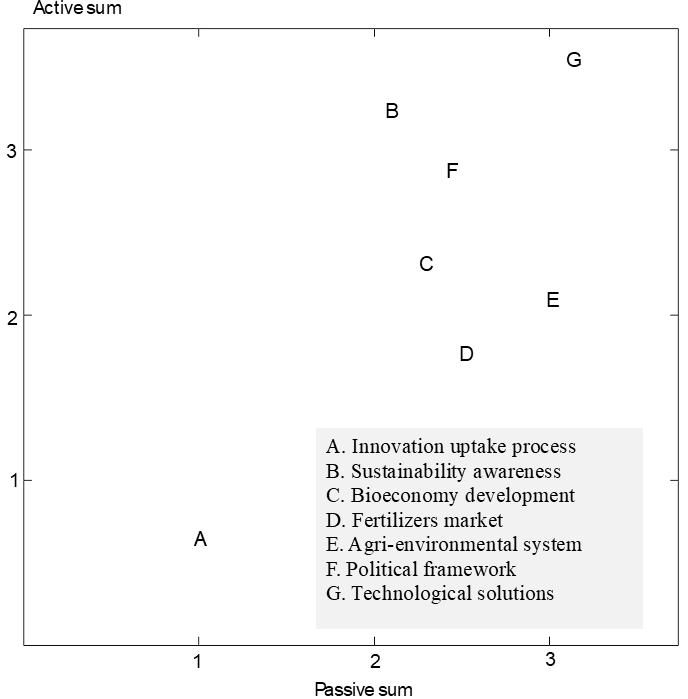
Technological solutions are the most influential factor (high active score sum), while the innovation process is the least influential. This result is probably affected by the presence during participation processes of several people with technical skills who therefore emphasized the relevance of the technological drivers for the development of BBFs. Social awareness and the political context are very influential too, while economic megatrends are weaker as they depend more on other factors.
The exploratory scenarios describe future, plausible, and alternative situations, highlighting the technical and socio-economic conditions that could determine them. In this article, we have built four scenarios for BBFs to 2050, using context scenarios for the agri-food system identified in the literature and specific drivers for BBFs identified thanks to the active contribution of stakeholders. To validate the results, we first consulted external experts to verify the consistency of the scenarios. Subsequently, we used the CIB method in an original way to improve the robustness of the verification process.
The defined scenarios include a very advantageous situation for BBFs (BBFs on valorization path), where the technological and socio-economic conditions are favorable to the development of an efficient, well-organized, and politically supported supply chain. In a context of this type, where circularity permeates the economic system and represents a value for all citizens, a potential threat for BBFs lies in the competition in the use of the raw material, the residual biomass of the agri-food system. Conversely, in the less favorable scenario (BBFs on technocratic path), mineral fertilizers continue to dominate the market, supported by technology and public support, while a marginal BBF supply chain finds limited space in politics, hindered by powerful chemical lobbies. In the other two scenarios (BBFs on differentiation path and BBFs on polarization path), which are intermediate compared to the previous ones, the production and use of BBFs are reduced in both cases, but this situation is determined by different evolution of the drivers. In the first case, the difficulty of integrating companies and the lack of a widespread knowledge and innovation system contribute to the fragmentation of the production fabric and limit the diffusion of efficient technologies for BBFs. Their use is therefore uneven across the territory and between types of agricultural holdings. Finally, in the ‘BBFs on polarization path’ scenario, the production of BBFs is strongly localized in some areas where favorable conditions exist (for example, for the availability of biomass), while more generally it is hindered by various factors, such as limited environmental sensitivity and the lack of adequate technology and logistics.
The scenario analysis highlighted the particular importance of some drivers for the future development of BBFs, such as product quality, farmers’ knowledge, adequate technology and logistics, and public intervention aimed not only at the regulation of the sector but also at the promotion of knowledge and use of BBFs, confirming what has also been found by others (Kurnawiati et al., 2023). The consultation of external experts has contributed to and strengthened the coherence of the defined scenarios. However, different driver evolutions may lead to the definition of other plausible scenarios. We therefore checked whether, among all the possible scenarios generated by the BBF drivers, the scenarios presented above were also included and what the relative degree of coherence was. For this purpose, we used the CIB algorithm. This approach aims to strengthen the verification of the results of the scenario analysis as the two paths are independent and start from different assumptions. The process of building storylines ensures that the factors considered are consistent with the object of the study (in our case the BBF supply chain), since they are based on specific information combined with expert assessments and stakeholder experiences. The CIB, meanwhile, focuses on interdependent relationships between the drivers that allow any inconsistencies to be highlighted. If the results of the two techniques overlap, the risk of producing inconsistent scenarios is lower. In our case, the results of the comparison demonstrate that the scenarios built for BBFs using the EUR-Agri-SSP and the stakeholder support are included among those indicated by the CIB as consistent but also indicate how other equally plausible narratives can be generated. This outcome is not surprising when we consider that one of the characteristics that guides the choice of drivers is uncertainty (in addition to relevance) and that, the greater the uncertainty, the more numerous the possible future realizations of the driver considered will be.
In addition to the methodological aspect, the analysis carried out on the BBFs case study produced a further result which contributes to confirming what has already been argued (Pernaa, 2017) regarding the ability of scenario analysis to create/increase knowledge through comparison between actors of different origins and experiences and the debate generated during the participatory process. This knowledge goes beyond the specific object of the investigation to include the ability to project oneself into the future, an ability which, however, only a structured and continuous path can ensure. The choice of stakeholders has an impact on the entire process of construction and evaluation of the scenarios and can represent a limit, where this choice is somehow lacking not only in terms of the breadth of knowledge on the object of the research but also by the lack of forecasting skills. On the other hand, the latter can be acquired along an interactive learning path between the research group and the actors involved in the scenario analysis.
Ultimately, the analysis provides stakeholders (researchers, policymakers, supply chain operators) with information to evaluate possible future trends in the BBF supply chain. The drivers identified and their evolutions traced in the scenarios constitute a decision support tool for any actions to be taken to favor (or hinder) the occurrence of desired (or unwanted) future situations. Monitoring the evolution of the identified drivers and constant and periodic discussion between stakeholders are the prerequisites for pursuing a desirable future development for BBFs.
Bock, A.K., Krzysztofowicz, M., Rudkin J. and Winthagen V. (2020). Farmers of the Future. EUR 30464 EN. Publications Office of the European Union, Luxembourg. https://doi.org/10.2760/680650. JRC122308.
Borch, K. and Merida, F. (2013). Dialogue in foresight: consensus, conflict and negotiation. In: Borch, K., Dingli, S.M. and Jorgensen, M.S. (eds.). Participation and Interaction in Foresight: dialogue, dissemination and visions. Edward Elgar, Cheltenbaro.
Börjeson, L., Höjer, M., Dreborg, K.H., Ekvall, T. and Finnveden G. (2006). Scenario types and techniques: Towards a user’s guide. Futures 38(7): 723-739.
Boschetti, F., Walker, I. and Price J. (2016). Modelling and attitudes towards the future. Ecological Modelling 322: 71-81.
Burgelman, J.C., Chloupková, J. and Wobbe W. (2014). Foresight in support of European research and innovation policies: The European Commission is preparing the funding of grand societal challenges. European Journal of Futures Research 2: 55. https://doi.org/10.1007/s40309-014-0055-4.
Chen, G., Li, X., Liu, X., Chen, Y., Liang, X., Leng, J., Xu, X., Liao, W., Aiu, Y., Wu, Q. and Huang, K. (2020). Global projections of future urban land expansion under shared socioeconomic pathways. Nature Communications 11: 537. https://doi.org/10.1038/s41467-020-14386-x.
Chojnacka, K., Moustakas, K. and Witek-Krowiak, A. (2020). Biobased fertilizers: a practical approach towards circular economy. Bioresource Technology 295: 122223. https://doi.org/10.1016/j.biortech.2019.122223.
European Commission. (2015). Closing the loop - An EU action plan for the Circular Economy. COM/2015/0614 final. Brussels.
European Commission. (2019). Regulation (EU) 2019/1009 of the European Parliament and of the Council of 5 June 2019 laying down rules on the making available on the market of EU fertilising products and amending Regulations (EC) No 1069/2009 and (EC) No 1107/2009 and repealing Regula. Official Journal European Union 2019: 1-114.
European Commission. 2020. A new Circular Economy Action Plan For a cleaner and more competitive Europe. COM/2020/98 final. Brussels.
European Environment Agency. 2020. Bio-waste in Europe — turning challenges into opportunities. Report No 4/2020. Publications Office of the European Union, Luxembourg.
Egas, D., Azarkamand, S., Casals, C., Ponsá, S., Llenas, L. and Colón, J. 2023. Life cycle assessment of bio-based fertilizers production systems: where are we and where should we be heading? The International Journal of Life Cycle Assessment 28: 626-650. https://doi.org/10.1007/s11367-023-02168-8.
ESPP - European Sustainable Phosphorus Platform 2023, Regulatory Activities, Proposal on the definitions of “Bio-Based Fertiliser” or “Bio-Based Nutrient” (30_09_2023), https://www.phosphorusplatform.eu/images/Regulatory%20activities/ESPP%20propsals%20Bio-Based%20Fertilisers%20v30_9_23.pdf.
Fauré, E., Arushanyan, Y., Ekener, E., Miliutenko, S. and Finnveden G. 2017. Methods for assessing future scenarios from a sustainability perspective. European Journal of Futures Research 5: 17. https://doi.org/10.1007/s40309-017-0121-9.
FAO 2022. The future of food and agriculture – Drivers and triggers for transformation. The Future of Food and Agriculture, no. 3. Rome. https://doi.org/10.4060/cc0959en.
Fertilizers Europe asbl 2021. Forecast of Food, Farming and Fertilizer use in the European Union 2021-2031, Available at https://www.fertilizerseurope.com/wp-content/uploads/2021/12/Forecast-2021-31-Studio-final-web.pdf.
Fritsche, U., Brunori, G., Chiaramonti, D., Galanakis, C., Matthews, R. and Panoutsou, C. 2021. Future transitions for the Bioeconomy towards Sustainable Development and a Climate-Neutral Economy - Foresight Scenarios for the EU bioeconomy in 2050. Borzacchiello, M.T., Stoermer, E. and Avraamides, M. (eds). Publications Office of the European Union, Luxembourg. https://doi.org/10.2760/763277, JRC123532.
Guivarch, C., Lempert, R. and Trutnevyte, E. (2017). Scenario techniques for energy and environmental research: An overview of recent developments to broaden the capacity to deal with complexity and uncertainty. Environmental Modelling & Software 97: 201-210.
Hariri, R.H., Fredericks, E.M. & Bowers, K.M. (2019) Uncertainty in big data analytics: survey, opportunities, and challenges. J Big Data 6: 44. https://doi.org/10.1186/s40537-019-0206-3.
Hunt, D.V.L., Lombardi, D.R., Atkinson, S., Barber, A.R.G., Barnes, M., Boyko, C.T., Brown, J., Bryson, J., Butler, D., Caputo, S., Caserio, M., Coles, R., Cooper, R.F.D., Farmani, R., Gaterell, M., Hale, J., Hales, C., Hewitt, C.N., Jankovic, L., Jefferson, I., Leach, J., MacKenzie, A.R., Memon, F.A., Sadler, J.P., Weingaertner, C., Whyatt, J.D. and Rogers, C.D.F. (2012). Scenario Archetypes: Converging Rather than Diverging Themes. Sustainability 4: 740-772.
Kurniawati, A., Stankovics, P., Hilmi Y.S., Toth, G., Smol, M., Toth, Z. (2023). Understanding the future of bio-based fertilisers: The EU’s policy and implementation. Sustainable Chemistry for Climate Action 3. https://doi.org/10.1016/j.scca.2023.100033.
Kurniawati, A., Toth, G., Ylivainio, K. and Toth, Z. (2023). Opportunities and challenges of bio-based fertilizers utilization for improving soil health. Organic Agriculture 13: 335-350. https://doi.org/10.1007/s13165-023-00432-7.
Kurniawan, J.H. (2020). Assessing Consistency of Scenarios Across Scales. Developing globally linked internally consistent scenarios under the Shared Socioeconomic Pathways framework. Dissertation. University of Waterloo, Canada.
IPCC-The Intergovernmental Panel on Climate Change. (2014). Climate change (2014): Impacts, Adaptation, and Vulnerability. Part 8: Regional Aspects. Contribution of Working Group II to the Fifth Assessment Report of the intergovernal Panel on Climate Change. Cambridge University Press, Cambridge, United Kingdom and New York, NY, USA.
Lassaletta, L., Estellés, F., Beusen, A.H.W., Bouwman, L., Calvet, S., van Grinsven, H.J.M., Doelman, J.C. Stehfest, E., Uwizeye, A. and Westhoek, H. (2019). Future global pig production systems according to the Shared Socioeconomic Pathways. Science of The Total Environment 665: 739-751. https://doi.org/10.1016/j.scitotenv.2019.02.079.
Mathijs, E., Deckers, J., Kopainsky, B., Nitzko, S. and Spiller A. (2017). Report on scenarios for EU farming. D1.2 of the European Project Sure Farm. https://www.surefarmproject.eu/.
Mitter, H., Techen, A.K., Sinabell, F., Helming, K., Schmid, E., Bodirsky, B.L., Holman, I., Kok, K., Lehtonen, H., Leip, A., Le Mouël, C., Mathijs, E., Mehdi, B., Mittenzwei, K., Mora, O., Øistad, K., Øygarden, L., Priess, J.A., Reidsma, P., Schaldach, R. and Schönhart, M. (2020). A protocol to develop Shared Socio-economic Pathways for European agriculture. Journal of Environmental Management 252: 15.
Nagesh, P., Edelenbosch, O.Y., Dekker, S.C., de Boer, H.J., Mitter, H. and van Vuuren, D.P. (2023). Extending shared socio-economic pathways for pesticide use in Europe: Pest-Agri-SSPs. Journal of Environmental Management 342: 118078. https://doi.org/10.1016/j.jenvman.2023.118078.
O’Neill, B.C., Kriegler, E., Ebi, K.L., Kemp-Benedict, E., Riahi, K., Rothman, D.S., van Ruijven, B.J., van Vuuren, D.P., Birkmann, J., Kok, K., Levy, M. and Soleckim, W. (2017). The roads ahead: Narratives for shared socioeconomic pathways describing world futures in the 21st century. Global Environmental Change 42: 169-180.
O’Neill, B.C., Kriegler, E., Riahi, K., Ebi, K.L., Hallegatte, S., Carter, T.R., Mathur, R. and van Vuuren, D.P. (2014). A new scenario framework for climate change research: the concept of shared socioeconomic pathways. Climatic Change 122: 387-400. https://doi.org/10.1007/s10584-013-0905-2.
Pernaa, H.K. (2017). Deliberative future visioning: utilizing the deliberative democracy theory and practice in futures research. European Journal of Futures Research 5: 13. https://doi.org/10.1007/s40309-017-0129-1.
Puglia, D., Pezzolla, D., Gigliotti, G., Torre, L., Bartucca, M.L. and Del Buono D. (2021). The opportunity of valorizing agricultural waste through its conversion into biostimulants, biofertilizers, and biopolymers. Sustainability 13: 2710. https://doi.org/10.3390/su13052710.
Puy A., Beneventano P., Lo Piano S., Portaluri T., and Saltelli A. (2022), Models with higher effective dimensions tend to produce more uncertain estimates. Science Advances 8. https://doi.org/10.1126/sciadv.abn9450.
Quist, J. and Vergragt, P. (2006). Past and future of backcasting: The shift to stakeholder participation and a proposal for a methodological framework. Futures 38(9): 1027-1045.
Reed, M.S., Kenter, J., Bonn, A., Broad, K., Burt, T.P., Fazey, I.R., Fraser, E.D.G., Hubacek, K., Nainggolan, D., Quinn, C.H., Stringer, L.C. and Ravera F. (2013). Participatory scenario development for environmental management: a methodological framework illustrated with experience from UK uplands. Journal of Environment Management 128: 345-362. https://doi.org/10.1016/j.jenvman.2013.05.016.
Rhydderch, A. (2017). Scenario Building: The 2x2 Matrix Technique. Futuribles International 11. Paris.
Schoemaker, P.J.H. (1995). Scenario Planning: A Tool for Strategic Thinking. MIT Sloan Management Review 36: 2.
Störmer, E., Bontoux, L., Krzysztofowicz, M., Florescu, E., Bock, A. and Scapolo, S. (2020). Foresight – Using Science and Evidence to Anticipate and Shape the Future. In: Šucha, V. and Sienkiewicz, M. (eds.). Science for Policy Handbook. European Commission, Joint Research Centre (JRC). Brussels/Belgium.
Swart, R.J., Raskin, P. and Robinson, J. (2004). The problem of the future: sustainability science and scenario analysis. Global Environmental Change 14: 137-146. https://doi.org/10.1016/j.gloenvcha.2003.10.002.
Tur-Cardona, J., Bonnichsen, O., Speelman, S., Verspecht, A., Carpentier, L., Debruyne, L., Marchand, F., Jacobsen, B.H. and Buysse, J. (2018). Farmers’ reasons to accept bio-based fertilizers: a choice experiment in seven different European countries. Journal of Cleaner Production 197: 406-416. https://doi.org/10.1016/J.JCLEPRO.2018.06.172.
van Ruijven, B. J., Levy, M. A., Agrawal, A., Biermann, F., Birkmann, J., Carter, T. R., Ebi, K.L., Garschagen, M., Jones, B., Jones, R., Kemp-Benedict, E., Kok, M., Kok, K., Lemos, M.C., … Lucas, P.L., Orlove, B., Pachauri, S., Parris, T.M., Patwardhan, A., Petersen, A., Preston, B.L., Ribot, J., Rothman, D.S. and Schweizer, V. J. (2014). Enhancing the relevance of Shared Socioeconomic Pathways for climate change impacts, adaptation and vulnerability research. Climatic Change 122(3): 481-494. https://doi.org/10.1007/s10584-013-0931-0.
Vervoort, J.M., Thornton, P.K., Kristjanson, P., Förch, W., Ericksen, P.J., Kok, K., Ingram, J.S.I., Herrero, M., Palazzo, A., Helfgott, A.E.S., Wilkinson, A., Havlík, P., MasonD’Croz, D. and Jost, C. (2014). Challenges to scenario-guided adaptive action on food security under climate change. Global Environmental Change 28: 383–394. https://doi.org/10.1016/j.gloenvcha.2014.03.001.
Weimer-Jehle, W. (2006). Cross-impact balances: A system-theoretical approach to cross-impact analysis. Technological Forecasting & Social Change 73: 334-361. https://doi.org/ 10.1016/j.techfore.2005.06.005.
Weimer-Jehle, W. (2023). Cross-Impact Balances WEB site, ZIRIUS - Centre for Interdisciplinary, Risk and Innovation Studies University of Stuttgart. https://www.cross-impact.org/english/CIB_e.htm
Wester-Larsen, L., Müller-Stöver, D.S., Salo, T. and Jensen L.S. (2022). Potential ammonia volatilization from 39 different novel biobased fertilizers on the European market – A laboratory study using 5 European soils. Journal of Environmental Management 323: 116249. https://doi.org/10.1016/j.jenvman.2022.116249.
Zawalińska, K., Smyrniotopoulou, A., Balazs, K., Böhm, M., Chitea, M., Florian, V., Fratila, M., Gradziuk, P., Henderson, S., Irvine, K., Konstantidelli, V., Krupin, V., Latruffe, L., Mikšytė, E., Miller, D., Monteleone, D., Polaschegg, M., Schwarz, G., Tzanopoulos, J., Tzouramani, I., Vlahos, G. and Wojciechowska, A. (2022), Advancing the contributions of european stakeholders in farming systems to transitions to agroecology. EuroChoices 21: 50-63. https://doi.org/10.1111/1746-692X.12378.
A. List of drivers proposed by stakeholders grouped by categories.
Sustainability awareness
1. Acceptance of BBF
2. Awareness of Producers (Farmers)
3. Awareness of Wastes as a Resource
4. Consolidation of Traditional Fertilisers
5. Demand of Healthy Products
6. Development of Sustainable Farming Method
7. Healthy Dietary Regimes
8. Higher Sustainability Awareness Thus Greater Demand
9. Improvement of the Landscape and of the Image of Our Agricultural Sector
10. Increase of Environmental Sensibility
11. Increased Awareness and Trust of Farmers
12. Increased Organic Production (Consumer - Export)
13. Increased Worldwide Demand for Organic Products
14. Increasing Awareness and Interest in Organic Production
15. Independence for Fertiliser
16. Public Awareness of Sustainability
17. Qualified Employment is Needed to Maintain a Sustainable Conscience
18. Raising Awareness
19. Sensibilization/Education/Promotion to Work with Alive Soils
20. Social Conscience about Use of Renewable Resources
21. Society Education about Environmental Problems Related to Agricultural Activity (Rc)
Political Framework
1. Administration for Farmer
2. Ban on Synthetic Fertilisers
3. Certain and Enhanced Regulation of Biomass / BBF
4. Certificates and Labels
5. Common Agricultural Policy/ Rural Development Programs
6. Compensation Measure for Soil C Sequestration
7. Design of a Common Regulation in Europe
8. Development of Regulation to Promote the Use of BBF
9. Economic Help to Develop BBF is Needed
10. Economic Sustainability Guaranteed
11. Environmental Responsive and Consistent Policies
12. Facilitation of Environmental Objectives Required by Legislation
13. Future Demands Imposed by Regulation (Water and Carbon Footprint Certifications) (Fa)
14. Influence of Lobby Groups
15. Intellectual Property Rights
16. Lack of Local Regulation
17. Lack of Political Will and Regulations to Support These Processes (Production, Distribution, Commercialization)
18. Legal Framework to be Develop
19. Legislation to Boast the Use of BBF If
20. Pressure on Transparency in the Chain
21. Protection of European Farmers Vs non-European Farmers
22. Raw Material Regulation
23. Recognition (Fps Public Health)
24. Regulation to Facilitate, Promote and Prioritize the Use of Organic Wastes to Produce BBF (Wp)
25. the Primary Sector is not Going to Lose Competitiveness
26. Variation in Specific Legislation for BBF
Fertilizers Market
1. Affordability of Rbff Production Process
2. Assessed Costs/Benefits of BBF
3. Competition with Other Fertilisers
4. Competitive Market Prices of BBF
5. Competitiveness of the Production Chain
6. Cost of Mineral Fertilizers
7. Cost of the Product (Including Full Production)
8. Costs of Production Will Determine Final Price of BBF
9. Decrease of the Biowaste Treatment Costs
10. Economic Imbalance of Costs of Wastes Management
11. Economic Studies Are Needed to Demonstrate Economic Profitability Growing with BBF and Alive Soils (Fa)
12. Economical Valorisation of the Food Final Products
13. Evolution of the Prices of Agricultural Products
14. High Prices of Chemical Fertilizers
15. Higher Prices of BBF in Comparison with Inorganic Fertilizers
16. Increase of Prices of Inorganic Fertilizers
17. Increase of the Price of Mineral Fertiliser
18. New Bio-Based Fertilizers Economically Viable Are Needed
19. Price of BBF: Competitive?
20. Production Costs (Competitors)
21. Qualitative Competitiveness
22. Reduction in Cost Price of BBF by Reducing Cost Price of Residual Flow
23. Remuneration of bio-based Resources
24. Valorisation Process must be Economically Sustainable
Technological Solutions
1. Accessibility of Technologies
2. Availability of Effective Technology
3. Availability, Homogeneity, and Stability in Time of Fbb
4. BBF Ease of Use
5. Continuity and Volumes of Inputs
6. Development at Big Scale of Technologies to Reduce Costs of Production of BBF
7. Ease of Technology Production
8. Efficiency of Technologies
9. Enhanced BBF Processing Technology
10. Ensuring Consistent Quality of End Product with Changing Input
11. Final BBF Consistent with Characteristics of Each Production Area
12. Lack of Innovation and Applicable Development of Last Valorisation Processes Developed (Rc)
13. Local Availability of Technological Solutions
14. Logistic
15. Management Methods Viable and Suitable for Private Companies
16. Need for Additional Investments
17. New Valorisation Processes must be in Agree to the Real Situation of the Agricultural Sector (Fm)
18. Nitrogen Level
19. Preferable BBF Traits
20. Production of Final Stables and Homogeneous BBF
21. Rationalization of BBF Production Processes
22. Reliability (Efficiency) and Easy to Use
23. Reorienting Production Sites Towards BBF
24. Risk of Contamination in the Process
25. Transportation Logistics
26. Used of Technologies not Proven
27. Weakly Developed Logistics for Production and Transport
Innovation Uptake Process
1. Creation of New Professional Activities
2. Farmers’ and BBF Producers Mutual Learning and Influence
3. Generate the Union of the Different Actors of the Project
4. Importance of the Complete Supply Chain - All Components
5. Increasing Number of Producer Organizations That Promote the Use of Bio-Based Fertilizers
6. Lack of Knowledge about Waste Valorisation Technologies
7. Lack of Social Association Associative Willingness to Join These Initiatives
8. Low Technical Capacity of Actors Who have to Fuse Technique and Economy
9. Networking with Advisory Organizations
10. Occurrence of Fertilizers Producers
Environmental System
1. Additional Benefits (E.G. Nutrient Input in Soil)
2. Assessment of Product Life Cycle Environmental Impact
3. Characteristics of Soils at Local Level
4. Greenhouse Gases
5. Impact of Climate Change on Soil
6. Improvement on Food Consumption and Yield Obtained
7. Nutrient Balance in Soil and Surface Water.
8. Optimization of Residues Management
9. Reduction of Vegetal Effluents
Bioeconomy Patterns
1. Availability and Quality of Biomass
2. Boom of BBF Industry and Circular Economy
3. Competition in Residual Flows
4. Competition with Other Processing Options for Residual Flows
5. Increased Demand bio-based Resources
6. Lack of Recycling Culture
7. Lack of Research on Waste Characterization and Utilization
8. Low Availability of Sources (Different to Sugarcane) and Raw Materials
9. Measures Favouring Circular Economy (Green Deal)
10. Raw Materials (Residues) Are Readily Available
11. Role (Involvement) of Large Retail Chains as Waste Provider
12. Seasonality and Variation of Volume of Vegetable Residues Produced
13. Seasonality of Waste Production
14. Shift Towards a Circular Approach
15. Strength of Circular Economy
16. Sufficient Raw Material