Received: November 8, 2024; Accepted: May 9, 2025; Published: December 31, 2025
Towards digital farming: exploring technological integration in agricultural practices of a sample of italian livestock farms
1 Department of Agriculture, Food and Environment, University of Pisa, Pisa, Italy
2 National Institute of Statistics (ISTAT), Italy
*Corresponding author. Email: felicitas.okoye@phd.unipi.it
Abstract. Despite the rapid rise of digital technologies in agriculture, their application remains more prominent in crop farming than in the livestock sector. Recognizing this gap, our study explores the current state and determinants of digital technology adoption across Italian livestock farms, examining key factors and broader trends in the industry. Using national agricultural census, and national statistical programme data, we applied a logistic regression model to assess the likelihood of adoption of technology. Findings reveal that large ruminant farms, particularly dairy cattle and buffalo, are more likely to integrate digital tools like decision support systems, cloud services, and monitoring devices. In contrast, meat cattle, small ruminants, and pig farms lag. Key determinants include broadband connectivity, ownership structure, education, and age, with additional factors influencing specific technology categories. Our results establish a foundation for future policy and investment, underscoring the need to build digital infrastructure and promote an inclusive model.
Keywords: digital agriculture, livestock farming, technology adoption.
Index
2. Digitalization in the livestock sector
4.2. Extent of digital technology adoption
4.3. Determinants of digital technology adoption in livestock production
The livestock industry has undergone significant transformations driven by evolving human needs, changes in consumption (Righi et al., 2023), and technological advancements (Subach & Shmeleva, 2022). Traditionally, livestock farming relied on subjective and less quantifiable but holistic approaches to animal welfare and management (Buller et al., 2020). However, a shift towards modern, data-driven processes characterized by interconnectivity and efficiency marks a significant change. Often referred to as digital farming, this shift includes concepts such as smart farming, precision agriculture, and Agriculture 4.0, rooted in the sustainability discourse and bolstered by advancements in information technology (Zhou et al., 2022). This shift is driven by concerns over food insecurity, economic factors, climate change, market dynamics and sustainability (Thornton et al., 2014).
Digital technologies advance agricultural practices by enabling diagnosis, intelligent perception, decision-making, and improved production processes (Zhou et al., 2022; Finger, 2023). Applied along the entire value chain, they enhance resource management, trade promotion, operational efficiency, and knowledge exchange (Barnes et al., 2019; Elijah et al., 2018), promoting sustainability, resilience, and overall competitiveness (Finger, 2023). However, adoption challenges persist. Finger (2023) notes that technologies with more potential benefits are least profitable and less widely adopted by small scale farmers due to their high investment costs and limited returns. Large and capital-intensive farms tend to benefit disproportionately from these technologies, exacerbating existing inequalities (Hackfort, 2021). Additional challenges include data ownership and power distribution within the farming community (Morrone et al., 2022; Neethirajan & Kemp, 2021; Wolfert et al., 2017).
Despite the growing integration of digital technologies in agriculture, livestock farming remains one of the least digitalized sectors globally (Neethirajan & Kemp, 2021). Meanwhile, adoption is diverse and limited to basic aspects of livestock management (Guntoro et al., 2019). Barriers to adoption include social factors such as low levels of trust in new technologies, digital illiteracy, and resistance to change (Eastwood et al., 2021; FAO, 2022), as well as technological challenges like infrastructure limitations and system integration, compatibility, and interoperability (Abeni et al., 2019; Tuyttens et al., 2022). Economic factors include high cost of technology, uncertainty about the return on investment, and misaligned business models (Groher et al., 2020). Additionally, the complexity of agroecosystems, compounded by difficulties in collaboration among stakeholders, agreeing on common goals and farming practices represent barriers to successful digitalization (Grivins & Kilis, 2023). These combined factors create a complex environment that limits widespread adoption of digital technologies in livestock farming (Cui & Wang, 2023). Moreover, digital technology development is dominated by a small number of powerful multinational corporations, prioritizing digital innovations that support their market dominance, potentially misaligning with the practical needs of smaller farms (Hackfort 2021). Research related to digitalisation in the livestock sector has focused more on certain livestock species, particularly cattle, with less emphasis on small ruminants like sheep and goats (Morrone et al., 2022; Tzanidakis et al., 2023) and other livestock such as pigs and buffaloes. This disparity has implications for animal welfare, leading to species- or livestock- specific differences (Tuyttens et al., 2022). Therefore, it is crucial to comprehend the extent of digital technology usage in livestock production and management (Fuentes et al., 2022). In Italy, the livestock sector is vital not only economically but also for its cultural heritage (Pulina et al., 2017). Local breeds, adapted through selective breeding, support sustainable husbandry and rural communities. By leveraging breed diversity and innovative technologies, the sector can address challenges like greenhouse gas emissions and resource management, contributing to both productivity and sustainability.
The primary goal of this research is to explore the extent of digitalization among Italian livestock farms and identify the factors influencing digital technology adoption. This research contributes to existing literature in several ways. First, the study provides a comprehensive analysis across all livestock categories, including small ruminants and monogastric species, thereby addressing a critical gap in digitalization research within the livestock sector, predominantly focused on dairy cattle and large ruminants. Second, by leveraging a large-scale, nationally representative datasets, we offer robust empirical evidence on the determinants of digital technology adoption, moving beyond the commonly acknowledged availability of digital solutions to assess the actual uptake and utilization of these technologies at the farm level. Third, this study introduces a new economic dimension by examining the role of marketing channels and their influence on digital investments, shedding light on how different marketing sales strategies may either facilitate or hinder the adoption of technological innovations. The findings of this research provide valuable insights for policymakers, technology providers, and researchers seeking to foster a more inclusive and effective digital transformation in livestock farming. Specifically, it seeks to answer: What is the current extent of digital technology usage in livestock production and management? What factors influence the adoption these technologies? The paper goes on with a literature review on how digital technologies have been integrated into the livestock sector over time. In section 3, the material and methods are explained. The results of the analysis are presented and discussed in section 4. We conclude with reflections on policy implications and recommendations.
2. Digitalization in the livestock sector
Digitalization in the livestock sector encompasses a broad array of technological innovations reliant on digital infrastructures and networks. These components enhance the creation, storage, and exchange of data, improving the functionality of various digital tools. Initially, Information and Communication Technologies (ICT) were pivotal in precision agriculture (Cox, 2002), but today’s digital solutions leverage the internet, big-data technology, cloud computing, and the internet of things (IoT) through sensors and wireless communication networks (Zhou et al., 2022).
Technologies in this digital shift, as recorded in the early 2000s, involve basic data management systems, including electronic identification systems such as Radio Frequency Identification (RFID) tags, tracking collars, and wearable biosensors, enabling farmers to monitor individual animal health, behaviours, and movement (Eastwood et al., 2021). These tools have improved animal welfare and productivity through early detection of health issues (Zhou et al., 2022). In Europe, Farm Management Information Systems (FMIS), barn cameras, and sensors are increasingly integrated into livestock management (Gabriel & Gandorfer, 2023). This phase also introduced simple automation for feeding, milking, and climate control systems.
Building on these early innovations, the mid-to-late 2000s saw the development of automated farm management technologies, increased development of robotic systems, and the integration of real-time data collection tools. These advancements laid the groundwork for further digitalization, allowing farms to transition from basic monitoring to more interactive, data-driven decision making.
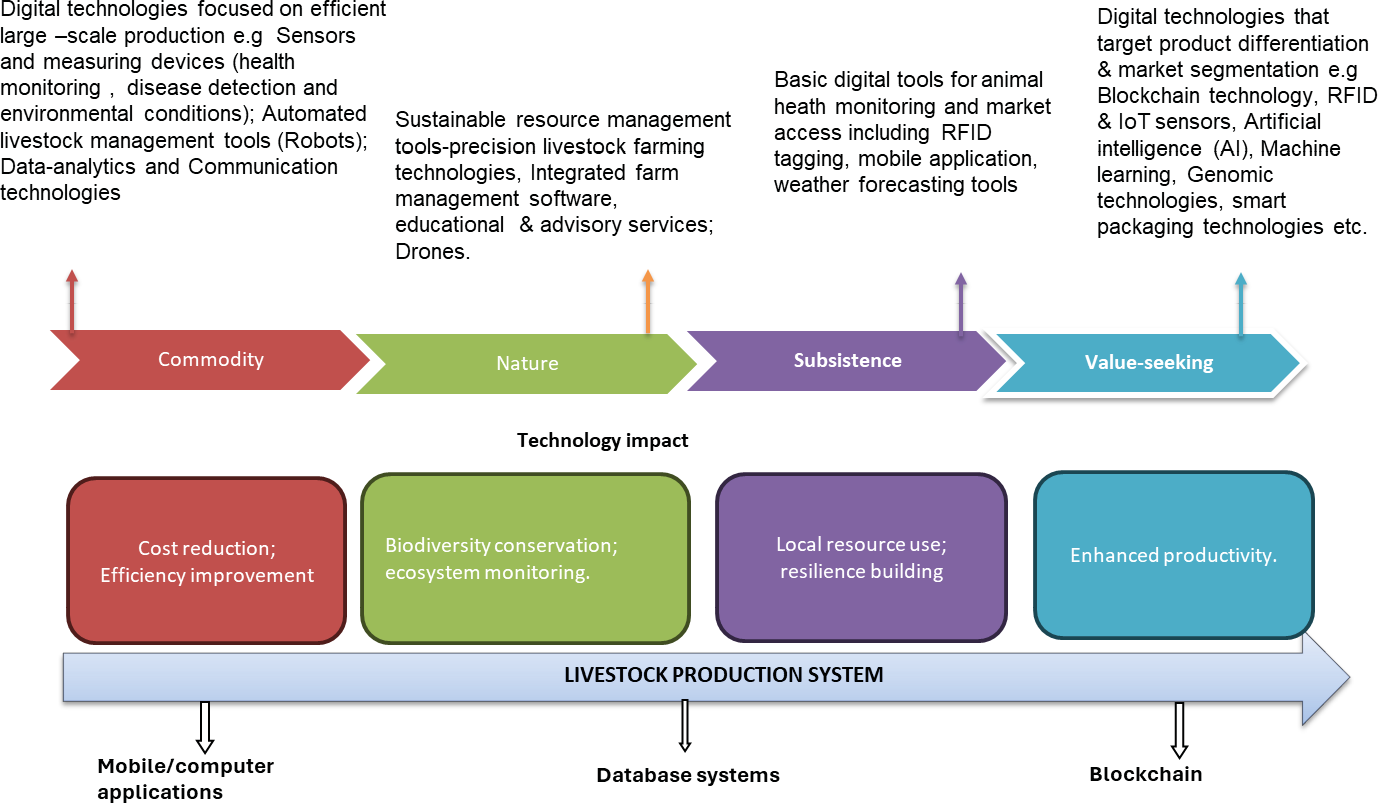
In the last decade, digitalization advanced with integrated systems combining data analytics, real-time monitoring and advanced sensors to enhance precision and decision making (Wolfert et al., 2017; Chavan et al., 2024). Technologies at the forefront include Artificial Intelligence (AI)-driven analytics, IoT-based monitoring systems, blockchain technology, advanced automation, and robotics, which promise improvement in sustainability and traceability (Calcante et al., 2014; Alonso et al., 2020a; D’Agaro et al., 2021; Alshehri, 2023; Alipio & Villena, 2023). However, blockchain technology is in its early stage of development and requires further validation and adoption (Neethirajan & Kemp, 2021). Further innovations such as gene editing and advanced biometrics offer further potential for improving animal welfare and sustainability (Eastwood et al., 2021). As shown in Figure 1, these digital tools address species-specific challenges and benefits various livestock production systems - commodity based, nature-based, subsistence, and value-seeking systems (Kraft et al., 2022) and tailored technological solutions are necessary for each system as they face unique challenges (Baker et al., 2022). For instance, a commodity-based system might struggle with regulatory issues, while a value-seeking system may face challenges related to skill shortages and data management. Despite these advancements, concerns remain that the focus on high-tech solutions may neglect simpler, more accessible innovations that could benefit a wider range of farmers, particularly small-scale operations (Barrett & Rose, 2022). To address issues of exclusion, Alonso et al. (2020b) suggest creating an integrated technology ecosystem – a coordinated network – where IoT, edge computing, AI, and blockchain technologies are bundled together. This approach is intended to lower the costs associated with adopting these technologies individually. However, while such an ecosystem could enhance accessibility, it may also introduce privacy and data ownership concerns that could limit widespread adoption. Promoting individual components of precision livestock farming technologies can be unsustainable (Banhazi et al., 2012).
Digitalization presents both optimistic prospects and contentious challenges. Precision livestock farming technologies can enhance animal welfare monitoring, but increased automation risks detaching farmers from direct animal care (Buller et al., 2020; Tuyttens et al., 2022), and technologies like drones may also cause stress to animals (Alanezi et al., 2022). Ethical concerns persist around factory farming practices and environmental impacts (Neethirajan & Kemp, 2021). Meanwhile the prioritization of economic efficiency could undermine broader sustainability goals (MacPherson et al., 2022). While these tools can drive sustainability, their deployment must prioritize ethical standards and resource efficiency.
Moreover, digitalization is reshaping farm business models, facilitating direct marketing and mitigating price effects and risks. However, it also alters farm operations, work content, and interactions among value chain stakeholders (Weber et al., 2022), requiring support for farmers as they navigate these complexities. While the adoption of digital technologies is inevitable, particularly as they become more affordable, akin to the widespread adoption of smartphones (Morrone et al., 2022), farmers adoption decisions are influenced by socio-demographic, institutional, and economic factors, which complicate the process (Vecchio et al., 2020).
The future of digital technologies in livestock farming requires a balanced approach that recognizes current capabilities while learning from past lessons. Stakeholders must integrate digital advancements with practical applications and ethical considerations to build a sustainable and competitive future (Eastwood et al., 2021).
This study utilized secondary data from two sources: the 7th General Census on Agriculture conducted by the National Institute of Statistics (Istituto Nazionale di Statistica-ISTAT) for the agricultural year 2019-2020, specifically covering the period from November 1st, 2019, to October 31st, 2020. The reference date for farm herd size in this dataset was December 1st, 2020. This census provided structural data on farms at national, regional, provincial, and municipal levels. The ISTAT survey was structured into sections covering general farm information, land use, consistency of farms, farm management methods, related activities and company managers, labor, and additional information on product destination, revenues/subsidies, marketing, investment in innovations, and memberships in associations or organizations. This dataset contributed to most of the socio-demographic variables used for this study. The target population comprised Italian farms, with at least 20 Ares (2,000 m²) of Utilized Agricultural Area (UAA).
The National Statistical Programme (IST-00173) survey (NSP) aimed to survey the number of cattle, buffaloes, pigs and sheep and goats owned on June 1st and December 1st of each calendar year. In the December 2020 edition, additional questions were introduced to survey the diffusion of technologies in livestock holdings. The livestock farms are selected by stratified random sampling; the stratification is by region and livestock classes, based on the total number of animals owned on the farm. Both datasets were collected via online questionnaire and telephone interviews.
The datasets initially included 246,161 observations from ISTAT and 7,587 from the NSP survey. After merging based on identification number and cleaning the datasets, the sample size was reduced to 4,133 livestock farms. The following exclusion criteria were further applied, that is, farms raising multiple types of livestock (due to the ambiguity of digital technology application), and those raising only horses, rabbits, ostriches, or poultry. The final sample size was 2,412 observations. The variables used in the analysis, summarized in Table 1, were categorized based on their relevance to technology adoption, as highlighted in the existing literature.
| Variable | Type | Description |
|---|---|---|
| SOCIO-DEMOGRAPHIC CHARACTERISTICS | ||
| Age | Continuous | Individual age; Min. age: 21 & Max. age: 94 |
| Gender | Categorical | 1: Male; 2: Female |
| Education | Categorical | 1: No educational qualification. 2: Primary school leaving certificate/ Certificate of final assessment. 3: Secondary or vocational school-leaving certificate (obtained no later than the year 1965) /Secondary education diploma. 4: Professional education/training qualification related to agriculture that does not permit enrolment in university. 5: Professional education/training qualification not related to agriculture that does not permit enrolment in university. 6: Upper secondary education related to agriculture that allows enrolment in university. 7: Upper secondary education not related to agriculture that allows enrolment in university. 8: Bachelors/master’s or equivalent qualification in agriculture. 9: Bachelors/master’s or equivalent qualification not in agriculture. |
| Area | Categorical | 1: Central; 2: Northeast; 3; Northwest; 4: South. |
| FARM OPERATIONS & ENDOWNMENT | ||
| Labor | Continuous | Total number of employees on the farm. |
| Livestock unit (UBA) | Continuous | Sum of each livestock unit. |
| Total agricultural area (SAT) | Continuous | Total area in hectares |
| Type of ownership (Legal form) | Categorical | 1: Entrepreneur or sole proprietorship or family business. 2: Partnerships 3: Capital companies 4: Cooperative Societies 5: State Administration or Public Body. 6: Other private entities 7: Collective ownership 8: Consortia |
| Production system | Categorical | Organic=1, conventional=2 |
| Type of livestock (Dairy cattle, meat cattle, Buffaloes, Sheep, Goat, Pig) | Categorical | 1: large ruminants; 2: Small ruminants; 3: Monogastric |
| Number of livestock | Continuous | Total number of each livestock in the farm. |
| Membership of association | Binary | 0: No association; 1: Yes association Association with producer organization Association with network of enterprises Association with other organization/companies |
| Public subsidies (%) | Continuous | The amount of subsidy received in percentage of the farms total gross revenues. |
| Marketing channels for animal products | Binary | 0: No sales on this marketing channel. 1: Yes, sales in this marketing channel. Direct sales on the farm Off-farm direct sales Sales to other farms Sales to industrial companies in Free Market Sales to industrial companies with multi-annual agreements Sales to commercial enterprises in Free Market Sales to commercial enterprises with multi-annual agreements Sales or contribution to association bodies |
| Other Remunerative activities | Binary | 0: No other activities, 1: Yes, Other activities |
| BEHAVIOURAL ATTRIBUTE | ||
| Agricultural training (Learning orientation) | Binary | 0: Never attended agricultural training. 1: Attended agricultural training. |
| REGIONAL INFRASTRUCTURES | ||
| Fixed broadband connectivity | Binary | 1: Yes, the farm uses at least one fixed broadband internet connection, 0: No |
| DIGITALIZATION | ||
| . | Binary | 0: No, I do not use this technology. 1: Yes, I use this technology. Decision support software Data Cloud computing Digital devices for animal monitoring Social network/website Precision animal husbandry system/machinery |
The study draws on various explanatory variables established in the literature to explore the adoption of digital technologies in livestock farming. Tey & Brindal, (2012) classify factors influencing adoption into six categories: socio-economic, agro-ecological, institutional, informational, perceptual, and technological. Based on these, a tailored set of variables were selected for this research.
The analysis categorized livestock into large ruminants, small ruminants and monogastric animals because they have distinct management requirements, economic values and level of environmental impacts that shape the development of digital technology. Variations in the availability and adoption of digital technologies across different livestock categories have been documented in the literature (Thomann et al., 2023). Research on digital technologies has predominantly focused on dairy cattle reflecting their intensive management systems and economic importance (Marino et al., 2023). Similarly, buffalo farming follows specialized intensive management strategies, particularly in regions where it plays a significant economic role, such as Italy, due to the high demand for Mozzarella di Bufala Campana PDO (Trapanese et al., 2024). While digitalization efforts often focus on ruminants due to their large land use and contributions to greenhouse gas (GHG) emissions (Pulina et al., 2017), this study considers adoption across all livestock categories to assess variation.
In assessing the status of digitalization in farms, the study considered the data utilization (meteorological, satellite, and drone-collected data), websites and social networks, cloud computing, Decision Support Systems (DSS), digital devices for individual animal monitoring, and precision husbandry systems or machinery. The percentage frequency of digital technology adoption was then calculated for each livestock category.
To ensure robustness and comparability across livestock categories in analyzing the determinants of technology adoption, the study further identified specific tools within digital devices for animal monitoring and precision animal husbandry systems/machinery. These technologies were analyzed as individual tools, rather than being grouped under broader categories. Only technologies applicable to all livestock types were retained in the analysis. Species-specific technologies, such as milking robots and milking parlors equipped with online milk quality measurement systems (which are exclusively used in dairy farming), were excluded to maintain consistency and enable cross-category comparisons. Similarly, social networks and websites were not considered core digital tools, as they do not serve a direct farm management function. Technologies were classified into three categories: highly adopted (adopted by at least 15% of sampled farms), somewhat adopted (adopted by less than 15% of sampled farms) and no digital technologies. Accordingly, livestock farms were grouped into farms using highly adopted digital technologies, farms using somewhat adopted digital technologies, and farms using no digital technology. This classification enabled a detailed assessment of digital technology adoption across farms by capturing variations in uptake. Including the ‘somewhat adopted’ category allowed us to distinguish farms with low but notable level of adoption, enabling a more focused analysis of the factors influencing digital technology adoption. This approach helped identify specific drivers or barriers associated with each category. This categorization formed the dependent variable in the econometric analysis, where the outcome variable was binary, taking a value of 1 if the farm adopted any form of digital technology (highly or somewhat adopted) and 0 if no digital technology was adopted.
A binary choice framework was used to model the decision to adopt digital technologies. A logistic regression model was employed to estimate the probability of adoption based on a set of independent variables. This approach, estimated via the maximum likelihood estimation (MLE), is preferred over multinomial logistic regression, as the categorization of digital technology use is not based on a distinct choice between unordered categories, but rather a binary decision of adoption. The logistic regression model is specified as:
(1)
where: represents the probability that farm adopts at least one digital technology within each category. are the independent variables hypothesized to influence adoption. is the intercept, and (for each ) are the estimated coefficients indicating the change in log-odds with a unit change in each variable. The independent variables include, total area of holding, state aid subsidy received, livestock unit (UBA), age, labour, total number of livestock, fixed broadband connectivity, area, type of livestock, type of ownership (legal form), production system, other remunerative activities, gender, education, agricultural training, membership of association, and marketing channels.
Marginal effects were calculated to provide an intuitive understanding of how each variable impacts the likelihood of adopting digital technologies. These effects translate the logistic regression coefficients into changes in the probability of adoption.
The marginal effect of each variable on the probability of adoption is given by:
(2)
where:
is the marginal effect of variable on adopting probability.
is the predictive probability of adoption.
is the probability of non-adoption.
is the estimated coefficient of .
Marginal effects were computed for both highly adopted and somewhat adopted technologies to observe differential impacts across varying levels of adoption.
Table 2 presents the descriptive analysis of the sampled livestock farms. The average age varied across livestock types, ranging from an average of 47 years for buffalo farmers to an average of 56 years for pig farmers, with an overall average age of 53 years. This reflects the typical demographic trend of middle-aged individuals managing farms. Gender distribution shows a predominance of male farm managers (85%), consistent with traditional gender roles in agriculture.
| Dairy Cattle (n=1091) |
Meat Cattle (n=435) | Buffalo (n=49) |
Goat (n=84) |
Sheep (n=329) |
Pig (n=424) |
Total (n=2412) |
|||||||||||||
|---|---|---|---|---|---|---|---|---|---|---|---|---|---|---|---|---|---|---|---|
| Age (mean & SD) | 54 (13.4) |
53 (14.2) |
47 (13.2) |
49.6 (15.5) |
48.6 (14.4) |
55.7 (14.0) |
53.0 (14.0) |
||||||||||||
| Gender | |||||||||||||||||||
| Male | 987 | 355 | 43 | 62 | 266 | 350 | 2063 | ||||||||||||
| Female | 104 | 80 | 6 | 22 | 63 | 74 | 349 | ||||||||||||
| Labour (mean & SD) | 3.2 (3.7) | 1.6 (2.4) | 4.6 (3.7) | 1.6 (2.1) | 1.9 (5.6) | 2.5 (5.5) | 2.6 (4.2) | ||||||||||||
| Type of ownership (legal form) | |||||||||||||||||||
| Entrepreneur or sole proprietorship or family business | 525 | 356 | 30 | 70 | 259 | 273 | 1513 | ||||||||||||
| Partnerships | 543 | 69 | 12 | 11 | 63 | 132 | 830 | ||||||||||||
| Capital companies | 17 | 7 | 7 | 2 | 4 | 16 | 53 | ||||||||||||
| Cooperative Societies | 6 | 3 | - | 1 | 3 | 3 | 16 | ||||||||||||
| State Administration or Public Body | - | - | - | - | - | - | - | ||||||||||||
| Other private entities | - | - | - | - | - | - | - | ||||||||||||
| Collective ownership | - | - | - | - | - | - | - | ||||||||||||
| Consortia | - | - | - | - | - | - | - | ||||||||||||
| Education | |||||||||||||||||||
| No educational qualification | 4 | 5 | - | - | 5 | 4 | 18 | ||||||||||||
| Primary school leaving certificate/ Certificate of final assessment | 90 | 67 | - | 9 | 35 | 65 | 266 | ||||||||||||
| Secondary education diploma | 458 | 183 | 16 | 39 | 145 | 155 | 996 | ||||||||||||
| Professional education/training qualification related to agriculture | 77 | 14 | - | 1 | 9 | 14 | 115 | ||||||||||||
| Professional education/training qualification not related to agriculture | 57 | 18 | 2 | 3 | 10 | 26 | 116 | ||||||||||||
| Upper secondary education related to agriculture | 156 | 44 | 6 | 13 | 31 | 45 | 295 | ||||||||||||
| Upper secondary education not related to agriculture | 167 | 63 | 19 | 11 | 73 | 79 | 412 | ||||||||||||
| Bachelor’s/master’s or equivalent qualification in agriculture | 41 | 12 | 1 | 1 | 9 | 15 | 79 | ||||||||||||
| Bachelor’s/master’s or equivalent qualification not in agriculture | 41 | 29 | 5 | 7 | 12 | 21 | 115 | ||||||||||||
| Livestock unit (UBA) (mean & SD) | 196.0 (231.9) |
81.4 (247.6) |
321.8 (250.9) |
20.1 (30.8) |
44.6 (50.5) |
248.9 (697.2) |
160.4 (358.3) |
||||||||||||
| Production system | |||||||||||||||||||
| Organic | 33 | 45 | 4 | 4 | 19 | 10 | 115 | ||||||||||||
| Conventional | 1058 | 390 | 45 | 80 | 310 | 414 | 2297 | ||||||||||||
| Total No of livestock (mean & SD) | 128.5 (155.2) |
66.0 (295.7) |
342.6 (262.0) |
115.1 (194.3) |
398.8 (480.2) |
868.9 (2236.2) |
288.2 (1010.2) |
||||||||||||
| Total area of holding (SAT) ha. (mean & SD) | 68.9 (80.1) |
84.9 (169.8) |
45.3 (50.6) |
35.3 (52.4) |
81.6 (160.2) |
50.4 (229.8) |
68.7 (145.5) |
||||||||||||
| Membership of association | |||||||||||||||||||
| Producer association | 398 | 99 | 16 | 19 | 54 | 93 | 679 | ||||||||||||
| Network of enterprises | 45 | 11 | 5 | 3 | 12 | 15 | 91 | ||||||||||||
| Association with companies/organization | 579 | 160 | 22 | 23 | 130 | 181 | 1095 | ||||||||||||
| Public subsidies (%) | 13.2 (17.3) |
225.1 (24.5) |
8.0 (12.0) |
18.0 (26.9) |
30.2 (28.8) |
13.3 (20.4) |
17.7 (22.4) |
||||||||||||
| Marketing channels | |||||||||||||||||||
| Direct sales on the farm | 135 | 776 | 10 | 18 | 60 | 112 | 411 | ||||||||||||
| Off-farm direct sales | 59 | 32 | 4 | 4 | 31 | 43 | 173 | ||||||||||||
| Sales to other farms | 65 | 78 | 1 | 10 | 19 | 32 | 205 | ||||||||||||
| Sales to industrial companies in Free Market | 220 | 39 | 14 | 11 | 69 | 59 | 412 | ||||||||||||
| Sales to industrial companies with multi-annual agreements | 75 | 11 | 1 | 2 | 9 | 9 | 107 | ||||||||||||
| Sales to commercial enterprises in Free Market | 328 | 179 | 12 | 14 | 91 | 91 | 715 | ||||||||||||
| Sales to commercial enterprises with multi-annual agreements | 33 | 7 | 3 | 1 | 0 | 3 | 47 | ||||||||||||
| Sales or contribution to association bodies | 398 | 31 | 6 | 8 | 48 | 17 | 508 | ||||||||||||
| Remunerative activities | 215 | 62 | 8 | 29 | 44 | 132 | 490 | ||||||||||||
| Agricultural Trainings (Learning orientation) | 827 | 231 | 36 | 40 | 173 | 258 | 1565 | ||||||||||||
| Regional Infrastructures | |||||||||||||||||||
| Fixed broadband connectivity (%) | 64.5 | 37.5 | 63.3 | 45.2 | 28.9 | 51.2 | 51.7 | ||||||||||||
| Source: own elaboration. | |||||||||||||||||||
Labor input, measured as the number of permanent employees, also varied across livestock categories, with buffalo farms requiring the highest average labor (4.6 employees), while other types, such as meat cattle and sheep farms, operated with fewer workers. The scale of operations, measured in livestock units, showed significant variation, with buffalo farms having the largest average livestock units per farm (321.8), indicating a high scale of operations that requires more labor force. There are also variations in the total area of holdings (SAT).
Public subsidies, an essential component of agricultural support, varied across livestock types. These variations could be attributed to policy priorities or the socio-economic focus of subsidies. Ownership structures leaned heavily towards sole proprietorship and family-owned businesses, which likely offer flexibility in decision-making processes that are less bureaucratic than other ownership forms. In terms of education, 41.3% of farmers had secondary education diplomas, and only 17% had formal higher education in agriculture. However, 64.9% of farmers participated in agricultural training programs, indicating a reliance on non-formal education to compensate for the lower levels of formal education.
Conventional farming remained the most predominant type of production system (95.2%), while organic farming remained relatively limited (5%). The limited adoption of organic methods may be due to the challenges of organic livestock production, as farmers rely on organic crops and avoid conventional feed additives, hormones, and medicines, making organic farming both costly and complex. Engagement in other remunerative activities varied by livestock type, with goat farmers (34.52%) participating more frequently in these activities compared to other livestock types. A suggestion that income diversification may be a crucial strategy for economic resilience. Marketing channels for final products were influenced by farm scale and final products (processed vs. non-processed), and 45.4% of respondents were affiliated with companies or organizations, with 28.2% participating in producer associations, reflecting a differentiated approach to market engagement.
4.2. Extent of digital technology adoption
Table 3 illustrates significant variation in digital technology adoption across livestock types, revealing distinct trends within the Italian livestock sector. Decision Support Systems (DSS) are adopted by 28.32% of farms, indicating their role in optimizing farm management and decision-making. Similarly, cloud computing services are utilized by 26.16% of farms, with the highest adoption rates observed among buffalo (48.98%) and dairy cattle farms (33.09%), emphasizing their role in managing complex, large-scale operations. In contrast, meat cattle, sheep, goat, and pig farms display relatively lower adoption rates. The limited uptake in these sectors may reflect a low perceived value of investment in digital technologies, as these farms may not require the same level of operational complexity as dairy or buffalo farms.
However, pig farms (24.06%) report a higher adoption of cloud services compared to meat cattle (17.47%), suggesting a moderate level of digitalization in this sector. Among small ruminants, goat farms (23.81%) exhibit a higher adoption rate of cloud services compared to sheep farms (14.59%).
| Digital tools | Dairy Cattle (n=1091) | Meat Cattle (n=435) | Buffalo (n=49) | Goat (n=84) | Sheep (n=329) | Pig (n=424) | Total (n=2412) | ||||||||||||
|---|---|---|---|---|---|---|---|---|---|---|---|---|---|---|---|---|---|---|---|
| Decision support system | 43.26 | 16.55 | 44.90 | 11.90 | 9.12 | 18.16 | 28.32 | ||||||||||||
| Use of Data | 26.58 | 18.39 | 14.29 | 11.90 | 12.46 | 13.44 | 20.11 | ||||||||||||
| Cloud services | 33.09 | 17.47 | 48.98 | 23.81 | 14.59 | 24.06 | 26.16 | ||||||||||||
| Social network/website | 12.37 | 7.36 | 26.53 | 27.38 | 8.51 | 19.34 | 12.98 | ||||||||||||
| Digital devices | 41.61 | 23.45 | 40.82 | 17.86 | 23.40 | 12.97 | 29.98 | ||||||||||||
| Specific digital devices common to various livestock types | |||||||||||||||||||
| Sensors on the limbs neck or ear tags | 37.21 | 20.69 | 28.57 | 17.86 | 19.15 | 9.91 | 26.12 | ||||||||||||
| Detectors of individual production | 15.12 | 1.84 | 16.33 | 2.38 | 0.61 | 1.89 | 8.00 | ||||||||||||
| Behavior image analyzers | 7.15 | 0.92 | 4.08 | 0.00 | 0.91 | 0.47 | 3.69 | ||||||||||||
| Others | 1.01 | 2.76 | 6.12 | 0.00 | 8.21 | 0.71 | 2.32 | ||||||||||||
| Precision animal husbandry system | 2.84 | 1.38 | 2.04 | 0.00 | 0.00 | 1.18 | 1.78 | ||||||||||||
| Specific precision animal husbandry system/machinery common to various Livestock types | |||||||||||||||||||
| Information system for livestock management | 1.92 | 0.46 | 0.00 | 0.00 | 0.00 | 0.00 | 0.95 | ||||||||||||
| Machines equipped with online analysis of food quality | 0.18 | 0.23 | 0.00 | 0.00 | 0.00 | 0.00 | 0.12 | ||||||||||||
| Milking robots | 0.37 | 0.00 | 2.04 | 0.00 | 0.00 | 0.00 | 0.21 | ||||||||||||
| Milking parlor equipped with online milk quality measurement system | 0.73 | 0.00 | 2.04 | 0.00 | 0.00 | 0.00 | 0.37 | ||||||||||||
| Remote animal identification management systems | 0.92 | 0.23 | 2.04 | 0.00 | 0.00 | 0.24 | 0.54 | ||||||||||||
| Sensors for detecting the productive and reproductive activity of the live-stock | 1.83 | 0.46 | 0.00 | 0.00 | 0.00 | 0.24 | 0.95 | ||||||||||||
| Robotic systems for ration management and stable cleaning | 0.09 | 0.23 | 0.00 | 0.00 | 0.00 | 0.71 | 0.21 | ||||||||||||
| Others | 0.18 | 0.00 | 0.00 | 0.00 | 0.00 | 0.71 | 0.21 | ||||||||||||
| Source. Authors own elaboration. | |||||||||||||||||||
In the sample, 29.98% of the farms use any type of digital devices, particularly sensors for individual animal monitoring that is widely adopted among dairy (37.21%) and buffalo farms (28.57%), where real-time tracking of animal production and health is essential in high-output dairy operations. In contrast, meat cattle (20.69%), sheep (19.15%), and goat farms (17.86%) show moderate adoption, while pig farms report the lowest uptake (9.91%). Detectors for individual animal production are primarily employed in buffalo (16.33%) and dairy cattle farms (15.12%), whereas behavior image analyzers show minimal adoption across all species (3.69%).
Precision animal husbandry systems remain underutilized, with an overall adoption rate of 1.78%. Their adoption is virtually nonexistent among small ruminants, with no recorded uptake in goat and sheep farms. Among large ruminants, dairy cattle (2.84%) and buffalo farms (2.04%) report some adoption, while meat cattle and pig farms have minimal use (1.38% and 1.18%, respectively). According to Bucci et al., (2019), Italy continues to lag behind other EU countries in the adoption of Precision Agriculture Technologies (PATS). Additional precision systems, such as information management tools (0.95%), machines with online food quality analysis (0.12%), remote animal identification (0.54%), and robotic systems for ration management and stable cleaning (0.21%), remain rare across all livestock categories. The limited use of Precision Livestock Farming (PLF) technologies in small ruminants and pig farms suggests significant untapped potential for digital transformation in these sectors. Studies by Abeni et al. (2019) and Vaintrub et al. (2021) indicate that advanced management tools are predominantly adopted in dairy-intensive regions, where they enhance operational efficiency and reduce labor costs, although this trend remains less prevalent in the Italian livestock sector.
The adoption of meteorological and satellite data follows a similar pattern, with dairy cattle farms (26.58%) being the primary users, followed by meat cattle (18.39%) and buffalo farms (14.29%). Small ruminant and pig farms demonstrate relatively low adoption rates, indicating a reduced reliance on environmental data for operational decision-making. Large, commercially oriented farms tend to perceive greater value in meteorological data, whereas smaller-scale and traditional operations may not prioritize these digital tools.
Social networks and websites, which are frequently used for marketing and supply chain engagement, show the highest adoption rates among goat (27.38%) and buffalo farms (26.53%). In contrast, dairy cattle (12.37%), meat cattle (7.36%), sheep (8.51%), and pig farms (19.34%) exhibit lower engagement on these platforms, which may reflect sector-specific market structures and differences in digital literacy.
In summary, the results reveal clear disparities in digital technology adoption across livestock sectors. Dairy cattle and buffalo farms lead in the adoption of DSS (43.26% and 44.90%, respectively) and cloud computing (33.09% and 48.98%, respectively), indicating higher levels of digital transformation in these intensive production systems. Conversely, meat cattle, small ruminants, and pig farms demonstrate limited digital engagement, highlighting areas of untapped potential and the need for targeted strategies to promote digital technology adoption.
4.3. Determinants of digital technology adoption in livestock production
The logistic regression model was used to examine factors influencing the likelihood of adopting digital innovations among livestock farms. It explicitly distinguishes between farms with highly adopted and somewhat adopted digital innovations. The output of the marginal effects analysis is summarized in Table 4.
| Variables | Marginal effects (Highly adopted digital innovations) | Marginal effects (Some-what adopted digital innovations) | |||||||||||||||||
|---|---|---|---|---|---|---|---|---|---|---|---|---|---|---|---|---|---|---|---|
| Fixed broadband connectivity | 0.16*** (0.02) | 0.14*** (0.02) | |||||||||||||||||
| Area | |||||||||||||||||||
| Northeast | 0.09** (0.04) | 0.02 (0.03) | |||||||||||||||||
| Northwest | 0.08* (0.04) | -0.01(0.03) | |||||||||||||||||
| South | -0.01(0.04) | -0.04 (0.03) | |||||||||||||||||
| Type of livestock | |||||||||||||||||||
| Monogastric | -0.14*** (0.03) | -0.01 (0.02) | |||||||||||||||||
| Small ruminants | -0.08** (0.04) | 0.03 (0.03) | |||||||||||||||||
| Type of ownership (Legal form) | 0.10*** (0.02) | 0.05*** (0.02) | |||||||||||||||||
| Total area of holding (ha) | -0.00 (0.00) | -0.00 (0.00) | |||||||||||||||||
| Production system | |||||||||||||||||||
| Conventional | -0.05 (0.05) | -0.06(0.04) | |||||||||||||||||
| Other Remunerative activities | 0.01 (0.03) | 0.14*** (0.02) | |||||||||||||||||
| Gender | |||||||||||||||||||
| Female | 0.03 (0.03) | -0.00 (0.02) | |||||||||||||||||
| Education | 0.01** (0.01) | 0.01*** (0.00) | |||||||||||||||||
| Agricultural training | 0.05* (0.02) | 0.03 (0.02) | |||||||||||||||||
| State aid Subsidy received | -0.00 (0.00) | -0.00* (0.00) | |||||||||||||||||
| Membership of association | |||||||||||||||||||
| Producer association | 0.06** (0.03) | 0.01(0.02) | |||||||||||||||||
| Network of enterprises | 0.09 (0.07) | 0.02(0.04) | |||||||||||||||||
| Association with companies/organization | -0.00 (0.02) | 0.02(0.02) | |||||||||||||||||
| Livestock unit (UBA) | 0.00*** (0.00) | -0.00 (0.00) | |||||||||||||||||
| Age | -0.00*** (0.00) | -0.00** (0.00) | |||||||||||||||||
| Labor | 0.00 (0.00) | 0.02*** (0.00) | |||||||||||||||||
| Total No. of livestock | -2.69e-06 (0.00) | -9.57e-06 (0.00) | |||||||||||||||||
| Marketing Channels | |||||||||||||||||||
| Direct sales on the farm | -0.02 (0.03) | 0.04* (0.02) | |||||||||||||||||
| Off-farm direct sales | 0.00 (0.04) | 0.01(0.03) | |||||||||||||||||
| Sales to other farms | -0.02 (0.04) | 0.00 (0.03) | |||||||||||||||||
| Sales to industrial companies in Free Market | 0.05 (0.03) | -0.03 (0.02) | |||||||||||||||||
| Sales to industrial companies with multi-annual agreements | 0.04 (0.06) | 0.03(0.04) | |||||||||||||||||
| Sales to commercial enterprises in Free Market | 0.03 (0.03) | -0.01(0.02) | |||||||||||||||||
| Sales to commercial enterprises with multi-annual agreements | -0.07 (0.08) | 0.06 (0.05) | |||||||||||||||||
| Sale or contribution to association bodies | 0.09***(0.03) | 0.02 (0.02) | |||||||||||||||||
| Source: own elaboration. Standard error values are inside parentheses, *p<0.10, **p<0.05, ***p<0.01. | |||||||||||||||||||
Fixed broadband connectivity significantly impacts both highly and somewhat adopted digital innovations. Sozzi et al. (2021) agree that poor internet coverage impacts adopting digital agriculture (DA) tools, particularly in Italy’s marginal and hilly agricultural areas. Thus, targeted investments in rural internet infrastructure are critical to advancing agricultural modernization. The variable Area captures regional effects on digital innovation adoption, and it is significant only for highly adopted digital innovations. Compared to the Central region, the Northeast region and Northwest region have a 9% and 8% likelihood of adoption of digital technology, respectively. This regional disparity mirrors findings by Altamore et al., (2024), who suggest that policy support and socio-economic differences shape diverse regional practices. Just as structural characteristics such as governance and historical influences drive varying agricultural practices across northern and southern Italy, similar regional factors may influence digital innovation adoption in our context. This suggests that adoption patterns may be shaped by present-day policies and longstanding regional characteristics that impact economic and social development. Similarly, for the highly adopted digital innovations, the Type of livestock variable shows that farmers managing monogastric animals are less likely (by approximately 14%) to adopt digital technologies. Additionally, managing small ruminants is associated with a reduced likelihood (by 8%) of digital technologies adoption compared to the large ruminant animals. The implication is that the digital technologies available may be more applicable to certain livestock systems than others and reflect specific technological needs or economic considerations in different livestock types. The type of ownership (legal form) positively influences high and somewhat adopted digital innovations, with a probability of 10% and 5% respectively, particularly within family-owned enterprises, where streamlined decision-making processes support the adoption of new technologies. Meanwhile, for somewhat adopted digital innovations, Other Remunerative Activities significantly increase the likelihood of adoption by 14%, suggesting that farmers with additional income streams may be more inclined to explore these digital solutions, as diversified income streams provide additional financial flexibility. However, these activities have no significant effect on highly adopted innovations, indicating that diversified income streams do not necessarily impact the adoption of broader farm management systems like DSS or cloud services. This provides evidence that although technology adoption is widespread, it is often limited to basic aspects of livestock management, with more sophisticated systems concentrated in specialized sectors. Education is a significant predictor for high and somewhat adopted digital innovations, with each additional year of schooling increasing the likelihood of adopting digital innovations by 1% in each case. Educated farmers are expected to be more receptive to technological advancements, given potential improvements in understanding and implementing new digital tools. Agricultural training positively impacts highly adopted digital innovations (5% increase), highlighting the role that Agricultural Knowledge and Innovation Systems (AKIS) play in facilitating digital transformation. In Italy, the coordination of knowledge exchange and training initiatives falls under the jurisdiction of the regional authorities (Birke et al., 2022). This decentralized approach allows AKIS to tailor training and knowledge-sharing programs for different regions’ specific needs and contexts. Such regionalized systems align with the Common Agricultural Policy’s cross cutting objective of modernizing agriculture by fostering knowledge sharing, innovation and digitalization through specialized training programs (An, 2024). State aid subsidies received show a negative impact on somewhat adopted digital innovations. Altamore et al., (2024) argues that Italian farms primarily use subsidies to supplement income. For instance, in southern regions of Italy where subsidies makeup a substantial portion of farm revenue, farms may prioritize essential operational costs over technology investment. While some EU aid targets agricultural innovation, the lack of subsidies specifically for digital technology suggests that generalized aid does not effectively drive digital adoption, underscoring a need for targeted incentives. Being part of a Producer association is positively associated with highly adopted digital innovations, increasing the likelihood of adoption by 6%. This supports the notion that community networks facilitate knowledge exchange and collective learning, making innovation adoption easy. A structured network encourages technology use more than independent farms by fostering a focus on product quality and accountability (Chen et al., 2021). The amount of Livestock unit (UBA) has a strong positive effect on highly adopted digital innovations, particularly for large farms where technologies such as DSS and cloud services offer benefits for streamlining operations and managing complex farm activities. This effect aligns with findings in literature, where herd size is often linked to greater investment in management tools that support efficiency at scale (Abeni et al., 2019). Age has an inverse relationship with highly and somewhat adopted digital innovations. Younger farmers are generally more likely to adopt digital innovations, possibly because they tend to have higher digital literacy and a longer-term outlook, giving them more time to benefit from these technologies. This trend is consistent with findings in the technology adoption literature (Barnes et al., 2019; Michels et al., 2020). Labor shows a positive impact on somewhat adopted digital innovations, with each additional worker associated with a 2% increase in the likelihood of adopting these technologies like precision animal husbandry systems and digital devices (e.g., behavior analyzers and production detectors, etc.), which require continuous monitoring and data interpretation. Conversely, highly adopted digital technologies like DSS and cloud services, designed to automate tasks and reduce labor dependency post-implementation, may appeal more to farms with fewer employees. Marketing channels play a critical role in shaping digital technology adoption. Direct on-farm sales have been found to positively influence somewhat adopted digital innovations, while sales through association bodies are more strongly linked to highly adopted innovations. However, the structure of the supply chain affects the extent to which producers benefit from price fluctuations and market stability, which in turn influences their ability to invest in digital technologies. Empirical evidence suggests that farmers represent a weak link in the value chain, meaning that increases in retail market prices often do not translate into significant financial benefits for producers (Goodwin et al., 2024). This price asymmetry may limit farmers’ financial capacity to adopt digital tools, particularly when market uncertainty discourages long-term investments.
This study highlights the variations in the adoption of digital technologies in livestock farming across Italy, with dairy and buffalo farms leading in digital engagement, while meat cattle, sheep, goat, and pig farms are lagging. This disparity in digital adoption is shaped by differences in operational scale and economic structure, which collectively impact animal welfare across species. Key socio-economic determinants, such as broadband connectivity, farm ownership structure, education, and age, significantly influence digital technology. Younger farmers and those with higher education levels are generally more inclined toward technology adoption, suggesting that digital literacy and training could potentially bridge adoption gaps for other farm demographics. Additionally, fostering a bottom-up, participatory co-design approach in the development of digital tools can play a crucial role in aligning technology with farmers’ specific needs and contexts. Engaging farmers actively in the co-design process allows for the tailoring of digital tools to address practical challenges, usability concerns, and operational requirements from the perspective of end-users. This approach not only enhances relevance but also promotes a sense of ownership and empowerment among farmers. By incorporating feedback from farmers into the design of digital tools, technology providers and developers can ensure that these innovations are accessible, adaptable, and directly responsive to the needs of those who will implement them in the field.
Highly adopted digital innovations are influenced by the location, livestock type, participation in agricultural training, livestock unit size, membership in producer associations, and engagement in sale or contributions to association bodies. In contrast, somewhat adopted innovations are driven by engagement in other income-generating activities, state aid subsidies received, labor availability, and involvement in direct sales marketing. Improving broadband infrastructure remains crucial to fostering widespread digital adoption, and targeting younger, digitally literate farmers is key. Integrating digital literacy into agricultural training programs can further ensure broad and effective engagement. The gap between traditional agricultural education and the skills needed for digital farming highlights the need for modernized curricula to align with evolving demands of the industry.
The Common Agricultural Policy (CAP) presents an opportunity to promote digital transformation by providing targeted funding for rural broadband infrastructure and digital literacy training. Future CAP reforms could focus on promoting digital technologies that enhance sustainability and efficiency, with a particular focus on small and mid-sized farms. Addressing disparities in access is essential to ensure that the benefits of digital agriculture extend to farms of all sizes and types.
These economic constraints with regards to the market structure reinforce the need for targeted policies that support both digital innovation and income stabilization measures. Ensuring that farmers have more predictable market conditions and access to stable contracts may enhance their ability to invest in digital technologies, fostering greater digital transformation in the livestock sector.
Looking ahead, further research should explore the long-term effects of digital technologies on farm productivity, economic outcomes, and sustainability. Additionally, it is important to examine the specific barriers faced by small and medium-sized farms in adopting digital tools and assess how policies such as the CAP can promote digital inclusion across the sector. Understanding the adaptation of digital solutions to different farm sizes and livestock species is essential for advancing precision livestock farming and ensuring technological advancements benefit the entire sector, not just a select few.
Broader implications for the livestock sector were also noted, particularly in underrepresented areas such as PLF for small ruminants and pigs. Reducing barriers to adoption in these areas is critical for fully realizing the potential of digital technologies across all livestock types. Collaborative efforts among technology providers, agricultural organizations, and policymakers are essential to fostering a sustainable and equitable transformation in livestock farming, benefiting a diverse range of farm types and sizes.
In summary, this study provides valuable insights into the current state of digital adoption in Italian livestock farming, yet limitations such as unaccounted regional differences that may affect the generalizability of the findings and the dataset, which was collected up until 2021, needs to be updated to reflect more recent developments, suggest avenues for ongoing research. Bridging the digital divide in livestock farming will require targeted, well-informed strategies to achieve a comprehensive digital transformation across the sector, equipping farmers with the tools needed to thrive in an increasingly digital agricultural landscape.
Abeni, F., Petrera, F., & Galli, A. (2019). A Survey of Italian Dairy Farmers’ Propensity for Precision Livestock Farming Tools. Animals, 9(5), 202. https://doi.org/10.3390/ani9050202
Alanezi, M. A., Shahriar, M. S., Hasan, M. B., Ahmed, S., Yusuf, A., & Bouchekara, H. R. (2022). Livestock management with unmanned aerial vehicles: A review. IEEE Access, 10, 45001–45028.
Alipio, M., & Villena, M. L. (2023). Intelligent wearable devices and biosensors for monitoring cattle health conditions: A review and classification. Smart Health. Scopus. https://doi.org/10.1016/j.smhl.2022.100369
Alonso, R. S., Sittón-Candanedo, I., García, Ó., Prieto, J., & Rodríguez-González, S. (2020a). An intelligent Edge-IoT platform for monitoring livestock and crops in a dairy farming scenario. Ad Hoc Networks. Scopus. https://doi.org/10.1016/j.adhoc.2019.102047
Alonso, R. S., Sittón-Candanedo, I., García, Ó., Prieto, J., & Rodríguez-González, S. (2020b). An intelligent Edge-IoT platform for monitoring livestock and crops in a dairy farming scenario. Ad Hoc Networks, 98, 102047. https://doi.org/10.1016/j.adhoc.2019.102047
Alshehri, D. M. (2023). Blockchain-assisted internet of things framework in smart livestock farming. Internet of Things (Netherlands). Scopus. https://doi.org/10.1016/j.iot.2023.100739
Altamore, L., Chinnici, P., Bacarella, S., Chironi, S., & Ingrassia, M. (2024). Current Framework of Italian Agriculture and Changes between the 2010 and 2020 Censuses. Agriculture, 14(9), 1603.
An, I. (2024). Meeting the European Union’s digital agriculture requirements.
Baker, D., Jackson, E. L., & Cook, S. (2022). Perspectives of digital agriculture in diverse types of livestock supply chain systems. Making sense of uses and benefits. Frontiers in Veterinary Science. Scopus. https://doi.org/10.3389/fvets.2022.992882
Banhazi, T. M., Lehr, H., Black, J. L., Crabtree, H., Schofield, P., Tscharke, M., & Berckmans, D. (2012). Precision Livestock Farming: An international review of scientific and commercial aspects. International Journal of Agricultural and Biological Engineering. Scopus. https://doi.org/10.3965/j.ijabe.20120503.00?
Barnes, A. P., Soto, I., Eory, V., Beck, B., Balafoutis, A., Sánchez, B., Vangeyte, J., Fountas, S., Van Der Wal, T., & Gómez-Barbero, M. (2019). Exploring the adoption of precision agricultural technologies: A cross regional study of EU farmers. Land Use Policy, 80, 163–174. https://doi.org/10.1016/j.landusepol.2018.10.004
Barrett, H., & Rose, D. C. (2022). Perceptions of the Fourth Agricultural Revolution: What’s In, What’s Out, and What Consequences are Anticipated? Sociologia Ruralis, 62(2), 162–189. https://doi.org/10.1111/soru.12324
Birke, F. M., Bae, S., Schober, A., Wolf, S., Gerster-Bentaya, M., & Knierim, A. (2022). AKIS in European countries: Cross analysis of AKIS country.
Bucci, G., Bentivoglio, D., Finco, A., & Belletti, M. (2019). Exploring the impact of innovation adoption in agriculture: How and where Precision Agriculture Technologies can be suitable for the Italian farm system? 275(1), 012004.
Buller, H., Blokhuis, H., Lokhorst, K., Silberberg, M., & Veissier, I. (2020). Animal welfare management in a digital world. Animals. https://doi.org/10.3390/ani10101779
Calcante, A., Tangorra, F. M., Marchesi, G., & Lazzari, M. (2014). A GPS/GSM based birth alarm system for grazing cows. Computers and Electronics in Agriculture. https://doi.org/10.1016/j.compag.2013.11.006
Chavan, M., Dhage, S., Gaikwad, U., Deokar, D., Lokhande, A., & Kamble, D. (2024). Digital livestock farming: A review. International Journal of Advanced Biochemistry Research, 8(4S), 469–478. https://doi.org/10.33545/26174693.2024.v8.i4sf.1027
Chen, X., Ou, X., Dong, X., Yang, H., Ubaldo, C., & Yue, X.-G. (2021). Impact of farmer organization forms on agricultural product quality from the perspective of technology adoption. 92–99.
Cox, S. (2002). Information technology: The global key to precision agriculture and sustainability. Computers and Electronics in Agriculture, 36(2–3), 93–111. https://doi.org/10.1016/s0168-1699(02)00095-9
Cui, L., & Wang, W. (2023). Factors Affecting the Adoption of Digital Technology by Farmers in China: A Systematic Literature Review. Sustainability, 15(20), 14824.
D’Agaro, E., Rosa, F., & Akentieva, N. P. (2021). New Technology Tools and Life Cycle Analysis (LCA) Applied to a Sustainable Livestock Production. Eurobiotech Journal. Scopus. https://doi.org/10.2478/ebtj-2021-0022
Eastwood, C. R., Edwards, J. P., & Turner, J. A. (2021). Review: Anticipating alternative trajectories for responsible Agriculture 4.0 innovation in livestock systems. Animal. Scopus. https://doi.org/10.1016/j.animal.2021.100296
Elijah, O., Rahman, T. A., Orikumhi, I., Leow, C. Y., & Hindia, M. N. (2018). An overview of Internet of Things (IoT) and data analytics in agriculture: Benefits and challenges. IEEE Internet of Things Journal, 5(5), 3758–3773.
Finger, R. (2023). Digital innovations for sustainable and resilient agricultural systems. European Review of Agricultural Economics, 50(4), 1277–1309.
Fuentes, S., Gonzalez Viejo, C., Tongson, E., & Dunshea, F. R. (2022). The livestock farming digital transformation: Implementation of new and emerging technologies using artificial intelligence. Animal Health Research Reviews, 23(1), 59–71. https://doi.org/10.1017/S1466252321000177
Gabriel, A., & Gandorfer, M. (2023). Adoption of digital technologies in agriculture—An inventory in a European small-scale farming region. Precision Agriculture. Scopus. https://doi.org/10.1007/s11119-022-09931-1
Goodwin, B. K., Rivieccio, G., De Luca, G., & Capitanio, F. (2024). Computing impulse response functions from a copula-based vector autoregressive model: Evidence from the italian agri-food value chain. Quality & Quantity, 58(2), 1779–1797. https://doi.org/10.1007/s11135-023-01720-w
Grivins, M., & Kilis, E. (2023). Engaging with barriers hampering uptake of digital tools. Italian Review of Agricultural Economics, 78(2), 29–38.
Groher, T., Heitkämper, K., & Umstätter, C. (2020). Digital technology adoption in livestock production with a special focus on ruminant farming. Animal, 14(11), 2404–2413. https://doi.org/10.1017/S1751731120001391
Guntoro, B., Hoang, Q. N., & A’Yun, A. Q. (2019). Dynamic Responses of Livestock Farmers to Smart Farming. IOP Conference Series: Earth and Environmental Science. Scopus. https://doi.org/10.1088/1755-1315/372/1/012042
Hackfort, S. (2021). Patterns of inequalities in digital agriculture: A systematic literature review. Sustainability (Switzerland). https://doi.org/10.3390/su132212345
Kraft, M., Bernhardt, H., Brunsch, R., Büscher, W., Colangelo, E., Graf, H., Marquering, J., Tapken, H., Toppel, K., Westerkamp, C., & Ziron, M. (2022). Can Livestock Farming Benefit from Industry 4.0 Technology? Evidence from Recent Study. Applied Sciences (Switzerland). Scopus. https://doi.org/10.3390/app122412844
MacPherson, J., Voglhuber-Slavinsky, A., Olbrisch, M., Schöbel, P., Dönitz, E., Mouratiadou, I., & Helming, K. (2022). Future agricultural systems and the role of digitalization for achieving sustainability goals. A review. Agronomy for Sustainable Development, 42(4), 70.
Marino, R., Petrera, F., & Abeni, F. (2023). Scientific Productions on Precision Livestock Farming: An Overview of the Evolution and Current State of Research Based on a Bibliometric Analysis. Animals, 13(14), 2280. https://doi.org/10.3390/ani13142280.
Michels, M., Fecke, W., Feil, J.-H., Musshoff, O., Pigisch, J., & Krone, S. (2020). Smartphone adoption and use in agriculture: Empirical evidence from Germany. Precision Agriculture, 21(2), 403–425. https://doi.org/10.1007/s11119-019-09675-5
Morrone, S., Dimauro, C., Gambella, F., & Cappai, M. G. (2022). Industry 4.0 and Precision Livestock Farming (PLF): An up to Date Overview across Animal Productions. Sensors, 22(12), 4319. https://doi.org/10.3390/s22124319
Neethirajan, S., & Kemp, B. (2021). Digital Livestock Farming. Sensing and Bio-Sensing Research. Scopus. https://doi.org/10.1016/j.sbsr.2021.100408
Pulina, G., Francesconi, A. H. D., Stefanon, B., Sevi, A., Calamari, L., Lacetera, N., Dell’Orto, V., Pilla, F., Ajmone Marsan, P., Mele, M., Rossi, F., Bertoni, G., Crovetto, G. M., & Ronchi, B. (2017). Sustainable ruminant production to help feed the planet. Italian Journal of Animal Science, 16(1), 140–171. https://doi.org/10.1080/1828051x.2016.1260500
Righi, S., Viganò, E., & Panzone, L. (2023). Consumer concerns over food insecurity drive reduction in the carbon footprint of food consumption. Sustainable Production and Consumption, 39, 451–465. https://doi.org/10.1016/j.spc.2023.05.027
Sozzi, M., Kayad, A., Ferrari, G., Zanchin, A., Grigolato, S., & Marinello, F. (2021). Connectivity in rural areas: A case study on internet connection in the Italian agricultural areas. 466–470.
Subach, T. I., & Shmeleva, Z. N. (2022). Introduction of digital innovations in livestock farming. IOP Conference Series: Earth and Environmental Science, 1112(1), 012079. https://doi.org/10.1088/1755-1315/1112/1/012079
Tey, Y. S., & Brindal, M. (2012). Factors influencing the adoption of precision agricultural technologies: A review for policy implications. Precision Agriculture, 13(6), 713–730. https://doi.org/10.1007/s11119-012-9273-6.
Thomann, B., Würbel, H., Kuntzer, T., Umstätter, C., Wechsler, B., Meylan, M., & Schüpbach-Regula, G. (2023). Development of a data-driven method for assessing health and welfare in the most common livestock species in Switzerland: The Smart Animal Health project. Frontiers in Veterinary Science, 10, 1125806. https://doi.org/10.3389/fvets.2023.1125806.
Trapanese, L., Petrocchi Jasinski, F., Bifulco, G., Pasquino, N., Bernabucci, U., & Salzano, A. (2024). Buffalo welfare: A literature review from 1992 to 2023 with a text mining and topic analysis approach. Italian Journal of Animal Science, 23(1), 570–584. https://doi.org/10.1080/1828051X.2024.2333813
FAO. (2022), The State of Food and Agriculture 2022, FAO. https://doi.org/10.4060/cb9479en
Thornton, P. K., Ericksen, P. J., Herrero, M., & Challinor, A. J. (2014). Climate variability and vulnerability to climate change: A review. Global Change Biology, 20(11), 3313–3328.
Tuyttens, F. A. M., Molento, C. F. M., & Benaissa, S. (2022). Twelve Threats of Precision Livestock Farming (PLF) for Animal Welfare. Frontiers in Veterinary Science. Scopus. https://doi.org/10.3389/fvets.2022.889623
Vaintrub, M. O., Levit, H., Chincarini, M., Fusaro, I., Giammarco, M., & Vignola, G. (2021). Precision livestock farming, automats and new technologies: Possible applications in extensive dairy sheep farming. Animal, 15(3), 100143.
Vecchio, Y., De Rosa, M., Adinolfi, F., Bartoli, L., & Masi, M. (2020). Adoption of precision farming tools: A context-related analysis. Land Use Policy. Scopus. https://doi.org/10.1016/j.landusepol.2020.104481
Weber, R., Braun, J., & Frank, M. (2022). How does the Adoption of Digital Technologies Affect the Social Sustainability of Small-scale Agriculture in South-West Germany? International Journal on Food System Dynamics. Scopus. https://doi.org/10.18461/ijfsd.v13i3.C3
Wolfert, S., Ge, L., Verdouw, C., & Bogaardt, M.-J. (2017). Big Data in Smart Farming – A review. Agricultural Systems, 153, 69–80. https://doi.org/10.1016/j.agsy.2017.01.023
Zhou, Y., Tiemuer, W., & Zhou, L. (2022). Bibliometric analysis of smart livestock from 1998-2022. Procedia Computer Science, 214, 1428–1435. https://doi.org/10.1016/j.procs.2022.11.327