Received: November 14, 2024; Accepted: June, 6 2025; Published: December 31, 2025
Do economic performance and innovation have a relationship? Evidence from Operational Groups in the Italian agri-food sector
Dapartment of Statistical Sciences “Paolo Fortunati”, University of Bologna, Italy
*Corresponding author. Email: francesco.mazzulla@unibo.it
Abstract. This study aims to investigate the potential mutual interdependence between an environment that fosters and encourages innovation and the economic performance of agricultural businesses operating in the sector. Specifically, it seeks to determine whether the economic performance of farms in regions with established Operational Groups (OGs) is better than that of farms located in regions where OGs have not yet been implemented, using the European Innovation Partnership for Agricultural Productivity and Sustainability (EIP-AGRI). We combine data on OGs collected from the Innovarurale website, with financial information from the ORBIS database for the period 2013-2022, to assess farm performance. Our estimation strategy employs three staggered difference-in-differences models and an event-study to validate the parallel trends assumption. The results show a positive association between the presence of OGs in a region and an improved economic performance. Our findings suggest that the diffusion of innovation tends to be related to the characteristics of the local economic environment, which should be a critical factor in future policy discussions.
Keywords: EIP-AGRI, staggered difference-in-differences model, Operational Groups, economic performance evaluation.
Index
A study on the 7th Italian Agricultural Census1 (Henke and Sardone, 2022), reveals that the Italian agri-food sector is undergoing significant structural changes. Between 2010 and 2020, the number of farms declined drastically, with 380,000 out of 500,000 missing farms being smaller than 2 hectares. Meanwhile, larger farms expanded, with those over 100 hectares growing by 17% and those between 50-100 hectares increasing by 11%. Despite this consolidation, micro and small farms face challenges due to a lack of entrepreneurial skills, limiting their adaptability. Additionally, the expected generational transition has not materialized, raising concerns about the sustainability of small-scale farming in Italy. Innovation trends from the Census further highlight sectoral shifts. Over 50% of farms, particularly in the north, have adopted mechanization for planting, tillage, and irrigation, enhancing efficiency. Digitalization has risen sharply, with 15.8% of farms using IT compared to just 3.8% in 2010. However, diversification efforts remain limited, hindered by farm size and generational gaps. Regional disparities persist, with northern farms embracing technology more rapidly than those in the south. These findings indicate that while innovation is progressing, barriers to equitable and widespread adoption remain.
In the agri-food sector, according to Golubev et al. (2021), knowledge dissemination in agriculture could increase productivity, adapting to environmental and market changes, and improving decision-making. It helps farmers adopt innovative practices, manage resources efficiently, and make informed choices, boosting financial stability. It fosters continuous learning through shared experiences and provides access to resources like financial aid and training. Promoting sustainable farming practices ensures environmental conservation and long-term agricultural viability, contributing to food security and broader sustainable development goals for future generations.
To improve this aspect in the Italian agri-food sector, the EIP-AGRI2 (European Innovation Partnership for Agricultural Productivity and Sustainability) has been implemented with the aim of improving agricultural productivity and sustainability through collaborative efforts among various stakeholders, including farmers, researchers, advisors, and sector representatives. The EIP-AGRI promotes a multi-actor and interactive approach, as a method of work, and this is applied in the implementation of OGs and of multi-actor research projects and thematic networks (under Horizon 2020, and Horizon Europe). This approach highlights the active participation of diverse stakeholders during the project, enhancing collaboration and integrating their knowledge into the innovation process. The interactive approach facilitates a reciprocal exchange of ideas, merging scientific knowledge with practical insights from stakeholders, thus expediting the implementation of new concepts. Knowledge sharing is central to this approach, encompassing both formal education and informal peer exchanges, which can improve learning outcomes and yield more effective solutions.
The main aim is to identify, develop, and implement innovative solutions tailored to the specific needs of farmers and rural communities (European Commission, 2014), and places emphasis on the importance of knowledge exchange and sharing as a practice among stakeholders to enhance the overall effectiveness of agricultural practices. This is achieved through various dissemination activities, including workshops, training sessions, and the use of digital platforms.
The European Commission study (2024) looks at the results and effects of EIP-AGRI support in order to get ready for the ex-post review scheduled for 2026. The study provides information on the effectiveness of OGs calls and possible areas for improvement by evaluating how Member States’ answers to these calls have impacted the achievement of results. The parameters set by OGs calls have been shown to promote the co-generation of innovative solutions, indicating a collaborative approach to problem-solving. The results indicate that these calls have increased the likelihood that innovative ideas will be embraced more broadly, perhaps leading to improved stakeholder engagement and the development of new partnerships.
Arzeni et al. (2023) study the implementation of EIP-AGRI in Italy to analyse the effectiveness of Operational Groups (OGs). The authors conduct an online survey finding that the implementation of OGs has been effective in capturing the real issues faced by farmers and rural entrepreneurs. This effectiveness is attributed to the collaborative nature of the groups, which fosters relationships among partners and enhances the innovation process. The study identified also low levels of both internal and external communication within OGs, which hindered the dissemination of results and reduced overall effectiveness. As a result, the authors discuss how future OGs should focus on improving their capacity to address the needs of larger groups of farmers and enhance their communication strategies to better share innovative solutions.
The aim of this paper is to use the implementation of EIP-AGRI, combined with financial data, as a tool to identify the Italian regions that favour innovation through the financing of OGs and thus investigate the mutual interdependence between an environment that supports and encourages innovation and the economic performance of agricultural businesses operating in the sector. Using an estimation strategy suitable to analyse a policy characterised by a staggered implementation over time (staggered DID) we show that farms located in regions where OGs are present appear to experience a positive and significant increase in their economic performance.
In the first section there will be a review of the literature related to the topic discussed in this study; in the second section we examine the data and the main variables used in the analysis and in the third section we offer an overview of the methodological approach implemented in this study. Finally, we present the results (fourth section) and discuss the main implications (fifth section).
Innovation in the agrifood sector is often limited due to a combination of several factors. For example, Manning (2024) explains how farmers face challenges like socio-technical barriers, such as external factors (market dynamics, bureaucratic hurdles) and internal factors (employee relations, financial constraints). Moreover, both public and private sector investments in agrifood innovation have decreased, limiting research and development opportunities (Carlberg, 2024). Finally, a lack of awareness about food security and the benefits of digital innovations affects farmers’ intentions to adopt new technologies (Aboagye-Darko and Mkhize, 2025).
The literature has emphasised that to foster innovation in the agrifood sector could be necessary several different strategies. To enhance innovation in the agrifood sector, it is essential to implement a diverse range of strategies tailored to different dimensions of the innovation ecosystem. A significant strategy is to engage stakeholders inclusively, ensuring that farmers, entrepreneurs, and researchers can collaborate meaningfully in digital co-innovation initiatives (Gouthon et al., 2024). Another strategy is to increase public investment in agricultural R&D, with the goal of allocating at least 0.10 percent of GDP to drive scientific advancement and technological progress (Carlberg, 2024). Furthermore, promoting sustainability-oriented innovation requires policies that support eco-innovation through environmental education, capacity building, and robust institutional frameworks (Chaparro-Banegas et al., 2024).
At the European level, innovation in the agrifood sector is supported through a combination of policies, strategic frameworks, and funding instruments. The EU research and innovation policy provides the overarching framework for initiatives such as Horizon Europe, a key funding programme that serves as an instrument to support research and technological development. Within Horizon Europe, Cluster 6 (“Food, Bioeconomy, Natural Resources, Agriculture and Environment”) finances a wide range of projects related to sustainable agriculture, including but not limited to precision farming, agricultural robotics, biotechnology, circular bioeconomy, and climate-resilient farming systems.
Strategic documents such as the European Green Deal and the Farm to Fork Strategy guide the EU’s long-term vision for sustainability and food system transformation. While not policies in themselves, these strategies shape legislative and funding priorities. They emphasize the reduction of pesticide and fertilizer use, support the development of sustainable business models, and promote innovative practices that enhance both environmental and economic performance in agriculture.
Crucially, the Common Agricultural Policy (CAP) remains the central EU policy for supporting agricultural innovation. Through mechanisms such as Operational Groups (OGs) under the European Innovation Partnership for Agricultural Productivity and Sustainability (EIP-AGRI) and the strengthening of the Agricultural Knowledge and Innovation System (AKIS), the CAP facilitates knowledge exchange, co-creation, and the uptake of innovative solutions among farmers, researchers, advisors, and other stakeholders.
In this context, the EIP-AGRI also fits in, promoting collaboration between farmers, researchers and businesses to accelerate the adoption of innovations and financing operational groups to develop innovative solutions in the agricultural sector.
This paper uses EIP-AGRI as a tool to analyse the link between innovation and economic performance. This relationship is explored in literature from two perspectives: innovation as a driver of economic performance, and vice versa.
To examine which studies have found that innovation in the agri-food sector can lead to improved economic performance, we can mention Ponta et al. (2022) that describe a positive relationship between sustainability-oriented innovation outputs, production value growth and EBITDA (Earnings Before Interest, Taxes, Depreciation, and Amortization) growth in farms. Moreover, research across the EU-28 showed that countries with higher investment in R&D and agricultural education achieved better agricultural performance (Coca et al., 2017). Technological eco-innovation and R&D spending were identified as key conditions benefiting company performance in the Spanish agri-food sector (Rabadán et al., 2019). Additionally, regional clusters were found to play a role in spreading innovation among associated farms, particularly for small and medium-sized ones that face difficulties innovating individually (Finco et al., 2018). These studies collectively highlight the importance of innovation, sustainability-oriented practices, and collaborative efforts in driving economic growth and competitiveness in the agri-food sector.
The literature also proposes a cyclical pattern in which innovation might result in better economic performance, which in turn enables additional investment in innovation (Francois and Shi, 1999; Baláž et al., 2023; Lucchese and Pianta, 2011; Brusoni et al., 2006). The regional performance of the agri-food sector significantly influences new investment in innovation. Studies show that organizational factors, including management, strategy, structure, culture, climate, and market orientation help to achieve innovative performance in regional agri-food companies (Corchuelo Martínez-Azúa et al., 2020). Regional context affects both the capacity and nature of innovation, with marketing innovation in farms linked to prior ICT experience (Peón and Martínez-Filgueira, 2020). Small farms face challenges in achieving innovation individually, but regional clusters can help develop innovation strategies and increase competitiveness (Finco et al., 2018). Public funding can also support innovation, with regional funding being more accessible to agri-food companies compared to state funding (Alarcón and Arias, 2018). Therefore, creating an enabling environment could help stimulate for agricultural innovation.
To the best of our knowledge, no previous studies have examined this link using farm-level financial data and a European policy instrument, such as EIP-AGRI, as a tool to identify the farms that are located in an area where there are OGs promoting the dissemination of innovative knowledge in the sector. This paper aims to fill the gap in the literature using an estimation method that provides robust results when the policy is implemented at a staggered level.
We combine data from two different sources. We collected data on the year of first implementation, the duration of the project and the total number of OGs per region from the official Italian EIP-AGRI website (Innovarurale3) (Table 1). As can be seen there are some regions in our sample that do not yet have OGs (Abruzzo, Lazio, Molise, Sardegna, Valle d’Aosta). Some of these regions (Lazio and Molise) are currently in the selection phase. Others (Abruzzo and Sardegna) began forming their first OGs in 2023. Finally, Valle d’Aosta has not activated this measure.
| Region | 2016 | 2017 | 2018 | 2019 | 2020 | 2021 | 2022 | Total | |||||||||||
|---|---|---|---|---|---|---|---|---|---|---|---|---|---|---|---|---|---|---|---|
| Abruzzo | 0 | 0 | 0 | 0 | 0 | 0 | 0 | 0 | |||||||||||
| Basilicata | 0 | 5 | 6 | 0 | 0 | 0 | 0 | 11 | |||||||||||
| Calabria | 0 | 0 | 0 | 0 | 0 | 2 | 2 | 4 | |||||||||||
| Campania | 0 | 0 | 0 | 34 | 6 | 11 | 0 | 51 | |||||||||||
| Emilia-Romagna | 51 | 37 | 5 | 44 | 43 | 33 | 0 | 213 | |||||||||||
| Friuli V. G. | 0 | 0 | 0 | 8 | 0 | 0 | 0 | 8 | |||||||||||
| Lazio | 0 | 0 | 0 | 0 | 0 | 0 | 0 | 0 | |||||||||||
| Liguria | 0 | 0 | 0 | 0 | 15 | 6 | 0 | 21 | |||||||||||
| Lombardia | 0 | 0 | 0 | 25 | 0 | 0 | 0 | 25 | |||||||||||
| Marche | 0 | 0 | 4 | 26 | 12 | 0 | 16 | 58 | |||||||||||
| Molise | 0 | 0 | 0 | 0 | 0 | 0 | 0 | 0 | |||||||||||
| Piemonte | 0 | 0 | 5 | 3 | 20 | 4 | 0 | 32 | |||||||||||
| Puglia | 0 | 0 | 0 | 0 | 47 | 1 | 0 | 48 | |||||||||||
| Sardegna | 0 | 0 | 0 | 0 | 0 | 0 | 0 | 0 | |||||||||||
| Sicilia | 0 | 0 | 0 | 5 | 45 | 4 | 7 | 61 | |||||||||||
| Toscana | 0 | 0 | 0 | 48 | 4 | 0 | 0 | 52 | |||||||||||
| Trentino A. A. | 3 | 8 | 4 | 0 | 2 | 0 | 0 | 17 | |||||||||||
| Umbria | 1 | 1 | 11 | 0 | 1 | 0 | 0 | 14 | |||||||||||
| Valle d’Aosta | 0 | 0 | 0 | 0 | 0 | 0 | 0 | 0 | |||||||||||
| Veneto | 0 | 3 | 19 | 39 | 0 | 0 | 0 | 61 | |||||||||||
| Total | 55 | 54 | 54 | 232 | 195 | 61 | 25 | 676 | |||||||||||
| Note: The Italian OGs started to be formed in 2016. | |||||||||||||||||||
| Source: Authors’ calculation using Innovarurale data. | |||||||||||||||||||
The second dataset used is the ORBIS4 database (Bureau van Dijk). ORBIS provides financial data on corporations for the past 10 years. The data are limited first of all to consider only active farms providing financial data in the period 2013-2022.
Then, according to the NACE classification code: limited to the following codes: 01 (Crop and animal production, hunting and related service activities); 02 (Forestry and logging); 03 (Fishing and aquaculture). From 2013 to 2022, we derive farm-level financial data to add the economic performance of the agri-food sector to our analysis. In Table 2 are summarized the descriptive statistics for the economic performance of selected variables.
| Variable | Obs | Mean | Std. Dev. | Min | Max | ||||||||||||||
|---|---|---|---|---|---|---|---|---|---|---|---|---|---|---|---|---|---|---|---|
| Operating Revenues | 111779 | 1.986 | 5.947 | 0 | 44.716 | ||||||||||||||
| Total Assets | 111779 | 3.572 | 7.628 | .006 | 52.254 | ||||||||||||||
| Net Income | 111773 | .017 | .191 | -.727 | 1.118 | ||||||||||||||
| Cash Flow | 93241 | .132 | .392 | -.479 | 2.653 | ||||||||||||||
| Shareholders’ Funds | 111779 | 1.221 | 3.341 | -.194 | 23.172 | ||||||||||||||
| Solvency Ratio | 110788 | 31.173 | 31.044 | -34.992 | 99.268 | ||||||||||||||
| Source: Authors’ estimation from Orbis database. | |||||||||||||||||||
We assign the farmers that are located in a region affected by the presence of OGs to a treatment group and those not affected by that to a control group. Therefore, a method that could be used to analyse this reform is the DID model, because it is appropriate to focus on the impact of the policy. As not all regions started to implement the OGs in the same year, there are more than two time periods and units are treated at different points in time. Roth et al. (2023) stated that using the 2X2 DID (2 groups, 2 periods) could lead to potential bias in the estimated result. As a result, a staggered DID model might be the best choice in this case.
We use three different recently developed estimation techniques.
Callaway and Sant’Anna (2021) develop a methodology characterized by the concept of “group-time average treatment effect”, that is the average treatment effect for group g at time t, including information regarding the unit’s first year of treatment:
(1)
The average treatment effect on the treated (ATT) can be interpreted as the difference between the potential outcome: the operating revenues (for example) of the i region in period t if there have been affected by OGs implementation at time g, and if there has not been influenced by time t. The difference between the expected change in operating revenues for group g between periods g-1 and t and the result for the control group that was not yet treated at period t is known as the ATT (Roth et al., 2023). The final estimation of ATT is:
(2)
where is the number of regions where there has been new OGs implementation at time g. is the number of regions in the control group, not-yet-treated by time t. The difference in parentheses represents the difference between the dependent variable of the treated regions at year t and before the policy occurred (g – 1).
The main drawback of this approach is that the control period is limited to the period immediate prior the intervention. Consequently, to compute the ATT, we use also the imputation approach of Borusyak et al. (2024), that consider the entire pre-treatment period as the reference period. The authors start from a TWFE model:
(3)
Considering only regions that are not-yet treated during the periods. After that they use the predicted value from this regression to calculate the never-treated outcome for each treated region, to estimate the treatment effect for each treated unit and then aggregate them to compute the ATT.
Finally, the model proposed by de Chaisemartin and D’Haultfœuille (2020), with a binary treatment and two periods, consists of a weighted average of two DID estimators, the first one compares the evolution of the dependent variable between the “switchers in” observations (those transitioning from untreated to treated) and the never treated ones between period 1 and period 2, the second estimator compares the evolution of the dependent variable between the always treated observations and the “switchers out” (that go from treated to untreated) between period 1 to period 2. The final estimator, once derived from the previous calculations, could be applied also to analyse staggered policies with treatment occurring over more than two periods. The method is basically the same, but the comparison is for each pair of consecutive time periods and then computing the average of these estimators across time.
Furthermore, de Chaisemartin and D’Haultfœuille (2024) proposed another type of estimator that can deal with a non-binary treatment variable, that is suitable for analysing treatment intensity. In fact we will use this model to introduce in our study the number of OGs for each year and region as the treatment variable, instead of working with the binary variable considered in the other settings.
Since different parallel trends assumptions characterize each of these approaches (Marcus and Sant’Anna, 2021), we perform more than one estimation and, as Roth et al. (2023) recommend when there are multiple pre-treatment periods, we test for pre-trends using the event study plot developed by Borusyak (2023).
The total number of farms in our sample is 11496. The treatment group consist of 9607 farms, while 1889 are located in regions where OGs have not yet been implemented.
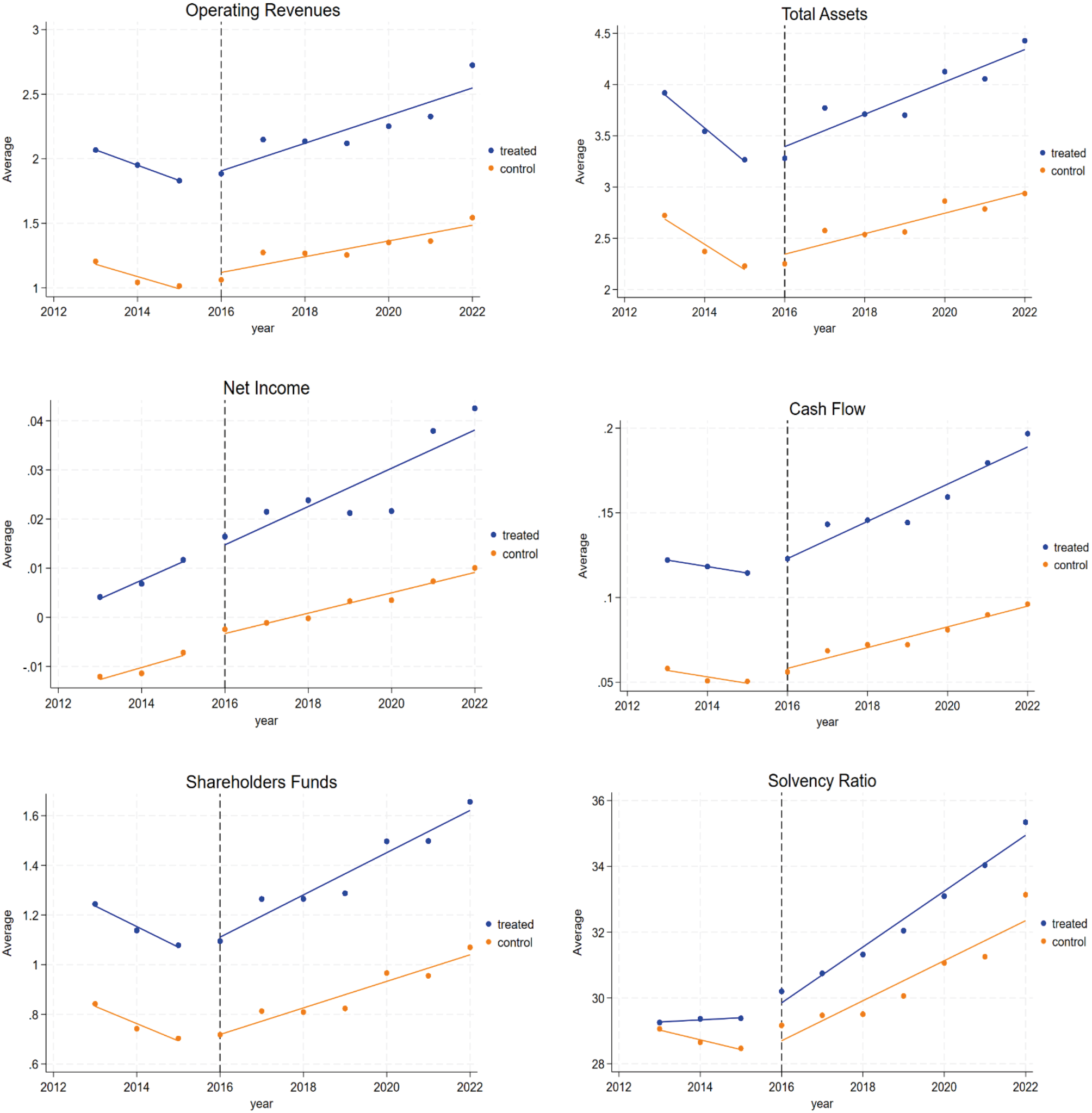
In order to verify the parallel trend assumptions needed for each of the three approaches we start by looking at the average trends of the dependent variables (Figure 1). Since 2016 is the first year that OGs start to form, we selected it as the graph’s cut-off year. For any specification of the dependent variable, it is quite evident that the trends exhibit a parallel pattern prior to the policy’s implementation (except for Solvency Ratio).
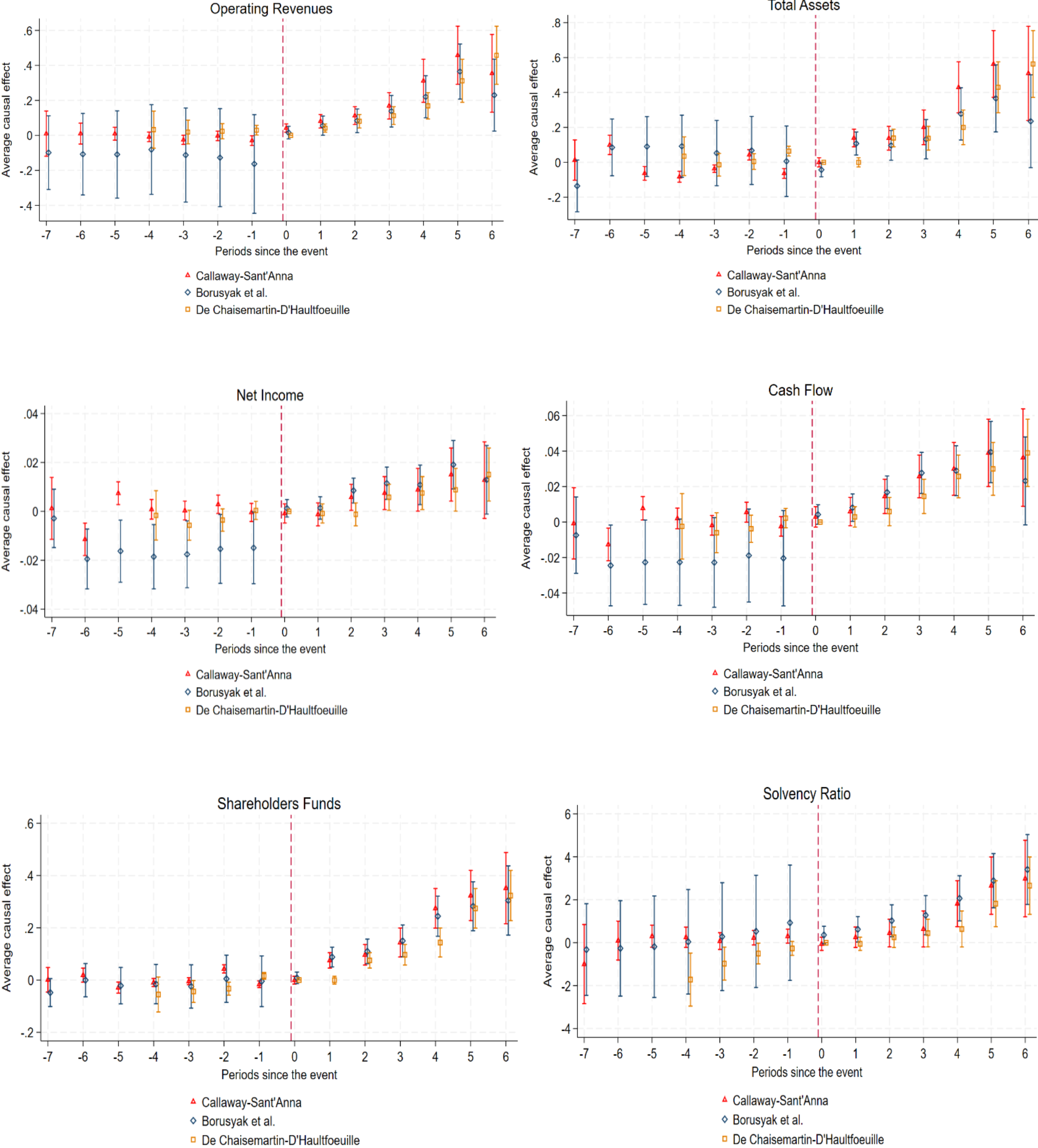
Using an event-study analysis in Figures 2, we offer a visual assessment of the pre-existing patterns in accordance with the pre-testing methodology (Roth et al., 2023). Since at least two models out of three shows not-significant pre-trend estimates (all of the intervals related to the pre-treatment include the zero value) the parallel trend assumption appears to be true and, consequently, we cannot reject the null hypothesis that the parallel trend was satisfied during the pre-treatment phase, confirming the validity of our design.
Having shown that the data support the parallel trend hypothesis, we can proceed to investigate in detail the differences between the two groups. Table 3 reports the Average Treatment Effects on the Treated (ATTs) estimated using the three staggered difference-in-differences (DID) models outlined in the previous section. The positive and statistically significant coefficients indicate that the farms located in the treated regions exhibit improved economic performance compared to those in regions where OGs was not yet implemented. Although the estimated effects vary in magnitude across the different model specifications, all results consistently point to a positive and statistically significant impact. These findings provide empirical evidence supporting the hypothesis that the presence of OGs is associated to an increase in economic performance.
| Operating Revenues | Total Assets | Net Income | Cash Flow | Shareholders Funds | Solvency Ratio | ||||||||||||||
|---|---|---|---|---|---|---|---|---|---|---|---|---|---|---|---|---|---|---|---|
| Callaway and Sant’Anna (2021) | 0.142*** | 0.176*** | 0.003* | 0.015*** | 0.112*** | 0.639** | |||||||||||||
| Borusyak et al. (2024) | 0.102*** | 0.107*** | 0.006*** | 0.016*** | 0.115*** | 1.091*** | |||||||||||||
| De Chaisemartin and D’Haultfoeuille (2020) | 0.135*** | 0.165*** | 0.003* | 0.014*** | 0.104*** | 0.561** | |||||||||||||
| Legend: * p<.1; ** p<.05; *** p<.01. Variables are expressed in millions (except for Solvency Ratio). | |||||||||||||||||||
Finally, we assess the effect of treatment intensity (measured by the number of OGs), on economic performance, as reported in Table 4.
| Operating Revenues | Total Assets | Net Income | Cash Flow | Shareholders Funds | Solvency Ratio | ||||||||||||||
|---|---|---|---|---|---|---|---|---|---|---|---|---|---|---|---|---|---|---|---|
| De Chaisemartin and D’Haultfoeuille (2024) | 0.002*** | 0.003*** | 0.00007* | 0.0002*** | 0.002*** | 0.011** | |||||||||||||
| Legend: * p<.1; ** p<.05; *** p<.01. Variables are expressed in millions (except for Solvency Ratio). | |||||||||||||||||||
This analysis employs the estimator proposed by de Chaisemartin and D’Haultfoeuille (2024) as a robustness check, giving its suitability for handing non-binary treatment variables. The application of this model adds further depth to our empirical strategy. The results reinforce our previous findings: the positive and statistically significant coefficients suggest that a higher number of OGs in treated areas is associated with a significant improvement in farms’ economic performance.
The results indicate the existence of a reciprocal relationship between farms’ economic performance and an environment that encourages and supports innovation. This relationship emerges consistently across all three model specifications and when considering six different economic performance variables. Several possible interpretations may explain this finding.
One plausible explanation, supported by Finco et al. (2018), is that farms located in areas where OGs are active benefit from the diffusion of innovation fostered by the European Innovation Partnership (EIP), which provides funding and resources aimed at supporting innovation uptake. In this view, the presence of OGs encourages farms to adopt innovative practices, thereby improving their economic performance.
An alternative hypothesis, as suggested by Corchuelo Martínez-Azúa et al. (2020), asserts that certain Italian regions possess distinctive socioeconomic characteristics that both facilitate the emergence of OGs and provide a fertile ground for the development of innovative networks. These pre-existing regional conditions could, in turn, enhance the dissemination and effectiveness of innovation initiatives.
This study has two main limitations. First, our study does not constitute a formal impact evaluation of the EIP-AGRI, as it is not possible to precisely identify which of the farms in our sample are directly involved in OGs. Therefore, we are unable to attribute the observed effects to one explanatory theory over the other. Second, the Orbis database, while rich in financial information, is not fully representative of the Italian agri-food sector. In particular, it underrepresents SMEs, which are highly prevalent in the Italian context. Despite these constraints, our findings offer valuable insights into the dynamics of innovation support in agriculture and provide a preliminary understanding of how the OGs have been implemented within the Italian agri-food sector.
This study investigates the relationship between the economic performance of the Italian agri-food sector and the presence of an innovation-friendly environment. We apply an estimation strategy that compares three distinct staggered DID models employing recently developed methodological frameworks to assess this association. To the best of our knowledge, this is the first study to use the EIP-AGRI as an analytical tool to explore the relationship between regional economic performance in the agri-food sector and an innovation-friendly environment.
The main findings suggests that farms located in regions where OGs have been recently established show significantly better financial performance compared to those in regions without the presence of OGs. However, the data also reveal regional disparities in the effectiveness of this dynamic, specifically the expected virtuous circle of innovation, improved economic performance and increased regional investment in innovation, appears more evident in some regions than in others.
These findings could carry implications for policymakers. To promote the diffusion of innovation and improve local farm performance, targeted awareness campaigns and better-targeted incentive mechanisms may be necessary in regions where such dynamics are less evident.
Future research should focus on refining the identification of farms that are involved in the OGs, which would allow for the application of causal inference techniques to more precisely evaluate the impact of EIP-AGRI. Additionally, expanding the dataset to include non-corporate farms particularly SMEs would contribute to a more comprehensive analysis of the sector. Furthermore, understanding the temporal dimension of policy impacts, namely the lag between project completion and observable impacts could improve the evaluation of innovation policies.
This study offers an overview of the implementation of the EIP-AGRI across the Italian regions, providing insights into how the regional socioeconomic environment is connected with the diffusion of innovation and how the policy could be more consistently and effectively implemented nationwide.
This study was carried out within the Agritech National Research Center and received funding from the European Union Next-GenerationEU (PIANO NAZIONALE DI RIPRESA E RESILIENZA (PNRR) – MISSIONE 4 COMPONENTE 2, INVESTIMENTO 1.4 – D.D. 1032 17/06/2022, CN00000022). This paper reflects only the authors’ views and opinions, neither the European Union nor the European Commission can be considered responsible for them.
Aboagye-Darko, D., & Mkhize, P. (2025). Unearthing the determinants of digital innovation adoption in the agricultural sector: the role of food security awareness and agricultural experience. Heliyon, 11(1), e41695. https://doi.org/10.1016/j.heliyon.2025.e41695
Alarcón, S., & Arias, P. (2018). The public funding of innovation in agri-food businesses. Spanish Journal of Agricultural Research, 16(4), e0111-e0111.
Arzeni, A., Giarè, F., Lai, M., Lasorella, M. V., Ugati, R., & Vagnozzi, A. (2023). Interactive approach for innovation: the experience of the Italian EIP AGRI Operational Groups. Sustainability, 15(19), 14271.
Baláž, V., Jeck, T., & Balog, M. (2023). Firm performance over innovation cycle: evidence from a small European economy. Journal of Innovation and Entrepreneurship, 12(1), 40.
Borusyak, K. (2023). Did_Imputation: Stata module to perform treatment effect estimation and pre-trend testing in event studies. https://EconPapers.repec.org/RePEc:boc:bocode:s458957
Borusyak, K., Jaravel, X., Spiess, J. (2024). Revisiting event study designs: Robust and efficient estimation. Rev. Econ. Stud. https://doi.org/10.1093/restud/rdae007
Brusoni, S., Cefis, E., & Orsenigo, L. (2006). Innovate or die?: a critical review of the literature on innovation and performance. Milan: Università commerciale Luigi Bocconi.
Callaway, B., Sant’Anna, P.H.C. (2021). Difference-in-differences with multiple time periods. J. Econom. 225, 200-230. https://doi.org/10.1016/j.jeconom.2020.12.001
Carlberg, J. G. (2024). Sustainable Innovation in the Canadian Agrifood Sector: Past, Present & Future. The School of Public Policy Publications, 17(1). https://doi.org/10.55016/ojs/sppp.v17i1.78334
Chaparro‐Banegas, N., Sánchez, M., Calafat, C., & Roig‐Tierno, N. (2024). Transforming the agri‐food sector through eco‐innovation: A path to sustainability and technological progress. Business Strategy and The Environment. https://doi.org/10.1002/bse.3968
Coca, O., Stefan, G., & Mironiuc, M. (2017). Empirical evidences regarding the relationship between innovation and performance in the agriculture of European Union. Scientific Papers Series Management, Economic Engineering in Agriculture & Rural Development, 17(1).
Corchuelo Martínez-Azúa, B., López-Salazar, P. E., & Sama-Berrocal, C. (2020). Determining factors of innovative performance: case studies in extremaduran agri-food companies. Sustainability, 12(21), 9098.
De Chaisemartin, C., & D’Haultfoeuille, X. (2020). Two-way fixed effects estimators with heterogeneous treatment effects. American economic review, 110(9), 2964-2996.
De Chaisemartin, C., & D’Haultfoeuille, X. (2024). Difference-in-differences estimators of intertemporal treatment effects. Review of Economics and Statistics, 1-45.
European Commission, DG Agri. Guidelines on Programming for Innovation and the Implementation of the EIP for Agricultural Productivity and Sustainability. Programming period 2014–2020. 2014. https://ec.europa.eu/eip/agriculture/sites/default/files/pb_guidelines_eip_implementation_2014_en.pdf
European Commission – Directorate-General for Agriculture and Rural Development – Unit A.3 (2024): Study on outcomes achieved by EIP AGRI Operational Group projects under the CAP.
Finco, A., Bentivoglio, D., & Bucci, G. (2018). Lessons of innovation in the agrifood sector: Drivers of innovativeness performances. Economia agro-alimentare, (2018/2).
Francois, P., & Shi, S. (1999). Innovation, growth, and welfare-improving cycles. Journal of Economic Theory, 85(2), 226-257.
Golubev, A. V., Kozlov, V. V., & Babkina, V. S. (2021). Spreading Innovation in the Agricultural Sphere: Traditions and Perspectives. In Complex Systems: Innovation and Sustainability in the Digital Age: Volume 2 (pp. 369-377). Cham: Springer International Publishing.
Gouthon, M., Gouroubera, M. W., Tama-Imorou, C., & Moumouni-Moussa, I. (2024). Role of Agricultural Policies in Promoting Digital Co-innovation in Benin’s Agricultural Sector. Asian Journal of Agricultural Extension, Economics and Sociology, 42(12), 394–412. https://doi.org/10.9734/ajaees/2024/v42i122665
Henke, R., & Sardone, R. (2022). The 7th Italian Agricultural Census: new directions and legacies of the past. Italian Review of Agricultural Economics (REA), 77(3), 67-75.
Lucchese, M., & Pianta, M. (2011). Cycles and innovation. WP-EMS University of Urbino, Faculty of Economics, March.
Manning, L. (2024). Innovating in an Uncertain World: Understanding the Social, Technical and Systemic Barriers to Farmers Adopting New Technologies. Challenge, 15(2), 32. https://doi.org/10.3390/challe15020032
Marcus, M., & Sant’Anna, P. H. (2021). The role of parallel trends in event study settings: An application to environmental economics. Journal of the Association of Environmental and Resource Economists, 8(2), 235-275.
Peón, D., & Martínez-Filgueira, X. (2020). Determinants of investing in innovative activities by agri-food and KIBS firms in rural areas: An exploratory analysis. Journal of Small Business Management, 58(6), 1155-1186.
Ponta, L., Puliga, G., Manzini, R., & Cincotti, S. (2022). Sustainability-oriented innovation and co-patenting role in agri-food sector: Empirical analysis with patents. Technological Forecasting and Social Change, 178, 121595.
Rabadán, A., González-Moreno, Á., & Sáez-Martínez, F. J. (2019). Improving firms’ performance and sustainability: The case of eco-innovation in the agri-food industry. Sustainability, 11(20), 5590.
Roth, J., Sant’Anna, P. H., Bilinski, A., & Poe, J. (2023). What’s trending in difference-indifferences? A synthesis of the recent econometrics literature. Journal of Econometrics, 235(2), 2218-2244.