Received: November 28, 2024; Accepted: September 9, 2025; Published: December 31, 2025
Impacts of heat waves on agricultural workers: An analysis of adaptation measures
1 Department of Agricultural and Food Sciences (DISTAL), Alma Mater Studiorum, University of Bologna, Italy
2 Department of Statistical Science “P. Fortunati”, Alma Mater Studiorum, University of Bologna, Italy
* Corresponding author. Email: stefano.targetti@unibo.it
Abstract. This study evaluates the effectiveness of different farm-level adaptation measures aimed at mitigating the adverse impacts of heat waves on labour productivity. Despite the increasing frequency of heat waves, existing literature on occupational heat stress primarily relies on modelled estimates. To address this gap, exploratory interviews and structured questionnaires were employed to identify key challenges posed by heat waves, as well as the perceived benefits and limitations of different adaptation strategies. Data were collected from nine farms located in Emilia-Romagna (Northeast Italy), all of which were characterized by a long-standing commitment to improving working conditions. The Analytic Hierarchy Process was used to evaluate the perceived effectiveness of adaptation measures according to three criteria: acceptability, flexibility, and timeliness. Findings indicate that, in the absence of adaptation strategies, productivity losses may reach up to 30%. Among the measures assessed, shifting work hours was identified as the most effective strategy. The study underscores the need for structured thermal risk assessment protocols and provides recommendations to inform sustainable and worker-centered adaptation policies in the agricultural sector.
Keywords: heat waves, adaptation measures, agricultural workers, productivity loss, Analytic Hierarchy Process (AHP).
Index
2.2. Identification of target participants
2.3. Identification of adaptation measures and data collection
2.4. Data processing and analysis
3.1. Results of the exploratory interviews
3.2. Results of the questionnaires
Worldwide, climate change scenarios point to an intensification of extreme heat events across all regions with growing implications for outdoor workers (IPCC AR6 WGI, 2021). According to the World Meteorological Organisation (WMO), a heat wave is defined as a period of at least six consecutive days during which the maximum daily temperature exceeds the 90th percentile based on the climatological reference period (1981-2010 or if available 1991-2020). Studies, such as de Sario et al. (2023), have shown that heat waves have significant economic impacts on society, including increasing healthcare costs (Martínez-Solanas et al., 2018), and costs for the social security system, that must compensate workers for heat-related injuries (Ma et al., 2019). In addition to these social costs, several studies have reported economic costs linked to a reduced worker productivity resulting from high temperature exposure in working environments (Morabito et al., 2021; Kjellstrom et al., 2009). In sectors such as agriculture, where most activities, are carried out outdoors, heat waves significantly increase the risk of work-related injuries and work productivity reductions (Di Blasi et al., 2023).
Thus, in recent years, the necessity to introduce acceptable preventive measures able to reduce the risk of outdoor work-related injuries and excessive heat exposure has become pressing. For instance, in recent years, countries such as Italy have introduced regional regulations to improve the working conditions during heat waves. Specifically, these regulations limit the working time between 12:30 and 16:00 for specific sectors such as agriculture and construction during the summer months and in case of heat waves. In 2021, these measures were implemented in three southern Italian regions (Puglia, Calabria and Basilicata). In 2024, similar regulations were adopted by 15 of the 21 Italian regions.
Economic effects linked to heat waves can be classified as direct and indirect impacts. Workers’ productivity loss (PL) involves a direct output loss for farms. This can entail relevant indirect effects because of the interdependencies along the value chain, and at a macroeconomic level on household consumption, national output, etc. (Zhao et al., 2021). These aspects related to climate changes are often neglected, but the magnitude of their potential impact on workers’ health and productivity underlines the need for case studies providing information on PL in different contexts and activities, and for different economic sectors (Kjellstrom et al., 2009). Indeed, current knowledge is scarce about the economy-wide effects of heat waves on the productivity of diversified economic sectors that range from outdoor to indoor activities and feature a heterogeneous structure and production orientation, such as agriculture (Day et al., 2019).
One approach to quantifying heat-related productivity loss is the use of the Wet Bulb Globe Temperature (WBGT) index and ISO 7243 standards. Kjellstrom et al. (2018) developed risk functions based on these metrics to estimate reductions in work capacity under different levels of heat stress. These functions assume that workers self-regulate their workload to avoid severe health consequences, such as heat stroke. Accordingly, these models can estimate productivity loss (PL) as a function of heat exposure and work intensity.
Individuals and firms can reduce the heat-stress implementing specific adaptation strategies able to cope with heat conditions (Kjellstrom, Holmer et al., 2009). A range of adaptation options are available and these offer different solutions that can fit to different working conditions and contexts cost-effectively. In general, behavioural adaptations such as the anticipation of working hours to avoid heat peaks, and passive adaptation options such as frequent drink breaks, together with technical equipment are indicated as valuable options for outdoor workers (Day et al., 2019). However, the identification of the adaptation measures strictly depends on local contexts and the type of activities. This warns against a generic identification of adaptation solutions and highlights a particular need for economic sectors such as agriculture, for an evaluation carried out at the farm level and able to consider the complexity of adaptation decision-making (Day et al., 2019).
The effectiveness of the available adaptation measures in reducing the impact of heat waves has a specific relevance to evaluate their soundness as tools to be included in regulations targeting the adaptation of working environments to climate risks. For instance, building on the work of Kjellstrom et al. (2018), Morabito et al. (2021) applied different heat risk functions to estimate the effectiveness of simple adaptation measures. In this study, WBGT and typical working hours data were combined to compare PL and economic costs related to farming activities in an Italian region with and without the adoption of adaptation measures. Using the modelled functions, Morabito and colleagues estimated a significant effect of the adaptation measures, and thus highlighted a potential positive impact for firms and workers engaged in intensive activities during heat waves, such as agricultural workers.
While model-based approaches provide valuable insights, evaluating the perceived effectiveness of adaptation measures and understanding workers’ and managers’ perceptions of climate risks are equally important. Risk perception is a critical factor influencing adaptive behavior (Madhuri and Sharma, 2020), and a range of psychological, economic, and contextual factors may shape the willingness to adopt preventive strategies (D’Alberto et al., 2024). Despite a robust body of literature focused on modeled projections of productivity loss under heat stress (e.g., Orlov et al., 2019; Kjellstrom et al., 2009; Morabito et al., 2021), empirical data on the perception of heat waves from both the individuals directly affected and those responsible for managing and organizing outdoor working activities during these events are currently limited.
Moreover, research on the operational feasibility and perceived efficacy of various adaptation strategies is still limited. In particular, studies investigating the views of land managers on the implementation and effectiveness of such measures are, to our knowledge, lacking. Yet, understanding these perspectives is important, as land managers are ultimately responsible for adopting and enforcing adaptation strategies at the farm level. The lack of empirical data on the perceived utility and impact of adaptation measures impedes the development of evidence-based policies that ensure worker safety and productivity during heat events. Without such insights, efforts to identify and promote tailored, context-specific adaptation measures risk being ineffective or unsustainable (Final Scientific Report of the WORKLIMATE Project, https://www.worklimate.it/).
This study aims to address this research gap by investigating how farm managers in Emilia-Romagna perceive and evaluate various adaptation measures designed to mitigate the impacts of heat waves on outdoor agricultural workers. The work contribution to the existing literature is twofold: (1) it provides an in-depth analysis of the challenges posed by heat waves within a specific agricultural context; and (2) it evaluates the perceived effectiveness of adaptation strategies based on empirical data collected from nine farms in the region. Specifically, the research explores land managers’ assessments of the impacts of heat waves on different types of workers, their evaluation of the advantages and disadvantages of various adaptation strategies, and their perceptions of these strategies’ effectiveness in reducing productivity losses.
In this analysis, the analytic hierarchy process (AHP) method was employed (Saaty, 2013). AHP was developed to support decision-making by structuring complex problem into a hierarchical framework. AHP organises decision problems into a hierarchy of factors that can be easily interpreted by an expert, thereby facilitating complex judgments and enabling a structured evaluation of multiple alternatives across different criteria. Originally developed by mathematician Thomas Saaty in the 1970s (Saaty, 1977), AHP is a widely used multi-criteria decision analysis (MCDA) technique. At the core of AHP lies the pairwise comparison approach, which evaluates decision elements in pairs, allowing for a more nuanced assessment of their relative importance. The hierarchy itself takes the form of a tree structure with successive levels representing broader decision criteria, specific sub-criteria, and eventually alternatives. These elements are compared pairwise at each level of the hierarchy, from the lowest level (typically comprising the alternatives or specific actions under evaluation) up to the highest-level criterion (Saaty, 1987). In this study, the objective was to identify the most effective adaptation measures to mitigate the impacts of heat waves. The AHP process involves assigning numerical values to each pairwise comparisons using a 1-to-9 scale, where 1 indicates equal importance and/or relevance of the two elements on the control element and 9 represents extreme importance of one element over another (Saaty, 2008) (Tab. 1). These comparisons are recorded in pairwise comparison matrices that reflect the relationships between criteria and adaptation measures. After completing the pairwise comparisons, the relative weights (or priority) for each criterion are calculated using specific procedures, particularly the eigenvalue method. This priority is defined as a vector representing the influence (or weight) of each single element within that level of the hierarchy (Duke & Aull-Hyde, 2002). The process entails calculating the normalized values for each matrix to derive weights that reflect the relative importance of each criterion, by means of the eigenvector method and a process of averaging over the normalised columns of the matrix (Meade & Sarkis, 1999; Saaty, 2008). For further details on the calculation of the priority by means of different matrix multiplication methods see in particular Villanueva et al. (2015). Subsequent consistency checks are then carried out to ensure the reliability of comparisons. The Consistency Ratio (CR) is utilised to assess consistency, by comparing the consistency index of the judgments to a random index. A CR value below 0.1 is generally considered acceptable, indicating a reasonable level of consistency in the decisions made during pairwise comparisons. Finally, the calculated weights are aggregated to determine the overall priorities of the adaptation measures (Liu et al., 2025).
| Intensity of importance | Definition | Explanation | |||||||||||||||||
|---|---|---|---|---|---|---|---|---|---|---|---|---|---|---|---|---|---|---|---|
| 1 | Equal importance | Two activities contribute equally to the objective. | |||||||||||||||||
| 2 | Weak or slight | Experience and judgment slightly favor one activity over another. | |||||||||||||||||
| 3 | Moderate importance | Experience and judgment slightly favor one activity over another. | |||||||||||||||||
| 4 | Moderate plus | Experience and judgment strongly favor one activity over another. | |||||||||||||||||
| 5 | Strong importance | Experience and judgment strongly favor one activity over another. | |||||||||||||||||
| 6 | Strong plus | An activity is favored very strongly over another. | |||||||||||||||||
| 7 | Very strong or demonstrated importance | An activity is favored very strongly over another. | |||||||||||||||||
| 8 | Very, very strong | The evidence favoring one activity over another is of the highest possible order of affirmation. | |||||||||||||||||
| 9 | Extreme importance | The evidence favoring one activity over another is of the highest possible order of affirmation. | |||||||||||||||||
| Source: Saaty, 2013. | |||||||||||||||||||
However, one of the main limitations of this methodology is that the quality of results heavily depends on the expertise and understanding of the respondents. Biases may be introduced if participants are not sufficiently knowledgeable about the subject matter (Villanueva et al., 2015). Furthermore, AHP does not rely on assumptions regarding known probability distributions (Duke & Aull-Hyde, 2002). As a result, the method is not statistical in nature and typically involves a relatively small number of expert respondents, due to the in-depth knowledge required to complete the questionnaires accurately.
2.2. Identification of target participants
As illustrated in Figure 1, the survey was organized in three main phases. The first step involved identifying the target group of participants.
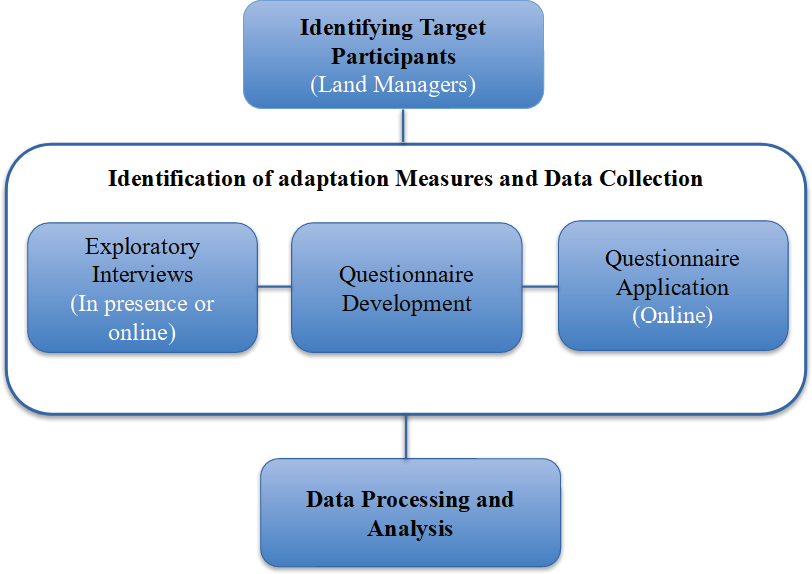
For our study, the target participants were farm managers of large, well-structured farms with a significant number of workers. Given the exploratory nature of the research, we considered appropriate to begin by involving farm managers operating within the same geographical area (Emilia Romagna). This choice allowed for greater homogeneity and consistency in the data collected, thereby minimising the influence of contextual and structural difference across regions. In light of the limited number of studies investigating the impact of heatwaves on farm management and the scarcity of empirical data on this issue, the survey specifically targeted farms with a demonstrated commitment to workers’ welfare. Indeed, the selected farm managers had already been implementing strategies and measures to mitigate the effects of heat waves on their employees over several years. Such an analysis enabled an in-depth analysis of the current implementation status of various adaptation measures. The first part of the survey focused on the Cooperative Agricole Braccianti (CABs) in the province of Ravenna. Later, the survey was extended to include other large farms in the region with the help of trade associations.
Collectively, these cooperatives manage approximately 11,500 hectares of utilised agricultural area (UAA). Their production is primarily oriented towards fruit trees, vegetables and cereal crops, although some also operate in the livestock and nursery sectors. These cooperatives were of particular interest due to their organisational structure: workers are also cooperative members and are involved in the decision-making process. Being directly exposed to the working conditions, the worker-members have developed a deeper awareness of the impacts of heat waves, including suggestions and proposals to more effective prevention and protection measures.
2.3. Identification of adaptation measures and data collection
We conducted a literature review to identify the adaptation measures able to reduce the impacts of heat waves on agricultural workers. Four adaptation measures were identified through a literature review (Day et al., 2019; Habibi et al., 2023; Kjellstrom et al., 2009; Marinaccio et al., 2022; Morabito et al., 2021; Spector et al., 2019; Zhao et al., 2021):
– shifting/anticipating work hours;
– setting up shaded areas;
– increasing the frequency of work breaks with facilitation of the availability of water;
– special equipment (ventilated jackets, clothing in technical, breathable fabric).
These measures represent different management options for the organisation of outdoor labour that can improve workers’ resilience to heat stress and aim to maintain a safe work environment. Therefore, the adoption of the measures also allows to enhance significantly worker performance, productivity, and company profits (Habibi et al., 2023).
The second phase involved the data collection (Figure 1). We started with exploratory interviews with the CAB farm managers, aimed at collecting preliminary information on the phenomenon of heat waves and identifying pros and cons related to the potential implementation of adaptation measures at farm level and productivity-related issues or operational problems observed during the last heat wave events. Five exploratory interviews were conducted with the managers of the seven CABs in the province of Ravenna. Each interview lasted on average 40 minutes and was conducted either online or in person. The interview was divided into two main sections: The first section focused on framing the problem and identifying the work problems already encountered during the last heatwaves (summer 2022-2023). The second section assessed the advantages and disadvantages and the respondents’ perceptions of the four selected adaptation measures. Then, based on the information gathered in the exploratory interviews, a questionnaire was designed to collect quantitative data on the adaptation measures and assess their effectiveness in reducing the impact of heatwaves on agricultural workers.
The questionnaire included 34 questions, and it was implemented on the QualtricsXM (2024) platform (Provo, Utah, USA, https://www.qualtrics.com).
The questionnaire was structured in three main sections: the first section included general information about the respondents and the farms, such as their role, main crops, farm size, the main symptoms observed in workers during the heat waves of the summers of 2022-2023, the activities most affected by the heat waves, and the adaptation measures adopted in these circumstances.
The second part of the questionnaire dealt with the assessment of the effectiveness of adaptation measures. In order to assess the effectiveness of the identified heat wave protection measures, we included four questions to collect data using the AHP method (Fig. 2). Three of these questions focused on specific criteria for assessing the effectiveness of each adaptation measure, namely:
1. Worker acceptability, i.e. the expected willingness of outdoor agricultural workers to adopt the measures.
2. Timeliness of implementation, i.e. the time needed to implement the measure after a heat wave forecast.
3. Flexibility of application, i.e. the possibility to adopt the measure in different types of farms.
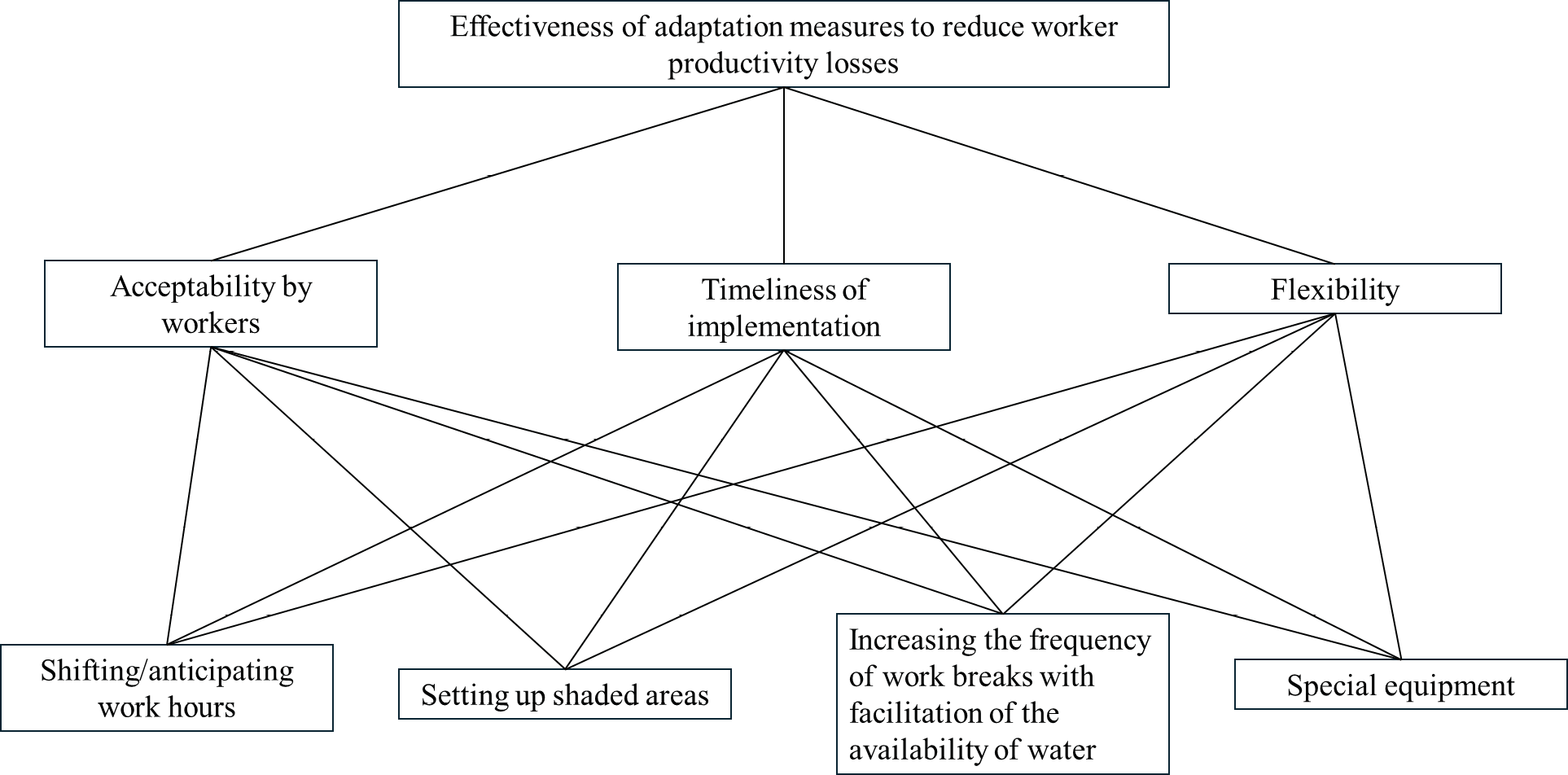
In addition, a further question concerned the comparison between the selected criteria. These criteria were derived from those identified by Day et al. (2019) and subsequently adapted based on the information gathered during the exploratory interviews.
This set of questions included four matrices comparing adaptation measures according to each of the criteria listed above using the AHP 1-9 scale.
As an example, we report two of the submitted questions for the two assessment levels:
– (Q11) - With respect to the criterion acceptability by workers, which of the following pairs of factors do you think is the preferred adaptation measure by workers? (Shifting of working hours VS Setting up shaded areas; Shifting of working hours VS Increased frequency of breaks… etc.) For each pair, express your preference on a scale of 1 to 9, where 1 indicates that the measures are equally preferred and 9 indicates that one measure is extremely more accepted than the other.
– (Q13) - Which criterion, among the following pairs of criteria, do you think is most important for an effective reduction of workers’ productivity loss? (Acceptability by the workers VS Timeliness of implementation; Acceptability by the worker VS Flexibility of application…etc) For each pair, express your preference on a scale of 1 to 9, where 1 indicates that the criteria are of equal importance and 9 indicates that one criterion is extremely more important than the other for reducing productivity loss.
The final part of the survey focused on estimating the productivity loss of agricultural workers. In the land manager survey, respondents were asked to report any adaptation measures implemented to cope with heat wave events. Respondents were then asked to estimate productivity loss in the following ranges in the absence of adaptation measures: 0-10%, 10-20%, 20-30%, and more than 30%. Specifically, the questionnaire asked respondents to provide an estimate of the percentage of daily productivity loss estimated for general workers and specialised workers during heat waves and in the absence of adaptation measures.
The questionnaire was distributed in June and July, and it was initially distributed to the CABs and to the main regional farmers’ associations, who then distributed it to the agricultural land managers in Emilia-Romagna. The distribution of the questionnaires to Emilia-Romagna was motivated by the need to obtain data that were as homogeneous as possible. This strategy helped to reduce the variability linked to geographical and structural factors, ensuring greater consistency in the results and facilitating comparisons between the different farm realities analysed.
2.4. Data processing and analysis
The survey collected a total of 15 responses from land managers in Emilia-Romagna. Only 9 questionnaires were completed in all parts and included in the analysis. For the AHP questions, we normalised the comparison matrix data and determined the priorities for each level of the hierarchy. Elaborations were performed with R 4.4.1 (2024) (RStudio: Integrated Development for R. RStudio, PBC, Boston, MA, http://www.rstudio.com/). The priority calculation was used to compare the relative contribution of the elements at each level of the hierarchy with an element in the adjacent higher level. We conducted a synthesis of the priorities to calculate a composite weight for each alternative, based on the preferences guided by the comparison matrix. After calculating the composite weight, the relative priority of each adaptation measure was obtained, and a final ranking was developed to identify the best adaptation alternative through the calculation of the average of all the overall priorities that were calculated for each questionnaire (Veisi et al., 2022).
Finally, the consistency ratio (CR) was calculated to verify the consistency of the judgments expressed by the respondents. The CR is suggested as a valid indicator of the cognitive stress of respondents, i.e. a high CR indicates a high complexity level of the questions and thus higher efforts required in the judgement process.
3.1. Results of the exploratory interviews
We conducted five interviews with CAB farm managers to get an initial overview of the impacts of the heatwaves, the benefits and challenges of the adaptation measures selected.
It emerged that all farms observed issues related to heat waves during the summers of 2022-2023, particularly in orchards during the harvesting of peaches and apricots: “The issue of heat waves is primarily felt in the orchard”. One farm also encountered difficulties in nurseries and in organic fields: “Heat waves are also felt in open fields across the 1,200 hectares of organic farmland, which requires frequent tilling to eliminate weeds”. Additionally, all managers reported that in the orchards, due to heat waves combined with high levels of humidity, the presence of nets and rows of trees themselves limit air circulation, workers experience signs of fatigue, tiredness, and breathing problems. The farm managers also stated that the productivity of workers decreased during heat waves: “During the hottest hours, fewer kilograms are harvested and in general during heat waves, yields decrease because workers are slower”, “From eleven o’clock onwards, employee performance drops by about 30 per cent”.
The interviewed farm managers stated that, to avoid extreme heat during the central hours of the day, they adjust the work schedule. In fact, field workers (who are mostly women) finish their workday by noon and, depending on daylight, they start working about an hour earlier, around 5 a.m. The shifting/anticipating of working hours was implemented by 5 out of 5 farms. For greater clarity, we provide the interviewee’s response as follows: “During the summer, it became necessary to start the workday an hour to an hour and a half earlier (depending on daylight) or to leave an hour earlier (by 12 p.m.)”. The anticipation of the working time also contributed to mitigate operational problems related to harvesting and storing the product. Indeed, excessive heat also affects the quality of the harvest, especially if it remains under the sun and is not delivered immediately to storage or processing centres.
Regarding the adaptation measures already implemented by the interviewed farms, in addition to adjusting work hours, five out of five farms also indicated the use of shaded areas represented by break rooms, warehouses, or shelters near the orchards. Other shaded areas included seminatural elements like hedges and groves established for instance with the support of agro-environmental measures in the past. The interviewees reported that most employees rely on own water supply. In the five farms however, the interviewees reported that supervisors are always supplied with drinking water as well as with a first aid kit. The availability of water supplies at the farm centre was also indicated by the five interviewed farm managers. Regarding the use of special equipment, the purchase of technical clothing to promote better breathability was reported in one interview: “In the summer of 2023, the farm purchased technical fabric shirts that allow workers to work more comfortably. The request originated from the workers”.
3.2. Results of the questionnaires
The main characteristics of the sample are presented in Table 2. The results of the questionnaire indicate that heat waves have a notable impact on farm workers’ health. Respondents reported significant physical symptoms among workers, including intense fatigue, excessive sweating, drops in blood pressure, muscle cramps, and dehydration. These symptoms typically occur during labor-intensive tasks such as fruit and vegetable harvesting, field operations, and manual activities like weed removal.
| Frequency | % | ||||||||||||||||||
|---|---|---|---|---|---|---|---|---|---|---|---|---|---|---|---|---|---|---|---|
| Respondent type | |||||||||||||||||||
| Entrepreneur | 2 | 22.22% | |||||||||||||||||
| Director/Manager | 5 | 55.56% | |||||||||||||||||
| Technician/Foreman | 2 | 22.22% | |||||||||||||||||
| Farming system | |||||||||||||||||||
| Cereal farming | 7 | 77.78% | |||||||||||||||||
| Horticultural | 4 | 44.44% | |||||||||||||||||
| Viticultural | 5 | 55.56% | |||||||||||||||||
| Fruit farming | 4 | 44.44% | |||||||||||||||||
| Zootechnical | 3 | 33.33% | |||||||||||||||||
| Other | 2 | 22.22% | |||||||||||||||||
| Symptoms observed during heat waves | |||||||||||||||||||
| Tiredness | 9 | 100.00% | |||||||||||||||||
| Pressure drops | 1 | 11.11% | |||||||||||||||||
| Muscle cramps | 1 | 11.11% | |||||||||||||||||
| Intense sweating | 8 | 88.89% | |||||||||||||||||
| Activities affected by heat waves | |||||||||||||||||||
| Fruit and vegetable harvesting | 6 | 66.67% | |||||||||||||||||
| Field operations | 4 | 44.44% | |||||||||||||||||
| Other (manual weeding) | 3 | 33.33% | |||||||||||||||||
| Measures against heat waves | |||||||||||||||||||
| Shifting/anticipating work hours | 8 | 88.89% | |||||||||||||||||
| Setting up shaded areas | 6 | 66.67% | |||||||||||||||||
| Increasing the frequency of work breaks with facilitation of the availability of water | 9 | 100.00% | |||||||||||||||||
| Special equipment | 2 | 22.22% | |||||||||||||||||
| Other (e.g. umbrellas) | 1 | 11.11% | |||||||||||||||||
| * Each participant had the opportunity to select more than one answer, so the total number of answers may exceed the number of participants. | |||||||||||||||||||
To mitigate the effects of heat waves, most farms have already implemented various adaptation measures. All respondents reported increasing the frequency of breaks and improving access to drinking water. Additionally, more than half of the farms have either shifted the start time of work to earlier hours, shortened the duration of work shifts, or established shaded rest areas near the fields. Fewer than a quarter of respondents reported the use of specialized equipment during heat waves. Among the additional adaptation measures mentioned, several farms have introduced portable shading structures, such as umbrellas, to protect workers during fruit harvesting.
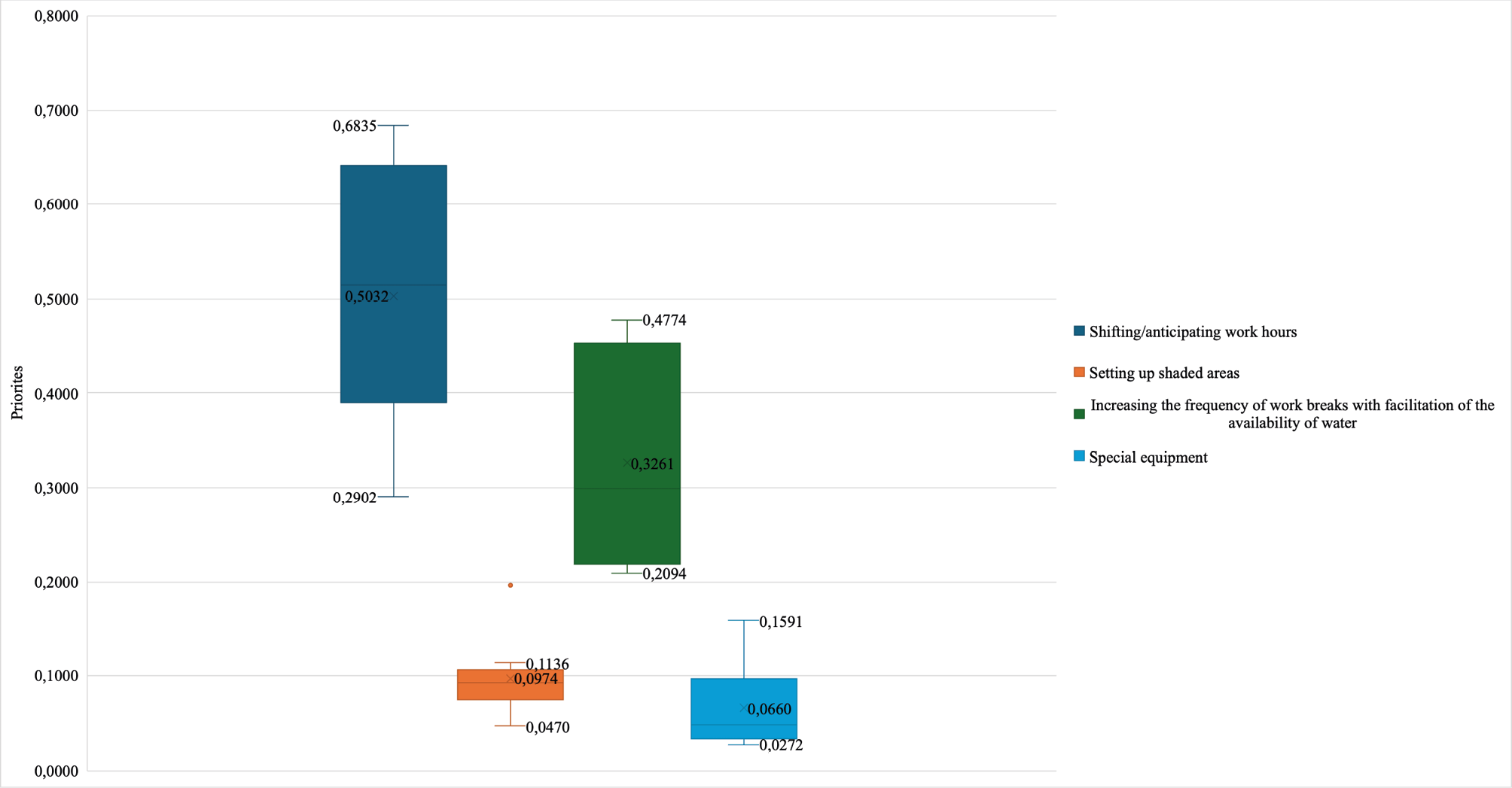
The average of the assigned priorities allowed for the development of a ranking of the most effective adaptation measures based on the selected criteria: worker acceptability, timeliness of implementation, and flexibility of application. As shown in Fig. 3, the adaptation measure with the highest ranking is the shifting or anticipation of working hours, with an average priority value of 0.5032. The second-highest ranked measure is increasing the frequency of work breaks and ensuring access to potable water, with a value of 0.3261. Considerably lower priority values were assigned to the creation of shaded areas (0.0974) and the use of special equipment (0.0660). The consistency ratio for the group of respondents was 0.20. This value is above the commonly accepted threshold (0.1), and indicates that the evaluation process posed a considerable cognitive challenge for respondents, likely due to the complexity of comparing multiple criteria and adaptation options.
The third part of the survey asked participants to provide an estimation of the average percentage of daily productivity loss observed among both common and specialized workers in case of heat waves. The results showed that the most relevant productivity losses occurred among common workers, with reduction rates ranging from 20% to 30% or more (44 % of respondents). As for specialized workers, such as tractor drivers, most respondents (44%) reported productivity losses between 0% and 10%.
The study, for the first time, explores the perception of land managers regarding heat wave adaptation measures that farms could easily implement to reduce the impact on productivity losses.
Overall, we found that common workers, especially those involved in fruit harvesting, can have productivity losses of over 30% in the absence of adaptation measures; this is confirmed by evidence in the literature, where productivity losses of this magnitude are reported (Morabito et al., 2021). Beside this and according to the perception of land managers, the most effective adaptation measure to reduce productivity losses is shifting/anticipating working hours. This evidence is based on the criteria of worker acceptability, timeliness of implementation, and flexibility, and it is also reported in some of the regulations focusing the reduction of heat wave impacts on workers (Emilia-Romagna region).
Common workers is the category that is most at risk during heat waves because of their exposure to outdoor activities performed in periods that can be affected by heat waves such as fruit picking. Thus, this worker category is exposed to heat and a higher risk of physical stress and reduced productivity. Specialised workers, such as tractor drivers, work in more favourable conditions (e.g. air-conditioned cabins) that mitigate the negative effects of high temperatures and preserve work capacity.
In this context, a more specific focus on the potential heat-related threats that can affect tractor drivers is necessary as the frequency of getting-on and -off tractors to e.g. operate changes/adjustments on equipment could generate abrupt changes of temperature and impact the workers’ health.
We also found that the interviewed land managers believe that the shifting/anticipating of the working hours is the most effective measure to reduce productivity losses, probably because it is easy to use low cost and immediately implementable. The effectiveness of this measure is also supported by Morabito et al., (2021), that showed how the adoption of such a measure reduces workers’ productivity losses by up to 33% and lowers the economic costs associated with such losses. Moreover, earlier working hours would have positive effects on the quality of the harvest, as it would not be exposed to the heat and delivered earlier to the harvest centres
Nonetheless, as also highlighted by Day et al. (2019), changing working hours could impact total working hours, associated income and economic and social costs that should not be underestimated. Indeed, anticipating the working schedule involves a range of benefits, but it is important to consider that this change could cause disadvantages and reorganization of workers’ routines, especially for those who have long commutations to reach the working place. In addition, the measure would have a significant impact on the various costs that the farm has to bear, including organisational, operational and logistic costs. In fact, 25% of the respondents reported the need to add about one extra working day per week, to compensate for the reduction in working hours. This also involves the need of additional workers or of additional trips to storage points during the week. Another challenge for the adoption of this measure is the limited availability of light in the early morning hours, which is essential for fruit picking.
It is therefore essential to make workers aware of the importance of this measure and to ensure the smooth running of activities. This is possible thanks to the presence of adequate infrastructure, implemented by companies to enable optimal harvesting even in low light conditions. For example, the installation of appropriate lighting systems can support early operations at dawn, ensuring effective implementation of activities.
Our results show that other simple adaptation measures such as increasing the frequency of breaks and providing shaded areas are also effective in protecting workers from heat and reducing production losses according to the land managers. Shade areas are understood to be groves and hedges or mobile shade structures such as canopy shelters. Despite the benefits of these measures, they represent an economic cost that could be significantly higher than the anticipation of the working time because workers are paid even during breaks and because setting up shade zones requires some investments for farms.
Lastly, the least effective measure for managers is special equipment (ventilated jackets and clothing in technical, breathable fabric) because, beside its cost, it is expected to be hardly acceptable by workers. Measures such as the use of special equipment may be rejected if they are considered inconvenient or unnecessarily complex. For this reason, whatever the measure, it is essential to involve workers in the decision-making process and to gather their feedback in order to identify the most practical and valued solutions.
The limitations of this study lie in its focus on data from a limited geographic area within Italy. However, the selection of large farm cooperatives with strong attention towards working conditions and safety allowed to collect the perception of adaptation measures and their effectiveness in farms with relevant awareness of the problem. This sampling approach may have introduced a bias linked to the farms’ greater capacity to implement adaptation strategies. Consequently, the findings reflect a localized perspective that may not be representative of the views of entrepreneurs at the national level or in other parts of the world. Significant differences could emerge if the research were conducted nationwide or expanded to include a broader range of Italian regions and farm types. Additionally, the CR of 0.2 points to some cognitive stress. This could be due to the small sample size or respondents’ lack of experience with such specific questions on heat waves and adaptation measures. This might have caused difficulties in fully understanding and evaluating the question, affecting the consistency of their responses.
This study presents an overview of how land managers perceive the impacts of heat waves on agricultural workers and assesses the perceived effectiveness of various adaptation measures. The research is based on empirical data collected from nine farms in Emilia-Romagna, each demonstrating a long-standing commitment to improving working conditions and mitigating heat-related risks in agricultural operations.
Although the sample size limits the statistical generalizability, our results offer valuable insights to inform future policy interventions. One key recommendation emerging from the study is the potential introduction of targeted incentives to support the adoption of adaptation practices that entail additional costs for farms. Such incentives could be designed to provide economic support for more resource-intensive but highly effective measures, such as installing shading infrastructure or rescheduling work to nocturnal hours.
Another crucial aspect relates to institutional collaboration in developing early warning systems and heat alert tools. These tools could serve both farms and regulatory bodies as a reliable reference for determining the timing and geographic location for the applicability of mandatory or recommended heat adaptation actions.
The findings confirm that heat waves have a significant impact on business operations and reduce labor productivity, particularly in open-field tasks such as fruit harvesting. The selected adaptation strategies, many of which are low-cost and easy to implement, provide effective ways to reduce productivity losses and enhance worker protection. Among the most effective measures identified are adjusting work schedules to earlier hours and increasing the frequency of breaks with access to potable water. These actions were recognized as widely applicable, simple to implement, and well-accepted by both managers and workers.
Beyond improving worker safety and reducing the risk of heat-related accidents, certain adaptation measures can generate operational benefits. For instance, shifting working hours not only reduces exposure to peak temperatures but may also improve the quality of harvest, particularly in sectors such as fruit cultivation.
A crucial aspect is the ease of implementation and high acceptance of many adaptation strategies. This enhances their feasibility and potential for widespread adoption. Because these measures typically do not require complex organizational changes or significant financial resources, they represent a practical starting point for improving heat adaptation of the agricultural sector.
In conclusion, the study underscores the dual benefits of adaptation strategies: they contribute both to worker well-being and to the operational efficiency of farms. By reducing the incidence of heat-related accidents and minimizing inefficiencies due to loss of labour productivity, targeted adaptation measures can serve as a foundation for sustainable and inclusive agricultural policy under conditions of increasing climate stress.
This research is funded by WORKLIMATE 2.0 project (BRIC 2022).
D’Alberto, R., Targetti, S., Schaller, L., Bartolini, F., Eichhorn, T., Haltia, E., Harmanny, K., Le Gloux, F., Nikolov, D., Runge, T. and Vergamini, D., 2024. A European perspective on acceptability of innovative agri-environment-climate contract solutions. Land Use Policy, 141, p.107120.
Day, E., Fankhauser, S., Kingsmill, N., Costa, H., & Mavrogianni, A. (2019). Upholding labour productivity under climate change: an assessment of adaptation options. Climate Policy, 19(3), 367–385. https://doi.org/10.1080/14693062.2018.1517640
de Sario Manuela, Francesca de’Donato, & Paola Michelozzi (n.d.). REPORT A1.1 Revisione della letteratura sulla stima dei costi sociali degli infortuni sul lavoro correlati a temperature estreme. www.worklimate.it
Di Blasi, C., Marinaccio, A., Gariazzo, C., Taiano, L., Bonafede, M., Leva, A., Morabito, M., Michelozzi, P., & de’ Donato, F. K. (2023). Effects of Temperatures and Heatwaves on Occupational Injuries in the Agricultural Sector in Italy. International Journal of Environmental Research and Public Health, 20(4). https://doi.org/10.3390/ijerph20042781
Duke, J. M., & Aull-Hyde, R. (2002). Identifying public preferences for land preservation using the analytic hierarchy process. Ecological Economics, 42(1–2), 131–145. https://doi.org/10.1016/S0921-8009(02)00053-8
Habibi, P., Razmjouei, J., John’, S., Mahdavi, F., & Heydari, A. (2023). Climate Change and Heat Stress Resilient Outdoor Workers: Findings from Systematic Literature Review. https://doi.org/10.21203/rs.3.rs-3319418/v1
IPCC AR6 WGI. (2021). Chapter 11: Weather and climate extreme events in a changing climate. In Ipcc (pp. 1513–1766). IPCC.
Kjellstrom, T., Holmer, I., & Lemke, B. (2009). Workplace heat stress, health and productivity-an increasing challenge for low and middle-income countries during climate change. Global Health Action, 2(1). https://doi.org/10.3402/gha.v2i0.2047
Kjellstrom, T., Kovats, R. S., Lloyd, S. J., Holt, T., & Tol, R. S. J. (2009). The direct impact of climate change on regional labor productivity. Archives of Environmental and Occupational Health, 64(4), 217–227. https://doi.org/10.1080/19338240903352776
Kjellstrom, T., Freyberg, C., Lemke, B., Otto, M., & Briggs, D. (2018). Estimating population heat exposure and impacts on working people in conjunction with climate change. International Journal of Biometeorology, 62(3), 291–306. https://doi.org/10.1007/s00484-017-1407-0
Liu, J., Liu, X., Zhu, A., Wang, X., Yu, Q., Chen, L., Al-Musawi, T. J., & Aasal, M. (2025). Prioritization of climate change mitigation strategies for coastal regions using the Analytic Hierarchy Process. Marine Pollution Bulletin, 212, 117516. https://doi.org/10.1016/J.MARPOLBUL.2024.117516
Ma, R., Zhong, S., Morabito, M., Hajat, S., Xu, Z., He, Y., Bao, J., Sheng, R., Li, C., Fu, C., & Huang, C. (2019). Estimation of work-related injury and economic burden attributable to heat stress in Guangzhou, China. Science of the Total Environment, 666, 147–154. https://doi.org/10.1016/j.scitotenv.2019.02.201
Madhuri and Sharma, U., 2020. How do farmers perceive climate change? A systematic review. Climatic Change, 162(3), pp.991-1010.
Marinaccio, A., Bonafede, M., & Morabito, M. (2022). Research and public health prevention policies of occupational heat exposure in Italy. In Occupational and Environmental Medicine (Vol. 79, Issue 3, pp. 215–216). BMJ Publishing Group. https://doi.org/10.1136/oemed-2021-107967
Martínez-Solanas, È., López-Ruiz, M., Wellenius, G. A., Gasparrini, A., Sunyer, J., Benavides, F. G., & Basagaña, X. (2018). Evaluation of the impact of ambient temperatures on occupational injuries in Spain. Environmental Health Perspectives, 126(6). https://doi.org/10.1289/EHP2590
Meade, L. M., & Sarkis, J. (1999). Analyzing organizational project alternatives for agile manufacturing processes: An analytical network approach. International Journal of Production Research, 37(2), 241–261. https://doi.org/10.1080/002075499191751
Morabito, M., Messeri, A., Crisci, A., Bao, J., Ma, R., Orlandini, S., Huang, C., & Kjellstrom, T. (2021). Heat-related productivity loss: benefits derived by working in the shade or work-time shifting. International Journal of Productivity and Performance Management, 70(3), 507–525. https://doi.org/10.1108/IJPPM-10-2019-0500
Orlov, A., Sillmann, J., Aaheim, A., Aunan, K., de Bruin, K (2019). Economic Losses of Heat-Induced Reductions in Outdoor Worker Productivity: a Case Study of Europe. EconDisCliCha 3, 191–211. https://doi.org/10.1007/s41885-019-00044-0
Relazione scientifica finale del progetto WORKLIMATE. (n.d.). https://www.worklimate.it/
Saaty, T. L. (1977). A scaling method for priorities in hierarchical structures. Journal of Mathematical Psychology, 15(3), 234–281. https://doi.org/10.1016/0022-2496(77)90033-5
Saaty, R. W. (1987). The analytic hierarchy process-what it is and how it is used (Vol. 9, Issue 5).
Saaty, T. L. (2008). Relative Measurement and Its Generalization in Decision Making Why Pairwise Comparisons are Central in Mathematics for the Measurement of Intangible Factors The Analytic Hierarchy/Network Process (To the Memory of my Beloved Friend Professor Sixto Rios Garcia). Rev. R. Acad. Cien. Serie A. Mat. VOL, 102(2), 251–318.
Saaty, T. L. (2013). The modern science of multicriteria decision making and its practical applications: The AHP/ANP approach. Operations Research, 61(5), 1101–1118. https://doi.org/10.1287/opre.2013.1197
Spector, J.T., Masuda, Y.J., Wolff, N.H. et al. (2019). Heat Exposure and Occupational Injuries: Review of the Literature and Implications. Curr Envir Health Rpt 6, 286–296. https://doi.org/10.1007/s40572-019-00250-8
Veisi, H., Deihimfard, R., Shahmohammadi, A., & Hydarzadeh, Y. (2022). Application of the analytic hierarchy process (AHP) in a multi-criteria selection of agricultural irrigation systems. Agricultural Water Management, 267. https://doi.org/10.1016/j.agwat.2022.107619
Villanueva, A. J., Targetti, S., Schaller, L., Arriaza, M., Kantelhardt, J., Rodriguez-Entrena, M., Bossi-Fedrigotti, V., & Viaggi, D. (2015). Assessing the role of economic actors in the production of private and public goods in three EU agricultural landscapes. Journal of Environmental Planning and Management, 58(12), 2113–2136. https://doi.org/10.1080/09640568.2014.1001022
Zhao, M., Lee, J. K. W., Kjellstrom, T., & Cai, W. (2021). Assessment of the economic impact of heat-related labor productivity loss: a systematic review. In Climatic Change (Vol. 167, Issues 1–2). Springer Science and Business Media B.V. https://doi.org/10.1007/s10584-021-03160-7