Received: January 24, 2025; Accepted: April 23, 2025; Published: 2025-12-30
Intention to use AI-Based Camera Systems in German Pig Farming: An extended technology acceptance model
Osnabrück University of Applied Sciences, Department of Farm Management, Osnabrück, Germany
*Corresponding author. E-mail: alexander.kuehnemund@hs-osnabrueck.de
Abstract. This study explores the factors influencing German pig farmers’ intention to use (ITU) AI-based camera systems in livestock farming. This research utilized an extended Technology Acceptance Model. Data from 185 farmers were analyzed through structural equation modeling, revealing that ease of use (β=0.276), innovation tolerance (β=0.398) and personal innovativeness (β=0.101) notably impact ITU. Concerns over data ownership and transparency showed limited effects, and perceived job relevance (β=0.355) enhanced acceptance. Expected transparency of AI camera systems had strong influence on perceived ease of use (β=0.419). A gradual integration of the factors showed that perceived usefulness has a strong influence on ITU but is superimposed by the factor job relevance in the modelling process. With an R2 of 0.749, the model has high explanatory and predictive power. These insights underscore the importance of user-centric design and transparency in AI technology deployment in agriculture. Although the ITU AI camera systems in pig farming depends on its ease of use and transparency, it also depends on the personal characteristics.
Keywords: AI, surveillance, precision livestock farming, technology acceptance.
Index
3. Study region, data collection and sampling
4. Statistical analysis: Structural equation modeling
Statistical requirement verification
Appendix 2: Items and descriptive statistics
Appendix 3: Reflective Constructs
Appendix 4: Heterotrait–Monotrait
Appendix 5: Formative constructs
Pig farmers face major challenges in the production and processing of animals. On the one hand, legal requirements for animal health and animal protection in Germany increased (German Federal Ministry of Food and Agriculture, 2024), e.g. ban on tail docking and requirements for defined husbandry types. On the other hand, pig farmers are faced with societal demands for production like animal rights values (Albernaz-Gonçalves et al., 2021). For this reason, the integration of artificial intelligence (AI) into the processes associated with pig farming is needed to improve modern agriculture. Therefore, an increasing number of animal behavior monitoring technologies have been developed over the last decade. Many of these solutions focus on the combination of visual recordings and artificial intelligence interpretation. In pig farming, these innovations range from live weight detection (Wongsriworaphon et al., 2015) and growth (Condotta et al., 2018) to behavioral detection (Nasirahmadi et al., 2019) and early disease detection (Fernández-Carrión et al., 2020). As a result, AI technologies can not only increase productivity but also improve overall animal welfare through early disease detection and prevention.
However, the adoption of AI systems and the use of intelligent systems in animal husbandry are less common than that of other technologies on farms in Germany (Rohleder et al., 2020). The aim of our study is to investigate the factors that determine the intention to use AI camera systems in pig farming. In the context of livestock farming, cluster analyses have identified heterogeneity in attitudes toward the agricultural technologies used (Schukat & Heise, 2021). In addition, various studies on the intention to use (ITU) farming technologies have reached different conclusions. Michels, Bonke, et al. (2020) investigated factors that influence farmers’ use of smartphone apps for crop protection. Their analyses revealed that performance expectancy and social norms were among the determining factors for the ITU. In contrast, Mohr and Kühl (2021) investigated the acceptance of AI technologies in agriculture in general and reported that previous factors have no influence on the intention to use them. In their study, for example, the perceived ease of use and the expectation of property rights over business data were decisive factors influencing the intention to use. This finding indicates the importance of analyzing the factors that determine the intended use of specific technologies and target groups. An established method for analyzing the usage intentions of potential target groups is the technology acceptance model (TAM) from Davis (1985). The TAM and various extensions, as well as models based on the original model, are precise means of determining the factors influencing the intention to use and predicting possible utilization (Davis & Granić, 2024). The model has also been applied to agricultural technologies in different studies (Alambaigi & Ahangari, 2016; Mohr & Kühl, 2021; Thomas et al., 2023). Besides intentional models using the TAM there are different other models used in the case of agricultural technologies. For example, the theory of planned behavior (TPB) (Ajzen, 1991) have often been used in the context of the implementation of new technologies in the rural economy. Sok et al. (2021) identified several articles in the field of animal husbandry that successfully applied to the TPB. In German agriculture this method was applied in study investigates the adoption of mixed cropping (Michels, Bonke, et al., 2020). In addition, a small number of researchers have examined technologies in agriculture from the perspective of stage-based models (Block et al., 2023; Lemken et al., 2017), such as the Transtheoretical Model of Behavioral Change (TTMC) (Prochaska & Velicer, 1997). This concept can be used to predict behavioral change and has its origins in the health sciences. Applying the model to adaptation is difficult at this stage because similar technologies are not yet available, or are limited, and understanding of the potential benefits can be very narrow. Despite the variety of approaches aiming to understand the use intentions of potential target groups, a TAM-based study is an appropriate choice, especially for technologies in the early stages of development and with low market penetration (Davis & Granić, 2024). Findings from TAM and new extensions provide valuable insights for potential technology users and help developers and policymakers set the right course for the adaptation of useful technologies.
The differentiation of the technology in question, especially in the field of AI, is necessary to define the research object and draw specific conclusions. In general, AI can be difficult to grasp with respect to the selected target group and application, as there are different perceptions of what AI is and can do. It is therefore useful to design research on the acceptance of technologies according to the object of investigation. Another reason to analyze this special issue related to AI technology is that both camera systems and AI that use image data are sensitive cases for potential users (Saheb, 2023). Since AI-based camera systems are relatively new and the use of this technology in the context of German livestock farming is low, this study on intention to use is essentially a theoretical ex ante model (Pierpaoli et al., 2013). Against this background, this study analyzes the influence of theoretically derived factors on the utilization intentions of German pig farmers. In addition, the research should help technology developers to adapt their systems to enable better market integration. Insights into the relevant characteristics that influence adoption intentions can help to inform farmers about AI camera systems in a targeted way. The findings should also serve to identify potential barriers to adaptation and provide an opportunity for developers and policy makers to take these into account. We use an extended technology acceptance model, which is explained and justified in more detail in the methods section.
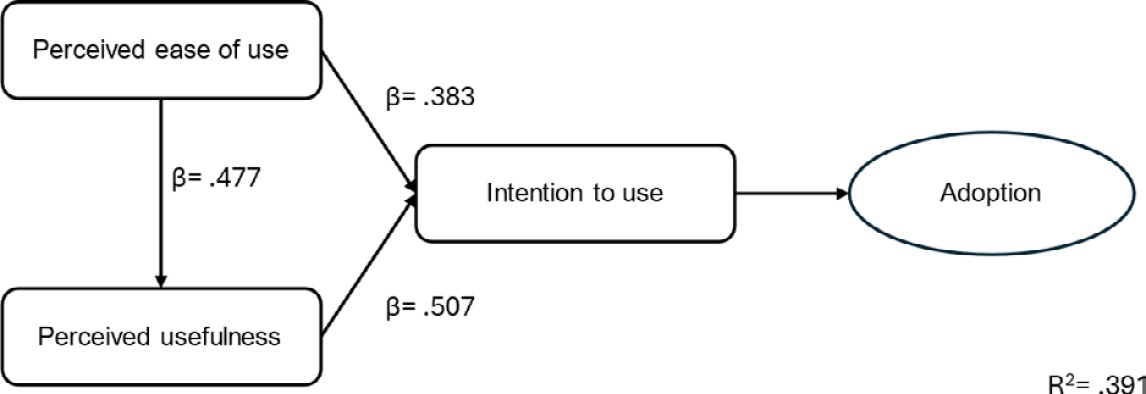
This investigation uses the TAM to analyze the potential adoption behavior of German pig farmers and to explain the intention to use this technology in terms of acceptance (Useche et al., 2013). In the context of the technology and the potential users (farmers), we expand this model to the context of pig farmers and the usage of AI camera surveillance, as shown in the following chapter The TAM is based on two factors, perceived usefulness (PU) and perceived ease of use (PEOU), which are decisive for the possible acceptance of new technologies by potential users (Davis, 1989). The PU indicates the degree to which a system improves work performance and, according to its founder Davis, is a strong influencing factor on the use of technology (Davis, 1989). The PEOU indicates how difficult or simple potential users consider learning and using a system or technology to be (Davis, 1989). In the original model, the two factors act as explanatory and predictive variables for the intention to use a new technology. The model in our analysis showed a lack of explanatory power which substantiated the contextual extension. Figure 1 illustrates the original TAM framework.
In addition to the PU and the PEOU, many other factors affect users’ intention to use new technologies (Pierpaoli et al., 2013). With the aim of identifying these factors, various extensions of the TAM have been made over time and embedded in other concepts to generate independent models that explain the intention to use technologies (Davis & Granić, 2024). In a systematic overview, Granić (2024) presented a total of 17 different models that analyze technology adoption at the individual level. These include, for example, the extended unified theory of acceptance and use of technology (UTAUT) (Venkatesh et al., 2012) and innovation diffusion theory (IDT) (Rogers, 1975). This resulted in a wide range of possible predictors for the intention to use technologies, whereby different aspects can be categorized in relation to the users, technology, tasks and social factors (Davis & Granić, 2024). Instead of applying one of the existing models to AI-based camera systems, it appears that the special nature of the technology and the task, as well as the users, make an extension necessary that considers these special aspects. In the present research, the combination of surveillance technology and the use of AI, in particular, plays a decisive role in this type of expansion.
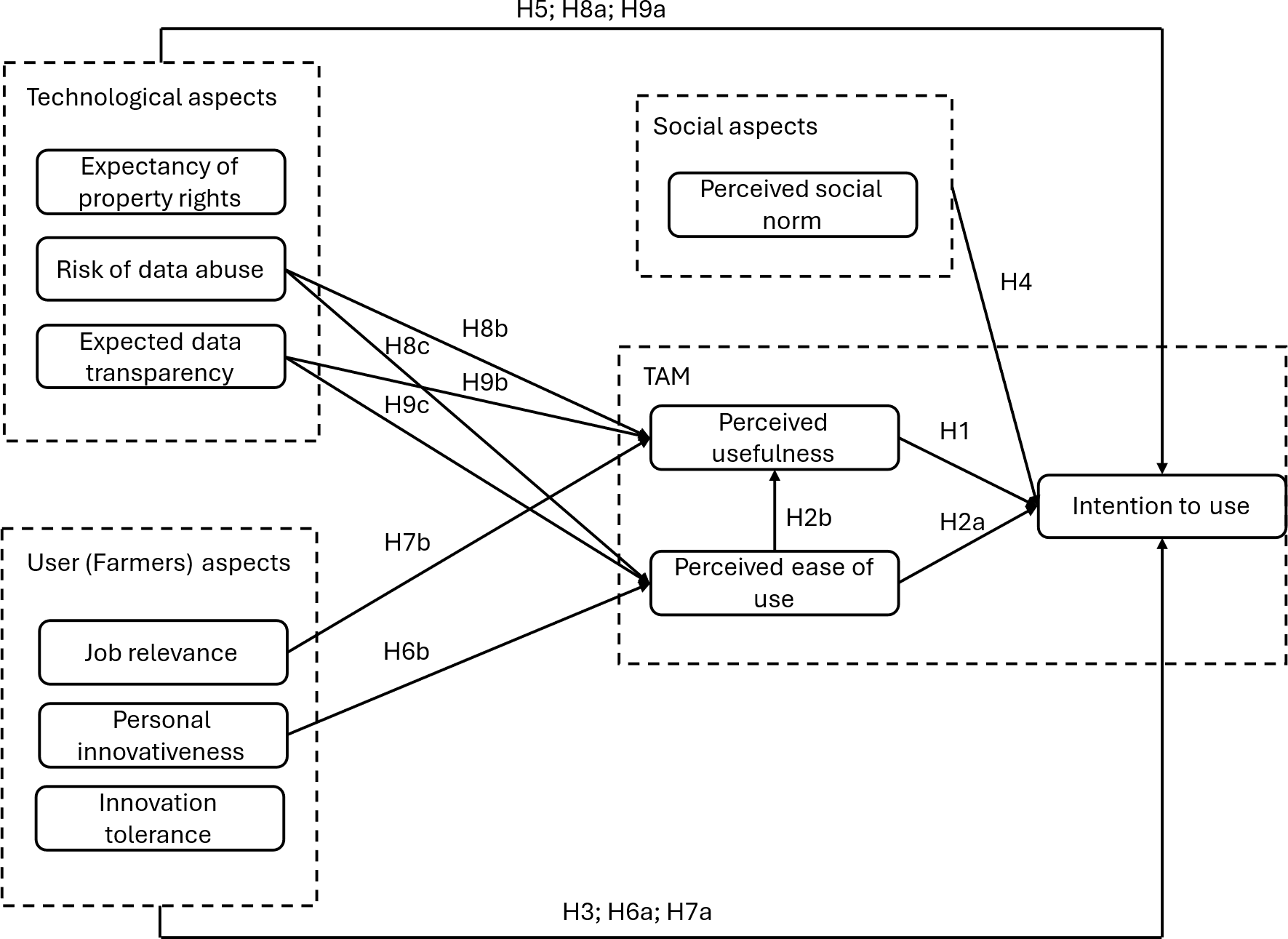
A literature search in the Scopus and SpringerLink databases during the conception phase of the study led to the factors explained below and, finally, to our extended TAM. As part of the modeling process, we assigned the individual constructs to the categories of farmer aspects, technological aspects and social aspects.
Innovation tolerance (IT) is a combination of risk attitudes and the expectation of future relevance from the user’s perspective. These factors can be well integrated into a behavioral model such as the TAM (Montes de Oca Munguia et al., 2021). It is known from the literature that risk aversion has a negative effect on technology adoption (Abadi Ghadim & Pannell, 1997). Conversely, Seibert et al. (2021) showed in their systematic literature review the positive effect of the willingness to take risks on the intention to use new technologies. A decision under uncertainty involves, in the context of technology adoption, the derivation of the value of the technology in the future. Innovators recognize the value of the technology and the future benefits that its use and rapid adaptation offer. They are convinced that utilization will be important in the future to benefit from adoption (Rogers, 2003). Those who see high potential in new technologies for the future are prepared to use the technology now. This study assumes that the combination of self-perceived risk behavior and the assessment of the importance of using technology in the future is decisive for the intention to use it.
Personal innovativeness (PI) extends models of technology acceptance by considering individual perceptions and beliefs (Agarwal & Prasad, 1998). People are described as innovative when they adopt new innovations at an early stage (Rogers & Shiemaker, 1971). A study on precision agriculture technologies revealed significant correlations between technology acceptance and PI as well as a moderating effect on the ITU by influencing the PEOU (Aubert et al., 2012). In her study on the adoption of virtual reality simulations, Fagan et al. (2012) reported a significant interaction between PI and PEOU. In the context of AI and agriculture, Mohr and Kühl (2021) showed the influence of the PI on the PEOU.
Job relevance (JR) describes the extent to which AI-based camera systems are relevant for daily tasks with animals from the user’s perspective. Farmers are more likely to use an information system if they perceive that the information it conveys is relevant to their job (Venkatesh & Davis, 2000). In the context of German livestock farmers, the pressure to use technologies to improve their jobs is a factor underlying the behavioral acceptance of farmers. In addition to the direct influence of JR on the intention to use new technologies, (agricultural) studies have highlighted the significant effect of this variable on PU (Marangunić & Granić, 2015; Michels et al., 2021).
The expectation of property rights (PRs) over business data plays an important role in the development of digitalized livestock farming. PR, particularly in the context of AI systems and camera technology, is unclear from a legal perspective (Härtel, 2020). The acceptance of AI-based camera systems is linked to the expectation of ownership and the legal certainty of the data created and used in this context (Härtel, 2020). Another point pertains to the need for AI systems for data-driven learning; for example, camera systems require video and images. Currently, it remains unclear who owns the original data and the data processed by the AI system. In relation to the cultural context, German individuals are critical of issues related to data security, especially with regard to the use of surveillance technology (Kostka et al., 2021; van Heek et al., 2017). A farmer who expects to own the data is assumed to be less willing to use an AI-based camera system.
The perceived risk of data abuse (RI) is a crucial factor for the intention to use new AI technologies. The use of AI and camera technology indicates a type of surveillance. Fundamental changes in the work environment and people’s trust in AI often lead to irrational worries in German society even at the individual level – a phenomenon that has been called “German angst” (Nickl, 2014). In their study, Beaudry and Pinsonneault (2010) reported that emotions such as anxiety have negative effects on the intention to use and PU of technology. In terms of surveillance characteristics, the RI has an impact on ITU camera technology (Krempel & Beyerer, 2014). With respect to the combination of AI and surveillance technology (Park & Jones-Jang, 2022), acceptance and even PU and PEOU can be negatively influenced. In terms of the adoption of AI technologies in a professional context, Dumbach et al. (2021) identified data protection as the most challenging barrier with respect to AI technology.
With respect to surveillance systems, the expected data transparency (TR) of the processed data and the operation of the system itself are important factors in the acceptance of camera technology (Krempel & Beyerer, 2014). It is difficult or even impossible to understand all aspects of AI systems, even when they are fully transparent. This situation represents a black box that may hinder the development of trust (Dam et al., 2018). However, transparency is a major driver of trust, which determines people’s willingness to accept strategic uncertainty (Poursabzi-Sangdeh et al., 2018; Schmidt et al., 2020; Zhao et al., 2019). A study by Wanner et al. (2022) concluded that transparency on AI-based camera systems affects the PU and PEOU (Wanner et al., 2022). A transparent system is easier to understand; thus, the PEOU and PU increase because people have more knowledge about the system.
Perceived social norm (PS) is based on perceived social pressures, personal feelings of moral obligation and the responsibility to engage in or refuse to engage in a specific behavior (Gorsuch & Ortberg, 1983). The expectations of behavior created by social pressure influence the intention and actual decision to behave in a certain way (Ajzen, 1991). German consumers assess their knowledge about agriculture as rather low (Heinke et al., 2017). However, even without sufficient knowledge, many consumers have a critical view of livestock production (Heinke et al., 2017). In the past, technological development in agriculture has been viewed critically by the population (Gupta et al., 2012; Pfeiffer et al., 2021). With respect to animal production, the public opinion of technological development has been accompanied by a negative comparison with natural outdoor husbandry (Cardoso et al., 2016; Weinrich et al., 2014). The expected view of society for AI-based camera systems therefore seems relevant, as tasks are transferred from farmers and the process of animal husbandry is autonomized. However, meat consumers have expressed a preference for innovation as a solution to potential problems in animal husbandry (Schulze et al., 2023). These findings highlight the ambivalent attitudes of the public.
Table 1 summarizes the factors included in our extended TAM.
| Category | Factor | Source |
|---|---|---|
| Farmers aspects | Innovation tolerance (IT) | Own creation based on (Rogers, 2003; Seibert et al., 2021) |
| Personal innovativeness (PI) | (Agarwal & Prasad, 1998; Aubert et al., 2012; Mohr & Kühl, 2021) | |
| Job relevance (JR) | (Rose et al., 2016; Venkatesh & Davis, 2000) | |
| Technological Aspects | Expectancy of property rights over business data (PR) | Own creation based on (Tiwari & Tiwari, 2020; van Heek et al., 2017) |
| Perceived risk of data abuse (RI) | (Krempel & Beyerer, 2014) | |
| Expected data transparency (TR) | (Krempel & Beyerer, 2014; Wanner et al., 2022) | |
| Social aspects | Perceived social norm (PS) | (Ajzen, 1991; Gorsuch & Ortberg, 1983; Heinke et al., 2017; Mohr & Kühl, 2021; Schulze et al., 2023) |
After the potential explanatory factors were identified, the individual structures were hypothesized in the structural model. Appendix 1 shows the list of individual hypotheses. Figure 2 shows the hypothesized effect of each factor on the intention of potential users to adopt the technology.
3. Study region, data collection and sampling
The target population of our investigation was pig farmers in Germany, who are decision-makers on their farms. The questionnaire was distributed through an agricultural panel to recruit participants from all federal states of Germany. The members of the panel were recruited throughout Germany via Deutscher Landwirtschaftsverlag, a specialized publishing house for agricultural media, which provides panels for various target groups in the German-speaking area.This approach also ensured that farmers who were not involved in the pig industry were not included in the data collection. The survey was conducted online between January and March 2023. The recruitment resulted in a total sample of 185 participants. Our sample can be considered a convenience sample, which is useful for studies with a pilot character, such as the present study on the ex-ante intention to use a technology (Teddlie & Yu, 2007). The participants were contacted via e-mail and initially informed about the study project. Before beginning the questionnaire, the participants provided informed consent to participate in the study.
The questionnaire (Appendix 2) was divided into different parts. The first part of the questionnaire collected sociodemographic and farm-related information. After the sociodemographic questions, the participants were presented with a description of the AI-based camera systems to provide them with a better understanding of the research object. This description was presented in text form. In the second part, farmers were asked to evaluate several statements pertaining to the extended TAM. Appendix 2 shows the different items, including the questions and descriptive statistics. The survey was administered in German, and the questions were translated into English for this manuscript; however, they were not adapted to the specific cultural context. To assess the statements, the questionnaire used a five-point Likert scale ranging from 1 = do not agree to 5 = fully agree. The questionnaire was pretested by two researchers with different groups of farmers to ensure that all the questions could be understood and interpreted unilaterally. These pretests featured two groups of 15 participants. After the test, the participants were asked about their understanding of the survey and its logic, and adjustments were made if they did not understand the statements or the sociodemographic questions. In addition, the intelligibility of the description of the subject matter was assessed by the test group.
4. Statistical analysis: Structural equation modeling
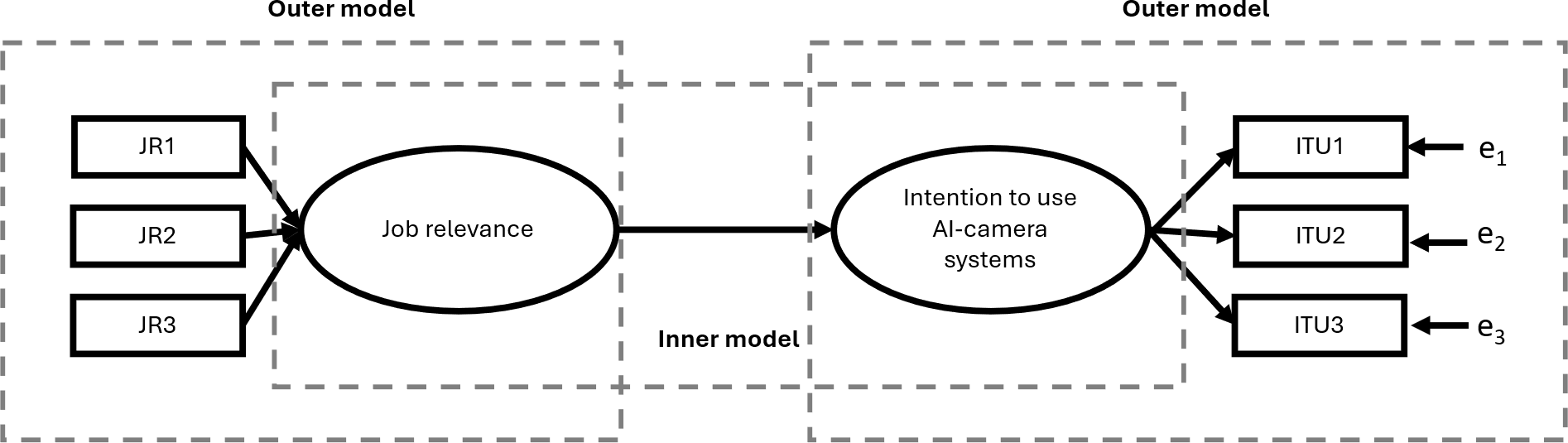
Structural equation modeling (SEM) is used to model and estimate the relationships among multiple independent and dependent variables concurrently (Hair et al., 2021a). This method is particularly useful when the concepts under consideration are unobservable and are measured indirectly through multiple indicators. This research uses the latest approach developed by Hair et al. (2021a) with the assistance of the R package SEMinR (Hair et al., 2022). In SEM, path models are used to represent the relationships among constructs or latent variables. Latent variables cannot usually be measured directly and are therefore created by indicators or manifest variables. The path model visualizes the relationships among all the constructs and depicts the hypotheses that relate the variables via these paths (Hair et al., 2021a). A partial least squares (PLS) path model consists of two elements. The first element is the structural model, also known as the inner model, which links the constructs. The inner model also represents the hypothesized relationship between the constructs. Second, the path model contains a measurement model or outer model. This model represents the relationships between the constructs and the individual indicators.
Figure 3 shows the exemplary inner and outer models for the latent JR in the context of this investigation. The inner model is shown in the center of the figure. The relationships among the elliptical constructs or latent variables are represented by the connecting arrows. The outer model on the left is a formatively measured construct captured by the indicators (JR1, JR2, and JR3). The outer model on the right shows a reflectively measured construct, in this case, the dependent variable ITU. In addition to the indicators used to measure the construct, the error terms for the manifest variables are recorded. These error terms represent the unexplained variance when the path model is estimated. However, this description applies only to the manifest variables. In contrast, the formative variables, in which context the relationship leads from the indicator to the construct, have no error terms (Sarstedt et al., 2016).
In general, PLS-SEM is applicable if the sample contains ten times as many participants as independent variables (Thompson et al., 1995). However, concerns have been expressed about the simple application of this “ten times” rule in the case of complex structural models. An alternative procedure is represented by the inverse square root method (Kock & Hadaya, 2018), which is used to calculate the probability that the path coefficient and its standard error are greater than the critical value for a predetermined significance level (Hair et al., 2021a). Therefore, the minimum sample size (Kock & Hadaya, 2018) is obtained by the following equation, where pmin is the value of the path coefficient with the minimal magnitude in the PLS path model. With a significance level of 5%, nmin > (2.486/pmin)2. Since this method is only suitable for ex post analysis, pmin deviates from the value reported in previous studies featuring a similar number of independent variables (Michels, Fecke, et al., 2020; Mohr & Kühl, 2021). Therefore, a pmin value of 0.185, which indicates a sample size of 180 respondents at a significance level of 0.05, was estimated in this study.
Statistical requirement verification
The results of the PLS-SEM are evaluated via a two-step process. First, the outer models are analyzed before the structural model (inner model) is evaluated. The decision to measure constructs reflectively or formatively is based on their conceptual nature and causal relationships. Reflective constructs (PU, ITU, and PI) have highly intercorrelated indicators that reflect the underlying variable, with a focus on internal consistency. Formative constructs (PEOU, JR, TR, RI, IT, PS, and PRs) are defined by unique, essential indicators that collectively form the construct. The removal of any indicator from formative constructs would significantly alter its meaning, ensuring that all critical dimensions are considered. The analysis of the reflective model reveals that the quality criteria of the indicators are satisfied. The indicator reliability (loadings ≥ 0.7), convergence validity (average variance extracted (AVE) ≥ 0.5) and internal consistency (rhoA ≥ 0.6) are satisfactory (see Appendix 3) and indicate that the variables of the constructs are appropriate for further analysis (Hair et al., 2021b). In addition, the analysis of the heterotrait‒monotrait ratio shows that all values of the reflective factors are below the cutoff value (HTMT < 0.9) and are therefore suitable for the analysis (Hair et al., 2021b) (see Appendix 4). The variance inflation factors (VIFs) of the formative variables are less than five, indicating that no critical levels of multicollinearity are observed. The weights (≥ 0.1) and loadings (> 0.5) are satisfactory and significant (Hair et al., 2021b) (see Appendix 5). Variables of the formative constructs that did not meet these values were excluded from further analysis. Variables may be included in the analysis if they do not meet the above requirements in part, but the t-statistics indicate that they are significant. The variables listed in Appendix 5 contribute to the determination of the formative constructs.
The structural model represents the hypothesized relationships among different constructs. Since the VIF indicates a value lower than five, no multicollinearity exists with respect to the variables. Some researchers have reported problems with multicollinearity with respect to values ranging between three and five (Becker et al., 2015). This criterion is also satisfied for all but one variable, which slightly exceeds three. The model quality regarding multicollinearity is satisfactory. To determine the explanatory power of the model, the R2 of the endogenous constructs is examined (Shmueli & Koppius, 2011). To assess statistical significance, the bootstrapping approach with 10,000 subsamples was employed, as recommended by Streukens and Leroi-Werelds (2016). The aim of PLS-SEM is to maximize the R2 value, and values of 0.75, 0.50 and 0.25 indicate substantial, moderate and low levels, respectively (Hair et al., 2011). The R2 in our analysis is 0.749, which indicates high explanatory power with regard to the adoption of AI-based camera systems in animal agriculture.
With respect to the analysis of predictive power, however, R2 serves only conditionally (Hair & Sarstedt, 2021). The PLSpredict method (Shmueli et al., 2016) was used to test the predictive power; accordingly, the model was divided into training samples and holdout samples to evaluate the predictive performance of the model (set.seed 123). The root-mean-square error (RMSE) of each indicator of the dependent construct of the structural model was subsequently compared with the RMSE of a naive linear regression model (LM) as a benchmark. One quality criterion is that all indicators should have a lower RMSE in the structural model than in the LM, in which case the model is reliable and has high predictive power (Shmueli et al., 2019). A majority or equal number of lower indicators have moderate predictive power, whereas a minority of lower indicators have weak predictive power (Shmueli et al., 2019). The test in this analysis (Appendix 6) indicates high predictive power with regard to the dependent indicator of the intention to use. Figure 4 shows the full SEM and the influence of the indicators after the prerequisite test.
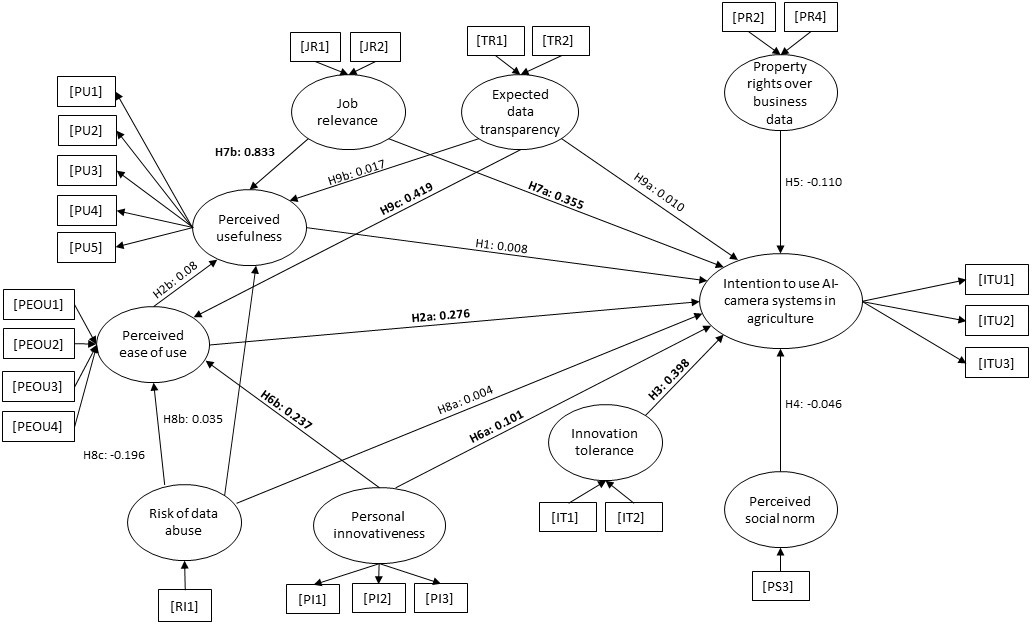
Table 2 shows an overview of the descriptive statistics in comparison with the German average. In our sample, farms have a greater number of animals than the German average in each category. The majority of farmers are aged between 35 and 54 (53.1%) and are thus comparable with German farmers (Federal Ministry of Food and Agriculture, 2023). In terms of gender, the distribution of the sample is different from the average distribution among German farmers, with one-third of the farmers being female. For our sample, we targeted decision-makers on farms, such as owners or directors. The majority (>99%) of our sample identified themselves as decision-makers on their farms. In this context, the distribution of gender is representative with respect to decision-makers on farms (Statistisches Bundesamt, 2023). The participants are more highly educated and younger than the average farmer is.
| N=185 | German average % |
||||||||||||||||||
|---|---|---|---|---|---|---|---|---|---|---|---|---|---|---|---|---|---|---|---|
| Sex, N (%) Female Male Other |
17 (9.2) 166 (89.7) 2 (1.1) |
11.25a 88.75a / |
|||||||||||||||||
| Age [years], mean (range) | 43.5 (20-72) | 53b | |||||||||||||||||
| Vocational education, N (%) No formal agricultural degree Vocational or technical school University degree |
6.4 49.3 44.3 |
33.2a 57.5a 9.2a |
|||||||||||||||||
| Number of fattening pigs, mean (range) | 1282.4 (0-8000) | / | |||||||||||||||||
| Number of sows, mean (range) | 138.0 (0-3000) | / | |||||||||||||||||
| Number of rearing piglets, mean (range) | 663.5 (0-16000) | / | |||||||||||||||||
| Number of acres [hectares], mean (range) | 135.0 (0-5000) | / | |||||||||||||||||
| a Statistisches Bundesamt (2023). | |||||||||||||||||||
| b German Farmers Association (2022). | |||||||||||||||||||
The analysis shows that seven out of sixteen hypotheses are supported. We obtain empirical evidence for H2a (β =.276, f2 = .152), H3 (β =.398, f2 = .213), H6a (β = .101, f2 = .035), and H7a (β = .355, f2 = .116), indicating that these constructs are relevant antecedents for the intention to use AI-based camera systems in pig farming. The results for PU and PEOU support H6b (β = .237, f2 = .083), H7b (β =.833, f2 = 2.037), and H9c (β = .419, f2 = .187). Table 3 shows the tested hypotheses, path coefficients, effect size f2 and t statistics of the model. The path coefficients indicate the direct relationships among the hypothesized constructs in SEM and can be understood as standardized beta coefficients (Hair et al., 2022). In general, the higher the path coefficient is, the greater the relevance of the relationship between the construct and the dependent variable. The analyses revealed that innovation tolerance has the greatest influence on the ITU of all the integrated factors. The F² value in SEM measures the effect size of an exogenous construct on the explained variance (R²) of an endogenous construct.
| Hypothesis | Path coefficient | Effect size f² | 95%CI | t-Statistics | |||||||||||||||
|---|---|---|---|---|---|---|---|---|---|---|---|---|---|---|---|---|---|---|---|
| LL | UL | ||||||||||||||||||
| H1 | PU → ITU | 0.010 | 0.000 | -0.146 | 0.123 | 0.138 | |||||||||||||
| H2a | PEOU → ITU | 0.276 | 0.152 | 0.150 | 0.387 | 2.339 | |||||||||||||
| H2b | PEOU → PU | 0.08 | 0.016 | -0.008 | 0.186 | 1.594 | |||||||||||||
| H3 | IT → ITU | 0.398 | 0.213 | 0.241 | 0.518 | 5.632 | |||||||||||||
| H4 | PS→ ITU | -0.046 | 0.005 | -0.160 | 0.035 | -0.909 | |||||||||||||
| H5 | PR → ITU | -0.110 | 0.032 | -0.168 | 0.048 | -2.078 | |||||||||||||
| H6a | PI → ITU | 0.101 | 0.035 | 0.020 | 0.193 | 2.339 | |||||||||||||
| H6b | PI → PEOU | 0.237 | 0.083 | 0.077 | 0.404 | 2.781 | |||||||||||||
| H7a | JR → ITU | 0.355 | 0.116 | 0.209 | 0.517 | 4.477 | |||||||||||||
| H7b | JR → PU | 0.833 | 2.037 | 0.756 | 0.889 | 24.563 | |||||||||||||
| H8a | RI → ITU | 0.004 | 0.000 | -0.074 | 0.080 | 0.105 | |||||||||||||
| H8b | RI → PU | 0.035 | 0.004 | -0.036 | 0.106 | 0.977 | |||||||||||||
| H8c | RI → PEOU | -0.196 | 0.038 | -0.381 | 0.003 | -2.001 | |||||||||||||
| H9a | TR → ITU | 0.008 | 0.000 | -0.117 | 0.067 | 0.153 | |||||||||||||
| H9b | TR → PU | 0.017 | 0.001 | -0.063 | 0.106 | 0.409 | |||||||||||||
| H9c | TR → PEOU | 0.419 | 0.187 | 0.233 | 0.595 | 4.432 | |||||||||||||
| Legend: ITU: Intention to use; IT: Innovation tolerance; JR: Job relevance; PEOU: Perceived ease of use; PI: Personal innovativeness; PR: Property rights over business data; PS: Perceived social norm; PU: Perceived usefulness; RI: Perceived risk of data abuse; TR: Transparency. | |||||||||||||||||||
In order to analyze the reliability of the model, a stepwise extension of the original model was performed. The extension showed that both the quality of the model and the influence of the variables changed as a result of the extension. The extension of the classical model showed that the additional factors increased the level of elucidation. The influence on the variance is mainly driven by the factors JR, IT and PI. RI shows no additional explanatory contribution. Other factors such as PS, PR and TR have a rather marginal explanatory power for ITU. Figure 5 shows the evolution of the variance explained (R2) by the gradual inclusion of the factors.
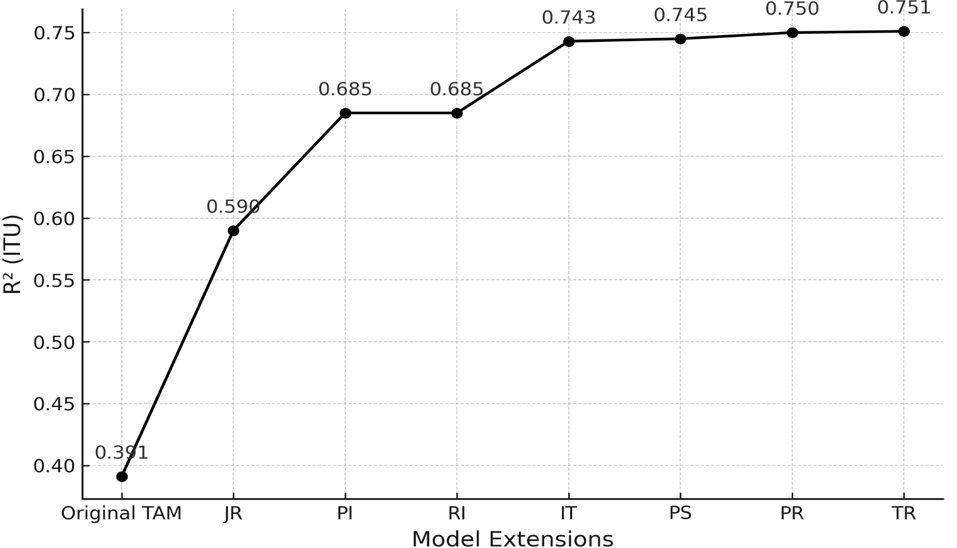
The path coefficients were also analysed in the context of stepwise extension. JR, IT and PEOU remain the most important influencing factors after the expansion. The change in the other path coefficients is marginal in the course of extension. An exception is PU, which is outweighed by JR after extension and loses importance as a result of further enlargements. Table 4 shows the results in detail.
| Number models | |||||||||||||||||||
|---|---|---|---|---|---|---|---|---|---|---|---|---|---|---|---|---|---|---|---|
| PU→ ITU | PEOU → ITU | JR→ ITU | PI → ITU | RI → ITU | IT→ITU | PS → ITU | PR → ITU | TR → ITU | |||||||||||
| Original TAM model | 0.507 | 0.383 | - | - | - | - | - | - | - | ||||||||||
| 2 (+ JR) | 0.073 | 0.308 | 0.557 | - | - | - | - | - | - | ||||||||||
| 3 (+ PI) | 0.057 | 0.289 | 0.543 | 0.111 | - | - | - | - | - | ||||||||||
| 4 (+ RI) | 0.057 | 0.290 | 0.545 | 0.111 | 0.005 | - | - | - | - | ||||||||||
| 5 (+ IT) | -0.006 | 0.236 | 0.361 | 0.098 | 0.029 | 0.374 | - | - | - | ||||||||||
| 6 (+ PS) | -0.005 | 0.242 | 0.365 | 0.095 | 0.027 | 0.400 | -0.057 | - | - | ||||||||||
| 7 (+ PR) | 0.009 | 0.252 | 0.358 | 0.097 | 0.027 | 0.418 | -0.041 | -0.083 | - | ||||||||||
| 8 (+ TR) | 0.010 | 0.276 | 0.355 | 0.101 | 0.004 | 0.398 | -0.046 | -0.110 | 0.008 | ||||||||||
| Legend: ITU: Intention to use; IT: Innovation tolerance; JR: Job relevance; PEOU: Perceived ease of use; PI: Personal innovativeness; PR: Property rights over business data; PS: Perceived social norm; PU: Perceived usefulness; RI: Perceived risk of data abuse; TR: Transparency. | |||||||||||||||||||
The primary objective of this study was to elucidate the factors influencing the intention to use AI-based camera systems in German pig farming. Even though our data did not support all the hypotheses, the results showed that user aspects concerning the farmer himself and the perceived ease of use are decisive for the intention to use AI-based camera systems in pig farming. Research on acceptance has been conducted to investigate various technologies within the context of agriculture. Our results are discussed in light of previous findings on technology acceptance in agriculture.
The analyses initially revealed that PEOU [H2a] is one of the most influential factors in the adoption of AI-based camera systems in German pig farming. Previous research confirms these findings. Mohr and Kühl (2021) reported that the PEOU and PI, among other factors, influence the acceptance of artificial intelligence among farmers in general. Other agriculture studies have confirmed this finding with respect to ease of use and acceptance (Michels et al., 2021). The transferability of the results to different agricultural sectors is reinforced by a study related to precision livestock farming, which revealed that visualization and PEOU influence the acceptance of a system (van Hertem et al., 2017).
In our study, innovation tolerance [H3] had the greatest impact on the intention to use AI-based camera systems in pig farming. The interpretation of the results of IT can be assigned to the person himself or herself, which incorporates a self-image consisting of risk affinity and the estimation of the future importance of this technology. This finding is in consistent with the literature, which states that risk aversion (Abadi Ghadim & Pannell, 1997) or the willingness to take risks (Seibert et al., 2021) determines the intention to use a new technology. This construct also supports the assumption that a positive view of the importance of the technology in the future is decisive for the intention to use it (Rogers, 2003). Although the empirical results show a dominant contribution of IT2, while IT1 exhibits a low weight and loading. This suggests that the construct is essentially driven by the specific item on AI-related attitudes, and the general trait-based indicator contributes minimally. Future research should consider refining the indicators to ensure a more balanced and representative operationalization of the construct.
In this study, the influence of personal innovativeness [H6a] on the intention to use AI-based camera systems was demonstrated. This construct has a statistically significant positive influence on the acceptance of AI-based camera systems in our sample, indicating that the intention to use increases with increasing innovativeness. Although the influence of this construct on the dependent latent variable is low, it can still explain acceptance to some extent. Previous studies from Agarwal and Prasad (1998) and Aubert et al. (2012) have identified PI as an influencing variable. This construct serves to identify early adopters as agents of innovation and should be considered an important factor in implementation processes in agriculture. This finding contradicts the results reported by Mohr and Kühl (2021), who found only an indirect influence of PI on acceptance. This indirect influence [H6b] was also supported by our data. Notably, in the case of the cited study, AI was considered in general, and the measurement of PI was made more difficult by a generalization of the subject of the study.
The statistical analysis of the survey results revealed another construct that has a statistically significant influence on the ITU: the perceived relevance of the technology for the farming profession [H7a]. The influence of JR on acceptance and adoption in the context of agricultural technologies was also demonstrated by Michels et al. (2021). The authors analyzed the acceptance of drone technology and demonstrated that JR has the greatest influence on the ITU. In conclusion, for practice and the development of new AI-based monitoring systems, it is important to communicate precisely the benefits for everyday working life.
Although the statistical measurements were not statistically satisfactory overall, this study demonstrated that expectations of data ownership have an effect on the intention to use [H5]. In contrast to other studies, our approach assumed a negative effect of stronger expectations regarding data rights. According to the variables PR2 and PR4 within the final construct and PR1 outside of the construct, the importance of data ownership to farmers determines their intention to use AI-based camera systems. An undefined ownership structure of the data is assumed to lead to rejection of the technology. Previous studies have also shown that in the context of German citizens and electronic data, German Angst plays a central role in the adoption, acceptance, and design of institutions (Akkaya et al., 2012).
Other constructs (e.g., PU, TR and RI) did not influence the intention to use AI-based camera systems in this sample. This finding contradict the conclusions of Krempel and Beyerer (2014), whose research on surveillance cameras showed that the transparency of the data processed was one of the most important factors regarding acceptance. This difference may be due to the type of AI surveillance. Furthermore, low perceived transparency as a barrier may have an important influence on farmers’ intention to use risk management tools (Giampietri et al., 2020). While PU [H1] is a crucial factor according to many studies on the acceptance of technology in agriculture (Michels, Fecke, et al., 2020; Michels et al., 2021), it is not relevant in our statistical model or in studies on the acceptance of AI in general (Mohr & Kühl, 2021). On the one hand, this difference may be because the PU can be accepted or rejected independently of the ITU. Thus, a rejection of the intention to use is not synonymous with the system’s lack of actual usefulness. On the other hand, the rejection of AI-based camera systems despite a perceived high or very high benefit is due to other factors, such as a lack of PEOU. This finding was not only supported by the full SEM, but also by the stepwise inclusion of the factors and the resulting development of the path coefficients. It can be concluded that PU has an influence on the original model, but that is outweighed by, among other things, the introduction of JR. On the one hand, this effect could derive by the fact that both variables measure similar characteristics in the occupational context. On the other hand, there are indications in our model that there is a stronger relationship between JR and ITU in the adaptation of technologies by the decision makers, as apparently the relevant professional context is more important than the actual usefulness.
An additional consideration in the context of modelling and hypothesis generation is the differentiated role of individual factors, whether as direct determinants, potential mediators, or moderators within the model structure. In the present model, it may be hypothesized that PI exerts a moderating influence on ITU, as it reflects, at least in part, trait-like characteristics of the respondents. While the conceptual phase of theory-driven hypothesis development did not provide sufficient justification for including such a moderation effect, theoretical reflections combined with the empirical findings of this study suggest that future analyses should explicitly consider this possibility.
Besides the findings of our model applying an extended TAM, other approaches should be used to investigate the ITU of AI camera systems. For example, the TPB could be an appropriate model for further research. In the case of animal husbandry and the monitoring of health and welfare parameters, TPB constructs would help to identify voluntary action by farmers in technology adaptation. An investigation of TPB factors would help to provide important insights for the development of systems and recommendations for policy, particularly in the highly regulated area of agriculture and AI. Especially in a policy context where voluntarism is the preferred option for adaptation over regulation.
Apart from the analysis of behavioral factors further research on the technology itself is also needed. It is equally important to know which economic and technology-specific factors, in addition to behavioral factors, moderate the potential adaptation. For new technologies with a specific field of application, Sok and Hoestra (2023) used the subject of electrified tractors to show that uncertainty about the economic benefits and cost-effectiveness were the most important factors for the decision of the farmers surveyed. An examination of the economic and technology-specific factors using random utility theory would provide further clarification on the possible adoption or rejection of AI camera systems and help companies and policymakers to create the necessary framework conditions for market integration. Since analyses of non-behavioral factors (e.g. age, education, farm size) have shown little influence on the adaptation of AI camera systems in pig farming (Kühnemund & Recke, 2024), consideration of the TPB and economic factors could help to explain the variance in the intention to use.
Our study is limited by the notion that the results must be understood considering the specific types of animal farmers. Therefore, these results are only partially applicable to other forms of livestock production. Especially in the case of highly integrated value chains that focus on the interests of the integrator, other factors could lead to acceptance or rejection, which were not considered in this study. The results must also be viewed in consideration of the convenience sample and do not constitute a representative analysis of the object of investigation. Therefor the findings are not generalizable to the overall population of German pig farmers. For further studies a representative sampling strategy should be applied in order to investigate models like TPB or random utility theory. Although Germany is one of the largest pig-producing countries in Europe and even worldwide, the results cannot be applied uniformly at the international level. Cultural idiosyncrasies, the strongly male-dominated agricultural sector and the formal institutions involved in handling the data in this context are only some of the reasons why the results cannot be fully generalized to a European or global context. It is possible that the survey procedure (online survey) causes selection bias because the survey invitation only reached people who were on the mailing list and may also have addressed those who are interested in technology. Despite these limitations, this study provides important findings for future research on and the development of AI-based camera systems. This study is characterized by a sample that corresponds to the characteristics of German pig farmers. Furthermore, the necessary sample size was achieved, increasing the robustness of the analysis. The model showed satisfactory performance, which emphasizes the significance of the results.
Knowledge of development and the factors that promote successful implementation are essential for practitioners as well as for policy and regulatory decision-makers. A technology is useful only if it is used by the target group. Future research should focus on user-friendly interfaces. In terms of simplicity, it is also important to ensure low-barrier access to the technology and to create an infrastructure that makes these systems easy to use for all farmers. In addition, it is conceivable that the target group and potential users could be reached through farmers who have already had experience with the system. In addition, the legal component should be explored by investigating the influence of such institutions. The results show that developers should focus on the benefits and application to the farmer’s job. The economic relevance of AI-based camera systems, as well as their potential to generate added value at specific stages of the livestock production process, should be more explicitly identified and communicated. Their implementation could offer targeted solutions to current challenges, such as the early detection and prevention of tail biting in undocked pigs or the reduction of labor-intensive, legally mandated animal observation tasks that currently lack direct economic return. In addition, attention should be paid to ease of use to ensure successful market integration. The analysis also suggests that AI camera systems should be further developed in collaboration with tech-savvy farmers to address their enthusiasm for innovation. Incorporating this technology into an intelligent housing system could lead to successful integration with other solutions such as housing climate and feeding. Policy makers should create the basis for such compatibility in order to increase the uptake of technologies. In addition to clear frameworks for transparency and legal certainty of data, policymakers and educational institutions should integrate educational programs into the training of farmers to facilitate the use of new AI technologies. This can lead to future farmers being more open to innovation.
In summary, the perceived ease of use, innovation tolerance, job relevance, and personal innovativeness emerged as influential constructs that shape the intention to use AI-based camera systems in pig farming. Understanding the behavior-based acceptance of AI technologies is crucial, and the factors identified in this study can guide the development of AI-based camera systems that are embraced by farmers and offer tangible benefits. In this sample, the general acceptance of an AI-based camera system was high; to support real adoption, the identified influencing factors should be considered. Evidence synthesis showed that influential constructs depend on the sample composition and the research object
Abadi Ghadim, A. K., & Pannell, D. J. (1997). A Conceptual Framework of Adoption of an Innovation Including Dynamic Learning, Personal Perceptions and Risk Attitudes.
Agarwal, R., & Prasad, J. (1998). A Conceptual and Operational Definition of Personal Innovativeness in the Domain of Information Technology. Information Systems Research, 9(2), 204-215. https://doi.org/10.1287/isre.9.2.204
Ajzen, I. (1991). The theory of planned behavior. Organizational Behavior and Human Decision Processes, 50(2), 179-211. https://doi.org/10.1016/0749-5978(91)90020-T
Akkaya, C., Wolf, P., & Krcmar, H. (2012). The Surprisingly Low Effect of National Culture on E-Government Adoption: A Cross-Cultural Comparison (Vol. 6).
Alambaigi, A., & Ahangari, I. (2016). Technology Acceptance Model (TAM) as a predictor model for explaining agricultural experts behavior in acceptance of ICT. International Journal of Agricultural Management and Development (IJAMAD), 6(1047-2017-1663), 235-247.
Albernaz-Gonçalves, R., Olmos, G., & Hötzel, M. J. (2021). My pigs are ok, why change? – animal welfare accounts of pig farmers. animal, 15(3), 100154. https://doi.org/10.1016/j.animal.2020.100154
Aubert, B. A., Schroeder, A., & Grimaudo, J. (2012). IT as enabler of sustainable farming: An empirical analysis of farmers’ adoption decision of precision agriculture technology. Decision Support Systems, 54(1), 510-520. https://doi.org/10.1016/j.dss.2012.07.002
Beaudry, A., & Pinsonneault, A. (2010). The Other Side of Acceptance: Studying the Direct and Indirect Effects of Emotions on Information Technology Use. MIS Quarterly, 34(4), 689-710. https://doi.org/10.2307/25750701
Becker, J.-M., Ringle, C., Sarstedt, M., & Völckner, F. (2015). How collinearity affects mixture regression results. Marketing Letters, 26(4), 643-659. https://EconPapers.repec.org/RePEc:kap:mktlet:v:26:y:2015:i:4:p:643-659
Block, J. B., Michels, M., & Mußhoff, O. (2023). A Trans-Theoretical Model for Farmers’ perceived Usefulness of Digital Risk Management Tools – A Case Study from Germany. German Journal of Agricultural Economics, 72(3-4). https://doi.org/10.30430/gjae.2023.0330
Cardoso, C. S., Hötzel, M. J., Weary, D. M., Robbins, J. A., & von Keyserlingk, M. A. (2016). Imagining the ideal dairy farm. Journal of Dairy Science, 99(2), 1663-1671. https://doi.org/10.3168/jds.2015-9925
Condotta, I. C. F. S., Brown-Brandl, T. M., Silva-Miranda, K. O., & Stinn, J. P. (2018). Evaluation of a depth sensor for mass estimation of growing and finishing pigs. Biosystems Engineering, 173, 11-18. https://doi.org/10.1016/j.biosystemseng.2018.03.002
Dam, H. K., Tran, T., & Ghose, A. (2018). Explainable software analytics Proceedings of the 40th International Conference on Software Engineering: New Ideas and Emerging Results, Gothenburg, Sweden.
Davis, F. (1985). A Technology Acceptance Model for Empirically Testing New End-User Information Systems.
Davis, F. D. (1989). Perceived Usefulness, Perceived Ease of Use, and User Acceptance of Information Technology. MIS Quarterly, 13(3), 319-340. https://doi.org/10.2307/249008
Davis, F. D., & Granić, A. (2024). Evolution of TAM. In F. D. Davis & A. Granić (Eds.), The Technology Acceptance Model: 30 Years of TAM (pp. 19-57). Springer International Publishing.
Dumbach, P., Liu, R., Jalowski, M., & Eskofier, B. M. (2021). The Adoption Of Artificial Intelligence In SMEs-A Cross-National Comparison In German And Chinese Healthcare. BIR Workshops,
Fagan, M., Kilmon, C., & Pandey, V. (2012). Exploring the adoption of a virtual reality simulation. Campus-Wide Information Systems, 29(2), 117-127. https://doi.org/10.1108/10650741211212368
Federal Ministry of Food and Agriculture. (2023). Altersgliederung der landwirtschaftlichen Betriebsinhaber. Retrieved from https://www.bmel-statistik.de/landwirtschaft/tabellen-zur-landwirtschaft
Fernández-Carrión, E., Barasona, J. Á., Sánchez, Á., Jurado, C., Cadenas-Fernández, E., & Sánchez-Vizcaíno, J. M. (2020). Computer Vision Applied to Detect Lethargy through Animal Motion Monitoring: A Trial on African Swine Fever in Wild Boar. Animals, 10(12), 2241. https://doi.org/10.3390/ani10122241
German Farmers Association. (2022). Situation Report 2021/2022. Trends and facts about agriculture.
German Federal Ministry of Food and Agriculture. (2024). Bundestag berät über Tierschutzgesetz. Retrieved 25.11. from
Giampietri, E., Yu, X., & Trestini, S. (2020). The role of trust and perceived barriers on farmer’s intention to adopt risk management tools. Bio-based and Applied Economics, 9(1), 1-24. https://doi.org/10.13128/bae-8416
Gorsuch, R. L., & Ortberg, J. (1983). Moral obligation and attitudes: Their relation to behavioral intentions. Journal of Personality and Social Psychology, 44, 1025-1028. https://doi.org/10.1037/0022-3514.44.5.1025
Granić, A. (2024). Technology adoption at individual level: toward an integrated overview. Universal Access in the Information Society, 23(2), 843-858. https://doi.org/10.1007/s10209-023-00974-3
Gupta, N., Fischer, A. R., & Frewer, L. J. (2012). Socio-psychological determinants of public acceptance of technologies: A review. Public Understanding of Science, 21(7), 782-795.
Hair, J., Hult, G. T. M., Ringle, C., & Sarstedt, M. (2022). A Primer on Partial Least Squares Structural Equation Modeling (PLS-SEM).
Hair, J. F., Hult, G. T. M., Ringle, C. M., Sarstedt, M., Danks, N. P., & Ray, S. (2021a). An Introduction to Structural Equation Modeling. In J. F. Hair Jr, G. T. M. Hult, C. M. Ringle, M. Sarstedt, N. P. Danks, & S. Ray (Eds.), Partial Least Squares Structural Equation Modeling (PLS-SEM) Using R: A Workbook (pp. 1-29). Springer International Publishing.
Hair, J. F., Hult, G. T. M., Ringle, C. M., Sarstedt, M., Danks, N. P., & Ray, S. (2021b). Partial Least Squares Structural Equation Modeling (PLS-SEM) Using R: A workbook.
Hair, J. F., Ringle, C. M., & Sarstedt, M. (2011). PLS-SEM: Indeed a Silver Bullet. Journal of Marketing Theory and Practice, 19(2), 139-152. https://doi.org/10.2753/MTP1069-6679190202
Härtel, I. (2020). Künstliche Intelligenz in der nachhaltigen Landwirtschaft – Datenrechte und Haftungsregime. Natur und Recht, 42(7), 439-453. https://doi.org/10.1007/s10357-020-3704-3
Heinke, H., Gröner, C., & Theuvsen, L. (2017). Tierwohl als Differenzierungsstrategie zur Erreichung einer höheren Prozessqualität in der Schweineproduktion? Die Sicht der Landwirte Heutige und zukünftige Herausforderungen an die Qualitätswissenschaft in Forschung und Praxis, Erlangen.
Kock, N., & Hadaya, P. (2018). Minimum sample size estimation in PLS-SEM: The inverse square root and gamma-exponential methods. Information Systems Journal, 28(1), 227-261. https://doi.org/10.1111/isj.12131
Kostka, G., Steinacker, L., & Meckel, M. (2021). Between security and convenience: Facial recognition technology in the eyes of citizens in China, Germany, the United Kingdom, and the United States. Public Understanding of Science, 30(6), 671-690. https://doi.org/10.1177/09636625211001555
Krempel, E., & Beyerer, J. (2014). TAM-VS: A Technology Acceptance Model for Video Surveillance. Privacy Technologies and Policy, Cham.
Kühnemund, A., & Recke, G. (2024). Non-behavioral variables on the acceptance of AI-based camera systems. 44. GIL-Jahrestagung, Biodiversität fördern durch digitale Landwirtschaft,
Lemken, D., Spiller, A., & von Meyer-Höfer, M. (2017). The Case of Legume-Cereal Crop Mixtures in Modern Agriculture and the Transtheoretical Model of Gradual Adoption. Ecological Economics, 137, 20-28. https://doi.org/10.1016/j.ecolecon.2017.02.021
Marangunić, N., & Granić, A. (2015). Technology acceptance model: a literature review from 1986 to 2013. Universal Access in the Information Society, 14(1), 81-95. https://doi.org/10.1007/s10209-014-0348-1
Michels, M., Bonke, V., & Musshoff, O. (2020). Understanding the adoption of smartphone apps in crop protection. Precision Agriculture, 21(6), 1209-1226. https://doi.org/10.1007/s11119-020-09715-5
Michels, M., Fecke, W., Feil, J.-H., Musshoff, O., Pigisch, J., & Krone, S. (2020). Smartphone adoption and use in agriculture: empirical evidence from Germany. Precision Agriculture, 21(2), 403-425. https://doi.org/10.1007/s11119-019-09675-5
Michels, M., von Hobe, C.-F., Weller von Ahlefeld, P. J., & Musshoff, O. (2021). The adoption of drones in German agriculture: a structural equation model. Precision Agriculture, 22(6), 1728-1748. https://doi.org/10.1007/s11119-021-09809-8
Mohr, S., & Kühl, R. (2021). Acceptance of artificial intelligence in German agriculture: an application of the technology acceptance model and the theory of planned behavior. Precision Agriculture, 22(6), 1816-1844. https://doi.org/10.1007/s11119-021-09814-x
Montes de Oca Munguia, O., Pannell, D. J., & Llewellyn, R. (2021). Understanding the Adoption of Innovations in Agriculture: A Review of Selected Conceptual Models. Agronomy, 11(1), 139. https://www.mdpi.com/2073-4395/11/1/139
Nasirahmadi, A., Sturm, B., Olsson, A.-C., Jeppsson, K.-H., Müller, S., Edwards, S., & Hensel, O. (2019). Automatic scoring of lateral and sternal lying posture in grouped pigs using image processing and Support Vector Machine. Computers and Electronics in Agriculture, 156, 475-481. https://doi.org/10.1016/j.compag.2018.12.009
Nickl, P. (2014). Risikogesellschaft und die German Angst. In L. Hieber & H.-U. Kammeyer (Eds.), Verantwortung von Ingenieurinnen und Ingenieuren (pp. 95-101). Springer Fachmedien Wiesbaden.
Pfeiffer, J., Gabriel, A., & Gandorfer, M. (2021). Understanding the public attitudinal acceptance of digital farming technologies: a nationwide survey in Germany. Agriculture and Human Values, 38(1), 107-128. https://doi.org/10.1007/s10460-020-10145-2
Pierpaoli, E., Carli, G., Pignatti, E., & Canavari, M. (2013). Drivers of Precision Agriculture Technologies Adoption: A Literature Review. Procedia Technology, 8, 61-69. https://doi.org/10.1016/j.protcy.2013.11.010
Poursabzi-Sangdeh, F., Goldstein, D. G., Hofman, J. M., Vaughan, J. W., & Wallach, H. M. (2018). Manipulating and Measuring Model Interpretability. Proceedings of the 2021 CHI Conference on Human Factors in Computing Systems. https://doi.org/10.48550/arXiv.1802.07810
Prochaska, J. O., & Velicer, W. F. (1997). The transtheoretical model of health behavior change. Am J Health Promot, 12(1), 38-48. https://doi.org/10.4278/0890-1171-12.1.38
Rogers, E. M. (2003). Diffusion of innovations (5 ed.). Free Press.
Rogers, E. M., & Shiemaker, F. F. (1971). Communication of Innovations. The Free Press, New York.
Rogers, R. W. (1975). A Protection Motivation Theory of Fear Appeals and Attitude Change1. The Journal of Psychology, 91(1), 93-114. https://doi.org/10.1080/00223980.1975.9915803
Rohleder, B., Krüsken, B., & Reinhardt, H. (2020). Digitalisierung in der Landwirtschaft 2020. https://www.bitkom.org/sites/main/files/2022-01/27.04.20_digitalisierung-in-der-landwirtschaft-2020.pdf
Rose, D. C., Sutherland, W. J., Parker, C., Lobley, M., Winter, M., Morris, C., Twining, S., Ffoulkes, C., Amano, T., & Dicks, L. V. (2016). Decision support tools for agriculture: Towards effective design and delivery. Agricultural Systems, 149, 165-174. https://doi.org/10.1016/j.agsy.2016.09.009
Saheb, T. (2023). Ethically contentious aspects of artificial intelligence surveillance: a social science perspective. AI and Ethics, 3(2), 369-379.
Sarstedt, M., Hair, J. F., Ringle, C. M., Thiele, K. O., & Gudergan, S. P. (2016). Estimation issues with PLS and CBSEM: Where the bias lies! Journal of Business Research, 69(10), 3998-4010. https://doi.org/10.1016/j.jbusres.2016.06.007
Schmidt, P., Biessmann, F., & Teubner, T. (2020). Transparency and trust in artificial intelligence systems. Journal of Decision Systems, 29(4), 260-278. https://doi.org/10.1080/12460125.2020.1819094
Schukat, S., & Heise, H. (2021). Smart Products in Livestock Farming – An Empirical Study on the Attitudes of German Farmers. Animals, 11(4), 1055. https://doi.org/10.3390/ani11041055
Schulze, M., Sonntag, W., & von Meyer-Höfer, M. (2023). Is less more? Investigating citizen and consumer preferences for the future direction of livestock farming policy. Journal of Cleaner Production, 390, 136136. https://doi.org/10.1016/j.jclepro.2023.136136
Seibert, D., Godulla, A., & Wolf, C. (2021). Understanding How Personality Affects the Acceptance of Technology: A Literature Review.
Shmueli, G., & Koppius, O. R. (2011). Predictive Analytics in Information Systems Research. MIS Quarterly, 35(3), 553-572. https://doi.org/10.2307/23042796
Shmueli, G., Sarstedt, M., Hair, J. F., Cheah, J.-H., Ting, H., Vaithilingam, S., & Ringle, C. M. (2019). Predictive model assessment in PLS-SEM: guidelines for using PLSpredict. European Journal of Marketing, 53(11), 2322-2347. https://doi.org/10.1108/EJM-02-2019-0189
Sok, J., Borges, J. R., Schmidt, P., & Ajzen, I. (2021). Farmer Behaviour as Reasoned Action: A Critical Review of Research with the Theory of Planned Behaviour. Journal of Agricultural Economics, 72(2), 388-412. https://doi.org/10.1111/1477-9552.12408
Sok, J., & Hoestra, J. (2023). Will farmers go electric? How Dutch environmental regulation affects tractor purchase motivations and preferences. Energy Research & Social Science, 102, 103180. https://doi.org/10.1016/j.erss.2023.103180
Statistisches Bundesamt. (2023). Arbeitskräfte: Deutschland, Jahre, Geschlecht, Altersgruppen, Rechtsformen, Art der Arbeitskräfte, Beschäftigungsumfang. Retrieved 20.05.2023 from https://www-genesis.destatis.de/genesis//online?operation=table&code=41141-0027&bypass=true&levelindex=1&levelid=1690281844084#abreadcrumb
Streukens, S., & Leroi-Werelds, S. (2016). Bootstrapping and PLS-SEM: A step-by-step guide to get more out of your bootstrap results. European Management Journal, 34(6), 618-632. https://doi.org/10.1016/j.emj.2016.06.003
Teddlie, C., & Yu, F. (2007). Mixed Methods Sampling:A Typology With Examples. Journal of Mixed Methods Research, 1(1), 77-100. https://doi.org/10.1177/1558689806292430
Thomas, R. J., O’Hare, G., & Coyle, D. (2023). Understanding technology acceptance in smart agriculture: A systematic review of empirical research in crop production. Technological Forecasting and Social Change, 189, 122374. https://doi.org/10.1016/j.techfore.2023.122374
Thompson, R., Barclay, D., & Higgins, C. A. (1995). The partial least squares approach to causal modeling: Personal computer adoption and use as an illustration. Technology Studies: Special Issues on Research Methodology, 2, 284-324.
Tiwari, P., & Tiwari, S. K. (2020). Integration of technology acceptance model with perceived risk, perceived trust and perceived cost: Customers’ adoption of m-banking. International Journal on Emerging Technologies, 11(2), 447-452.
Useche, P., Barham, B. L., & Foltz, J. D. (2013). Trait-based Adoption Models Using Ex-Ante and Ex-Post Approaches. American Journal of Agricultural Economics, 95(2), 332-338. https://doi.org/10.1093/ajae/aas044
van Heek, J., Arning, K., & Ziefle, M. (2017). The Surveillance Society: Which Factors Form Public Acceptance of Surveillance Technologies? Smart Cities, Green Technologies, and Intelligent Transport Systems, Cham.
van Hertem, T., Rooijakkers, L., Berckmans, D., Peña Fernández, A., Norton, T., Berckmans, D., & Vranken, E. (2017). Appropriate data visualisation is key to Precision Livestock Farming acceptance. Computers and Electronics in Agriculture, 138, 1-10. https://doi.org/10.1016/j.compag.2017.04.003
Venkatesh, V., & Davis, F. D. (2000). A Theoretical Extension of the Technology Acceptance Model: Four Longitudinal Field Studies. Management Science, 46(2), 186-204. https://doi.org/10.1287/mnsc.46.2.186.11926
Venkatesh, V., Thong, J. Y. L., & Xu, X. (2012). Consumer Acceptance and Use of Information Technology: Extending the Unified Theory of Acceptance and Use of Technology. MIS Quarterly, 36(1), 157-178. https://doi.org/10.2307/41410412
Wanner, J., Herm, L.-V., Heinrich, K., & Janiesch, C. (2022). The effect of transparency and trust on intelligent system acceptance: Evidence from a user-based study. Electronic Markets, 32(4), 2079-2102. https://doi.org/10.1007/s12525-022-00593-5
Weinrich, R., Kühl, S., Zühlsdorf, A., & Spiller, A. (2014). Consumer attitudes in Germany towards different dairy housing systems and their implications for the marketing of pasture raised milk. International Food and Agribusiness Management Review, 17(1030-2016-83034), 205-222.
Wongsriworaphon, A., Arnonkijpanich, B., & Pathumnakul, S. (2015). An approach based on digital image analysis to estimate the live weights of pigs in farm environments. Computers and Electronics in Agriculture, 115, 26-33. https://doi.org/10.1016/j.compag.2015.05.004
Zhao, R., Benbasat, I., & Cavusoglu, H. (2019). Do Users Always Want to Know More? Investigating the Relationship between System Transparency and Users’ Trust in Advice-Giving Systems. European Conference on Information Systems.
H1: The perceived usefulness of AI-based camera systems in pig livestock farming has a positive effect on the intention to use AI-based camera systems in pig livestock farming.
H2a: The perceived ease of use of AI-based camera systems in pig livestock farming has a positive effect on the intention to use AI-based camera systems in pig livestock farming.
H2b: The perceived ease of use of AI-based camera systems in pig livestock farming has a positive effect on the perceived usefulness of AI-based camera systems in pig livestock farming.
H3: Innovation tolerance has a positive effect on the intention to use AI-based camera systems in pig livestock farming.
H4: Perceived social norms have a positive effect on the intention to use AI-based camera systems in pig livestock farming.
H5: The expectation of property rights over business data has a negative effect on the intention to use AI-based camera systems in pig livestock farming.
H6a: The personal innovativeness of farmers has a positive effect on their intentions to use AI-based camera systems in pig livestock farming.
H6b: The personal innovativeness of farmers has a positive effect on the perceived ease of use of AI-based camera systems in pig livestock farming.
H7a: Job relevance has a positive effect on the intention to use AI-based camera systems in pig livestock farming.
H7b: Job relevance has a positive effect on the perceived usefulness of AI-based camera systems in pig livestock farming.
H8a: The perceived risk of data abuse has a negative effect on the intention to use AI-based camera systems in pig livestock farming.
H8b: The perceived risk of data abuse has a negative effect on the perceived usefulness of AI-based camera systems in pig livestock farming.
H8c: The perceived risk of data abuse has a negative effect on the perceived ease of use of AI-based camera systems in pig livestock farming.
H9a: Expected data transparency has a positive effect on the intention to use AI-based camera systems in pig livestock farming.
H9b: Expected data transparency has a positive effect on the perceived usefulness of AI-based camera systems in pig livestock farming.
H9c: Expected data transparency has a positive effect on the perceived ease of use of AI-based camera systems in pig livestock farming.
Appendix 2: Items and descriptive statistics
| Factor name | Factor description | Mean | SD | ||||||||||||||||
|---|---|---|---|---|---|---|---|---|---|---|---|---|---|---|---|---|---|---|---|
| To what extent do you agree with the following statements? I think that… | |||||||||||||||||||
| ITU1 | … I will additionally observe my animals using cameras. | 3.65 | 1.22 | ||||||||||||||||
| ITU2 | … I will use cameras in my business in the future. | 3.49 | 1.25 | ||||||||||||||||
| ITU3 | … I would use cameras on my farm. | 3.65 | 1.22 | ||||||||||||||||
| To what extent do you agree with the following statements? I think that the use of AI-based camera systems… | |||||||||||||||||||
| PU1 | … allows me to do work in the barn more quickly than before. | 2.98 | 1.23 | ||||||||||||||||
| PU2 | … facilitates the work of all employees on my farm. | 3.05 | 1.24 | ||||||||||||||||
| PU3 | … increases the productivity of my business. | 3.20 | 1.16 | ||||||||||||||||
| PU4 | … reduces my overall workload on the farm. | 3.05 | 1.19 | ||||||||||||||||
| PU5 | … gives me more flexibility in terms of my operating processes. | 3.23 | 1.15 | ||||||||||||||||
| To what extent do you agree with the following statements? For me, … | |||||||||||||||||||
| PEOU1 | …operating AI cameras to observe animals is easy to learn. | 3.79 | 0.95 | ||||||||||||||||
| PEOU2 | … videos from animal observation cameras are easy to evaluate. | 3.25 | 1.07 | ||||||||||||||||
| PEOU3 | … working with cameras to observe animals in the barn is possible without technical problems. | 3.13 | 1.09 | ||||||||||||||||
| PEOU4 (R) | … it is difficult to operate AI cameras and evaluate videos. | 3.67 | 1.11 | ||||||||||||||||
| To what extent do you agree with the following statements? I think that… | |||||||||||||||||||
| JR1 | … the use of AI cameras can be relevant to my work. | 3.54 | 1.15 | ||||||||||||||||
| JR2 | … the use of AI cameras can have a high degree of relevance for my operations. | 3.06 | 1.17 | ||||||||||||||||
| JR3 | … AI cameras are suitable for my business. | 3.16 | 1.15 | ||||||||||||||||
| To what extent do you agree with the following statements? I think that… | |||||||||||||||||||
| TR1 | … I am well informed about what data are captured by a camera-based image processing system. | 2.92 | 1.15 | ||||||||||||||||
| TR2 | … I am well informed about how such a system processes data. | 2.76 | 1.17 | ||||||||||||||||
| To what extent do you agree with the following statements? I think that… | |||||||||||||||||||
| RI1 | … I could be disadvantaged by errors in the collection or processing of data by the system. | 3.10 | 1.10 | ||||||||||||||||
| RI2 | … (image) data could be misused. | 3.62 | 1.23 | ||||||||||||||||
| To what extent do you agree with the following statements? | |||||||||||||||||||
| IT1 | I consider myself to be a risk taker. | 3.24 | 0.93 | ||||||||||||||||
| IT2 | I think it will be important in the future to use AI cameras for animal observation. | 3.25 | 1.19 | ||||||||||||||||
| To what extent do you agree with the following statements? | |||||||||||||||||||
| PI1 | I enjoy being around people who are trying out new technologies. | 4.03 | 0.84 | ||||||||||||||||
| PI2 | I am very curious about how new agricultural technologies work. | 4.07 | 0.91 | ||||||||||||||||
| PI3 | I like to try out new agricultural technologies. | 3.84 | 0.92 | ||||||||||||||||
| PI4 | I often determine information about new technologies. | 4.10 | 0.82 | ||||||||||||||||
| To what extent do you agree with the following statements? | |||||||||||||||||||
| PS1 | The German population has a positive view of modern technology in agriculture. | 2.61 | 0.99 | ||||||||||||||||
| PS2 | Policy-makers support modern agriculture. | 1.84 | 0.90 | ||||||||||||||||
| PS3 | I think that the use of AI camera monitoring in barns is consistent with society’s expectations of agriculture. | 3.09 | 1.13 | ||||||||||||||||
| To what extent do you agree with the following statements? | |||||||||||||||||||
| PR1 | Corporate data belongs to the farmers. | 4.78 | 0.55 | ||||||||||||||||
| PR2 | Stronger regulation for data security reduces the competitiveness of German farmers. | 2.40 | 1.10 | ||||||||||||||||
| PR3 | The government should create a data platform for sharing agricultural data. | 2.09 | 1.07 | ||||||||||||||||
| PR4 | As long as I receive large benefits from it, I do not care if companies use operational data. | 2.11 | 1.21 | ||||||||||||||||
| PR5 | The data flow of visual material should be controlled by farmers. | 4.40 | 1.12 | ||||||||||||||||
| Legend: ITU: Intention to use; IT: Innovation tolerance; JR: Job relevance; PEOU: Perceived ease of use; PI: Personal innovativeness; PR: Property rights over business data; PS: Perceived social norm; PU: Perceived usefulness; RI: Perceived risk of data abuse; TR: Transparency. | |||||||||||||||||||
Appendix 3: Reflective Constructs
| Reflective measurement models | Indicator name | Indicator reliability Loadings |
Convergent validity AVE |
Internal consistency rhoA | rhoC | Cronbach’s Alpha | |||||||||||||
|---|---|---|---|---|---|---|---|---|---|---|---|---|---|---|---|---|---|---|---|
| Intention to use AI-based camera systems | ITU1 | 0.942 | 0.898 | 0.944 | 0.964 | 0.943 | |||||||||||||
| ITU2 | 0.955 | ||||||||||||||||||
| ITU3 | 0.946 | ||||||||||||||||||
| Perceived usefulness | PU1 | 0.847 | 0.722 | 0.907 | 0.928 | 0.903 | |||||||||||||
| PU2 | 0.825 | ||||||||||||||||||
| PU3 | 0.876 | ||||||||||||||||||
| PU4 | 0.865 | ||||||||||||||||||
| PU5 | 0.835 | ||||||||||||||||||
| Personal innovativeness | PI1 | 0.871 | 0.729 | 0.827 | 0.90 | 0.815 | |||||||||||||
| PI2 | 0.856 | ||||||||||||||||||
| PI3 | 0.834 | ||||||||||||||||||
| Legend: ITU: Intention to use; PI: Personal innovativeness; PU: Perceived usefulness. | |||||||||||||||||||
Appendix 4: Heterotrait–Monotrait
| Perceived usefulness | Personal innovativeness | Intention to use | |
|---|---|---|---|
| Perceived usefulness | . | . | . |
| Personal innovativeness | 0.366 | . | . |
| Intention to use | 0.742 | 0.443 | . |
Appendix 5: Formative constructs
| Formative measurement models | Indicator name | VIF | Weight | Loadings | |||||||||||||||
|---|---|---|---|---|---|---|---|---|---|---|---|---|---|---|---|---|---|---|---|
| Perceived ease of use | PEOU1 | 1.723 | 0.380 | 0.776 | |||||||||||||||
| PEOU2 | 1.753 | 0.482 | 0.849 | ||||||||||||||||
| PEOU3 | 1.467 | 0.446 | 0.809 | ||||||||||||||||
| PEOU4 | 1.342 | -0.199 | 0.329 | ||||||||||||||||
| Job relevance | JR1 | 2.943 | 0.407 | 0.920 | |||||||||||||||
| JR2 | 2.317 | 0.185 | 0.817 | ||||||||||||||||
| JR3 | 2.327 | 0.509 | 0.931 | ||||||||||||||||
| Perceived risk of data abuse | RI1 | 1.169 | 0.941 | 0.992 | |||||||||||||||
| Innovation tolerance | IT1 | 1.045 | 0.079 | 0.283 | |||||||||||||||
| IT2 | 1.045 | 0.981 | 0.997 | ||||||||||||||||
| Perceived social norm | PS3 | 1.057 | 0.979 | 0.997 | |||||||||||||||
| Property rights | PR2 | 1.360 | 0.559 | 0.797 | |||||||||||||||
| PR4 | 1.151 | 0.379 | 0.629 | ||||||||||||||||
| Transparency | TR1 | 1.196 | 0.481 | 0.766 | |||||||||||||||
| TR2 | 1.196 | 0.703 | 0.898 | ||||||||||||||||
| Legend: IT: Innovation tolerance; JR: Job relevance; PEOU: Perceived ease of use; PR: Property rights over business data; PS: Perceived social norm; RI: Perceived risk of data abuse; TR: Transparency. | |||||||||||||||||||