Received: November, 29 2024; Accepted: May 9, 2025; Published: December 31, 2025
Towards a new policy narrative for agriculture: capturing social sustainability issues
Jesús Antón1* , Masayasu Asai2 , Francesco Vanni1 
1 Organisation for Economic Co-operation and Development (OECD), Paris, France
2 Division of Natural Resource Economics, Graduate School of Agriculture, Kyoto University, Kyoto, 606-8502, Japan
*Corresponding author. Email: jesus.anton@oecd.org
Abstract. Awareness about issues related to inequality and well-being in agriculture is increasing, with some evidence of inequalities affecting e.g. women, youth, and migrant farmworkers, that hinder their access to income, land, health, education, and training. Despite the increasing policy interest around social sustainability, tackling social issues in agriculture is complex due to lack of consensus in definition, contextual specificities, data gaps and needs to apply non-sectoral policies. Two decades ago, environmental sustainability faced similar challenges but is now mainstreamed in agricultural policy making. Climate change measurement and analysis played a pivotal role in creating a new agri-environmental policy narrative. Expanding agricultural sustainability from the green transition towards a just transition will require a game changer that is measurable and highly correlated with main social issues. Could an investment in measuring income inequalities play this role and facilitate a new social sustainability perspective in agricultural policies?
Keywords: social sustainability, green transition, income inequalities, inclusiveness, well-being.
Index
2. How the environment became a main driver in recent agricultural policy trends
3. What are the policy challenges to advance towards social sustainability?
4. Measuring social sustainability performance
5. Looking for a catalyst on social sustainability
The goal of sustainability over time is recognised as one of the most fundamental principles in global policy making, typically covering three pillars: economic, environmental and social sustainability (Giddings et al., 2002). To advance sustainable development, the agricultural sector thus needs to contribute to all three dimensions (Janker & Mann, 2020; FAO, 2022). Traditionally, the sustainability debate in agriculture has focused mainly on economic aspects and, more recently, on the environment. Economic sustainability, building competitiveness and productivity growth, has been prominent in agricultural policies. Over the past two decades, together with other environmental concerns, climate change and its effects on economic growth and environmental outcomes have come to the forefront of global agriculture policy dialogues (Olesen & Bindi, 2002; Howden et al., 2007). The need to accelerate a green transition in agriculture has led to an increased focus of agriculture and food systems policies on climate-smart strategies to move farms and rural communities towards net zero emissions and better management of the environment (Asai et al., 2023).
The income gap between agriculture and other economic sectors has been a long-lasting argument to justify support to farmers, in particular in the early times after the Second World War (Gardner, 1992). Recent data show that farm income in the EU Member States has been increasing, even if there may still be in some cases a gap compared to other sectors (Matthews, 2024). On the other hand, the lack of economic opportunities for the farming sector, declining services and lower well-being standards in rural areas remained prominent, witness the farmer protests that emerged in Europe in 2023-2024 (Finger et al., 2024; Matthews, 2024).
In recent decades, the social aspects have been rarely discussed as main policy drivers in agriculture and are seen as a cause or a consequence of environmental or economic problems, rather than a stand-alone goal. However, recent evidence shows that farmers, farmworkers and their families in rural areas of OECD countries are facing a diversity of social issues that are of an increasing concern for policy makers (Asai & Antón, 2024). For instance, in Switzerland, female farm family workers work around 75-80 hours a week, but only about half of them (55%) are paid for their work (Moser & Saner, 2022). In the United Kingdom, over 50% of workers in agriculture, forestry and fishing were suffering from work-related Musculoskeletal Disorders (MSDs) (HSE, 2023), while in Australia one farmer dies by suicide every 10 days, a rate 59% higher than non-farmers (Sartor, 2021). In the United States, the net farm income of African American farmers is 10% of the average of other farmers (Collins et al., 2023).
Most of these issues are related to inequality and quality of life (e.g. physical and mental health) that are not a new phenomenon in agriculture. However, people’s awareness of the related risks is increasing. For instance, more frequent extreme weather events result in farm income losses, which may be perceived as critical risks by famers, exacerbating the uncertainty on the sustainability of the sector and, potentially, impacting mental illness and higher rates of suicide (Daghagh Yazd et al., 2019; Riethmuller et al., 2023). Social issues are returning from a new lens: skewed distribution of income and of low-income risk among farmers and farmworkers reflect inequalities and potential social exclusion, which is a concern for citizens and policy makers.
Tackling social issues has gained increasing policy importance, also in agriculture, as reflected in the food systems approach (OECD, 2021). However, the lack of data and evidence has been identified as a constraint to identify and address some social issues, including related to gender, illness and injuries in the farm, and immigrant farmworkers (Giner et al., 2022; Merisalu et al., 2019; Antonioli et al., 2023). Accordingly, there is no widely acknowledged methodology for quantifying and analysing the social dimension of sustainability, neither on the criteria to be used when assessing the concept (Saleh & Ehlers, 2023; Janker & Mann, 2020).
The overall goal of this paper is to identify opportunities to advance towards social sustainability goals in agriculture when designing, implementing and monitoring policies. How can the agriculture and food policy community develop a narrative and the required evidence to respond to existing social sustainability issues? We first review the green transition in agriculture according to recent agricultural policy trends in OECD countries. In particular, we assess critical conditions that transformed the policy narrative by mainstreaming environmental sustainability, led by climate change and the efforts to measure its linkages to agriculture. Second, we explore the main dimensions of social issues in agriculture, and their data and measurement challenges that impede further understanding and analysing social sustainability concerns. Finally, we explore the role of income as potential catalyst to advance on the social sustainability agenda. Income is measurable and could be analysed from a new social sustainability perspective, focused on income inequalities and well-being, facilitating the advancement of the policy agenda from a necessary green transition to a green and inclusive transition in agriculture.
2. How the environment became a main driver in recent agricultural policy trends
Agricultural policies were significantly reformed in the 1990´s and 2000s in the United States, the European Union and in other OECD countries. For instance, the reforms of the EU´s Common Agricultural Policy (CAP) prior to the mid-2000s were successful in reducing producer support, notably market price support, while progressively “decoupling” support from production, with payments per hectare that do not require any specific production and are more effective in transferring support to farmers. The main goal of these reforms was of an economic nature: reducing the distortions associated to the government support to the sector and reaching farmers more effectively.
A shift on composition and level of support was observed not only in the European Union, but across OECD countries, where successive reforms have led to increased market orientation and more efficient forms of support. It is also reflected in the share of the most production- and trade-distorting forms of support, which has also decreased. Given that such support (market price support, coupled direct payments and input support) potentially also contributes to negative environmental outcomes, these reforms also contributed to improve environmental sustainability, even if this was not the main objective (Bureau & Antón, 2022)
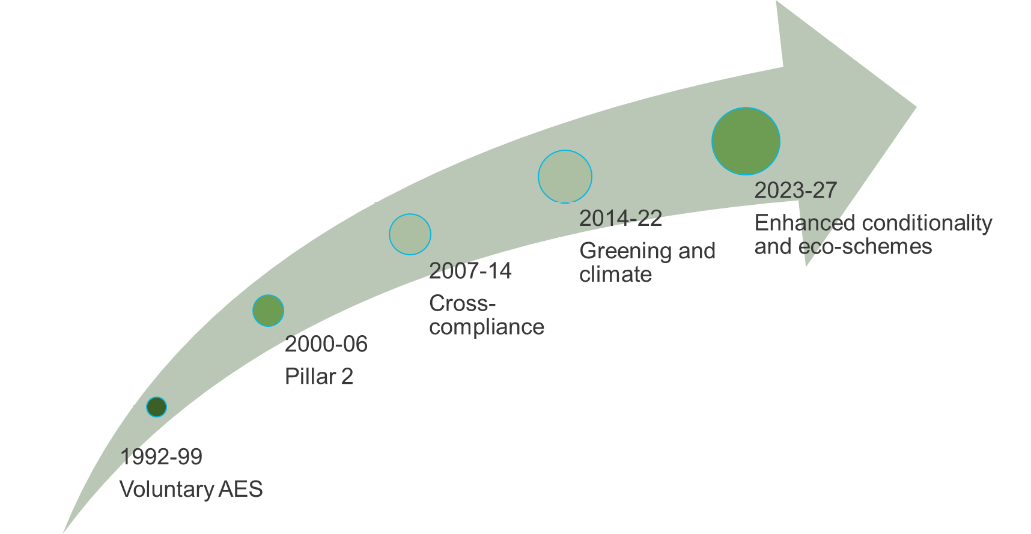
Since these reforms took place, there has also been an increasing scope of environmental requirements attached to the CAP payments (Figure 1). Since 2010, the European Union’s Producer Support Estimate (PSE) level and composition have remained almost unchanged, though increasingly with input constraints attached to payments, reflecting a greater integration of environmental and climate objectives (OECD, 2023; OECD, 2024).
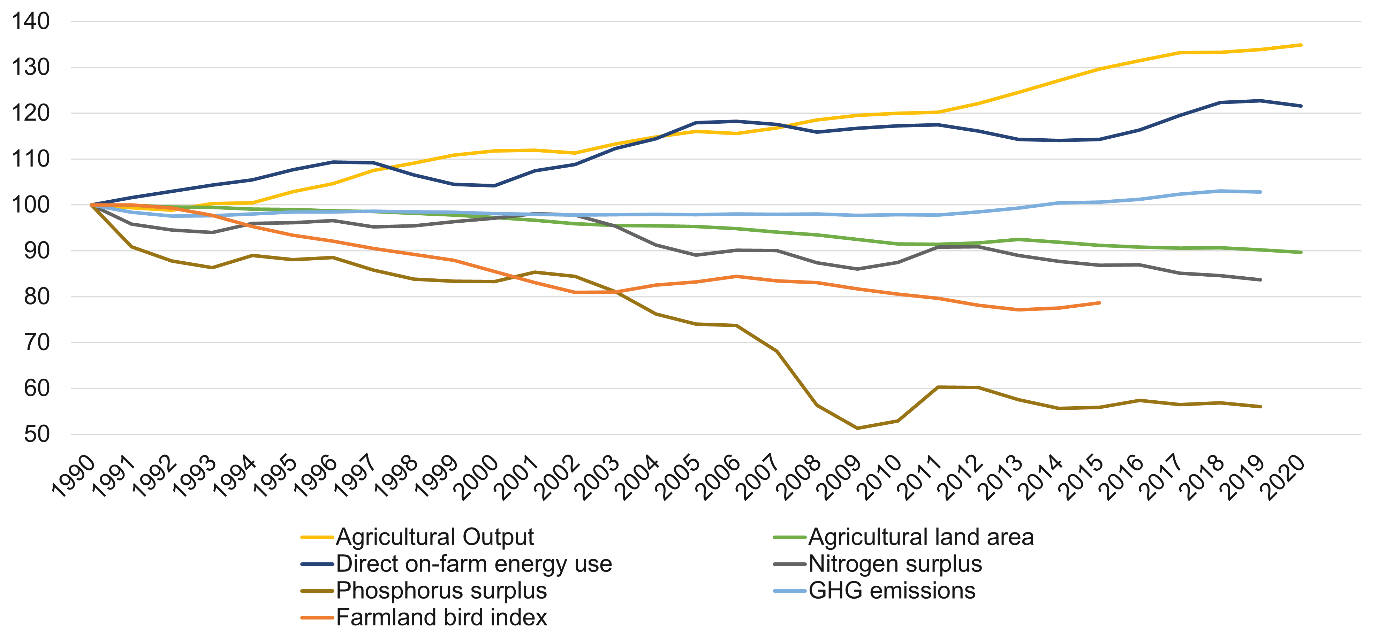
To reflect this evolution of agricultural policy objectives and impacts, a variety of agri-environmental indicators has been developed by countries and international organisations to track the environmental performance of the farming sector, particularly during the last two decades. For instance, the OECD agri-environmental database (OECD, 2023) shows trends and levels of a broad range of indicators, including on agricultural land use change, fertiliser use, water abstraction, on-farm energy consumption, GHG emissions and nutrient balances (Figure 2). These indicators were selected on the basis of data availability, and environmental and policy relevance. They provide an accurate comparable measurement of the main environmental pressures associated with agricultural activities. The OECD agri-environmental database allows to assess performance comparing trends across countries and between agricultural output growth and environmental outcomes. For instance, in the last three decades OECD countries significantly increased output while, at the same time, reduced nutrient balances. Trends in other environmental outcomes such as GHG emissions and farmland bird index are less promising.
Regardless of the performance of each country, the development of agri-environmental indicators has been an integral part of a new narrative that has increased the focus of agricultural policies on environmental sustainability. The measurement of these sustainability outcomes helps to develop a common understanding of the environmental goals and their links with agricultural production, practices and policies. These indicators have also inspired and informed attempts to combine economic and environmental performance into an environmentally sustainable productivity index in agriculture (Cobourn et al., 2024).
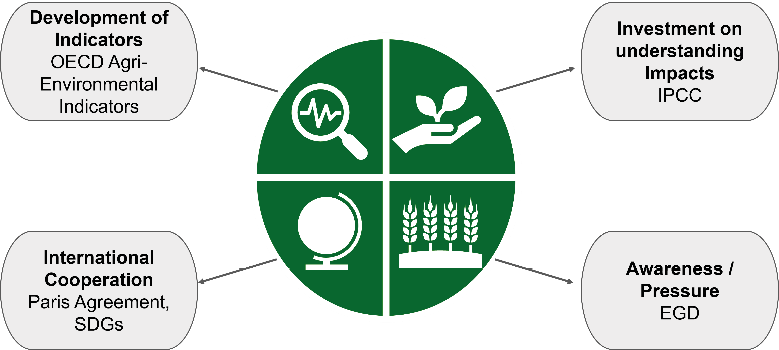
Climate change has been a global game changer or “catalysts” in the environmental policy agenda and, to a great extent, also in the agricultural sustainability debate. Indeed, climate change is a shared environmental concern and a global public good that has contributed to growing awareness on environmental sustainability (Figure 3) reflected in the European Green Deal EGD. Each country’s and each sector’s GHG emissions contribute cumulatively to the increase of the overall concentration of GHGs in the atmosphere, and then mitigating climate change through reduced emissions is a common goal for which there are already comparable methods to measure, and relevant indicators have been developed accordingly. Climate change also brings multiple related agri-environmental issues together because there are significant correlations among them. For instance, there are links between different emissions, water quality and nutrient imbalance, and between emissions and biodiversity. The work of the International Pannel on Climate Change (IPCC) has informed policymaking and international negotiations, including the UNFCC and the Paris Agreement, and has triggered and embedded a large body of research on measuring and understanding the environmental impacts of different economic activities and alternative policies (Guerrero, 2021; Lankoski, 2016; OECD, 2022; DeBoe, 2020). The analysis of climate change and of its relations to the agricultural sector not only has contributed to a new narrative that increasingly puts farmers in the driving seat of the contribution of agriculture to the environment, but it has also stimulated the development of a broad range of agri-environmental policies and regulations.
3. What are the policy challenges to advance towards social sustainability?
The food systems approach to policy making has incorporated not only agri-environmental concerns, but also consumer concerns and social issues (OECD, 2021), resulting in a growing concern for policy makers and research communities to improve well-being of farmers and their communities (Asai & Antón, 2024). Well-being of farmers is affected by a broad range of factors, which can be classified in four main groups: (1) Factors affecting farmers’ economic well-being (such as income and wealth); (2) Factors affecting the quality of life, including work and job quality; (3) Factors affecting the well-being of the community; and (4) Factors affecting the well-being of women, Indigenous Peoples and specific social groups.
As regards as the economic factors, regional inequalities and the urban-rural divide challenge the well-being of rural areas (Meloni et al., 2024; OECD, 2020). Based on the analysis of household disposable income in 25 European countries, Meloni et al. (2024) found that the income of rural households is lower than that of non-rural households. The proximity to urban centres plays an important role in shaping well-being of rural residents, including farmers (OECD, 2020). Rural places situated in closer proximity to urban centres exploit benefits from infrastructure development (e.g. hospitals and schools) and transportation because of improved access to human capital, external markets, and a wide array of services and environmental amenities. Remote areas, in contrast, face the largest challenges regarding connectivity, causing higher costs for transportation, infrastructure and service provision that affect the well-being of residents in these areas (OECD, 2020; OECD/EC-JRC, 2021).
Given that agricultural sector faces double challenges of aging and rural depopulation, encouraging generational renewal is a top priority for many countries. Nevertheless, young farmers encounter multiple obstacles both prior to entry and once in the sector (Campi et al., 2024). These obstacles include capital constraints, regulatory complexities, access to land and housing, lower access to services compared to other jobs, and lack of the networks needed to access resources. Negative social views of farming due to e.g. hard-working conditions, degrade the attractiveness of the profession and discourage new entrants (Campi et al., 2024). Furthermore, a ‘brain drain’ of young talents from rural areas challenges generational renewal (Kalantaryan et al., 2021; Zagata & Sutherland, 2015). Other studies also show that farms in more isolated regions are less prone to be inherited by the following generation (Aldanondo Ochoa et al., 2007).
As for the factors affecting the quality of life, agriculture is known for one of the most hazardous sectors worldwide, with numerous studies reporting elevated levels of occupational fatalities, injuries, and illnesses (WHO, 2004). As regards the working conditions, farmers may face long working hours, in particular during peak production seasons and under labour shortages (Marlenga et al., 2010; Hostiou et al., 2020). It was recently found that farmers working longer than 40 hours per week may be at higher risk for fatigue-related injury and illness (Elliott et al., 2022). In many cases farmers and those working in agriculture are also exposed to chemical pesticides, and this is linked to chronic illnesses such as cancer, and heart, respiratory and neurological diseases (Dhananjayan & Ravichandran, 2018).
Occupational stress, associated with longer working hours, compliance with increasing government regulations, weather volatility, and financial pressures is another factor that may have negative effects on quality of life and in some cases it can lead to mental health issues for farmers and their families (Farm Management Canada, 2020; Brennan et al., 2021; Daghagh Yazd et al., 2019). A range of ongoing occupational stressors associated with farming may contribute to place farmers at an elevated risk of suicide (Purc-Stephenson et al., 2023): evidence from Australia, France and the United States shows higher suicide rates of farmers than those working in other sectors (Miller & Rudolphi, 2022; Page & Fragar, 2002; Bossard et al., 2016; Hostiou et al., 2020).
Securing equal opportunities to work in safe conditions and the same access to care and health services is highly important for the individual well-being. The literature shows that in the farming sector such conditions are not always met and are challenged by climate change and structural transformations. Studies in Canada highlight three barriers for providing mental care services for farmers: accessibility of health services in rural areas; stigma around mental health in the agricultural community; and lack of health professionals who are familiar with the agricultural context (Farm Management Canada, 2020; Hagen et al., 2019).
Social capital is another important dimension of social sustainability and is key for higher community well-being. Inclusiveness may be achieved through better connections between people and in particular cultural events and leisure activities can lead to a higher sense of civic engagement for farmers and improved co-operation with other members of the community (Halstead et al., 2021; Rivera et al., 2018). Moreover, community involvement, trust and support can help people tackle challenges and opportunities, and contribute to improve individual well-being and resilience, helping individuals and communities to recover from, and more successfully adapt and transform in response to adverse events (Aldrich & Meyer, 2014; Adger, 2010). In contrast, rural crime, discrimination and social isolation lead to distrust among community members and lack of a sense of belonging, adversely impacting community well-being (Deller & Deller, 2010; Smith, 2020). The ongoing ageing and depopulation trends in rural areas may exacerbate this negative phenomenon.
Finally, there are unique challenges often faced by Women, Indigenous Peoples, and specific social groups, such as migrant farmworkers and people with disabilities, due to social and economic barriers and biases that hinder their access to income, land, food, health, education and training, and other services (OECD/FAO, 2016; Todd et al., 2024; ILO, 2023). Women tend to encounter longer unpaid working hours more often than men and have lower social security entitlements (FAO, 2020). In the European Union, only 31.6% of farm managers were female in 2020 (OECD, 2023), while in the United States, 7% of all farms were operated solely by women in 2017-2020 (Todd et al., 2024). These figures imply that women’s role in agricultural decision making, and farm and land ownership remains relatively modest.
For Indigenous Peoples the main inequalities concern their access to land (including land that was taken from their ancestors), education and training, as well as capital, which remains a significant barrier for Indigenous entrepreneurs and business owners (OECD, 2019). Migrant farmworkers often are (informally) hired on a casual, piecework or seasonal basis, and their work often involves long hours and difficult conditions under high risk of illnesses and injuries, while being insufficiently covered by social security (UN, 2009; Martin, 2016).
The actors and territories involved on these social issues are very heterogeneous and the challenges facing farmers and farmworkers are diverse. Different social circumstances may require different policies and tools and need targeted analysis. Furthermore, the bargaining position of farmers and farmworkers differs across locations and sectors and is a main source of inequalities both along the agrifood value chain and within the farming sector.
In the past decade, several OECD countries have incorporated social issues in the policies and programmes led by their respective ministries of agriculture. For example, generational renewal and social conditionality on employment conditions and on-farm safety and health are part of the goals and measures included under the European Union’s Common Agricultural Policy 2023-27 (OECD, 2023). Both Canada and New Zealand implement specific agricultural measures for Indigenous Communities, while, in the United States, the Department of Agriculture administers programmes that benefit the so defined “socially disadvantaged farmers and ranchers” (Todd et al., 2024; Asai & Antón, 2024). In Italy and Japan, the ministries fund “social farming” initiatives to create more inclusive opportunities for vulnerable groups at community level, such as promoting agricultural employment for persons with disabilities (Guirong & Oba, 2023; Borsotto & Giarè, 2020).
Table 1 presents an overview of five case studies from OECD countries with examples on how governments have approached issues of inequality and other social issues in agriculture: the definition of the issue, the policy rationale and the specific policy measures. Across these policy examples, policy makers have looked beyond traditional sectoral policies and seek to target social issues from a broader policy perspective, as agricultural policies are often not designed for the purpose of tackling these issues. The main types of policies in the toolbox applied in these examples are targeted measures on health, skills, training, social protection, legal reforms, research and data. Existing agricultural policies are not targeted to identified social issues and they are used only as accompanying measures (Switzerland) or potential sources of funding (Italy).
| Country | Social issues at stake | Rationale for policy interventions | Main policy instruments | ||||||||||||||||
|---|---|---|---|---|---|---|---|---|---|---|---|---|---|---|---|---|---|---|---|
| Canada (Case 1) |
Increasing number of farmers suffering from mental health problems. | Mitigate factors of farmers’ stress that could affect mental health | Support farmer mental health research Promote mental health literacy in agricultural communities |
||||||||||||||||
| Switzerland (Case 2) |
Many family members (e.g. wives) who work on the farm receive no financial renumeration and social protection. | Equal treatment across workers in agriculture and with other sectors | From 2027, extend social protection coverage to partners on farms as a precondition for direct payment | ||||||||||||||||
| Italy (Case 3) |
Lack of effective social and health services in some rural areas, and limited care services for vulnerable groups. | Inclusiveness opportunities for vulnerable groups through the Social Farming (SF) practices | Set-up networks for diversification of agricultural activities, (e.g. healthcare, education) and to carry SF | ||||||||||||||||
| New Zealand (Case 4) |
Economic pressures, demographic and social changes, and mental health challenge well-being of farmers and other citizens in remote rural communities. | Support “rural community hubs” to build social relationships and rural resilience | Start-up funding to help establish the “rural community hub” where people meet, discuss issues, have workshops etc. | ||||||||||||||||
| Japan (Case 5) |
Limited job opportunities for people with disabilities while agricultural sector faces an acute shortage of labour force. | Equal access to jobs and sources of income for persons with disabilities. Reduce labour shortages in agricultural sector |
Provide training courses and support to develop user-friendly facilities that reduce barriers to employment faced by persons with disabilities. | ||||||||||||||||
| Source: Based on Asai & Anton (2024). | |||||||||||||||||||
| Note: Information covers a selection of case studies collected from governments and experts in those case study countries/regions in the period of June 2023 - Feb 2024. | |||||||||||||||||||
4. Measuring social sustainability performance
The lack of appropriate data is a further challenge to advance in the social sustainability agenda in agriculture, making important social issues invisible to both policy makers and citizens. Greater understanding of issues around inequality and inclusiveness and the best policy approaches to address them requires appropriate data, indicators and measurement (Asai & Antón, 2024; Giner et al., 2022), which is challenging due to complexity, a missing social sustainability framework, lack of data and unstandardized indicators (Brennan et al., 2020; Janker & Mann, 2020). Figure 4 summarises the three main challenges associated with measuring social sustainability performance in agriculture: the lack of a clear and agreed definition of social sustainability; the data gaps to define and identify social issues; and the challenge to quantify social issues in indicators. Even if agri-environmental sustainability faces similar challenges, there has been a significant advancement in the last two decades as reflected in the set of agreed OECD agri-environmental indicators in Figure 2.
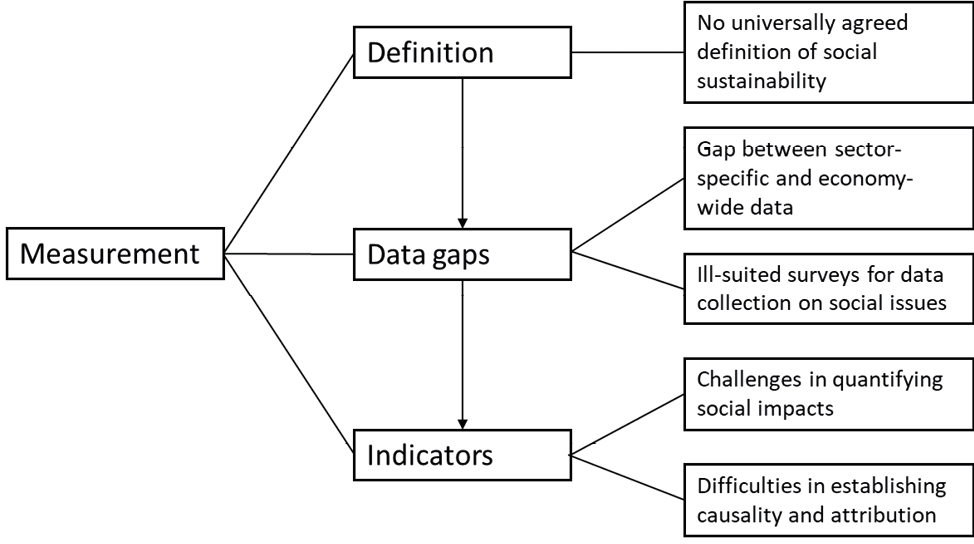
Despite the increasing interest, the common understanding of what constitutes social sustainability and how it might be achieved is limited (Janker et al., 2019; Asai & Antón, 2024; Nowack et al., 2022). Social sustainability is still considered as subjective and there is no consensus on the different aspects it should entail (Janker & Mann, 2020; Saleh & Ehlers, 2023). A universal definition is lacking and there is no widely acknowledged methodology for quantifying and assessing the social dimension of sustainability. Indicators on contracts, gender gaps and socioeconomic characteristics of the farming population are a good starting point. However, Janker & Mann (2020) performed an analysis of 87 farm-related social sustainability assessment tools finding a diversity of approaches: some tools are based on human rights and working rights according to the UN and ILO conventions and look for working conditions indicators, while others assess farmers’ perceptions of their quality of life.
Social issues may remain hidden if there is no data able to identify and define them. Evidence suggests that there is still a large gap between agricultural sector-specific (e.g. the Census of Agriculture) and economy-wide data on social issues (Asai & Antón, 2024). In many OECD countries, farmers represent a very small share of the total population and they are often under-sampled in general surveys that tend to be non-representative of the farmer population. For instance, although the EU’s Income and Living Conditions survey (EU-SILC)1 was not created for the assessment of farmers’ welfare, it allows for the identification of farmers and farm households (Marino et al., 2023). An attempt to analyse the income gaps between farm and non-farm households in EU Member states using EU-SILC was confronted to too small samples of farm households to allow a representative distributional analysis (Rocchi et al., 2020; Marino et al., 2021; Marino et al., 2023).
Having a small sample size poses a critical limitation on the use of general datasets for exploring social issues in agriculture, especially when focusing on smaller sub-groups within farming populations, notably those that are disadvantaged or vulnerable. Considering that the family farm remains the most common type of farm in many countries, women often engage in family unpaid labour that might not be recorded in statistics, which makes it difficult to acknowledge and assess (Giner et al., 2022). Regarding the racial and ethnic minorities in agriculture, some countries like the United States have a questionnaire on racial and ethnic, under- or un-reported cases are frequent due to incomplete survey responses with respect to race and ethnicity information (Lacy, 2023).
The surveys regularly conducted in the agricultural sector, including the Farm Accountancy Data Network (FADN) in Europe and the Agricultural Resource Management Survey (ARMS) in the United States, are primarily intended for economic purposes. Although there are ongoing initiatives to expand the scope of these surveys (e.g. from FADN to Farm Sustainability Data Network (FSDN) reflecting the CAP’s evolution towards sustainability), they may still not be well-suited to analyse social issues. Furthermore, most of the existing sectoral surveys focus on farmers, yet there are substantial data gaps regarding farmworkers, especially migrant and seasonal farmworkers, despite their important role in the agricultural sector in many countries (Ryan, 2023; Ramos et al., 2020). In economy-wide household surveys farm households are under-sampled, and migrant and seasonal farmworkers are not captured because they normally focus on the resident population (Kalantaryan et al., 2021). Some countries like Italy and the United States collect some data on seasonal foreign farmworkers (Antonioli et al., 2023; Castillo et al., 2022).
The self-employed status of many farmers is likely resulting in the under-reporting of incidents (e.g. accidents, injuries, illness and suicides). Studies from European countries found that farmers and farmworkers are unlikely to report injuries if they do not have an incentive such as insurance benefits (Merisalu et al., 2019). In areas such as mental health, it is difficult to ask sensitive questions on personal health or social relations through a survey (Brennan et al., 2020). Several studies highlight that a large share of actual cases of mental illness or suicide may be underreported due to social stigma in rural areas (Purc-Stephenson et al., 2023; Miller & Rudolphi, 2022). Finally, there are personal and social sensitivities that are country specific and make data collection on social issues particularly challenging. For instance, some countries such as Finland, Norway and Sweden, explicitly forbid the collection of statistics on ethnic identity (OECD, 2019). These data gaps make it harder to develop indicators to monitor and tackle social issues and to identify target groups.
Because social issues are complex and vary across countries and regions, context-specific data and analytical methods are used, requiring more qualitative indicators than for environmental and economic issues. Such indicators are subject to a high degree of subjectivity (Kelly et al., 2018) and are difficult to harmonise. The choice of social sustainability indicators is not only the result of a neutral scientific analysis, but also of societal choice reflecting a diversity of views.
Finally, another challenge is identifying drivers that hinder some aspects of well-being in a manner that is specific for farmers or their communities (Asai & Antón, 2024). This analysis is critical to identify the need for policies that specifically tackle social sustainability in an agricultural context. Information regarding these driving factors and causal relations is frequently limited. There is a risk of a vicious circle between the shortage of data for identifying policy demands and the lack of clear policy priorities for funding data initiatives.
5. Looking for a catalyst on social sustainability
Therefore, despite the increasing policy interest around the dimensions that affect the well-being of farmers, their families and farmworkers, and that of the communities in which they live, defining and tackling social issues in agriculture is complex. There are four main bottlenecks summarised in Figure 5. First, there is no consensus on what constitutes a social issue. The nature of social sustainability includes social processes and interactions that emerge within a community and makes it difficult to identify a coherent, clear and utilisable definition (Eizenberg & Jabareen, 2017). Moreover, subjectivity often comes into play in people’s judgments that a particular state of affairs constitutes a social issue (Kulik, 2023). This is frequent in any analysis of agriculture, but in the case of social issues the driving factors go beyond complex production conditions into personal, health and community linkages.
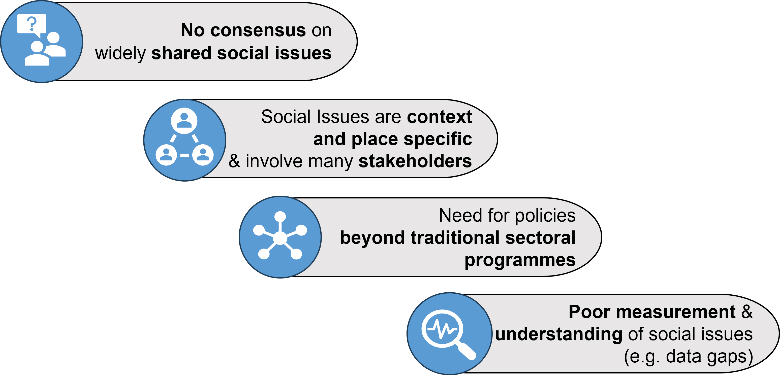
Second, social issues are often context specific and addressing them requires considering different perspectives and sensitivities of stakeholders. Urban-rural inequalities play an important role in shaping well-being of rural residents, including farmers (OECD, 2020; Meloni et al., 2023). Thus, social issues can benefit from a place-based approach because they are associated with a specific location. Possible solutions often derive from the local context, and policy interventions are often away from the traditional agricultural policy areas (OECD, 2020; Asai et al., 2023).
Third, tackling social issues requires policies that go beyond traditional sectoral programmes. Agricultural policies focus mainly on economic and environmental outcomes of the sector, often leaving social objectives and implications to other policy areas. However, the agricultural sector is only a small player for social policy partners and its specificities and policy context may be overlooked. As confirmed by the five policy examples in Table 1, defining and tackling social issues in agriculture requires policies beyond traditional sectoral programmes (Asai et al., 2023; Janker & Mann, 2020; Saleh & Ehlers, 2023).
Finally, as discussed in section 4, social issues are often poorly measured due to the lack of data and data infrastructure, and subsequent unstandardised indicators. The trade-offs between social and economic sustainability are, therefore, difficult to assess. For instance, how better working conditions affect productivity.
Considering these bottlenecks, a game changer seems necessary to advance on the social sustainability agenda in agriculture, similarly to what climate change measurement and analysis represented in the context of the green transition. This does not mean that social sustainability must come after environmental sustainability in a sequential manner. Policy trends towards environmental and social sustainability may have the same policy roots, but they may need different triggers to effectively become main drivers of policy changes and impacts.
The policy agenda for a more inclusive transition could benefit from an indicator that is easily measurable and highly correlated with social sustainability issues, and that allows cross-comparison among countries, regions and social groups. Income inequality has a good potential to play a catalyst role on social sustainability, since it meets several critical conditions. Although not perfect, income inequality is a widely social concern and affects all the population, and it is also correlated to many dimensions that are currently characterising the social sustainability debate in agriculture, including health, gender, marginalized groups, decent work and social capital. Of course, a complete analysis of social issues should also include access to public services and infrastructure that also contribute to well-being.
Together with wealth, income largely determines the ability of individuals to meet their basic needs (e.g. food, housing, healthcare, transportation, education) and to make choices that contribute to security, satisfaction and personal fulfilment (Meloni et al., 2024; OECD, 2020; Meloni et al., 2023). Thus, addressing income-related inequalities is critical to achieve overall economic well-being. In the agricultural policy debate, such issues have been discussed for a long time to justify policy support aiming to address the assumption of lower income in agriculture business as compared to other production activities (Rocchi et al., 2020; Katchova, 2008). However, the social sustainability debate would benefit from a broader perspective on income, by looking not only at the level of farm income, but also looking at: the farm household income and income of those working in farming and food sector; the income distribution differences by gender and with other sectors; and the differences among agricultural, rural and non-rural households. It should also entail by focusing on policies tackling income inequalities and their impacts on low household income and poverty among those making their living from agriculture, rather than focusing solely on increasing farm income (OECD, 2023; OECD, 2003).
Recent studies show that in the European Union farm household incomes on average are not particularly lower compared to non-farm household incomes (Rocchi et al., 2020; Marino et al., 2021; Mittenzwei et al., 2024), while others have shown that income inequality and poverty are greater in the farm community compared to the non-farm community (de Frahan et al., 2017). However, the lack of data is the main constraint for an accurate assessment. Administrative, political, and technical obstacles hinder the collection of comprehensive farm household data and currently there is no reliable system to allow income comparisons among farmers, farm workers and those in other sectors of the economy (Hill & Bradley, 2015; ECA, 2016; OECD, 2023).
Improving the understanding of the income distribution issues related to farms, farm households and rural households could help to move forwards the social sustainability agenda also from an agricultural policy perspective. As showed in Figure 6, in the context of the CAP, direct payments to farmers decoupled from production, which represent an important part of farm income, have been increasingly linked to several environmental requirements under conditionality. However, direct payments are distributed to households based on the amount of land used rather than on their overall household income. A full sustainable (social and environmental) transition would lead to a shift in the policy mix towards more targeted payments to farm households suffering from low-income, and to result-based agri-environmental payments (OECD, 2023).
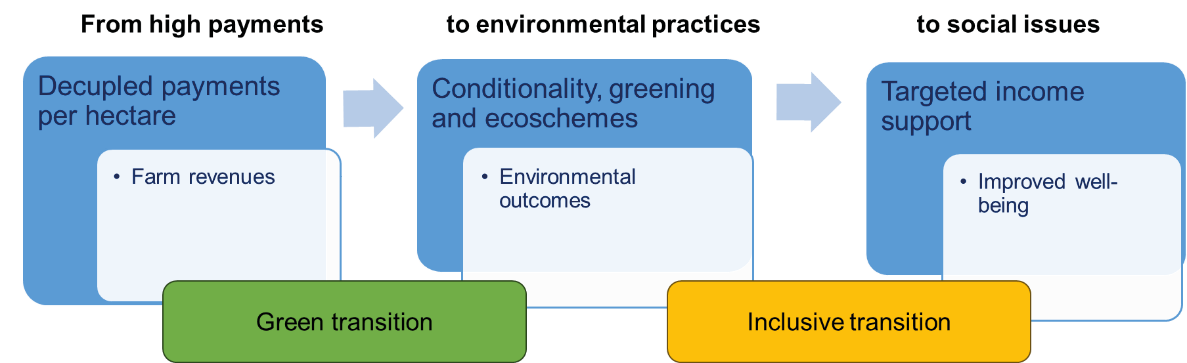
In addition to these targeted payments, other EU and national agricultural policies could contribute to the inclusive transition. For example, EU rural development policy includes a range of measures some of which may increase the attractiveness of rural areas and promote agricultural entrepreneurship. The provision of public services such as education, health and transport is particularly relevant to improve well-being and social sustainability. Social conditionality was also introduced in the CAP 2023-27, with the overall objective of linking farmer payments to compliance with certain labour laws. Although all these policy tools have potential to improve, among other, the well-being and working conditions of farmers and the agricultural labour force, they are not targeted to income distribution issues.
Stronger evidence on disposable income could allow to have a better understanding of the standard of living of farmers, since income is strongly interlinked with key dimensions of well-being including, among other, job quality, housing, health and work-life balance. Thus, improving the availability and access to micro-economic datasets for the assessment of the income aspect of policies not only at farm level but at the household level could be a very important step in monitoring and tackling social sustainability issues in agriculture.
Such a data investment would provide policy makers with a proxy for the well-being of farm households and then a tool to better define the rationale of income support and to target it to legitimate social objectives (OECD, 2023). A more accurate measurement of total farm household income would also allow to assess the potential impact of agriculture policies as compared to non-sectoral policies such as social policies on income and ensuring livelihoods, as well as to contributing to other social sustainability objectives. Data availability and needed investments to measure farm household income deserves a separate in-depth analysis.
Social issues are gaining momentum in research and policy discussions on agricultural sustainability. This is the result of multiple drivers, including increasing anecdotal evidence of inequalities and quality of life issues that are specific to the agricultural sector. Similarly to environmental issues twenty years ago, social sustainability today lacks a clear and shared definition, and a common and well-established metrics to tackle its complexity and its multiple and interrelated dimensions. Measuring and analysing climate change, together with other agri-environmental indicators, has contributed to create a new agri-environmental policy narrative based on metrics related to the environmental sustainability of agriculture.
Recently, governments have made efforts to focus their policies on achieving agricultural “sustainable productivity growth” (SPG) (OECD, 2024). The concept of SPG is based on the idea of increasing productivity while reducing the pressures on the environment. The need to also cover the social aspects of sustainability has emerged in the discussion on measuring the SPG (OECD, 2024). The main difficulty of measuring social sustainability performance is its many dimensions and context-specificity (Asai & Antón, 2024; Janker & Mann, 2020)
Despite this limitation and other existing bottlenecks in addressing social sustainability, an increasing number of governments has started to approach the issues of inequality, inclusiveness and other social issues in agriculture. Since agricultural policies are often not designed for the purpose of tackling social issues, seeking for cross-sectoral approaches and collaboration with other policy areas and stakeholders can help to design policy mixes targeted to the sector’s social concerns. However, the lessons from agri-environmental sustainability show that to advance on the social sustainability agenda a new narrative is needed based on clear definitions and metrics. The design and implementation of suitable policy mixes needs an evidence-based approach to respond to the most pressing social issues.
In a context where available statistical tools are not sufficient to measure the well-being of farm households and farm workers, measuring income inequalities could be a catalyst to advance on the research and policy agenda on social sustainability through both a new narrative and a new set of indicators. In particular, more reliable data on agricultural household income could be an important first step to design more effective and targeted income support that responds to social sustainability concerns. Investing on data to build a new evidence-based narrative on the sustainable transition of agriculture, that needs to be greener, but also more inclusive and socially sustainable.
This paper does not represent the views of the OECD or of its member countries. The opinions expressed and arguments employed are those of the authors.
This paper builds on the findings from the recent OECD works on agricultural policy reviews (OECD, 2023; OECD, 2024) and social issues in agriculture (Asai & Antón, 2024), and on a keynote presentation at the AIEAA Conference in Bari (Italy) in July 2024 (Antón et al., 2024).
The authors wish to acknowledge the valuable supports made by Helena Rasch and Leonie Gollisch during their internship at the OECD. The authors are also grateful to members of the OECD Farm-Level Analysis Network and country experts who provided case studies.
Adger, W. N., 2010. Social Capital, Collective Action, and Adaptation to Climate Change. In: Der Klimawandel. s.l.:VS Verlag für Sozialwissenschaften, Wiesbaden, pp. 327-345.
Aldanondo Ochoa, A. M., Casanovas Oliva, V. & Almansa Sáez, C., 2007. Explaining farm succession: the impact of farm location and off-farm employment opportunities. Spanish Journal of Agricultural Research, 5(2), 214-225.
Aldrich, D. P. & Meyer, M. A., 2014. Social Capital and Community Resilience. American Behavioral Scientist, 59(2), 254-269.
Antonioli, F., Severini, S. & Vigani, M., 2023. Visa for competitiveness: foreign workforce and Italian dairy farms’ performance. European Review of Agricultural Economics, 50(1), 115-150. https://doi.org/10.1093/erae/jbab045
Antón, J., Asai, M., Rasch, H. & Vanni, F., 2024. Reconciling productivity and sustainability: are agricultural policies in OECD countries changing compass?. Bari, 13th AIEAA Conference.
Asai, M. & Antón, J., 2024. Social issues in agriculture in rural areas, OECD Food, Agriculture and Fisheries Papers, No. 212, OECD Publishing, Paris, https://doi.org/10.1787/fec15b38-en
Asai, M., Dwyer, J., Antón, J. & Garcilazo, E., 2023. Fostering agricultural and rural policy dialogue. OECD Food, Agriculture and Fisheries Papers, No. 197, OECD Publishing, Paris, https://doi.org/10.1787/d36fcbad-en
Borsotto, P. & Giarè, F., 2020. L’agricoltura sociale: un’opportunità per le realtà italiane. In: Rapporto 2020. Programma Rete Rurale Nazionale 2014-2020.
Bossard, C., Santin, G. & Guseva Canu, I., 2016. Suicide Among Farmers in France: Occupational Factors and Recent Trends. Journal of Agromedicine, 21(4), 310-315. https://doi.org/10.1080/1059924X.2016.1211052. PMID: 27409004
Brennan, M., Hennessy, T. & Dillon, E., 2020. Towards a better measurement of the social sustainability of Irish agriculture. International Journal of Sustainable Development, 23(3/4), 263-287. https://doi.org/10.1504/IJSD.2020.115229
Brennan, M., Hennessy, T., Meredith, D. & Dillon, E., 2021. Weather, Workload and Money: Determining and Evaluating Sources of Stress for Farmers in Ireland. Journal of Agromedicine, 27(2), 32-142. https://doi.org/10.1080/1059924X.2021.1988020
Bureau, J. & Antón, J., 2022. Agricultural Total Factor Productivity and the environment: A guide to emerging best practices in measurement. OECD Food, Agriculture and Fisheries Papers, No. 177, OECD Publishing, Paris, https://doi.org/10.1787/6fe2f9e0-en
Campi, M. et al., 2024. The evolving profile of new entrants in agriculture and the role of digital technologies, OECD Food, Agriculture and Fisheries Papers, No. 209, OECD Publishing, Paris, https://doi.org/10.1787/d15ea067-en
Castillo, M., Philip, M. & Zachariah, R., 2022. The H-2A Temporary Agricultural Worker Program in 2020, U.S. Department of Agriculture, Economic Research Service.
Cobourn, K., O’Donnell, C., Antón, J. & Henderson, B., 2024. An Index Theory Based Approach to Measuring the Environmentally Sustainable Productivity Performance of Agriculture. OECD Food, Agriculture and Fisheries Papers, No. 213, OECD Publishing, Paris, https://doi.org/10.1787/bf68fb78-en
Collins, L. A., McDonald, T. M., Giri, A. K. & Subedi, D., 2023. The relative financial performance of African American farms in the United States since the Great Recession. Applied Economic Perspectives and Policy, 46(1), 32-51. https://doi.org/10.1002/aepp.13346
Daghagh Yazd, S., Wheeler, S. & Zuo, A., 2019. Key Risk Factors Affecting Farmers’ Mental Health: A Systematic Review. International Journal of Environmental Research and Public Health, 16, 4849. https://doi.org/10.3390/ijerph16234849. PMID: 31810320
de Frahan, B. H., Dong, J. & De Blander, R., 2017. Farm Household Incomes in OECD Member Countries over the Last 30 Years of Public Support, LIS Working Paper Series, No. 700, Luxembourg Income Study (LIS), Luxembourg.
DeBoe, G., 2020. Economic and environmental sustainability performance of environmental policies in agriculture, OECD Food, Agriculture and Fisheries Papers, No. 140, OECD Publishing, Paris, https://doi.org/10.1787/3d459f91-en
Deller, S. C. & Deller, M. A., 2010. Rural Crime and Social Capital. Growth and Change, 41(2), 221-275. https://doi.org/10.1111/j.1468-2257.2010.00526.x
Dhananjayan, V. & Ravichandran, B., 2018. Occupational health risk of farmers exposed to pesticides in agricultural activities. Current Opinion in Environmental Science & Health, 4, 31-37. https://doi.org/10.1016/j.coesh.2018.07.005
ECA, 2016. Is the Commission’s system for performance measurement in relation to farmers’ incomes well designed and based on sound data?, Luxembourg: European Court of Auditors.
Eizenberg, E. & Jabareen, Y., 2017. Social Sustainability: A New Conceptual Framework. Sustainability, 9(1). https://doi.org/10.3390/su9010068
Elliott, K. C. et al., 2022. Working hours, sleep, and fatigue in the agriculture, forestry, and fishing sector: A scoping review. American Journal of Industrial Medicine, 65(11), 898-912.
FAO, 2020. Gender Equality and Women’s Empowerment in the context of Food Security and Nutrition. FAO, Rome.
FAO, 2022. Sustainable Food and Agriculture. FAO, Rome.
Farm Management Canada, 2020. Healthy Minds, Healthy Farmers: Exploring the Connection between Mental Health and Farm Business Management. [Online] Available at: https://fmc-gac.com/wp-content/uploads/2020/07/finalreport.pdf
Finger, R. et al., 2024. Farmer Protests in Europe 2023-2024. EuroChoices, 23(3), 59-63. https://doi.org/10.1111/1746-692X.12452
Gardner, B. L., 1992. Changing Economic Perspectives on the Farm Problem. Journal of Economic Literature, 30(1), 62-101.
Giddings, B., Hopwood, B. & O’Brien, G., 2002. Environment, economy and society: fitting them together into sustainable development. Sustainable Development, 10, 187-196. https://doi.org/10.1002/sd.199
Giner, C., Hobeika, M. & Fischetti, C., 2022. Gender and food systems: Overcoming evidence gaps. OECD Food, Agriculture and Fisheries Papers, No. 199, OECD Publishing, Paris, https://doi.org/10.1787/043db97b-en
Guerrero, S., 2021. Characterising agri-environmental policies: Towards measuring their progress. OECD Food, Agriculture and Fisheries Papers, No. 155, OECD Publishing, Paris, https://doi.org/10.1787/41257e3c-en
Guirong & Oba, S., 2023. Potential People of Disability in Agriculture, as Social Farming in Japan, Compared with Other Countries. Reviews in Agricultural Science, 11, 181-202. https://doi.org/10.7831/ras.11.0_181
Hagen, B. N. M. et al., 2019. Research trends in farmers’ mental health: A scoping review of mental health outcomes and interventions among farming populations worldwide. PLOS ONE, 14(12), e0225661. https://doi.org/10.1371/journal.pone.0225661
Halstead, J. M., Deller, S. C. & Leyden, K. M., 2021. Social capital and community development: Where do we go from here? Community Development, 53(1), 92-108. https://doi.org/10.1080/15575330.2021.1943696
Hill, B. & Bradley, B. D., 2015. Comparison of farmers’ incomes in the EU member states, Brussels: European Parliament.
Hostiou, N., Vollet, D., Benoit, M. & Delfosse, C., 2020. Employment and farmers’ work in European ruminant livestock farms: A review. Journal of Rural Studies, 74, 223-234. https://doi.org/10.1016/j.jrurstud.2020.01.008
Howden, S. et al., 2007. Adapting agriculture to climate change. Proc. Natl. Acad. Sci. USA, 104, 19691–19696. https://doi.org/10.1073/pnas.0701890104
HSE, 2023. Agriculture, forestry and fishing statistics in Great Britain, 2023, s.l.: Health and Safety Executive.
ILO, 2023. Policy guidelines for the promotion of decent work in the agri-food sector – Meeting of Experts on Decent Work in the Agri-food Sector: An Essential Part of Sustainable Food Systems (Geneva, 8–12 May 2023).
Janker, J. & Mann, S., 2020. Understanding the social dimension of sustainability in agriculture: a critical review of sustainability assessment tools. Environment, Development and Sustainability, 22, 1671–1691. https://doi.org/10.1007/s10668-018-0282-0
Janker, J., Mann, S. & Rist, S., 2019. Social sustainability in agriculture – A system-based framework. Journal of Rural Studies, 65, 32-42. https://doi.org/10.1016/j.jrurstud.2018.12.010
Kalantaryan, S., Scipioni, M., Natale, F. & Alessandrini, A., 2021. Immigration and integration in rural areas and the agricultural sector: An EU perspective. Journal of Rural Studies, 88, 462-472. https://doi.org/10.1016/j.jrurstud.2021.04.017
Katchova, A. L., 2008. A Comparison of the Economic Well‐Being of Farm and Nonfarm Households. American Journal of Agricultural Economics, 90(3), 733-747. https://doi.org/10.1111/j.1467-8276.2007.01128.x
Kelly, E. et al., 2018. Sustainability indicators for improved assessment of the effects of agricultural policy across the EU: Is FADN the answer?. Ecological Indicators, 89, 903-911. https://doi.org/10.1016/j.ecolind.2017.12.053
Kulik, R. M., 2023. “Social issue”. [Online] Available at: https://www.britannica.com/topic/social-issue [Accessed 4 October 2023].
Lacy, K., 2023. Race and Ethnicity of U.S. Farmers and Ranchers: Background, Data, and Recent Trends. Presentation for the OECD Farm-Level Analysis Network (FLAN) 32nd Meeting.
Lankoski, J., 2016. Alternative Payment Approaches for Biodiversity Conservation in Agriculture. OECD Food, Agriculture and Fisheries Papers, No. 93, OECD Publishing, Paris, https://doi.org/10.1787/5jm22p4ptg33-en
Marino, M., Rocchi, B. & Severini, S., 2021. Conditional Income Disparity between Farm and Non‐farm Households in the European Union: A Longitudinal Analysis. Journal of Agricultural Economics, 72(2), 589-606. https://doi.org/10.1111/1477-9552.12420
Marino, M., Rocchi, B. & Severini, S., 2023. Assessing the Farm–Nonfarm Households’ Income Gap along the Income Distribution in the European Union. JCMS: Journal of Common Market Studies, 62(2), 318-340. https://doi.org/10.1111/jcms.13494
Marlenga, B. et al., 2010. Impact of Long Farm Working Hours on Child Safety Practices in Agricultural Settings. The Journal of Rural Health, 26(4), pp. 366-372. https://doi.org/ 10.1111/j.1748-0361.2010.00304.x
Martin, P. L., 2016. Migrant Workers in Commercial Agriculture. International Labour Office, Geneva.
Matthews, A., 2024. Farmer Protests and Income Developments in the EU. The Political Quarterly, Volume 95, 344-349. https://doi.org/10.1111/1467-923X.13396
Meloni, C. et al., 2024. Are rural households poorer than non-rural households in Europe?. Journal of Rural Studies, 106, 103214. https://doi.org/10.1016/j.jrurstud.2024.103214
Meloni, C., Rocchi, B. & Severini, S., 2023. A systematic literature review on the rural-urban economic well-being gap in Europe. Bio-based and Applied Economics, 12(4), 305-321. https://doi.org/10.36253/bae-13178
Merisalu, E., Leppälä, J., Jakob, M. & Rautiainen, R., 2019. Variation in Eurostat and national statistics of accidents in agriculture. Agronomy Research, 17(5), 1969-1983. https://doi.org/10.15159/AR.19.190
Miller, C. D. M. & Rudolphi, J. M., 2022. Characteristics of suicide among farmers and ranchers: Using the CDC NVDRS 2003–2018. American Journal of Industrial Medicine, 65(8), 675-689. https://doi.org/10.1002/ajim.23399
Mittenzwei, K. et al., 2024. Decomposing household income differences between farmers and non‐farmers: Empirical evidence from Norway. Journal of Agricultural Economics, , 75(2), 672-687. https://doi.org/10.1111/1477-9552.12579
Moser, R. & Saner, K., 2022. Les femmes dans l’agriculture: Rapport sur l’étude 2022, AGRIDEA.
Nowack, W., Schmid, J. C. & Grethe, H., 2022. Social dimensions of multifunctional agriculture in Europe - towards an interdisciplinary framework. International Journal of Agricultural Sustainability, 20(5), 758-773. https://doi.org/10.1080/14735903.2021.1977520
OECD/EC-JRC, 2021. Access and Cost of Education and Health Services: Preparing Regions for Demographic Change. OECD Rural Studies, OECD Publishing, Paris, https://doi.org/10.1787/4ab69cf3-en
OECD/FAO, 2016. OECD-FAO Guidance for Responsible Agricultural Supply Chains. OECD Publishing, Paris. https://doi.org/10.1787/9789264251052-en
OECD, 2003. Farm Household Income: Issues and Policy Responses. Paris: OECD Publishing.
OECD, 2019. Linking Indigenous Communities with Regional Development. OECD Rural Policy Reviews, OECD Publishing, Paris, https://doi.org/10.1787/3203c082-en
OECD, 2020. How’s Life? 2020: Measuring Well-being. OECD Publishing, Paris, https://doi.org/10.1787/9870c393-en
OECD, 2020. Rural Well-being: Geography of Opportunities. OECD Rural Studies, OECD Publishing, Paris, https://doi.org/10.1787/d25cef80-en
OECD, 2021. Making Better Policies for Food Systems. OECD Publishing, Paris. https://doi.org/10.1787/ddfba4de-en
OECD, 2022. Making Agri-Environmental Payments More Cost Effective. OECD Publishing, Paris. https://doi.org/10.1787/4cf10d76-en
OECD, 2023. Measuring the Environmental Performance of Agriculture Across OECD Countries, Paris: OECD Publishing. https://doi.org/10.1787/4edcd747-en
OECD, 2023. Policies for the Future of Farming and Food in the European Union. OECD Agriculture and Food Policy Reviews, OECD Publishing, Paris, https://doi.org/10.1787/32810cf6-en
OECD, 2024. Agricultural Policy Monitoring and Evaluation 2024. Innovation for Sustainable Productivity Growth, OECD Publishing, Paris, https://doi.org/10.1787/74da57ed-en
Olesen, E. J. & Bindi, M., 2002. Consequences of climate change for European agricultural productivity, land use and policy. European Journal of Agronomy, 16(4), 239-262. https://doi.org/10.1016/S1161-0301(02)00004-7
Page, A. N. & Fragar, L. J., 2002. Suicide in Australian Farming, 1988–1997. Australian & New Zealand Journal of Psychiatry, 36(1), 81-85. https://doi.org/10.1046/j.1440-1614.2002.00975.x
Purc-Stephenson, Doctor & Keehn, 2023. Understanding the factors contributing to farmer suicide: a meta-synthesis of qualitative research. Rural and Remote Health, (3)8189. https://doi.org/10.22605/RRH8189
Ramos, A. K., Girdžiūtė, L., Starič, J. & Rautianinen, R. H., 2020. Identifying “Vulnerable Agricultural Populations” at Risk for Occupational Injuries and Illnesses: A European Perspective. Journal of Agromedicine, 26(3), 340-345. https://doi.org/10.1080/1059924X.2020.1771498
Riethmuller, M. L., Dzidic, P. L., McEvoy, P. M. & Newnham, E. A., 2023. Change, connection and community: A qualitative exploration of farmers’ mental health. Journal of Rural Studies, 97, 591-600. https://doi.org/10.1016/j.jrurstud.2023.01.018
Rivera, M., Knickel, K., María Díaz‐Puente, J. & Afonso, A., 2018. The Role of Social Capital in Agricultural and Rural Development:Lessons Learnt from Case Studies in Seven Countries. Sociologia Ruralis, 59(1), 66-91. https://doi.org/10.1111/soru.12218
Rocchi, B., Marino, M. & Severini, S., 2020. Does an Income Gap between Farm and Nonfarm Households Still Exist? The Case of the European Union. Applied Economic Perspectives and Policy, 43(4), 1672-1697. https://doi.org/10.1002/aepp.13116
Ryan, M., 2023. Labour and skills shortages in the agro-food sector. OECD Food, Agriculture and Fisheries Papers, No. 189, OECD Publishing, Paris, https://doi.org/10.1787/ed758aab-en
Saleh, R. & Ehlers, M., 2023. Exploring farmers’ perceptions of social sustainability. Environment, Development and Sustainability, 27, 6371–6396. https://doi.org/10.1007/s10668-023-04140-w
Sartor, L., 2021. Farmer Suicides - Exploring Ten Yeas of Coronial Data (2009-2018). [Online] Available at: https://www.ruralhealth.org.au/news/first-national-study-farmer-suicide-rates-using-coronial-data
Smith, K., 2020. Desolation in the countryside: How agricultural crime impacts the mental health of British farmers. Journal of Rural Studies, 80, 522-531. https://doi.org/10.1016/j.jrurstud.2020.10.037
Todd, J., Whitt, C., Key, N. & Mandalay, O., 2024. An Overview of Farms Operated by Socially Disadvantaged, Women, and Limited Resource Farmers and Ranchers in the United States, (Report No. EIB-266). U.S. Department of Agriculture, Economic Research Service. https://doi.org/10.32747/2024.8254670.ers
UN, 2009. Large-scale land aquisitions and leases: A set of minimum principles and measures to address the human rights challenge.
WHO, 2004. Health of workers in agriculture, WHO Regional Publications, Eastern Mediterranean Series 25.
Zagata, L. & Sutherland, L. A., 2015. Deconstructing the ‘young farmer problem in Europe’: Towards a research agenda. Journal of Rural Studies, 38, 39-51. https://doi.org/10.1016/j.jrurstud.2015.01.003
1 EU-SILC is a harmonised household survey that collects multidimensional microdata on income, poverty, social exclusion and living conditions in Europe.