Received: February 14, 2025; Accepted: November 25, 2025; Published: 2025-12-30
The potential of digital agriculture start-ups to reshape market dynamics in the ag-input industry: A case study from Argentina
1 Laboratorio de Innovación y Emprendimientos (LINE), Facultad de Ciencias Empresariales, Universidad Austral, Argentina
2 Centro de Agronegocios y Alimentos (CEAg), Facultad de Ciencias Empresariales, Universidad Austral, Argentina
3 Center for Development Research (ZEF), Universität Bonn, Germany
*Corresponding author. E-mail: pmacclay@austral.edu.ar
Abstract. Agri-food global value chains (GVCs) face growing pressure to enhance productivity and environmental sustainability, with technological innovation playing a critical role. In this context, start-ups have emerged as key innovation developers. This study provides a qualitative, exploratory analysis of the technological characteristics of 114 digital agriculture (DA) start-ups in Argentina. We have characterized their solutions and proposed implications for the industrial dynamics in agricultural input markets. Our analysis implies that most DA innovations tend to be complementary to existing technological packages rather than being disruptive. While these start-ups introduce innovative solutions, they currently seem to hold limited capacity to challenge the market dominance of large multinational agricultural input firms. By exploring the intersection of innovation and market structures, this study provides valuable insights into the evolving industrial dynamics of ag-input markets in agri-food GVCs. The findings offer strategic implications for start-ups, incumbents, and policymakers.
Keywords: start-ups, digital agriculture, innovation, industrial organization.
Index
2. The agricultural input industry in the face of the digital transition
3.1. Interactions between incumbents and start-ups in the context of technological change
3.2. Dimensions of analysis: materiality and functional integration of innovations
4.2. Identifying and classifying DA start-ups
5. Results: characterizing Argentine start-ups
5.1. Initial identification of DA start-ups
5.2. Characterization of DA start-ups according to their technological features
6. Discussion: Can DA start-ups change industrial dynamics in the ag-input markets?
Over the past decades, agri-food systems have undergone profound transformations driven by accelerated urbanization, technological change, and novel production techniques, resulting in significant gains in both productivity and food availability (Barrett et al., 2022; FAO, 2017; Reardon et al., 2019). However, global agri-food value chains (GVCs) continue to face substantial challenges related to addressing multiple imperatives: increasing food production for a growing global population, supporting agricultural-dependent emerging economies in their development trajectories, implementing more sustainable and efficient production practices that align with new social and environmental standards, and developing resilience to climate change impacts (Cerutti et al., 2023; Crippa et al., 2021; Yang et al., 2024).
In response to increasing pressure, we have seen in recent years the development of a large set of technologies aimed at enhancing the resilience of GVCs to potential shocks and steering them toward more sustainable trajectories (Costa et al., 2022; Wang et al., 2021). Unlike a few decades ago, when innovations were mainly concentrated in the R&D departments of large companies, today many innovations in this field are rooted in small technology-based companies and start-ups, known as agrifoodtech start-ups (Klerkx & Villalobos, 2024; Mac Clay et al., 2024). These companies, increasingly recognized as key players in the transformation of GVCs, offer solutions across the entire agri-food value chain, from upstream activities such as farming inputs and agricultural production, through food processing and distribution, all the way to downstream segments that connect with the end consumer. Among this large set of agrifoodtech start-up companies, a specific group is focused on providing digital agriculture (DA) solutions to the upstream segment of the value chain (McFadden et al., 2022, 2023; Wolfert et al., 2023), contributing to enhance farm-level data analysis, decision-making, and automation through technologies such as artificial intelligence, the Internet of Things (IoT), big data, robotics, sensors, remote sensing, platform technologies and blockchain, among others (Klerkx et al., 2019; Klerkx & Rose, 2020; Lezoche et al., 2020)1.
In recent years, Latin America has witnessed rapid growth in the number of start-ups focused on food and agriculture, particularly in Brazil and Argentina, which account for 51% and 23% of these companies in the region, respectively (Bisang et al., 2022; Vitón et al., 2019). In particular, the dynamism of Argentina in this field can be attributed to a combination of factors. Externally, the country ranks as the world’s third-largest net food exporter (World Bank, 2024). Internally, the agri-industrial sector explains 23.1% of the GDP and generates around 23% of private-sector employment (Ramseyer et al., 2024). Moreover, Argentina has pioneered in the adoption of agricultural technologies in the past, such as no-till farming (Peiretti & Dumanski, 2014; Scoponi et al., 2011) and genetically modified seeds (Qaim & Janvry, 2005; Qaim & Traxler, 2005), demonstrating a tradition of technological openness among farmers. Farmers are, on average, young (average age of 44 years) and highly educated (around 45% of farmers in Argentina have completed undergraduate or graduate studies), which favors the adoption of technology (FAO et al., 2021). Additionally, the availability of qualified professionals and entrepreneurial capacities seems to be fostering the development of agrifoodtech start-ups in the country (Lachman et al., 2022; Lachman & López, 2022; Navarro & Camusso, 2022).
However, beyond the promises and enthusiasm currently driving the innovative practices of these start-ups, there are critical aspects of political economy that determine the long-term fate of a technological innovation, which should not be overlooked (Hackfort, 2024; Prause et al., 2021). The scaling and success of a technological package do not depend exclusively on its intrinsic potential, as market and industrial dynamics will necessarily shape this process. Agricultural input markets currently exhibit high levels of concentration and market power, with a reduced group of companies wielding influence over commercial and technological trends (Fairbairn & Reisman, 2024; Mac Clay et al., 2024; Sauvagerd et al., 2024). Under this scenario, the promised transformation in agriculture risks being slowed down (or eventually thwarted) by incumbent strategies (Béné, 2022).
Despite a growing body of research analyzing the potential of new technologies in agri-food GVCs (Finger, 2023; Herrero et al., 2020, 2021; Meemken et al., 2024), little attention has been given to the dynamics of technological innovation within them, especially in developing countries, in which the development and commercialization of innovations pose additional challenges (Alam et al., 2023; Macchiavello et al., 2022). Overall, this work seeks to provide a preliminary perspective on how young start-up companies may reshape the market dynamics of the agricultural input industry and the implications for its future evolution. The main objective of this paper is to provide an exploratory analysis of whether digital agriculture (DA) start-ups have the potential to disrupt the industry structure in global agricultural input markets by challenging the dominant position of established multinational firms, particularly in the upstream segment of the value chain. We approach this question through a case study of Argentina, a relevant context due to its dynamic entrepreneurial ecosystem and strong presence of global agribusiness actors (Lachman et al., 2022; World Bank, 2024). We do this by characterizing the technological solutions offered by DA start-ups operating upstream at the farmer level2, and by exploring how these solutions interact with the current technological standards set by incumbent companies in the agricultural input industry. The rationale behind focusing on the DA segment is that digital solutions have particularly drawn the attention of agricultural input suppliers (such as seed, agrochemical, fertilizer, and machinery manufacturers) who view DA as a transversal technology across various activities in agricultural production (Lezoche et al., 2020). These companies also foresee DA as a potential enhancer of their current technological platforms in seed, crop protection, crop nutrition, and agricultural machinery segments (Fairbairn & Reisman, 2024; Kenney et al., 2020; Prause, 2021).
The remainder of this paper is structured as follows. In section 2, we describe the current industry structure of the agricultural input industry and the strategic actions incumbents are taking in the face of accelerating innovation in DA. In section 3, we present our conceptual framework, discuss the literature on interactions between established firms and start-ups in the context of accelerated technological change, and outline our two main analytical dimensions. In section 4, we present our methodological approach, and in section 5, we present the results of our analysis. In section 6, we discuss our results, exploring the central topic of the paper: whether DA start-ups change industrial dynamics in ag input markets. Overall, our analysis shows that most of the solutions developed by Argentine start-ups tend to be predominantly complementary to the existing technological packages, and this may represent an opportunity for dominant firms to strengthen their position either by acquiring or investing (as a way of technological exploration) in early-stage start-ups to incorporate those solutions into their own technological platforms. The last section of the paper presents conclusions and implications for different stakeholders.
2. The agricultural input industry in the face of the digital transition
Over the last three decades, concentration in agri-food GVCs has increased simultaneously in industries such as crop seeds, agrochemicals, fertilizers, agricultural machinery, and animal health and breeding products (Clapp, 2021; Fuglie et al., 2012; MacDonald, 2017; MacDonald et al., 2023). The path towards increasing market share has happened (mainly) through mergers or acquisitions (M&As), consolidating a small number of megacompanies that have led to GVCs’ reconfiguring3. The implications of growing concentration in agricultural input markets and (its consequent increase in market power) have been explored in the literature by various authors, including Fuglie et al. (2012), IPES (2017), Deconinck (2020), Clapp (2022), and Béné (2022). Fuglie et al. (2012) note that the increase in market power resulting from this concentration can lead to higher input prices for producers. Furthermore, consolidation often limits options, favoring products that are more profitable for large companies (Clapp, 2021).
However, within the current technological paradigm driven by information and communication technologies (ICTs), DA solutions have sparked debate over whether this market dynamic of concentration can be disrupted. In the field of DA, many innovations originate from start-ups and small to medium-sized technology-based firms (Klerkx & Villalobos, 2024; Manganda et al., 2024). Over the last decade, we have witnessed a highly dynamic scenario of the creation of these types of firms, rooted in innovation ecosystems, which redefine relationships among traditional sector actors and introduce new business models based on digitalization and data access (Basso & Antle, 2020; Rotz et al., 2019).
Large incumbent companies that control the agricultural input markets are shifting toward incorporating digital solutions into their portfolios and adapting their business models to approach farmers with a more integrated, smart-farming approach. This is a limiting factor to start-ups’ potential to disrupt industry structures. Incumbent companies are now pivoting from selling products to offering more integrated solutions, using digital tools within broader systems to incorporate data analytics, decision support, and automation, while strengthening oligopolistic dynamics by establishing collaborative and interconnected digital platforms, which may limit the access of new players (Sauvagerd et al., 2024). Seed and crop protection companies such as Bayer, Corteva, Syngenta, and BASF have developed proprietary platforms that enable farm-level decision-making based on real-time environmental and agronomic data. These systems, such as Bayer’s FieldView or BASF’s xarvio exemplify the shift towards offering service-based solutions that create data lock-ins and potentially redefine customer relationships (Jiang, 2021; Trivedi, 2022). Fertilizer firms are also going in the same line. Companies like Nutrien and Yara, for instance, use digital platforms to monitor field-level input application and promote practices related to precision fertilization, while large animal pharma incumbents have recently advanced in the acquisition of precision tools for livestock management and monitoring (e.g., Merck Animal Health acquired QuantifiedAg and Zoetis acquired Performance Livestock Analytics). Crop protection and nutrition companies are also investing in digital marketplaces that streamline the process of selling to farmers and create digital channels as a complementary solution to traditional distribution channels (for example, Yara and Syngenta are investors in the Argentine marketplace Agrofy).
Farm machinery manufacturers, including Deere & Co., CNH Industrial, Kubota, and AGCO, are investing in precision agriculture and smart machinery (Birner et al., 2021; Paolillo, 2022). These companies are integrating sensors and telemetry to improve the performance of their products, with a focus on automation and interoperability. They also offer services that enhance the value of the data collected by machinery. Moreover, commodity trading companies such as Cargill, ADM, and Louis Dreyfus are using digitalization to improve the transparency and traceability of their value chains. They provide digital tools to farmers to facilitate selling and adopt digital platforms to enhance their sourcing process.
Collectively, these actions indicate a systemic trend: dominant input firms are not only adapting to digital agriculture but also seeking to shape its institutional and commercial architecture. Based on the C4 concentration ratio (ETC Group & GRAIN, 2025), we summarize in Appendix 1 the initiatives of top companies in each significant segment related to DA. These are the actors most likely to influence the direction and structure of digital agriculture.
Considering the actions these companies are taking towards DA, the critical question that emerges is whether the evolving patterns of innovation and the novel technological solutions associated with DA that small firms are developing have the potential to disrupt the recent trend of market concentration in aginput industries or whether they will entrench existing patterns of consolidation further.
3.1. Interactions between incumbents and start-ups in the context of technological change
The features of new technologies and their relationship to incumbent firms’ current technological standards not only influence production but also shape market dynamics, including strategy configuration, leadership, and governance (Mac Clay & Sellare, 2025). This is especially relevant in a context in which the cost of technological building blocks has been drastically reduced over the last decades, due to increases in computing capacity (Lundstrom & Alam, 2022) and reductions in genome sequencing costs (Song et al., 2023). What was once an exclusively internal process for large firms is now being reconfigured as a distributed innovation process, with smaller players entering the scene. Start-ups (and small- to medium-sized firms) hold greater ability and flexibility to explore emerging technologies first, in many cases with disruptive potential.
Start-ups can adapt quickly and flexibly to new business opportunities and are more likely to align incentives among entrepreneurs, investors, and employees (Bendig et al., 2022; Dushnitsky & Yu, 2022). In contrast, incumbents tend to focus on exploiting existing capabilities (Freeman & Engel, 2007). Thus, as start-ups have more dynamic rates of innovation, this may imply an opportunity for incumbents to outsource part of their R&D process by making corporate investments, acquiring start-ups, or forming partnerships within an open innovation framework, in interactive contexts such as business or innovation ecosystems (Berthet et al., 2018; Bogers et al., 2018).
While these advantages give start-ups some disruptive potential, their ability to challenge dominant industry positions can be mitigated by the response of incumbent firms, which are in control of the value chain and have the ability to set governance rules, as well as prioritize technology standards (Clapp & Ruder, 2020; Fairbairn & Reisman, 2024). Many novel technologies exhibit low marginal costs once they become commercially scalable but require substantial investments in the development phase (Zilberman et al., 2022). Start-ups often lack the necessary operational and financial resources, as well as market access, distribution channels, and brand recognition. Thus, for start-ups, partnering with large, established firms may be necessary not only to secure funds for technological development but also to secure future access to markets once the technology is viable. By interacting with start-ups, incumbents may be able to exploit a window of technology to incorporate promising solutions while reducing failure costs (Dushnitsky & Lenox, 2005). The possibility of engaging in open innovation processes is also critical for redefining corporate identity in rapidly evolving contexts (Waßenhoven et al., 2025).
This interaction between incumbents and start-ups may also give incumbent firms a way to control technological pathways, which is especially relevant in the context of high market concentration, as it happens in agricultural input industries (Béné, 2022). By investing in, acquiring, or entering into research partnerships with start-ups and emerging companies, these incumbents might find a way to control the type of technology that reaches the market (or even the pace of innovation). Moreover, some innovations tend to be systemic, requiring adaptations from different members of the value chain to be successful. In these cases, some industry incumbents need to step up and take leadership, promoting these technologies as the new standard, potentially leading to winner-take-all scenarios (Harryson & Lorange, 2024; Klerkx & Rose, 2020; Sauvagerd et al., 2024).
3.2. Dimensions of analysis: materiality and functional integration of innovations
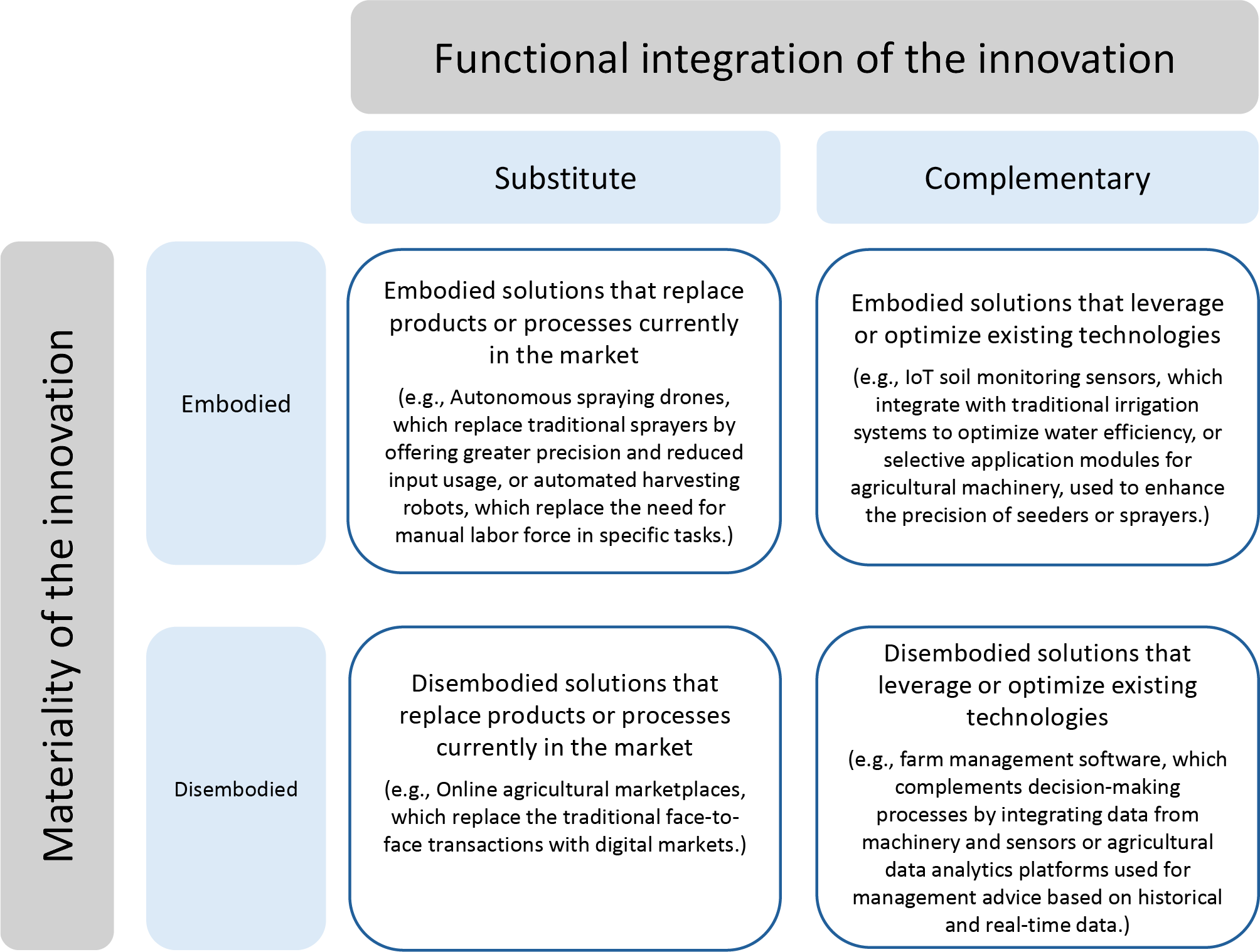
To assess the extent to which emerging DA start-ups offering solutions to farmers in the upstream segment of GVCs can disrupt and reshape the highly concentrated agricultural input markets (as described in the previous section), this paper characterizes start-ups technologies and examines how they interact with the currently incumbent-led technological paradigm. We proceed along two analytical dimensions. First, we explore the materiality and mode of deployment of technological change, distinguishing between embodied and disembodied innovations, as proposed in the agricultural economics literature by Sunding and Zilberman (2001) and Dosi et al. (2021). Simply put, embodied innovations are those that are integrated into physical capital or machinery (i.e., technologies whose adoption requires investment in tangible equipment). Embodied digital tools are incorporated into physical agricultural equipment, such as selective-spraying modules, drones for crop monitoring, variable-rate technologies, and animal-based devices (e.g., ruminal boluses that track internal health indicators). These technologies often require capital investment and technical know-how for operation (Birner et al., 2021; van der Velden et al., 2024).
Disembodied innovations, on the other hand, refer more to software and information technologies and do not depend exclusively on physical devices, being relatively placeless. These technologies could be implemented without significant changes to capital goods and can be deployed without necessarily being tied to a particular machine or location (although they may require physical devices like computers or smartphones to work). These types of disembodied innovations include tools such as cloud-based advisory platforms, farm management apps, weather and pest forecasting systems, and data analytics services that support informed decision-making.
However, this distinction between embodied and disembodied innovations is insufficient to analyze the solutions provided by start-ups comprehensively. Several authors (Birner et al., 2021; Lavarello et al., 2019) emphasize the importance of classifying solutions according to their relationship with existing products and services, reflecting the functional integration type. Lavarello et al. (2019) argue that, unlike previous technological revolutions characterized by technological substitution and the entry of new players, DA is associated with leveraging complementarities between new enabling technologies and existing technological trajectories. Birner et al. (2021) suggest that product substitutability in DA can be seen as a factor that reduces market concentration, as substitutes tend to foster the entry of new players and competition. Therefore, this analysis incorporates a second fundamental dimension that distinguishes between substitute and complementary goods. Substitute goods can lower entry barriers and stimulate competition by enabling the replacement of traditional technologies (e.g., a spraying drone replacing a conventional sprayer). On the other hand, complementary goods may eventually strengthen the position of dominant market players by optimizing existing technologies and reinforcing dependence on established infrastructures (i.e., IoT sensors that enhance the efficiency of traditional irrigation systems) (Besanko et al., 2012).
A synthesis of our bi-dimensional conceptual framework is shown in Figure 1. This framework considers (i) the distinction between embodied and disembodied innovations (materiality of the innovation) and (ii) the classification of goods into substitutes and complements (the functional integration of the innovation). The combination of these dimensions results in a matrix with four quadrants, providing an analytical tool to explore the transformative potential of these innovations on the concentration of agricultural input markets.
The first point in our analysis is to identify and systematize a comprehensive list of agrifoodtech start-ups in the country. We first start with this more comprehensive concept (which includes solutions at the farmer level as well as at the mid- and downstream segments), and we then narrow down to DA start-ups, which constitute the main objective of this paper. We have not found fully harmonized and updated databases that collect systematic information on agrifoodtech start-ups. For this purpose, we combined industry reports with a selection of public sources, including news, press releases, and websites, until a comprehensive database was established. We started collecting available information from previous research studies and surveys conducted between May and July 2022 (Soler et al., 2022) and between July and October 2023 (Navarro et al., 2024). We complemented this information using Crunchbase, a database of innovative ventures increasingly used for academic research (Dalle et al., 2017). This information was also combined with ad hoc web searches and consultations with experts and stakeholders in the local entrepreneurial ecosystem.
While the term “start-up” lacks a universally accepted definition (Connolly et al., 2018; Klerkx & Villalobos, 2024), for this study, we define start-ups as business ventures characterized by two key elements: (a) an innovative approach underpinned by intensive research and development activities; and (b) scalability potential, reflected in business models which tend to be replicable across multiple markets and the promise of exponential growth for investors (Escartín et al., 2020; Vergara & Barrett, 2025). For instrumental purposes, we define Argentine agrifoodtech start-ups as companies founded and operating in Argentina that develop technologies in agriculture and food and have achieved (or are close to) at least a minimum viable product by October 2024. While there is no undisputed temporal criterion for defining start-ups (i.e., companies not exceeding a certain number of years), we include in our analysis companies founded in 2010 or later, considering that it was in early 2010s when concepts like Climate-Smart Agriculture, Digital Agriculture, and Agriculture 4.0 began to gain systematic attention in the literature (Alam et al., 2023; FAO, 2010). We acknowledge this is a pragmatic operationalization, that combines the innovativeness profile, product readiness and year of foundation does not fully capture other relevant dimensions of a start-up company, such as the funding stage (whether the company has already received pre-seed or seed funding, or it is more advanced into series A, B, etc.), governance and ownership structure, or the realized scalability or internalization potencial. Thus, our criteria should not be read as a definitive taxonomy for selecting or identifying start-ups, but rather as a practical shorthand for building an initial database.
As a first step, and to ensure comprehensive coverage and consistency with previous studies, we adopted an inclusive classification encompassing companies developing both agricultural-specific innovations and those implementing improvements across the entire value chain, including processing, logistics, marketing, and traceability. This is why, in this stage, we use the broader agrifoodtech denomination and we later move to specific DA companies. Our systematic search methodology yielded a database of 239 Argentine agrifoodtech start-ups. For each company, we compiled data on their description, primary value proposition, and core technology applied. Around three-quarters of these companies initiated operations after 2016.
4.2. Identifying and classifying DA start-ups
As a second step, we leverage this database to identify start-ups offering farmer-centered solutions in the field of DA in the upstream segment. The literature provides various proposals to classify the solutions developed by start-ups working in agriculture and food (AgFunder, 2024; Herrero et al., 2020, 2021; Mac Clay et al., 2024; McFadden et al., 2023), but due to the dynamic nature of the sector, no typology has yet achieved universal adoption. To distinguish between start-ups that provide DA solutions and those that do not, we classify the start-ups according to the criteria proposed by Mac Clay et al. (2024), which adopt a comprehensive agri-food value chain approach4, allowing us to capture those companies specifically providing DA solutions to farmers (rather than to mid- and downstream segments of the value chain). This preliminary step is essential to contextualize DA start-ups within the value chain, evaluate their relative significance and visibility compared to other solutions, and understand their role within the broader innovation landscape in Argentina’s agri-food sector. For instrumental purposes, DA solutions are defined as those within the categories of “Precision agriculture, smart farming, and agricultural robotics” and “Digital Agribusiness Marketplaces”5, as outlined by Mac Clay et al. (2024).
To further characterize the remaining start-ups operating in the DA field, we apply the typology presented by McFadden et al. (2023), which categorizes digital solutions into three groups: (i) “Data and Data collection”, (ii) “Decision Support” and (iii) “Equipment and input adjustment based on data”. Examples in the first category include data obtained from yield monitoring equipment, sensors, and images captured by drones, aircraft, or satellites. Decision support tools include digital maps or other visualizations of georeferenced data, mobile applications, and other analytical tools that provide management recommendations. Technologies in the third category primarily include guidance systems, automatic steering, and variable-rate applicators. The purpose of this classification is not to perform a selection (as was done in the previous step), but to provide an initial characterization of DA start-ups, using a standard criterion commonly applied in various reports on the subject. Finally, we characterize the subgroup of DA start-ups based on their primary technological features, following the typology introduced in the previous section (Figure 1). This framework classifies DA start-ups into four distinguishable categories: (a) embodied and substitute, (b) embodied and complementary, (c) disembodied and substitute, and (d) disembodied and complementary. A summary of the categories is presented in Table 1.
| Mac Clay et al. (2024) | McFadden et al. (2023) | Own Conceptual Framework |
|---|---|---|
| Start-ups providing Digital Agriculture (DA) solutions (including precision agriculture, smart farming, and farm robotics and digital agribusiness marketplaces) | Data and Data Collection | Complementary & embodied |
| Other Solutions | Decision-Making Support | Complementary & disembodied |
| Data-driven Equipment and Input Adjustments | Substitute & embodied | |
| Substitute & disembodied |
Based on this final classification, which reflects key technological attributes, we hypothesize about the potential of these start-ups to challenge the dominant position of large multinational companies in the agricultural input segment of agri-food GVCs. Given the nascent nature of these start-ups and the technologies they offer, our analysis adopts an exploratory perspective. We outline ideas on how and to what extent each of the four groups of innovations identified in Figure 1 could drive changes in the industrial dynamics of highly concentrated input markets.
5. Results: characterizing Argentine start-ups
5.1. Initial identification of DA start-ups
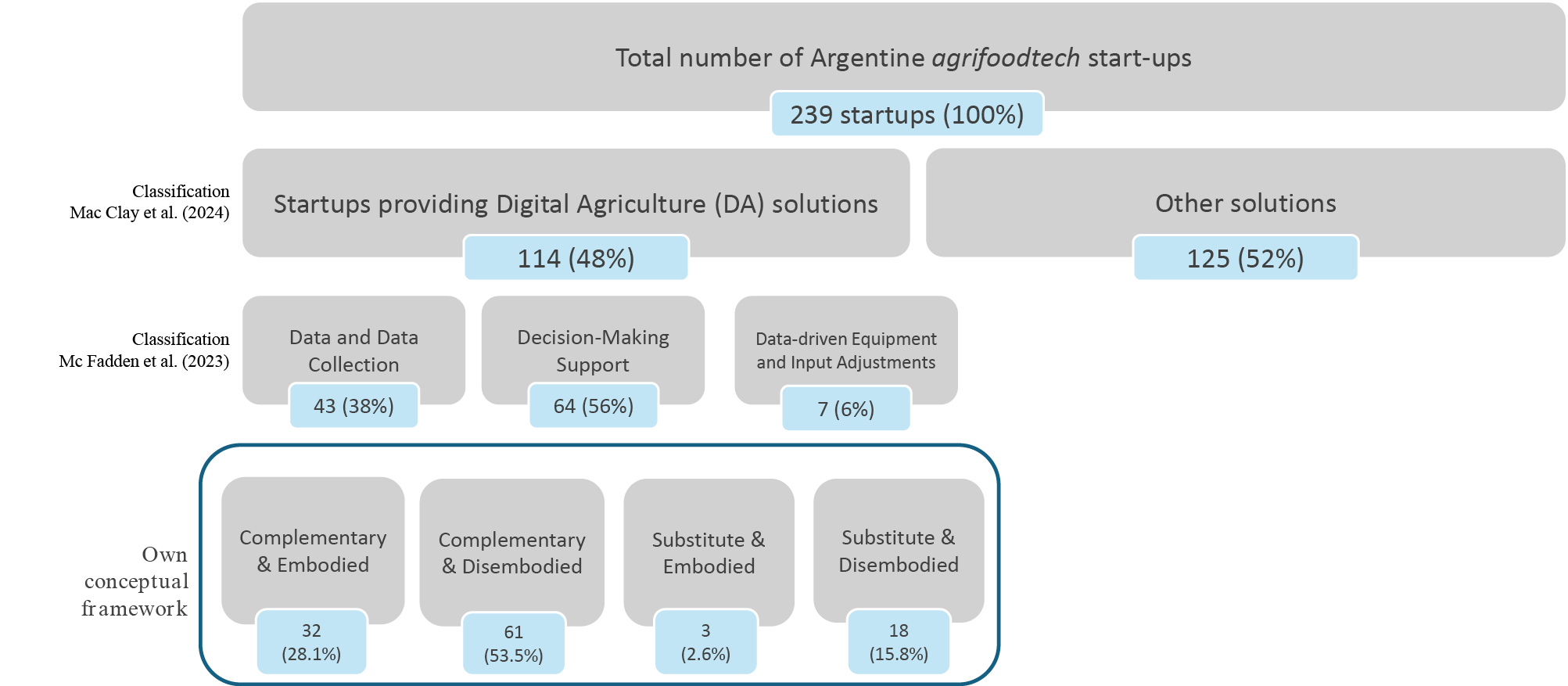
In this section, we present the classification of the group of 239 agrifoodtech start-ups identified in Argentina. We begin by identifying the subset of DA solutions that constitutes the core of our analysis, based on the categories presented by Mac Clay et al. (2024) (the details of this classification are shown in Appendix 2). Within the upstream segment, Precision agriculture, smart agriculture, and agricultural robotics solutions account for 41% of the total companies. These start-ups focus on developing solutions such as real-time data collection, satellite images and drones, farm management software, precision livestock technologies, and digital advisory services. DA start-ups have the potential to transform agricultural input markets since the vast amount of data they generate can be utilized not only by farmers to optimize decisions but also by other start-ups to improve their technologies. At the same time, there is a group of companies defined as Digital Agribusiness Marketplaces (7% of the total number of companies) which contribute to farmers’ digitalization by connecting them with input suppliers and clients, and providing services related to price discovery. These two groups form the core of what is defined, for the purpose of this paper, as DA. As the analysis shows, around half of start-up companies in Argentina are oriented toward the upstream segment, providing digital services for farms. A possible explanation for this is related to the distinct agricultural profile of the country and the importance of primary production both for the internal productive structure and the export markets (World Bank, 2024).
From this first classification step, we retain 114 companies from the initial set of 239, which constitute our DA group (the full list of these companies is presented in Appendix 3). We will now focus on this subset of DA start-ups, which are the main object of this paper. As a first characterization, we apply McFadden et al. (2023) classification typology. As shown in Figure 2, we see a predominance in the categories of Data and data collection (37.7%)6 and Decision-making support7 (56.1%). This reflects a focus on solutions that are primarily oriented towards collecting information and optimizing the decision-making process. Technologies related to data collection and decision support are among the most adopted by Argentine farmers. According to Borbiconi et al. (Borbiconi et al., 2024), half of the farmers in Argentina use technologies that facilitate data collection. Puntel et al. (2022) note that remote sensing and mapping solutions have an adoption rate of between 60% and 80%. The Data-driven Equipment and Input Adjustments8 category accounts for only 6.1%, indicating a lower representation of these solutions, which are more related to farming automation. This is also in line with adoption data. For equipment and inputs, registered rate adoptions are lower among Argentine farmers (except possibly for GPS, which is adopted mainly due to its integration into machinery). Variable-rate technology adoption ranges between 30% and 40% (Borbiconi et al., 2024; McKingsey & Company, 2024; Puntel et al., 2022).
5.2. Characterization of DA start-ups according to their technological features
After mapping and characterizing DA start-ups’ profiles based on McFadden et al. (2023), we categorize them now using our own analytical framework, outlined in Figure 1. As a starting point, and based on the value proposition of the 114 start-ups that constitute our object of study, we list the specific solutions these companies are providing and label them in terms of both dimensions: the materiality and the functional integration of the innovation. This is presented in detail in Table 2. In each row, we explain the criteria behind classifying a solution as embodied or disembodied (materiality) and as complementary or substitute (functionality). For example, a farm digital advisory platform is disembodied in nature, as it does not require dedicated hardware (beyond a computer or smartphone), but is complementary, as it integrates data from different sources. On the other hand, a spraying drone is embodied, considering that these are physical devices equipped with sensors, spraying systems, and autonomous navigation technology, and are substitutes in their functional nature (as they cover the same function as traditional spraying equipment).
| Solution | Materiality | Functional integration | Start-ups | ||||||||||||||||
|---|---|---|---|---|---|---|---|---|---|---|---|---|---|---|---|---|---|---|---|
| Custom tech solutions | Disembodied: These are software-based and digital developments without a dedicated physical component, focusing on data, analytics, and management. | Complementary: They enhance existing agricultural processes by digitizing, optimizing, and integrating operations rather than replacing them. | Agrosty, AgroToolbox, Integra Labs, Kan Territory Magoya, Sendevo | ||||||||||||||||
| Digital agribusiness marketplaces | Disembodied: Software-based platforms without a dedicated physical hardware component. They operate online and are accessible via computers or mobile devices, meaning their value lies in the digital services they provide. | Substitute: These platforms replace traditional, in-person agricultural buying and selling channels by enabling producers and buyers to transact entirely online. | AgriRed, Agro24, Agrofy, Bipolos, Enbaca, Flashagro, GenGanar, HaciendaGo, La Rotonda, Malevo, Mercado Agrario, Modo Agrario, Muu Mercado Digital Ganadero, Pacta, Qira, Rastro Agropecuario, Wymaq | ||||||||||||||||
| Digital platforms enabling sustainable and regenerative agriculture | Disembodied: Operate through digital platforms and services without physical hardware. | Complementary: Support sustainability and traceability by providing data and validation tools, improving decision-making rather than replacing production processes. | Cacta, Edra, Eirú, Puma, Ruuts, Ucrop.it | ||||||||||||||||
| Farm digital advisory platform | Disembodied: Software and apps that process agricultural data via digital channels, without requiring dedicated hardware. | Complementary: Support and improve farming decisions by integrating data from other technologies, enhancing efficiency without replacing existing practices. | Agroapp, AgroBrowser, Agroconsultas, Agrohub, Agrology, Agro Aprilis, Avansys, Bold, Bright Data Analytics, Caburé, CROPilot.tech, Dymaxion Labs, EcoDrip, Eiwa, Fauno, iAgro, Kilimo, Kuna, Nutrixya, OKARATech, PreSeeds, Rastros, Satellites On Fire, Terratio, UrsulaGIS, Vistaguay, Yield Data | ||||||||||||||||
| Farm Management Software | Disembodied: Digital applications that collect, process, and analyze agricultural data for farm management. It operates entirely through computers, tablets, or smartphones, without requiring a dedicated physical hardware component to function. | Complementary: These software enhance decision-making, optimize resource allocation, and improve efficiency in farm operations. It complements existing processes, machinery, labor, and agronomic practices by providing better coordination and data-driven management tools. | AgroPro, Auravant, Culti, Hi-Terra, Inteliagro, Lievrex, Ñandú, Riante, SaiLO, Sima, SmallData | ||||||||||||||||
| Livestock digital advisory platforms | Disembodied: Software and digital platforms accessible via computers or mobile devices. | Complementary: Provide management support and advisory tools that optimize livestock production without substituting existing practices. | Nandi, RumIA, Uniagro soft | ||||||||||||||||
| Livestock identification with AI | Disembodied: Based on software and AI vision systems, not dependent on physical devices. | Substitute: Replaces traditional identification methods (tags, marks) with digital recognition powered by artificial intelligence. | IDanimal | ||||||||||||||||
| Livestock management software | Disembodied: Digital systems and applications that collect, process, and analyze data for livestock management without tangible hardware. | Complementary: Strengthen livestock production by enabling traceability, data-driven management, and efficiency, without replacing existing practices. | Avismart, Cattler, Cowdoo (Raíces), FieldData, Finca | ||||||||||||||||
| Real-time monitoring of air quality with sensors | Embodied: Requires physical sensor devices installed in the environment. | Complementary: Provide environmental data that improves management and risk prevention, supporting agricultural operations rather than replacing them. | AR-PUF, Indegap | ||||||||||||||||
| Real-time monitoring of climate with weather stations | Embodied: Weather stations are tangible devices capturing and transmitting data. | Complementary: Offer real-time climatic information that supports planning and decision-making without replacing production processes. | AgroTrack, Canopilogger, Climate Sense, MKL Agro, Mixon, Pampe.ro, Smartium | ||||||||||||||||
| Real-time monitoring of fodder with satellites | Disembodied: Service based on satellite imagery and data analytics, delivered digitally without requiring specific hardware. | Complementary: Improve fodder management by providing objective and continuous information without substituting production. | Forrager | ||||||||||||||||
| Real-time monitoring of grass with sensors and satellites | Embodied: Combine sensors and smart devices installed in the field with satellite data. | Complementary: Optimize pasture management by supplying precise and integrated information, enhancing existing practices. | Pastech | ||||||||||||||||
| Real-time monitoring of livestock water systems with sensors | Embodied: Depend on physical devices and sensors installed in water systems. | Complementary: Strengthen existing infrastructure by enabling monitoring, alerts, and efficient use of resources. | Agrocheck, Control Campo | ||||||||||||||||
| Real-time monitoring of machinery with sensors | Embodied: Sensors and hardware integrated into agricultural machinery. | Complementary: Improve existing equipment with real-time traceability, control, and efficiency, without replacing the machinery itself. | Acronex, Minnow, Corvus (AGDP), DVL Satelital | ||||||||||||||||
| Real-time monitoring of silobags with sensors | Embodied: Physical sensors placed in silobags to track storage conditions. | Complementary: Support and enhance storage systems by providing data to prevent losses and improve conservation. | Wiagro | ||||||||||||||||
| Real-time monitoring of soil with sensors | Embodied: Depend on physical sensors installed in the soil. | Complementary: Complement agronomic practices with real-time data on nutrients, humidity, and soil conditions. | Agrosense, Briste, Clarion | ||||||||||||||||
| Real-time monitoring of water systems with sensors | Embodied: Requires physical devices and automation systems in irrigation or water infrastructure. | Complementary: Add control, efficiency, and automation to water systems, without substituting the infrastructure itself. | Hidromotic Ingeniería, Ponce | ||||||||||||||||
| Smart devices and robotics for livestock | Embodied: Physical devices and robotic systems applied to livestock management. | Complementary: Enhance animal husbandry with monitoring, automation, and precision management, while keeping traditional production practices. | Bastó, Cattle Trace (Onsen Ingeniería), Dale Vaquita, Digirodeo, El Ojo del Amo, Huella Software, Magno, Novimetrics | ||||||||||||||||
| Smart devices for sprayers | Embodied: Physical devices integrated into spraying machinery. | Complementary: Improve precision and reduce input use by optimizing existing sprayers rather than replacing them. | DeepAgro | ||||||||||||||||
| Solutions for smart data and connected devices | Disembodied: Provide digital platforms and connectivity (e.g., satellite data, IoT integration) without field hardware. | Complementary: Strengthen agricultural systems by enabling communication, data access, and interoperability of devices. | Innova Space, Satellogic, Vertrev | ||||||||||||||||
| Spraying drones | Embodied: Physical devices equipped with sensors, spraying systems, and autonomous navigation technology. Their operation depends on the physical machinery itself. | Substitute: They replace traditional spraying equipment, such as tractor-mounted sprayers, by performing the same task and reducing reliance on older machinery for spraying operations. | Agrovants, Servidrone, UCO Drone | ||||||||||||||||
| Source: Own elaboration based on the two dimensions presented in Figure 1. | |||||||||||||||||||
When we examine this analysis as a whole, the first point to highlight is that Argentine digital agriculture start-ups notably gravitate towards complementary solutions, that enhance the efficiency of existing technology platforms without replacing current production tools. As shown by Figure 2, among the 114 digital agriculture start-ups, approximately 80% offer complementary solutions. In the group of embodied complementary solutions (28.1% of total companies), we find devices for soil monitoring, precision irrigation systems, and technologies to optimize agricultural input requirements. One example is DeepAgro, which offers a device (called sprAI) that enhances the spraying process through an AI-based system capable of weed recognition, enabling more efficient use of machinery. They have recently incorporated a large language model system that enables better task tracking and facilitates inquiries regarding equipment efficiency (Martínez, 2025). The recent partnership between DeepAgro and a local agricultural machinery manufacturer illustrates the complementary nature of this solution (La Nación Campo, 2024). Other examples include cases like Cattler or Digirodeo, which offer smart devices for livestock management, Wiagro, which provides sensors for monitoring silobags or Agrosense, offering devices for soil monitoring.
A second group (53.5% of the companies in DA) provides disembodied complementary solutions, such as digital farm management tools and data analysis platforms. This category includes software companies such as Eiwa, Agrology, or iAgro, which help farmers integrate data collected from their agricultural machinery, telemetry systems, geographic information systems, and accounting software. The goal is to support more efficient farm management and data-driven decision-making. These tools offer a more precise and integrated visualization of information, and in some cases, provide management recommendations based on data analysis. However, they are complementary solutions in the sense that, despite the value they offer, they still rely on the generation of primary data from other equipment or software. Some firms in this category are even forming alliances with telecommunications companies to ensure connectivity in the field, which is crucial for data collection and the integration of cloud-based equipment (Vazquez, 2024).
Conversely, substitute solutions, which replace entirely current products, processes, or tools, are marginal within the DA landscape in Argentina. Only 2.6% of DA companies correspond to embodied substitutes. We can mention the case of companies such as UCO Drone, Servidrone, and Agrovants, which offer drones for crop spraying services. This practice helps avoid losses caused by crop or soil damage resulting from ground-based equipment, while also allowing spraying in areas that are otherwise inaccessible and achieving greater overall precision. With improvements in the load capacity of drones (from approximately 10 liters to nearly 50 liters, increasing efficiency by hectares per hour), many farmers in Argentina are beginning to replace some ground-based applications with drones (Razzetti, 2025). However, this trend is still in its early stages.
Finally, among the group of companies offering disembodied substitute solutions (15.8% of total), we find agricultural marketplaces, such as Agrofy or Agrired, which facilitate both the purchase of inputs (such as crop protection products and fertilizers) and even the sale of agricultural production. These marketplaces aim to disintermediate the value chain by enabling farmers to bypass traditional local distributors and purchase directly. Although still in its early stages, this trend clearly shows potential to substitute the conventional channels. In Argentina, only about 20% of farmers regularly purchase online, although those who have done so express an intention to continue using the online channel (Borbiconi et al., 2024).
6. Discussion: Can DA start-ups change industrial dynamics in the ag-input markets?
As outlined in the conceptual framework, the interactions between incumbents and start-ups in the context of technological change can have multiple facets, allowing more flexibility to technological exploration and enabling open innovation and deeper inter-firm linkages. This analysis focuses specifically on whether the technological profile of DA start-ups provides a sufficient foundation for transforming existing market dynamics, challenging the market positions of established dominant firms. Drawing on our previous classification of DA start-ups in Argentina in Section 5, we propose an exploratory and conceptual analysis to examine whether the technological characteristics of these start-ups possess transformative potential for the industrial organization of agricultural input markets, or whether they will reinforce the market power dynamics that have prevailed in the sector over the past thirty years (as described in Section 2). Given the current lack of sufficient empirical evidence on this topic, the ideas presented in this analysis should be regarded as an exploratory exercise.
At first glance, the predominance of complementary solutions and the low representation of substitute technologies appear to limit their capacity to disrupt the current balance of power. Large companies can pre-emptively acquire start-ups, integrating innovative technologies while maintaining market dominance. Furthermore, start-ups developing complementary technologies, whether embodied or disembodied, often depend on the infrastructure, data, or distribution channels of large companies, which limits their independence and ultimately strengthens the position of the incumbents.
Dominant multinational companies are leveraging complementary technologies to transition from input-based business models to platform or solution-based models. For example, a crop protection company that previously offered herbicides or pesticides is now offering systemic and integrated solutions to achieve weed and pesticide-free farms, thereby minimizing the need for agrochemicals. While greater precision in product application could be a driver of a sales reduction of these companies’ core products, digital tools enable companies to integrate solutions and shift their value creation model. This transition offers comprehensive agronomic management solutions that complement traditional product sales. Another example could be the case of an agricultural machinery company, which in the past obtained revenue mainly from the sale of products (i.e., tractors) and today seeks to offer a service of real-time data analysis of the field to maximize the efficiency of the planting process. In both cases, companies leverage smart technologies to transform product sales into recurring service or subscription revenue streams.
Conversely, substitute solutions may represent a more evident opportunity to generate a disruptive market impact. The development of substitute solutions, such as autonomous machinery, could facilitate the entry of new players, breaking the entry barriers imposed by large companies and diversifying the agricultural input market. However, their low representation among Argentinian start-ups suggests the existence of significant entry barriers, including prohibitive scaling expenses, limited access to capital, and challenges in establishing and managing physical infrastructure. Aware of the threat posed by these specific innovations, large companies may adopt defensive strategies to safeguard their leadership position and neutralize the impact of innovations that could challenge their value propositions.
Our analysis is in line with previous evidence on the topic. Lavarello et al. (2019) observe that digital technologies tend to reinforce existing technological trajectories rather than disrupt them. Sauvagerd et al. (2024) show that despite many new digital solutions coming from small companies, the strategies of large incumbents tend to consolidate an oligopolistic landscape in these new platforms. Mac Clay et al. (2024) show that incumbent firms in the agricultural machinery, seed, and crop protection fields are employing corporate venture strategies to invest in digital agriculture platforms that may allow an upgrade in their own services and operations. In fact, these corporate venture strategies show that even when incumbent firms develop their own digital branches, they still seek complementarities in solutions developed by start-ups. There are several examples in this line, such as BASF and Yara investing in Ecorobotix9, a company utilizing AI for autonomous crop protection, Syngenta investing in Greeneye10, an AI-driven precision spraying solution, or Bayer investing in EarthOptics11, a precision agriculture company focused on soil health, to mention a few. The rapid acceleration of technological innovation and the proliferation of digital solutions have led to a fragmented landscape, making it virtually impossible for any single firm to develop all the necessary capabilities internally. This has led to the need for external exploration of complementary capabilities. In a similar line, Rotz et al. (2019), Hackfort (2021), and Clapp and Ruder (2020) explain the political economy behind the development of digital solutions and how multinational companies tend to prioritize the development of technological lines that are aligned with their own interests and may lead them to higher benefit capture.
Additionally, the type of innovations developed by DA start-ups, whether embodied or disembodied, also influences their potential to disrupt concentration in the agricultural input industry. While embodied solutions directly impact agricultural production, their ability to alter concentration dynamics is limited. The “physical” nature of these innovations requires scale, production processes, physical infrastructure – and consequently capital – as well as the necessary channels to distribute these products, all of which constitute a set of entry barriers for smaller firms. In contrast, disembodied solutions offer a different field of action with greater potential to disrupt industrial concentration dynamics. These technologies enable greater flexibility in terms of scalability and accessibility, as start-ups could offer their solutions to a wide variety of actors, providing them with a potentially global reach.
A key element in this discussion is technological compatibility. Birner et al. (2021) state that interoperability between various digital tools and agricultural machinery can influence market concentration. If start-ups develop technologies that are not compatible with the dominant systems, they may face difficulties in scaling up and attracting users. Conversely, promoting standards that ensure interoperability could reduce entry barriers but also reinforce the dominant position of large companies, that hold a first-mover advantage in terms of the existing technological infrastructure. Finally, access to information and the use of big data emerge as additional factors that may strengthen concentration dynamics. This raises questions related to the ownership and governance of such data. Digital technologies generate vast amounts of data, which, if exclusively controlled by large agricultural input companies, could further consolidate their advantages by optimizing processes, reducing costs, and adjusting prices.
As a final point in this section, we mention a caveat to our analysis. While we have focused exclusively on the technological characteristics of the solutions offered by start-ups, other factors may help reshape market dynamics. Further factors also require careful consideration, especially given the complex nature of the problem we are studying, such as incumbent firms’ strategies and business reactions, access to venture capital (which shapes start-up scaling potential), and regulatory frameworks that influence value chain dynamics from producer to consumer.
This paper provides a preliminary assessment of the potential of DA start-ups to transform market dynamics in the agricultural input segment of agri-food GVCs, challenging dominant firms’ current positions as industry leaders. For this purpose, we have characterized the technological features of 114 DA start-ups in Argentina (a country with increasing momentum in start-up creation), based on two technological dimensions (embodied/disembodied technologies and complementary/substitutive). Our analysis reveals that most Argentine start-ups offer complementary solutions to existing technological packages. They enhance and optimize the production tools already available to farmers but are unlikely to replace them. This, in turn, presents an opportunity for dominant firms to integrate these technologies into their own innovation pipelines (through start-up acquisitions, strategic alliances, or investments via corporate venture capital), thus reinforcing the oligopolistic dynamics that have shaped the sector over the past 30 years. In this sense, despite the promise that start-ups bring to the market through new technologies, our preliminary analysis suggests that their disruptive potential concerning the industrial dynamics of the agricultural input market remains somewhat limited.
Based on these findings, this study offers insights for various stakeholders. Large firms are compelled to develop open innovation capabilities. Collaboration with external actors becomes imperative to leverage the potential of new technologies and maintain competitiveness in a globalized and dynamic market. At the same time, ICTs have lowered the barriers to entry in agri-food markets, enabling new players to introduce digital innovations. Meanwhile, start-ups need to acknowledge that generating solutions and innovations is a process distinct from scaling, commercializing, and distributing these solutions in the market – a domain still dominated by large firms.
The above discussion underscores that start-ups alone do not appear sufficient to reverse industry concentration in agri-food agricultural input markets. This scenario demands innovative public policies that foster a more inclusive environment, combining public investment in R&D with regulatory frameworks to mitigate concentration risks. Additionally, measures are needed to facilitate technological interoperability, and address the infrastructure and financing challenges that start-ups face in order to enhance their competitiveness.
This study represents a preliminary effort to explore the role of DA start-ups in the transformation market dynamics, adopting a prospective viewpoint, which is suitable given the early and rapidly evolving stage of innovation in agriculture. As such, rather than offering conclusive impact assessments, we aimed to map out emerging trends and highlight possible directions of change in market dynamics and value chain morphology. Our work, exploratory in nature, reflects the novelty of the DA field, which implies limitations in the availability of longitudinal data. Our findings provide a foundation for future research, particularly as more empirical evidence becomes available. Dynamics such as investments, acquisitions, mergers, and strategic alliances would be valuable avenues of exploration. At the same time, it is necessary to intensify efforts to promote systematization and ensure the public availability of market data, sales figures, and market shares. This would enable the development of studies with a more quantitative focus. Additionally, examining the dynamic evolution of the market and incorporating factors such as regulations, public policies, and the adoption of technology by farmers would open new perspectives on better understanding the forces shaping the structure of this ever-changing sector and achieving a more comprehensive understanding of the phenomenon.
This research has been partially funded by Universidad Austral (Concurso Interno de proyectos de investigación científica, Resolución 26/2024 Comisión Permanente del Consejo Superior). Pablo Mac Clay acknowledges additional funding from the German Federal Ministry of Food and Agriculture (BMEL; 2219NR144).
AgFunder. (2024). Global AgriFoodTech Investment Report 2024. AgFunder. agfundernews.com
Alam, Md. F. B., Tushar, S. R., Zaman, S. Md., Gonzalez, E. D. R. S., Bari, A. B. M. M., & Karmaker, C. L. (2023). Analysis of the drivers of Agriculture 4.0 implementation in the emerging economies: Implications towards sustainability and food security. Green Technologies and Sustainability, 1(2), 100021. https://doi.org/10.1016/j.grets.2023.100021
Barrett, C. B., Reardon, T., Swinnen, J., & Zilberman, D. (2022). Agri-food Value Chain Revolutions in Low- and Middle-Income Countries. Journal of Economic Literature, 60(4), 1316–1377. https://doi.org/10.1257/jel.20201539
Basso, B., & Antle, J. (2020). Digital agriculture to design sustainable agricultural systems. Nature Sustainability, 3(4), Article 4. https://doi.org/10.1038/s41893-020-0510-0
Bendig, D., Kleine-Stegemann, L., Schulz, C., & Eckardt, D. (2022). The effect of green startup investments on incumbents’ green innovation output. Journal of Cleaner Production, 376, 134316. https://doi.org/10.1016/j.jclepro.2022.134316
Béné, C. (2022). Why the Great Food Transformation may not happen – A deep-dive into our food systems’ political economy, controversies and politics of evidence. World Development, 154, 105881. https://doi.org/10.1016/j.worlddev.2022.105881
Berthet, E. T., Hickey, G. M., & Klerkx, L. (2018). Opening design and innovation processes in agriculture: Insights from design and management sciences and future directions. Agricultural Systems, 165, 111–115. https://doi.org/10.1016/j.agsy.2018.06.004
Besanko, D., Dranove, D., Shanley, M., & Schaefer, S. (2012). Economics of Strategy (6th ed.). Wiley.
Birner, R., Daum, T., & Pray, C. (2021). Who drives the digital revolution in agriculture? A review of supply-side trends, players and challenges. Applied Economic Perspectives and Policy, 43(4), 1260–1285. https://doi.org/10.1002/aepp.13145
Bisang, R., Lachman, J., López, A., Pereyra, M., & Tacsir, E. (2022). Agtech: Startups y nuevas tecnologías digitales para el sector agropecuario: los casos de Argentina y Uruguay. IDB Publications. https://doi.org/10.18235/0004218
Bogers, M., Chesbrough, H., & Moedas, C. (2018). Open Innovation: Research, Practices, and Policies. California Management Review, 60(2), 5–16. https://doi.org/10.1177/0008125617745086
Borbiconi, F. A., Mac Clay, P., Beltramino, C., Méndez, F., Capretto, T., & Feeney, R. (2024). Los productores agropecuarios frente a la revolución tecnológica: Perfiles de adopción en el agro argentino. Reunión Anual de la Asociación Argentina de Economía Agraria (AAEA), Rosario (Argentina).
Cerutti, N., Lamb, W. F., Crippa, M., Leip, A., Solazzo, E., Tubiello, F. N., & Minx, J. C. (2023). Food system emissions: A review of trends, drivers, and policy approaches, 1990–2018. Environmental Research Letters, 18(7), 074030. https://doi.org/10.1088/1748-9326/acddfd
Clapp, J. (2021). The problem with growing corporate concentration and power in the global food system. Nature Food, 2(6), Article 6. https://doi.org/10.1038/s43016-021-00297-7
Clapp, J. (2022). Concentration and crises: Exploring the deep roots of vulnerability in the global industrial food system. The Journal of Peasant Studies, 0(0), 1–25. https://doi.org/10.1080/03066150.2022.2129013
Clapp, J., & Ruder, S.-L. (2020). Precision Technologies for Agriculture: Digital Farming, Gene-Edited Crops, and the Politics of Sustainability. Global Environmental Politics, 20(3), 49–69. https://doi.org/10.1162/glep_a_00566
Connolly, A. J., Turner, J., & Potocki, A. D. (2018). IGNITE your corporate innovation: Insights from setting up an ag-tech start-up accelerator. International Food and Agribusiness Management Review, 21(6), 833–846. https://doi.org/10.22434/IFAMR2017.0089
Costa, C., Wollenberg, E., Benitez, M., Newman, R., Gardner, N., & Bellone, F. (2022). Roadmap for achieving net-zero emissions in global food systems by 2050. Scientific Reports, 12(1), Article 1. https://doi.org/10.1038/s41598-022-18601-1
Crippa, M., Solazzo, E., Guizzardi, D., Monforti-Ferrario, F., Tubiello, F. N., & Leip, A. (2021). Food systems are responsible for a third of global anthropogenic GHG emissions. Nature Food, 2(3), 198–209. https://doi.org/10.1038/s43016-021-00225-9
Dalle, J.-M., den Besten, M., & Menon, C. (2017). Using Crunchbase for economic and managerial research (OECD Science, Technology and Industry Working Papers No. 2017/08; OECD Science, Technology and Industry Working Papers, Vol. 2017/08). https://doi.org/10.1787/6c418d60-en
Deconinck, K. (2020). Concentration in Seed and Biotech Markets: Extent, Causes, and Impacts. Annual Review of Resource Economics, 12(1), Article 1. https://doi.org/10.1146/annurev-resource-102319-100751
Dosi, G., Piva, M., Virgillito, M. E., & Vivarelli, M. (2021). Embodied and disembodied technological change: The sectoral patterns of job-creation and job-destruction. Research Policy, 50(4), 104199. https://doi.org/10.1016/j.respol.2021.104199
Dushnitsky, G., & Lenox, M. J. (2005). When do incumbents learn from entrepreneurial ventures?: Corporate venture capital and investing firm innovation rates. Research Policy, 34(5), 615–639. https://doi.org/10.1016/j.respol.2005.01.017
Dushnitsky, G., & Yu, L. (2022). Why do incumbents fund startups? A study of the antecedents of corporate venture capital in China. Research Policy, 51(3), 104463. https://doi.org/10.1016/j.respol.2021.104463
Escartín, D., Marimon, À., Rius, A., Vilaseca, X., & Vives, À. (2020). Startup: Concepto y ciclo de vida. Revista de Contabilidad y Dirección, 30, 13–21.
ETC Group, & GRAIN. (2025). Top 10 Agribusiness Giants – Corporate Concentration in Food & Farming 2025. https://www.etcgroup.org/sites/www.etcgroup.org/files/files/top_10_agribusiness_giants.pdf
Fairbairn, M., & Reisman, E. (2024). The incumbent advantage: Corporate power in agri-food tech. The Journal of Peasant Studies, 0(0), 1–24. https://doi.org/10.1080/03066150.2024.2310146
FAO. (2010). “Climate-Smart” Agriculture. Policies, Practices and Financing for Food Security, Adaptation and Mitigation.
FAO. (2017). The future of food and agriculture: Trends and challenges. Food and Agriculture Organization of the United Nations.
FAO, CIAT, & The World Bank. (2021). Digital Agriculture Profile Argentina. FAO; https://openknowledge.fao.org/handle/20.500.14283/cb3955en
Finger, R. (2023). Digital innovations for sustainable and resilient agricultural systems. European Review of Agricultural Economics, jbad021. https://doi.org/10.1093/erae/jbad021
Freeman, J., & Engel, J. S. (2007). Models of Innovation: Startups and Mature Corporations. California Management Review, 50(1), 94–119. https://doi.org/10.2307/41166418
Fuglie, K. O., King, J. L., Heisey, P. W., & Schimmelpfennig, D. E. (Eds.). (2012). Rising Concentration in Agricultural Input Industries Influences New Farm Technologies. Amber Waves: The Economics of Food, Farming, Natural Resources, and Rural America. https://doi.org/10.22004/ag.econ.142404
Hackfort, S. (2021). Patterns of Inequalities in Digital Agriculture: A Systematic Literature Review. Sustainability, 13(22), Article 22. https://doi.org/10.3390/su132212345
Hackfort, S. (2024). Democratization through precision technologies? Unveiling power, participation, and property rights in the agricultural bioeconomy. Frontiers in Political Science, 6. https://doi.org/10.3389/fpos.2024.1363044
Harryson, S., & Lorange, P. (2024). Vertical Integration versus Open Innovation? From Winner Takes it All to Winners Make it All. California Management Review, 67(1), 138–163. https://doi.org/10.1177/00081256241279334
Herrero, M., Thornton, P. K., Mason-D’Croz, D., Palmer, J., Benton, T. G., Bodirsky, B. L., Bogard, J. R., Hall, A., Lee, B., Nyborg, K., Pradhan, P., Bonnett, G. D., Bryan, B. A., Campbell, B. M., Christensen, S., Clark, M., Cook, M. T., de Boer, I. J. M., Downs, C., … West, P. C. (2020). Innovation can accelerate the transition towards a sustainable food system. Nature Food, 1(5), Article 5. https://doi.org/10.1038/s43016-020-0074-1
Herrero, M., Thornton, P. K., Mason-D’Croz, D., Palmer, J., Bodirsky, B. L., Pradhan, P., Barrett, C. B., Benton, T. G., Hall, A., Pikaar, I., Bogard, J. R., Bonnett, G. D., Bryan, B. A., Campbell, B. M., Christensen, S., Clark, M., Fanzo, J., Godde, C. M., Jarvis, A., … Rockström, J. (2021). Articulating the effect of food systems innovation on the Sustainable Development Goals. The Lancet Planetary Health, 5(1), e50–e62. https://doi.org/10.1016/S2542-5196(20)30277-1
IPES. (2017). Too big to feed: Exploring the impacts of mega-mergers, consolidation, and concentration of power in the agri-food sector. (p. 108). International Panel of Experts on Sustainable Food Systems. : http://www.ipes-food.org/images/Reports/Concentration_FullReport.pdf
Jiang, Y. (2021, March 9). Rising to Transform Agricultural Production – – How Agrochemical Titans Unlock the Potential of Digital Agriculture? AgroPages. https://news.agropages.com/News/Detail-38263.htm
Kenney, M., Serhan, H., & Trystram, G. (2020). Digitization and Platforms in Agriculture: Organizations, Power Asymmetry, and Collective Action Solutions (SSRN Scholarly Paper No. 3638547). https://doi.org/10.2139/ssrn.3638547
Klerkx, L., Jakku, E., & Labarthe, P. (2019). A review of social science on digital agriculture, smart farming and agriculture 4.0: New contributions and a future research agenda. NJAS: Wageningen Journal of Life Sciences, 90–91(1), 1–16. https://doi.org/10.1016/j.njas.2019.100315
Klerkx, L., & Rose, D. (2020). Dealing with the game-changing technologies of Agriculture 4.0: How do we manage diversity and responsibility in food system transition pathways? Global Food Security, 24, 100347. https://doi.org/10.1016/j.gfs.2019.100347
Klerkx, L., & Villalobos, P. (2024). Are AgriFoodTech start-ups the new drivers of food systems transformation? An overview of the state of the art and a research agenda. Global Food Security, 40, 100726. https://doi.org/10.1016/j.gfs.2023.100726
La Nación Campo. (2024, March 4). Aplicaciones selectivas: Se consolidó una alianza entre DeepAgro y Crucianelli. La Nación Campo. https://www.lanacion.com.ar/economia/campo/aplicaciones-selectivas-se-consolido-una-alianza-entre-deepagro-y-crucianelli-nid04032024/
Lachman, J., Braude, H., Monzón, J., López, S., & Gómez-Roca, S. (2022). El potencial del agro 4.0 en Argentina. Diagnóstico y propuestas de políticas públicas para su promoción. Ministerio de Desarollo Productivo.
Lachman, J., & López, A. (2022). The nurturing role of the local support ecosystem in the development of the Agtech sector in Argentina. Journal of Agribusiness in Developing and Emerging Economies, ahead-of-print(ahead-of-print). https://doi.org/10.1108/JADEE-10-2021-0264
Lavarello, P., Bil, D., Vidosa, R., & Langard, F. (2019). Reconfiguración del oligopolio mundial y cambio tecnológico frente a la agricultura 4.0: Implicancias para la trayectoria de la maquinaria agrícola en Argentina. Ciclos En La Historia, La Economía y La Sociedad, 30(53), 163–193.
Lezoche, M., Hernandez, J. E., Alemany Díaz, M. del M. E., Panetto, H., & Kacprzyk, J. (2020). Agri-food 4.0: A survey of the supply chains and technologies for the future agriculture. Computers in Industry, 117, 103187. https://doi.org/10.1016/j.compind.2020.103187
Lundstrom, M. S., & Alam, M. A. (2022). Moore’s law: The journey ahead. Science, 378(6621), 722–723. https://doi.org/10.1126/science.ade2191
Mac Clay, P., Feeney, R., & Sellare, J. (2024). Technology-driven transformations in agri-food global value chains: The role of incumbent firms from a corporate venture capital perspective. Food Policy, 127, 102684. https://doi.org/10.1016/j.foodpol.2024.102684
Mac Clay, P., & Sellare, J. (2025). The Nexus Between Innovation, Value Chains, and Social Sustainability in the Context of a Bioeconomy Upgrading. Business Strategy & Development, 8(1), e70087. https://doi.org/10.1002/bsd2.70087
Macchiavello, R., Reardon, T., & Richards, T. J. (2022). Empirical Industrial Organization Economics to Analyze Developing Country Food Value Chains. Annual Review of Resource Economics, 14(1), 193–220. https://doi.org/10.1146/annurev-resource-101721-023554
MacDonald, J. M. (2017, April 3). Mergers and Competition in Seed and Agricultural Chemical Markets. Amber-Waves (USDA Economic Research Service). https://www.ers.usda.gov/amber-waves/2017/april/mergers-and-competition-in-seed-and-agricultural-chemical-markets/
MacDonald, J. M., Dong, X., Fuglie, K. O., & United States. Department of Agriculture. Economic Research Service. (2023). Concentration and competition in U.S. agribusiness. Economic Research Service, U.S. Department of Agriculture. https://doi.org/10.32747/2023.8054022.ers
Manganda, A. S., Sehnem, S., & Lara, A. C. (2024). Transition to the Circular Economy: Innovative and Disruptive Production Technologies Adopted by Agribusiness Startups. Environmental Quality Management, 34(1), e22293. https://doi.org/10.1002/tqem.22293
Martínez, B. (2025, March 14). Inédito: Presentaron un sistema conversacional basado en ChatGPT que ayuda a analizar información de los cultivos. La Nación Campo. https://www.lanacion.com.ar/economia/campo/inedito-presentaron-un-sistema-conversacional-basado-en-chatgpt-que-ayuda-a-analizar-informacion-de-nid14032025/
McFadden, J., Casalini, F., Griffin, T., & Antón, J. (2022). The digitalisation of agriculture: A literature review and emerging policy issues. OECD. https://doi.org/10.1787/285cc27d-en
McFadden, J., Njuki, E., & Griffin, T. (2023). Precision Agriculture in the Digital Era: Recent Adoption on U.S. Farms. https://www.ers.usda.gov/publications/pub-details/?pubid=105893
McKingsey & Company. (2024). Voice of the global farmer 2024: Farmer survey | McKinsey. McKingsey & Company. https://www.mckinsey.com/industries/agriculture/our-insights/global-farmer-insights-2024#/
Meemken, E.-M., Becker-Reshef, I., Klerkx, L., Kloppenburg, S., Wegner, J. D., & Finger, R. (2024). Digital innovations for monitoring sustainability in food systems. Nature Food, 1–5. https://doi.org/10.1038/s43016-024-01018-6
Navarro, A. I., & Camusso, J. (2022). Opportunities and Challenges for the New Generation of Sustainable AgTech Startups in LAC (SSRN Scholarly Paper No. 4417489). Social Science Research Network. https://doi.org/10.2139/ssrn.4417489
Navarro, A. I., Camusso, J., Soler, M. J., Arraigada, J., & Varvello, J. C. (2024). Sustainability and economic performance of startups in the AgTech sector: Empirical evidence from Argentina (SSRN Scholarly Paper No. 4974629). Social Science Research Network. https://doi.org/10.2139/ssrn.4974629
Paolillo, J. (2022, April 19). John Deere: Pioneering the ag-tech of the future. Digital Innovation and Transformation - Harvard Business School. https://d3.harvard.edu/platform-digit/submission/john-deere-pioneering-the-ag-tech-of-the-future/
Peiretti, R., & Dumanski, J. (2014). The transformation of agriculture in Argentina through soil conservation. International Soil and Water Conservation Research, 2(1), 14–20. https://doi.org/10.1016/S2095-6339(15)30010-1
Prause, L. (2021, November 25). Corporate power in the digital agri-food system. Welthungerhilfe.de - Für Eine Welt Ohne Hunger Und Armut. https://www.welthungerhilfe.org/news/latest-articles/2021/corporate-power-in-the-digital-agri-food-system
Prause, L., Hackfort, S., & Lindgren, M. (2021). Digitalization and the third food regime. Agriculture and Human Values, 38(3), 641–655. https://doi.org/10.1007/s10460-020-10161-2
Puntel, L. A., Bolfe, É. L., Melchiori, R. J. M., Ortega, R., Tiscornia, G., Roel, A., Scaramuzza, F., Best, S., Berger, A. G., Hansel, D. S. S., Palacios Durán, D., & Balboa, G. R. (2022). How digital is agriculture in a subset of countries from South America? Adoption and limitations. Crop & Pasture Science, 74(6), 555–572. https://doi.org/10.1071/CP21759
Qaim, M., & Janvry, A. D. (2005). Bt cotton and pesticide use in Argentina: Economic and environmental effects. Environment and Development Economics, 10(2), Article 2. https://doi.org/10.1017/S1355770X04001883
Qaim, M., & Traxler, G. (2005). Roundup Ready soybeans in Argentina: Farm level and aggregate welfare effects. Agricultural Economics, 32(1), 73–86. https://doi.org/10.1111/j.0169-5150.2005.00006.x
Ramseyer, F., Rodríguez Zurro, T., & Terré, E. (2024). Más allá de la sequía: Las cadenas agroindustriales fueron motor de la economía en 2023. Informativo Semanal BCR, 2168. https://www.bcr.com.ar/es/mercados/investigacion-y-desarrollo/informativo-semanal/noticias-informativo-semanal/mas-alla-de-0
Razzetti, N. (2025, June 10). ¿Se sostiene el boom de los drones en la agricultura argentina? El especialista Martín Rainaudo explica sus ventajas y desvent. Bichos de Campo. https://bichosdecampo.com/se-sostiene-el-boom-de-los-drones-en-la-agricultura-argentina-el-especialista-martin-rainaudo-explica-sus-ventajas-y-desventajas-y-analiza-el-potencial-de-crecimiento-de-esa-tecnologia/
Reardon, T., Echeverria, R., Berdegué, J., Minten, B., Liverpool-Tasie, S., Tschirley, D., & Zilberman, D. (2019). Rapid transformation of food systems in developing regions: Highlighting the role of agricultural research & innovations. Agricultural Systems, 172, 47–59. https://doi.org/10.1016/j.agsy.2018.01.022
Rotz, S., Duncan, E., Small, M., Botschner, J., Dara, R., Mosby, I., Reed, M., & Fraser, E. D. G. (2019). The Politics of Digital Agricultural Technologies: A Preliminary Review. Sociologia Ruralis, 59(2), 203–229. https://doi.org/10.1111/soru.12233
Sauvagerd, M., Mayer, M., & Hartmann, M. (2024). Digital platforms in the agricultural sector: Dynamics of oligopolistic platformisation. Big Data & Society, 11(4), 20539517241306365. https://doi.org/10.1177/20539517241306365
Scoponi, L., Durán, R., Pesce, G., & De Batista, M. (2011). Difusión de la innovación tecnológica: El caso de la siembra directa en Argentina y su comparación con Brasil. Revista Capital Científico-Eletrônica (RCCҽ), 9(1), 11–25.
Soler, M. J., Arraigada, J., Krakov, A., & Fusoni, G. (2022). Situación actual y perspectivas del ecosistema AgTech de Argentina. Endeavor - Bain&Company. https://www.endeavor.org.ar/wp-content/uploads/2022/11/ecosistema-agtech-argentina-2022-1.pdf
Song, B., Ning, W., Wei, D., Jiang, M., Zhu, K., Wang, X., Edwards, D., Odeny, D. A., & Cheng, S. (2023). Plant genome resequencing and population genomics: Current status and future prospects. Molecular Plant, 16(8), 1252–1268. https://doi.org/10.1016/j.molp.2023.07.009
Sunding, D., & Zilberman, D. (2001). Chapter 4 The agricultural innovation process: Research and technology adoption in a changing agricultural sector. In Handbook of Agricultural Economics (Vol. 1, pp. 207–261). Elsevier. https://doi.org/10.1016/S1574-0072(01)10007-1
Trivedi, A. (2022, October 4). Bayer Crop Science: Unlocking value through AI-driven digital farming. Digital Innovation and Transformation - Harvard Business School. https://d3.harvard.edu/platform-digit/submission/bayer-crop-science-unlocking-value-through-ai-driven-digital-farming/
van der Velden, D., Klerkx, L., Dessein, J., & Debruyne, L. (2024). Cyborg farmers: Embodied understandings of precision agriculture. Sociologia Ruralis, 64(1), 3–21. https://doi.org/10.1111/soru.12456
Vazquez, P. (2024, March 7). Conectividad: Una alianza busca superar el mayor obstáculo de las nuevas tecnologías. La Nación Campo. https://www.lanacion.com.ar/economia/campo/conectividad-una-alianza-busca-superar-el-mayor-obstaculo-de-las-nuevas-tecnologias-nid07032024/
Vergara, J. M., & Barrett, C. B. (2025). Private Capital Investments in Agrifood-Tech Startups in South America, 2007–2022. Agribusiness. https://doi.org/10.1002/agr.22022
Vitón, R., Castillo, A., & Teixeira, T. L. (2019). AGTECH: Mapa de la innovación Agtech en América Latina y el Caribe. IDB Publications. https://doi.org/10.18235/0001788
Wang, F., Harindintwali, J. D., Yuan, Z., Wang, M., Wang, F., Li, S., Yin, Z., Huang, L., Fu, Y., Li, L., Chang, S. X., Zhang, L., Rinklebe, J., Yuan, Z., Zhu, Q., Xiang, L., Tsang, D. C. W., Xu, L., Jiang, X., … Chen, J. M. (2021). Technologies and perspectives for achieving carbon neutrality. The Innovation, 2(4), 100180. https://doi.org/10.1016/j.xinn.2021.100180
Waßenhoven, A., Rennings, M., & Bröring, S. (2025). Unraveling the Interplay Between Strategic Adaptation and Organizational Identity. Academy of Management Proceedings, 2025(1), 22764. https://doi.org/10.5465/AMPROC.2025.22764abstract
Wolfert, S., Verdouw, C., van Wassenaer, L., Dolfsma, W., & Klerkx, L. (2023). Digital innovation ecosystems in agri-food: Design principles and organizational framework. Agricultural Systems, 204, 103558. https://doi.org/10.1016/j.agsy.2022.103558
World Bank. (2024). Towards a More Competitive, Inclusive, and Resilient Agrifood Sector in Argentina. World Bank. https://doi.org/10.1596/41383
Yang, Y., Tilman, D., Jin, Z., Smith, P., Barrett, C. B., Zhu, Y.-G., Burney, J., D’Odorico, P., Fantke, P., Fargione, J., Finlay, J. C., Rulli, M. C., Sloat, L., Jan van Groenigen, K., West, P. C., Ziska, L., Michalak, A. M., the Clim-Ag Team, & Lobell, D. B. (2024). Climate change exacerbates the environmental impacts of agriculture. Science, 385(6713), eadn3747. https://doi.org/10.1126/science.adn3747
1 This paradigm of accelerated innovation in the digital agriculture field is also known in the literature as Agriculture 4.0, Agri-food 4.0 or the Fourth agricultural revolution.
2 We exclude companies offering solutions exclusively at the midstream or downstream level.
3 Examples include the 2015 merger of Dow and DuPont, resulting in Corteva Agriscience; ChemChina’s acquisition of Syngenta in early 2016; and Bayer’s subsequent purchase of Monsanto. This sector, already highly concentrated and dominated by the “Big Six” since the early 2000s, is now controlled by four major firms – Bayer, Corteva, Syngenta, and BASF. Something similar happens in the agricultural machinery sector, in which the four leading companies control around half of the market sales.
4 This typology comprises eleven different solutions, categorized by their position in the value chain.
5 The authors in this work consider a broader category, which is “E-commerce and delivery solutions”. Within this category, the authors include both apps specifically related to farmers’ digitalization, as well as other apps linked to food distribution to the final consumer (for example, delivery apps). This second group of solutions is unrelated to what we define as digital agriculture, so for practical purposes, we divide the category into two to specifically capture “Digital Agribusiness Marketplaces”, and the rest we indicate as “Other”.
6 Examples of companies in this category are Aseagro, Caburé, Control Campo, Nandi; Vistaguay or Pastech.
7 Examples of companies in this category are Albor, Auravant, Eiwa or Sima.
8 Examples: Deepagro, Campo Preciso, UCO Drone or Agrovants.