Received: February 25, 2025; Accepted: July 9, 2025; Published: 2025-12-30
Enabling technologies in citrus farming: A living lab approach to agroecology and sustainable water resource management
Department of Agriculture, Food and Environment, University of Catania, Catania, Italy
*Corresponding author. E-mail: giulio.cascone@phd.unict.it
Abstract. This study examines the role of enabling technologies in the agroecological transition, focusing on sustainable water management in citrus farming through the participatory approach of a Living Lab in the Inner Area of Calatino in Sicily. The analysis is based on a comparison of two citrus farms: one equipped with advanced digital tools (sensors, decision support systems, and real-time monitoring), and one with a traditional management approach. Through the joint application of economic analysis, Monte Carlo simulation and sensitivity analysis, it was possible to estimate the effects of technology adoption. Findings reveal that enabling technologies reduce water consumption by 33%, increase yield per hectare by 16%, and boost net profit by 25% (+€2,780/ha), enhancing resource efficiency and lowering operational costs. Additionally, the Living Lab facilitated knowledge transfer, fostered collaboration, and mitigated resistance to innovation, highlighting the need for targeted training and institutional support to promote broader adoption. These results provide valuable insights for policymakers and stakeholders, demonstrating how digital solutions can drive sustainability, economic viability, and resilience in agriculture, but also for farmers, providing operational tools to improve farm efficiency and profitability.
Keywords: agroecology, enabling technologies, living lab, water management, citrus farming.
Index
3.1. Living Lab approach and case study characteristics
3.2. Issues related to the management of irrigation resources
3.3. Cost-effectiveness assessment of KETs deployment
In recent decades, agroecology has become a key strategy to tackle sustainability challenges in agriculture. It combines ecological, economic, and social principles to address problems like soil degradation, biodiversity loss, climate change, and economic inequality This paradigm not only protects the environment but also offers economic advantages by fostering local markets, short supply chains, and more equitable and resilient food systems (Van der Ploeg et al., 2019; D’Annolfo et al., 2017; Poux and Aubert, 2018).
Agroecology successfully integrates environmental sustainability with agricultural productivity through practices that enhance soil fertility, promote crop diversification, and reduce reliance on chemical inputs. Studies have demonstrated that agroecological systems can achieve yields comparable to those of conventional agriculture while delivering significant benefits in terms of lower environmental impact and increased resilience to climate change (D’Annolfo et al., 2017; Poux and Aubert, 2018). Moreover, adopting agroecological practices improves the quality of food produced, contributing to human health and the well-being of farming communities (Belliggiano and Conti, 2019).
Other studies have highlighted how agroecological systems can generate economic benefits for farmers by reducing dependence on external inputs and increasing long-term profitability (Van der Ploeg et al., 2019; D’Annolfo et al., 2017). However, the agroecological transition requires adequate support from public policies, including instruments that promote the adoption of agroecological practices and facilitate market access for small-scale producers (Gava et al., 2022; Schiller et al., 2020). Agroecology not only promotes more sustainable and resilient farming practices but also represents a comprehensive approach to agri-food governance, fostering farmers’ autonomy, food sovereignty, and social justice (Van der Ploeg et al., 2019).
A key factor in accelerating the agroecological transition is the integration of Key Enabling Technologies (KETs), such as digital tools, Internet of Things (IoT) sensors, artificial intelligence, and precision agriculture systems, which optimize resource management and reduce waste (Chollet et al., 2023; Bellon-Maurel et al., 2022). These technologies provide real-time data on soil and crop status, boosting efficiency and reducing environmental impact (Fischetti et al., 2025; Ewert et al., 2023). By adapting practices to local conditions, KETs offer agroecology a practical path to greater sustainability (Ewert et al., 2023).
However, the integration of KETs into agroecology has sparked debate within the agroecological community, dividing the sector into two opposing perspectives. Traditionalists argue that agroecology should preserve traditional practices and local knowledge, avoiding reliance on technological tools that could disrupt the ecological and social balance of agricultural systems. Modernizers see innovation as an opportunity to improve sustainability and efficiency. They support the responsible integration of new technologies to make farming models more resilient (Bertoglio et al., 2021; Menozzi et al., 2015; Arata and Menozzi, 2023).
Despite these concerns, the synergy between agroecology and enabling technologies offers significant potential for sustainable development, particularly in inner areas. These territories can benefit from agroecological innovation to revitalize agricultural activity and enhance local natural resources (Gava et al., 2025; Verharen et al., 2021). Moreover, inner areas offer unique opportunities for agroecological innovation due to the presence of traditional farming systems and the availability of high-quality natural resources (Verharen et al., 2021). The integration of modern technologies into agroecological production systems – through decision-support tools, knowledge-sharing platforms, and mobile applications for farm management (Espelt et al., 2019; Emeana, 2021) – represents a concrete opportunity to facilitate the transition to more sustainable models. These tools can help reduce barriers to the adoption of agroecological practices and strengthen producers’ competitiveness in the market (Maurel and Huyghe, 2017).
In this context, Living Labs emerge as essential tools for promoting an integrated system that combines technology and agroecology. These participatory innovation spaces engage farmers, researchers, policymakers, and other agri-food system stakeholders, fostering the experimentation of innovative solutions and facilitating knowledge transfer at the local level (Larbaigt et al., 2024; Berghez et al., 2019; Giampietri et al., 2020; Ouattara et al., 2024). Living Labs serve as a bridge between scientific research and agricultural practice, allowing technologies to be tailored to specific territorial needs, thereby improving farmers’ acceptance of new practices and enhancing the effectiveness of transition strategies (Giagnocavo et al., 2022; Belliggiano and Conti, 2019).
A concrete example of such integration is the experimental initiative focused on citrus farming in the inner area known as the “Calatino,” aimed at demonstrating its economic feasibility. This territory encompasses nine municipalities in central-eastern Sicily (Caltagirone, Grammichele, Licodia Eubea, Mazzarrone, Mineo, Mirabella Imbaccari, San Cono, San Michele di Ganzaria, and Vizzini) all within the Metropolitan City of Catania. The area represents 1.6% of the regional population and spans approximately one thousand square kilometres.
In this Living Lab a range of integrated systems have been installed, incorporating weather stations, sensors, and decision-support systems, with the aim of optimising water usage. This initiative is expected to enhance resource use efficiency, while concurrently improving the resilience and economic viability of the production system (Fischetti et al., 2025; Ewert et al., 2023; Rocchi et al., 2024).
Citrus farming was selected for this study because it represents one of the most relevant agricultural sectors in Sicily, with more than 30% of national citrus production, and oranges covering more than 60% of the total supply (Scuderi et al., 2022). While remaining a leading global player, Italy has lost leadership in the last decade due to structural criticalities in strategic areas such as Sicily (Rapisarda et al., 2015), which nevertheless maintains 55 % of the national area dedicated to citrus (about 61 000 ha) (Istat, 2022).
The research was based on the hypothesis that adopting an integrated system (weather station, sensors, and decision-support system) enables a more sustainable management of water resources, reducing waste (water consumption) and environmental costs while positively impacting operational costs, revenues, and farm economic efficiency.
Therefore, the following research questions were formulated:
Q1. How can the integration of enabling technologies accelerate the agroecological transition in inner areas?
Q2. What are farmers’ perceptions and resistances regarding the adoption of digital tools and precision agriculture systems in the agroecological context?
Q3. What economic and environmental impacts result from combining agroecological practices with innovative technologies, particularly in the citrus sector?
Q4. To what extent do Living Labs facilitate the creation of an integrated system that merges technology and agroecology, fostering sustainability in inner areas?
The Inner Area of Calatino covers approximately 982 km² and includes nine municipalities in the province of Catania: Caltagirone, Grammichele, Licodia Eubea, Mazzarrone, Mineo, Mirabella Imbaccari, San Cono, San Michele di Ganzaria, and Vizzini. The area has a population of approximately 70,606 inhabitants. It is characterized by an economy strongly linked to agriculture, with a significant presence of farms and specialized crops, as well as artisanal activities primarily related to ceramics and small-scale industry.
The utilized agricultural area (UAA) of the Inner Area of Calatino amounts to 56,330 hectares, of which approximately 4% is allocated to organic farming. Organic production is particularly concentrated in the municipalities of San Cono (11%) and Vizzini (9.9%). Overall, the Calatino region hosts 279 organic farms, primarily cultivating citrus fruits, vineyards, olive groves, and herbaceous crops, representing a growing sector.
One of the most representative sectors in terms of income and employment in Calatino is citrus production, particularly concentrated in the municipality of Mineo, which hosts vast plantations dedicated to the cultivation of oranges and mandarins (Table 1).
| Municipality | Area (km²) | Farms | Utilised agricultural area (ha) | Citrus groves (ha) | Vineyards (ha) | Olive groves (ha) | Herbaceous crops (ha) | ||||||||||||
|---|---|---|---|---|---|---|---|---|---|---|---|---|---|---|---|---|---|---|---|
| Caltagirone | 383.37 | 2,368 | 20,437 | 615 | 892 | 1,469 | 10,659 | ||||||||||||
| Grammichele | 32.07 | 511 | 1,698 | 480 | 21 | 176 | 665 | ||||||||||||
| Licodia Eubea | 112.45 | 823 | 6,132 | 68 | 956 | 342 | 2,660 | ||||||||||||
| Mazzarrone | 34.78 | 352 | 1,905 | 17 | 865 | 160 | 375 | ||||||||||||
| Mineo | 245.27 | 1,859 | 15,423 | 3,000 | 30 | 952 | 5,573 | ||||||||||||
| Mirabella Imbaccari | 15.3 | 214 | 990 | 4 | 9 | 117 | 419 | ||||||||||||
| San Cono | 6.63 | 100 | 278 | 1 | 4 | 33 | 58 | ||||||||||||
| San Michele di Ganzaria | 25.81 | 217 | 904 | 4 | 45 | 139 | 535 | ||||||||||||
| Vizzini | 126.75 | 463 | 8,563 | 170 | 48 | 296 | 4,080 | ||||||||||||
| Total Calatino | 982 | 6,907 | 56,330 | 4,359 | 2,870 | 3,684 | 25,024 | ||||||||||||
| Source: Elaboration on ISTAT data, 2022. | |||||||||||||||||||
Additionally, other municipalities in the area, such as Caltagirone and Vizzini, also feature extensive citrus orchards, although integrated with other agricultural productions. Mazzarrone is renowned for its PGI table grapes, while San Cono stands out for its PDO prickly pear (Figure 1).
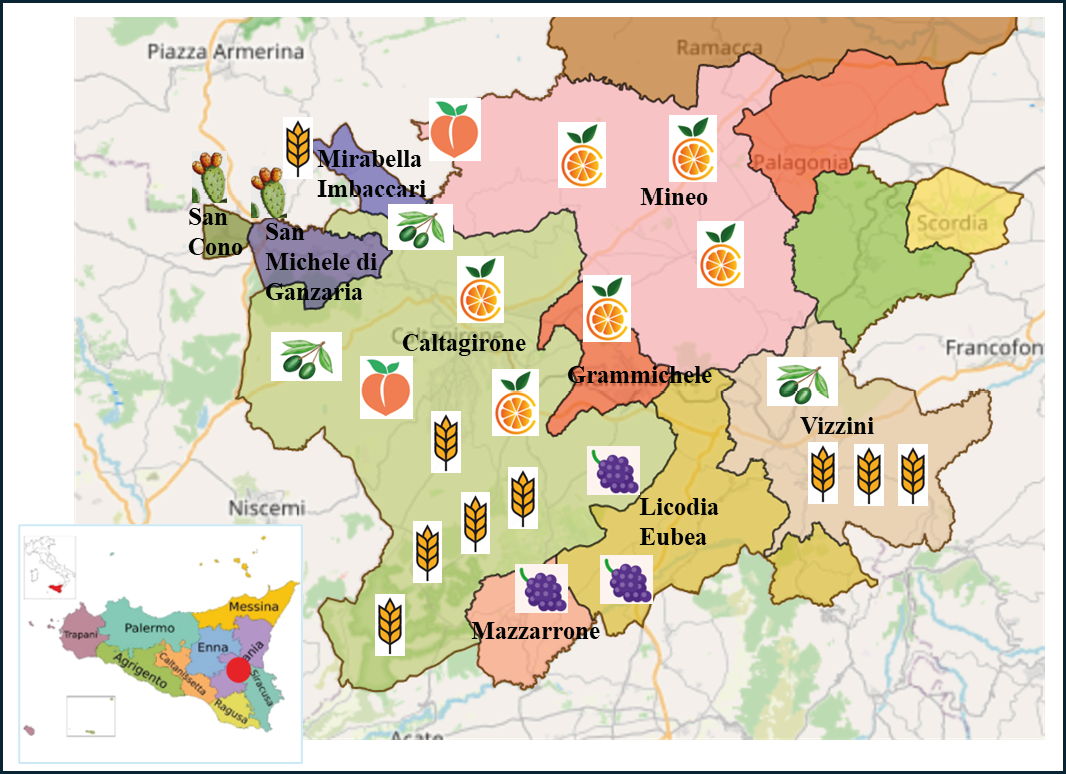
Local agriculture is characterized by a combination of herbaceous crops (cereals, legumes, forages) and tree crops (vineyards, olive groves, citrus orchards, and fruit trees), with a huge portion of the area dedicated to organic or transitioning farming methods.
The University of Catania has launched a Living Lab with the aim of fostering the transition towards sustainability and a circular economy. The initiative involves farmers, local institutions, environmental organisations and consumers, and is focused on establishing the Calatino Bio-district. Among the various crops present, citrus cultivation was chosen as the focal crop for the Living Lab project because of its significant economic weight in the Calatino area and its sensitivity to water resource management issues. Citrus fruits represent one of the main sources of local agricultural income and require particularly efficient water management, making them an ideal case for experimenting with innovative strategies in line with agroecological principles.
The primary objectives are to promote:
– the transition to organic farming and organic certification to enhance the competitiveness of local products;
– the adoption of sustainable agricultural practices, such as crop rotations, organic fertilizers, and integrated pest management, in line with agroecological principles;
– short supply chains, through local markets and the creation of a food hub for the distribution and valorization of organic products;
– social inclusion and cooperation among producers, processors, and distributors.
Through these strategies, the Bio-district aims to enhance the environmental sustainability of local agriculture and promote economic development based on circularity and biodiversity, positioning Calatino as a model for agroecological transition in Sicily.
The Calatino Living Lab serves as a participatory platform where farmers, researchers, technical experts, and institutional representatives collaborate to facilitate the agroecological transition of the region. This large-scale transition is often hindered by regulatory constraints, economic challenges, and technological limitations (Toffolini et al., 2021; Beaudoin et al., 2022; Potters et al., 2022; Yousefi and Ewert, 2023; Timpanaro et al., 2024; Gardezi et al., 2024). In Sicily, the recent regional legislation on agroecology (Regional Law No. 21 of 29/07/2021, “Provisions on Agroecology, Biodiversity Protection, Sicilian Agricultural Products, and Technological Innovation in Agriculture”) establishes strict criteria for farms, highlighting the need for an in-depth analysis of its practical implications and potential areas for improvement.
The methodological approach adopted is summarized in Figure 2. The establishment of a collaborative ecosystem is imperative for the co-design of innovative solutions for sustainable water resource management, agroecology, and the adoption of enabling technologies by farmers, institutions, researchers, businesses, and consumers. A preliminary study involved the identification of key stakeholders and the definition of local challenges. This was followed by structuring the Living Lab as a participatory platform for research and experimentation. Stakeholders were selected using a targeted approach, favoring organic or in-conversion farmers operating in the citrus sector who expressed interest in adopting agroecological practices and innovative technologies. Institutional representatives, technicians and local associations with a key role in promoting agricultural sustainability in the Calatino area were also involved. Stakeholder engagement was achieved through preliminary meetings, thematic focus groups, interactive workshops, and demonstration visits to pilot farms, with invitations disseminated via email, social media, and local networks.
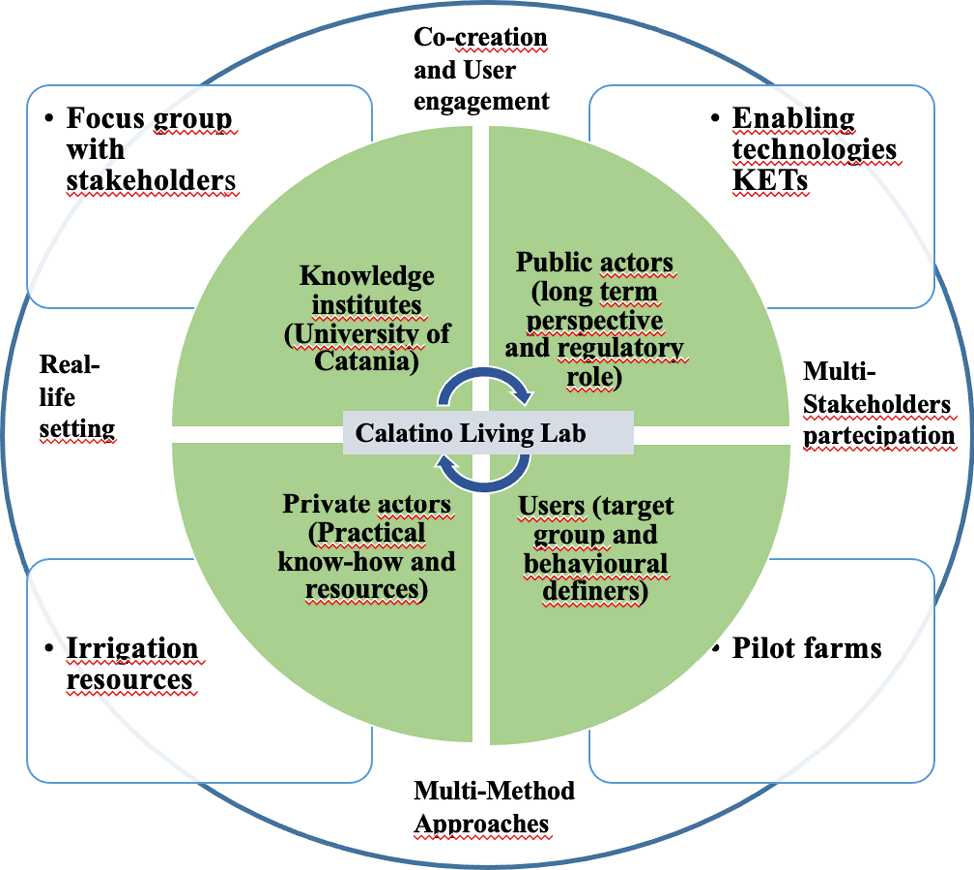
Although this targeted selection ensured the active participation of motivated and competent actors, it is important to recognise that it may have introduced a certain degree of bias into the selection. Specifically, the inclusion of stakeholders already inclined towards innovation and sustainability may limit the generalisability of the results to broader agricultural populations that may be more hesitant or resistant to adopting digital technologies.
The first step of the Living Lab was an in-depth analysis of regional regulations to understand the criteria for recognizing agroecological farms and the potential barriers to their adoption. Through participatory discussions among stakeholders several critical issues were identified, including:
– high initial requirements, such as the obligation to allocate 20% of farmed land to native varieties and to replant 20% of the area with indigenous tree species;
– management difficulties, due to the requirement for complex environmental certifications and the high costs of compliance;
– limited technological support, as no incentives are provided for adopting innovative tools that could facilitate the agroecological transition;
– commercial constraints, including the obligation to sell 20% of production in local markets, a requirement that could disadvantage farms located in more remote areas.
The stakeholder discussions within the Living Lab also highlighted a shared need to leverage technological innovations to support farms in resource management, improve production efficiency, and ensure economic sustainability. A key concern among stakeholders was water resource management, one of the main challenges for Sicilian agriculture. Multiple focus groups were organized to explore issues such as:
– how can water management be improved in agroecological farms?
– which technologies can promote water conservation without compromising productivity?
– what strategies can be adopted to make irrigation more efficient and less dependent on intensive water use?
The focus groups revealed that many organic farms lack advanced tools for water monitoring, relying instead on empirical practices that often lead to waste or water shortages.
Based on the discussions and emerging needs, two organic citrus farms in the Calatino region were selected as pilot cases to assess the impact of enabling technologies applied to irrigation management (one implementing Key Enabling Technologies and the other without KETs). These farms align with the agroecological principles defined by FAO (2018) and were equipped with (Table 2):
– weather stations for real-time monitoring of temperature, humidity, and precipitation;
– soil sensors to measure moisture levels and optimize irrigation;
– Decision Support Systems (DSS) based on climatic and agronomic data to enhance resource management.
The choice of these technologies was guided directly by the critical issues identified during the focus groups. Soil sensors and weather sheds allow accurate monitoring of environmental parameters, enabling more efficient irrigation management tailored to actual crop needs. The DSS system provides farmers with decision support based on objective data, reducing uncertainty in irrigation planning and helping to limit water wastage. Table 2 summarizes the comparison between the principles of agroecology (FAO, 2018), the corresponding enabling technologies, and their practical application in traditional agroecology, precision agriculture, and the two pilot farms within the Living Lab. The structure of the table allows for a direct comparison of how different approaches integrate technology to address agroecological goals. Reading across each row, one can observe the progressive transition from traditional practices to precision and digitally-supported agroecological farming. Each principle – such as biodiversity, resource efficiency or co-creation of knowledge – is linked to specific digital tools (e.g. soil sensors, DSS platforms) and corresponding practices observed in the field. For example, while the traditional approach relies on experience-based decisions, the digitised farm uses real-time data to manage irrigation and nutrient input more precisely. This alignment between agroecological objectives and enabling technologies illustrates how innovation can improve sustainability and productivity without compromising ecological integrity.
| FAO principles | Enabling technologies | Agroecology | Precision agriculture | Farm with technologies | Farm without technologies |
|---|---|---|---|---|---|
| 1. Diversity | GIS (Geographic Information Systems) | Biodiversity mapping | Irrigation and fertilization zoning | Mapping cover crops and water retention | Traditional cultivation without mapping |
| 2. Synergy | Big Data | Local agroecological planning | Optimization of production efficiency | Weather and soil data analysis for crop synergy | Experience-based management and traditional rotations |
| 3. Efficiency | IoT (Internet of Things) | Sensors for water conservation | Automated irrigation and fertilization | Targeted irrigation sensors and DSS for water management | Scheduled irrigation without monitoring |
| 4. Resilience | Drones | Monitoring of natural resources | Detection of infestations and targeted irrigation | Decision-support system for mitigating water and climate stress | Reactive response to climate change without predictive tools |
| 5. Recycling | Sensors | Natural measurement of soil nutrients | Advanced soil and crop monitoring | Nutrient monitoring to reduce chemical inputs | Fertilizers and compost application based on experience |
| 6. Knowledge Sharing | Big Data and digital platforms | Shared access to environmental and agricultural data | AI-driven process optimization | Software for comparison between agroecological farms | Limited knowledge exchange within local cooperatives |
| 7. Human and Social Values | Mobile applications for farmers | Digital training for social inclusion | Agricultural workforce automation | Decision-making support based on digital data | Dependence on personal experience and manual labor |
| 8. Food Traditions | Blockchain for traceability | Protection of local production | Monitoring of production chains | Traceability of farm sustainability | Traditional sales without digital certification |
| 9. Responsible Governance | Open data and GIS | Active participation in agricultural management. | Automated data collection for agricultural policies | Use of platforms for farm monitoring | Participation limited to local cooperatives |
| 10. Circular Economy | IoT and AI for agricultural waste management | Recycling and reuse of agricultural by-products | Waste reduction through optimization | Crop residue recovery and reuse of wastewater | Traditional disposal without optimization |
The comparison between citrus farming with and without innovative technologies was based on the analysis of total costs and net benefits for each system, including water savings, production yield, and profitability increase, as extensively explored in the literature (Alston, 2010; Pardey et al., 2010; Lubell et al., 2011; Alston et al., 2021; Medici et al., 2021; Jamil et al., 2021).
The baseline assumptions for the comparison are reported in Table 3. The analyzed parameters highlight the potential impact of digital innovations on irrigation, climate monitoring, decision-making processes, water-use efficiency, management costs, and agronomic yield.
| Aspect | Farm with technology | Farm without technology | |||||||||||||||||
|---|---|---|---|---|---|---|---|---|---|---|---|---|---|---|---|---|---|---|---|
| Irrigation | Uses precise data (soil moisture, weather forecasts) to optimize water requirements | Irrigation based on experience and traditional fixed irrigation cycles (not optimized) | |||||||||||||||||
| Climate monitoring | Weather station and sensors provide real-time data on temperature, wind, and rainfall | Based on visual observations and generic weather forecasts | |||||||||||||||||
| Decision-making | User-friendly application suggests irrigation timing and quantity | Subjective decisions based on intuition and experience | |||||||||||||||||
| Water efficiency | Greater water control with reduced waste | High risk of water excess or deficit, leading to higher-than-necessary consumption | |||||||||||||||||
| Management costs | Initial investment in technology, but lower variable costs (e.g., energy for irrigation) | Constant costs due to inefficient resource use | |||||||||||||||||
| Agronomic yield | Optimized water requirements and reduced plant stress, leading to higher productivity | Yield affected by irrigation mismanagement or unexpected climatic conditions | |||||||||||||||||
| Source: Our elaboration. | |||||||||||||||||||
As for the total costs (C) for each agricultural system, these are calculated as the sum of the costs of water, fertiliser, labour, cover crops and technology (for the innovative system only), as shown in Table 4.
| Variables | Farm with Technology | Farm without Technology | |||||||||||||||||
|---|---|---|---|---|---|---|---|---|---|---|---|---|---|---|---|---|---|---|---|
| Total costs (C) |
|
|
|||||||||||||||||
| Total revenue (R) |
|
|
|||||||||||||||||
|
Net profit ( ) |
|
|
|||||||||||||||||
| The variables considered were the following: A = Cultivated area (ha); Pc = Production per hectare in agriculture without innovative water-saving technologies (t/ha); Pt = Production per hectare in agriculture with innovative water-saving technologies (t/ha); p = Sales price per tonne (€/t); Wc = Water consumption per hectare in agriculture without innovative water-saving technologies (m³/ha); Wt = Water consumption per hectare in agriculture with innovative water saving technologies (m³/ha); Cw = Water cost per m³ (€/m³); Cf = Fertiliser cost per hectare (€/ha); Cp = Pesticide cost per hectare (€/ha); Ct = Technology cost (installation + maintenance per hectare) (€/ha); Ccc = Cover crop cost per hectare (€/ha); Ce = Energy cost per hectare (€/ha); Cother = Other costs (€/ha). | |||||||||||||||||||
The additional benefit of farming with innovative technologies over conventional farming is given by:
Expanding
where:
(Pt - Pc) * p = represents the increase in profitability due to increased production.
(Wt - Wc) * Cw = represents the water savings in terms of costs.
Ct + Ccc are the additional costs for the adoption of technologies and cover crops.
If:
B>0 → adoption of the technologies is cost effective.
B<0 → the additional costs outweigh the benefits, making the transition uneconomic without incentives.
B 0 → Profitability is similar in the two models, but there may be indirect environmental benefits.
The economic evaluation was completed with a sensitivity analysis, hypothesising alternative scenarios on a possible rent for the KETs plant and equipment (necessary to have up-to-date and enhanced decision support systems with links to meteorological databases), and with a Monte Carlo modelling to focus the analysis on the other variables (water consumption, operating costs, production) that present uncertainty and that most influence the difference in profit between the two pilot companies.
Monte Carlo modelling assumes that:
At the end of N iterations we estimate
– the average profit for each company
and
– the average difference
– the distribution (and dispersion) of ∆Π, which makes it possible to assess the probability that the technology will lead to a higher profit.
The final Monte Carlo model used was as follows:
where each uncertain parameter is sampled from a specified distribution. Repeating this calculation for many iterations yields the profit difference distribution, which provides a comprehensive assessment of the economic sensitivity to the adoption of the innovative technology.
3.1. Living Lab approach and case study characteristics
The two citrus farms analyzed were identified as pilot sites within the Living Lab of the Calatino Inner Area, a collaborative ecosystem aimed at testing and validating innovative solutions for regenerative citrus farming and sustainable water resource management. The objective is to develop scalable strategies for other farms seeking to integrate regenerative practices with technological innovations.
The selection of the farms (Table 5) was based on:
– Representation of the citrus sector within the region and the study area.
– Diversity in management practices, as one farm adopted enabling technologies, while the other relied on a traditional agroecological approach.
– Entrepreneurs’ willingness to engage in the co-experimentation and training process.
| Information | Farm with technology | Farm without technology | |||||||||||||||||
|---|---|---|---|---|---|---|---|---|---|---|---|---|---|---|---|---|---|---|---|
| Localization | Mineo | Mineo | |||||||||||||||||
| UAU, ha | 5 | 5 | |||||||||||||||||
| Production address | Blood orange | Blood orange | |||||||||||||||||
| Organic certification | Yes | Yes | |||||||||||||||||
| Regenerative agriculture | Cover crops + advanced water management | Cover crops with traditional management | |||||||||||||||||
| Water use | Sensor monitoring + DSS | Manually programmed irrigation | |||||||||||||||||
| Nutrient management | Soil analysis + targeted fertilisation | Experience-based fertilisation | |||||||||||||||||
| Pest control | Biological strategies + data monitoring | Biological strategies without monitoring | |||||||||||||||||
| Market | Selling to local supply chains and quality markets | Selling to local supply chains and quality markets | |||||||||||||||||
| Source: Our elaboration. | |||||||||||||||||||
The two pilot farms are in Mineo (Catania province) and share the same production identity (5 hectares of blood oranges, organic certification, and a commitment to regenerative agriculture). Their differing agricultural management approaches make them suitable case studies for assessing the impact of enabling technologies compared to a system based solely on traditional agronomic experience.
The farm utilizing innovative technology has integrated sensors, a decision support system (DSS), and advanced soil analysis to optimize irrigation and plant nutrition. The goal is to achieve more efficient water use, a more targeted nutrient management strategy, and continuous pest monitoring, thereby reducing input usage and maximizing productivity.
The farm without innovative technology follows a more traditional approach, with manually scheduled irrigation and fertilization based on the farmer’s experience. While it employs cover crops and organic farming strategies, it lacks tools for real-time monitoring of soil and water conditions, which can result in less precise management and higher resource consumption.
The intersection of three key elements – organic farming (a low-impact agricultural management model aligned with agroecological principles, aiming for balanced and resilient production systems while reducing dependency on external inputs), regenerative agriculture (cover crops contribute to reducing erosion, improving water retention, and increasing soil organic matter, fostering a healthier and more productive ecosystem in the long term), and enabling technologies (agroecology does not exclude technology but leverages it to enhance sustainable resource management) – is represented by agroecology. This guiding principle unites the two pilot farms of the Living Lab in the Calatino.
This integrated approach improves the sustainability, productivity, and resilience of agricultural systems, turning environmental and economic challenges into opportunities for innovation (Niggli, 2015; Gascuel-Odoux et al., 2022; Bless et al., 2023; Domínguez et al., 2024).
3.2. Issues related to the management of irrigation resources
The discussion among stakeholders on the water emergency in citrus farming has highlighted how it is the result of a combination of climatic, institutional and economic factors that negatively affect production and farm sustainability. Figure 3 represents a visualization of the relationships between the main factors characterizing this crisis, as they emerged during the focus group. The structure was elaborated using MAXQDA software, through the exploration of co-occurrences between thematic codes applied to text segments. The figure is organized hierarchically, starting from the main cause (climate change) at the top, branching downward into its effects on water availability and plant health, and further into institutional and economic consequences. Arrows represent causal links, while mitigation strategies are shown as side branches connected to the specific problems they address. No color coding was used; the structure is entirely based on logical connections and thematic clusters. This approach made it possible to clearly highlight the connections between climatic, institutional and economic variables, as well as the mitigation strategies adopted by citrus growers and sector experts.
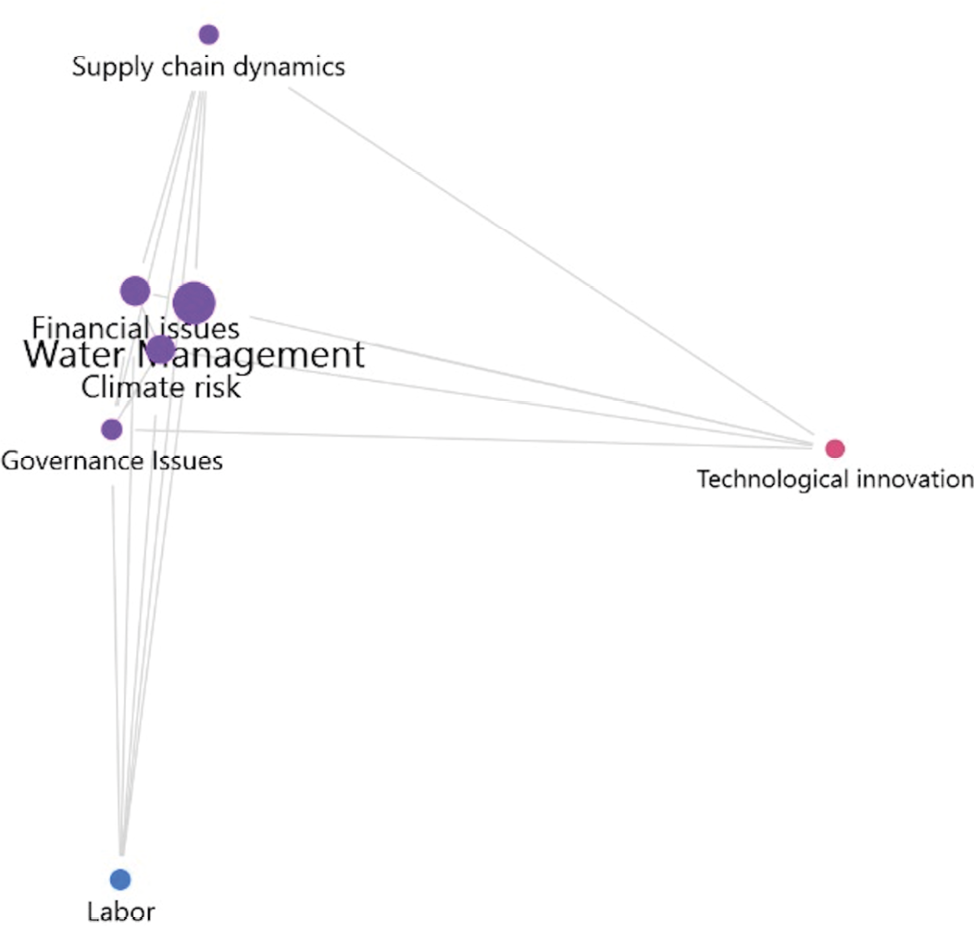
The central element of the water crisis, as emerged from the discussion, is climate change, which manifests through alterations in rainfall patterns. This results in two opposing but equally damaging situations: water scarcity, caused by reduced precipitation and rising temperatures that intensify evaporation and increase plant water demand, or water excess, with sudden and intense rainfall leading to floods, water stagnation, and root damage.
These issues are compounded by institutional inefficiency, which worsens water resource management. The lack of maintenance of watercourses, poor planning in water distribution, and the bureaucratic rigidity of reclamation consortia make it difficult for citrus growers to access water when they need it most. Additionally, the absence of a consumption-based pricing system leads to waste and inefficient resource use.
To address the water crisis, citrus growers have adopted various technological and agronomic solutions. These include innovations in irrigation, such as surface and subsurface micro-irrigation systems to reduce water waste, or the use of regulated deficit irrigation systems to optimize water use according to plant growth stages. Farmers have also experimented with alternative water resources, such as treated wastewater, through phytoremediation processes, to reduce dependence on conventional water sources. A common strategy is the selection of rootstocks resistant to water stress, as well as the use of raised beds to improve drainage and controlled cover cropping.
According to stakeholders, a coordinated territorial approach involving public institutions, reclamation consortia, and producer organizations is lacking. Additionally, a revision of irrigation tariffs based on actual consumption could encourage more responsible water use, while increased digitalization in water resource management (sensors, weather stations) could enable more precise irrigation planning.
These results highlight not only the complexity of the water crisis, but also the proactive role of farmers in experimenting with feasible solutions. The issues and strategies discussed in this section have been translated into the visual structure shown in Figure 3, which helps to summarise the entire problem-solving framework in a single view. This makes the figure particularly useful for better understanding where to intervene and how to support adaptation efforts more effectively.
3.3. Cost-effectiveness assessment of KETs deployment
The calculations clearly show the positive impact of KET adoption on farm management, with benefits reflected in water efficiency, operating costs, productivity and overall profitability.
Table 6 shows that the adoption of enabling technologies results in a significant improvement in farm management, with water consumption reduced by 33% and a consequent annual saving of 420 €/ha, without penalizing productivity. This implies greater sustainability in resource use and reduced production costs.
| Parameter | Farm with technology | Farm without technology | Difference % | ||||||||||||||||
|---|---|---|---|---|---|---|---|---|---|---|---|---|---|---|---|---|---|---|---|
| Annual water consumption (m³/ha) | 2,800 | 4,200 | -33% | ||||||||||||||||
| Average cost of water (€/m³) | 0.3 | 0.3 | 0% | ||||||||||||||||
| Water saving (€/ha) | 420 € | 0 € | --- | ||||||||||||||||
| Water saving (%) | 33% | 0 | --- | ||||||||||||||||
| Production per hectare (t/ha) | 44 | 38 | 16% | ||||||||||||||||
| Sale price (€/t) | 400 € | 400 € | 0% | ||||||||||||||||
| Revenues per hectare (€/ha) | 17,600 € | 15,200 € | 16% | ||||||||||||||||
| Cost cover crops (€/ha) | 250 € | 250 € | --- | ||||||||||||||||
| Fertiliser costs (€/ha) | 720 € | 850 € | -15% | ||||||||||||||||
| Pesticide cost (€/ha) | 40 € | 140 € | -71% | ||||||||||||||||
| Energy cost for irrigation (€/ha) | 520 € | 750 € | -31% | ||||||||||||||||
| Technology investment (€/ha) | 500 € | 0 € | --- | ||||||||||||||||
| Other cost | 1,570€ | 1,990€ | -21% | ||||||||||||||||
| Total cost (€/ha) | 3,600 € | 3,980 € | -10% | ||||||||||||||||
| Source: Our elaboration. | |||||||||||||||||||
The cost of energy for water withdrawal is reduced by 31%, confirming how energy efficiency is an additional economic benefit of technological innovation.
Productivity increases by 6 tons/ha (+16%), translating into a revenue increase of €2,400/ha. This result underscores how technological adoption not only improves efficiency, but also directly contributes to strengthening the company’s competitiveness.
At the same time, there is a reduction in the use of fertilizers (-15%) and a drastic decrease in pesticides (-71%), reflecting the improvement in agronomic management and less dependence on external inputs, with clear economic and environmental benefits.
Despite an initial investment of €500/ha, the innovative company achieves a net profit of €14,000/ha, compared to €11,220/ha for the traditional company, with a 25% increase in profitability (+€2,780/ha) (Table 7). This highlights how the economic benefits far outweigh the costs of technology adoption.
| Parameter | Farm with technology | Farm without technology | Difference % | ||||||||||||||||
|---|---|---|---|---|---|---|---|---|---|---|---|---|---|---|---|---|---|---|---|
| Revenues R (€/ha) | 17,600 € | 15,200 € | 16% | ||||||||||||||||
| Total costs C (€/ha) | 3,600 € | 3,980 € | -10% | ||||||||||||||||
| Net profit Π (€/ha) | 14,000 € | 11,220 € | 25% | ||||||||||||||||
| Change in benefits (ΔB) | +2,780 | ||||||||||||||||||
| Source: Our elaboration. | |||||||||||||||||||
Considering three scenarios based on complete enabling technologies to be acquired by annual subscription, a sensitivity analysis can also be developed (Table 8):
– 200 €/ha/year → Basic Package (sensors + basic software);
– 400 €/ha/year → Intermediate (sensors + advanced DSS + local weather)
– 600 €/ha/year → Advanced (sensors + advanced DSS + weather integrated with weather databases such as SIAS, ISPRA, SwissMetNet, etc.).
| Rental scenario | Annual cost per hectare (€) | Net new profit (€/ha) | Difference vs. farm without technology (€) | Convenience compared to the traditional model | |||||||||||||||
|---|---|---|---|---|---|---|---|---|---|---|---|---|---|---|---|---|---|---|---|
| Rent 200 €/ha/year | 200.00 € | 13,800.00 | 2,580.00 | Very affordable | |||||||||||||||
| Rent 400 €/ha/year | 400.00 € | 13,600.00 | 2,380.00 | Still profitable | |||||||||||||||
| Rent 600 €/ha/year | 600.00 € | 13,400.00 | 2,180.00 | Advantageous but low margin | |||||||||||||||
| Source: Our elaboration. | |||||||||||||||||||
Sensitivity analysis on the different levels of technology subscription shows that even with a higher fee (600 €/ha/year), the positive margin remains substantial (+2,180 €/ha compared to the farm without technology). The intermediate package (400 €/ha/year) emerges as the one most balanced between investment and economic benefit, suggesting a sustainable option for maximizing farm profitability.
To assess how net profit (€/ha) responds to key economic drivers, a Monte Carlo simulation was conducted. The goal was to compare the farm adopting innovative technology with the one that does not, highlighting how variations in certain parameters can either amplify or reduce the benefits derived from technology adoption.
The model assumed that the product’s selling price (400 €/t) and non-specific fixed costs (e.g., general expenses, logistics) remain constant, while variations in production and costs influenced by technology were analyzed. Analysis considered water costs, expenses for cover crops, fertilizers, pesticides, irrigation energy, and, for the technology-adopting farm, the technological investment.
The Monte Carlo simulation involves repeated iterations, where in each cycle, random values are drawn for each parameter according to predefined distributions. In this study, uniform distributions around baseline values were assumed. In particular, the unit cost of water was varied between 0.3 and 0.5 €/m³, while water consumption for the technological farm ranged between 2,520 and 3,080 m³/ha, and for the non-technological farm, between 3,780 and 4,620 m³/ha. Similarly, production per hectare and operating costs were defined within specific intervals to reflect real-world variability and simulate a wide range of scenarios.
Table 9 shows that, on average, the farm adopting technology achieves a net profit of approximately 14,000 €/ha, while the non-technological farm reaches around 11,220 €/ha, resulting in an average difference of +2,780 €/ha. These results indicate a significant average economic benefit from adopting innovative technology. The standard deviations, 1,200 €/ha and 1,400 €/ha respectively, highlight considerable variability. This suggests that while the average benefit is positive, in some scenarios, the advantage may be lower or even more pronounced.
| Statistics | Farm with technology (€/ha) |
Farm without technology (€/ha) |
Difference (Tech - NonTech, €/ha) | ||||||||||||||||
|---|---|---|---|---|---|---|---|---|---|---|---|---|---|---|---|---|---|---|---|
| Average profit | 14.000 € | 11.220 € | 2.780 € | ||||||||||||||||
| Standard deviation | 1.200 € | 1.400 € | 1.300 € | ||||||||||||||||
| Minimum Profit | 11.000 € | 8.500 € | 2.500 € | ||||||||||||||||
| Maximum profit | 17.000 € | 15.500 € | 3.500 € | ||||||||||||||||
| Median | 14.100 € | 11.300 € | 2.800 € | ||||||||||||||||
| Source: Our elaboration. | |||||||||||||||||||
The economic advantage is primarily driven by savings in operational costs. The technology enables a substantial reduction in water consumption, leading to lower water expenses, and decreases costs associated with fertilizers and pesticides, due to more efficient and sustainable farming practices. These savings, combined with a potential increase in yield per hectare, contribute to a higher net profit.
The simulation also highlights the model’s sensitivity to various parameters. For instance, an increase in the unit cost of water shifts total costs to higher values, making water savings even more critical. Similarly, variations in yield per hectare directly affect revenue and, consequently, net profit. The ability to adjust multiple parameters simultaneously helps identify key drivers of economic success and potential sources of risk.
The Monte Carlo simulation comparing farms with and without innovative technology demonstrates that adopting technology leads to a significant average increase in net profit per hectare. These findings provide essential support for strategic decision-making in a competitive and dynamic environment, where operational efficiency and innovation are crucial for success.
The analysis conducted within the Living Lab of the Calatino inner area has enabled an exploration of the impact of enabling technologies on the agroecological transition in inner areas, highlighting economic, environmental, and organizational benefits. Starting from the research questions, the findings clearly show that the integration of enabling technologies enhances the efficiency of resource management, particularly in terms of water and nutrient use, helping to improve productivity and keep costs down. These findings align with those reported by Bellon-Maurel et al. (2022) and Maurel and Huyghe (2017), who highlight how digital tools contribute to resource optimization and improved sustainability in agricultural systems. Furthermore, Ajena et al. (2022) emphasize that digitalization can break down traditional barriers fostering innovation in rural sectors, particularly in inner areas where challenges are more pronounced. Therefore, the integration of technology accelerates the agroecological transition by providing farmers with real-time data and decision-making tools that enhance precision and sustainability in farm management. Regarding the second research question, the comparison between the two pilot farms revealed a significant gap in farmers’ perceptions. The farm that adopted the innovative technology reported tangible benefits, such as reduced operational costs and improved productivity. In contrast, the farm following a traditional approach relied on well-established methods and expressed skepticism toward digital tools. This resistance stems from a perception of greater reliability associated with traditional methods, combined with limited familiarity with innovative technologies and concerns about high initial costs and a steep learning curve. These aspects are consistent with the findings of Anderson and Maughan (2021) and Schiller et al. (2020), who describe the existing gap between innovation and tradition in agriculture. Literature suggests that the lack of specific training and institutional support represents a major barrier to the adoption of digital technologies (Timpanaro et al., 2023).
In this context, Living Labs serve as co-experimentation and training spaces that facilitate knowledge transfer and help overcome initial resistance (Scuderi et al., 2023). Active participation and dialogue among farmers, researchers, and technical experts contribute to demystifying new technologies and highlighting their potential in sustainable resource management. Living labs show that they can function as catalysts for change, fostering an agroecological transition that is not only technologically advanced, but also socially inclusive (Cascone et al., 2024; Beaudoin et al., 2022).
The third research question led to a deeper analysis and reflection on the economic outcomes through Monte Carlo simulation. From an economic perspective, the farm integrating enabling technologies achieves higher per-hectare revenues due to increased production and more efficient cost management. These findings align with the studies of Alston (2010) and Pardey et al. (2010), which emphasize how agricultural innovation can generate substantial economic benefits.
From an environmental perspective, the adoption of innovative technologies promotes more sustainable resource management and a reduction in chemical input use. The decrease in water consumption and pesticide application, for example, contributes to minimizing environmental impact and fostering more regenerative agricultural practices. These results are consistent with the evidence provided by Domínguez et al. (2024) and D’Annolfo et al. (2017), who highlight the potential of combining agroecological practices with technological innovation to promote sustainable and resilient agriculture. Thus, the integration of technologies not only enhances economic efficiency but also represents a successful approach to reducing environmental impact by encouraging a more responsible use of resources.
Finally regarding Q4, the Living Lab model implemented in the Calatino context has proven to be an effective environment for the co-creation and experimentation of innovative solutions. The two pilot farms, despite sharing the same production identity and organic certification, differ in their management approach: one integrates enabling technologies, while the other follows a traditional method. This strategic choice has highlighted how the presence of digital technologies is not contradictory to agroecological principles but rather enhances their effectiveness, improving the sustainable management of resources and the resilience of the production system.
Living Labs play a crucial role in bridging the gap between technological innovation and traditional agricultural practices. They provide a space where farmers, researchers, technologists, and institutional stakeholders can experiment, exchange experiences, and validate solutions in real time (Scuderi et al., 2024). In our case, the adoption of digital tools has improved irrigation monitoring and management, leading to more efficient water use and lower operational costs. These results, combined with the integration of regenerative practices such as the use of cover crops and targeted nutrient management, contribute to creating an integrated system that addresses the environmental and economic challenges of inner areas. Moreover, the active participation of farmers in Living Labs fosters a bottom-up approach that stimulates responsible innovation and the dissemination of best practices.
For example, during one of the demonstration sessions, an organic farmer had the opportunity to test a low-cost soil moisture monitoring system, immediately noting its usefulness in reducing water waste. This kind of direct experience helped turn initial prejudice into interest and openness. In another case, a young farmer who initially showed skepticism toward the use of digital data for crop management changed his perspective after sharing his needs with a group of experts within the Living Lab and receiving support in interpreting the data collected. The opportunity to learn by doing, in a nonjudgmental and co-creation-oriented context, proved essential to reduce cognitive barriers and build confidence toward innovation. Recent studies (Gascuel-Odoux et al., 2022; Potters et al., 2022) also highlight how collaboration and the engagement of local actors are essential for achieving effective and sustainable agroecological transitions.
A critical issue that deserves attention concerns the economic implications related to the costs of adopting enabling technologies, especially in vulnerable rural settings. While these technologies can generate efficiency and reduced operating costs, they often entail significant upfront investments, the need for technical maintenance, and increasing dependence on external suppliers. This can lead to an imbalance in bargaining power between farms, which are often small or medium-sized, and technology providers, which operate according to industrial and centralized market logics.
In the absence of adequate support and regulatory measures, this imbalance can produce regressive effects: farms with greater economic capacity will be able to access technologies more easily and take competitive advantage of them, while the more fragile realities risk being excluded from the innovation process (Bissadu et al., 2025).
For this reason, it is crucial to accompany technology adoption with targeted policy strategies capable of ensuring affordability, technical training, systems interoperability and open innovation models. Living Labs, represent a possible lever to rebalance power dynamics through co-design and direct involvement of farmers in technology selection and testing processes. To effectively address these power imbalances and promote a more inclusive adoption of enabling technologies, several targeted policy actions should be considered. Such measures can help rebalance contractual relationships between farmers and technology providers, in line with the principles of responsible innovation (Bellon-Maurel et al., 2022; Beaudoin et al., 2022; Gava et al., 2025).
First, public incentives for technology adoption should be conditional on the use of open standards and interoperable systems to avoid technological lock-in, as discussed by Ditzler and Driessen (2022) and Clapp and Ruder (2020). This approach strengthens farmers’ autonomy and prevents dependence on proprietary technologies controlled by a few large suppliers (Bissadu et al., 2025).
Second, it is essential to promote the creation of farmer-led cooperatives or technology consortia to strengthen collective bargaining power in the purchase and negotiation of technology services. This is in line with recommendations to strengthen agricultural innovation systems (Potters et al., 2022) and enable bottom-up governance models (Gava et al., 2025).
Thirdly, the creation of public platforms dedicated to the collective procurement of technologies, supported by technical advisory services and independent consultants, can further protect farmers from unfavourable contractual conditions. The provision of advisory vouchers for access to third-party technical expertise would complement this strategy.
Furthermore, regulatory frameworks should explicitly recognise farmers’ ownership of agricultural data generated by digital systems, ensuring that technology providers cannot appropriate or monetise such data without informed consent (Clapp and Ruder, 2020; Bellon-Maurel et al., 2022).
Living Labs themselves can be institutionalised as territorial “technology brokers”, acting as independent intermediaries to ensure equitable access to innovation and promote co-created solutions tailored to local needs (Beaudoin et al., 2022; Gardezi et al., 2024). This model of participatory innovation is in line with the agroecological governance structures advocated by Gascuel-Odoux et al. (2022), which support equitable access to technological innovation in rural areas.
By adopting these integrated strategies, policymakers can help reduce asymmetries in bargaining power, protect the interests of smallholder farmers, and promote an inclusive, resilient, and participatory agroecological transition.
In summary, our research findings indicate that:
– The integration of enabling technologies accelerates the agroecological transition by improving resource management and increasing profitability.
– Farmers’ perceptions are influenced by direct experience and the support provided by Living Labs, which help overcome resistance to innovation.
– The combination of agroecological practices and innovative technologies generates positive economic and environmental impacts, as evidenced by increased productivity and reduced operational costs.
– Living Labs play a key role in facilitating the integration of technology and agroecology, fostering the creation of integrated and sustainable systems in inner areas.
These findings not only confirm the existing literature but also provide an operational framework to guide strategic decisions in complex agricultural contexts, where sustainability and innovation need go hand in hand. The integrated and participatory approach promoted by Living Labs thus emerges as an effective response to current and future challenges, helping to transform environmental and economic challenges into opportunities for innovation and sustainable development.
The study conducted within the Living Lab of the Calatino Inner Area highlights how the integration of enabling technologies can play a crucial role in accelerating the agroecological transition in rural areas. The results, derived from a comparative analysis of two pilot citrus farms – one adopting advanced digital tools and the other maintaining a traditional approach – demonstrate economic, environmental, and managerial benefits, confirming the transformative potential of such innovations.
The farm that integrated sensors, decision support systems (DSS), and other digital technologies achieved significant operational efficiency, including a 33% reduction in water consumption and a 16% increase in yield per hectare, leading to a 25% improvement in profitability. These findings not only underscore the importance of more precise resource management but also confirm that the adoption of enabling technologies can enhance environmental sustainability by reducing chemical inputs and improving irrigation efficiency. The study also highlights some critical issues and concrete challenges to be addressed. Among these, the affordability of technologies is a major obstacle, especially for small companies with limited liquidity. Similarly, the technical complexity of the systems and the costs associated with maintenance, software updates and staff training may limit widespread adoption. Furthermore, the scalability of the tested solutions remains to be verified in different contexts due to soil and climate conditions, farm size and crop type.
However, this study has some limitations. First, the small number of cases analyzed may limit the generalizability of the results. Given the diversity of agronomic and socio-economic contexts, further large-scale studies are needed to confirm the replicability of the observed benefits. Additionally, while the methodology integrates an in-depth economic analysis and a Monte Carlo simulation, it could be enriched by further long-term measurements to assess the economic and environmental sustainability of these technologies over time.
Another limitation concerns the analysis of farmers’ perceptions. While the comparison between the innovative and traditional groups highlighted resistance and scepticism toward digital tools, a more extensive qualitative investigation – such as in-depth interviews or focus groups with a broader sample of producers – could provide further insights into the dynamics of adoption and the training needs required to support the transition.
Based on these considerations, several future research directions emerge. Expanding the Living Lab model to other rural areas in Sicily and different agricultural sectors could help determine whether enabling technologies can generate similar benefits in different contexts. Future studies could implement comparative pilot projects in different production systems, such as viticulture or olive growing, and monitor key indicators like water use efficiency, yield performance, and farmer adoption rates over at least three growing seasons.
Further research could also explore the long-term impact of adopting digital tools, analyzing, for example, how economic and environmental benefits evolve over multiple production cycles and under changing climatic and market conditions. Longitudinal studies should be conducted, integrating detailed farm accounting records, soil and water monitoring data, and farmer surveys, to track both economic returns and resource use efficiency over a 5–10 year horizon. Another key area of interest involves the development of training programs and institutional support mechanisms to facilitate the dissemination of these technologies among farmers. Future initiatives should design modular, practice-oriented training programs focused on digital literacy, irrigation management, and precision agriculture tools, targeting different farmer profiles (smallholders, young farmers, cooperatives), possibly through partnerships with vocational training institutes and local cooperatives. Collaborations with universities and research centers to design dedicated training programs could help overcome learning curve challenges and promote greater adoption of digital systems.
Finally, the study highlights the importance of targeted policy actions to mitigate power asymmetries between farmers and technology providers. By introducing conditional incentives, promoting collective procurement mechanisms, supporting open innovation models, and formalising the role of Living Labs as technology intermediaries, policymakers can help ensure that the digital transformation in agriculture promotes autonomy, inclusiveness, and long-term sustainability (Clapp and Ruder, 2020; Bellon-Maurel et al., 2022; Gava et al., 2025). These measures are essential to enable a fair and balanced agroecological transition, particularly in vulnerable rural contexts.
This study demonstrates that the integration of enabling technologies, supported by a participatory model such as the Living Lab, represents a fundamental driver in accelerating the agroecological transition in rural areas. Despite certain limitations, the findings provide a strong scientific and operational contribution, suggesting that the combination of digital innovation and agroecological practices can not only enhance economic efficiency and environmental sustainability but also foster cultural and organizational change toward a more resilient and inclusive agricultural system. Future research and targeted policy interventions will be essential to facilitate the broader adoption of these models and contribute decisively to the transformation of the agri-food system.
This study was carried out within the Agritech National Research Center and received funding from the European Union Next-GenerationEU (Piano Nazionale di Ripresa e Resilienza (PNRR) – Missione 4 Componente 2, Investimento 1.4 – D.D. 1032 17/06/2022, CN00000022). This manuscript reflects only the authors’ views and opinions, neither the European Union nor the European Commission can be considered responsible for them.
Ajena, F., Bossard, N., Clément, C., Hibeck, A., Tiselli, E., and Oehen, B. (2022). Agroecology and Digitalisation: traps and opportunities to transform the food system. Working paper, IFOAM Organics Europe.
Alston, J. M. (2010). The Benefits from Agricultural Research and Development, Innovation, and Productivity Growth. OECD Food, Agriculture and Fisheries Papers, No. 31, OECD Publishing. https://doi.org/10.1787/5km91nfsnkwg-en.
Alston, J. M., and Pardey, P. G. (2021). The economics of agricultural innovation. Handbook of agricultural economics, 5: 3895-3980. https://doi.org/10.1016/bs.hesagr.2021.10.001.
Anderson, C. R., and Maughan, C. (2021). The innovation imperative”: the struggle over agroecology in the international food policy arena. Frontiers in Sustainable Food Systems, 5: 619185. https://doi.org/10.3389/fsufs.2021.619185
Arata, L., and Menozzi, D. (2023). Farmers’ motivations and behaviour regarding the adoption of more sustainable agricultural practices and activities. Bio-Based and Applied Economics, 12(1): 3–4. https://doi.org/10.36253/bae-14720
Beaudoin, C., Joncoux, S., Jasmin, J. F., Berberi, A., McPhee, C., Schillo, R. S., and Nguyen, V. M. (2022). A research agenda for evaluating living labs as an open innovation model for environmental and agricultural sustainability. Environmental Challenges, 7: 100505. https://doi.org/10.1016/j.envc.2022.100505.
Belliggiano, A., and Conti, M. (2019). L’agroecologia come formula di sostenibilità e recupero dei saperi locali. Perspectives on rural development, 2019(3): 375-400.
Bellon-Maurel, V., Lutton, E., Bisquert, P., Brossard, L., Chambaron-Ginhac, S., Labarthe, P., … and Veissier, I. (2022). Digital revolution for the agroecological transition of food systems: A responsible research and innovation perspective. Agricultural Systems, 203: 103524. https://doi.org/10.1016/j.agsy.2022.103524.
Bergez, J. E., Audouin, E., and Therond, O. (2019). Agroecological transitions: from theory to practice in local participatory design (p. 335). Springer Nature. https://doi.org/10.1007/978-3-030-01953-2
Bertoglio, R., Corbo, C., Renga, F. M., and Matteucci, M. (2021). The digital agricultural revolution: a bibliometric analysis literature review. Ieee Access, 9: 134762-134782. https://doi.org/10.48550/arXiv.2103.12488
Bicksler, A. J., Mottet, A., Lucantoni, D., Sy, M. R., and Barrios, E. (2023). The 10 Elements of Agroecology interconnected: Making them operational in FAO’s work on agroecology. Elem Sci Anth, 11(1): 00041. https://doi.org/10.1525/elementa.2022.00041
Bissadu, K. D., Sonko, S., and Hossain, G. (2025). Society 5.0 enabled agriculture: Drivers, enabling technologies, architectures, opportunities, and challenges. Information Processing in Agriculture, 12(1): 112-124. https://doi.org/10.1016/j.inpa.2024.04.003
Bless, A., Davila, F., and Plant, R. (2023). A genealogy of sustainable agriculture narratives: implications for the transformative potential of regenerative agriculture. Agriculture and Human Values, 40(4): 1379-1397. https://doi.org/10.1007/s10460-023-10444-4
Brumer, A., Wezel, A., Dauber, J., Breland, T. A., and Grard, B. (2023). Development of agroecology in Austria and Germany. Open Research Europe, 3. https://doi.org/10.12688/openreseurope.15431.1
Cascone, G., Scuderi, A., Guarnaccia, P., and Timpanaro, G. (2024). Promoting innovations in agriculture: Living labs in the development of rural areas. Journal of Cleaner Production, 141247. https://doi.org/10.1016/j.jclepro.2024.141247.
Chollet, N., Bouchemal, N., and Ramdane-Cherif, A. (2023). IoT-Enabled Agroecology: Advancing Sustainable Smart Farming Through Knowledge-Based Reasoning. In KEOD (pp. 190-199). https://doi.org/10.5220/0012183500003598
Clapp, J., and Ruder, S. L. (2020). Precision technologies for agriculture: Digital farming, gene-edited crops, and the politics of sustainability. Global Environmental Politics, 20(3): 49-69. https://doi.org/10.1162/glep_a_00566
D’Annolfo, R., Gemmill-Herren, B., Graeub, B., and Garibaldi, L. A. (2017). A review of social and economic performance of agroecology. International Journal of Agricultural Sustainability, 15(6): 632-644. https://doi.org/10.1080/14735903.2017.1398123
Ditzler, L., and Driessen, C. (2022). Automating agroecology: How to design a farming robot without a monocultural mindset?. Journal of Agricultural and Environmental Ethics, 35(1): 2. https://doi.org/10.1007/s10806-021-09876-x
Domínguez, A., Escudero, H. J., Rodríguez, M. P., Ortiz, C. E., Arolfo, R. V., and Bedano, J. C. (2024). Agroecology and organic farming foster soil health by promoting soil fauna. Environment, Development and Sustainability, 26(9): 22061-22084. https://doi.org/10.1007/s10668-022-02885-4.
Duff, H., Hegedus, P. B., Loewen, S., Bass, T., and Maxwell, B. D. (2021). Precision agroecology. Sustainability, 14(1): 106. https://doi.org/10.3390/su14010106
Emeana, E. M. (2021). Agroecological Development in Nigeria: The Challenges to its Improvement and the Potential for Mobile-Enabled Applications to Enhance Transitioning (Doctoral dissertation, Coventry University).
Espelt, R., Peña-López, I., Miralbell-Izard, O., Martín, T., and Vega Rodríguez, N. (2019). Impact of information and communication technologies in agroecological cooperativism in Catalonia. Agric. Econ. 65 (2): 59–66. https://doi.org/10.17221/171/2018-AGRICECON
Ewert, F., Baatz, R., and Finger, R. (2023). Agroecology for a sustainable agriculture and food system: from local solutions to large-scale adoption. Annual Review of Resource Economics, 15(1): 351-381. https://doi.org/10.1146/annurev-resource-102422-090105
FAO (2018) The 10 elements of agroecology: guiding the transition to sustainable food and agricultural systems. http://www.fao.org/3/i9037en/i9037en.pdf
Gardezi, M., Abuayyash, H., Adler, P. R., Alvez, J. P., Anjum, R., Badireddy, A. R., … and Zia, A. (2024). The role of living labs in cultivating inclusive and responsible innovation in precision agriculture. Agricultural Systems, 216: 103908. https://doi.org/10.1016/j.agsy.2024.103908.
Gascuel-Odoux, C., Lescourret, F., Dedieu, B., Detang-Dessendre, C., Faverdin, P., Hazard, L., … and Caquet, T. (2022). A research agenda for scaling up agroecology in European countries. Agronomy for sustainable development, 42(3): 53. https://doi.org/10.1007/s13593-022-00786-4
Gava, O., Povellato, A., Galioto, F., Pražan, J., Schwarz, G., Quero, A. L., … and Carolus, J. (2022). Policy instruments to support agroecological transitions in Europe. EuroChoices, 21(3): 13-20. https://doi.org/10.1111/1746-692X.12367
Gava, O., Vanni, F., Schwarz, G., Guisepelli, E., Vincent, A., Prazan, J., … and Povellato, A. (2025). Governance networks for agroecology transitions in rural Europe. Journal of Rural Studies, 114: 103482. https://doi.org/10.1016/j.jrurstud.2024.103482
Giagnocavo, C., de Cara-García, M., González, M., Juan, M., Marín-Guirao, J. I., Mehrabi, S., … and Crisol-Martínez, E. (2022). Reconnecting farmers with nature through agroecological transitions: interacting niches and experimentation and the role of agricultural knowledge and innovation systems. Agriculture, 12(2): 137. https://doi.org/10.3390/agriculture12020137
Giampietri, E., Yu, X., and Trestini, S. (2020). The role of trust and perceived barriers on farmer’s intention to adopt risk management tools. Bio-Based and Applied Economics, 9(1): 1–24. https://doi.org/10.13128/bae-8416.
ISTAT- Istituto di Statistica Nazionale, Seventh general census of agriculture: first results. https://www.istat.it/it/files//2022/06/REPORT-CENSIAGRI_2021-def. pdf, 2022. (Accessed 25 Aprile 2025).
Jamil, I., Jun, W., Mughal, B., Waheed, J., Hussain, H., and Waseem, M. (2021). Agricultural Innovation: A comparative analysis of economic benefits gained by farmers under climate resilient and conventional agricultural practices. Land Use Policy, 108: 105581. https://doi.org/10.1016/j.landusepol.2021.105581.
Jeanneret, P., Aviron, S., Alignier, A., Lavigne, C., Helfenstein, J., Herzog, F., … and Petit, S. (2021). Agroecology landscapes. Landscape Ecology, 36(8): 2235-2257. https://doi.org/10.1007/s10980-021-01248-0
Kerr, R. B. (2020). Agroecology as a means to transform the food system. Landbauforschung, 70(2): 77-82. https://doi.org/10.3220/LBF1608651010000
Larbaigt, J., Barcellini, F., and Zouinar, M. (2024). Transitioning towards agroecology through digital technology: an empirical study of design activities in an agroliving lab. In Proceedings of the European Conference on Cognitive Ergonomics 2024 (pp. 1-7). https://doi.org/10.1145/3673805.3673833
Levavasseur, V. (2022). Supporting and massifying agroecology practices with an operational toolbox the French case study. In XXXI International Horticultural Congress (IHC2022): International Symposium on Agroecology and System Approach for Sustainable 1355 (pp. 277-286). https://doi.org/10.17660/ActaHortic.2022.1355.35
Lubell, M., Hillis, V., and Hoffman, M. (2011). Innovation, cooperation, and the perceived benefits and costs of sustainable agriculture practices. Ecology and Society, 16(4). https://doi.org/10.5751/ES-04389-160423.
Lucantoni, D., Sy, M. R., Goïta, M., Veyret-Picot, M., Vicovaro, M., Bicksler, A., and Mottet, A. (2023). Evidence on the multidimensional performance of agroecology in Mali using TAPE. Agricultural Systems, 204: 103499. https://doi.org/10.1016/j.agsy.2022.103499
Maurel, V. B., and Huyghe, C. (2017). Putting agricultural equipment and digital technologies at the cutting edge of agroecology. Ocl, 24(3), D307. https://doi.org/10.1051/ocl/2017028
McGreevy, S. R., Tamura, N., Kobayashi, M., Zollet, S., Hitaka, K., Nicholls, C. I., and Altieri, M. A. (2021). Amplifying agroecological farmer lighthouses in contested territories: navigating historical conditions and forming new clusters in Japan. Frontiers in Sustainable Food Systems, 5: 699694. https://doi.org/10.3389/fsufs.2021.699694
Medici, M., Pedersen, S. M., Canavari, M., Anken, T., Stamatelopoulos, P., Tsiropoulos, Z., … and Tohidloo, G. (2021). A web-tool for calculating the economic performance of precision agriculture technology. Computers and Electronics in Agriculture, 181: 105930. https://doi.org/10.1016/j.compag.2020.105930.
Menozzi, D., Fioravanzi, M., and Donati, M. (2015). Farmer’s motivation to adopt sustainable agricultural practices. Bio-Based and Applied Economics, 4(2): 125–147. https://doi.org/10.13128/BAE-14776
Niggli, U. (2015). Incorporating agroecology into organic research–an ongoing challenge. Sustainable Agriculture Research, 4(3).
Ouattara, S. D., Sib, O., Sanogo, S., Sodre, E., Vall, E., and Berre, D. (2024). Agronomic Assessment of Agroecological technologies codesigned and experimented with the dairy farmers members of the Agroecological Living Landscape of Burkina Faso. Monograph. CIRAD. 2024b. https://agritrop.cirad.fr/611298/
Pardey, P. G., Alston, J. M., and Ruttan, V. W. (2010). The economics of innovation and technical change in agriculture. Handbook of the Economics of Innovation, 2: 939-984. https://doi.org/10.1016/S0169-7218(10)02006-X.
Potters, J., Collins, K., Schoorlemmer, H., Stræte, E. P., Kilis, E., Lane, A., and Leloup, H. (2022). Living labs as an approach to strengthen agricultural knowledge and innovation systems. EuroChoices, 21(1): 23-29. https://doi.org/10.1111/1746-692X.12342.
Poux, X., and Aubert, P. M. (2018). An agroecological Europe in 2050: multifunctional agriculture for healthy eating. Findings from the Ten Years For Agroecology (TYFA) modelling exercise, Iddri-AScA, Study, 9, 18.
Rapisarda, P., Parisi, P., and Mazzamuto, F. (2015). An operative model for regional interventions supporting the citrus sector in Sicily. Quality - Access to Success, 16(S1): 165 - 171.
Rocchi, B., Viccaro, M., and Sturla, G. (2024). An input-output hydro-economic model to assess the economic pressure on water resources. Bio-Based and Applied Economics, 13(2): 203–217. https://doi.org/10.36253/bae-14957
Rosset, P. M., and Altieri, M. A. (2017). Agroecology: science and politics (pp. 160-pp).
Sanz-Cañada, J., Sánchez-Hernández, J. L., and López-García, D. (2023). Reflecting on the concept of local agroecological food systems. Land, 12(6): 1147. https://doi.org/10.3390/land12061147
Schiller, K. J., Klerkx, L., Poortvliet, P. M., and Godek, W. (2020). Exploring barriers to the agroecological transition in Nicaragua: A Technological Innovation Systems Approach. Agroecology and sustainable food systems, 44(1): 88-132. https://doi.org/10.1080/21683565.2019.1602097
Scuderi, A., La Via, G., Timpanaro, G., and Sturiale, L. (2022). The digital applications of “Agriculture 4.0”: Strategic opportunity for the development of the Italian citrus chain. Agriculture, 12(3): 400.
Scuderi, A., Cascone, G., Timpanaro, G., Sturiale, L., La Via, G., and Guarnaccia, P. (2023). Living labs as a method of knowledge value transfer in a natural area. In International Conference on Computational Science and Its Applications (pp. 537-550). Cham: Springer Nature Switzerland. https://doi.org/10.1007/978-3-031-37111-0_37
Scuderi, A., Timpanaro, G., Sturiale, L., Cammarata, M., and Cascone, G. (2024). Evaluation of the “Silvestri Craters on Etna” Living Lab for Knowledge Value Transfer. In International Symposium: New Metropolitan Perspectives (pp. 127-136). Cham: Springer Nature Switzerland. https://doi.org/10.1007/978-3-031-74608-6_12
Sinclair, F., Wezel, A., Mbow, C., Chomba, C., Robiglio, V., Harrison R. (2019). The contribution of agroecological approaches to realizing climateresilient agriculture. Background Paper. Global Commission on 40 Page 12 of 13 Agron. Sustain. Dev. (2020) 40: 40 Adaptation, Rotterdam. https://cdn.gca.org/assets/201912/TheContributionsOfAgroecologicalApproaches.pdf
Timpanaro, G., Foti, V. T., Cascone, G., Trovato, M., Grasso, A., and Vindigni, G. (2024). Living Lab for the Diffusion of Enabling Technologies in Agriculture: The Case of Sicily in the Mediterranean Context. Agriculture, 14(12): 1-24. https://doi.org/10.3390/agriculture14122347
Timpanaro, G., Pecorino, B., Chinnici, G., Bellia, C., Cammarata, M., Cascone, G., and Scuderi, A. (2023). Exploring innovation adoption behavior for sustainable development of Mediterranean tree crops. Frontiers in Sustainable Food Systems, 7: 1092942. https://doi.org/10.3389/fsufs.2023.1092942
Toffolini, Q., Capitaine, M., Hannachi, M., and Cerf, M. (2021). Implementing agricultural living labs that renew actors’ roles within existing innovation systems: A case study in France. Journal of Rural Studies, 88: 157-168. https://doi.org/10.1016/j.agsy.2023.103661.
Van Der Ploeg, J. D. (2021). The political economy of agroecology. The Journal of Peasant Studies, 48(2): 274-297. https://doi.org/10.1080/03066150.2020.1725489
Van der Ploeg, J. D., Barjolle, D., Bruil, J., Brunori, G., Madureira, L. M. C., Dessein, J., … and Wezel, A. (2019). The economic potential of agroecology: Empirical evidence from Europe. Journal of rural studies, 71: 46-61. https://doi.org/10.1016/j.jrurstud.2019.09.003
Verharen, C., Bugarin, F., Tharakan, J., Wensing, E., Gutema, B., Fortunak, J., and Middendorf, G. (2021). African environmental ethics: Keys to sustainable development through agroecological villages. Journal of Agricultural and Environmental Ethics, 34(3): 18. https://doi.org/10.1007/s10806-021-09853-4
Yousefi, M., and Ewert, F. (2023). Protocol for a systematic review of living labs in agricultural-related systems. Sustainable Earth Reviews, 6(1): 11. https://doi.org/10.1186/s42055-023-00060-9.
Zeng, S., Li, J., and Wanger, T. C. (2023). Agroecology, technology, and stakeholder awareness: Implementing the UN Food Systems Summit call for action. Iscience, 26(9). https://doi.org/10.1016/j.isci.2023.107510