https://doi.org/10.36253/bae-17477
Received: March 21, 2025; Accepted: August 1, 2026; Published: October 2, 2026
The concept of circular economy in agriculture. A review of the literature and a possible way forward
1 Department of Agricultural and Food Economics, Università Cattolica del Sacro Cuore, 29122, Piacenza, Italy
2 Department of Biosciences and Agro-Food and Environmental Technologies, Università degli Studi di Teramo, 64100, Teramo, Italy
3 Department of Agricultural and Food Economics, Università Cattolica del Sacro Cuore, 29122, Piacenza, Italy
*Corresponding author. E-mail: diana.escobar@unicatt.it
Abstract. The EU prioritises the circular economy to foster sustainability, optimise resources, and minimise waste. Despite its potential, lacking a clear definition for circular economy in agriculture limits its benefits and cumulative knowledge. This study systemically identifies a consensus concept of circular economy in agriculture and its relationship with circular bioeconomy. We conducted a two-stage review and coding analysis of academic and grey literature, 22 documents define circular economy in agriculture and 12 define circular bioeconomy. Results indicate that circular economy in agriculture closes production loops, reduces, manages, and repurposes waste, primarily through the R’s principles - reduce, reuse, recycle. Its aims include environmental, economic, health and food security benefits. Circular economy in agriculture is overarching and synergistic to circular bioeconomy, since cascading mechanisms improve sustainable resource management. As circular economy evolves, this study offers a foundation for future research integrating expert validation and qualitative assessments with implementation and monitoring strategies.
Keywords: circular economy, circular bioeconomy, sustainability, concept, coding.
Contents
3.1. Circular economy principles in agriculture
3.2. The relationship between circular economy in agriculture and sustainability
3.3. Circular bioeconomy concept and its relationship with circular economy in agriculture
4.1. Discussion on circular economy principles in agriculture
4.2. The relationship between circular economy in agriculture and sustainability
4.3. Circular bioeconomy concept and its relationship with circular economy in agriculture
1. Introduction
Population growth and the produce-use-dispose model have driven actual estimates in which we use more than the available amount of raw materials on Earth (United Nations Development Programme, 2023). This situation makes circularity indispensable for sustainable development. The European Union (EU), through the European Green Deal and the Circular Economy Action Plan, promotes a sustainable development through the circular economy, defined as an economic system that optimises the use of materials, maintains the value of resources, and minimises the generation of waste (European Commission, 2015). The agricultural sector is strategic for transitioning to the circular economy, given its high use of natural resources, specifically water and nutrients (European Commission, 2022). Furthermore, if circular economy in agriculture promotes sustainability, it will maintain the economic, social, and environmental bases so that food security and nutrition for future generations are not compromised (FAO, 2018).
Despite its widespread presence in the policy debate, the definition of a circular economy remains ambiguous, with scholars and practitioners adapting the idea of circularity according to their contexts and expertise. Much of the literature on circular economy has focused on practical and technical levels, leaving aside the evaluation of its values, structure, and potential (Korhonen, Nuur, et al., 2018). Furthermore, different definitions have been applied from diverse perspectives, either a post-political stand (Borrello et al., 2020) or different backgrounds and geographic regions, making the circular economy an “umbrella concept” (Homrich et al., 2018). The vagueness of the concept of circular economy poses the risk of obstructing its benefits (Arru et al., 2022; Borrello et al., 2020) and a collapse of the model due to impeded cumulative knowledge (Kirchherr et al., 2017).
A clear theoretical framework recognised by researchers, policymakers and practitioners is essential for realising the potential of circularity in agriculture, as it would connect technological advances in a comprehensive knowledge base and provide the foundation for effective supporting policies (Rinaldi & Biaggi, 2025). Modern research and technologies in the areas of waste recovery, wastewater treatment, biochar application, and clean energy (Amoah-Antwi et al., 2020; Barros et al., 2020; Hidalgo et al., 2019; Maaß & Grundmann, 2018) are expanding opportunities to enhance resource efficiency and value creation. Yet, the integration of circularity into agricultural production remains fragmented, largely due to a lack of consensus on definitions (Tamasiga et al., 2022; Velasco-Muñoz et al., 2021). Current conceptualisations in the agrifood sector tend to be narrow in scope, focusing either on compiling circular practices (De Boer & van Ittersum, 2018) or on specific components such as livestock systems (Van Zanten et al., 2019), rather than offering a comprehensive and operational framework.
Usually, sustainability tends to be an effect associated with a circular economy. Businesses and policymakers view the circular economy as an approach to pursuing sustainable development (Ghibelline et al., 2016; Ministero della Transizione Ecologica, 2022; Murray et al., 2017). However, being more circular does not always translate into being more sustainable. The relationship between circularity and sustainability often has trade-offs, such as the environmental impact of the energy required to recycle materials (Barcelos et al., 2021; Geissdoerfer et al., 2017). Also, improvements in the different pillars of sustainability may happen separately, such as specifying benefits in environmental sustainability (Koppelmäki et al., 2021; Van Zanten et al., 2019). The achievements of a circular economy may vary depending on the interest of the government to reach specific sustainable development goals, sometimes resulting in trade-offs with other objectives (Livingstone et al., 2022).
The circular bioeconomy is a term often used in the agricultural sector to talk about the circular economy due to the biological nature of the main resources used in this field. However, there is still debate about the connection between circular economy and bioeconomy, which influences the definition used for circular bioeconomy (Leipold & Petit-Boix, 2018)1. Furthermore, bioeconomy has been thought to be circular inherently due to the material circularity of nature (Konstantinis et al., 2018). Hence, circular economy in agriculture has often been used interchangeably with circular bioeconomy (Velasco-Muñoz et al., 2021), but the relationship between these concepts has not been properly assessed.
Previous research has looked for a consensus definition of a circular economy (Kirchherr et al., 2017), but they do not focus on the characteristics of the agricultural sector (i.e., being based on managing biological resources), that must be instead considered to give precise guidelines (Ellen MacArthur Foundation, 2019c). Most studies still focus on circularity in the agri-food industry and distribution phases rather than the production phase (Martínez-Moreno et al., 2024; Velasco-Muñoz et al., 2021), although this last one is the biggest contributor to the European agrifood circularity index (Arru et al., 2022). Further research is thus needed to compare understandings of circularity in agricultural production and to systemically address the connection between circularity and sustainability.
In this research we aim to fill this gap by proposing a new, comprehensive definition of circular economy applied to agriculture. This definition is built answering the questions: i) what principles define the concept of a circular economy presently applied to agriculture by scholars and practitioners? ii) what is the relationship between circularity and the economic, social and environmental sustainability of farms? Then, given the close relationship between the concepts of circular economy in agriculture and of circular bioeconomy, we also address a complementary research question: iii) what is the connection between the identified definition of circular economy applied to agriculture and the concept of circular bioeconomy?
The approach we adopted for this review article is the Preferred Reporting Items for Systematic Reviews and Meta-Analyses (PRISMA) statement 2020 (Page et al., 2021), followed by a coding analysis. The novelty of this work with respect to the existing literature is, first, the focus on agriculture when explaining the concept of circular economy, and second, the use of the literature review combined with a coding framework to get a structured consensus definition and its connection with sustainability.
2. Method and data
The method used in this research consists of collecting documents, coding their information, and analysing the classified information to construct a unified concept. The circular economy may be considered a social construct since its definition has depended on the users’ perspective of circularity practices. Dahlsrud (2008) recognise that though it is not possible to develop an unbiased definition of social constructions, studying similarities and differences of the available definitions through a coding framework allows identifying a consensus idea. To find a consensus concept, Singh & Aggarwal (2022) used an open coding process to unpack and repack qualitative data.
The PRISMA statement 2020 was used to identify, select and review documents to recognise a consensus concept of circular economy in agriculture. The PRISMA approach allows users to construct a transparent, accurate, and complete systematic literature review (Page et al., 2021).
The literature review was divided into two stages: the first stage was the collection of definitions of circular economy applied to the agricultural sector and the second was on the collection of definitions of circular bioeconomy to allow for comparison among the two (for a detailed description of the steps followed, please refer to Supplementary Materials).
Figure 1 presents the flow diagram with information about the selection of documents for the literature review, following the PRISMA approach. We found 109 records during database search. After removing duplicates, we screened 72 records, from which we reviewed 17 full-text documents, and finally included 9 documents. Later, we searched references of the initially included studies, using the snowball method. We also added relevant documents from the Ellen MacArthur webpage. 13 extra documents that fulfilled inclusion criteria were found in these searches. The final number of documents analysed, including academic and grey literature, was 22 (see Table S1).
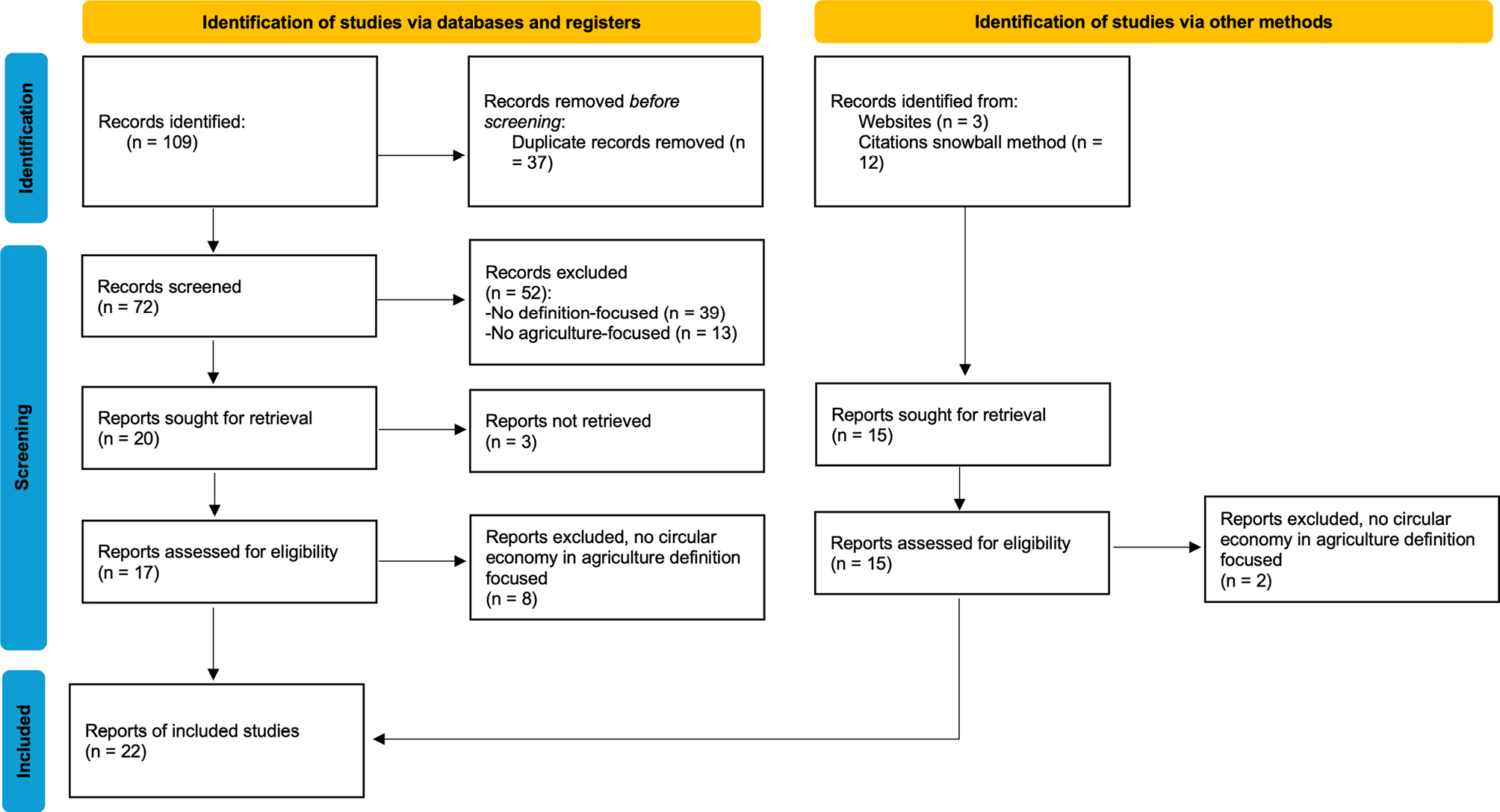
Figure S1 presents the flow diagram with information about the selection of documents for the second stage literature review, following the PRISMA approach. We found 57 records during database search. After removing duplicates, we screened 55 records, from which we reviewed 18 full-text documents, and finally included 12 documents (see Table S3).
Building on the literature defining circular economy applied to agriculture and the literature defining circular bioeconomy, we performed a conceptual comparison of the two perspectives. This analysis examines how each concept frames circularity, with particular attention to their respective principles and economic, social, and environmental aims.
3. Results
The following text presents the coding framework used to analyse the information collected through the literature review, which leads to the replies to the research questions. Section 3.1 replies to the first research question by identifying the principles that define the circular economy in agriculture; section 3.2 replies to the second research question on the relationship between circular economy and sustainability aims, and finishes by presenting the new comprehensive definition of circular economy in agriculture which englobes principles and aims; while section 3.3 defines circular bioeconomy and its relationship with the definition of circular economy in agriculture.
The coding framework for circular economy applied to agriculture, generated after analysing the collected literature, is presented in Figure 2. This figure is a graphic representation of how the concept of circular economy in agriculture has been structured: the connection between the ideas is represented by straight lines connecting the nodes, a “child” is a subordinate idea depicted at a lower level, and “sibling” ideas are the ones represented at the same horizontal level. Figure 2 identifies five core principles: cascading, efficiency, regeneration, systemic approach, and the R’s principles.
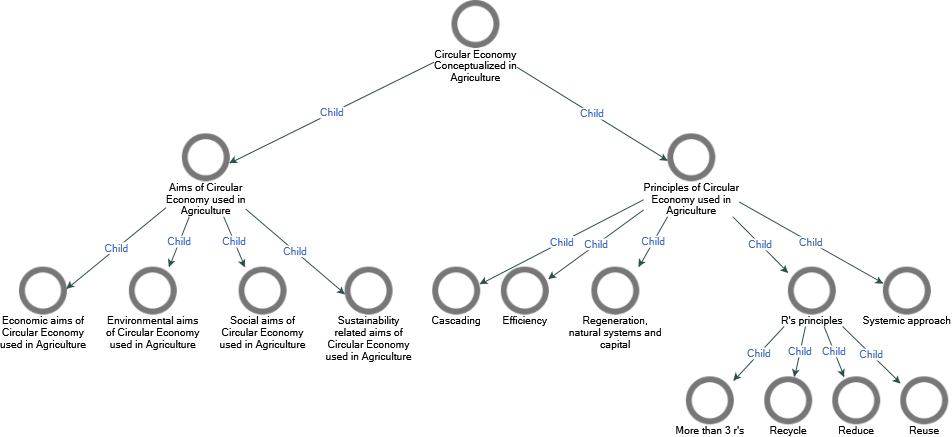
The aims of the circular economy applied to agriculture are categorised as economic, social, environmental, and those explicitly referring to sustainability. This classification of the aims enables recognising the difference between circularity associated explicitly with sustainability and its three pillars and circularity associated with aims only in economic, social, or environmental aspects. With this categorisation of the aims we intend to identify if the common critique of circularity’s relationship with sustainability applies also to the agricultural sector, meaning that when circular economy is said to be sustainable, it refers to economic and environmental sustainability only, leaving behind social sustainability (Schöggl et al., 2020). Furthermore, we contribute to the broader discussion about the components of sustainability, which suggests that the unjustified use of the three-pillar model may blind us from a better understanding of the complex synergies and trade-offs between the three pillars of sustainability (Purvis et al., 2019).
3.1. Circular economy principles in agriculture
Looking at the words mentioned in the literature (see Figure S2), the principles of circular economy in agriculture refer to “Waste” and “Products”, discussing closing the loop production patterns, reducing waste, effectively managing waste, and using waste as a resource.
The most used principles are the R’s - reduce, reuse, and recycle (see Figure S3). Within the R’s principles, “recycle” is the leading topic, followed by “reuse”, while “reduce” is mentioned in less than 50% of the documents analysed. Recycling refers to closing the loop for waste, such as using agricultural and livestock residues to generate agricultural inputs. Yuille et al. (2022) refer to recycling as a way to design out waste and obtain resources to replenish the system’s self-supporting capacity, while the Ellen MacArthur Foundation (2019b) and Ruiz et al. (2009) add that waste passes from being a cost to a potential source of value. Furthermore, Fassio & Tecco (2019) and Pimbert (2012) go back to the foundation of the circular economy, mentioning that the principle of recycling originates from the proposal of mimicking the dynamics of natural ecosystems adopted by industrial ecology2.
Reusing includes the conservation of water, secondary raw materials, and food. Food redistribution is recognised as a more valuable use of resources than recycling (Ruiz et al., 2019). Recycling is only recommended when reusing is impossible, as when food surplus becomes food waste. Food waste is generated when edible food surplus becomes inedible due to the lack of preparation or preservation (Jurgilevich et al., 2016). Food redistribution improves the environmental performance of the whole agri-food value chain. Unclaimed food implies unnecessary greenhouse gas emissions during production, processing, transportation, storing, distribution and retail (Papargyropoulou et al., 2014).
Reducing in agriculture means minimising the use of natural resources, chemical fertilisers, food waste, and pollution. The reduction is motivated by the finitude of resources (Jurgilevich et al., 2016; Paño Yañez, 2021) and to separate income from material inputs (Pimbert, 2012). Jun & Xiang (2011) define reducing as the diminished use of scant and non-renewable resources, keeping fixed production and consumption targets. Conversely, Barañano et al. (2021) consider the principle of reduction as a general decrease in the number of resources used and the quantity extracted, the number and amount of products discarded. The circular economy is also expected to reduce pollution (Therond et al., 2017), by using local inputs in opposition to a globalised food system based on commodity trade.
Cascading, which means using resources sequentially and consecutively at their highest value (Ellen MacArthur Foundation, 2019c), is considered by only 60% of the documents assessed. Cascading is commonly referred to as “optimising” the management of the stock of resources (Fassio & Tecco, 2019; Paño Yañez, 2021). Barañano et al. (2021) explain that cascading is applied when biomass is converted into products, the waste from this process is used as input for a lower-level production, this step is repeated until the waste can no longer be transformed into products, and finally, the waste is burned to provide energy. The highest-value use of resources is based on prioritizing plant biomass for human food production. In this hierarchy, edible biomass should first be used to produce food for humans, by-products should be reused or recycled, and inedible biomass should be used as animal feed. Livestock can then convert this biomass into additional food, manure, and ecosystem services (Van Zanten et al., 2019; Velasco-Muñoz et al., 2021). However, the opportunities for valorising residues and by-products are determined by the purity of the waste and the effectiveness of the collection system (Ellen MacArthur Foundation, 2019b).
3.2. The relationship between circular economy in agriculture and sustainability
Circular economy applied to agriculture targets sustainability mainly through environmental and economic aims, and least frequently, though still considered by 70% of the documents analysed, social aims (see Figure S4).
The environmental aims of the circular economy are the most extensively described. Figure S5 section a in the Supplementary Materials presents the keywords used in their description, which refer to the environmental aims of using fewer inputs, generating less waste, and improving soil.
Table 1 shows the specific environmental aims of the circular economy with the reference documents mentioning them, which are the basis of the subsequent information. According to these documents, the circular economy in agriculture aims at restoring nature’s balance, thereby shifting the agricultural sector from a contributor to climate change to a solution. This framework operates by maximizing resource efficiency, reducing pollution, and fostering the regeneration of soil, agrobiodiversity, and ecosystems. By alleviating the strain on natural ecosystems, the circular economy model simultaneously improves food production and rejuvenates marginal lands, preserving the integrity of landscapes. Crucially, the return of nutrients to the soil enhances food production, promotes carbon sequestration and mitigates pollution. Effective waste management practices, including composting, further amplify these results by conserving water resources. Such soil enhancements strengthen resilience against adverse weather conditions like wind, floods, and droughts. Additionally, soil improvement and waste management decrease the reliance on chemical fertilizers, thus diminishing resource extraction and lowering energy consumption and transportation-related pollution. Using local resources further minimises the environmental footprint of transportation activities. Moreover, strategies focusing on water demand reduction and wastewater reuse alleviate the strain on hydrological resources. Using waste for energy generation serves to both mitigate resource depletion and combat improper waste disposal practices.
| Circular economy strategy | Environmental aims | Reference | |||||||||||||||||
|---|---|---|---|---|---|---|---|---|---|---|---|---|---|---|---|---|---|---|---|
| Regenerate nature | Climate change solution | Velasco-Muñoz et al., 2021; Ellen MacArthur Foundation, 2019b; Freeman et al., 2022; Yuille et al., 2022 |
|||||||||||||||||
| Resource efficiency, pollution reduction, and enhancing soil, agrobiodiversity and ecosystems | Climate change solution | De Rosa et al., 2021; Ellen MacArthur Foundation, 2019b; Pimbert, 2012; Therond et al., 2017; Velasco-Muñoz et al., 2021 | |||||||||||||||||
| Reduce stress on natural ecosystems | Improve environmental conditions of marginal lands while preserving landscapes | EIP-AGRI, 2015; Freeman et al., 2022; Paño Yañez, 2021 | |||||||||||||||||
| Soil improvements | Resilience to wind, floods, and droughts | Ellen MacArthur Foundation, 2019b; SYSTEMIQ & Ellen MacArthur Foundation, 2017 | |||||||||||||||||
| Composting residues | Improve soil | Bos & Broeze, 2020; Ellen MacArthur Foundation, 2019b; Yuille et al., 2022 | |||||||||||||||||
| Local resource use | Minimize pollution | Barcelos et al., 2021; Jurgilevich et al., 2016; Therond et al., 2017 | |||||||||||||||||
| Water demand reduction and wastewater reuse | Alleviate pressure on hydrological resources | Velasco-Muñoz et al., 2021 | |||||||||||||||||
| Carbon sequestration capacity enhancement | Reduce carbon emissions and improve resilience to environmental challenges | SYSTEMIQ & Ellen MacArthur Foundation, 2017 | |||||||||||||||||
| Waste used to produce energy | Reduce resource depletion and pollution from waste disposal | Barcelos et al., 2021; EIP-AGRI, 2015 | |||||||||||||||||
| Source: our elaboration. | |||||||||||||||||||
The aim of economic sustainability under the framework of circular economy is expected from the efficient use and reuse of materials, as well as logistic and resilience improvements (see Figure S5 section b in the Supplementary Materials).
Table 2 shows the economic aims of the circular economy with the reference documents that mention them, which are the basis of the subsequent information. According to these documents, the circular economy is expected to bring sustainable economic growth while reducing resource consumption. This is achieved by efficient resource use and recycling. Reducing excess nitrogen (N) and phosphorus (P) and reusing resources like water in fertirrigation improves productivity. Furthermore, the circular economy reduces dependence on costly and risky external sources like agrochemicals, transgenic technologies, and fossil fuels. Adopting circular practices also enhances resilience by promoting adaptation to climate change. Circularity is a way to achieve long-term higher yields and performance thanks to environmental protection. Additionally, it encourages the renewal of infrastructure and the creation of networks for better resource management, fostering innovation and multiple revenue streams, such as generating income from biomass energy.
| Circular economy strategy | Economic aims | Reference | |||||||||||||||||
|---|---|---|---|---|---|---|---|---|---|---|---|---|---|---|---|---|---|---|---|
| Efficient resource use and recycling | Economic growth | Burgo-Bencomo et al., 2019; De Rosa et al., 2021; EIP-AGRI, 2015; Ellen MacArthur Foundation, 2019a; Fassio & Tecco, 2019; Jun & Xiang, 2011; Ruiz et al., 2019; Velasco-Muñoz et al., 2021 | |||||||||||||||||
| Minimise resource use | Economic growth | Hens et al., 2018; Velasco-Muñoz et al., 2021 | |||||||||||||||||
| Valorisation of organic waste | Business opportunities | Ellen MacArthur Foundation, 2019b | |||||||||||||||||
| Control excess N and P | Productivity improvements | Yuille et al., 2022 | |||||||||||||||||
| Regenerate nature | Benefit profitability | SYSTEMIQ & Ellen MacArthur Foundation, 2017 | |||||||||||||||||
| Reduced dependence on external agrochemical inputs, transgenic technologies, and fossil energy | Reduced costs and risks | EIP-AGRI, 2015; Pimbert, 2012; SYSTEMIQ & Ellen MacArthur Foundation, 2017; Yuille et al., 2022 |
|||||||||||||||||
| Local transport of inputs | Reduced costs | Barcelos et al., 2021 | |||||||||||||||||
| Environmental protection | Improved resilience, better incomes, higher yields | Ellen MacArthur Foundation, 2019a, 2019b; Freeman et al., 2022; SYSTEMIQ & Ellen MacArthur Foundation, 2017; Burgo-Bencomo et al., 2019; Ellen MacArthur Foundation, 2019a; Jun & Xiang, 2011; Kristensen et al., 2016; Velasco-Muñoz et al., 2021 |
|||||||||||||||||
| Renewal of infrastructure and the formation of networks | Improved resource use | Barcelos et al., 2021; Fassio & Tecco, 2019 | |||||||||||||||||
| Innovative entrepreneurship | Multiple revenue streams | Ruiz et al., 2019; Velasco-Muñoz et al., 2021; EIP-AGRI, 2015; Ellen MacArthur Foundation, 2019a; Therond et al., 2017 |
|||||||||||||||||
| Source: our elaboration. | |||||||||||||||||||
Social sustainability is aimed by circularity in agriculture through two main aspects: human health protection and food security. Additionally, some mention improved human capital and technology (See Figure S5 section c). Table 3 shows the social aims of the circular economy with the reference documents mentioning them, which are the basis of the subsequent information. The circular economy lessens the negative impacts of production that damage human health, including extraction of raw materials, waste production, hazardous substances emission, and pollution of soil, water and air. Besides, human health may benefit from the consumption of food with a higher-quality nutrient profile. Circular Economy practices are expected to increase soil organic matter and improve soil health, which can enhance nutrient availability and favour micronutrient uptake by plants, potentially leading to crops with a richer nutrient profile. Food security might also improve by reducing food waste and enhancing the production and resilience of agriculture. Furthermore, energy and water security would improve through reduced pollution and the use of renewable resources. The circular economy might also reduce poverty because it allows farmers to have multiple revenue streams. The participation and importance of women in business may also increase, as circular economy provides an opportunity for the creation of new businesses in which women may contribute and lead. Social development may be improved by promoting farmers’ knowledge and technology application to create biobased products. Moreover, circular economy in agriculture is expected to allow farmers to improve their quality of life by investing in health and education with the money they save through simplified logistics and self-sufficient production.
| Circular economy strategy | Social aims | Reference | |||||||||||||||||
|---|---|---|---|---|---|---|---|---|---|---|---|---|---|---|---|---|---|---|---|
| Reduced extraction of raw materials from nature, waste production, greenhouse gases and hazardous substances emission | Human health protection | Burgo-Bencomo et al., 2019; Ellen MacArthur Foundation, 2019a, 2019b; Kristensen et al., 2016; Yuille et al., 2022 | |||||||||||||||||
| Production of food with a higher-quality nutrient profile | Human health benefit | Ellen MacArthur Foundation, 2022; SYSTEMIQ & Ellen MacArthur Foundation, 2017 | |||||||||||||||||
| Reduction of food waste, enhanced production and resilience of food production systems | Food security improvement | Burgo-Bencomo et al., 2019; Fassio & Tecco, 2019; Jurgilevich et al., 2016; Kristensen et al., 2016; Yuille et al., 2022; Ellen MacArthur Foundation, 2019a, 2019b |
|||||||||||||||||
| Reduced pollution and production of energy from renewable sources | Energy and water security | Pimbert, 2012 | |||||||||||||||||
| Opportunity generator of multiple revenue streams | Poverty reduction | Pimbert, 2012; EIP-AGRI, 2015; Ellen MacArthur Foundation, 2019a | |||||||||||||||||
| Innovation to create biobased products | Social development | Burgo-Bencomo et al., 2019; Fassio & Tecco, 2019 | |||||||||||||||||
| Participation and importance of women in business | Social development | Fassio & Tecco, 2019 | |||||||||||||||||
| Farmers’ knowledge and technologies reinforcement | Social development | Fassio & Tecco, 2019 | |||||||||||||||||
| Costs reduction by simplified logistics | Health and education investments | Barcelos et al., 2021 | |||||||||||||||||
| Source: our elaboration. | |||||||||||||||||||
Based on the results of Section 3.1 and 3.2, we propose a comprehensive concept of circular economy applied in agriculture, which departs from the basics and reaches the objectives that emerge from the available documents:
Circular economy in agriculture is a comprehensive framework that integrates the principles of reusing resources and recycling waste through cascading processes that maximize resource value, it strives to reduce materials used whenever possible, with the ultimate goal of regenerating nature. This approach aims for numerous benefits for environment conservation, improving the condition of soil, water and air, and tackling climate change; thus, enhancing human wellbeing by improving health and nutrition, and consequently bringing opportunities for sustainable economic growth.
3.3. Circular bioeconomy concept and its relationship with circular economy in agriculture
In this section we present the results of the search for the definition of circular bioeconomy which drives the identification of the relationship with the concept of circular economy in agriculture.
The definition of circular bioeconomy is not unique; it is influenced by the definition of bioeconomy from which the literature departs. Nevertheless, most documents agree that the circular bioeconomy relies on using bioresources while applying some circular economy principles, from which cascading is central (Jarre et al., 2020). A common statement is that circular bioeconomy constitutes the way towards zero waste (Barañano et al., 2021; Hodson de Jaramillo, 2018a). However, the paper by Giampietro (2019) marks a straight difference from the other publications. It states that the circular economy represents the target outcome of decoupling resource use from natural resources, while the bioeconomy describes the biophysical processes needed to achieve this result. Konstantinis et al. (2018) combine both approaches, considering that circular bioeconomy means using non-fossil resources for complete economic exploitation while preserving environmental sustainability. Liobikienė & Miceikienė (2023) extend this analysis, indicating that the final aim of circular bioeconomy is improving sustainability. Yet, in a couple of cases, the circular bioeconomy is tightly associated with technological advances and biorefineries are part of its definition (Ptak et al., 2022).
A few recent documents compile previous publications to propose a synergistic definition, gradually driving towards the definition of circular economy in agriculture. Tan & Lamers (2021) and Tolić (2022) compare a series of definitions of the circular bioeconomy, they cite Giampietro (2019), Ptak et al. (2022), Robert et al. (2020), and others highlighting efficient use of biobased renewable resources. Tan & Lamers (2021) propose that circular bioeconomy is a synergy of circularity and bioeconomy, focused on carbon management. Tolić (2022) expands this concept to include reduced resource consumption, recovery, waste recycling, and as last resource safe disposal. Other documents are on the way to this compilation, including in the concept of circular bioeconomy some aspects of circular economy in agriculture that are not commonly used. Pyka et al. (2022) define circular bioeconomy as using biomass effectively and efficiently through cascading, recycling, reusing, and reducing waste. However, the reduction mentioned in this study referred to waste only, rather than inputs consumed. Ptak et al. (2022) align more closely with the circular economy aims, addressing pollution and costs of resources transport. According to Therond et al. (2017), the circular bioeconomy is an improvement of bioeconomy in territorial socio-economic dynamics, aligning with the systemic approach of circularity in agriculture.
Sustainability and climate change are frequently mentioned in the description of circular bioeconomy, while the strategies to achieve improvements in the three pillars of sustainability are not identified. According to Ptak et al. (2022) sustainability and resource efficiency are part of the definition of a circular bioeconomy, similarly Pyka et al. (2022) define circular bioeconomy as an extension of bioeconomy to achieve goals in sustainability and climate change. On the contrary, Tan & Lamers (2021) argue that circular bioeconomy does not mean sustainability. This argument is supported by studies in which the circular bioeconomy aims for sustainability when complying with conditions like cascading for optimum valorisation of biomass (Barañano et al., 2021) or a systemic approach including different sectors and nations (Hodson de Jaramillo, 2018a).
Economic and environmental aims are the most commonly mentioned within circular bioeconomy, based on the conservation of biomass and reduced extraction and dependence on natural resources (Tan & Lamers, 2021). Addressing climate change is an expected result mentioned in the 2020s (Barañano et al., 2021; Ptak et al., 2022; Pyka et al., 2022; Tolić, 2022). Aims for human well-being are not frequently mentioned, except for Tolić (2022) who underlines that the safe disposal of unavoidable waste should benefit human health. The circular bioeconomy, like the circular economy applied to agriculture, is expected to bring sustainability benefits and tackle climate change, but the concept of circular economy applied to agriculture presents a clearer description of the strategies to achieve these aims.
4. Discussion
4.1. Discussion on circular economy principles in agriculture
According to the most used terms to define circular economy in agriculture, managing waste to close loops is the idea behind this framework. Research about agricultural waste has experienced exponential growth during the last 20 years. Duque-Acevedo et al. (2020) explain that government and academic authors have influenced the direction of the studies to focus on maize and wheat waste management due to the relevance of their production in the places of research. Furthermore, the consistent application of measurement tools for agricultural waste may facilitate monitoring and understanding the implications of waste reduction. In the EU, up to the year 2018, there was no clear definition or common measurement method for waste. Wastes and byproducts have been considered only marginally in literature, they are not adequately conceptualised in economic terms, and the circularity of flows is not usually highlighted (Viaggi, 2022).
According to most of the documents analysed, circular economy is based on the principles of recycling, reusing, regenerating natural systems, and cascading the use of resources. Nevertheless, in agreement with Velasco-Muñoz et al. (2021), the application of circular economy in agriculture generates an overlapping of principles through specific techniques, like combining livestock raising and crop production activities. Several circular economy principles, namely, reducing, reusing, and recycling, applied through these techniques, still need to be recognised by literature, which has tended to simplify these interactions and define them as recycling only. In this direction, recent research proposes the adaptation of circularity indicators to biological and agricultural goods by integrating the assessment of waste generation with the evaluation of product performance, measured through yield efficiency and the bioavailability period of agricultural inputs (Escribà-Gelonch et al., 2023).
The principle of reducing is the least mentioned within the three R’s, maybe due to the thought that reducing resources used would constitute a barrier to economic growth. There has been a hesitant inclusion of this principle in previous research; Velasco-Muñoz et al. (2021) indicate that the goal of circular economy in agriculture is not to minimise (reduce) the use of resources, but to keep cycles (either recycling or reusing) which would benefit economic and environmental aspects; nevertheless, the same authors mention that the principle of reducing should become integral to the circular economy due to its efficiency benefits. Indeed, practitioners’ expectations from the circular economy and policies that promise economic growth without highlighting the limits of natural resources tend to mould the development of the circular economy. This is a critique recognised in previous research (Giampietro, 2019; Kirchherr et al., 2017; Korhonen, Honkasalo, et al., 2018), and, Temesgen et al. (2021) explain that relying on recycling ignores ecological economists’ concern regarding the actual economic model’s dependence on increased consumption and production, instead of a sustainable scale of production targeting human wellbeing.
Unfortunately, the scarce inclusion of the principle of reduction is also evidenced in the definition of circular economy in agriculture. The effect of “reducing” on economic, environmental, and social wellbeing must be considered by policymakers, who support actions that may not bring substantial economic benefits to the industry but could benefit people’s welfare. The livestock sector illustrates this tension, as reducing production inputs and pollution levels can improve environmental outcomes. A reduction in livestock production may be facilitated by redistribution strategies, accounting for local animal-feed resources, land availability for manure distribution, and potential manure exports to neighbouring areas which rely on synthetic fertilizers (Madelrieux et al., 2023). Yet, literature emphasizes the need for more information about biomass flows to effectively implement such strategies (Dourmad et al., 2019).
The principle of regeneration of natural systems has been increasingly used and is basic for achieving most sustainability aims. Contrary to the results of Velasco-Muñoz et al. (2021), who indicated that most documents discussing circular economy in agriculture analyse technical efficiency, the definition of circular economy in agriculture talks about the best management of resources to regenerate nature. This is positive, as, at least from a theoretical point of view, circular economy in agriculture is driving towards sustainability, considering the negative long-term effects of a narrow focus on efficiency. Focusing on the regeneration of natural systems may be essential to achieving the expected benefits from the circular economy in countries that have already advanced in circularity strategies. For instance, Italy has improved its efficiency in resource use during the last 20 years, it reached a significantly low rate of landfill disposal of waste among the EU countries and invested in one of the most advanced systems of organic waste management (Ministero dell’Ambiente e della Tutella del Territorio e del Mare, 2017). Yet, the circular economy is considered a pathway to face Italy’s scarcity of raw materials. Complementarity between the applicability of circular economy principles and theoretical research may facilitate their effective implementation.
The increased use of the term regeneration has led to a deeper evaluation of its application. In this respect, Morseletto (2020) highlights the difficulties in measurement, which impact the application of this principle. Quantifying environmental and economic damages from production is challenging due to complex interactions and unknown regeneration time, while assessing soil regeneration’s value and costs is also difficult. Nevertheless, the importance of this principle has not diminished and is considered a metaphorical framework, meaning the “ability of nature to revive itself, recover from disturbances, and rebuild its functions” (Morseletto, 2020: 769), that in agriculture is translated into fertility promotion, nutrient cycling, and ecological services (Arfini et al., 2025; Vollaro et al., 2017).
4.2. The relationship between circular economy in agriculture and sustainability
The environmental aims are cited in most literature defining circular economy applied in agriculture, and their description is the most detailed. The definition of circular economy in agriculture has benefited from a clearer identification of its expected achievements compared to the circular economy general definition, which has been criticised for poorly reflecting the position of natural capital and ecosystem services (D’Amato & Korhonen, 2021). Likewise, a common agreement in literature is that circularity in agriculture should be part of the solution to climate change (Abitabile et al., 2024), although proper quantification still needs to be developed. Cantzler et al. (2020) identified low greenhouse gas saving potential in agriculture in comparison to other industries; however, other studies quantified the impacts of energy and waste management and efficiency, while regenerative agriculture and recycling nutrients, although promising, have not been evaluated (Deloitte, 2016; Ellen MacArthur Foundation, 2019b). While the theory has advanced in identifying the possible environmental results of circular economy in agriculture, ex-post assessments after the complete concept has been applied still need development and generalisation (Escobar et al., 2025).
The economic aims are the second most mentioned. Economic growth is expected from circularity in agriculture, which would address the problem of population growth and limited resources by minimising resource use. The aim of economic growth has also called more attention in the general definition of circular economy; the first research of Kirchherr et al. (2017) identified no meaningful mention of economic growth, while in 2023 around 15% of the definitions included it (Kirchherr et al., 2023). On the other hand, circularity in agriculture also aims to improve economic resilience due to the protection of the environment, which in turn brings social benefits in food security and protects human health. Indeed, about 70% of the documents that mention sustainability as the objective of circular economy applied to agriculture also include social aims. The inclusion of social aims is an improvement in comparison to documents revising the general definition of circular economy (El Wali et al., 2021; Kirchherr et al., 2017, 2023; Murray et al., 2017).
Summarising the relationship between circular economy in agriculture and sustainability, we conclude that the circular economy supports an embedded systems approach to sustainability, aligning with other concepts in the EU political agenda, like the EU Bioeconomy strategy (Viaggi, 2019). Hence, it requires passing from the three-pillar structure of sustainability to an embedded system approach, which has sustainability of the biosphere as a base, enclosing society, and sequentially, economy (Fritsche et al., 2020). On the other hand, even though sustainability aims from the circular economy are extensive, equating these aims with quantifiable relationships is not straightforward. Shadow prices could play a crucial role in reflecting the impacts of circularity on sustainability, going beyond economic gains to environmental and social effects that are scarcely measured. Water pollution is an example where calculating shadow prices could reflect the advantages of circularity. Koundouri et al. (2014) highlight that reliable pricing data for natural resources is scarce, and by estimating the shadow price of groundwater, policymakers could design pumping taxes that encourage farmers to reduce groundwater pollution and aquifer depletion.
Shadow prices are rarely applied in agricultural policy decisions, contributing to the failure to achieve environmental objectives (Huhtala & Marklund, 2008; Mamardashvili et al., 2016). Mamardashvili et al. (2016) explain that the high costs of pollution abatement in Swiss farms pose significant political challenges to implementing effective nitrogen surplus taxes. Furthermore, Huhtala & Marklund (2008) found that farms act within the manure application limits, therefore, shadow prices are very high. High shadow prices suggest that innovative circular economy practices may be necessary to face persisting environmental issues, particularly for intensive animal breeding where manure management remains challenging.
While shadow pricing of environmental impacts has been explored to a wider extent, its application to social aspects remains limited. Ait Sidhoum (2018) made an initial attempt to quantify social outputs from agricultural production technologies in the EU. The results suggest that social outputs - like consumer health, food security, local economic stability, rural community cohesion, and employment retention - have positive shadow prices, aligning with farmers’ private interests; however, subsidies may be necessary in efficient farms that tend to prioritise private gains over social and public goods.
The definition of circular economy applied to agriculture proposed at the end of section 3.2 is driven by a wider consensus in principles and aims in comparison to the general definitions used for the circular economy. Previous research found a lack of agreement in the literature about the concept of circular economy (Kirchherr et al., 2017), with interpretations depending on the interests of its users (Korhonen, Nuur, et al., 2018). Aiming to simplify the diversity in definitions, the principles were classified into the 3R’s and sustainable design strategies – i.e. eco-design, nature-inspired design, and cradle-to-cradle (Prieto-Sandoval et al., 2018). However, in contrast to the opinion of Kirchherr et al. (2023) who fear that industry-specific studies will constitute a barrier to the broader applicability of the circular economy, we see that the focus on the agricultural sector facilitates agreement in understanding the framework while targeting its application to industry-specific resources.
Our results also suggest that the consensual definition of circular economy applied in agriculture coincides with the latest general definition of circular economy, in using recycling and reusing as principles, and sustainability as the main aim (Kirchherr et al., 2023). Furthermore, our research identified that in agriculture, the social pillar of sustainability is commonly cited, in comparison to the general definition of circular economy. The increased use of the principle of regeneration was also noted in the general definition of circular economy applied in agriculture (Kirchherr et al., 2023).
4.3. Circular bioeconomy concept and its relationship with circular economy in agriculture
We conclude that circular economy in agriculture may be considered overarching and synergistic to circular bioeconomy. This means they are not interchangeable terms, despite the common undifferentiated use. This confusion may be driven by the roots of the concepts: circular economy was mostly focused on urban contexts, while bioeconomy was defined for rural areas (D’Amato et al., 2017). Nevertheless, circularity in agriculture includes processes that involve non-biological cycles, such as the prioritization of local inputs and the efficient use of synthetic materials (Velasco-Muñoz et al., 2021). Circular economy applied in agriculture should have a synergistic effect on bioeconomy by promoting the efficient use of resources, hence making biomass availability and use sustainable. While cascading is not mentioned by more than 60% of the definitions of circular economy applied in agriculture, the term is essential in circular bioeconomy definitions. This is due to the belief that cascading is the most effective way to close the loop when managing biomass.
The cascading use of biomass is considered a way to claim circularity and sustainability according to policies, as it protects natural capital and the provision of ecosystem services. Policies promoting the circular economy recognise that cascading can maximise sustainability by first using residues to enrich soils, leaving energy production as a lower value option (Ministero della Transizione Ecologica, 2022). Policymakers also mention the role of cascading in promoting efficient resource use (European Commission, 2015).
Indeed, the synergy between circular economy applied to agriculture and circular bioeconomy is necessary to achieve the sustainability expectations of both terms. They are complements, as was suggested by D’Amato et al. (2017). Both models target sustainability improvements and tackling climate change. However, circular bioeconomy tends to focus on economic and environmental aims, while societal outputs are overlooked due to the technical focus of the framework (D’Amato & Korhonen, 2021), confirming the weakness of a technology-based approach versus a socio-ecological one (Priefer et al., 2017). Finally, both target economic growth. Nevertheless, sustainable economic growth is still a contested benefit from these frameworks, as the literature explains that their aims may be contradictory, resulting in weak sustainability (D’Amato et al., 2017; Murray et al., 2017; Tomaselli et al., 2017). Complete assessments of the economic, social, and environmental results from the application of these concepts may bring a clearer idea of their limitations.
Policy documents about circular economy and circular bioeconomy collect information from scholars and practitioners about the principles, strategies, and sustainability aims of these approaches, but raw conceptualizations of these terms, which focus only on technical aspects, may mislead from the expected benefits. Alternatively, technical limitations should be mentioned more clearly in policies to make their expectations more credible. As recognized by Kirchherr et al. (2023), when defining circular economy academics, policymakers, and the private sector each can obtain benefits from learning from the other.
5. Conclusions
In this paper we intended to construct a consensus concept of circular economy applied in agriculture. We found that the vast majority of literature, including academics and practitioners, define this concept as a model founded on waste management through the 3Rs, which expects to achieve sustainability in its three pillars through the regeneration of nature. The concept of circular economy applied in agriculture can benefit from the circular bioeconomy approach that prioritizes the cascading of biomass to achieve high efficiency when striving towards zero waste. Furthermore, generalized guidelines on the meaning and application of circular economy are needed to avoid deviations from the sustainability objectives towards merely technical or economic interests. Future economic, social, and environmental wellbeing may depend on the application of circular economy practices, therefore, continuous advancement in solving the main barriers to this framework is fundamental, together with adequate tools to follow up on the progress toward circular economy aims. Nonetheless, we must remember that circular economy is not the panacea to achieve all possible sustainability solutions, but a beneficial framework, when properly applied according to the needs and capacities of each location.
Our study identified needed directions of future research, which mainly relate to the measurement of the application and benefits of circular economy. A constant question concerns whether the broad strategies and aims of the circular economy can be achieved. In this context and considering the increasing promotion of the circular economy in EU regulation, we discussed the relationship between the definition of circular economy in agriculture, policies, and measurement tools needed to assess policy objectives. Existing research has centred on assessing specific aspects guided by policies and new technologies, such as energy production from biomass, leaving aside fundamentals of circularity like an exhaustive measurement of waste. Furthermore, evaluating the environmental and social damages of production and the counteracting power of circular economy remains a challenge for which frames of evaluation, like shadow prices, need to be extended.
A limitation of this study is the use of only one database for the literature review. We chose the Scopus database from Elsevier because it is an internationally recognized source that includes a vast number of scholarly articles, but more information to enrich this study could be obtained from other popular databases. Furthermore, having a single researcher carry out the coding process carries potential interpretative bias. Although we applied a structured coding protocol within NVivo and engaged in continuous peer discussions to mitigate this risk, future studies could enhance reliability through inter-coder agreement measures. Moreover, we did not include external experts during the construction of the coding framework. Expert opinions may further improve the understanding of the common aspects expected from the concept of circular economy. Finally, we recognize that the definition of circular economy in agriculture is a changing concept, which will be affected by new technologies, practices, and expectations, but we hope that this research serves as a starting point for more synergies in the theory and practice of this concept.
References
Abitabile, C., Arzeni, A., Cisilino, F., & Orlando, M. (2024). Building sustainable futures: The bio-based fertilizer case-study. Bio-Based and Applied Economics, 14(1), 3–17. https://doi.org/10.36253/bae-15786
Ait Sidhoum, A. (2018). Valuing social sustainability in agriculture: An approach based on social outputs’ shadow prices. Journal of Cleaner Production, 203, 273–286. https://doi.org/10.1016/j.jclepro.2018.08.212
Amoah-Antwi, C., Kwiatkowska-Malina, J., Thornton, S. F., Fenton, O., Malina, G., & Szara, E. (2020). Restoration of soil quality using biochar and brown coal waste: A review. Science of The Total Environment, 722, 137852. https://doi.org/10.1016/j.scitotenv.2020.137852
Arfini, F., Bartolini, F., Carbone, A., Castellotti, T., Coderoni, S., Cortignani, R., D’Annolfo, R., Dara Guccione, G., Donati, M., Galli, F., Henke, R., Mazzocchi, G., Monteleone, A., Raggi, M., Pesce, A., Pupo D’Andrea, M. R., Rocchi, B., Romano, D., Sardone, R., … Zumpano, C. (2025). Where is the Italian agriculture heading? A discussion in light of the prospects for the future CAP. Bio-Based and Applied Economics, 14(2), 5–14. https://doi.org/10.36253/bae-18042
Arru, B., Furesi, R., Pulina, P., Sau, P., & Madau, F. A. (2022). The Circular Economy in the Agri-food system: A Performance Measurement of European Countries. Economia Agro-Alimentare/Food Economy - Open Access, 24(2). https://doi.org/10.3280/ecag2022oa13245
Barañano, L., Garbisu, N., Alkorta, I., Araujo, A., & Garbisu, C. (2021). Contextualization of the Bioeconomy Concept through Its Links with Related Concepts and the Challenges Facing Humanity. Sustainability, 13(14). https://doi.org/10.3390/su13147746
Barcelos, S. M. B. D., Salvador, R., Barros, M. V., de Francisco, A. C., & Guedes, G. (2021). Circularity of Brazilian silk: Promoting a circular bioeconomy in the production of silk cocoons. Journal of Environmental Management, 296, 113373. https://doi.org/10.1016/j.jenvman.2021.113373
Barros, M. V., Salvador, R., de Francisco, A. C., & Piekarski, C. M. (2020). Mapping of research lines on circular economy practices in agriculture: From waste to energy. Renewable and Sustainable Energy Reviews, 131, 109958. https://doi.org/10.1016/j.rser.2020.109958
Blomsma, F., & Brennan, G. (2017). The Emergence of Circular Economy: A New Framing Around Prolonging Resource Productivity. Journal of Industrial Ecology, 21(3), 603–614. https://doi.org/10.1111/jiec.12603
Borrello, M., Pascucci, S., & Cembalo, L. (2020). Three Propositions to Unify Circular Economy Research: A Review. Sustainability, 12(10). https://doi.org/10.3390/su12104069
Bos, H. L., & Broeze, J. (2020). Circular bio-based production systems in the context of current biomass and fossil demand. Biofuels, Bioproducts and Biorefining, 14(2), 187–197. https://doi.org/10.1002/bbb.2080
Bourque, L. (2004). Coding frame. The Sage Encyclopedia of Social Science Research Methods. Thousand Oaks, CA: Sage.
Burgo-Bencomo, O. B., Gaitán Suazo, V., Yanez Sarmiento, J., Zambrano Morales, Á. A., Castellanos Pallerols, G., & Estrada Hernández, J. A. (2019, April 22). La Economía circular una alternativa sostenible para el desarrollo de la agricultura. Espacios. 40 (13). https://www.revistaespacios.com/a19v40n13/a19v40n13p02.pdf
Cantzler, J., Creutzig, F., Ayargarnchanakul, E., Javaid, A., Wong, L., & Haas, W. (2020). Saving resources and the climate? A systematic review of the circular economy and its mitigation potential. Environmental Research Letters, 15(12), 123001. https://doi.org/10.1088/1748-9326/abbeb7
Dahlsrud, A. (2008). How corporate social responsibility is defined: An analysis of 37 definitions. Corporate Social Responsibility and Environmental Management, 15(1), 1–13. https://doi.org/10.1002/csr.132
D’Amato, D., Droste, N., Allen, B., Kettunen, M., Lähtinen, K., Korhonen, J., Leskinen, P., Matthies, B. D., & Toppinen, A. (2017). Green, circular, bio economy: A comparative analysis of sustainability avenues. Journal of Cleaner Production, 168, 716–734. https://doi.org/10.1016/j.jclepro.2017.09.053
D’Amato, D., & Korhonen, J. (2021). Integrating the green economy, circular economy and bioeconomy in a strategic sustainability framework. Ecological Economics, 188, 107143. https://doi.org/10.1016/j.ecolecon.2021.107143
Davis, G. G., & Hall, J. (2006). Circular Economy Legislation: The international experience. Paper for the environment and natural resources protection Committee of the National People’s congress. https://www.google.de/url?sa=t&rct=j&q=&esrc=s&source=web&cd=1&ved=0ahUKEwjLwbvbw4LRAhUaIFAKHdXJA1wQFggjMAA&url=http%3A%2F%2Fsiteresources.worldbank.org%2FINTEAPREGTOPENVIRONMENT%2FResources%2FCircularEconomy_Legal_IntExperience_ExecSummary_EN.doc&usg=AFQ.
De Boer, I. J., & van Ittersum, M. K. (2018). Circularity in agricultural production. Wageningen University & Research.
De Rosa, M., Di Pasquale, J., & Adinolfi, F. (2021). The Root towards More Circularized Animal Production Systems: From Animal to Territorial Metabolism. Animals, 11(6). https://doi.org/10.3390/ani11061540
Deloitte. (2016). Deloitte Sustainability Circular economy potential for climate change mitigation. https://www2.deloitte.com/content/dam/Deloitte/fi/Documents/risk/Deloitte%20-%20Circular%20economy%20and%20Global%20Warming.pdf
Dourmad, J.-Y., Guilbaud, T., Tichit, M., & Bonaudo, T. (2019). Les productions animales dans la bioéconomie. INRAE Productions Animales, 32(2), 205–220. https://doi.org/10.20870/productions-animales.2019.32.2.2485
Duque-Acevedo, M., Belmonte-Ureña, L. J., Cortés-García, F. J., & Camacho-Ferre, F. (2020). Agricultural waste: Review of the evolution, approaches and perspectives on alternative uses. Global Ecology and Conservation, 22, e00902. https://doi.org/10.1016/j.gecco.2020.e00902
EIP-AGRI. (2015). EIP-AGRI Workshop ‘Opportunities for Agriculture and Forestry in the Circular Economy’. https://ec.europa.eu/eip/agriculture/sites/default/files/eip-agri_ws_circular_economy_final_report_2015_en.pdf
El Wali, M., Golroudbary, S. R., & Kraslawski, A. (2021). Circular economy for phosphorus supply chain and its impact on social sustainable development goals. Science of The Total Environment, 777, 146060. https://doi.org/10.1016/j.scitotenv.2021.146060
Ellen MacArthur Foundation. (2013). Towards the circular economy. Journal of Industrial Ecology, 2(1), 23–44.
Ellen MacArthur Foundation. (2019a). Cities and circular economy for food. https://www.ellenmacarthurfoundation.org/publications
Ellen MacArthur Foundation. (2019b). Completing the picture: How the circular economy tackles climate change. https://www.ellenmacarthurfoundation.org/completing-the-picture
Ellen MacArthur Foundation. (2019c). The biological cycle of the butterfly diagram. https://ellenmacarthurfoundation.org/articles/the-biological-cycle-of-the-butterfly-diagram
Ellen MacArthur Foundation. (2022). A circular economy for food will help people and nature thrive. https://www.ellenmacarthurfoundation.org/topics/food/overview#:~:text=With%20the%20circular%20economy%2C%20we,become%20inputs%20for%20new%20products.
Ellen MacArthur Foundation. (2025). Ellen MacArthur Foundation—What we do. https://www.ellenmacarthurfoundation.org/about-us/what-we-do
Escobar, D., Sckokai, P., & Coderoni, S. (2025). The Impact of Italian Farms’ Circularity on their Economic Performances. 14th AIEAA Conference.
Escribà-Gelonch, M., Butler, G. D., Goswami, A., Tran, N. N., & Hessel, V. (2023). Definition of agronomic circular economy metrics and use for assessment for a nanofertilizer case study. Plant Physiology and Biochemistry, 196, 917–924. https://doi.org/10.1016/j.plaphy.2023.02.042
European Commission. (2008). Directive 2008/98/EC of the European Parliament and of the Council of 19 November 2008 on Waste and Repealing Certain Directives. (Directive 2008/98/EC). http://eur-lex.europa.eu/legal-content/EN/TXT/PDF/?uri= CELEX:32008L0098&from=EN.
European Commission. (2015). Closing the loop—An EU action plan for the Circular Economy. COM(2015) 614 Final. Brussels
European Commission. (2022). Circular economy action plan. https://ec.europa.eu/environment/strategy/circular-economy-action-plan_en
European Environment Agency. (2016). Circular economy in Europe. Developing the knowledge base. https://www.eea.europa.eu/en/analysis/publications/circular-economy-in-europe
FAO. (2018). Food Systems | Food and Agriculture Organization of the United Nations. https://www.fao.org/food-systems/en/
Fassio, F., & Tecco, N. (2019). Circular Economy for Food: A Systemic Interpretation of 40 Case Histories in the Food System in Their Relationships with SDGs. Systems, 7(3). https://doi.org/10.3390/systems7030043
Freeman, K. K., Valencia, V., Baraldo, J., Schulte, R. P. O., & van Zanten, H. H. E. (2022). On-farm circular technologies for enhanced sustainability: The case of Uruguay. Journal of Cleaner Production, 372, 133470. https://doi.org/10.1016/j.jclepro.2022.133470
Fritsche, U., Brunori, G., Chiaramonti, D., Galanakis, C., Hellweg, S., Matthews, R., & Panoutsou, C. (2020). Future transitions for the Bioeconomy towards Sustainable Development and a Climate-Neutral Economy—Knowledge Synthesis Final Report. Publications Office of the European Union. JRC121212. doi:10.2760/667966
Geissdoerfer, M., Savaget, P., Bocken, N. M. P., & Hultink, E. J. (2017). The Circular Economy – A new sustainability paradigm? Journal of Cleaner Production, 143, 757–768. https://doi.org/10.1016/j.jclepro.2016.12.048
Ghisellini, P., Cialani, C., & Ulgiati, S. (2016). A review on circular economy: The expected transition to a balanced interplay of environmental and economic systems. Towards Post Fossil Carbon Societies: Regenerative and Preventative Eco-Industrial Development, 114, 11–32. https://doi.org/10.1016/j.jclepro.2015.09.007
Giampietro, M. (2019). On the Circular Bioeconomy and Decoupling: Implications for Sustainable Growth. Ecological Economics, 162, 143–156. https://doi.org/10.1016/j.ecolecon.2019.05.001
Hens, L., Block, C., Cabello-Eras, J. J., Sagastume-Gutierez, A., Garcia-Lorenzo, D., Chamorro, C., Herrera Mendoza, K., Haeseldonckx, D., & Vandecasteele, C. (2018). On the evolution of “Cleaner Production” as a concept and a practice. Journal of Cleaner Production, 172, 3323–3333. https://doi.org/10.1016/j.jclepro.2017.11.082
Hidalgo, D., Martín-Marroquín, J. M., & Corona, F. (2019). A multi-waste management concept as a basis towards a circular economy model. Renewable and Sustainable Energy Reviews, 111, 481–489. https://doi.org/10.1016/j.rser.2019.05.048
Hodson de Jaramillo, E. (2018a). Bioeconomía: El futuro sostenible. Revista de La Academia Colombiana de Ciencias Exactas, Físicas y Naturales, 42(164), 188–201. https://doi.org/10.18257/raccefyn.650
Hodson de Jaramillo, E. (2018b). Bioeconomy: A sustainable future. Revista de la Academia Colombiana de Ciencias Exactas, FÃ\-sicas y Naturales, 42, 188–201.
Homrich, A. S., Galvão, G., Abadia, L. G., & Carvalho, M. M. (2018). The circular economy umbrella: Trends and gaps on integrating pathways. Journal of Cleaner Production, 175, 525–543. https://doi.org/10.1016/j.jclepro.2017.11.064
Huhtala, A., & Marklund, P.-O. (2008). Stringency of environmental targets in animal agriculture: Shedding light on policy with shadow prices. European Review of Agricultural Economics, 35(2), 193–217. https://doi.org/10.1093/erae/jbn025
Jarre, M., Petit-Boix, A., Priefer, C., Meyer, R., & Leipold, S. (2020). Transforming the bio-based sector towards a circular economy—What can we learn from wood cascading? Forest-Based Circular Bioeconomy: Matching Sustainability Challenges and New Business Opportunities, 110, 101872. https://doi.org/10.1016/j.forpol.2019.01.017
Jun, H., & Xiang, H. (2011). Development of Circular Economy Is A Fundamental Way to Achieve Agriculture Sustainable Development in China. 2010 International Conference on Energy, Environment and Development - ICEED2010, 5, 1530–1534. https://doi.org/10.1016/j.egypro.2011.03.262
Jurgilevich, A., Birge, T., Kentala-Lehtonen, J., Korhonen-Kurki, K., Pietikäinen, J., Saikku, L., & Schösler, H. (2016). Transition towards Circular Economy in the Food System. Sustainability, 8(1). https://doi.org/10.3390/su8010069
Kirchherr, J., Reike, D., & Hekkert, M. (2017). Conceptualizing the circular economy: An analysis of 114 definitions. Resources, Conservation and Recycling, 127, 221–232. https://doi.org/10.1016/j.resconrec.2017.09.005
Kirchherr, J., Yang, N.-H. N., Schulze-Spüntrup, F., Heerink, M. J., & Hartley, K. (2023). Conceptualizing the Circular Economy (Revisited): An Analysis of 221 Definitions. Resources, Conservation and Recycling, 194, 107001. https://doi.org/10.1016/j.resconrec.2023.107001
Konstantinis, A., Rozakis, S., Efpraxia-Aithra, M., & Kesheng, S. (2018). A Definition of Bioeconomy through the Bibliometric Networks of the Scientific Literature. https://agbioforum.org/wp-content/uploads/2021/02/AgBioForum-21-2-64.pdf
Koppelmäki, K., Helenius, J., & Schulte, R. P. O. (2021). Nested circularity in food systems: A Nordic case study on connecting biomass, nutrient and energy flows from field scale to continent. Resources, Conservation and Recycling, 164, 105218. https://doi.org/10.1016/j.resconrec.2020.105218
Korhonen, J., Honkasalo, A., & Seppälä, J. (2018). Circular Economy: The Concept and its Limitations. Ecological Economics, 143, 37–46. https://doi.org/10.1016/j.ecolecon.2017.06.041
Korhonen, J., Nuur, C., Feldmann, A., & Birkie, S. E. (2018). Circular economy as an essentially contested concept. Journal of Cleaner Production, 175, 544–552. https://doi.org/10.1016/j.jclepro.2017.12.111
Koundouri, P., Dávila, O. G., Anastasiou, Y., Antypas, A., Mavrogiorgis, T., Mousoulides, A., Mousoulidou, M., & Vasiliou, K. (2014). An Econometric Analysis of Agricultural Production, Focusing on the Shadow Price of Groundwater: Policies Towards Socio-Economic Sustainability. In P. Koundouri & N. A. Papandreou (Eds), Water Resources Management Sustaining Socio-Economic Welfare: The Implementation of the European Water Framework Directive in Asopos River Basin in Greece (pp. 87–100). Springer Netherlands. https://doi.org/10.1007/978-94-007-7636-4_5
Kristensen, D. K., Kjeldsen, C., & Thorsøe, M. H. (2016). Enabling Sustainable Agro-Food Futures: Exploring Fault Lines and Synergies Between the Integrated Territorial Paradigm, Rural Eco-Economy and Circular Economy. Journal of Agricultural and Environmental Ethics, 29(5), 749–765. https://doi.org/10.1007/s10806-016-9632-9
Leipold, S., & Petit-Boix, A. (2018). The circular economy and the bio-based sector—Perspectives of European and German stakeholders. Journal of Cleaner Production, 201, 1125–1137. https://doi.org/10.1016/j.jclepro.2018.08.019
Liobikienė, G., & Miceikienė, A. (2023). Contribution of the European Bioeconomy Strategy to the Green Deal Policy: Challenges and Opportunities in Implementing These Policies. Sustainability, 15(9). https://doi.org/10.3390/su15097139
Livingstone, L., Börkey, P., Dellink, R., & Laubinger, F. (2022). Synergies and trade-offs in the transition to a resource-efficient and circular economy. https://www.oecd-ilibrary.org/content/paper/e8bb5c6e-en
Maaß, O., & Grundmann, P. (2018). Governing Transactions and Interdependences between Linked Value Chains in a Circular Economy: The Case of Wastewater Reuse in Braunschweig (Germany). Sustainability, 10(4). https://doi.org/10.3390/su10041125
Madelrieux, S. S., Courtonne, J.-Y., Grillot, M., & Harchaoui, S. (2023). Bioéconomie et économie circulaire: Lecture critique et place de l’élevage. INRAE Productions Animales, 36(1), 7430. https://doi.org/10.20870/productions-animales.2023.36.1.7430
Mamardashvili, P., Emvalomatis, G., & Jan, P. (2016). Environmental Performance and Shadow Value of Polluting on Swiss Dairy Farms. Journal of Agricultural and Resource Economics, 41(2), 225–246. JSTOR.
Martínez-Moreno, M. M., Buitrago, E. M., Yñiguez, R., & Puig-Cabrera, M. (2024). Circular economy and agriculture: Mapping circular practices, drivers, and barriers for traditional table-olive groves. Sustainable Production and Consumption, 46, 430–441. https://doi.org/10.1016/j.spc.2024.02.036
Ministero della Transizione Ecologica. (2022, June 21). Strategia Nazionale Per L’Economia Circolare. https://www.mase.gov.it/sites/default/files/archivio/allegati/PNRR/SEC_21.06.22.pdf
Ministero dell’Ambiente e della Tutella del Territorio e del Mare. (2017). Towards a model of circular economy for Italy, Overview and Strategic Framework. https://circulareconomy.europa.eu/platform/sites/default/files/strategy_-_towards_a_model_eng_completo.pdf
Morseletto, P. (2020). Restorative and regenerative: Exploring the concepts in the circular economy. Journal of Industrial Ecology, 24(4), 763–773. https://doi.org/10.1111/jiec.12987
Murray, A., Skene, K., & Haynes, K. (2017). The Circular Economy: An Interdisciplinary Exploration of the Concept and Application in a Global Context. Journal of Business Ethics, 140(3), 369–380. https://doi.org/10.1007/s10551-015-2693-2
Page, M. J., McKenzie, J. E., Bossuyt, P. M., Boutron, I., Hoffmann, T. C., Mulrow, C. D., Shamseer, L., Tetzlaff, J. M., Akl, E. A., Brennan, S. E., Chou, R., Glanville, J., Grimshaw, J. M., Hróbjartsson, A., Lalu, M. M., Li, T., Loder, E. W., Mayo-Wilson, E., McDonald, S., … Moher, D. (2021). The PRISMA 2020 statement: An updated guideline for reporting systematic reviews. International Journal of Surgery, 88, 105906.
Pagotto, M., & Halog, A. (2016). Towards a Circular Economy in Australian Agri-food Industry: An Application of Input-Output Oriented Approaches for Analyzing Resource Efficiency and Competitiveness Potential. Journal of Industrial Ecology, 20(5), 1176–1186. https://doi.org/10.1111/jiec.12373
Paño Yañez, P. (2021). Viabilidad de la economía circular en países no industrializados y su ajuste a una propuesta de economías transformadoras. Un acercamiento al escenario latinoamericano. CIRIEC-España, Revista de Economía Pública, Social y Cooperativa, 289. https://doi.org/10.7203/CIRIEC-E.101.15979
Papargyropoulou, E., Lozano, R., K. Steinberger, J., Wright, N., & Ujang, Z. bin. (2014). The food waste hierarchy as a framework for the management of food surplus and food waste. Journal of Cleaner Production, 76, 106–115. https://doi.org/10.1016/j.jclepro.2014.04.020
Pimbert, M. (2012). Fair and sustainable food systems: From vicious cycles to virtuous circles. International Institute for Environment and Development. JSTOR. http://www.jstor.org/stable/resrep01493
Potting, J., Hekkert, M., Worrell, E., & Hanemaaijer, A. (2017). Circular Economy: Measuring Innovation in the Product Chain. https://www.pbl.nl/uploads/default/downloads/pbl-2016-circular-economy-measuring-innovation-in-product-chains-2544.pdf
Priefer, C., Jörissen, J., & Frör, O. (2017). Pathways to shape the bioeconomy. Resources, 6(1). Scopus. https://doi.org/10.3390/resources6010010
Prieto-Sandoval, V., Jaca, C., & Ormazabal, M. (2018). Towards a consensus on the circular economy. Journal of Cleaner Production, 179, 605–615. https://doi.org/10.1016/j.jclepro.2017.12.224
Ptak, M., Skowrońska, A., Pińkowska, H., & Krzywonos, M. (2022). Sugar Beet Pulp in the Context of Developing the Concept of Circular Bioeconomy. Energies, 15(1). https://doi.org/10.3390/en15010175
Purvis, B., Mao, Y., & Robinson, D. (2019). Three pillars of sustainability: In search of conceptual origins. Sustainability Science, 14(3), 681–695. https://doi.org/10.1007/s11625-018-0627-5
Pyka, A., Cardellini, G., van Meijl, H., & Verkerk, P. J. (2022). Modelling the bioeconomy: Emerging approaches to address policy needs. Journal of Cleaner Production, 330, 129801. https://doi.org/10.1016/j.jclepro.2021.129801
Reh, L. (2013). Process engineering in circular economy. Measurement Technology for Particulate System, 11(2), 119–133. https://doi.org/10.1016/j.partic.2012.11.001
Reike, D., Vermeulen, W. J. V., & Witjes, S. (2018). The circular economy: New or Refurbished as CE 3.0? —Exploring Controversies in the Conceptualization of the Circular Economy through a Focus on History and Resource Value Retention Options. Sustainable Resource Management and the Circular Economy, 135, 246–264. https://doi.org/10.1016/j.resconrec.2017.08.027
Rinaldi, G. M., & Viaggi, D. (2025). Towards the knowledge and innovation system for the bioeconomy? Bio-Based and Applied Economics, 14(2), 15–30. https://doi.org/10.36253/bae-17326
Robert, N., Giuntoli, J., Araujo, R., Avraamides, M., Balzi, E., Barredo, J. I., Baruth, B., Becker, W., Borzacchiello, M. T., Bulgheroni, C., Camia, A., Fiore, G., Follador, M., Gurria, P., la Notte, A., Lusser, M., Marelli, L., M’Barek, R., Parisi, C., … Mubareka, S. (2020). Development of a bioeconomy monitoring framework for the European Union: An integrative and collaborative approach. New Biotechnology, 59, 10–19. https://doi.org/10.1016/j.nbt.2020.06.001
Ruiz, E., Canales, R., & García, V. (2019). La medición de la economía circular. Marcos, indicadores e impacto en la gestión empresarial. https://foretica.org/wp-content/uploads/informe_medida_economia_circular_foretica.pdf
Schöggl, J.-P., Stumpf, L., & Baumgartner, R. J. (2020). The narrative of sustainability and circular economy—A longitudinal review of two decades of research. Resources, Conservation and Recycling, 163, 105073. https://doi.org/10.1016/j.resconrec.2020.105073
Schut, E., Crielaard, M., & Mesman, M. (2016). Circular economy in the Dutch construction sector: A perspective for the market and government. Beleidsverkenning Circulaire Economie in de Bouw. http://hdl.handle.net/10029/595297
Sihvonen, S., & Ritola, T. (2015). Conceptualizing ReX for Aggregating End-of-life Strategies in Product Development. The 22nd CIRP Conference on Life Cycle Engineering, 29, 639–644. https://doi.org/10.1016/j.procir.2015.01.026
Singh, S., & Aggarwal, Y. (2022). In search of a consensus definition of innovation: A qualitative synthesis of 208 definitions using grounded theory approach. Innovation: The European Journal of Social Science Research, 35(2), 177–195. https://doi.org/10.1080/13511610.2021.1925526
SYSTEMIQ, & Ellen MacArthur Foundation. (2017). Achieving ‘growth within’. https://www.ellenmacarthurfoundation.org/achieving-growth-within
Tamasiga, P., Miri, T., Onyeaka, H., & Hart, A. (2022). Food Waste and Circular Economy: Challenges and Opportunities. Sustainability, 14(16). https://doi.org/10.3390/su14169896
Tan, E. C. D., & Lamers, P. (2021). Circular Bioeconomy Concepts—A Perspective. Frontiers in Sustainability, 2. https://doi.org/10.3389/frsus.2021.701509
Temesgen, A., Storsletten, V., & Jakobsen, O. (2021). Circular Economy – Reducing Symptoms or Radical Change? Philosophy of Management, 20(1), 37–56. https://doi.org/10.1007/s40926-019-00112-1
Therond, O., Duru, M., Roger-Estrade, J., & Richard, G. (2017). A new analytical framework of farming system and agriculture model diversities. A review. Agronomy for Sustainable Development, 37. https://doi.org/10.1007/s13593-017-0429-7
Tolić, I. (2022). Concepts of bioeconomy. In Economics, Ecology, and Policy for the Bioeconomy (1st Edition, p. 22). Routledge. https://www.taylorfrancis.com/chapters/edit/10.4324/9781003223733-2/concepts-bioeconomy-iva-toli%C4%87
Tomaselli, M., Hajjar, R., Ramón-Hidalgo, A., & Vásquez-Fernández, A. (2017). The problematic old roots of the new green economy narrative: How far can it take us in re-imagining sustainability in forestry? International Forestry Review, 19(1), 139–151.
Trokanas, N., Cecelja, F., & Raafat, T. (2014). Semantic input/output matching for waste processing in industrial symbiosis. Selected Papers from ESCAPE-23 (European Symposium on Computer Aided Process Engineering - 23), 9-12 June 2013, Lappeenranta, Finland, 66, 259–268. https://doi.org/10.1016/j.compchemeng.2014.02.010
United Nations Development Programme. (2023). What is circular economy and why does it matter? https://climatepromise.undp.org/news-and-stories/what-is-circular-economy-and-how-it-helps-fight-climate-change
Van Zanten, H. H. E., Van Ittersum, M. K., & De Boer, I. J. M. (2019). The role of farm animals in a circular food system. Global Food Security, 21, 18–22. https://doi.org/10.1016/j.gfs.2019.06.003
Velasco-Muñoz, J. F., Mendoza, J. M. F., Aznar-Sánchez, J. A., & Gallego-Schmid, A. (2021). Circular economy implementation in the agricultural sector: Definition, strategies and indicators. Resources, Conservation and Recycling, 170, 105618. https://doi.org/10.1016/j.resconrec.2021.105618
Viaggi, D. (2019). Bioeconomy and the Common Agricultural Policy: Will a strategy in search of policies meet a policy in search of strategies? Bio-Based and Applied Economics, 7(2), 179–190. https://doi.org/10.13128/bae-7674
Viaggi, D. (2022). Agricultural waste management and valorisation in the context of the circular bioeconomy: Exploring the potential of biomass value webs. Current Opinion in Environmental Science & Health, 27, 100356. https://doi.org/10.1016/j.coesh.2022.100356
Vollaro, M., Galioto, F., & Viaggi, D. (2017). The circular economy and agriculture: New opportunities for re-using Phosphorus as fertilizer. Bio-Based and Applied Economics, 5(3), 267–285. https://doi.org/10.13128/BAE-18527
Yuille, A., Rothwell, S., Blake, L., Forber, K. J., Marshall, R., Rhodes, R., Waterton, C., & Withers, P. J. A. (2022). UK Government Policy and the Transition to a Circular Nutrient Economy. Sustainability, 14(6). https://doi.org/10.3390/su14063310
Zhijun, F., & Nailing, Y. (2007). Putting a circular economy into practice in China. Sustainability Science, 2(1), 95–101. https://doi.org/10.1007/s11625-006-0018-1
Zhu, L., Zhou, J., Cui, Z., & Liu, L. (2010). A method for controlling enterprises access to an eco-industrial park. Science of The Total Environment, 408(20), 4817–4825. https://doi.org/10.1016/j.scitotenv.2010.06.035
Zhu, Q., Geng, Y., & Lai, K. (2010). Circular economy practices among Chinese manufacturers varying in environmental-oriented supply chain cooperation and the performance implications. Journal of Environmental Management, 91(6), 1324–1331. https://doi.org/10.1016/j.jenvman.2010.02.013
1 The circular economy and the bioeconomy may be in fact connected in five possible ways: i) separate but reinforcing, ii) completely integrated, iii) partially antagonistic, iv) bioeconomy a precondition to circular economy, v) circular economy a tool in transitioning to the bioeconomy (Leipold & Petit-Boix, 2018).