https://doi.org/10.36253/bae-18613
Received: September 11, 2025; Accepted: April 20, 2026; Published: October 2, 2026
Priority policy areas to support agroecology transitions in rural Europe: insights from an actor-centred approach
1 Council for Agricultural Research and Economics, Research Centre for Agricultural Policies and Bioeconomy, via della Toscana 21, 50127 Firenze, Italy
2 Council for Agricultural Research and Economics, Research Centre for Agricultural Policies and Bioeconomy, Borgo XX Giugno 74, 06121 Perugia, Italy
3 Thünen Institute of Farm Economics, Bundesallee 63, 38116, Braunschweig, Germany
4 Council for Agricultural Research and Economics, Research Centre for Agricultural Policies and Bioeconomy, Viale dell’Università, 14, 35020 Legnaro (PD), Italy
*Corresponding author. E-mail: oriana.gava@crea.gov.it
Abstract. Agroecology is increasingly recognised as a pathway to sustainable food systems, yet its uptake in Europe remains limited, raising questions about the effectiveness of current policy support. This Policy Paper identifies priority policy areas to support agroecology transitions by integrating actor perspectives through a participatory mixed-methods approach combining multi-criteria analysis and qualitative evaluation. Evidence from 15 European case studies shows that policy instruments perform differently across transition goals (adoption, positioning, amplification). Knowledge promotion and payments for investments emerge as key enablers for adoption and market positioning, while networking and cooperation are critical for territorial scaling. By contrast, certification schemes and food policies require redesign to better address equity concerns and improve connectivity across actors and scales. The findings highlight the importance of adapting, combining, and sequencing existing policy instruments in line with transition goals and governance conditions. Overall, the paper provides actionable insights for policymakers seeking to create enabling environments for agroecology in Europe, with implications relevant beyond the European context.
Keywords: mixed-methods, participatory research, policy mechanisms, actor-centred approach, multi-actor platform.
Contents
2.2. Performance and qualitative mechanisms explaining policy performance1across transition goals
2.2.1. Agri-environment payments
2.2.3. Context-specific and cross-cutting instruments
2.2.5. Income and market support
2.2.7. Networking and cooperation
2.2.8. Payments for investments
1. Introduction
Agroecology is an integrated, science-based, and transdisciplinary approach to the redesign of agri-food systems for sustainability, and is increasingly recognized as a vital strategy for achieving sustainable agriculture aligned with environmental, social, and economic goals (HLPE, 2019; Wezel et al., 2009). Despite its potential to address climate, food, and biodiversity crises (Bezner Kerr et al., 2023), scaling agroecology remains an unresolved challenge in Europe, where uptake is still limited (Rega et al., 2022). The literature highlights persistent failures of existing instruments to remove structural barriers and lock-ins that hinder agroecology transitions (Peeters et al., 2021; Place et al., 2022; Williams et al., 2024). To date, the Common Agricultural Policy (CAP), while including provisions for organic farming and environmental stewardship, has often prioritised conventional practices, limiting its transformative potential (Runhaar, 2021). Future policy intervention is expected to play a pivotal role by creating enabling environments for amplification processes (Boix-Fayos and de Vente, 2023; Ewert et al., 2023; Lam et al., 2020).
Recent literature on agroecology transitions emphasises the need for tailored policy frameworks that respond to local contexts and socio-economic realities (Gava et al., 2025; Prost et al., 2023). The challenge is not to reinvent the wheel, but to build on existing instruments and frameworks by placing actors at the centre of decision-making. This ensures that local goals are considered and avoids a one-size-fits-all approach. While previous studies have mapped barriers and proposed broad policy mixes (Lampkin et al., 2020; Peeters et al., 2021), there is still limited evidence on how actors’ goals influence policy prioritisation across different transition stages, a gap increasingly acknowledged in the literature (Fiore et al., 2024; Helenius et al., 2020). Addressing this gap is critical for designing context-sensitive and goal-oriented policy frameworks that move beyond generic recommendations and support systemic change (Niggli et al., 2021; Prost et al., 2023). This is directly relevant for policy design, as identifying which policy areas matter most cannot be separated from why they matter to actors pursuing different transition goals. By explicitly linking actors’ goals to policy prioritisation, this study bridges the gap between general policy frameworks and the identification of policy areas that are most relevant for accelerating agroecology transitions.
Against this background, this article contributes to the science-policy dialogue by providing an examination of policy priorities that are potentially useful for scaling agroecology through an actor-centred lens. Drawing on participatory research within the UNISECO project across 15 European case studies (Schwarz et al., 2022), the aim of the article is to identify which policy areas matter most under different transition goals (adoption, positioning, and amplification) and to highlight opportunities for improving existing instruments. The analytical and methodological approach and the underlying data draw on earlier work developed within the UNISECO project (Galioto et al., 2021; Gava et al., 2025, 2022; Linares Quero et al., 2022) and are used here to inform the policy cycle. The article offers an actor-oriented perspective on the performance of policy instruments within broader governance dynamics. By placing actors at the centre of the policy process, the proposed approach captures both the goals of accelerating agroecology transitions and the policy priorities that can serve as meaningful levers aligned with actors’ needs and expectations on the ground. The findings provide practical insights for policymakers and practitioners seeking to create enabling environments for agroecology, supporting more inclusive and transformative policy design.
2. Evidence and analysis
2.1. Methods and data
The analytical and methodological frameworks and data build on earlier research developed within the UNISECO project (Galioto et al., 2021; Gava et al., 2025, 2022; Linares Quero et al., 2022), additional supporting theoretical, methodological explanation and data for this specific paper are available from the Supplementary materials. Evidence presented here results from the combination of participatory multi-criteria analysis and qualitative evaluation of policy instruments (structured towards policy areas) identified through a participatory process in 15 case studies across Europe (Table 1).
| Policy areas | Intervention logic | Examples from the case studies |
|---|---|---|
| Agri-environment payments | Encouraging the adoption and maintenance of agroecological practices and/or the creation/restoration of habitats or landscape elements | Action and result-based agri-environment payments; Organic farming; Payments for non-productive investments |
| Certification schemes | Food labelling to reduce information asymmetry business-to-consumer about the sustainability of farming methods and the produced food | Carbon farming; Carbon footprint; Biodiversity-friendly; Climate-friendly |
| Context-specific and cross-cutting | Heterogeneous group of instruments, for which patterns could not be identified, displaying a variety of aims, including economic growth, job creation, better quality of life in rural areas, landscape management, forestry, hygiene and food safety, biomass for fuel and energy production | Regional policy; LEADER; Fiscal policy; Hygiene and food safety regulations; Wildlife laws; Land use planning; Forestry laws; Tax reduction for biofuels |
| Food policies | Regulating food from production to end-of-life to improve its sustainability, with special attention to the phases of processing, distribution, and consumption | Green public procurement; Short food chains; School meal programs; Food carbon tax |
| Income and market support | Keeping the viability of farming, regulating agricultural markets and producer organisations | Direct area-based payments; Greening payments; Cross-compliance; Payments for areas with specific constraints |
| Knowledge promotion | Advancing knowledge about sustainable farming, including agroecology, also by triggering knowledge creation and diffusion across multiple actors, from farmers to consumers | Advisory services; Information and training; Continuing education; Formal education |
| Networking and cooperation | Creating/maintaining formal or informal networks of collaborating actors across multiple disciplines | Operational groups; Cooperatives (machinery, storage, sales, marketing); Innovation hubs |
| Payments for investments | Supporting (loans for) capital investments, especially in physical assets on farm | Farm modernization and investment; Diversification of farm activities; Payments for physical assets; Payments for other gainful activities |
Each case study represents a distinct transition goal:
– Adoption: introducing agroecological practices within conventional systems;
– Positioning: creation and stabilisation of demand for agroecological products;
– Amplification: territorial scaling of agroecology through collective and transformative strategies.
Actors engaged in the evaluation at the case study level were drawn from the project’s Multi-Actor Platforms, ensuring representation of farmers, advisors, value chain actors, policymakers, researchers, civil society organizations, and consumers (Zawalińska et al., 2022).
2.2. Performance and qualitative mechanisms explaining policy performance1across transition goals
This section synthesises evidence from the multi-criteria analysis and the qualitative evaluation to assess how major policy areas perform across three agroecology transition goals. The analysis highlights relative prioritisation patterns (rankings are available from Table A1) and the mechanisms explaining why specific policy areas matter at different stages. Detailed results are reported in the Supplementary materials.
2.2.1. Agri-environment payments
Agri-environment payments show a supportive but generally moderate performance across transition goals. They are valued as entry points that compensate income losses and encourage participation, particularly in early stages. However, their contribution to long-term transformation remains limited unless integrated with complementary instruments and governance frameworks. In Nivala (Finland), for example, such payments supported initial engagement in sustainable feedstock production for a collective biogas initiative.
2.2.2. Certification schemes
Certification schemes show mixed performance across transition goals and tend to rank lower for amplification. Qualitative evidence highlights a mechanism centred on information asymmetry reduction and market signalling, which can support positioning by enhancing consumer trust and enabling product differentiation. Illustratively, in Lithuania and Latvia, certification supported market positioning through producer cooperatives and sustainability labelling. However, actors also identified important constraints, including administrative burden, compliance costs, and misalignment with local agroecological values. These factors can exclude smaller producers and limit scalability, reducing the contribution of certification schemes to broader agroecology transitions unless equity safeguards and supportive measures are introduced.
2.2.3. Context-specific and cross-cutting instruments
Context-specific and cross-cutting instruments include a heterogeneous set of policies addressing local challenges and broader sustainability objectives, such as fiscal measures, land-use planning, biodiversity protection, and energy policy. Their performance varies across transition goals and depends strongly on alignment with territorial conditions and coordination with other policy areas. Qualitative evidence points to a place-based adaptation mechanism: when tailored to local socio-economic and biophysical contexts, these instruments can help remove specific bottlenecks and reinforce agroecological transitions. For example, in Lake Lucerne (Switzerland), a nitrogen tax incentivised lower livestock density and supported diversification toward low-input arable systems. However, actors also highlighted risks of fragmentation and unintended effects when such instruments are implemented in isolation. Overall, these findings suggest that context-specific and cross-cutting instruments are most effective when embedded in integrated governance frameworks that ensure coordination, coherence, and alignment with broader agroecological strategies.
2.2.4. Food policies
Food policies, including public procurement, short supply chains, and awareness campaigns, also rank relatively low, particularly for amplification. The qualitative analysis points to a demand-creation mechanism that remains weak when food policies are implemented in isolation from supply-side support. For example, in Transylvania (Romania) and Scotland (United Kingdom), food policies contributed to awareness-raising and local market initiatives but had limited impact on scaling agroecological production. Actors highlighted that administrative complexity, limited adaptability to local contexts, and weak coordination with producer support constrain their effectiveness. These findings suggest that food policies are more likely to contribute to agroecology transitions when integrated with investment support, knowledge promotion, and coordination mechanisms that strengthen producer capacity and market connectivity.
2.2.5. Income and market support
Income and market support instruments display mixed performance, with higher relevance in adoption contexts and declining relevance for amplification. Qualitative evidence suggests that these instruments mainly stabilise farm viability and enable experimentation, rather than directly driving agroecological transformation. In Nienburg (Germany), greening payments were perceived as providing the financial buffer needed for farmers to experiment with conservation agriculture.
2.2.6. Knowledge promotion
Knowledge promotion emerges as a consistently high-performing policy area across all transition goals. It ranks among the top priorities for adoption and positioning and remains critical for amplification. Qualitative evidence indicates distinct mechanisms across stages: in adoption contexts, advisory services reduce uncertainty and support individual decision-making; in positioning contexts, they facilitate coordination and shared understanding along the value chain; and in amplification contexts, they enable collective learning and territorial scaling. For example, in the Basque Autonomous Community and Navarra (Spain), actors highlighted how collective training and advisory networks supported territorial expansion of agroecological practices.
2.2.7. Networking and cooperation
Networking and cooperation instruments gain importance as transitions move from individual adoption to collective scaling. They perform moderately for adoption and positioning but become among the most relevant policy areas for amplification. The underlying mechanism is collective action: these instruments support coordination among farmers, advisors, value-chain actors, and public authorities, fostering shared governance arrangements. For instance, in Auvergne–Rhône-Alpes (France), multi-actor forums supported cooperation in the development of a territory of sustainable viticulture.
2.2.8. Payments for investments
Payments for investments perform strongly for adoption and positioning and remain relevant for amplification. Their effectiveness is explained by a risk-reduction mechanism that enables concrete changes in farm infrastructure and practices. In early stages, they support feasibility and experimentation; in later stages, they help consolidate investments at territorial level when aligned with broader strategies. Illustratively, in Chianti (Italy), investment support facilitated the development of sustainable viticulture infrastructure, enabling scaling at territorial level.
3. Discussion
3.1. Policy options
The evidence shows that the relevance and performance of policy instruments vary across agroecology transition goals, reflecting the different actions and coordination requirements involved. This confirms that uniform policy is unlikely to be effective and that policy support needs to evolve as transitions progress (Figure 1).
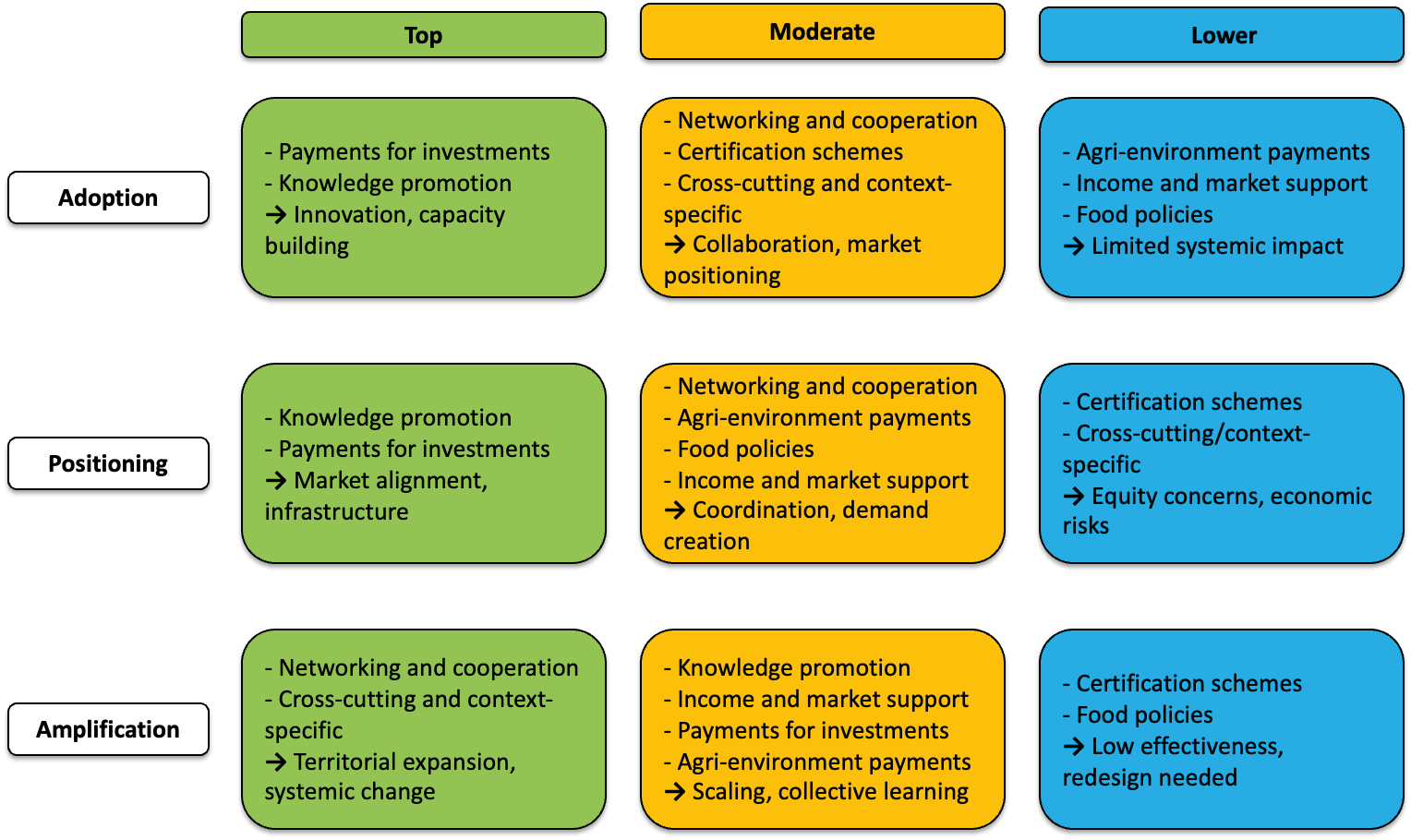
For adoption actions, which aim to introduce agroecological practices in conventional farming systems, top-ranked instruments such as payments for investments and knowledge promotion are particularly relevant. These instruments support technical implementation and capacity building, enabling farmers to initiate change. This aligns with the need for technical information and financial tools to implement changes on farm and to develop business strategies for better positioning the produced food on the market. Moderate-ranked instruments like networking and cooperation and certification schemes contribute to market positioning and collaboration, while lower-ranked instruments such as agri-environment payments and food policies show limited systemic impact, indicating a need for redesign or complementary support mechanisms (Frison and Clément, 2020; Salliou et al., 2019).
Positioning actions, which focus on stabilising demand for agroecological products, benefit most from instruments like knowledge promotion and payments for investments, which align with market infrastructure and actor goals. Moderate-ranked instruments including networking and cooperation and agri-environment payments facilitate coordination and demand creation. Lower-ranked instruments such as certification schemes and cross-cutting/context-specific policies raise equity concerns and economic risks, suggesting that their design may not fully support positioning objectives. Coordination between public agencies and training centres is an important governance issue to be addressed. New governance models should involve research institutes, advisory services, small farms and other local value chain actors through networking instruments and regional policies (Helenius et al., 2020).
Amplification actions, aimed at scaling agroecology through collective agency, are best supported by networking and cooperation and cross-cutting/context-specific instruments, which enable territorial expansion and systemic change. Moderate-ranked instruments like knowledge promotion and agri-environment payments foster collective learning and scaling. Lower-ranked instruments such as certification schemes and food policies are perceived as less effective, highlighting the need for reconsidering their design to better support transformative goals. Strategic plans for agroecology are required to ensure its diffusion and consolidation in the long period. Long-term strategies should be evidence-based, draw on clear and cost-effective rules, and favour the creation of new partnerships in food system governance, including value chain, AKIS, civic society organisations, public sector, and consumers (e.g., land-use partnership, bio-districts, producer-consumer associations, knowledge hubs) (Niggli et al., 2021).
Across all transition goals, knowledge promotion plays a central role, but its function changes as transitions progress. In early stages it supports individual decision-making and technical learning; in later stages it facilitates coordination, shared understanding, and collective capacity building. This confirms that policy effectiveness depends not only on instrument choice, but also on how instruments are sequenced and combined as transitions evolve (Šūmane et al., 2018).
3.2. Policy recommendations
Instruments such as payments for investments and knowledge promotion emerged as top-ranked across adoption and positioning actions. To maximise their effectiveness, robust monitoring mechanisms should be implemented to ensure accountability and continuous improvement, given that these instruments are reported to reduce risk and enable learning processes that unfold over time and across scales. These instruments should be embedded in local innovation ecosystems, including training programmes, cooperatives, and advisory services, to support technical implementation and capacity building (Sanderson Bellamy and Ioris, 2017; Schoonhoven and and Runhaar, 2018; Teixeira et al., 2018). Integrative strategies are also needed to foster a more sustainable agricultural base and a more resilient rural economy that can adapt to challenges and uncertainties in food production, reflecting the observed complementarity between investment support and knowledge-based mechanisms in enabling both technical change and organisational learning (Tataridas and and Freitas, 2024).
Income and market support instruments should be tailored to agroecological strategies and aligned with environmental regulations. Their effectiveness can be enhanced by integrating them with knowledge transfer mechanisms and by ensuring that they support the development of sustainable business models (Runhaar, 2021). Income and market support are reported to stabilise farm viability and enable experimentation, rather than directly drive agroecological transformation, which may explain its lower relevance for amplification goals.
Agri-environment payments should reflect the true value of ecosystem services and be adapted to local farming systems. Findings indicate that these payments are most effective when they act as entry points for participation and collective uptake, but insufficient on their own to sustain longer-term systemic change. Their design should go beyond financial compensation to include integrated governance frameworks that align ecological goals with socio-economic realities (Ewert et al., 2023; Teixeira et al., 2018). National CAP Strategic Plans should be better aligned with agroecological principles and deliver coherent, multi-dimensional eco-schemes (Donham et al., 2022).
The role of knowledge promotion is central across all action types: (i) adoption, it reduces uncertainty and supports individual decision-making; (ii) positioning, it facilitates coordination along the value chain and supports market alignment by strengthening shared understanding among producers, intermediaries, and consumers; (iii) amplification, it enables collective learning, coordination, and territorial scaling. However, its implementation should be differentiated: at the adoption stage, emphasis should be placed on technical training and market-oriented strategies; at the amplification stage, capacity building and access to agroecology-specific advisory services are critical. Strengthening AKIS and integrating advisory services with research and education institutions can enhance knowledge co-creation and dissemination (Landini et al., 2021; Sanderson Bellamy and Ioris, 2017). Co-creation and horizonal knowledge sharing are essential to build trust, relevance, and legitimacy in agroecology transitions (Sirdey et al., 2023), especially participatory and multi-stakeholder approaches including farmer-led training and regional research hubs (Donham and Wezel, 2022) and agroecology living labs (Rastorgueva et al., 2025, Stone et al., 2026).
Certification schemes and food policies, which ranked lower in the MCA, require redesign to address equity concerns and economic risks. The mechanisms identified by actors point to misalignment between these instruments and local agroecological practices, particularly where administrative burden, cost, and weak integration with producer support undermine their legitimacy and effectiveness. Voluntary certification schemes can reduce information asymmetry, but they must be supported by public awareness campaigns and improved public procurement standards. Enhancing connectivity through local supply chains and participatory networks and knowledge hubs can reinforce consumer trust and complement certification efforts, especially in agroecological territories (Duru et al., 2015; Sirdey et al., 2023).
Across all action types, findings suggest that coordination failures are recurring governance bottlenecks. Then, there is a need for improved coordination between public agencies, training centres, and local actors. New governance models should foster horizontal and vertical collaboration, involving research institutes, advisory services, small farms, and civil society organisations. These include decentralized and territorial governance, particularly in contexts where land access and resource management shape farmers’ autonomy and resilience (Sirdey et al., 2023); mosaic of regionally adapted systems and participatory governance to support agroecological transitions aligned with the Green Deal (Donham and Wezel, 2022).
Strategic plans for agroecology should be long-term and evidence-based, explicitly recognising that different policy instruments activate distinct mechanisms at different transition stages, and therefore require sequencing and combination across adoption, positioning, and amplification goals (Frison and Clément, 2020; Helenius et al., 2020; Salliou et al., 2019).
4. Conclusions
This article provides policy-relevant evidence on how existing policy instruments can better support agroecology transitions in Europe. By integrating actor perspectives from 15 European case studies, it identifies which policy areas are most relevant for different transition goals (adoption, positioning, amplification) and explains how their effectiveness changes as transitions evolve.
The findings show that while all policy areas contribute to agroecology transitions, their prominence and effectiveness vary by transition stage. Knowledge promotion and payments for investments emerge as key enablers across adoption and positioning, while networking and cooperation are essential for scaling agroecology at the territorial level. In contrast, certification schemes and food policies currently play a more limited role and require redesign to better address equity and connectivity. Overall, the results highlight that policy effectiveness depends less on introducing new instruments than on adapting, combining, and sequencing existing ones in line with actors’ goals and governance conditions.
From a policy perspective, the analysis underscores the need for better-tailored strategies to address the socio-economic barriers faced by diverse farming systems and territorial contexts. Strengthening advisory services, supporting capacity building, and improving governance, particularly at intermediate and territorial levels, are critical. Rather than creating new tools, policy efforts should focus on adjusting the design and governance of existing instruments to better align with agroecological principles.
This study has limitations that are relevant for interpretation. Fieldwork was conducted before ex-post evidence on CAP 2023–2027 became available, and the analysis relies on actor perceptions rather than measured impacts. Future policy-oriented research could strengthen the evidence base by combining this actor-centred framework with longitudinal data and quasi-experimental approaches (e.g. before–after comparisons or comparative analyses between similar territories exposed to different policy mixes) to triangulate perceived and observed outcomes. While the empirical focus is European, the framework and lessons identified offer transferable insights for other regions seeking to design context-sensitive policies to support agroecology transitions.
Acknowledgments
This work was supported by Horizon 2020, the European Union’s research and innovation funding programme from 2014 to 2020 (UNISECO– ‘Understanding & improving the sustainability of agro-ecological farming systems in the EU’, Grant Agreement No. 773901). The contributions of Gerald Schwarz were also partly funded through research of the Horizon Europe project AGROECOLOGY (European Partnership ‘Accelerating Farming Systems Transition: Agroecology
Living Labs and Research Infrastructures’, Grant Agreement No. 101132349). The funder had no role in study design, data collection and analysis, decision to publish, or preparation of the manuscript. The authors thank all stakeholders in the EU and case study level activities of the UNISECO project for their contributions. The authors also thank all research partners in the UNISECO projects who contributed to data collection in the case studies.
References
Bezner Kerr, R., Postigo, J.C., Smith, P., Cowie, A., Singh, P.K., Rivera-Ferre, M., Tirado-von der Pahlen, M.C., Campbell, D., Neufeldt, H., 2023. Agroecology as a transformative approach to tackle climatic, food, and ecosystemic crises. Current Opinion in Environmental Sustainability 62, 101275. https://doi.org/10.1016/j.cosust.2023.101275
Boix-Fayos, C., de Vente, J., 2023. Challenges and potential pathways towards sustainable agriculture within the European Green Deal. Agricultural Systems 207, 103634. https://doi.org/10.1016/j.agsy.2023.103634
Donham. J., Wezel, A. 2022. 10 steps to achieve the European green Deal. Policy Brief. AE4EU. https://www.agroecology-europe.org/new-policy-brief-from-ae4eu-10-steps-to-achieve-the-european-green-deal/
Donham. J., Wezel, A., Migliorini, P. 2022. Improving eco-schemes in the light of agroecology. Policy Brief. AE4EU. https://www.ae4eu.eu/ae4eu-policy-brief/
Duru, M., Therond, O., Fares, M., 2015. Designing agroecological transitions; A review. Agron. Sustain. Dev. 35, 1237–1257. https://doi.org/10.1007/s13593-015-0318-x
Ewert, F., Baatz, R., Finger, R., 2023. Agroecology for a Sustainable Agriculture and Food System: From Local Solutions to Large-Scale Adoption. Annual Review of Resource Economics 15, 351–381. https://doi.org/10.1146/annurev-resource-102422-090105
Fiore, V., Borrello, M., Carlucci, D., Giannoccaro, G., Russo, S., Stempfle, S., Roselli, L., 2024. The socio-economic issues of agroecology: a scoping review. Agricultural and Food Economics 12, 16. https://doi.org/10.1186/s40100-024-00311-z
Frison, E., Clément, C., 2020. The potential of diversified agroecological systems to deliver healthy outcomes: Making the link between agriculture, food systems & health. Food Policy, Sustainable Food Systems for Healthy Diets in Europe and Central Asia 96, 101851. https://doi.org/10.1016/j.foodpol.2020.101851
Galioto, F., Gava, O., Povellato, A., Vanni, F., 2021. Innovative Market and Policy Instruments to Promote the Agro-ecological Transition Strategies. UNISECO Deliverable 5.4. https://doi.org/10.5281/ZENODO.5578065
Gava, O., Povellato, A., Galioto, F., Pražan, J., Schwarz, G., Quero, A.L., Iragui, U.Y., Massa, C.A., Zīlāns, A., Carolus, J., 2022. Policy instruments to support agroecological transitions in Europe. EuroChoices 21, 13–20. https://doi.org/10.1111/1746-692X.12367
Gava, O., Vanni, F., Schwarz, G., Guisepelli, E., Vincent, A., Prazan, J., Weisshaidinger, R., Frick, R., Hrabalová, A., Carolus, J., Yoldi, U.I., Pyysiäinen, J., Smyrniotopoulou, A., Vlahos, G., Balázs, K., Szilágyi, A.J., Jegelevičius, G., Mikšytė, E., Zilans, A., Frățilă, M., Röös, E., Miller, D., Povellato, A., 2025. Governance networks for agroecology transitions in rural Europe. Journal of Rural Studies 114, 103482. https://doi.org/10.1016/j.jrurstud.2024.103482
Helenius, J., Hagolani-Albov, S.E., Koppelmäki, K., 2020. Co-creating Agroecological Symbioses (AES) for Sustainable Food System Networks. Front. Sustain. Food Syst. 4. https://doi.org/10.3389/fsufs.2020.588715
HLPE, 2019. Agroecological and other innovative approaches for sustainable agriculture and food systems that enhance food security and nutritio (No. 14), HLPE Reports. High Level Panel of Experts on Food Security and Nutrition of the Committee on World Food Securit, Rome, Italy.
Lam, D.P.M., Martín-López, B., Wiek, A., Bennett, E.M., Frantzeskaki, N., Horcea-Milcu, A.I., Lang, D.J., 2020. Scaling the impact of sustainability initiatives: a typology of amplification processes. Urban Transform 2, 3. https://doi.org/10.1186/s42854-020-00007-9
Lampkin, N., Schwarz, G., Bellon, S., 2020. Policies for agroecology in Europe, building on experiences in France, Germany and the United Kingdom. Landbauforschung : journal of sustainable and organic agricultural systems 103–112. https://doi.org/10.3220/LBF1611684471000
Landini, F., Gallardo Lopez, F., Ramirez Valverde, G., Aguilar Calegare, M., Kellen Onofre Dos Santos, D., 2021. How much do extension agents and advisors value agroecology in different countries? Contributions to the understanding of their potential role in scaling up agroecology. Agroecology and Sustainable Food Systems 45, 1554–1578. https://doi.org/10.1080/21683565.2021.1933296
Linares Quero, A., Iragui Yoldi, U., Gava, O., Schwarz, G., Povellato, A., Astrain, C., 2022. Assessment of the Common Agricultural Policy 2014–2020 in Supporting Agroecological Transitions: A Comparative Study of 15 Cases across Europe. Sustainability 14, 9261. https://doi.org/10.3390/su14159261
Niggli, U., Sonnevelt, M., Kummer, S., 2021. Pathways to Advance Agroecology for a Successful Transformation to Sustainable Food Systems.
Peeters, A., Lefebvre, O., Balogh, L., 2021. A Green Deal for implementing agroecological systems: Reforming the Common Agricultural Policy of the European Union. Landbauforschung : journal of sustainable and organic agricultural systems 83–93. https://doi.org/10.3220/LBF1610123299000
Place, F., Niederle, P., Sinclair, F., Carmona, N.E., Guéneau, S., Gitz, V., Alpha, A., Sabouring, E., Hainzelin, E., 2022. Agroecologically-conducive policies: A review of recent advances and remaining challenges. Center for International Forestry Research (CIFOR). https://doi.org/10.17528/cifor-icraf/008593
Prost, L., Martin, G., Ballot, R., Benoit, M., Bergez, J.-E., Bockstaller, C., Cerf, M., Deytieux, V., Hossard, L., Jeuffroy, M.-H., Leclère, M., Le Bail, M., Le Gal, P.-Y., Loyce, C., Merot, A., Meynard, J.-M., Mignolet, C., Munier-Jolain, N., Novak, S., Parnaudeau, V., Poux, X., Sabatier, R., Salembier, C., Scopel, E., Simon, S., Tchamitchian, M., Toffolini, Q., van der Werf, H., 2023. Key research challenges to supporting farm transitions to agroecology in advanced economies. A review. Agron. Sustain. Dev. 43, 11. https://doi.org/10.1007/s13593-022-00855-8
Rastorgueva, N., Bassignana, C.F., Angarita, E., Fasso, A., Hassink, J., Goris, M., Schmutz, U., Conroy, J., Dinç, S., Wezel, A., Migliorini, P., 2025. Agroecological Living Labs as entry points for transition towards sustainable food systems: a novel framework for the evaluation of living labs at different scales. Agroecology and Sustainable Food Systems 0, 1–34. https://doi.org/10.1080/21683565.2025.2477215
Rega, C., Thompson, B., Niedermayr, A., Desjeux, Y., Kantelhardt, J., D’Alberto, R., Gouta, P., Konstantidelli, V., Schaller, L., Latruffe, L., Paracchini, M.L., 2022. Uptake of Ecological Farming Practices by EU Farms: A Pan-European Typology. EuroChoices 21, 64–71. https://doi.org/10.1111/1746-692X.12368
Runhaar, H., 2021. Four critical conditions for agroecological transitions in Europe. International Journal of Agricultural Sustainability 19, 227–233. https://doi.org/10.1080/14735903.2021.1906055
Salliou, N., Muradian, R., Barnaud, C., 2019. Governance of Ecosystem Services in Agroecology: When Coordination is Needed but Difficult to Achieve. Sustainability 11, 1158. https://doi.org/10.3390/su11041158
Sanderson Bellamy, A., Ioris, A.A.R., 2017. Addressing the Knowledge Gaps in Agroecology and Identifying Guiding Principles for Transforming Conventional Agri-Food Systems. Sustainability 9, 330. https://doi.org/10.3390/su9030330
Schoonhoven, Y., and Runhaar, H., 2018. Conditions for the adoption of agro-ecological farming practices: a holistic framework illustrated with the case of almond farming in Andalusia. International Journal of Agricultural Sustainability 16, 442–454. https://doi.org/10.1080/14735903.2018.1537664
Schwarz, G., Vanni, F., Miller, D., Helin, J., Pražan, J., Albanito, F., Fratila, M., Galioto, F., Gava, O., Irvine, K., Landert, J., Quero, A.L., Mayer, A., Monteleone, D., Muller, A., Röös, E., Smyrniotopoulou, A., Vincent, A., Vlahos, G., Zīlāns, A., 2022. Exploring Sustainability Implications of Transitions to Agroecology: a Transdisciplinary Perspective. EuroChoices 21, 37–47. https://doi.org/10.1111/1746-692X.12377
Sirdey, N., Scopel, E., Ferrier, G., Khann, L., Ermolli, M., Paracchini, M.L., 2023. Mapping the contribution of agroecological transitions to the sustainability of food systems [WWW Document]. JRC Publications Repository. https://doi.org/10.2760/171903
Stone, T. F., Alami, S., Bach, J. L., Bindelle, J., Busse, M., Ciaccia, C., … Berg, T. R. (2026). Agroecology Living Labs to transform food systems: a critical review at the science-policy-society nexus in Europe. Agroecology and Sustainable Food Systems, 50(6), 1271–1312. https://doi.org/10.1080/21683565.2025.2560915
Šūmane, S., Kunda, I., Knickel, K., Strauss, A., Tisenkopfs, T., Rios, I. des I., Rivera, M., Chebach, T., Ashkenazy, A., 2018. Local and farmers’ knowledge matters! How integrating informal and formal knowledge enhances sustainable and resilient agriculture. J Rural Stud 59, 232–241. https://doi.org/10.1016/j.jrurstud.2017.01.020
Tataridas, A., and Freitas, H., 2024. The path forward: integrating agroecology into global policy frameworks. Agroecology and Sustainable Food Systems 48, 924–933. https://doi.org/10.1080/21683565.2024.2343045
Teixeira, H.M., Van den Berg, L., Cardoso, I.M., Vermue, A.J., Bianchi, F.J.J.A., Peña-Claros, M., Tittonell, P., 2018. Understanding Farm Diversity to Promote Agroecological Transitions. Sustainability 10, 4337. https://doi.org/10.3390/su10124337
Wezel, A., Bellon, S., Doré, T., Francis, C., Vallod, D., David, C., 2009. Agroecology as a science, a movement and a practice. A review. Agronomy for Sustainable Development 29, 503–515. https://doi.org/10.1051/agro/2009004
Williams, T.G., Bürgi, M., Debonne, N., Diogo, V., Helfenstein, J., Levers, C., Mohr, F., Stratton, A.E., Verburg, P.H., 2024. Mapping lock-ins and enabling environments for agri-food sustainability transitions in Europe. Sustain Sci 19, 1221–1242. https://doi.org/10.1007/s11625-024-01480-y
Zawalińska, K., Smyrniotopoulou, A., Balazs, K., Böhm, M., Chitea, M., Florian, V., Fratila, M., Gradziuk, P., Henderson, S., Irvine, K., Konstantidelli, V., Krupin, V., Latruffe, L., Mikšytė, E., Miller, D., Monteleone, D., Polaschegg, M., Schwarz, G., Tzanopoulos, J., Tzouramani, I., Vlahos, G., Wojciechowska, A., 2022. Advancing the Contributions of European Stakeholders in Farming Systems to Transitions to Agroecology. EuroChoices 21, 50–63. https://doi.org/10.1111/1746-692X.12378
Annex
| Transition goal | Policy area | N. obs | Avg | Median | Min | Max |
|---|---|---|---|---|---|---|
| Adoption | Agri-environment payments | 70 | 3.0 | 3.2 | 0 | 5 |
| Certification schemes | 19 | 3.3 | 3.4 | 1.9 | 4.5 | |
| Context-specific and cross-cutting | 58 | 3.5 | 3.5 | 0.1 | 5 | |
| Food policies | 24 | 2.6 | 3.0 | 0 | 4.2 | |
| Income and market support | 20 | 2.9 | 3.0 | 0 | 4.8 | |
| Knowledge promotion | 50 | 3.6 | 3.6 | 2 | 5 | |
| Networking/Cooperation | 40 | 3.3 | 3.3 | 1.3 | 5 | |
| Payments for investments | 56 | 3.6 | 3.7 | 1.5 | 5 | |
| Positioning | Agri-environment payments | 69 | 3.3 | 3.3 | 1.3 | 4.9 |
| Certification schemes | 13 | 3.0 | 3 | 0.5 | 5 | |
| Context-specific and cross-cutting | 60 | 2.4 | 2.8 | 0 | 4.3 | |
| Food policies | 114 | 3.3 | 3.6 | 0 | 5 | |
| Income and market support | 86 | 3.2 | 3.3 | 0 | 5 | |
| Knowledge promotion | 57 | 3.5 | 3.7 | 0 | 5 | |
| Networking/Cooperation | 49 | 3.3 | 3.3 | 1.5 | 4.7 | |
| Payments for investments | 51 | 3.4 | 3.6 | 1.9 | 5 | |
| Amplification | Agri-environment payments | 94 | 3.3 | 3.6 | 0 | 5 |
| Certification schemes | 25 | 3.2 | 3.4 | 0 | 4.7 | |
| Context-specific and cross-cutting | 16 | 3.7 | 3.8 | 2.3 | 5 | |
| Food policies | 57 | 1.6 | 0 | 0 | 4.9 | |
| Income and market support | 37 | 3.4 | 3.4 | 1.8 | 4.8 | |
| Knowledge promotion | 59 | 3.6 | 3.6 | 2.6 | 4.6 | |
| Networking/Cooperation | 74 | 3.7 | 3.9 | 1 | 5 | |
| Payments for investments | 70 | 3.3 | 3.2 | 1.6 | 5 |
1 Selected illustrative case study examples are chosen for their explanatory value. This does not imply that each mechanism is unique to a single case study, nor that other mechanisms were absent in the same contexts.