Received: January 13, 2026; Accepted: April 6, 2026; Published: July 5, 2026
Policy Paper
Rural policy in the 2028-2034 EU budget: Reform or Retreat? A rural-proofing analysis
1 CREA-Policy and Bioeconomy, Italy
2 National Research Council, Italy
3 AEIDL, Italy
*Corresponding author. Email: francesco.mantino@crea.gov.it; francomantino5@gmail.com
Abstract. The proposed EU Multiannual Financial Framework (2028–2034) reshapes rural development by consolidating instruments into a Single Fund and recentralising strategic decisions at national level. Although presented as simplification, the reform risks reinforcing existing biases toward urban, high-productivity regions. Drawing on rural proofing concepts, EU comparative analyses, and fine-grained Italian municipal data, the article shows that 2014–2020 Cohesion Policy allocated only a limited share of resources to rural areas, while the EAFRD remained the main-though uneven-source of support. The reform also gives rise to concerns about resources and institutional responsibilities for broader rural measures, including diversification, infrastructure, services, and funding for LEADER and cooperation initiatives. Key recommendations include: (i) a mandatory rural chapter in NRPPs; (ii) explicit rural safeguards in Single Fund rules; (iii) clearer rural typologies and better data systems; (iv) stronger multi-level governance with real local participation; and (v) dedicated resources for capacity-building and co-design.
Keywords: EU budget, CAP Reform, rural development, rural proofing, cohesion policy.
Index
2. Assessing the Rural Focus of ERDF, ESF and EAFRD: Evidence and Analysis
2.1. The territorial allocation of funds in Europe
2.2. Territorial distribution of EU expenditures in Italy: A more granular analysis
3. Discussion: rural development prospects after 2027
4. Conclusions and policy recommendations
1. Introduction: The Multi-annual Financial Framework (MFF) for 2028-2034. The European Commission’s proposal
The European Commission’s Communication1 on the MFF 2028–2034 (EC, 2025a) was presented in July 2025 and immediately sparked a controversial debate. The main components of the proposal are as follows:
a) The new budget architecture shifts from separate budgets for each fund to a system where only a few interventions are ring-fenced. The total budget is €1,985 billion, with the largest share allocated to “Economic, Social and Territorial Cohesion, Agriculture, Rural and Maritime Prosperity and Security” (€1,062 billion, 53%). The MFF removes the current two-pillar structure: most agricultural interventions will be financed through a ring-fenced €294 billion, while only some measures – such as LEADER, territorial and local cooperation initiatives, and support for knowledge sharing and innovation – will be funded as mandatory measures from the non-ring-fenced amount. This means most CAP interventions will be ring-fenced.
b) The MFF proposal introduces a 25% flexibility margin within each NRP plan to enable Member States to address crises during the programming period, revise priorities at the time of the mid-term review, or provide additional resources to existing measures. In the context of the recent EU-Mercosur agreement, the Commission has proposed that Member States can allocate, as early as 2028, part of this flexibility margin (approximately €45 billion) within their NRP plans to provide additional resources – beyond the €294 billion already ring-fenced – for either CAP income support measures or investment in rural areas.
c) Another important share of the EU budget is allocated to a broad “economic, territorial and social cohesion, including rural communities and tourism” envelope, which also covers the aforementioned rural development measures (LEADER, etc.) outside the CAP ring-fenced envelope. This broad set of interventions can be programmed by Member States with more flexibility than in the past, subject to a minimum earmarking for less developed regions and minimum targets for social (14%) and environmental and climate objectives (43%).
d) All measures will be financed through a single multi-purpose fund: the European Fund for Economic, Social and Territorial Cohesion, Agriculture and Rural, Fisheries and Maritime Prosperity and Security. This Single Fund merges previous instruments and will be distributed via nationally pre-allocated envelopes under shared management between the Commission and Member States. According to the proposed common Regulation, the fund will pursue multiple objectives, from reducing regional imbalances and supporting employment to implementing CAP and fisheries policy, as well as strengthening EU defence and security.
e) Resources will be disbursed following the approval of a National and Regional Partnership Plan (NRPP) prepared by each Member State. The NRPP will define priorities, investments, and interventions based on national and regional challenges. The single-fund structure aims to provide “a simpler and more flexible policy framework that enhances synergies and complementarities across sectors” (EC, 2025).
f) Another relevant innovation concerns the new financing model, largely inspired by the Recovery and Resilience Facility (RRF), under which most EU payments to Member States will depend on the fulfilment of predefined milestones and targets for reforms and investments, rather than on the current reimbursement of eligible expenditure incurred.
g) Among management rules, it is worth mentioning that the proposal introduces an n+1 decommitment rule, which could represent a tightening compared to the current rules in cohesion policy, home affairs and rural development, where n+2 or n+3 rules apply and allow implementation for two or three years after the EU funds are committed, without the Member State losing those funds.
h) The MFF proposal has been accompanied by draft regulations2 for the NRPF, ERDF, Cohesion Fund, CAP, and ESF. The regulation establishing the Single Fund significantly narrows the scope of CAP-eligible measures, removing support for rural diversification into non-agricultural activities as well as for infrastructure and essential services for rural populations. The underlying assumption is that these types of interventions will be addressed by non-CAP instruments, managed by non-agricultural administrations, within a broader framework of policy integration and coordination.
The initial proposal faced strong opposition from the European Parliament and the Committee of the Regions over rural priorities and limited regional involvement, prompting revisions reflected in the EU Presidency’s draft Negotiating Box for Heading 1 (European Council, 2025). Several elements of criticism have been raised in recent documents of the European Court of Auditors (ECA, 2026). European Commission President Ursula von der Leyen has sent a letter to European Parliament and European Council’s president outlining adjustments to the proposed MFF, proposing that at least 10% of national allocations (after deducting the minimum ring-fenced amount for the CAP) be earmarked for rural objectives3 and ensuring mechanisms for a stronger regional role in multi-level governance. However, implications for rural areas still require detailed analysis, particularly regarding policy effectiveness and institutional efficiency.
Key concepts underpinning Rural Proofing (RP) methodologies can support our analysis. RP approaches stress that policy design must rely on existing data on rural dynamics, including socioeconomic indicators, service provision levels, territorial disparities, and past public investment patterns. OECD (2024) highlights that RP requires evidence-based decision-making grounded in available data. EU RP frameworks link the process to Territorial Impact Assessment tools (CoR, 2022), which use quantitative territorial data – often including historical indicators and past funding where relevant. Some national guidelines explicitly require assessing funding allocations. UK guidance (DEFRA, 2022) states that RP must examine financial allocations and past fund distribution to ensure that “funding formulae reflect needs in rural areas.” This necessarily involves reviewing how funds were previously distributed across territories4.
Based on these concepts, this article aims to address the following questions:
1. To what extent have the past ERDF and ESF fund allocations prioritized rural areas, compared to EAFRD? Section 2 will analyse EU 2014-21 allocation choices, based on studies across EU countries and a specific study on the Italian case which can offer data availability of the funds’ distribution at the granular level.
2. In light of the evidence on past fund allocation between urban and rural areas, and the most recent experience with rural development implementation at the national level, what can be said about rural development prospects after 2027? Section 3 discusses this issue.
3. What policy recommendations can improve the proposed MFF approach? These considerations will be developed in the final section.
2. Assessing the Rural Focus of ERDF, ESF and EAFRD: Evidence and Analysis
2.1. The territorial allocation of funds in Europe
Assessing how much Cohesion Policy funding reaches rural areas is essential for evaluating territorial priorities and is a core element of rural-proofing. At EU level, only two cross-country studies provide sufficient evidence: Kah, Georgieva and Fonseca (EP-REGI, 2020) and Münch et al. (DG AGRI, 2024). Results differ because “rural” is defined in different ways. The EP study uses DEGURBA and examines programme-level allocations, reflecting planned rather than actual spending. The EC study classifies NUTS3 regions as rural, but this masks internal heterogeneity. These methodological differences explain divergent estimates: about 10% in the EP study versus 19–24% in the EC study (Table 1).
| Study | Reference period | Share of Cohesion Policy allocated in rural areas | Ratio urban/rural allocated funds | % of non-allocated funds | Definition of “rural” | ||||||||||||||
|---|---|---|---|---|---|---|---|---|---|---|---|---|---|---|---|---|---|---|---|
| billion € | (% of total | ||||||||||||||||||
| Kah et al., 2020 (EP-REGI Committee Study) | 2014-2019 | 45,6 | 9.7% | 3.74 | 54.5% | DEGURBA classification (cities; towns and suburbs; rural areas). | |||||||||||||
| Münch et al., 2024 (EC-DG-AGRI study) | 2014-2021 | 35,7 | Between 19.5% (ERDF) and 23.7% (Cohesion Fund) | 2.90 | 18.0% | NUTS3 regions classified as “rural” according to EUROSTAT typologies | |||||||||||||
| Source: authors’ elaboration. | |||||||||||||||||||
The choice of analysis unit also affects project location identification, especially for large-scale projects or when territorial codes are missing (Münch et al., 2024). These operational limits lead to high shares of non-allocable funds, which increase with finer granularity. The EP study reports 54% of funds as non-allocable, compared to 18% in the EC study using NUTS3 regions. After adjusting for non-allocable funds, urban areas still receive three to four times more funding than rural territories (Table 1).
Both studies reveal significant differences among EU countries, allowing for three clusters regarding Cohesion policy:
a) Countries with strong territorial targeting and a substantial share of funds allocated to rural areas (around 20–30%), such as Austria, Finland, Sweden, Czechia, and Slovakia;
b) Countries predominantly targeting urban areas, including the largest Member States (France, Germany, Italy, Spain) and others like Belgium and the Netherlands;
c) Countries with no clear territorial targeting, such as Slovenia, Estonia, Bulgaria, Croatia, Cyprus, and Denmark.
These findings suggest that only group a) explicitly prioritise rural areas in their Cohesion programmes, while urban areas dominate actual Cohesion Policy allocations.
The EC study also examines Cohesion Policy’s contribution to rural regions facing specific constraints-such as islands, mountain areas, regions with persistent demographic decline, very low population density, or extreme remoteness. In 2014–2020, these areas received an estimated €13.4 billion annually, mainly from CAP Pillar I (60%) and, to a lesser extent, Pillar II (24%), with only a marginal share from Cohesion funds. Moreover, some authors note that Cohesion Policy’s contribution has fluctuated over time. For example, ERDF support for rural areas increased between 1993–99 and 2007–13, but it was significantly reduced in 2014–20 (Soldi, 2016).
2.2. Territorial distribution of EU expenditures in Italy: A more granular analysis
Few studies have examined territorial allocation in Italy. Recent research has analysed financial distribution at the municipal level (LAU), focusing first on EAFRD (Mantino et al., 2024) and later comparing ERDF, ESF, and EAFRD allocations (Mantino et al., 2025). The objectives were twofold: to assess whether Cohesion policies effectively reach rural areas and to explore whether varying intensities of demographic change affect the uptake of Cohesion and rural development policies. Demographic dynamics can influence the performance of rural and urban territories, including their ability to respond proactively to economic and environmental transitions-a relationship widely documented over the past decade.
These studies applied the DEGURBA classification of rural and urban areas using LAU-level information. As highlighted in the EP analysis, a substantial share of expenditure appeared in the databases as non-allocable, due to many projects lacking a unique municipal location (e.g. large interventions covering multiple LAUs or crossing regional boundaries). This issue was particularly significant for ERDF and ESF projects, but much less relevant for EAFRD. Non-allocable projects generally concern large-scale infrastructures and services, which only marginally affect rural areas. Even after accounting for these funds, the share of ERDF and ESF absorbed by rural areas in Italy remains lower than the 10% estimated by the EP study for the EU overall (Figure 1): it ranges from 2% for ESF to 8% for ERDF, well below the rural population share (around 17%). By contrast, EAFRD funding allocated to rural areas is substantial and increases when managed locally by LAGs under LEADER.
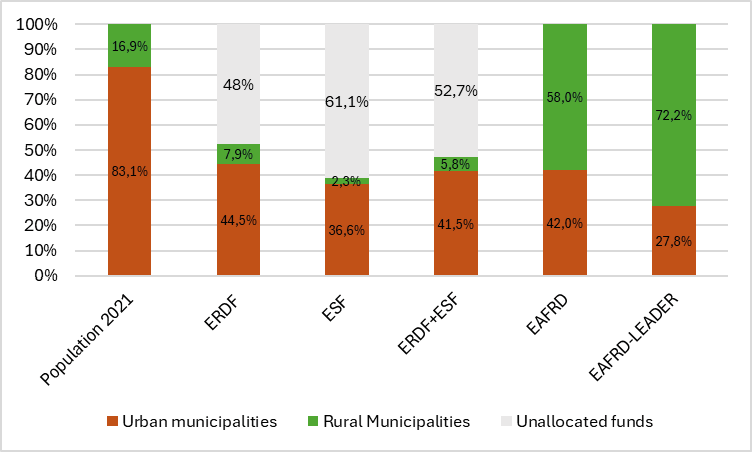
It is worth noting that around 42% of EAFRD resources go to urban areas, mainly small towns and peri-urban municipalities near agricultural zones. By contrast, ERDF and ESF funding is concentrated in the largest urban centres, which act as key hubs for economic development, innovation and services, including in less developed regions such as the Mezzogiorno. This pattern reinforces the asymmetry whereby major cities attract disproportionate investment due to higher institutional capacity, greater visibility and denser beneficiary networks.
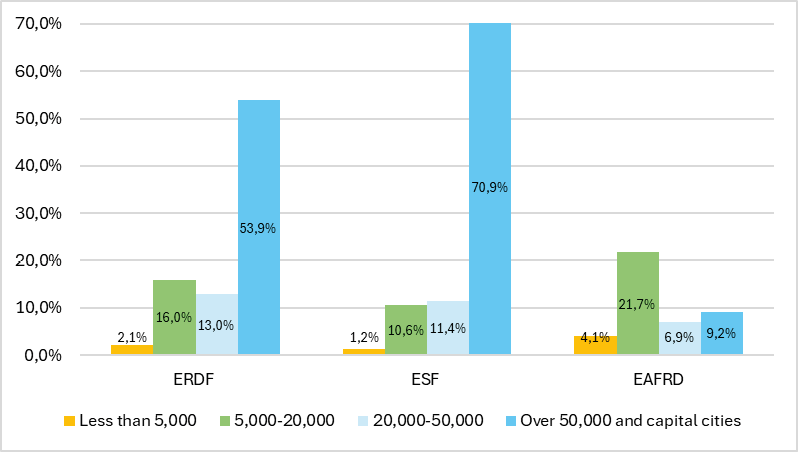
Figure 2 illustrates the biased distribution of policies whose stated objective is to reduce intra-territorial disparities: more than half of ERDF funding and nearly three quarters of ESF funding are allocated to cities with more than 50,000 inhabitants, as well as to regional and provincial capitals. By contrast, the EAFRD mainly supports small urban centres.
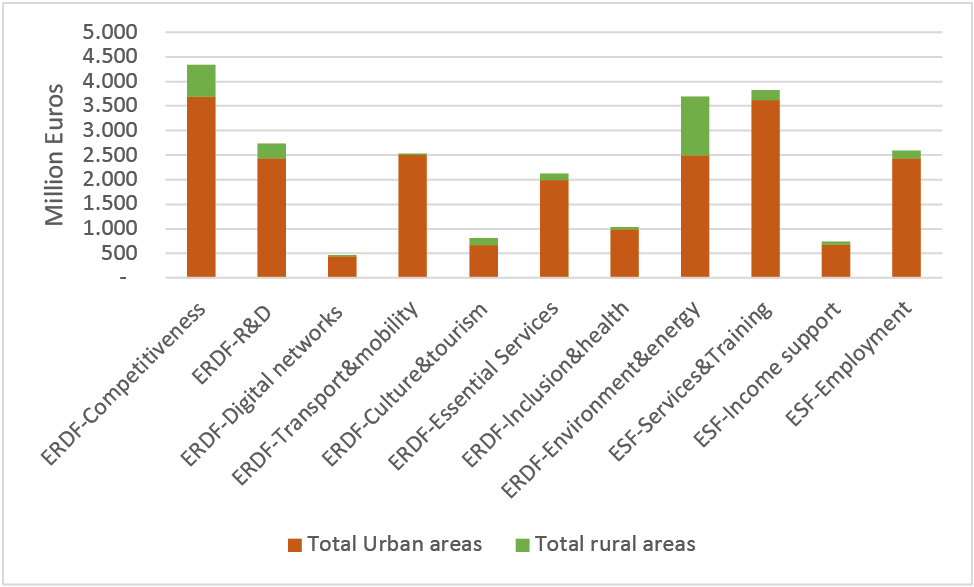
Cohesion Policy plays only a marginal role in supporting rural areas in Italy, with the main exceptions being interventions related to the environment and energy (Figure 3) and, to a lesser extent, measures aimed at enhancing the competitiveness of small and medium-sized enterprises. This result partly confirms the pattern observed at the European level (Kah et al., 2020). Nevertheless, it is noteworthy how little priority Italian authorities assign to rural areas in key policy fields for addressing population decline, such as transport and mobility (ERDF), essential services for residents (ERDF), and employment opportunities (ESF).
An analysis across urban and rural typologies clearly shows that Cohesion Policy pays little or no attention to demographically fragile rural areas, whereas the EAFRD allocates 22% of rural development funding to these areas, with LEADER interventions accounting for around 37% of the total.
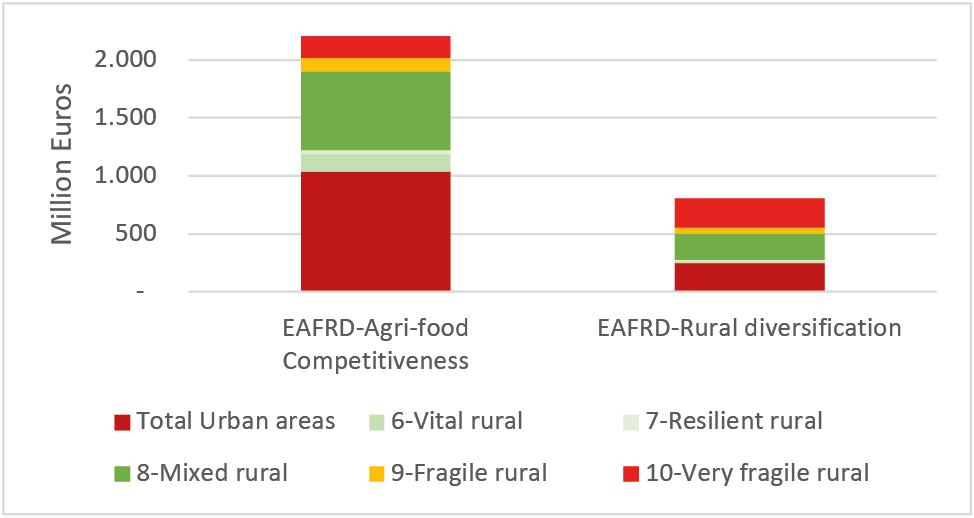
Nevertheless, the EAFRD’s capacity to target the most fragile areas varies by intervention type (Figure 4): participation by beneficiaries in fragile areas is substantial in non-sectoral schemes, covering a wide range of measures linked to rural diversification (e.g. non-agricultural activities, small-scale services and infrastructure, non-productive investments, forestry). By contrast, competitiveness-oriented measures are concentrated in urban areas and in resilient or dynamic rural regions. This dichotomy is particularly problematic given the limited role of Cohesion Policy in strengthening rural contexts, as shown above.
In conclusion, many needs in rural areas remain unmet by both the EAFRD and Cohesion Policy investments5. This is due, first, to the continued focus of Rural Development Programmes on traditional agricultural support instruments; and second, to the weaker capacity of the most fragile rural areas to absorb funding compared with urban areas and with resilient or dynamic rural regions – both for the EAFRD and for the ERDF/ESF. This raises a key question: is the limited territorial focus on rural areas the result of shortcomings in the EU-level policy design, or of weak programme implementation at national and regional levels? Evidence suggests that both levels play a role, although in different ways. Under shared management, the European Commission is responsible for ensuring coherence between national/regional actions and the EU’s agreed priorities (EC, 2025b), meaning that responsibility for the quality and orientation of Cohesion programmes is jointly shared with national administrations.
Current EU regulations for the ERDF and ESF prioritise thematic objectives – such as innovation, digitalisation, SME competitiveness, employment and social inclusion – rather than specific territorial types. Although the regulations allow rural targeting, they do not require dedicated allocations for rural areas. Evaluations (Munch et al., 2024; Dwyer et al., 2021) show that Structural Fund priorities are not well aligned with rural needs, reflecting structural territorial neutrality in fund design. Alternative policy options therefore need to be explored, given the controversial implications of the new MFF institutional architecture.
3. Discussion: rural development prospects after 2027
This section discusses the most significant implications for the future allocation of funds for rural development. Two main types of implications emerge: those concerning the overall volume of resources, and those more generally related to the governance system for NRP plans.
Concerns about future resources relate both to the territorial dimension of rural development measures-such as LEADER, local cooperation initiatives, diversification into non-agricultural activities, and rural infrastructure and essential services-and to the potential rural share of the Single Fund outside CAP interventions. For the former, the mandatory inclusion of LEADER and cooperation initiatives within the CAP ensures their presence in future NRPs. However, the volume of resources will depend on how strongly national and regional rural/agricultural authorities favour a sectoral approach. Additional factors may further reduce funding for these measures: pressures from agricultural lobbies supporting direct income payments, and the new n+1 decommitment rule, which shortens implementation timeframes and tends to reward faster, simpler measures over more complex interventions with higher transformative potential (ECA, 2026). This particularly affects LEADER/CLLD and cooperation initiatives, which require longer implementation periods and specific capacity-building support.
Within a context of budget constraints and rising competition among national lobbies, another critical issue concerns the share of the Single Fund that may be allocated at national level to rural diversification, infrastructure, and services. Two scenarios appear plausible. In the first, non-agricultural administrations would assume greater responsibility for financing collective rural investments, while CAP structural measures would focus more narrowly on agri-food systems and innovation. Alternatively, the current mix of CAP structural and territorial instruments could be retained, continuing to support both agri-food investments and rural diversification-mainly through LEADER/CLLD-while Cohesion Policy instruments would take on a larger role in funding rural services and infrastructure.
Whichever scenario prevails, addressing broader rural needs requires non-agricultural administrations to treat rural areas as territorial priorities, a task for which they are not necessarily inclined or adequately prepared. It also demands the creation of effective coordination mechanisms across interventions and consistent support for LEADER groups as they implement diversified local development strategies. This pathway is demanding, as it depends on institutional capacity and political commitment that remain uneven across EU Member States (Münch et al., 2024), including Italy.
A growing body of literature (Rodríguez-Pose, 2025) highlights that Cohesion Policy is increasingly oriented towards high-productivity urban centres, often at the expense of marginalised territories such as intermediate cities, peripheral rural areas, and former industrial regions. This trend is likely to intensify in the next programming period, given the strong emphasis on strengthening the EU’s competitiveness-an approach that channels investments into a narrow set of strategic sectors while paying limited attention to territorial disparities or the value of place-based approaches.
Regarding governance, the new policy framework reshapes the balance of power within the multilevel system, despite its reassuring rhetoric on the role of regions and local authorities. By placing strong emphasis on simplification and flexibility in defining strategic priorities, it effectively promotes a recentralisation and nationalisation of EU investment programmes. This shift continues a trajectory already evident in the 2021–2027 period with the introduction of National Recovery and Resilience Plans (NRRPs) and CAP Strategic Plans (SPs). Experience with these models has generated substantial criticism, particularly concerning transparency, the lack of a coherent strategic vision (Erjavec et al., 2025), the erosion of regional and local responsibilities in programme design and implementation (Rodríguez-Pose, 2025), and the limited – if not negligible – administrative simplification actually achieved6. A “one-size-fits-all” logic has often prevailed more strongly than in earlier regionalised approaches, reducing flexibility during implementation and negatively affecting the quality of rural development strategies at local level.
The experience of 2021–2027 raises a key question: how can genuine simplification be reconciled with the creation of a single national plan covering Cohesion Policy, the CAP, migration and border management, and climate-related interventions, without sacrificing the level of detail traditionally required in EU Operational Programmes? The first major challenge will be transforming these plans from broad catalogues of measures into genuinely strategic instruments capable of articulating clear priorities and demonstrating policy synergies and complementarities.
A second challenge concerns the risk of top-down intervention menus, as occurred with the NRRPs and CAP SPs. Ensuring that regional and local institutions retain adequate flexibility during implementation will depend largely on how meaningfully the partnership principle is applied within Member States. Significant territorial variation persists, shaped by domestic political contexts, raising the ongoing risk of a “patchwork Europe” (Foote, 2025) characterised by uneven participation and fragmented governance practices.
4. Conclusions and policy recommendations
Policy recommendations start with redefining rurality. Current undifferentiated notions and categories such as “less-favoured areas” fail to capture rural diversity. More nuanced typologies and granular socio-economic diagnostics are needed to represent the full diversity and complexity of rural spaces across Member States. The issue therefore remains open and calls for greater political attention as well as a more sustained research effort at the national level. The definition based on the DEGURBA classification represents a useful starting point, but it requires further refinement to capture the heterogeneity that exists within the broad category of rural areas.
A second set of recommendations concerns the legal provisions governing the design of future NRP plans. The draft regulation establishing the Single Fund specifies that each NRP should be organised into chapters grouping measures, objectives, and associated milestones and targets. A complementary proposal circulated by the European Council (2025) allows NRPs to include national, sectoral-including one dedicated to the CAP-and several regional or territorial chapters. This option is especially relevant for countries with regionalised governance structures.
Introducing a dedicated “rural chapter” would provide an effective framework for shaping an integrated strategy for rural areas and for differentiating interventions within the same NUTS2 region, regardless of its classification as less developed, transition, or more developed. Such a chapter would be particularly important for addressing the needs of peripheral rural areas facing demographic decline, weakened local economies, and shrinking essential services.
Only a limited number of Member States currently have experience with these types of territorial policies. Spain, Italy, and France are experimenting with holistic, intersectoral, and multi-fund approaches (Münch et al., 2024). These initiatives combine dedicated financial resources, strong governance arrangements, and clear delineation of areas exposed to severe demographic challenges-elements that would benefit from a more coherent European-level framework. Some scholars (Rodríguez-Pose, 2025; Hansum, 2025) propose allocating cohesion funds based not only on GDP per capita but also on socio-economic exposure to green and demographic transitions.
Joint work led by DG AGRI and DG REGIO under the Rural Pact may support preparations for the next programming period. However, this should be complemented by stronger efforts to valorise existing national and regional experiences. Establishing a rural chapter would also serve as a safeguard for interventions structurally less compatible with the n+1 decommitment rule, which tends to prioritise rapid expenditure over complex place-based processes.
Another set of recommendations concerns the need for NRP plans to grant local communities sufficient autonomy to define their own development strategies, based on thorough diagnostic assessments and tailored to local needs. To achieve this, national and regional administrations should avoid imposing rigid, top-down lists of eligible measures, which limit flexibility and hinder genuine place-based approaches. This broader room for manoeuvre should be ensured by appropriate EU-level implementing rules. Furthermore, adequate resources must be allocated at the national level to support strategic planning, including granular data collection, the development of intervention logic, the setting of priorities, and strengthened learning and co-design processes. Recent research – such as the Horizon Europe RUSTIK project7- shows that multi-actor approaches like living labs can significantly improve data provision, co-creation and local learning capacities. However, these approaches require dedicated capacity-building resources to establish meaningful stakeholder engagement structures. Broader room for manoeuvre also applies to LEADER/CLLD initiatives, which continue to face constraints, including concentration in areas with stronger social capital, procedural rigidity imposed by managing authorities, and challenges in combining funding streams due to inconsistent rules.
Although the proposed reform of EU policies emphasises simplification at higher levels of government, ensuring efficient and effective design and implementation of NRP plans will require a clear division of responsibilities and robust coordination between national and regional authorities, notably in regionalised countries. The timetable for submitting and approving NRP plans by January 2028 may be challenging. This is not only due to the intensive work and coordination required within Member States and with the Commission, but also because it is essential to ensure that the plan’s timeline allows for meaningful engagement of stakeholders throughout the design process. Robust methodological guidelines have to be developed by the national coordinating authority to guarantee effective stakeholder participation, particularly involving local actors.
Baldi, L., Calzolai, S., Arfini, F., & Donati, M. (2024). Predicting the effect of the Common Agricultural Policy post-2020 using an agent-based model based on PMP methodology. Bio-based and Applied Economics 13(4): 333-351. https://oaj.fupress.net/index.php/bae/article/view/14592/13240
Committee of the Regions (CoR) (2022). Rural proofing – a foresight framework for resilient rural communities, Brussels, 2022. https://ldnet.eu/wp-content/uploads/bsk-pdf-manager/2022/06/Rural-Proofing_CoR_coter_nat_rural.pdf
Council of the European Union (2025). Multiannual Financial Framework 2028-2034. Revised possible elements for a future draft Negotiating Box (Heading 1), 20.11.2025, 14344/2/25 Rev 2.
DEFRA (Department for Environment, Food and Rural Affairs) (2022). Rural proofing - Practical guidance to consider the outcomes of policies in rural areas, November 2022. https://assets.publishing.service.gov.uk/media/6388a51bd3bf7f32848cbc3d/rural-proofing-guidance.pdf
Dwyer, J.; Kubinakova, K.; Powell, J.; Micha, E.; Dunwoodie-Stirton, F.; Mantino, F.; Forcina, B.; Beck, M.; Gruev, K.; Ghysen, A.; et al. (2021). Evaluation Support Study on the Impact of Leader on Balanced Territorial Development; European Commission: Brussels, Belgium. Available online: https://op.europa.eu/en/publication-detail/-/publication/bd6e4f7c-a5a6-11ec-83e1-01aa75ed71a1/language-en
Erjavec E., Rac I., Bertolozzi-Caredio D. (2025). Common Agricultural Policy Strategic Plans: smokescreens or instruments for evidence-based policymaking? Italian Review of Agricultural Economics, vol. 80, no. 3, 2025. https://doi.org/10.36253/rea-16856
European Commission (2025a). A dynamic EU Budget for the priorities of the future - The Multiannual Financial Framework 2028-2034, Brussels, 16.7.2025 COM(2025) 570 final/2. https://eur-lex.europa.eu/legal-content/EN/TXT/?uri=celex:52025DC0570
European Commission (2025b). Ex post evaluation of the European Regional Development Fund (ERDF) and the Cohesion Fund for the programming period 2014-2020, Commission Staff Working Document, SWD(2025) 329 final, https://ec.europa.eu/regional_policy/sources/reports/2025/Ex_Post_Evaluation_ExecutiveSummary.pdf
Hansum R. (2025). Breaking the traps – Smarter regional allocation of EU cohesion spending 2028-2034, Policy Brief, Hertie School, Jaques Delors Centre, available at https://www.delorscentre.eu/en/publications/detail/publication/breaking-the-traps
Kah S, Georgieva N & Fonseca, L 2020, Research for REGI Committee – EU Cohesion Policy in nonurban areas, European Parliament, Policy Department for Structural and Cohesion Policies, Brussels, http://www.europarl.europa.eu/RegData/etudes/STUD/2020/652210/IPOL_STU(2020)652210_EN.pdf
Foote N. (2025). EU Budget: How Brussels’ New Plans Put Regions Out to Pasture, available at: https://www.arc2020.eu/eu-budget-how-brussels-new-plans-puts-regions-out-to-pasture/
Mantino F., De Fano G., Asaro G. (2024). Evaluating the impact of long-term demographic changes on local participation in Italian rural policies (2014–2020): A spatial autoregressive econometric model. Land, 13: 1581. https://doi.org/10.3390/land13101581
Mantino F., De Fano G., Asaro G. (2025). Reaching the margins: Addressing demographic transition through EU Cohesion and Rural Development Policies in Italy, Italian Review of Agricultural Economics, vol. 80, no. 3, 2025. DOI: 10.36253/rea-16853. https://oajournals.fupress.net/index.php/rea/article/view/16853
Münch A., Gorny H., Badouix M., Gaugitsch R., Dwyer J., Kubinakova K., Beck M., Van Bunnen P., Mantino F., Brkanovic S. (2024). Study on funding for EU rural areas–final report, European Commission, Directorate-General for Agriculture and Rural Development, Publications Office of the European Union, Luxembourg. https://data.europa.eu/doi/10.2762/901111
OECD (2024), Rural Proofing: Lessons from OECD countries and potential application to health, OECD Regional Development Papers, Paris. https://www.oecd.org/content/dam/oecd/en/publications/reports/2024/06/rural-proofing_bf4fa3b5/4011899a-en.pdf
Rodríguez-Pose A. (2025). Forging a sustainable future together: Cohesion Policy at its defining moment, Regional Studies, 59:1, https://doi.org/10.1080/00343404.2025.2552869
Soldi R. (2016). Evolution of the Budget Dedicated for Rural Development Policy, report written for Committee of the Regions, European Union, 2016. https://op.europa.eu/en/publication-detail/-/publication/1c0f0d08-b794-11e6-9e3c-01aa75ed71a1/language-en
1 The Communication and related documents can be downloaded from the following site: https://commission.europa.eu/publications/multiannual-financial-framework_en
2 The whole set of draft Regulations can be downloaded from the following site: https://commission.europa.eu/strategy-and-policy/eu-budget/long-term-eu-budget/eu-budget-2028-2034_en
3 This target should be monitored, by summing expenditure taking place in regions coded 02 as rural regions.
4 One key issue raised by the UK guideline is about “Distribution, equality, devolution and funding”, with a related question to be answered by rural proofers on “Is an equitable proportion of your funding programme going to rural Areas?” (DEFRA, 2022, p. 8).
5 Similar considerations can be raised regarding the CAP first-pillar instruments, given their distortive effects at the territorial level (Baldi et al., 2025).
6 Matthews A. (2025). Fitting the CAP into the next MFF long-term budget, available at: https://capreform.eu/fitting-the-cap-into-the-next-mff-long-term-budget/.
7 See the content and deliverable of the project at the site: https://rustik-he.eu/.