Open Essays and Researches
Philanthropic foundations as field-builders: insights from two emblematic Italian cases
Università di Bologna, Italia
Email: paola.arrigoni2@unibo.it
Abstract. To date, the scholars who have studied Italian philanthropic foundations have mainly focused on their function as the funders of various kinds of initiatives or policies. Only rarely have they investigated the foundations’ input to policymaking processes, while virtually never examining foundations’ role as field builders, that is to say, as actors with the power to influence how fields are defined and delimited in the context of policymaking. Drawing on a large corpus of official documents and semi-structured interviews, the paper addresses this under-studied role of philanthropic foundations in relation to two Italian cases: the university policies of one of the country’s largest foundations of banking origin; the climate policies of the main climate networks to which Italian foundations belong. The foundations’ presumed field-building role is explored from both the organizational-relational and discursive perspectives. Next, the twin concepts of depoliticization/politicization frame discussion of the hypothesis that, in both cases studied, the foundations’ involvement in policymaking entails a discursive depoliticization of public action and a governmental and social politicization of their own actions. The data analysis appears to confirm the research hypotheses, raising questions surrounding the actual innovative reach of philanthropic foundations and the relationship they establish with public actors.
Keywords: philanthropy, italian foundations, field-building approach, depoliticization/politicization frame, philanthropic policymaking.
Index
Theoretical framework: foundations as field-builders between politicization and depoliticization
The policies of foundations of banking origin concerning the university of turin
Italian environmental philanthropy and its networks
List of documents on CPS’s university policies
List of documents by the networks of which Italian foundations are members
«One thing remains certain: building and connecting fields will continue to be what defines us as philanthropy» (The Rockefeller Foundation, Philanthropy as Field Builder, Perspective, 25 April 20131).
The recent global increase in the operations and public influence of philanthropic organizations (Depecker et al. 2018) has drawn growing attention in the scholarly literature. While most studies to date have focused on US foundations, there is a burgeoning body of European literature on the topic (Monier 2023). In Italy, few studies have adopted political and sociological perspectives on foundations. Those that have, mainly examined their contributions to funding initiatives or policies, rarely addressing their involvement in policymaking (Burroni et al. 2017; Ravazzi 2016) and never exploring their role as field-builders. At the global level also, philanthropic foundations’ role as field-builders remains an underexplored phenomenon. This gap in the literature has prompted scholars to call for more scientific and empirical research on the subject (Betsill et al. 2021).
In this paper, I examine the previously understudied role of philanthropic foundations as field-builders through two Italian cases: 1) the university policies of Compagnia di San Paolo (Csp), a Turin-based Foundation of banking origin (hereafter Fob) and one of Italy’s largest in terms of assets and funding expenditure2; 2) the policies of the climate networks involving Italian foundations. The selection of two heterogeneous cases was deliberate, based on differences in: scale of analysis, with the first case being primarily local and the second primarily national-international; policy domain, with the first focusing on knowledge and the second on climate; organizations: a single foundation in the first case and four networks including several Italian foundations in the second. This heterogeneity serves to illustrate: the broad scope of Italian foundations’ sphere of intervention (Pierri 2019); the diversity of their organisational forms (auxiliary bodies, networks with other actors, and inter-organisational committees); the similarities, despite their heterogeneity, in the content and general orientation of their actions, particularly regarding their role in policymaking; the neoliberal convergence of local and supra-local dimensions at the epistemic and governance level in both cases; two underexplored policy domains for Italian foundations – climate and university policies.
Theoretically speaking, this paper draws on two key strands of the literature: the field-building approach (Apajalahti et al. 2018; Bartley 2007; Betsill et al. 2021 Lounsbury et al. 2003) and the politicization/depoliticization framework (d’Albergo, Moini 2019). I use the analytical categories of these two approaches as heuristic tools for verifying the foundations’ role in field-building, focusing on both their discursive positioning and the organizational forms and actions they adopt to advance their ideas and agendas in their targeted policy domains. Following Bartley (2007), a field is understood as an arena where different actors routinely interact, adopt a common frame of reference, and pursue (at least partially) shared projects. Field-building activity within specific policy domains can be analysed through two dimensions: relational and discursive. Applying Bartley’s framework, I examine the forms and the procedures through which foundations organize and disseminate their agendas (relational dimension) and analyze the justificatory and value regimes that underpin and legitimize foundation’s policies (discursive dimension) in the two cases under study. I then connect the findings from these dimensions to the conceptual framework of depoliticization/politicization. This approach allows me to explore the hypothesis that foundations’ involvement in policymaking leads to both the discursive depoliticization of public action and the governmental and social politicization of their own actions. The depoliticization of public action is inherently political in nature. Following Burnham, depoliticization is understood as «the process of removing the political character of decision-making processes» (2001: 128) with the adoption of solutions portrayed as inevitable because they are supported by scientific and expert knowledge. By this definition, when depoliticization occurs, the political dimension of the decision-making process “takes a back seat” rather than disappearing. This process is also structurally linked to complementary processes of politicization, wherein multiple social practices are shaped by non-political actors whose political power is enhanced as decision-making responsibilities shift from governments to them.
In both cases, I draw my research data from: 1) official reports and memoranda of understanding (20 documents on university policies and 16 on climate policies)3; 2) semi-structured interviews (16 on university policies and six on climate policies)4; 3) the official websites of the networks and foundations. I apply discourse analysis to all the textual material to uncover the logics, principles, and ideas that foundations evoke to legitimize their actions (Mills 1940) and ascertain their overall degree of depoliticization – that is to say, the extent to which foundations address issues from a technical perspective, overlooking their political – and therefore more controversial – aspects, to propose solutions framed as virtually inevitable and therefore harder to challenge. This entails analysing how the most commonly used categories in climate and university policymaking (e.g., climate change, just transition, sustainable development, and SDGs in the former; and excellence, competitition, attractiveness, and innovation in the latter) and the overarching logic underpinning policies in these domains are articulated across the corpus. These texts also enable me to map out the foundations’ modus operandi and their efforts to shape political agendas
The paper is organized as follows: in the first section, I outline the theoretical framework; in the second and third sections, I outline the two cases in terms of the foundations’ policy rationales and how these are constructed and disseminated; in the fourth section, I discuss my findings in relation to the two theoretical paradigms of reference.
Theoretical framework: foundations as field-builders between politicization and depoliticization
Philanthropic foundations are becoming increasingly powerful in terms of their direct or indirect influence on public issues and policy agendas (Lefèvre, Monier 2021; Skocpol 2016).
There are different theoretical approaches to assessing the influential role of philanthropy. Some authors have framed the role of foundations in the policymaking process as that of patrons supporting other organizations, especially NGOs, for the benefits that the latter in their turn can provide. Many of these scholars welcome the intervention of foundations, emphasizing the close relationship between philanthropic motives and the commitment to promoting justice or social innovation (Suarez 2012; Mosley, Galaskiewicz 2015; Reckhow 2016). Other scholars examine foundations as political entrepreneurs with the capacity to influence governance by leveraging their financial resources to set up or modify institutional structures (Madénian,Van Neste 2023). More recently, other authors have begun to analyze foundations from a field-building perspective (Morena 2016; Betsill et al. 2021). This last framework is related to the theories of patronage and political entrepreneurship referenced above. Field-builders may be defined, following Apajalahti et al. (2018: 47), as actors engaged in an ongoing interactive process of mobilizing organizational and discursive activities with a view to defining fields and shaping their boundaries and characteristics. For Bartley (2007), foundations act as field-builders by deploying tangible and intangible resources at both the relational and cultural levels. In his view5, analysing these dimensions enables us to unpack how foundations frame social movements within new organizational and value contexts, enroll them in new projects, and subtly channel protest. Accordingly, I set out to test the hypothesis that foundations have taken on a fielding-building role in the cases under study, at two distinct levels: 1) the discursive contours of their policy frameworks; 2) the organizational means by which they seek to implement these frameworks via policy agendas.
The politicization/depoliticization framework (d’Albergo, Moini 2019) is a further heuristic tool that can help to tease out the implications of the foundations’ field-building endeavours at the social, governmental, and discursive levels. More specifically, the twin concepts of depolitization-politization offer «a valuable key to deciphering and understanding the evolving relations between society, politics and the economy» (ivi: 219). Moini and d’Albergo (2019) have introduced an analytical-interpretive account of the three levels at which the intertwining dynamics of depoliticization and politicization may be observed: 1) at the discursive level, when defining courses of action is framed as indispensable and ideas contributed by nonpolitical actors (who lack legitimization via democratic-electoral processes) are given a key, or even leading, role in identifying potential courses of action, with the endorsement of political actors; 2) at the governmental level, when power and responsibility are transferred from the democratically-elected leadership of political institutions to more technocratic bodies, or – at any rate – to players who have not been democratically elected; 3) at the social level, when responsibility for collective problems is taken on by social actors, with or without the involvement of public agencies.
Before examining our two cases through the lens of politicization/depoliticization, let us first analyze – for each in turn – whether and how foundations have played a field-building role at the discursive and relational levels of analysis identified in the literature.
The policies of foundations of banking origin concerning the university of turin
The analysis presented here is based on a broader study conducted between October 2021 and April 2023 on behalf of the Documentation and Research Centre on Foundations and Civil Society at the University of Turin’s Department of Culture, Politics and Society (Dcps). This larger project examined the overarching university policies of both the Compagnia di San Paolo (Csp) and Crt foundations. In this paper, I focus solely on Csp’s policies concerning Turin University (UniTo) over the period 2008-2023 and in the domain of the social and political sciences.
Csp has been providing funding to universities in Turin since its inception in the 1990s. Up to 2008, the foundation followed no specific set of guidelines in allocating resources, but rather granted funds based on proposals received from individual university researchers. After 2008, due to both the economic crisis and its own evolution towards a more strategic and hands-on model, Csp began to formalize its relations with universities by establishing new policy instruments. Ever since, the Csp has regulated its relations with the university system via three main mechanisms: agreements, auxiliary bodies, and research tenders outside the agreements.
The majority of grants are governed by three-year agreements with five universities, primarily benefiting UniTo and Turin Polytechnic (PoliTo) (see Fig. 1). The concept of collaborating with university institutions through agreements first surfaced in 2008-2009, during the early years of Angelo Benassia’s chairmanship. At that time, Csp began transitioning from a model still largely focused on individual grant allocations to a more mixed hands-on and grantmaking approach (Arrigoni 2024).
| Conventions | 2010-12 | 2013-15 | 2016-18 | 2019-21 | 2022-24 | Tot. | |||||||||||||
|---|---|---|---|---|---|---|---|---|---|---|---|---|---|---|---|---|---|---|---|
| UniTo (Università di Torino) from 2010 | 27 mil. | 21 mil. | 22 mil. | 15 mil. | 15 mil. | 100 mil. | |||||||||||||
| PoliTO (Politecnico di Torino) from 2009 | 11 mil. | 15 mil. | 19.7 mil. | 10.5 mil. | n.r. | ||||||||||||||
| Università del Piemonte Orientale (from 2009) | 1 mil. | 4 mil. | 3.1 mil. | 3.3 mil. | n.r. | ||||||||||||||
| Università di Genova (from 2019) | - | - | - | 2.4 mil, | n.r. | ||||||||||||||
| Università Federico II di Napoli (from 2009) | 1.8 mil. | 5.2 mil. | 5.5 mil. | 4.5 mil, | n.r. | ||||||||||||||
| Total | 40.8 mil. | 45.2 mil. | 50.3 mil. | 35.7 mil. | 32.7 mil. | 204 mil. | |||||||||||||
| Source: Convenzioni Csp-Atenei 2009-2024; Rapporti Csp 2009-2022. | |||||||||||||||||||
Since the introduction of the agreement system, Csp and UniTo have established shared objectives, which Csp undertakes to fund and the University to co-finance. A joint committee, the Planning and Monitoring Committee (Cpm) oversees each agreement cycle. This committee comprises the rector of the university, three university professors appointed by the rector, and four members appointed by Csp’s board of management. The Cpm defines strategic guidelines for UniTo’s projects and for auxiliary bodies where the university is a partner (Collegio Carlo Alberto, Hugef). It also sets annual priorities, prepares final reports, and coordinates evaluation activities. The appointment of UniTo representatives to the Cpm is highly institutionalized, as evidenced by the inclusion of university senate chairs in the last three committees. With the stipulation of the fifth and most recent agreement, the governance system was expanded to include two committees: a Strategic Committee – composed of the university rector and general manager on UniTo’s side and Csp’s President and General Secretary – and a Technical Committee consisting of four representatives of the University (appointed by the rector) and four representatives of Csp (appointed by its board of management). The Technical Committee, tasked with implementing the Strategic Committee’s guidelines, effectively replaces the Cpm from the earlier agreements. This marks a significant shift, reinforcing Csp’s strategic role by allowing it to directly manage a portion of the funds disbursed under the agreement. Conversely, this change reduces the University’s decision-making autonomy.
From 2010 to 2024, Csp allocated €100m to UniTo across five three-year agreement cycles, with UniTo contributing an increasing proportion of co-funding (Fig. 2). Overall, Csp’s support has proven highly valuable, especially in a context of limited resources for Italian universities:
The growth of the university is partly an outcome of this investment and also a result of certain constraints that Csp has imposed. These limitations have had the merit of preventing [us] from doing things that are too far removed from the real world, things that no one perceives as urgent6.
| Agreement | Csp funding | UniTo funding | Tot. funding | ||||||||||||||||
|---|---|---|---|---|---|---|---|---|---|---|---|---|---|---|---|---|---|---|---|
| 2010-12 | 27 | 42.2 | 69.2 | ||||||||||||||||
| 2013-15 | 21 | 38.6 | 59.6 | ||||||||||||||||
| 2016-18 | 22 | 37 | 60 | ||||||||||||||||
| 2019-21 | 15 | 41.9 | 56.9 | ||||||||||||||||
| 2022-24 | 15 | 70.1 | 85.1 | ||||||||||||||||
| Total | 100 | 229.8 | 329.8 | ||||||||||||||||
| Sources: Convenzioni UniTo-Csp 2010-2024. | |||||||||||||||||||
The main problems identified by most UniTo interviewees in this study relate to decision-making processes and – closely linked – to the excessive alignment of Csp policies with those of other external organizations (a point we will revisit in the discourse section). A lack of effective co-planning was highlighted, primarily attributed to an imbalance of power favoring the funding provider:
Csp is very into avoiding dependency situations, or a Good Samaritan effect. However, it does not achieve this by adopting a strong co-design model: instead, what happens at the table is a negotiation process, where Csp clearly has the power to decide. The university tries to propose and negotiate spaces, formally and informally, knowing that it is the other side’s prerogative to say yes or no; because it has the power to pull out, to say the least7.
Csp’s tendency to impose its own political agenda – according to some UniTo respondents – can even translate into an attitude of presumed superiority:
One thing is to sit around a table and say ‘I am interested in these issues – where are you at with these topics? Can we support you’? Quite another thing is to say: ‘These are the issues, you are not particularly good at addressing them, so we will give you resources to equip you to be competitive’. (…) The leitmotif is: the other party is not competent, regardless of who the other parties are. ‘We know’ and it is not clear where this supposed knowledge comes from8.
According to several representatives from both Csp and UniTo, the challenges with decision-making processes stem partly from the inherent differences between the two organizations. Unlike a private foundation, where a small group can make decisions with relatively few constraints, a university is a pluralistic and more complex institution, making it harder to achieve consensus on what needs to be done.
The second key dimension of the relationship between Csp and universities concerns Csp’s auxiliary bodies, in which the universities are also stakeholders: the Collegio Carlo Alberto (Cca) founded with UniTo; the Italian Institute for Genomic Medicine (Iigm) set up with UniTo and PoliTo; and Links, a center for applied research, innovation and technology transfer that is run with PoliTo.
Here, I focus on the Collegio Carlo Alberto because it was jointly set up with the University of Turin in 2004 to promote research and specialized training in economics and finance, with some scope for other social and political sciences9. Csp provides substantial annual funding10 and sets the Collegio’s medium- and long-term goals. The University of Turin is represented on its board of management and academic staff, provided there is no conflict of interest11.
The Cca is a relatively difficult subject to interpret, both for many UniTo professors and some leading Cps-Cca figures:
I don’t understand it myself, this very Turin thing of the Cca (…) it lies in the relationship between people (…) someone in a top, secure position is interested in something and then that thing becomes everybody’s problem. It often happens in universities12; I have to say that I often struggle to understand… the system here is not simple by any means (…) and it is not always easy to make the Cca’s mission understood13.
The Cca appears to be the most complex component of UniTo-Csp relations and, at times, not entirely free of latent conflicts. These conflicts are more evident – and thus, at least theoretically, more resolvable – when certain resources, such as competitive grant funding awarded to UniTo faculty members affiliated with the College, are exclusively allocated to the Cca. On the other hand, the conflict is more latent regarding the Cca’s tendency to seek autonomy from the University, a tendency that, according to several interviewees, has been apparent since its inception:
There was this invention of the Carlo Alberto, first in competition with the university – when they were trying to create a private university, similar to the Bocconi in Milan – and then as a tool for conditioning the University. How? Formally, there is an equal partnership; in practice, the University just lends its name to [the Cca] and then Csp decides everything14.
Hints emerge that this tendency remains present:
I cannot say that there is a rational and conscious long-term strategic goal, but there is a non-explicit component, which is [for Cca] to establish itself as an excellent research institution that is partially independent of the university. One clue is that the Cca has hired staff, not just administrative staff, who have no financial relationship with UniTo. The other clue is that the Cca also does teaching outside and independently of UniTo’s teaching programs. There has been no formal move to be recognized as a private university, but some of the executive leadership of the Cca are on board with that idea15. Pure and simple autonomy was also considered by a few members of faculty, but it always seemed to us a choice that would have disrupted our relationship with UniTo. It was an informally discussed hypothesis but it has never been a politically feasible perspective16.
Other key issues between the Cca and UniTo concern the risks of functional overlap or duplication and potential conflicts of interest. Regarding the first issue, it is significant that all Csp-UniTo agreements explicitly state that the research fields funded by Csp through this mechanism should differ from those supported via its auxiliary bodies. However, this issue does not seem to have been fully resolved: «There has always been a side-by-side coexistence, never been true integration. The work we researchers at UniTo do with the Cca has never been recognized by UniTo»17. Additionally, many interviewees remain unclear about the added value the Cca brings to UniTo and local research: «We have to work hard to justify that the Cca is a place where better research is done than in the UniTo departments. Otherwise, the departments would suffice»18. Moreover, «Csp gives a lot of money to us in the Cca, so each year we must somehow justify our existence. However, the often somewhat self-referential faculty have not been very successful in explaining to others the rationale for the Cca and why it should be supported»19.
With regard to its functions, it would appear that the Cca works, at least in part, for the economics faculty or departments:
the Cca was born with the idea that it was a kind of super economics department (…) the vast majority [of faculty] are economists, so the benefits go more to the economics departments. For economists, the Cca has functioned as a recruitment agency from abroad to Italy; more than one of them has become a full professor, but for the social and political disciplines this has never worked20.
For the UniTo sociologists and political scientists working there, the Cca represents an opportunity to obtain some extra research funding and support for participating in competitive grant schemes. However, this dual affiliation causes them some problems, especially in terms of conflicts of interest or, at least, tension between two different organizational logics:
They asked us to be more present, but if you took seriously what the Cca asked of you, you could not do as much as you should at UniTo (…) The issue of conflict of interest, by the way, has involved several researchers at UniTo over time. It is left to the spontaneous initiative of the professors to participate or refrain from participating in competitive grant applications as Cca faculty. They sometimes participate for their personal convenience or because they could not do so as UniTo faculty since there is already a group from another Italian university. It is absurd in any case: I am working on a research project, I am from UniTo and UniTo is not visible anywhere21.
Finally, the third main instrument governing Csp’s relationship with UniTo is the stand-alone research tender, first introduced in 2016. Although the first and second agreements did not formally preclude the participation of UniTo in Csp tenders open to all universities, the tacit rule was that UniTo would not apply for these. While the rationale on the part of Csp was to avoid duplication:
This might make sense with a agreement broad enough to accommodate most of the possible processes… But even then, a twofold objection remained. [First], there was the risk that the auxiliary bodies outside the agreement system would attempt to capture as many resources as possible through these [schemes], bypassing the agreements. The second issue, which was important to us at Csp, concerned the scope of our cooperation with UniTo and Polito. If no further space was allowed outside the agreement system, it became difficult to envision collaborative relationships22.
From the third agreement onwards, Csp decided that preventing UniTo from participating in grant schemes outside of the terms of the agreement was not sustainable and it reintroduced this possibility, while reducing the funding it allocated under the auspices of the agreement by about €6m. The most recent grant schemes seem to reflect the Csp’s desire to regain some freedom of maneuver. Indeed, unlike in the past when each university put out its own call for research proposals, Csp now manages applications directly, defines the research themes and evaluation criteria, and stimulates competition among universities by urging them to submit research projects that will have a significant impact on local development.
The underlying rationale guiding Csp’s three main modes of relationship with UniTo – agreements, stand-alone research tenders, and the partnership with its auxiliary body, the Cca – is undoubtedly to enhance its capacity to steer UniTo in line with its own strategic priorities. This logic, according to both UniTo and Csp staff, has become increasingly prominent with each successive agreement:
Csp is implementing a policy of self-evolution, going from being a cash dispenser to a co-designer of projects. It no longer gives us money to do what we want; rather, it supplies us with general principles, which they refer to as missions. We can propose blueprints that are in keeping with these [principles]. [Csp] wants to steer the university, rather than simply consult with it23.
This logic aligns with the principles of directing financial support to achieve a leveraging effect, discouraging dependency, and pursuing goals recognized as key by other actors. Over time, Csp has reduced its funding for the agreements and required the University to increase its level of co-financing (Fig. 2). It also mandates that UniTo co-finance projects aligned with Csp’s programmatic aims, which the foundation increasingly reinforces and legitimizes by following the political agendas of external bodies. These include, for example, the Italian University and Research Ministry’s VQR (research quality assessment) program, the three pillars of EU policy (green transition, digital resilience, and social cohesion) and the UN SDGs. According to many UniTo interviewees, all of this tends to generate an excessive degree of uniformity:
It seems as though everyone is doing the same things. There is convergence between the Csp, Eu, Mur, and Nrrp (National Recovery and Resilience Plan) grant schemes: the same language, the same mainstream criteria, the same themes. Research cannot thrive like this – we will give up exploring new angles because they are poorly rewarded, which is unfortunate. This situation creates groups that, in order to win competitive grant funding, specialize in ‘trendy’ thematic areas and focus on applying to these grant schemes24.
This approach is particularly evident in the two most recent agreements stipulated during the chairmanship of Francesco Profumo. These documents, which draw on a model proposed by the European Commission, present a significant challenge: to transform the university into an «innovative, competitive and attractive» institution with four missions to be pursued via a specific set of projects. While partially aligned with the previous macro-areas of intervention (teaching, research, infrastructure), the new missions define more specific objectives. For example, in research, the focus is on helping the university compete at the European level post-Horizon 2020, while in teaching, it is about integrating innovative technologies and enhancing graduates’ employability. Two new missions have also been introduced. One is focused on developing strategies for the management, protection, and promotion of intellectual property, especially through Proof of Concept (PoC) studies in the applied sciences. This is complemented by the equivalent Proof-of-Value (PoV) research in the humanities and social sciences, aimed at verifying, based on a prototype, the generation of value for specific user/client categories25. The other new mission, «Continuous VQR and reporting» is designed to enhance monitoring of the university’s scientific output, with the goal of securing increased Ministerial funding26. In the latest agreement (2021-23), two new cross-mission projects have also been introduced: EUR - Regionally Engaged University (which includes PoV research) and Open Science, which encompasses public engagement activities related to the universities’ third mission.
The distribution of resources has also changed over time (Figure 3). Specifically, research has been losing out to teaching and, in the most recent agreement, also to new initiatives related to the third mission.
| Teaching | Research | Infrastructure | PoC-+ 3rd mission | VQR | Tot | ||||||||||||||
|---|---|---|---|---|---|---|---|---|---|---|---|---|---|---|---|---|---|---|---|
| I | 41.1 | 43.3 | 15.6 | - | - | 100 | |||||||||||||
| II | 36.7 | 44.3 | 19.0 | - | - | 100 | |||||||||||||
| III | 49.5 | 31.2 | 19.3 | - | - | 100 | |||||||||||||
| IV | 64.7 | 33.3 | - | 3.3 | 1.3 | 100 | |||||||||||||
| V | 53.3 | 20.0 | - | 26.7 | 1.3 | 100 | |||||||||||||
| Sources: Convenzioni UniTo-Csp 2010-2024. | |||||||||||||||||||
Teaching is the area that has received most funding across all the agreements. It only saw a slight decrease under the second agreement, when research benefited from a slightly higher allocation. From the third agreement onwards, however, teaching became the main area of expenditure by a significant margin. The primary investment in this area has been PhD scholarships, for which Csp allocated around €27m per agreement between 2010 and 2023 (almost 60% of the funding dedicated to teaching). Up to the fourth agreement, the number of PhD grants on offer steadily increased. However, under the fifth agreement, no additional scholarships were financed. Instead, the value of the existing scholarships was topped up, in order to enhance the competitiveness and attractiveness of UniTo’s doctoral programs27. The rationale behind this shift is to pursue excellence and attract talented candidates that might otherwise choose to go elsewhere.
The infrastructure category spans grants for the purchase of online bibliographic resources, software for teaching and research, and updates to the accounting system. From the fourth agreement onwards, infrastructure investments have not been listed separately but rather are included under the different missions.
As regards evaluation, which has been viewed as central by both Csp and UniTo from the first agreement, the assessment methods and criteria used have not changed over time. The Csp-UniTo Joint Committee is the body in charge of evaluating the implementation of the agreement, together with the UniTo Evaluation Board. The use of external and anonymous evaluations for research projects is also encouraged, with procedures aligned to those in use at the Eu or international levels28.
As well as progressively receiving less resources, research is the area that has seen the most variation in how funding is allocated: under the first agreement, research proposals were invited and funds distributed to the different departments to investigate a set of topics of which half had been proposed by UniTo and half by Csp; under the second agreement, for the first time, the emphasis was on enhancing the capacity of UniTo researchers to compete successfully for Eu funding via a young researchers program and Horizon 2020; under the third agreement, research funding was provided through three mechanisms: a program for young researchers focused on ERC-like projects, research projects based on UniTo proposals, and ex-post grant funding; in contrast, under the fourth and fifth agreements, most research funding was allocated ex-post to UniTo researchers or research teams who had successfully participated in international competitive research tenders (and from the most recent agreement, also in Italian Ministry tenders) but did not receive funding. This approach is intended to encourage participation in competitive grant schemes (especially international ones) and to strengthen researchers’ ability to secure funding. Ex-post grants were the sole form of research funding under the fourth agreement. However, in the fifth agreement, they were supplemented by a new measure, the «Super-ERC», a package designed to incentivize promising researchers – selected based on their academic track records – to apply for ERC grants29. According to both UniTo and Csp staff, this shift has, de facto, led to a gradual narrowing in UniTo’s choice of research topics, as Eu grant schemes have increasingly become a required benchmark:
It seems to me that Csp acts as an Italian flywheel for European directives, a kind of local receiver and interpreter of the main keywords and tools in European programs30. Yes, from the beginning, the core idea was that, compared to the resources up for grabs at the European scale, Csp’s assets are limited […] While as pure and simple aid to the University they might not count for much, if used as a stimulus to attract a greater amount of EU resources, their value could be greatly amplified via a multiplier effect31 .
Stand-alone research tenders have followed a similar strategic direction, with an increase in Csp’s proactive involvement in selecting topics and implementation methods.
The situation at the Cca is more complex. While Csp wields considerable influence, power groups from both UniTo and Csp have played a role from the outset. At the discursive level, the Cca’s guiding principles align with Csp’s broader university policies: fostering excellence among UniTo’s permanent faculty, encouraging and supporting their participation in European competitive grant schemes, and building an international academic community. Despite these intentions, the majority of UniTo respondents affiliated with the Cca – and even some senior Csp figures – believe that this international community is struggling to take shape. On one hand, few UniTo faculty members manage to sustain continuous long-term involvement with the Cca. On the other hand, powerful team and disciplinary dynamics tend to favor economists who adopt quantitative-mathematical methods and draw on neoclassical or behaviorist paradigms. As one interviewee remarked: «It is difficult for the other disciplines to find points of convergence with these economists. They are all mainstream quantitative and do not take a historical approach. You won’t even find institutionalists who focus more on organizations»32.
While the original idea was to bring together economists with diverse approaches, this vision no longer appears to hold, at least according to one Cca economist:
In terms of orientation, we are all aligned with what’s happening internationally. In the 1970s and 1980s, there was the more liberalist approach, the more Keynesian approach, the more Marxian approach … Now, economics is 90% mainstream. We’ve become more totalitarian; some would call it neoliberal, but I’d describe it as more focused on a logical-mathematical approach. Alternative models still exist, but they are niche33.
Italian environmental philanthropy and its networks
The literature suggests that foundations, constrained by their relatively limited resources compared to governments, strategically aim to maximise their impact by channelling funds towards their policy priorities (Depecker et al. 2018). They also seek to play a mediating role between public and private actors, often through the creation of networks, think tanks, and research institutes. In recent years, Italian foundations have been particularly active in the realm of networking, using it as one method – though not their primary one – to position themselves and exert influence on public decision-makers.
If we exclude climate networks with a more specialized focus, Italian foundations primarily participate in four networks. Within Italy, the most significant are the Italian Alliance for Sustainable Development (ASviS), and the Forum for Sustainable Finance (ItaSIF). While climate change represents a key theme of interest for these groups, it is not their exclusive focus and and their membership also includes non-philanthropic organizations. Nevertheless, ASviS is headed by two representatives from Italian organized philanthropy: Pierluigi Stefanini, president of the Unipolis Foundation34 and Marcella Mallen, president of the Prioritalia Foundation35. ItaSIF on the other hand, includes all Italian banking foundations (Fobs) through Acri, their representative association. At the international level, the two main climate networks for Italian foundations are the F20 Forum for Climate Solutions and the #PhilanthropyForClimate network. The latter also operates at the national (Assifero) and European (Epcc and Ecfi) scales, with predominantly philanthropic members.
Established in February 2016 as a joint initiative of the Unipolis Foundation and the University of Roma Tor Vergata, ASviS’ mission is «to raise awareness about the importance of Agenda 2030 (…) and to mobilize efforts towards achieving the SDGs»36. It is a large and diverse network with over 300 civil society affiliates, including approximately 80 foundations, as well as an additional 300 private organizations such as cooperatives, associations, and companies37.. Collectivley, ASviS represents a significant portion of the Italian economy. The Alliance has also formed partnerships with three European networks and one global network to support and monitor progress towards the SDGs.
ItaSIF was created in 2001 to promote the incorporation of Environmental, Social and Governance (Esg) criteria into financial products and processes. Its over 140 members include Italian finance companies, such as banks (e.g., Intesa San Paolo), insurance companies (e.g., Unipol), consultancy companies (e.g., Goldman Sachs), asset management companies and pension funds, trade associations, trade unions, NGOs (e.g., WWF, UNICEF), and BlackRock, one of the world’s leading investment companies. Its organized philanthropy partners are nearly all foundations of banking origin, including Acri, the Fobs’ representative association. ItaSIF is a founding member of both the European Sustainable Investment Forum (Eurosif), which was set up to promote socially responsible investment in European financial markets, and the Global Sustainable Investment Alliance, which unites seven of largest sustainable investment organizations at the world level.
Foundations Platform F20 is an international network that was founded in 2017 with the involvement of the G20 countries. Of the 70+ foundations that make it up, four are Italian: Unipolis, Cariplo, Csp, and FCMessina. Its members include some of the foundations that are viewed as “heavyweights” in terms of their capacity to condition global climate philanthropy and international climate agreements (Morena, 2016). Only a small number of foundations wield such power: the Swiss-based Oak, the Swedish IKEA, British billionaire Anthony Hohn’s Children’s Investment Fund, the American Ford, Rockefeller Brothers and Bloomberg foundations, as well as the pass-through foundations ClimateWorks and the European Climate Foundation, whose sponsors include billionaires such as Bezos, Gates, Zuckerberg, and Hewlett.
The global face of the Climate Change Network is the #PhilanthropyForClimate movement, represented at the European level by Philea, and at the Italian level by Assifero. Founded in the UK in 2019 by ESF (the association representing UK foundations), the network has issued a declaration on climate change, endorsed by its member foundations and philanthropic organizations. In 2021, Dafne (now Philea), the European foundations’ representative association, called on all European second-level associations to join the #PhilanthropyForClimate network and to issue national statements modelled on that adopted in the UK in 2019. That same year, Philea and WINGS – a «community of thought leaders and changemakers who are committed to ensuring philanthropy reaches its fullest potential as a catalyst for social progress»38 – launched #PhilanthropyForClimate at the global level, focusing on foundations without national representative organizations such as Assifero or Esf. Furthermore, Assifero promotes alignment with the SDGs both directly among its members and through the ECFI (European Community Foundation Initiative), a collaborative project aimed at strengthening and advancing the community foundation movement in Europe. Assifero is also a member of the two global promoters of #PhilanthropyForClimate, Philea and WINGS.
All the networks develop policy proposals and present them to public decision-makers, commission research, and disseminate their ideas via publications, conferences, and webinars. ASviS has also signed two memoranda of understanding with the Italian Ministry of Education and Research (2016-2018, 2019-2021) on fostering the dissemination of a culture of sustainability. F20 organizes the annual Climate Solutions Forum in the G20 host country, an international event where it delivers analyses and appeals to the G20 Heads of State. Acri (the association representing Italian Fobs and a member of ItaSIF) has publicly pledged resources and networking efforts at all levels «to ensure that the opportunity afforded by the Recovery Fund is not wasted» (Francesco Profumo, president of Acri, Corriere della Sera, 30 August 2020). This commitment has been followed by concrete action. For example, many Fobs have stepped forward «to provide the necessary expertise» to local authorities lacking «adequate resources for managing the planning phase for applying for National Recovery Plan grants»39. They offered assistance and training during the grant allocation process and the development of preliminary project proposals, dispensing over €30 million in ad hoc funding. Furthermore, in May 2022, Acri signed a memorandum of understanding with the Ministry for Regional Affairs to facilitate cooperation between the foundations and regional authorities during the rollout of the National Recovery Plan (Acri Report, 2022).
The four climate networks with Italian members are also interconnected via cross-affiliations. For example, Unipolis, FCmessina (via Assifero), Cariplo, and Csp are members of both the F20 and ASviS, and three of them have endorsed Assifero’s climate declaration. The Fobs, and Acri, are also part of ItaSIF. The overlap between philanthropic and financial actors is most evident in the case of ItaSIF but is a feature of all the networks. The interconnections among the four networks also facilitate joint initiatives, such as the position paper «Foundations for Sustainable Development», which included shared policy recommendations and was presented to the Italian government, G20, G7, COP15, and COP26 during the 2021 G20 summit in Italy. The four networks under study also have ties with other international networks (Figure 4), and through these, with a series of primarily US-based mega-foundations. The latter have played a role in shaping global climate governance, including via the leading European ‘pass-through’ foundations – ClimateWorks and Ecf – which focus on reallocating funds from other foundations to support climate projects (Morena, 2016). In essence, the networks examined here maintain connections with numerous other networks of philanthropic organizations and other actors, both within Italy and internationally.
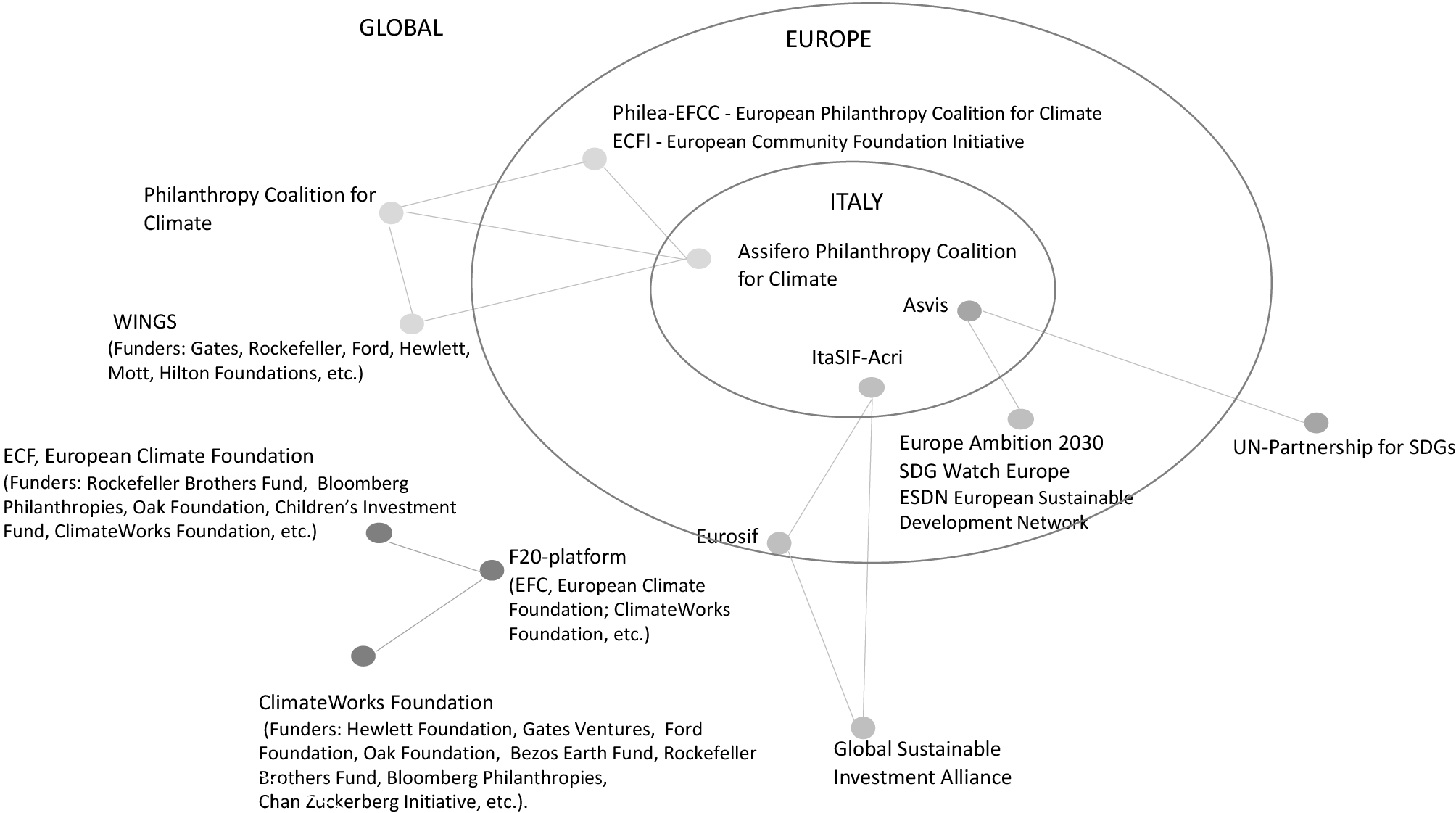
The interconnectedness of the organizations in the various networks, their jointly produced statements, and explicit commitment to concentrating on their points of agreement rather than their points of difference, all characterize the main discursive positions of Italian climate philanthropy.
One principle enshrined in the documents is that of a «just transition» as defined in the European Green Deal: this implies «combining environmental objectives – mitigation and adaptation to climate change, but also the protection of biodiversity and the circular economy – with social objectives – the reduction of inequalities, decent work, social cohesion’»40.
The most distinctive characteristic of all four organized philanthropy networks’ discursive stance is their alignment with the SDG framework and the related sustainable development paradigm. The latter are often viewed as neoliberal variations on the theme of capitalist development because they place maintaining growth before protecting the environment (Gabay, Ilcan, 2017; Weber 2017). Nevertheless, the documents unanimously assert that «the direction identified in 2015 with the adoption of the UN 2030 Agenda and the Paris Agreement is still useful and appropriate»41. Assifero is part of «the national alliance to meet the Agenda 2030 objectives»42 and runs workshops on the SDGs for local community foundations. From its founding in 2017, Platform F20 has been «calling and actively advocating for the implementation of the SDGs and for climate action by the G20 member states»43. Even for specifically climate-related policies, SDGs remain the key framework of reference. ASviS calls on policymakers to «ensure the consistency of all climate policies (…) by adopting the required systemic outlook, as entailed in the mainstreaming of the 2030 Agenda (…)»44. The SDGs have been adopted by ItaSIF as its primary investment criteria because they enable the use of internationally recognized parameters, allowing for both the ex-ante identification and ex-post measurement of outcomes. ItaSIF has even published a handbook for «the finance industry, foundations and third-sector organizations to further explore the role of impact investment in financing SDG-aligned activities that also offer a financial return»45. This policy was confirmed by an interviewee: «in promoting environmental sustainability at the local level, our projects contribute to the pursuit of the SDGs … we have also assimilated the SDGs internally, for example with our suppliers. We have a huge handbook of practices»46.
In addition, ItaSIF is in favour of applying Environmental, Social and Governance (ESG) criteria to financial products and processes. However, there is no shared universal standard for ESGs, as Mariana Mazzucato and Rosie Collington (2023) have aptly observed, meaning that companies are free to select – among the many ESG measurement systems – that most favorable to their practices and/or least detrimental to their other goals, including profitability. And indeed, even if universal metrics were to be adopted, «the climate crisis is so complicated (…) it is unlikely that criteria assessment methods would provide accurate information about the risks companies face in different markets» (Mazzucato, Collington 2023: 223).
The networks also discursively emphasize the need for sustainable finance, again with a view to fulfilling the SDGs47. However, rhetoric aside, how much pressure can foundations put on banks and financial actors to adopt sustainable finance? Consider ItaSIF. Its members include both Acri and some of the country’s major financial players, such as the two largest Italian banks Unicredit and Intesa Sanpaolo (Isp). The latter institution is genetically linked with Acri. «Banking on Climate Chaos» (2023), a study conducted by a coalition of NGOs on the financing of the fossil fuel industry by the world’s largest banks shows that the 60 largest private banks have financed fossil fuels to the tune of $5.5 trillion. The Italian banks Unicredit and Intesa Sanpaolo have respectively underwritten loans worth $43 billion and $22 billion to fossil fuel companies since 2016 and are among the top 40 banking institutions involved in financing the fossil fuel multinationals. ItaSIF’s weakness in this regard was confirmed in an interview with an executive at Banca Etica:
While the Forum was originally driven by good intentions, over time – with the inclusion of a growing number of actors, particularly from the financial sector – it has somewhat lost sight of its original mission. And the current president seems to intend widening the parterre even more (…). Now, many organizations wear the sustainability hat although their activities do not always reflect this48.
A second defining feature of the networks’ rhetoric is the presentation of climate change as an issue that may appropriately be addressed via a pragmatic, strategic, focused, nonpartisan and science-driven strategy. Organized philanthropy has conventionally espoused such strategies, in keeping with a liberal tradition that dates back to the nineteenth century (Mitsushima 2017). Given the high stakes and the limited resources available, the networks advocate a targeted approach to climate change, anticipating that this will maximize the impact of their climate philanthropy and potentially facilitate the measurement of outcomes. This implies that their beneficiaries need to be closely monitored. Formal and informal platforms must coordinate their efforts (i.e., engage in networking). Efforts, including investment in research and communications, to steer the public debate and persuade businesses and investors to commit, is a further component of the strategy49. This may explain why the networks overemphasize problem solving to the detriment of problem setting, and remain at a superficial reading of the problems without questioning the capitalist logics that have given rise to them. Furthermore, the networks’ countless policy proposals tend to list issues without establishing any clear order of priority and are vague when it comes to specifying how the stated objectives are to be attained.
My analysis seems to confirm the hypothesis that within the domain of university and climate policies, foundations act as field-builders as defined by Bartley.
In the discursive dimension, foundations construct and boost the frames they deem appropriate.
Csp’s university policies are best understood within the broader context of the privatization of European public research, a process that began in the 1990s when the international university system was reconceptualized around the principle of «the market as the authentic reality principle of government action itself» (OECD 1995a, 1995b). This shift translated, to varying degrees across the world – and certainly in Italy (from the 2010 Gelmini Reform onwards) and Europe (from the 2008 Bologna Process onwards) – into reforms aimed at aligning education with market demands and transforming public universities into business-like entities (Coin 2011, 2018; de Martin 2017). The university policies discussed here suggest that, with some exceptions, Csp has tended to back this managerial and market-focused master narrative, emphasizing excellence, innovation, competition, effectiveness, efficiency, and impact measurement. These priorities tend to advance the privatization of knowledge at the expense of higher education’s public function. UniTo has participated in this process ob torto collo, a reluctance that is fueled by a number of critical voices from within. In contrast, Csp, as an ‘independent’ private body, has embraced the model voluntarily and, at times, acritically. Overall, these dynamics appear to have marginalized or curtailed the critical and imaginative potential of the social sciences (Mills 1959), which are now largely rewarded when they conform to market-oriented logics. Instead of problematizing this market-driven approach, Csp has adopted it as the guiding framework for its university policies.
The Italian networks on the other hand, in alignment with international philanthropy and the broader global regime, support an agenda that draws on selected dispositives within the mainstream neoliberal paradigm. This stance is informed by the market episteme (McMichael 2009), which emphasizes the role of private actors and financial instruments in development. The environmental crisis is framed as an apolitical issue requiring techno-managerial solutions, while market logics remain dominant. Under this agenda, environmental protection and the liberal economic order are perceived as mutually reinforcing: the prevailing economic system is portrayed not as the primary culprit for the worsening climate crisis, but rather as part of its solution. Philanthrocapitalism, far from diverging from contemporary financial capitalism, actively participates in climate policymaking with an eye toward returns on investment. This approach leaves fundamental issues unaddressed, as it fails to confront the root causes of the climate crisis (Mitchell, Sparke 2016). Overall, a shared discursive stance on climate change response emerges from the networks’ documents. This consensus reflects, in part, the necessity of reconciling the perspectives of different foundations, and in part, the Italian networks’ strong ties with international climate philanthropy. This is not to suggest that individual foundations or individual interventions within Italian climate philanthropy do not sometimes adopt less mainstream or more transformative discursive or practical approaches. However, the dominant uniformity in the networks’ discourses and modes of action, and – often – among individual foundations, underscores the internal homogeneity of the field.
In the relational dimension, foundations wield their influence and disseminate their policies through a diverse range of practices.
In the case of CPS’s university policies, the foundation has established a formal partnertnship with UniTo. Through three-year agreements, Csp funds projects that align with its policy perspectives and plays a recognised strategic and operational role in shaping the University’s policies, including by directly participating in joint committees. Through the Cca, it has established a (predominantly) economics department parallel to UniTo, co-opts staff from the university, attracts international economists, and facilitates their eventual integration into UniTo’s faculty. Additionally, Csp uses stand-alone tenders to fund research, setting both the topics and the project criteria.
In the domain of climate action, foundations forge alliances and networks with philanthropic and non-philanthropic actors at both the national and international levels. These networks advance their agendas by convening conferences or roundtables with political and economic elites (e.g. G7, G20), commissioning or curating in-house studies and position papers to influence policymaking (e.g. ASviS, Itasif, F20-platform), organizing seminars to support grant-seeking or engage their member organizations (e.g. Assifero, Itasif), and undertaking advocacy or formal and informal diplomacy (see Morena 2016).
Drawing on the theoretical paradigm of politicization and depoliticization processes, I have argued that in the two cases examined, foundations and their networks have assumed a political role by taking collective responsibility for climate or university policies (social politicization). However, they have also played a pivotal role in shaping global climate policy agendas from the UN System to the Paris Agreement, as well as the policy agenda of Turin University (governmental politicization). Their relational and discursive activities not only underscore their field-building role in the two domains but also explicity highlight their assumption of a political role at both the social and governmental levels. In the case of university policies, Csp appears more focused on steering decision-making than engaging in dialogue with the university. Meanwhile, philanthropic networks have arguably monopolized the direction of the UNCCC climate agenda and its governance system (Morena 2016). However, both cases reveal a tendency to depoliticise discourse by framing university or climate challenges as problems best addressed through expert-driven, market-oriented solutions. For example, universities are depicted as needing to be competitive, innovative and attractive, while climate issues are tackled through a focus on growth and technological fixes rather than environmental protection. These approaches are presented as optimal, effectively precluding critical (political) debate. In this context, the case of the Cca is particularly illustrative, as it tends to privilege mainstream neoclassical and behavioural orientations in economics, at the expense of other approaches. This framing implies that these perspectives are either the only viable options or inherently superior – another form of depoliticisation.
It is noteworthy how, in both cases, foundations actively support and reinforce hegemonic international frames. This raises the question: where does the innovation they champion truly lie (Barbetta 2008)? Perhaps it would be more pertinent to explore how organized philanthropy is becoming increasingly integrated into the dominant frameworks of the State and international political organizations, albeit under a new, philanthropic guise.
Apajalahti E.L, Temmes A., Lempiälä T. (2018), Incumbent organisations shaping emerging technological fields: cases of solar photovoltaic and electric vehicle charging, in «Technology Analysis & Strategic Management», 30, 1, 44-57.
Arrigoni P. (2024), Élite, filantropia e trasformazioni dello Stato. La Compagnia San Paolo di Torino, Bologna: il Mulino.
Barbetta, G. (2008), Le fondazioni di origine bancaria: dalla nascita per caso all’esercizio della innovazione sociale, in Turati G., Piacenza M., Segre G. (cur.), Patrimoni e scopi. Per un’analisi economica delle fondazioni, Torino: Edizioni Fondazione Giovanni Agnelli.
Bartley, T. (2007), How foundations shape social movements: The construction of an organizational field and the rise of forest certification, in «Social problems», 54, 3, 229–255.
Betsill M., Enrici A., Le Cornu E., Gruby R. (2022), Philanthropic foundations as agents of environmental governance: a research agenda, in «Environmental Politics», 31, 4, 684-705.
Burnham P. (2001), New Labour and the politics of depoliticization, in «British Journal of Politics and International Relations», 3, 2, 127-149.
Burroni L., Ramella F., Trigilia C. (2017), Fondazioni e sviluppo locale, Roma: Donzelli.
Coin F. (2011), L’organizzazione scientifica della ricerca umanistica, in «Archivio di studi urbani e regionali», 101,102, 175-181.
Coin F. (2018), L’inadeguatezza del digital academic, in «Rivista trimestrale di scienza dell’amministrazione», 1, 1, 1-23.
d’Albergo E., Moini G. (2019), Politica e azione pubblica nell’epoca della depoliticizzazione. Attori, pratiche e istituzioni, Roma: Sapienza Università Editrice.
De Martin J. C. (2017), Università futura - tra democrazia e bit, Torino: Codice Edizioni.
Depecker T., Déplaude M.O., Larchet N. (2018), La philanthropie comme investissement. Contribution à l’étude des stratégies de reproduction et de légitimation des élites économiques, in «Politix», 121, 9-27.
Gabay G., Ilcan S. (2017), Leaving No-one Behind? The Politics of Destination in the 2030 Sustainable Development Goals, in «Globalizations», 14 (3), 337-242.
Lefèvre S., Monier A. (2021), Philanthropes en démocratie, Paris: PUF.
Lounsbury M., Ventresca M., Hirsch P.M. (2003), Social movements, field frames and industry emergence, in «Socio-Economic Review», 1, 1, 71-104.
Madénian H. Van Neste S. L. (2023), Philanthropic foundations as urban climate policy entrepreneurs, in «Journal of Urban Affairs», 47, 1, 159-176.
Mazzucato M., Collington R. (2023), Il grande imbroglio. Come le società di consulenza indeboliscono le imprese, infantilizzano i governi e distorcono l’economia, Bari: Laterza.
McMichael P. (2009), Contesting Development: Critical Struggles for Social Change, London: Routledge.
Mills C.W. (1959), The Sociological Imagination, Oxford: Oxford University Press.
Mills C. W. (1940), Situated Actions and Vocabularies of Motive, in «American Sociological Review», 5, 6, 904-913.
Mitchell K., Sparke M. (2016), The New Washington Consensus: Millennial Philanthropy and the Making of Global Market Subjects, in «Antipode», 48, 724-749.
Mitsushima N. (2017), Aménager, subvertir et contester l’ordre électoral: Philanthropie et politique sous la Restauration (1819-1830), in «Genèses», 109, 32-56.
Monier A. (2023), The Mobilization of the Philanthropic Sector for the Climate: A New Engagement?, in Kassiola J., Luke T.W. (eds.), The Palgrave Handbook of Environmental Politics and Theory. Environmental Politics and Theory, London: Palgrave Macmillan.
Morena E. (2016), The price of climate action, London: Palgrave Macmillan.
Mosley J.E, Galaskiewicz, J. (2015), The relationship between philanthropic foundation funding and state-level policy in the era of welfare reform, in «Nonprofit and Voluntary. Sector Quarterly», 44, 6, 1225–1254.
Pierri P. (2019), Filantropia. Attori, caratteristiche e prospettive in Italia, Milano: AIPB.
Ravazzi S. (2016), Philanthropic foundations and local policy-making in the austerity era: Does urban governance matter?, in «Lex Localis»,14, 4, 917-935.
Reckhow S. (2016), More than Patrons: How Foundations Fuel Policy Change and Backlash, in «Political Science & Politics», 49, 3, 449-454.
Skocpol T. (2016), Why Political Scientists Should Study Organized Philanthropy, in «Political Science and Politics», 49, 3, 433-436.
Suarez D.S. (2012), Grant making as advocacy. The emergence of social justice Philanthropy, in «Nonprofit Management & Leadership», 22, 3, 259-280.
Weber H. (2017), Politics of ‘Leaving No One Behind’: Contesting the 2030 Sustainable Development Goals Agenda, in «Globalizations», 14, 3, 1-16.
List of documents on CPS’s university policies
Cca (2017, 2020), Bilanci di missione.
Csp, Rapporti (2007, 2008, 2010, 2014, 2018, 2020)
Csp, Bilanci di missione (2007, 2008, 2010, 2014, 2018, 2020)
Csp, Documento programmatico pluriennale 2019-2021
UniTo-Cca, Convenzione 2019
UniTo-Csp, Convenzione 2010-2012
UniTo-Csp, Convenzione 2013-2015
UniTo-Csp, Convenzione 2016-2018
UniTo-Csp, Convenzione 2019-2021
UniTo-Csp, Convenzione 2022-2024
UniTo-Csp, Rapporto consuntivo 2020
List of documents by the networks of which Italian foundations are members
Assifero, Dichiarazione d’impegno delle fondazioni e degli enti filantropici italiani per il clima, settembre 2021.
Assifero Philea, Wings, WE ACT #PhilanthropyForClimate, Guida pratica di attuazione della dichiarazione d’impegno delle fondazioni e degli enti filantropici italiani per il clima, marzo 2023.
Assifero, Bilancio sociale 2022, 2023
ASviS-gruppo di lavoro finanza, Finanza per lo sviluppo sostenibile. Un tema strategico per l’Agenda 2030, position paper, settembre 2020.
ASviS, Cinque anni di ASviS. Storia di un’alleanza per l’Italia del 2030, febbraio 2021.
ASviS-gruppo di lavoro fondazioni, Fondazioni per lo sviluppo sostenibile, position paper, settembre 2021.
ASviS, La transizione ecologica giusta, quaderno 7, Ottobre 2022.
ASviS-gruppo di lavoro finanza, Finanza per lo sviluppo sostenibile, position paper, gennaio 2023.
ASviS, Dieci proposte sul piano nazionale di adattamento ai cambiamenti climatici, policy brief, marzo 2023.
Forum per la Finanza Sostenibile (con ABI e ANIA), Finanza sostenibile per il rilancio dell’economia, ottobre 2016.
Forum per la finanza sostenibile (con Social Impact Agenda per l’Italia), Impact Investing: la finanza a supporto dell’impatto socio-ambientale, dicembre 2017.
Forum per la Finanza Sostenibile, Lettera al governo con otto proposte sull’utilizzo di strumenti di finanza sostenibile per indirizzare Next Generation EU verso obiettivi di decarbonizzazione e inclusione sociale, ottobre 2020.
Forum per la Finanza Sostenibile, Appello ai partiti per uno sviluppo sostenibile, equo e inclusivo dell’Italia, settembre 2022.
F20, Becoming Part of the Solution, F20 Recommendations 2021 for the G20 and the G7 as part of the G20, June 2021.
F20, Global Cooperation and Responsibility - G7/G20 Becoming Part of the Solution, F20 Recommendations 2022 to the G20 and the G7 as part of the G20, June 2022.
F20, Annual Report 2022, June 2023.
ECFI (con Assifero), The SDGs are good for us, report on workshop, 28-29 June, London
EPCC, Philea, Climate philanthropy networks, 2022.
2 Acri (2023), Ventottesimo Rapporto Annuale, Anno 2022, Roma.
3 For a full list of the documents, see the Appendix.
4 Between October 2021 and April 2023, I conducted 16 interviews on Csp’s university policies, with UniTo lecturers (10) and managers at Csp (6). Between December 2022 and November 2023, I conducted seven interviews on climate policies with executives at Assifero (2), Cariplo (2), FCmessina (1), Banca Etica (1), and Fondazione del Monte di Bologna e Ravenna (1). I carried out more interviews for the first case because it involved more complex policies over a longer time period, and required input from both university stakeholders and foundation representatives.
5 He specifically cites the case of forest certification, a form of governance developed in the 1990s by an international association – the Forest Stewardship Council (Fsc) – as a moderate, market-based alternative to disruptive environmental boycotts, as for example in Amazonia.
6 Interview 1 UniTo, 2021
7 Ibidem.
8 Interview 8 UniTo, 2021
9 Bilancio di missione Cca, 2007
10 The data available online in the Cca’s mission reports from 2006 to 2017 indicate that for each year at least three quarters of the College’s financial resources come from the Csp.
11 Convenzione UniTo-Cca 2019
12 Interview 9 UniTo, 2021
13 Interview 2 Cca-Csp, 2022
14 Interview 10 UniTo, 2022
15 Interview 2 UniTo, 2022
16 Interview 3 Csp, 2022
17 Interview 9 UniTo, 2022
18 Interview 2 Csp, 2022
19 Interview 1 Cca-Csp, 2022
20 Interview 9 UniTo, 2022
21 Interview 8 UniTo, 2021
22 Interview 4 Csp, 2021
23 Interview 9 UniTo, 2021
24 Interview 8 UniTo, 2021.
25 Documento programmatico pluriennale 2019-2021, Csp and UniTo.
26 Ibidem.
27 Rapporto consuntivo Csp-UniTo, 2020.
28 2010-2012 Agreement.
29 Interview 7 UniTo, 2021.
30 Interview 3 UniTo, 2022.
31 Interview 5 Csp, 2022.
32 Interview 10 UniTo-Cca, 2022.
33 Interview 6 Csp-Cca, 2022.
34 A foundation of the UnipolSai Italian insurance group.
35 A foundation set up by Manageritalia and CIDA, two organizations representing Italian management executives.
36 ASviS website, accessed 16 March 2023.
37 Ibidem.
38 It receives funding from, among others, the Gates, Rockefeller, Ford, Hewlett, Mott, Aga Khan, and Hilton Foundations.
39 Acri website, accessed 15 November 2023.
40 ItaSIF (2022), p.2.
41 ASviS (2022), p.5.
42 Făgăraș (2023), European community foundations and SDGs, p.27.
43 F20 (2023), p.2.
44 ASviS (2023b), p.4.
45 ItaSIF (2017), p.1.
46 Interview with Cariplo executive, December 2022.
47 ASviS (2023a).
48 Interview with Banca Etica executive, November 2023.
49 ASviS (2021), position paper; Assifero (2023), Bilancio sociale.