Focus Section
How to contrast anti-migrant racism? Nurturing reflexivity through a collective analysis of solidarity practices at the urban level
Università degli Studi di Padova, Italia
Email: annalisa.frisina@gmail.com
Abstract. This article presents an innovative research experience based on a method Collective Analysis of Practices (CAoP) used in Venezuela among sociologists engaged in social movements. This method travelled to Padova (thanks to a refugee-researcher) and our proposal is to explore how to contrast anti-migrant racism at the urban level learning from solidarity practices shared through a collective reflexive work. Moreover, we propose to rethink (internal) border struggles in relation to the emergence of political antiracism in Italy. The article starts introducing our theoretical background, connecting migration and urban studies for a renewed focus on the legacies of colonialism and on the relevance of race and (anti)racism. Then we reconstruct our empirical context, showing continuities and changes in Padova’s antiracist political activism. After a presentation of the different phases of the method, we discuss the most interesting issues that emerged: the dilemmas of solidarity facing welfare racism; the limits and potentialities of antiracist practices according to different positionalities; and the need to further coordinate antiracist everyday practices at the urban level, going beyond reactive convergences tied to racist border violence and building together long-term strategies of socio-political change. Our CAoP in Padova showed the importance of building antiracist places and self-aware communities of resistance to counteract a political and economic system that does not care about collective needs, reproduce a migrant-native divide through the rhetoric of zero-sum game of rights and seems to respond only to the imperative of capital accumulation in an increasingly violent way.
Keywords: anti-migrant racism, cities, antiracism, collective reflexivity, welfare, urban capitalism.
Index
Why race and (anti)racism matter in migration and urban studies
Reconstructing Padova’s antiracist political activism
Collective analysis of practices: nurturing collective reflexivity
Gathering data, collective analysis and synthesis
Solidarity practices in the frame of welfare racism
«Before working on borders, I experienced them»
«We are not a network, or are we?»
Claiming the right to stay together in the city
Why race and (anti)racism matter in migration and urban studies
The politics of borders is linked to global systems of power and repression which have their roots in slavery, colonialism and racial capitalism. From the theoretical perspective of border imperialism (Walia 2013), capitalist extractivism, displacement, border fortification, criminalization of migrants, the expansion of detention centers for undocumented migrants, racialized hierarchies of citizenship and migrant labor exploitation are all connected. Borders are apparatuses of state violence, they function as instruments of segregation, exploitation, surveillance, punishment and differential inclusion (Mezzadra, Neilson 2014). People are classified as migrant or refugee not because they represent homogeneous social groups, but because of state-regulated relations of governance and difference (Walia 2021: 2). Borders operate as technologies of rule that maintain and naturalize imperialist relations of domination.
According to Mayblin and Turner (2021) migration studies should delink from ‘state science’ and methodological nationalism (Wimmer, Glick Schiller 2002)2, renewing focus on the legacies of colonialism in contemporary power relations and particularly on the continued relevance of race and racism. Global capitalism is inherently shaped by colonial and racial logics and this continues to structure mobility.
The very construction of the notion of ‘migration’ and the political processes that are involved in making someone a ‘migrant’ (borders, immigration regimes, etc.) are fundamentally colonial. Equally, ideas about human worth and cultural difference that shape current debates about migration are fundamentally tied to the invention of race under empire (Mayblin, Turner 2021: 76).
The colonial border was about containment and about forced mobility: indigenous workers could be seen as an economic necessity within the evolving dictates of imperial capitalism and a social risk. Internal and external borders were created to control racialized workers and «racial threats» (Ibid., 70).
At the heart of the European project – not just through formal imperialism – lies a history of racial violence that continues to be obscured.
Racialized violence is not always spectacle but technocratic, structural and administrated- enacted, for example, through regimes of waiting in detention centres and refugee camps, housing and labour policies, resettlement schemes, deportation mechanism, integration strategies and the inclusion/exclusions of the welfare state or in social work practice. The mundanity of violence and its technicality don’t stop it being arranged by understandings of race (Ibidem: 73).
The legacy of colonialism is present also in the banal reproduction of racial understanding of belonging, nationhood and culture, which are central to discourses on migration and shape everyday experiences of migrants.
There is frankly no way to understand migration in the contemporary world without a critical sensitivity to the central and constitutive role of racialization and the long pernicious legacies of colonial and postcolonial racism. There is, in other words, no adequate way to comprehend contemporary migration processes outside a critical analysis of a global/postcolonial socio-political order that has been consolidated through a centuries-long global regime of white supremacy (De Genova 2024: 274).
According to Fauser (2024), bordering is a crucial mechanism of ordering and othering that demarcates the social order of belonging. Recognizing the city as a border space means discussing how the racially unmarked, whose presence is legitimated, are differentiated from the racialized, marked as others, at the urban scale. Migration control is enforced through legal-administrative categorizations that intertwine migrant and residence status with stratified access to rights. For instance, in Italy Gargiulo (2024) showed how municipal registration is used as a selective device which reproduces social and racial hierarchies, preventing people considered undeserving from being fully autonomous in a legal and material sense.
Internal border control in Italy is largely entrusted to the police. As Fabini (2022) has shown, the police have broad discretional powers to control people on the streets. In the 2024 UN report (EMLER)3, racial profiling in Italy is defined as a ‘systematic and harmful practice’ that is rarely reported due to the intimidating behaviour of law enforcement agencies. Only thanks to the efforts of ASGI (Association for Juridical Studies on Immigration) and other civil society organisations4, this is emerging as an issue that can no longer be ignored5. The phenomenon of racial profiling becomes more widespread the more the police are politically encouraged to stop and search people who are “suspected” of being a threat to public order (i.e. people racialized as non-white), in particular areas of the city (such as the “red zones” instituted at the end of 2024 by the government led by G. Meloni’s neo-fascist party6).
“555,181 people have been monitored since the establishment of red zones, urban areas identified to counter situations of decay and illegality more effectively. Of the 4,122 expulsion orders issued against individuals with criminal records and dangerous individuals, 3,073 – equal to 74.5% – concern the foreign citizens” (Minister of the Interior, Piantedosi, 14 May 20257).
Not only migration studies, but also urban studies, especially in Europe, need to elaborate the relevance of colonial legacy, race and racism. According to Montalva Barba (2024: 151-152), racism is embedded in urban theorization: race is hidden and whiteness is the «unspoken norm or marker of normalcy in urban theorizing». Whiteness (as a standpoint of structural advantage) is ignored; race is assumed irrelevant or reduced to class matters, but it shapes the everyday. Race (as a historical and sociopolitical category) is inseparable from «conceptions of the city» and its «social problems».
Du Bois was a pioneer in urban sociology (too), but he suffered an «epistemic apartheid» as a Black scholar (Morris 2015). His approach emphasized the «social and spatial production of race as defining characteristic of cities» (Loughran 2025: 206). Du Bois’s theory can give important insights to study of the «urban question» (Brenner 2000), i.e. the role of cities as «sociospatial arenas» where the contradictions of capitalism are continually produced and fought out. For Du Bois, «economic forces were not operating independently of racial logics but bound together in tandem: urban space was racialized» (Loughram 2025: 210). In his view, not only were social spaces racialized, but also race was spatialized. In other words, urban spaces «helped discipline people to their racial identities» and trained the white gaze to see people racialized as not white as a «homogeneous mass», «identified with crime, vice and underdevelopment» (Ibidem: 211). However, Du Bois hoped in the transformative potential of cities, especially for people fleeing racial oppression (Ibidem: 213).
Ha and Picker (2022: 1) invite us to rethink the European urban, exploring «the role played by five centuries of circulation between colonies and metropoles of technologies of governance, wealth, knowledge and affect». Developmentalist and Eurocentric readings of European cities are pervasive, due to «lack of reflexivity in producing knowledge from the European ‘centre’» (Ibidem: 10). Studying the «fundamental ordering function» that race plays in urban processes across Europe (Ibidem: 15) could help us to better understand the nexus between the presence of ‘migrants’ in Europe and the coloniality of the present; the Othering process of migrants imagined as outsiders of white and Christian Europe; racial segregation in European cities and the rhetoric of “decay” of urban districts where they live.
European cities are not only commodified infrastructure «for globalized financial and tourist industries», but also spaces of «self-organization, of self-determination and of resistance against institutional discrimination, state violence and capitalist exploitation» (Ibidem: 21). Racial injustice and struggles for racial justice routinely occur not only at Europe’s borders, but in its urban centres too. According to De Genova (2015) border struggles are dislocated and re-scaled as urban struggles. In cities, border enforcement has illegalized an increasing number of migrants, who are often subject to extraordinary policing, surveillance and raids. Disposability, deportability and premature (social) death must be understood in relation to various spatializations of racial state violence against people «who are likewise very commonly racialized as ‘ethnically’, ‘culturally’ or ‘religiously’ inassimilable and inimical to the presumptive ‘national’ identity of the destination country» (De Genova 2024: 274). Today «routine border authoritarianism» tied to white nationalism fuels «full-spectrum right-wing political authoritarianism» (De Genova 2025).
According to Alietti (2024: 9), the contemporary city seems made up of ‘interrupted spaces’, in contradiction with the idea of urbanity as ‘encounter between differences’. On the one hand, the hegemony of neoliberalism increases social and racial inequalities, and the close connection between political powers and economic elites (local, national and supranational) gives rise to «authoritarian cities» (Ibidem: 31-33). On the other hand, there continue to be experiences of struggle (i.e. against gentrification, overtourism and securitarianism) that are present especially in working-class and racialized neighbourhoods: forms of mutual aid, squatting, and self-management of cultural spaces and social services. In these experiences of daily urban struggle, important alliances are formed for increasingly intersectional struggles.
After discussing why colonial legacy, race and racism matter in migration studies and in (European) urban studies, we argue that it is important to draw connections between border struggles and antiracism. Keskinen, Atabong Alemnji and Sekkula (2024: 5-6) showed that the (b)ordering of Europe is «a central way to control mobility and settlement, but also to secure the racial order and hegemony of whiteness», because «the logic of bordering and the logic of ordering into racial and class hierarchies are in many ways intertwined processes». Our focus on internal (b)ordering and urban antiracism allows us to analytically connect local struggles against racism and border regimes to global power structures. We are interested in the disobedient knowledge (Ibidem: 8-13) generated by people categorized as migrants or ‘not white’/ ‘not belonging to Europe/Italy’ (imagined as white), together with their supporters/allies in contemporary society.
Disobedient knowledge is part of resistance created in action (Hardt, Negri 2004) and we will discuss the importance of listening to and learning from the political subjectivities of those targeted by racism. In a political and economic system that cares less and less about collective needs and fuels divisions between migrants and natives through the rhetoric of zero-sum rights, it becomes essential to build anti-racist spaces. Our research shows how CAoP can contribute to the construction of disobedient knowledge and self-critical communities capable of addressing the current democratic crisis.
In this first section we have introduced our theoretical background, connecting migration and urban studies for a renewed focus on the legacies of colonialism and on the relevance of race and (anti)racism. In the following sections, we will discuss our research, starting from the presentation of our empirical context and showing the importance of temporality for understanding continuities and changes in Padova’s antiracist activism. Then, we will present our methodology inspired by an activist-research experience from Abya Yala8 (Latin America), aimed at nurturing the reflexivity of civil society actors (CSAs), broadly defined as formal and informal social institutions that may be more or less professionalised (Bonizzoni, Hajer 2023). Thanks to a collective analysis of solidarity and antiracist practices in Padova, we will show the dilemmas of solidarity facing welfare state racism; the limits and potentialities of antiracist practices according to different positionalities of activists (and researchers); and the need to better/further coordinate antiracist everyday practices at the urban level, going beyond the reactive convergences tied to racist border violence and building together long-term strategies of socio-political change. Finally, we will discuss the importance of multiplying anti-racist spaces in European cities, where the political subjectivity of racialised people as non-white is recognised and where it is possible to build knowledge and practices of resistance together with their allies, reflectively and self-critically.
Reconstructing Padova’s antiracist political activism
Padova is a medium-sized city9 with a large university10 (Savino et al. 2024) in the wealthy north-east of Italy. It has a history of political activism and disobedience, particularly since the 1970s with autonomist collectives, occupied social centres, student movements and one of the first independent radio stations in the north-east of Italy linked to political movements. The political and criminal repression of the late seventies, the arrests in Padova and the so-called Processo 7 aprile (Casarini 2009; Despali, Despali 2020) led to a lull in political activism in the city in the early eighties, which was re-ignited in the late eighties and early nineties. Regarding antiracism and solidarity for migrants, since the 1990s there has been a wide range of CSAs in the city engaging on issues such as housing, immigration bureaucracy, labour conditions and challenging other bordering processes that take place in everyday situations (Keskinen et al. 2024, 8). In this paper we focus above all on antiracist and antifascist grassroots CSAs that act independently from national and local governments or political parties and are largely self-funded such as collectives, comitati, grassroots unions and associations11. These actors engage in direct social actions, that is,
actions that do not primarily focus on claiming something from the state or other power holders, but that instead focus on directly transforming some specific aspects of society by means of the very action itself (Zamponi 2024: 2).
The direct social actions adopted by these actors are less visible than protest actions but represent «a significant part of the repertoire of contention» (Bosi, Zamponi 2015: 369). In the context of migrant solidarity these actions include social/legal information/help desks, occupation of buildings, Italian language courses, food distribution, after school clubs and sports activities, monitoring/denouncing bordering practices both within the urban space of Padova and at various external borders. Whilst some of these actions may traditionally be considered as «not political», they are a form of repoliticization rooted in the «reinvention of the social» (Raffini, Pirni 2019: 29).
Networks of solidarity often draw on sedimented practices and knowledges (Tazzioli, Walters 2019; Zamponi 2024), hence the importance of recording «counter histories» in order to bring the dimension of temporality to the study of solidarity. It is not easy to map a history of grassroots migration solidarity actors, for certain spaces of solidarity are ephemeral (Tazzioli, Walters 2019) and the political and police repression of activists and migrants leads to their often working under the radar and the destruction of material records to avoid potential repercussions (Wright 2021). Historically anticapitalist critique in Padova has been linked to autonomism and White/Eurocentric Marxism (Mellino, Pomella 2020), and on an international level in the early 1990s through international exchange with the Zapatistas (EZLN) in Abya Yala. In more recent years, reflections on Black Marxism and racial capitalism have emerged. In this section we provide a brief genealogy of grassroots practices that have characterised migrant solidarity in Padova, drawing on some of these actors’ written accounts, interviews and their self-narration during the workshop of analysis of collective practices.
At the core of the practices of political collectives seeking social transformation in the 1970s in Padova was the approach of the «inchiesta operaia», which entailed finding a way to establish a relationship with the subjectivities to engage with in order to build the pathway for co-organisation for social transformation (Wright 2021)12. The focus was on the operaio, the worker, and leafleting outside factories was a strategy for making contact. The transformation of the city and the housing situation due to the growing student presence was a further area of interest to the political collectives in the 80s (Ibidem).
Migrant solidarity activities in Italy began in the late 1980s and early 1990s with key events being the arrival of the Vlora ship in Italy with around 20,000 Albanians on board in August 1991 and the war in ex-Yugoslavia (Colucci 2018)13. In 1992-3, Roma, Serbians and Kosovans arrived in Padova and established informal makeshift camps. They were supported in two key struggles by antiracist solidarity actors RazzismoStop: getting recognition as refugees displaced by war and in resettlement from the makeshift camps to solutions negotiated with the local authorities (Zambon, De Marchi 2024)14. The increasing presence of migrants in the city and the bordering practices enacted by official schools of Italian (rising costs, requiring formal documents) led to the setting up of one of the first grassroots Italian schools run by activists in the Veneto region in 1993. Based on principles of gratuità (free of charge) and accessibility, meaning that no formal documents, registration or payment was required, this became a model for similar schools in other cities in the region such as Mestre and Treviso (Bottazzo 2011). These schools were not established merely to provide a response to a concrete need, but also served as a contact point, a way of establishing relations with migrants, to better understand their conditions, and to be able to intervene politically for social transformation (Bottazzo 2011; Zambon, De Marchi 2024 ).
The establishment of sportelli15 has been a key part of the «repertoire of contention» put in practice by migrant solidarity actors in Padova. One significant information desk was set up in the Serenissima housing complex on via Anelli in 1999. Originally built for students in the 1970s, the complex fell into disrepair in the 1990s, leading to an influx of over 1,000 migrant workers and families who had been struggling to find accommodation (Vianello 2006; Mantovan, Sbraccia, Vianello 2011). In response to escalating conflicts, an assemblea was called by RazzismoStop, leading to the creation of the Comitato per il superamento del ghetto di via Anelli. The committee established an information desk in an intermodal container and later acquired a flat to maintain a daily presence and support a re-housing program. Despite tensions with city authorities, including the mayor’s controversial decision to build a wall isolating via Anelli, the help desk and committee remained active until 2005, advocating for alternative housing solutions (Faiella, Mantovan 2011; Zambon, De Marchi 2024).
The anti-racist and housing struggles and the contacts made with migrants in the city through RazzismoStop fed into the establishment of the grassroots trade union16 Associazione Diritti Lavoratori (ADL) Cobas, which adopts conflictual forms of struggle such as strikes, blockades and lawsuits against companies17. Through investigations and information acquired through its delegates it is able to uncover and challenge illegal employment practices, exploitation and gangmastering (Benvegnù et al. 2018). The majority of its delegates are currently migrant workers whom they support not merely in relation to labour but also through help desks for problems related to documents, housing, health, residence permits, family unifications.
Squats have a long tradition in Italy and have been used by asylum seekers and migrants and solidarity actors serving both social and political functions, and have been framed as «educational sites of resistance» (Caciagli 2019: 730). Following the temporary occupation of RazzismoStop’s Italian school by over fifty African migrants in 2013, the empty premises of an insurance company not far from the station was occupied18 with the support of RazzismoStop for over 4 years, under the name of Casa dei Diritti Don Gallo19. This informal settlement was by no means the first occupation by migrants and solidarity actors in the city, nor the most long-standing but it was one of the largest and most visible (Medici Senza Frontiere 2016). From being a housing solution, it also became a reference point for people in transit, and activists provided social/legal support and dichiarazione di ospitalità (declaration of hospitality)20.
The so-called “long summer of migration” in 2015 and the new scenario this represented in terms of the governance of migration marked a significant turn in migrant solidarity in the city and surrounding area (see Farina, Firouzi Tabar in this volume). The setting up of “asylum centres”21, led to mobilisations of solidarity actors with asylum seekers and detained migrants22, denouncing the authorities and the cooperative running these centres. Self-organized spaces and collectives of researchers, students and activists such as Bios Lab23 and the project Sconfinamenti monitored the operating of these centres, sought to build relations with the asylum seekers hosted in these spaces, and provided support through a legal desk (Vis a Vis) (Firouzi Tabar 2019). In addition to monitoring and denouncing migration governance and bordering practices within the city, migrant solidarity activists monitor racist violence and human rights violations at external borders24.
In the 2000s, anti-racist sports and after school clubs also became significant forms of direct action and engaging with migrants. Associations in different areas of the city were established, using sport as a tool to bring people together and destigmatize neighbourhoods through not only sporting activities but also after school clubs, Italian school, food distribution, cultural events25.
The relations built through the initiatives outlined above have allowed solidarity actors in the city to uncover and denounce violations of asylum seekers and migrants’ rights by institutional and non-institutional actors. These include individuals and professionals charging asylum seekers and migrants for (what should be) free documents such as declarations of hospitality and other papers needed to be “regularized”26 (Bonizzoni 2016). Relations of trust and support are built also through acts of «civil disobedience», such as solidarity hires or hosting (that is employing or hosting an undocumented migrant – even just on paper – in order to regularise them), which Bonizzoni and Hajer define as a form of «morally justified protest» that includes transgressing certain legal norms (Bonizzoni, Hajer 2023).
Collective analysis of practices: nurturing collective reflexivity
Collective Analysis of Practices (Análisis Colectivo de las Prácticas, CAoP) was born as a methodological proposal in Abya Yala, specifically in Venezuela27, in the 1980s and is the result of the socio-cultural promotion work of educators, pedagogues, and activists of the association «Churuata»28. In a context characterized by neo-liberal hegemony, this group nevertheless organise themselves and resist latifundialism, against the lack of space for political participation, the loss of democratic freedoms and the strong social exclusion experienced in the country. CAoP is an alternative approach to knowledge production, emphasising the «we» in the construction of shared visions of collective experiences, narrating and analysing from embodied experience, organization and solidarity (Peralta 1994: 8). It thus generates spaces of participation for reflection, debate and the elaboration of proposals for social transformation.
Guided by the tradition of the pedagogical and andragogical29 processes typical of Freirean popular education, CAoP is a dialogical, horizontal form of education, where «no one educates anyone, not even himself: people educate themselves in communion, through the mediation of the world» (Freire 2005: 89). In this methodology, which is used primarily with adults, andragogy plays a fundamental role as an educational approach. Following Ramírez Díaz (2016: 25), andragogy posits that the learner is independent and self-directed, their life experience is an important source of learning, the problems discussed stem from the specific context, the learning content is related to what the learner needs to know, and knowledge construction is not through unidirectional transmission but through a dialogical process. Principles for the implementation of the CAoP methodology are «tres mutuos» (three reciprocities) which are Conocimiento mutuo (mutual recognition), Respeto mutuo (mutual respect) and Apoyo mutuo (mutual support). The aims are to promote a sense of interdependence, synergy and to consolidate collectives (Peralta 1994: 37).
The CAoP takes place in workshops that can last several hours or days, depending on the needs of the group, their objectives, and logistical constraints. In this case, the implementation of the methodology was part of an academic investigation that included prior work involving individual interviews and ethnography with various social organizations and activists in solidarity with migrants (Farina, Firouzi Tabar in this volume). A proposal was then presented to them for a collective meeting to share experiences and reflections on their solidarity practices. The workshop is seen as a collective space where «a joint analysis of everyone’s practices is carried out» (Peralta 1994: 17). Before the workshop, a ‘methodological orientation group’ is formed, consisting of a rapporteur and others who will document the debates at each working table (following a training session if needed). After an initial plenary session in which the objectives of the workshop are presented, the methodology is briefly explained and the participants introduced. The activity unfolds in three main phases: gathering data, analysis and synthesis.
We approach Activist Research (AvR) as a methodological perspective because it allows us to recognize our positions and links with activism while we do fieldwork. Following Martínez (2025), AvR «is not a research method but a methodological approach that entails a toolbox of research, as well as collaborative and action methods» (Martínez 2025: 843). The CAoP is part of this toolbox of research. This method stems from a long tradition of pioneering initiatives from the global south in education, local development,feminist and anti-racist social movements. We work with the CAoP to facilitate the exchange and sharing of solidarity practices by those CSAs who are actively engaged in Padova, to nurture a collective reflexivity on the nexus of both migration and racism and solidarity and antiracism. In epistemological terms, we want to remain vigilant by engaging in an exercise of reflexivity regarding theoretical approaches to migration and the preconceptions we start with as researchers. «The key criticism was that migration studies, for too long, had not reflected on the ways in which migration research itself co-produces the phenomena it describes» (Muller 2025: 470). CAoP was an opportunity to do research together, share and give value to experiences of solidarity and collectively reflect on the potential and limits of antiracist solidarity practices in Padova30. AvR allows us to consider activists and volunteers as «producers of knowledge, not just informants for scientists or passive recipients of data, reports, and scientific publications. Activists can raise important research questions that can guide academics» (Martínez 2025: 844). We invited anti-racist and solidarity activists from organizations such as Open Your Borders, Catai, the ADL Cobas union, Caritas, Quadrato Meticcio, and Open Gates (see Appendix for information on these). We created two mixed groups to ensure a balanced presence of all participating organizations. One group consisted of six people and a second of five. In total, there were seven women (aged between 20 and 60 ) and four men (aged between 20 and 42). In terms of legal status, two identified themselves as having a migrant or refugee background from Albania and Venezuela and another from Iran was raised in Italy since childhood but still did not have Italian citizenship. All the CSAs offer initiatives such as Italian language school, sport practices, food donation and support and social-legal orientation helpdesks (Farina, Firouzi Tabar in this volume) for people, mostly migrants and refugees, racialized as non-white, in vulnerable situations in the Padova area.
The aims of the CAoP were:
– For participating CSAs to reflect on their solidarity practices
– To promote an exchange of experiences amongst different solidarity actors in Padova
– To analyse the critical nodes of reception practices in the territory
– To share good practices and knowledge of the antiracist and solidarity activists in the city and their role in/for the city’s reception policies
The questions guiding our collective discussion and analysis were:
– What are the consequences of European and Italian migration policies for solidarity practices in Padova?
– What actions are taken to combat discrimination and institutional violence?
– How is structural racism addressed at city level?
– What actions have been or could be effective? What results have they had or could they have over time?
Gathering data, collective analysis and synthesis
In the first phase, the basic guidelines are to keep in mind the objectives of the starting questions and the proposed theme and to «highlight the importance of practice as a factor in the construction of collective thinking, the importance of listening to each experience» (Peralta 1994: 18). Workshop facilitators emphasised the importance that participants promote respect for the right to speak, always base opinions and debate on actual practice, and avoid interruptions and the devaluation or dismissal of other experiences, organisations or people.
Participants were asked to reflect out loud starting from simple generative questions about their solidarity and anti-racism practices as volunteers, social workers, activists or union members: « What am I doing? Since when? With whom? Where? How? Main results? Main difficulties?» (Peralt: 1994: 19). Participant interventions were written on a large sheet of paper by the trained «scribes»31 and were then displayed on the walls, where all participants could see. As suggested by Peralta (1994), they remained there as a working tool and framework for the exchange of experiences.
Each participant shared their experience with the others, who listened carefully. Only once an intervention was over could the other participants ask questions, check whether what was written on the sheets corresponded to what was said and, if not, make the necessary changes.
Participants then indicated the ideas they found interesting for discussion. After this validation process, the information that was written as part of a first cycle was coded with letters or numbers32 to organise it for analysis, which was the second moment or cycle of the workshop. Following Saldaña (2009: 3), «a code in qualitative inquiry is most often a word or short phrase that symbolically assigns a summative, salient, essence-capturing, and/or evocative attribute for a portion of language-based or visual data».
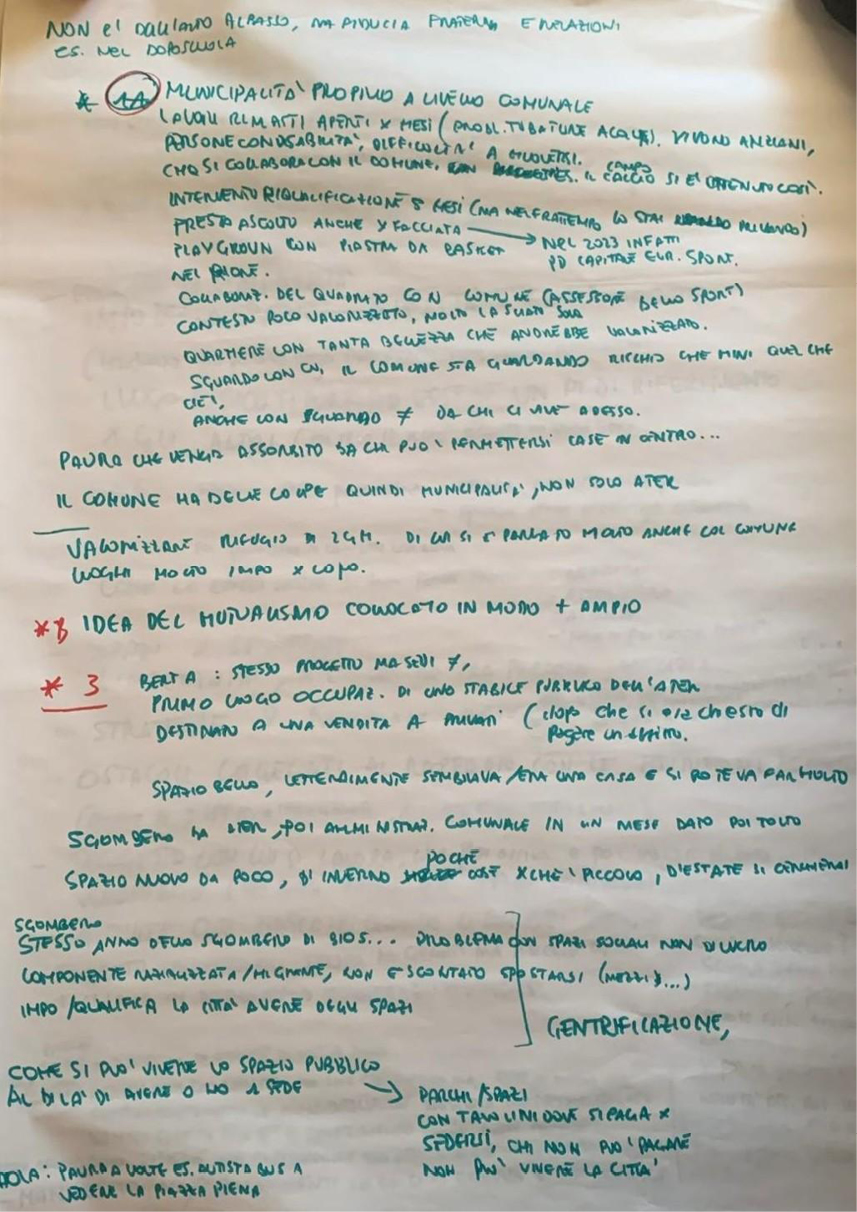
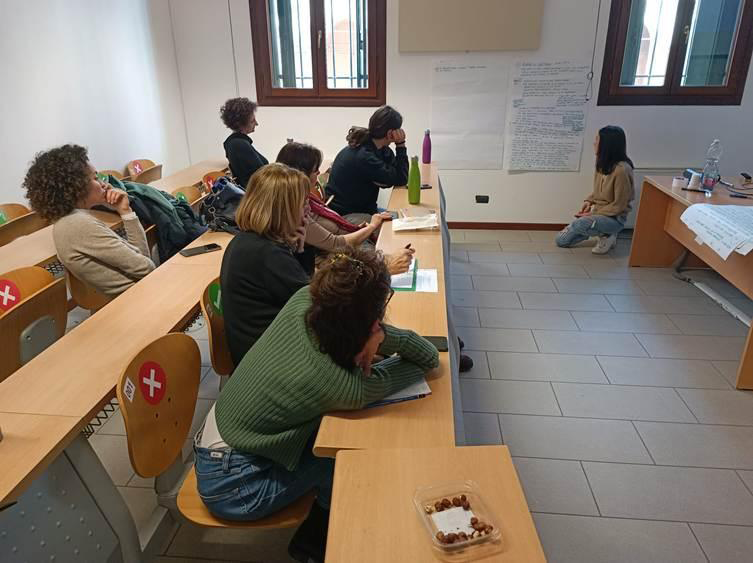
Once the data was written and coded, it was read to the group by the mediator who asked if they considered these ideas fundamental. Some minor modifications were suggested by the group when ideas had not been properly written down or slightly misunderstood. A summary was prepared to read out in the plenary session and discuss with the other group.
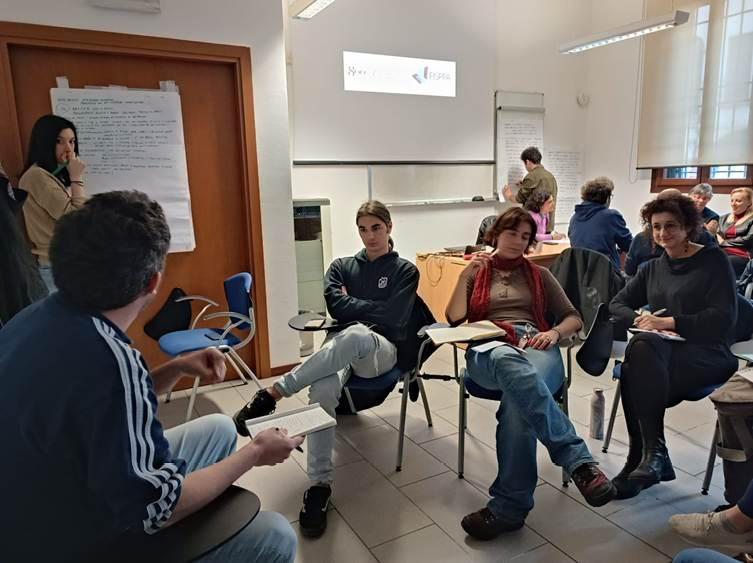
After the analysis, the group discussed the resulting synthesis starting from what the facilitator wrote following participants’ suggestions. Each of the ideas and proposals for action presented in the synthesis had to be approved by consensus for the collective to recognise the result as its own. In this process it is possible that consensus is reached on some ideas, but it is also possible to identify disagreements that cannot be resolved within the debate and that remain outstanding as ideas to be discussed in the future.
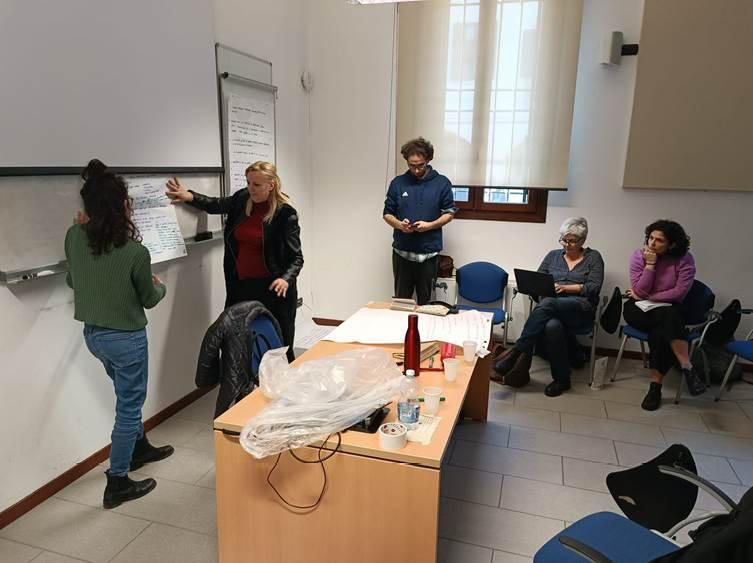
We see how at the different moments of coding during the workshop, which Saldaña (2009) identifies as the first and second cycle33, together with the participants we agreed on how to organize the data written on the sheets according to the topic addressed, who said it (pseudonym and organization) to then reorganize it as a collective synthesis to be presented in the final plenary.
As part of the issues that emerged from the initial questions and participants’ reflections, we have selected some that we consider relevant to our theoretical focus on the topics of racism, migration, solidarity, and anti-racism.
Solidarity practices in the frame of welfare racism
Right from the start, those who participated in the collective analysis of practices clarified that their commitment had become necessary to fill the gaps left by the government. Legal helpdesks, those «for filling out the SPID», «Italian language courses,» and other initiatives were considered «essential activities» that institutions did not offer. The reflection arising from the collective analysis highlighted the limits of this daily commitment and the need to keep in mind the broader political frame to consciously orient oneself in direct actions and not get trapped in emergency logics.
O. (Stria/Open Gates) In 2018/2019, there was a cut in investment in reception and people were coming for social and health issues. Then the decree required registration with the registry office, so we organised meetings at the help desk; Padova was the first city where the mayor signed the registration of an applicant. A widespread practice today is for prefectures to delay admission to reception centres, disregarding national and European regulations. There are more than a hundred people on the streets waiting without a reception facility. Migrants are living on the streets! When they turn to municipal facilities, they are turned away because they are supposedly under the jurisdiction of the prefecture (…). It is the system that slows down entry into the reception system
M. (ADL Cobas) Yes, we see that too. People come to us to eat because they have no alternative; we see this limbo (…). We also send letters to the police headquarters and the prefecture asking for explanations… because it is a right!
All those involved in the discussion, even those historically less politicized, such as the local Caritas, recognised that these are structural problems. It is therefore important to place the critical issues that emerged with regard to solidarity and anti-racist practices within an interpretative framework that highlights institutional racism.
Anti-migrant racism produces divided spaces which reinforce the naturalization of the binaries of State thought, such as the legitimated presence of (white) Italian citizens vs the illegitimated presence of “foreigners” in the city. As Perocco argued (2022: 289), with its «pedagogy of precariousness» welfare racism is a weapon against the rooting of migrants and a tool to gather political consensus among “the native population”. Anti-migrant racism divides the working class and introduces new stratifications for the «differential exploitation of work».
Welfare racism is part of a «wider system of subjugation of immigrants and the inequality that structurally affects them» (Ibidem: 261). Perocco underlined the importance of the combined action of the labour market, mass media and the legal system. In the long process of «precarization and criminalization of immigrants», there are (among other institutional discrimination at the level of the regions and of the municipalities) three national laws which mark Italian welfare racism: law 189/2002 (the so-called “Bossi-Fini Law”) which binds work, residence permit and dwelling (Ibidem: 267); the legislative decrees of the 2008 “Security Package” and law 132/2018 (the so-called “Security decree”), generating increased illegalization and criminalization. Moreover, the emergency-based model of the reception system progressively worsened the material conditions of refugees and asylum seekers. Municipal residence became very difficult to obtain, blocking any form of «social rooting» and «delivering people to the labour market on their knees, forced to accept the unacceptable» (Ibidem: 281). Welfare racism is legitimized by racialized welfare discourses: at all levels of public administration, the corollaries of the mantra “Italians first”34 are the representation of migrants as “parasites” and the naturalization of the lack of public resources for welfare.
A recent research study (Asgi-Centro Medì 2023) showed how this logic of suspicion is tied to racial discrimination. For example, many regional and local council regulations have introduced a requirement of «planetary non-ownership», i.e. demonstrating that you do not own any property anywhere in the world.
As commented by the Constitutional Court, this is a burdensome and unreasonable constraint. On the one hand, there is the practical impossibility of obtaining and presenting documents from countries of origin certifying non-ownership of property. On the other, (…) for Italian citizens only a self-declaration is required, whereas foreigners are obliged to present evidence and formal inspections (Ibidem: 104).
These extra requirements reproduce a political message of safeguarding and protecting “Italian citizens” against competition from immigrants for public resources. Today, this has become one of the most important sources of tension between “natives and foreigners”, fueled by a decade of policies of local exclusion.
Local exclusion policies have especially targeted asylum seekers and the establishment of reception centres around the country (…). There are nationalist arguments: stand up for national citizens rather than spending public money to welcome refugees. Then security topics, presented as defending public order and prevention of health risks (…). On other occasions, mayors have even resorted to bureaucratic arguments (Ibidem: 44).
The role of municipal racism is crucial. Against rooting and inclusion, municipalities use residence as a weapon for local racist policies (Gargiulo 2024). Municipal resolutions and mayoral ordinances are particularly widespread in Northern Italy, especially where the local government is of the Lega party. The representation of white working class resentment against a supposed “migrants’ preferential treatment” is fueled by orchestrated “local revolts” by far-right militants, with the complicity of (local) media. Welfare chauvinism (Gargiulo, Morlicchio, Tuorto 2024) for the (few) deserving is intertwined with political choices dictated by decades of neoliberalism and marketization of services now considered commodities and no longer social rights. On the one hand, we are witnessing widespread institutional abdication of responsibility, while on the other, individuals are being held responsible and must prove themselves worthy.
Racial discrimination in Italy has been reported by international bodies on several occasions, but to date Italian society has struggled to address the issue, in the absence of institutional support35.
The Office of the High Commissioner for Human Rights of the United Nations, with the support of the ILO during its last visit to Italy (2021), stigmatized the fact that Italy is one of the few European Union countries still lacking a “robust and independent” national human rights institution (…). This institution should have sufficient resources and powers (ASGI and Centro Medì 2023, 42).
As we will discuss in the next paragraph, only political antiracism can push the Italian State to change.
«Before working on borders, I experienced them»
During the introductory round, one of the participants immediately wanted to clarify his position as a researcher, but also as an activist and as a racialized subject targeted by institutional racism. O-, activist from Open Gates commented: «Even though I’ve been here for 30 years, I don’t have citizenship. Before working on borders, I experienced them. I have to renew my residence permit every year». And then, he says he tries to «combine research with activism». This also applies to the research experience of sociologist Gustavo Garcia, who, as a refugee, outside the academic space, like the rest of the research team, has ties and participation with CSAs. In our research, it is particularly relevant to make these complexities and tensions visible in the fieldwork36.
This reveals a crucial dimension of the research: highlighting our lived experiences as subjects marked by racialization, legal precarity, and institutional exclusion. We situate the research within embodied histories of displacement, struggle, and resistance. Here, we expose the asymmetry between those who study borders as an abstract concept and those who confront them as material limitations on life, borders as technologies of governance and denial of citizenship. The symbiotic link between activism and research offers a critical approach to the field without sacrificing rigor, opening a space for epistemic disobedience: producing knowledge from positions historically considered outsiders, marginal, or highly politically engaged. Making these complexities visible invites us to rethink the issue of knowledge production and the positioning of the researcher. It moves us from academic extractivism to a space of co-research, co-resistance, and political commitment to social justice.
The following reflections emerged from the analysis of the final plenary session of the workshop and the transcription of participants’ interventions. In methodological terms, we were limited by the time constraints of holding the workshop in a single, four-hour session due to the logistical difficulties of bringing together people from all the social organizations or CSAs, in the same space, at the same time. Those who have worked with CAoP for years do not establish rigid criteria regarding the duration of the workshop, but agree that the more time dedicated to debate, reflection, and analysis, the richer the results. Another critical point is that we held the workshop as a research group and not as an initiative of Padova’s grassroots social organizations (CSAs) that participated due to the bonds of friendship and trust outside the academic sphere.
We want to highlight what has been a limitation of the italian anti-racist movement with its fundamentally anti-fascist approach on one hand, and catholic approach on the other hand for some years, but at the same time, the importance of giving continuity and building anti-racist solidarity networks for migrants, refugees and asylum seekers. In the CSAs present at the workshop, we saw not only white Italian allies and supporters, but also people with migrant backgrounds and people racialized as non-white promoting agendas to combat the social exclusion of migrants, asylum seekers, and refugees, as in the cases of Open Gates and the ADL Cobas union.
Over the past 35 years, we have witnessed a growing politicization and prominence of migrants, Italians with migrant background, asylum seekers, and refugees in the struggles against racism in Italy; a fight historically promoted by white-Italians anti-fascist organizations and a break with the welfare and paternalistic paradigm that has dominated practices of solidarity with migrants, refugees, and asylum seekers. The logic of representation, where the subject racialized as non-white is “spoken” or “interpreted” by others, is subverted to position them as an epistemic subject that produces theory, defines agendas, and leads actions, challenging the charitable and paternalistic dynamic that has historically characterized much of anti-racism in Italy. Following Colucci (2018), and Frisina & GhebremariamTesfau (2026), we take the murder of South African exile Jerry Masslo in August 1989 in Villa Literno, Caserta Province of South African as a turning point.
«On 7 October 1989, 200.000 people also protested in Rome against racism in response to Masslo’s murder and the migrant farm workers were in the frontline of the protest, publicly naming institutional discrimination against migrants in Italy» (Frisina & Ghebremariam Tesfau, 2025: 77).
To this mobilization and enactment of laws, we can add the work of the G2 network, created in 2005 to demand reform of the Italian citizenship law and its 2011 campaign “L’Italia sono anchi’o” (Italy is also Italy), the “Italians without citizenship” movement in 2016, the Network for Citizenship reform created in 2020 and the “dalla parte giusta della storia” (of the fair part of history) campaign, racially motivated murders and attacks in 2018 in Macerata, Florence, and Rosarno, the formation with migrant background antiracist activists of the group of experts inside the foundation Il Razzismo e una Brutta Storia (Racism is a terrible history), the 2020 Black Lives Matter Italy mobilizations following the murder of George Floyd in the United States, and the creation in 2022 of the Coordinamento Antirazzista Italiano (Ibid, 82). In Italy—as in many other European countries—structural racism is not limited to individual expressions of prejudice, but is embedded in the very organization of work, migration policies, and living conditions.
The CSAs with whom we conducted the workshop have been fighting in Padova against a system that racializes precariousness, systematically assigning migrants, especially those racialized as non-white, to the toughest, most unstable, and lowest-paid sectors of the economy—agriculture, logistics, domestic and care work, etc. This is the direct product of institutional racism: a network of laws, administrative practices, and labour hierarchies that place migrants in a position of structural vulnerability. In these spaces where microaggressions and discrimination occur daily, CSAs and volunteers play an important role in solidarity practices to overcome many institutional obstacles.
One of the most frequent activities carried out by volunteers, activists, and social workers, including immigrants with greater length of residence, cultural expertise, and familiarity with the Italian public system (police headquarters, municipal registry offices, employment services, the national health service, etc.), consists of accompanying asylum seekers and other immigrants in difficulty to the relevant offices…The mere presence of Italian companions, or even immigrants with greater argumentative and dialectical skills…leads to a significant improvement in the interactions and behavior of officials (Ambrosini & Campomori 2024: 166).
The CAoP highlighted the importance of understanding how racism is not an accident of the system, but a constitutive pillar of contemporary economic, political, and social relations. It is not an isolated phenomenon: it is part of a modern/colonial power regime that articulates racial hierarchization with the extraction of economic value. «Terms such as institutional racism, structural racism, and racial capitalism become indispensable analytical tools within the anti-racist movement, which becomes capable of connecting migrant struggles with historical anti-racist struggles» (Ibid: 87.)
M. from ADL Cobas argued that they operate in a context where institutional racism manifests itself not only in formal migration policies, but in the entirety of social and administrative practices that shape the lives of migrants in Italy. The high percentage of interventions targeting ‘foreigners’ (99%) indicates that exclusion mechanisms are systemic, not episodic. These include limited access to documents, healthcare, housing, and mobility (e.g., driving licenses), demonstrating how bureaucracy acts as a racially based selection device or filter, distinguishing who can have and exercise fundamental rights. The employment sector highlights a double level of discrimination: on the one hand, exploitation through gangmastering and the structural precariousness of migrants in low-wage sectors (logistics, cleaning, care); on the other, the devaluation of non-contractualized work, which disproportionately affects migrant women. Migrant bodies are destined for arduous, invisible, and poorly protected tasks. Allievi explains how a «significant percentage of immigrants perform so-called ddd jobs: dirty, dangerous, and demeaning—others replace the third “d” with demanding or dull» (Allievi 2020: 141).
ADL’s interventions, however, concern all aspects of life, not just employment. Residence permits, family reunification, access to healthcare, are major issues as well as housing because «homes are not rented to them because they are migrants». Language is reported to be a significant barrier in dealing with bureaucratic issues, and in obtaining a driving licence – the lack of which is a limitation.
Access to language learning is conditional on legal status and formal documents in institutional courses. I. from Liberalaparola, on the other hand, argues that they provide unconditional access to Italian courses in their «free and open Italian language school» as a response to this formal exclusion. The implicit relational structure of public policies and its welfarist logic, which positions migrants as passive and inferior subjects, is challenged by Liberalaparola, which promotes a «perspective that places both parties on the same level, not a pyramid scheme with us in a superior position». Their courses represent a concrete example of a grassroots anti-racist practice, and fill the gaps left by a system that conditions access to education on administrative legal status. They also compensate for a limited (and increasingly reduced) number of hours of Italian classes offered through official channels. This represents a form of resistance to the criminalization of migrants, asylum seekers, and refugees, combating social exclusion.
L. from Caritas proposes a universalistic approach in the provision of their services: «Activities are not only open to migrants but to anyone without distinction». Nonetheless, though she says «It’s not top-down, but [based on] fraternal trust and relationships», she also states that there are regulations and documents such as the ISEE (Indicator of the Equivalent Economic Situation) are required. L. from Caritas discusses a particular experience in the Guizza area south of Padova, where a significant number of Venezuelan migrants have arrived in recent years (the first with Italian citizenship, and later others with only Venezuelan citizenship). L. highlights, by contrast, how the migratory journeys of Venezuelans with Italian citizenship are narrated and treated as virtuous experiences of agency and autonomy compared to those of non-European migrants receiving support from Caritas. This implies a critique of the fact that public policies often rigidly categorize recipients (migrants vs. Italians), creating separations and potential stigmatization.
The «Open Your Borders» project in general is born from direct experience and testimony, overturning the security narrative surrounding border areas, refugee camps, and migrants. O. from Open Gates highlights the legal precariousness and legal insecurity imposed as a structural condition on migrants, regardless of their social stability or contribution to society, and emphasizes the systematic use of emergency logic as a tool to avoid inclusive structural policies: «I have problems related to my criminal record. Being involved in politics has led to a series of criminal charges. We are precarious researchers. Every year I have to renew my residence permit»; «Instead of challenging the current model, why don’t we open a reception center, with public funds, that challenges the current reception system?»; «In 2018/2019, there was a cut in investments in reception, and people were coming for social and health reasons»; «One hundred people on the streets waiting without a reception facility. Migrants are on the streets!».
In the final plenary session, the participants presented summaries of several situations that were identified as critical issues that highlight practices of discrimination and institutional racism: «Difficulty in obtaining a declaration of hospitality and housing suitability»; «Difficulty in recognizing qualifications obtained abroad»; «View of migrants as illegal and not as people to be valued»; «Distinction between first-class and second-class migrants»; «Lack of mediators and difficulty in protecting migrants’ rights»; «Short-sighted and emergency-focused vision for the very short term»; «List of safe countries: are they really safe?»; «Minimum mediation and support at police stations is needed to stem racism and institutional violence».
The participants articulated a critique of the institutional racism inherent in Italian migration policies. Bureaucratic difficulties and discriminatory conditions for accessing fundamental rights such as housing, healthcare, and educational qualification recognition constitute forms of administrative exclusion that arise from structurally exclusionary regulatory frameworks. This creates a vicious cycle that limits access to legality and perpetuates legal precariousness for migrants, asylum seekers, and refugees.
The shortage of mediators and the absence of effective protection demonstrate how the neoliberal state progressively dismantles, outsources, or effectively delegates the management of vulnerability to solidarity networks and civil society organizations, which compensate for a short-term, emergency approach incapable of addressing the migration issue as a structural phenomenon.
In the next section, we aim to show an important limit of the interventions by CSAs: even if they share common practices, sometimes they feel that there is a lack of coordination and cooperation among them.
«We are not a network, or are we?»
One of the limitations that was identified is the dispersion and fragmentation of this diversity of solidarity actors. Most of the actors knew each other and their activities (perhaps with the exception of Caritas), though some questioned the extent to which they were part of a network, as was reported in one of the group’s summaries «we are not a network, or are we?» . Whilst the heterogeneity of solidarity actors presents a value and richness, permitting action in different terrains, the fragmentation and lack of coordination can be seen to lead to isolation and frustration (Farina, Firouzi Tabar in this volume). There was a perceived lack of coordination, a sense of disorganization – nonetheless among many there was also a sense that there is complementarity, network, dialogue and exchange, above all amongst some of the politicized collectives.
M. (ADL Cobas) They are not coordinated groups but there is synchrony, networking, dialogue, complementarity. Nobody is completely isolated and they know there are reference points in the other groups: we don’t work together but we know each other and there is an exchange.
This coming together of the network seems to occur above all in response to emergencies, as P. from Quadrato Meticcio said «we are all a bit disorganised but we respond to emergencies through phone contacts, mailing lists, social media ».
Mobilisation of the network of antiracist solidarity groups is not always easy as relations can be conflictual yet there are moments when groups put aside their differences and come together (Frisina et al. 2021). Points of convergence in Padova have often been mobilisations regarding political and legislative measures on migration-related issues as well as local occurrences that affect marginalized communities and individuals. Space does not allow for a complete list of events, but the nature of such occurrences include: racial murders in the city and region – for instance the shooting of the 11 year old Tarzan Sulic in police custody in 1993 (Zambon, De Marchi 2024), the death of Sandrine Bakayoko at the CONA camp (Firouzi Tabar 2019 ), the death of Oussama Ben Rebha37 drowned in the Brenta River after a long chase and stop by the police (Frisina, Ghebremariam Tesfau’ forthcoming); interventions on spaces of segregation such as the building of the wall in via Anelli (Zambon, De Marchi 2024) or the threatened replacement of a community football pitch in the Palestro area with a car park (Frisina et al. 2021); anti-migrant actions such as the attack on a building housing asylum seekers that led to the first rally of Padova Accoglie38(Zamponi 2018). Anti-racist solidarity groups also organize in response to the increasing securitisation of the governance of migration and institutional racism through national legislation and local ordinances39 and at cultural and community-building events and manifestations.
The fragmentation and limited coordination reported above can contribute to missed opportunities, above all in terms of:
– mutual learning and support through exchange of experiences and knowledge
– the ability to provide migrants comprehensive information on the solidarity initiatives in the city that could support them
– political advocacy
– competing for limited resources
These limitations, but also the potential of this heterogeneous group of actors, were acknowledged by several of the participants who saw the need for developing strategies for strengthening the network and collective action. This is particularly important given the growing attacks on the fundamental rights of asylum seekers and migrants, the increasing securitization of (certain parts of) the urban space40 and the criminalization of solidarity.
Claiming the right to stay together in the city
According to Mantovan (2018), urban citizenship is a controversial process of negotiation, through which various social actors promote claims on/for/through urban space. In this sense, urban citizenship is a conflictual process of creating and claiming space, a constantly evolving socio-spatial dynamic that involves different groups in a battle for rights and urban space. Her analysis of the Padova case proves useful for interpreting the findings from the collective analysis of practices of our research. At the local government level, both right-wing and left-wing politics have left structural problems unresolved (e.g., the housing issue, to which migrants are most exposed), treating migration as a matter of public order. Neoliberal hegemony, with its rhetoric of security and “decay”41, fragments society and depoliticises. As Mantovan showed, oppositional and pseudo-meritocratic logic pushes for continuous “moral” distinctions not only between good middle-class Italian citizens and bad, “illegal and dangerous” migrants, but also between migrants themselves and between people racialized as non-white. Racial stratification occurs, for example, between people who have been in the city or in a particular neighbourhood for a longer or shorter period of time, or even between national and religious groups that are more or less stigmatized. Activists we met in our research refuse the hegemonic view of citizenship as a zero-sum urban game, in which only the spatial rights of white locals (and of any particular group) must prevail at the expense of migrants, of people racialized as non white and of any marginalized people present in the city.
Collective analysis of solidarity practices has brought to light alternative narratives of those areas of Padova that are described in local news media as “dangerous places of decay” due to the presence of social marginalization and/or people racialized as non-white. As other research has shown (Cancellieri, Peterle 2019), there is still a need to construct de-stigmatizing narratives of peripheral neighbourhoods, listening to the voices of those inhabitants who are rarely recognized as political subjects and who are either invisible or hyper-visible as illegitimate presences in the city.
In a context characterized by institutional abandonment and welfare cuts, collective analysis of practices has highlighted the crucial importance of social spaces managed by civil society.
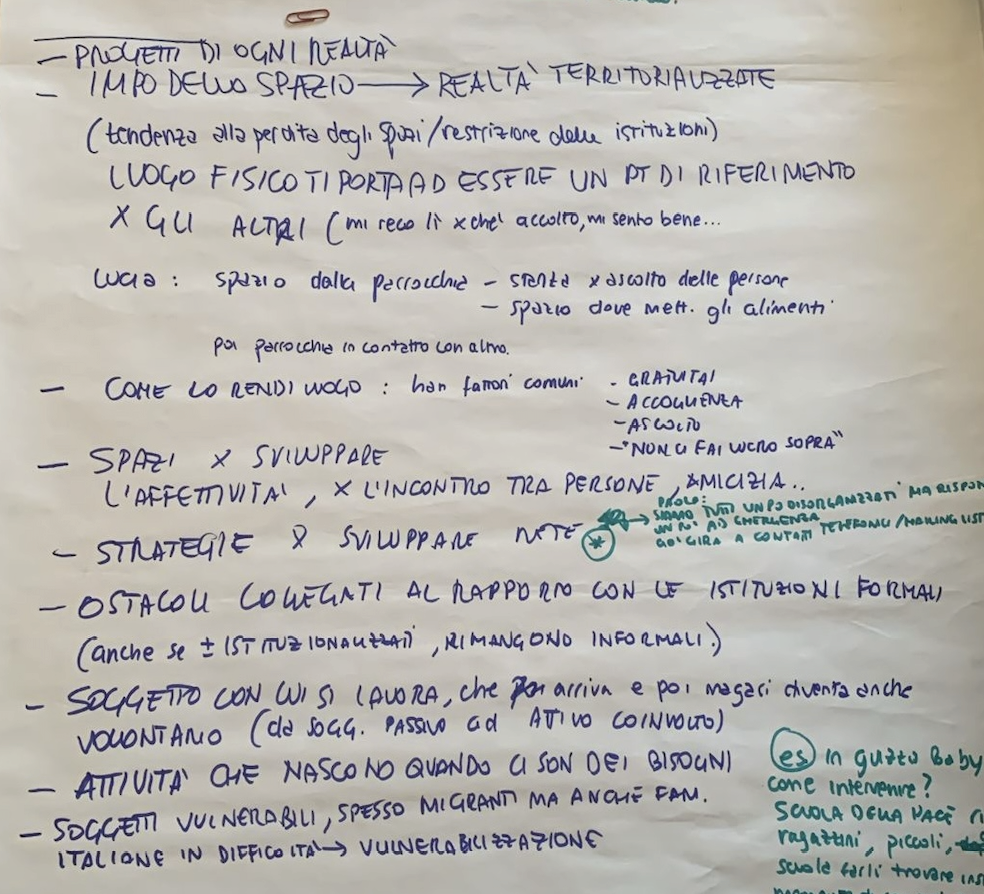
The social actors involved in the discussion emphasized how they rooted solidarity and antiracist places in different parts of the city. They engage daily with building and defending de-commodified places where they can feel good together. This means challenging institutional political action, which for many years has been shrinking and eroding autonomous social and cultural spaces (also) in Padova42. These anti-racist places are vital ‘for affectivity’, for recognizing migrants as people with whom to build friendships and overcoming hegemonic representations of racialized others as dangerous or vulnerable. These places foreshadow a city where security is built by strengthening social ties; where people are not only bearers of needs to be cared for collectively, but also of capacities to be made available without profit; where trust and hope in social change are nurtured by organizing protests and legal battles, “immigrants and locals” together. As we have seen (Perocco 2022), there are many discriminatory measures against migrants which need to be challenged and denounced by citizens and associations and through the work of trade unions and judges. Only struggle can force institutions to acknowledge structural racism, as demonstrated by the recent case of the Turin Police Headquarters43.
According to Stierl et al. (2021: 788-9), cultural and quotidian spaces have provided platforms for the transversal cultivation of struggles that can subvert the citizen/non-citizen binary.
Be it in housing struggles and rent strikes, or in organizing for health and education, the creation of worker’s social/cultural centers, or by nurturing cultural and artistic spaces and activities that invigorate the more narrowly “political” aspects of struggles —these have all become instruments with which to make migrants’ and other marginalized people’s struggles visible, audible, legible, and ultimately legitimate, connecting labor and life, the right to work with the right to residence, the right to a livelihood with the right to the city (Ibidem: 800).
Border struggles -typically associated with migrants- can become part of a wider struggle for all the people living the city, because border regimes degrade quality of life for all. Desiring “a good life” together means not only resisting the status quo but prefiguring alternative futures.
The collective analysis of solidarity and antiracist practices can therefore become part of the toolkit of those who are fighting against rampant socio-spatial alienation (Martinez, Diaz 2025, 12-13) and contribute to the creation of self-aware communities (Ibidem, 36-40) that are engaged on a daily basis against racialized capitalist urban development.
The European reception system has proven to be a machine for exploiting migrants and refugees (Mellino 2019). The progressive affirmation of a global war regime and the radicalization of the coloniality of the European migration regime (on the new Migration and Asylum Pact, Mellino 2025) make it increasingly difficult to establish networks and coalitions, pushing CSAs even further to confront violent emergency measures.
Starting from an awareness of the limits of liberal anti-racism, it becomes essential to adopt «solidarity as method» (Picozza 2021: 26): «as a critical tool capable of interconnecting the border’s oppressive practices to the colonial relations inherent to autonomous practices of solidarity».
Our research contributes to a deeper understanding of some of the changes taking place in solidarity and anti-racist mobilizations in contemporary Italy. It promotes a more reflective approach to the initiatives of white activists in solidarity with migrants, recognizing some of the pitfalls and potentialities in the emerging alliances in anti-racist activism in European cities.
Our work is an invitation to escape presentism and emergency approaches to migrations, rethinking internal border struggles in relation to the emergence of political antiracism in Italy. Combining research and activism through the method of the collective analysis of solidarity practices, we have promoted a reflexive space where questioning how solidarity can work against institutional racism (and not for its benefit). Our CAoP has brought together solidarity actors who operate separately but in similar ways or with very similar goals. The research has generated broader collective reflection, which has at least suspended wariness between actors (between those who understand the radicalism of the left differently; between Catholic and non-Catholic actors) and who are perhaps sometimes also competing for cultural hegemony in the area.
Through the analysis of solidarity practices based in Padova, participants discussed mutual support, self-organisation, social practices against welfare racism; they shared the experiences of bureaucratic violence and racial discrimination against migrants; then they underlined the importance of making antiracist places in the city, where an alternative society can be prefigured.
This exploratory study aims to contribute to the debate on race and (anti)racism in migration and urban studies, showing that in urban struggles against socio-spatial alienation and for social/racial justice, activist research can offer useful methods (such as CAoP) for reflecting on how to distance oneself from racial state thinking, how to produce disobedient knowledge by reflecting on practices of solidarity, and how to resist the structural violence of borders on a daily basis by overcoming the institutionally produced divide between migrants and natives.
According to Walia (2021), solidarity and antiracist activism with migrants and refugees needs a structural critique. The liberal discourse of hospitality and welcoming is misleading and it hides how people become migrants or refugees because of global power dynamics of capitalism, militarism and imperialism. Walia invites us to nurture a solidarity which derives from a common liberation struggle that unites people who stand with migrants because of the awareness of being part of a political and economic structure that is de-humanizing and creates multiple inequalities related to interlocked systems of power and domination.
We hope that our research has contributed to «imagine struggle as a collective process of learning about justice – learning what it looks like from multiple heterogeneous perspectives within a struggle» (Stiers et al. 2021, 802).
Alietti A. (2024) Interruzioni. Città, razzismo e politiche urbane, Milano: Mimesis.
Allievi, S. (2020) La spirale del sottosviluppo. Perché (così) l’Italia non ha futuro, Bari: GiusLaterza & Figli.
Ambrosini M. & Campomori F. (2024) Le politiche migratorie, Bologna: il Mulino
ASGI, Centro Medì (2023), When Institutions Discriminate: Equality, Social Rights, Immigration Report of Project L.A.W. – Leverage the Access to Welfare. https://www.asgi.it/wp-content/uploads/2023/04/Report_LAW_EN.pdf
Benvegnù C., Haidinger B., Sacchetto D. (2018), Employment in the European Logistics Sector: Unions’ responses to a segmented workforce, in Doellgast V. L., Lillie N., Pulignano V. (Eds.) Reconstructing Solidarity: Labour Unions, Precarious Work, and the Politics of Institutional Change in Europe, Oxford: Oxford University Press, 83-103.
Brenner N. (2000) The Urban Question as a Scale Question: Reflections on Henri Lefebvre,
Urban Theory and the Politics of Scale, in «International Journal of Urban and Regional Research» 24, 2, 361- 378.
Bonizzoni P., Hajer M. (2023), Civil Society Actors and the 2020 Italian Amnesty: Bordering to Deborder? in «Journal of Intercultural Studies», 44, 1, 44-60.
Bosi L., Zamponi L. (2015), Direct Social Actions and Economic Crises: The Relationship between Forms of Action and Socio-Economic Context in Italy, in «Partecipazione e conflitto», 8, 2, 367-391.
Bottazzo R. (2011), LIBERALAPAROLA. Qui c’è una scuola di italiano, libera e aperta a tutti, Roma: Quotidiano ambientalista Terra.
Caciagli C. (2019), Housing Squats as “Educational Sites of Resistance”: The Process of Movement Social Base Formation in the Struggle for the House. Antipode, 51, 3, 730–749.
Cancellieri A., Peterle G. (2019), Quartieri. Viaggio al centro delle periferie italiane, Padova: BeccoGiallo.
Casarini L. (2009, cur.), Il processo sette aprile: Padova trent’anni dopo: voci dalla città degna, Roma: Manifestolibri.
De Genova N. (2015), Border Struggles in the Migrant Metropolis, in «Nordic Journal of Migration Research», 5(1), 3-10.
De Genova N. (2024), Migration, race and the racializing strategy of borders, in «International Migrations», 62, 273-276.
De Genova N. (2025), From border war to civil war: the despotism of the border and full-spectrum authoritarianism, in «Citizenship Studies», 1-24.
Despali G., Despali P. (2020), Gli autonomi: Storia dei collettivi politici veneti per il potere operaio, Bologna: DeriveApprodi.
Faiella F., Mantovan C. (2011, cur.), Il ghetto disperso. Pratiche di desegragazione e politiche abitative, Padova: Cleup.
Fauser M. (2024), Mapping the internal border through the city: an introduction, in «Ethnic and racial studies», 47(12), 2477-2498.
Firouzi Tabar O. (2019), L’accoglienza dei richiedenti asilo tra segregazione e resistenze: Un’etnografia a Padova e Provincia, in Fabini G., Firouzi Tabar O., Vianello F. (cur.) Lungo i confini dell’accoglienza: Migranti e territori tra resistenze e dispositivi di controllo, Roma: Manifestolibri, 173-210.
Firouzi Tabar O. (2024), Social Construction of the “Good Refugee” and the Resistances of Asylum Seekers in Italy between Marginalization and Autonomous Crossing of Urban Spaces, in «Sociální Studia / Social Studies», 20, 2, 39-56.
Freire P. (2005), Pedagogia degli oppressi, Torino: Gruppo Abele edizioni.
Frisina A., Ghebremariam Tesfau’ M., Frisina S. (2021), Decolonize your eyes, Padova. Pratiche visuali di decolonizzazione della città, in Roots§Routes-Research on Visual Cultures, https://www.roots-routes.org/decolonize-your-eyes-padova-pratiche-visuali-di-decolonizzazione-della-citta-di-annalisa-frisina-mackda-ghebremariam-tesfau-e-salvatore-frisina/
Frisina A., Ghebremariam Tesfau’ M. (2025), The emergence of a new antiracism (1989-2023) in Italy, in Adam I., Beaman J., Jung M. (eds.), A new wave of antiracism in Europe?, IMISCOE Research Series, Springer https://link.springer.com/book/9783032000019, 73-90.
Gargiulo E. (2024), Internal status borders: municipal registration between emancipation, exclusion and omission in Italy, in «Ethnic and racial studies», 47, 12, 2499-2519.
Gargiulo E., Morlicchio E., Tuorto D. (2024), Prima agli italiani. Welfare, sciovinismo, risentimento, Bologna: Il Mulino.
Ha N. K., Picker G. (eds), (2022), European Cities: Modernity, Race and Colonialism, Manchester: Manchester University Press.
Hardt M., Negri A. (2004), Moltitudine. Guerra e democrazia nel nuovo ordine imperiale, Milano: Rizzoli.
Iannuzzi, F. E., Sacchetto, D. (2020). Outsourcing and workers’ resistance practices in Venice’s hotel industry: The role of migrants employed by cooperatives, in «Economic and Industrial Democracy», 43(2), 877-897. https://doi.org/10.1177/0143831X20960227 (Original work published 2022)
Keskinen S., Alemanji A. A., Seikkula M. (2024), Introduction: Race, (b)ordering and disobedient knowledge, in S. Keskinen S. Alemanji A. A., Seikkula M. (Eds.), Race, bordering and disobedient knowledge, Manchester: Manchester University Press, 1-22.
Loughran K. (2025), “The Coming In of the Southern Freedman’s Sons and Daughters”: Du Bois and the Urban Question, in Morris A. et al. (eds.), The Oxford Handbook of W. E. B. Du Bois, Oxford: Oxford University Press, 205-218.
Mantovan C., Sbraccia A., Vianello, F. (2011), Via Anelli e il progetto di dispersione, in Faiella F., Mantovan C. (cur.), Il ghetto disperso. Pratiche di desegragazione e politiche abitative, Padova: Cleup.
Mantovan C. (2017), Contested areas: Coexistence, conflict and governance in the districts near the railway stations of Padua and Mestre (North-eastern Italy), in «Justice, Power and Resistance»,Vol.1, 98-126.
Mantovan C. (2018), ‘They treat us like criminals’: urban public spaces and ethnic discrimination in Italy, in «Patterns of Prejudice», Vol. 52, No. 4, pp. 338-354.
Martínez, M. A. (2023). Activist Research as a Methodological Toolbox to Advance Public Sociology, in «Sociology», 58, 4, 832-850.
Martínez, M. A., Díaz I. (2025), Centros sociales autogestionados. Por una reapropiaciòn colectiva de la ciudad, Madrid: Ediciones Akal.
Mayblin L., Turner J. (2021), Migration Studies and Colonialism, Cambridge: Polity Press.
Mellino M. (2025), La colonialità del nuovo Patto sulla migrazione e l’asilo tra congiuntura di guerra e crisi dell’Europa, in del Guercio A., Rondine F., Frontiere, solidarietà, diritti. Il governo delle migrazioni in Europa e in Italia, Napoli: Editoriale Scientifica, 375-399.
Mellino M. (2019), Governare la crisi dei rifugiati. Sovranismo, neoliberalismo, razzismo e accoglienza in Europa, Roma: Derive&Approdi.
Mellino, M., Ruben Pomella, A. (2020). Marx nei margini. Dal marxismo nero al femminismo postcoloniale , Rome: Alegre.
Mezzadra S., Neilson B. (2014), Confini e frontiere. La moltiplicazione del lavoro nel mondo globale, Bologna: Il Mulino.
Montalva Barba M. (2024), Questioning the foundations: the embedded racism in urban sociology theorization, in Martinez M. A. (ed.), Research Handbook on Urban Sociology, Edward Elgar Publish, 151-166.
Morris A. (2015), The Scholar Denied: W. E. B. Du Bois and the Birth of Modern Sociology, Berkeley: University of California Press.
Peralta H. (1994), ¿Cómo hacer para saber qué hacer? Caracas: Ediciones Churuata.
Perocco F. (2022), The system of racial discrimination in the Italian welfare state, in Perocco F. (ed.) Racism in and for the welfare state, Basingstoke: Palgrave Macmillan, 261-98.
Picozza F. (2021), The Coloniality of Asylum. Mobility, Autonomy, Solidarity in the Wake of Europe’s Refugee Crisis, New York: Bloomsbury.
Porto-Gonçalves, C., (2016). Abya Yala, in Enciclopédia Latinoamericana (online). https://latinoamericana.wiki.br/es/entradas/a/abya-yala
Raffini L., Pirni A. (2019), Atomizzata o connessa? L’agire politico nella società individualizzata tra de-politicizzazione e ri-politicizzazione, in «Cambio. Rivista Sulle Trasformazioni Sociali», 9, 17, 29-39.
Ramírez Díaz, J. (2016). Comparative analysis of andragogy and pedagogy announces by adulthood perception, in «Umanitas magazine», 13,13: 23-43.
Saldaña, J. (2009), The Coding Manual for Qualitative Researchers, London: Sage Publications Ltd.
Sayad A. (1999), Immigration et pensée d’État, in «Actes de la recherche en sciences
sociales», 129, 1, 5-14.
Stierl, M., Bojadžijev, M., De Genova, N., Eckert, J., Khosravi, S., Lecadet, C., Mazzara, F., McNevin, A., & Nyers, P. (eds.), Minor keywords of political theory: Migration as a critical standpoint, in «Politics and Space», vol. 40, 4, 794-806.
Tazzioli M., Walters W. (2019), Migration, solidarity and the limits of Europe, in «Global Discourse», 9, 1, 175-190.
Valeri M., Afrofobia. Razzismi vecchi e nuovi, Fefè Editore, Roma, 2019. p. 174.
Vianello F. (a cura di) (2006), Ai margini della città, Roma: Carocci editore.
Walia A. (2013), Undoing Border Imperialism, Oakland: K Press.
Walia A. (2021), Border and Rule: Global Migration, Capitalism and the Rise of Racist Nationalism, Haymarket Books: Chicago.
Wimmer A., & Glick Schiller N. (2002), Methodological nationalism and beyond: Nation-state building, migration and the social sciences, in «Global Networks» 2, 301–334.
Wright S. (2021), The weight of the printed word: Text, context and militancy in Operaismo, Leida: Brill.
Zambon G., De Marchi P. (2023), Ismael e gli altri. Una storia di migrazione e caporalato, Padova: Becco Giallo.
Zambon G., De Marchi P. (2024), Il muro di Via Anelli – Frammenti di vita e di lotta per la casa. Padova: Becco Giallo.
Zamponi L. (2024), Mutual aid and solidarity politics in times of emergency: Direct social action and temporality in Italy during the COVID-19 pandemic, in «Social Movement Studies», 23, 6, 756-776. Zapata-Barrero, R., Yalaz, E. (Eds.) (2018), Qualitative Research in European Migration Studies, Springer: Barcelona. https://link.springer.com/book/10.1007/978-3-319-76861-8
| Organization | Operating since… | Actions (DSA) | Area of city | ||||||||||||||||
| ADL (Associazione Diritti Lavoratori) Cobas – grassroots union1 | 1992 | organization of workers, strikes and legal actions for workers’ rights and adequate pay, public denouncing, women’s group of mutual support; bureaucratic support (sometimes physically accompanying people) for employment contracts and conditions, obtaining and renewing permit to stay, citizenship papers, health papers, decreto flussi (flows decree), housing, driving licence, recognition of education and qualifications | Arcella and Bassanello | ||||||||||||||||
| Caritas | food distribution, community Sunday lunch Listening desk (religious – not action) After school club |
Guizza | |||||||||||||||||
| Catai2 and ex-Casetta Bertha | Italian course (for migrants and international students); food distribution (recuperating what is thrown away from mercato agro-alimentare); Sportello sociale, (documents, housing, work); after school club; lunches in quartiere; sportello di ascolto e psicologico | Ponte San Leonardo and Arcella | |||||||||||||||||
| Liberalaparola3 | 1993 (as Razzismo Stop school) | Italian courses, radio project, social/international dinners, music workshops | Arcella | ||||||||||||||||
| Open your borders | 2017 | Legal/administrative helpdesk (with support of pro-bono lawyers); mapping services for migrants4; observe directly what is happening at borders, in refugee camps | Pontecorvo | ||||||||||||||||
| Quadrato Meticcio5 | 2012 | Sports activities (football, girls’ team,); after school club – support homework; food distribution; social and housing helpdesk | Quartiere Palestro | ||||||||||||||||
| STRIA / Open Gates | 2022 Originating from experience of Bioslab which from 2014/15 started observing migrant centres | Legal helpdesk (5 mornings a week), also deals with housing, permits; ethno-psychological support; Italian course; cultural events | Station area | ||||||||||||||||
| 1 https://adlcobas.it/ | |||||||||||||||||||
| 2 https://poterealpopolo.org/spazio-catai-padova/ | |||||||||||||||||||
| 3 https://www.facebook.com/LiberaLaParola/about_details?locale=it_IT | |||||||||||||||||||
| 4 https://www.meltingpot.org/2025/07/padova-una-mappa-dei-servizi-territoriali-cittadini/ | |||||||||||||||||||
| 5 https://asdquadratometiccio.it/chi-siamo/ | |||||||||||||||||||
1 Frisina wrote paragraph 1 (Why race and (anti)racism matter in migration and urban studies), 4 (Solidarity practices in the frame of welfare racism), 7 (Claiming the right to stay together in the city) and the concluding remarks. Garcia wrote paragraph 3 (Collective analysis of practices: nurturing collective reflexivity) and 5 (“Before working on borders, I experienced them”). Helm wrote paragraph 2 (Reconstructing Padova’s antiracist political activism) and 6 (“We are not a network, or are we?”). We would thank Ale Boussalem for his suggestions.
2 State institutions try to hold a monopoly on the official definition of everything related to immigration. As migration scholars we should refuse to reify state concepts such as ‘integration’, ‘sovereignty’ and above all the ‘migrant vs citizen’ divide. On the nexus between migration and State thought, see Sayad (1999).
7 https://www.facebook.com/photo/?fbid=557792647389990&set=sono-555181-le-persone-controllate-dallistituzione-delle-zone-rosse-aree-urbane-
8 Abya Yala is the term used by indigenous organizations and movements to refer to Latin America. Abya Yala, in the language of the Kuna indigenous people who inhabit Panama and Colombia, means “mature land,” “living land,” or “land that flourishes,” and is used in contrast to “America” (Porto-Gonçalves: 2016, par. 1), a name imposed by European colonizers to refer to the continent and derived from the name of the navigator and explorer Amerigo Vespucci. It was first used at the Second Continental Summit of Indigenous Peoples and Nationalities of Abya Yala, held in Quito in 2004, as a way for native populations to assert their social and cultural rights and the recognition of their ancestral territories.
9 In May 2025 the total population counted 210.969, of these 173.842 are classified as ‘Italian residents’, and 37.127 ‘foreign residents’ https://www.comune.padova.it/sites/default/files/2025-07/Dem_06_25.pdf In 2003, there were 9.913 ‘foreign residents’, amounting to 4.8% of the resident population https://www.tuttitalia.it/veneto/64-padova/statistiche/cittadini-stranieri-2003/
10 In 2023-24 the University had 70,786 enrolled students, 8.6% of whom were international students. The university population (over 75,000 if one considers students and staff) is roughly equivalent to one third of the city’s population (though non-resident students are not counted in the city’s population https://www.unipd.it/dati-statistici-iscritti
11 In the initial phase of exploratory research two political parties were included (Potere al Popolo and Rifondazione) as they were involved with social help desks for migrants. In the collective analysis phase just one (Potere al Popolo) chose to be involved. Opening up spaces for exchange between leftist groups in Padova is not to be taken for granted due also to historical tensions.
12 The historical reconstruction comes from document analysis and an extended qualitative interview with M.S., long-term activist with RazzismoStop, as a privileged witness of class (and later class and antiracist) struggles since the 1970s.
13 As Colucci (2018) points out, this is by no means the beginning of migration into Italy, but rather marks the time of increasingly restrictive legislation, mobilisations and solidarity.
14 The association was also involved in a counter-investigation following the shooting of the 11 year old Tarzan Sulic in police custody in 1993. For more info, see https://www.youtube.com/watch?v=a8o3DobGFzI
15 social help desks, run on a voluntary level by activists, which may provide information on issues such as housing, welfare services, legal advice
16 In Italy, unlike the Confederal and larger trade unions, grassroots unions are often less bureaucratic and hierarchical organisations, characterised by a horizontal and agile structure. They have grown above all in sectors with a strong presence of migrant workers (Iannuzzi, Sacchetto 2020)
17 https://adlcobas.it/ ADL Cobas came to life in 1992, building on the social and political activism of the 1980s in the Bassa Padovana, and labour struggles related to restructurings, decentralization, layoffs, the precarization of labour and the environmental devastation in the area.
18 https://www.meltingpot.org/2013/12/padova-50-rifugiati-occupano-una-palazzo-abbandonatonasce-la-casa-dei-diritti-don-gallo/
19 https://cdn.knightlab.com/libs/timeline3/latest/embed/index.html?source=149VBsDKhB74DACXTJTY5mnaF3j4jO7UUAqYSn5P9zL0&font=Default&lang=en&initial_zoom=2&height=650
20 This is a document stating that a (non-EU citizen) person is hosted at a certain address and is required for the permit to stay if someone does not have a rental contract.
21 Such as the Centro di Prima Accoglienza (CPA) in the city – at the ex military base “Prandina” hosting on average 400 people for around one year – and two large camps in the province of Padova (Bagnoli, hosting around 1000 migrants) and Venice (Cona, hosting 1500).
24 https://www.meltingpot.org/tag/confini-e-frontiere/ the website meltingpot reports on both
25 See San Precario (https://www.instagram.com/polisportivasanprecario/) in the Arcella area and Quadrato Meticcio in Palestro district (https://www.instagram.com/quadrato_meticcio/).
26 https://www.meltingpot.org/2023/09/richiedenti-asilo-assolti-per-falsa-dichiarazione-di-ospitalita/
27 García Figueroa proposed the CAoP methodology based on his experience as an Afro-Venezuelan sociologist, anti-racist activist, member of the social organization Movimiento de Pobladores, and six years of work in the Urban Planning Department of the Caracas City Hall, where roundtables and workshops for community planning and development of infrastructure projects were promoted. He became familiar with various participatory methodologies shared by popular educators and activists from urban and rural contexts in the country with whom he collaborated permanently.
28 The Churuata is a traditional collective dwelling of the Piaroa indigenous people in Venezuela, built with organic materials from the Amazon rainforest, with a circular shape and whose internal structure of concentric rings made with wood and lianas is covered with palm leaves and gives that appearance of a conical dome that starts from the ground. https://farfanestudio.es/2011/10/25/la-catedral-de-la-arquitectura-indigena-venezolana-la-churuata-piaroa/
29 We want to highlight the difference between pedagogy and andragogy to value the educational processes specific to adults and to ensure that they are not viewed as synonymous with pedagogy, which is instruction directed toward children and adolescents. Because we apply the CAoP in a meeting with adults, as an epistemological, methodological, and theoretical basis, we propose recognizing «andragogy in five learning principles: 1) Self-concept; 2) Subject experience; 3) Learning readiness; 4) Learning orientation; 5) Motivation to learn» (Ramírez Díaz 2016: 24). We also take a critical stance toward the traditional conception of adult education, which focuses on providing skills for the market.
30 The Collective Analysis of Practices workshop took place on March 27, 2023, in Padova, at the Claricini Building of the University of Padova (FISPPA Department) and was carried out within the research activities of the University of Padova unit, coordinated by A. Frisina, as part of the PRIN2020 project MOBS – Mobilities, solidarities and imaginaries across the borders: the mountain, the sea, the urban and the rural as spaces of transit and encounters (2022–2025).
31 Two sociology students from the University of Padova, served as scribes after two-hour training sessions with sociologist Gustavo Garcia to practice accurately and quickly summarizing what they heard from the workshop participants. The discussions were also recorded and transcribed in their entirety by the two of them for a more gradual and interpretive analysis by our research team and recorded the ideas expressed as faithfully as possible.
32 Each of these interventions, which are written on the sheets, is visible at all times to the entire group of participants, and the coding is developed together with them. As a first cycle «Coding is only the initial step toward an even more rigorous and evocative analysis and interpretation for a report» (Saldaña 2009: 8).
33 For both cycles, Saldaña proposes a flexible and creative use in which «the portion of data to be coded during First Cycle coding processes can range in magnitude from a single word to a full sentence to an entire page of text to a stream of moving images. In Second Cycle coding processes, the portions coded can be the exact same units, longer passages of text, and even a reconfiguration of the codes themselves developed thus far» (Ibid.: 3).
34 This slogan has its local version. For instance, see the Mayor of Padova Bitonci (2014): “Paduans first”, considering “local residents” only those residing in Padova for 10-15 years (with the goal of allocating council houses to “Italians” to the detriment of “foreigners”). https://www.agi.it/regioni/veneto/padova_bitonci_nuove_regole_per_case_popolari_prima_i_padovani-47603/news/2014-08-11/
35 Italy established the National Office against Racial Discrimination (UNAR) in 2003, under pressure from the European Union. However, it was placed under the Presidency of the Council, therefore of the national government. UNAR doesn’t have sanctioning powers and doesn’t provide compensation for victims. ASGI has repeatedly denounced the limitations of UNAR.
36 On research and activism, see Farina and Firouzi Tabar in this volume. In our equipe we were researchers with and without a migratory background, racialized as white and non-white, but all us were involved with antiracism and the struggles of migrants in Padova. In different situations, we made explicit our critical approach, for instance facilitating the awareness that in one hand «…racist and xenophobic interpretations and categorizations of migrants are false interpretations in the sense that they are not related to any real features of the categorized groups» but on the other hand «those beliefs have real causal impacts on social processes as they lead to social and material de-valuation of certain social groups and categories» (Zapata-Barrero, Yalaz, 2018: 96).
40 https://www.internazionale.it/reportage/marco-de-vidi/2025/08/04/padova-arcella-zona-rossa-proteste
41 In the 1990s the meaning of urban decay moved away from an urban planning sphere to a socio-political one, following the racist rhetoric of the Northern League. See Mantovan (2017) research in Padova, which includes a discussion on the crucial role of local administration which invested too little in social policies, delegating too much to the third sector, with poor coordination of the activities.
42 Consider, for example, BiosLab and Casetta Berta, two places of mutualism in the Palestro and Arcella neighbourhoods, which were evicted five years ago and then recently reborn thanks to the steadfastness of activists who were able to reclaim new spaces (as Spazio Stria, with which we collaborated throughout the research, see Farina and Firouzi Tabar in this volume).