Taxation in agriculture: an evaluation of the Italian land cadastre as a tool for identifying incomes in the agricultural sector
Department of Agricultural, Food and Environmental Sciences, University of Perugia, Italy
E-mail: antonio.pierri@unipg.it; francesco.poma@studenti.unipg.it; stefano.ciliberti@unipg.it
*Corresponding author
Abstract. Recent tax reforms contributed to developing a seemingly tax-free agricultural sector in Italy. The purpose of this article is to investigate inconsistencies of the cadastral system and analyse whether it contributes to distancing taxation in agriculture from general principles of fairness and economic efficiency. Data from official sources are analysed using a composite research design with four methodological steps, aimed to: i) investigate differences between cadastral holders and farms; ii) highlight impacts of structural changes in agriculture; iii) contrast determination procedures for cadastral and capital incomes; and iv) evaluate farmland income as a measure of income and land value. Findings reveal several limitations of the Italian cadastral system as an instrument for measuring land and business income, highlighting a mismatch between property and business income taxation, which makes the distinction between farmland and agrarian income anachronistic.
Keywords: agriculture, land cadastre, taxation, income, Italy.
JEL codes: H20, Q10.
Index
2. Taxation for the agricultural sector in Italy
3.1. Analytical approach and data
3.1.1. Comparing economic characteristics of cadastral holders and agricultural holdings
3.1.2. Evaluating impacts of structural changes in agriculture
3.1.3. Contrasting determination procedures for cadastral income and capital income
3.1.4. Comparing farmland income as a measure of income and land value in agriculture
4.1. Composition and fiscal framework of farms
4.2. Effects of structural changes in agriculture
4.3. Effects of income dynamics in agriculture
4.4. Effects of the dynamics of land values in agriculture
5. Final considerations and recommendations
5.1. Recommendations and pending questions
Farmers’ protests in Italy were recently triggered by the government’s choice to stop the exemption of farm incomes from the personal income tax (henceforth, IRPEF, from the Italian acronym “Imposta sul reddito delle persone fisiche”), which was introduced in 2016 (Mazzocchi et al., 2024). A new attempt was made to placate the protests using taxation, amending art. 1, paragraph 44 of Law 232/20161, to establish new tax exemptions for farm incomes until 2025. Thus, once again, policymakers decided to intervene in a tax system that had already been subject to numerous amendments, distorting cadastral-based taxation and losing sight of the constitutional objectives (Visco, 2024).
The illusion of the cadastral determination of the agricultural income, as opposed to that of any other enterprise that carries out its activities in another economic sector, definitively waned with the reform of Article 2135 of the Italian Civil Code through Legislative Decree No. 99/2004 (Coletta et al., 2009). Since then, the introduction of mechanisms of differentiated exclusion of cadastral tax bases, reserved for certain types of self-employed agricultural entrepreneurs with given characteristics (L. 232/2016), has continued to result in further corporatisation of tax policies in agriculture (Cristofaro, 2015).
The original setting of the Italian cadastre has been maintained since the end of the 19th century2, despite repeated interventions. The role of the cadastral system is twofold: it carries out and updates the inventory of real estate with its graphic representation, and it updates and determines taxable incomes (Permanent Committee on Cadastre in the European Union, 2009; Zangheri, 1980).
Over the years, the cadastre has represented an important tool for ensuring a differentiated fiscal charge for the agricultural sector compared with other productive sectors. As a result, a redistribution of income supposedly aimed at producing the effect of rebalancing the remuneration of agricultural input has occurred (Pierri, 2015).
The Italian cadastral system has continued to maintain considerable autonomy from the taxation system outlined in Art. 53 of the Constitution, which would have led to a shift from a real-type tax system to a personal one. However, although cadastral taxation already seemed largely unable to consider taxpayer conditions and therefore somewhat inadequate for such a pivotal role, the application of the first tax reform in 1971 left the preexisting cadastral framework unaltered.
The cadastral system was used for the purpose of thoroughly approximating actual incomes3, an objective partly pursued with the revision of the cadastral valuations for the land cadastre in 1978–79 and of the building cadastre in 1988–89.
Authorised by the Ministerial Decree of January 20, 1990, a new revision of the land cadastre was proposed, which was supposed to have 1988–89 as a reference period. However, the revision was never carried out because the Parliament, with Law n. 75/1993, subsequently planned to “establish new criteria for the classification and determination of the land cadastre values that would account for the productive potential of the land”4. This legislation, which aimed to simplify the cadastral system, was not implemented because of the difficulties encountered in the elaboration of criteria and methods aimed at defining homogeneous classes of land productivity and the unrepresentativeness of the database adopted to validate estimations aimed at identifying taxable incomes (Zuccolo, 1993). Finally, the Minister of Agriculture stopped the reform process with a decree, perhaps due to external pressures from those who feared that such a new tariff system would have been excessively detrimental for farmers (Cristofaro, 2015).
Since then, it has been evident to both the academic world and those working in the sector that the old qualification and classification system (established in 1939) and the criteria and methods used as a basis for estimation operations no longer corresponded to modern production systems and actual structural characteristics of farms (Pierri, 2015; Simonotti, 2008). Table 1 lists all the main regulatory procedures for determining cadastral rents related to land in Italy since the beginning of the 20th century.
| Year | Act of law | Entry into force | Determination of cadastral incomes (amount) | Time reference for cadastral incomes | |
|---|---|---|---|---|---|
| Farmland income (R.D.) | Agrarian income (R.A) | ||||
| 1939 | Regio Decreto n. 589/1939, convertito nella legge 29 giugno 39, n. 976 “revisione generale degli estimi dei terreni” | 1939 | R.D. | R.A. | 1939 |
| 1973 | D.P.R. 29 settembre 1973, n. 604 -“revisione degli estimi e del classamento del catasto terreni” | 1984 | R.D. | R.A. | 1939 |
| 1984 | Pubblicazione ed entrata in vigore Nuove Tariffe d’estimo riferite al biennio 1978/79 | 1984 | R.D. | R.A. | 1978–1979 |
| 1990 | Catasto Terreni revisione rendite catastali biennio 1988-89 - D.M. n. 3/355 del 20/01/1990 | Not enacted | R.D. | R.A. | 1978–1979 |
| 1994 | Legge n. 724/1994 Art. 31 comma 1 - maggiorazione tariffe d’estimo 1977/78 | 1995 | R.D.+80% | R.A. +70% | 1978–1979 |
| 2012 | Legge n. 228/2012 Art. 225 comma 512 - maggiorazione tariffe d’estimo 1977/78 | 2013–2014 | R.D. +80%+15% | R.A. +70%+15% | 1978–1979 |
| 2015–2016 | R.D. +80%+30% | R.A. +70%+30% | 1978–1979 | ||
| 2016 | Legge n. 232/2016 Art 1 comma 44 - Per gli anni 2017, 2018 e 2019 poi prorogato fino al 2023 | 2017–2023 | R.D. +80%+30% | R.A. +70%+30% | 1978–79 (Full exemption for CDs and IAPs) |
| 2023 | Legge n. 213/2023 e DL 215/2023 - Esenzione imposta Redditi Dominicali ed Agrari per fasce di reddito imponibile | 2024–2025 | R.D. +80%+30% | R.A. +70%+30% | 1979–79 (Full exemption for CDs and IAPs) |
However, any successive attempt to revise the land cadastre was futile. Furthermore, real-type taxation systems have been progressively reintroduced, leading to the adoption of cadastral incomes as a tax base for real estate, despite the inability of this system to express actual and potential income and/or asset configurations. In such a framework, flat-rate taxation systems characterised by an extreme simplification of accounting obligations have been increasingly adopted in the agricultural sector (Seroglia, 2003).
However, to the best of our knowledge, there is a gap (or at least a lack of updated and comprehensive studies) regarding the ability of the current taxation system in agriculture, which is based on the land cadastre, to capture both income and land value dynamics in light of the structural and regulatory changes that the sector has experienced in recent decades in Italy (Bottarelli, 2017; Ribaudo 1995). Accordingly, whether continuous tax concessions and exemptions to farmers are somehow technically sound and coherent with the Italian constitutional goals is not clear.
Therefore, the research objective of this paper is to provide an updated and detailed evaluation of the potential divergence and inconsistencies at stake in the current taxation system for Italian farms, to shed light on the main weaknesses and to identify possible amendments and improvements.
Based on previous studies in this field (Bayer et al., 2018; Golubeva et al., 2021; Kovalchuk et al., 2021), the present work aims to investigate and assess the role of the Italian land cadastre in identifying taxable agricultural incomes and its ability to foster an eventual fair redistribution of wealth to positively affect farm efficiency and productivity. For this purpose, data from several Italian official sources are used to analyse whether and how the taxation of the Italian farming sector is effective.
2. Taxation for the agricultural sector in Italy
Despite some weak attempts to introduce individual taxation systems, the agricultural sector continues to apply income taxes on a real basis, generating an unequal taxation system by law. Such a system also applies to land leased for agricultural use5: the only case in which rent must be declared is when it amounts to less than 80% of the revalued farmland income6. This latter income is known as reddito dominicale in Italy. Moreover, the sector benefits from a special VAT exemption scheme that allows a tax reduction and therefore implies indirect financial support. Additionally, a specific reduction in the taxation of agricultural-related activities was introduced in 2014 through the inclusion of the agrarian income7 (known as reddito agrario in Italy) of all activities related to the handling, processing and marketing of agricultural products. Finally, between 2016 and 2017, exemptions from the regional production tax (henceforth, IRAP, from the Italian acronym “Imposta regionale sulle attività produttive”)8, from the local municipal tax (named IMU, from the Italian acronym “Imposta municipale unica”) and from IRPEF for specific farmer categories9 were introduced.
The rationale behind these concessions for the agricultural sector has been to support small farms, which are supposedly less able than large farms to manage rural areas and land properly and therefore should be encouraged to maintain their production activity through reduced fiscal pressure and fiscal charge. Fiscal pressure is defined as the ratio of taxes plus social security contributions to GDP (ISTAT, 2025), whereas fiscal charge measures the share of national income absorbed exclusively by tax revenues and is calculated as the ratio of taxes to GDP (Agenzia delle Entrate, 2025).
Estimates from the Yearbook of Italian Agriculture for the period 2011–2015 (Table 2) measure the differential of fiscal pressure and fiscal charge in the primary sector (which includes agriculture, forestry and fishing) compared with other economic sectors.
| Item | 2011 | 2012 | 2013 | 2014 | 2015 | Average 2011–15 | |||||||||||||
|---|---|---|---|---|---|---|---|---|---|---|---|---|---|---|---|---|---|---|---|
| Fiscal pressure | |||||||||||||||||||
| Agriculture, forestry and fishing | 21.5 | 18.8 | 16.8 | 19 | 19.3 | 19.1 | |||||||||||||
| Other sectors | 40.7 | 43.4 | 43.3 | 43.5 | 43.4 | 42.9 | |||||||||||||
| Fiscal charge | |||||||||||||||||||
| Agriculture, forestry and fishing | 9.6 | 7 | 5.6 | 7.1 | 7.6 | 7.4 | |||||||||||||
| Other sectors | 25.7 | 28.3 | 27.8 | 28.2 | 28.1 | 27.7 | |||||||||||||
| Source: CREA - Council of Research in Agriculture and Analysis of Agricultural Economics (2017). | |||||||||||||||||||
The data reveal that the fiscal pressure and fiscal charge in the primary sector were 19.1% and 7.4%, respectively, on average, whereas they were 42.9% and 27.7%, respectively, for the other productive sectors. In addition, the table shows that both indicators decreased over time, in contrast to the situation in the other Italian economic sectors.
Table 3 lists and quantifies the amounts of some relevant10 tax concessions (including allowances and relief) for the Italian farming system.
| Items | 2017 | 2018 | 2019 | 2020 | 2021 | Average 2017–21 | |||||||||||||
|---|---|---|---|---|---|---|---|---|---|---|---|---|---|---|---|---|---|---|---|
| Social security contributions (reductions or exemptions) for: | 352 | 384 | 183 | 169 | 162 | 250 | |||||||||||||
| Employers and their employees | 271 | 303 | 118 | 105 | 100 | 180 | |||||||||||||
| Self-employed workers | 81 | 80 | 65 | 64 | 62 | 70 | |||||||||||||
| Direct and indirect taxation (reductions) for: | 1.632 | 1.637 | 1.607 | 1.576 | 1.529 | 1.596 | |||||||||||||
| IRPEF | 195 | 190 | 193 | 193 | 195 | 193 | |||||||||||||
| VAT | 448 | 431 | 401 | 361 | 331 | 394 | |||||||||||||
| Mineral oil tax refunds | 990 | 1.016 | 1.012 | 1.022 | 1.004 | 1.009 | |||||||||||||
| TOTAL | 1.984 | 2.021 | 1.789 | 1.745 | 1.691 | 1.846 | |||||||||||||
| Source: CREA (2023). | |||||||||||||||||||
During the observed period, these overall concessions amounted, on average, to 1.85 billion Euro per year. Data also show that tax refunds on (mostly fossil) fuels represent the main form of benefit for Italian farmers, followed by taxation reductions applied to the VAT (due to the abovementioned special scheme) as well as IRPEF and social security contributions when applied to self-employed workers, such as coltivatori diretti (henceforth CD, i.e., family farmers) and professional agricultural entrepreneurs (henceforth IAP, acronym of imprenditori agricoli principali).
The research design focuses on several assumptions and is intended to verify the limitations of the cadastral system as a tool for determining the tax base for direct and indirect taxes. These limitations can be traced back to the critical issues described below:
1) The divergence between cadastral holders, farms (as defined by the ISTAT) and companies carrying out agricultural activities.
2) Effects induced by structural changes in the agricultural sector after 1978–79 (the date of the last revision of cadastral tariffs).
3) Divergence of determination procedures between cadastral income and capital income.
4) The inconsistency of farmland income as a measure of income and land value in agriculture.
Analyses are mainly based on the regulations in force for the latest revision of cadastral estimates (Law no. 976/1939 and Ministerial Decree 13/12/1979) and the concepts of study farms, farmland income (RD) and agrarian income (RA) (Medici, 1948). Specifically, study farms are defined as those located within a typical municipality of a homogeneous territory (census circle) that has a prevalence or almost the totality of a certain crop quality (e.g., arable land) (Michieli, 1989).
Then, the farmland income corresponds to the land benefit before taxes and is calculated based on the economic balance scheme drawn up by the Italian agricultural economist Arrigo Serpieri (1877-1960), on which cadastral regulations and cadastral tariffs are based, as illustrated below:
RD = Plv - (Qagr + Sv + Sa + St + I) = Rpl – Qf(1)
where:
PLV = gross saleable production,
Qagr = depreciation allowance on agricultural capital,
Sv = miscellaneous expenses,
Sa = wages,
St = salaries,
I = interest on agricultural capital,
Rpl = gross farm income, and
Qf = depreciation of land capital.
Finally, agrarian income is calculated as follows:
RA = I + Std(2)
where:
I = interest on agricultural capital, and
Std = wages for managerial work.
3.1. Analytical approach and data
The approaches adopted to verify the abovementioned potential limitations and weaknesses of the Italian land cadastre are illustrated in detail in Figure 1.
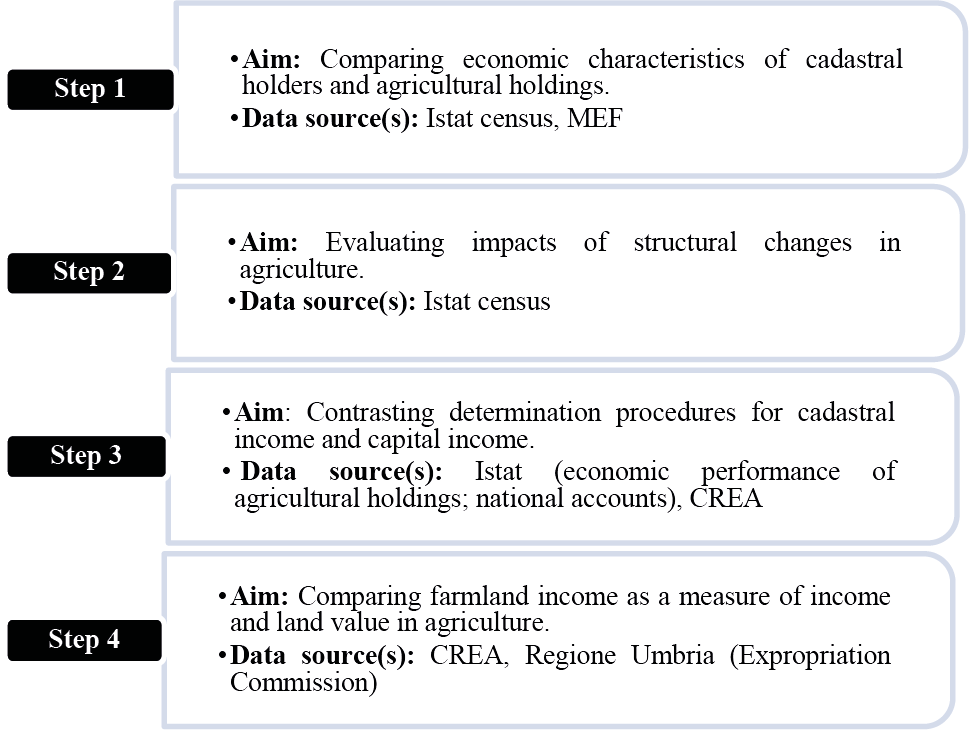
The following subsections report a detailed description of the independent procedural steps adopted and implemented for each of the issues under investigation.
3.1.1. Comparing economic characteristics of cadastral holders and agricultural holdings
Based on previous works (Antonietti, 1985; Coletta et al., 2009), the limitations of the cadastral system were tested using available statistical sources to verify the consistency between the principles underlying cadastral taxable values and the structural changes that Italian agriculture has undergone over the past 70 years.
For this purpose, ISTAT data related to the 2020 census were compared with VAT turnover data on Italian agriculture for the year 2020, processed according to the ATECO code. Data were provided by the ‘Dipartimento delle Finanze Direzione studi e ricerche economici fiscali’ of the Italian Ministry of Economy and Finance (MEF) and were processed separately by year, turnover and type of entity (cooperatives and their consortia, sole proprietorships, corporations and partnerships) that submitted the annual VAT return for 2020.
3.1.2. Evaluating impacts of structural changes in agriculture
After the unification of Italy, the land cadastre was regulated by the Messedaglia Law (Law No. 3682 of March 1, 1886) and Regulation No. 4871 of August 2, 1887. The land tax based on the land registry (i.e., the farmland income) was closely linked to land ownership, reflecting the centrality of land as the main source of wealth at that time: other types of income (such as labour and capital) were therefore not considered taxable at all. Only later was a tax on movable wealth introduced into the Italian tax system, which charged professions, arts and crafts and was based on self-declaration by taxpayers; in the agricultural sector, for example, it was determined by means of the agricultural tax base (established by Royal Decree No. 16 of January 4, 1923) but introduced only with the revision of the estimates in 1939. However, most of the land at the time was in the hands of capitalist landowners. Therefore, given the small size of the farming property, it was decided not to tax income generated from the work of family farmers (which was somehow categorised as self-employed in the agricultural sector). This principle, which inspired the founding law determining the taxable farmland and agrarian values, remains unchanged today, although it appears anachronistic.
Accordingly, the empirical analysis verifies whether the assumptions underlying the system for the determination of farmland income and agrarian income are fulfilled.
The analysis was structured using the data from the ISTAT agricultural censuses of the last 50 years to investigate whether i) the prevalent form of conduct, both in terms of production units and utilised agricultural area, is represented by the family farm and/or professional agricultural entrepreneur as well as whether ii) the form of conduct corresponding to the management with wage labour is currently a minority.
A further check was carried out by processing ISTAT aggregate data on the economic performance of farms and those on regular and irregular employment in the agricultural sector for the past decade (2011–2021) to calculate the following equation:
– The ratio of total WU to employee WU.
– The estimate of the average hourly compensation of employees as the ratio of internal employee income, net of social security and insurance contributions, to total employee hours.
– The estimate of the average compensation of employees as the ratio of total employee income, net of contributions, to the number of employees.
– The estimate of total income from self-employment, not subject to taxation, as the ratio of the average hourly remuneration of employees, net of contributions, to the total hours worked by self-employed workers.
– The estimate of the average remuneration of self-employed workers as the ratio of the total value of self-employment income to the number of self-employed workers.
3.1.3. Contrasting determination procedures for cadastral income and capital income
Previous approaches in the literature have been limited to determining taxable income from capital and self-employment based on ISTAT data on national accounts (Coletta et al., 2009). This analysis instead makes use of ISTAT data on the economic performance of agricultural holdings and the value of the fixed capital stock by sector from the national accounts to reconstruct the aggregate taxable value subject to taxation for the period 2011–2021. Specifically, starting from the definitions of farmland income and agrarian income mentioned above, the value of the total taxable income subject to taxation was estimated as follows:
– The values of gross saleable production and variable costs were defined based on the value of production and value added at constant prices (i.e., net of taxes on products and gross of subsidies on products).
– The value of wages and salaries was derived from the domestic compensation of employees in current prices.
– Self-employment incomes were estimated based on the hourly rate of compensation of employees, net of contribution charges for hours worked by self-employed persons derived from national accounts data, multiplied by the hours worked by the self-employed in the sector.
– Depreciation typically represents the loss in value, which is calculated at the current replacement cost, suffered by fixed assets (e.g., machinery, plant, means of transport) during the year due to physical deterioration, obsolescence (loss of economic value of capital goods due to technical progress incorporated into new goods) and insured accidental damage (e.g., fire, accident, shipwreck) (ISTAT, 2025). Specifically, data concerning the depreciation of farm buildings, fixed equipment and land improvements were derived from ISTAT national accounts for the agricultural sector. Depreciation of plants and equipment as well as of multiannual crops was also obtained from the same source.
– The value of interest on agricultural capital was derived by assigning a rate of 2% to half of the value of the sector’s net fixed capital stock determined at current replacement prices.
– The same data used to determine cadastral income were then analysed in the form of a step-by-step profit and loss account to show the gross operating surplus net of estimated depreciation.
– Finally, the value of financial transfers from Pillar I CAP interventions provided by the Council of Research in Agriculture and Analysis of Agricultural Economics (CREA) was added to highlight its impact on taxable income.
3.1.4. Comparing farmland income as a measure of income and land value in agriculture
The failed revision of the cadastral tariffs and unitary rates for farmland income in the two-year period of 1978–79 resulted in continuous attempts to update their values over time through differentiated coefficients to establish direct taxes on income from land, indirect taxes of patrimonial nature (e.g., the Imposta municipale unica, IMU) and the transfer of assets by inheritance.
Here, the analysis focused on certain crop qualities of the best agricultural land belonging to a homogeneous territorial area in Umbria to compare the following:
– The taxable land income11 (based on the cadastral system in force) with the values of the land rents recorded by the CREA (2023) regional report on the rental market and from the database of annual rents by type of farm and crop quality in the Umbria Region (CREA, 2025).
– The cadastral values of agricultural land used for the determination of the IMU taxable income12 and for inheritance purposes, with the average market values derived from the ‘Overview of agricultural values by type of crop of land included in the individual agricultural regions of the provinces of Perugia and Terni, valid for the calendar year 2023’ published by the Regione Umbria (2022) and determined by the Regional Expropriation Commission.
Hereafter, we report the findings of the empirical analysis aimed at shedding light on the potential limitations of the current system of cadastral taxation in Italian agriculture we previously identified and described. Each of the following sections reports evidence related to one of the abovementioned issues under investigation.
4.1. Composition and fiscal framework of farms
The census records of the land cadastre (updated to 2022) include approximately 86 million cadastral parcels, of which more than 60 million are income-producing. The number of cadastral positions13 in Italy is more than 6.5 million (accounting for only cadastral parcels associated with farmland and agrarian incomes), in contrast to the 1.133 million farms surveyed by ISTAT (2020) and the 451,734 VAT fiscal positions with ATECO 01.4-digit codes14. Specifically, agricultural holdings (farms) according to the ISTAT are technical‒economic units consisting of land, even in noncontiguous plots, and possibly of various facilities and equipment, on which agricultural activity is carried out, as either the principal or a secondary activity. VAT returns in agriculture identify businesses (natural and legal persons) in the records of the Italian Revenue Agency (Agenzia delle Entrate) that carry out agricultural, livestock and forestry activities on a professional basis. Specifically, annual VAT returns in agriculture in Italy identify businesses with turnover exceeding 7,000 euros that have not opted for the exemption scheme. Therefore, the numbers of cadastral companies, farms and VAT fiscal positions in agriculture do not match because taxpayers who declare income from land can be divided into three different categories, which we identified and described by combining ISTAT information (regarding ATECO) and tax statistics (referring to VAT returns), as follows:
a) Landowners who:
– Manage property and obtain rents. They are exempt from VAT because they do not carry out business activities and pay income taxes on a cadastral basis regardless of the rent received.
– Use the land for recreational purposes, i.e., absentee owners. These landowners are exempted from VAT because they do not carry out business activities and pay taxes on income on a cadastral basis.
b) Landowners who carry out a productive activity that cannot be classified under ATECO codes 01.1 to 01.7 and that ISTAT considers similar to agricultural businesses under VAT exemptions and, therefore, do not have a VAT registration number. They are exempt from any accounting or other obligations. Moreover, they do not appear in the statistical data of VAT returns, and they pay income taxes on a cadastral basis.
c) Professional agricultural businesses owning or renting all or part of the land they manage, which own a VAT registration number and are classified under ATECO codes 01.1 to 01.7. They pay income taxes on a cadastral basis if they are natural persons (including partnership companies) or on a balance sheet accounting basis if they are legal entities (i.e., corporations15).
The existence of such a variety of taxpayers who declare income from land explains the numerical differences between the number of cadastral positions, the number of farms surveyed by the 2020 ISTAT census of agriculture, and the number of VAT returns identifying businesses carrying out agricultural, livestock and forestry activities on a professional basis.
For the first two categories, which are numerically predominant, only information on the cadastral taxable income ability is available, and it is therefore almost impossible to measure actual profitability. The third category represents almost one-third of the agricultural companies registered by the ISTAT census and is the only one for which it is possible to evaluate turnover so that the general and sectoral participation in primary production can be weighed.
Accordingly, a more realistic and accurate picture of the companies operating in the agricultural sector on a professional basis can be provided by data referring to the amount of turnover16 declared for tax purposes from different typologies of VAT returns (individuals, companies, and corporations) related to ATECO (Table 4).
| Class of TO | Individuals | Association or partnership | Corporation | Overall | |||||||||||||||
|---|---|---|---|---|---|---|---|---|---|---|---|---|---|---|---|---|---|---|---|
| N. | % | TO € (000) |
% | N. | % | TO € (000) |
% | N. | % | TO € (000) |
% | N. | % | TO € (000) |
% | ||||
| TO less than 0 € | 127 | 0.0% | -951 | 0.0% | 23 | 0.0% | -1,201 | 0.0% | 14 | 0.1% | -288 | 0.0% | 164 | 0.0% | -2,440 | 0.0% | |||
| TO equals to 0 € | 35,916 | 10.0% | 0 | 0.0% | 7,270 | 12.2% | 0 | 0.0% | 7,074 | 29.2% | 0 | 0.0% | 50,260 | 11.3% | 0 | 0.0% | |||
| TO from > € 0 to > € 100,000 | 276,474 | 76.8% | 7,009,356 | 33.5% | 28,681 | 48.1% | 977,058 | 6.4% | 8,492 | 35.0% | 269,181 | 1.0% | 313,647 | 70.7% | 8,255,594 | 13.2% | |||
| TO from > € 100,000 to < € 500,000 | 42,383 | 11.8% | 8,451,101 | 40.4% | 16,547 | 27.8% | 3,938,000 | 25.9% | 4,464 | 18.4% | 1,074,242 | 4.1% | 63,394 | 14.3% | 13,463,344 | 21.5% | |||
| TO from > € 500,000 to < € 2,000,000 | 4,773 | 1.3% | 4,095,730 | 19.6% | 5,791 | 9.7% | 5,479,337 | 36.0% | 2,158 | 8.9% | 2,221,915 | 8.4% | 12,722 | 2.9% | 11,796,982 | 18.9% | |||
| TO from > € 2,000,000 to < € 5,000,000 | 391 | 0.1% | 1,167,364 | 5.6% | 1,046 | 1.8% | 3,128,929 | 20.6% | 1,124 | 4.6% | 3,532,612 | 13.4% | 2,561 | 0.6% | 7,828,905 | 12.5% | |||
| TO from> € 5,000,000 to < € 10,000,000 | 32 | 0.0% | 187,393 | 0.9% | 183 | 0.3% | 1,225,703 | 8.1% | 431 | 1.8% | 3,127,386 | 11.9% | 646 | 0.1% | 4,540,481 | 7.3% | |||
| TO from > € 10,000,000 | 0 | 0.0% | 0 | 0.0% | 33 | 0.1% | 465,278 | 3.1% | 504 | 2.1% | 16,158,382 | 61.2% | 537 | 0.1% | 16,623,660 | 26.6% | |||
| TO – overall | 360,096 | 100.0% | 20,909,992 | 100.0% | 59,574 | 100.0% | 15,213,104 | 100.0% | 24,261 | 5.5% | 26,383,429 | 42% | 443,931 | 100.0% | 62,506,525 | 100.0% | |||
| Source: our elaboration on Ministry of Economy and Finance (MEF) data (2020). | |||||||||||||||||||
On the one hand, the table reveals that individuals represent approximately 80% of the overall number of VAT returns, but they generate only one-third of the overall amount of turnover. On the other hand, although corporations represent only 5.4% of the overall number of VAT returns, they contribute to generating 42% of the overall turnover of the primary sector.
4.2. Effects of structural changes in agriculture
Over the last 50 years, both the structure of farms and the characteristics of farmers (and similar entrepreneurial figures) have changed radically. In this context, the structure of land ownership in the first agricultural census (1861) in Italy revealed a prevalence of capitalist holdings, with direct forms of tenancy or coparticipation, and a reduced presence of family farms (i.e., direct management). This productive structure did not require the consideration of taxable income among the self-employed in agriculture, who were in fact excluded from any form of taxation17.
Moreover, in the second postwar period, data on the distribution of land ownership reveal that private properties with areas greater than 50 hectares accounted for 81% of the national cadastral area18. Direct management was still low and was represented mainly by small production units.
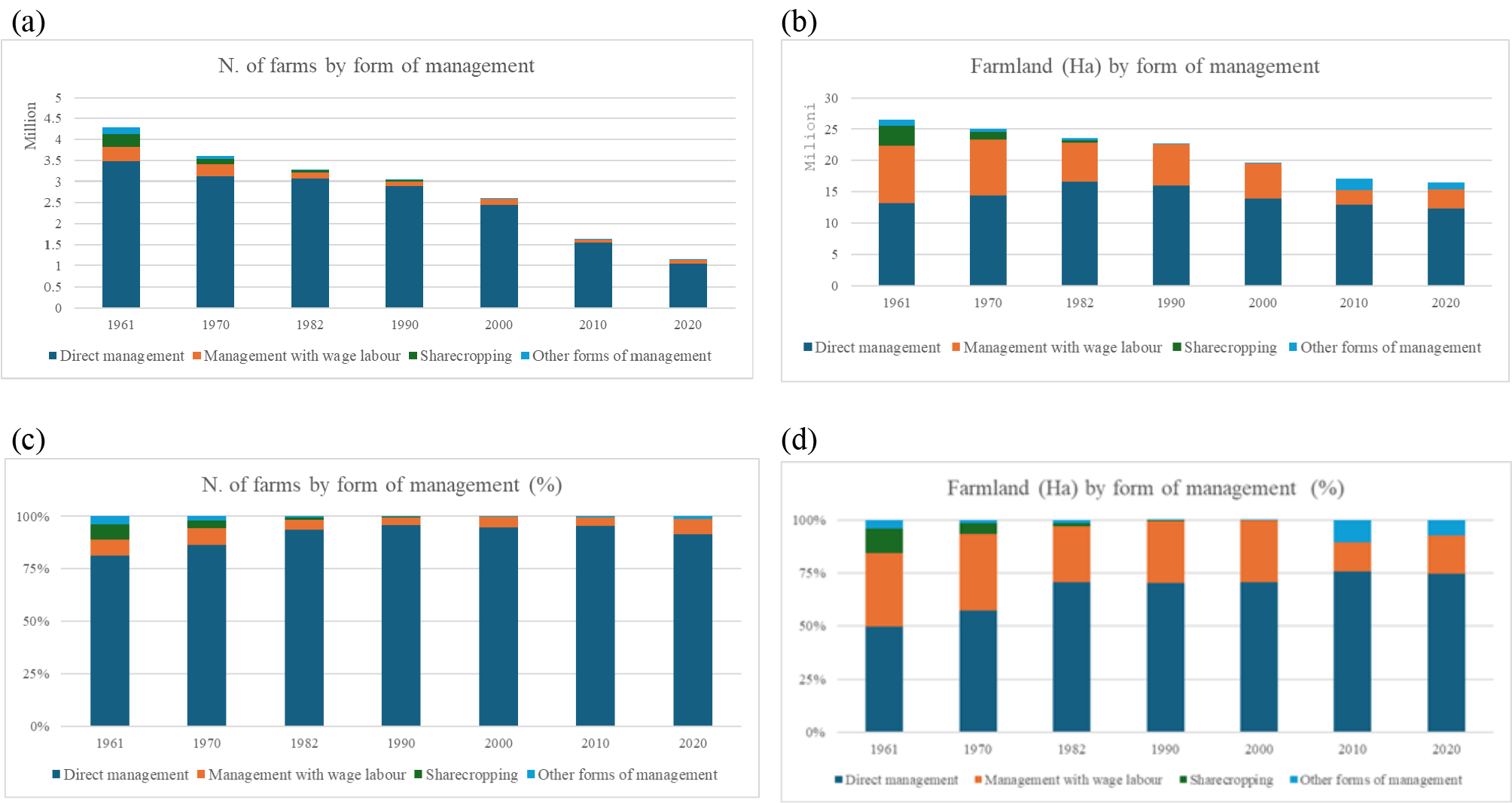
Later census data from 1961 to 2020 are summarised in Table 5 and reported graphically in Figure 2.
| Form of management | CENSUS 1961 | CENSUS 1982 | CENSUS 2000 | CENSUS 2010 | CENSUS 2020 | ||||||||||||||
|---|---|---|---|---|---|---|---|---|---|---|---|---|---|---|---|---|---|---|---|
| Farms | Farmland (ha) | Farms | Farmland (ha) | Farms | Farmland (ha) | Farms | Farmland (ha) | Farms | Farmland (ha) | ||||||||||
| Direct management | 3,485,968 | 13,218,237 | 3,063,010 | 16,597,798 | 2,457,960 | 13,868,478 | 1,546,507 | 12,927,680 | 1,047,976 | 12,298,323 | |||||||||
| Management with wage labour | 330,060 | 9,158,660 | 152,250 | 6,209,702 | 132,935 | 5,706,993 | 66,490 | 2,323,913 | 81,679 | 3,029,486 | |||||||||
| Sharecropping | 316,549 | 3,125,536 | 39,550 | 389,274 | 1,487 | 17,242 | - | - | - | - | |||||||||
| Other forms of management | 161,347 | 1,069,132 | 15,750 | 363,150 | 708 | 14,381 | 7,887 | 1,829,506 | 16,059 | 1,197,664 | |||||||||
| Total | 4,293,924 | 26,571,665 | 3,270,560 | 23,559,924 | 2,593,090 | 19,607,094 | 1,620,884 | 17,081,099 | 1,145,714 | 16,525,473 | |||||||||
| Form of management | CENSUS 1961 | CENSUS 1982 | CENSUS 2000 | CENSUS 2010 | CENSUS 2020 | ||||||||||||||
| Farms | Farmland (ha) | Farms | Farmland (ha) | Farms | Farmland (ha) | Farms | Farmland (ha) | Farms | Farmland (ha) | ||||||||||
| Direct management | 81% | 50% | 94% | 70% | 95% | 71% | 95% | 76% | 91% | 74% | |||||||||
| Management with wage labour | 8% | 34% | 5% | 26% | 5% | 29% | 4% | 14% | 7% | 18% | |||||||||
| Sharecropping | 7% | 12% | 1% | 2% | 0% | 0% | - | - | - | - | |||||||||
| Other forms of management | 4% | 4% | 0% | 2% | 0% | 0% | 1% | 11% | 1% | 7% | |||||||||
| Total | 100% | 100% | 100% | 100% | 100% | 100% | 100% | 100% | 100% | 100% | |||||||||
| Source: our elaboration on ISTAT data. | |||||||||||||||||||
The data reveal that family farms were clearly prevalent in terms of farmland ownership, despite the emergence of self-employed agricultural entrepreneurs, such as professional agricultural entrepreneurs and similar subjects. Taken together, these latter categories represent a sort of tax-exempt category both within the agricultural sector and compared with other small self-employed entrepreneurs in the manufacturing and service sectors, which are instead subject to personal taxation systems.
Furthermore, data on employment in the agricultural sector by labour positions as identified in the ISTAT national accounts (and broken down by labour units and hours worked) indicate an agricultural sector where self-employed workers predominate (Table 6).
| Crop and animal production, hunting and related services | 2011 | 2013 | 2015 | 2017 | 2020 | 2021 |
|---|---|---|---|---|---|---|
| AWU (annual working units) – total | 969,074 | 992,157 | 853,686 | 830,000 | N/A | N/A |
| AWU (annual working units) – employees | 185,946 | 206,635 | 196,921 | 172,000 | N/A | N/A |
| Employees (000) | N/A | 407.5 | 423.8 | 449.3 | 453.5 | 453.4 |
| Self-employed workers (000) | N/A | 463.7 | 461.2 | 443.8 | 423.6 | 415.9 |
| Internal income from employment (millions of €) | 6,643.6 | 6,770.5 | 7,564.7 | 8,116.2 | 8,679.8 | 9,010.2 |
| Employee remuneration - net of contributions (millions of €) | 5,407.9 | 5,588.4 | 6,223.3 | 6,642.5 | 7,125.7 | 7,369.7 |
| Hours of employment (000) | 658,315.9 | 644,644.7 | 673,917.1 | 727,506.6 | 717,818.4 | 741,436.6 |
| Employees estimated average hourly wage (€/h) | 8.2 | 8.7 | 9.2 | 9.1 | 9.9 | 9.9 |
| Employees estimated average income (€/per capita) | N/A | 1,582.0 | 1,590.2 | 1,619.2 | 1,582.8 | 1,635.3 |
| Self-employed working hours (000) | 1,627,075.0 | 1,548,560.2 | 1,614,245.5 | 1,562,139.3 | 1,484,639.9 | 1,531,523.9 |
| Estimated self-employment incomes (millions of €) | 13,366.0 | 13,424.4 | 14,906.8 | 14,263.1 | 14,737.8 | 15,223.0 |
| Estimated self-employment average income (€/per capita) | N/A | 28,950.6 | 32,321.7 | 32,138.6 | 34,791.9 | 36,602.5 |
| Total working hours (000) | 2,285,390.9 | 2,193,204.9 | 2,288,162.6 | 2,289,645.9 | 2,202,458.3 | 2,272,960.5 |
The table also shows that the annual work units (AWUs) of employees in the primary sector represent approximately one-fifth of the total number of AWUs in the period 2011–2017. Moreover, their hours of employment represent approximately one-third of the total number of working hours from 2020–2021.
Therefore, the taxation of agricultural incomes under the current cadastral system neglects the remaining amount (i.e., two-thirds) of working hours, thus excluding self-employment income in the agricultural sector. In this context, self-employed workers in agriculture are also the main beneficiaries of the income support offered by the first pillar of the Common Agricultural Policy (CAP), which results in a high level of transfer inefficiency (Ciliberti et al., 2022). In this regard, importantly, the selection of cadastral quantification for entrepreneurial income was, at the time, a political choice. Cadastral incomes do not reflect actual incomes, as they are the result of political decisions made almost a century ago (1939) in an entirely different economic context (where the Common Agricultural Policy had not yet been launched).
Moreover, the revision of the civil law system (introduced by Legislative Decree N. 228/2001 on the orientation and modernisation of the agricultural sector) has not been followed by a real harmonisation of the taxation process. In fact, the taxable incomes stemming from all the so-called “connected” activities in agriculture (i.e., processing and/or selling of agri-food products) have mostly been incorporated within the traditional agrarian taxable amount.
Because of the lack of tax harmonisation, a substantial difference in tax treatment persists for the following reasons:
– Agricultural activities recognised as such for civil law purposes but not for tax purposes.
– Agricultural activities absorbed by the agrarian cadastral taxable amount.
– Other agricultural activities that, although recognised for tax purposes as agricultural activities, are not absorbed by the cadastral taxable amount and whose taxable income is determined at a diversified flat rate.
– Agricultural activities that do or do not require the presence of instrumental inputs and that are subject to both separate taxation and the Italian tax for indivisible public services (i.e., TASI, acronym of tributo per i servizi indivisibili)19; and
– Agricultural land that, to all intents and purposes, is an instrumental asset, subject or not subject to the land tax (IMU) according to its altitude and the entrepreneurial subject that holds it.
Apart from the activities “connected” to agriculture, which are not absorbed by the cadastral taxable amount, the main distorting element of taxation in agriculture is how cadastral rates are determined. Indeed, they still tend to be used as a tax base with differentiated multiplier coefficients that are logically disconnected from both the reality and the structural changes that agriculture has undergone since the last revision of the cadastral rates.
As already mentioned, for the purposes of determining the taxable cadastral value, cadastral income is currently increased by different coefficients depending on whether the owner is an agricultural entrepreneur or a family farmer and/or a professional agricultural entrepreneur. However, such a differentiation does not appear logical in terms of tax consistency. Farmland income constitutes, in fact, the taxable base of land capital alone, which is deployed in a virtually identical manner by the various types of entrepreneurs subject to taxation. In contrast, the distinctive elements that differentiate these types of entrepreneurs are the prevalence of time spent and/or income earned from agricultural activities. However, counterintuitively, this latter aspect does not contribute to determining the taxable amount.
4.3. Effects of income dynamics in agriculture
The 1939 revision of the land valuations focused on the determination of land rent, which was deduced from units of production considered homogeneous and representative in terms of the production type and system. It follows that cadastral land taxation measures a differential of land income resulting from the use of production factors, which are barely in line with the reality of production or the changes introduced by agricultural policies since 1978 (Ceccaroni Cambi Voglia and Venzi, 1997).
Some statistical data taken from ISTAT national accounts (Table 7) clarify whether the system of cadastral income determination is detached from reality and from the level of capital income it should measure to properly achieve the goal of fiscal equalisation.
| Item | 2011 | 2012 | 2013 | 2014 | 2015 | 2016 | 2017 | 2018 | 2019 | 2020 | 2021 | Average | |||||||
|---|---|---|---|---|---|---|---|---|---|---|---|---|---|---|---|---|---|---|---|
| Gross saleable production (current values, production in constant prices) | 52,296.7 | 54,266.3 | 57,020.3 | 54,319.0 | 55,460.6 | 53,466.80 | 55,781.20 | 56,944.80 | 57,124.80 | 56,711.80 | 60,660.10 | 55,822.9 | |||||||
| Variable costs (gross saleable production – value added in constant prices) | 24,156.7 | 24,996.2 | 25,174.1 | 24,499.0 | 24,087.4 | 23,668.50 | 24,369.10 | 25,410.50 | 25,702.30 | 26,130.00 | 28,978.80 | 25,197.5 | |||||||
| Wages (employee income) | 6,643.6 | 6,858.1 | 6,770.5 | 7,145.4 | 7,564.7 | 7,777.20 | 8,116.20 | 8,292.70 | 8,442.30 | 8,679.80 | 9,010.20 | 7,754.6 | |||||||
| Self-employment income (estimated) | 1,3366.0 | 13,281.8 | 13,424.4 | 14,190.9 | 14,906.7 | 14,654.28 | 14,263.12 | 14,372.51 | 14,919.07 | 14,737.85 | 15,222.98 | 14,303.6 | |||||||
| Depreciation of plant and equipment | € 4,653.2 | € 4,791.5 | € 4,686.6 | € 4,676.1 | € 4,696.3 | € 4,673.3 | € 4,786.5 | € 4,944.9 | € 5,134.6 | € 5,090.1 | € 5,365.2 | € 4,863.5 | |||||||
| Depreciation of multiannual crops | € 347.1 | € 340.7 | € 331.8 | € 344.1 | € 343.5 | € 347.6 | € 346.1 | € 338.9 | € 335.9 | € 327.9 | € 339.6 | € 340.3 | |||||||
| Depreciation of farm buildings, fixed equipment and land improvements | € 6,331.2 | € 6,291.0 | € 6,171.4 | € 6,044.4 | € 5,917.4 | € 5,806.3 | € 5,739.8 | € 5,730.6 | € 5,639.5 | € 5,564.8 | € 5,727.6 | € 5,905.8 | |||||||
| Capital income | -€ 3,201.1 | -€ 2,293.0 | € 461.5 | -€ 2,581.0 | -€ 2,055.5 | -€ 3,460.4 | -€ 1,839.6 | -€ 2,145.3 | -€ 3,048.9 | -€ 3,818.6 | -€ 3,984.3 | -€ 2,542.4 | |||||||
| Interest on advance capital (2% for 6 months) | € 421.3 | € 432.8 | € 369.6 | € 427.1 | € 426.1 | € 422.7 | € 433.6 | € 447.2 | € 452.5 | € 457.9 | € 494.2 | € 435.0 | |||||||
| Interest on inventories (2%) | 1,752.7 | 1,735.1 | 1,677.4 | 1,629.6 | 1,585.1 | 1,549.37 | 1,539.49 | 1,548.20 | 1,546.84 | 1,525.62 | 1,583.58 | 1,606.6 | |||||||
| Farmland income | -€ 5,375.2 | -€ 4,460.9 | -€ 1,585.5 | -€ 4,637.7 | -€ 4,066.7 | -€ 5,432.5 | -€ 3,812.7 | -€ 4,140.7 | -€ 5,048.3 | -€ 5,802.2 | -€ 6,062.1 | -€ 4,584.0 | |||||||
| Wages for managerial activity (2% of production value) | 1,045.9 | 1,085.3 | 1,140.4 | 1,086.3 | 1,109.2 | 1,069.34 | 1,115.62 | 1,138.90 | 1,142.50 | 1,134.24 | 1,213.20 | 1,116.5 | |||||||
| Agrarian income | € 3,220.0 | € 3,253.3 | € 3,187.4 | € 3,143.1 | € 3,120.5 | € 3,041.4 | € 3,088.7 | € 3,134.3 | € 3,141.9 | € 3,117.8 | € 3,291.0 | € 3,158.1 | |||||||
| Cadastral taxable income | -€ 2,155.2 | -€ 1,207.7 | € 1,601.9 | -€ 1,494.6 | -€ 946.3 | -€ 2,391.0 | -€ 724.0 | -€ 1,006.4 | -€ 1,906.4 | -€ 2,684.4 | -€ 2,771.1 | -€ 1,425.9 | |||||||
| Source: our elaboration on ISTAT data. | |||||||||||||||||||
The analysis demonstrates the inability of the cadastral system to measure the contributory and earning capacity of the agricultural production sector. In the absence of EU contributions in the form of income compensation, the earning capacity of the sector is characterised by negative capital income as a whole and by a significant share of self-employment income that the cadastral system, as it was conceived, is unable to consider and tax.
Furthermore, Table 8 shows the results of another analysis based on data taken from national accounts for the period 2011–2021. The findings show that, over the period observed, the production sector generated an average annual taxable income estimated at 14.738 million Euro. This latter is mostly determined by the self-employment income of farm owners and/or their unpaid or non-transparently remunerated assistants. In other words, these results show that the primary sector is able to generate significant labour and capital income that is generally not subject to taxation, confirming previous evidence from Coletta et al. (2009). Moreover, this economic performance further improves when the value of income financial support under the first pillar of the CAP is considered.
| Items | 2011 | 2012 | 2013 | 2014 | 2015 | 2016 | 2017 | 2018 | 2019 | 2020 | 2021 | Average | |||||||
|---|---|---|---|---|---|---|---|---|---|---|---|---|---|---|---|---|---|---|---|
| Gross saleable production (current values, production in constant prices) | 52,296.7 | 54,266.3 | 57,020.3 | 54,319.0 | 55,460.6 | 53,466.8 | 55,781.2 | 56,944.8 | 57,124.8 | 56,711.8 | 60,660.1 | 55,822.9 | |||||||
| Variable costs (gross saleable production – value added in constant prices) | 24,156.7 | 24,996.2 | 25,174.1 | 24,499.0 | 24,087.4 | 23,668.5 | 24,369.1 | 25,410.5 | 25,702.3 | 26,130.0 | 28,978.8 | 25,197.5 | |||||||
| Value added (VA) | 28,140.0 | 29,270.1 | 31,846.2 | 29,820.0 | 31,373.2 | 29,798.3 | 31,412.1 | 31,534.3 | 31,422.5 | 30,581.8 | 31,681.3 | 30,625.4 | |||||||
| Wages (employee income) | 6,643.6 | 6,858.1 | 6,770.5 | 7,145.4 | 7,564.7 | 7,777.2 | 8,116.2 | 8,292.7 | 8,442.3 | 8,679.8 | 9,010.2 | 7,754.6 | |||||||
| Social contributions payable by the tenant and family members | 1,574.0 | 1,653.0 | 1,694.0 | 1,778.0 | 1,735.0 | 1,735.0 | 1,735.0 | 1,735.0 | 1,735.0 | 1,735.0 | 1,735.0 | 1,713.1 | |||||||
| Gross operating margin (GOM) | 19,922.4 | 20,759.0 | 23,381.7 | 20,896.6 | 22,073.5 | 20,286.1 | 21,560.9 | 21,506.6 | 21,245.2 | 20,167.0 | 20,936.1 | 21,157.7 | |||||||
| Gross operating surplus | 24,728.9 | 25,572.9 | 28,044.0 | 25,412.7 | 26,629.4 | 24,780.5 | 26,005.2 | 25,829.4 | 25,518.2 | 24,447.1 | 25,177.8 | 25,649.6 | |||||||
| Depreciation | 11,872.8 | 11,941.9 | 11,675.6 | 11,517.9 | 11,398.1 | 11,245.4 | 11,274.0 | 11,400.2 | 11,494.5 | 11,346.6 | 11,796.7 | 11,542.2 | |||||||
| Taxable income | 12,856.1 | 13,631.0 | 16,368.4 | 13,894.8 | 15,231.3 | 13,535.1 | 14,731.2 | 14,429.2 | 14,023.7 | 13,100.5 | 13,381.1 | 14,107.5 | |||||||
| Subsides from CAP First Pillar in Italy | 4,806.5 | 4,813.9 | 4,662.3 | 4,516.1 | 4,555.9 | 4,494.4 | 4,444.3 | 4,322.8 | 4,273.0 | 4,280.1 | 4,241.7 | 4,491.9 | |||||||
| Source: our elaboration on ISTAT data. | |||||||||||||||||||
All in all, the findings confirm previous evidence that the Italian land cadastre provides a tax base that is inadequate vis à vis the current profitability framework of the agricultural sector (Colombo, 2003; Pierri, 2015). Additionally, the inadequacy of the IRPEF levy from cadastral-determined entrepreneurial income in comparison to the increasing amount of farmland managed by individuals who are self-employed in agriculture supports the argument of an excessive benevolence of the national fiscal authorities regarding agriculture.
To achieve transparency and better equalise the taxation system in agriculture, it would be necessary to shift to the evaluation of forms of taxation of both capital income and self-employment income in agriculture to reveal other tax bases often hiding forms of exploitation and undeclared work in agriculture20. Currently, however, the fiscal irrelevance for agricultural companies of the cost of fixed-term dependent labour and/or seasonal workers does not allow undeclared work in agriculture to be discovered, with negative consequences in terms of social security contributions and taxable incomes.
4.4. Effects of the dynamics of land values in agriculture
Finally, another fundamental aspect relates to the use of farmland income rates to define land values for inheritance and the IMU tax base for land in no mountainous and disadvantaged areas held by nonexempt persons (provided that they operate in the agricultural production sector).
The proliferation of differentiated coefficients and the corporatisation of tax policies have led to objective criticism for at least two reasons:
– The tax bases of the different indirect taxes for determining land values are incomprehensibly differentiated, and
– The cadastral incomes are determined by differential classes of merit, which were conceived in 1937–39, without considering the evolution of technologies in the current economic context.
The consistency between the cadastral value and the value of agricultural land is shown in Table 9, where, for the best arable land in Umbria (belonging to the same homogeneous agricultural region in municipalities bordering the Tiber Valley), we compared the following:
| Crop quality | Umbria - municipalities – Homogeneous agricultural region n. 7 (2021–2022) | Class | Farmland income (1978/79) – [A] | IMU tax base [A*1.25.135] | Tax base for inheritance tax [A*112.5] | Agricultural values (Umbria Region – 2023) | IRPEF tax base – Farmland income (landowners) [A*1.8*1.3] | IRPEF tax base – Farmland income (family farmers and professional agricultural entrepreneurs) [A*1.8] | Rents | ||||||||||
|---|---|---|---|---|---|---|---|---|---|---|---|---|---|---|---|---|---|---|---|
| Irrigated arable crop | Bastia | 1 | 90.4 | 15,251.62 | 10,167.7 | 25,000 | 211.5 | 162.7 | 750.0 | ||||||||||
| Bastia | 2 | 72.3 | 12,201.29 | 8,134.2 | 22,000 | 169.2 | 130.1 | 600.0 | |||||||||||
| Cannara | 1 | 72.3 | n.a. | 8,134.2 | 25,000 | 169.2 | 130.1 | 750.0 | |||||||||||
| Deruta | U | 82.6 | n.a. | 9,296.2 | 25,000 | 193.4 | 148.7 | 750.0 | |||||||||||
| Torgiano | U | 82.6 | n.a. | 9,296.2 | 25,000 | 193.4 | 148.7 | 750.0 | |||||||||||
| Bettona | U | 82.6 | n.a. | 9,296.2 | 25,000 | 193.4 | 148.7 | 750.0 | |||||||||||
| Average value | : | : | 80.5 | : | 9,054.1 | 24,500 | 188.3 | 144.9 | 725.0 | ||||||||||
| Arable crop | Bastia | 1 | 74.9 | 12,637.05 | 8,424.7 | 18,000 | 175.2 | 134.8 | 400.0 | ||||||||||
| Bettona | 1 | 61.9 | n.a. | 6,972.2 | 18,000 | 145.0 | 111.6 | 455.0 | |||||||||||
| Cannara | 1 | 61.9 | n.a. | 6,972.2 | 18,000 | 145.0 | 111.6 | 450.0 | |||||||||||
| Deruta | 1 | 61.9 | n.a. | 6,972.2 | 18,000 | 145.0 | 111.6 | 450.0 | |||||||||||
| Torgiano | 1 | 61.9 | n.a. | 6,972.2 | 18,000 | 145.0 | 111.6 | 450.0 | |||||||||||
| Average value | : | : | 64.6 | : | 7,262.9 | 18,000 | 151.1 | 116.2 | 441.0 | ||||||||||
| Arable crop | Bastia | 2 | 56.8 | 8,589.71 | 6,391.2 | 16,000 | 132.9 | 102.3 | 350.0 | ||||||||||
| Bettona | 2 | 46.5 | n.a. | 5,229.1 | 16,000 | 108.8 | 83.7 | 350.0 | |||||||||||
| Cannara | 2 | 46.5 | n.a. | 5,229.1 | 16,000 | 108.8 | 83.7 | 400.0 | |||||||||||
| Deruta | 2 | 46.5 | n.a. | 5,229.1 | 16,000 | 108.8 | 83.7 | 350.0 | |||||||||||
| Torgiano | 2 | 46.5 | n.a. | 5,229.1 | 16,000 | 108.8 | 83.7 | 300.0 | |||||||||||
| Average value | : | : | 48.6 | : | 5,461.5 | 16,000 | 113.6 | 87.4 | 350.0 | ||||||||||
| n.a. = not applied. | |||||||||||||||||||
| Source: Our elaboration on ISTAT data, CREA (2025) and the Regional Expropriation Commission for Umbria (2022). | |||||||||||||||||||
– The tax value determined based on the farmland income, multiplied by differentiated coefficients for the purposes of paying property taxes (i.e., IMU) and for the purposes of declaring mortgage, cadastral and inheritance taxes.
– The regional agricultural values for the calendar year 2023, determined by the Regional Expropriation Commission.
– The unit taxable value of the farmland income for the corresponding crop quality, revalued in a differentiated manner and used for the purposes of paying income tax by both landowners and those classified as family farmers or professional agricultural entrepreneurs.
The comparison between tax values and the prudential reference values determined by the Regional Expropriation Commission revealed a significant undervaluation of the tax value for inheritance purposes compared with the value of the land (with differences ranging from €10,000 to €15,000 per hectare, compared with an average land value of approximately €20,000 per hectare). This phenomenon causes a generalised benefit for all land ownership, regardless of the form of management. These results are perfectly in line with those of Agosta et al. (2022) and Asciuto et al. (2008), who reported that tax values were consistently lower than market prices in Sicily. Empirical evidence therefore confirms a considerable discrepancy between these two economic parameters due to the erroneous quantification of the multiplier coefficients used to calculate tax values from the revalued farmland incomes.
To summarise the phenomena under investigation, Figure 3 - Panel a shows that taxes due by landowners, dedicated to the mere management of land assets on the plains benefitting from rents, are established based on a taxable income defined on a cadastral basis, which, for the plains of Umbria, is, on average, equal to 30% of the rent. Conversely, family farmers and professional agricultural entrepreneurs pay taxes on land taxable income that is defined on a cadastral basis, which corresponds, on average, to 23% of the use value of land (i.e., the ordinary rent) of the land owned for representative irrigated arable crops in Umbrian plain areas.
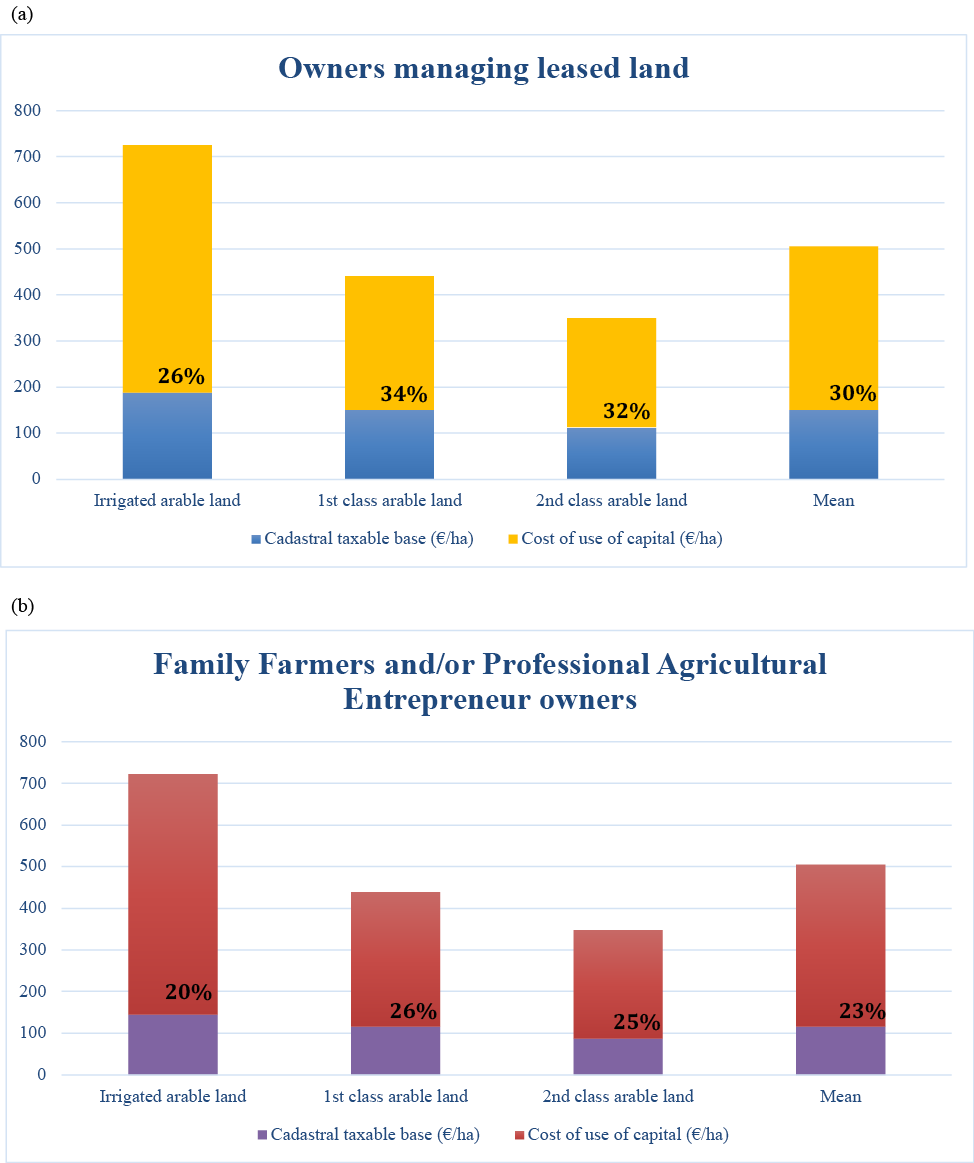
Moreover, in both cases, in the case of mortis causa succession, family farmers and professional agricultural entrepreneurs pay cadastral, mortgage and inheritance taxes based on a taxable income defined on a cadastral basis that ranges from 37–41% of the normal agricultural value for irrigated plain land in Umbria. Thus, the discrepancy between the cadastral taxable amount and the normal value reduces the taxation of both cadastral mortgage taxes and transferred assets.
In other EU countries, the levy on income in the agricultural sector for tax purposes is quite similar to those in other economic sectors. It differs in some cases for flat-rate systems by type of enterprise; the only state that continues to adopt the cadastral system for determining direct taxes is Italy (Seroglia, 2003).
Table 10 summarises the different regimes for determining the tax bases for some EU countries in relation to personal income taxation and wealth, inheritance and registration taxes.
| Country | Income tax | Property tax | Inheritance tax | Tax on real estate transaction (registration tax) | |||||||||||||||
|---|---|---|---|---|---|---|---|---|---|---|---|---|---|---|---|---|---|---|---|
| Austria | Incomes – Flat rate for small enterprises | Cadastral value | Cadastral value | Market value | |||||||||||||||
| Belgium | Incomes | N/A | Market value and cadastral value | Market value | |||||||||||||||
| Denmark | Incomes | Market value | Market value | N/A | |||||||||||||||
| Finland | Incomes | Market value | Conventional value | Market value | |||||||||||||||
| France | Incomes | Cadastral value | Market value with benefits for agriculture | Market value with benefits for agriculture | |||||||||||||||
| Germany | Incomes – Flat rate for small enterprises | Conventional value | Conventional value | Market value with benefits for agriculture | |||||||||||||||
| Greece | Incomes | N/A | N/A | Market value | |||||||||||||||
| Italy | Cadastral value | Cadastral value with benefits for agriculture | Cadastral value | Market value with subsidised rates | |||||||||||||||
| The Netherlands | Incomes | Market value | Market value | Market value | |||||||||||||||
| Portugal | Incomes – Flat rate for small enterprises | Market value | Cadastral value | Market value | |||||||||||||||
| Spain | Incomes | N/A | Market value (if higher than cadastral value) | Market value (if higher than cadastral value) | |||||||||||||||
| Sweden | Incomes | N/A | Market value | Market value | |||||||||||||||
| Source: own elaboration on Cristofaro (1997; 2017) and van der Veen et al. (2007) – N/A: information not available. | |||||||||||||||||||
What emerges is that, except in the case of the VAT, for which there is currently a certain degree of uniformity in Europe owing to harmonisation policies, the structure of the individual taxes is diversified across the EU countries under analysis. However, taxation in agriculture is predominantly oriented towards normal cost and revenue regimes and is not differentiated from taxation in other production sectors.
The case of taxes on assets or on the transfer of real estate rights is different; however, cadastral or conventional values offer a useful reference for simplifying the determination of the taxable amount subject to levies. One interesting case is represented by the Austro-Hungarian cadastre (called the “property tax cadastre”), from which Italy derived its cadastral system of assessment and determination of the land valuation rate. It lost its initial function of reference for the calculation of the Austrian property tax in 1968 due to fiscal reforms. In this case, the so-called Einheitswert, or “Austrian cadastral value,” is adopted to calculate the tax base for property taxes. Specifically, it has been updated to 1 January 2023 for agricultural and forestry property and attached business premises. Moreover, for indirect taxes, the Einheitswert is used only in the case of land transfers to direct descendants, ascendants, and relatives and in the case of inheritance; in all other cases, the taxable amount is determined by the actual amount paid.
Finally, the table reveals that incomes from agricultural activity are taxed based on profits, even if in different ways.
5. Final considerations and recommendations
Originally, cadastral incomes were introduced to simplify the taxation process for those working in the agricultural sector by assigning an ordinary income for specific territorial districts and types of farming. These incomes were intended to remain stable for long periods (at least 10 years). However, such an approach based on average sectoral income does not fit with the characteristics of the current Italian agricultural context, which is largely multifaceted and where profitability increasingly depends more on business models (including or not directly processing and selling agricultural products or providing a wide range of services) than on types of farming and geographical location. In detail, several limitations of the Italian cadastral system as an instrument for measuring land and business incomes emerged throughout this work, which can be summarized as follows:
– The structural data of agricultural holdings by type of management confirmed the predominance of direct management across farms. This fact is also proven in numerical terms by the distribution of VAT returns by turnover class and type of enterprise. Thus, the determination of business income through the cadastral taxable amount brought to the exclusion from any form of taxation of those incomes earned by self-employed agricultural entrepreneurs (either landowner or tenant).
– The analysis of national accounts for the period 2011-2021 showed that the agricultural sector generated an estimated annual taxable income of around €15 billion on average, mainly determined by the self-employment income of farm owners and their families, which is not subject to any form of taxation.
– Farm incomes have not grown uniformly across the different regions of the country since the revision of the cadastral valuations for the land cadastre in 1978–79. Thus, no plausible argument can still support the hypothesis of a revision of the tax base linked to the application of multiplier coefficients rather than to a comprehensive revision of the taxation system based on the results of accurate business studies.
– The decision to tax the agricultural sector through systems based on average ordinary incomes has led over time to a significant divergence between cadastral income values and market values, because of the inadequacy of both the multiplier coefficients and the cadastral rents vis à vis the profound changes that have taken place in Italian agriculture over the last 50 years.
– A comparison between agricultural values, ordinary rents and the current taxable base for farmland income has highlighted how it is undeniable that the system of taxation of land income on a cadastral basis leads to a significant erosion of the taxable base for both direct and indirect taxes in agriculture.
– Even if one were to opt for a taxation system that is not personal and progressive but real and proportional, the schemes and valuation techniques of the 1939 land cadastre are certainly not reproducible.
Overall, there is a clear mismatch between property taxation and business income taxation, which makes the distinction between farmland and agrarian income anachronistic. The results confirm previous evidence (Abbozzo, 1984; Lechi, 1993; Lechi and Segale, 1998; Guerrieri, 2003) and highlight that agricultural production is carried out by less than one-quarter of the farms surveyed by ISTAT and that the tax system is detached from this reality.
Therefore, the limitations of the cadastral system should lead to its abandonment as an instrument for defining ordinary average incomes as a tax base for direct taxes (Ribaudo, 1995; Schifani, 1985). However, the land cadastre could maintain its civil functions by guaranteeing historical cadastral continuity and the subjective and objective variations indispensable for ascertaining property rights (Agosta et al., 2022). Similarly, it could retain the function of determining conventional and/or cadastral reference values as a tax base for indirect taxes, similar to what has been done in other European countries (e.g., Austria).
5.1. Recommendations and pending questions
To achieve such a reform of the Italian cadastral system, the Italian Revenue Agency should concentrate its human resources and expertise on the following steps:
– Review and update crop qualities with a considerable simplification of the cartographic representation for the cadastral base;
– Create a cadastral map and census of territories characterised by conditions of economic marginality and affected by environmental constraints, where the priorities of land protection and conservation should reduce the taxable land value;
– Set up a ‘Land Value Survey Agency’ that can provide a public database of agricultural land property values, which would fill a crucial gap in the valuation activities of both public and private entities; and
– Implement a system of ‘conventional cadastral values’ to be used as a tax base for indirect taxes on transfers, inheritances and other land taxes that currently use cadastral incomes as a tax base.
The use and implementation of the information already existing in the databases (such as land values and rents and agricultural values), together with the experience and data held by the Italian Revenue Agency, could be instrumental in achieving such an objective.
In contrast, owing to political pressure from agricultural stakeholders, the recent enabling act on tax reform21 does not seem to address these issues. In addition, any attempt to reform the status quo could face strong resistance, such as in the case of the recent protest by farmers, unless an inclusive and shared process of redesigning taxation in this sector is promoted. Consequently, the cadastral system still represents an instrument for the real tax measurement of agrarian income and provides for generic changes in the determination of agrarian income, even though it is no longer able to provide any reliable measure of business income. In this regard, it is worth considering the provisions of the Legislative Decree 192/2024 (clarified by the Revenue Agency in Circular 12/E of 8 August 2025), which extended taxation based on agricultural income to more advanced cultivation systems (such as the production of vegetables in vertical farms as well as hydroponic crops), as they are considered related to agricultural activities.
Unsurprisingly, the decision to keep the criteria for determining the tax bases of the agricultural sector unchanged, without adapting them to the structural changes that agriculture has undergone over the last 70 years, has generated a tax system contradicting constitutional objectives related to general taxation. At the extreme, given the total tax revenue from direct taxes and the IMU currently derived from agricultural taxation, one might even consider a complete abolition of direct taxation in agriculture.
However, over several decades, various actors have proposed the definitive abandonment of agricultural values and rents and their replacement with a real property taxation system with its tax base anchored to market value. Another proposal is the definitive abandonment of agrarian income in the determination of agricultural business income and its replacement with a personal budget-type taxation system. However, although income based on balance sheets should theoretically be used, the lack of an effective and cost-efficient control system, even in other economic sectors, has led to the use of flat-rate taxation methods and synthetic income indicators developed to facilitate control by authorities. In any case, the taxation of land income must be distinguished from the taxation of income from agricultural activities, as these two types of income are clearly distinct.
With respect to the taxation of land income, the shift to a cadastre of values would make it possible to define simplified taxation systems based on equalised values in relation to the rate of return on land capital. Despite the extreme fragmentation of Italian agriculture, the liberalisation of agricultural land rents since 2001 and the traceability of means of payment in land purchases and sales since 2006 have contributed to the emergence of widespread exchange prices.
These considerations do not provide immediate justification for the increase in taxation and/or a transition towards a taxation of actual income: in fact, the tax system responds not only to revenue objectives, but also to economic policy choices aimed at supporting particular sectors of economic activity, especially for small businesses operating in disadvantaged areas. In an asset-oriented tax system, the equalisation of the taxation of land income could be achieved with a single tax for all taxpayers (through appropriate levels of exemption or reduction in relation to marginality conditions and territorial constraints) and a deductible tax only for agricultural enterprises that use real estate as a capital asset and opt for balance sheet taxation. To determine incomes, one could consider forms of balance sheet taxation for businesses with turnovers and asset values above a certain threshold while allowing simplified forms of taxation for other agricultural entrepreneurs (with certain taxable income rates in relation to the turnover of agricultural activities, as is already the case for related agricultural activities). Like the ‘flat-rate or minimum tax regime’ (known in Italy as ‘regime forfetario’) for professionals, artisans and traders that has been implemented since 2015, this type of regime may be introduced with differentiated turnover thresholds for agricultural entrepreneurs. However, some doubts remain which would require further research and evaluations, such as: would such a regime be really applied in the agricultural sector? If yes, with what consequences? And, also, would it be enforceable by the public body responsible for monitoring and assessing taxable income?
Overall, any attempt to reform and enhance the current taxation systems for agricultural incomes should certainly consider the high level of diversity of Italian agriculture, where some farms generate high incomes, whereas others would likely be overwhelmed by increased tax burdens. Therefore, some relevant issues deserve attention, such as the eligibility requirements for an income tax based on balance sheets or updated conditions for those who could benefit from tax exemptions and concessions in the agricultural sector. It follows that policymakers, public authorities and administrations should rigorously address the fundamental issue related to the identification of those to be considered and defined as “farmers for tax purposes”. Additionally, given that the agricultural sector traditionally receives substantial public funding from the CAP, which in many internal and low-productivity areas represents a large share of farm income, policymakers and public authorities could consider whether it is more reasonable for taxpayers or society to invest additional resources (and transition costs) in developing a more efficient and effective agricultural taxation system rather than simply managing a reduction in income support levels. Also, at the current status, authorities and stakeholders could evaluate whether and how income support measures should be included in the taxable income, considering what are the implications of including/excluding them. Likewise, some key issues questions should finally arise around actions for a better targeting of both taxation and income support measures (namely, ‘what are the farmers still needing income support?’, and ‘should a single taxation method be adopted for all farmers?’).
However, considering some major caveats is necessary, mainly because all the analyses conducted largely relied on aggregate and secondary data, which are not able to capture the wide heterogeneity traditionally characterising the agricultural sector in Italy. Moreover, such investigations will need to be updated in the coming years, as they rely on data that are certainly not time invariant. Thus, future studies could extend the time span and adopt a territorial or specialisation approach (based on administrative regions, altimetric zones, type of farming, etc.) when performing the analyses to overcome the limitations of the current research.
This work was supported by the Italian Ministry of University and Research under the research program “PON Ricerca e Innovazione”.
Abbozzo, P. (1984). Fiscalità e Catasto [rurale in Italia]. Rivista di Economia Agraria, 39, 43–56.
Agenzia delle Entrate (2025). Glossario. Available at: https://www.agenziaentrate.gov.it/portale/web/english/nse/glossary (Accessed 9 September 2025).
Agosta, M., Di Franco, C. P., Schimmenti, E., & Asciuto, A. (2022). The Land Cadastre in Italy and some fiscal implications: a case study. Aestimum, 81, 15–38.
Antonietti, A. (1985). L’accertamento fiscale dei redditi dei terreni; aspetti economico-estimativi ed applicativi. La stima della redditività imponibile dei terreni. Atti del XV Incontro di Studio Ce.S.E.T. - La stima dei redditi e dei valori immobiliari a fini fiscali, Viterbo, 23 febbraio 1985. Aestimum.
Asciuto, A., Mandanici, S., Schimmenti, E., & Viviano, P. (2008). Conservazione del Catasto nella recente normativa nazionale. Estimo e Territorio, 6, 11–26.
Bayer, T. A. (2018). Taxation as a factor of increasing the efficiency of peasant household (homestead) farms. Economy of Agricultural and Processing Enterprises, 11, 50–60.
Bottarelli, S. (2017). La revisione del 1988: un’occasione mancata. In Cristofaro, A. (Eds.). Fisco e Agricoltura. Una difficile convivenza. Ancona, Associazione Alessandro Bartola - Collana economia applicata, vol. 17.
Ceccaroni Cambi Voglia, G. L., & Venzi, L. (1997). Una verifica della perequazione fiscale in agricoltura. Rivista di Politica Agraria, n. 3.
Ciliberti, S., Severini, S., Ranalli, M. G., Biagini, L., & Frascarelli, A. (2022). Do direct payments efficiently support incomes of small and large farms? European Review of Agricultural Economics, 49(4), 796–831. https://doi.org/10.1093/erae/jbac013
Coletta, A., Ribaudo, F., & Venzi, L. (2009). Fiscalità e catasto terreni. Atti del XXXVIII Incontro di Studio (Viterbo) “Il catasto nelle politiche di fiscalità immobiliare e di governo del territorio”, 63-100.
Colombo, G. (2003). Catasto Terreni: struttura attuale, principale normativa e problemi di utilizzazione. In Seroglia, G. (Ed.). La revisione del Catasto Terreni: contributi per un dibattito. Roma, INEA.
CREA (2017). Annuario dell’agricoltura italiana. 2015. Roma, CREA.
CREA (2023). Indagine sul mercato fondiario in Italia l’andamento dei canoni di affitto dei terreni agricoli - Rapporto regionale 2023. Available at https://www.crea.gov.it/documents/68457/0/CREA-PB+-+Rapporto+AF+2023+%281%29.pdf/1c25c6ba-a981-9f4c-b0eb-0efd333eab7c?t=1734022745342 (Accessed 25 August 2025).
CREA (2025). Esempi di valori fondiari e canoni d’affitto. Available at https://www.crea.gov.it/web/politiche-e-bioeconomia/-/indagine-mercato-fondiario (Accessed 29 August 2025).
Cristofaro, A, (1997). Le agevolazioni fiscali all’agricoltura: una valutazione quantitativa. In Sotte, F. (Ed.). Spesa pubblica e agricoltura. Ancona, CLUA.
Cristofaro, A. (2015). Per il settore agricolo privilegi fiscali assegnati senza equità. Nuova economia nuova società. Available at https://www.nens.it/archivio/il-settore-agricolo-privilegi-fiscali-assegnati-senzaequit%C3%A0 (Accessed 31 October 2025).
Cristofaro, A. (2017). Fisco e agricoltura: una difficile convivenza. Ancona, Associazione Alessandro Bartola, e Agriregionieuropa, volume 5.
Golubeva, S. G., Barinova, O. I., Shilova, I. N., Rodionova, T. G., & Malinovskaya, Y. N. (2021). The effect of taxation on the efficiency of the agricultural sector. In Nardin, D. S., Stepanova, O. V., & Kuznetsova, V. V. (Eds.). Land Economy and Rural Studies Essentials, vol 113. European Proceedings of Social and Behavioural Sciences. European Publisher, 88–95. https://doi.org/10.15405/epsbs.2021.07.12
Guerrieri, G. (2003). Considerazioni sulle proposte di accertamento fiscale dei redditi agrari. In Seroglia, G. (Ed.). La revisione del Catasto Terreni: contributi per un dibattito. Roma, INEA.
ISTAT (2010). Censimento dell’Agricoltura 2010. I.Stat e IstatData.
ISTAT (2020). Censimento dell’Agricoltura 2020. I.Stat e IstatData.
ISTAT (2025). Glossario. Available at https://www.istat.it/classificazioni-e-strumenti/glossario/ (Accessed 9 September 2025).
Kovalchuk, I., Melnyk, V., Novak, T., & Pakhomova, A (2021). Legal Regulation of Agricultural Taxation. European Journal of Sustainable Development, 10(1), 479–494. https://doi.org/10.14207/ejsd.2021.v10n1p479
Lechi, F., & Segale, A. (1993). Problemi attuali di imposizione fiscale e di valutazione delle tariffe d’estimo nel Catasto Terreni. Genio Rurale, 11.
Lechi, F. (1998). Considerazioni sull’attività di criteri e metodi utilizzati nella imposizione fiscale diretta in agricoltura. Aestimum, 35, 13–27.
Mazzocchi, G., Vassallo, M., Gabrieli, G., & Henke, R. (2024). ‘No farmers, no food’: a sentiment analysis of the 2024 farmers’ protests in Italy. Italian Review of Agricultural Economics, 79(2), 93–106. https://doi.org/10.36253/rea-15468
Medici, G. (1956). Distribuzione della proprietà fondiaria dei privati e degli enti in Italia - Distribuzione per classi di superficie. Roma, INEA.
Medici, G. (1948). Principi di Estimo. Bologna, Calderini.
Michieli, I. (1989). Trattato di estimo. Bologna, Edagricole.
Permanent Committee on Cadastre in the European Union (2009). Cadastral information system: a resource for the E.U. policies overview on the cadastral system of the E.U. member states.
Pierri, A. (2015). La riforma del catasto si dimentica dei terreni. Agriregionieuropa, 40.
Regione Umbria (2022). Bollettino ufficiale - Quadro di insieme dei valori agricoli per tipo di coltura dei terreni compresi nelle singole regioni agrarie della provincia di Perugia e Terni validi per l’anno solare 2021–2022.
Ribaudo, F. (1995). Fisco ed agricoltura. Rivista di Politica Agraria, 13(3).
Schifani, C. (1985). La stima dei valori immobiliari ai fini fiscali: aspetti metodologici ed applicativi. Atti del XV incontro Ce.S.E.T. “La stima dei redditi e dei valori immobiliari a fini fiscali”, 69–80.
Seroglia, G. (2003). La revisione del catasto terreni: contributi per un dibattito. Roma, INEA.
van der Veen, H. B., van der Meulen, H. A. B. van Bommel, K. H. M., & Doorneweert, B. (2007). Exploring agricultural taxation in Europe. The Hague, LEI.
Simonotti, M. (2008). Il metodo catastale per classi e tariffe. Estimo e Territorio, 2, 8–14.
Visco, V. (2024). Lo strumento fiscale non risolve i problemi degli agricoltori. IlSole24Ore.
Zangheri, R. (1980). Catasti e storia della proprietà terriera. Torino, Einaudi.
Zuccolo, A. (1993). La formazione del prezzo sul mercato fondiario italiano: 1961-1987. La Questione Agraria, 51, 45–64.
1 Law n. 232/2016, art. 1, paragraph 44 states that farmland and agrarian incomes are not part of the income taxation base for family farmers and professional agricultural entrepreneurs.
2 L.3682/1886: Messedaglia Law or Law of Land Equalisation, later supplemented by Law 976/1939 (Second General Revision of the Cadastre). For what concerns the estimative operations for tax purposes, it introduced the use of the company balance sheet on existing and ordinary farms and the sum of farmland and agrarian incomes as taxable income.
3 Article 2 of Law 825/1971 stated that “determination of the farmland, agrarian and building incomes (must be carried out) based on cadastral valuation rates regulated in such a way as to ensure, where possible, adherence to actual incomes, except in those cases exhaustively determined, in which the possibility of divergence and the economic characteristics of the income require direct assessment”.
4 Law n. 75/1993 Art.1-sexies.
5 Agricultural land rents are subject to the VAT exemption regime (Article 10, p. 1, n. 8 of the Presidential Decree 633/72).
6 This is also referred to as rental income or landlord income and represents the amount of income deriving from the ownership of land, regardless of what is farmed there.
7 This is the income attributed for fiscal purposes to someone – e.g., owner, householder – who uses the agricultural land.
8 This is an Italian local tax that is levied on the value of net production generated by businesses and professionals at an ordinary rate of 3.9 percent. A reduced rate of 1.9 percent applies to those in the agricultural sector. However, since 2017, farmers have been exempted from paying the IRAP, figuratively making this concession equals to 3.9% if compared with the initial ordinary rate.
9 Art. 1, paragraph 13 of the Stability Law 2017 (L 232/2016) established that “agricultural land owned and managed by family farmers and professional agricultural entrepreneurs is exempt from IMU, regardless of its location.”
10 Data regarding concessions and exemptions for the IMU (i.e., mountain and disadvantaged areas) are not publicly available to our knowledge.
11 In particular, the taxable farmland income was determined based on the current tax legislation in force according to the subjective characteristics of the taxpayer; thus:
– In the case of a landowner, the farmland income (referred to 1978/79) is revalued by 80 percent and further revalued by 30 percent, yielding a coefficient of increase equal to 2.34 (since RD *1.80 *1.30 = RD * 2.34);
– In the case where the owner is a direct cultivator or professional farmer, the farmland income (referring to 1978/79) is revalued only by 80 (RD x1.80).
12 The tax base for the IMU of agricultural land is determined equal to or greater than the farmland income multiplied by 168.75 (number obtained by applying a revaluation coefficient equal to 25% and a multiplier equal to 135). For the inheritance tax, since 2004, the tax base is determined equal to or greater than the farmland income of agricultural land multiplied by 112.50.
13 They represent individuals who are registered as holders of real estate in the Italian land register.
14 ATECO is the classification of economic activities adopted by the ISTAT for statistical purposes, i.e., for the production and dissemination of official statistical data. ATECO is the national version of the NACE nomenclature. NACE is the acronym for “Nomenclature statistique des activités économiques dans la Communauté européenne” (i.e., the “statistical classification of economic activities in the European Community”) and is the subject of legislation at the European Union level that imposes the uniform use of the classification within all Member States. The ATECO codes from 01.1–01.7 refer to the agricultural sector.
15 For limited companies, the standard tax regime is balance sheet taxation. Agricultural limited liability companies may opt for taxation on a cadastral basis (as established by paragraphs 1093–1095 of Article 1 of Law No. 296 of December 27, 2006 – Provisions for the preparation of the annual and multiyear State budget – 2007 Finance Law). Once the option has been made, then the taxpayer is bound to apply the chosen regime for at least three years (Circular 10/E 2010 Revenue Agency).
16 According to the ISTAT, turnover is defined as “[an economic measure that] includes sales of products manufactured by the enterprise, receipts for processing followed on behalf of third parties, receipts for any nonindustrial services provided to third parties (e.g., commissions, machinery rentals), sales of goods purchased in the enterprise’s own name and resold without processing, commissions and other fees for sales of goods for third parties, gross receipts from traffic and services to third parties. Turnover is required gross of all expenses charged to clients (e.g., transportation, packaging, insurance) and all indirect taxes on manufacturing, consumption, etc., except VAT invoiced to customers, net of rebates and discounts granted to customers and returned goods. Export tax refunds, interest on arrears, and interest on instalment sales are also excluded”.
17 Direct taxation on labour, professional and commercial income had been subject to mobile wealth tax since 1877 (T.U. n. 402 of 24 August 1877). By Royal Decree n. 16 of 4 January 1923, the agrarian income earned by the owner from the cultivation of his land, whether directly or under the sharecropping or tenant farming system, as well as the income of the sharecropper or tenant farmer, was subject to the taxation of mobile wealth. To facilitate its determination and with the revision of cadastral valuations in 1939, Royal Decree Law n. 589 of 4 April 1939 established agrarian income as the income from working capital and management labour and resulting from the formation of the valuation rates, excluding the income from manual labour provided by anyone. For this purpose, agrarian income rates were determined per unit area of each quality and class. These basic principles of the mobile wealth tax remained unchanged until the 1950s.
18 Source: Medici (1956).
19 The marketing and sale of agricultural products in business facilities subject to TASI and that do not fall within the same production range as the agricultural business (e.g., sale of potatoes at a fruit farm shop) are subject to separate taxation, even though they fall within the scope of the marketing and promotion of agricultural products provided for in Article 2135 of the Italian Civil Code.
20 Agriculture is widely recognised as one of the economic sectors most characterised by the phenomenon of informal or undeclared work resulting in the nonpayment or partial payment of taxes and social security contributions. This is a social problem that cyclically re-emerges despite being a subject of debate for over 50 years. Efforts to fight this issue by ministerial decree or with inspections by the National Labour Inspectorate have never proved to offer an effective solution, and the phenomenon remains widespread throughout the country and reaches critical levels in Southern Italy, where Eurispes estimated the incidence of undeclared work in agriculture at 31.7% in 2013.
21 Law No. 111/2023, Art. 5.