Integrating Spatial Analysis, Ecosystem Services and Cost Analysis for Nature-Based Solution (NBS) planning in urban contexts
1 Department of Architecture and Urban Studies (DAStU), Politecnico di Milano, Italy
2 Department of Architecture, Built Environment, and Construction Engineering (DABC), Politecnico di Milano, Italy
3 Politecnico di Torino, Italy
E-mail: giulia.datola@polimi.it, alessandra.oppio@polimi.it, marta.dellovo@polimi.it, marco.rossitti@polimi.it, danny.casprini@polimi.it, tarantino.giulia99@gmail.com, francesca.torrieri@polimi.it
*Corresponding author.
Abstract. Nature-Based Solutions (NBS) are suggested as strategies to mitigate climate change effects in urban contexts. However, cities face issues in planning with NBS due to the lack of a comprehensive evaluation framework to properly support the strategic integration of NBS in urban planning. This research aims to fill this gap by proposing a multi-step evaluation framework to firstly identify the most suitable intervention area, and secondly provide an overall evaluation of NBS interventions according to both cost and benefits. The proposed model has been applied to the city of Milan to identify the most urgent areas for NBS implementation, according to multidimensional vulnerability maps. Three NBS alternative scenarios have been compared with the business-as-usual scenario and evaluated according to costs and benefits accounted through Ecosystem Services. The evaluation results are monetary and non-monetary values, useful for supporting decision processes for NBS planning in urban contexts.
Keywords: Nature-Based Solution (NBS), Ecosystem Services (ES), urban vulnerability, cost estimation, integrated evaluation framework, spatial analysis.
Index
2. Nature-Based Solutions (NBS)
2.1. Evaluating NBS Intervention in the Urban Context
3.2. Phase 2: Alternative scenarios development
3.3. Phase 3: Evaluating alternative NBS scenarios according to costs and benefits
3.3.2. Benefits Estimation through Ecosystem Services
3.4. Phase 4: Selection of the most preferred scenario
4.2. Mapping empty and brownfield areas in the city of Milan
4.3. Identification of Urban Vulnerability Indicators
5.1.1.1 People over 75 years old and people under 14 years old
5.1.2. Environmental indicators
5.1.2.1 Urban Heat Island (UHI)
5.1.2.2. Hydrogeologic risk map
5.1.3. Infrastructure indicators
5.1.3.1. Strategic infrastructures
5.2. Intervention area identification
5.3. Definition of alternative NBS scenarios
5.4. Comparative evaluation of NBS scenarios
5.4.2. Ecosystem Services Assessment
Societies are facing several issues and hazards concerning climate change and local stresses (Carter et al., 2021; Olivieri et al., 2024). In this context, cities represent particularly vulnerable places, according to the fact that both direct and indirect effects of climate change impact social, economic, and environmental dimensions implying tangible effects on citizens’ well-being and health (Romanello et al., 2021), which are mainly related to the depletion of natural resources, water, and food (Davies et al., 2021; Faivre et al., 2017).
This research explores the implementation of Nature-Based Solutions (NBS) as a regeneration intervention to renovate empty green areas and a mitigation strategy to reduce the Urban Heat Island (UHI) phenomenon (Masiero et al., 2022). The renovation of sites through NBS can be effective in protecting, providing or enhancing regulating Ecosystem Services (ES) (Masiero et al., 2022). For instance, NBS can contribute to absorbing air pollutants (Abhijith et al., 2017), as well as reducing the temperature in cities (Bartesaghi Koc et al., 2018).
NBS can be described as “solutions that are inspired and supported by nature, which are cost-effective, simultaneously provide environmental, social and economic benefits and help build resilience. Such solutions bring more, and more diverse, nature and natural features and processes into cities, landscapes and seascapes through locally adapted, resource-efficient and systemic interventions” (European Commission, 2015).
NBS have been thus proposed as a suitable strategy to support the transition of sustainable and resilient development in cities (Raymond et al., 2017) to maximize the interactions among nature, society, and economy (Cohen-Shacham et al., 2019; Dumitru et al., 2020; Sowińska-Świerkosz and García, 2021). Therefore, NBS in urban environments, such as urban forestry and Sustainable Urban Drainage Systems (SUDS) (Faivre et al., 2017) can provide multiple benefits, including the reduction of flood risk, water pollution, air pollution and heat island effects (European Environment Agency, 2021).
Furthermore, implementing NBS in the urban context is strongly encouraged by international and national policies, such as the European Green Deal, the Sustainable Development Goals (SDGs) and the Italian Recovery and Resilience Plan (PNRR). These policies recognize NBS as effective urban regeneration strategies due to their ability to address and provide multidimensional benefits related to environmental, social, and economic dimensions at the same time (Wild et al., 2020; Wickenberg et al., 2021).
However, despite this interest (e.g., SDGs, PNRR), the strategic planning and management of NBS hardly emerge as a priority in urban actions to address climate and multidimensional challenges. These difficulties are mainly related to the lack of a comprehensive evaluation framework to assess the implementation and maintenance costs of NBS, as well as the generated benefits according to a monetary perspective (Wild et al., 2020; Sowińska-Świerkosz and García, 2021). Moreover, the shortage of decision-support tools able to identify the most suitable and urgent urban areas to locate NBS interventions to optimise the allocation of economic resources negatively affects the integration of NBS in strategic urban planning.
According to this state-of-the-art, this study proposes a multi-step evaluation framework, which can be defined as an Economic-Spatial Decision Support System (E-SDSS). It combines both monetary and non-monetary evaluation methodologies to (1) identify the most appropriate urban areas to implement NBS interventions by considering multidimensional stresses represented by vulnerability maps through the Geographic Information System (GIS), to (2) estimate both implementation and maintenance costs of NBS intervention and (3) assess the provided ES (Fang et al., 2023; Pereira et al., 2023; Semeraro et al., 2022; Zanini et al., 2024).
This contribution illustrates the application of the proposed evaluation framework to the city of Milan, as a first attempt. It aims to identify the most urgent areas to implement NBS interventions for mitigating the UHI following the Climate and Air Plan of Milan (Comune di Milano, 2023). Three alternative NBS scenarios have been comparatively evaluated according to costs and the provided ES, both in biophysical and monetary terms.
The final evaluation output of the proposed E-SDSS is represented by monetary and non-monetary values, useful for supporting the decision processes concerning the NBS implementation in urban contexts, considering comprehensive and multidimensional perspectives (de Magalhães et al., 2019).
2. Nature-Based Solutions (NBS)
The concept of NBS has emerged to foster sustainable development by transversally addressing social, economic, and environmental challenges in urban environments (Castellar et al., 2021). The concept of NBS was first mentioned in 2008 by the World Bank (Leary et al., 2008). From this first attempt, many definitions of NBS have been provided both in academic and policy contexts. This section does not intend to list all the available NBS definitions. It aims at giving a general overview of this topic, as well as discussing the different perspectives, by selecting the most significant definitions to better understand the multidimensional aspects to be managed in the evaluation.
The International Union for Conservation of Nature (IUCN) underlines the relationship between the NBS and their usefulness as ES for citizens’ well-being. Furthermore, the definition provided by IUCN also underlines the wider possibilities of NBS interventions, ranging from street trees and retention ponds to protected natural areas, also emphasising the actions for conservation and restoration (Nesshöver et al., 2017).
On the other hand, the European Commission (EC) describes NBS as solutions inspired by nature through a wider perspective, according to the three sustainability pillars, namely economy, environment and society (European Commission, 2015). Moreover, the EC also stresses the capability of the NBS to provide different ES, like carbon storage and water flow regulation, which can support the reduction of disaster risk and the implementation of environments which enhance human well-being (Eisenberg et al., 2022).
Therefore, it is possible to underline and address both similarities and differences in describing NBS in these two main definitions. The definition proposed by EC embraces a broad perspective, describing NBS as cost-effective solutions inspired by nature that provide environmental, social, and economic benefits (European Environment Agency, 2021). On the other hand, the IUCN definition emphasizes actions for conservation and restoration, underlining the provision of ES by NBS, as well as their ability to address many societal challenges (Castellar et al., 2021). The commonality refers to describing NBS as solutions inspired by nature, which support and suggest its integration in the built environment.
According to the existence of different definitions and interpretations of NBS (Castellar et al., 2021), it is fundamental to declare that this research is conceptually based on the definition proposed by the EC. Therefore, NBS are here analysed as complex and multidimensional interventions, able to address economic, social, and environmental challenges from a holistic perspective (Nesshöver et al., 2017).
2.1. Evaluating NBS Intervention in the Urban Context
In the literature, three main approaches have been proposed for NBS evaluation (Wild et al., 2024), namely (1) the Eklipse framework (C. Raymond et al., 2017), (2) the IUCN’s Global Standard (Cohen-Shacham et al., 2019) and (3) the EC’s Impact Assessment Handbook (European Commission, 2021). These approaches mainly refer to the assessment of NBS impacts in natural environments.
However, this research focuses on the evaluation of implementing NBS in the urban context. This section thus illustrates the performed literature review to address the state-of-the-art of this topic, examining the evaluation of NBS in urban environments concerning the three dimensions of sustainable development, namely (1) environment, (2) society, and (3) economy.
For this purpose, three literature reviews have been performed (Assumma et al., 2023). Figure 1 illustrates the PRISMA diagram of the three developed literature reviews, also specifying the screening and the eligibility questions used.
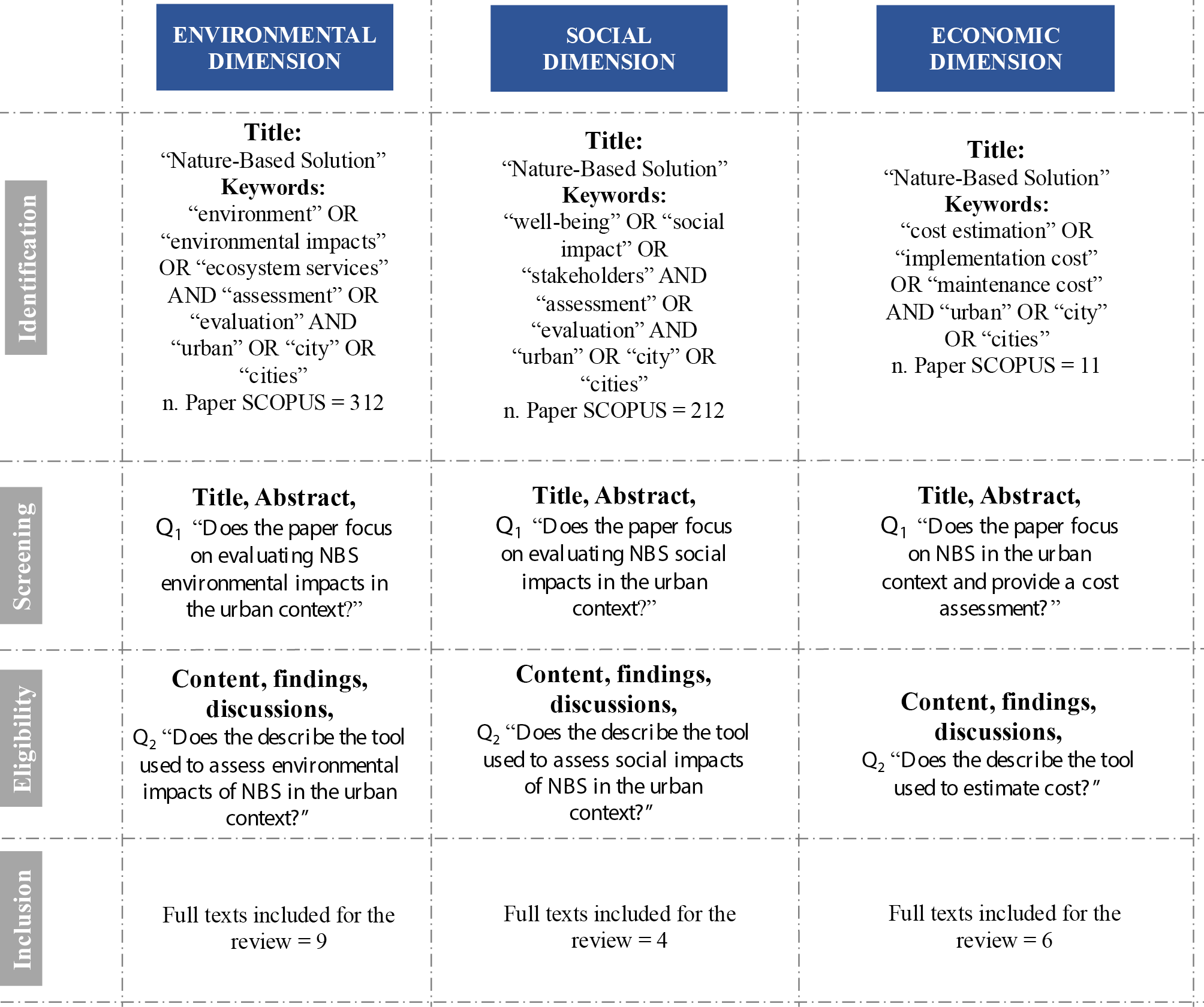
The first literature review concerns the environmental sphere. It has been developed on the Scopus database with this survey “Nature-Based Solution” AND “environment” OR “environmental impacts” OR “ecosystem services” AND “assessment” OR “evaluation” AND “urban” OR “city” OR “cities”. The survey produced 312 results. These have been first screened according to their abstract. Subsequently, their contents, findings and discussion were analysed according to the eligibility questions. Many papers have been excluded due to their lack of focus on the urban context, as well as in describing the evaluation methodology. Therefore, 9 papers have been considered at the end of the elicitation. Table 1 lists the papers considered for the environmental assessment and describes them according to the case studies and the evaluation tools used. From this analysis, it is possible to underline that many of the analysed works refer to the ES assessment and mapping. However, only a few cases evaluated ES according to their monetary values. Secondly, the environmental assessment of NBS in the urban context is mainly focused on risk reduction and flood insurance, among others (Soto-Montes-de-Oca et al., 2023). Concerning the applied evaluation methods, they are mainly referred to indicator-based models, and ES evaluation mapping and tools. Multicriteria Analysis (MCA) has been proposed as a Decision Support System (DSS) to support the identification and definition of NBS intervention according to vulnerability by Camacho-Caballero and colleagues (Camacho-Caballero et al., 2024).
| ID | Authors and year | Case Study | Evaluation tool |
|---|---|---|---|
| 1 | (Lafortezza and Sanesi, 2019) | Nature-based solutions: settling the issue of sustainable urbanization | DPSIR (Driving force–Pressure–State–Impact–Response) model |
| 2 | (Longato et al., 2023) | A method to prioritize and allocate nature-based solutions in urban areas based on ecosystem service demand | Spatial assessments of ES demand and numeric scores reflecting the capacity of different typologies of NBS to supply multiple ES |
| 3 | (Stange et al., 2022) | Comparing the implicit valuation of ecosystem services from nature-based solutions in performance-based green area indicators across three European cities | Berlin’s Biotope Area Factor (BAF), Stockholm’s Green Area Factor (GYF) and Oslo’s Blue Green Factor (BGF) for ES assessment |
| 4 | (Camacho-Caballero et al., 2024) | Assessing Nature-based solutions in the face of urban vulnerabilities: a multi-criteria decision approach | Multi-Criteria Decision Approach |
| 5 | (Soto-Montes-de-Oca et al., 2023) | Enhancing megacities’ resilience to flood hazard through peri-urban nature-based solutions: Evidence from Mexico City | Indicator of runoff coefficient and avoided cost of flood insurance |
| 6 | (Zölch et al., 2017) | Regulating urban surface runoff through nature-based solutions – An assessment at the micro-scale | Runoff performance |
| 7 | (Geneletti et al., 2022) | Mainstreaming Nature-Based Solutions in Cities Through Performance-Based Planning: a Case Study in Trento, Italy | Performance-based planning based on ES mapping and assessment at the urban scale |
| 8 | (Beceiro et al., 2022) | Assessment of the contribution of Nature-Based Solutions (NBS) to urban resilience: application to the case study of Porto | Multidimensional indicators-based model |
| 9 | (Babí Almenar et al., 2023) | Modelling the net environmental and economic impacts of urban nature-based solutions by combining ecosystem services, system dynamics and life cycle thinking: An application to urban forests | ES evaluation, System Dynamics Model (SDM), Life Cycle Thinking (LCT). |
Concerning the social dimension, this research aims to explore how well-being is investigated, as well as how it can be improved by NBS according to their ability to mitigate climate change effects. The literature review has been developed on the Scopus database, according to this survey “Nature-Based Solution” AND “well-being” OR “social impact” OR “stakeholders” AND “assessment” OR “evaluation” AND “urban” OR “city” OR “cities”, which provides 14 results. Also in this case, the recognized papers have been first screened according to their abstract and then their contents, findings and discussion have been examined according to the eligibility questions (Fig. 1). Many papers have been thus excluded through this process for their lack in focusing on the urban context, as well as the poor descriptiomn of social impacts evaluation processes. Therefore, at the end of the elicitation, only 3 papers have been considered. Table 2 lists the considered papers for the society dimension and describes them according to the used and proposed evaluation methods.
| ID | Authors | Case Study | Evaluation tool |
|---|---|---|---|
| 1 | (Mok et al., 2021) | Valuing the invaluable(?)—a framework to facilitate stakeholder engagement in the planning of nature-based solutions | Value-based framework based on the Willgness To Pay (WTP) and qualitative impacts matrix developed by urban stakeholders |
| 2 | (Longato et al., 2023) | Assessing the long-term effectiveness of Nature-Based Solutions under different climate change scenarios | System Dynamics Model (SDM) to address different scenarios of climate change and socio-economic contexts. The stakeholders’ involvement is considered as a key factor for NBS effectiveness |
| 3 | (Watkin et al., 2019) | A Framework for Assessing Benefits of Implemented Nature-Based Solutions | Indicators-based model with indicators related to the social effects |
From the performed literature review, it is possible to underline that stakeholders engagement is a crucial aspect of addressing the social impacts of NBS interventions. Moreover, indicator-based models are the most used evaluation approach to qualitatively address the social impacts of NBS interventions (Longato et al., 2023; Watkin et al., 2019). Furthermore, it is important to underline that efforts have been made to assess social impacts in quantitative and monetary terms, by applying the Willingness To Pay (WTP) (Mok et al., 2021). It is possible to highlight that the evaluation demands concerning social and environmental dimensions are often interrelated, trying to qualitatively investigate how the environmental impacts of NBS can improve the well-being of citizens.
The third review concerns the economic dimension, focusing on the estimation of the implementation and maintenance costs of NBS intervention in the urban context. More in detail, this review considers both scientific and grey literature. This choice has been made to consider also reports and deliverables provided by the most relevant European projects which operatively work on NBS implementation. Table 3 illustrates the results obtained by the analysis performed on the Scopus platform, highlighting which methodology for cost estimation is applied and whether the description of NBS working phases is provided. Also in this case, the identified papers have been analysed by the screening and the eligibility phases to consider only those papers which are coherent with the urban context, and which describe the adopted cost estimation procedure. Therefore, six papers have been selected. On the other hand, Table 4 lists the European and international projects which have explored this topic, describing how it has been addressed.
| ID | Authors and year | Title | Implementation cost method | Maintenance cost method | Description of NBS working phase |
|---|---|---|---|---|---|
| 1 | (Sikorska et al., 2020) | Energy crops in urban parks as a promising alternative to traditional lawns – Perceptions and a cost-benefit analysis | Pricing list | Not estimated | Yes, different works have been identified and described |
| 2 | (Gaona Currea et al., 2024) | Ecohydrological Nature Based-Solutions for Sustainable Cities: A Case Study based on Water Security and Modeling | Pricing list | Not estimated | Not described |
| 3 | (Reu Junqueira et al., 2023) | Developing and testing a cost‐effectiveness analysis to prioritize green infrastructure alternatives for climate change adaptation | Medium parametric implementation cost [€/m2; €/m3] for NBS considered typology | Not estimated | Not described |
| 4 | (Cristiano et al., 2020) | Analysis of potential benefits on flood mitigation of a CAM green roof in Mediterranean urban areas | Medium parametric implementation cost [€/m2; €/m3] for NBS considered typology | Not estimated | Not described |
| 5 | (Biasin et al., 2023) | Nature-Based Solutions Modeling and Cost-Benefit Analysis to Face Climate Change Risks in an Urban Area: The Case of Turin (Italy) | Medium parametric implementation cost [€/m2; €/m3] for NBS considered typology | Not estimated | Not described |
| 6 | (Le Coent et al., 2021) | Is-it worth investing in NBS aiming at reducing water risks? Insights from the economic assessment of three European case studies | Medium parametric implementation cost [€/m2; €/m3] for NBS considered typology | Not estimated | Not described |
| Project | Source | Cost estimation methodology | Maintenance cost estimation method | Description of NBS working phase |
|---|---|---|---|---|
| SOS4Life | (Ravanello et al., 2019) | Medium parametric implementation cost [€/m2; €/m3] | Not estimated | Not described |
| Urbangreen UP | (Urban Green, 2022) | Medium parametric implementation cost [€/m2; €/m3] | Estimated | Yes, the process and the different works are described and listed |
| UNALAB | (Eisenberg and Polcher, 2019) | Medium parametric implementation cost [€/m2; €/m3] | Not estimated | Yes, the process and the different works are described and listed |
According to the performed analysis (Table 3), it is possible to state that the topic of NBS cost estimation is currently less explored and quite recent in the academic literature. Most of the considered research estimate the implementation cost using a parametric medium implementation cost of NBS. Only two of the analysed research estimated implementation costs using the pricing list related to the implementation context, also giving information about the working phase (Gaona Currea et al., 2024; Sikorska et al., 2020). Furthermore, the maintenance cost is rarely investigated, despite its relevance according to the lifecycle of NBS.
Table 4 compares and describes the most relevant European projects which address the topic of NBS cost estimation. All the considered projects use a parametric medium cost for estimating the implementation cost. Whereas the maintenance cost is less investigated. By the analysis of both academic and grey literature, it is possible to underline that there is a lack of a common and general procedure to estimate the implementation and maintenance cost by considering the required works to implement NBS, as well as the characteristics of the implementation contexts. Moreover, the description of the NBS interventions with the implementation required works is often not reported without the possibility of adapting the given parametric cost to the context under analysis (Le Coent et al., 2021).
According to the performed literature review, it is possible to identify some evaluation challenges, which can be listed as follows:
a. Multidimensional evaluation of NBS interventions
The proposed evaluation models and procedures rarely consider the multidimensionality of NBS interventions, focusing on and evaluating only one dimension. For example, some research investigating the economic aspects (Table 3) does not simultaneously consider the social and environmental dimensions. On the other hand, social and environmental dimensions are often addressed simultaneously (Tables 1 and 2), but the economic aspects are not engaged in these assessments.
b. NBS scale of intervention and spatial distribution
In the urban context, NBS implementation is typically linked to the urban planning and policy process (C. Raymond et al., 2017). However, spatial distribution and intervention scales have been rarely addressed within the urban planning perspective. Therefore, integrating NBS evaluation to properly support urban planning is recognised as a major challenge within urban NBS planning (Langemeyer et al., 2020).
c. Cost estimation and economic assessment of NBS in the urban context
There is a critical issue concerning the economic and monetary evaluation of NBS costs and benefits (Sowińska-Świerkosz and García, 2021), as addressed by the performed literature review (Section 2.1). Implementation and maintenance costs of NBS are usually estimated according to parametric costs without considering the NBS-specific features, e.g., NBS lifecycle and location, which directly affect the costs (Babí Almenar et al., 2018; La Rosa and Privitera, 2022).
According to these remarks, it is possible to address the lack of DSS, evaluation tools and models to comprehensively assess NBS interventions to support their design and implementation in urban systems for urban policy-making, as also underlined by the EC (Datola and Oppio, 2023; Wild et al., 2020).
According to this state-of-the-art, this research proposes a multi-step evaluation method to aid the identification of the appropriate intervention area, according to the specific conditions and needs of the implementation context (Wild et al., 2020; C. M. Raymond et al., 2017), as well as to assess alternative NBS scenarios according to costs and benefits to identify the most suitable one.
The specific scope of this methodological proposal is to integrate the spatial analysis to identify the most suitable location for NBS intervention to mitigate the UHI, with the costs and benefits evaluation of NBS. This section describes the proposed multi-step evaluation framework, which has been designed to answer the addressed evaluation lacks and challenges (Section 2.2). Figure 2 illustrates the proposed evaluation approach which is structured into four phases.
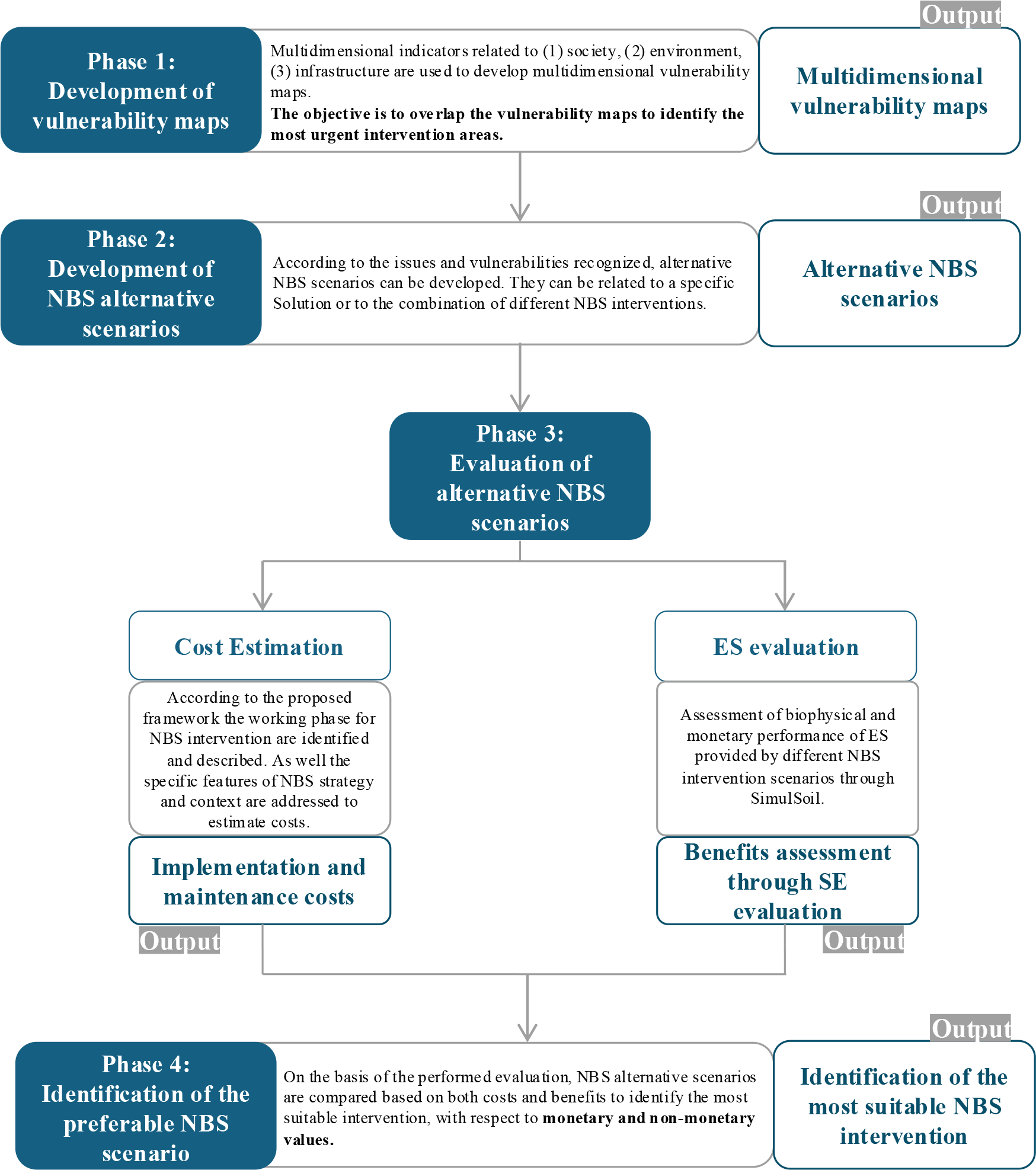
3.1. Phase 1: Identification of the NBS intervention location according to multidimensional vulnerability
Urban vulnerabilities are spatially heterogeneous and concern two key dimensions, sensitivity and exposure (Camacho-Caballero et al., 2024). Sensitivity indicates how much a system is affected by hazards, exposure refers to how close systems are to hazards (Tapia et al., 2017). Vulnerability can thus be described as the susceptibility to damage of both ecological and social systems (Cutter, 2016). In general, vulnerability analysis affords insights into the extent and patterns of exposure of people to climate-related risks, as well as the inequalities in managing and overcoming these impacts. NBS can address social, economic and environmental vulnerabilities by improving urban areas’ conditions according to multidimensional aspects, mitigating climate change, fostering the well-being of citizens, reducing the UHI phenomena, managing stormwater and making cities more livable, among others (Pereira et al., 2023).
This research developed an in-depth literature review to collect and provide a comprehensive list of multidimensional indicators to address urban vulnerability according to social, economic, environmental, and infrastructural dimensions (Camacho-Caballero et al., 2024; Huynh et al., 2020; Pereira et al., 2023) (Appendix A). It aims to provide a repository list of multidimensional indicators to be used and selected according to the specific evaluation demand and context. Appendix A lists the collected indicators. It can be argued that the social indicators aim to analyse the population composition and density, as well as the spatial distribution of vulnerable populations. The economic indicators are mainly proposed to observe the average household income and how different income brackets are spatially distributed. The environmental indicators are focused on identifying how different urban areas can be affected by several risks and pressures, such as UHI, exposure to floods, as well as the distribution of permeable areas (Zha et al., 2024). The infrastructure indicators mainly referred to the analysis of the distribution on the territory of critical infrastructure, such as hospitals and schools. Therefore, this list of indicators (Appendix A) can be used as a reference to identify the most appropriate indicators to perform vulnerability maps according to both the evaluation demand and contexts, to underline specific issues and challenges to address.
3.2. Phase 2: Alternative scenarios development
According to the vulnerabilities addressed through the multidimensional maps, it is possible to propose and design alternative NBS scenarios to properly respond to the identified issues, such as urban forestry and rain gardens to address both the UHI phenomenon and the runoff issue.
3.3. Phase 3: Evaluating alternative NBS scenarios according to costs and benefits
The evaluation framework proposes the evaluation of NBS interventions according to costs and benefits, to give a multidimensional and comprehensive evaluation perspective.
As discussed before (Section 2.1), several studies propose different methods to estimate NBS costs. However, many of the proposed frameworks lack in describing NBS intervention works, as well as in considering the characteristics of the implementation context, which consistently affect both the implementation and the maintenance costs (Section 2.1). Most of the researches apply medium implementation and maintenance costs (€/m2 or €/m3). Moreover, a general framework to facilitate the description of NBS working phases to properly estimate the NBS intervention costs according to the specific intervention characteristics has not been provided.
According to these operational needs, this research aims to introduce a basic framework to recognise the implementation and maintenance costs of NBS interventions. For this purpose, the Work Breakdown Structure (WBS) has been considered as the basic methodological reference, due to its ability to break down the project into simpler work units, providing a common basis for communication and cost estimation. The WBS can identify all the components of the project according to a hierarchical scheme (Utica, 2011). To develop the WBS, it is suggested to apply approved classification procedures, such as UNI 8290 standard and UNIFORMAT II. For this first attempt to propose a general framework to describe NBS intervention for cost estimation, the UNIFORMAT II have been taken as a reference.
Table 5 illustrates the general structure of the proposed schedule, developed following the UNIFORMAT II standard and adapted to the specific context of estimating NBS-related costs.
| Implementation cost | Maintenance cost | |||||||||||
|---|---|---|---|---|---|---|---|---|---|---|---|---|
| ID | Work entitities | Description | Code | U.M. | Unitary price | Quantity | Cost [€] |
Code | U.M. | Unitary price | Quantity | Cost [€] |
| 1 | Preliminary works |
|||||||||||
| 2 | Structure | |||||||||||
| 3 | Technological service systems |
|||||||||||
| 4 | External arrangement |
|||||||||||
| 5 | Furniture | |||||||||||
| Tot. Cost | Total Implementation cost | Total Maintenance cost | ||||||||||
The proposed framework organises the identified work entities on the rows to describe the NBS intervention. Five work entities have been considered and adapted to fit the evaluation of NBS. Specifically, (1) preliminary works, to include site preparation and earthmoving, (2) structure, which refers to potential structural foundations, such as foundation, retaining, and elevation structures, (3) technological service systems, that cover service facilities, like irrigation system, (4) external arrangement, which represent the core features of NBS, namely the implementation of natural elements, and (5) furniture which involves the final finishing elements required and defined by the project.
On the columns, the proposed framework includes the estimation of implementation and maintenance costs, for each working entity and subsequently aggregated them to determine the total implementation and maintenance costs. In detail, the columns include the following items:
–Description: a description of each work entity, fitted to the specific analysed project;
–Code: it corresponds to the code of the reference price list to identify the cost according to the specific location;
–Unity of measure: it specifies the unit through which each work item is described and evaluated (e.g., square meters, linear meters);
–Unitary price: the unit cost as defined in the reference price list;
–Quantity: the amount or the extent of each specific work entity;
–Cost: the estimated cost for each work entity, calculated by multiplying the unit price by the quantity. These costs are then summed to obtain the total implementation cost and total maintenance cost.
This hierarchical scheme has been proposed to represent project features in a clear and organised manner. This framework has proposed a procedural model, established a common communication and provided a general outline that can be tailored to specific cases. It has been designed to be flexible and applicable in different contexts, permitting the description of the required entities of specific NBS intervention, as well as the estimation of costs according to the specific NBS and context features.
3.3.2. Benefits Estimation through Ecosystem Services
This research addresses NBS as an intervention based on nature able to address multidimensional issues, as well as to provide different ES (Wild et al., 2020). NBS can improve biodiversity and supply a wide range of ES, essentials to improving food security, health, and well-being (Fang et al., 2023; Pereira et al., 2023). ES are defined as “the benefits human populations derive, directly or indirectly, from ecosystem functions” (Costanza et al., 1997). In the literature, different classifications of ES have been proposed (Caprioli et al., 2020). This study refers to the classification proposed by (Gómez-Baggethun and Barton, 2013), which identifies eleven ES, grouped into these categories:
–for provisioning: food supply;
–for regulating: water flow regulation and runoff mitigation, urban temperature regulation, noise reduction, air purification, moderation of environmental extremes, waste treatment, climate regulation, pollination and seed dispersal;
–for cultural: recreation and cognitive development;
–for supporting: animal sighting (habitat for biodiversity).
As underlined in the work provided by (Pereira et al., 2023), urban forests, green corridors, street trees, green facades, and rain gardens are important NBS for several regulating ES (e.g., air and water purification, flood, climate and water regulation, carbon sequestration) (Collins et al., 2019; Escobedo et al., 2019), provisioning (e.g., biomass, medical plans) (Silva et al., 2022), and cultural ES (e.g., recreation, landscape aesthetics, social cohesion, cultural heritage) (Hoeben and Posch, 2021). These ES are crucial in the urban context, as they provide a direct impact on human health and security (Caprioli et al., 2020). Therefore, NBS have a fundamental role in implementing mitigation strategies to face climate change effects (Pereira et al., 2023), thus improving the livability of urban areas.
In this sense, the benefits of NBS interventions can be addressed by the valuation of the provided ES. In the literature, several assessment frameworks have been proposed (Caprioli et al., 2020). This research proposes the implementation of the GIS within SimulSoil software according to the scope of integrating spatial analysis with economic and monetary values. SimulSoil has been selected according to its easy-to-use approach (for more information, please see the manual (SimulSoil User Guide, 2012)), as well as its capability to provide ES valuation both in biophysical and monetary terms. In detail, SimulSoil permits to estimate the values of the following ES: Habitat Quality (HQ), Carbon Sequestration (CS), Water Yield (WY), Sediment Retention (SR), Nutrient Retention (NR), Crop Production (CPR), Crop Pollination (CPO) and Timber Production (TP).
3.4. Phase 4: Selection of the most preferred scenario
The final phase concerns the evaluation of the alternative scenarios according to implementation and maintenance costs, and the provision of ES both in monetary and biophysical terms.
Therefore, it supports the selection of the preferred scenario by considering also the trade-offs between costs and benefits (de Magalhães et al., 2019), as well as according to the ability of the scenario to address the identified urban vulnerability of the intervention context.
The city of Milan is characterised by a high level of soil consumption, which is approximately 70% of its territory. In 2023, the city of Milan approved the plan “Piano Aria Clima” (Comune di Milano, 2023) which is the urban plan aimed at reducing air pollution, contributing to the prevention of climate change and defining adaptation strategies for the municipal territory, according with the principles of health, equity, social inclusion, and the protection of the vulnerable groups. In this planning instrument, NBS have an important role in achieving the above-mentioned targets.
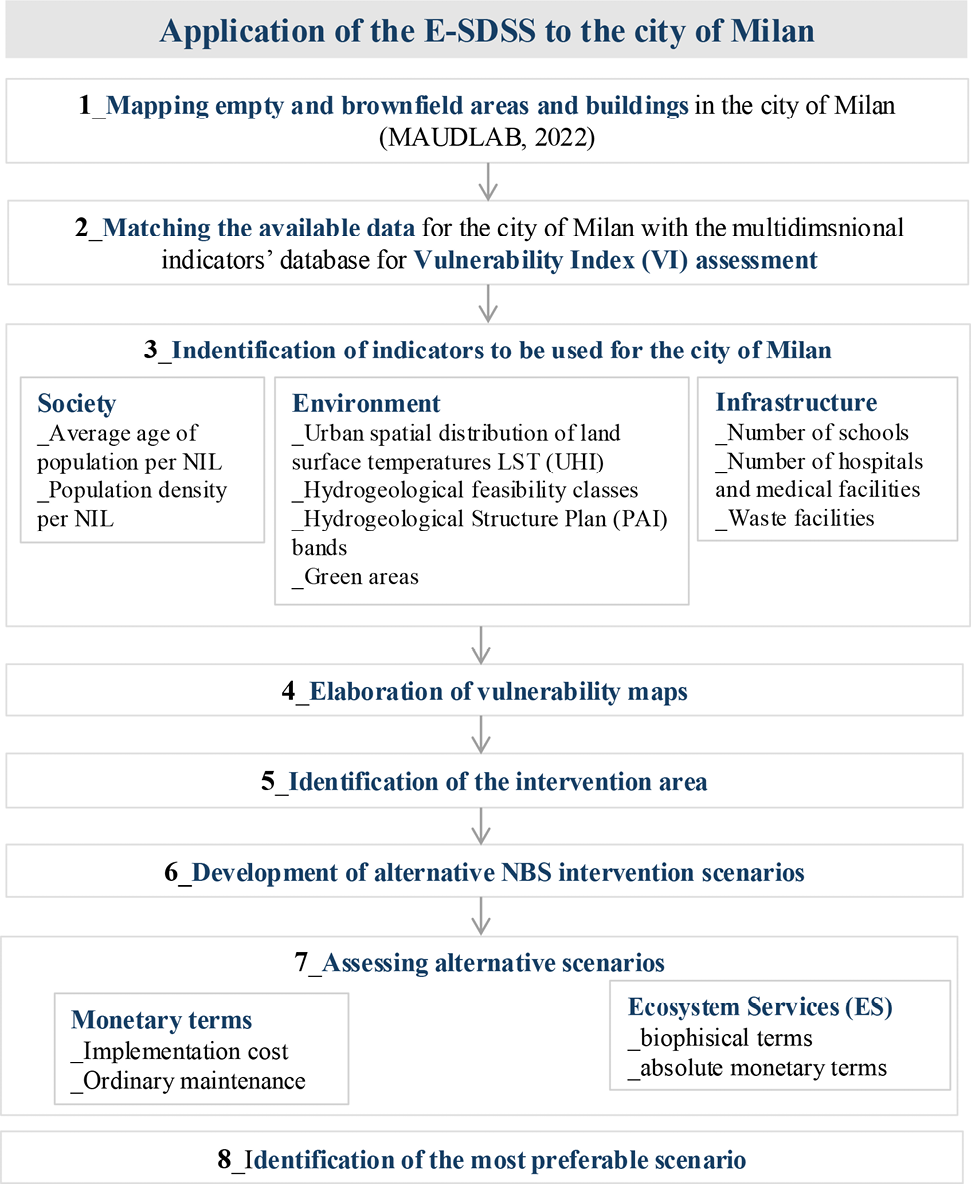
This paper describes the application of the proposed evaluation framework to the city of Milan. The aim is to support the identification of the most suitable area in which to implement NBS as a regeneration strategy to renovate empty green areas and mitigate UHI effects (Masiero et al., 2022). For this purpose, the evaluation framework has been first applied to identify the most urgent areas to be renovated, according to multidimensional vulnerability maps related to the UHI phenomenon and impacts on the well-being of the community and propose alternative NBS scenarios for addressing the underlined issues. Secondly, it assesses and compares NBS alternative strategies according to costs (implementation and maintenance) and the ES provided both in biophysical and monetary terms. Figure 3 illustrates the stages of the proposed multi-step evaluation framework to the city of Milan.
4.2. Mapping empty and brownfield areas in the city of Milan
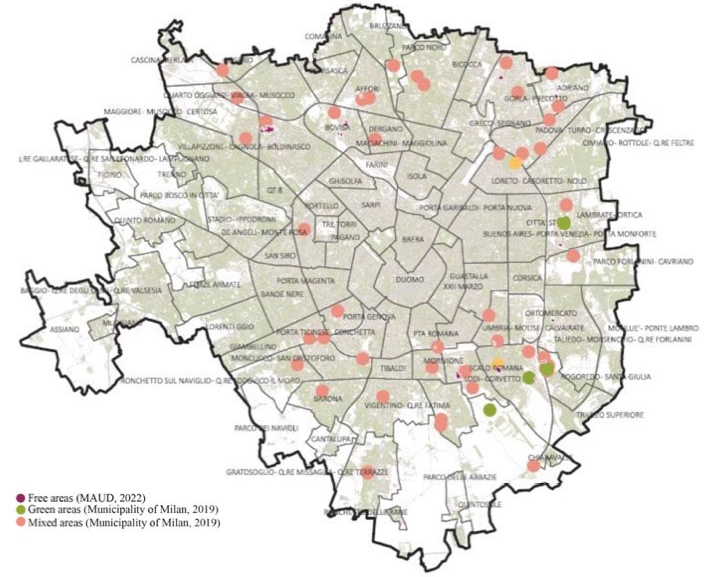
As clarified in the previous section, the illustrated case study explores the implementation of NBS as green brownfield areas regeneration strategy (Masiero et al., 2022). Figure 4 represents the spatial distribution of areas that need to be renovated in the city of Milan. Buildings, mixed areas and green areas are represented in this map, as described in Table 6. This map has been developed by integrating the data provided by the Geoportale of Milan, with the information recognised and represented by the MAUD1 lab of Politecnico di Milano.
| Name | Description | Source |
|---|---|---|
| Buildings and areas in decay | Abandoned and degraded privately-owned buildings on the territory of Milan, which represent a danger to safety or public health and safety, or inconvenience to urban decorum and quality | Geoportale di Milano, 2019 |
| Brownfield sites | Area identified as brownfield sites in the municipality of Milan | MAUD Lab, Department of Architecture and Urban Studies (DAStU) Politecnico di Milano, 2022 |
4.3. Identification of Urban Vulnerability Indicators
The developed analysis of urban vulnerability indicators (Section 3.1 and Appendix A) provided a comprehensive list of multidimensional indicators to be used to address urban vulnerability through a multidimensional approach. This list (Appendix A) has been developed to provide a repository for selecting the appropriate indicators according to the evaluation purpose and context. In this application, the evaluation demand concerns the identification of the most vulnerable urban areas for UHI in the city of Milan, concerning multiple dimensions. Therefore, social, environmental and infrastructure dimensions have been considered. The economic dimension has not been engaged according to the main evaluation demands. Therefore, the indicators included in the comprehensive list, referred to social, environmental and infrastructure dimensions, have been compared with the available data of the city of Milan, to identify the indicators to be used for developing vulnerability maps for UHI exposure. Table 7 lists the multidimensional indicators used for the application.
| Dimension | Indicator | Description | Source |
|---|---|---|---|
| Social | People over 75 years old | Number of people over 75 years old per NIL [Num.] | SiSi, 2023 |
| People under 14 years old | Number of people under 14 years old per NIL [Num.] | SiSi, 2023 | |
| Environmental | Urban spatial distribution of Land Surface Temperatures LST (UHI) | It contains the average surface temperature value of the summer months from 2013 to 2017 aggregated over the Urban Atlas zones [°C] | Geoportale Milano, 2018 |
| Hydrogeological Structure Plan (PAI) bands | Perimeter and zoning of areas at very high hydrogeological risk [qualitative: low, medium, high] | Geoportale Lombardia, 2023 | |
| Infrastructure | Number of schools | Number of schools in the municipality of Milan with their spatial localization [Num.] | SiSi, 2023 |
| Number of hospitals and medical facilities | Number of hospital and medical facilities in the municipality of Milan with their spatial localization [Num.] | SiSi, 2023 |
5.1.1.1 People over 75 years old and people under 14 years old
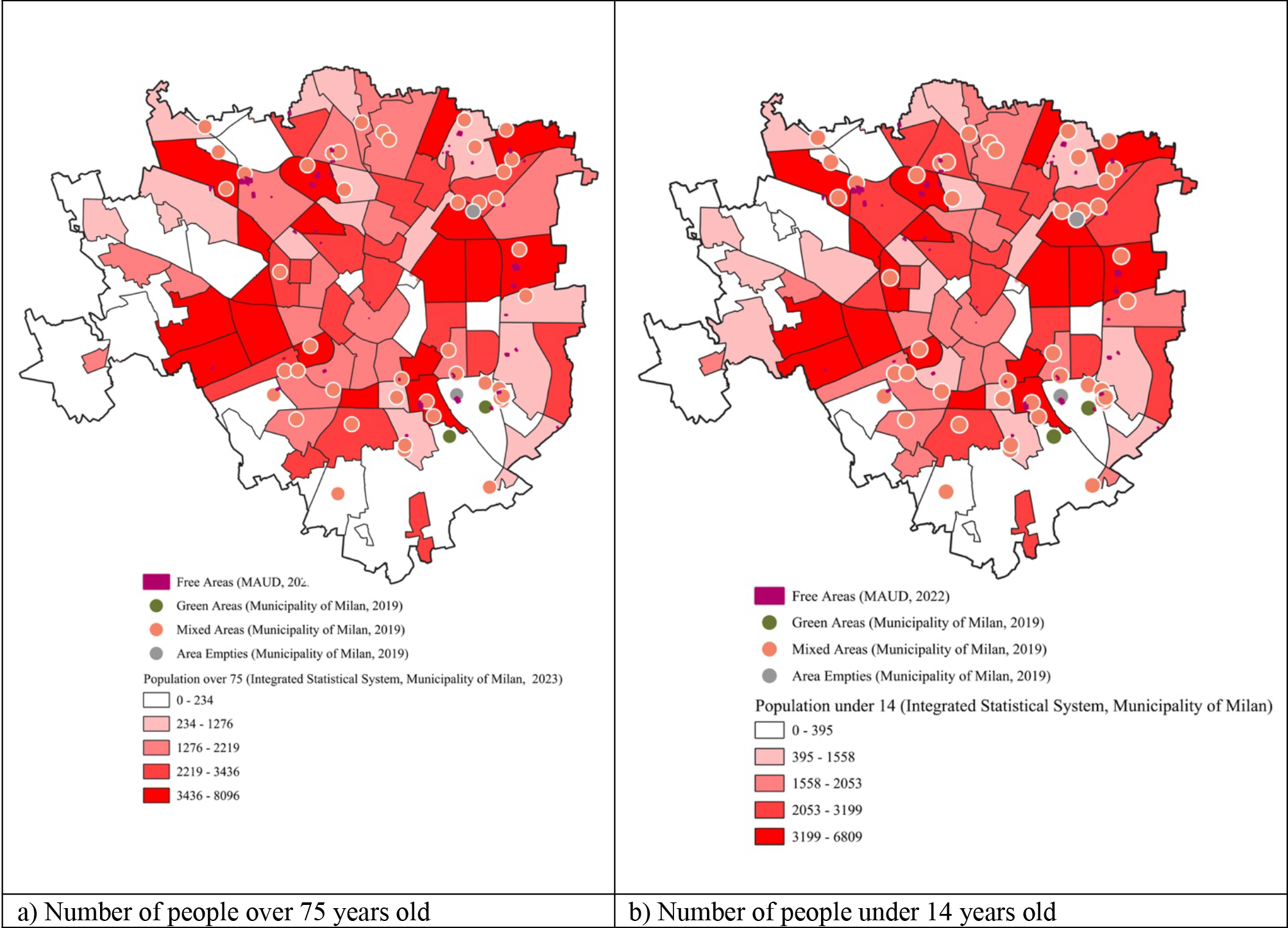
For the social indicators, the number of people over 75 years old and under 14 years old have been represented. Figure 5a and Figure 5b represent the spatial concentration of these population categories per NIL2 (Nucleo di Identità Locale), with the overlapping of the areas to be redeveloped. It can be seen from this overlay that many of the areas which need to be redeveloped fall within the NILs, with highest concentration of over-65 and under-14 population.
5.1.2. Environmental indicators
5.1.2.1 Urban Heat Island (UHI)
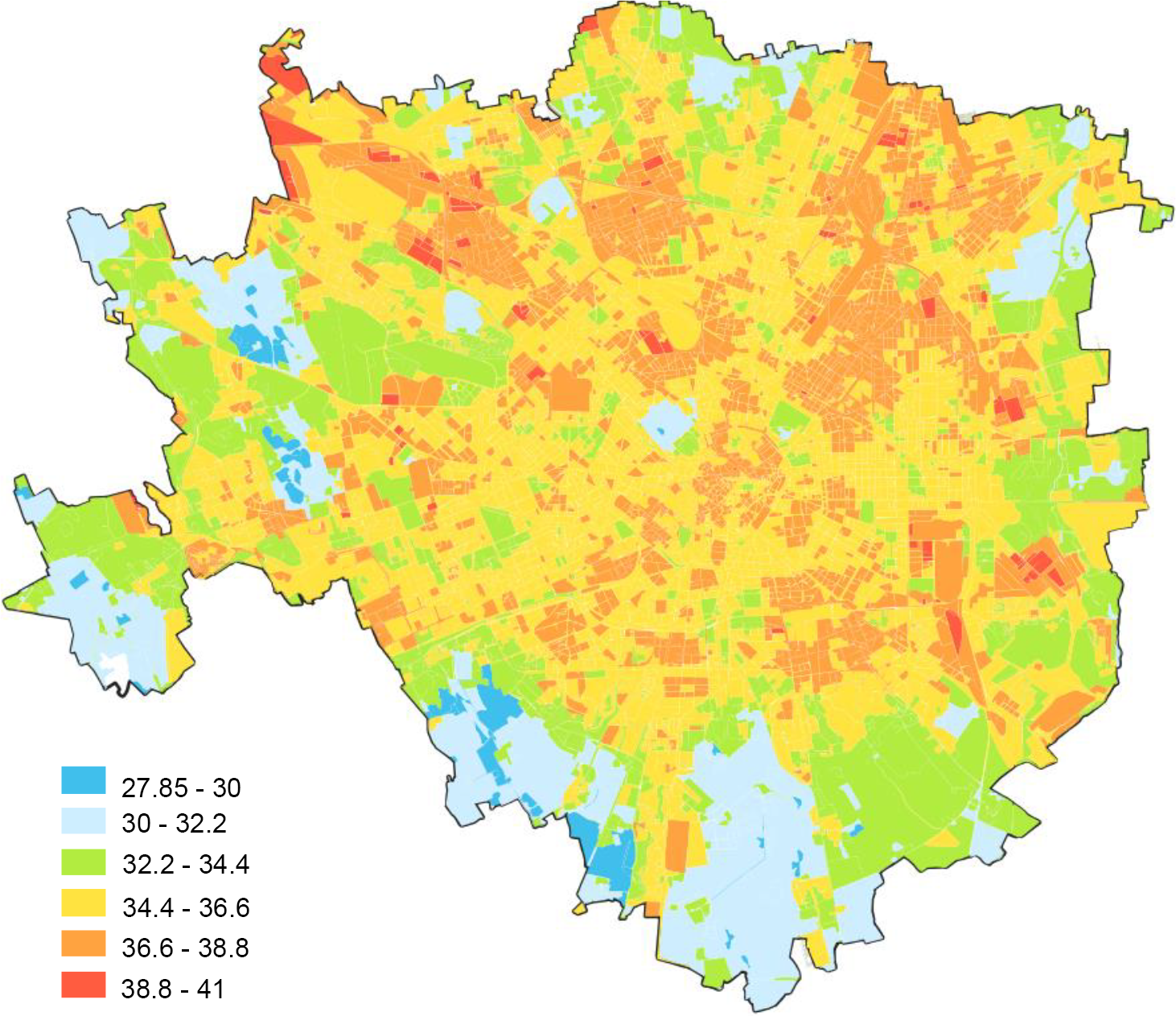
UHI effects and climate change are phenomena which severely affect citizens’ well-being and health, especially in summer (Olivieri et al., 2024). Figure 6 represents the Land Surface Temperature (LST) of the city of Milan. This map represents the average surface temperature trend in the city of Milan by combining the average value of the surface temperature of the summer months from 2013 to 2017, aggregated over the Urban Atlas zones. It can be noted that the higher temperatures are registered in the most urbanised areas, characterised by a greater quantity of impermeable soil. On the other hand, the more peripheral areas show lower temperatures due to the higher presence of green areas. It is also relevant to underline that the difference in temperature between peripheral and central areas is approximately 10 °C, which corresponds to the phenomenon of the UHI. Moreover, this map overlaps the distribution of the area which needs to be renovated with the UHI. As can be noticed, some areas fall in zones characterised by 36.8° and 38.8°.
5.1.2.2. Hydrogeologic risk map
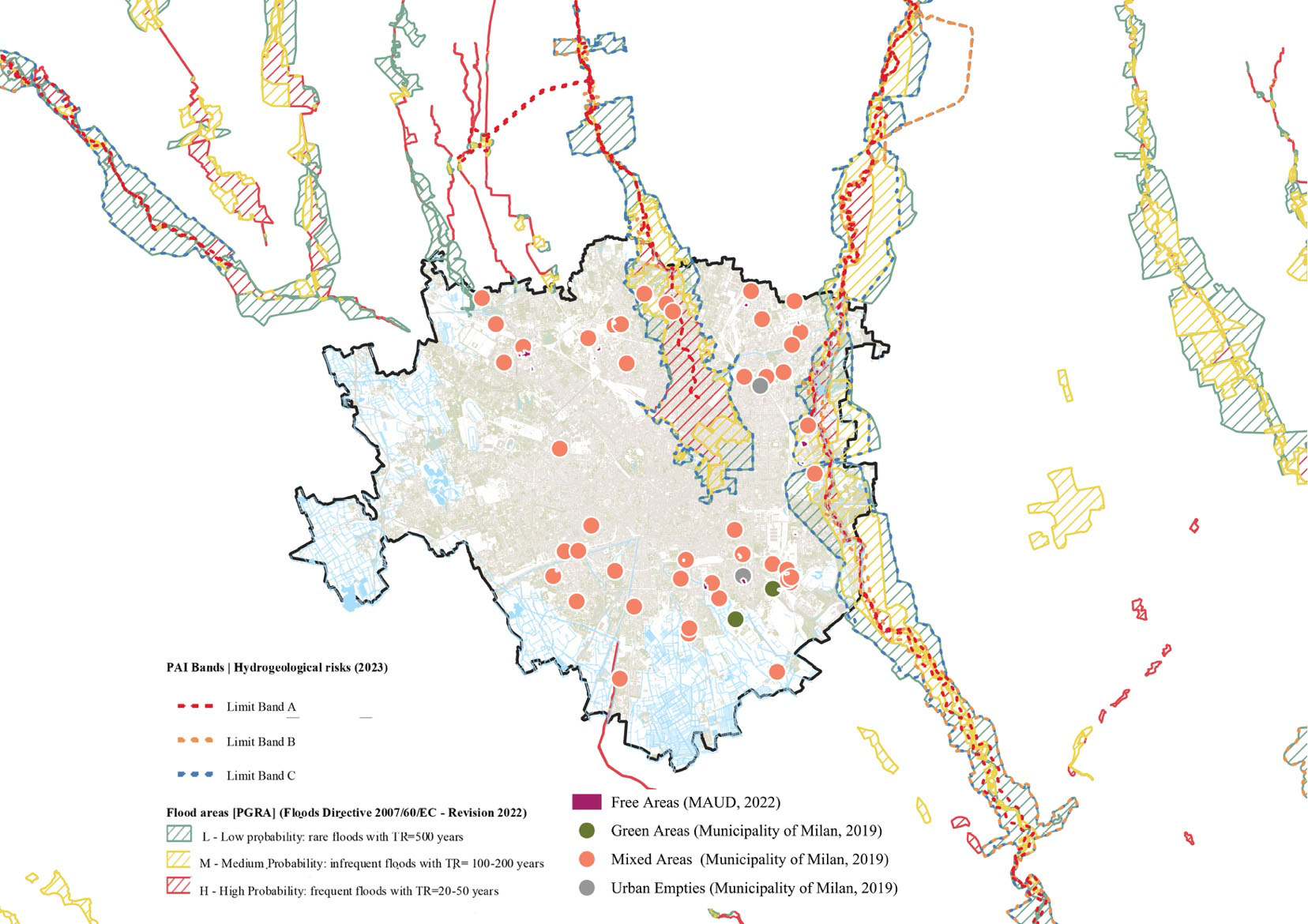
Figure 7 represents the overlapping of areas to be regenerated with the different zones defined by the Hydrogeological Planning Plan (Lombardy Region, 2023). It is possible to notice that three levels of risk have been identified, lower, medium and high. It is possible to address that some mixed areas and free areas are located in the signaled flood areas.
5.1.3. Infrastructure indicators
5.1.3.1. Strategic infrastructures
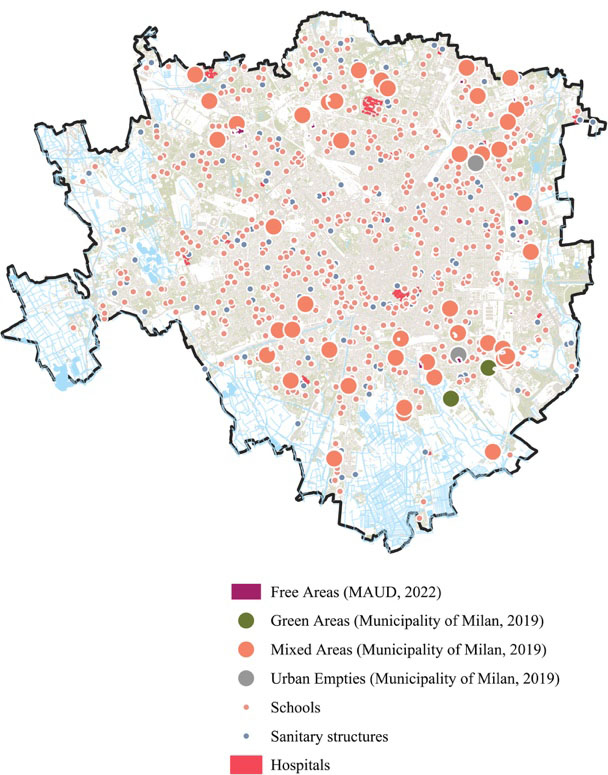
According to the infrastructural dimension, the spatial distribution of strategic infrastructure has been investigated to identify if their location falls in those areas with the highest UHI and/or in the addresses flood areas. Figure 8 represents the mapping of schools, sanitary structures and hospitals. These types of structures have been analysed according to the fact that they host the most vulnerable population groups (i.e., population under-14 years old, population over-14 years old, and population with health assistance needs). Moreover, the spatial distribution of strategic infrastructure has been overlapped with the spatial distribution of areas to be regenerated to verify their potentials for regeneration intervention.
5.2. Intervention area identification
Figure 9 illustrates the framework used to identify the most urgent intervention area, which is based on the overlapping of the different developed maps (Section 5.1).
This procedure is based on the methodology proposed by McHarg (McHarg, 1995). He introduced the possibility of describing the territory according to different thematic maps, each representing an environmental or social variable by layers. The main objective is to overlap these different spatial levels to design harmoniously with nature, to support the planning decision to minimise environmental impact and maximise sustainability.
Following this methodology, the developed maps have been overlapped to identify the area where NBS implementation for UHI mitigation is most urgently needed, considering also the flood risk. Thus, the maps related to (1) population under-14 years old (Figure 5a), (2) population over 75 years old (Figure 5b), (3) the UHI (Figure 6), the PAI bands (Figure 7), and the distribution of the strategic infrastructures (schools, hospitals, and health facilities) (Figure 8) have been overlapped to the map of the abandoned areas in city of Milan (Figure 4).
To perform the overlapping of these different maps, it is necessary to make them homogeneous layers. Therefore, maps have been converted into maps with homogeneous values, ranging from 1 to 5, where 1 indicates a very low vulnerability level, and 5 a very high vulnerability level. Only the maps related to the spatial distribution of the areas to be regenerated (Figure 4) and the strategic infrastructures (Figure 8) have not been homogenized with these value scales, as the objective was to evaluate their position concerning the UHI and flood areas.
Table 8 illustrates the conversion of indicator values into homogeneous values.
| Indicator | U.M. | Value | Homogenous value | ||||||||||||||||
|---|---|---|---|---|---|---|---|---|---|---|---|---|---|---|---|---|---|---|---|
| People over 75 years old | [Num.] | 0 – 234 | 1 | ||||||||||||||||
| 234 – 1276 | 2 | ||||||||||||||||||
| 1276 – 2219 | 3 | ||||||||||||||||||
| 2219 – 3436 | 4 | ||||||||||||||||||
| 3496 – 8096 | 5 | ||||||||||||||||||
| People under 14 years old | [Num.] | 0 – 395 | 1 | ||||||||||||||||
| 395 – 1558 | 2 | ||||||||||||||||||
| 1558 – 2053 | 3 | ||||||||||||||||||
| 2053 – 3199 | 4 | ||||||||||||||||||
| 3199 – 6809 | 5 | ||||||||||||||||||
| Urban spatial distribution of Land Surface Temperatures LST (UHI) | [°C] | 27.85 – 32.2 | 1 | ||||||||||||||||
| 32.2 – 34.4 | 2 | ||||||||||||||||||
| 34.4 – 36.6 | 3 | ||||||||||||||||||
| 36.6 – 38.8 | 4 | ||||||||||||||||||
| 38.8 – 41.0 | 5 | ||||||||||||||||||
| Hydrogeological Structure Plan (PAI) bands | Risk class | Low | 1 | ||||||||||||||||
| Medium | 3 | ||||||||||||||||||
| High | 5 | ||||||||||||||||||
| Legend: 1. Very low risk; 2. Low risk; 3. Medium risk; 4. High risk; 5. Very high risk. | |||||||||||||||||||
Based on the overlap between homogeneous vulnerability maps and localisation data, the area in Via dei Canzi (33,367 m²) (Figure 9) has been identified as one of the most critical zones for UHI and flood risk mitigation through NBS. This site falls within a NIL classified as high-risk due to the significant presence of vulnerable population, particularly individuals over 75 and under 14 years of age. Additionally, the area is exposed to elevated LST (value equal to 4) and is situated near key public infrastructures, including schools and healthcare facilities. The urgency for intervention is further underscored by its classification as a medium-risk zone for flooding (value equal to 3). Consequently, the implementation of NBS in this area holds the potential to address both UHI effects and flood risk, aligned with the objectives of the Piano Clima plan.
5.3. Definition of alternative NBS scenarios
Once the intervention area has been selected, alternative scenarios of NBS implementation have been developed. Based on the objective of the evaluation, which gives great attention to UHI effects and flooding exposure to identify the most vulnerable area in which it is mostly urgent to intervene, a specific literature review has been carried out to identify the most suitable NBS intervention to be implemented for UHI mitigation and the water management support.
Table 9 illustrates the considered references to identify the most suitable NBS for addressing these stresses. From the performed analysis, it can be concluded that the most suitable NBS, according to the feature of the implementation area, are: (1) urban forestation and (2) bioswales/rain gardens. Furthermore, Table 9 specifies which mitigation measures and which vulnerabilities the different NBS are designed to address.
| Authors and year | Title | Recommended NBS | Mitigation measure and addressed vulnerability |
|---|---|---|---|
| (Oukawa et al., 2024) | Advantages of modeling the urban heat island intensity: A tool for implementing nature-based solutions | Urban forest | UHI mitigation; improving the overall wellbeing of urban residents (SDG 3) |
| (Hayes et al., 2022) | Nature-Based Solutions (NBSs) to Mitigate Urban Heat Island (UHI) Effects in Canadian Cities | Green roofs, urban forests, vegetated vertical surfaces | UHI mitigation; improving the overall wellbeing |
| (Marando et al., 2022) | Urban heat island mitigation by green infrastructure in European Functional Urban Areas | Urban forest (including grass, shrubs, and trees) | UHI mitigation; improving the overall wellbeing |
| (Lu et al., 2024) | Harnessing the runoff reduction potential of urban bioswales as an adaptation response to climate change | Biowales | Runoff reduction and urban stormwater management |
| (Chaves et al., 2024) | Comparative analysis of bioretention design strategies for urban runoff infiltration: a critical overview | Raingardens | Runoff reduction and urban stormwater management |
| (Ramírez-Agudelo et al., 2020) | Nature-Based Solutions for Water Management in Peri-Urban Areas: Barriers and Lessons Learned from Implementation Experiences | Sustainable Urban Drainage Systems (SUDS); green roofs/walls; rain gardens | Runoff reduction and urban stormwater management; UHI mitigation |
Three different implementation scenarios have been proposed by different combinations of the selected NBS. The proposed alternative scenarios are described in Table 10.
| Scenario | NBS typology | Quantity |
|---|---|---|
| Scenario 1 | Urban forestation | 33,367 m2 |
| Scenario 2 | Urban forestation | 16,683 m2 |
| Rain garden | 16,683 m2 | |
| Scenario 3 | Urban forestation | 22,245 m2 |
| Rain garden | 11,122 m2 |
5.4. Comparative evaluation of NBS scenarios
The alternative scenarios have been evaluated through the proposed multi-step evaluation framework (Section 3), according to the implementation and maintenance costs and the provided ES.
The proposed cost schedule has been used for cost estimation to address and describe the different working phases. In detail, the estimation of implementation and maintenance costs has been developed using the pricing list of Lombardy Region (2024), according to the location of the case study.
Table 11 represents the synthesis of the cost estimation for the three NBS scenarios according to the proposed schedule (for the detailed spreadsheet, please see Appendix B).
| ID | Work entities | Scenario 1 (S1) | Scenario 2 (S2) | Scenario 3 (S3) | |||
|---|---|---|---|---|---|---|---|
| Implementation cost | Maintenance cost (per year) | Implementation cost | Maintenance cost (per year) | Implementation cost | Maintenance cost (per year) | ||
| 1 | Preliminary works | 354,858.05 € | - | 816,259.67 € | - | 688,560.97 € | |
| 2 | Structures | - | - | - | - | - | |
| 3 | Technological services systems | 1,093.51 € | - | 163.90 € | - | 142,521.30 € | |
| 4 | External arrangements | 207,104.85 € | 150,759.93 € | 245,309.83 € | 66,089.08€ | 116,491.81 | 87,305.93 € |
| 5 | Finishing | - | - | - | |||
| Total cost | 563,056.40 € | 150,759.93 € | 1,061,733.39 € | 66,089.08€ | 947,574.08 € | 87,305.93 € | |
5.4.2. Ecosystem Services Assessment
Alternative scenarios have also been evaluated according to the provided ES. This evaluation has been carried out using SimulSoil software, which has allowed to perform the simulation of the different NBS scenarios in terms of ES supply. These scenarios have then been compared with the current state-of-the-art of the area (Business as Usual scenario – BAU) to address the difference in ES provision. The provided ES have been assessed both in biophysical and monetary terms (Fig. 10 and Tab. 12).
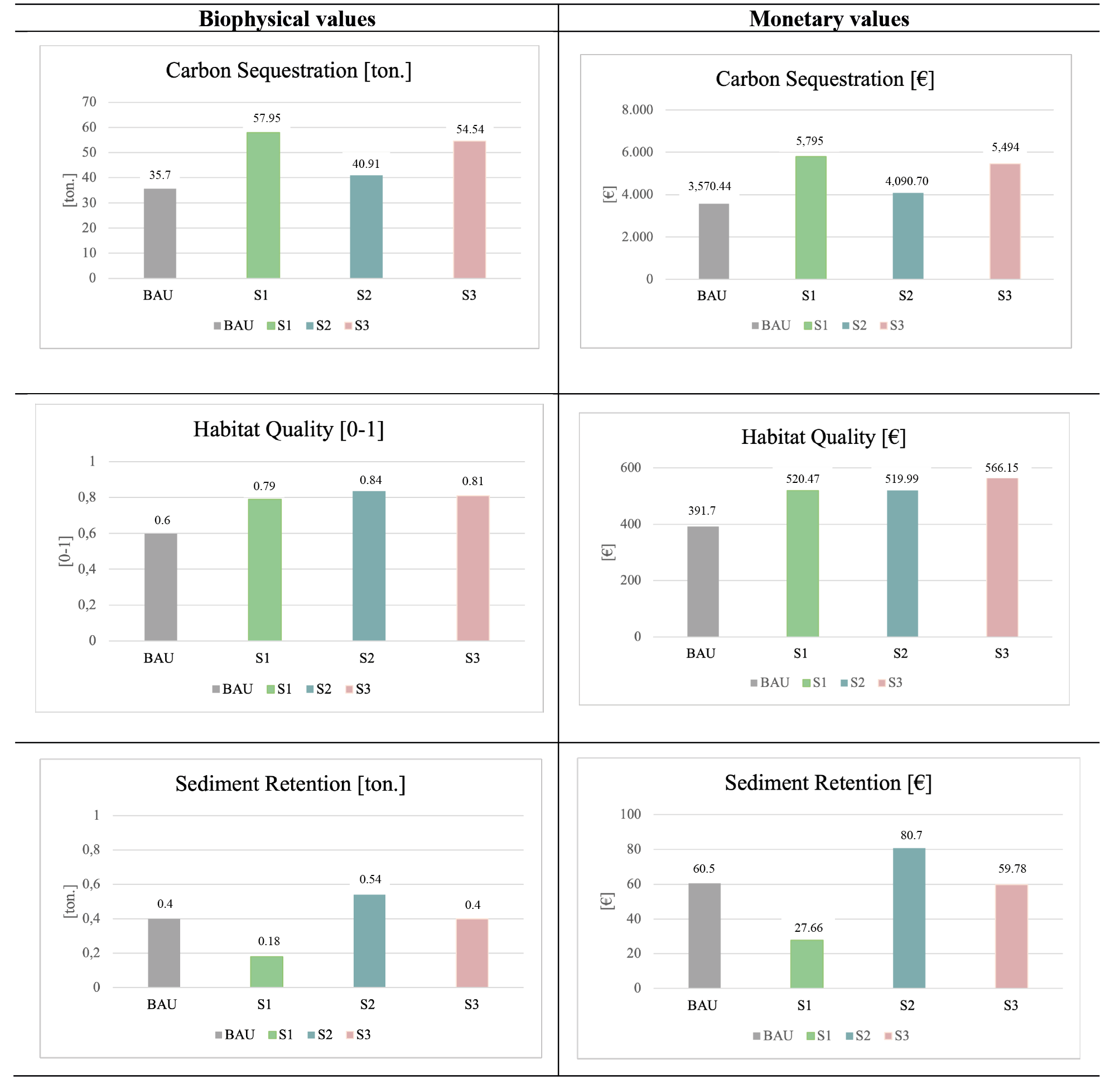
| Biophysical terms | Monetary terms | ||||||||||
|---|---|---|---|---|---|---|---|---|---|---|---|
| Cod. | U.M. | S0 | S1 | S2 | S3 | Cod. | U.M | S0 | S1 | S2 | S3 |
| CS | ton. | 35.70 | 57.95 | 40.91 | 54.54 | CS | € | 3,570 | 5,795 | 4,090 | 5,454 |
| HQ | 0-1 | 0.60 | 0.79 | 0.84 | 0.81 | HQ | € | 391.70 | 520.47 | 519.99 | 566.15 |
| SDR | Ton. | 0.40 | 0.18 | 0.54 | 0.40 | SDR | € | 60.50 | 27.66 | 80.71 | 59.78 |
According to the cost estimation, Scenario 2 has the highest implementation expenditure and the lowest annual maintenance requirement. Scenario 1 is characterised by the lower implementation cost and the higher maintenance cost. On the other hand, Scenario 3 has a similar implementation cost compared to Scenario 2 and a maintenance cost equal to € 87,317.06 per year.
Regarding the evaluation of ES in biophysical terms, all scenarios are expected to improve the Carbon Sequestration (CS) and Habitat Quality (HQ) compared to the BAU scenario, although to varying degrees depending on their specific performances. Conversely, for the Sediment Delivery Ratio (SDR), only Scenario 2 is expected to enhance supply conditions relative to the BAU scenario. Scenario 3 is projected to maintain current performance levels, while Scenario 1 may result in a decrease.
The proposed multi-step evaluation framework enables the assessment and comparison of different NBS scenarios concerning implementation and maintenance costs, and the provision of ES both in monetary and biophysical terms. Consequently, this approach can support the selection of the most suitable scenario by considering the trade-offs between costs and benefits (de Magalhães et al., 2019). Therefore, Decision-Makers (DMs) and public administrations can identify the most suitable solution under available financial resources for covering both implementation and maintenance costs, while aligning these with the provision of ES.
For instance, if the priority is given to the provision of ES, according to limited financial resources, the Scenario 2 should be the preferred option, as it improves the supply of all considered ES. Conversely, if the priority is the economic budget, Scenario 1 might be favored, given that it has the lowest implementation cost. Moreover, according to the fact that it is an ex-ante evaluation, it is possible to provide some changes to the proposed intervention to reduce maintenance costs.
Therefore, the proposed E-SDSS can be considered a suitable tool to support the spatial planning of NBS in the urban context, according to specific context-based analysis of urban vulnerability. Moreover, this context-based analysis is suitable to support the allocation of economic resources to intervene with NBS where it is most needed. Furthermore, this evaluation framework gives information about the implementation and maintenance costs of NBS intervention to select the most suitable one according to both expenses and benefits, or rather the supply of different ES.
According to this first attempt, one of the main strengths of the proposed E-SDSS is the cost estimation framework, which is based on a simplified and adapted version of the WBS methodology. This approach enables the estimation of both implementation and maintenance costs through a hierarchical and clear structure. Moreover, it allows the description of the various work entities and takes into account the geographical location of the intervention, which is one of the main influential factors affecting the overall costs.
Moreover, the integration of cost estimation with spatial vulnerability analysis and ES assessment can provide an innovative and suitable E-SDSS by giving a comprehensive evaluation of NBS intervention, supporting DMs in locating the limited economic resources where they are needed (Rossitti et al., 2023). Therefore, this E-SDSS can contribute in an operative way to the advancement of NBS design and implementation in the urban context by proposing an ex-ante and context-based assessment (Nesshöver et al., 2017; C. M. Raymond et al., 2017; Rossitti and Torrieri, 2021a), filling the gap of the absence of a suitable DSS for NBS implementation in urban contexts (Salm et al., 2023; Wild et al., 2024).
Furthermore, the proposed evaluation framework can be applied in other contexts according to the list of vulnerability indicators (Appendix A) which can be used as a repository to identify the suitable frameworks to address the context-based conditions, as well as the proposed cost sheet can be applied in other context and implemented with different price lists.
However, above these potentialities, some criticalities have to be addressed. The first issue concerns the availability of the data to develop the vulnerability maps. In this application, many of the listed indicators in Appendix A cannot be used due to the lack of availability for the city of Milan. Despite its user-friendly application for addressing ES through biophysical terms, SimulSoil software estimates the monetary values through absolute terms, which does not allow the assessment of annual economic benefits.
NBS are widely recommended as a strategic approach to support the sustainable and resilient transition of cities, as well as an effective solution to mitigate climate change effects and provide essential ES (Di Pirro et al., 2023). However, their implementation in the urban context is quite limited due to the lack of an evaluation framework to address both the implementation and the maintenance costs (Dumitru et al., 2020; Wild et al., 2020), which negatively affect the integration of NBS in strategic urban planning. Moreover, the issue of how to distribute NBS in the urban context has been recognised as one of the main crucial challenges in NBS urban implementation (Camacho-Caballero et al., 2024; Langemeyer et al., 2020). Therefore, to fill these gaps, this research proposed an E-SDSS to support (1) the identification of the most vulnerable areas where to intervene with respect to to multidimensional vulnerability maps and (2) the evaluation of NBS alternative scenarios according to implementation and maintenance costs and ES supply. More in detail, the maintenance cost has been included in the evaluation according to the fact that it should be a relevant burden for public administrations, despite the capacity of NBS to create healthier, safer, and more resilient environments, as well as to give new values to poor quality or abandoned landscapes (Giordano et al., 2020).
The application of the proposed E-SDSS to the city of Milan represents a preliminary test to address both strengths and weaknesses, to define the required future improvements to the proposed model. Among the obtained results, two main trajectories can be proposed for implementing the provided E-SDSS.
The first implementation concerns the integration of the Spatial Multi-Criteria Analysis (SMCA) to identify the most urgent areas according to a synthetic Vulnerability Index (VuI) (Oppio and Dell’Ovo, 2020; Rossitti and Torrieri, 2021b). Furthermore, SMCA also consider the different relative importance of the indicators, which allows to better addressing the context-based conditions. Secondly, a more in-depth analysis of the monetary values of ES provided will be implemented to develop a Cost Benefit Analysis (CBA) for the economic and financial feasibility of NBS interventions.
These further implementations will be relevant to exploring more in-depth the cost-effectiveness of NBS interventions. Furthermore, a better understanding of the economic value generated by NBS and the ES they provide supports the development of more effective policies and measures (Masiero et al., 2022). Moreover, future implementation will also encourage stakeholders’ participation in decision-making processes (Barton et al., 2018), strenghtening the importance of their inclusion in NBS planning (Kabisch et al., 2017).
Abhijith, K. V, Kumar, P., Gallagher, J., McNabola, A., Baldauf, R., Pilla, F., Broderick, B., Di Sabatino, S., & Pulvirenti, B. (2017). Air pollution abatement performances of green infrastructure in open road and built-up street canyon environments – A review. Atmospheric Environment, 162, 71–86. https://doi.org/https://doi.org/10.1016/j.atmosenv.2017.05.014
Assumma, V., Datola, G., Quagliolo, C., & Oppio, A. (2023). Evaluating nature-based solutions impacts: a preliminary framing of assessment methods. In Gervasi, O., Murgante, B. Rocha, A. M. A. C., Garau, C., Scorza, F., Karaka, Y., & Torre, C. M. (Eds.). Computational Science and Its Applications – ICCSA 2023 Workshops. ICCSA 2023. Lecture Notes in Computer Science, vol 14108. Cham, Springer, 512–527. https://doi.org/10.1007/978-3-031-37117-2_35
Babí Almenar, J., Petucco, C., Rugani, B., Egusquiza, A., Arana Bollar, M., Larrey-Lassalle, P., Pousse, M., Musseti, A., Yilmaz, Ö., Basoglu, D., Szkordilisz, F., Körmöndi, B., Kraus, F., Laïlle, P., Serna, V., Martín, S., Köroglu, T., Hevizi, B., Breton Ramos, E. M., Donati, R., Colombo, S. (2018). Development of a multi-scale system dynamics assessment framework for nature-based solutions in cities – Deliverable 4.1 of Nature4Cities (“Nature Based Solutions for re-naturing cities: knowledge diffusion and decision support platform through new collaborative models”). European Commission Grant Agreement No. 730468. Released by the Luxembourg Institute of Science and Technology (LIST).
Babí Almenar, J., Petucco, C., Sonnemann, G., Geneletti, D., Elliot, T., & Rugani, B. (2023). Modelling the net environmental and economic impacts of urban nature-based solutions by combining ecosystem services, system dynamics and life cycle thinking: an application to urban forests. Ecosystem Services, 60, 101506. https://doi.org/https://doi.org/10.1016/j.ecoser.2022.101506
Bartesaghi Koc, C., Osmond, P., & Peters, A. (2018). Evaluating the cooling effects of green infrastructure: a systematic review of methods, indicators and data sources. Solar Energy, 166, 486–508. https://doi.org/https://doi.org/10.1016/j.solener.2018.03.008
Barton, D. N., Kelemen, E., Dick, J., Martin-Lopez, B., Gómez-Baggethun, E., Jacobs, S., Hendriks, C. M. A., Termansen, M., García- Llorente, M., Primmer, E., Dunford, R., Harrison, P. A., Turkelboom, F., Saarikoski, H., van Dijk, J., Rusch, G. M., Palomo, I., Yli-Pelkonen, V. J., Carvalho, L., … Lapola, D. M. (2018). (Dis) integrated valuation – Assessing the information gaps in ecosystem service appraisals for governance support. Ecosystem Services, 29, 529–541. https://doi.org/10.1016/j.ecoser.2017.10.021
Beceiro, P., Brito, R. S., & Galvão, A. (2022). Assessment of the contribution of Nature-Based Solutions (NBS) to urban resilience: application to the case study of Porto. Ecological Engineering, 175, 106489. https://doi.org/https://doi.org/10.1016/j.ecoleng.2021.106489
Biasin, A., Masiero, M., Amato, G., & Pettenella, D. (2023). Nature-based solutions modeling and cost-benefit analysis to face climate change risks in an urban area: the case of Turin (Italy). Land, 12(2), 280. https://doi.org/10.3390/land12020280
Camacho-Caballero, D., Langemeyer, J., Segura-Barrero, R., Ventura, S., Beltran, A. M., & Villalba, G. (2024). Assessing Nature-based solutions in the face of urban vulnerabilities: a multi-criteria decision approach. Sustainable Cities and Society, 103, 105257. https://doi.org/10.1016/j.scs.2024.105257
Caprioli, C., Bottero, M., & Mondini, G. (2020). Urban ecosystem services: a review of definitions and classifications for the identification of future research perspectives. In Gervasi, O., Murgante, B., Misra, S., Garau, C., Blečić, I., Taniar, D., Apduhan, B. O., Rocha, A. M. A. C., Tarantino, E., Torre, C. M., & Karaca, Y. (Eds.). Computational Science and Its Applications – ICCSA 2020. ICCSA 2020. Lecture Notes in Computer Science(), vol 12253. Cham, Springer, 332–344. https://doi.org/10.1007/978-3-030-58814-4_23
Carter, T. R., Benzie, M., Campiglio, E., Carlsen, H., Fronzek, S., Hildén, M., Reyer, C. P. O., & West, C. (2021). A conceptual framework for cross-border impacts of climate change. Global Environmental Change, 69, 102307. https://doi.org/10.1016/j.gloenvcha.2021.102307
Castellar, J. A. C., Popartan, L. A., Pueyo-Ros, J., Atanasova, N., Langergraber, G., Säumel, I., Corominas, L., Comas, J., & Acuña, V. (2021). Nature-based solutions in the urban context: terminology, classification and scoring for urban challenges and ecosystem services. Science of The Total Environment, 779, 146237. https://doi.org/10.1016/j.scitotenv.2021.146237
Chaves, M. T. R., Farias, T. R. L., & Eloi, W. M. (2024). Comparative analysis of bioretention design strategies for urban runoff infiltration: a critical overview. Ecological Engineering, 207. https://doi.org/10.1016/j.ecoleng.2024.107352
Cohen-Shacham, E., Andrade, A., Dalton, J., Dudley, N., Jones, M., Kumar, C., Maginnis, S., Maynard, S., Nelson, C. R., Renaud, F. G., Welling, R., & Walters, G. (2019). Core principles for successfully implementing and upscaling Nature-based Solutions. Environmental Science & Policy, 98, 20–29. https://doi.org/10.1016/j.envsci.2019.04.014
Collins, C. M. T., Cook-Monie, I., & Raum, S. (2019). What do people know? Ecosystem services, public perception and sustainable management of urban park trees in London, U.K. Urban Forestry & Urban Greening, 43, 126362. https://doi.org/10.1016/j.ufug.2019.06.005
Comune di Milano. (2023). Piano AriaClima. Available at: https://www.comune.milano.it/documents/20126/430903598/Piano+Aria+Clima+-+Approvato+-220325.pdf/bb865fc9-f37b-a90a-b4d1-ff595e7162ef?t=1652093098404 (Accessed 2 July 2025).
Costanza, R., Cumberland, J. H., Daly, H., Goodland, R., & Norgaard, R. B. (1997). An Introduction to Ecological Economics. Boca Raton, CRC Press.
Cristiano, E., Urru, S., Farris, S., Ruggiu, D., Deidda, R., & Viola, F. (2020). Analysis of potential benefits on flood mitigation of a CAM green roof in Mediterranean urban areas. Building and Environment, 183, 107179. https://doi.org/10.1016/j.buildenv.2020.107179
Cutter, S. L. (2016). Resilience to What? Resilience for Whom? The Geographical Journal, 182(2), 110–113. https://doi.org/10.1111/geoj.12174
Datola, G., & Oppio, A. (2023). NBS design and implementation in urban systems: dimensions, challenges and issues to construct a comprehensive evaluation framework. In Gervasi, O., Murgante, B., Rocha, A. M. A. C., Garau, C., Scorza, F., Karaka, Y., & Torre, C. M. (Eds.). Computational Science and Its Applications – ICCSA 2023 Workshops. ICCSA 2023. Lecture Notes in Computer Science, vol 14108. Cham, Springer, 444–454. https://doi.org/10.1007/978-3-031-37117-2_30
Davies, C., Chen, W. Y., Sanesi, G., & Lafortezza, R. (2021). The European Union roadmap for implementing nature-based solutions: a review. Environmental Science & Policy, 121, 49–67. https://doi.org/10.1016/j.envsci.2021.03.018
de Magalhães, R. F., Danilevicz, Â. de M. F., & Palazzo, J. (2019). Managing trade-offs in complex scenarios: a decision-making tool for sustainability projects. Journal of Cleaner Production, 212, 447–460. https://doi.org/10.1016/j.jclepro.2018.12.023
Di Pirro, E., Roebeling, P., Sallustio, L., Marchetti, M., & Lasserre, B. (2023). Cost-effectiveness of Nature-Based Solutions under different implementation scenarios: a national perspective for Italian urban areas. Land, 12(3), 603. https://doi.org/10.3390/land12030603
Dumitru, A., Frantzeskaki, N., & Collier, M. (2020). Identifying principles for the design of robust impact evaluation frameworks for nature-based solutions in cities. Environmental Science & Policy, 112, 107–116. https://doi.org/10.1016/j.envsci.2020.05.024
Eisenberg, B., & Polcher, V. (2019). Nature Based Solutions – Technical Handbook, Part II. Urban Nature Labs. https://doi.org/10.13140/RG.2.2.24970.54726
Eisenberg, B., Chiesa, C., Fischer, L. K., Jakstis, K., Polcher, V., & Schwarz-v. Raumer, H.-G. (2022). Nature-based Solutions. Technical Handbook Factsheets. UNaLab URBAN NATURE LABS, Institut für Landschaftsplanung und Ökologie – ILPÖ.
Escobedo, F. J., Giannico, V., Jim, C. Y., Sanesi, G., & Lafortezza, R. (2019). Urban forests, ecosystem services, green infrastructure and nature-based solutions: nexus or evolving metaphors? Urban Forestry & Urban Greening, 37, 3–12. https://doi.org/10.1016/j.ufug.2018.02.011
European Commission (2015). Towards an EU research and innovation policy agenda for nature-based solutions & re-naturing cities – Final report of the Horizon 2020 expert group on ‘Nature-based solutions and re-naturing cities’ – (full version). Directorate-General for Research and Innovation. Publications Office. https://data.europa.eu/doi/10.2777/479582
European Commission. (2021). Evaluating the impact of nature-based solutions – A handbook for practitioners. Publications Office of the European Union. https://doi.org/doi/10.2777/244577
European Environment Agency. (2021). Nature-based solutions in Europe: Policy, knowledge and practice for climate change adaptation and disaster risk reduction. In EEA Report , No 01/2021. Publications Office of the European Union, Luxembourg. Available at: https://www.eea.europa.eu/publications/nature-based-solutions-in-europe (Accessed 2 July 2025).
Faivre, N., Fritz, M., Freitas, T., de Boissezon, B., & Vandewoestijne, S. (2017). Nature-Based Solutions in the EU: innovating with nature to address social, economic and environmental challenges. Environmental Research, 159, 509–518. https://doi.org/10.1016/j.envres.2017.08.032
Fang, X., Li, J., & Ma, Q. (2023). Integrating green infrastructure, ecosystem services and nature-based solutions for urban sustainability: a comprehensive literature review. Sustainable Cities and Society, 98, 104843. https://doi.org/10.1016/j.scs.2023.104843
Gaona Currea, J. A., Larrinaga López, J., León Sarmiento, J., Ortega Minakata, A. T., Gorrotxategi Carbajo, J., Soto Trujillo, C., Camacho Otero, J., & Ortiz de Urbina, I. (2024). Ecohydrological Nature based-Solutions for Sustainable Cities: A Case Study based on Water Security and Modeling. IOP Conference Series: Earth and Environmental Science, 1363(1), 012076. https://doi.org/10.1088/1755-1315/1363/1/012076
Geneletti, D., Cortinovis, C., Orta-Ortiz, M. S., Kato-Huerta, J., Longato, D., & Falco, E. (2022). Mainstreaming Nature-Based Solutions in cities through performance-based planning: a case study in Trento, Italy. In Mahmoud, I. H., Morello, E., Lemes de Oliveira, F., & Geneletti, D. (Eds.). Nature-based solutions for sustainable urban planning. contemporary urban design thinking. Cham, Springer, 19 – 46. https://doi.org/10.1007/978-3-030-89525-9_2
Giordano, R., Pluchinotta, I., Pagano, A., Scrieciu, A., & Nanu, F. (2020). Enhancing nature-based solutions acceptance through stakeholders’ engagement in co-benefits identification and trade-offs analysis. Science of The Total Environment, 713, 136552. https://doi.org/10.1016/j.scitotenv.2020.136552
Gómez-Baggethun, E., & Barton, D. N. (2013). Classifying and valuing ecosystem services for urban planning. Ecological Economics, 86, 235–245. https://doi.org/10.1016/j.ecolecon.2012.08.019
Hayes, A., Jandaghian, Z., Lacasse, M., Gaur, A., Lu, H., Laouadi, A., Ge, H., & Wang, L. (2022). Nature-Based Solutions (NBSs) to mitigate Urban Heat Island (UHI) effects in Canadian cities. Buildings, 12(7), 925. https://doi.org/10.3390/buildings12070925
Hoeben, A. D., & Posch, A. (2021). Green roof ecosystem services in various urban development types: a case study in Graz, Austria. Urban Forestry & Urban Greening, 62, 127167. https://doi.org/10.1016/j.ufug.2021.127167
Huynh, H. L. T., Do, A. T., & Dao, T. M. (2020). Climate change vulnerability assessment for Can Tho city by a set of indicators. International Journal of Climate Change Strategies and Management, 12(1), 147–158. https://doi.org/10.1108/IJCCSM-01-2018-0003
Kabisch, N., Korn, H., Stadler, J., & Bonn, A. (2017). Nature-Based Solutions to Climate Change Adaptation in Urban Areas: Linkages between Science, Policy and Practice. Cham, Springer. https://doi.org/10.1007/978-3-319-56091-5
La Rosa, D., & Privitera, R. (2022). Innovation in Urban and Regional Planning. INPUT 2021. Lecture Notes in Civil Engineering, vol 242. Cham, Springer. https://doi.org/10.1007/978-3-030-96985-1
Lafortezza, R., & Sanesi, G. (2019). Nature-based solutions: settling the issue of sustainable urbanization. Environmental Research, 172, 394–398. https://doi.org/10.1016/j.envres.2018.12.063
Langemeyer, J., Wedgwood, D., McPhearson, T., Baró, F., Madsen, A. L., & Barton, D. N. (2020). Creating urban green infrastructure where it is needed – A spatial ecosystem service-based decision analysis of green roofs in Barcelona. Science of the Total Environment, 707, 135487. https://doi.org/10.1016/j.scitotenv.2019.135487
Le Coent, P., Graveline, N., Altamirano, M. A., Arfaoui, N., Benitez-Avila, C., Biffin, T., Calatrava, J., Dartee, K., Douai, A., Gnonlonfin, A., Hérivaux, C., Marchal, R., Moncoulon, D., & Piton, G. (2021). Is-it worth investing in NBS aiming at reducing water risks? Insights from the economic assessment of three European case studies. Nature-Based Solutions, 1, 100002. https://doi.org/10.1016/j.nbsj.2021.100002
Leary, N., Adejuwon, J., Barros, V., Burton, I., Kulkarni, J., & Lasco, R. (2008). Climate change and adaptation. London, Earthscan.
Longato, D., Cortinovis, C., Balzan, M., & Geneletti, D. (2023). A method to prioritize and allocate nature-based solutions in urban areas based on ecosystem service demand. Landscape and Urban Planning, 235, 104743. https://doi.org/10.1016/j.landurbplan.2023.104743
Lu, L., Johnson, M., Zhu, F., Xu, Y., Ruan, T., & Chan, F. K. S. (2024). Harnessing the runoff reduction potential of urban bioswales as an adaptation response to climate change. Scientific Reports, 14(1), 12207. https://doi.org/10.1038/s41598-024-61878-7
Marando, F., Heris, M. P., Zulian, G., Udías, A., Mentaschi, L., Chrysoulakis, N., Parastatidis, D., & Maes, J. (2022). Urban heat island mitigation by green infrastructure in European Functional Urban Areas. Sustainable Cities and Society, 77, 103564. https://doi.org/10.1016/j.scs.2021.103564
Masiero, M., Biasin, A., Amato, G., Malaggi, F., Pettenella, D., Nastasio, P., & Anelli, S. (2022). Urban forests and green areas as Nature-Based Solutions for brownfield redevelopment: a case study from Brescia Municipal area (Italy). Forests, 13(3), 444. https://doi.org/10.3390/f13030444
McHarg, I. L. (1995). Design with Nature. Hoboken, John Wiley & Sons.
Mok, S., Mačiulytė, E., Bult, P. H., & Hawxwell, T. (2021). Valuing the invaluable(?)—a framework to facilitate stakeholder engagement in the planning of nature-based solutions. Sustainability, 13(5), 1–16. https://doi.org/10.3390/su13052657
Nesshöver, C., Assmuth, T., Irvine, K. N., Rusch, G. M., Waylen, K. A., Delbaere, B., Haase, D., Jones-Walters, L., Keune, H., Kovacs, E., Krauze, K., Külvik, M., Rey, F., van Dijk, J., Vistad, O. I., Wilkinson, M. E., & Wittmer, H. (2017). The science, policy and practice of nature-based solutions: an interdisciplinary perspective. Science of The Total Environment, 579, 1215–1227. https://doi.org/10.1016/j.scitotenv.2016.11.106
Olivieri, F., Sassenou, L.-N., & Olivieri, L. (2024). Potential of Nature-Based Solutions to diminish urban heat island effects and improve outdoor thermal comfort in summer: case study of Matadero Madrid. Sustainability, 16(7), 2778. https://doi.org/10.3390/su16072778
Oppio, A., & Dell’Ovo, M. (2020). Strategic Environmental Assessment (SEA) and Multi-Criteria Analysis: An Integrated Approach. In G. Campeol (Ed.). Strategic Environmental Assessment and Urban Planning: Methodological Reflections and Case Studies. Cham, Springer, 47–63. https://doi.org/10.1007/978-3-030-46180-5_4
Oukawa, G. Y., Krecl, P., Targino, A. C., & Batista, L. F. A. (2024). Advantages of modeling the urban heat island intensity: a tool for implementing nature-based solutions. Sustainable Cities and Society, 102, 105204. https://doi.org/10.1016/j.scs.2024.105204
Pereira, P., Yin, C., & Hua, T. (2023). Nature-based solutions, ecosystem services, disservices, and impacts on well-being in urban environments. Current Opinion in Environmental Science & Health, 33, 100465. https://doi.org/10.1016/j.coesh.2023.100465
Ramírez-Agudelo, N. A., Porcar Anento, R., Villares, M., & Roca, E. (2020). Nature-Based Solutions for water management in peri-urban areas: barriers and lessons learned from implementation experiences. Sustainability, 12(23). https://doi.org/10.3390/su12239799
Ravanello, L., Lavoro, D., Farnè, E., Lombardi, R., Poli, F., Pinosa, F., Salomoni, M. T., Tagliaferri, R., & Zorzin, V. (2019). Liberare il suolo. Linee guida su desealing e rigenerazione urbana. Available at: https://www.sos4life.it/wp-content/uploads/Linee-guida-per-la-resilienza-urbana-vol.-2.pdf (Accessed 2 July 2025).
Raymond, C., Breil, M., Nita, M., Kabisch, N., de Bel, M., Enzi, V., Frantzeskaki, N., Geneletti, G., Lovinger, L., Cardinaletti, M., Basnou, C., Monteiro, A., Robrecht, H., Sgrigna, G., Muhari, L., Calfapietra, C., & Berry, P. (2017). An impact evaluation framework to support planning and evaluation of nature-based solutions projects. Report prepared by the EKLIPSE Expert Working Group on Nature-based Solutions to Promote Climate Resilience in Urban Areas. Centre for Ecology and Hydrology.
Raymond, C. M., Frantzeskaki, N., Kabisch, N., Berry, P., Breil, M., Nita, M. R., Geneletti, D., & Calfapietra, C. (2017). A framework for assessing and implementing the co-benefits of nature-based solutions in urban areas. Environmental Science & Policy, 77, 15–24. https://doi.org/10.1016/j.envsci.2017.07.008
Reu Junqueira, J., Serrao‐Neumann, S., & White, I. (2023). Developing and testing a cost‐effectiveness analysis to prioritize green infrastructure alternatives for climate change adaptation. Water and Environment Journal, 37(2), 242–255. https://doi.org/10.1111/wej.12832
Romanello, M., van Daalen, K., Anto, J. M., Dasandi, N., Drummond, P., Hamilton, I. G., Jankin, S., Kendrovski, V., Lowe, R., Rocklöv, J., Schmoll, O., Semenza, J. C., Tonne, C., & Nilsson, M. (2021). Tracking progress on health and climate change in Europe. The Lancet Public Health, 6(11), e858–e865. https://doi.org/10.1016/S2468-2667(21)00207-3
Rossitti, M., Oppio, A., Torrieri, F., & Dell’Ovo, M. (2023). Tactical urbanism interventions for the urban environment: which economic impacts? Land, 12(7). https://doi.org/10.3390/land12071457
Rossitti, M., & Torrieri, F. (2021a). Circular economy as ‘catalyst’ for resilience in inner areas. Sustainable Mediterranean Construction. Land Culture, Research And Technology, 2021(5), 64–67.
Rossitti, M., & Torrieri, F. (2021b). How to manage conflicting values in minor islands: a MCDA methodology towards alternative energy solutions assessment. In Gervasi, O., Murgante, B., Misra, S., Garau, C., Blečić, I., Taniar, D., Apduhan, B. O., Rocha, A. M. A. C., Tarantino, E. & Torre, C. M. (Eds.). Computational Science and Its Applications – ICCSA 2021. ICCSA 2021. Lecture Notes in Computer Science(), vol 12955. Cham, Springer, 582–598. https://doi.org/10.1007/978-3-030-87007-2_42
Salm, J. A. P., Bočkarjova, M., Botzen, W. J. W., & Runhaar, H. A. C. (2023). Citizens’ preferences and valuation of urban nature: insights from two choice experiments. Ecological Economics, 208, 107797. https://doi.org/10.1016/j.ecolecon.2023.107797
Semeraro, T., Scarano, A., & Pandey, R. (2022). Ecosystem services analysis and design through Nature-Based Solutions in urban planning at a neighbourhood scale. Urban Science, 6(1), 23. https://doi.org/10.3390/urbansci6010023
Sikorska, D., Macegoniuk, S., Łaszkiewicz, E., & Sikorski, P. (2020). Energy crops in urban parks as a promising alternative to traditional lawns – Perceptions and a cost-benefit analysis. Urban Forestry & Urban Greening, 49, 126579. https://doi.org/10.1016/j.ufug.2019.126579
Silva, D. A. L., Filleti, R. A. P., Musule, R., Matheus, T. T., & Freire, F. (2022). A systematic review and life cycle assessment of biomass pellets and briquettes production in Latin America. Renewable and Sustainable Energy Reviews, 157, 112042. https://doi.org/10.1016/j.rser.2021.112042
Soto-Montes-de-Oca, G., Cruz-Bello, G. M., & Bark, R. H. (2023). Enhancing megacities’ resilience to flood hazard through peri-urban nature-based solutions: evidence from Mexico City. Cities, 143. https://doi.org/10.1016/j.cities.2023.104571
Sowińska-Świerkosz, B., & García, J. (2021). A new evaluation framework for nature-based solutions (NBS) projects based on the application of performance questions and indicators approach. Science of The Total Environment, 787, 147615. https://doi.org/10.1016/j.scitotenv.2021.147615
Stange, E. E., Barton, D. N., Andersson, E., & Haase, D. (2022). Comparing the implicit valuation of ecosystem services from nature-based solutions in performance-based green area indicators across three European cities. Landscape and Urban Planning, 219, 104310. https://doi.org/10.1016/j.landurbplan.2021.104310
Tapia, C., Abajo, B., Feliu, E., Mendizabal, M., Martinez, J. A., Fernández, J. G., Laburu, T., & Lejarazu, A. (2017). Profiling urban vulnerabilities to climate change: an indicator-based vulnerability assessment for European cities. Ecological Indicators, 78, 142–155. https://doi.org/10.1016/j.ecolind.2017.02.040
Urban Green (2022). In Brears, R.C. (Ed.). The Palgrave Encyclopedia of Urban and Regional Futures. Cham, Palgrave Macmillan, 2015–2015. https://doi.org/10.1007/978-3-030-87745-3_300768
Watkin, L. J., Ruangpan, L., Vojinovic, Z., Weesakul, S., & Torres, A. S. (2019). A framework for assessing benefits of implemented nature-based solutions. Sustainability, 11(23), 6788. https://doi.org/10.3390/su11236788
Wickenberg, B., McCormick, K., & Olsson, J. A. (2021). Advancing the implementation of nature-based solutions in cities: A review of frameworks. Environmental Science & Policy, 125, 44–53. https://doi.org/https://doi.org/10.1016/j.envsci.2021.08.016
Wild, T., Baptista, M., Wilker, J., Kanai, J. M., Giusti, M., Henderson, H., Rotbart, D., Espinel, J. D. A., Hernández-Garcia, J., Thomasz, O., & Kozak, D. (2024). Valuation of urban nature-based solutions in Latin American and European cities. Urban Forestry and Urban Greening, 91. https://doi.org/10.1016/j.ufug.2023.128162
Wild, T., Freitas, T., & Vandewoestijne, S. (2020). Nature-based solutions : state of the art in EU-funded projects Publications Office of the European Union, Luxembourg. https://doi.org/doi/10.2777/236007
Zanini, S. F., de Carli, A., Rizzo, A., Conte, G., & Masi, F. (2024). Monetization of ecosystem services from Nature-Based Solutions for agricultural diffuse pollution control: simplified value transfer method at European scale. Water, 16(6), 898. https://doi.org/10.3390/w16060898
Zölch, T., Henze, L., Keilholz, P., & Pauleit, S. (2017). Regulating urban surface runoff through nature-based solutions – An assessment at the micro-scale. Environmental Research, 157, 135–144. https://doi.org/10.1016/j.envres.2017.05.023
| Dimension | Indicator | Description | Type and unit of measure | Source |
|---|---|---|---|---|
| Social | Deprivation Index | Composed of income deprivation, employment and education deprivation, health deprivation and disability, housing and services accessibility, and living environment deprivation and crime | Quantitative [0-1] |
(Acosta & Haroon, 2021) |
| Health index | Composed of diabetes, ischemic heart disease, breast and cervix cancer, tuberculosis, infant deaths, traffic accident, and homicide | Quantitative [0-1] |
(Acosta & Haroon, 2021) | |
| Proportion of households that are 1-person households | Percentage of families composed by only one person | Quantitative [%] |
(Tapia et al., 2017; Zha et al., 2024) | |
| Lone parent households per 100 households with children aged 0–17 | Number of lone parent households per 100 households with children between 0 and 17 years old | Quantitative [num. people] |
(Tapia et al., 2017) | |
| Number of deaths per year under 65 due to diseases of the circulatory or respiratory systems per 1000 inhabitants | Number of deaths every year under 65 from circulatory and respiratory diseases per 1000 inhabitants | Quantitative [num. people] |
(Tapia et al., 2017) | |
| Population growth rate | Rate of population growth | Quantitative [num. people or %] |
(Adapted from Tapia et al., 2017) | |
| Population density | Total number of inhabitants per square kilometre | Quantitative [num. people /km2] |
(Adapted from Tapia et al., 2017; Zha et al., 2024; Huynh et al., 2020) | |
| Proportion of population aged 0–4 years old | Percentage of population under 4 years old | Quantitative [%] |
(Tapia et al., 2017) | |
| Proportion of population aged 75 years and over | Percentage of population over 75 years old and over | Quantitative [%] |
(Tapia et al., 2017) | |
| Population under 14 years old and over 65 years old | Percentage of population under 14 years and over 65 years | Quantitative [%] |
(Zha et al., 2024) | |
| Female population | Percentage of female population on the total of it | Quantitative [%] |
(Zha et al., 2024; Huynh et al., 2020) | |
| Illiteracy rate | Percentage of population that can read and write | Quantitative [%] |
(Zha et al., 2024) | |
| Water use per capita | Average of the quantity of water used by one person every day | Quantitative [litres/person/day] |
(Huynh et al., 2020; Tapia et al., 2017) | |
| Poverty rate | Percentage of poor population | Quantitative [%] |
(Huynh et al., 2020) | |
| Working-age population | Labour force population | Quantitative [num. people] |
(Huynh et al., 2020) | |
| Economic | Median Household Income | Median Household Income per Census Track | Quantitative [€] |
(Adapted from Acosta & Haroon, 2021) |
| Price of domestic water | Price of a m3 of domestic water | Quantitative [€/m3] |
(Tapia et al., 2017) | |
| Per capita income | Income level of population | Quantitative [€] |
(Zha et al., 2024) | |
| Unemployment rate | Percentage of population without a job/incomes | Quantitative [%] |
(Huynh et al., 2020) | |
| Environmental | Average of the maximum daily temperature | Average of the maximum daily temperature heatwave | Quantitative [°C] |
(Adapted from Acosta & Haroon, 2021; Huynh et al., 2020) |
| Urban Heat Island | Positive temperature differential over time between an urban census tract | Quantitative [°C] |
(Acosta & Haroon, 2021) | |
| Flood risks zone | Percentage of the area under flood risk | Quantitative [%] |
(Acosta & Haroon, 2021) | |
| Number of days with extreme concentrations of ozone O3 | Number of days ozone O3 concentrations exceed 120 ug/m3 | Quantitative [num. days] |
(Tapia et al., 2017) | |
| Number of days with extreme concentrations of PM10 | Number of days particulate matter PM10 concentrations exceed 50 ug/m3 | Quantitative [num. days] |
(Tapia et al., 2017) | |
| Accumulated ozone concentration | Accumulated ozone concentration in excess 70 ug/m3 | Quantitative [ug/m3] |
(Tapia et al., 2017) | |
| Annual average concentration of NO2 | Annual average concentration of NO2 (ug/m3) | Quantitative [ug/mv] |
(Tapia et al., 2017) | |
| Annual average concentration of PM10 | Annual average concentration of PM10 (ug/m3) | Quantitative [ug/m3] |
(Tapia et al., 2017) | |
| Mean soil sealing | Percentage of soil sealing of UMZ of core city (EEA 2012) | Quantitative [%] |
(Tapia et al., 2017) | |
| NLST | Average nighttime land surface temperature | Quantitative [°C] |
(Zha et al., 2024) | |
| NHTF | Nighttime High-Temperature Frequency | Quantitative [°C] |
(Zha et al., 2024) | |
| Greenspace proportion | The proportion of green space in the total area of each census tract % | Quantitative [%] |
(Zha et al., 2024) | |
| Distance to greenspaces | The average distance of each census tract to the nearest green space in km | Quantitative [km] |
Adapted from (Zha et al., 2024) | |
| Greenspace area | The area of greenspace in each census tract in km2 | Quantitative [km2] |
(Zha et al., 2024) | |
| Per capita greenspace area | Supply of green space per capita m2 | Quantitative [m2/person] |
(Zha et al., 2024) | |
| Water area | The area of water in each census tract km2 | Quantitative [km2] |
(Zha et al., 2024) | |
| Distance to water bodies | The average distance of each census tract to the nearest water body in km | Quantitative [km2] |
(Zha et al., 2024) | |
| Average number of storms and tropical depressions | Average of storm water and tropical depression events per year | Quantitative [Num.] |
(Huynh et al., 2020) | |
| Average number of floods | Average number of floods events per year | Quantitative [Num.] |
(Adapted from Huynh et al., 2020) | |
| Heavy rain | Number of heavy rain events per year | Quantitative [Num.] |
(Huynh et al., 2020) | |
| Change in potential evaporation compared with a baseline period | Change in potential evaporation compared with a baseline period of the sea level | Quantitative [%] |
(Adapted from Huynh et al., 2020) | |
| Change of annual rainfall | Percentage of change of annual rainfall events per year | Quantitative [%] |
(Adapted from Huynh et al., 2020) | |
| Area of forest | Extension of forest area | Quantitative [ha] |
(Huynh et al., 2020) | |
| Infrastructure | Critical infrastructure facilities | Number of critical infrastructure facilities (e.g., hospitals, schools) |
Quantitative [Num.] |
(Celine Wehbe & Hiba Baroud, 2024) |
| Proximity of infrastructure to natural barriers (e.g., levees, hills) | Evaluation of how close critical infrastructure is to natural protective features, which can mitigate risk | Quantitative [km linear] |
(Celine Wehbe & Hiba Baroud, 2024) | |
| Access to alternative routes in case of infrastructure failure | Availability of backup routes for transportation, enhancing resilience during emergencies. | Qualitative [0-1] |
(Rome et al., 2019) | |
| Number of public spaces available for emergency shelter | Number the facilities that can be used as emergency shelters, indicating community preparedness | Quantitative [Num.] |
(Celine Wehbe & Hiba Baroud, 2024; Rome et al., 2019) | |
| Average age of infrastructure assets | Average lifespan of infrastructure components, which can indicate potential vulnerabilities due to aging | Quantitative [Years] |
(Celine Wehbe & Hiba Baroud, 2024; Rome et al., 2019) | |
| Quality of building materials used in construction | This qualitative assessment evaluates the resilience of materials against hazards, influencing vulnerability | Qualitative [low, medium, high / 1-5] |
(Celine Wehbe & Hiba Baroud, 2024; Rome et al., 2019) | |
| Number of air conditioners | Number of air conditioners per 100 households | Quantitative [num.] |
(Zha et al., 2024) | |
| Number of hospitals | Density of medical service institutions | Quantitative [num.] |
(Zha et al., 2024 ; Huynh et al., 2020) | |
| Density of built-up area | Number of buildings per square kilometre | Quantitative [num. Building / km2] |
(Zha et al., 2024) | |
| Number of schools | Number of schools per square kilometre | Quantitative [num. Building / km2] |
(Huynh et al., 2020) | |
| Number of different industrial activities | Number of different industrial activities | Quantitative [num. industries / km2] |
(Huynh et al., 2020) |
| ID | Work | Description | Code | IMPLEMENTATION COST | |||
|---|---|---|---|---|---|---|---|
| U.M. | Quantity | Unitary Price | Cost [€] | ||||
| 1 | Preliminary work | CULTURAL LAYER DEVELOPMENT WORK: Land, general soil plant; height [cm] = 10 ÷ 30. WORK: Laying with mechanical means. Included: excavation; quarry allowance; loading; transport; unloading of material; laying and regularization also by hand. | LOM241.OC.AAA.a16.A0000.Na000.0250 | m3 | 10,010.10 | 35.45 € | 354,858.05 € |
| 2 | Structure | - | - | - | - | - | - |
| 3 | Technological service systems | IRRIGATION SYSTEM: Irrigation system, temporary mobile of generic material; density [plants/ha] = 651 ÷ 850. WORK: Watering with mechanical means; function: emergency. TECHNICAL SPECIFICATIONS: single plant, in areas accessible with tanker; watering with approximately 30 l/plant.” |
and get your insights from that. OC.AAA.a46.I0000.Za000.0000.b | ha | 3.34 | 327.79 € | 1,093.51 € |
| 4 | External arrangement | WORK: Generic natural wood shrub species; pot diameter [cm] = 18. WORK: Planting. Included: planting; excavation; backfilling; formation of turnstile; distribution of fertilizers or soil improvers; watering. TECHNICAL SPECIFICATIONS: planting in rows/groups | and get your insights from that. OC.AAB.a09.B4526.Qa000.1535. | unit | 1,504 | 10.82 € | 16,662.80 € |
| WORK: Herbaceous species, generic type of plant; pot diameter [cm] = 9 ÷ 12.WORK: Planting. Included: watering; making a hole; backfilling; fertilizing.TECHNICAL SPECIFICATIONS: watering with water [l/m²] = 30; fertilizing [l/m²] = 30. | and get your insights from that. OC.AVA.a08.B4527.P0000.1285.- | unit | 1,960 | 1.60 € | 3,136.00 € | ||
| WORK: Generic natural wood shrub species; pot diameter [cm] = 18.WORK: Planting. Included: planting; excavation; backfilling; formation of a turnstile; distribution of fertilizers or soil improvers; watering.TECHNICAL SPECIFICATIONS: planting in rows/groups; watering with water [l/m²] = 30; fertilization [l/m²] = 30. | and get your insights from that. OC.AAB.a09.B4526.Qa000.1535.- | unit | 1,960 | 10.82 € | 21,207.20 € | ||
| WORK: Herbaceous species, ornamental roses of generic plant; pot diameter [cm] = 15 | height [cm] = 20 ÷ 60.WORK: Planting. Included: watering; creation of hole; backfilling; fertilization.TECHNICAL SPECIFICATIONS: watering with water [l/m²] = 30; fertilization [l/m²] = 30. | and get your insights from that. OC.AVA.a08.B4527.P0000.2275.- | unit | 1,960 | 10.69 € | 10,952.40 € | ||
| WORK: Generic soil; surface [m²] > 2500. WORK: Seeding with mechanical means. Included: milling; stone removal and removal of medium-sized stones; backfilling; final rolling and leveling; first fertilization; first watering. |
and get your insights from that. OC.AAA.a22.A0000.Na000.0085.b O | m2 | 33,367 | 4.35 € | 145,146.45 € | ||
| 5 | Furniture | - | - | - | - | - | - |
| 563,056.40 € | |||||||
| ID | Work | Description | Code | MAINTAINANCE COST | |||
|---|---|---|---|---|---|---|---|
| U.M. | Quantity | Unitary Price | Cost [€] | ||||
| 1 | Preliminary work | - | - | - | - | - | - |
| 2 | Structure | - | - | - | - | - | - |
| 3 | Technological service systems | - | - | - | - | - | - |
| 4 | External arrangement | WORK: Generic plant herbaceous species. WORK: Mowing with mechanical means. Included: finishing with hand brush cutters. TECHNICAL SPECIFICATIONS: of generic essences and age not exceeding one year, on horizontal surfaces. | LOM241.OC.AAB.c24.B4527.P0000.1765.a | m2 | 33,336 | 0.03 € | 1,008.08 € |
| WORK: Forest, damaged by natural disasters and fires of generic natural wood; density [plants/ha] = 350 ÷ 500 | damaged plants [%] ≤ 25. WORK: Reforestation with mechanical and manual means. Included: cutting, felling, preparation, concentration and removal of damaged and fallen material; localized artificial renewal with opening of holes; planting of certified native forest plants; localized reforestation for the restoration of forest tracks; fixing of small landslides with naturalistic engineering techniques; signage; closing. “ |
LOM241.OC.AAB.a11.B0000.Qa000.0500.- | ha | 3.36 | 8,156.8 € | 27,406.85 € | ||
| WORK: Generic natural wood tree; use: road; height [m] ≤ 10. WORK: Elimination pruning. Included: treatment of cuts greater than diameter [cm] > 5. TECHNICAL SPECIFICATIONS: elimination of dead wood. | LOM241.OC.AVB.a39.B4542.Qa000.0560.c O | unit | 1,540 | 79.45 | 122,353.00 € | ||
| 5 | Furniture | - | - | - | - | - | - |
| 150,759.93 € | |||||||
| ID | Work entities | Description | Code | IMPLEMENTATION COST | |||
|---|---|---|---|---|---|---|---|
| U.M. | Quantity | Unitary Price | Cost [€] | ||||
| 1 | Preliminary work | CULTURAL LAYER DEVELOPMENT WORK: Land, general soil plant; height [cm] = 10 ÷ 30. WORK: Laying with mechanical means. Included: excavation; quarry allowance; loading; transport; unloading of material; laying and regularization also by hand. | LOM241.OC.AAA.a16.A0000.Na000.0250 | m3 | 5,005.05 | 35.45 € | 177,429.02 € |
| LAND EXTRACTION WORK: Excavation of general terrain. Included: rock boulders/relics of walls up to 0.750 m³. Excluded: rock.WORK: Excavation. Included: leveling and configuration of the bottom, including steps; profiling of walls and slopes; loading, transport and stacking of material on site. Excluded: excavation framework; signalling and protection works.TECHNICAL SPECIFICATIONS: ground of materials of a general nature and consistency, dry/wet/muddy soil, general depth | LOM241.OC.EEA.c09.A6402.Na000.0000 | m3 | 10,010.10 | 4.71 € | 47,147.57 € | ||
| WORK: Base layer, coarse gravel/generic natural rock pebbles. Included: fine gravel; crushed stone; gravel.WORK: Formation. Included: filling, arrangement and compaction of material. | LOM241.OC.EEA.a04.C0910.Mb000.0005.- | m3 | 2,002.02 | 61.31 € | 122,743.85 € | ||
| WORK: Base layer, coarse gravel/generic natural rock pebbles.WORK: Formation. Included: placement and compaction of material. | LOM241.OC.EEA.a04.C0910.Mb000.0000.- | m3 | 6,673.40 | 58.51 € | 390,460.63 € | ||
| WORK: Polypropylene plastic (PP) drainage layer; function: separation layer | filter | reinforcement; use: ground.WORK: Laying. Included: cuts, scraps and overlaps both longitudinal and transversal, operations and supplies necessary to complete the work in all its parts. Excluded: facade perimeter scaffolding; formation of all work surfaces, of any type, up to a height of 4.00 m.TECHNICAL SPECIFICATIONS: laid dry on a previously leveled and compacted sub-base. | LOM241.OC.EEA.a02.C2700.D0013.0525.- | m2 | 16,683.50 | 2.39 € | 39,873.57 € | ||
| WORK: General soil backfilling. WORK: Training. Included: loading, transport and unloading at the place of use; levelling and compacting in layers no greater than 50 cm; wetting; refilling. | LOM241.OC.EEA.a04.A6600.Na000.0015.- | m3 | 961.52 | 40.15 € | 38,605.03 € | ||
| 2 | Structures | - | - | - | - | - | - |
| 3 | Technological service systems | IRRIGATION SYSTEM “WORK: Irrigation system, temporary mobile of generic material; density [plants/ha] = 651 ÷ 850. WORK: Watering with mechanical means; function: emergency. TECHNICAL SPECIFICATIONS: single plant, in areas accessible with tanker; watering with approximately 30 l/plant.” |
LOM241.OC.AAA.a46.I0000.Za000.0000.b | ha | 0.50 | 327.79 € | 163.90 € |
| WORK: Drainage pipe made of polyvinyl chloride (PVC) plastic; External diameter [mm] = 125.WORK: Laying. Included: fixing systems. Excluded: excavation; support surface; backfill; filling. | LOM241.OC.EEA.a02.I7832.D0017.0035.- | m2 | 16,683.50 | 10.36 € | 172.841,06 € | ||
| WORK: Generic natural wood shrub species; pot diameter [cm] = 18. WORK: Planting. Included: planting; excavation; backfilling; formation of turnstile; distribution of fertilizers or soil improvers; watering. TECHNICAL SPECIFICATIONS: planting in rows/groups | LOM241.OC.AAB.a09.B4526.Qa000.1535 | unit | 770 | 10.82 € | 8,331.40 € | ||
| WORK: Herbaceous species, generic of generic plant; pot diameter [cm] = 9 ÷ 12.WORK: Planting. Included: watering; making hole; backfilling; fertilizing.TECHNICAL SPECIFICATIONS: watering with water [l/m²] = 30; fertilizing [l/m²] = 30 | LOM241.OC.AVA.a08.B4527.P0000.1285 | unit | 980 | 1.60 € | 1,568.00 € | ||
| WORK: Generic natural wood shrub species; pot diameter [cm] = 18.WORK: Planting. Included: planting; excavation; backfilling; formation of a turnstile; distribution of fertilizers or soil improvers; watering.TECHNICAL SPECIFICATIONS: planting in rows/groups; watering with water [l/m²] = 30; fertilization [l/m²] = 30. | LOM241.OC.AVA.a08.B4527.P0000.1285.- | unit | 980 | 10.82 € | 10,603.60 € | ||
| WORK: Herbaceous species, ornamental roses of generic plant; pot diameter [cm] = 15 | height [cm] = 20 ÷ 60.WORK: Planting. Included: watering; making a hole; backfilling; fertilizing.TECHNICAL SPECIFICATIONS: watering with water [l/m²] = 30; fertilizing [l/m²] = 30 | LOM241.OC.AVA.a08.B4527.P0000.2275.- | unit | 980 | 10.69 € | 10,476.20 € | ||
| 4 | External arrangement | LAWN CARPETS WORK: Generic soil; surface [m²] > 2500. WORK: Seeding with mechanical means. Included: milling; stone removal and removal of medium-sized stones; backfilling; final rolling and leveling; first fertilization; first watering. |
LOM241.OC.AAA.a22.A0000.Na000.0085.b O | m2 | 5,005.05 | 4.35 € | 21,771.97 € |
| WORK: Herbaceous species, generic of generic plant; pot diameter [cm] = 9 ÷ 12.WORK: Planting. Included: watering; making a hole; backfilling; fertilizing.TECHNICAL SPECIFICATIONS: watering [l/m²] = 30; fertilizing [l/m²] = 30. | LOM241.OC.AVA.a08.B4527.P0000.1285.- | unit | 1,960 | 1.60 € | 3.136.00 € | ||
| WORK: Herbaceous species, generic of generic plant; pot diameter [cm] = 9 ÷ 12.WORK: Planting. Included: watering; making a hole; backfilling; fertilizing.TECHNICAL SPECIFICATIONS: watering [l/m²] = 30; fertilizing [l/m²] = 30. | LOM241.OC.AVA.a08.B4527.P0000.1290.- | unit | 560 | 3.64 € | 2,038.40 € | ||
| WORK: Generic natural wood shrub species; pot diameter [cm] = 18.WORK: Planting. Included: planting; excavation; backfilling; formation of a turnstile; distribution of fertilizers or soil improvers; watering.TECHNICAL SPECIFICATIONS: planting in rows/groups; watering with water [l/m²] = 30; fertilization [l/m²] = 30. | LOM241.OC.AAB.a09.B4526.Qa000.1535.- | unit | 490 | 10.82 € | 5,301.80 € | ||
| WORK: Herbaceous species, generic of generic plant; pot diameter [cm] = 9 ÷ 12.WORK: Planting. Included: watering; making a hole; backfilling; fertilizing.TECHNICAL SPECIFICATIONS: watering [l/m²] = 30; fertilizing [l/m²] = 30. | LOM241.OC.AVA.a08.B4527.P0000.1285.- | unit | 2,450 | 1.60 € | 3,920.00 € | ||
| WORK: Shrub species, generic natural wood climbers; pot diameter [cm] = 28.WORK: Planting. Included: planting; excavation; backfilling; formation of a turnstile; distribution of fertilizers or soil improvers; watering.TECHNICAL SPECIFICATIONS: planting in rows/groups; watering with water [l/m²] = 30; fertilization [l/m²] = 30. | LOM241.OC.AAB.a09.B4526.Qa000.1775.- | unit | 140 | 38.01 € | 5,321.40 € | ||
| 5 | Furniture | - | - | - | - | - | |
| 1,061,733.39 € | |||||||
| ID | Work entities | Description | Code | MAINTAINANCE COST | |||
|---|---|---|---|---|---|---|---|
| U.M. | Quantity | Unitary Price | Cost [€] | ||||
| 1 | Preliminary works | - | - | - | - | - | - |
| 2 | Structures | - | - | - | - | - | - |
| 3 | Technological servicw systems | - | - | - | - | - | - |
| 4 | External arrangements | WORK: Generic plant herbaceous species. WORK: Mowing with mechanical means. Included: finishing with hand brush cutters. TECHNICAL SPECIFICATIONS: of generic essences and age not exceeding one year, on horizontal surfaces. |
LOM241.OC.AAB.c24.B4527.P0000.1765.a | m2 | 5,005.05 | 8,156.8 € | 4,078.40 € |
| WORK: Forest, damaged by natural disasters and fires of generic natural wood; density [plants/ha] = 350 ÷ 500 | damaged plants [%] ≤ 25. WORK: Reforestation with mechanical and manual means. Included: cutting, felling, preparation, concentration and removal of damaged and fallen material; localized artificial renewal with the opening of holes; planting of certified native forest plants; localized reforestation for the restoration of forest tracks; fixing small landslides with naturalistic engineering techniques; signage; closing. |
LOM241.OC.AAB.a11.B0000.Qa000.0500 | ha | 0.50 | 79.45 € | 61,176.50 € | ||
| WORK: Generic natural wood tree; use: road; height [m] ≤ 10. WORK: Elimination pruning. Included: treatment of cuts greater than diameter [cm] > 5 TECHNICAL SPECIFICATIONS: elimination of dead wood. |
LOM241.OC.AVB.a39.B4542.Qa000.0560.c | unit | 770 | 0.04 € | 684.02 € | ||
| Land with herbaceous species or shrubs of generic essences and age not exceeding one year: Mowing with mechanical means on horizontal surfaces. Including finishing with hand brush cutters | 1G.EM.04.00.00.00.0005 | m2 | 16,683.50 | - | - | ||
| 5 | Furniture | - | - | - | - | - | - |
| 66,089.07 € | |||||||
| ID | Work entities | Description | Code | IMPLEMENTATION COST | |||
|---|---|---|---|---|---|---|---|
| U.M. | Quantity | Unitary Price | Cost [€] | ||||
| 1 | Preliminary works | WORK: Land, general soil plant; height [cm] = 10 ÷ 30. WORK: Laying with mechanical means. Included: excavation; quarry allowance; loading; transport; unloading of material; laying and regularization also by hand. | LOM241.OC.AAA.a16.A0000.Na000.0250 | m3 | 6,673.40 | 35.45 € | 236,572.03 € |
| WORK: Excavation of general terrain. Included: rock boulders/relics of walls up to 0.750 m³. Excluded: rock.WORK: Excavation. Included: leveling and configuration of the bottom, including steps; profiling of walls and slopes; loading, transport and stacking of material on site. Excluded: excavation framework; signalling and protection works.TECHNICAL SPECIFICATIONS: ground of materials of a general nature and consistency, dry/wet/muddy soil, general depth | LOM241.OC.EEA.c09.A6402.Na000.0000 | m3 | 6,673 | 4.71 € | 31,429.83 € | ||
| WORK: Base layer, coarse gravel/generic natural rock pebbles. Included: fine gravel; crushed stone; gravel.WORK: Formation. Included: filling, arrangement and compaction of material. | LOM241.OC.EEA.a04.C0910.Mb000.0005.- | m3 | 1,334.68 | 61.31 € | 81,829.23 € | ||
| WORK: Base layer, coarse gravel/generic natural rock pebbles.WORK: Formation. Included: placement and compaction of material. | LOM241.OC.EEA.a04.C0910.Mb000.0000.- | m3 | 4,448 | 58.51 € | 260,252.48 € | ||
| WORK: Polypropylene plastic (PP) drainage layer; function: separation layer | filter | reinforcement; use: ground.WORK: Laying. Included: cuts, scraps and overlaps both longitudinal and transversal, operations and supplies necessary to complete the work in all its parts. Excluded: facade perimeter scaffolding; formation of all work surfaces, of any type, up to a height of 4.00 m.TECHNICAL SPECIFICATIONS: laid dry on a previously leveled and compacted sub-base. | LOM241.OC.EEA.a02.C2700.D0013.0525.- | m2 | 16,683 | 2.39 € | 38,872.37 € | ||
| WORK: General soil backfilling. WORK: Training. Included: loading, transport and unloading at the place of use; levelling and compacting in layers no greater than 50 cm; wetting; refilling. | LOM241.OC.EEA.a04.A6600.Na000.0015.- | m3 | 961.52 | 40.15 € | 38,605.03 € | ||
| 2 | Structure | - | - | - | - | - | - |
| 3 | Technological service systems | WORK: Irrigation system, temporary mobile of generic material; density [plants/ha] = 651 ÷ 850. WORK: Watering with mechanical means; function: emergency. TECHNICAL SPECIFICATIONS: single plant, in areas accessible with tanker; watering with approximately 30 l/plant. |
LOM241.OC.AAA.a46.I0000.Za000.0000.b | ha | 0.66 | 327.79 € | 216.34 € |
| WORK: Drainage pipe made of polyvinyl chloride (PVC) plastic; External diameter [mm] = 125.WORK: Laying. Included: fixing systems. Excluded: excavation; support surface; backfill; filling. | LOM241.OC.EEA.a02.I7832.D0017.0035.- | m2 | 13,736 | 10.36 € | 142,304.96 € | ||
| WORK: Generic natural wood shrub species; pot diameter [cm] = 18. WORK: Planting. Included: planting; excavation; backfilling; formation of turnstile; distribution of fertilizers or soil improvers; watering. TECHNICAL SPECIFICATIONS: planting in rows/groups | LOM241.OC.AAB.a09.B4526.Qa000.1535. | unit | 1,023 | 10.82 € | 11,068.86 € | ||
| WORK: Herbaceous species, generic of generic plant; pot diameter [cm] = 9 ÷ 12.WORK: Planting. Included: watering; making hole; backfilling; fertilizing.TECHNICAL SPECIFICATIONS: watering with water [l/m²] = 30; fertilizing [l/m²] = 30 | LOM241.OC.AVA.a08.B4527.P0000.1285.- | unit | 3,906 | 1.60 € | 6,249.60 € | ||
| WORK: Generic natural wood shrub species; pot diameter [cm] = 18.WORK: Planting. Included: planting; excavation; backfilling; formation of a turnstile; distribution of fertilizers or soil improvers; watering.TECHNICAL SPECIFICATIONS: planting in rows/groups; watering with water [l/m²] = 30; fertilization [l/m²] = 30. | LOM241.OC.AVA.a08.B4527.P0000.1285.- | unit | 1,302 | 10.82 € | 14,087.64 € | ||
| WORK: Herbaceous species, ornamental roses of generic plant; pot diameter [cm] = 15 | height [cm] = 20 ÷ 60.WORK: Planting. Included: watering; making a hole; backfilling; fertilizing.TECHNICAL SPECIFICATIONS: watering with water [l/m²] = 30; fertilizing [l/m²] = 30 | LOM241.OC.AVA.a08.B4527.P0000.2275.- | unit | 3,906 | 10.69 € | 41,755.14 € | ||
| 4 | External arrangement | WORK: Generic soil; surface [m²] > 2500. WORK: Seeding with mechanical means. Included: milling; stone removal and removal of medium-sized stones; backfilling; final rolling and leveling; first fertilization; first watering. |
LOM241.OC.AAA.a22.A0000.Na000.0085.b | m2 | 6,673.40 | 4.35 € | 29,029.29 € |
| WORK: Herbaceous species, generic of generic plant; pot diameter [cm] = 9 ÷ 12.WORK: Planting. Included: watering; making a hole; backfilling; fertilizing.TECHNICAL SPECIFICATIONS: watering [l/m²] = 30; fertilizing [l/m²] = 30. | LOM241.OC.AVA.a08.B4527.P0000.1285.- | unit | 1,288 | 1.60 € | 6,249.60 € | ||
| WORK: Herbaceous species, generic of generic plant; pot diameter [cm] = 9 ÷ 12.WORK: Planting. Included: watering; making a hole; backfilling; fertilizing.TECHNICAL SPECIFICATIONS: watering [l/m²] = 30; fertilizing [l/m²] = 30. | LOM241.OC.AVA.a08.B4527.P0000.1290.- | unit | 368 | 3.64 € | 1,339.52 € | ||
| WORK: Generic natural wood shrub species; pot diameter [cm] = 18.WORK: Planting. Included: planting; excavation; backfilling; formation of a turnstile; distribution of fertilizers or soil improvers; watering.TECHNICAL SPECIFICATIONS: planting in rows/groups; watering with water [l/m²] = 30; fertilization [l/m²] = 30. | LOM241.OC.AAB.a09.B4526.Qa000.1535.- | unit | 322 | 10.82 € | 3,484.04 € | ||
| WORK: Herbaceous species, generic of generic plant; pot diameter [cm] = 9 ÷ 12.WORK: Planting. Included: watering; making a hole; backfilling; fertilizing.TECHNICAL SPECIFICATIONS: watering [l/m²] = 30; fertilizing [l/m²] = 30. | LOM241.OC.AVA.a08.B4527.P0000.1285.- | unit | 2,450 | 1.60 € | 3,920 € | ||
| WORK: Shrub species, generic natural wood climbers; pot diameter [cm] = 28.WORK: Planting. Included: planting; excavation; backfilling; formation of a turnstile; distribution of fertilizers or soil improvers; watering.TECHNICAL SPECIFICATIONS: planting in rows/groups; watering with water [l/m²] = 30; fertilization [l/m²] = 30. | LOM241.OC.AAB.a09.B4526.Qa000.1775.- | unit | 92 | 38.01 € | 3,496.92 € | ||
| 5 | Furniture | - | - | - | - | - | - |
| 947,574.08 € | |||||||
| ID | Work entities | Description | Code | MAINTAINANCE COST | |||
|---|---|---|---|---|---|---|---|
| U.M. | Quantity | Unitary Price |
Cost [€] | ||||
| 1 | Preliminary works | - | - | - | - | - | - |
| 2 | Structures | - | - | - | - | - | - |
| 3 | Technological servicw systems | - | - | - | - | - | - |
| 4 | External arrangements | WORK: Generic plant herbaceous species. WORK: Mowing with mechanical means. Included: finishing with hand brush cutters. TECHNICAL SPECIFICATIONS: of generic essences and age not exceeding one year, on horizontal surfaces. |
LOM241.OC.AAB.c24.B4527.P0000.1765.a | m2 | 6,673.40 | 0.03 € | 200.20 € |
| WORK: Forest, damaged by natural disasters and fires of generic natural wood; density [plants/ha] = 350 ÷ 500 | damaged plants [%] ≤ 25. WORK: Reforestation with mechanical and manual means. Included: cutting, felling, preparation, concentration and removal of damaged and fallen material; localized artificial renewal with opening of holes; planting of certified native forest plants; localized reforestation for the restoration of forest tracks; fixing of small landslides with naturalistic engineering techniques; signage; closing. |
LOM241.OC.AAB.a11.B0000.Qa000.0500.- | ha | 0.66 | 8,156.8 € | 5,383.49 € | ||
| “WORK: Generic natural wood tree; use: road; height [m] ≤ 10. WORK: Elimination pruning. Included: treatment of cuts greater than diameter [cm] > 5. TECHNICAL SPECIFICATIONS: elimination of dead wood.” |
LOM241.OC.AVB.a39.B4542.Qa000.0560.c O | cad | 1,023 | 79.45 € | 81,277.35 € | ||
| “Land with herbaceous species or shrubs of genetic essences and age not exceeding one year: Mowing with mechanical means on horizontal surfaces. Including finishing with hand brush cutters” | LOM2301_1G.EM.04.00.00.00.0005._ | m2 | 11,122.33 | 0.04 € | 444.89 € | ||
| 5 | Furniture | - | - | - | - | - | |
| 87,305.93 € | |||||||
2 NIL (Nuclei d’Identità Locale) represents the smallest units for urban and territorial planning. Officially introduced in 2017 by City Council Resolution No. 35 dated March 13, 2017. The NIL divides the city into 88 outlined areas, each with its own name.