Tourism investment and poverty in Algeria’s economy: does the Autoregressive Distributed Lag model provide new evidence?
1Higher School of Commerce, Koléa University Center, Tipaza, Algeria
2Faculty of Economic, Commercial and Management Sciences, University of Algiers 03, Algeria
3 College of Business Administration, Northern Border University, Arar, Saudi Arabia
E-mail: mo_admane@esc-algr.dz; merizekesc@hotmail.com; siham.riache.ua3@gmail.com; bilal.louail@nbu.edu.sa
*Corresponding author
Abstract. Tourism is an effective method for attaining sustainable growth, reducing unemployment, and alleviating poverty because of its significance and influence on other economic activities. Therefore, the current investigation investigates the impact of tourism investment on poverty in the Algerian economy from 1995 to 2020. To study how tourism investment affects poverty reduction in both the short and long term, we use the Autoregressive Distributed Lag (ARDL) model. This model helps to handle issues like non-stationarity, connections between different areas, and correcting errors in the data. This paper contributes by providing empirical evidence of the impact of tourism investment on poverty reduction in Algeria and provides policy recommendations for sustainable growth. Policy implications can prompt policymakers to leverage tourism for poverty alleviation by promoting sustainable investment, improving infrastructure, and supporting employment. The study recognizes the prospects of tourism as a long-lasting economic driver of poverty alleviation. This research makes a significant contribution by presenting empirical evidence on how tourism contributes to poverty reduction in Algeria. We offer policymakers lessons to formulate effective policies that can maximize the economic and social impact of tourism.
Keywords: tourism investment, poverty, Algeria economy, individual family consumption, pro-poor tourism, ARDL model.
JEL codes: L83, I32, O55, D12, O18, C32.
Index
3. Data overview and methodological strategy
4.1. Evaluate order of integration
4.1.2. Cointegration assessments – ARDL bounds tests
4.2. Determine optimal lag length
4.3.1. ARDL model estimation for the long-run model
4.3.2. Calculating the ARDL Model’s Error Correction Form (ARDL-ECM)
4.4.1. Lagrange Multiplier test of residual
4.4.2. Structural stability test for estimated ARDL model
6. Conclusion and policy recommendations
The scope and depth of poverty, as well as its disproportionately high prevalence in the least developed countries, render it one of the most significant challenges that the entire world is currently confronted with (Ruja et al., 2024). The initial objective of the 2030 Sustainable Development Agenda is to eradicate destitution. “Algeria believes that the strategy for poverty reduction should be considered not only in terms of improving people’s basic monetary income but also in its non-income dimensions” (United Nations, 2019).
Tourism, like any other productive activity, is a potent instrument that can enhance the quality of life for impoverished individuals and encourage sustainable development in local communities (Agarwal et al., 2024). Increasing the income of individuals and families is facilitated by the creation of a variety of employment opportunities in a variety of sectors, including transportation, handicrafts, hospitality, and local services, by tourism (Zhao et al., 2023). However, to achieve this goal, we need to understand how much the poor can access and benefit from tourism and how to help them take part in the industry more. The World Tourism Organization (UNWTO) is committed to this objective, as it is of the opinion that the potential of tourism can be more effectively leveraged to directly resolve poverty-related issues. The organization creates strategies and programs to empower the most vulnerable groups, including women, youth, and rural populations, by allowing them to participate in tourism activities and receive a fair portion of its revenues. It also encourages sustainable tourism, which guarantees the continuity of benefits for future generations by preserving the cultural and environmental heritage of tourist areas. UNWTO endeavors to create an enduring positive impact on impoverished local communities by emphasizing responsible and inclusive tourism. The organization’s objective is to transform tourism into a viable instrument for addressing poverty and promoting sustainable development in accordance with the 2030 Agenda (United Nations, 2015).
This research aims to investigate the relationship between poverty, as evidenced by household spending in Algeria, and tourism investment. Investment in the tourism sector is regarded as one of the most critical factors that can contribute to the improvement of economic conditions by generating employment opportunities, upgrading infrastructure, and increasing local income (UNWTO, 2011). Many people think that tourism development can greatly improve people’s lives, especially in developing countries that want to broaden their income sources instead of relying on just one area (Ashley and Mitchell, 2009). The primary objective of the investigation is to determine the nature of the correlation between household consumption and tourism investment in Algeria. Is the relationship between investing in tourism and increased household consumption, which in turn improves living standards, limited or ineffectual in the context of the Algerian economy? The research aims to understand these trends by comparing tourism investment data with household spending in Algeria (World Bank, 2020).
This research is significant in that it aims to elucidate the extent to which tourism can fuel economic and social development. Tourism investment is not limited to the construction of hotels and tourist facilities; it also includes the provision of local services that can stimulate the local economy by promoting minor industries, traditional crafts, and a variety of services (Sinclair, 1998). If the study shows that higher tourism investment leads to increased household spending, it could support the idea that focusing on tourism development could help reduce poverty and improve living standards in Algeria. The goal of this research is to provide science-based advice that will help create effective tourism strategies. This will improve the economy and living conditions for Algerian families while supporting the country’s efforts for sustainable development.
This research makes substantial contributions to understanding the correlation between poverty alleviation and tourism investment in Algeria. The research offers new information about how poverty and tourism are connected by using the Autoregressive Distributed Lag (ARDL) model. This model is well known for its ability to look at both short-term and long-term relationships between different factors. This method enables researchers to investigate the influence of tourism investment on poverty, as indicated by household consumption levels, across a variety of time periods. The research thereby offers novel perspectives on the potential of tourism to alleviate poverty in Algeria. Secondly, the research emphasizes the significance of tourism as a sustainable development tool. The results indicate that tourism investment can have a beneficial effect on the local economy by enhancing the quality of life and decreasing poverty rates. Investment in the tourism sector creates new employment opportunities, improves infrastructure, and stimulates tourism-related sectors such as transportation, trade, and handicrafts. This beneficial effect bolsters national endeavors to accomplish sustainable development objectives, with a particular emphasis on the initial objective of eliminating poverty. Thirdly, the model’s scientific recommendations inform the study’s concluding policy guidance. This guidance is intended to assist in the development of informed economic policies that are designed to encourage tourism investment as a means of reducing poverty. These suggestions can help policymakers find the key areas of tourism that have the most impact and use resources effectively, which will boost tourism’s role in economic and social growth. This research contributes to the body of knowledge regarding tourism economics in Algeria and offers a practical framework for policymakers to utilize tourism as a tool to enhance living standards and combat poverty in the nation.
The paper is divided into five primary sections: an introduction, a literature review, the study methodology, the estimation and results, and a conclusion that addresses the implications and limitations.
This literature review investigates the relationship between poverty alleviation and tourism investment, emphasizing a variety of studies that illustrate the potential of increased tourism to enhance living standards, stimulate local economies, and foster job creation. It examines the opportunities and obstacles that are linked to the development of tourism, underscoring the necessity of sustainable practices to guarantee long-term benefits for marginalized communities.
This review of the literature critically evaluates the correlation between poverty alleviation and tourism investment, emphasizing recent empirical studies from a variety of contexts, such as Indonesia, China, Latin America, Honduras, and specific regions within China. Pham and Nugroho (2022) examine the detrimental consequences of COVID-19 on tourism in Indonesia, with a particular emphasis on Bali, where the pandemic has significantly reversed over a decade of progress in poverty reduction. The study shows that the drop in tourism affects not just tourist areas, but also regions that don’t rely on tourism because of trade between these areas. This is important for policymakers to consider.
Zhao and Xia (2020) offer empirical evidence in China that tourism, in conjunction with institutional variables, has a substantial impact on both absolute and relative poverty levels. Their research uses the Foster–Greer–Thorbecke (FGT) poverty measures to show that the effects are complicated and differ in size and importance over different time periods.
Winter and Kim (2021) use the capability approach to explore the relationship between tourism and poverty. They highlight that the people in their study value both the money and the other benefits that tourism brings. Their results indicate that these opportunities contribute to a variety of well-being factors, indicating that tourism can be a critical factor in the improvement of individual capabilities and, by extension, in the reduction in poverty.
Dossou et al. (2023) examine the relationship between poverty reduction, governance quality, and tourism in Latin America. Although governance quality promotes poverty alleviation, tourism development can exacerbate poverty under specific circumstances, according to their findings. It is intriguing that the authors disclose the complementary effects of governance and tourism on poverty alleviation, and they provide policy recommendations to improve these connections.
Ridderstaat et al. (2022) suggest a framework for comprehending the relationship between poverty and tourism development, with a particular emphasis on Honduras. The results of their study suggest that the relationship between tourism and poverty is primarily direct and contextual, indicating that the role of tourism in poverty alleviation is influenced by specific market conditions and local contexts.
Li et al. (2022) focus on ethnic tourism in China. They show that areas with many ethnic minorities can see a big boost in their economies through tourism, especially when looking at how much it contributes to their overall economy. Their results suggest that the relationship changes and is not straightforward. The positive effects of tourism decrease when a place relies on it more than 34%. This underscores the significance of context in comprehending the influence of tourism on poverty alleviation.
Finally, Wang et al. (2020) evaluate the perceptions of impoverished residents regarding the influence of tourism on poverty alleviation from a multidimensional poverty perspective. Their research indicates that tourism economic development has a substantial impact on the reduction of multidimensional poverty. However, they also recognize that additional promotional initiatives and enhancements are required to further capitalize on these advantages.
In summary, this literature review emphasizes the intricate and multifaceted relationship between poverty alleviation and tourism investment. It highlights the importance of specific policies that consider the changing nature of tourism, local situations, and the quality of leadership to effectively use tourism to reduce poverty.
We still don’t fully understand how tourism affects different people and places, even though existing studies have given us important information about how tourism investment can help reduce poverty (Neger et al, 2025). There are not enough detailed frameworks that consider governance quality, reliance on tourism, and different forms of poverty, even though many studies focus on specific areas (Sánchez-Dávila and García, 2025). Furthermore, the long-term poverty reduction strategies in tourism-dependent regions have not been extensively investigated in relation to the impact of global disruptions, such as the COVID-19 pandemic. To develop policies that are effective and responsive to the unique conditions and obstacles of the local area, it is imperative that future research address these gaps.
This study contributes to the literature by showing novel empirical evidence on the relationship between tourism investment and poverty in Algeria using the Autoregressive Distributed Lag (ARDL) model. As compared to previous studies, which predominantly handled aggregate economic growth or employment in industries, this research specially addresses the effect of tourism investment on poverty alleviation both in the short-run and long-run. By using new evidence and advanced econometric techniques, the paper offers a more nuanced view of the dynamic interactions between these variables. The findings add to policy debate by highlighting tourism as a potential driver of poverty alleviation in Algeria’s economic system.
3. Data overview and methodological strategy
The dependent variable is regressed on its own past values and the past values of one or more independent variables in the ARDL (Autoregressive Distributed Lag) model. The following is a fundamental description of the ARDL model for a panel dataset, in which is the dependent variable and represents the independent variables for cross-sectional unit i at time t:
(1)
where:
: Cross-sectional fixed effect for unit i.
: Coefficients for the lagged dependent variable Y.
: Coefficients for the lagged independent variable X.
: Error term.
P and Q are the maximum lag orders for Y and X, correspondingly.
The ARDL model can capture both short- and long-term relationships:
1. The coefficients of the lagged dependent and independent variables are indicative of short-term dynamics.
2. You can use an Error Correction Model (ECM) to estimate the long-term relationship once you’ve established a cointegrating relationship.
When selecting latency orders P and Q for your research, it is important to consider the panel structure, if applicable, as well as criteria such as AIC or BIC.
In this study, the dependent variable is consumption, and an economic model will be estimated to investigate the correlation between household per capita consumption and tourism investment from 1995 to 2020. The objective of this study is to elucidate the influence of tourism investment on household spending, thereby enabling policymakers to develop policies that increase income and support the national economy through family expenditure. And apply equation 01 in the relationship between variables.
(2)
where:
: Natural logarithm of the household per capita consumption in Algeria at time t.
: Natural logarithm of the tourism investment in Algeria at time t.
: Cross-sectional fixed effect for unit i.
: Coefficients for the lagged household per capita consumption.
: Coefficients for the lagged tourism investment.
: Error term.
Using the log-transformed numbers allows you to interpret the coefficients as elasticities, displaying the percentage change due to a 1% change.
Using the Autoregressive Distributed Lag (ARDL) model, this investigation investigates the correlation between poverty and tourism investment in the Algerian economy from 1995 to 2020. To diversify its economy and improve its tourism sector, Algeria is currently examining the impact of fluctuations in tourism investment on poverty levels. We evaluate poverty using the national poverty rate, which provides a comprehensive understanding of the socioeconomic challenges faced by the population. Considering the potential for tourism to generate employment opportunities and promote economic expansion, it is imperative to comprehend its influence on poverty reduction. The study incorporates data from the World Bank and national statistics to quantify tourism investment, which encompasses both domestic investment and foreign direct investment (FDI) in tourism-related sectors. Control variables in the model include inflation, unemployment rates, and GDP per capita, which are crucial for comprehending the broader economic context. The research also examines the potential existence of a threshold effect, as it investigates whether the relationship follows a nonlinear pattern. Table 1 presents the relevant data details for the analysis.
| Type | Proxy | Variables | Description | Sign | Source |
|---|---|---|---|---|---|
| Dependent Variable | LnHpcCON | Household per capita use. | Household per capita consumption | World Bank, 2023 | |
| Independent Variable | LnTI | Tourism Investment | Development and funding of tourism-related facilities and activities. | + | |
| Control Variables | LnOPNS | Economic Openness | Exports plus Imports divided by GDP | + | |
| LnINFR | Infrastructure | Fixed telephone and mobile cellular subscriptions per 100 people | + | ||
| LnGDPpc | Market Size | Gross Domestic Product annual percapita | + |
Economic openness was included to cover employment opportunities impacted by trade liberalization, balancing unemployment. Investment in infrastructure was included as it increases productivity while reducing costs, reducing inflationary pressure. These controls enable a better estimation of the contribution of tourism investment to poverty because they cover overall economic and structural determinants of Algeria.
Table 2 of descriptive statistics reveals the important summary measures for the logarithmic variables. LnHpcCON has an average of 0.83 and a moderate amount of variation, with a standard deviation of 0.52. This suggests that household spending per person is stable. LnTI has a high average value of 10.18 and a low variation, with a standard deviation of 1.52. This means that investment values are close to each other. The S/Dev of 39.55 for lnINFR implies substantial variation and a wide range for the values of infrastructure. LnOPNS (Openness) is moderately variable: S/Dev = 10.46, indicating differences in trade or economic openness. LnGDPpc (GDP per capita) varies significantly, with S/Dev = 3.18, which means economic disparities. The Jarque-Bera statistics indicate data normality across variables: Prob > 0.05.
| Proxy | Mean | S/Dev | Max | Min | Jarq-Bera | Prob |
|---|---|---|---|---|---|---|
| LnHpcCON | 0.83 | 0.52 | 3.04 | -0.23 | 1.72 | 0.45 |
| LnTI | 10.18 | 1.52 | 12.25 | 8.81 | 2.45 | 0.17 |
| LnINFR | 43.85 | 39. 55 | 117.21 | 2.43 | 5.63 | 0.073 |
| LnOPNS | 53.98 | 10.46 | 56. 85 | 23.68 | 0.57 | 0.36 |
| LnGDPpc | 3.62 | 3.18 | 6.20 | -1.12 | 0.75 | 0.70 |
Table 3 of the correlation matrix shows strong relations among the variables under study. LnHpcCON has a strong positive relationship with LnOPNS (0.87) and LnGDPpc (0.73), implying that the openness of the economy and GDP per capita do matter in consumption. The relationship between LnTI and LnOPNS (0.93) is strong, while the relationship between LnHpcCON (0.59) is moderate, suggesting that the growth of tourism investment heavily depends on openness. LnINFR (infrastructure) moderately correlates with LnHpcCON (0.52) and LnOPNS (0.63), hinting at its supportive role in consumption and openness. The strong correlation between LnGDPpc and LnOPNS (0.78) strengthens economic interconnectivity. In general, openness emerges as a central influence across variables.
| Variables | LnHpcCON | LnTI | LnINFR | LnOPNS | LnGDPpc |
|---|---|---|---|---|---|
| LnHpcCON | 1 | ||||
| LnTI | 0.59 | 1 | |||
| LnINFR | 0.52 | 0.15 | 1 | ||
| LnOPNS | 0.87 | 0.93 | 0.63 | 1 | |
| LnGDPpc | 0.73 | 0.42 | 0.43 | 0.78 | 1 |
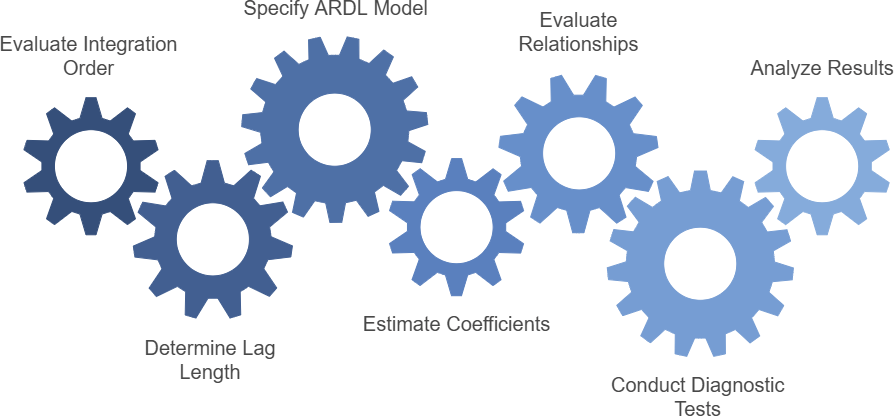
The Autoregressive Distributed Lag (ARDL) model frequently examines the dynamic relationships between variables in time series data. The initial step in the process is to evaluate the order of integration of the variables using unit root tests, such as the Augmented Dickey-Fuller (ADF) or the Kwiatkowski-Phillips-Schmidt-Shin (KPSS) test, to ascertain whether the variables are stationary or I(1) (Pesaran et al., 2001). Next, we use the Akaike Information Criterion (AIC) or the Schwarz Bayesian Criterion (SBC) to find the best latency length for the ARDL model (Pesaran and Shin, 1999). The ARDL model includes both the dependent and independent variables, along with their past values, after figuring out the correct lag length. We estimate the model using ordinary least squares (OLS) to determine the coefficients. After estimating, researchers look at how quickly things balance out by studying the long-term and short-term connections between the variables, including how errors are corrected (Wang and Zhang, 2020). Diagnostic tests, like the Breusch-Godfrey test for autocorrelation and the Jarque-Bera test for normality, are used to ensure the model is valid (Narayan and Narayan, 2004). The results are examined to better understand how the different variables relate to each other (Bashir and Shahbaz, 2020) (see Figure 1).
4.1. Evaluate order of integration
The order of integration of all the variables in our study is shown in Table 4, which is based on the findings of the Kwiatkowski-Phillips-Schmidt-Shin (KPSS) and Augmented Dickey-Fuller (ADF) tests for unit root. The findings indicate that all independent variables are integrated into various orders (I(0) and I(1)), whereas the dependent variable (HpcCON) is integrated into order one (I(1)). As a result, neither of the series is integrated into order two (I(2)), as shown by the ADF and KPSS tests. Therefore, we can estimate our model using the Autoregressive Distributed Lag (ARDL) Bounds Testing approach.
| Test | LnHpcCON | LnTI | LnGDPpc | LnINFR | LnOPNS | ||||||||||||||
|---|---|---|---|---|---|---|---|---|---|---|---|---|---|---|---|---|---|---|---|
| At Level | ADF | -3.44 | -4.74 | -2.69*** | -4.69*** | -3.65 | |||||||||||||
| KPSS | 1.15 | 1.37 | 2.49 | 2.49 | 6.46 | ||||||||||||||
| At 1st Difference | ADF | -5.17* | -4.17* | - | - | -5.21*** | |||||||||||||
| KPSS | 1.081* | 1.91* | 1.05* | 1.65* | 1.68* | ||||||||||||||
| Order of Integration | I(1) | I(1) | I(0) | I(1) | I(1) | ||||||||||||||
| Note: *, **, and *** signify the rejection of the null hypothesis at the 1%, 5%, and 10% levels, respectively. | |||||||||||||||||||
4.1.2. Cointegration assessments – ARDL bounds tests
Table 5 displays the statistical results for bound testing in each model, revealing the existence of long-term associations. The model has computed F-statistics of 76.67, respectively. These values are higher than the critical upper bound values for the significance level of the model. In particular, the F-statistic exceeds the 1% upper bound critical value of 5.58 for the model. We reject the null hypothesis that there is no cointegration since the F-statistics in both situations are greater than the critical thresholds. This finding suggests that the variables in both models move together over time and offers strong evidence of a cointegrating relationship between them. These results confirm that the model’s cointegration findings are strong and indicate that there are long-term, stable connections in the study.
| Statistics | Regression | Conclusion | |||||||||||||||||
|---|---|---|---|---|---|---|---|---|---|---|---|---|---|---|---|---|---|---|---|
| F-S | 76.67* | ||||||||||||||||||
| LUB10 | 3.02-3.51 | Cointegration | |||||||||||||||||
| LUB5 | 3.62-4.16 | ||||||||||||||||||
| LUB1 | 4.94-5.58 | ||||||||||||||||||
| K | 1 | ||||||||||||||||||
| Note: * indicates statistical significance at 1%; ** indicates statistical significance at 5%; *** indicates statistical significance at 10%; F-S: F-statistics; LUB10: Lower-upper bound (10%); LUB5: Lower-upper bound (5%); LUB1: Lower-upper bound (1%); K denotes the quantity of regressors incorporated in the models. | |||||||||||||||||||
4.2. Determine optimal lag length
In the analysis of the time series, figuring out the ideal lag length is essential to guaranteeing model accuracy and dependability. A suitable lag time improves forecast accuracy, lowers autocorrelation, and collects crucial historical data. To determine the model’s best-fit lag structure, selection criteria such as AIC, BIC, and HQIC are frequently employed. Table 6 suggests estimating the study model with three-time gaps using the ARDL model.
| Lag | LogL | LR | FPE | AIC | SC | HQ |
|---|---|---|---|---|---|---|
| 0 | -29.49 | - | 0.07 | 3.14 | 3.24 | 3.16 |
| 1 | 54.05 | 142.04* | 2.82e-05 | -4.80 | -4.50* | -4.74 |
| 2 | 57.57 | 5.26 | 3.01e-05 | -4.75 | -4.25 | -4.65 |
| 3 | 63.19 | 7.31 | 2.66e-05* | -4.91* | -4.22 | -4.78* |
| 4 | 66.66 | 3.81 | 3.03e-05 | -4.86 | -3.97 | -4.69 |
4.3.1. ARDL model estimation for the long-run model
The Autoregressive Distributed Lag (ARDL) model can be used to estimate the long-run equilibrium equation once the cointegration relationship between the dependent and independent variables in this study has been confirmed. To comprehend the long-term effects of the independent variable on the dependent variable, as well as the sustainability of their relationship over time, this estimation is an essential step. This study employs two lags to enhance the precision and coherence of the results. Table 7 displays the estimation results for the long-run parameters using the ARDL model. According to predictions, some economic factors might not greatly affect individual spending over the long term. The results show that the effect of household consumption is not important at the 1% significance level. This suggests that other factors might have a longer-lasting, more potent effect. Additionally, the modified R-squared value shows that tourism investment accounts for about 68.2% of the differences in individual consumption levels, which is consistent with the study (Sánchez-Dávila and García, 2025). Given its role in increasing household spending, this emphasizes the significance of tourism investment as a factor in raising individual consumption levels. It implies that encouraging tourism investments may eventually help raise household purchasing power.
| Variable | Coef | Std. Error | T-Statistic | P-V |
|---|---|---|---|---|
| C | 0.252 | 0.245 | 1.078 | 0.308 |
| LnHpcCON | 1.214 | 0.014 | 2.728 | 0.017 |
| LnTI | 3.512 | 0.026 | 1.562 | 0.002 |
| LnINFR | 2.523 | 0.235 | 1.523 | 0.041 |
| LnOPNS | 3.264 | 0.324 | 2.635 | 0.006 |
| LnGDPpc | 2.512 | 0.235 | 0.523 | 0.001 |
| R-Squared | 0.682 | Adjusted R-Squared | 0.589 | |
| F-Statistic | 3.017 | Prob (F-Statistic) | 0.031 | |
4.3.2. Calculating the ARDL Model’s Error Correction Form (ARDL-ECM)
The Error Correction Model (ECM) is an important tool in ARDL analysis. It helps measure the short-term relationships between variables and determine how quickly they correct to reach a long-term balance. Because it illustrates the degree to which short-term imbalances affect long-term behavior, this model is very helpful in dynamic models. The ARDL model’s error correction findings are shown in Table 8. The results of the bound test are confirmed, showing that there is a relationship between the variables. This is supported by the error correction parameter, which is statistically significant at the 1% level and is negative. The error correction coefficient (-0.439) indicates that the current year rectifies about 43.9% of the household spending imbalance from the prior year. After any short-term shocks or imbalances, the variables progressively return to equilibrium over time, as confirmed by this negative, statistically significant coefficient. The results show that the household consumption parameter is very important in the dynamic model, as it is the only one that is statistically significant at the 1% level. This model suggests that short-term changes in personal consumption eventually led to the achievement of the intended equilibrium, which is consistent with the study (Sánchez-Dávila and García, 2025; Neger et al, 2025). With only a small portion of the imbalance being corrected each year, the adjustment speed is rather slow, suggesting that shocks or changes in the economy gradually affect consumption patterns.
| Variable | Coef | Std. Error | T-Statistic | P-V | |||||||||||||||
|---|---|---|---|---|---|---|---|---|---|---|---|---|---|---|---|---|---|---|---|
| C | -0.563* | 1.236 | -3.253 | 0.001 | |||||||||||||||
| D(LnTI) | 2.231** | 0.112 | 2.122 | 0.015 | |||||||||||||||
| D(LnINFR) | 3.261 | 0.539 | 3.147 | 0.157 | |||||||||||||||
| D(LnOPNS) | 1.254 | 1.536 | 2.159 | 0.132 | |||||||||||||||
| D(LnGDPpc) | 2.489** | 0.589 | 3.259 | 0.012 | |||||||||||||||
| D(LnTI)(-1) | 2.115* | 1.479 | 1.158 | 0.005 | |||||||||||||||
| D(LnINFR)(-1) | 3.456* | 1.886 | 4.157 | 0.002 | |||||||||||||||
| D(LnOPNS)(-1) | 1.356* | 0.753 | 2.428 | 0.004 | |||||||||||||||
| D(LnGDPpc)(-1) | 2.512* | 1.769 | 1.4258 | 0.001 | |||||||||||||||
| CointEq(-1) | -0.439* | 0.253 | -5.156 | 0.000 | |||||||||||||||
| Note: * indicates statistical significance at 1%; ** indicates statistical significance at 5%; *** indicates statistical significance at 10%. | |||||||||||||||||||
4.4.1. Lagrange Multiplier test of residual
We used the LM test to check for any serial correlation in the residuals. This helped us ensure that the model we used in the study is valid and has no econometric issues. The purpose of this test is to identify any autocorrelation, which can skew results and impair estimate accuracy. We accept the null hypothesis because, as shown in Table 9, the chi-square value is higher than the 5% significance level. This means that the results are not statistically significant at this level. We therefore draw the conclusion that there are no autocorrelation problems in the residuals of the model. The residuals appear random instead of following a pattern, which means the model gives reliable results and supports the credibility of the findings. As a result, the model’s results and suggestions can be trusted to provide unbiased scientific understandings of the economic relationships under study.
| F-Statistic | 0.85 | Prob. F (1,12) | 0.37 |
|---|---|---|---|
| Obs*R-Squared | 1.32 | Prob. Chi-Square (1) | 0.24 |
4.4.2. Structural stability test for estimated ARDL model
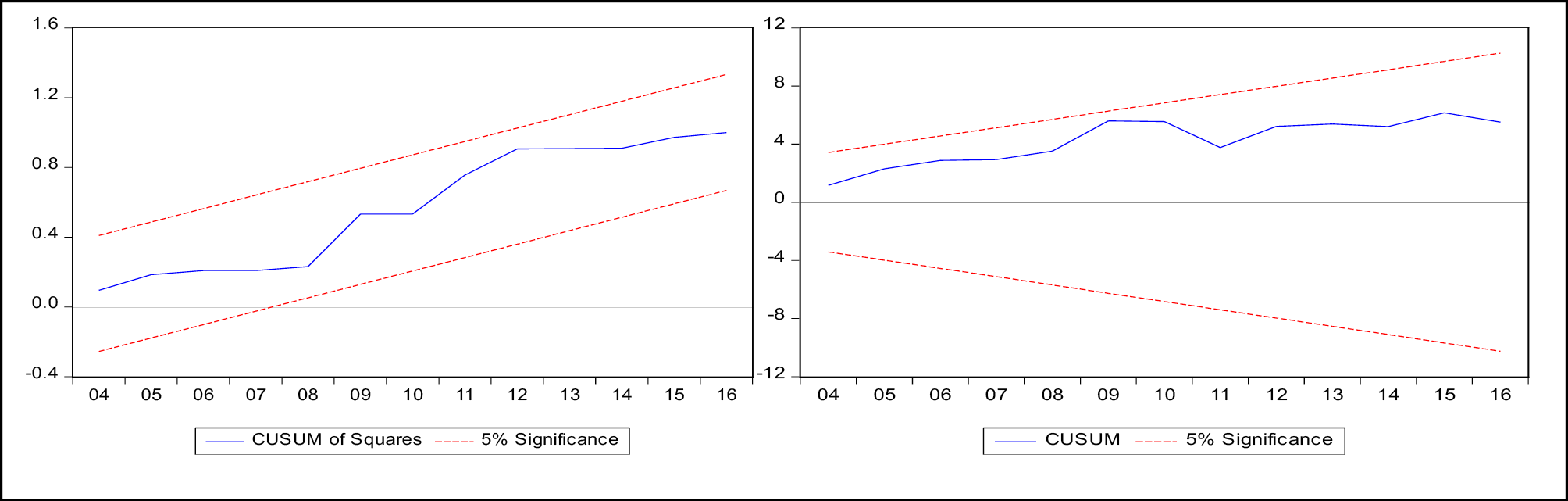
The cumulative sum of recursive residuals (CUSUM) and the cumulative sum of squares of recursive residuals (CUSUMSQ) tests are crucial for ensuring data stability and excluding any structural changes over time that could compromise the quality of the model. To confirm consistency across time, these tests assess how stable the model’s short- and long-term parameters are. The CUSUM test shows that the model remains stable, and its parameters stay consistent over time. The cumulative sum line stays within the critical zone limits at the 5% significance level (see Figure 2). The CUSUMSQ test yields a similar result, indicating stability in the squared residuals. This demonstrates that the model attains the required stability, improving the validity and accuracy of the findings by examining the economic linkages being examined and bolstering trust in the study’s conclusions and suggestions.
This analysis agrees with Garza-Rodriguez (2019) that tourism helps local economies grow. It shows a stable relationship between money spent on tourism and the amount of money households spend per person. Additionally, the study shows that investments in tourism have a positive effect on household consumption, which lowers poverty. This is consistent with earlier research, including Cárdenas-García et al. (2024) and Folarin and Adeniyi (2019), which showed that tourism boosts employment and economic growth, and Njoya and Seetaram (2018), which demonstrated that tourism investments raise household incomes in rural areas.
Evidence suggests that by ending the cycle of poverty and bringing financial stability to households, sustainable tourism development not only boosts individual consumption but also advances social and economic development. According to Kronenberg and Fuchs (2021), tourism can be a potent instrument for generating economic opportunities for underserved communities. They stress the significance of integrating local communities, allowing the impoverished to engage in the tourism value chain, thereby improving living standards and fostering economic stability.
Policymakers must acknowledge tourism as a viable economic sector to optimize the contributions of tourism investment to the national economy. Since tourism increases demand for a variety of skills and services, resulting in new job opportunities, we stress the necessity of policies that encourage skill development and tourism training (Bhatt et al., 2024). Matiku et al. (2021) agree that for sustainable tourism to bring economic and social benefits, it needs good management of people and natural resources.
The results of this study demonstrate how tourism investment can help lower poverty and raise living standards in local communities, particularly when it is incorporated into larger development plans. To attract tourists and promote foreign direct investment in this industry, governments should make investments in the infrastructure and amenities required. According to Zhang and Yang (2023), tourism has the potential to increase tax income and enhance public services for the benefit of everybody.
In conclusion, tourism investment has the potential to greatly reduce poverty and enhance local populations’ quality of life, especially when integrated into national development plans. To make tourism development a more effective instrument for reducing poverty, this study suggests implementing national policies that support sustainable tourism, training skilled human resources to manage the industry, and enhancing synergy between economic sectors.
6. Conclusion and policy recommendations
This study uses the Autoregressive Distributed Lag (ARDL) model to look at both short- and long-term effects of tourism investment on reducing poverty in Algeria. The purpose of this study is to ascertain whether more tourism investment may reduce poverty in Algeria, given the growing importance of tourism as an economic engine. This study examines whether tourism investment has a positive impact on poverty reduction and provides new insights into this relationship by using the ARDL framework. Furthermore, from 1995 to 2020, the report presents both aggregated and disaggregated evaluations of tourism investments across important sectors like lodging, transportation, and infrastructure. We carried out several diagnostic tests to verify the model’s accuracy and stability to assure resilience.
The findings show a strong correlation between tourism investment and poverty reduction over the long term, indicating that higher tourism investment is associated with lower rates of poverty. The results show that investments in the tourism industry have a favorable effect on reducing poverty, especially when it comes to creating jobs and revenue for industry. The findings, however, indicate a range of short-term outcomes, with certain tourism investments exhibiting delayed effects on reducing poverty. Furthermore, compared to other forms of tourism spending, the study finds that infrastructure investments – such as those in lodging and transportation – have a greater long-term impact on reducing poverty.
This study has many limitations even though it offers fresh perspectives on how tourism investment affects poverty. Increased data frequency could reveal more subtle effects. Future research may also be able to capture dynamic shifts in the relationship between tourism investment and poverty by including time-varying factors. To provide more thorough knowledge of the potential of tourism to reduce poverty in developing economies like Algeria, future studies should also take sector-specific studies and investigate additional socioeconomic variables.
Policymakers need to enhance tourism investment through the development of infrastructure, creation of employment, and inclusive economic policies to achieve optimal poverty reduction. Because of data constraints, the authorities need to improve data collection and the frequency of reporting to allow more precise analysis. Policies need to be time-dynamic in nature, capturing evolving economic conditions, considering time-varying determinants of tourism and poverty. Investments focusing on sub-sectors such as ecotourism, cultural heritage, and hospitality services can also generate sustainable employment and income opportunities. The inclusion of broader socioeconomic factors, i.e., education and financial inclusion, in the study will lead to better-informed policies. Strengthening public-private partnerships can also support tourism-led poverty alleviation through entrepreneurship and business development. Lastly, policymakers need to incorporate tourism investment in an overall economic diversification plan so that the benefits trickle down to marginalized groups. All these actions will make the sector more effective in stimulating sustainable growth and alleviating poverty in Algeria’s economy.
Policymakers should give transportation and lodging infrastructure improvements top priority to use tourism investment to reduce poverty in Algeria, as both sectors have demonstrated significant and beneficial effects on poverty alleviation. Encouraging private sector investment in rural and underserved areas through tax exemptions or subsidies could promote inclusive tourist growth, boosting local revenue and job possibilities. Enhancing tourism and hospitality workforce training initiatives would also guarantee skill development and long-term jobs for local populations. Building partnerships with foreign investors in tourism can bring in more money and expertise, helping the industry grow in the long run and ensuring the benefits are spread fairly.
The authors extend their appreciation to the Deanship of Scientific Research at Northern Border University, Arar, KSA for funding this research work through the project number “NBU-FFR-2026-2576-01”.
Agarwal, R., Mehrotra, A., Mishra, A., Rana, N. P., Nunkoo, R., & Cho, M. (2024). Four decades of sustainable tourism research: Trends and future research directions. International Journal of Tourism Research, 26(2), e2643. https://doi.org/10.1002/jtr.2643
Ashley, C., & Mitchell, J. (2009). Tourism and poverty reduction: pathways to prosperity. London, Routledge. https://doi.org/10.4324/9781849774635
Bashir, M. F., & Shahbaz, M. (2020). The role of renewable energy consumption in economic growth: evidence from a panel of 21 Asian countries. Renewable Energy, 153, 23–30. https://doi.org/10.1016/j.renene.2020.01.071
Bhatt, K., Seabra, C., Kumar, J., Ashutosh, K., & Kumar Kabia, S. (2024). Tourism-led inclusive growth in emerging and developing economies: a systematic literature review. SAGE Open, 14(2), 21582440241252516. https://doi.org/10.1177/21582440241252516
Cárdenas-García, P. J., Brida, J. G., & Segarra, V. (2024). Modeling the link between tourism and economic development: evidence from homogeneous panels of countries. Humanities and Social Sciences Communications, 11(1), 1–12. https://doi.org/10.1057/s41599-024-02826-8
Dossou, T. A. M., Ndomandji Kambaye, E., Bekun, F. V., & Eoulam, A. O. (2023). Exploring the linkage between tourism, governance quality, and poverty reduction in Latin America. Tourism Economics, 29(1), 210–234. https://doi.org/10.1177/13548166211043974
Folarin, O., & Adeniyi, O. (2020). Does tourism reduce poverty in Sub-Saharan African countries?. Journal of Travel Research, 59(1), 140–155. https://doi.org/10.1177/0047287518821736
Garza-Rodriguez, J. (2019). Tourism and poverty reduction in Mexico: an ARDL cointegration approach. Sustainability, 11(3), 845. https://doi.org/10.3390/su11030845
Kronenberg, K., & Fuchs, M. (2021). Aligning tourism’s socio-economic impact with the United Nations’ sustainable development goals. Tourism Management Perspectives, 39, 100831. https://doi.org/10.1016/j.tmp.2021.100831
Li, Y. J., Ouyang, C. X., Zhou, S. Y., Yu, H., & Knight, W. D. (2022). Tourism dependence and poverty alleviation thresholds in Chinese ethnic tourism. Journal of Mountain Science, 19(10), 3026–3036. https://doi.org/10.1007/s11629-022-7479-2
Matiku, S. M., Zuwarimwe, J., & Tshipala, N. (2021). Sustainable tourism planning and management for sustainable livelihoods. Development Southern Africa, 38(4), 524–538. https://doi.org/10.1080/0376835X.2020.1801386
Narayan, P. K., & Narayan, S. (2004). Does energy consumption have any impact on economic growth? A panel data analysis. Applied Energy, 76(2), 213–220. https://doi.org/10.1016/j.apenergy.2003.09.001
Neger, M., Rahid, A. O., & Alnour, M. (2025). Moderating effects of energy poverty for sustainable tourism, policy, innovation, and environmental resilience: evidence from SEM-ANN approaches. Discover Sustainability, 6(1), 103. https://doi.org/10.1007/s43621-025-00904-8
Njoya, E. T., & Seetaram, N. (2018). Tourism contribution to poverty alleviation in Kenya: a dynamic computable general equilibrium analysis. Journal of Travel Research, 57(4), 513–524. https://doi.org/10.1177/0047287517700317
Pesaran, M. H., & Shin, Y. (1999). An autoregressive distributed-lag modelling approach to cointegration analysis. In Strøm, S. (Ed.). Econometrics and Economic Theory in the 20th Century: The Ragnar Frisch Centennial Symposium. Econometric Society Monographs. Cambridge, Cambridge University Press (pp. 371-413).
Pesaran, M. H., Shin, Y., & Smith, R. J. (2001). Bounds testing approaches the analysis of level relationships. Journal of Applied Econometrics, 16(3), 289–326. https://doi.org/10.1002/jae.616
Pham, T., & Nugroho, A. (2022). Tourism-induced poverty impacts of COVID-19 in Indonesia. Annals of Tourism Research Empirical Insights, 3(2), 100069. https://doi.org/10.1016/j.annale.2022.100069
Ridderstaat, J., Fu, X., & Lin, B. (2022). A framework for understanding the nexus between tourism development and poverty: application to Honduras. Tourism Management, 93, 104620. https://doi.org/10.1016/j.tourman.2022.104620
Ruja, I. N., Sumarmi, & Idris. (2024). Programs, opportunities, and challenges in poverty reduction: a systematic review. SAGE Open, 14(2), 21582440241256242. https://doi.org/10.1177/21582440241256242
Sánchez-Dávila, E., & García, L. Y. (2025). Does the origin of tourism matter for poverty reduction? Evidence from Peruvian’s department, 2003–2022. Journal of Policy Research in Tourism, Leisure and Events, 1–18. https://doi.org/10.1080/19407963.2024.2448447
Sinclair, M. T. (1998). Tourism and economic development: A survey. The Journal of Development Studies, 34(5), 1–51. https://doi.org/10.1080/00220389808422535
United Nations World Tourism Organization (UNWTO). (2011). Tourism and poverty alleviation: recommendations for action. Available at: https://www.e-unwto.org/doi/book/10.18111/9789284407019 (Accessed 12 March 2025).
United Nations. (2015). Transforming our World: The 2030 Agenda for Sustainable Development. United Nations. Available at: https://sdgs.un.org/publications/transforming-our-world-2030-agenda-sustainable-development-17981 (Accessed 12 March 2025).
United Nations. (2019). Responsabilité, culture de paix, mixité et pluralité au service de l’Agenda 2030. United Nations Publishing. Available at: https://andp.unescwa.org/index.php/plans/1124 (Accessed 12 March 2025).
Wang, K., & Zhang, H. (2020). An empirical analysis of the relationship between tourism, energy consumption, and economic growth in China using ARDL model. Sustainability, 12(8), 3419. https://doi.org/10.3390/su12083419
Wang, K., Gan, C., Chen, L., & Voda, M. (2020). Poor residents’ perceptions of the impacts of tourism on poverty alleviation: from the perspective of multidimensional poverty. Sustainability, 12(18), 7515. https://doi.org/10.3390/su12187515
Winter, T., & Kim, S. (2021). Exploring the relationship between tourism and poverty using the capability approach. Journal of Sustainable Tourism, 29(10), 1655–1673. https://doi.org/10.1080/09669582.2020.1865385
World Bank. (2020). Tourism for Development: 20 Reasons Sustainable Tourism Counts for Development. Available at: https://www.worldbank.org (Accessed 12 March 2025 Month Year)
Zhang, H., & Yang, Y. (2023). Is tourism growth able to shrink economic inequalities? A DSGE analysis. Annals of Tourism Research Empirical Insights, 4(1), 100089. https://doi.org/10.1016/j.annale.2023.100089
Zhao, J., Yang, D., Zhao, X., & Lei, M. (2023). Tourism industry and employment generation in emerging seven economies: evidence from novel panel methods. Economic research-Ekonomska istraživanja, 36(3), 2206471. https://doi.org/10.1080/1331677X.2023.2206471
Zhao, L., & Xia, X. (2020). Tourism and poverty reduction: Empirical evidence from China. Tourism Economics, 26(2), 233–256. https://doi.org/10.1177/0047287520947792