https://doi.org/10.36253/aestim-18753
Received: September 25, 2025; Accepted: January 4, 2026; Published: September 11, 2026
Stakeholders’ perceptions of factors shaping quality of life in rural areas: Evidence from two Italian case studies
1 Department of Agricultural, Forestry, Food and Environmental Sciences, University of Basilicata, Italy
2 Department of Agriculture, Food, Environment and Forestry, University of Florence, Italy
3 Erasmus Happiness Economics Research Organization, Rotterdam, The Netherlands
E-mail: maria.andreoli@unibas.it, francesca.gerini@unifi.it, mario.cozzi@unibas.it, severino.romano@unibas.it, fabio.boncinelli@unifi.it, leonardo.casini@unifi.it, enrico.marone@unifi.it, mburger@ese.eur.nl, mauro.viccaro@unibas.it
*Corresponding author
Abstract. Rural areas play a crucial role in achieving sustainable development, yet they face persistent and recurring social issues such as demographic decline, limited access to essential services, and economic stagnation. Framed on community revitalization and place-based development, this study examines the factors influencing quality of life in marginal rural areas at high risk of abandonment, focusing on Basilicata and Tuscany – two Italian regions with distinct socio-economic profiles. Adopting a qualitative approach, semi-structured interviews were conducted with local stakeholders to capture their lived experiences and perceptions of rural well-being and development opportunities. The analysis, supported by textual data processing, highlights shared and region-specific challenges. Key themes include service accessibility, demographic dynamics, economic opportunities, and governance capacity. Findings reveal that while both regions emphasize essential services and economic revitalization, their approaches differ: Basilicata stakeholders stress infrastructural deficits and demographic decline, whereas Tuscany stakeholders highlight rural diversification and place-based initiatives. These insights underscore the importance of local stakeholder perceptions in shaping rural development strategies. The study contributes to theoretical debates on rural well-being by demonstrating how stakeholder perspectives influence policy priorities and intervention strategies. It advocates for place-sensitive policies that enhance institutional capacity and leverage regional assets to promote sustainable rural community revitalization. These findings support the need for a context-specific approach to rural policy that integrates both qualitative and quantitative measures of well-being.
Keywords: well-being, inner areas, sustainable rural development, local context, place-based policy.
Contents
2.2 Quality of life in marginal rural areas: definitions, dimensions, and approaches
3. Case studies and methodology
3.1 Methodological approach and research design
3.3 Data analysis and methodological tools
4.1 Word cloud and thematic coding
4.1.1 Depopulation and demographic trajectories
4.1.2 Essential services and quality of life
4.1.4 Tourism development strategies
4.1.5 Environmental management and risk perception
4.3 Descending Hierarchical Classification (DHC) and Confirmatory Factor Analysis (CFA)
4.4 Integrated summary of results
1. Introduction
Rural areas play a key role in achieving the Sustainable Development Goals (SDGs) established by the United Nations (United Nations, 2015). In the European Union (EU), these areas encompass 80% of the territory and accommodate 30% of the population (European Commission, 2021a). They are fundamental for food production, the sustainable management of natural resources, landscape conservation, and tourism development, significantly contributing to preserving European cultural heritage and traditions (European Commission, 2021a). Despite these assets, rural areas face considerable challenges, including globalization, urbanization, demographic decline, and population ageing, threatening rural infrastructure and services (Li et al., 2019; OECD, 2020a; Shucksmith, 2016).
To respond to these challenges, the EU has developed several initiatives and programs, such as the Common Agricultural Policy (CAP), Rural Development Programs (RDPs), the European Agricultural Fund for Rural Development (EAFRD), and LEADER program (European Commission, 2021b). These programs support sustainable agriculture, innovation, and competitiveness in the agricultural sector, protect the rural environment and landscape, and improve the quality of life (QoL) in rural areas.
The EU underscored the importance of maintaining satisfactory QoL levels in rural areas as a fundamental prerequisite for their development in the Cork Declaration 2016 (European Union, 2016). This prominence was reiterated in 2021 with the “Long-term vision for the EU’s rural areas - Towards stronger, connected, resilient and prosperous rural areas by 2040” (European Commission, 2021a). The Vision leverages opportunities emerging from the EU’s green and digital transitions, as well as lessons learned from the COVID-19 pandemic, to address these concerns comprehensively. This policy framework highlights the need for differentiated strategies that reflect the diversity and complexity of rural areas.
In Italy, additional measures have been mobilized through the National Recovery and Resilience Plan (RRPs), financed by the NextGenerationEU funds (European Parliament and Council, 2021). The plan includes targeted interventions to improve accessibility, digitalization, social cohesion, and innovation capacity in rural and inner areas. Within this framework, the National Center for Agricultural Technologies (Agritech) is tasked with analysing the socioeconomic determinants of development disparities and identifying the specific needs of rural communities (Ministero dell’Università e della Ricerca, 2022).
Although this topic is of significant importance, intervention strategies aimed at improving the QoL in rural areas remain limited (Casini et al., 2019). A key barrier lies in the complexity of defining and operationalizing well-being, which is inherently multidimensional and strongly context-dependent (Stiglitz et al., 2009; OECD, 2020a; Casini et al., 2021; Veréb et al., 2024). Previous studies have emphasized the importance of considering local contexts and subjective perceptions when assessing quality of life in rural and marginal areas (Scott, 2012; Shucksmith, 2016; McCrea et al.,
2016). However, empirical research based on qualitative, place-based analyses of local stakeholders’ perceptions – particularly in Italian inner areas – remains limited. Addressing this gap requires a deeper understanding of lived experiences and locally grounded interpretations of well-being, which can inform more context-sensitive development strategies.
This study aims to respond to this challenge by contributing new conceptual and empirical insights to the literature on rural well-being and place-based development. This study focuses on stakeholder perceptions of well-being in inner areas of two Italian regions, Basilicata and Tuscany, defined under the National Strategy for Inner Areas (Barca et al., 2014). The research aims to investigate how key local stakeholders perceive well-being in marginal rural areas, with a focus on identifying the socio-territorial dynamics that influence current challenges and shape development opportunities. Applying a qualitative approach, the research explores the interplay between demographic trends, service provision, and territorial assets in shaping QoL. While grounded in the Italian context, the study also aims to extract broader conceptual patterns that inform the understanding of rural marginality in other European settings. In this way, it seeks to enhance the generalizability of its findings and contribute to cross-contextual theorizing on rural transformation.
The study addresses the following research questions: i) Which specific dimensions of well-being are perceived as most relevant by local stakeholders in Italian inner areas? ii) What region-specific challenges and opportunities emerge from stakeholders’ narratives, and how do these reflect broader patterns of rural transformation? iii) In what ways do thematic clusters, such as demographic dynamics, public services, agricultural systems, and territorial governance, interact in shaping perceptions of QoL and prospects for rural development?
Through semi-structured interviews with local administrators, the study offers a qualitative exploration of these issues. The methodology enables the collection of rich, context-specific knowledge and offers detailed insights into the governance dynamics influencing QoL in rural territories (Shucksmith and Brown, 2016). Beyond documenting casespecific dynamics, the study aims to identify recurring discursive configurations that may inform a more generalizable understanding of rural well-being. The findings contribute to the broader literature on place-based development and inform policy efforts to foster inclusive and sustainable rural regeneration.
By emphasizing stakeholder voices, this research seeks to support policies that are locally grounded. In doing so, it responds to the growing recognition that rural well-being cannot be externally imposed but must be co-constructed with local communities.
The contribution of this study lies in its ability to link grounded stakeholder perspectives with broader conceptual debates on rural well-being and governance. The empirical contribution is twofold: first, it deepens the understanding of local perceptions of QoL in inner areas; second, it identifies discursive patterns that are potentially generalizable across diverse rural contexts.
2. Background
2.1 Marginal and inner areas
Marginal areas are territories of significant interest in terms of geography, regional development, and the formulation of policy strategies (Li et al., 2019). They become particularly crucial in countries like Italy, where geographic diversity and socio-economic development disparities pose significant challenges (Bertolini and Pagliacci, 2017). In Italy, the definition of marginal areas is associated with that of inner areas provided in the Italian National Strategy for Inner Areas, an initiative launched by the Italian government in 2014 to address issues of marginalization and promote socio-economic development in remote areas (Barca et al., 2014). In Italy, inner areas encompass 60% of the national land area, 52% of municipalities, and 22% of the population (Agency for the Territorial Cohesion, 2024). Inner areas are characterized by their considerable distance from centres offering essential services such as healthcare, education, and mobility. These areas possess a rich heritage of environmental and cultural resources and exhibit great diversity due to their intrinsic nature and centuries-long processes of anthropisation that have shaped them (Barca et al., 2014).
During the second half of the 20th century, Italy’s inner areas were often regarded, particularly from sociodemographic and economic perspectives, as shrinking regions - marginal, declining, and contracting areas afflicted by dramatic depopulation. This phenomenon, characterized by a mass exodus, especially of young people, to urban and metropolitan areas in the plains and coastal zones, resulted in a significant demographic shift (Bertolini and Pagliacci, 2017; Mallach, 2017; Martins and Davino, 2023). The exodus was driven by the pursuit of better living conditions and propelled by industrialization and urbanization dynamics (Barca et al., 2014).
These regions face a comprehensive structural crisis marked by economic and labour market decline, peripheralization, and a widening urban-rural divide, exacerbating the inherent disadvantages of rural areas (ESPON, 2017). Additionally, shrinking inner areas experience a deterioration of rural infrastructure, a reduction in the availability of essential services, difficulties in accessing healthcare, social services, and education, as well as limitations in transport, digital connectivity, and postal and banking services (European Commission, 2024). These factors have led to negative outcomes such as higher poverty and unemployment rates compared to more developed regions, such as urban areas.
Inner areas exhibit various territorial, cultural, and social aspects that can be leveraged to foster the development of these regions (Tricarico et al., 2022). These areas are often rich in valuable natural and scenic resources, including mountains, hills, forests, and natural parks that provide opportunities for tourism, recreational activities, and biodiversity conservation. The natural heritage represents a fundamental asset that, if properly managed, can stimulate economic development and improve the QoL for residents (Sardaro et al., 2021). The cultural heritage of inner areas is equally significant, encompassing historic villages, archaeological sites, local traditions, and artisanal products (Crociata et al., 2025). These elements can drive cultural tourism and the promotion of typical products, contributing to the enhancement of local identities and social cohesion (Woods, 2006).
Inner areas offer a more tranquil and less polluted living environment compared to urban areas (Cozzi et al., 2022). The presence of green spaces, low population density, and direct contact with nature are factors that contribute to a higher QoL (Casini et al., 2021). These aspects can attract new residents, particularly families and individuals seeking a more sustainable and healthier lifestyle (Sgroi, 2022).
Social cohesion is a crucial factor for community resilience and the ability to tackle economic and social challenges.
Communities in inner areas are often characterized by a strong sense of belonging and social cohesion (Viccaro et al., 2021). This cohesive social structure facilitates collaboration and active citizen participation in local development projects (Mastronardi et al., 2020).
Agriculture represents an important component of the economy in inner areas (Boncinelli and Casini, 2014). The availability of agricultural land offers opportunities for economic development and employment (Christiaensen et al., 2021). The enhancement of local productions and the integration of agri-food supply chains can significantly contribute to the sustainable development of rural areas (Liu et al., 2022).
Recently, interest in inner areas has grown, driven by increased awareness of their potential for sustainable development and the enhancement of territorial heritage (Yin et al., 2022). The abundant natural resources, including forests, pastures, watercourses, and biodiversity, present invaluable opportunities for nature tourism and green economy activities (Barca et al., 2014). Additionally, the rich cultural heritage, characterized by centuries-old traditions, local craftsmanship, and distinctive products, provides a foundation for the development of high-quality agri-food chains and cultural tourism (Barca et al., 2014). This renewed focus on inner areas underscores their strategic importance in fostering sustainable economic growth and enhancing the QoL for their inhabitants (Marsden, 2009).
2.2 Quality of life in marginal rural areas: definitions, dimensions, and approaches
In the context of marginal rural areas, QoL has emerged as a central concern for both researchers and policymakers (Meloni et al., 2023; Veréb et al., 2024; OECD, 2020a). In territories affected by structural vulnerabilities, QoL transcends standard measures of economic performance, encompassing a broader set of material and immaterial dimensions (OECD,
2020a). The term “quality of life”, often used synonymously with well-being or happiness, indicates an individual’s overall satisfaction with his or her existence (McCrea et al., 2016). It is a complex and dynamic concept that varies across time and social contexts (Pontin et al., 2013), reflecting the diverse needs and experiences of local populations (Viccaro et al., 2021). It is also relative, as assessing well-being often involves comparing individuals or communities with others (Casini et al., 2021).
Among the conceptual frameworks, the capability approach offers a useful reference point (Nussbaum, 2000; Sen, 1999), highlighting the importance of assessing well-being in terms of people’s effective freedoms and real opportunities to pursue the lives they value. This perspective reinforces the need for a multidimensional and context-sensitive interpretation of QoL, especially in marginal areas where structural constraints may limit individual and collective agency.
Since capabilities are context-dependent, the selection of dimensions must be adapted to each case (Nussbaum, 2000; Sen, 1999). In the Italian rural context, studies have identified key QoL dimensions including economic conditions, healthcare, education, employment, transport, safety, environmental quality, landscape, cultural heritage, social ties, and innovation (Casini et al., 2021; Viccaro et al., 2021).
Methodologically, the literature distinguishes between subjective and objective approaches to assessing well-being (OECD, 2020b; Voukelatou et al., 2021). Each offers distinct but complementary insights: subjective methods focus on personal perceptions, while objective ones rely on measurable indicators (Cummins, 2000; Stiglitz et al., 2009; Viganó et al., 2019). Subjective approaches assess individuals’ satisfaction with housing, health, education, employment, and social life, typically through surveys, interviews, or focus groups (Casini et al., 2021; Contzen and Häberli, 2021; MäkiOpas et al., 2022; Vendemmia et al., 2021). Qualitative methods, in particular, capture the complexity of lived experiences (Creswell and Poth, 2017). For instance, quantitative measures might indicate generally adequate healthcare facilities in a community, yet qualitative data might reveal barriers linked to trust, culture, or accessibility (Kahneman and Krueger, 2006). These methods thus allow a richer, community-grounded understanding of QoL.
Objective approaches rely on quantifiable indicators such as income, employment, education, or life expectancy (ISTAT, 2023; OECD, 2020b). Their strength lies in standardisation and comparability across contexts (Barrington-Leigh and Escande, 2018; Veréb et al., 2024), but they may miss subjective experiences and local specificities. While indispensable for large-scale analysis, they should be complemented by more contextual tools (Frey and Stutzer, 2002).
The qualitative approach, which involves conducting interviews or focus groups with citizens and specially informed people to measure QoL, is suitable for gathering detailed data essential for identifying emerging themes and outlining key variables that may influence the QoL in the communities under study (Makri and Neely, 2021).
In this regard, our study, based on a qualitative approach through interviews with mayors, offers significant advantages. First, mayors represent a privileged point of observation, as they possess both institutional knowledge and direct experience of the everyday challenges faced by their communities. As the leading figures of local authorities, they are entrusted with responsibilities across social, environmental, and economic domains, dimensions that closely intersect with QoL. Their narratives provide valuable and privileged points of view into the interplay between structural constraints and local resources, and into the perceptions of what constitutes a “good life” in marginal areas. Second, the qualitative method allows for flexibility and depth, capturing place-specific understandings of QoL that are often overlooked by standardized metrics. Finally, this approach aligns with the capability perspective, enabling a contextualized and peoplecentred reading of well-being that is sensitive to the values, priorities, and aspirations of local populations.
3. Case studies and methodology
3.1 Methodological approach and research design
This study adopts a qualitative methodology with an exploratory purpose. The research design is guided by three general research questions formulated to analyze the relationship between quality of life, local governance, and conditions of territorial marginality. These questions are intentionally broad to capture the complexity of the social, institutional, and territorial processes under analysis. The aim is to investigate the perceptions of key local stakeholders regarding the factors that influence QoL in rural areas. This choice, grounded in a bottom-up logic, is driven by the need to capture direct experiences and socio-cultural nuances often overlooked by top-down quantitative approaches (Corbetta, 2015). This approach is particularly suited for understanding human experiences within their natural context and for building theory directly from data (Creswell & Poth, 2017; Sutton & Austin, 2015). The instrument for data collection was the semi-structured interview, selected for its capacity to ensure both flexibility in inquiry and comparability across data sets. As highlighted by Hijmans and Kuyper (2020), this technique relies on a thematic guide and open-ended questions, allowing the conversational path to be adapted while ensuring investigative depth. The interview protocol (see Appendix), composed of 13 questions, was developed from the key points emerging from a previous study by Casini et al. (2021) regarding viability and well-being in marginal areas. These dimensions were used to operationalize the research questions through a contextualized adaptation of empirical evidence, specifically calibrated for mayors of inner areas in Basilicata and Tuscany. Rather than a one-to-one correspondence, each of the three research questions is explored through a set of complementary questions, ensuring coherence between the theoretical framework, research questions, and data collection instruments. Specifically, the interview protocol explored dimensions of rural life (Meloni et al., 2023) such as accessibility and satisfaction with services (e.g., education, healthcare, transportation, tourism), social cohesion and safety, environmental quality and territorial strengths, challenges faced by specific demographic groups (e.g., youth, women, immigrants), issues in agricultural activities, strategies to address depopulation, and opportunities for public funding and sustainable development. The interviews were conducted online between May and September 2023, each lasting 50–60 minutes, and were audio-recorded with informed consent.
3.2 Case studies and sample
The case selection is guided by a comparative logic and a maximum variation sampling strategy. The objective is to include territories with differing socio-economic and morphological conditions, which are nonetheless united by their shared classification under the National Strategy for Inner Areas (NSIA) 2021–2027.
In particular, the analysis focus on specific inner areas of Basilicata and Tuscany, two Italian regions characterized by distinct geographical, demographic, and socio-economic profiles. The selection of these regions is also driven by their explicit inclusion in the PNRR Agritech project, which targets rural innovation and development in selected areas of Southern and Central Italy. By examining these contrasting case studies, the research aims to identify key challenges and factors affecting QoL of rural communities. This serves as a starting point for defining specific approaches to investigate QoL dimensions in greater depth and offering policy recommendations to enhance rural development and improve QoL.
Basilicata and Tuscany (Figure 1) were selected for their rural landscapes and socio-economic structures. Basilicata, located in southern Italy, is predominantly rural (OECD, 2020b), with 72 municipalities classified as peripheral or ultraperipheral by the National Strategy for Inner Areas (NSIA) 2021-2027. The region faces significant challenges, including population aging, depopulation, and limited economic development, making it a vital case for studying rural marginalization (Viccaro et al., 2015, 2021).
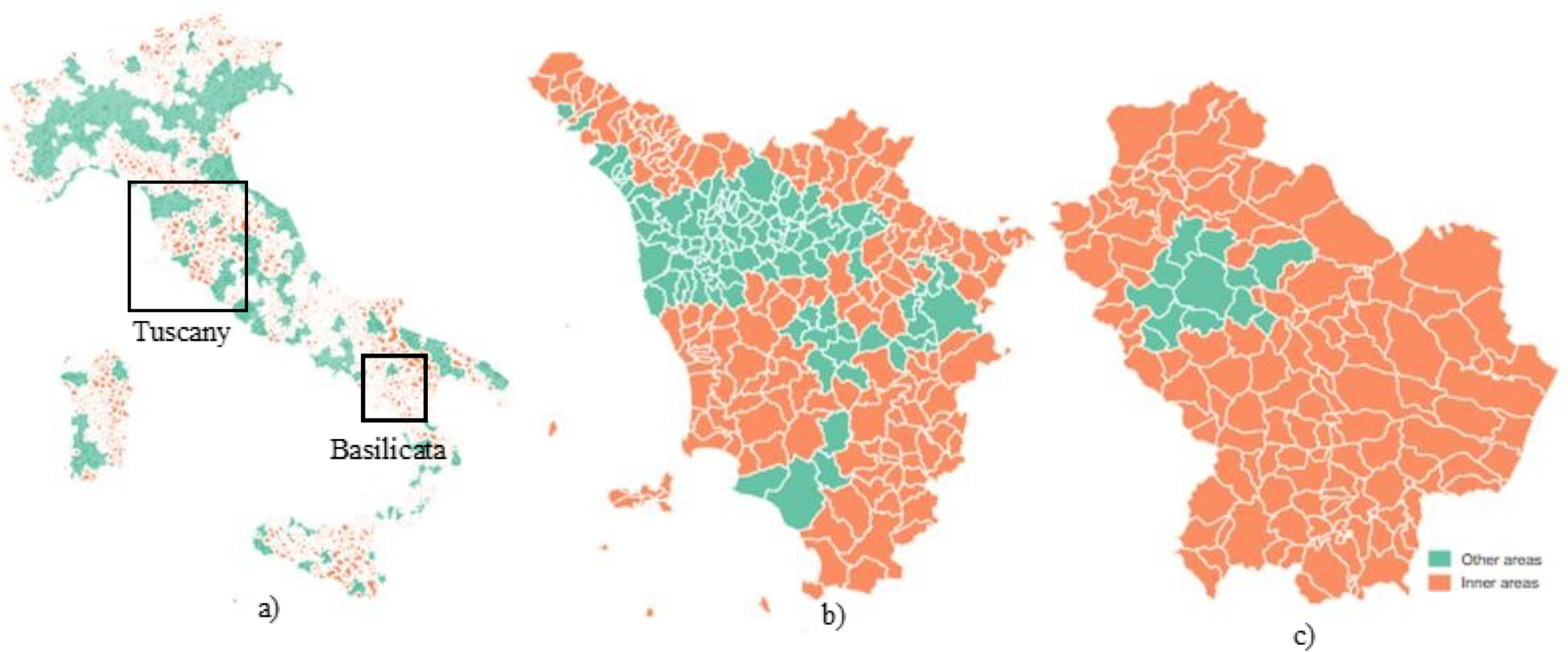
The seven Basilicata’s inner rural areas (Alto Bradano, Montagna Materana, Marmo Platano, Mercure - Alto Sinni - Val Sarmento, Medio Agri, Medio Basento, Vulture) highlight both socio-economic difficulties and opportunities for endogenous development. Tuscany (central Italy), in contrast, offers a more diversified rural environment across its ten provinces. The NSIA 2021-2027 identifies six inner areas (Casentino - Valtiberina, Garfagnana - Lunigiana - Media Valle del Serchio - Pistoia Apennines, Valdarno - Valdisieve - Mugello - Val Bisenzio, Amiata Grossetana - Amiata Val d’Orcia - Colline del Fiora, Alta Valdera - Alta Val di Cecina - Colline Metallifere - Val di Merse, Valdichiana Senese), encompassing 164 municipalities classified as intermediate, peripheral, or ultra-peripheral. Tuscany’s rural complexity, rooted in its natural resources, cultural heritage, and socio-economic infrastructure, provides insights into QoL dynamics (Casini et al., 2018). Together, these regions enable a comparative analysis of local administrators’ perspectives regarding rural well-being and sustainable development.
This study employed a purposive sampling strategy aimed at engaging institutional stakeholders who could offer both a strategic and an operational perspective on local dynamics. All mayors of the municipalities classified as peripheral and ultra-peripheral (NSIA, 2021-2027) in the two regions under consideration were contacted, along with the Presidents of National Association of Italian Municipalities (NAIM) Tuscany and Basilicata, via official emails requesting their participation in a qualitative interview. The final sample consists exclusively of those who expressed their availability to participate, thus constituting a self-selected sample from the target population of local decision-makers. No ex-ante selection criteria were applied other than institutional status and geographical location. Specifically, in Basilicata, four mayors and one President of Unions of Municipalities, who also serve as mayor, were interviewed. In Tuscany, the sample comprises three local administrators from the Tuscan-Emilian Apennines area, one Vice President of Unions of Municipalities, who also serve as mayor and the President of NAIM Tuscany. Although the sample is not statistically representative, it is nonetheless consistent with the exploratory objectives of qualitative research, as it consists of individuals directly involved in decision-making and territorial management processes. This composition ensures qualified institutional representation and allows for a comparison between two different ideas of rural governance, which is useful for uncovering local perceptions, priorities, and strategic visions. A summary overview of the sample composition, including ID (MB means mayor of Basilicata and MT means mayor of Tuscany), role, and geographical origin, is provided in following Table 1.
| ID | Role | Location |
|---|---|---|
| MB_01 | Mayor | Basilicata |
| MB_02 | Mayor | Basilicata |
| MB_03 | Mayor and President of Union of Municipalities | Basilicata |
| MB_04 | Mayor | Basilicata |
| MB_05 | Mayor | Basilicata |
| MT_01 | Mayor | Tuscany |
| MT_02 | Mayor | Tuscany |
| MT_03 | Mayor and Vice President of Union of Municipalities | Tuscany |
| MT_04 | Mayor | Tuscany |
| MT_05 | President of NAIM Tuscany | Tuscany |
The decision to involve mayors does not stem from the assumption that their viewpoint is the most relevant among all stakeholders, but from the recognition that they are among the most representative figures for their territory, in their capacity as “first citizens” and spokespersons for the local population. Furthermore, they are key actors in local change, as they directly lead the processes of planning, management, and administrative innovation, particularly in peripheral contexts where local government plays a crucial role in ensuring the provision of services and attracting resources for development (Viccaro, 2021).
3.3 Data analysis and methodological tools
The analysis of the empirical material was designed to combine the depth of qualitative interpretation with the efficiency of computational methods by tools for textual analysis. This approach aimed to identify recurring themes, relational patterns, and semantic structures emerging from stakeholders’ narratives, while maintaining strong adherence to the original discourse (Chaves et al., 2017; Ratinaud, 2008).
The transcriptions were carried out using an open coding approach (McLeod, 2024), according to the Grounded Theory Method (Glaser and Strauss, 1967), based on a word-by-word and event-by-event logic, to maximise fidelity to the participants’ expressions and to enable the emergence of meaningful interpretative cues (Tarozzi, 2008). This detailed and unfiltered transcription ensured that the subjective nuances of each interviewee’s narrative were retained as input for the subsequent stages of text processing and analysis.
For example, the following segment from interview MT_01: “The young people I see around here are more interested in niche products linked to production and baking, such as ancient grains, chestnut flour and desserts made with chestnut flour and potatoes...”. Was coded as: youth entrepreneurship, agricultural innovation, niche production. Another example, from interview MB_01: “We have two main urban centres more than 18 km apart... we have the same human resources as an average municipality but we have to manage twice as much”. Was coded as: infrastructure duplication, administrative fragmentation, human resource strain.
The transcripts were further processed using IRaMuTeQ (Interface de R pour les Analyses Multidimensionnelles de Textes et de Questionnaires) software, version 0.7 alpha 2, developed by Pierre Ratinaud (2008).
The IRaMuTeQ software was chosen because it supports a systematic and comparative textual analysis aimed at a multi-level understanding of stakeholder perceptions (Rodríguez et al., 2024, Mendes et al., 2016; Souza et al., 2018). Its primary strength lies in applying quantitative methods to qualitative data, thus enriching the interpretation with statistical evidence without sacrificing the depth of the original discourse (Camargo & Justo, 2013; Lahlou, 2012). Furthermore, its suite of integrated tools ensures methodological coherence across all phases of the analysis (Ratinaud, 2008; Mennani & Attak, 2024).
The analysis employed a multi-phase process using several of IRaMuTeQ’s analytical tools to compare perceptions across Basilicata and Tuscany. Initially, we conducted an exploratory analysis using a word cloud and similarity analysis to identify core concepts and reveal their underlying connections, effectively mapping the stakeholders’ discourse (DePaolo & Wilkinson, 2014; Bletzer, 2015; Segev, 2022). Following this, we applied Descending Hierarchical Classification (DHC) to inductively group the text into coherent thematic clusters. Finally, the robustness of this thematic structure was statistically validated with Confirmatory Factor Analysis (CFA), which confirmed the consistency and differentiation of the clusters (Brown, 2015; Mishra, 2016). This structured approach enabled a detailed, comparative analysis of perceptions of rural well-being.
For this study, the interview transcripts were transformed into two different corpora representing stakeholders from Basilicata and Tuscany: each corpus of analysis included five interviews, known as an Initial Context Unit - ICU (Souza et al., 2018), for each region. These corpora were then analysed using word cloud visualization, similarity analysis, DHC and confirmatory factor analysis (CFA) (Camargo and Justo, 2013; Castro et al., 2014). To ensure data integrity, only “full” language elements - adjectives, nouns, verbs, and auxiliary forms - were retained during corpus preparation, enriching the content, and enhancing the depth of analysis. Corpus preparation involved standardizing acronyms, correcting typographical errors, and adjusting composite words (e.g., “wild_animals” or “hydrogeological_instability”) to ensure consistent processing.
It is important to point out that, in adherence to the methodological principles of the Grounded Theory, the interviews were analysed and subjected to textual analysis in their original language (Italian) without any modifications. This decision is consistent with established practices in the existing literature (i.e., Karim et al., 2024; Chaves et al., 2022; Galli & Fasanelli, 2020; Souza et al., 2018), which frequently employs the IRaMuTeQ software for the textual analysis of interviews, favouring the use of texts in their original language.
The analysis revealed core themes influencing rural well-being in Basilicata and Tuscany, highlighting shared and region-specific perspectives. The methodological steps provided a detailed understanding of rural well-being, offering actionable insights for addressing challenges and promoting sustainable development in rural areas.
4. Results
The findings presented in this section are derived from semi-structured interviews with 10 mayors from the two case study areas. Although this sample is not statistically representative, as previously noted, the analysis holds significant validity. It reflects the perspective of key institutional actors whose political and administrative vision constitutes the primary source of the data analyzed.
4.1 Word cloud and thematic coding
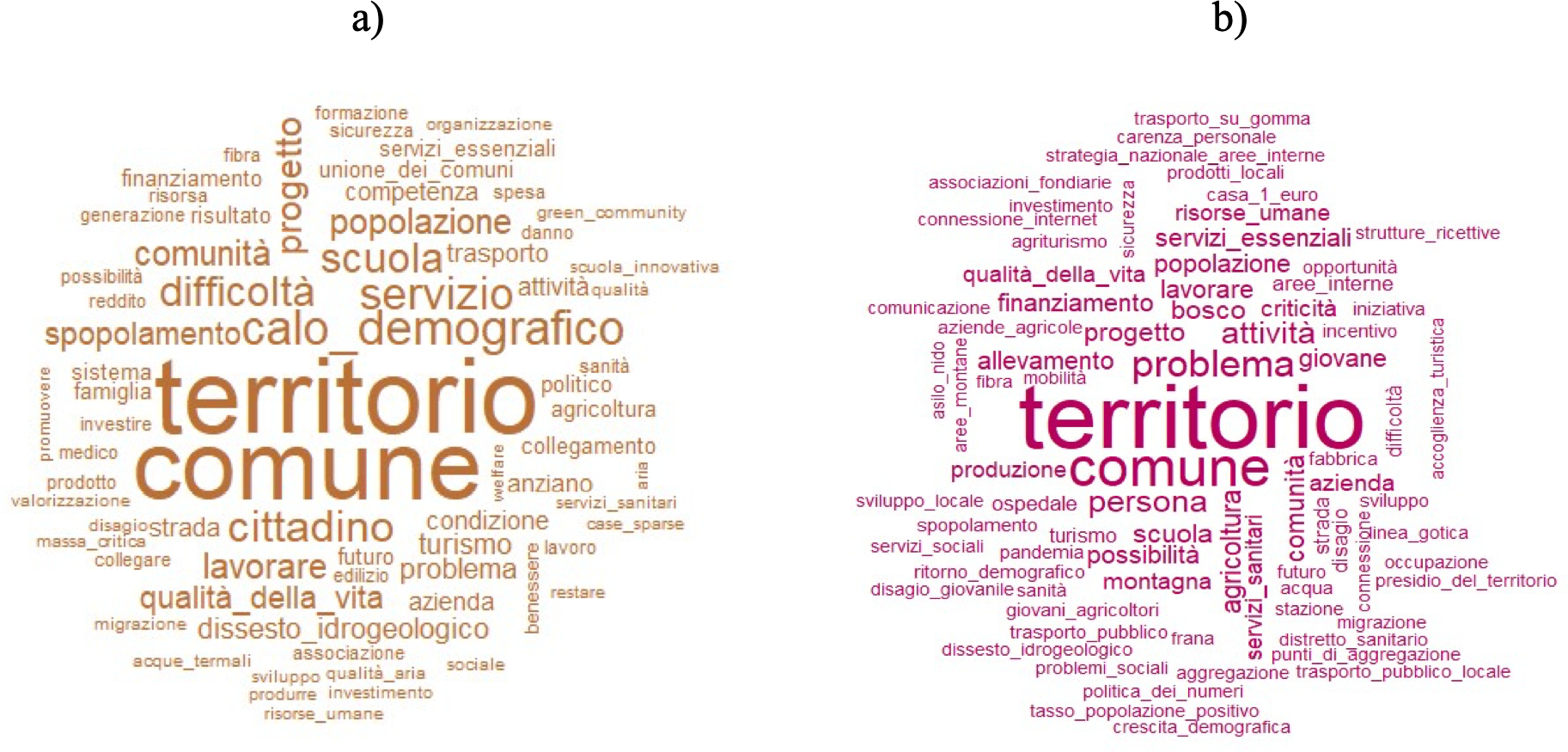
The application of IRaMuTeQ software facilitated the creation of word clouds, a technique that aggregates words and organizes them graphically based on their frequency in the text. Words that appear more frequently are displayed in larger sizes, offering a visually engaging and straightforward method for identifying key themes in the qualitative data. The generated word clouds highlighted recurring issues raised by the stakeholders (Figure 2). and represent a first level of exploration of the textual data. Furthermore, to enrich the understanding of the underlying meanings, a qualitative thematic coding was carried out based on the full texts (Table 2).
| Thematic Code | Key Issues |
|---|---|
| Essential services | Schools, healthcare, local public transport |
| Human resources | Staff shortages, NEETs, turnover |
| Territorial development | Tourism, agriculture, circular economy |
| Structural vulnerabilities | Hydro-geological instability, isolation, bureaucracy |
| Demographics and population | Depopulation, birth/death rate, immigration |
| Governance and administration | Union of municipalities, PNRR funds, inland area planning |
The coding followed an inductive and iterative approach (Thomas, 2003), which allowed us to identify the main thematic areas and semantic interconnections between concepts. The most significant themes were organised into main categories and subcategories, as shown in the Table 2.
This structure has made it possible to interpret word clouds not only in terms of frequency, but as a visual representation of a complex network of meanings, consistent with territorial narratives.
Common themes across both Basilicata and Tuscany included terms such as territory (territorio), municipality (comune), citizen/people/population (cittadino/persona/popolazione), agriculture (agricoltura), human capital (risorse umane), essential services (servizio/servizi essenziali), tourism (turismo), and hydro-geological instability (dissesto idrogeologico).
Distinctive regional differences were also evident. In Basilicata, terms such as depopulation/demographic decline (spopolamento/calo demografico), green community, scattered houses phenomenon (fenomeno delle case sparse), union of municipalities (unione dei comuni), and innovative school (scuola innovativa) emerged prominently. In contrast, Tuscany featured terms such as population growth/positive population rate (crescita demografica/tasso popolazione positivo), forest (bosco), mountains (montagne), local public transport (trasporto pubblico locale), and 1€ houses project1 (progetto case a 1€).
Although word clouds effectively highlight significant terms, they do not capture the underlying complexities behind these terms.
To explore the meaning of these concepts in greater depth, a qualitative thematic coding was applied, which made it possible to contextualise the terms within the narratives expressed by the interviewees. The qualitative interpretation was supported by direct quotations taken from the text corpus, which allowed each key term to be linked to its specific narrative and semantic function. Here are some relevant examples.
4.1.1 Depopulation and demographic trajectories
The phenomenon of depopulation (spopolamento/calo demografico) in Basilicata is not merely a statistical trend but represents a profound and systemic lived experience for its communities. Interview data elucidate a deeply negative natural balance (births vs. deaths), where deaths significantly outnumber births, compounded by a pronounced exodus of younger generations. As one stakeholder (MB_01) articulated, “We are losing entire generations. They reach the age of 18 and then [...] they leave.” This demographic decline is quantified by another participant (MB_03): “The natural balance (births vs. deaths) is minus 18, minus 19, which means that in five years, almost 100 inhabitants have been lost.” These narratives correspond to the analytical codes of youth exodus, demographic imbalance, and demographic contraction. Conversely, the demographic landscape in Tuscany is characterized by a “positive population trend” (crescita demografica/tasso di popolazione positivo). This growth is propelled primarily by in-migration, including a notable trend of individuals returning to their ancestral or second homes in search of an enhanced quality of life. This is evidenced from MT_02 by observations that “a demographic return of individuals originally from Vernio is also occurring” and from MT_01 that “approximately 10-15 families have returned in recent years; they have purchased detached houses with gardens […] for a better quality of life compared to the city.” This phenomenon is coded as residential return and attractive in-migration, underscoring the region’s appeal.
4.1.2 Essential services and quality of life
While the term “essential services” (servizi essenziali) is pivotal in both regional contexts, its connotations diverge significantly. In Basilicata, the discourse is dominated by themes of scarcity and fragmentation. The administrative structure itself exacerbates these challenges, as one stakeholder explained (MB_2): “As a highly fragmented municipality, we are compelled to manage multiple instances of every service [...], which results in a duplication or triplication of both problems and costs.” This strain is particularly acute in the educational sector, where dwindling numbers threaten viability MB_4): “Our school has only 30 children in total. This makes it challenging to sustain the organization of services.” These conditions are analytically captured by the codes inefficient duplication of public services and erosion of the critical mass for educational services. In Tuscany, by contrast, while challenges are acknowledged, the narrative reveals a greater degree of institutional resilience and proactive problem-solving. A key example is the strategic response to healthcare needs (MT_02): “We decided to establish a Casa della Salute (community health center) [...], which delivers a highquality healthcare service”. This proactive approach is coded as innovation in territorial healthcare services, highlighting a capacity for adaptive governance.
4.1.3 Work
The term “to work” (lavorare) appears in both word clouds but reflects different perspectives in the two regions. In Basilicata, the term “lavorare” is associated with a lack of job opportunities, as expressed by stakeholders who noted the absence of work and the challenges faced by a large segment of the NEET population (Not in Education, Employment, or Training). Expressions like (MB_03): “[...] work is the big absent and it does not allow us to catch the opportunities of the territory [...], [...] there is a very large segment of NEET population, they have difficulties to find their own work dimension [...]”, highlight this aspect. These expressions align with the codes of structural unemployment and skills mismatch. On the other hand, in Tuscany, the same term conveys a positive outlook, reflecting the availability of jobs, particularly in small- and medium-sized industries (MT_O1):“[...] thank goodness Mugello is still today an area where there are industries and therefore job opportunities, whether they are small or medium industries... so there is a job opportunity [...]”. Furthermore, there are clear signs of innovation and entrepreneurial spirit, particularly in the agricultural sector (MT_03): “Young farmers are taking marketing very seriously”. These dynamics are coded as youth entrepreneurship and agricultural innovation.
4.1.4 Tourism development strategies
Similarly, the concept of “tourism” (turismo), present in both analyses, is imbued with distinct strategic orientations in each region. In Basilicata, tourism development is increasingly linked to territorial branding and specialized niches, such as wellness. This is exemplified by the initiative to create “a territorial brand called Latronico, city of wellness” (MB_01), which is coded as experiential tourism linked to wellness and health. In Tuscany, the tourism strategy is deeply integrated with the enhancement of existing cultural and landscape heritage. The focus is on sustainable and networked models, as illustrated by the success of a specific trekking route (MT_04): “The trekking route running parallel to the Via degli Dei (Path of the Gods) [...] generates 1,500 overnight stays for our local accommodation facilities”. This approach is classified as slow tourism, integrated with the territorial network.
4.1.5 Environmental management and risk perception
Finally, the issue of “hydrogeological instability” (dissesto idrogeologico), while a shared concern, elicits divergent responses and narratives. In Basilicata, it is framed as an immediate and recurrent threat that defines the territory’s vulnerability. As one interviewee stated (MB_01), “Hydrogeological instability is the biggest issue [...]. Flooding, landslides, and canals that need to be fixed”. This perception corresponds to the codes of structural fragility and natural risk. In Tuscany, while the presence of the same risk is acknowledged, the narrative is oriented towards prevention and active management. The problem is viewed as manageable through proper stewardship of natural resources, reflecting a proactive rather than reactive stance (MT_05): “If a forest is cared for, it is cut down, water drainage channels are built, the forest is a resource and does not cause problems”. This perspective is coded as sustainable management of forest resources.
4.2 Similarity analysis
A similarity analysis was conducted using graph theory concepts to gain deeper insights into these dynamics. This method identifies co-occurrences within the text corpus, grouping closely related words into clusters. Each cluster represents a “lexical community” that reflects central themes in the representations of the participants (Salviati, 2017; Reinert, 1983). The more closely and/or overlapping the blocks, the greater their commonality. In this way, words with a high level of co-occurrence with each other will be found in the same communality, instead weakly connected with other communalities (Salviati, 2017). In Basilicata, the analysis revealed four main clusters (Figure 3): territory (territorio), municipality (comune), service (servizio), and demographic decline (calo demografico). The central cluster, “territorio”, included words such as citizen, essential services, agriculture, difficulty, and development. It is semantically dense and interconnected, highlighting how the territory is not perceived solely as a geographical space, but as a container of needs, challenges and potential. On the one hand, structural weaknesses linked to accessibility and geographical marginality; on the other, the presence of local resources, such as agriculture, which represent opportunities for revitalisation. Furthermore, showed a strong correlation with the cluster “comune”, which featured terms such as hydro-geological instability, safety, health services, migration, inhabitants, and funding.
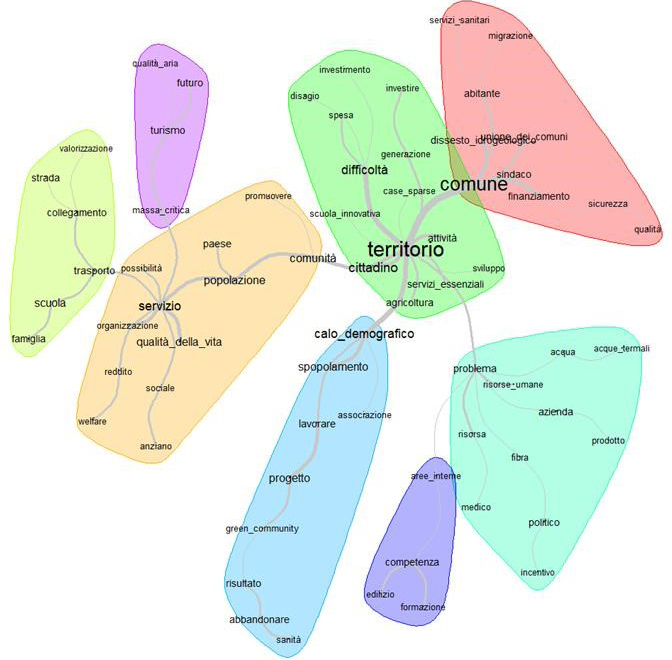
The cluster “comune” focuses on institutional and managerial aspects. It is closely related to the themes of safety and environmental security, suggesting that municipalities are perceived as responsible for caring for the territory. The intersection between the two clusters reflects a structural relationship: the municipality is the institutional point of contact between citizens and the territory.
The cluster “servizio”, represents one of the central thematic areas in the text corpus analysed for Basilicata region. This semantic group has developed around a set of terms that denote a strong focus on social, infrastructural and quality of life needs in rural contexts. The most frequent and highly interconnected words include: income, welfare, social services, population ageing, quality of life, transport, school, roads, tourism, air quality, and future opportunities. Within this cluster, two main sub-themes emerge, which can be interpreted as functional sub-clusters. Sub-cluster 1: Basic Services and Mobility. This includes terms such as transport, school, and roads, which are linked to the daily accessibility and usability of the territory. These aspects are frequently associated with the logistical difficulties of inland areas, particularly for the elderly and students. Their presence in the discourse suggests a lived experience of isolation, which is attributed to a lack of fundamental public services. Sub-cluster 2: Services for Development and Sustainability. Featuring words like tourism, air quality, and future opportunities, a more proactive and forward-looking narrative emerges, oriented towards leveraging the territory as a resource for sustainable development. The cluster “servizio” was also correlated with the cluster “territorio”, a connection evidenced by their proximity and partial overlap on the cluster map. This suggests that services are intrinsically linked to the quality and sustainability of the territory. Furthermore, the semantic relationship with the “calo demografico” cluster is indirect but significant: the lack or inadequacy of services appears to be a structural cause of depopulation, while simultaneously representing a potential lever to reverse this trend if strengthened through targeted public investment. In summary, the “servizio” cluster reflects a set of concrete and perceived challenges in the daily lives of the inhabitants of Basilicata’s inland areas. At the same time, it reveals a forward-looking perspective aimed at reconstructing a fabric of services capable of attracting and retaining the population, particularly its youth. This makes the cluster particularly rich and strategically significant for future territorial planning. The cluster “calo demografico”, related to the cluster “territorio”, grouped terms such as depopulation, desertion, work, project, and green community. This cluster underscores the pressing issue of demographic decline in Basilicata and the importance of developing projects, such as green community initiatives, to combat this challenge and foster regional resilience. The overlap with “territorio” underlines the interconnection between demographic dynamics and the quality of the living environment.
In Tuscany, the similarity analysis identified five main clusters (Figure 4): territory (territorio), service (servizio), zone (area), issue (problema), and municipality (comune). The central cluster “territorio” represents a detailed and integrated vision of the regional context, where elements of identity, economic development, environmental sustainability and repopulation of inland areas converge. It includes words like security, tourism, farms, livestock, agriculture, young population, hydro-geological instability, demographic return, and production, and exhibited strong correlations with its sub-clusters. These latter express an integrated representation of ‘living’ the territory. Two sub-clusters emerge within this cluster. Sub-cluster 1: Territory as a Productive and Scenic Resource. Terms such as agriculture, livestock farming, tourism, local products, and agricultural enterprises delineate a vision of the territory as a driver of local development. Agritourism practices and the valorisation of traditional local products are perceived not only as economic activities but also as instruments for cultural and environmental promotion. Sub-cluster 2: Territory as a Space for Return and Regeneration. Featuring words such as youth, demographic return, €1 houses project, mountain, and opportunities, a proactive narrative emerges in which the territory is viewed as an opportunity for repopulation and social innovation, particularly by young people and new inhabitants. There are also references to structural challenges, such as hydrogeological instability, which frequently appear alongside words like safety and prevention, signalling the need for investment in environmental risk management. However, this problematic component is integrated into a resilient and proactive vision of the territory. The “territorio” cluster in Tuscany should therefore be interpreted in a dual sense: on the one hand, it summarises a set of concrete needs related to the stewardship and valorisation of the land; on the other, it fosters a strategic vision in which the rural landscape becomes a space for innovation, inclusion, and rebirth.
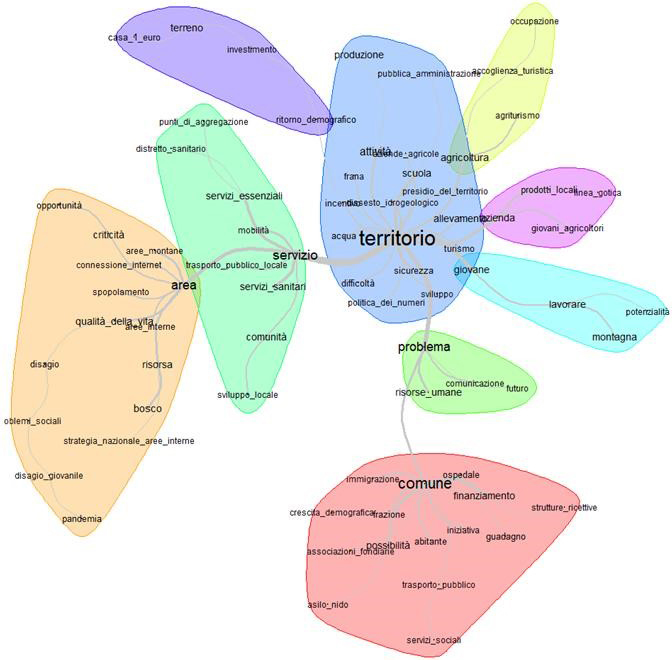
The clusters “servizio” and “area” were also closely linked, grouping terms such as meeting points, essential services, health services, local development, public transport, forest as a resource, youth challenges, internet connectivity, and depopulation. These clusters highlighted both the critical services needed to improve QoL and the challenges faced by the region. Furthermore, shows strong interconnections with the “territorio” cluster. The latter shares spatial and infrastructural references (public transport, forest as a resource, local development) with the “area” cluster. On the other hand, it shares the concepts of essential services and quality of life with the “servizio” cluster, reinforcing the centrality of the territory in the design of local public policies. Lastly, the clusters “problema” and “comune”, that showed weaker correlations with the cluster “territorio”. This apparent dispersion may be due to the stakeholders’ use of synonymous terms, such as criticality and issue, or administered land and municipality. Despite this, these clusters still encompassed significant terms, including human resources, communication, future immigration, population growth, social services, financing, and income. Although less central, the “problema” and “comune” clusters function as contextual indicators.
The “problema” cluster signals the grey areas of the discourse: elements of discontinuity, inequality, or uncertainty for which participants struggle to find a shared vocabulary. The “comune” cluster shows that the local level is acknowledged as crucial, yet also as vulnerable and in need of support, both in terms of governance and resources. In summary, their marginality on the map does not correspond to a lack of thematic relevance but rather to the lexical dispersion and variability with which these institutional and problematic issues are addressed.
The following Table 3 provides a comparative overview of the key themes emerging from the word cloud and similarity analysis conducted on the interview corpora of Basilicata and Tuscany.
| Category | Basilicata | Tuscany |
|---|---|---|
| Key Themes | Depopulation, hydrogeological instability, scattered houses, union of municipalities | Population growth, forests, public transport, €1 house project |
| Clusters | Territory, municipality, essential services, agriculture, demographic decline | Territory, area, services, issue, municipality |
| Narrative | Systemic crisis, isolation, service shortages | Territorial regeneration, return to rural areas, residential attractiveness |
| Structure | Clusters centered on fragility and vulnerability | Clusters focused on territorial enhancement |
4.3 Descending Hierarchical Classification (DHC) and Confirmatory Factor Analysis (CFA)
A thematic exploration was conducted using the Descending Hierarchical Classification (DHC) technique to deepen the analysis, applying the Reinert method (1983). This approach facilitates the identification of clusters composed of words with shared characteristics represented through a dendrogram of classes (Souza et al., 2018). The DHC technique statistically identifies homogeneous groups of topics within a text corpus by analysing the frequency of words. The ChiSquare (χ2) test is employed to measure the associative strength between words and their respective classes, with a value greater than 3.84 indicating significance at p<0.0001 (Lahlou, 2012).
In Basilicata, five distinct classes emerged from the analysis (Figure 5).
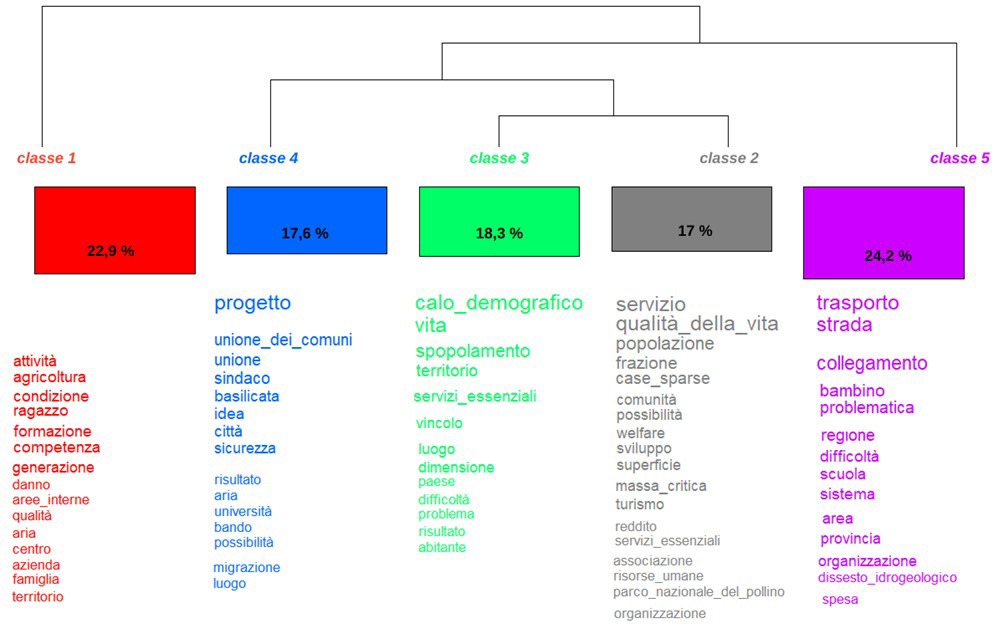
Class 5 (24.2%) is the most prominent, highlighting mobility issues, such as inadequate public transport and connections, damaged or impassable roads due to hydrogeological instability, and poor land management. This category reflects the physical and infrastructural crisis facing the region. For many public officials, mobility is not merely a logistical problem but a community-wide issue: such deficiencies lead to a scarcity of services and exacerbate depopulation. The difficulty in moving around restricts access to healthcare, education, employment, and culture, creating a vicious cycle of isolation and marginalization: “Our small municipality remains isolated for three months of the year due to landslides. For this reason, we have implemented a social taxi service for the elderly and students”.
Class 1 (22.9%) emphasizes the relationship between agricultural land, production quality, and the shortage of young or adequately trained farmers. This class indicates a strong productive identity and reveals that while agricultural management is a valuable asset, it requires policies for generational renewal, support for innovation, and access to land. Without targeted action to attract young farmers, the rural fabric of the Basilicata region risks a progressive decline, regardless of the quality of its products. Class 3 (18.3%) addresses the intertwined issues of depopulation, demographic decline, and essential services. This represents one of the main problems afflicting Basilicata’s inner areas, where the lack of essential services contributes to depopulation and demographic decline. At the same time, the reduced population discourages the provision of such services, creating a negative vicious circle. Class 4 (17.6%) is the class of local strategies for development and resilience. This class represents communities that, despite structural constraints, demonstrate a distinct capacity for endogenous project development. Through resilient and community-based initiatives – often rooted in the cultural, tourism, or social sectors – these areas position themselves not as passive policy recipients, but as proactive agents experimenting with innovative solutions for local development. Finally, class 2 (17%) is the class of local governance, planning, and networks. Complementing the previous cluster, this group represents its political-institutional counterpart. Here, local governance, though operating with limited resources, is characterized by the adoption of innovative and integrated strategic planning. This includes initiatives such as smart welfare, the promotion of short supply chains, and administrative cooperation.
Confirmatory factor analysis (CFA) further supports these findings, with two principal factors that collectively explain 56.44% of the total variance. The first factor, accounting for 28.9% of the variance, is defined as the Axis of ProjectBased Resilience. The second factor (27.54%) represents the Axis of Structural Criticality. Together, these axes constitute two latent dimensions that semantically organize the discourse of local actors and are visualized on the X and Y axes in Figure 6.
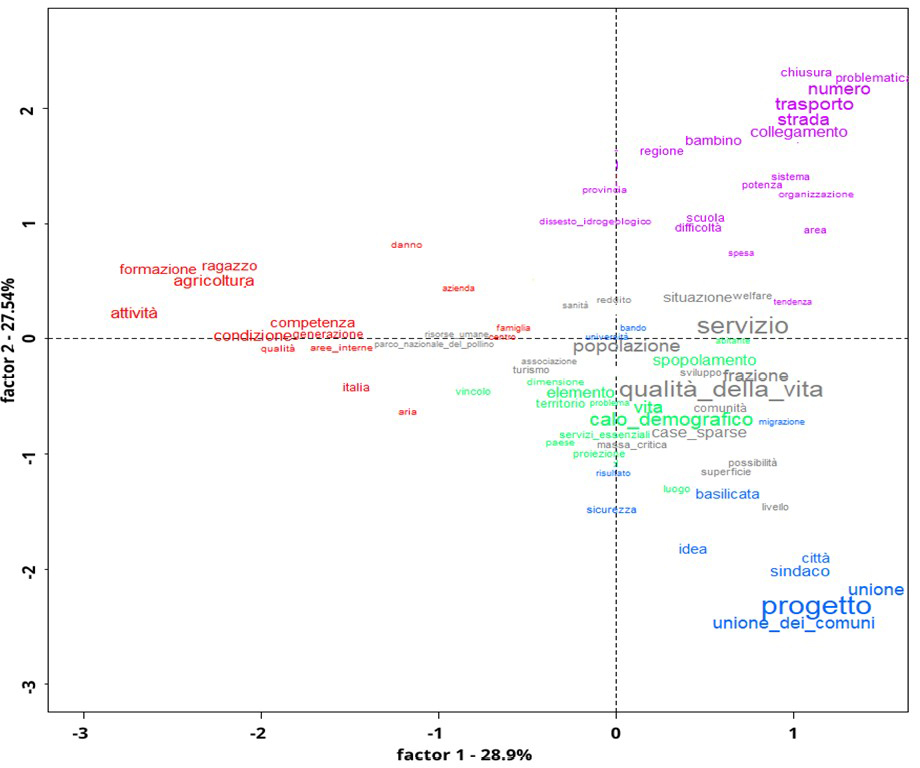
The analysis shows that classes 2, 3, and 4 are closely interconnected and situated in the same quadrant. This indicates the necessity of addressing major issues (class 3) by implementing targeted socio-economic initiatives (classes 2 and 4). This suggests that local communities are not passive in the face of the crisis, but develop detailed and proactive responses, even in a context of scarcity. Conversely, classes 1 and 5 are situated in separate quadrants, reflecting their relative independence and lack of a direct cause-and-effect relationship. While these classes address important themes highlighted by stakeholders, they are not perceived as directly influencing one another. The areas covered in the interviewees’ texts remain more descriptive than strategic. In summary, the CFA in Basilicata region confirms the centrality of the crisisresponse dynamic, highlights critical “shadow areas”, and underscores the coherence between perception and narrative. In Tuscany (Figure 7), the most significant class, class 2 (24.3%), encapsulates critical challenges in the region’s inner areas, such as limited access to primary schools, inadequate essential services, crime, and shortages of human resources and healthcare. The analysis of Tuscany’s inland areas reveals a condition of systemic vulnerability. The level of vulnerability appears comparable to that observed in the Basilicata region, although the Tuscan situation exhibits distinct regional characteristics: a less pronounced degree of geographical isolation is offset by a marked crisis in essential services, which ensure the connection between local communities and the region’s main urban centres.
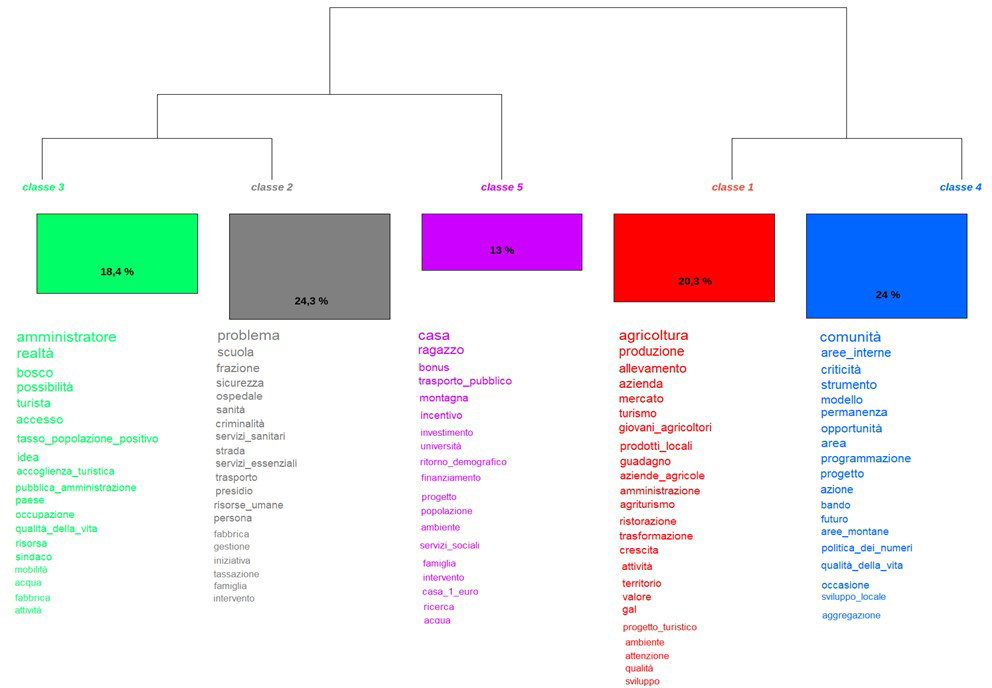
Closely related to class 2 is class 3 (18.4%), which outlines strategies for socio-economic improvement, including leveraging forests as a resource, boosting tourism, creating jobs, improving mobility, and enhancing local governance. Moreover, this class represents the regional strategy aimed at redefining territorial identity. Moving beyond the mere acknowledgment of the service deficit, it promotes a revival founded upon culture and tourism. Class 1 (20.3%) focuses on Tuscany’s agricultural sector, characterized by young farmers, high-quality local products, livestock, food processing, and the growth of agritourism. In contrast to Basilicata, the agricultural sector in Tuscany shows a superior degree of integration within local development strategies. This integration is bolstered by greater youth participation and an enhanced capacity to articulate a contemporary agro-territorial vision. Class 5 (13%) highlights tools for development and repopulation, such as economic incentives, university collaborations, and the “1€ home project”, trying to convert territories into opportunities for new inhabitants. Lastly, class 4 (24%), while representing a significant portion of the text, appears as an outlier, addressing a political vision for the future through elements such as programming, policy frameworks, and public initiatives. The class can be defined as politically aspirational because it expresses a long-term strategic vision that transcends the management of immediate crises. It outlines a transformative orientation aimed at reforming the structural conditions of the inland areas.
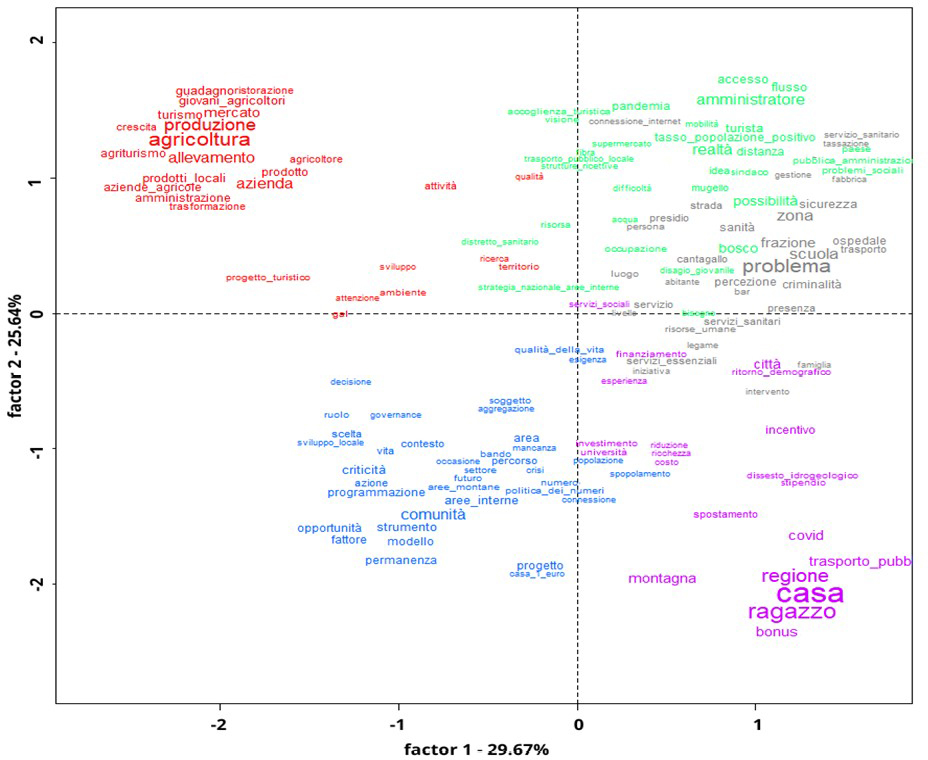
The confirmatory factor analysis (CFA) for Tuscany yielded two factors that collectively account for 55.31% of the total variance (see Figure 8). These have been identified as factor 1 Axis of Structural Vulnerabilities (explaining 29.67% of the variance) and factor 2 Axis of Strategic Response and Political Vision (explaining 25.64% of the variance). CFA revealed strong connections between classes 2 and 3, which are located in the same quadrant. This underscores the interplay between the primary challenges in Tuscany’s inner areas (class 2) and the proposed solutions for socio-economic development (class 3), aligning with the DHC results. In contrast, classes 1, 4, and 5 exhibit greater dispersion and independence. These classes are less directly linked to the narrative of daily emergencies and instead fulfil complementary and strategic roles. They are configured as project-based and political-institutional domains, to be activated in parallel with addressing immediate needs. Their semantic distance from classes 2 and 3 signals that they are not yet fully integrated into the operational management of crises, but represent potential levers for structural change. Indicating that while important to stakeholders, they do not form a cohesive cause-and-effect relationship with other clusters. In summary, the CFA for Tuscany highlights a convergence between local needs and responses, the presence of governance tools and strategic visions that remain insufficiently integrated, and a conscious yet segmented representation of territorial challenges.
The following Table 4 presents an integrated comparison between the two regions analyzed (Basilicata and Tuscany), based on the results of the DHC and CFA. It summarizes the main thematic classes identified, the latent factors extracted, and the discursive and analytical implications that characterize each territorial context.
| Class / Factor | Basilicata | Tuscany |
|---|---|---|
| Class 1 (DHC) | Agriculture and lack of generational turnover | Integrated agriculture and local products |
| Class 2 (DHC) | Local governance and planning | Deficiencies in essential services |
| Class 3 (DHC) | Depopulation and essential services | Economic and territorial development strategies |
| Class 4 (DHC) | Resilient local projects and community initiatives | Political vision and long-term programming |
| Class 5 (DHC) | Infrastructure and mobility issues | Repopulation tools and €1 house project |
| Factor 1 (CFA) | Axis of Project-Based Resilience | Axis of Structural Vulnerability |
| Factor 2 (CFA) | Axis of Structural Criticality | Axis of Strategic Vision and Political Response |
| Association | Strong connections between local issues and responses, though thematically fragmented | Greater coherence between needs and strategies, though vision is not fully operationalized |
| Implications | Focus on urgency and local solutions; discourse remains partially segmented | Strategic discourse more cohesive and development-oriented |
4.4 Integrated summary of results
The qualitative analysis revealed a nuanced framework of local administrators’ perceptions regarding the primary factors influencing quality of life in inland areas, highlighting specific convergences and divergences between Basilicata and Tuscany. In both contexts, the themes of territory, essential services, agriculture, and environmental risk are central, although framed by distinct rationales and priorities. In Basilicata, narratives of structural vulnerability, depopulation, isolation, and service deficiencies are predominant; these, however, are accompanied by experiences of territorial resilience based on endogenous initiatives. Tuscany, in contrast, demonstrates a stronger integration of local governance, development strategies, and projects aimed at territorial regeneration and attracting new residents. The analysis led to the identification of two principal interpretative axes: the ‘Axis of Structural Vulnerability’, which underscores the systemic fragilities of the territories; and the ‘Axis of Strategic Response’, which reflects the capacity for political, administrative, and project-based mobilization. These axes translate into a series of challenges and opportunities, summarized in the following table (Table 5), which constitutes a valuable knowledge base for the formulation of targeted policies for the sustainable development of inland areas.
| Thematic Category | Identified Challenges | Opportunities |
|---|---|---|
| Demography | Depopulation, negative natural balance, youth outmigration (especially in Basilicata) | Residential return and new migration (e.g., €1 house project in Tuscany) |
| Essential Services | School and healthcare deficiencies, administrative fragmentation, limited mobility | Creation of health centers, smart welfare initiatives, alternative transport solutions |
| Work and Human Resources | Youth unemployment, skills mismatch, lack of qualified human resources | Youth entrepreneurship and innovation in agriculture (especially in Tuscany) |
| Tourism and Local Development | Limited tourism attractiveness or fragmented offer | Development of territorial brands (e.g., ‘City of wellness’), sustainable trekking, slow tourism |
| Environment and Risk | Recurrent hydrogeological instability, poor land maintenance | Sustainable forest management, proactive prevention, promotion of natural resources |
| Governance and Vision | Coordination difficulties among local authorities, scarce resources |
Participatory strategic planning, Union of Municipalities, access to NRRP funds |
5. Discussion
The results presented through word cloud, similarity analysis, and hierarchical classification provide critical insights into how local stakeholders perceive QoL in marginal rural areas. In both Basilicata and Tuscany, stakeholders strongly emphasized the importance of essential services – particularly healthcare, education, and transport – as core components of rural well-being. As shown in the similarity analysis (Figures 3 and 4), the clusters labelled “servizio” and “territorio” were central in both regions. This supports Moseley and Owen’s (2008) argument that service accessibility lies at the heart of rural vitality. However, the perception of these services varied significantly. In Basilicata, the cluster “calo demografico” (Figure 3) reveals that service scarcity is intertwined with demographic decline and infrastructural limitations. Stakeholders described a cycle of depopulation and service withdrawal, where insufficient transport and healthcare access contribute to population loss, which in turn justifies further service cuts. This aligns with the DHC Class 3 (Figure 5), highlighting a perceived need for urgent interventions to break this cycle. Indeed, Basilicata communities faced the so-called “rural vulnerability cycles” (Marsden, 2009) where demographic, economic, and service declines reinforce each other. This perception of demographic decline as a pressing issue reflects local experiences of ageing populations, out-migration, and the subsequent loss of human capital, all contributing to the region’s economic stagnation. Local stakeholders are attuned to the daily consequences of these demographic shifts, such as the closure of schools, reduced services, and weakened social networks (Black et al., 2019).
Conversely, in Tuscany, although stakeholders also pointed to service needs (DHC Class 2, Figure 7), the overall perception was more optimistic. The presence of ongoing projects, such as the “1€ house” initiative and forest-based tourism (DHC Class 5 and 3), points to a more proactive local governance model. The cluster “giovani_agricoltori” and associated terms suggest that youth engagement and agricultural diversification are seen as realistic strategies for repopulation and rural vitality, supporting Brunori and Rossi’s (2007) work on rural diversification.
Another relevant dimension concerns perceptions of agriculture. In Basilicata, Class 1 of the DHC and the associated CFA quadrant (Figure 6) link agriculture to structural challenges, particularly the lack of generational turnover and the environmental fragility of rural land. Stakeholders explicitly mentioned the absence of young and adequately trained farmers as a threat to agricultural sustainability. This reflects findings by Li et al. (2019) and Marsden (2009) on the compounding effects of rural demographic and economic decline. In Tuscany, by contrast, Class 1 (Figure 7) connects agriculture to local identity and economic opportunity, emphasizing value-added products and integration with tourism. This perception aligns with Woods’ (2005) view that rural areas can leverage local assets to create new development pathways.
Importantly, the role of local governance was repeatedly emphasized. In Basilicata, stakeholders pointed to institutional weaknesses and limited capacity to coordinate development projects, as reflected in DHC Classes 2 and 4. In Tuscany, the proximity to regional institutions and stronger collaboration among municipalities facilitated more strategic planning and access to funding (see Figure 8). This resonates with the place-based approach advocated by Barca et al. (2014).
Overall, these findings support the view that rural development trajectories are deeply mediated by local perceptions and governance capacity. Rather than presenting universal challenges, our results demonstrate that the same issue – be it demographic change, agriculture, or service access – is understood and acted upon differently depending on context. Our results suggest the need for policy approaches that account for local perceptions and capacities, supporting Marsden’s (2016) and Pugh and Dubois’ (2021) call for context-sensitive rural development strategies. This is particularly important given the emerging challenges highlighted by stakeholders.
The contrasts between Basilicata and Tuscany demonstrate that rural development trajectories are not predetermined but shaped by the interactions between perceptions, institutional capacity, and resource availability. This supports the work by Li et al. (2019) on the diversity of rural evolution pathways while providing specific insights into how local context mediates development outcomes.
Finally, our findings point out important insights about rural governance and policy implementation. Indeed, stakeholder perceptions significantly influence how policies are interpreted and implemented locally (Lopolito et al., 2015; Scott, 2012). This is particularly evident in how similar EU rural development initiatives yield different outcomes in Basilicata versus Tuscany, supporting the place-based development approaches (Barca et al. 2014).
6. Conclusions
This study set out to investigate how local stakeholders in inner areas of two Italian regions, Basilicata and Tuscan, perceive QoL and to identify the socio-territorial dynamics that shape rural development. The perspectives of stakeholders, grounded in local knowledge and lived experiences, offer invaluable insights for informing policies and initiatives aimed at enhancing QoL and fostering community revitalization in rural areas. Through a qualitative analysis of semi-structured interviews, supported by textual processing, we addressed three core research questions.
First, regarding the dimensions of well-being perceived as most relevant, stakeholders in both regions emphasized access to essential services (health, education, transport), economic opportunities, and demographic stability. However, the interpretation of these dimensions varied contextually: in Basilicata, stakeholders framed them as areas of structural deficiency, while in Tuscany they were linked to opportunities for innovation and revitalization.
Second, the analysis revealed region-specific challenges and opportunities. In Basilicata, depopulation, service erosion, and institutional fragility emerged as interrelated issues. Tuscany stakeholders, on the other hand, identified demographic return, youth entrepreneurship, and multifunctional agriculture as promising development vectors. These divergent framings demonstrate how similar problems, such as outmigration or infrastructure needs, are differently conceptualized and addressed, confirming the relevance of context-sensitive analysis (Pugh and Dubois, 2021).
Third, our results illustrated the interaction among demographic dynamics, service provision, and territorial governance. The co-occurrence patterns and hierarchical classes pointed to cyclical processes in Basilicata – where service deficits contribute to population decline – and to more resilient configurations in Tuscany, where place-based initiatives are helping to stabilize or reverse rural decline.
From a theoretical perspective, this study contributes to debates on rural well-being by demonstrating the central role of perception in shaping development priorities. Our findings support capability-based (Sen, 1999; Nussbaum, 2000) and governance-oriented approaches, highlighting the need to include stakeholder perspectives in assessments of rural vitality. Methodologically, the integration of textual analysis with qualitative coding reinforces the value of combining Grounded Theory (Glaser and Strauss, 1967) and computational tools (Ratinaud, 2008; Camargo and Justo, 2013) in rural studies.
The policy implications are equally significant. The evidence suggests that a one-size-fits-all strategy is inadequate for rural development. In Basilicata, investment should prioritize rebuilding institutional capacity and infrastructure, while in Tuscany, policy can focus on consolidating existing diversification pathways. In both cases, policies must respond to local framings and lived experiences, not just statistical indicators (Scott, 2012).
Despite the contributions provided, this study has limitations that should be acknowledged. The focus on mayors, although justified by their institutional role and their privileged position in observing territorial dynamics, excludes other relevant stakeholder groups whose perspectives could further enrich the understanding of well-being in inner areas. Moreover, the analysis is limited to two Italian regions, Basilicata and Tuscany, characterized by specific socio-territorial configurations; therefore, the results reflect strongly contextualized dynamics and cannot be automatically extended to other rural contexts.
Future research should involve a larger and statistically representative sample, including broader stakeholder categories, such as youth, women, and sectoral representatives, to deepen the understanding of intra-regional diversity. Expanding the analysis to other regions could also enhance generalizability and contribute to comparative theorization across European rural contexts.
In conclusion, this study reinforces the importance of perception-led, place-based strategies in addressing rural marginality. By foregrounding the voices of local administrators, it offers actionable insights for designing policies that are both territorially embedded and socially responsive.
Funding declaration
This study was carried out within the Agritech National Research Center and was funded by the European Union – NextGenerationEU under the Italian National Recovery and Resilience Plan (PNRR), Mission 4, Component 2, Investment 1.4 (Directorial Decree No. 1032 of 17/06/2022; Project code CN00000022). The views and opinions expressed in this manuscript are solely those of the authors and do not necessarily reflect those of the European Union or the European Commission, which cannot be held responsible for them.
References
Agency for the Territorial Cohesion (2024). National Strategy for “Inner Areas” SNAI [WWW Document]. Available at: https://www.agenziacoesione.gov.it/strategia-nazionale-aree-interne/?lang=en (Accessed 19 July 2024).
Ballas, D. (2013). What makes a ‘happy city’?. Cities, 32(Supplement 1), 39–50. https://doi.org/10.1016/j.cities.2013.04.009
Barca, F., Casavola, P., & Lucatelli, S. (2014). A strategy for inner areas in Italy: definition, objectives, tools and governance. Collana Materiali UVAL, 31, 1–68.
Barrington-Leigh, C., & Escande, A. (2018). Measuring Progress and Well-Being: A Comparative Review of Indicators. Social Indicators Research, 135, 893–925. https://doi.org/10.1007/s11205-016-1505-0
Bertolini, P., & Pagliacci, F. (2017). Quality of life and territorial imbalances. A focus on italian inner and rural areas. Bio-based and Applied Economics, 6, 183–208. https://doi.org/10.13128/BAE-18518
Black, N., Scott, K., & Shucksmith, M. (2019). Social inequalities in rural England: Impacts on young people post-2008. Journal of Rural Studies, 68, 264–275. https://doi.org/10.1016/j.jrurstud.2018.09.008
Bletzer, K. V. (2015). Visualizing the qualitative: making sense of written comments from an evaluative satisfaction survey. Journal of Education and Evaluation for Health Professions, 12, 12. https://doi.org/10.3352/jeehp.2015.12.12
Bock, B. B. (2016). Rural Marginalisation and the Role of Social Innovation; A Turn Towards Nexogenous Development and Rural Reconnection. Sociologia Ruralis, 56, 552–573. https://doi.org/10.1111/soru.12119
Boncinelli, F., & Casini, L. (2014). A Comparison of the Well-Being of Agricultural and Non Agricultural Households Using a Multicriterial Approach. Social Indicators Research, 119, 183–195. https://doi.org/10.1007/s11205-0130488-3
Brunori, G., & Rossi, A. (2007). Differentiating countryside: Social representations and governance patterns in rural areas with high social density: The case of Chianti, Italy. Journal of Rural Studies, 23, 183–205. https://doi.org/10.1016/j.jrurstud.2006.10.001
Burns, G. W. (2005). Naturally happy, naturally healthy: The role of the natural environment in well-being. In Huppert, F. A., Baylis, N., & Keverne, B. (Eds.). The Science of Well-being. Oxford, Oxford University Press.
Camargo, B. V., & Justo, A. M. (2013). IRAMUTEQ: um software gratuito para análise de dados textuais. Temas em Psicologia, 21(2), 513–518. https://doi.org/10.9788/TP2013.2-16
Carvalho, D. N. R., Aguiar, V. F. F., Apolinário, D. B., Bendelaque, D. F. R., Pereira, L. C. G., Figueira, S. A. S., & Orlandi, F. S. (2024). A glance at the use of IRaMuTeQ® software in scientific research: a bibliometric study. Revista de Enfermagem da UFPI, 13, 1–10. http://dx.doi.org/10.26694/reufpi.v13i1.4280
Casini, L., Boncinelli, F., Contini, C., Gerini, F., & Scozzafava, G. (2019). A Multicriteria Approach for Well-Being Assessment in Rural Areas. Social Indicators Research, 143, 411–432. https://doi.org/10.1007/s11205-018-1978-0
Casini, L., Boncinelli, F., Gerini, F., Romano, C., Scozzafava, G., & Contini, C. (2021). Evaluating rural viability and well-being: Evidence from marginal areas in Tuscany. Journal of Rural Studies, 82, 64–75. https://doi.org/10.1016/j.jrurstud.2021.01.002
Castro, A., Koelzer, L. P., Camargo, B. V., & Bousfield, A. B. S. (2014). Representações sociais na internet sobre cotas para negros em universidades federais. Cadernos de Pesquisa Interdisciplinar em Ciências Humanas, 15(106), 202– 220. https://doi.org/10.5007/1984-8951.2014v15n106p202
Chaves, M. M. N., dos Santos, A. P. R., dos Santos, N. P., & Larocca, L. M. (2017). Use of the Software IRAMUTEQ in Qualitative Research: An Experience Report. In Costa, A., Reis, L., Neri de Sousa, F., Moreira, A., & Lamas, D. (Eds.). Computer Supported Qualitative Research. Cham, Springer.
Chaves, S. M. A., Calado, R. D., Bourguignon, S. C., Viera, L. E. V., Ramos, J. R. S., Rodrigues, L. E. M., Saldanha, A. D., & Braga Neto, O. O. (2022). Fast-Track 24-Hour UPA: Analysis of opportunities and continuous improvements through IRAMUTEQ. IFAC-PapersOnLine, 55(10), 221–226. https://doi.org/10.1016/j.ifacol.2022.09.627
Christiaensen, L., Rutledge, Z., & Taylor, J.E. (2021). Viewpoint: The future of work in agri-food. Food Policy, 99, 101963. https://doi.org/10.1016/J.FOODPOL.2020.101963
Contzen, S., & Häberli, I. (2021). Exploring dairy farmers’ quality of life perceptions – A Swiss case study. Journal of Rural Studies, 88, 227–238. https://doi.org/10.1016/j.jrurstud.2021.11.007
Corbetta, P. (2015). La ricerca sociale, metodologie e tecniche. Le tecniche qualitative. Vol. III. Bologna, Il Mulino.
Cozzi, M., Prete, C., Viccaro, M., Sijtsma, F., Veneri, P., & Romano, S. (2022). Understanding the Role of Nature in Urban-Rural Linkages: Identifying the Potential Role of Rural Nature-Based Attractive Clusters That Serve Human Well-Being. Sustainability, 14, 1–19. https://doi.org/10.3390/su141911856
Creswell, J. W., & Plano Clark, V. L. (2017). Designing and Conducting Mixed Methods Research. Thousand Oaks, SAGE Publications.
Creswell, J. W., & Poth, C. N. (2017). Qualitative Inquiry and Research Design: Choosing Among Five Approaches. Thousand Oaks, SAGE Publications.
Crociata, A., Pinate, A. C., & Urso, G. (2025). The cultural and creative economy in Italy: Spatial patterns in peripheral areas. European Urban and Regional Studies, 32(1), 53–75. https://doi.org/10.1177/09697764231222221
Cummins, R. A. (2000). Objective and subjective quality of life: An interactive model. Social Indicators Research, 52, 55–72. https://doi.org/10.1023/A:1007027822521
DePaolo, C. A., & Wilkinson, K. (2014). Get Your Head into the Clouds: Using Word Clouds for Analyzing Qualitative Assessment Data. TechTrends, 58, 38–44. https://doi.org/10.1007/s11528-014-0750-9 ESPON (2017). Policy brief: Shrinking rural regions in Europe. Luxembourg, ESPON.
European Commission (2021a). Long-term vision for rural areas: for stronger, connected, resilient, prosperous EU rural areas. Brussels, European Commission.
European Commission (2021b). Commission staff working document. A long-term Vision for the EU’s Rural Areas. Brussels, European Commission.
European Commission (2024). The long-term vision for the EU’s rural areas: key achievements and ways forward. Brussels, European Commission.
European Parliament and Council (2021). Regulation (EU) 2021/241 establishing the Recovery and Resilience Facility. Brussels, European Parliament and Council.
European Union (2016). Cork 2.0 declaration. A better life in rural areas. Luxembourg, European Union. https://doi.org/10.2762/618522
Frey, B. S., & Stutzer, A. (2002). What can economists learn from happiness research? Journal of Economic Literature, 40, 402–435. https://doi.org/10.1257/jel.40.2.402
Galli, I., & Fasanelli, R. (2020). Public understanding of science and common sense: Social representations of the human microbiome among the expert and non-expert public. Health Psychology Open, 7(1), 1–11. https://doi.org/10.1177/2055102920913239
Glaser, B. G., & Strauss, A.L. (1967). The Discovery of Grounded Theory: Strategies for Qualitative Research. Chicago, Aldine Publishing Co.
Guite, H. F., Clark, C., & Ackrill, G. (2006). The impact of the physical and urban environment on mental well-being. Public Health, 120(12), 1117–1126. https://doi.org/10.1016/j.puhe.2006.10.005
Hijmans, J., & Kuyper, L. (2020). Conducting semi-structured interviews: Practical guidelines for novice researchers. Neurological Research and Practice, 2(1), 25. https://doi.org/10.1186/s42466-020-00059-z ISTAT (2023). Bes 2022: il benessere equo e sostenibile in Italia. Roma, ISTAT.
ISTAT (2019). Rapporto BES 2018: il benessere equo e sostenibile in Italia. Available at: https://www.istat.it/it/archivio/224669 (Accessed 31 July 2024).
Kahneman, D., & Krueger, A. B. (2006). Developments in the Measurement of Subjective Well-Being. Journal of Economic Perspectives, 20, 3–24.
Karim, N., Mustapha, B., & Oumlil, R. (2024). Impact of social innovation on value in cooperatives: a systematic literature review and a modeling attempt. Procedia Computer Science, 237, 477–484. https://doi.org/10.1016/j.procs.2024.05.130
Lahlou, S. (2012). Text Mining Methods: An answer to Chartier and Meunier. Papers on Social Representations, 20, 38.1–38.7.
Li, Y., Westlund, H., & Liu, Y. (2019). Why some rural areas decline while some others not: An overview of rural evolution in the world. Journal of Rural Studies, 68, 135–143. https://doi.org/10.1016/j.jrurstud.2019.03.003
Liu, L., Cavaye, J., & Ariyawardana, A. (2022). Supply chain responsibility in agriculture and its integration with rural community development: A review of issues and perspectives. Journal of Rural Studies, 93, 134–143. https://doi.org/10.1016/J.JRURSTUD.2020.07.003
Lopolito, A., Prosperi, M., Sisto, R., & De Meo, E. (2015). Translating local stakeholders’ perception in rural development strategies under uncertainty conditions: An application to the case of the bio-based economy in the area of Foggia (South Italy). Journal of Rural Studies, 37, 61–74. https://doi.org/10.1016/j.jrurstud.2014.12.005
Mäki-Opas, T., Pieper, R., & Vaarama, M. (2022). Exploring the capability approach to quality of life in disadvantaged population groups. Scientific Reports, 12, 1–11. https://doi.org/10.1038/s41598-022-18877-3
Maggino, F., & Zumbo, B. D. (2012). Measuring the quality of life and the construction of social indicators. In Land, K.,
Michalos, A., & Sirgy, M. (Eds.). Handbook of Social Indicators and Quality of Life Research. Dordrecht, Springer.
Makri, C., & Neely, A. (2021). Grounded Theory: A Guide for Exploratory Studies in Management Research. International Journal of Qualitative Methods, 20, 1–14. https://doi.org/10.1177/16094069211013654
Mallach, A. (2017). What we talk about when we talk about shrinking cities: The ambiguity of discourse and policy response in the United States. Cities, 69, 109–115. https://doi.org/10.1016/j.cities.2017.01.008
Marsden, T. (2016). Exploring the Rural Eco-Economy: Beyond Neoliberalism. Sociologia Ruralis, 56, 597–615. https://doi.org/10.1111/soru.12139
Marsden, T. (2009). Mobilities, vulnerabilities and sustainabilities: Exploring pathways from denial to sustainable rural development. Sociologia Ruralis, 49, 113–131. https://doi.org/10.1111/j.1467-9523.2009.00479.x
Martins, J. R., & Davino, C. (2023). Local Migration Governance in European Shrinking Areas: a German and an Italian Case. Journal of International Migration and Integration, 24, 863–888. https://doi.org/10.1007/s12134-023-010295
Mastronardi, L., Giagnacovo, M., & Romagnoli, L. (2020). Bridging regional gaps: Community-based cooperatives as a tool for Italian inner areas resilience. Land Use Policy, 99, 104979. https://doi.org/10.1016/j.landusepol.2020.104979
McCrea, R., Walton, A., & Leonard, R. (2016). Developing a Model of Community Wellbeing and Resilience in Response to Change. Social Indicators Research, 129, 195–214. https://doi.org/10.1007/s11205-015-1099-y
McLeod, S. (2024). Open coding in qualitative research. ResearchGate. Available at: https://doi.org/10.13140/RG.2.2.32424.89608 (Accessed 20 July 2024).
Meloni, C., Rocchi, B., & Severini, S. (2023). A systematic literature review on the rural-urban well-being gap in Europe. Bio-based and Applied Economics, 12, 1–20. http://dx.doi.org/10.36253/bae-13178
Mendes, F. R., Zangão, M. O., Gemito, M. L., & Serra, I. C. (2016). Social representations of nursing students about hospital assistance and primary health care. Revista Brasileira de Enfermagem, 69(2), 343–350. https://doi.org/10.1590/0034-7167.2016690218i
Mennani, S., & Attak, Y. (2024). Application of IRaMuTeQ in qualitative textual analysis: Tools, strategies, and outcomes. In Chakraborty, A. (Ed.). Advanced Research Methodologies for Digital Transformation in Societal and Organizational Contexts. Hershey, IGI Global. Ministero dell’Università e della Ricerca (2022). Centro Nazionale per le Tecnologie dell’Agricoltura AGRITECH. Roma, Ministero dell’Università e della Ricerca. Available at: https://www.mur.gov.it/sites/default/files/202206/22_06_28Scheda_centro nazionale agritech_PNRR_MUR.pdf (Accessed 21 January 2026).
Moseley, M. J., & Owen, S. (2008). The future of services in rural England: The drivers of change and a scenario for 2015. Progress in Planning, 69, 93–130. https://doi.org/10.1016/j.progress.2007.12.002
Musella, M. (2015). Teoria Economica dello sviluppo umano. Una introduzione. Santarcangelo di Romagna, Maggioli Editore.
Nussbaum, M. C. (2000). Women and Human Development: the Capabilities Approach. Cambridge, Cambridge University Press.
Nussbaum, M. C. (1999). Sex and Social Justice. Oxford, Oxford University Press.
OECD (2020a). Rural Well-being: Geography of Opportunities. Paris, OECD Publishing. https://doi.org/10.1787/d25cef80-en
OECD (2020b). How’s Life? 2020: Measuring well-being. Paris, OECD Publishing. https://doi.org/10.1787/9870c393en
Presidenza del Consiglio dei Ministri (2021). Piano nazionale di ripresa e resilienza. Roma, Presidenza del Consiglio dei Ministri. Available at: https://www.governo.it/sites/governo.it/files/PNRR.pdf (Accessed 21 January 2026).
Pugh, R., & Dubois, A. (2021). Peripheries within economic geography: Four “problems” and the road ahead of us. Journal of Rural Studies, 87, 267–275. https://doi.org/10.1016/j.jrurstud.2021.09.007
Ratinaud, P. (2008). IRAMUTEQ: Interface de R pour les Analyses Multidimensionnelles de Textes et de Questionnaires. Available at: http://www.iramuteq.org/ (Accessed 20 July 2024).
Reinert, M. (1983). Une méthode de classification descendante hiérarchique : application à l’analyse lexicale par contexte. Les Cahiers de l’Analyse des Données, 8(2), 187–198.
Rodríguez, J., Reguant, M., & Ortega, D. (2024). A practical case study of qualitative data analysis with IRaMuTeQ: lexicometric analysis of narratives of bisexual men and women. Journal of Educational Research, 42(2), 1–20.
Salviati, M. E. (2017). Manual do Aplicativo IRaMuTeQ (versão 0.7 Alpha 2 e R versão 3.2.3). Planaltina, The author. Available at: http://www.iramuteq.org/documentation/fichiers/manual-do-aplicativo-iramuteq-par-maria-elisabethsalviati (Accessed 20 July 2024).
Sardaro, R., La Sala, P., De Pascale, G., & Faccilongo, N. (2021). The conservation of cultural heritage in rural areas: Stakeholder preferences regarding historical rural buildings in Apulia, southern Italy. Land Use Policy, 109, 105662. https://doi.org/10.1016/J.LANDUSEPOL.2021.105662
Scott, K. (2012). Measuring Wellbeing: Towards Sustainability?. London, Routledge.
Segev, E. (2022). Semantic Network Analysis in Social Sciences. London, Routledge.
Sen, A. (1984). The living standard. Oxford Economic Papers, 36, 74–90. https://doi.org/10.1093/oxfordjournals.oep.a041662
Sen, A. (1985). Commodities and capabilities. Amsterdam, North Holland.
Sen, A. (1999). Development as Freedom. Oxford, Oxford University Press.
Shucksmith, M., & Brown, D. L. (2016). Rural Studies: The Challenges Ahead. In Shucksmith, M., & Brown, D.L. (Eds.). Routledge International Handbook of Rural Studies. London, Routledge.
Shucksmith, M., Shucksmith, J., & Watt, J. (2006). Rurality and social inclusion: A case of preschool education. Social Policy and Administration, 40, 678–691. https://doi.org/10.1111/j.1467-9515.2006.00526.x
Sgroi, F. (2022). Evaluating the sustainability of complex rural ecosystems during the transition from agricultural villages to tourist destinations and modern agri-food systems. Journal of Agriculture and Food Research, 9, 100330. https://doi.org/10.1016/j.jafr.2022.100330
Souza, M. A. R., Wall, M. L., Thuler, A. C. M. C., Lowen, I. M. V., & Peres, A. M. (2018). The use of IRAMUTEQ software for data analysis in qualitative research. Revista da Escola de Enfermagem da USP, 52, e03353. https://doi.org/10.1590/s1980-220x2017015003353
Stiglitz, J. E., Sen, A., & Fitoussi, J. -P. (2009). Report by the Commission on the Measurement of Economic Performance and Social Progress. Available at: https://ec.europa.eu/eurostat/documents/8131721/8131772/Stiglitz-Sen-FitoussiCommission-report.pdf (Accessed 31 July 2024).
Sutton, J., & Austin, Z. (2015). Qualitative research: Data collection, analysis, and management. The Canadian Journal of Hospital Pharmacy, 68(3), 226–231. https://doi.org/10.4212/cjhp.v68i3.1456 Tarozzi, M. (2008). Che cos’è la grounded theory. Roma, Carocci.
Tashakkori, A., Johnson, R. B., & Teddlie, C. (2020). Foundations of mixed methods research: Integrating quantitative and qualitative approaches in the social and behavioral sciences. Thousand Oaks, SAGE Publications.
Thomas, D. R. (2003). A general inductive approach for qualitative data analysis. American Journal of Evaluation, 27(2), 237–246. https://doi.org/10.1177/1098214005283748
Tricarico, L., Jones, Z. M., & Daldanise, G. (2022). Platform Spaces: When culture and the arts intersect territorial development and social innovation, a view from the Italian context. Journal of Urban Affairs, 44, 545–566. https://doi.org/10.1080/07352166.2020.1808007
United Nations (2015). Transforming our world: the 2030 Agenda for Sustainable Development, A/RES/70/1. New York, United Nations. Available at: https://sdgs.un.org/sites/default/files/publications/21252030 Agenda for Sustainable Development web.pdf (Accessed 21 January 2026).
Vendemmia, B., Pucci, P., & Beria, P. (2021). An institutional periphery in discussion. Rethinking the inner areas in Italy. Applied Geography, 135, 102537. https://doi.org/10.1016/j.apgeog.2021.102537
Veréb, V., Marques, C., Madureira, L., Marques, C., Keryan, T., & Silva, R. (2024). What Is Rural Well-Being and How Is It Measured? An Attempt to Order Chaos. Rural Sociology, 89, 239–280. https://doi.org/10.1111/ruso.12536
Viccaro, M., Romano, S., Prete, C., & Cozzi, M. (2021). Rural planning? An integrated dynamic model for assessing quality of life at a local scale. Land Use Policy, 111, 105742. https://doi.org/10.1016/j.landusepol.2021.105742
Viganó, F., Grossi, E., & Blessi, G.T. (2019). Urban – Rural dwellers’ well-being determinants: When the city size matters. The case of Italy. City, Culture and Society, 19, 100293. https://doi.org/10.1016/j.ccs.2019.100293
Voukelatou, V., Gabrielli, L., Miliou, I., Cresci, S., Sharma, R., Tesconi, M., & Pappalardo, L. (2021). Measuring objective and subjective well-being: dimensions and data sources. International Journal of Data Science and Analytics, 12, 1–15. https://doi.org/10.1007/s41060-020-00224-2
Woods, M. (2005). Rural Geography: Processes, Responses and Experiences in Rural Restructuring. London, SAGE Publications.
Woods, M. (2006). Redefining the ‘Rural Question’: The New ‘Politics of the Rural’ and Social Policy. Social Policy and Administration, 40, 579–595.
Yin, X., Chen, J., & Li, J. (2022). Rural innovation system: Revitalize the countryside for a sustainable development. Journal of Rural Studies, 93, 471–478. https://doi.org/10.1016/J.JRURSTUD.2019.10.014
Appendix
1. I would like to begin by asking for a brief, general description of the territory you administer. Could you please specify its name, geographical location, and province? I am also interested in knowing if it is part of a national park or nature reserve and, if so, what specific constraints or regulations apply. Finally, could you provide the approximate population?
2. Regarding local services, I would like to inquire about their importance, presence, and the community’s level of satisfaction with them. Specifically, I am interested in:
i. Education.
ii. Healthcare services, including hospitals, local health authorities (such as Azienda Sanitaria Locale – ASL), community health centres, social assistance services, and pharmacies.
iii. Which is the nearest urban centre that offers a comprehensive range of services? I would also like to know the typical distance and travel time to reach it.
iv. Transportation infrastructure, such as train and bus services, and the condition of the road network.
v. The role of tourism. Is it a significant sector in the area? If so, what is the availability of accommodation and dining facilities? vi. The presence of commercial services and amenities, such as supermarkets, postal services, banks, tobacconists, and clothing retail.
vii. Recreational, sporting, and cultural facilities, including cinemas and community centres.
3. Could you describe the social fabric of the community? Furthermore, I would like to know if there are significant or established immigrant communities residing in the area.
4. Regarding safety and security, what is the general perception within the community? Are there any specific safety concerns I should be aware of?
5. I would like to inquire about the quality of the local environment and the state of the landscape.
6. From your perspective, what would you identify as the main challenges, resources, and strengths of this territory?
7. Do you observe specific challenges or difficulties faced by particular socioeconomic groups, such as young people, women, or immigrants? If such challenges exist, I would like to know if any specific policies or interventions have been implemented to support these groups and, if so, what they entail.
8. In relation to the municipal administration, I would like to ask if you consider the available human resources to be sufficient. Furthermore, are they adequately trained to meet the current and future needs of the municipality?
9. Focusing on the agricultural sector, I would like to understand the main difficulties faced by local farming operations. On a related note, I am interested to know if there is a presence of young farmers or entrepreneurs who have chosen to remain in and invest in the local agricultural economy.
10. I would like to inquire about demographic trends. Have you observed a tendency towards depopulation in your municipality? If so, I am interested in learning about any strategies or specific projects, such as the ‘One-EuroHouse’ initiative, that have been implemented to counteract this trend.
11. Regarding sustainable development, I would like to know if the municipality has received public funding for related initiatives. If so, do you consider this funding to be sufficient to achieve your objectives?
12. In your opinion, what actions or policies could be suggested to further improve the quality of life in this area?
13. Finally, I would like to explore the perspective of young people. What do you believe are the primary reasons that motivate young people to remain in the municipality? Furthermore, what arguments would you use to persuade young individuals or families to move here?
1 The “€1 houses project” initiative refers to local municipal programs aimed at counteracting depopulation and housing abandonment in inner and marginal areas. Through this scheme, municipalities transfer ownership of abandoned or underused dwellings at a symbolic price, in this case 1 €, while purchasers commit to renovating the properties within a defined timeframe. Beyond the symbolic value of the sale price, the initiative seeks to stimulate local economic activity, attract new residents, and support place-based strategies for rural regeneration.