https://doi.org/10.36253/aestim-18916
Received: October 22, 2025; Accepted: December 17, 2025; Published: September 11, 2026
From surface right to full ownership: three approaches to determine the fair fee
1 Department of Civil, Environmental, Land, Building Engineering and Chemistry, Polytechnic University of Bari, Italy
2 Department of Engineering, Lum Giuseppe Degennaro University, Casamassima (Bari), Italy
3 Department of Architecture and Design, Sapienza University of Rome, Italy
E-mail: marco.locurcio@poliba.it, pierluigi.morano@poliba.it, amoruso@lum.it, felicia.diliddo@poliba.it, francesco.tajani@uniroma1.it
*Corresponding author
Abstract. The topic of public residential housing is relevant in the international context with different peculiarities and approaches in the various European Member States, according to the several political, economic, and cultural specificities, despite some general analogies characterizing this sector. The present research focuses on the Italian territory, aiming to critically analyse the institute mostly implemented in the initiatives of social housing, that is the surface right. In particular, the objective of the study is to empirically verify the fair fee to be paid for the conversion of surface right into full ownership, overcoming the legal provisions and considering also the real estate market and the compensation approach which takes into account the initial advantage of the assignees. By applying the three approaches, the potential disparities caused by the current legislation are highlighted and the possible increased revenues for the Public Administration generated if the normative forecasting were integrated by including real estate factors, are detected.
Keywords: surface right, social housing, conversion value, full ownership, superficiary.
Contents
3. Overview of EU Member States
4. The evolution of the Italian legislative framework in social housing
6.1 Analysis of the initial database
6.2 Improvement of the initial database
6.3 Application of the three approaches
7. Conclusions and future developments
1. Introduction
Public residential housing, also known as social housing, represents a crucial component of policies adopted by various European countries. The main objective of this sector is to provide affordable residential solutions for low- and middleincome groups, thereby contributing to greater social cohesion and collective well-being. The size of the sector and the methods of its management vary significantly among the different EU Member States. On average, about 20% of European households live in social housing (Housing Europe, 2023); however, the proportion of social housing within the overall dwellings stock differs considerably across countries. Despite differences linked to the specific national contexts, the social housing sector faces several common challenges, including limited financial resources, issues related to maintenance and management, and a continuously growing demand that exceeds the available supply. In response to these arguments, the European Union promotes policies and financial instruments aimed at strengthening social and affordable housing (European Commission, 2023). A significant initiative in this field is the Affordable Housing Initiative, which guides the New European Bauhaus (NEB). This program integrates environmental sustainability, aesthetic value, and social inclusion, with the aim of supporting the ecological transition in the construction sector more fairly and inclusively (European Union, 2020). Although relevant differences among each Member State rooted in their unique historical, economic, and social backgrounds, it is still possible to identify some common features in the interpretation of social housing. In particular: i) the objective is generally recognized as being of public interest, aimed at increasing the availability of affordable housing through construction, management, or acquisition of properties for this purpose; ii) the target population is defined based on socio-economic criteria or the presence of vulnerabilities (European Parliament, 2013).
In the Italian national context, over time, the State has played a decisive role in the real estate market, intervening in various ways to ensure access to housing, recognized as a fundamental right by the Constitution. Government housing policies have evolved in response to the different economic and social phases the country has gone through, with the main purpose of countering shelter deprivation and promoting social inclusion through access to housing. After World War II, Italy faced a severe housing shortage, especially in large cities, due to population growth, urbanization, and the abandonment of homes damaged by the conflict. Within this framework, the government intervened with a public residential construction plan aimed at meeting the demand for public housing (Autonomous Institutes for Public Housing – IACP), also through financing programs for building new dwellings intended for the less affluent social classes with rent-controlled leases. Starting from the 1970s, with rising property prices and increasing economic inequalities, the Italian State has further expanded and integrated its intervention in the housing market. The inclusion of fiscal incentives to encourage homeownership, such as tax deductions on expenses for purchasing and renovating properties, has strongly stimulated demand for private housing. During this period, private residential construction has assumed an increasingly significant function, with the State continuing to be a key player by regulating the sector through laws aimed at protecting tenants’ rights and opposing real estate speculation.
More recently, during the 1990s and 2000s, the strategic policies developed by the national government have continued to address housing challenges with measures pursued to support the real estate market, promoting the creation of instruments such as real estate funds, but also encouraging long-term rental policies through the introduction of agreedrent contracts. These agreements have been designed to reduce rental costs for low-income families and stabilize the rental market in a context where demand for rental housing has grown significantly. In parallel, the surface right has been introduced as one of the essential institutes to solve the problem of scarce building land in urban areas, allowing the use of public land without transferring ownership, for affordable residential construction projects benefiting economically disadvantaged families. Moreover, the State has maintained its crucial role in financing and managing social housing policies to promote the inclusion of vulnerable groups such as low-income families, young couples, the elderly, and people with disabilities. The definition of social housing programs through tenders for the construction and renovation of affordable rental housing has aimed to ensure that housing remained accessible to all social classes, even within a context of a growing private market and liberalization of the real estate sector. In the Italian context, for decades, the State has held a dual role, both as legislator and market regulator and as a direct economic actor, through the promotion of public residential construction projects and support for fiscal and financial policies to facilitate the purchase and rental of housing. These interventions have allowed not only to address the housing scarcity but also responding to the country’s social, economic, and demographic transformations, aiming for more equitable access to homeownership and the enjoyment of housing.
2. Aim
As clarified above, social housing plays a fundamental role in the international panorama, as it aims to ensure the lowincome population the right to adequate housing. In the context of growing urbanization and rising real estate costs, this model represents a concrete response to the housing crisis, promoting social inclusion and community cohesion. In addition to providing housing at controlled prices, social housing fosters sustainable urban development, reduces inequality, and contributes to collective well-being. This research first provides an overview of the different approaches used in the management of social housing across various European countries, highlighting the heterogeneity resulting from differing political, economic, and cultural contexts, despite some general analogies characterizing this sector. Subsequently, the study focuses on the evolution of social housing in Italy, with an in-depth examination of the main instrument still used in the development of public housing initiatives in Italian context, namely the surface right.
In particular, the objective of this research is to empirically investigate the approach established by current legislation that allows housing assignees (superficiaries) to convert surface right into full ownership, upon payment of an amount provided by law. The aim is to assess whether the amount obtained through the legally defined formula differs from the amount that would result from i) a purely market-based approach, and ii) a model based on the legitimate need to compensate the community for the initial advantage granted to the assignees-superficiaries. By applying these three different logics to a case study consisting of various areas distributed throughout Italian territory, the present study intends to highlight any disparities caused by the current legislative model, to the disadvantage of potentially higher revenues that Public Administrations could obtain through the use of the two alternative models proposed by the authors.
The novelty of this research lies in proposing a methodological approach that goes beyond purely market-based logic addressed in the existing literature, also taking into account the initial advantage in favour of the beneficiaries, intrinsically linked to the lower price of the dwelling at the time of assignment. This gain is recognized in exchange for compliance with restrictions on the transfer of the properties and represents a key element for a more fair and comprehensive assessment of the processes involved in converting the surface right into full ownership. Thus, incorporating this dimension allows for a more nuanced understanding of the distributional implications of such conversions and helps identify the conditions under which the mechanism can ensure greater equity and long-term sustainability.
The paper is structured as described below: in Section 3 an overview of social housing in EU Member States is provided; in Section 4 the history and framework of public residential housing in Italy is described; in Section 5 the methodological approach based on the three different models (i.e. legal-based approach, market approach and compensation one) is illustrated; in Section 6 the proposed method is applied to the case study related to the Italian territory and obtained results are discussed; in Section 7 the conclusions and future developments of the research are presented.
3. Overview of EU Member States
Generally, there are some common strategies adopted to address housing challenges: primarily, many European countries allocate public funds for the construction and maintenance of social housing units. For example, the European Union has proposed the establishment of a pan-European investment platform for sustainable, affordable housing, allowing local authorities and cooperatives to obtain long-term, zero-interest loans (European Economic and Social Committee, 2024). Moreover, in several States, cooperatives and non-profit organizations play a key role in managing and developing social housing. These collaborations aim to ensure quality housing at affordable prices while promoting social cohesion. In terms of the size of the sector, social housing represents close to 28 million dwellings and accounts on average for 8% of the total housing stock in the European Union. Representing more than 20% of the overall housing supply, this sector is most prominent in Austria, Denmark, and the Netherlands. Finland, France, Iceland, Ireland, and the United Kingdom have a moderately sized social rental housing sector, comprising between 10% and 19% of the total stock. In contrast, the sector remains relatively limited-ranging from 2% to 10% of the total housing supply-in countries such as Belgium, Czechia, Germany, Hungary, Italy, Norway, Poland, the Slovak Republic, Slovenia and Switzerland.
The smallest share of social housing, making up less than 2% of the total stock, is found in Estonia, Latvia, Lithuania, Portugal, and Spain (OECD, 2024). Despite some general analogies, different approaches can be attributed to four dimensions: i) tenure; ii) provider of the service; iii) beneficiaries; iv) funding arrangements. Regarding tenure, social housing is primarily offered for rent in most countries, though the option to purchase dwellings also exists in many cases (e.g. in Italy, Ireland, France, Germany, Finland, Estonia, The Netherlands, Poland, Portugal, Slovenia, Spain). Additionally, some countries provide intermediate tenure solutions, such as shared ownership, where tenants purchase a portion of the property while paying rent on the remaining share (a model that has become increasingly common in the UK). In other countries, including several Mediterranean nations like Cyprus, Greece, and Spain, social housing has been made available as low-cost housing for sale. Social rental housing is available in all Member States except Greece, whereas home ownership is absent in Northern Europe and much of Eastern Europe (as in Denmark, Sweden, Latvia, and Lithuania). Meanwhile, shared ownership exists in certain countries but does not follow a clear geographical trend (European Parliament, 2013).
Another legal instrument common in some European countries, primarily Italy and France, is based on the principle of separating ownership of the land from that of the building on it. In France, the term “bail à Construction” refers to a long-term contract in which the tenant (locataire) acquires the right to build on land owned by the landlord, and then operates the building as a residence, often in a social housing context (habitation à loyer modéré or HLM). This instrument, which differs from a standard rental contract, allows for the construction of social housing, promoting the creation of housing infrastructure for people with low or moderate incomes through a rent-controlled rental system. In Italy, the surface right is used in social housing to separate ownership of the land (often owned by a public entity) from that of the building, enabling the construction and management of affordable housing. Public entities grant building rights for a fixed period, after which ownership of the building can revert to the public entity. This mechanism helps reduce construction costs and make social housing initiatives economically sustainable, offering housing solutions to low-income or disadvantaged segments of the population. With reference to the provider of the service, there are various subjects responsible for developing and managing social rental housing. In several countries, regional and municipal authorities or agencies are responsible for at least half of the social housing sector. In some countries, central government agencies also play a direct role in providing social housing, including Belgium, Denmark, Italy, Luxembourg, Malta, Portugal, Romania and Slovenia. Except for Iceland, countries where public authorities are the sole providers of social rental housing tend to have relatively small social housing sectors, as seen in Hungary, Latvia, Lithuania, Norway, and the Slovak Republic.
Meanwhile, in several countries with a substantial or moderate share of social rental housing, such as the Netherlands and Finland, non-profit or limited-profit housing associations have a significant presence. In England, as well as in Austria, a large non-profit and limited-profit sector operates alongside a considerable stock of housing owned and managed by local authorities. However, in England, local authorities have significantly reduced their investment in constructing new housing units. In France, the HLM (habitations à loyer modéré) sector is primarily managed by regional and municipal authorities, along with non-profit providers (OECD, 2024). Considering the growing need to respond to sustainability requirements in the construction sector, social cooperative and public housing providers have to combine availability, affordability and sustainability in planning and implementing their activities. Specifically, social, public, and cooperative housing often show better performance than purely private housing. This demonstrates the crucial role of public, cooperative and social housing in driving a fair energy transition and addressing the cost-of-living crisis that is affecting many families.
Taking France as an example, 46% of the social housing stock qualifies A, B, or C as Energy Performance Label (EPL), compared to only 25% of all homes. The situation reported for Italy presents a significantly less favorable picture: more than half of the available buildings are characterized by EPL equal to F and G, indicating that the level of energy efficiency in residential units in Italy is relatively low. In fact, the Italian property stock is characterized overall by a high elderly, with a greater historicity than other European countries; public rental housing (Edilizia Residenziale Pubblica, ERP) is estimated to account for about 3.5% of the country’s total real property stock. Therefore, the need to renovate public housing is widespread, taking into account that about 10% of the stock is currently vacant (Housing Europe, 2023). There are also notable geographical differences regarding potential beneficiaries of social housing. In some countries, social or public housing is a universal service available to all citizens, with the public sector mainly acting as a market regulator and promoting social diversity in line with local policies. Conversely, in other nations, social housing is a targeted service operating separately from the private rental market, benefiting only households considered unable to be served. In particular, eligibility criteria are different: in some countries, access is determined on the basis of income thresholds assessed through means-testing, while in others, social housing is specifically intended for the most vulnerable groups. Income ceilings are the most common criteria used to define eligibility for social housing. In countries such as Austria, France, and Germany, the upper income limit is set high enough to ensure a diverse mix of beneficiaries, whereas in others, like Italy, the threshold is much lower.
Additional criteria for housing allocation include household needs, based on observable individual circumstances such as poor housing conditions, homelessness, unhealthy living environments, overcrowding, or involuntary cohabitation. In some cases, priority is given to specific groups, such as young people, the elderly, people with disabilities, large families, individuals with mental health conditions, ethnic minorities, or refugees. Moreover, in some countries as Denmark, Sweden, and the UK, applications for social housing waiting lists are open to everyone, aiming to prevent social segregation and ensure that public housing remains accessible to all parts of the community. However, in practice, the eligibility for the house is largely based on the actual need, and despite the absence of income limits in some cases, there is still a strong correlation between income levels and access to social housing. Lastly, the funding mechanisms employed to finance social housing take on various forms. In certain countries, the sector is almost entirely supported by public funds, while in others, housing providers rely heavily on credit obtained from the financial markets. Additional differences arise from factors such as the maturity level of social housing providers, government commitment to the sector, and conditions in the mortgage market. Housing projects in nearly all EU Member States are financed through different sources, including bank loans, mortgages, public grants, public loans, private funds from housing organizations, and contributions from tenants.
Furthermore, municipalities can contribute by providing funding or offering land for social housing construction at reduced prices or even for free. In certain countries, such as Austria, Italy, and Luxembourg, other essential factors for social housing provision include the availability of public land at discounted rates or tax deductions and credits for social housing providers. Moreover, the setting of rents plays a crucial role in the financial sustainability of social housing, as the existence of benefits for demand-side support. Given that housing providers fund a significant portion of their operations through loans and mortgages, various public aid schemes have been established. Generally, the public sector supports the housing sector through grants, public loans from specialized public credit institutions, interest rate subsidies, and government-backed guarantees. In some countries, social housing is directly provided by local authorities, and the financial burden may be partially or fully absorbed by the municipal budget through transfers from the national budget. However, the general level of public investment in housing development and in particular affordable housing is considered still low: as highlighted by the OECD, public investment in housing development has halved since 2001, more specifically, during the global financial crisis of 2009 there was a sharp decline in public financial support and in many European countries the level of public spending on housing development is still lower than the 2009 level. Moreover, the current macro-economic situation must be considered, starting from rising inflation, particularly from the sharp increase in construction and renovation costs that began in 2021 as a result of supply chain disruptions due to the Covid 19 pandemic and culminated in late 2022 following the invasion of Ukraine.
The cost-of-living crisis has eroded real incomes and the surge in interest rates has made borrowers more vulnerable to financial distress. In particular, it resulted in an increasing demand in social housing: for instance, the number of households applying for social housing in France has reached 2.4 million, 16% more compared to 2016 and 7% more in just one year since 2021. Households registered to obtain social housing in Brussels have increased from 49,000 in 2020 to almost 52,000 in 2022 – and this list could continue to grow. For this reason, the social housing sector requires adequate funding and policies that are grounded in the local realities. In this regard, the availability of greater economic resources is crucial for financing renovation and construction projects, both in terms of European support policies and programs, as well as national and local strategies, which also facilitate the involvement of private entities and cooperatives.
4. The evolution of the Italian legislative framework in social housing
The analysis of the broader European framework reveals that social housing has evolved through diverse models shaped by the specific historical, political, and socio-economic peculiarities of each country. Despite this diversity, certain underlying principles remain consistent across national contexts. In Italy, the origin of social housing can be attributed to the Fascist era (1922–1943), during which the State and cooperatives intervened in response to the growing need to improve the housing conditions of low-income categories of population. During the Twenty-year period the social housing became a tool of social control, while in the post-war period, the Insurance National Institute (INI) - Casa Plan marked its greatest expansion, with widespread interventions of relatively high architectural quality. The INI-Casa Plans were public residential construction programs promoted in Italy between 1949 and 1963 by the INI in collaboration with the State. Their main objective was to address the post-war housing emergency and to stimulate employment in the construction sector. With this aim, the government has introduced over time specific housing strategies for providing affordable accommodation for the most vulnerable groups.
A pivotal step in this process has been the creation of the Economic and Popular Housing Plans (PEHP) with Law No. 167 on April 18, 1962, later amended by Laws No. 904 (July 21, 1965) and No. 865 (October 22, 1971). These Plans have identified designated zones for the development of affordable or public housing, with the necessary infrastructure and collective services, as green areas and communal facilities, according to the urbanistic standards. In this context, the legislation has authorized the expropriation of land for public purposes within these zones, through the inclusion of a compensation mechanism based on the land’s value two years before the approval of the PEHP. This form of reduced indemnity - since it did not consider the current market value – has aimed to allow municipalities, public housing institutes (IACP) and social housing operators to access buildable land at lower selling prices. The acquired land was then to be developed according to integrated planning, ensuring the inclusion of essential public services within the same zoning scheme.
Among the legal and regulatory instruments widely used in Italy for public housing initiatives, the surface right has assumed a significant role, as it allows for more flexible and efficient land management-particularly in urban areas where the availability of buildable land is limited. The surface right derives from the Roman law (superficies), where it referred to the possibility of building on someone else’s land in exchange for a fee. In the Roman system, it was not a fully autonomous right, but rather a concession that resembled a contractual relationship more than a true real right. In postunification Italy, the 1865 Civil Code included the institution only marginally. The 1942 legislator with the Civil Code has strengthened the institution for economic and social reasons, making it a useful tool to support construction activity and manage real-estate assets. Over time, the surface right has progressively evolved into a flexible instrument, capable of adapting to changing housing needs, public–private partnerships, and urban development strategies, thus acquiring renewed relevance in contemporary property law.
Specifically, in public housing policies, the use of surface rights has represented a concrete response to the growing demand for housing, enabling the State to promote the development of construction projects at lower costs without transferring the ownership of public land. In particular, surface right has been introduced by Article 35 of Law No. 865 of October 22, 1971, which has provided two different legal procedures for allocating land within PEHP zones: full ownership transfer, which permanently conveys the land to private subjects, and the granting of surface rights. The latter allows beneficiaries (known as superficiaries or leaseholders) to build and own constructions while public authorities continue to be the owner of the land for a fixed term from 60 to 99 years.
However, surface rights may be established for an indefinite period (named indefinite-term surface right). In this case, the right may be granted for an unlimited time, and the ownership of the land always remains with the grantor. Once the building is completed, these operators transfer the leasehold title (or the surface right) of each housing unit at subsidized prices to eligible individuals, based on predetermined income thresholds. Specifically, the surface right is governed by Articles 952–956 of the Italian Civil Code. Also referred to as superficial ownership, it is a legal mechanism that allows the superficiary to construct, own and benefit from a building located on land legally owned by the landowner (the grantor). This structure legally separates land ownership from building ownership, allowing the superficiary (the grantee) to use the property for economic or residential purposes without acquiring the underlying land.
Among the various legal procedures to constitute the surface right, the Italian normative establishes the contract – either for a fee or free of charge - for which the compensation, if it is involved - can be paid either as a lump sum or through recurring payments, such as an annual concession fee. Moreover, the will, i.e. via testamentary disposition, and the adverse possession (usucapion), provided that the legal conditions for such acquisition are met, represent alternative modalities included in the legislation to obtain the surface right. A significant development has occurred with Article 31 of Law No. 448 of December 23, 1998, which has granted municipalities the opportunity to convert land initially assigned under surface rights within PEHP areas into full ownership. This allows leaseholders to transform their right into full freehold ownership, purchasing the land on which their properties stand on. This possibility regards both the fixed-term surface right and the indefinite-term one. The conversion process is initiated by the municipality and requires the voluntary agreement of each housing beneficiary, formalized through a notarial deed. The fee to be paid for the acquisition is determined using a standardized formula outlined in Law No. 448/1998.
Although surface right is regulated at the national level by the Civil Code, its practical application varies significantly across municipalities, which adapt it to specific urban, social and economic objectives. The main differences concern the allocation criteria (requirements, procedures and priorities), the duration of the right and renewal conditions, the rents, the urban and building restrictions and the monitoring and sanctions in case of non-compliance. These variations reflect the flexibility of the institute, which municipalities use to pursue territorial policy goals such as managing public assets, urban development, social housing and regulating real estate prices.
Within this framework, it is evident that the State continues to use the surface right as a housing policy institute, in line with its priority to support universal access to housing also in areas characterized by higher selling prices. In this sense, the surface right has, over time, provided a practical solution to the issue of land accessibility in densely populated urban areas, allowing for the use of public land without transferring its ownership. Considering the importance of this institute, on the one hand, the legal and normative aspects of surface right, as well as the procedures for its conversion into full ownership, find consistent foundation in the normative literature (Magri and Scilhanick, 2006). On the other hand, however, the appraisal methodology applied to these real rights does not always adequately reflect actual market conditions (Carbonara and Stefano, 2021; De Mare and Nesticò, 2010), resulting in a discrepancy between the market value and the legal evaluation (Patel and Patel, 2023) which is often based on normative prescriptions detached from market dynamics.
5. Methodological Approach
This paragraph describes three different methodological approaches through which it is possible to determine the amount to be paid for the conversion of surface right into full ownership. The first approach (the so-called legal-based approach) follows the provisions currently established by Italian law; the second (the so-called market approach) is based purely on market logic; the third (the so-called compensation approach) aims to offset the initial advantage granted to the holders of surface right.
5.1 Legal-based approach
The current legislative provision, namely Law No. 448 of December 23, 1998 – Public finance measures for stabilization and development (as amended by Law No. 108/2021 and Decree-Law No. 21/2022) – establishes that the conversion of surface right into full ownership shall take place upon payment of a fee (Cc.48) determined as follows:
Cc.48 = (60%MVarea − C0)(1)
where:
– MVarea is the fair market value of the asset, that is, the market value of the buildable land at the date on which the transfer deed is being executed;
– C0 are the fees paid for the concession of surface right, revalued based on the change – ascertained by Italian National Institute of Statistics (ISTAT) – in the consumer price index for households of workers and employees, occurring between the month in which the mentioned fees were paid and the month in which the deed of transfer of the land is carried out.
The removal of the restriction on the maximum sale price, as defined by Decree No. 151 of September 28, 2020 – Regulation concerning the removal of price constraints on properties built under the regulated housing scheme (20G00168) (Official Gazette General Series No. 280 of November 10, 2020) – is subject to the payment of an amount determined as follows:
(2)
where:
– QM is the pro-rata share (in thousandths) of the housing unit;
– ADC is the number of years of the agreement’s duration;
– ATC is the number of years, or fraction thereof, elapsed from the agreement’s start until the maximum duration of the concession.
In the case of an agreement concerning the transfer of surface right with a duration between 60 and 99 years, the previous provision becomes:
CRVs = CRV0.5(3)
Ultimately, according to the current legislation, the amount to be paid to convert the surface right into full ownership, with the simultaneous removal of the restriction on the maximum sale price, is:
(4)
(5)
The legal framework is easy to apply and takes into account factors such as the duration of the concession and its remaining term, the fees paid at the time of establishing the surface right, and the value of the property at the date of conversion into full ownership; however, although the formulas consider macroeconomic elements through the ISTATFOI index, they use a series of external coefficients whose origin is neither based on appraisal logic nor linked to the evolution of the real estate market.
5.2 Market approach
Setting aside the regulatory framework, and instead adopting market-based logic, the amount to be paid for the conversion of the surface right into full ownership is equal to the difference between the market value of full ownership (MV) and that associated with the surface right (MVsup):
IMarket = MV − MVSup(6)
The market value of a dwelling subject to a surface right, in the absence of specific regulatory guidelines, is equal to the initial accumulation of constant, deferred, and limited annual payments, i.e. the annual lease fees. Similarly, the market value of a property in full ownership, determined indirectly through the income capitalization method, is equal to the ratio between the annual payments and the capitalization rate. In formula:
(7)
where:
– a is the annual rent;
– r is the discount rate, equal to the capitalization rate;
– q = 1 + r is the unitary principal and interest;
– n = ADC − ATC is the remaining duration of the concession.
The equivalence between the discount rate, used to estimate the market value of the property under surface right conditions, and the capitalization rate, used to estimate the market value of the property in full ownership, is made possible because: i) the fees are not indexed; ii) the remaining duration of the concession is always greater than 40 years (as explained below in the case study); iii) the opportunity cost, represented by the two rates in the two different situations, is practically the same since they refer to the same property, whereas the number of years in which the right holder receives the rent represents the only difference.
This approach is easily implementable as it is based on parameters referring to the analysis date and thus easily determinable; however, the main limitation of the market approach is that it does not consider that the current value of the property is closely linked to investments made by the surface right holders over the years, which should be partially deducted from the amount thus determined, and it doesn’t take into account the fees paid at the time the surface right was established.
5.3 Compensation approach
In this work, a third approach called compensation is proposed. At the time of establishing the surface right, the holders/assignees are required to comply with restrictions on the transfer of the properties. The rationale behind these restrictions is inherently connected to the lower price of the dwelling, which is closely linked to the reduced price paid for the buildable land on which the properties are constructed. To convert the surface right into full ownership, the community should be compensated for the initial advantage through a payment equal to the difference between the market value of the buildable land in the year the agreement is signed (MVArea,i) and the fees paid at the initial time of the concession (O). By applying the rules of financial mathematics, this difference should be brought forward to the date of conversion of the surface right into full ownership using the actualization factor; in formula:
ICompensation = (MVArea,i − O)(1 + i)t(8)
where:
– i is the annual interest rate;
– t is the time in years elapsed between the date of establishment of the surface right and the date of its conversion into full ownership.
In practice, this approach aims to return to the community the plusvalue initially recognized to the assignee-surface right holders(MVArea,i − O) assuming that, purely theoretically, the surface right holder has invested this saving in a lowrisk investment.
The application of the compensation approach faces the difficulty of determining the market value of the buildable land at the date of establishment of the surface right, since PEHP areas were developed starting around 1970, with their greatest expansion in the 1980s. During those years, there were no selling price listings currently compiled semiannually by the Real Estate Market Observatory (OMI) of the Italian Revenue Agenc , and it is difficult to find sale prices from which to derive MVArea,i. Furthermore, the question concerns the interest rate to be included (for example, government bond yields, savings bonds) and whether to use a fixed rate or differentiate it based on the year the right was established.
6. Case study
6.1 Analysis of the initial database
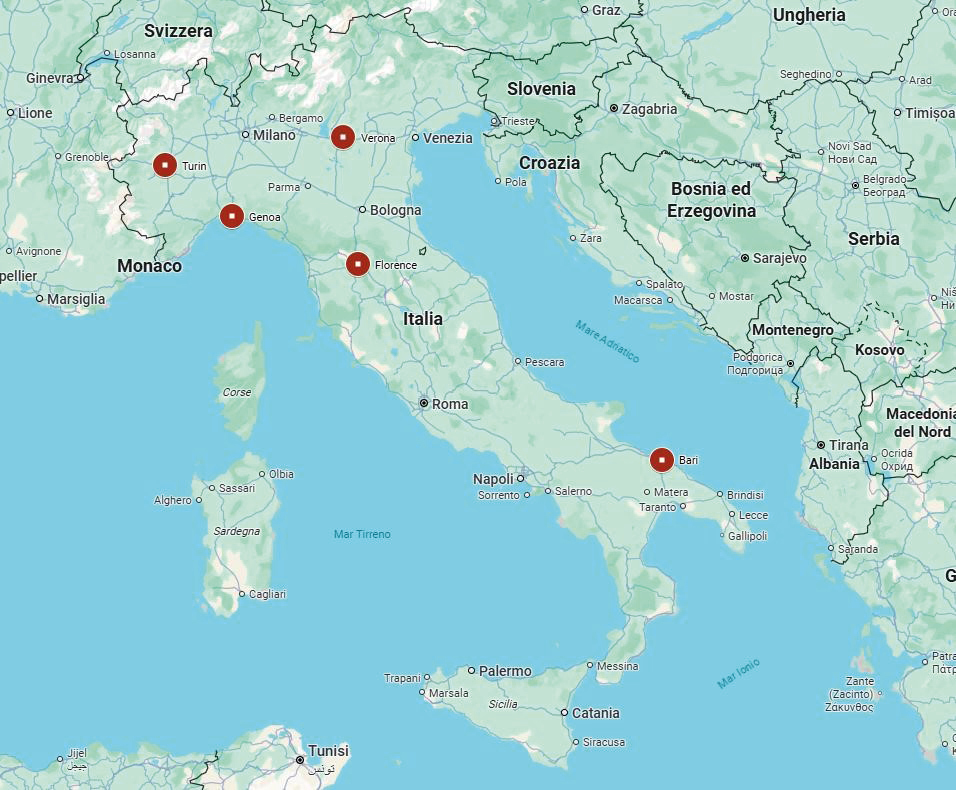
In order to determine the amount required for the conversion from surface right to full ownership, the necessary information for applying the three approaches (ILex, IMarket e ICompensation) relating to the 15 most populous Italian municipalities (Rome, Milan, Naples, Turin, Palermo, Genoa, Bologna, Florence, Bari, Catania, Verona, Venice, Messina, Padua, and Trieste) have been collected. Following consultations with the technical departments of the municipalities, positive feedback has been received from the cities of Bari, Florence, Genoa, Turin and Verona, which have provided data regarding 96 areas where public housing developments (Edilizia Residenziale Pubblica, ERP) have been carried out between 1976 and 1998.
All the municipalities, except the city of Verona, are regional capitals. As Figure 1 shows, the city of Bari is located in Southern Italy, Florence in Central Italy, Verona in the North-East, whereas the cities of Turin and Genoa are in the North-West cluster. According to ISTAT data updated as of 01/01/2025 (Table 1), the most populous municipality is Turin, which also has the highest population density, whereas the least populous is Verona, which also has the lowest density. The municipal territory of Genoa is the most extensive, while Florence and Bari are comparable both in terms of surface area and number of residents.
| ID | Case study | Population | Area (Km²) | Population density (ab/Km²) |
|---|---|---|---|---|
| 1 | Bari | 315,473 | 115.93 | 2,721.24 |
| 2 | Florence | 362,353 | 102.22 | 3,544.83 |
| 3 | Genoa | 563,947 | 239.9 | 2,350.76 |
| 4 | Turin | 856,745 | 130.11 | 6,584.77 |
| 5 | Verona | 255,133 | 198.86 | 1,282.98 |
| TOTAL | 2,353,651 | 787.02 |
The technical offices of the five municipalities have provided the following information: i) area address, ii) year of establishment of the surface rights, iii) fees paid, iv) built volume or surface area, and v) duration of the concession. To standardize these data, volume has been converted to surface area by assuming a floor-to-floor height of 3 meters. In most cases, the construction refers to the Gross Floor Area (GFA), which is an urban planning parameter whose definition and determination vary depending on the applicable building regulations.
The total GFA of the 96 areas is 680,981 m2, with an average of just over 7,000 m2. The minimum GFA of 670 m2 is found in the municipality of Florence, while the maximum, 77,350 m2, is in the municipality of Genoa. The city with the highest number of analyzed areas is Florence, followed by Genoa, Verona, Bari, and finally Turin (Table 2).
| Case study | N | GFA (m²) | GFA_average (m²) | GFA_min (m²) | GFA_max (m²) | Fees paid (€) | Unitary fees_average (€/m²) | Unitary fees_min (€/m²) | Unitary fees_max (€/m²) |
|---|---|---|---|---|---|---|---|---|---|
| Bari | 12 | 39,884 | 3,324 | 860 | 9,196 | 1,043,855 | 23.8 | 0.4 | 117.8 |
| Florence | 45 | 147,949 | 3,288 | 670 | 13,511 | 2,655,223 | 16.5 | 0.5 | 78.3 |
| Genoa | 18 | 250,574 | 13,921 | 1,083 | 77,340 | 859,096 | 4.3 | 1.4 | 21.1 |
| Turin | 4 | 137,568 | 34,392 | 7,248 | 46,905 | 1,101,817 | 13.1 | 2.1 | 33.7 |
| Verona | 17 | 105,006 | 6,177 | 1,333 | 17,400 | 3,866,487 | 55.1 | 4.7 | 170.4 |
| TOT. | 96 | 680,981 | 7,094 | 670 | 77,340 | 9,526,479 | 21.8 | 0.4 | 170.4 |
The greatest development of PEHP interventions has occurred around the 1980s: even in the analyzed sample, the 1980-1982 period accounts for the highest number of areas (39), corresponding to a GFA of almost 277,889 m2 (40.8% of the total). Regarding the last decade analyzed (1989-1998), only 12 areas have been developed, totaling a GFA of just 95,798 m2 (14.1% of the total) (Figure 2).
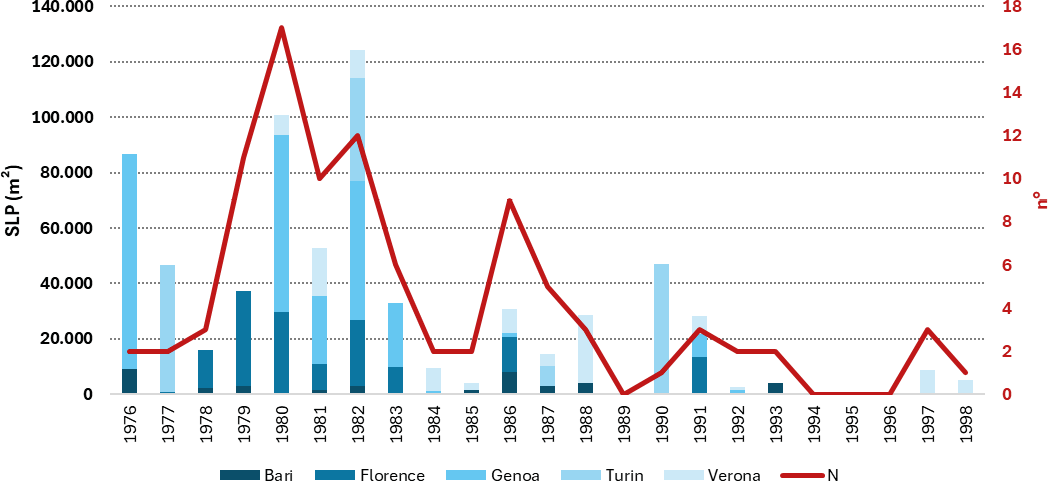
The geographical distribution of the cities, their size, the number of provided areas and the considered time interval make the analyzed sample adequately representative of the investigated phenomenon.
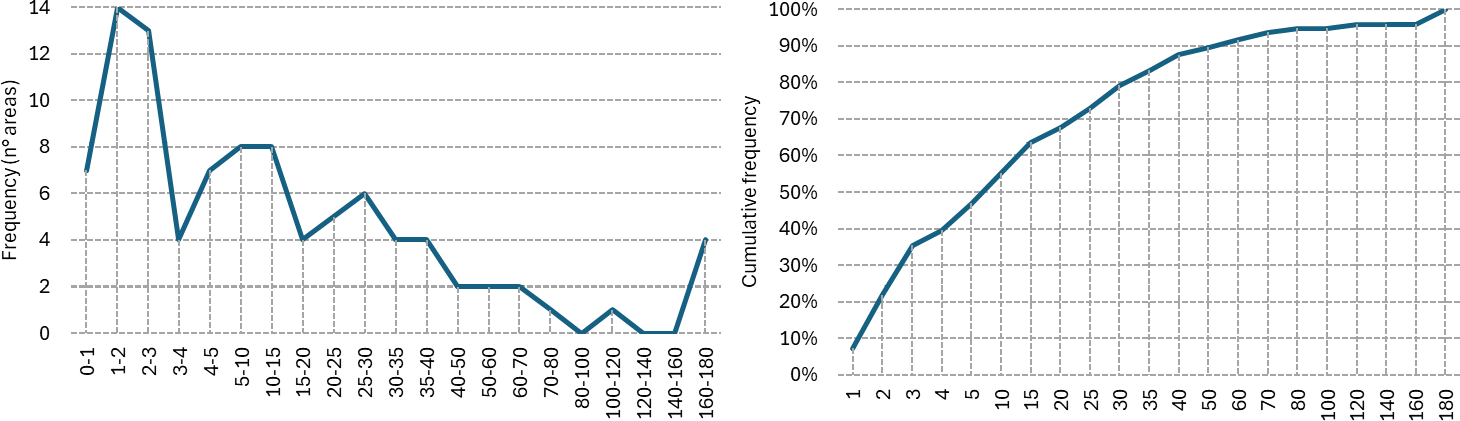
The duration of the concession is 99 years in 81% of cases and 90 years in the remaining 19%; the total fees paid amount to nearly 9.5 million euros, corresponding to a unit cost per m2 of GFA of 21.8 €/m2 , with a minimum of 0.43 €/ m2 in Bari and a maximum of 170.4 €/ m2 recorded for the city of Verona. The graphs showing absolute and cumulative frequencies (Figure 3) reveal that in 47% of cases, the initial fees paid are less than 5 €/m2, in 36% between 5 and 35 €/m2, in 11% within the range 35-100 €/m2, and rarely (5%) exceed 100 €/m2 (Figure 3).
6.2 Improvement of the initial database
In order to generalize the three approaches, useful for their subsequent comparison, commercial surface unit (CS) has been considered: the CS is the most widely used parameter for direct estimates, as it is considered more representative of the market’s appreciation of the different surfaces included in the property. For its determination, the references provided by OMI of the Italian Revenue Agency (Central Directorate of the Real Estate Market Observatory, 2016) can be used, which are applied in defining the value ranges of the different homogeneous market micro-zones. As previously introduced, the fees paid at the time of establishing the surface right refer to the GFA, while the OMI of the Italian Revenue Agency quotations refer to the CS: since it is not possible to establish a coefficient for converting GFA to CS, equivalence between these parameters has been assumed. The current legislation uses the thousandth share associated with each housing unit as the base parameter for determining the conversion fee. Simplistically, it has been considered that the ratio between the GFA of the individual property and the total GFA of the analyzed area corresponds to the equivalent ratio between commercial surfaces and ultimately to the thousandth share.
After georeferencing the areas, the initial database has been enriched with value quotations related to sales and rentals of “civil” and “economic” housing provided by the OMI of the Italian Revenue Agency for the second half of 2024. Only for some micro-zones in the municipality of Verona, OMI does not provide rental information for economic housing: in this case, rental values have been reconstructed using the capitalization rate applied to civil housing located in the same context. Moreover, for the “E3 - SACRA FAMIGLIA, CA` DI DAVID” micro-zone in the city of Verona, OMI only provides information for civil-type properties, therefore only this category has been taken into account.
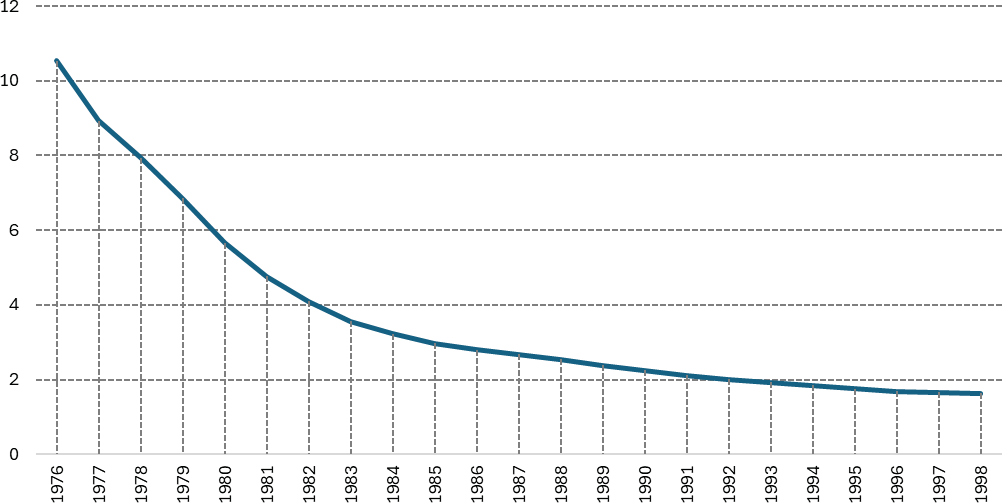
Assuming a reference date of December 31st, 2024, for the application of the first approach (ILex), in addition to the data provided by the technical offices, the identification of the national consumer price indices for worker and employee families provided by ISTAT (FOI-Istat) is needed. Specifically, these indices allow the adjustment of fees paid from the year of establishment of the surface rights to the present date (Figure 4).
Through an overlay between the locations of the areas and the market micro-zones elaborated by OMI, it is highlighted that for all analyzed municipalities, the PEHP areas are located in residential suburbs; specifically, the areas in Bari are spread across 8 micro-zones, Verona in 7, Genoa in 6, Florence in 5 and Turin in 3 (Figure 5).
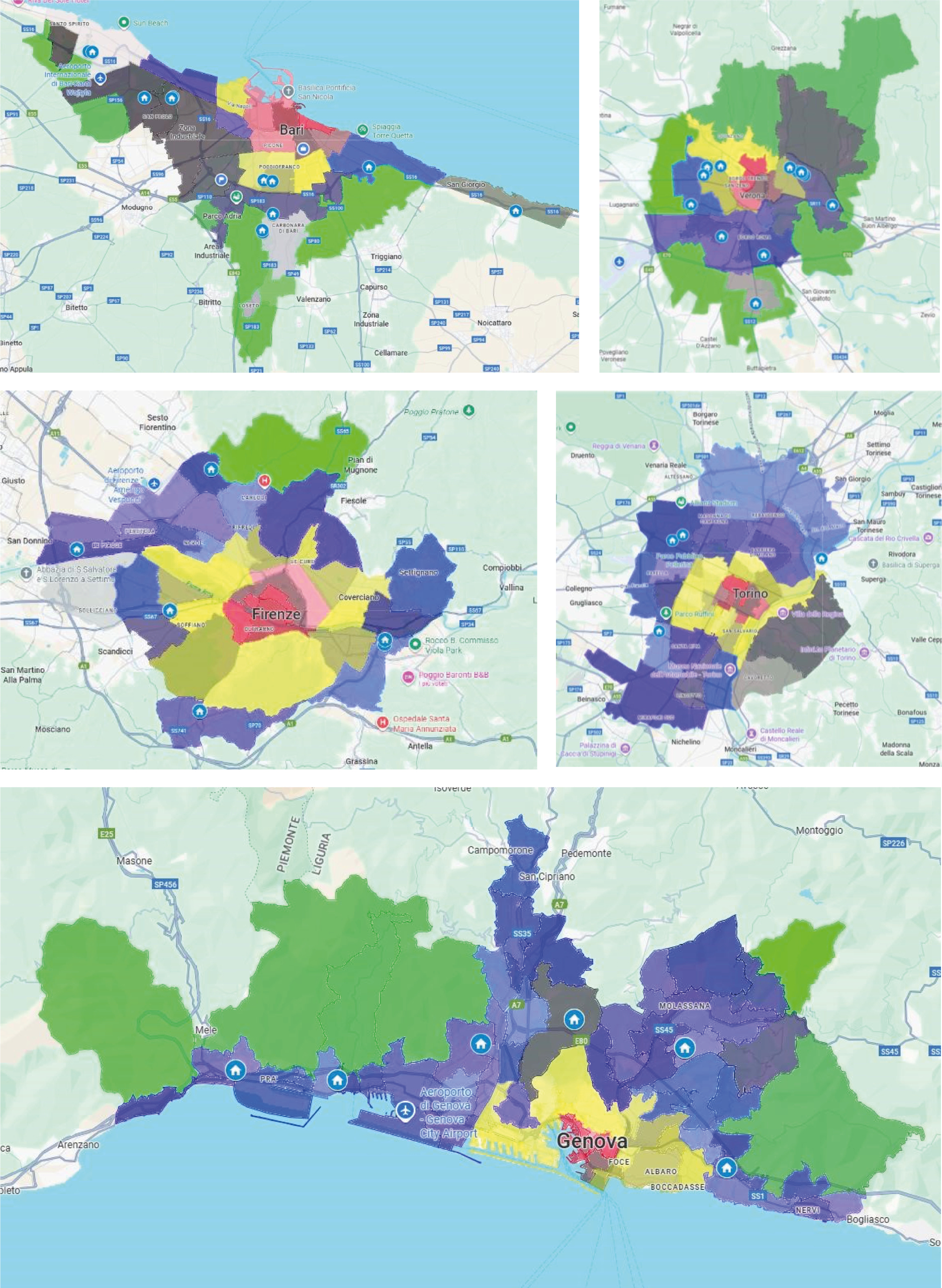
Finally, the calculation of ILex requires estimating the market value of the area at the hypothetical date of December 31st, 2024 (MVArea). This market value can be determined by assessing the revenues (sales of the new buildings) and the costs (construction, urbanization and financial charges, overheads, profits, etc.) generated by the transformation initiative carried out on the land by an ordinary investor. Since the detailed information data necessary to apply this method are not known, the incidence of the land value compared to the total property value can be considered as a simplification. By taking into account the land swaps in favor of landowners in residential development cases and some municipal resolutions applied for determining expropriation indemnity in social housing interventions, this coefficient has been set at 15%.
Therefore, the mathematical relationship is expressed below:
MVArea = 15% QMIN(9)
in which QMIN is the minimum quotation for residential properties of the economic type reported by OMI for the micro-zone in which the analyzed area is included.
For the application of the market approach (IMarket) the minimum OMI quotation associated with the lease of economic-type properties has been used instead of the annual rent (a = LMIN), and the ratio between QMIN and LMIN to determine the capitalization rate (r = QMIN/LMIN).
To determine the market value of the area at the date of establishment of the surface right (MVArea,i), useful for the implementation of the compensation approach (ICompensation), the same approach previously introduced for MVArea has been adopted. Thus:
MVArea,i = 15%QCI(10)
in which QCI represents the nominal values provided by the magazine “Il Consulente Immobiliare”, published by “Il Sole 24 Ore” in the year of establishment of the surface right, adjusted as described below. QCI is an average quotation published biannually and associated with the central and peripheral zones of the main Italian cities. To harmonize this information with the data required, a new semi-central zone has been hypothesized, whose value is the average of the previous zones, and the values for the missing years have been reconstructed as the average of the observations for the previous and following years. Furthermore, since the context is economic housing, this value has been divided by a coefficient of 1.25, obtained as the average ratio between OMI quotations for civil-type dwellings and those for economictype ones. The interest rate needed to temporally transform the amounts into a present value could correspond to the net yield of government securities (BTP and BOT) issued by the Ministry of Economy and Finance – Treasury Department. This yield was over 10% during the 1970s and 1980s (periods marked by high inflation and low liquidity), whereas currently it is around 2%. As a precautionary measure, the latter rate (i.e. 2%) has been chosen to avoid excessively penalizing the superficiaries.
6.3 Application of the three approaches
The database has allowed the determination of ILex, IMarket e ICompensation for the 96 cases: for 60 of the 96 areas, the approach that generates the highest amount payable by the superficiary to become the owner is linked to the market logic. For 34 areas, by implementing the compensation approach the highest conversion fee is obtained, whereas for only 2 areas, the legal-based approach determines this result. In 7 situations, the superficiary should pay nothing if referring to the compensation approach, and in 16 cases by considering the legal-based approach (Figure 6). In the city of Florence, the most penalising approach for the superficiary is usually the market approach; in the city of Turin, the compensation approach generates a higher payment for all areas. In Genoa, the market approach proves to be the worst in 55% of cases, while the compensation approach is less preferred in the remaining 45%. In the cities of Bari and Verona, the highest amount is mostly determined using the compensation approach, only occasionally through the market approach, and for just one area by means of the legal-based approach (Figure 7).
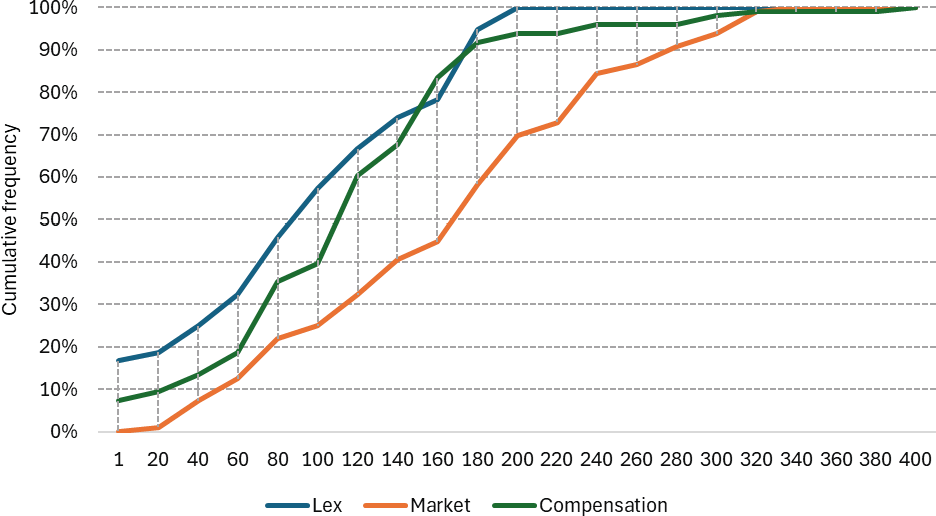
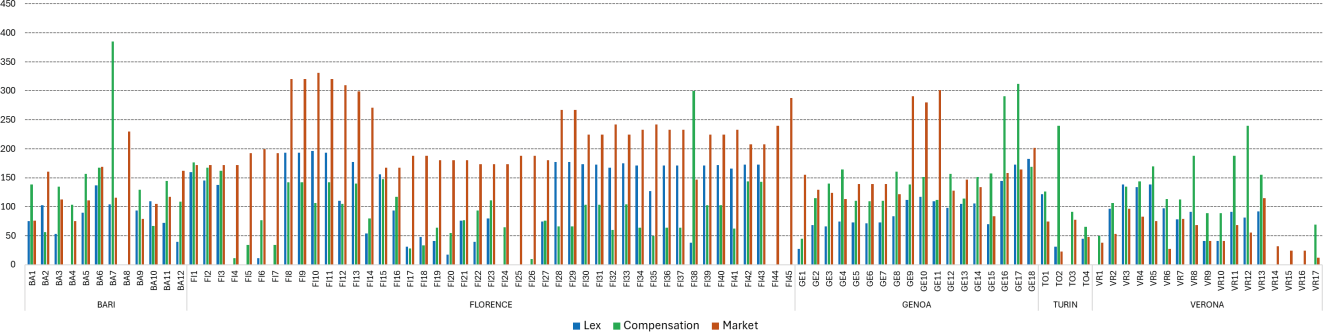
As shown in Table 3, excluding cases where the amount payable is zero, the minimum compensation - equal to 9€/m² - and the maximum - equal to 385€/m² - are both determined through the compensation approach. The average amounts are equal to 109€/m² for the legal-based approach, 120€/m² for the compensation approach, and 162€/m² for the market approach.
| Lex | Market | Compensation | |||||||||||||||||
|---|---|---|---|---|---|---|---|---|---|---|---|---|---|---|---|---|---|---|---|
| MIN* (€/m2) | 11 | 12 | 9 | ||||||||||||||||
| MAX (€/m2) | 196 | 331 | 385 | ||||||||||||||||
| MED (€/m2) | 109 | 162 | 120 | ||||||||||||||||
| ST. DEV. (€/m2) | 62 | 81 | 70 | ||||||||||||||||
| Revenue (€) | 53,971,104 | 92,547,574 | 80,605,543 | ||||||||||||||||
| * excluding the value 0. | |||||||||||||||||||
By assuming that all superficiaries become owners, this would generate revenue for the Public Administration of nearly 54 €million according to the legal-based approach, 92.5 €million according to the market approach, and 80.6 €million according to the compensation approach.
From this initial analysis of the results of the three approaches, it is evident that the compensation approach occupies an intermediate position between the legal-based and market approaches. Through correlation analysis, it is possible to highlight that the market approach and the compensation one are not correlated, whereas the legal-based approach shows a weak positive correlation with the other two.
7. Conclusions and future developments
The need to address the housing emergency in Italy during the 1970s led to the creation of PEHP zones, which aimed to provide housing at prices below market value to individuals who could not access the free market. This situation was made possible through the expropriation of land, generally by municipalities, and its subsequent allocation to cooperatives following the payment of a fee lower than the market value of the land. This mechanism was often linked to the simultaneous creation of the surface right for the housing assignee, implicitly allowing the municipality – having become the landowner – to potentially regain possession of the dwelling in the future (Locurcio et al., 2025; Tajani et al., 2025). Over time, this prospect proved difficult to implement, and successive governments facilitated the conversion of the surface right into full ownership upon payment of a corresponding fee.
Within this framework, the present work has critically analyzed the approach established by current legislation, comparing the fee determined according to its application with the purely market-based logic and with the approach connected to the legitimate need to compensate the community for the initial advantage granted to the assignee-surface right holders. Through a case study involving 96 PEHP areas located in five Italian municipalities, the fees determined according to the three approaches have been compared to highlight the disparities caused by the current legislation and the potential increased revenues for the Public Administration that could be generated if the approaches proposed by the authors have been applied. The research offers practical guidance for defining a fair fee for converting surface rights into full ownership by integrating market-based criteria and the initial advantage granted to beneficiaries. This approach helps reduce disparities generated by current legislation, enhances consistency in administrative decisions, and can improve the financial sustainability of public administrations by identifying potential additional revenues. Moreover, it provides policymakers with a data-driven tool to design more equitable and effective housing policies, with potential applicability beyond the Italian context. However, the potential of the proposed approach, called compensation, faces limitations related to identifying the necessary data for its wide-scale application, especially when operating in small municipalities with stagnant real estate dynamics and difficulties in obtaining objective real estate information referring to the date of establishment of the surface right. These limitations could be overcome by identifying, through a regression-based approach, a predictive function that yields results comparable to those of the compensation approach by using proxy variables in place of the market value of the land at the date of establishment of the surface right - for example, by using coefficients representing real estate trends such as the House Price Index referring to nominal prices. This future development, particularly if built on a larger sample, would overcome the arbitrariness of the coefficients to be used in the current legal-based approach, creating a fair model based on compensating the actual advantage granted to surface right holders, free from logics connected to the specificities of different real estate markets.
Authors’ contribution
This work should be attributed equally to the authors.
References
Carbonara, S., and Stefano, D. (2021). The transformation of surface rights into property rights. A financial resource for rebalancing municipal budgets. The case of Pescara. In Morano, P., Oppio, A., Rosato, P., Sdino, L., and Tajani, F. (Eds.). Appraisal and Valuation, Green Energy and Technology. Cham, Springer International Publishing, pp. 91–101.
Central Directorate of the Real Estate Market Observatory (2016). Manual of the Quotation Database of the Real Estate Market Observatory: Technical instructions for the development of the OMI Quotation Database, 2016. Available at: https://www.agenziaentrate.gov.it/portale/documents/20143/265514/omiallegati_AGENZIA+DELLE+ENTRATE_Manuale+BDQ_OMI_2016_ALLEGATI.pdf (Accessed 15 October 2025).
De Mare, G., and Nesticò, A. (2010). Il diritto di superficie nelle trasformazioni urbane: profili estimativi. Valori e Valutazioni, 4, 151–163.
European Commission (2023). Affordable housing initiative. October 2023. https://single-marketeconomy.ec.europa.eu/sectors/proximity-and-social-economy/social-economy-eu/affordable-housing-initiative_en
European Economic and Social Committee (2024). Social housing in the EU - decent, sustainable and affordable. 592th plenary session. Brussels. December 4-5, 2024. Available at: https://www.eesc.europa.eu/en/agenda/ourevents/events/592nd-plenary-session-4-5-dec-2024 (Accessed 28 September 2025).
European Parliament (2013). Directorate General for Internal Policies. Social Housing in the European Union. Available at: https://www.europarl.europa.eu/RegData/etudes/note/join/2013/492469/IPOLEMPL_NT(2013)492469_EN.pdf (Accessed 29 September 2025).
European Union (2020). New European Bauhaus. Available at: https://new-european-bauhaus.europa.eu/about/aboutinitiative_en (Accessed 29 September 2025)
Housing Europe (2023). The State of Housing in Europe 2023. Available at: https://www.housingeurope.eu/the-state-ofthe-housing-in-europe-2023/ (Accessed 5 October 2025).
Locurcio, M., Morano, P., Amoruso, P., Di Liddo, F., and Tajani, F. (2025). Rationalizing evaluation legal models for affordable home ownership and leasehold interests in Italy. In Gervasi, O., Murgante, B., Garau, C., Karaca, Y., Faginas Lago, M. N., Scorza, F., and Braga, A. C. (Eds.). Computational Science and Its Applications – ICCSA 2025 Workshops. ICCSA 2025. Lecture Notes in Computer Science, vol 15896. Cham, Springer, pp. 134–145.
Magri, M., and Scilhanick, E. (2006). Diritto di superficie. Ancona, CEDAM editore.
OECD (2024). OECD Affordable Housing Database. OECD Directorate of Employment, Labour and Social Affairs - Social Policy Division. PH4.2. Social Rental Housing Stock. April 16, 2024. Available at: https://www.oecd.org/content/dam/oecd/en/data/datasets/affordable-housing-database/ph4-2-social-rental-housingstock.pdf (Accessed 7 October 2025).
Patel, M. B., and Patel, D. A.(2023). Empirical analysis of real estate disputes. Journal of Legal Affairs and Dispute Resolution in Engineering and Construction, 15(11), 04522037-1.
Real Estate Market Observatory of Italian Revenue Agency. Available at: https://www.agenziaentrate.gov.it/portale/schede/fabbricatiterreni/omi/banche-dati/quotazioni-immobiliari (Accessed 25 October 2025).
Tajani, F., Locurcio, M., Morano, P., Cerullo, G., Mirabella, A. (2025). Surface rights in affordable and social housing: a logic-deductive approach for determining the fair redemption value. Valori e Valutazioni, 37, 165–181.