Digital competence in early childhood: the dialogue between pedagogy and neuroscience for screen education in the Di.Co.Each project
Competenza digitale nella prima infanzia: il dialogo tra pedagogia e neuroscienze per un’educazione agli schermi nel progetto Di.Co.Each
1 Università degli Studi di Firenze, Italy
2 Università di Ginevra, Switzerland
cosimo.dibari@unifi.it; irene.balboni@unige.ch; claudio.dantonio@unifi.it; ester.giamberini@unifi.it
*Corresponding author.
Abstract. In recent decades, the spread of digital technologies in daily life has introduced the presence of screens into childhood life as well. Despite the recommendations of the American Academy of Paediatricians and other studies on the subject, the use of technological devices frequently occurs at an early age, with high exposure times and without adequate adult accompaniment. Based on these considerations, the Di.Co.Each Project has been carried out since October 2023 and it aims to foster interdisciplinary research (combining medical, pedagogical, psychological, and sociological perspectives) to enrich the literature and promote among parents, educators, and teachers a greater awareness of the risks and opportunities of the presence of electronic devices in the lives of children, promoting approaches that are conducive to the early acquisition of digital skills. The article offers a summary of the results of the first year of the project and relates the investigation developed from a neuroscientific point of view (with a literature review) with the research in the pedagogical field, carried out on a qualitative level (through focus groups with parents, educators/teachers, and pediatricians), on a quantitative level (with a questionnaire for educational staff and a questionnaire for parents).
Keywords: digital competence, early childhood, media literacy education, systematized literature review.
Riassunto. Negli ultimi decenni, la diffusione delle tecnologie digitali nella vita quotidiana ha introdotto la presenza degli schermi anche nell’infanzia. Nonostante le raccomandazioni dell’American Academy of Pediatrics e di altri studi sul tema, l’utilizzo dei dispositivi tecnologici avviene frequentemente già in età precoce, con tempi di esposizione elevati e senza un adeguato accompagnamento da parte degli adulti. A partire da queste considerazioni, dal mese di ottobre 2023 è attivo il Progetto Di.Co.Each, che mira a promuovere la ricerca interdisciplinare (combinando prospettive mediche, pedagogiche, psicologiche e sociologiche) per arricchire la letteratura esistente e favorire, tra genitori, educatori e insegnanti, una maggiore consapevolezza sui rischi e le opportunità legati alla presenza dei dispositivi elettronici nella vita dei bambini, promuovendo approcci favorevoli all’acquisizione precoce delle competenze digitali. L’articolo propone una sintesi dei risultati del primo anno del progetto e mette in relazione l’indagine sviluppata da un punto di vista neuroscientifico (attraverso una rassegna della letteratura) con la ricerca in ambito pedagogico, condotta a livello qualitativo (tramite focus group con genitori, educatori/insegnanti e pediatri) e quantitativo (con un questionario rivolto al personale educativo e uno rivolto ai genitori).
Parole chiave: competenza digitale, prima infanzia, educazione alla media literacy, revisione sistematica della letteratura.
Index
1. Introduction: the Di.Co.Each project
3. Research from a pedagogical perspective
3.1 Pedagogical literature review
4. Review of neuroscientific literature
5. The dialogue between pedagogy and neuroscience
1. Full search string of neuroscientific literature review
2. Neuroimaging methods and measures
1. Introduction: the Di.Co.Each project
Digital technology is now widespread in the daily lives of individuals and has produced profound social and cultural transformations over the past decades. This “revolution” was outlined by Negroponte already in the mid-1990s but has taken and is taking on increasingly radical declinations (Negroponte, 1994). In particular, since the diffusion of touchscreens, these transformations are increasingly and closely affecting subjects that originally would not be among the target audience of these tools. In particular, contemporary childhood is growingly characterised by the presence of these devices and this exposes today’s children to completely new contents and it opens up new possibilities compared to the past (Mascheroni et al., 2021). Today, we live in a reality strongly permeated by the presence of digital technology and a clear distinction between living in a material reality and in a digital one no longer exists. Luciano Floridi, as well as other philosophers, describes this phenomenon as ‘onlife’, reflecting the lack of boundaries and intertwining that makes the material and digital hard to dissociate (Floridi et al., 2015).
The fact that digital tools have been part of children’s lives from the earliest age has led various experts to use Marc Prensky’s evocative metaphor of ‘digital natives’ to underline a generational divide that can no longer be bridged (Prensky, 2001). This label has continued to circulate in both journalistic and scientific debates, although from a scientific point of view, the American author’s thesis has been widely rejected and refuted, even by Prensky himself who revised and criticised his own definition a decade later (Prensky, 2012). As a consequence, various misunderstandings have arisen: the first, for example, is the underestimation of the digital divide, which in reality concerns various parts of the planet and is often found even within various cities; the second concerns the false idea, disproved by neuroscience (Rivoltella, 2013), that childhood brain transformations are taking place; a third, more purely pedagogical, is the idea that as ‘digital natives’ the new generations already have innate ‘competences’ in the use of technology. This leads to the belief that curiosity and confidence are sufficient elements to use digital technologies in a conscious, critical and creative way (Di Bari, 2023; Marangi, 2023).
The Project Di.Co.Each, launched on 15 October 2023 and involving the collaboration between the University of Florence (lead partner), the University of Bologna and the University of Roma La Sapienza, has set out to initiate an interdisciplinary reflection that aims at framing the theme of digital competence from early childhood. Rather than waiting for the arrival of the first personal devices, it is possible to promote experiences and initiate reflections that will allow the child, with the guidance of adults (parents, educators, teachers, first and foremost, but also other adult reference figures, such as grandparents), to gradually build up their screen competence.
To this end, the Di.Co.Each project in its two years of activity, has conducted a literature review to investigate the most significant research on the subject from a mainly pedagogical and neuroscientific perspective. At the same time, in order to investigate how and how many digital tools are present in today’s families, two mixed-method works were launched. Specifically, one of a quantitative nature (with the administration of two questionnaires, one of which was specifically addressed to the 0-6 educational services’ staff) and the other of a qualitative nature, through various focus groups addressed to parents, educators, teachers and pediatricians. Interesting results emerge from this dual research, as discussed further in this article, bringing out a specific mature perspective on these issues. However, the reported results are to be considered provisional, as the research is still in progress. Final results will be made public with further contributions.
In particular, this work reflects on the results gathered in the first year of research and examines how the literature review in the neuroscientific field, despite having highlighted a limited number of results inherent to the topic, can enter into a dialogue with the various fronts of pedagogical research and offer useful indications for development of an ‘action-research’ path that has the ambition to promote trainings that concern childhood both directly (with activities carried out in the nursery and pre-school) and indirectly (with a parents training pathway).
The relationship between childhood and the digital world is frequently at the centre of various debates/explorations/ involving public opinion, policy makers, and scientific research. However, these perspectives are often not fully aligned with what is proposed by the scientific research (Haddon et al., 2020; Arabiat et al., 2023). The dynamics of journalism and social networks , for example, prioritizing content that promotes users engagement (i.e. clickbait), influence public opinion and can promote an alarmist attitude. As a consequence, both policy measures and scientific research are increasingly in danger of being characterised by alarmism and sensationalism.
Framing the relationship between childhood and the digital world within a pedagogical framework means systematically leveraging the knowledge derived from various educational sciences.. This approach emphasizes the need to draw from these disciplines to trigger actions and reflections able to accompany the education processes and the formation of the human being. Around this theme, the categories refer to completely different times and tools, and the risk of taking ‘apocalyptic’ or ‘integrated’ positions is absolutely concrete: on the one hand, an emphasis on dangers, which frequently produces forms of moral panic that do not help to deal with current challenges; on the other, an attempt to promote educational innovation by believing that technology (and digital in particular) is automatically capable of conveying active attitudes, skills and knowledge without any need for mediation In order to avoid these two extreme attitudes, as Umberto Eco (1964) already suggested, advocating for a position that is neither apocalyptic nor blindly integrated – pedagogy should assume, at the same time, critical and opened-minded perspectives. This new pedagogy should provide educators and other relevant figures in education with much needed tools to interpret and navigate the new digital context.
Precisely the Media Education approach, from the pedagogical perspective, offers valuable suggestions: the idea of media education, ‘with’ media, ‘about’ media and ‘beyond’ media, which was already relevant in the 1980s from primary school onwards in relation to electronic media, can now also be useful for pre-school children and extended to the various devices that populate their days. Just as Len Masterman underlined that it is essential to include all cultural forms within the school’s scope of analysis, and that today the media content for children also needs to be better understood and problematised (Masterman, 1985). At the same time, in line with the British author’s call to recognise that the media do not neutrally show reality but offer a representation of it, the first ‘seeds’ of digital competence can emerge precisely from forms of active use of digital devices. This should encourage us to understand how these tools are ‘opaque’ and that opacity is the source of both potentials and limits to be mastered. Again using a reference from the 1980s, which remains topical today, one can advocate the adoption of a ‘homeostatic’ approach (Postman, 1979) toward digital presence, which does not promote prohibitionist or demonising attitudes, but is oriented towards understanding and fostering an ‘ecology’ through an enhancement of schools, both to preserve traditional knowledge and to offer tools for interpreting the currently transformations (Buckingham, 2019).
What we know about the relationship between digital technology and childhood today comes mainly from paediatric studies. These start with the 1990s analyses by the American Academy of Paediatricians and have evolved through the various updates up to those of 2015 or the most recent ones that also address the impact of digital screens. To date, a comparison of the guidelines that have been disseminated at the international level reveals an overall call not to expose children to screens until the age of two, while avoiding exposure as much as possible until at least the age of four to five. For this age group, it is suggested above all to limit screen-time (in line with the experiences of past years when the idea of a ‘media diet’ was proposed), to carefully select the contents, and to avoid unsupervised use.
These suggestions often end up clashing with what can be observed in everyday life and with what the most widespread statistics on the subject tend to show: exposure to screens usually takes place in the family already before the age of two, at a time and in a manner very different from what is laid down in paediatric recommendations. To frame the issue from a pedagogical perspective, it is interesting to investigate the motivations that see children interacting with screens: it is common for adults to use the device in order to indulge in other activities that would otherwise be considered impossible; or, again, the device used as a ‘calming’ or even an ‘anaesthetising’ agent (Di Bari, 2023). This stark mismatch between paediatric recommendations and family habits is the scenario within which pedagogy should take a central role, both in informing parents (as early as the preparatory courses) and in guiding families towards a more conscious use of screens. An interdisciplinary point of reference is proposed by the French psychiatrist Serge Tisseron, who, while starting from paediatric recommendations and studies in developmental psychology, emphasises the difficulty in guaranteeing screen-free contexts for children, calling instead for actions that, age group by age group, manage to bring children to master screens. In order to educate about screens, Tisseron believes, three actions are needed (Tisseron, 2016): promoting self-regulation (so that there can be autonomous and responsible use), encouraging alternation (so that the digital device does not become a substitute but a complement to other forms of experience) and guaranteeing accompaniment (so that the adult knows how to make the use of the digital device not the end but the means, a pre-text to enrich one’s own experiences).
The pedagogical challenge is precisely to ensure that crèches and pre-schools can enhance their usual dialogue with families in a vertical manner (together with primary school, in the age group where the first smartphones usually arrive), promoting greater circulation of information. This perspective of continuity takes up Serge Tisseron’s invitation to gradually build digital skills, involving all the actors accompanying the growth of childhood and leading to a more conscious and responsible use, exploring the risks and opportunities, without postponing the issues until they start using them independently (Marangi, 2023). With this in mind, 0-6 educational contexts could be structured not as ‘digital free’ spaces, but ‘quite digital’ spaces in which, while holding firm to traditional experiences (which are the most important ones for the child’s development), digital tools can become a useful actor in pursuing traditional goals and can be used in an active, conscious, creative and, as the child gets older, increasingly critical way.
3. Research from a pedagogical perspective
In order to answer the initial research question elaborated during the planning phase, the DI.CO.EACH group identified Action-Research as the hermeneutic-interpretative reference methodology. The objective that drives the research is the promotion of an educating community made up of significant adults, universities and children, in which there is the possibility of participating in the construction of conscious digital practices, which allow the maturation of a culture of Digital Devices hinged on competences useful to promote an active and responsible citizenship of children and adults, starting from early childhood.
A Bildung of knowledge and skills with, at its core, educational processes that spring from equal relationships, in which exchange, trust and care become the flywheel of an intense dialogue aimed at the well-being of the wider human community.
Of the two years of research, the first (from October 2023 to September 2024) focused on context analysis and documentation, using three research tools, two qualitative and one quantitative.
For the first area, two Literature Reviews (one pedagogical, focusing on the construct of digital competence in early childhood, and one neuroscientific) and a Paediatric Guidelines Review on the relationship between early childhood and digital competence were designed.
At the same time, the research team made use of the focus group tool to detect perceptions, beliefs, habits of parents, educators, teachers and paediatricians in the relationship between digital devices and early childhood (0-6).
As part of the quantitative research, two questionnaires were drawn up and disseminated, one for parents and one for educators, aimed at investigating the methods of use and the attitudes adopted by the significant figures of children in the 0-6 range.
3.1 Pedagogical literature review
In the first phase of the Project, a literature review on the construct of digital competence in early childhood was conducted with the aim of mapping the state of the art of empirical research that has investigated the relationship between digital competence and early childhood. A systematised approach was adopted for this investigation, following Grant and Booth’s methodology (2009), characterised by an articulated structure accounting the principles and processes underlying the research protocol, and the different stages of data selection and analysis.
Building a network of connections that intercepts, connects and relates the existing literature is a fundamental key and a necessary step in order to define a clear and useful frame of reference for the research work.
This review specifically aims to synthesise published studies and different points of view in order to deepen, in a reflexive process, the understanding and theoretical framing of digital competences in early childhood for developing new questions, considerations and perspectives. Several contents were selected through Scopus database, exploiting search and filtering options, being aware of the limitations of representativeness associated with this choice, relying on transparency and accountability criteria to make the selection and analysis process explicit. According to that, the results must therefore be interpreted as specific to the sample of articles and research analysed, rather than generalisable to the entire scientific landscape.
The analysis process took place in the two stages of mapping and reviewing emerging evidence, according to the ySKILLS Horizon 2020 protocol (Haddon et al, 2020), and was based on a combination of several keyword strings (early AND childhood OR baby OR babies OR toddler* OR preschooler* OR pediatric*; parent* OR famil*; education OR educator* OR early childhood education OR media education OR kindergarten OR preschool* OR nursery; survey* OR questionnaire* OR meta-analyis* OR quantitative OR empirical OR study OR studies OR finding* OR interview* OR focus group* OR action research OR qualitative OR observation* OR case study; digital* skill* OR mobile* skill* OR digital* competen* OR mobile* competen* OR digital* literac* OR mobile* literac* OR media literac*). The database used was Scopus, the selection was limited to European countries, material published after 2013 and only in English language.
Through interactive filtering and inter-subjective comparison, from an initial amount of 529 titles there was a final result of 31 articles focused on digital competence in 0-6. The results were summarised using the PRISMA flowchart (Moher et al., 2009).
The collected data were divided into two macro-areas: context analysis (with a more quantitative look at the type of educational context and skills, age groups, caregivers, time of use, educational activities carried out, discourses on risks/opportunities and the reference to well-being) and thematic analysis (qualitative dimension with a focus on the most significant issues, divided into formal and informal educational contexts).
The emerging thematic datum is significant in reference to the role and mediation that adults should take on for a responsible use of digital technologies by children.
The literature identifies a free-flowing nature of children in and between experiences, including those of a digital nature. This inherent disposition is recognised in a playful and free approach to experiences, in a dimension where there is no distinction between real-life and digital practices (Arnott et al., 2019; Burnett et al., 2020; Demetriu & Nikiforidou, 2019; Papadakis, 2022).
In Arnott et al. (2019), reference is made to the adultomorphic fallacy, according to which the adult’s perception of a clear distinction between real and digital reality is projected onto the childhood experience; according to this point of view, all experiences are perceived as real. This educational stance requires awareness and intentionality, as core competences; beliefs and convictions of reference adults influence the integration of digital technologies as complementary resources (Demetriu & Nikiforidou, 2019) and the possibility for children to acquire literacy (Burnett et al., 2020) and skills useful for building active and responsible citizenship.
Resource availability and an open attitude enable the careful and selective integration (Demetriu & Nikiforidou, 2019) of digital technologies into everyday experiences; they provide children with the opportunity to interact with them in the free and alternating flow of experiences, acquiring balance (Arnott et al, 2019; Undheim, 2022), skills and abilities, through mediation (Herodotou, 2018), support (Demetriu & Nikiforidou, 2019), proactive engagement (Sakr, 2018) and proximal guidance (Baltzaki & Chlapana, 2023; Herodotou, 2018; Undheim, 2022).
Necessary for children is not the distinction between types of experiences, but the awareness of being seen as they experience (Burnett et al., 2020), in a supportive and caring dimension, in which enthusiasm moves through an emotional relational presence (Arabiat et al., 2023). Moreover, literacy and skills emerge from the educational relationship (Burnett et al., 2020; Haas et al., 2022), thanks to a use that is effecting and pedagogically grounded/motivated uses (Demetriu & Nikiforidou, 2019).
Constant attention is required to ensure integration, presence and support to the educational processes involving adults (Baltzaki & Chlapana, 2023; Burnett et al., 2020; Demetriu & Nikiforidou, 2019; Dolgova et al., 2018; Mertala, 2019; Papadakis, 2022; Sakr, 2018; Undheim, 2022); such attention allows for keeping the educational role performative, through the acquisition and exercise of metacognitive reflexivity. Sharing and training actions allow for the creation (and active participation) of an educating community (Haas et al., 2022) and a unique information space (Dolgova et al., 2018), which are useful in literacy and competence development processes.
In order to further investigate the use of digital devices in early childhood and to be able to triangulate the emerging data, several focus groups were conducted in parallel to the literature review, with the aim of investigating the perceptions, beliefs and educational practices of the main significant adults involved in the lives of 0-6 children. To achieve this aim, the focus-groups conducted were organised with three categories of participants: parents, educators and teachers of the Integrated System 0-6, and paediatricians.
Participants were selected through a convenience sampling, involving different territorial and associative realities. Target areas included Florence, Livorno, Bologna, Russi and Savona. As for educators and teachers, the selection was based on territorial criteria, including the educational staff of the services involved in the study and in the subsequent action-research phase. Lastly, Paediatricians were selected on a national scale, through the reference association networks.
Data collection took place between January and May 2024. There were 23 focus groups, in particular divided into: 9 with parents, 9 with educators and teachers, 5 with paediatricians (including one dedicated to trainees). A total of 239 people took part, specifically: 87 parents, 116 educators and teachers, 36 paediatricians (including 10 trainees).
The methodology adopted involved a thematic analysis (Corbin & Strauss, 1990; Clarke & Braun, 2017) conducted using an inductive approach, with the aim of capturing the participants’ views, exploring both already known and emerging themes that had not been considered by the research team (Gibbs, 2012). The data-analysis process was divided into several phases in order to intercept, examine and synthesise the collected opinions in a progressive process. In the first phase, the verbatim transcription of the audio and video recordings of the various focus-groups was carried out. At the same time, a repeated reading and observation of the transcripts was carried out in order to foster a familiarisation process with the data. The second phase, instead, focused on building the codebook and coding the data, following the principles of Initial coding (Charmaz, 2006). This phase, which was exploratory in nature, aimed to identify the main themes, categories and subcategories emerging, creating an initial analytical grid (first-level codes).
Subsequently, through Focused coding (Charmaz, 2006), the codebook was further articulated, with the definition of new themes, categories or subcategories (second-level codes) along with the identification of representative examples for each of these. Finally, the themes and categories developed were systematically applied to the entire corpus of data for an in depth understanding of the experiences, beliefs and educational practices related to the use of digital devices in early childhood, offering an articulated view of this complex phenomenon, identifying cues for future interventions and multiple educational reflections.
The codebook includes eight macro areas of analysis: needs, covid, parenting, media education, grandparents, concerns, adult and childhood uses. The use categories have as subcategories: tools, practices, activities, content, rules and time. The other categories are aimed at the investigation of: perceptions, beliefs and motivations.
Although the focus group analysis phase is still running and the final data will be published in later stages, an initial coding of the focus groups revealed a significant presence of digital devices in early childhood in the three spheres of experience: domestic, educational and social.
This presence changes as the quality of adult attitude changes. At lower levels of awareness of personal digital stance, with related insufficient levels of skills and passive uses by adults, digital babysitting practices and passive uses by children occur. As awareness levels increase on the part of significant adults, so does an integration of beliefs, habits, and skills, enabling an effective presence for the protection and well-being of children and a balanced response to their needs.
From the perspective of awareness and responsibility, digital technologies are presented to childhood as one of many fields of experience, where alternation, accompaniment and self-regulation enable integration and fluidity.
To sustain a conscious and responsible stance, education of meaningful adults and the creation of an educating community are useful, that become creative agents of active and responsible digital citizenship, promoters of humanity’s well-being, in dialogue and free and equal exchange of practices, experiences and skills
To acquire standardized quantitative information on meaningful samples of adults, the research team DI.CO.EACH prepared a survey consisting of two online fillable questionnaires, one for parents and one for educators and teachers, both categories in relation to early childhood (0-6). The survey involves convenience and snowball sampling nationwide, with a focus on Educational Services 0-6 and pediatric outpatient clinics.
The structuring of the two questionnaires took place between December 2023 and April 2024; dissemination was started in April 2024. The total sample of parents as of December 2024 is 3911, of which 1880 questionnaires were 100% completed; that of educators and teachers is 892, of which 456 were 100% completed. As mentioned above, more information on the questionnaires will be given in subsequent publications, which will be disseminated when the research processes are completed.
The objective was to investigate digital perceptions, practices, and skills in those involved in the mediation between childhood and digital devices. In the family environment, the investigation focused on the digital devices and content present and enjoyed by adults and children, as well as possible mediation skills and modes. With educational personnel, the investigation focused on digital devices and fruitions in both home and professional environments by adults and children.
Central to both questionnaires were questions about adults’ attitudes toward digital technologies, their integration into various ecological contexts, and their uses by early childhood.
The data collected will be examined through multivariate statistical analysis techniques and disseminated through subsequent publications. The aim is to expand and contextualize what emerged from the qualitative research and enable the expansion of knowledge necessary for the continuation of the project through action-research.
4. Review of neuroscientific literature
In parallel to the pedagogical literature review, we conducted another systematic literature review including neuroscientific evidence. Early childhood is an age of extreme brain plasticity and it is becoming increasingly important to study the effect of exposure and/or interaction with digital media on this sensitive developmental period.
The methodology for the present review follows the Preferred Reporting Items for Systematic Reviews and Meta-Analysis (PRISMA) guidelines (Page et al., 2021). The same keywords used for the behavioural studies selections in addition to the specifiers for brain imaging studies (i.e. neur* and brain) were used to identify studies for the neurobiological section. Unlike the search for behavioural studies, due to the limited availability of this type of research in the neuroscientific field, no limitations for geographical areas or years of publication were entered (full search string in the supplementary materials). Records were searched in January 2024. We included only records including participants between 0 and 6 years of age, reporting the data separately for this age group, and exploring the relationship between exposure to, interaction with and/or use of digital devices and neural metrics. The retrieval and selection process is displayed in Figure 1.
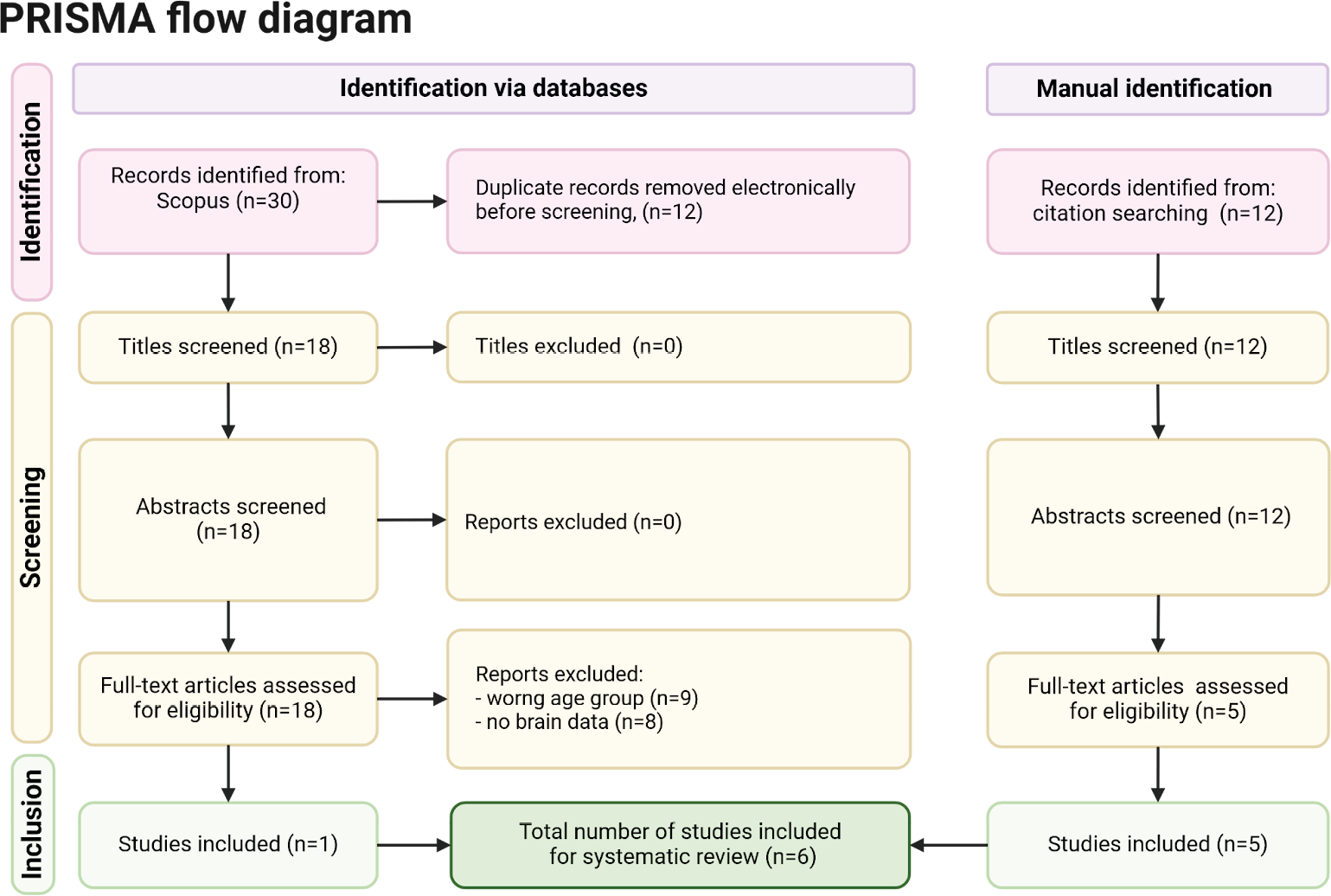
A total of 6 studies were selected. An overview of the sample size, participants’ age and neuroimaging methods and metrics is presented in Table 1. Additional explanations of the neuroimaging methods and measurements are available in the supplementary materials.
| Study | Age | Sample size | Neuroimaging method | Neural measure | Digital measure | Main findings |
|---|---|---|---|---|---|---|
| Hutton et al., 2022 | 3-5 yo | 52 | sMRI | Cortical thickness (CT) Sulcal depth (SD) |
Media use (ScreenQ) | Lower CT Lower SD |
| Hutton et al., 2020 | 3-5 yo | 47 | sMRI | Fractional anisotropy (FA), radial diffusivity (RD) | Media use (ScreenQ) | Lower connectivity values in language, literacy and executive function tracts |
| Twait et al., 2019 | 4-6 yo | 32 | EGG | ERP P300, N200 | Dialogic reading vs. screen reading exposure | Greater P300 and N200 for the group exposed to the screen |
| Shimada & Hiraki, 2006 | 6-7 months | 9 | fNIRS | oxy-Hb in motor areas | Perception of live vs digital motion of objects and people | No difference in motor activation between object and biological motions for screen group only |
| Li et al., 2018 | 4-6 yo | 19 | fNIRS | oxy-Hb in frontal areas | Exposure vs interaction with fantastical events on screen | Lower frontal activation a better inhibition for Interaction with fantastical events, compared to passive viewing. |
| Li et al., 2020 | 4-6 yo | 18 | fNIRS | oxy-Hb in frontal areas | Exposure to high or low (i.e. more realistic)events | Loer frontal activation and better executive performances after exposure to low fantasy events compared to high |
Overall, the studies can be divided into two thematic categories: two studies explore the relationship between screen exposure and differences in anatomical neural metrics whereas the remaining works explore neural activation during the interaction with and/or exposure to digital contents.
As mentioned, two studies focused on the effect of screen exposure on connectivity (Hutton et al., 2020) and cortical morphology (Hutton et al., 2022). Both works explore the relationship with an index of screen-based media used, Screen-Q, measuring frequency, access, content and co-viewing in line with American Academy of Pediatrics recommendations (Klakk et al., 2020). The higher the scores in the questionnaire, the higher the exposure. In the first study, Hutton and colleagues (2020) focus on the relationship between Screen-Q scores and measures of radial diffusivity (RD) and fractional anisotropy (FA). These two white matter indices quantify connectivity strength and integrity of the axons, therefore representing how coherently and efficiently brain areas served by white matter tracts might be connected. The exploration of how these two measures in three tracts relevant to literacy, language and executive function (i.e. uncinate, inferior longitudinal, and arcuate fasciculus) revealed how higher self-reported media use correlated with lower FA and higher RD in substantial sections of all the tracts. This effect survived correction for socio-economic status (SES) and age. The same questionnaire was correlated to measures of sulcal depth (SD) and cortical thickness (CT; Hutton et al., 2022). In this work, higher media-screen use was marginally correlated with lower CT in visual areas and higher-order processing areas (i.e. bilateral cuneus, left lingual gyrus and right precuneus, superior parietal and supramarginal gyri). Moreover, higher ScreenQ scores correlated with lesser SD in key areas for the visual processing of objects and words (the right fusiform gyrus). Interestingly, most of the correlations found in the initial analysis controlling for the effect of age and sex either disappeared or resulted in much lower significance after controlling for mother education.
The second subset of studies investigates how brain activation can vary based on the interaction and/or exposure to digital devices. The study including the youngest participants in this review, from 6 to 7 months of age, used an imaging technique called function near-infrared spectroscopy (fNRIS) to measure the motor cortex response to live and televised human and object motion (Shimada & Hiraki, 2006). In this work, children exposed to screen presentations of object motions and body motions presented the same activation in motor cortices in both conditions. In contrast, children who witnessed those motions live had higher activity for the action observation compared to the object movement. These results suggest that the activation in motor brain areas is different for televised vs. live presentation of movement.
The other two studies used the same technology, fNRIS, with children between the ages of 4 and 6 to explore brain activation while viewing fantastical events and the effect of interacting with said events compared to passive exposure. Li and colleagues (2020) showed how exposure to on-screen high fantasy events, compared to children seeing low fantasy events, leads to lower executive function performances and a trend toward higher activation of dorsolateral prefrontal areas, which is key in performing high-level cognitive tasks. The author argued that even if the higher activation in frontal areas represented just a marginally significant trend during some sections of the viewing they could still point to a depletion of cognitive resources. If exposure to fantastical events might reduce cognitive resources, the same seems not to be true of interacting with these events. In a study with a similar design, using fNRIS with children from 4 to 6 years of age, Li and colleagues (2018) investigated the effect of viewing and interacting, through a touch screen, with fantastical events. The results confirmed that the children who were passively viewing fantastical events had higher extended frontal activation during post-viewing tasks and lower inhibition abilities compared to children who were given the chance to interact with the events. The authors suggested that interaction via touch with fantastical events might moderate the effect of high fantasy content presentation.
Another study by Twait and colleagues (2019) explored the cognitive and neural impact of book reading intervention through screen or dialogic reading. Children with poor vocabulary skills between 4 and 6 years of age underwent a six-week intervention in which they were either read books by a reader on screen or had live interaction with a reader. They were tested for attention, switching abilities and speed of processing before and after intervention and electroencephalography (EEG) measures for attention (P300) and executive control (N200) were collected and analysed during an inhibition task at the final time point. Overall, the results showed improvement in cognitive skills for both groups, with the dialogic reading group outperforming the screen group in all measures but auditory attention. In terms of brain activity, the ERP data show greater P300 in parietal and occipital areas, supporting attentional processes, and greater N200 in frontal areas in challenging task conditions only for the group exposed to the screen. These results, the authors argue, point to less efficient executive inhibitory functions, both at the behavioural and neural level, in children exposed to screen reading only compared to children who underwent reading intervention with live interaction.
Overall, the findings indicate that while use or passive exposure to digital devices is linked to poorer cognitive outcomes and markers for slower development and/or greater depletion of resources, the same does not hold for active interaction with the devices. Similarly, structural findings of poorer neural development in children with high media exposure are moderated by socio-economic factors (i.e. family economic status or education), suggesting that more factors may correlate and jointly explain poorer neural outcomes. This means that we cannot directly assess how much of the observed effect of screen exposure and media use is direct, i.e. media use has a direct negative effect on neural development and cognition, and how much is indirect, i.e. passive media exposure replaces and takes time away from social and interactive stimulation (Tomopoulos et al., 2007).
5. The dialogue between pedagogy and neuroscience
The in-depth neuroscientific study reported in the previous paragraph can represent a valuable complementary ‘source’ to the pedagogical research, as it makes it possible to highlight various significant points that can also be related to the pediatric guidelines that have been disseminated over the last ten years. Notably, in addition to the guidelines from the American Academy of Pediatrics, the recommendations issued in France, Australia, and within the Italian context – by SIP and the ‘Custodi Digitali’ project – also hold particular relevance.
The articles reviewed reveal a partial re-dimension of the perspectives that tend to feed the ‘moral panic’ around the presence of screens in childhood life. The scarce studies and the limited sample invite to consider with caution these results and their possible implications.
The articles selected for review also highlight the need to avoid generalizations and to analyze the context in which screen use takes place specifically; the types of content used are also relevant. Thinking about an answer to the question ‘What effects do screens have on the child’s brain?’ the answer that emerges from the reviewed research is ‘it depends…’. This variability is related to how the child is confronted with the tool. In particular, the presence of an adult accompanying the child’s use is very important. In addition, a very significant concern regarding the possible positive effects is fostering a concrete interaction with the screen, in which the young user is not only exposed to the content but takes an active role in its transformation.
Another fact relevant to pedagogical research is the emphasis on the fact that the screen, even when enjoyed with simple exposure, is a very neurally demanding activity for the child. This study underlines how using the screen as a moment of relaxation is undesirable. These considerations can be related to pedagogical research and to the need to start building digital competence from childhood, as advocated by the DI.CO.EACH project.
These needs, already present with the widespread use of digital screens, have become increasingly urgent in recent years. From the focus group analyses, adults’ perceptions of the year 2020 clearly emerge. The pandemic period from Covid was presented as a momentous watershed that initiated significant changes in the developments and uses of digital technologies, including by early childhood. The perspective that has emerged is the increasing fruitions, initiations at earlier and earlier ages, and the intensification of phenomena of passive use and abuse, both by adults and children. Strong social exposure and fruitions due to family needs bring out a dimension of problematicity, in which regressive practices and manifestations of censorship are unthinkable. On the one hand, significant adults reported foreseeing numerous opportunities in digital devices (with marked improvement in lifestyles) and, on the other hand, they expressed their non-intention to relegate their children to protective bubbles in which digital access is not allowed, a practice that is not feasible and risky for possible future development-in the pre-adolescent and adolescent stages-of issues related to socialization, integration and bullying.
The results of the two literature reviews clarify that reflections should not converge on the use of digital technologies, but on the need to acquire mediation models functional to children well-being and to the whole community’s ones.
Fluidity and convergent access to experiences by childhood manifest how children are able to move freely in their playful and cognitive experiences, without developing dependent participation patterns for any of them, holding firm to the feeling of excitement that moves experiencing. Conversely, in the absence of adult participation, child experiences exhibit states of diminished well-being. With reference figures (in the minds of whom children should know they are), but also with other adult figures and peers, interest in relationship and sociality is the basis of experiencing. An experience qualitatively charged with participation, arising from the attention of the other, the pleasure that flows from being in relationship and the feeling of warmth that envelops and involves in it, projecting life into becoming through the dimensions of joy.
Having experiences is a vital element for child care aimed at well-being, even within the digital domain. Experiences in which a separation between the digital and real-life is not desirable, but the modulation of the quality of the relationship is significant. As with any field of experience, mediating digital experiences means being present with every aspect of the person, concerning body, mind and heart, with awareness of its temporary qualities.
Adult mediation together with a digitally approaching childhood means to be in a caring relationship, in which each experience is intentionally designed for developing well-being, communicating and participating in the relationship, in a mutually open and continuously flowing exchange.
From this perspective, digital experiences could be one of the many useful tools for participating “together” in reality, in the sharing of practices and emotions. Respecting developmental stages and ages, access to digital devices could be one of the moments of shared life able to guarantee childhood the opportunity to grow in a careful and affective environment, in an enveloping embrace capable of transmitting security and interest, but also the necessary skills useful in becoming active, aware and responsible digital citizens.
Significant is the example of the parent who, in his participation in a focus group, brought back the pleasure of time spent with his child to the discovery, through digital tools, of passions in common, as a time of nurturing the self, the other-from-self and the whole family; in this case, the medium are nature documentaries and internet searches for videos, which have been made possible to listen to the voices of those animals encountered and a deepening knowledge.
Although connected to digital devices, the pleasure is not their own but is inherent in the relationship and love that mutually can be given through them as well. In the case just described, the instrument of togetherness was the documentary, but enjoyment was not the end in itself. Mediation and accompaniment contains within themselves the essence of the caring action.
The first year of research of Di.Co.Each Project has enabled us to gain awareness that not “apocalyptic” campaigns but educational processes aimed at building critical and aware minds are functional to respond to today’s problems related to digital technologies, in a context of circularity of skills and interdependence of practices and well-being.
Problem orientation is necessarily educational, through social actions of intervention in praxis, by means of a hermeneutically grounded reflexive and meta reflexive approach, which knows how to dispose itself in reality with intentional planning.
The different stages of the research highlighted the need for dialogue between the multiple actors involved in childhood education: educators, teachers, parents, and experts from various disciplinary perspectives. Each of these actors should set up contexts in which children can deal with risks and exploit the possibilities of screens. The intervention model, proper to the second year of the project and which takes shape in the action research, envisages a democratic and participative style. After a specification of the problem defined in its meanings through the triangulation of data (arising from the first year, but in the awareness of its being always open and constantly changing), it turns to a change that is possible through the educational praxis exercised by and within the educating community.
A community of practices that addresses the present challenges they face by interdependently modifying its own gaze, starting from the conviction that it’s urgent and possible to act on our educational stance and point of view, on how we observe reality. A reality in which not digital technologies should be placed at the centre of the focal lens but humanity, in its singularities and pluralities, focusing on its relational, as a community of persons. The project therefore aims to inform and train adults involved in childhood education, working out with them strategies that can become good practices and traces for the development of paediatric and pedagogical guidelines for building digital competence from early childhood.
The action research’s aim of the Di.Co.Each project is to facilitate the formation of minds that can face reality through critical and reflective gazes, but also capable of manifesting attention, interest and participation. Perspectives that shift their view from digital technologies to people, from tools to modes of mediation and reaction. As emerges from the analyses carried out, it is not the experiences themselves that make the difference, but the possibility of experiencing in the awareness of a reciprocal gaze, participating in a loved and caring relationship. According to that, the most significant outcome in this first year of research is the awareness of the necessity of a re-settlement of the pedagogical point of view, focusing in particular on the capability of identifying a more shifted balance in favor of the centrality of the person and the fundamental mediation aspect of the educational relationship. The task of the second year of this research project will be to build a social network aimed to observe and collect relational styles, resources and possibilities, in order to carry on this educational challenge for promoting a forward-looking change for children and community well-being.
Abdel-Aziz, K., & Ciccarelli, O. (2014). Rationale for Quantitative MRI of the Human Spinal Cord and Clinical Applications. In Cohen-Adad J. & Wheeler-Kingshott C. A. M. (Eds.), Quantitative MRI of the Spinal Cord (pp. 3-21). Academic Press. https://doi.org/10.1016/B978-0-12-396973-6.00001-0
Arabiat, D., Al Jabery, M., Robinson, S., Whitehead, L., & Mörelius, E. (2023). Interactive technology use and child development: A systematic review. Child: Care, Health and Development, 49(4), 679-715. https://doi.org/10.1111/cch.13082
Arnott, L., Palaiologou, I., & Gray, C. (2019). Internet of toys across home and early childhood education: understanding the ecology of the child’s social world. Technology, Pedagogy and Education, 28(4), 401-412. https://doi.org/10.1080/1475939X.2019.1656667
Baltzaki, M., & Chlapana, E. (2023). Fostering receptive vocabulary development of kindergarten children with the use of Information and Communication Technologies (ICT). Education and Information Technologies, 28(11), 14019-14049. https://doi.org/10.1007/s10639-023-11707-7
Buckingham, D. (2019). The media education manifesto. Polity Press.
Burnett, C., Merchant, G., & Neumann, M. M. (2020). The appearance of literacy in new communicative practices: Interrogating the politics of noticing. Cambridge Journal of Education, 50(2), 167-183. https://doi.org/10.1080/0305764X.2019.1654978
Charmaz, K. (2006). Constructing grounded theory: A practical guide through qualitative analysis. Sage.
Clarke, V., & Braun, V. (2017). Thematic analysis. The Journal of Positive Psychology, 12(3), 297-298. https://doi.org/10.1080/17439760.2016.1262613
Corbin, J., & Strauss, A. (1990). Grounded theory research: Procedures, canons, and evaluative criteria. Qualitative Sociology, 13(1), 3-21. https://doi.org/10.1007/BF00988593
Demetriou, K., & Nikiforidou, Z. (2019). The relational space of educational technology: Early childhood students’ views. Global Studies of Childhood, 9(4), 290-305. https://doi.org/10.1177/2043610619881458
Di Bari, C. (2023). I nativi digitali non esistono. Uppa.
Dolgova, V., Batenova, Y., Emelyanova, I., Ivanova, I., Pikuleva, L., & Filippova, O. (2019). Factors of the readiness for information exchange in pre-school education establishments. Education Sciences, 9(3), 1-10. https://doi.org/10.3390/educsci9030166
Eco, U. (1964). Apocalittici e integrati. Bompiani.Gibbs, G. R. (2012). Analysing qualitative data (2nd ed.). Sage.
Grant, M. J., & Booth, A. (2009). A typology of reviews: An analysis of 14 review types and associated methodologies. Health Information and Libraries Journal, 26(2), 91-108. https://doi.org/10.1111/j.1471-1842.2009.00848.x
Haas, B., Lavicza, Z., Houghton, T., & Kreis, Y. (2022). Evaluating technology-enhanced, STEAM-based remote teaching with parental support in luxembourgish early childhood education. Frontiers in Education, 7, 1-12. https://doi.org/10.3389/feduc.2022.872479
Haddon, L., Cino, D., Doyle, M.A., Livingstone, S., Mascheroni, G. & Stoilova, M. (2020). Children and young people’s digital skills: A systematic evidence review. KU, Leuven: ySKILLS. https://doi.org/10.5281/zenodo.4160176
Hatzigianni, M., Gregoriadis, A., Karagiorgou, I., & Chatzigeorgiadou, S. (2018). Using tablets in free play: The implementation of the digital play framework in Greece. British Journal of Educational Technology, 49(5), 928-942. https://doi.org/10.1111/bjet.12620
Herodotou, C. (2018). Mobile games and science learning: A comparative study of 4 and 5 years old playing the game Angry Birds. British Journal of Educational Technology, 49(1), 6-16. https://doi.org/10.1111/bjet.12546
Hutton, J. S., Dudley, J., DeWitt, T., & Horowitz-Kraus, T. (2022). Associations between digital media use and brain surface structural measures in preschool-aged children. Scientific Reports, 12(1), 19095. https://doi.org/10.1038/s41598-022-20922-0
Hutton, J. S., Dudley, J., Horowitz-Kraus, T., DeWitt, T., & Holland, S. K. (2020). Associations Between Screen-Based Media Use and Brain White Matter Integrity in Preschool-Aged Children, PubMed. 174(5):509. https://pubmed.ncbi.nlm.nih.gov/31682712/
Klakk, H. et al. (2020). The development of a questionnaire to assess leisure time screen-based media use and its proximal correlates in children (SCREENS-Q). BMC Public Health, 20(1), 664. https://doi.org/10.1186/s12889-020-08810-6
Li, H., Hsueh, Y., Yu, H., & Kitzmann, K. M. (2020). Viewing Fantastical Events in Animated Television Shows: Immediate Effects on Chinese Preschoolers’ Executive Function. Frontiers in Psychology, 11. https://doi.org/10.3389/fpsyg.2020.583174
Li, H., Subrahmanyam, K., Bai, X., Xie, X., & Liu, T. (2018). Viewing Fantastical Events Versus Touching Fantastical Events: Short-Term Effects on Children’s Inhibitory Control. Child Development, 89(1), 48-57. https://doi.org/10.1111/cdev.12820
Marangi, M. (2023). Addomesticare gli schermi. Scholé.
Mascheroni, G., & Siibak, A. (2021). Datafied Childhoods: Data practices and imaginaries in children’s lives. Peter Lang.
Masterman, L. (1985). Teaching the media. Routledge.
Mertala, P. (2019). Teachers’ beliefs about technology integration in early childhood education: A meta-ethnographical synthesis of qualitative research. Computers in Human Behavior, 101, 334-349. https://doi.org/10.1016/j.chb.2019.08.003
Moher, D., Liberati, A., Tetzlaff, J., Altman, D. G., & Prisma Group. (2009). Preferred reporting items for systematic reviews and meta-analyses: the PRISMA statement. PLoS med, 62, 1006-1012. https://doi.org/10.1016/j.jclinepi.2009.06.005
Negroponte, N. (1994). Being digital. Knopf.
Page, M. J. et al. (2021). The PRISMA 2020 statement: An updated guideline for reporting systematic reviews. BMJ, 372(71). https://doi.org/10.1136/bmj.n71
Papadakis, S. (2021). The impact of coding apps to support young children in computational thinking and computational fluency. A literature review. Frontiers in Education, 6, 657895. https://doi.org/10.3389/feduc.2021.657895
Pinti, P. et al. (2020). The present and future use of functional near‐infrared spectroscopy (fNIRS) for cognitive neuroscience. Annals of the New York Academy of Sciences, 1464(1), 5-29. https://doi.org/10.1111/nyas.13948
Prensky, M. (2001). Digital natives, digital immigrants. On the Horizon, 9(5), 1-6. https://doi.org/10.1108/10748120110424816
Prensky, M. (2012). Brain gain. Macmilian.
Sakr, M. (2018). Multimodal participation frameworks during young children’s collaborative drawing on paper and on the iPad. Thinking Skills and Creativity, 29, 1-11. https://doi.org/10.1016/j.tsc.2018.05.004
Shimada, S., & Hiraki, K. (2006). Infant’s brain responses to live and televised action. NeuroImage, 32(2), 930-939. https://doi.org/10.1016/j.neuroimage.2006.03.044
Sur, S., & Sinha, V. K. (2009). Event-related potential: An overview. Industrial Psychiatry Journal, 18(1), 70-73. https://doi.org/10.4103/0972-6748.57865
Tomopoulos, S. et al. (2007). Is Exposure to Media Intended for Preschool Children Associated With Less Parent-Child Shared Reading Aloud and Teaching Activities? Ambulatory Pediatrics, 7(1), 18-24. https://doi.org/10.1016/j.ambp.2006.10.005
Twait, E., Farah, R., Shamir, N., & Horowitz-Kraus, T. (2019). Dialogic reading vs screen exposure intervention is related to increased cognitive control in preschool‐age children, Acta Paediatrica, Wiley Online Library, 108(11), 1993-2000. https://onlinelibrary.wiley.com/doi/10.1111/apa.14841
Undheim, M. (2022). Children and teachers engaging together with digital technology in early childhood education and care institutions: A literature review. European Early Childhood Education Research Journal, 30(3), 472-489. https://doi.org/10.1080/1350293X.2021.1971730
1. Full search string of neuroscientific literature review
The following search string was entered in the database Scopus on the 28th of January 2024:
( earlyAND childhoodOR babyOR babiesOR toddler*OR preschooler*OR pediatric*) AND ( parent*OR famil*) AND ( educationOR educator*OR earlyAND childhoodAND educationOR mediaAND educationOR kindergartenOR preschool*OR nursery) AND ( survey*OR questionnaire*OR meta-analyis*OR quantitativeOR empiricalOR studyOR studiesOR finding*OR interview*OR focusAND group*OR actionAND researchOR qualitativeOR observation*OR caseAND study) AND ( digital*AND skill*OR mobile*AND skill*OR digital*AND competen*OR mobile*AND competen*OR digital*AND literac*OR mobile*AND literac*OR mediaAND literac*) AND TITLE( neur*OR brain)
2. Neuroimaging methods and measures
The measures obtained by each neuroimaging method mentioned in the table refer only to the ones included in the present review. Other possible indices could be extracted but are not relevant in the present work.
| Method | Measures | Interpretation in the papers |
|---|---|---|
| Structural magnetic resonance imaging (sMRI) | 1. Cortical thickness (CT) 2. Sulcal depth (SD) 3. Fractional anisotropy (FA)4. Radial diffusivity (RD) |
More CT/SD = higher quantity of grey matter. Within the developmental samples in this review, lower CT/SD in primary sensory areas (e.g. visual areas) is considered a sign of efficient pruning whereas the opposite is true for higher-level areas (i.e. high CT/SD better development) RD represents a measure of myelination of the tracts, with low RD corresponding to strongly myelinated, hence efficient, connection (Abdel-Aziz & Ciccarelli, 2014). Whereas, FA is a measure of how coherent the structural connections are (Abdel-Aziz & Ciccarelli, 2014) and for this measure, low scores represent poor connectivity in white matter tracts. |
| Electroencephalography (EEG) | Event-related potential (ERP) | Measure of neural activity for cognitive and sensory processes based on time-locked analysis of EEG activation (Sur & Sinha, 2009). In the present review ERPs for attention (P300) and executive control (N200) were measured. |
| Functional near infra-read spectroscopy (fNRIS) | 1. oxyhemoglobin (oxy-Hb) 2. deoxy-hemoglobin (deoxy-Hb) 3. total hemoglobin (total-Hb) |
This method measures haemoglobin concentration, considered to be a proxy for brain metabolic needs (i.e. brain activity) and it is tolerant to motion (Pinti et al., 2020) making it one of the brain imaging methods of choice with very young participants. |