Digital Integration in Early Childhood Education and Care: Innovating Educators’ Competencies
Integrazione digitale nell’educazione e cura della prima infanzia: innovare le competenze degli educatori
University of Padova, Italy
marina.derossi@unipd.it; cinzia.ferranti@unipd.it
*Corresponding author.
Abstract. The University of Padua carried out a research-training path for the development of digital innovation within the Territorial Pedagogical Coordination (TPC) of Parma. The training was aimed at the Coordinators so that they could subsequently implement training and development actions among the staff of the educational services. In this first phase of the research-training project, a survey was carried out among educational staff in 2019 to detect their beliefs on the usefulness of digital technologies and their use in educational work. The questionnaire was constructed by referring to the competence framework of the European document Digital Competence Framework for Educators-DigCompEdu. Subsequently, in the post-Covid phase, the survey was proposed again to detect the change in the perceptions of educators and teachers on the use of digital tools in educational work with children, with the professional community, and in communication with families. This article will present some data from the second administration in 2023. The questionnaire consisted of 22 items with a 5-level scale and 176 educators and teachers responded. The data collected showed responses at the highest levels of the scale in the use of digital tools for educational documentation. Digital educational documentation is used for communication with families and the exchange of experiences in the professional community. The integration of digital technologies in the work with children is widespread at an average level although educators and teachers believe that it is important to educate children in the correct, creative, and responsible use of technologies from their first experiences in educational services. Digital technologies are considered important for learning in specific educational areas such as the language area, the logic-science area, and the music area.
Keywords: early childhood education, digital educational technologies, professional development, community development, digital competence for education.
Riassunto. L’Università di Padova ha realizzato un percorso di ricerca-formazione per lo sviluppo dell’innovazione digitale all’interno del Coordinamento Pedagogico Territoriale (CTP) di Parma. La formazione era rivolta ai Coordinatori affinché potessero successivamente implementare azioni di formazione e sviluppo tra il personale dei servizi educativi. In questa prima fase del progetto di ricerca-formazione, è stata condotta un’indagine tra il personale educativo nel 2019 per rilevare le loro convinzioni sull’utilità delle tecnologie digitali e sul loro utilizzo nel lavoro educativo. Il questionario è stato costruito facendo riferimento al quadro di competenze del documento europeo Digital Competence Framework for Educators-DigCompEdu. Successivamente, nella fase post-Covid, l’indagine è stata riproposta per rilevare il cambiamento nelle percezioni di educatori e insegnanti sull’uso degli strumenti digitali nel lavoro educativo con i bambini, con la comunità professionale e nella comunicazione con le famiglie. In questo articolo verranno presentati alcuni dati della seconda somministrazione del 2023 del questionario, composto da 22 item con una scala a 5 livelli e hanno risposto 176 educatori e insegnanti. I dati raccolti hanno mostrato risposte ai livelli più alti della scala nell’uso di strumenti digitali per la documentazione didattica, che viene utilizzata per la comunicazione con le famiglie e lo scambio di esperienze nella comunità professionale. L’integrazione delle tecnologie digitali nel lavoro con i bambini è diffusa a un livello medio, anche se educatori e insegnanti ritengono importante educare i bambini a un uso corretto, creativo e responsabile delle tecnologie fin dalle prime esperienze nei servizi educativi. Le tecnologie digitali sono considerate importanti per l’apprendimento in aree educative specifiche come l’area linguistica, l’area logico-scientifica e l’area musicale.
Parole chiave: educazione della prima infanzia, tecnologie educative digitali, sviluppo professionale, sviluppo della comunità, competenze digitali per l’educazione.
Index
5. Educators’ and teachers’ beliefs on the integration of digital tools in educational work in ECEC
Digital competence is among the educational and training priorities induced by the New/Net/Knowledge Economy in order to overcome new forms of digital divide (EU Council Recommendation, 2018).
There is currently an increasingly significant connection between the themes of the DigComp 2.1 framework (Carretero et al., 2017), updated with DigComp 2.2. (Vuorikari et al., 2022) and the goals of the 2030 Agenda (UN, 2015). The reflection concerns the integration of digital technologies1 in education to foster the quality of education in terms of sustainability, accessibility and inclusion (Goal 4) and to combat poverty, including educational poverty (Goal 1).
Society is witnessing many innovations, thanks to which many opportunities are emerging, but also risks of exclusion of entire sectors and vulnerable groups that are still poorly prepared for digital innovation. Overcoming this critical issue requires educational processes that are essential for the development of active and responsible citizenship, starting from early childhood (Su & Yang, 2024).
In fact, in 2019, the European Commission’s Eurydice report reaffirmed that pre-primary education is a fundamental means of contributing to the fight against educational disadvantage by focusing on early intervention programmes in 0-6 services. The aim is to offer educational activities aimed at fostering the integral, sustainable, and inclusive development of boys and girls also in terms of their relationship with digital innovation.
An important function of services on this front is also the construction of networking with families and the territory (Ferranti 2018; Flewitt & Clark, 2020) for participatory and responsible involvement through the methodological perspective of socio-cultural educational animation (De Rossi, 2018).
The educational pathway should guarantee project continuity between education in the 0-3 age group and the subsequent 3-6 age group to foster a gradual development of children and represent a context of reference and support for the families that inhabit our communities today.
The difference in life paths, identities, growth times, relational modes, and conceptions of education become the starting point for building a common basis of coexistence for the group of children and adults.
The crucial role for transformative learning is that of educators and teachers in their daily work. In this perspective, the DigCompEdu framework (Redecker, 2017) is of extreme interest since the training towards a digital culture of educators and teachers is closely connected to the quality and innovation of their work also in the contexts of early childhood education and care. Educational continuity in the 0-6 age group can be realised in the establishment of childcare poles and territorial pedagogical coordination, which represent important elements of educational organisation and planning also about the development of digital culture. Consequently, educational services and pre-schools become in the territories the privileged contexts of social integration to guarantee equal opportunities and innovative development for the community, even if the achievement of this objective encounters some critical points.
The first critical node of this connection therefore relates to the dialogue between the Pedagogical Guidelines and the National Indications, to which the first National Guidelines for Early Childhood Education Services, adopted by Ministerial Decree no. 43 of 24 February 2022, should be added.
From an organisational and management point of view, the continuity of work between crèches and preschools is not automatic. In fact, on the national territory, pre-schools refer to educational institutions that include primary and secondary schools, while the educational services for the 0-3 age group are part of other private or municipal administrations.
In essence, the relationship between the 0-3 segment and the 3-6 segment still appears highly fragile and full of contradictions, even though Legislative Decree No. 65 of 2017 provides for the implementation of an integrated system for the education of the 0-6 age group. On a pedagogical level, this relationship of continuity is fundamental for the definition of an effective system in giving equal opportunities to all children to develop their potential for relationships, autonomy, creativity, and learning and to overcome inequalities, territorial, economic, ethnic, and cultural barriers. The training of educators and teachers on the integration of digital technology in educational work can be the privileged context for experimenting with common working practices in order to implement concrete actions of innovation on a planning and methodological level.
The six competence areas indicated by the DigCompEdu framework (Redecker, 2017) are the basis for the dissemination of educational innovation, through the action of educational personnel who know how to directly involve children in the correct encounter with technologies from their earliest experiences.
In particular, the areas define a comprehensive competence framework for educators and teachers in the use of digital resources for educational purposes: professional involvement and enhancement (Area 1); creation and sharing of digital educational resources (Area 2); management and organisation of technologies in teaching-learning processes (Area 3); use to improve assessment practices (Area 4); use to foster processes of inclusion, personalisation and active involvement of students (Area 5); developing creativity, responsibility, personal well-being and problem solving through the use of digitally mediated information and communication (Area 6).
However, the recent systematic review (Su & Yang, 2024) still highlights persistent critical issues of digital skills training in educators, although some interesting changes have become apparent in the aftermath of the pandemic experience. It is important to continue doing research in this area for the improvement of initial and continuous training strategies.
The research question (RQ) of this study is: after the pandemic experience, what is the commitment of the 0-6 educators in service in the integration of digital technologies in the different areas (teaching, communication with families, documentation) of the educational profession?
Between 2018 and 2019, the University of Padua carried out a research-training pathway for the development of digital innovation addressed to the territorial pedagogical coordination of the 0-6 services (TPC of Parma), which then generated training actions also for the educational staff of early childhood services and schools (Bazzoli et al., 2024). Among the various activities proposed in this pathway was a survey among the staff of early childhood education services, preschools and 0-6 services referring to the competence framework indicated in the document Digital Competence Framework for Educators-DigCompEdu (Redecker, 2017).
The survey aimed to detect educators’ and teachers’ perceptions of their ability to use digital tools, their usefulness, frequency and usage patterns regarding some specific dimensions: educational work with children; educational documentation; communication with families; sharing and networking with the professional community.
The semi-structured questionnaire was shared with the coordinators’ group and 65 educators (35.13%) responded out of a total of 185 questionnaires administered.
From this first survey, dating back to the pre-Covid period, a picture emerged characterised by a lack of use of digital technologies in all the professional contexts involved.
Concerning specific professional purposes, 61.5% of the respondents stated that they use technological tools and resources mainly for the preparation of teaching materials and 58.5% for researching information for professional purposes.
On the other hand, about the integration of technologies in direct work with children, the frequency of positive answers was lower. In the specific item on the use of the tablet, it emerged that 27.7% did not use it for educational work, 35.4% made predominantly personal use and the remainder did not use it at all. 70.8% stated that they did not use apps for section activities with the boys and girls and only 16.9% used them occasionally.
More widespread was the use of traditional technological tools to document activities: the camera, video camera, and audio recorder (fairly 40%; frequently 30.8%; very 24.6%).
The survey was also extended to the use of technology for communication both in the professional community and with families (use of platforms and networks). The results in both cases, before the Coronavirus emergency, were at rather low levels, highlighting a scenario that had been little explored in this respect. Concerning communication between colleagues for work purposes, 66 % showed no or little use of technological resources for this purpose.
About communication with families, 83% also stated that they made no or little use of online communication tools, social networks, or platforms for disseminating materials and documentation.
In 2023, after the Covid emergency period, the questionnaire was proposed again to the educational staff of the Parma area managed by the Territorial Pedagogical Coordination (TPC).
In this study, the term digital technology is used in a broader sense. By ‘digital tools’ we mean all the digital technologies that educators and teachers use to carry out their educational mission. They can be tablets and related apps, robots, interactive whiteboards, etc., or tools for communicating with families and the professional community.
For this aim, the same online questionnaire proposed in the pre-Covid period was administered, composed of three dimensions: a) background and education (7 items); b) use of technologies (9 items); c) beliefs on the use of technologies in professional contexts (6 items).
The closed-ended items of dimensions b) and c) were defined with a self-anchoring scale (from 1 not at all to 5 very much), whereas for dimension a) there were multiple-choice or short answers.
The first datum of interest is the fact that in 2023 the number of respondents was much higher (N= 176), i.e. 95.6% of the total number of educational staff working at the facilities. In our opinion, this first datum may mean that the staff, after the forced experience of using digital resources due to the pandemic, shows greater sensitivity and involvement towards the issue of technology integration in their educational work.
55.7% are educators of 0-3 services, 26% are preschool teachers (3-6) and 18.2% are part of integrated 0-6 services.
27.8% stated that between 2020 and 2022 they had attended specific training courses on the use of technology for teaching in early childhood contexts promoted by their institution, and 42% stated that they had attended generic training courses on the use of technology, also as self-training using offers on the web. The remaining 30.2% had no training at all, but had tried to practice independently the use of some tool they considered useful for their educational work. This percentage is an increase compared to the pre-Covid survey in which a total of 38.5% stated that they had attended generic training courses on didactic innovation, but not very specific on the integration of digital resources in educational work.
73% stated that they had increased their technological equipment for professional use after the distance learning experience of the pandemic period. The number of mobile devices increased: laptop (69%); tablet (34%); smartphone (71%).
81.8% say they use their devices to prepare material for educational activities; 23.9% to propose educational activities in the section and 92.6% for educational documentation (M=3,93; SD=1,04; Mo=4).
In particular, 64.8% use technological tools to produce videos, 87.5% use specific software and Apps to build photo and image collections, also in the form of digital storytelling; 34.7% use the tools for observation and annotation during section work.
The item concerning the use of educational apps involving children shows rather poor results: M=1.78; SD=1.01; Mo=-1. 24% of the answers are at level 3 and only 8% at the highest levels (4 and 5); 25.6% of educators and teachers state that they offer the apps to children little in their activities and 52.8% not at all.
Regarding the perception of greater preparedness in the use of digital technologies for professional purposes, 43.2% of the respondents perceived an improvement resulting from the pandemic experience at good and very good levels (level 4 and 5), 38.6% were in the medium range of improvement (level 3), while 10.8% perceived little improvement (level 2) and only 7.4% perceived no change in an improving sense (level 1). Overall, the results of this item are: M=3.31; SD=1.06; Mo=3.
However, alongside the use of new devices, traditional technologies (72%), such as the camera, video camera, and audio recorder are still in use, also because they are often present as available equipment in the services.
4. Survey results on digital documentation, communication with families and the professional community
Educational documentation within early childhood services is a means to improve the quality of care and education, but above all to keep track of the developmental progress of the individual child.
Research has shown that this practice from a professional perspective can empower educators, families, and the children themselves (Alasuutari & Kelle, 2015; Bondioli & Savio, 2018; Hostyn et al., 2020).
It is possible to distinguish between a communicative and an evaluative function of documentation. The former is the telling of what happens daily in the facilities and can therefore be a reflective tool precisely because the educator has to put himself in the child’s perspective to document. This process contributes to improving the quality of educational services since it allows both the monitoring of children’s development and educators and teachers to review their actions.
On the other hand, the evaluative function refers to the evaluation of the educational proposals of the service to review and improve the offer (De Rossi & Restiglian, 2013).
De Rossi and Restiglian (2013) add a third function that they define as formative since it refers to sharing in the professional community. Therefore, it is closely related to the design process not so much about the products that documentation creates, but more importantly to the processes in their becoming.
Taking this perspective into account in the most recent studies, the issues of documentation and the use of digital resources were also the subject of this second investigation, together with the issue of communication with families and the professional community.
After the pandemic period, digital documentation practices increased: overall, a high percentage of the respondents stated that they use technological tools to document their educational work with children at the highest levels of the scale (4 and 5). The data analysis shows: M= 4.20; SD= 0.90; Mo= 5 (Fig. 1).
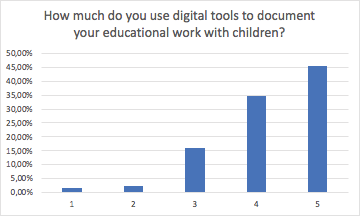
Compared to the data from the previous administration, there is an increase in the use of digital tools for documentation, in particular the percentage placing the responses at level 5 is 45.6%. This shows an alignment with the positive responses of the educators from the items concerning the possession of more technological equipment and the increase in the perception of being prepared to use it. It could also signify the development of greater awareness of the value of documentation in educational practices that occurred during the pandemic distancing period.
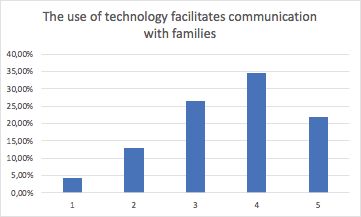
Similarly, according to the majority of respondents, digital documentation disseminated on collaborative platforms, digital environments and social networks is an important tool in the process of dialogue and communication with families. The analysis of the responses to this item concerning the use of documentation to communicate with families shows: M=3.80; SD=0.99; Mo=4 (Fig. 2).
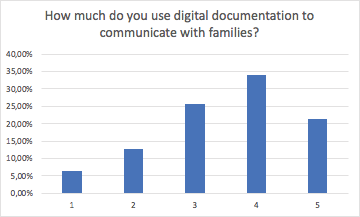
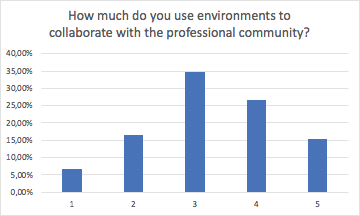
Continuing with the discussion of the data, we note an increase in positive responses regarding the use of digital resources to communicate with families through the use of platforms provided by services or reserved social channels, which multiplied during the Covid emergency: 34.7% (level 3); 26.7% (level 4) and 15.3% (level 5).
These resources, at different times, are also used to collaborate with the professional community (exchange of documentation; self-training; sharing of projects): M=3.67; SD=0.97; Mo=4.
5. Educators’ and teachers’ beliefs on the integration of digital tools in educational work in ECEC
The 2023 survey also proposed the third dimension of the questionnaire to see whether the increased use of digital tools in the Covid emergency period by educational staff has changed the relevant beliefs.
This dimension is divided into two groups of items intended to detect the perceived usefulness of the integration of digital in the work with children: 1) to initiate the development of digital competence from early childhood; 2) to enhance certain areas of learning (linguistic; scientific; musical; spatio-temporal etc.) (Calvani & Menichetti, 2013).
The use of digital technologies to develop digital competence in children is considered on average useful. The item’s answers show results concentrated in level 3 (42.6%), while the answers at the higher levels of the scale are lower: 15.3% (level 4) and 7.4% (level 5); the remaining 24.4% of the respondents affirm that it is not very useful to integrate digital technologies in educational work with children (M=2.85; SD=1.04; Mo=3).
The same trend can also be seen for the second group of items referring to the perception of the usefulness of digital tools for the enhancement of certain areas of learning (M=2.93; SD=0.99; Mo=3).
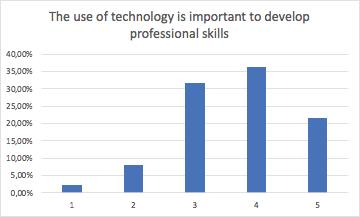
Educators and teachers instead seem to be more convinced of the usefulness of the use of digital technologies for their professional development, the relationship with the territory, and communication with families. As for the belief on the usefulness of the integration of digital technologies in their work related in relation to their professional development, the trend of responses is positive: M=3.67; SD=0.97; Mo=4 (Fig. 4).
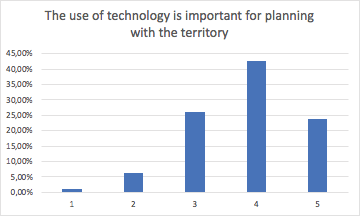
The last items for which we report the data refer to the belief of educators and teachers on the usefulness of digital technologies for the design of the service relating to the territory (M=3.82; SD=0.91; Mo=4) (Fig. 5) and to facilitate communication with families (M=3.80%; SD=0.99; Mo=4) (Fig. 6).
The continuity of children’s educational experience requires integrated planning of the educational offer and unified territorial pedagogical coordination, especially when it comes to building digital culture for children and families.
The introduction of the integrated system of services for children in the 0-6 age group, provided for by Legislative Decree No. 65 of 2017, places the role of educators and teachers at the centre to the development of educational innovation. Educators and teachers represent a micro-community that should act in a coordinated way and with a solid shared professional background.
In this perspective, the research-training path developed in the context of the Territorial Pedagogical Coordination of the Municipality of Parma represented an attempt to build a common base of competencies of the educational staff to realise the diffusion of digital innovation in the various childcare services and preschools.
Although the survey is limited to the territorial context, it is of interest in understanding the perceptions and beliefs of educational personnel to improve teaching organisation, educational work, and communication with families and the territory.
From the data that emerged from the 2023 survey, it can be seen that the perception of educators and teachers on the use of digital technologies is a process that is still evolving, both because of the direct work with children and because of the centrality of the role of services as a space for dialogue and cultural growth for families and the territory.
From the data analysed it seems to emerge a profile of educators who are not yet completely expert in digital innovation on a practical level, especially in the educational planning integrated with digital and acted out in their work with children.
This aspect could derive both from the need to reinforce competence in the process of didactic mediation using technological resources and from the complexity of choosing Apps and resources on the market, which is very wide and does not always offer reliable products (Carbotti, 2015; Ferranti, 2018).
The use and choice of digital resources, especially in relation to the age of children, cannot disregard a solid didactic preparation of educators and teachers and the creation of integrated environments for the use of digital technologies (Undheim, 2022). The integrated use of digital technologies in teaching activities must be understood with a meaning that is not only technical but broader in a cognitive, metacognitive, and corporeal sense related to the proposed learning activity.
On the other hand, about digital educational documentation and the use of technology for communication with families and the relationship between educational services and the territory, the survey data show positive results that attest to innovative proposals.
The analysis of educators’ and teachers’ beliefs seems to encourage future steps towards digital transition with regard to the qualification of educational interventions and community processes, both professional and networking relationships.
It can be deduced that the sustainable perspective is towards the intensification of the training of educational personnel, understood as a stimulus and accompaniment for a paradigmatic change aimed at connecting the educational profession with social instances and evolutionary processes in childhood education.
In this regard, the research-training course organised by the Territorial Pedagogical Coordination of Parma (TPC) and carried out with the University of Padua, which began before the pandemic and ended after the recovery, paved the way for several initiatives that will continue in the future. These include the design of training courses for educators and teachers for didactic innovation in the professional community; the realisation of open meetings with families; the implementation of projects with the territory and for the territorial community; the drafting of a report and Guidelines on the principles for the correct integration of digital in educational processes.
Alasuutari, M., & Kelle, H. (2015). Documentation in childhood. Children & Society, 29(3), 169-173. https://doi.org/10.1111/chso.12119
Bazzoli, V., De Rossi, M., Dieci, M., Ferranti, C., Gazza, B., Tarantola, F. (2024). Innovazione digitale in prospettiva di comunità. PensaMultimedia. https://www.pensamultimedia.it/libro/9791255681151
Bondioli, A., & Savio, D. (2018). Educare l’infanzia. Temi chiave per i servizi 0-6. Carocci.
European Education Area (2018). Council Recommendation on Key Competences for Lifelong Learning. https://education.ec.europa.eu/it/focus-topics/improving-quality/key-competences [verified 4 March 2024]
Calvani, A., & Menichetti, L. (2013). La competenza digitale: per un modello pedagogicamente significativo. Italian Journal of Educational Technology, 21(3), 132-140. https://www.learntechlib.org/p/183289/
Carbotti, S. (2015). App per l’infanzia: linee guida per una progettazione efficace. Form@ re-Open Journal per la formazione in rete, 15(1), 159-169. https://doi.org/10.13128/formare-15396
Carretero, S., Vuorikari, R., & Punie, Y. (2017). DigComp 2.1: The Digital Competence Framework for Citizens with eight proficiency levels and examples of use. Publications Office of the European Union. https://publications.jrc.ec.europa.eu/repository/handle/JRC106281 [verified 5 March 2024].
De Rossi, M. (2018), La competenza digitale come processo di sviluppo permanente. In Ferranti C., Giocare e apprendere con le tecnologie, pp. 7-12. Carocci.
De Rossi, M., & Restiglian, E. (2013). Narrazione e documentazione educativa. Percorsi per la prima infanzia. Carocci.
Ferranti, C. (2018). Giocare e apprendere con le tecnologie. Carocci.
Flewitt, R., & Clark, A. (2020). Porous boundaries: Reconceptualising the home literacy environment as a digitally networked space for 0–3 year olds. Journal of Early Childhood Literacy, 20(3), 447–471. https://doi.org/10.1177/1468798420938116
Hostyn, I., Mäkitalo, A. R., Hakari, S., & Vandenbussche, L. (2020). The professional actuation of pedagogical documentation in Belgian and Finnish early childhood education settings. Early Child Development and Care, 190(3), 400-413. https://doi.org/10.1080/03004430.2018.1475368
Lindeman, S., Svensson, M., & Enochsson, A. B. (2021). Digitalisation in early childhood education: A domestication theoretical perspective on teachers’ experiences. Education and Information Technologies, 26(4), 4879–4903. https://doi.org/10.1007/s10639-021-10501-7
ONU (2015). Agenda 2030. https://unric.org/it/agenda-2030/ [verified 2 March 2024]
Mishra, P., & Koehler, M. J. (2006). Technological pedagogical content knowledge: A framework for teacher knowledge. Teachers college record, 108(6), 1017-1054. https://doi.org/10.1111/j.1467-9620.2006.00684.x
Redecker, C. (2017). European Framework for the Digital Competence of Educators: DigCompEdu. In Punie, Y. (ed). EUR 28775 EN. Publications Office of the European Union. https://publications.jrc.ec.europa.eu/repository/handle/JRC107466 [verified 2 March 2024].
Su, J., & Yang, W. (2024). Digital competence in early childhood education: A systematic review. Education and information technologies, 29, 1-49. https://doi.org/10.1007/s10639-023-11972-6
Undheim, M. (2022). Children and teachers engaging together with digital technology in early childhood education and care institutions: A literature review. European Early Childhood Education Research Journal, 30(3), 472-489. https://doi.org/10.1080/1350293X.2021.1971730
Vuorikari, R., Kluzer, S.. & Punie, Y. (2022). DigComp 2.2: The Digital Competence Framework for Citizens – With new examples of knowledge, skills and attitudes. Publications Office of the European Union. https://publications.jrc.ec.europa.eu/repository/handle/JRC128415?fbclid=IwAR2oU4AP-0aj8mp8sMfTLRgvC9ZpuaO7a942d1b8UC3YCnC0bdnu88-G5XY [verified 4 March 2024].
1 The integration of digital technologies refers to the TPCK framework (Mishra & Koehler, 2006). This framework aims to reflect on the knowledge required by teachers to achieve the effective integration of technologies in teaching, which stems from the interaction between three main components of learning environments: educational content, pedagogy and technology. In this study, the specific types of technologies considered were laptops, tablets and educational apps. The pedagogical approach considered was participatory, involving children and the professional community. The level of specific training of educators was also taken into account.