Domestication of Media Literacy theory in a non-western context: Models of Media and Information Literacy (MIL) in academic discourse in Uzbekistan
Addomesticamento della teoria della Media Literacy in un contesto non occidentale: modelli di Media e Information Literacy (MIL) nel discorso accademico in Uzbekistan
University of Gothenburg, Sweden
Abstract. This paper builds on calls to dewesternise media theories by examining the conceptualizations of Media and Information Literacy (MIL) in Uzbekistan, suggesting that we should examine more individual countries’ MIL understandings from their internal, emic perspectives. As a Central Asian country situated at the crossroads of multiple influences along the Silk Road, Uzbekistan faces the challenge of gradually developing a unified vision for MIL on its own grounds. Understanding how MIL has been framed and applied by key stakeholders – including academics, practitioners, and policymakers, both national and international – is therefore essential. With the help of a systematic literature review of academic publications addressing MIL in Uzbekistan from 2011 to 2025, this study identified a growing number of national, regional, and international perspectives on MIL, with practical applications and pedagogical implications. Besides the UNESCO’s widely adopted global framework, a thematic analysis identified four distinct MIL conceptualisations: the value-based, synthetic-thematic, user-centred, and the disinformation model, which can be observed to entail protective, evaluative and emancipatory elements. These models and their implementation are analysed in the broader context of developing culturally relevant and sustainable MIL frameworks.
Keywords: media and information literacy (MIL), systematic literature review, thematic analysis, MIL policy, Uzbekistan.
Riassunto. Questo articolo si sviluppa a partire dagli appelli a de-occidentalizzare le teorie sui media esaminando le concettualizzazioni della Media and Information Literacy (MIL) in Uzbekistan, suggerendo la necessità di esaminare più approfonditamente la ricezione dell’MIL nei singoli paesi dalle loro prospettive interne, emiche. L’Uzbekistan, essendo un paese dell’Asia centrale situato al crocevia di molteplici influenze lungo le Vie della Seta, si trova ad affrontare la sfida di sviluppare gradualmente una visione unitaria dell’MIL sul proprio territorio. Comprendere come l’MIL sia stata inquadrata e applicata dai principali stakeholder, tra cui accademici, professionisti e responsabili politici, sia a livello nazionale che internazionale, è quindi essenziale. Con l’ausilio di una revisione sistematica della letteratura accademica che affronta l’MIL in Uzbekistan dal 2011 al 2025, questo studio ha identificato un numero crescente di prospettive nazionali, regionali e internazionali sull’MIL, con applicazioni pratiche e implicazioni pedagogiche. Oltre al quadro di riferimento globale ampiamente adottato dall’UNESCO, un’analisi tematica ha identificato quattro distinte concettualizzazioni del MIL: il modello basato sui valori, quello sintetico-tematico, quello incentrato sull’utente e quello della disinformazione, che possono essere osservati come caratterizzati da elementi protettivi, valutativi ed emancipativi. Questi modelli e la loro implementazione vengono analizzati nel contesto più ampio dello sviluppo di quadri di riferimento del MIL culturalmente rilevanti e sostenibili.
Parole chiave: media and information literacy (MIL), rassegna sistematica della letteratura, analisi tematica, politica della MIL, Uzbekistan.
Index
4. Research questions and methodology
5.2. Synthetic-thematic models
Academic publications included in the study
Establishing media and information literacy (MIL) policy frameworks in different parts of the world is a question of situated knowledge and practice. Theories in the field of media, journalism and communication have been criticised to entail a Western bias (Mohammed, 2022; Iwabuchi, 2014; Ullah, 2014; Thussu, 2013; Wasserman & De Beer, 2009). As theories, concepts and models have been largely developed with understandings of democratic media, education and sociocultural systems in mind, they both reinforce and normalise a certain kind of freedom of speech, quality of education, and independent media. As such, their capability to describe and capture the essentials of existing autocratic and transitional societies are restricted.
Consequently, ideas developed within the Western frames cannot be directly transformed and inserted into another cultural context to develop to strengthen democratic development. As Miike (2022) points out, the situation is complex, and dewesternising attempts of existing Western-oriented theories may remain cosmetic, reinforcing the US- and Eurocentrism as a global or universal standard, and rendering research as hegemonic monologue among Western and Westernized elites in the world. Setting more emic agendas, that is, agendas that become centric to the communities in question, requires active elaboration of perspectives that emerge from within these communities (Miike, 2006). For example, creating an Asia-centric agenda implies, according to Miike (2019, p. 164), «the self-conscious process of actively centring diverse and distinct Asian traditions as essential intellectual resources and of developing concepts, comparisons, postulates, and principles». Local cultures are then not treated as «peripheral targets of data analysis and rhetorical criticism» but «become central resources of theoretical insight and ethical reflection» (ibid.). Many scholars argue that a combination of emic and etic perspectives is the most effective way to understand cultural phenomena: the emic perspective ensures cultural congruence, while the etic perspective allows for cross-cultural comparisons and theoretical generalizations, crystallising the uniqueness of the object of inquiry.
In this paper, I discuss the adoption of the idea of MIL by academics in the Global South, where development of MIL policies, pedagogies and practices is a prevalent issue. I intend to synthetize local traits of theory formation and conceptualization that has been conducted in a country that has been widely left beyond the scope of discussions of MIL. The Republic of Uzbekistan, surrounded by Afghanistan, Kazakhstan, Tajikistan, Kyrgyzstan and Turkmenistan as neighbours, is a Central Asian country with 32 million people, in which the newly shaped freedom of speech is only a couple of years old. Central Asia forms a desert in the academic knowledge, as it has been literally left out in global comparative studies on journalism, media and communication, driven by the Western understandings. It has not been systematically incorporated into significant global comparative studies in media, journalism, and communication or is subsumed under the broad category of «Asian media» (Hanusch, 2020; Hanitzsch et al. 2019; Hallin & Mancini, 2012). Besides, it is often unclear what is included in the Central Asian area (Roche, 2018). For more multifaceted research, as outlined by scholars promoting multicultural dialogue (Miike, 2022), it would be beneficial to break barriers between Western and non-Western spaces and pursue negotiation between traditions, especially between the globally oriented concept of MIL and the Asian approaches, as MIL is thought to be a shared global concept.
This paper pursues two primary objectives. First, it aims to develop an emic understanding of MIL by analysing Uzbek academic literature on MIL, thereby exploring glocal manifestations of MIL frameworks. I analyse locally grounded perspectives on a globally and transnationally conceptualised subject – what can be termed a «think locally» approach. Conceptually, the adaptation of global ideas in local contexts is about domestication of MIL, a process by which new ideas are integrated into the existing macrostructures of societal sectors and made familiar, routine, and meaningful within the specific sociocultural context. Second, as a scholar situated within a Western academic framework, I employ the systematic literature review as a methodological effort to examine the process of dewesternisation in scholarly inquiry. The reflections drawn from this analysis aims at contributing to the advancement of culturally congruent and contextually sensitive methodological approaches to literature reviews.
I will first examine the dominant global policy and collaboration concept of MIL proposed by UNESCO in the context of dewesternising efforts. Thereafter, I will describe the Uzbek conditions of MIL in terms of MIL maturity of the society. I will proceed to describing the research design and presentation of the results of the systematic literature review.
The dynamism between emic and etic perspectives is especially true to the concept of MIL, which has been developed to work in line with the principle «think globally, act locally», largely influenced by Marshall McLuhan’s idea of the global village (Mihailidis, 2009). The global framework of MIL was officially launched by UNESCO in 2011 at the conference in Fez in Morocco, after decades of preceding declarations and consultations (Wilson et al., 2011). The framework has been accompanied seminal materials serving to establish the concept and enable its implementation across local contexts, form of revised curriculum guidelines (Grizzle et al., 2023) to policy implementation and assessment guidelines (UNESCO, 2013; Grizzle et al., 2013; see also Frau-Meigs et al., 2017), as well as handbooks and manuals highlighting the practical and pedagogical aspects across different sectors, such as media (Ireton & Posetti, 2018; Jaakkola, 2024), education of new technologies (Miao & Cukurova, 2024; Miao & Shiohira, 2024; Frau-Meigs, 2024), content creation (Ha, 2024), and youth work (Acero Pulgarin et al., 2024). Besides, ideas are regularly boosted by educational events and MOOCs (massive open online courses), such as the MOOC on MIL for adult educators developed by the UNESCO Institute for Lifelong Learning (UIL, 2024) or for government officials and policymakers developed by the UNESCO, the Autonomous University of Barcelona and the United Nations University (UAB, 2023).1 The adaptation of these global ideas has been richly examined across continents in the UNESCO MILID Yearbooks, but case studies often remain descriptive, and comparative studies have remained scarce. More attempts for emic understandings of MIL conceptualisations should be made.
Studies that seek to draw on local conceptual development encounter several challenges. First, the theoretical and conceptual work conducted in the Global North and in the Global South may be not come into contact with each other, because of imbalances in infrastructures of academia, constraints in freedom of speech, and lack of resources (Jonbekova, 2018; Komil-Burley, 2021). Second, texts that entail theoretical and conceptual work in local contexts and based on local conditions may not be published in shared international fora, not even in South-South dialogues (see e.g. Medrado & Rega, 2023). In many countries of the Global South, the practices of open access publishing are often underdeveloped, as databases, repositories, open access cultures and mindsets are lacking, while the capacity of promoting models, best practices and ideas related to MIL may be limited to local physical communities. Third, local research communities may not always have the overview and contextual awareness of what is unique and special in their conditions. As researchers may not be globally networked and connected, they can find it difficult to see the forest for the trees and focus on features in the local conditions that would be relevant in terms of broader contexts. Fourth, researchers may neither connect to dominant theories and concepts of theory formation in Western or international discursive spaces nor form a uniform vocabulary at the local level, which can result in the local theory formation remaining more or less inaccessible to both external and internal parties.
Moreover, reviewing literature in transcultural settings can present certain challenges. Academic conventions for presenting and publishing analyses vary across different contexts. In some cases, the expectations regarding the explication of research design, methodological rigor, transparency, and ethical commitments may differ from those commonly applied in Western academic traditions. Besides, translating ideas into a foreign language without a proofreading support can result in misleading or poor language use and expression of ideas. Emerging publication cultures may still be in the process of aligning with established international ethical and quality frameworks. As a result, differences in standards and approaches may create disparities when using texts as data for systematic literature reviews, which, as an established methodology, are mainly developed in the Western world (see e.g. Petticrew & Roberts, 2008; Gough et al., 2012). Therefore, even for literature reviews, a central methodological challenge is thus how to avoid Euro- or US-comparatism by setting the Western theories and methodologies as the highest standard.
So far, country- and region-specific descriptions and comparisons of MIL have been mainly conducted by describing the structures of the MIL ecologies, consisting of MIL actors (organisations and societal structures for implementation and promotion of MIL frameworks), initiatives (projects, campaigns and other educational interventions by MIL actors), resources (teaching, learning and educational materials produced for implementation and promotion purposes), pedagogies (approaches and the underlying (see e.g. Chapman & Rokša-Zubčević, 2024; EDMO, 2025). Cross-country comparisons on MIL conceptualisations remain few (see e.g. Forsman, 2020; Stix & Jolls, 2020). Comparativity is partly restricted by the diversity of definitions when it comes to MIL; as often mentioned, Potter (2022) found in his systematic literature review over 400 definitional elements for MIL, and, in similarity to attempts to break down journalism cultures, identities and role performances for the sake of comparativity (Hanitzsch et al., 2019, Mellado et al., 2016), there is not a widely accepted universal model of the cultural constituents of MIL – if not UNESCO’s standard framework, to be addressed in brief in the Uzbek context next, can be characterised as such.
The strive for a conceptualisation of media skills or competences has been a 21-st-century political priority across the globe, supported by the creation of the global policy framework by UNESCO. UNESCO’s global MIL framework serves as a broad umbrella framework for policy intended to be adapted and implemented in national ecologies through local initiatives. Footed in the human rights perspective and democratic development of societies of the Global South, it defines MIL as people’s ability to access, analyse, evaluate and create information in a variety of media forms (Wilson et al., 2011), suggesting that these capacities should be supported by various societal sectors in collaboration with each other.
The «UNESCO model» has become the standard of MIL development worldwide, including in Uzbekistan, in which the local representative office of UNESCO has played a central role (Cherny & Murovana, 2021; Gendina, 2016; Kukier, 2020). While only a handful of countries in the world have a centralised MIL strategy, countries typically begin their MIL development work by introducing MIL in the national school curricula. Ismailova (2016, p. 124) summarised the developmental stage of MIL in Uzbekistan almost a decade ago as follows:
In Uzbekistan, there is no concept of a national model for the development of media education, there is no unified system of media pedagogy. Media education projects are more likely to be found in informal education (trainings of non-governmental educational institutions, advanced training courses, etc.). There is a shortage of specialists who can effectively teach media literacy. There are few training centers that prepare highly qualified media educators. Moreover, such a specialty remains unclaimed due to the lack of demand for such specialists in the modern labor market.
This does not mean that a «unified system of media pedagogy» is preferred or can be introduced, but the parallel implementation of MIL across sectors may make actors more aligned with each other and contribute to a shared understanding. Uzbekistan is characterised in V Dem’s categorisation (Angiolillo et al., 2025) as a «closed autocracy», in which the development has been hindered by media capture – a strong governmental control of public broadcasters and media regulatory bodies – use of state resources in favour of pro-government media, and the existence of a circle of loyal oligarchs to run private media in the government’s interest. In the World Press Freedom Index (RSF, 2024), Uzbekistan occupied the rank 148, compared to 120 in Kyrgyzstan, 142 in Kazakhstan and 178 in Afghanistan. In Freedom House’s (2025) scoring, Uzbekistan ranks the same as Russia, having 2 political rights and 10 civil liberties. Still, the MIL landscape is characterized by prolific efforts to promote MIL especially in educational as well as library and information services sectors, even at the grassroot level where pedagogical and practical MIL initiatives by NGOs have resulted in a growing body of teaching and learning resources.
Uzbekistan became a member state of UNESCO in 1993, and the representative office in the capital of Tashkent was established in 1996. UNESCO’s MIL model has been introduced in local settings, not the least because of guidebooks translated into local languages (e.g. Mamatova & Sulaymanova, 2015; Cherny & Murovana, 2021). Chelysheva (2019, p. 5) calls the local UNESCO textbook by Mamatova and Sulaymanova (2015) as one of the key learning resources, in which media and information literacy is viewed as a tool of democracy, including all media resources (media, libraries, archives, etc.). Moreover, thanks to a number of international organisations active in the area, the concepts of media literacy (ML) and media and information literacy (MIL) have gained a widespread acceptance in the public discourse. The local terms for MIL include media va axborot savodxonligi (MAS) in Uzbek, медиа и информационная грамотность (MИГ) in Russian, which is still widely used as the language of administration, as well as саводнокии ВАО ва иттилоотӣ in Tajik and media hám informaciyalıq sawatlılıq in Karakalpak, which are recognized minority languages. Also, the terms media literacy (mediasavodxonlik, медиаграмотность), media education (media ta’lim, мeдиаобразованиe) and information cultures (axborot madaniyatlari, информационные культуры) are widely used to refer to MIL or aspects of MIL. The literacy word savodxonlik is applied to subliteracies such as kompyuter savodxonligi (computer literacy), but also other expressions denoting literacy are frequent: oʻqishni oʻrganish (learning to read), mahorat (skill, competence), lfabetizatsiya and bilimlari (knowledge, from bilish, ‘to know’).
While there is no presidential decree on MIL education, the work in Uzbekistan has been conducted in the discursive spaces of digitalisation of education and legal regulation (Atavullaev et al. 2020). After the death of the former president Islam Karimov in 2016, the new president Shavkat Mirziyoyev has introduced reforms for modernization (Dadabaev, 2019), not the least the national strategy New Uzbekistan 2030, which entails investments in digitalisation (Begalov & Zhukovskaya, 2022; Makhmudova et al., 2022), resulting in a digital transition and platformization of education (Makhmutkhodjaeva, 2021; Zhukovskaya, 2021). The reforms have not always delivered the expected outcomes, and the progress of the «upgraded autocracy» has been turned out to be slow (Schiek, 2018). Even if the president has assured to be «on the side of free-thinking journalists» (Kun.uz, 2023), freedom of speech has been reported to be curbed by state control and self-censorship (Amnesty International, 2025). Boundaries between state and civil society are blurred, which means that a high level or NGOs are initiated and controlled by the state as GONGOs, government-organised non-governmental organisations. Still, local researchers from different disciplines have assessed the COVID-19 pandemic as a turning point towards a heightened awareness of the need of critical thinking and MIL (Muratova & Nikadambaeva, 2021; Ubaydullaeva, 2021). At the time of writing, preparations for a MIL strategy are underway (Jaakkola, 2025). In his inaugural speech at the UNESCO General Conference in Samarkand in October 2025, president Mirziyoyev addressed the urgency of combatting disinformation in the digital sphere and developing a MIL strategy based on UNESCO’s model (Tuhsinov, 2025).
According to the cultural map by Inglehart and Welzel (2005; see WVS, 2023), Uzbekistan is located at the limits of the African-Islamic cultural sphere, in which traditional and survival values dominate, but it is placed in proximity to the Latin-American sphere where traditional values are combined with self-expression values. With a large in-country variation (Aminova & Jegers, 2014), especially with differences between urban and rural areas, Uzbekistan shows a high tendency towards uncertainty avoidance, which is one if the cultural dimensions in Hofstede’s (2001) cultural difference comparison framework, while showing a power distance and degree of collectivism that is at approximately same levels than in Western countries such as Germany (Majidi et al., 2015).
4. Research questions and methodology
This study analyses academic texts on MIL published in 2011–2025 by researchers in Uzbekistan. It conducts a systematic literature review of published literature explicitly addressing MIL or a variation of it (ML, media education), intending to make sense of the meanings and understandings of MIL in the local context. The overall question for the study reads as follows: What kind of conceptualisations of MIL have been applied in the academic studies, supported by pedagogical materials production, and how do these conceptualizations resemble or deviate from the global model outlined by UNESCO? This question is regarded as important to understand how the domestication of the MIL concept unfolds in a country under vivid reforms.
The literature review conducted by searching international databases Web of Science, Google Scholar, ERIC, Scopus, and Directory of Open Access Journals (DOAJ) with search terms Uzbek*/o’zbek*/узбек* combined with «media litera*» and «media and information litera*», mediasavodxonli*, «media va axborot savodxonli*», and медиаграмотност*. The database searches retrieved 1,094 items in total, of which many were, however, irrelevant and needed to be harvested manually. In addition to database searches, references were supplemented by examining the citations within the identified articles and by searching in the digital platform ResearchGate. As an outcome of database searches and reference cross-validations, I could identify 60 relevant research publications written in 2011–2025 in English, Uzbek and Russian languages, mostly by researchers from Uzbekistan. The articles are listed in the Appendix 1.
The number of the articles in total, 4.2 papers per year on average, is limited, and it can be clearly seen in Figure 1 that most of the publications have been published only during the past couple of years, indicating a growing interest in MIL. The concept of MIL – which was officially introduced with the launch of the global MIL curriculum in 2011 (Wilson et al., 2011) in conjoint to the Fez Declaration (UNESCO, 2011) – has only existed in the compound form of «media» and «information» for 15 years now, and the literature review only included articles directly addressing the concept or topic of MIL, leaving articles with indirect relevance out of scope (cf. Jaakkola, 2023). In addition, while the information searches retrieved academic papers only, there are training manuals and resource books published by both national and international actors, some of which were mentioned in the articles, as such institutionally produced pedagogical materials are part of implementation of ideas of MIL.2
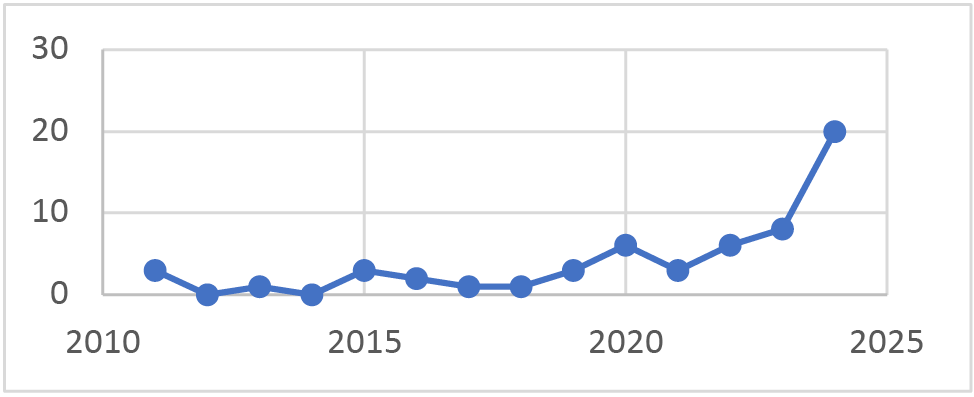
Researchers in Central Asian states have suffered from shortcomings in freedom of speech, career guidance and empowerment, as well as lacking academic support structures (see Jonbekova, 2018), making them obliged to create alternative strategies for the access of information (Komil-Burley, 2021). Publishing academic articles has been mostly possible in English- and Russian-language journals abroad, which has required academic skills of publishing and support for these skills in the local academic environment. Nevertheless, the articles identified in the literature review can be assessed to form the core of the national academic literature in Uzbekistan, dealing directly and explicitly with MIL and been published and openly accessible.
Indeed, researchers had not widely published in journals that are indexed in international databases. The journals where researchers had published articles the most frequently included the Uzbek journals International Scientific Journal of Media and Communications in Central Asia and O’zMU xabarlari, the Taylor & Francis-owned international journal Central Asian Survey and the Slovak journal Media Education (Mediaobrazovanie). There are also local magazines publishing popular-scientific (or hybrid) essays, such as the «scientific-theoretical and educational-methodical journal» Xalq ta’limi: Muammolar, izlanishlar, yechimlar («Public education: Problems, research, solutions», see https://avloniy.uz/en/journal) established in 2021 by the National Institute of Pedagogical Excellence Named after A. Avloni and O‘zbеkistonda oliy ta’lim («Higher education in Uzbekistan», see https://edujournal.uz) established in 2022 by the Center for the Research on Development of Higher Education under the Ministry of Higher Education, Science and Innovations. The scientific quality of the article shows significant variation, particularly in terms of methodological design and empirical analysis. However, the primary objective of this study is not to assess the scientific quality of the publications – which is also bound to Western assumptions – but to examine and capture the underlying conceptual frameworks and perspectives embedded within the approaches.
The literature retrieved was addressed in groups of, and each article was grouped into a category formed the help of a qualitative thematic analysis (Guest et al., 2012). Articles were grouped into the categories of national, regional, international and sector-specific conceptualisation. A qualitative analysis of texts in each group was conducted to search for their common features.
Qualitative thematic analysis (Guest et al., 2012) was employed to examine the literature. A grouping of texts was elaborated inductively to identify their common features. This process involved iterative comparison to ensure that the themes accurately reflected the conceptual distinctions and variations present in each category. Themes were then from within the data by identifying recurring patterns, and key concepts, which seemed to be connected to the geographical levels, forming national, (inter)regional and international/global models.
The author of this article comes from a Western area, more particularly, from a Nordic country. Finland, Sweden, Norway, Denmark and Iceland are known for developing proactive policy approaches to MIL early on, based on their long traditions in media and mass communication education, including integration of MIL elements in formal school curricula and centralized multistakeholder or cross-sectoral MIL policy work (see e.g. Forsman, 2020; Carlsson, 2019). The author has authored a draft strategy on MIL for Uzbekistan to assist the development of a MIL strategy in tight collaboration with the national UNESCO office within the project “Empowering the government and citizens of Uzbekistan by strengthening access to information, accountability of institutions and media competence” (2023–2026), funded by the Swiss Development Cooperation (SDC) (see UNESCO, 2025). The academic literature review is part of the process of collecting evidence and information on the existing development of MIL in the country. The literature review was, however, conducted as a separate independent study.
The journal articles, book chapters and entire PhD theses that were identified to form the sample could be grouped into three according to their topics. Many articles started by generally discussing MIL and its importance as part of societal development of the country, but their intention was more specific. The first group (n=26) presents articles that tried to outline a national model in which traditionalism, heritage and history, togetherness and communitarism, as well as the discussion of the country’s future, were in the foreground. They typically saw these traits as part of «modernisation», «development» and «reform» processes. The second group (n=10) focused on individuals as users, seeking a holistic perspective on media and information management from the individual’s user perspective. The third group (n=7) made a distinction from this by trying to synthetise different topics in the context of CIS or Post-Soviet countries. The fourth group (n=3) was also individual-centric but what distinguished it from the previous one was its focus on a single topic, namely disinformation. The fifth group (n=13) included case or context-specific studies focusing on specific sectors and target groups, discussing MIL in a non-holistic perspective of the previous groups. The models could be found at national (Uzbekistan), regional (Central Asian or Eurasian countries) and international levels (global), summarized in Table 1.
| Model | Type | Literature1 | Objective | Functional focus | |||||||||||||||
|---|---|---|---|---|---|---|---|---|---|---|---|---|---|---|---|---|---|---|---|
| Value-based | National | Djumanova (2022, 2023), Kholmurzaev et al. (2020); Berdiyeva (2024) | In-native development | National values and legislation, «Uzbek model» | |||||||||||||||
| User-centred | Regional | Ablazov (2023a), Mahmudova (2021), Gendina (2016), Gendina & Kosolopova (2019a, 2019b, 2019c),1 Abdullayeva et al. (2024) | Digital hygiene and wellbeing | Individual’s information cultures | |||||||||||||||
| Synthetic thematic | Regional | Fedorov (2011), Fedorov and Levitskaya (2018, 2019) | Thematic coherence | Awareness and skills, thematic alignment | |||||||||||||||
| Disinformation (single-thematic) | International | Braesel & Karg (2021),1 Reineck & Lublinski (2015), Dadakhonov (2024c), Nitsche (2020), Imankulov et al. (2018), IREX (2025),1 Shturkhetsky (2018),1 Gorokhovsky (2021)1 | Resilience | Disinformation, manipulated content | |||||||||||||||
| Actor-based | International | UNESCO (2011),1 Mamatova & Sulaymanova (2015),1 Cherny & Murovana (2021)1 | Aligned collaboration of MIL actors | Awareness and skills, collaborator alignment | |||||||||||||||
| 1 Training/pedagogical material (otherwise academic literature). | |||||||||||||||||||
In terms of geocultural intentions, we can observe that the national models sought to establish their foundation in national cultures, particularly in traditional values and cultural heritage. A central aim was to identify motivations and epistemic underpinnings that would create a conceptualisation perceived as inherently belonging to the population and that the population could claim ownership for. Articles focusing on regional modellisation were often anchored in comparativist intentions between Central Asian states, Eurasia or CIS countries (countries of the former Soviet Union committed to the Commonwealth of Independent States, namely Armenia, Azerbaijan, Kazakhstan, Kyrgyzstan, Tajikistan, Uzbekistan, Belarus, and Russia.) These models were typically developed from a Russian perspective. Even if there were some references to Chinese and Singaporean education in the texts, no influences were systematically adopted from these regions, probably because of a linguistic and cultural barrier, which is lower towards countries where Russia is widely spoken.
The international models were adaptations of models that were originally created as global and culturally sensitive, to enable their flexible adaptation to countries they are exported to. The influential role of foreign aid organisations in countries like Uzbekistan has been identified by several studies (Dadakhonov, 2024a, 2024b, 2024d; Kukier, 2020). The role of international experts is widely acknowledged and respected as part of the progress of the country. Besides UNESCO, IREX, DW Akademie, Internews and OSCE (Organization for Security and Co-operation in Europe) have been active in the MIL area in the Central Asian region, where American and European funding has played an important role.
Policy models and frameworks have different weight, as promoted by both individual researchers and worldwide organisations, and advanced in varying degrees of academic and pedagogical documentation, but for the sake of a conceptual analysis, they are juxtaposed. They also have different directions of origin, stemming from various intellectual and political contexts. I contend that the models diverge in three fundamental dimensions: the intended or imagined audience, the conceptualization of culture that informs the framework, and the underlying rationale for motivation – the justification for promoting MIL. Next, I will discuss the value-based, synthetic-thematic, user-centred and disinformation models in respective order as models proposed for Uzbekistan.
Local researchers addressing MIL have made efforts to make the concept culturally congruent or maybe even nascent within the local culture. The effort to create an articulated «Uzbek model» of MIL is reflected in many of the Uzbek researchers, especially most explicitly outlined by Djumanova (2022, 2023). The idea is that the Uzbek model would draw on international ideas but be anchored in national values. Indeed, the frequently expressed concept of «national values» (milliy qadriyatlar) as part of the «national spiritual and moral education» and «a child’s upbringing» (Siddiqova, 2023, p. 662), as well as «healthy thinking» (Sattarov, 2025) are of high importance on the agenda of «New Uzbekistan», affecting educational ideologies and practices (Ismoilova & Muxammedova, 2022; Ismagilova et al., 2020; Berdiyeva, 2024). Educators talk about «germination» of certain values in children, and «spiritual education», which in the Western frame could be referred to as cultivation and Bildung. More specifically, the national values most often refer to the commitment to the state (patriotism – expressed in the programme «Frоm nаtiоnаl rеvivаl tо nаtiоnаl prоgrеss» as «dеvоtiоn tо thе Mоthеrlаnd»), appreciation of family and community, as well as protection and enculturation of young people. Invertedly, the Republic Spirituality and Enlightenment Center (2025) identifies the following values as non-preferred values: «the indifference to the fate of the nation, localism, tribalism, corruption, disregard for family values, and irresponsibility for the upbringing of youth» (n.p.; translation by the author). The values of communitarism also include the central role of diaspora communities (Urpekova, 2022), as Uzbek youth is expected to take care of their older family members, and religious convictions, the «Islamic needs» (Saber et al., 2022).
In general, the Jadid ancestors (Jadidlar), engaged in science and (spiritual) education as well as in creating the modern public sphere, play an important role in the contemporary public imaginary of intellectual life and learning (Samadova, 2025). The progressive reforms of the Muslim-identity Jadids,3 who were born in the second half of the 19th century and died, having faced persecution and execution, in mid-20th century, also provides the people with the mindset for reforms in public life today. Intellectual roots are also searched for in pre-Soviet literature such as O’tkan Kunlar – Bygone days (1927) by Abdullah Qodiriy that has a special place in the decolonial Uzbek literature.
The country-native formation of ideas makes an attempt to remain sensitive towards the traditional and religious ways of living. Islamic cultures are still challenging to be addressed in public, Islamic education and MIL has been studied elsewhere in Asia, for example, in Indonesia (see Syukri et al., 2023; Devi et al., 2023; Sukawati, 2023; Balya et al. 2023), but not that much in secular Uzbekistan. Still, the ideological orientation of the national model can turn out to be promising for incorporating inter-faith dialogue and peace education, as has been developed in the Indian anti-violence context (Kundu, 2011).
The Uzbek model, accompanied with production of national resources (see e.g. Voronina et al., 2021), can be characterised as a protective, value-based, and community-centred model. The national Uzbek model is thus value- and community-based, seeking epistemic and moral footings in traditions and heritage and the togetherness of shared values that are, as Asian values, community-oriented. National models are often described for the intended national audience, with an intention to make sense of the local ownership of foreign models. The national models indicate a strong emphasis on protection of young people from harmful information and effects of the public sphere, as well as their education into citizens complying with the national frames.
5.2. Synthetic-thematic models
There is no common understanding of MIL between Central Asian states, which show significant differences in terms of their governance, democratic development and media environments (Anonymous, 2023; Dadakhonov, 2024b). Regional collaboration has, however, resulted in the production of seminal pedagogical and promotional resources,2 such as the platforms Mediasabak (https://www.mediasabak.org) and Qlever (https://uz.qlever.asia).
Against this backdrop, Fedorov and Levitskaya (2018, 2019) attempted to synthetise a common model for CIS countries, with a conclusion that there was no unified understanding other than the holistic view that is also found in UNESCO’s components of MIL. They pointed out that in difference from UNESCO’s model, the ingredients of ICT, media production and counter-propaganda were weak in CIS countries, with the exception of Ukraine that was «seasoned with clear anti-Russian position» (ibid., p. 30). Still, their «synthetic model» has become established to denote to media education in countries close to Russia. It is called «synthetic» and has, as such a similar objective as UNESCO’s model, driven from a more West-Global-South perspective, as the idea is to outline a model that would collect the different elements that hosted by media education. Namely, Fedorov (2011) had previously identified five emphases in media education models: informative (learning about media), ethical-ideological (philosophies, religions), aesthetic (arts and culture), cognitive-sociocultural (development of a creative personality), and practice-based (practical training of media production).
Despite their conclusion of the lack of a common model, Fedorov and Levitskaya (2019, p. 31) divided the CIS-country media education models into the following: models focused on the analysis of the role and functions of media and media culture in society (analysis of media texts or the development of analytical thinking); models focused on practical activities, models focused on the ideas of a civil and democratic society, journalism models («designed mainly to prepare young audience for admission to the faculties of journalism»), and counter-propaganda models, focused «on the search for fake media messages and propaganda». They note (ibid.) that the models focused on the ideas of a civil and democratic society have been «promoted in recent years by media agencies of the European Union countries in Kazakhstan, Kyrgyzstan, Azerbaijan, Uzbekistan and Moldova». These groups distinguish models by both topic (analytical thinking, journalism, democratic ideals, disinformation), method (analysis–production or theory–practice) and promoter (CIS countries, EU).
The attempt to identify common traits between countries of the former Soviet Union can be interpreted as a pursuit to cover a geocultural area. However, the countries included in the area neither share an educational system nor follow a common developmental path, so the model can be seen more as a normative or ideal conceptualization, potentially driven more by political or strategic cultural intent than by content.
An individual- or user-centred conceptualisation has been outlined by the «personal cultural model» or an individual-centred MIL model (Gendina, 2016; Ablazov, 2023a; Mahmudova, 2021), in which the personal awareness of one’s own media uses and construction of a personalised media landscape, as well as digital hygiene and information security, play a central role.
The National Library of Uzbekistan has promoted the cognitive-sociocultural dimension by adopting Russian Gendina’s (2017) views on «information cultures». Gendina and Kosolopova’s (see e.g. 2014) manuals written in Russian for primary school grades were translated into Uzbek (Gendina & Kosolopova, 2019a, 2019b, 2019c). The idea of information cultures has been adopted by governmental bodies, as, for example, the Ministry of Higher Education, Science and Innovation has produced a textbook on MIL (Abdullayeva et al., 2024). The Republican Scientific and Methodological Center for the Development of Education of the Republic of Uzbekistan, a governmental authority for development of educational materials and practices, has advanced the global 4C’s – Communication, Collaboration, Critical Thinking, and Creativity – as part of 21st-century skills widely adapted in American and European frameworks as the «4K model» to educate Uzbek teachers in this cognitive-sociocultural dimensions (Rajapbayeva, 2024). The ideas of «living in harmony with the internet» and choosing proper «internet food» or media diet are also reflected in pedagogical materials produced by international organisations in collaboration with other Central Asian actors (Imankulov et al., 2018 by IREX and Tekimbajeva 2020 by DW Akademie).
DW Akademie, the section for international media development of the German public-service channel Deutsche Welle, has been active in Central Asia and established their «DW model» (Dadakhonov, 2024c; see Braesel & Karg, 2021). Reineck and Lublinski (2015) discuss DW Akademie’s approach as a human rights based model, but also UNESCO’s model is deeply rooted in the same idea. Even DW’s definition of MIL resembles UNESCO’s as a compound concept: «a composite set of knowledge, skills, and attitudes that enables and empowers citizens to competently and critically engage with media and information, in order for them to increase their individual autonomy and collective solidarity in society» (Reineck and Lublinski, 2015, p. 5). What distinguishes DW’s ideas from UNESCO’s is their stronger emphasis on media, instead of information, while still maintaining the user-centred perspective. Similar to UNESCO’s understanding, DW focuses on seven core competences of MIL, namely the access, use, evaluation and creation of media content, as well as participation in media, knowledge about media contexts and the demanding of media quality and rights, which are additions to the UNESCO’s definition (ibid.).
The international models, which have been mostly funded by European and American actors, have the aim of promoting pluralism and media awareness in countries of less democratic development. The focus lies on resisting propaganda, external disinformation influences and creating societal resilience through individual behaviour. The models are basically imported and adapted to national, local conditions by international aid organisations working with the country. International organisations such as DW Akademie, IREX and Internews – and also UNESCO – have not only abundant experience from different regions in the Global South, but also the best possibilities to make resources available in different languages. Indeed, multilingualism – the use of the parallel languages of Uzbek, Russian, English, and, sometimes, Karakalpak and Tajik – is pivotal for a proper outreach and creating equal learning conditions for the entire population.
IREX, the International Research & Exchanges Board, has developed a «Learn to discern» model that focuses on people’s ability to recognise and resist manipulative content, with training manuals adapted to linguistic regions (IREX, 2025). The training manual by IREX Europe for Central Asian countries (Shturkhetsky, 2018) was funded by British sources and developed in collaborators in Kazakhstan and Kyrgyzstan. Leaning on UNESCO’s concept of MIL, it breaks down its topic into the concepts post-truth, hate speech and stereotypes as entries into democratic discourse and media, media hygiene as an entry into information security, addresses propaganda as a phenomenon and presents the aims and workings of journalism and content creation. In the beginning, American experts from Yale, Princeton and other Ivy League universities encourage students to «think for yourself» (ibid., p. 9), and at the end, there are practical exercises. In the similar line of thought, the regional BRYCA project4 published a training manual in critical thinking for vulnerable youth (Gorokhovsky, 2021).
The international models powerfully place the individual to the centre; for example, in both DW and IREX manuals, an individual’s personal relationship to media and information structures is strongly embedded. Besides the me-centredness, international models also share the point of departure in human rights and the individual’s rights of access to information. While the international models ensure a sufficient quality in terms of extension and depth of MIL work, they are not always fully attuned to the specific cultural, social, and educational contexts of local settings. As a result, these models require careful adaptation and contextualization to ensure their relevance and effectiveness in addressing local needs and challenges.
The study at hand examined the domestication of ideas of MIL at the country level in the context of Uzbekistan. Several MIL models were identified and discussed in the literature, and they are not necessarily mutually exclusive, but they typically contain similar, parallel or shared elements and co-exist within a MIL ecology, since, in fact, all cultures are always hybrid (Glück, 2015). The models, emerging from different structural conditions, are conceptual syntheses that serve as idealized frameworks or normative guidelines for the implementation and development of MIL across various sectors and within cross-sectoral collaborations. It may be worth noticing that, in fact, models inherently remain aspirational and cannot be fully realized in practice. They represent efforts to achieve internal coherence in conceptualizing MIL, but they may lack a systematically developed relationship to other existing models. They are often comprehensive and flexible to host a variety of media and communication forms, practices, pedagogies, domains and everything that people need to deal with digital environments. The models also entail political or instrumental endeavours, as the synthetic model, as a creation of Russian researchers, can be observed to serve Post-Soviet connectivity, and the UNESCO model serving as a tool for democratising the Global South.
The MIL models are characterized by a dynamic interplay between etic and emic perspectives. Typically, the consideration of cultural contexts in model development and conceptualisation is framed within notions of cultural congruence or sensitivity. However, local efforts to outline models and generate context-specific insights from within individual countries present approaches that challenge the conventional, unidirectional understanding of cultural sensitivity. While global models often treat local conditions as factors that must be adjusted to fit an allegedly universal framework, local modelling efforts reveal a more complex and multidirectional dynamic. Many international models – such as disinformation frameworks or the UNESCO MIL model – are, still, rather based on the idea of cultural flexibility, offering relatively neutral or universal components that can be adapted to various cultural settings. National models, with their emic efforts that Ezumah (2019) identifies as processes of glocalization and hybridization, go further by embodying a culturally native and locally sustainable approach. The development of ideas is meant to be deeply rooted in the local cultural climate, in the Uzbek context explicitly framed in terms of «national values». These models not only adapt to but originate from within the cultural context they aim to serve.
Although the models employ different vocabularies and emerge from varying starting points, their differences are not necessarily substantial. What remains to be explored is the extent to which these models «speak the same language» in practical, situational interventions, and how MIL actors can meaningfully relate to and apply them. For practitioners, particularly educators, constructive guidance is essential. A structured juxtaposition and comparison of models, alongside fostering dialogue between them, can support effective pedagogical implementation. Without such comparative efforts, the proliferation of diverse MIL models may risk causing confusion among both educators and learners, obscuring their distinct contributions and pedagogical implications, and potentially rendering them counterproductive. Therefore, systematic identification and analysis of locally developed models can play a crucial role in advancing a more coherent understanding of MIL approaches and enhancing their educational relevance.
The literature review is constrained by what can be described as the «window of publishing» – that is, the public framing shaped by open access publications. Only those ideas, practices, and models that have been reified and made visible through openly accessible documents can be identified and critically examined. Conversely, innovations developed within communities that are not documented in shareable, accessible formats remain outside the scope of public discourse. Put differently, if ideas are not published online with open access, they tend to be obscured within the realm of so-called grey literature, collective local memory, or oral histories. This limitation is particularly relevant in the context of MIL development in a country with rapid change such as Uzbekistan.
This study, conducted in the context of dewesternising intentions of media theories, focused on the emerging conceptualisations of MIL in the post-Soviet (non-Baltic) republic of Uzbekistan. It disclosed national models of MIL that were value- and community-based, regional models that were thematically aligned, and international models that were more individual-based and focused on one single topic such as disinformation. Countries in the Global South need to approach different models and their political, economic and sociocultural underpinnings carefully, and it is not surprising that the development of a national model, independent of different external and etic cultural influences, stands out as a priority. Therefore, as also pointed out by the UNESCO’s overall framework, the process of domestication seems to be an important element of local MIL development and needs to be conducted with local actors.
Creating innate models of MIL is important for fostering ownership of the media educational mission of a societies, especially in non-Western regions where the understanding of media, journalism, and democracy deviate from those in Western liberal democracies. MIL frameworks are embedded in the structural conditions of a society, such as the legal regulation of the public sphere and the degrees of freedom of speech, which create opportunities and challenges for the presence of the MIL concept. The study helps cast light on how MIL development is not neutral and needs to be de- and reconstructed in local settings to increase our understandings of cultural native and flexible models. While UNESCO’s overall framework may help identify structures, the thematic foci are sought through models such as identified in this study. Dewesternising efforts may in the form of international disinformation models result in rewesternising (Glück, 2015), if the cultural factors are not developed with emic approaches and by local factors.
The window of publishing that is created by a literature review like the study at hand highlights the importance of engaging researchers as part of MIL development processes, encouraging documentation work among policymakers and pedagogical pioneers, as well as supporting cultures of openness and transparency, in which a common acceptance of sharing of materials is achieved. If countries with reform intentions include the priority of strengthening research in their agendas, they receive evidence-based knowledge about local conceptual, pedagogical and practical development of MIL in their MIL policy agendas, which, more broadly, benefits the disciplinary field of media literacy and education research.
Abdullayeva, B. S., Ro‘ziyev, Y. Z., & Ismoilova, K. V. (2024). Mediasavodxonlik va axborot madaniyati – darslik [Media literacy and information culture – a textbook]. Ministry of Higher Education, Science and Innovation.
Aminova, M., & Jegers, M. (2014). Are Hofstede’s national cultures homogeneous? The case of Uzbekistan. In: Ahrens, J., & Hoen, H.W. (Eds.) Economic development in Central Asia: Institutional underpinnings of factor markets. PL Academic Research, 85–98.
Amnesty International (2025, April 28). Uzbekistan. In: The state of the world’s human rights: April 2025. Amnesty International, 392–394. https://www.amnesty.org/en/documents/pol10/8515/2025/en/
Angiolillo, F., God, A. G., & Lindberg, S. (2025). 25 years of autocratization – democracy trumped? Democracy report 2025. V-Dem Institute.
Anonymous (2023). Sociological research on media consumption and media literacy in Central Asian countries: Kazakhstan, Tajikistan, Uzbekistan. USAID, Mvector and Internews.
Asanbayeva, G. (Ed.) (2021). O’zbekiston oliy ta’lim muassasalari o’qituvchilari uchun mediasavodxonlik bo’yicha o’quv qo’llanma [A study guide on media literacy for teachers of higher educational institutions of Uzbekistan]. Internews.
Atavullaev M., Khojie, T., Isanova, G., Valiev, B., & Madaminov, N. (2020). The importance of developing legal consciousness in the formation of public opinion. Journal of Advanced Research in Dynamical and Control Systems, 12(2), 2848–2854. https://doi.org/10.5373/JARDCS/V12I2/S20201351
Balya, T., Kholil, S., & Kustiawan, W. (2023). Digital media literacy in improving educators tasks based on the Islamic education model. Edukasi Islami: Jurnal Pendidikan Islam, 12(2), 2245–2264. https://doi.org/10.30868/ei.v12i02.4899
Begalov, B. A., & Zhukovskaya, I. E. (2022). Statistical assessment of the implementation of socio-economic development strategies of the Republic of Uzbekistan in the context of digital transformation. Статистика и экономика, 19(3), 64–76. https://doi.org/10.21686/2500-3925-2022-3-64-76
Berdiyeva, I. (2024). The role of media education in educating young generation with respect for national values. O’zMU xabarlari – News of the NUUz, 1(1.1.1), 78–81. https://doi.org/10.69617/uzmu.v1i1.1.1.579
Braesel, S., & Karg, T. (2021). Media and information literacy: A practical guidebook for trainers. (3rd ed.) DW Akademie.
Carlsson, U. (Ed.) (2019). Understanding media and information literacy (MIL) in the digital age: A question of democracy. University of Gothenburg.
Chapman, M., & Rokša-Zubčević, A. (2024). Fostering media freedom literacy across the OSCE region. Organization for Security and Co-operation in Europe (OSCE).
Cherny, Y. Y., & Murovana, T. A. (Eds.) (2021). Медийно-информационная грамотность в цифровом мире: Как научить учителей [Media and information literacy in the digital world: How to teach teachers]. UNESCO. https://iite.unesco.org/wp-content/uploads/2021/05/MIL_Teachers_book_2021.pdf
Dadabaev, T. (2019). Uzbekistan as Central Asian game changer? Uzbekistan’s foreign policy construction in the post-Karimov era. Asian Journal of Comparative Politics, 4(2), 162–175. https://doi-org.ezproxy.ub.gu.se/10.1177/2057891118775289
Dadakhonov, A. O. (2024a). The effectiveness of foreign aid in the sphere of media and information literacy in Central Asian countries. Advances in Journalism and Communication, 12, 48–72. https://doi.org/10.4236/ajc.2024.121003
Dadakhonov, A. O. (2024b). Sustainability indicators of foreign assistance in the field of media and information literacy: A case Study on Kyrgyzstan and Uzbekistan. Journal of Media Research, 49(17), 44–64.
Dadakhonov, A. O. (2024c). Role of DW Akademie’s media and information literacy model in cultivating a media-savvy generation. Research on Education and Media, 16(2), https://doi.org/10.2478/rem-2024-0013
Dadakhonov, A. O. (2024d). Sustaining foreign aid initiatives in the field of media and information literacy within the central asian context. Media Education, 15(1), 57–70. https://doi.org/10.36253/me-15703
Devi, N. M., Juliani, Syahputri, N. K., & Nasanah, N. N. (2023). Media literacy approach in Islamic religious education curriculum for the digital era. Journal of Contemporary Islamic Primary Education, 2(2), 153–163. https://doi.org/10.61253/jcipe.v2i2.297
EDMO (2025). Media literacy country profiles. https://edmo.eu/resources/repositories/mapping-the-media-literacy-sector/
Ezumah, B. (2019). De-Westernizing African journalism curriculum through glocalization and hybridization. Journalism & Mass Communication Educator, 74(4), 452–467. https://doi.org/10.1177/1077695819849360
Fedorov, A. (2011). Modern media education models. Acta Didactica Napocensia, 4(1), 73–82.
Fedorov, A., & Levitskaya, A. (2019). Synthetic media education model used in Commonwealth of Independent States (CIS). Media Education (Mediaobrazovanie), 59(1), 30–36. https://doi.org/10.13187/me.2019.1.30
Forsman, M. (2020). Media literacy and the emerging media citizen in the Nordic media welfare state. Nordic Journal of Media Studies, 2, 59–70. https://www.doi.org/10.2478/njms-2020-0006
Freedom House (2025). Countries and territories. https://freedomhouse.org/countries/freedom-world/scores
Gendina, N. (2017). Information culture and information literacy as a scientific direction and a field of educational activities in Russia. In: Sales, D., & Pinto, M. (Eds.) Pathways into information literacy and communities of practice: Teaching approaches and case studies. Chandos Publishing, 167–202. https://doi.org/10.1016/B978-0-08-100673-3.00007-1
Gendina, N. I., & Kosolopova, E. V. (2014). Основы информационной культуры школьника: учебно-методический комплекс для учащихся 3-4-х классов общеобразовательных организаций. РШБА.
Gendina, N. I., & Kosolopova, E. V. (2019a). Maktab o’qucvhilarining axborot madaniyati asoslari: Umumiy o’rta ta’lim maktablarining 1-2 sinf o’qucvhilari uchun o’quv-uslubiy majmua [Fundamentals of information culture of schoolchildren: Educational and methodological complex for students of grades 1–2 of general secondary schools]. National Library of Uzbekistan.
Gendina, N. I., & Kosolopova, E. V. (2019b). Maktab o’qucvhilarining axborot madaniyati asoslari: Umumiy o’rta ta’lim maktablarining 3-4 sinf o’qucvhilari uchun o’quv-uslubiy majmua [Fundamentals of information culture of schoolchildren: Educational and methodological complex for students of grades 3–4 of general secondary schools]. National Library of Uzbekistan.
Gendina, N. I., & Kosolopova, E. V. (2019c). Maktab o’qucvhilarining axborot madaniyati asoslari: Umumiy o’rta ta’lim maktablarining 5-7 sinf o’qucvhilari uchun o’quv-uslubiy majmua [Fundamentals of information culture of schoolchildren: Educational and methodological complex for students of grades 5–7 of general secondary schools]. National Library of Uzbekistan.
Glück, A. (2015). De-Westernisation: Key concept paper. MeCoDEM, University of Leeds.
Gorokhovsky, A. (2021). Mетодическое пособие для тренеров по медиа и информационной грамотности для работы с проблемной/трудной молодёжью [A methodological guide for trainers on media and information literacy for working with problematic/difficult youth]. ERIM. https://www.mediasabak.org/media/library/2021/03/29/67e56bd415054d87a1cf98b6fea51b59.pdf
Gough, D., Thomas, J., & Oliver, S. (2012). An introduction to systematic reviews. Sage Publications.
Hallin, D. C., & Mancini, P. (Eds.) (2012). Comparing media systems beyond the Western world. Cambridge University Press.
Hanitzsch, T., Hanusch, T., & Ramaprasad, J. (Eds.) (2019). Worlds of journalism: Journalistic cultures around the globe. Columbia University Press.
Hanusch, F. (Ed.) (2020). Comparing journalistic cultures. Routledge.
Hofstede, G. (2001). Culture’s consequences: Comparing values, behaviors, institutions, and
organizations across nations. Sage Publications.
Imankulov, M., Usupbaeva, A., Tekimbaeva, A., Danilova, N., Shturkhetsky, S., & Kozhobekova, B. (2018). Медиа и информационная грамотность: Ресурсная книга для учителя [Media and information literacy: A resource book for teachers]. IREX.
Inglehart, R., & Welzel, C. (2005). Modernization, cultural change and democracy: The human development sequence. Cambridge University Press.
IREX, International Research & Exchanges Board (2025). Learn to discern: Media literacy trainer’s manual. https://www.irex.org/resource/learn-discern-media-literacy-trainers-manual
Ismagilova, F. S., Maltsev, A. V., & Sattarov, E. N. (2020). The Uzbek national tradition in the pedagogical practices of adult educators. Changing Societies & Personalities, 4(2), 172–189. https://doi.org/10.15826/csp.2020.4.2.096
Ismoilova, G. A., & Muxammedova M. B. qizi. (2022). The role of national values in spiritual and moral education of students-youth. International Journal of Social Science & Interdisciplinary Research, 11(10), 194–197.
Iwabuchi, K. (2014). De-westernisation, Inter-Asian referencing and beyond. European Journal of Cultural Studies, 17(1), 44–57.
Jaakkola, M. (2023). Capturing the contours of the field of media and information literacy (MIL) research: A systematic literature review of studies conducted at Swedish universities in 2021. In: Jaakkola, M., Durán-Becerra, T., & Onyancha, O. B. (Eds.) Media and information literacy for the public good: UNESCO MILID yearbook 2023. Corporación Universitaria Minuto de Dios UNIMINUTO, 159–190.
Jaakkola, M. (2025). Media va axborot savodxonligi (MAS). Project webpage. https://miluz.natminforskning.se
Jonbekova, D. (2018). Educational research in Central Asia: Methodological and ethical dilemmas in Kazakhstan, Kyrgyzstan and Tajikistan. Compare: A Journal of Comparative and International Education, 50(3), 352–370. https://doi.org/10.1080/03057925.2018.1511371
Kholmurzaev, A. A., Polotov, K. K., & Toxirov, I. X. (2020). Methods of using media education in the learning process. ISJ Theoretical & Applied Science, 5(85), 205–208. https://dx.doi.org/10.15863/TAS.2020.05.85.42
Komil-Burley, D. (2021). Conducting research in authoritarian bureaucracies: Researcher positionality, access, negotiation, cooperation, trepidation, and avoiding the influence of the gatekeepers. International Journal of Qualitative Methods, 20. https://doi.org/10.1177/1609406921996862
Kukier, J. (2020). Role of UNESCO in promoting media and information literacy between 1982–2016. In: Granat, A. (Ed.) Recepcja mediów: Wnioski z badań – lata 2019–2020. Wydawnictwo Uniwersytetu Marii Curie-Skłodowskiej, 95–107.
Kun.uz (2023, August 31). “I am always on the side of free-thinking journalists” – president. Kun.uz. https://kun.uz/en/18562925#!
Kundu, V. (2011). Media literacy education in the context of peace education. Science Communicator, 2(2), 56–72.
Majidi, M., Ashurbekov, R. K., Altaliyeva, A., & Kowalski, S. (2015). Western and Central Eurasian cultural differences: Germany, Kazakhstan, United States of America, and Uzbekistan. Organizational Cultures: An International Journal, 14(3–4), 1–20.
Makhmudova, G., Ashurov, Z., & Razakova B. (2022). Development of digital ecosystem and formation of digital platforms in Uzbekistan. π-Economy, 15(2). https://doi.org/10.18721/JE.15201
Makhmutkhodjaeva, L. S. (2021). Online and digital education at universities of Uzbekistan. Открытое образование, 25(3), 46–61. https://doi.org/10.21686/1818-4243-2021-3-46-61
Medrado, A. & Rega, I. (2023). Media activism, artivism and the fight against marginalisation in the Global South: South-to-South communication. Routledge.
Mellado, C., Hellmueller, L., & Donsbach, W. (Eds.) (2016). Journalistic role performance: Concepts, contexts, and methods. Routledge.
Mihailidis, P. (2009). Connecting cultures: New dynamics in global media literacy. Afterimage, 37(2), 37–41. https://www.proquest.com/scholarly-journals/connecting-cultures-new-dynamics-global-media/docview/212097536/se-2
Miike, Y. (2006). Non-Western theory in Western research? An Asiacentric agenda for Asian communication studies. Review of Communication, 6(1–2), 4–31. https://doi.org/10.1080/15358590600763243
Miike, Y. (2019). Intercultural communication ethics: An Asiacentric perspective. The Journal of International Communication, 25(2), 159–192. https://doi.org/10.1080/13216597.2019.1609542
Miike, Y. (2022). What makes multicultural dialogue truly multicultural? Rethinking cultural convergence, theoretical globalism, and comparative Eurocentrism. Journal of Multicultural Discourses, 17(1), 34–43. https://doi.org/10.1080/17447143.2022.2033246
Mohammed, W. F. (2022). Dismantling the Western canon in media studies. Communication Theory, 32(2), 273–280.
Muratova, N., & Nikadambaeva, K. (2021). Coronavirus in Uzbekistan: Turning point in the Uzbek mass media. In: Proceedings for the conference Наука, культура, образование: актуальные вопросы, достижения и инновации: сборник статей Международной научнопрактической конференции in Penza, Russia, 107–110.
Petticrew, M., & Roberts, H. (2008). Systematic reviews in the social sciences: A practical Guide. Wiley.
Potter, W. J. (2022). Analysis of definitions of media literacy. Journal of Media Literacy Education, 14(2), 27–43. https://doi.org/10.23860/JMLE-2022-14-2-3
Reineck, D., & Lublinski, J. (2015). Media and information literacy: A human rights-based approach in developing countries. Discussion Paper. DW Akademie.
Republic Spirituality and Enlightenment Center (2025). Respublika ma’naviyat va ma’rifat markazining vazifalari [Tasks of the Republican Center for Spirituality and Enlightenment]. https://backend.manaviyat.uz/media/docs/Марказ_вазифаси.pdf
Roche, S. (2018). Knowledge production on Central Asia: Transcultural approaches in Central Asian studies. The Journal of Transcultural Studies, 9(1–2), 95–111. https://doi.org/10.17885/heiup.jts.2018.1-2.23638
RSF, Reporters without borders (2024). Index. https://rsf.org/en/index
Saber, M. D., Nourabadi, S., Al-Salami, A. A. A., Pallathadka, H., Nazarkosimov, S. I., Linh, H. V., Al-Khafaji, F. A. H., & Muda, I. (2022). “Islamic culture” textbook content and religious needs of literacy students. HTS Teologiese Studies/Theological Studies, 78(1), 1–7. https://doi.org/10.4102/hts.v78i1.7994
Samadova, S. S. K. (2025). The significance of the Jadids’ scientific heritage in developing the spirituality of youth in New Uzbekistan. Intelektualitas Jurnal Penelitian Lintas Keilmuan, 1(4), 6. https://doi.org/10.47134/intelektualitas.v1i4.3642
Sattarov, A. V. (2025). Formation of healthy thinking in students based on the works of A. Avloni. Multidisciplinary Journal of Science and Technology, 5(2), 694-696.
Schiek, S. (2018). Uzbekistan’s transformation from an “old” to an “upgraded” autocracy. L’Europe en Formation, 385(1), 87–103. https://doi.org/10.3917/eufor.385.0087
Shturkhetsky, S. (2018). Медиаграмотность: Практическое учебное пособие для высших учебных заведений по медийной и информационной грамотности [Media literacy: A practical study guide for higher education institutions on media and information literacy]. IREX Europe. https://mediasabak.org/media/3f1921fa-9f7b-46a6-b110-c08809510337.pdf
Siddiqova Y. M. kizi (2023). The role of national spiritual values in the formation of future primary class teachers. Science and Innovation – International Scientific Journal, 2(12), 656–662. https://doi.org/10.5281/zenodo.10403127
Stix, D. C., & Jolls, T. (2020). Promoting media literacy learning: A comparison of various media literacy models. Media Education, 11(1), 15–23. https://doi.org/10.36253/me-9091
Sukawati, S. (2023). Hadith study of media literacy skills in Islamic education. Jurnal Tarbiyah Islamiyah, 8(2), 647–656. https://doi.org/10.48094/raudhah.v8i2.389
Syukri, M., Putri, Y., & Nurhuda, A. (2023). The role of digital literacy in learning media according to Islam. Kasta: Jurnal Ilmu Sosial, Hukum, Agama, Budaya Dan Terapan, 3(1), 33-46.
Tekimbajeva, A. (Ed.) (2020). Понимание медиа: Основы медиаграмотности. Практическое руководство по обучению МИГ [Understanding media: Fundamentals of media literacy. A practical guide to teaching MIL]. DW Akademie. https://www.mediasabak.org/media/library/2020/06/30/fc7f8247ecb04bd1aa5aba713fb9b035.pdf
Tuhsinov, D. (2025, October 30). Shavkat Mirziyoyev calls for global initiatives on education, heritage, and climate at UNESCO conference. Kun.uz. https://kun.uz/en/news/2025/10/30/shavkat-mirziyoyev-calls-for-global-initiatives-on-education-heritage-and-climate-at-unesco-conference
Thussu, D. (2013). De-Americanising media studies and the rise of ‘Chindia’. Javnost – The Public, 20(4), 31–44.
Ubaydullaeva, D. (2021). Student online protests in Uzbekistan: Democratization of higher education as concomitant to the COVID-19 crisis? Central Asian Survey, 40(3), 382–399. https://doi.org/10.1080/02634937.2021.1922358
Ullah, M. S. (2014). De-westernization of media and journalism education in South Asia: In search of a new strategy. China Media Research, 10(2), 15–23.
UNESCO (2025). Empowering the government and citizens of Uzbekistan by strengthening access to information, accountability of institutions and media competence. UNESCO Core Data Portal. https://core.unesco.org/en/project/501UZB5002
Urpekova, A. (2022). Building the bonds: A comparison of diaspora engagement policies in Kazakhstan and Uzbekistan. Turkish Journal of Diaspora Studies, 2(1), 41–54.
Voronina E. A., Toktogulova E., & Kayypov, E. (2021). Замонавий оммавий ахборот восита-ларида ҳамда мулоқот майдонида “Адоват тили”. Олий ўқув юртлари ўқитувчилари учун ўқув-услубий қўлланма [“Hate speech” in modern mass media and in the field of communication: A teaching and methodological guide for teachers of higher education institutions]. ОАВни қўллаш маркази ЖЖ.
Wasserman, H. & De Beer, A. (2009). Towards De-westernizing journalism studies. In: Wahl-Jorgensen, K. & Hanitzsch, T. (eds.) The Handbook of Journalism Studies. Routledge, 428–438.
Wilson, C., Grizzle, A., Tuazon, R., Akyempong, K., & Cheung, C.-K. (2011). Media and information literacy curriculum for teachers. UNESCO.
WVS, World Values Survey (2023). Findings and insights. https://www.worldvaluessurvey.org/WVSContents.jsp
Zhukovskaya, I. E. (2021). The main trends in improving the activities of a higher educational institution in the context of digital transformation. Открытое образование, 25(3), 15–25. https://doi.org/10.21686/1818-4243-2021-3-15-25
Academic publications included in the study
Categorisation:
[A] Value-based model, with a focus on national conditions and values
[B] User-based model, with a focus on individual media or technology users
[C] Synthetic-thematic model, with a focus on outlining a common approach between thematic and geographical areas
[D] Disinformation model, with a focus on combatting disinformation and propaganda
[E] Sector-specific approach, with a focus on a specific sector or target group
1. Abdikarimov, K. (2023). Relevance of promoting media literacy of the population of Uzbekistan at the present stage. Foreign Languages in Uzbekistan. 174–187. https://doi.org/10.36078/1697520188 [A]
2. Abdikarimov, K. (2024a). The concepts of “fake” and “disinformation” in the media environment of Uzbekistan. International Scientific Journal of Media and Communications in Central Asia, 3. https://doi.org/10.62499/ijmcc.vi3.37 [D]
3. Abdikarimov, K. (2024b). Media literacy as a means of protecting Uzbekistan’s media environment from disinformation. International Scientific Journal of Media and Communications in Central Asia, 6, 47–55. https://doi.org/10.62499/ijmcc.vi6.63 [D]
4. Abdukadirova, N. A. (2022). Functions of media education and media resources in the training of specialists. Czech Journal of Multidisciplinary Innovations, 11(1), 1–5. [E]
5. Abdullaeva, O., & Beknazarova, S. (2020). Медиакультура современной молодежи Узбекистана [Media culture of modern youth in Uzbekistan]. In: Chelysheva, I. (Ed.) Современное состояние медиаобразования в России в контексте мировых тенденций: Материалы II международной научной конференции [The current state of media education in Russia in the context of global trends: Materials of the II scientific conference]. DirectMedia, 22–26. Retrieved from https://ifap.ru/library/book616.pdf [C]
6. Abdurakhmanov K., & Beknazarova, S. (2011a). Classification of the learning objectives of the subject “multimedia education” by integrating elements of media education into the educational process. Scientific Review: Humanitarian Studies, 4, 12–14. [E]
7. Abdurakhmanov, K., & Beknazarova, S. (2011b). Из истории развития медиаобразования в Узбекистане [From the history of the development of media education in Uzbekistan]. Media Education (Mediaobrazovanie), 2, 20–24. [A]
8. Ablazov, E. E. (2013). Mediakul’tura i mediaobrazovanie v obespečenii modernizacii sistemy vysšego obrazovanija v Uzbekistane [Media culture and media education in ensuring the modernization of the higher education system in Uzbekistan]. Credo News, 4/2013. http://credonew.ru/content/view/1292/68/ [A]
9. Ablazov, E. E. (2022). Media culture and media education in ensuring the modernization of higher education system in Uzbekistan. International Journal of Human Computing Studies, 4(10), 1–3. https://doi.org/10.31149/ijhcs.v4i10.3528 [A]
10. Ablazov, E. E. (2023a). Application of media education models in the New Uzbekistan and the strategy of formation of personality media culture. Middle European Scientific Bulletin, 43, 188–190. https://doi.org/10.47494/mesb.v43i.2025 [A]
11. Ablazov, E. E. (2023b). Philosophical content of the concept of media culture. Best Journal of Innovation in Science, Research and Development, 2(10), 666–668. [A]
12. Alimov, M. (2024). Use of electronic textbooks based on media education in the process of teaching students. O’zMU xabarlari – News of the NUUz, 1(1.5.1), 55–57. https://doi.org/10.69617/nuuz.v1i1.5.2.4547 [E]
13. Allayarov, S., Ibrohimzoda, M., Abdurakhimova, S., Otamurodova, M., & Antonov-Ovseenko, A. (2023). Media research management methodologies as a tool for solving problems of information and media literacy of the population: A view of Uzbekistan. International Scientifiс Journal of Media and Communications in Central Asia, 3, 4–25. [A]
14. Atajonova, A. (2024). Development of media literacy of future primary school teachers. O’zMU xabarlari – News of the NUUz, 1(1.4.1), 73–76. https://doi.org/10.69617/uzmu.v1i1.4.1.2148 [E]
15. Beknazarova, S. (2011). Сравнительный анализ внедрения элементов медиаобразования в учебный процесс [A comparative analysis of the introduction of media education elements into the educational process]. Media Education (Mediaobrazovanie), 3, 75–83. [B]
16. Beknazarova, S. (2020). Социологическое исследование на тему: «Пути повышения эффективности защиты детей от негативной информации в сети интернет» [Sociological research on the topic: “Ways to improve the effectiveness of protecting children from negative information on the internet”]. In: Chelysheva, I. (Ed.) Современное состояние медиаобразования в России в контексте мировых тенденций: Материалы II международной научной конференции [The current state of media education in Russia in the context of global trends: Materials of the II scientific conference]. DirectMedia, 158–163. Retrieved from https://ifap.ru/library/book616.pdf [D]
17. Berdiyeva, I. (2024). The role of media education in educating young generation with respect for national values. O’zMU xabarlari – News of the NUUz, 1(1.1.1), 78–81. https://doi.org/10.69617/uzmu.v1i1.1.1.579 [A]
18. Chelysheva, I. (2019). Media literacy education in Uzbekistan, Kyrgyzstan and Turkmenistan. European Researcher, 4, 3–10. https://doi.org/10.13187/ijmil.2019.1.3 [A]
19. Dadakhonov, A. O. (2024a). The effectiveness of foreign aid in the sphere of media and information literacy in Central Asian countries. Advances in Journalism and Communication, 12, 48–72. https://doi.org/10.4236/ajc.2024.121003 [A]
20. Dadakhonov, A. O. (2024b). Main issues of implementing media and information literacy in school education in Central Asian countries: The case of Kazakhstan, Kyrgyzstan, and Uzbekistan. Media Literacy and Academic Research, 7(1), 51–71. https://doi.org/10.34135/mlar-24-01-03 [A]
21. Dadakhonov, A. O. (2024c). Role of DW Akademie’s media and information literacy model in cultivating a media-savvy generation. Research on Education and Media, 16(2), https://doi.org/10.2478/rem-2024-0013 [B]
22. Dadakhonov, A. O. (2024d). Sustainability indicators of foreign assistance in the field of media and information literacy: A case Study on Kyrgyzstan and Uzbekistan. Journal of Media Research, 49(17), 44–64. [A]
23. Dadakhonov, A. O. (2024e). Sustaining foreign aid initiatives in the field of media and information literacy within the Central Asian context. Media Education, 15(1), 57–70. https://doi.org/10.36253/me-15703 [E]
24. Djumanova, S. (2022a). Historical formation of the concepts of media literacy education, fact-checking among the peoples of the Ancient East (on the example of Uzbekistan). Media Education (Mediaobrazovanie), 18(4), 562–573. https://doi.org/10.13187/me.2022.4.562 [A]
25. Djumanova, S. (2022b). O‘zbek auditoriyasining mediaiste’moli va mediasavodxonlik ko‘rsatkichlari [Media consumption and media literacy indicators of the Uzbek audience]. Retrieved from https://cdn.uza.uz/2022/04/13/06/42/tM875ptevTzjMl56AWGbpYBQtDx4uzqK.pdf [A]
26. Djumanova, S. (2023). Замонавий медиамакондаги ахборот-психологик кураш шароитида медиатаълимнинг “Ўзбек модели”ни яратиш ва амалиётга жорий этиш истиқболлари. Doctoral dissertation. University of Journalism and Mass Communications of Uzbekistan. [A]
27. Elmuradova, G. (2024). Formation of media literacy in preschool children based on children’s media content. O’zMU xabarlari – News of the NUUz, 1(1.2), 269–273. https://doi.org/10.69617/uzmu.v1i1.2.1010 [E]
28. Fedorov, A., & Levitskaya, A. (2018). Mass media education in Commonwealth of Independent States (CIS). Media Education (Mediaobrazovanie), 1, 7–17. https://doi.org/10.2139/ssrn.3109487 [C]
29. Fedorov, A., & Levitskaya, A. (2019). Synthetic media education model used in Commonwealth of Independent States (CIS). Media Education (Mediaobrazovanie), 59(1), 30–36. https://doi.org/10.13187/me.2019.1.30 [C]
30. Gendina, N. (2016). Integrating the personal information culture concept and the idea of media and information literacy offered in the UNESCO curriculum for teachers: Experiences of Russia and Uzbekistan. In: Kurbanoğlu, S., Boustany, J, Špiranec, S., Grassian, E., Mizrachi, D., Roy, L., & Çakmak, T. (Eds.) Information literacy: Key to an inclusive society. Springer, 543–554. https://doi.org/10.1007/978-3-319-52162-6_54 [B]
31. Gendina, N. I. (2017). Učebnaja programma JUNESKO po media i informacionnoj gramotnosti dlja učitelej kak ob”ekt analiza i adaptacii v Rossii i Uzbekistane [The UNESCO curriculum on media and information literacy for teachers as an object of analysis and adaptation in Russia and Uzbekistan]. Media Education (Mediaobrazovanie), 3, 27–44. [B]
32. Gorbatkova, O. (2015). Synthesis of media criticism and media education in the learning process of pupils and students in the countries of Central Asia (Uzbekistan, Tajikistan, Kyrgyzstan). Media Education (Mediaobrazovanie), 1, 65–76. [C]
33. Ismailova, K. (2016). Медиаобразование в Узбекистане: Тенденции, проблемы, перспективы [Media education in Uzbekistan: Trends, problems, prospects]. Foreign Languages in Uzbekistan, 6, 121–126. [A]
34. Ismoilova, G. A., & Karimova, S. U. gizi (2024). The role of media literacy in the image of a modern teacher. Pedagogical Cluster-Journal of Pedagogical Developments, 2(10), 226–231. [A]
35. Jonbekova, D. (2018). Educational research in Central Asia: Methodological and ethical dilemmas in Kazakhstan, Kyrgyzstan and Tajikistan. Compare: A Journal of Comparative and International Education, 50(3), 352–370. https://doi.org/10.1080/03057925.2018.1511371 [C]
36. Kholmurzaev, A. A., Polotov, K. K., & Toxirov, I. X. (2020). Methods of using media education in the learning process. ISJ Theoretical & Applied Science, 5(85), 205–208. https://dx.doi.org/10.15863/TAS.2020.05.85.42 [E]
37. Kikuta, H. (2019). Mobile phones and self-determination among Muslim youth in Uzbekistan. Central Asian Survey, 38(2), 181–196. https://doi.org/10.1080/02634937.2019.1584603 [E]
38. Kudratkhoja, S. (2024). The political socialization of the people in Uzbekistan: Media presence and the absence of media literacy. International Scientifiс Journal of Media and Communications in Central Asia, 4, 4-19. https://doi.org/10.62499/ijmcc.vi4.26 [A]
39. Kurbanova, D. (2021). XXI asrda ta’lim sohasidagi muammo va yechimlar [Problems and solutions in education in the 21st century]. Xalq ta’limi: Muammolar, izlanishlar, yechimlar, 1(1), 69–73. [A]
40. Mahmudova, M. (2021). The role of media education in person’s information security (based on national and international experiences). European Scholar Journal (ESJ), 2(8), 50–53. [B]
41. Mallaboyev, N. M., & Imamova, Z. A. (2024). Development of information digital competence in higher technical education students in a digital educational environment. Pedagogical Cluster-Journal of Pedagogical Developments, 2(5), 528–533. [B]
42. Mamadaliev, A. (2024). From fake news to facts: The role of media literacy in modern society. Mental Enlightenment Scientific – Methodological Journal, 5/7), 126–134. https://doi.org/10.37547/mesmj-V5-17-17 [A]
43. Mamatova, J., & Sulaymanova, S. (2015). Узбекистан на пути развития медиаобразования [Uzbekistan on the path to developing media education]. Extremum-press. https://unesdoc.unesco.org/ark:/48223/pf0000246792 [A]
44. Muminova, M. (2024). Developing digital media competence in future teachers in a digital educational environment. Multidisciplinary Journal of Science and Technology, 4(12), 824–827. [A]
45. Muratova, N. (2019). Media and information literacy in journalism: A handbook for journalists and journalism educators. UNESCO. [E]
46. Muratova, N. (2022). Mass media in state strategic programs of information society development in different countries. International Journal of Social Science Research and Review, 5(4), 56–61. https://doi.org/10.47814/ijssrr.v5i4.259 [C]
47. Muydinov F. F. (2023). Theoretical foundations for the development of media competence when preparing students for professional activities. The American Journal of Social Science and Education Innovations, 5(9), 67–74. [E]
48. Orozonova, A., Alamanova, C., & Kazakov, A. (2021). Media literacy of future higher education applicants from theory to practice. Futurity Education, 1(1), 48–57. https://doi.org/10.57125/FED.2022.10.11.5 [A]
49. Rajapbayeva, X. N. (2024). The “4k” model: Fostering critical thinking, creativity, communication, and collaboration skills in education. Pedagogs, 57(2), 74–79. [A]
50. Reineck, D., & Lublinski, J. (2015). Media and information literacy: A human rights-based approach in developing countries. Discussion Paper. DW Akademie. [B]
51. Rustamova, N. R. (2019). Media culture as a developing factor of rational thinking of secondary school students. European Journal of Research and Reflection in Educational Sciences, 7(3), 64–68. [E]
52. Rustamova, N. R. (2020). Development of technology based on vitagenic experience using media resources in higher educational institutions students teaching. International Journal of Scientific and Technology Research, 9(4), 2258–2262. [B]
53. Shadiev, R., Wang, X., & Huang, Y. M. (2020). Promoting intercultural competence in a learning activity supported by virtual reality technology. International Review of Research in Open and Distributed Learning, 21(3). https://doi.org/10.19173/irrodl.v21i3.4752 [B]
54. Shuxratjanovna, I. S., & Mamatsheripovna, D. M. (2022). Fuqarolik jamiyati va ta’lim sohasida jurnalistikaning o‘rni [The role of journalism in civil society and education]. Xalq ta’limi: Muammolar, izlanishlar, yechimlar, 2(2), 127–135. [A]
55. Sotlikova, R., & Haerazi, H. (2023). Students’ perceptions towards the use of podcasts in EFL classroom: A case study at a University of Uzbekistan. Journal of Languages and Language Teaching, 11(3), 461–474. https://doi.org/10.33394/jollt.v11i3.8172 [E]
56. To‘rayeva, N. (2024). The concept of “media content” and problems in creating media content. O’zMU xabarlari – News of the NUUz, 1(1.1), 294–297. https://doi.org/10.69617/uzmu.v1i1.1.489 [B]
57. Turopova, L. S., & Qobulov, U. S. (2025). The role of digital media in modern education. Pedagogical Cluster – Journal of Pedagogical Developments, 3(02), 49–53. [E]
58. Xalillayeva G. M. qizi (2025). Media madaniyat asarlarini tahlil qilishning uslubiy asoslari [Methodological foundations of the analysis of media cultural works]. Multidisciplinary Journal of Science and Technology, 5(2), 367–370. [E]
59. Xasanov, X. (2024). The decision-making role of media literacy and education directed to it in the life of society. O’zMU xabarlari – News of the NUUz, 1(1.10.1), 232–233. https://doi.org/10.69617/nuuz.v1i1.10.1.4776 [A]
60. Zadorin, I., Saponova, A., Reshetova, V., Chizhova, D. (2023). Measuring media literacy level: A case of Central Asia. In: Davydov, S. (eds) Internet in the Post-Soviet Area. Societies and Political Orders in Transition. Springer, 203–225. https://doi.org/10.1007/978-3-031-32507-6_10 [C]
1 International MOOCs with relevance for MIL can be found on UNESCO’s (2025) webpage or the international online course platforms Coursera, edX and FutureLearn, as well as at Knight Foundation.
2 Materials produced in other Central Asian countries than Uzbekistan are left out of the scope of this study, even if especially if they can be expected to play a crucial role in education.
3 The figures include, among others, Burhonov Abdulvohid (1875–1934), Munavvarqori Abdurashidxonov (1878–1931), Shukuriy Abduqodir (1875–1943), Ubaydulla Asadullaxo’jayev (1878–1939), Abdulla Avloniy (1878–1934), Abdurauf Fitrat (1885–1938), Ismoil Gasprinskiy (1851–1914), Is’hoqxon Ibrat (1862–1937), Obidjon Mahmudov (1871–1936), So’fizoda Muhammadsharif (1880–1937), and Po’latxo’jayev Usmonxo’ja (1878–1968).
4 The Qlever platform was developed within the EU-funded project “Media and information literacy for enhancing critical thinking of young people in Central Asia” (BRYCA) implemented by the NGO ERIM (France), Media Support Center (Kyrgyzstan), International Center for Journalism MediaNet (Kazakhstan), Center for Development of Modern Journalism (Uzbekistan) and the public Organization Gurdofarid (Tajikistan).