Remediating prebunking in practice: Enhancing teachers’ competencies for digital source evaluation and disinformation detection
Rimediare il prebunking nella pratica: potenziare le competenze degli insegnanti per la valutazione delle fonti digitali e il riconoscimento della disinformazione
Università degli Studi di Modena e Reggio Emilia, Italy
nicola.bruno@unimore.it; annamaria.desantis@unimore.it; stefano.moriggi@unimore.it
*Corresponding author
Abstract. This study evaluates a national program for media literacy training designed to enhance Italian teachers’ competencies in digital source evaluation and disinformation detection. Using a “remediated prebunking” approach, the program involved 115 primary and secondary school teachers across Italy in a blended learning experience combining online modules with hands-on workshops. The intervention focused on two core areas: digital source verification and visual literacy for detecting manipulated images. A pre-post quasi-experimental design assessed six competency domains through mixed-methods evaluation emphasizing argumentative reasoning over simple classification accuracy. Results demonstrated significant improvements across all domains, with particularly notable gains in visual literacy and collaborative analytical skills. These findings suggest that “remediated prebunking” methodologies can effectively address systematic gaps in teacher preparation for tackling disinformation in digital citizenship education, providing evidence-based guidance for scalable professional development interventions.
Keywords: disinformation, media literacy, prebunking, teacher education, visual literacy.
Riassunto. Questo studio valuta un programma nazionale di formazione alla media literacy volto a potenziare le competenze degli insegnanti italiani nella valutazione delle fonti digitali e nel riconoscimento della disinformazione. Adottando un approccio di “prebunking rimediato”, il programma ha coinvolto 115 docenti della scuola primaria e secondaria di diverse regioni italiane in un percorso blended che combinava moduli online con laboratori pratici. L’intervento si è concentrato su due aree fondamentali: la verifica delle fonti digitali e la visual literacy per individuare immagini manipolate. Un disegno quasi-sperimentale pre-post ha valutato sei domini di competenza attraverso una metodologia mista, ponendo l’accento sul ragionamento argomentativo più che sulla semplice accuratezza classificatoria. I risultati hanno evidenziato miglioramenti significativi in tutti i domini, con progressi particolarmente rilevanti nella visual literacy e nelle capacità analitiche collaborative. Questi esiti suggeriscono che le metodologie di “prebunking rimediato” possano affrontare in modo efficace le lacune sistemiche nella formazione degli insegnanti per contrastare la disinformazione nell’ambito dell’educazione alla cittadinanza digitale, offrendo indicazioni basate su evidenze per interventi di sviluppo professionale scalabili.
Parole chiave: disinformazione, media literacy, prebunking, formazione insegnanti, visual literacy.
Index
2. The Structure of the Training
B. Visual Literacy and Manipulated Images
In the post-media information environment (Eugeni, 2015), where visual, textual, and algorithmically curated content converge on digital platforms, the ability to evaluate the credibility of information has become a core civic competency (Council of Europe, 2025). As disinformation proliferates across social media, messaging apps, and news aggregators (Pérez-Escolar et al., 2023), the ability to assess sources critically – especially when content is emotionally charged, visually manipulated, or algorithmically amplified – is both urgent and foundational to democratic resilience. This challenge is especially pressing within the European context, where only 9% of citizens across 11 countries report having received training on distinguishing true from false information, despite 58% expressing interest in such training (Ipsos Mori, 2021).
The present study specifically investigates teachers’ media literacy needs as a crucial precondition for empowering students to navigate today’s complex information environment. Teachers must be able to both recognize manipulative content and guide learners through the analytical practices required to navigate the digital sphere. However, multiple studies show that educators – those responsible for preparing new generations of digitally literate citizens – are themselves often underprepared to critically evaluate online information, particularly visual content (Erdem et al., 2018; Ranieri et al., 2018; ICILS, 2018; Trust et al., 2022; Tsankova et al., 2023; Zaçellari et al., 2024). Key policy frameworks and guidelines such as DigComp 2.2 (European Commission, 2022a), the Guidelines for Teachers and Educators on Tackling Disinformation (European Commission, 2022b), and UNESCO’s Handbook for Journalism Training (UNESCO, 2018) emphasize the crucial role of educators in tackling disinformation and mediating digital culture. These policy documents call on teachers not only to develop their own media literacy skills but also to transfer them effectively to students. Previous research (Bruno et al., 2025) shows that Italian teachers, even with some digital experience, have a hard time understanding digital sources and evaluating their trustworthiness: only one in four participants reached the minimum threshold of proficiency in tasks related to verifying digital content, while a majority struggled with visual and contextual evaluation. While teachers can often identify assertive cues of reliability, such as verified profile badges or source URLs, their ability to evaluate content based contextual provenance (Hebbar et al., 2024) remains limited. Teachers also demonstrated polarized trust dynamics – placing disproportionate confidence in traditional media like television while dismissing digital platforms as untrustworthy. Such an imbalance suggests not just a skills deficit but a deeper cultural misalignment with the nature of today’s post-media environment (Moriggi, 2023).
These findings align with broader research from other projects, which documented systematic gaps in teachers’ digital and media literacy competencies across multiple countries, revealing that current teacher education programs inadequately prepare educators for the complex demands of digital citizenship instruction (Ranieri et al., 2018; Trust et al., 2022). Recent comparative reports such as TeaMLit (2023) confirm these patterns, emphasizing wide heterogeneity in teacher readiness and calling for differentiated approaches to professional development.
This mismatch between institutional expectations and teacher readiness is particularly concerning. While several training programs for teachers on countering disinformation and source evaluation have been promoted recently (at least in Italy through the program of professional development Scuola Futura by the Minister of Education), these interventions rarely make explicit their methodological framework, nor do they measure impact through systematic pre- and post-training assessment. This gap limits our understanding of which approaches are most effective and how to design evidence-informed interventions for teacher professional development. This lack of evaluation is particularly problematic in light of international evidence showing that not all media literacy interventions are equally effective. A meta-analysis of 49 media literacy interventions confirms that, although they can significantly reduce belief in misinformation (d = 0.27) and likelihood of sharing it (d = 1.04), effectiveness varies substantially depending on instructional strategy and intensity (Huang et al., 2024). The meta-analysis synthesized findings from 49 experimental studies (N ≈ 81,000 participants) and reported an overall medium effect size (d = 0.60), with higher efficacy observed in multi-session and classroom-based interventions.
In response to the lack of empirical data on the effectiveness of professional development programs focused on disinformation, we developed and delivered a national media literacy training program between 2023 and 2024, involving 243 primary and secondary school teachers across Italy. The training was designed around a 12 hours blended learning model and integrated both synchronous and asynchronous activities in online formats, as well as in-person workshops in selected regions. The program aimed to enhance teachers’ competencies in verifying digital sources, while equipping them with concrete strategies to design and implement classroom activities on media literacy.
The program consisted of two core modules: (1) Evaluating Digital Sources, where teachers applied the TAG method – Trova (Find), Analizza (Analyze), Guardati intorno (Look around) – to assess websites and other digital sources; and (2) Visual Verification, where participants engaged with real-world examples of image-based manipulation, from decontextualized photos to doctored visuals. In both modules, teachers were challenged to go beyond surface-level cues and develop reasoning strategies based on lateral reading, contextual analysis, and the use of verification tools (e.g., reverse image search).
The pedagogical architecture of the training drew upon a remediated application of prebunking strategies, as theorized in attitudinal inoculation research (Cook, Lewandowsky & Ecker, 2017) and recontextualized for educational settings (Bruno & Moriggi, 2023a; 2023b). This approach aligns with recent rapid evidence assessment findings demonstrating that effective media literacy interventions must employ strategies that prompt conscious and rational engagement with content and develop critical thinking skills, rather than relying on passive information delivery (Anstead et al., 2025). Prebunking involves exposing learners to weakened forms of manipulative content before they encounter it in real-world scenarios, thereby fostering a form of “cognitive immunity” (van der Linden, 2023). The improvement of prebunking means combining the psychological ideas of giving warnings and countering false information with active teaching methods like case studies and working together. Crucially, the training moved beyond passive exposure to manipulative content, engaging participants in active, collaborative activities requiring them to reconstruct the genealogy of disinformation, applying an inquiry-based approach. This hands-on learning approach aimed to not only enhance understanding of concepts but also to tackle a major issue with prebunking efforts: the temporary nature of resistance to misleading information, often called “informative decay” (van der Linden, 2023). By embedding analytic reasoning in group-based case work, we sought to make protective effects more durable and transferable to classroom practice (Gallese et al., 2025).
To evaluate whether this pedagogical model could produce measurable improvements, we measured teacher competencies through pre- and post-questionnaires completed by 115 participating teachers, examining how the integration of media literacy content with remediated prebunking methodologies can improve both personal competencies and pedagogical readiness in addressing disinformation.
The structure of our evaluation was guided by two central research questions, which reflect both the effectiveness and the pedagogical mechanisms of the intervention.
1) How effective is a “remediating prebunking” professional development program in improving teachers’ competencies across six key domains of digital source evaluation and disinformation recognition?
– Sub-question: Does the program improve both technical accuracy and argumentative reasoning competencies in media literacy tasks?
2) Which training formats and pedagogical approaches within the program are most effective for developing durable media literacy competencies?
– Sub-question: How do hands-on, collaborative workshop activities compare to other delivery formats in terms of learning outcomes?
By addressing these questions, our study contributes to the growing empirical literature on teacher education in media and information literacy (MIL), building specifically on the systematic deficiencies documented in European teacher preparation (Ranieri et al., 2018) and responding to calls for multidimensional professional development approaches (Ranieri, 2021, Trust et al., 2022). We offer practical guidance for designing scalable, evidence-informed interventions in formal, non-formal, and informal learning environments.
In current research and policy discourse, disinformation refers to false or misleading information that is fabricated, presented, or disseminated with the intent to deceive and to inflict public harm. The scientific literature distinguishes between disinformation, misinformation, and malinformation to capture the different nuances of information disorders (Wardle & Derakhshan, 2017). This distinction expands the notion of disinformation beyond the binary opposition of true and false by including the communicative intentions behind the act of information production. It also constitutes one of the conceptual pillars of the training offer proposed to teachers, as further redefined in Bruno et al. (2023a). However, in this paper we use the term disinformation as an umbrella concept encompassing the various forms of information disorder, without emphasizing differences in intentionality, since these distinctions are not directly relevant to our analysis.
2. The Structure of the Training
In response to the critical gap identified in teachers’ ability to evaluate sources and detect disinformation (Bruno et al., 2025), a national professional development initiative for media literacy training was launched between 2023 and 2024. The training was promoted by Open the Box, a media literacy program active in Italy since 2020, and a network of Italian schools participating in the “Scuola Futura” professional development initiative supported by the Ministry of Education. The duration of the training is 12 hours and it offered diverse delivery formats, combining fully online modules (both synchronous and asynchronous activities) with synchronous workshops (both online and in-person), depending on local organizational contexts.
The program was implemented across multiple institutional and geographical settings between 2023 and 2024, reaching educators through diverse delivery modalities while maintaining pedagogical consistency. This flexible implementation strategy enabled adaptation to local organizational needs while preserving core learning objectives. Of the 233 teachers initially enrolled across seven distinct course iterations, 115 completed both the training program and the pre- and post-assessment protocols that form the basis of this analysis. Table 1 below summarizes the courses.
| Course Title | Participants | Pre/post Assessment |
Delivery Mode |
|---|---|---|---|
| Das - Alla prova dei fatti (Investigating the facts) 1 (IC Einstein) | 77 | 39 | Online |
| Das - Alla prova dei fatti (Investigating the facts) 2 (IC Einstein) | 44 | 13 | Online |
| Media Literacy 1 (IC3 Modena) | 27 | 6 | Online |
| Media Literacy 2 (IC3 Modena) | 10 | 2 | Online |
| Critical Thinking for Digital Citizenship (IC Mondovì 2) | 30 | 26 | In-person |
| Media Literacy (Check It Out) | 15 | 3 | Online |
| Critical Thinking for Digital Citizenship (IC Borsellino - Valenza) | 30 | 26 | In-person |
| Total | 233 | 115 |
This paper’s analysis includes only the 115 teachers who completed the final evaluation activities, out of the total 233 enrolled. Regardless of delivery format, each course followed a shared curriculum built around two core thematic modules:
This module addressed the ability to assess the trustworthiness of digital sources, emphasizing lateral reading and detection of deceptive formats (clickbait, sponsored content, satirical misrepresentation), in line with Area 1.2 of the DigComp 2.2 framework: “Evaluating data, information and digital content” (European Commission, 2022a).
The first module provided both historical context and practical application frameworks for digital source evaluation. Teachers began by examining three decades of media evolution – from the emergence of citizen journalism to the contemporary proliferation of AI-generated content – and developed a conceptual understanding of how information ecosystems have transformed. Central to this module was the TAG method (Trova, Analizza, Guardati intorno), a systematic framework enabling comprehensive evaluation of digital sources across multiple formats, including websites, social media posts, and multimedia content. The TAG method is based on the Civic Online Reasoning (COR) methodology for source evaluation developed by the Stanford History Group (McGrew et al., 2023). Through hands-on analysis of real-world case studies, teachers developed competencies in evaluating source credibility, conducting reverse image searches, identifying sponsored content and clickbait techniques, and distinguishing between satirical news and verified information sources. This approach moved beyond simple checklist approaches to foster deep analytical reasoning about information provenance and reliability indicators.
B. Visual Literacy and Manipulated Images
The second module addressed the critical gap in educators’ visual literacy competencies (Aljalabneh, 2024), focusing specifically on image-based disinformation techniques. This module focused on visual disinformation – such as doctored photos, AI-generated images, and decontextualized visuals. Drawing from post-media aesthetic education (Moriggi, 2023), the course introduced four typologies of image manipulation and guided teachers in using tools like reverse image search, metadata analysis, and contextual cross-checking. Teachers collaborated on identifying visual manipulation and constructing reasoned justifications for their assessments. The training emphasized the cognitive asymmetry between identifying “assertive provenance” (e.g., verified badges) and the more complex “inferred context” analysis (Hebbar et al., 2024).
Through collaborative analysis of real-world examples, teachers learned to apply verification tools and techniques, including reverse image searching, metadata analysis, image forensics techniques and tools, and contextual cross-referencing. This hands-on approach enabled teachers to develop both technical competencies in detecting visual manipulation and critical reasoning skills for recognizing decontextualized or strategically staged imagery.
Inspired by inoculation theory (Cook, Lewandowsky, & Ecker, 2017) and adapted for educational contexts (Bruno & Moriggi, 2023a), the programme introduced a two-phase “remediated prebunking” model:
– Phase 1 – Passive Prebunking: Teachers were exposed to weakened manipulative content (e.g., deepfakes, fake headlines) and provided with forewarnings and explanatory debunking elements.
– Phase 2 – Active Prebunking: Teachers worked collaboratively to reverse-engineer the genealogy of real disinformation cases through inquiry-based, media-archaeological practices. They traced sources, checked claims, and reconstructed timelines, fostering inquiry-based reasoning.
This hybrid strategy addresses the limitations of short-lived cognitive resistance (“informative decay”) documented in recent literature (van der Linden, 2023) and promotes durability and transferability of critical literacy skills.
As highlighted above, the educational architecture of the training drew inspiration from recent reinterpretations of prebunking strategies (Cook et al., 2017; Ecker et al., 2022), adapted for educational contexts by Bruno and Moriggi (2023).
In more detail, the “remediated” prebunking activities included two different but complementary steps. At first, teachers learned about disinformation tactics by watching multimedia examples and receiving clear warnings about how these tricks work, along with explanations of why the claims are false. This foundational exposure created awareness of common manipulation strategies while building cognitive defenses against future encounters with similar content. The training then moved to active prebunking, where teachers worked together to analyze specific misinformation campaigns and figure out how they started using research-based methods. By integrating passive exposure with active, inquiry-driven casework, the training aimed to build what Ecker et al. (2022) describe as “cognitive immunity.” Participants were trained to recognize manipulative techniques and prepared to design similar educational activities for their students. This aligns with a view of teachers as co-creators of knowledge and digital culture mediators (Frau-Meigs, 2024; Trust et al., 2022).
The course helped participants build what is known as “cognitive immunity,” which means being mentally and culturally ready to understand and spot misleading information, by balancing learning about disinformation tactics with teamwork and active analysis. Acquiring this ‘immunity’ is the first step in a training program during which teachers will acquire the knowledge and skills needed to design similar immersive educational experiences with students. At the end of the training, they should be able to share tools, cases, and activities that will enable their students to learn how to decipher the logic of the unreliable through the two stages (active and passive) of remediated prebunking.
To evaluate the effectiveness of our remediated prebunking intervention, we employed a pre-post quasi-experimental design. The assessment included four parts that aimed to gather initial information and track skill improvement: personal demographic information, the use and trust of media sources, an understanding of digital literacy concepts, and hands-on evaluation of seven different types of real-world digital content case studies. This mixed-methods approach enabled comprehensive assessment of both declarative knowledge and applied analytical skills essential for effective media literacy instruction.
The practical assessment component focused on 7 core competency domains essential for digital source evaluation (see Table 2). These domains reflect DigComp 2.2’s Area 1.2 on “Evaluating data, information and digital content” and aim to simulate high-frequency cognitive demands in today’s online media environments. Each domain was evaluated using different but similar case studies in the pre- and post-tests for keeping the measurements consistent.
| Code | Competency Domain | Description |
|---|---|---|
| [RELIABLE] | Source Reliability Evaluation | Distinguish between reliable and misleading websites or online information sources. |
| [SPONSORED] | Sponsored Content Recognition | Identify commercially sponsored news or content disguised as editorial. |
| [VERIFIED] | Social Media Verification | Recognize verified social media accounts and distinguish them from fake or impersonated profiles. |
| [SATIRICAL] | Satirical Content Discrimination | Distinguish satire or parody from factual news articles or posts. |
| [TRUSTWORTHY] | News Trustworthiness Assessment | Evaluate the credibility and balance of digital news items beyond surface cues. |
| [DECONTEXTUALIZED] | Visual Decontextualization Detection | Detect authentic images misused out of context to mislead or manipulate public perception. |
Each competency assessment combined quantitative and qualitative evaluation methods. Teachers provided binary classifications (e.g., Reliable/Unreliable) accompanied by open-ended questions for arguing their decisions. The scoring methodology weighted qualitative reasoning more heavily than simple classification accuracy, with closed-response answers contributing 25% and explanatory comments contributing 75% of the total score. This scoring design reflects our pedagogical focus on reasoning and transfer, rather than rote recognition of superficial features. Two trained reviewers assessed all open-ended answers using a set guideline that looked at the quality of evidence, the complexity of reasoning, and the correct use of verification methods. The combined score of quantitative and qualitative assessment ranged from 0 to 4 for each question; the minimum level of proficiency was set at 2.4 (60% of the total score).
Analysis focused on six of the seven competency domains: [RELIABLE], [SPONSORED], [VERIFIED], [SATIRICAL], [TRUSTWORTHY], and [DECONTEXTUALIZED]. The [MANIPULATED] domain was excluded due to technical inconsistencies in post-test administration that compromised data quality.
We assessed the normality of the differences between the pre- and post-test scores for six variables using the Shapiro-Wilk test (α = 0.05). The null hypothesis for this test is that the data are normally distributed.
Next, we conducted a one-tailed t-test on paired samples (greater, α = 0.05) to compare the results of the two tests. The null hypothesis in this case was that the mean difference between the post-test and pre-test scores was equal to or less than 0 (as a consequence, post-test > pre-test).
For the variables where the normality assumption was not met according to the Shapiro-Wilk test, we used the non-parametric one-sided Wilcoxon signed-rank test for paired samples (greater, α = 0.05) instead of the t-test. The null hypothesis was that the true location shift is equal to or less than 0. The results describe further investigations into the variation of teachers’ scores, taking into account the identified proficiency point.
Previous publications (Bruno et al., 2025) have comprehensively detailed the demographic and baseline characteristics of our sample. Briefly, the participating teachers demonstrated moderate digital engagement patterns, with more than half reporting active use of 3–5 social media platforms. Daily social media consumption was relatively modest, with 73% of teachers spending 1–2 hours on these platforms the day before the survey, while 15% reported no social media use. Platform preferences reflected generational patterns, with universal adoption of WhatsApp, followed by Facebook (78%) and Instagram (62%). Notably, usage of platforms popular among younger demographics remained minimal, including TikTok (17%) and Pinterest (27%). Teachers demonstrated high levels of trust in traditional media sources, particularly television and online newspapers, as well as information from family networks, while expressing skepticism toward digital platforms as information sources.
Baseline assessment revealed significant deficiencies across all six competency domains, confirming the need for targeted intervention. As illustrated in Figure 1 and detailed in Table 3, pre-training performance distributions showed concerning patterns. For the [TRUSTWORTHY] and [DECONTEXTUALIZED] domains, even the third quartile scores fell well below the established proficiency threshold of 2.4 points, indicating that 75% of teachers lacked adequate competency in these critical areas. The [RELIABLE] and [SPONSORED] domains showed marginally better performance, with third quartile scores slightly below sufficiency, while only the [VERIFIED] and [SATIRICAL] domains demonstrated third quartile performance just above the minimum threshold.
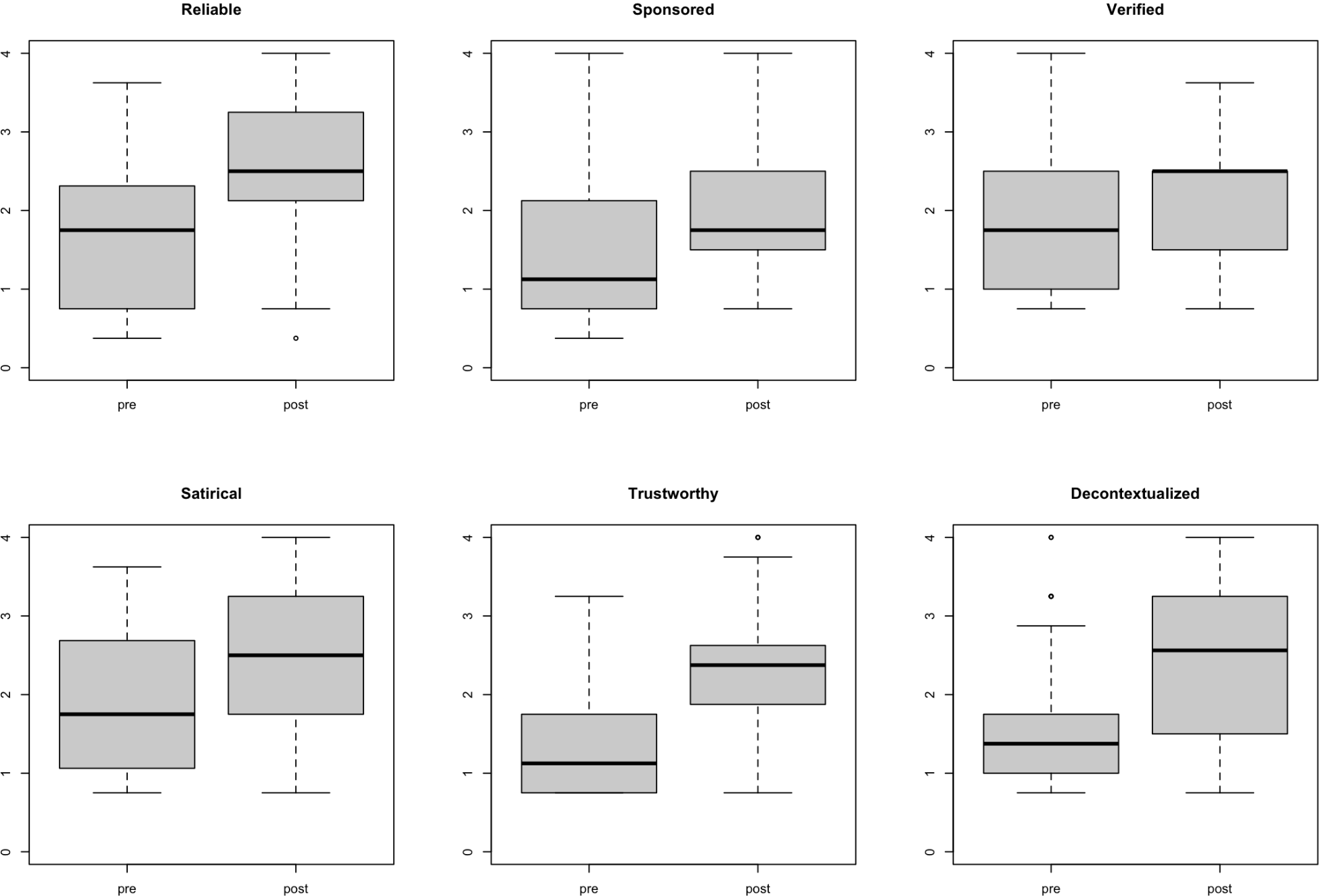
| Competency | Pre-test | Post-test | ||
|---|---|---|---|---|
| 1st quartile | 3rd quartile | 1st quartile | 3rd quartile | |
| [RELIABLE] | 0.750 | 2.312 | 2.125 | 3.250 |
| [SPONSORED] | 0.750 | 2.125 | 1.500 | 2.500 |
| [VERIFIED] | 1.000 | 2.500 | 1.500 | 2.500 |
| [SATIRICAL] | 1.062 | 2.688 | 1.750 | 3.250 |
| [TRUSTWORTHY] | 0.750 | 1.750 | 1.875 | 2.625 |
| [DECONTEXTUALIZED] | 1.000 | 1.750 | 1.500 | 3.250 |
Following the intervention, substantial improvements were observed across all competency domains. Post-training distributions demonstrated marked upward shifts, with third quartile scores exceeding the proficiency threshold for all six assessed competencies. This overall improvement shows that the remediated prebunking methodology effectively helped participants overcome the various skill gaps identified at the start, allowing most of them to reach a satisfactory level of competency in all areas of evaluating digital sources.
Before using a hypothesis test to verify that the difference in scores between the pre- and post-tests is significant, we checked that the differences follow a normal distribution using the Shapiro-Wilk test (Table 4). Given p < 0.05, for the variables [SPONSORED], [SATIRICAL], and [TRUSTWORTHY], we cannot reject the null hypothesis of normality. Consequently, we applied a one-tailed paired t-test to compare the results of the pre- and post-tests. For the other three variables ([RELIABLE], [VERIFIED], and [DECONTEXTUALIZED]), we rejected H0 and applied a one-sided Wilcoxon signed-rank test for paired samples (Table 5). In both cases, we found that the post-test results were better than the pre-test results with 95% confidence, meaning the differences are likely real and not just random chance. So, we can assume the results are related to the suggested training path, even if they aren’t compared to the control group.
| Normality test Shapiro-Wilk test (α = 0.05) |
||||
|---|---|---|---|---|
| N. | W | p-value | H0 | |
| [RELIABLE] | 108 | 0.97048 | 0.01667 | Rejected |
| [SPONSORED] | 115 | 0.98325 | 0.1619 | Accepted |
| [VERIFIED] | 115 | 0.94069 | 6.861e-05 | Rejected |
| [SATIRICAL] | 112 | 0.97817 | 0.06335 | Accepted |
| [TRUSTWORTHY] | 108 | 0.98529 | 0.2823 | Accepted |
| [DECONTEXTUALIZED] | 107 | 0.96899 | 0.01324 | Rejected |
| Hypothesis test One-tailed t-test on paired samples (α = 0.05) |
||||
|---|---|---|---|---|
| df | t | p-value | H0 | |
| [SPONSORED] | 114 | 5.5112 | 1.121e-07 | Rejected |
| [SATIRICAL] | 111 | 7.0324 | 8.77e-11 | Rejected |
| [TRUSTWORTHY] | 107 | 12.445 | 2.2e-16 | Rejected |
| One-sided Wilcoxon signed-rank test for paired samples | ||||
| V | p-value | H0 | ||
| [RELIABLE] | 4688.5 | 2.626e-12 | Rejected | |
| [VERIFIED] | 2706 | 1.581e-06 | Rejected | |
| [DECONTEXTUALIZED] | 4723.5 | 8.469e-12 | Rejected | |
We verified the percentages of teachers who achieved a better score in the post-test compared to the pre-test to better understand the phenomenon and the effects of the training path on their learning (Table 6). Around 80% of the teachers obtained a better result on the post-test for the skills related to [TRUSTWORTHY], [RELIABLE], and [DECONTEXTUALIZED]. A slightly lower percentage (69.6%) obtained a better result in the [SATIRICAL] question. About half of the teachers (53.9%) achieved a better score in the [VERIFIED] question, with approximately 30% of teachers maintaining the same score in both the pre- and post-tests. The percentage decreases in the [SPONSORED] question, where the score between the repeated tests increases for only 24.3% of the teachers.
| N. | Pre > Post | Pre = Post | Pre < Post | |
|---|---|---|---|---|
| [RELIABLE] | 108 | 14.8% | 5.6% | 79.6% |
| [SPONSORED] | 115 | 66.1% | 9.6% | 24.3% |
| [VERIFIED] | 115 | 17.4% | 28.7% | 53.9% |
| [SATIRICAL] | 112 | 23.2% | 7.21% | 69.6% |
| [TRUSTWORTHY] | 108 | 11.1% | 7.4% | 81.5% |
| [DECONTEXTUALIZED] | 107 | 19.6% | 3.7% | 76.6% |
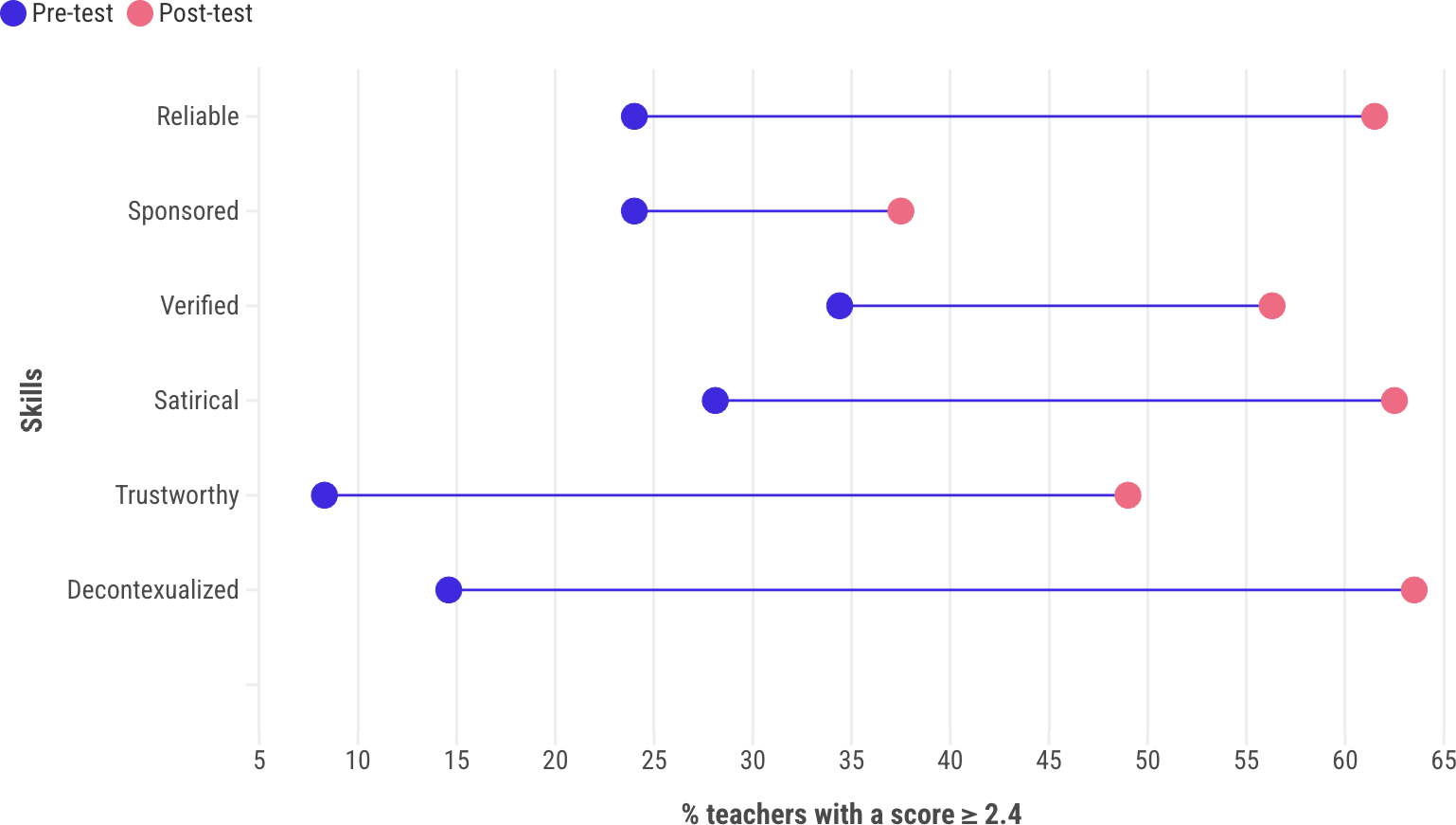
In addition, we subset the sample to 96 teachers, choosing those for whom no NA was recorded in the pre- and post-tests for all six skills. We then operated on the proficiency score (2.4 = 60% of the score). The percentage of teachers who exceeded the cut-off score increases with different sizes (Figure 2). The [TRUSTWORTHY] and [DECONTEXTUALIZED] variables have the biggest increases, but they also have the lowest percentage at first. They are followed in order by [RELIABLE], [SATIRICAL], [VERIFIED], and [SPONSORED].
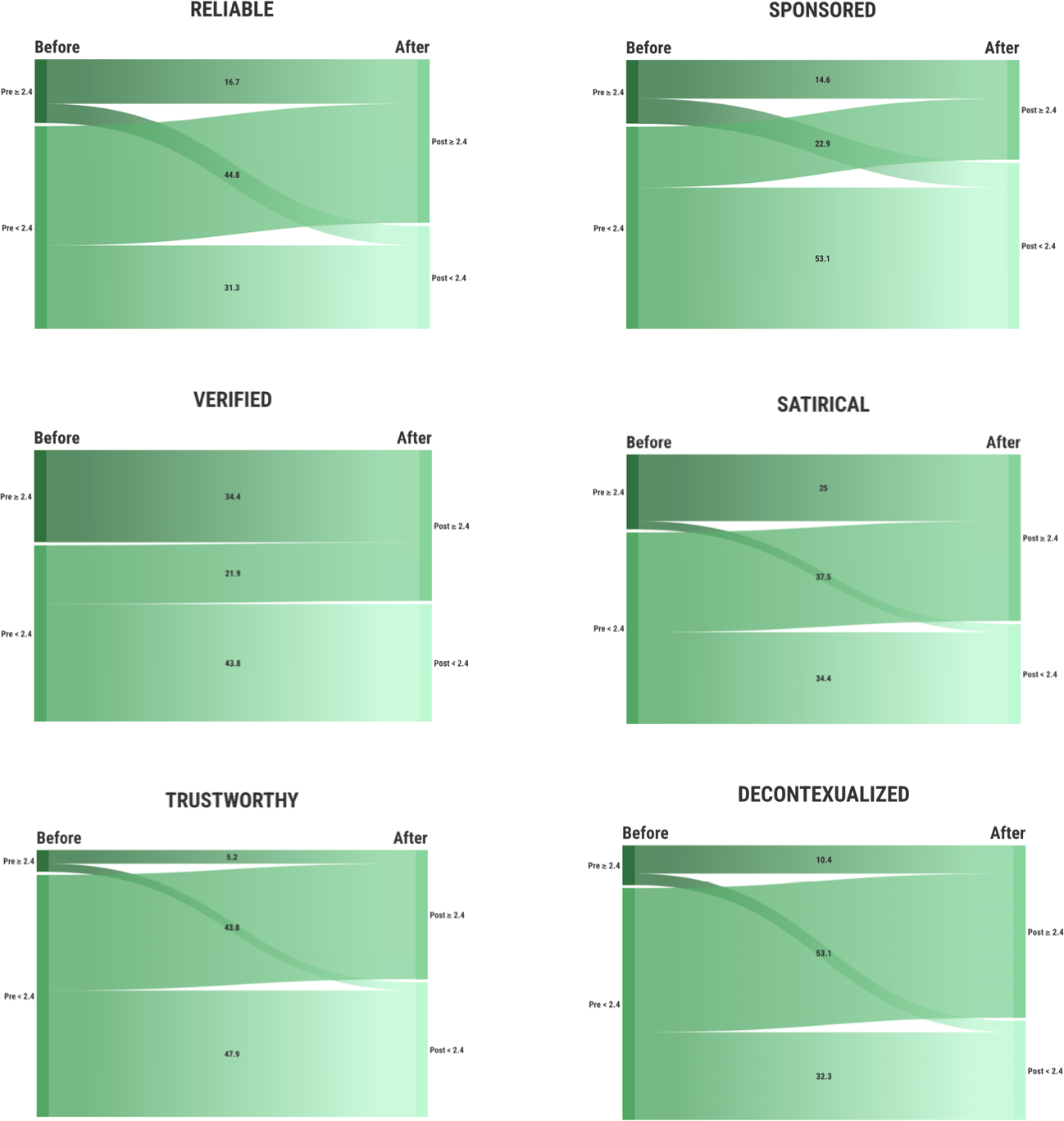
In detail (Figure 3), we see that:
– For all the skills, there is a percentage of teachers who obtained a score lower than 2.4 in the pre-test and remained in the same range in the post-test. The quota is high for [SPONSORED], [TRUSTWORTHY], and [VERIFIED] variables (53.1%, 47.9%, and 43.8%), about 30 percent for the other skills. Although, as stated in Table 3, the improvements involved a high number of teachers, these were not enough in all cases to move teachers’ skills above the proficiency level.
– Except for the [VERIFIED] question, there is a percentage of teachers who obtained proficient scores in the pre-test but lost points in the post-test. It is close to 10% for [RELIABLE] and [SPONSORED] variables, and 3–4% for the others.
- There is a percentage (from 21.9 to 53.1) of teachers who obtained not adequate scores in the pre-test and improved to proficiency in the post-test. The percentage is larger in the [DECONTEXTUALIZED] question, lower in the [SPONSORED] and [VERIFIED] ones. For the last, however, many teachers have achieved and maintained proficiency since the beginning of the course.
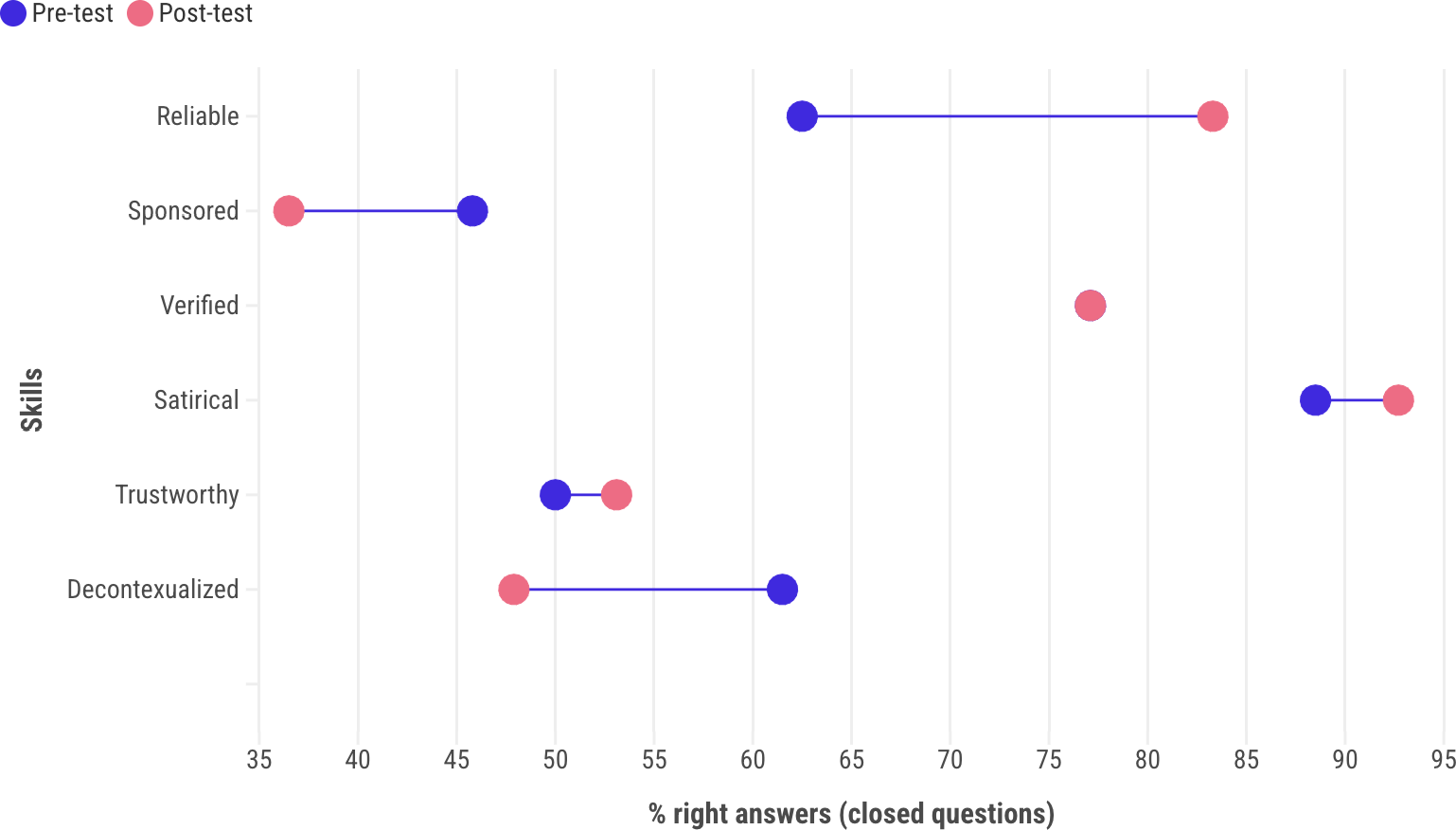
To better understand the mechanisms related to worsening or improving results, we investigate whether there were differences in the scores achieved in closed-ended questions and comments for all the variables. Figure 4 displays the percentage of teachers who answered the closed-ended question correctly, which contributes to the score for each skill. As can be seen, this increase is relevant for the [RELIABLE] competency and moderate for the [TRUSTWORTHY] and [SATIRICAL] variables (the latter, however, started from a very high percentage). The percentages of pre- and post-tests coincide perfectly for the [VERIFIED] competency, while showing a reduction for [DECONTEXTUALIZED] and [SPONSORED] questions. For the former, there was generally an important improvement between the two repeated measures, which was not confirmed in the latter. According to these early results, the difference in scores is largely due to the teachers’ comments; it can be assumed that the training was not always sufficient to yield a correct and unique answer to the closed question. However, even if there is no absolute certainty about the topics, the training path has improved teachers’ argumentation and awareness of issues related to the reliability of sources.
This study set out to evaluate whether a blended, prebunking-oriented teacher training program could enhance six key competencies for detecting mis- and disinformation among Italian educators (Research Question 1), and whether hands-on, collaborative formats contributed more effectively than passive delivery to durable learning outcomes (Research Question 2). Our findings provide compelling evidence for the effectiveness of remediated prebunking approaches while revealing important insights about the nature of developing media literacy skills that extend beyond simple binary skill acquisition.
The noticeable improvements seen in all six areas – [RELIABLE], [SPONSORED], [VERIFIED], [SATIRICAL], [TRUSTWORTHY], and [DECONTEXTUALIZED] – show that preventive methods based on inoculation theory can help teachers become more resilient to digital misinformation. These results match recent studies showing that effective media literacy programs need to use methods that encourage active thinking and understanding of content instead of just giving information passively (Anstead et al., 2025). By exposing participants to weakened examples of manipulation and guiding them through structured refutation strategies, our program created the cognitive “antibodies” theorized in the prebunking literature while addressing the systematic deficiencies in teacher preparation documented across European contexts. In a digital environment saturated with emotional content and visual manipulation, even a small shift in interpretive awareness can mark the difference between passivity and agency.
Our findings are particularly noteworthy as they extend beyond quick-fire recognition tasks to include qualitatively richer justifications and deeper analytical reasoning. Teachers demonstrated wider use of verification terminology and more explicit reference to lateral-reading heuristics in their post-training responses. It’s as if teachers moved from knowing the answer to understanding the question. They learned to trace the logic behind the manipulation, even when certainty was out of reach. This growth in quality often surpassed the improvement in correct answers, with some areas showing a big increase in teachers meeting the basic standards, even when their accuracy in simple right-or-wrong questions only improved a little. The [DECONTEXTUALIZED] domain exemplifies this pattern: while correct multiple-choice responses actually declined slightly, the proportion of teachers achieving sufficiency more than quadrupled (from 14.6% to 63.5%). The improvement in this domain means that teachers became better at explaining their reasoning, even if they didn’t always find clear answers – an important skill for shifting from basic teaching methods to more advanced analytical practices.
Such argumentative competence represents perhaps the most valuable outcome of our intervention, as it equips educators to teach why content is credible or not rather than relying on checklist heuristics alone. This capability is essential because teachers must model and scaffold complex cognitive processes for their students while adapting to the visual-centric nature of contemporary post-media aesthetics (Manovich, 2001). Rather than acting as gatekeepers of truth, teachers evolved into facilitators of how to navigate uncertainty, think critically, and engage ethically with information in complex media environments. The dramatic improvement in visual literacy competencies – particularly the four-fold increase in teachers successfully evaluating decontextualized images – addresses one of the most critical gaps identified in prior research, where visual content evaluation emerged as educators’ weakest competency area.
The biggest improvements happened in areas where teachers participated in hands-on, group workshops – [RELIABLE] and [DECONTEXTUALIZED] – where they worked together to figure out the origins of questionable websites and reverse-search controversial images using the TAG method. This pattern directly address Research Question 2 and clearly shows that hands-on, inquiry-based learning is more effective for lasting understanding than just being passively exposed to information and supports Anstead et al.’s (2025) findings that media literacy programs work better when people actively think about and engage with the real case studies. These teamwork aspects focused on the advanced teaching skills needed for today’s media education, going beyond old literacy methods to include the changes that Manovich (2001) and Rivoltella (2020) say are needed in today’s media landscape.
But not all gaps were bridged. Despite the overall progress, two domains – [SPONSORED] content recognition and [TRUSTWORTHY] news evaluation – remained particularly challenging. More than half of participants still failed to reach sufficiency in these areas, even after training. While [TRUSTWORTHY] showed significant relative growth, the [SPONSORED] domain lagged behind, with a high percentage of participants experiencing score regression.
A closer look at the course design reveals a likely cause: [SPONSORED] content was the only domain that lacked a dedicated hands-on workshop. Unlike [RELIABLE] and [DECONTEXTUALIZED], which benefited from group-based, inquiry-driven analysis, [SPONSORED] was addressed through brief, passive exposure.
These findings offer a clear answer to Research Question 2: formats that prioritize active, collaborative learning – such as case reconstruction and investigative tasks – lead to more robust and durable competency gains than those relying solely on expository content.
This contrast underscores a crucial pedagogical insight: awareness is not enough. Recognizing the subtle persuasive techniques embedded in native advertising or branded content requires time and reflection. Without these, even well-intentioned training may fall short. For educators to effectively mediate these challenges in the classroom, they must first engage with them in depth – not just encounter them in passing.
The ongoing difficulties in domains such as [SPONSORED] and [TRUSTWORTHY] also highlight a well-documented challenge in prebunking interventions: the phenomenon of informative decay, whereby the cognitive resistance acquired during training tends to weaken over time (van der Linden, 2023).
Like a vaccine without a booster, even well-internalized reasoning strategies can fade if they are not revisited, reinforced, or reactivated through continued engagement. In our study, this effect may partly explain the limited improvement and occasional regression in performance in areas that received only minimal active training.
To counteract this decay, future iterations of the program should include structured booster activities – such as short refresh modules, review-based case studies, or personal reflection assignments – delivered at regular intervals after the main intervention. These low-intensity follow-ups could help reactivate cognitive defenses and support longer-term retention, especially in areas where subtle persuasive strategies – like native advertising – require deeper and repeated analysis. This approach aligns with research emphasizing that sustained professional development must address both technical competencies and the cultural shifts required for effective digital citizenship education (Ranieri et al., 2021; Trust et al., 2022).
Our findings suggest that policy guidelines should promote the use of detailed assessment criteria for evaluating teacher skills instead of just using pass/fail tests. Just as we urge students to explain their reasoning, our findings suggest that evaluating teachers’ media literacy must go beyond checklists and embrace interpretive complexity. The fact that giving more importance to open-ended reasoning (75%) instead of just simple classification accuracy (25%) encourages deeper thinking shows that how we assess students can greatly affect their learning results. This insight helps ongoing conversations about the best ways to measure and improve media literacy skills while also recognizing the creative and interpretive aspects that today’s media requires.
Several limitations constrain our conclusions and point toward future research directions. The study sample consisted of Italian teachers who voluntarily participated in the program, potentially introducing selection bias toward higher baseline motivation. A randomized controlled design with a true control group would strengthen causal claims about intervention effectiveness. Long-term follow-up studies are important to see how long the improvements last and to understand how skills might fade over time, especially since there are concerns about how lasting these effects are. Also, breaking down the results by how the program was delivered (completely online or in person) could help us understand how much social interaction, being present, and reflecting at different times contribute to learning outcomes.
Even with these limitations, our study shows strong evidence that improved prebunking methods can effectively fill the gaps in how teachers are prepared for media literacy while also helping them develop the important skills needed for today’s digital citizenship education. The success of the intervention in improving both technical skills and critical thinking shows a hopeful way to expand effective media literacy education that understands the complicated nature of today’s media environments. As disinformation becomes more advanced and widespread, helping educators improve their skills through research-based teamwork is an important investment in strengthening democracy and developing digital citizenship.
This study demonstrates that remediated prebunking approaches can effectively enhance teachers’ media literacy competencies, addressing critical gaps in educator preparation for digital citizenship instruction. The big improvements seen in six areas of skills, especially in visual literacy and source evaluation, show that working together and exploring topics is more effective than just traditional teaching methods.
Three key insights emerge from our findings. First, being able to argue and explain ideas well is often more important than just getting right or wrong answers, which means how we assess students can greatly impact their learning results. Second, experiential depth produces more durable gains than broad coverage, with hands-on workshops generating the strongest improvements. Third, the dramatic success in developing visual literacy competencies demonstrates that targeted interventions can rapidly address previously intractable skill deficits.
These findings have immediate implications for policy frameworks and teacher training design. Educational programs should prioritize active, collaborative methodologies while incorporating regular reinforcement activities to counter skill decay. As false information becomes more advanced, helping teachers improve their skills using research-based methods is essential for strengthening democracy and teaching responsible online behaviour.
According to CRediT system: Nicola Bruno: Conceptualization, Methodology, Investigation, Project Administration, Supervision, Writing – Original Draft, Writing – Review & Editing; Annamaria De Santis: Methodology, Formal analysis, Data Curation, Visualization; Stefano Moriggi: Conceptualization, Methodology, Investigation, Writing – Review & Editing.
Aljalabneh, A. (2024). Visual media literacy: Educational strategies to combat image and video disinformation on social media. Frontiers in Communication. https://doi.org/10.3389/fcomm.2024.1490798
Anstead, N., Edwards, L., Livingstone, S., & Stoilova, M. (2025). The Potential for Media Literacy to Combat Misinformation: Results of a Rapid Evidence Assessment. International Journal of Communication, 19, 23. https://ijoc.org/index.php/ijoc/article/view/23549/5009
Bruno, N., & Moriggi, S. (2023a). La verità vi prego sulla disinformazione. Il prebunking come modello educativo per una società postmediale. In S. Moriggi (Ed.), Postmedialità. Società ed educazione (pp. 101–128). Raffaello Cortina.
Bruno, N., & Moriggi, S. (2023b). Prebunking as preventive ecology: The case of conspiracy thinking. In T. Minerva & A. De Santis (Eds.), Proceedings of the Italian Symposium on Digital Education (ISYDE 2023). https://hdl.handle.net/11380/1366623
Cook, J., Lewandowsky, S., & Ecker, U. K. H. (2017). Neutralizing misinformation through inoculation: Exposing misleading argumentation techniques reduces their influence. PLOS ONE, 12(5), e0175799. https://doi.org/10.1371/journal.pone.0175799
Council of Europe. (2025). Digital Citizenship Education Planner. Available here: https://www.coe.int/en/web/education/dce-planner
Ecker, U. K. H., Lewandowsky, S., Cook, J., Schmid, P., & Fazio, L. (2022). The psychological drivers of misinformation belief and its resistance to correction. Nature Reviews Psychology, 1, 13–29. https://doi.org/10.1038/s44159-021-00006-y
Erdem, C., & Eristi, B. (2018). Paving the way for media literacy instruction in preservice teacher education: Prospective teachers’ levels of media literacy skills. International Journal of Instruction, 11(4), 795–810. https://doi.org/10.12973/iji.2018.11450a
European Commission. (2022a). DigComp 2.2: The Digital Competence Framework for Citizens. https://data.europa.eu/doi/10.2760/115376
European Commission. (2022b). Guidelines for teachers and educators on tackling disinformation and promoting digital literacy through education and training. https://education.ec.europa.eu/news/guidelines-for-teachers-and-educators-on-tackling-disinformation-and-promoting-digital-literacy-through-education-and-training
Eugeni, R. (2015). La condizione postmediale. Scholé.
Frau-Meigs, D. (2024). User empowerment through media and information literacy responses to the evolution of generative artificial intelligence (GAI). UNESCO. https://unesdoc.unesco.org/ark:/48223/pf0000388547
Gallese, V., Moriggi, S., Rivoltella, P.C. (2025). Oltre la Tecnofobia. Il digitale dalle neuroscienze all’educazione. Raffaello Cortina.
Hebbar, N., & Wolf, C. (2024). Determining trustworthiness through provenance and context. Google Policy Paper. https://static.googleusercontent.com/media/publicpolicy.google/it//resources/determining_trustworthiness_en.pdf
Huang, G., Jia, W., & Yu, W. (2024). Media literacy interventions improve resilience to misinformation: A meta-analytic investigation of overall effect and moderating factors. Communication Research. Advance online publication. https://doi.org/10.1177/00936502241288103
International Association for the Evaluation of Educational Achievement (IEA). (2018). International Computer and Information Literacy Study (ICILS). https://www.iea.nl/studies/iea/icils/2018
Ipsos MORI. (2021). Online media literacy: Across the world, demand for training is going unmet. Ipsos. https://www.ipsos.com/en-uk/online-media-literacy-across-world-demand-training-going-unmet
Manovich, L. (2001). Post-media aesthetics. https://manovich.net/index.php/projects/post-media-aesthetics
McGrew, S., & Breakstone, J. (2023). Civic Online Reasoning Across the Curriculum: Developing and Testing the Efficacy of Digital Literacy Lessons. AERA Open, 9. https://doi.org/10.1177/23328584231176451
Moriggi, S. (2023). Postmedialità. Società ed educazione. Raffaello Cortina.
Pérez-Escolar, M., Lilleker, D. G., & Tapia-Frade, A. (2023). A systematic literature review of the phenomenon of disinformation and misinformation. Media and Communication, 11(2), 76–87. https://doi.org/10.17645/mac.v11i2.6487
Ranieri, M., Bruni, I., & Kupiainen, R. (2018). Digital and Media Literacy in Teacher Education: Findings and Recommendations from the European Project e-MEL. Italian Journal of Educational Research, 151-166. https://ojs.pensamultimedia.it/index.php/sird/article/view/2796
Ranieri, M. (2021). Cittadinanza digitale e sviluppo professionale. Quali dimensioni concettuali, quali approcci formativi?. Essere a scuola, 6, 12-16. https://www.morcelliana.net/img/cms/Materiali%20on%20line/essere%20a%20scuola/2021/6%202021%20-%20febbraio/Contributo%20Eas%206.pdf
Rivoltella, P. C. (2020). Nuovi alfabeti. Educazione e culture nella società post-mediale. Scholé.
TeaMLit Project. (2023). Media Literacy in Teacher Education: Comparative Report. https://media-and-learning.eu/project/teamlit/
Trust, T., Maloy, R., Butler, A. & Goodman, L. (2022). Critical Media Literacy in Teacher Education: Discerning Truth Amidst a Crisis of Misinformation and Disinformation. Journal of Technology and Teacher Education, 30(2), 167-176. Waynesville, NC USA: Society for Information Technology & Teacher Education. https://doi.org/10.70725/007235rcfely
Tsankova, S., Angova, S., Nikolova, M., Valchanov, I., Valkov, I., & Minev, G. (2023). The media literacy and the teachers. Pedagogika–Pedagogy, 95(1), 68–80. https://doi.org/10.53656/ped2023-3.03
UNESCO (2018). Journalism, fake news & disinformation: handbook for journalism education and training. https://unesdoc.UNESCO.org/ark:/48223/pf0000265552
van der Linden, S. (2023). Foolproof: Why we fall for misinformation and how to build immunity. 4th Estate.
Wardle, C., & Derakhshan, H. (2017). Information disorder: Toward an interdisciplinary framework for research and policy making. Council of Europe Report. Retrieved online October 14, 2025. Available here https://edoc.coe.int/en/media/7495-information-disorder-toward-an-interdisciplinary-framework-for-research-and-policy-making.html
Zaçellari, M., & Reçi, L. (2024). Empowering future teachers with media and literacy skills. Interdisciplinary Journal of Research and Development, 11(1), 74–81. https://doi.org/10.56345/ijrdv11n108