https://doi.org/10.36253/me-20214
Received: March, 2026; Accepted: April, 2026; Published: May, 2026
Enhancing AI literacy in education: A multi-country pre-post quasi-experimental evaluation study
Potenziare l’AI literacy nell’educazione: uno studio di valutazione quasi-sperimentale pre-post multi-paese
¹ University of Florence, Italy
² Paul Valéry University Montpellier 3, France
*Corresponding author
Abstract. This study examines the effectiveness of targeted professional development workshops in enhancing AI literacy preparedness among educators in Romania, France, and Finland, within the framework of the TADAM (Tools & Awareness about Disinformation, Algorithms & Media) project. Using a pre-post design with independent groups, we assessed educators’ perceived preparedness across four dimensions: AI literacy promotion, local knowledge development, training facilitation, and stakeholder networking, before and after participation in country-specific workshops. Results indicate that participants assessed following workshop completion reported substantially higher preparedness levels across all four dimensions compared to those assessed before the workshops, with effect sizes ranging from medium-large to large. Psychometric analysis confirmed excellent internal consistency and strong unidimensional structure of the preparedness measure. Overall, the findings suggest that competency-based professional development models emphasising active learning, collaborative co-design, and contextual adaptation may be associated with meaningful gains in educators’ perceived preparedness in emerging technological domains, while acknowledging the methodological limitations inherent in non-randomised designs.
Keywords: AI literacy, educational technology, media education, pre-post intervention, professional development.
Riassunto. Il presente studio esamina l’efficacia di interventi formativi mirati per lo sviluppo dell’alfabetizzazione sull’intelligenza artificiale (AI literacy) tra gli educatori di tre paesi europei – Romania, Francia e Finlandia – nell’ambito del progetto TADAM (Tools & Awareness about Disinformation, Algorithms & Media). Attraverso un disegno quasi-sperimentale pre-post con gruppi indipendenti, lo studio ha analizzato i livelli di preparazione percepita degli educatori su quattro dimensioni: promozione dell’AI literacy, sviluppo della conoscenza locale, facilitazione della formazione e networking tra stakeholder. I dati sono stati raccolti tramite questionari somministrati prima e dopo la partecipazione a 12 workshop organizzati nei tre contesti nazionali (6 in Romania, 4 in Francia, 2 in Finlandia). I risultati mostrano che i partecipanti valutati dopo i workshop hanno riportato livelli significativamente più elevati di preparazione rispetto a quelli valutati prima, con effetti di entità medio-grande e grande in tutte le dimensioni esaminate. L’analisi psicometrica ha confermato l’elevata coerenza interna dello strumento e una struttura unidimensionale robusta. Nel complesso, i risultati suggeriscono che modelli formativi basati sulle competenze, centrati sull’apprendimento attivo, sulla co-progettazione e sull’adattamento contestuale, possono essere associati a un sostanziale miglioramento della preparazione percepita degli educatori in ambiti tecnologici emergenti, pur con le limitazioni metodologiche proprie dei disegni non randomizzati.
Parole chiave: AI literacy, intervento pre-post, media education, sviluppo professionale, tecnologia educativa.
Contents
4.3 Between- group comparisons
1. Introduction
The proliferation of artificial intelligence (AI) technologies across educational contexts has fundamentally transformed pedagogical practices, information dissemination, and knowledge construction processes (Holmes et al., 2019; Luckin et al., 2022). Educational institutions worldwide now confront unprecedented challenges in navigating AI-mediated environments, where algorithmic decision-making influences curriculum development, learning analytics, content personalization, and assessment methodologies (Zawacki-Richter et al., 2019). This technological transformation coincides with escalating concerns regarding AI-generated misinformation, algorithmic bias, and the erosion of critical thinking capacities among students and educators alike (Bender et al., 2021; Wardle & Derakhshan, 2017).
Within this context, teacher and educator preparedness emerges as a critical determinant of successful AI integration in educational settings (Crompton & Burke, 2023; Ng et al., 2023). However, systematic evidence on effective professional development interventions remains notably sparse, particularly across diverse European educational systems characterized by distinct linguistic, cultural, and institutional frameworks (Caena & Redecker, 2019; European Commission, 2020). The existing literature predominantly features technology-centric approaches that prioritize technical skills over critical pedagogical competencies, neglecting the broader socio-ethical dimensions essential for responsible AI implementation (Selwyn, 2019; Williamson et al., 2020).
The TADAM (Tools & Awareness about Disinformation, Algorithms & Media) project addresses this gap through a multi-country professional development initiative targeting media and IT professionals, educators, and students across Europe. Specifically, Work Package 3 (WP3) implemented 12 regional workshops across the three partner countries (6 in Romania, 4 in France, and 2 in Finland) focused on enhancing AI literacy competencies through participatory, practice-oriented methodologies adapted to local contexts. These workshops operationalized AI literacy as encompassing four interconnected dimensions: (1) promoting media information literacy skills around AI, (2) increasing local knowledge around AI topics, (3) facilitating training activities on AI subjects, and (4) fostering networking among stakeholders engaged with AI in educational contexts.
This study specifically examines the education sector component of TADAM’s WP3 interventions, evaluating workshop outcomes across three European countries: Romania (IAME workshops targeting practicing teachers), France (University Paul-Valéry workshops targeting educators and trainers), and Finland (TAU workshops targeting future media educators in bachelor programs). Our investigation addresses a fundamental research question:
To what extent are targeted professional development workshops associated with enhanced educators’ perceived preparedness in AI literacy promotion, knowledge development, training facilitation, and stakeholder collaboration?
By employing rigorous psychometric validation and independent-groups statistical analysis, this research contributes empirical evidence on intervention outcomes while acknowledging inherent methodological limitations of non-randomized designs. The findings hold implications for educational policy, professional development program design, and future research directions in AI literacy education.
2. Theoretical background
AI literacy transcends mere technical proficiency, encompassing critical understanding of AI systems’ capabilities, limitations, societal implications, and ethical considerations (Long & Magerko, 2020; Ng et al., 2021). Recent frameworks conceptualize AI literacy as a multidimensional construct integrating cognitive, practical, and socio-ethical competencies essential for navigating AI-saturated environments (Laupichler et al., 2022; Southworth et al., 2023). For educators specifically, AI literacy extends beyond personal competence to include pedagogical capabilities for fostering students’ critical engagement with AI technologies (Celik et al., 2022; Su et al., 2023).
Empirical research demonstrates that educators’ AI literacy influences their instructional practices, technology adoption decisions, and capacity to address AI-related challenges in educational contexts (Kim & Kim, 2022; Ng et al., 2023). However, studies consistently report significant gaps in teachers’ AI-related knowledge, skills, and confidence, particularly regarding ethical implications and critical evaluation of AI outputs (Crompton & Burke, 2023; Tetzlaff et al., 2021). These deficits underscore the urgent need for systematic professional development interventions grounded in evidence-based pedagogical principles.
Effective professional development in educational technology contexts exhibits specific characteristics: active learning approaches, sustained duration, collaborative participation, coherence with institutional contexts, and explicit focus on content knowledge (Desimone, 2009; Lawless & Pellegrino, 2007). Meta-analytic evidence suggests that technology-focused professional development achieves moderate positive effects on teacher knowledge and practice when incorporating these design principles (Tondeur et al., 2016; Schmid et al., 2020).
The TADAM workshops operationalized these principles through participatory methodologies informed by instructional design theories (Merrill, 2002), experiential learning frameworks (Dewey, 1938), and structured expert consultation approaches (Delphi method1). Workshops emphasized hands-on activities, peer collaboration, critical reflection on AI applications, and co-design of educational strategies adapted to local contexts. This pedagogical approach aligns with contemporary frameworks advocating constructivist, practice-based professional development models (Darling-Hammond et al., 2017; Vangrieken et al., 2015).
Educational technology interventions across diverse cultural contexts encounter distinct challenges related to technological infrastructure, pedagogical traditions, institutional policies, and societal values regarding technology’s role in education (Tondeur et al., 2021; Voogt et al., 2013). The TADAM project’s multi-country design explicitly acknowledged these contextual variations, adapting workshop content and methodologies to Romanian, French, and Finnish educational systems while maintaining core learning objectives. This approach reflects contemporary understanding that effective educational interventions require cultural responsiveness alongside methodological rigor (Gay, 2018; Paris & Alim, 2017).
Assessing professional development outcomes presents methodological challenges, particularly regarding construct validity, measurement reliability, and causal inference limitations (Guskey, 2000; Opfer & Pedder, 2011). Self-reported preparedness measures, while pragmatically valuable for large-scale assessments, introduce potential response biases and may not correlate perfectly with objective competency assessments (Dunning et al., 2004; Kennedy, 2016). Furthermore, pre-post designs without randomized controls face threats to internal validity from selection effects, maturation, and historical factors (Shadish et al., 2002). The current study addresses these challenges through rigorous psychometric validation, transparent statistical reporting, and explicit acknowledgment of design limitations.
3. Methods
3.1 Study design
This study employed a pre-post intervention design examining two independent groups of educators, one assessed before workshop participation (pre-workshop group) and one assessed after (post-workshop group), with no individual-level matching between groups. The design represents a pragmatic quasi-experimental approach suitable for real-world professional development contexts where randomized controlled trials prove logistically infeasible (Reichardt, 2019). Data collection occurred between June 2024 and April 2025 across three country-specific workshop series implemented as part of the TADAM project’s Work Package 3 decentralization phase.
3.2 Participants and settings
Participants comprised educators and future educators recruited through three distinct workshop implementations targeting education professionals:
IAME (Institute for Advanced Media Education, Romania): Practicing teachers from Romanian educational institutions (pre-workshop: N = 158, post-workshop: N = 122). Workshops addressed AI’s roles in media production, ethical implications, critical evaluation skills, audience perception, and creative applications.
Université Paul Valéry (Montpellier, France): Educators and trainers engaged in media education contexts (pre-workshop: N = 55, post-workshop: N = 27). Workshops focused on evaluating audience perception, awareness, and emotions regarding AI outputs, alongside reflections on media education strategies.
TAU (Tampere University, Finland): Bachelor-level students in media education programs (pre-workshop: N = 24, post-workshop: N = 20). Workshops emphasized critical AI prompting skills, creative applications, and awareness development for future media educators.
The total analytical sample comprised 237 pre-workshop participants and 169 post-workshop participants following data quality filtering procedures. Given the independent-groups design and anonymized data, the observed reduction in respondents (28.7%) should be interpreted as a descriptive decrease in sample size between assessment timepoints rather than a precise individual-level dropout rate. This reduction reflects combined effects of workshop scheduling conflicts, survey non-completion, voluntary participation constraints, and data quality filtering, but does not represent tracked individual-level attrition since pre- and post-workshop participants were not matched individuals.
3.3 Intervention description
Workshop interventions varied in duration (4–8 hours) and specific content adaptation to local contexts, while maintaining consistent core learning objectives aligned with TADAM’s AI literacy framework. All workshops incorporated: (1) expert presentations on AI fundamentals, applications in media/education, and ethical considerations; (2) hands-on activities with AI tools demonstrating practical applications and limitations; (3) collaborative group work addressing real-world scenarios and challenges; (4) critical reflection exercises examining AI’s societal implications and educational applications; and (5) co-design activities developing locally-relevant educational strategies and resources.
Workshop pedagogical approaches aligned with Merrill’s (2002) instructional design principles emphasizing task-centered learning, Dewey’s (1938) experiential learning theories prioritizing hands-on engagement, and structured expert consultation methodologies facilitating knowledge exchange. Detailed workshop descriptions, agendas, and materials are documented in the TADAM project WP3 report. Table 1 provides an overview of the 12 education-sector workshops included in this study.
| Institution | Workshop Title | Date | Target | Format | |||||||||||||||
|---|---|---|---|---|---|---|---|---|---|---|---|---|---|---|---|---|---|---|---|
| IAME (Romania) | The consequences of AI in media production and the role of media education | Jan–Apr 2025 (6 sessions) | Teachers, media educators | In person + online | |||||||||||||||
| Univ. Paul Valéry (France) | Regional workshops on AI in media education (Montpellier ×2, European Journalism Symposium, Toulouse) | Nov–Dec 2024 (4 sessions) | Educators, trainers, media professionals | In person | |||||||||||||||
| TAU (Finland) | AI awareness and prompting skills for future media educators | Nov 2024 + Mar 2025 (2 sessions) | Future media educators (bachelor students) | In person | |||||||||||||||
| Note. All workshops incorporated: expert presentations, hands-on AI tool activities, collaborative group work, critical reflection, and co-design of educational resources. Duration ranged from 4 to 8 hours per session. | |||||||||||||||||||
3.4 Measures
The primary outcome measure assessed participants’ perceived preparedness across four dimensions of AI literacy competency using a short preparedness scale developed for the TADAM project, for which we obtained preliminary evidence of strong internal consistency and unidimensional structure. Pre-workshop participants responded to items prefaced with ‘Before attending the workshop, to what extent do you feel prepared to:’, while post-workshop participants responded to parallel items prefaced with ‘After attending the workshop, to what extent do you feel prepared to:’. The four measured dimensions comprised: (1) AI Literacy Promotion: ‘Promote media information literacy skills around AI’; (2) Local Knowledge Development: ‘Increase local knowledge around the workshop topic’; (3) Training Facilitation: ‘Facilitate training activities on the workshop topic’; (4) Stakeholder Networking: ‘Foster networking among stakeholders around the workshop topic’.
The four items represent conceptually distinct facets of AI literacy preparedness but empirically form a highly coherent unidimensional scale with excellent internal consistency. Responses employed five-point Likert scales adapted to local languages (English, Romanian, French, Finnish). Scale anchors ranged from 1 (not at all prepared) to 5 (extremely prepared). A composite preparedness score was calculated as the mean of all four items for participants with at least three valid responses.
Demographic information was also collected in pre-workshop surveys, including gender, age, educational attainment, professional field, and years of professional experience. This information facilitated sample characterization and enabled identification of education-sector participants through linguistic and contextual indicators.
3.5 Procedures
Pre-workshop surveys were administered immediately before workshop commencement, while post-workshop surveys were completed immediately following workshop conclusion. All surveys employed online platforms ensuring anonymity and confidentiality. Participation was voluntary, and informed consent was obtained from all participants following ethical guidelines for educational research. The study received institutional approval from the University of Florence Ethics Committee.
All statistical analyses were conducted using Python 3.9 with SciPy 1.9.3, NumPy 1.23.5, and Pandas 1.5.3 libraries. Significance threshold was set at α = .05 for all inferential tests. Effect size interpretations followed Cohen’s (1988) conventional benchmarks: small (d = 0.20), medium (d = 0.50), and large (d = 0.80).
Between-group differences in preparedness scores were examined using independent samples t-tests with Welch’s correction for unequal variances (Welch, 1947). Effect sizes were quantified using Cohen’s d calculated as the standardized mean difference between groups. Ninety-five percent confidence intervals (CI) for mean differences were calculated using standard error estimation appropriate for independent samples. Internal consistency reliability was assessed using Cronbach’s alpha coefficient, calculated separately for pre-workshop and post-workshop groups. Construct dimensionality was evaluated through principal component analysis (PCA) with standardized scores.
4. Results
4.1 Sample characteristics
The analytical sample comprised 237 pre-workshop participants (IAME: n = 158, Valéry: n = 55, TAU: n = 24) and 169 post-workshop participants (IAME: n = 122, Valéry: n = 27, TAU: n = 20). Romanian participants (IAME) constituted the majority of both pre-workshop (66.7%) and post-workshop (72.2%) samples, reflecting the larger scale of Romanian workshop implementations. The observed reduction in respondents between pre-workshop and post-workshop assessments (28.7%) reflects combined effects of workshop scheduling conflicts, survey non-completion, voluntary participation constraints, and data quality filtering rather than individual-level dropout.
4.2 Descriptive statistics
Table 2 presents descriptive statistics for all four preparedness dimensions and the composite score. Pre-workshop preparedness scores ranged from M = 2.80 (Training Facilitation) to M = 2.96 (Stakeholder Networking), with standard deviations indicating substantial variability (SD = 1.10–1.16). Post-workshop scores demonstrated consistently higher means ranging from M = 3.62 (Training Facilitation) to M = 3.71 (Local Knowledge Development), with reduced variability (SD = 0.87–1.00) suggesting greater consensus in perceived preparedness following workshop participation. The composite preparedness score increased from M = 2.89 (SD = 1.02) pre-workshop to M = 3.67 (SD = 0.88) post-workshop, representing an increase of 0.78 scale points on the five-point scale.
| Dimension | Pre-Workshop | Post-Workshop | |||||||||||||||||
|---|---|---|---|---|---|---|---|---|---|---|---|---|---|---|---|---|---|---|---|
| M | SD | N | M | SD | N | ||||||||||||||
| AI Literacy Promotion | 2.85 | 1.13 | 234 | 3.70 | 0.88 | 141 | |||||||||||||
| Local Knowledge Development | 2.94 | 1.11 | 233 | 3.71 | 0.87 | 141 | |||||||||||||
| Training Facilitation | 2.80 | 1.16 | 234 | 3.62 | 1.00 | 141 | |||||||||||||
| Stakeholder Networking | 2.96 | 1.10 | 231 | 3.65 | 0.95 | 141 | |||||||||||||
| Composite Score | 2.89 | 1.02 | 234 | 3.67 | 0.88 | 141 | |||||||||||||
| Note. M = Mean; SD = Standard Deviation; N = Sample Size. All measures on 5-point Likert scales (1 = Not at all prepared, 5 = Extremely prepared). | |||||||||||||||||||
4.3 Between- group comparisons
Independent samples t-tests with Welch’s correction revealed statistically significant differences between pre-workshop and post-workshop groups across all four preparedness dimensions and the composite score (all p < .001). Effect sizes ranged from medium-large to large magnitude according to conventional benchmarks (Cohen, 1988) (Figure 1).
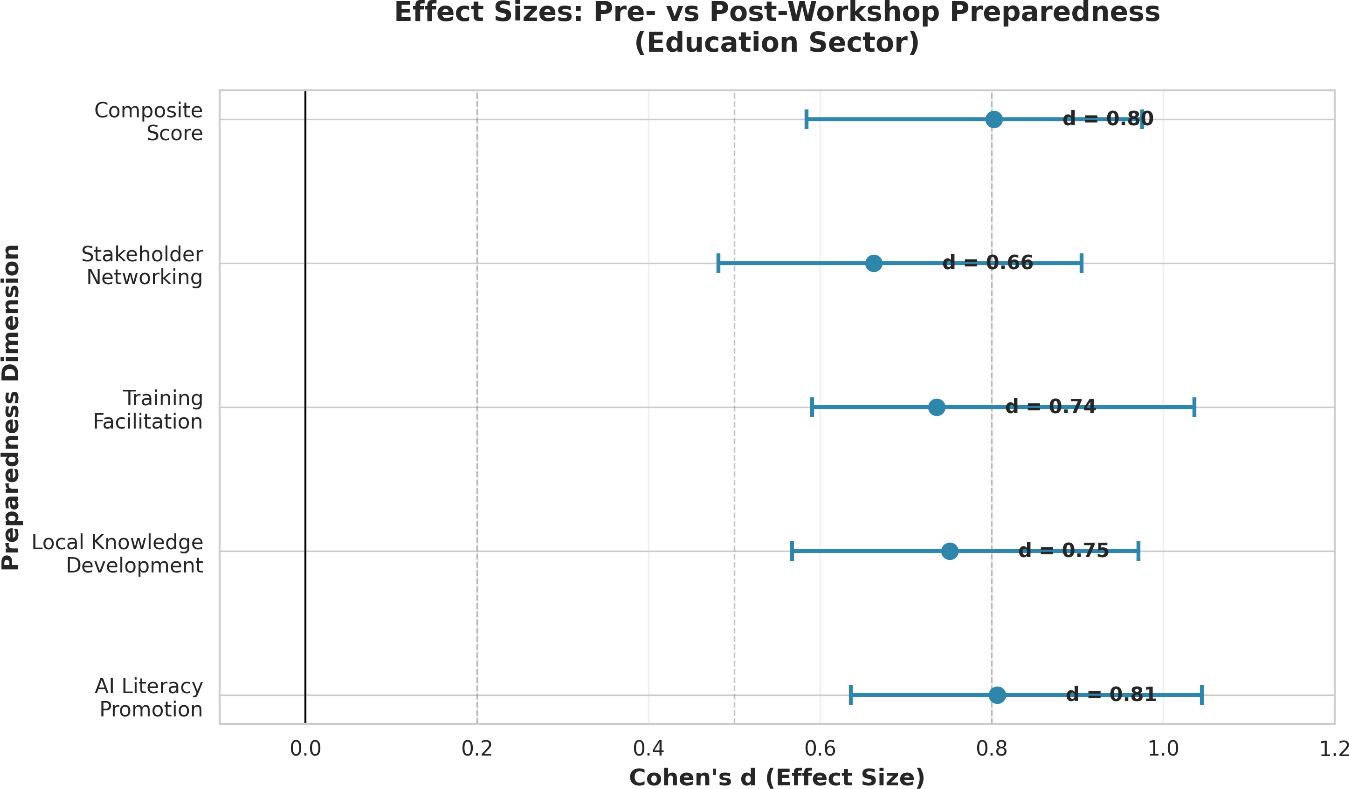
Post-workshop participants reported significantly higher preparedness for promoting media information literacy skills around AI (M = 3.70, SD = 0.88) compared to pre-workshop baseline (M = 2.85, SD = 1.13), t(349.25) = 8.12, p < .001. The effect size was large (d = 0.81) with 95% CI [0.64, 1.06]. Similarly, post-workshop participants demonstrated significantly elevated preparedness for increasing local knowledge around AI topics (M = 3.71, SD = 0.87) relative to pre-workshop assessment (M = 2.94, SD = 1.11), t(347.93) = 7.46, p < .001, d = 0.75, 95% CI [0.57, 0.97].
Post-workshop participants reported significantly higher preparedness for facilitating training activities on AI topics (M = 3.62, SD = 1.00) compared to pre-workshop levels (M = 2.80, SD = 1.16), t(329.08) = 7.24, p < .001, d = 0.74, 95% CI [0.60, 1.04]. Post-workshop participants also exhibited significantly higher preparedness for fostering networking among AI-focused stakeholders (M = 3.65, SD = 0.95) compared to pre-workshop baseline (M = 2.96, SD = 1.10), t(328.85) = 6.40, p < .001, d = 0.66, 95% CI [0.48, 0.90]. Although this was the smallest effect observed among the four dimensions, it nonetheless represents substantial enhancement in perceived capacity to build collaborative communities around AI education.
The composite preparedness score demonstrated a large and statistically significant difference between post-workshop (M = 3.67, SD = 0.88) and pre-workshop (M = 2.89, SD = 1.02) groups, t(328.91) = 7.82, p < .001, d = 0.80, 95% CI [0.58, 0.98].
4.4 Psychometric properties
The four-item preparedness scale demonstrated excellent internal consistency in both pre-workshop (α = 0.927) and post-workshop (α = 0.964) assessments, substantially exceeding conventional acceptability thresholds (Nunnally & Bernstein, 1994). All four preparedness items exhibited strong positive correlations with total scores in both assessments (all r > .90, all p < .001). Pre-workshop item-total correlations ranged from r = .899 (Training Facilitation) to r = .918 (Local Knowledge Development); post-workshop correlations ranged from r = .916 (AI Literacy Promotion) to r = .963 (Stakeholder Networking) (Figure 2).
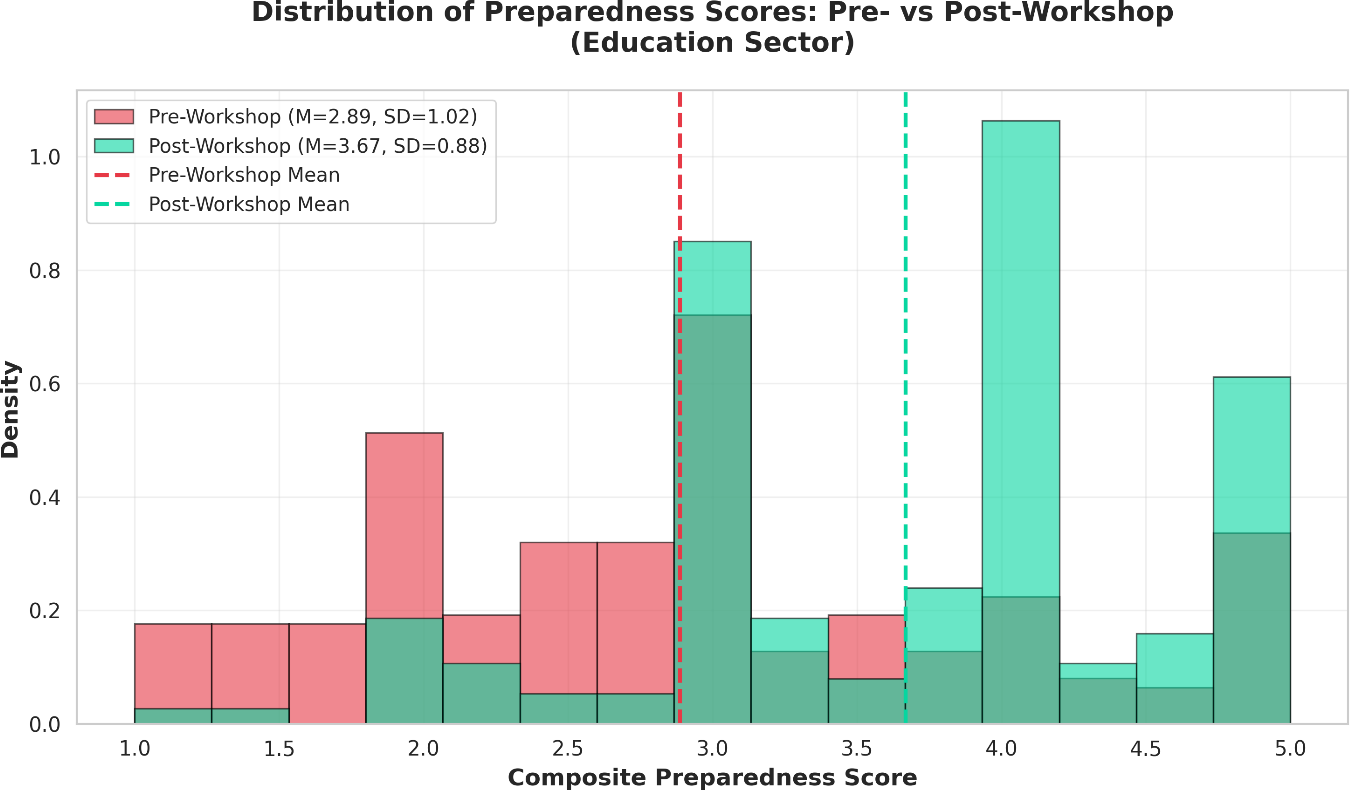
Principal component analysis revealed strong unidimensional structure in both assessment periods. For pre-workshop data, the first principal component explained 82.0% of total variance (eigenvalue = 3.28), with subsequent components explaining only 9.0%, 6.0%, and 3.0% respectively. Component loadings on PC1 were highly uniform (range: 0.901–0.911). Post-workshop PCA demonstrated even stronger unidimensionality, with PC1 explaining 91.0% of variance (eigenvalue = 3.64) and remaining components explaining only 4.5%, 3.0%, and 1.5%. The increased variance concentration in PC1 post-workshop corroborates the enhanced internal consistency.
5. Discussion
This multi-country evaluation of TADAM project workshops provides evidence that post-workshop educators reported substantially higher perceived preparedness for addressing AI literacy challenges compared to pre-workshop assessments. Participants assessed after workshop completion demonstrated significantly higher preparedness across all examined dimensions, with effect sizes ranging from medium-large to large magnitude (d = 0.66–0.81). The composite preparedness score exhibited a large effect (d = 0.80) approaching thresholds for ‘very large’ impacts, indicating comprehensive perceived competency development spanning multiple facets of AI literacy education.
These findings align with and extend existing literature documenting moderate-to-large effects of well-designed professional development interventions on teacher knowledge and self-efficacy (Darling-Hammond et al., 2017; Schmid et al., 2020). The current results demonstrate that structured workshops incorporating active learning, expert consultation, hands-on activities, and collaborative co-design are associated with meaningful preparedness enhancement even in emerging competency domains like AI literacy.
The largest observed effect emerged for preparedness to promote media information literacy skills around AI (d = 0.81), suggesting that workshops were associated with enhanced educators’ confidence to integrate AI-related content into existing media literacy curricula. This finding holds particular significance given persistent challenges in translating technical AI concepts into pedagogically accessible formats appropriate for diverse student populations (Celik et al., 2022; Su et al., 2023).
Similarly strong associations emerged for local knowledge development (d = 0.75), reflecting workshops’ explicit emphasis on contextual adaptation and culturally-responsive implementation. The medium-large association for training facilitation preparedness (d = 0.74) indicates meaningful growth in participants’ confidence to design and deliver AI-focused professional development to colleagues and stakeholders. This multiplier potential represents a critical pathway for scaling intervention impacts beyond initial workshop participants (Darling-Hammond et al., 2017).
The stakeholder networking dimension exhibited the smallest (though still medium-large) effect (d = 0.66), potentially reflecting greater complexity in building collaborative communities compared to individual competency development. Future intervention iterations might strengthen this dimension through explicit follow-up structures, online community platforms, or regional network-building initiatives (Vangrieken et al., 2015).
The excellent internal consistency reliability (α = 0.927–0.964) and strong unidimensional structure (82.0–91.0% variance explained by PC1) provide compelling evidence for the psychometric quality of the AI literacy preparedness measure. These properties support the validity of interpreting preparedness as a coherent, unified construct. The uniformly high item-total correlations (all r > .90) confirm that all four dimensions contribute meaningfully to overall preparedness assessment, though these very high correlations also suggest some degree of item redundancy. Future research might explore expanded measurement frameworks incorporating dimensions such as critical evaluation of AI outputs, ethical reasoning, or technical understanding of algorithmic fundamentals.
These findings advance theoretical understanding of professional development associations with perceived competency in emerging technology contexts. The substantial effect sizes achieved through relatively brief interventions (4–8 hours) challenge deficit narratives suggesting that meaningful competency development requires prolonged, intensive training programs. Rather, results support competency-based models emphasizing active engagement, collaborative knowledge construction, and explicit attention to pedagogical application (Darling-Hammond et al., 2017; Desimone, 2009).
The cross-cultural evidence spanning Romanian, French, and Finnish educational systems demonstrates that participatory workshop models can be associated with positive outcomes across diverse institutional contexts when appropriately adapted to local needs (Gay, 2018; Paris & Alim, 2017). Practically, key principles emerging from this evaluation include: (1) emphasizing hands-on experimentation over passive information transmission; (2) incorporating collaborative co-design activities enabling contextual adaptation; (3) engaging diverse expertise through expert consultation balanced with peer learning; (4) explicitly addressing pedagogical applications rather than technical skills alone; and (5) maintaining focus on critical perspectives alongside practical competencies.
6. Limitations
The independent-groups pre-post design without randomized assignment or matched controls introduces substantial threats to internal validity (Shadish et al., 2002). Pre-workshop and post-workshop participants represent different individuals who may differ systematically on unmeasured characteristics influencing preparedness assessments. Selection bias emerges as a particular concern, as individuals choosing to participate in optional professional development workshops may possess higher baseline motivation, prior knowledge, or institutional support compared to non-participants. Future research employing randomized controlled designs with matched longitudinal follow-up would substantially strengthen causal inference.
Reliance on self-reported preparedness measures introduces potential response biases including social desirability effects, acquiescence bias, and imperfect metacognitive awareness (Dunning et al., 2004). The multilingual questionnaire implementation required extensive interpretation and mapping of Likert scale responses across languages; while comprehensive mapping protocols were employed, semantic equivalence across linguistic contexts cannot be guaranteed. The four-item preparedness measure, while demonstrating excellent psychometric properties, captures only perceived readiness rather than actual competency, behavioral implementation, or student learning outcomes.
The analytical sample exhibited substantial imbalance across countries, with Romanian participants comprising 66.7% of pre-workshop and 72.2% of post-workshop groups. This geographic concentration limits generalizability to other European contexts and precludes robust country-level subgroup analyses. The convenience sampling approach inherent in recruiting voluntary workshop participants limits population representativeness, restricting confident generalization to broader educator populations.
Data collection occurred during a period of rapid AI development and societal attention (mid-2024 through early-2025), potentially influencing baseline preparedness levels and workshop receptivity through contemporaneous media coverage and institutional initiatives. Post-workshop assessments occurred immediately following workshop conclusion, precluding evaluation of preparedness sustainability, knowledge retention, or actual implementation of workshop-acquired competencies in professional practice. Longitudinal follow-up assessments would substantially strengthen evidence for intervention sustainability.
Regarding statistical considerations, the independent-groups comparison approach precludes estimation of individual-level change trajectories accessible through repeated-measures designs. Multiple hypothesis testing without explicit correction for family-wise error inflation may elevate Type I error rates, though the consistency of significant findings across all tested dimensions and the large effect magnitudes reduce concerns about false-positive results. Replication studies would strengthen confidence in the robustness of observed patterns.
7. Conclusion
This multi-country evaluation of TADAM project workshops provides evidence that post-workshop educators reported substantially higher AI literacy preparedness compared to pre-workshop assessments across diverse European educational contexts. Post-workshop participants demonstrated significantly higher preparedness across all examined dimensions, with effect sizes ranging from medium-large to large magnitude. The findings suggest that competency-based, participatory training models emphasizing active learning, collaborative co-design, and contextual adaptation may be associated with enhanced perceived preparedness compared to groups assessed before workshop participation.
The satisfactory psychometric properties of the preparedness measure, including high internal consistency and a unidimensional structure, offer preliminary support for the validity of these assessments and point to directions for expanded measurement frameworks in future research. The cross-cultural evidence spanning Romanian, French, and Finnish educational systems demonstrates that positive associations between workshop participation and preparedness can be observed across diverse institutional contexts when interventions are appropriately adapted to local needs.
Critically, these findings must be interpreted within the constraints of the independent-groups pre-post design without randomized controls. The substantial methodological limitations including selection bias, potential compositional differences between groups, measurement reliance on self-report, and absence of longitudinal follow-up, preclude definitive causal conclusions and limit generalizability. Future research should employ randomized controlled trials with matched longitudinal designs, multi-method assessment protocols, and explicit examination of implementation fidelity and student learning outcomes.
Despite these limitations, this study offers a contribution to emerging scholarship on AI literacy education. The observed effect magnitudes are consistent with those reported for well-designed brief professional development interventions, suggesting that workshops incorporating contemporary pedagogical principles may show promise for enhancing educators’ perceived competency in rapidly evolving technological domains. As artificial intelligence continues to transform educational practices, systematic investigation of professional development approaches becomes increasingly urgent, requiring continued empirical investigation balancing methodological rigor with pragmatic responsiveness to rapidly evolving technological and educational landscapes.
References
Bender, E. M., Gebru, T., McMillan-Major, A., & Shmitchell, S. (2021). On the dangers of stochastic parrots: Can language models be too big? Proceedings of the 2021 ACM Conference on Fairness, Accountability, and Transparency, 610–623. https://doi.org/10.1145/3442188.3445922
Caena, F., & Redecker, C. (2019). Aligning teacher competence frameworks to 21st century challenges: The case for the European Digital Competence Framework for Educators (Digcompedu). European Journal of Education, 54(3), 356–369. https://doi.org/10.1111/ejed.12345
Celik, I., Dindar, M., Muukkonen, H., & Järvelä, S. (2022). The promises and challenges of artificial intelligence for teachers: A systematic review of research. TechTrends, 66(4), 616–630. https://doi.org/10.1007/s11528-022-00715-y
Cohen, J. (1988). Statistical power analysis for the behavioral sciences (2nd ed.). Lawrence Erlbaum Associates.
Crompton, H., & Burke, D. (2023). Artificial intelligence in higher education: The state of the field. International Journal of Educational Technology in Higher Education, 20(1), 1–22. https://doi.org/10.1186/s41239-023-00392-8
Darling-Hammond, L., Hyler, M. E., & Gardner, M. (2017). Effective teacher professional development. Learning Policy Institute.
Desimone, L. M. (2009). Improving impact studies of teachers’ professional development: Toward better conceptualizations and measures. Educational Researcher, 38(3), 181–199. https://doi.org/10.3102/0013189X08331140
Dewey, J. (1938). Experience and education. Macmillan.
Dunning, D., Heath, C., & Suls, J. M. (2004). Flawed self-assessment: Implications for health, education, and the workplace. Psychological Science in the Public Interest, 5(3), 69–106. https://doi.org/10.1111/j.1529-1006.2004.00018.x
European Commission. (2020). Digital Education Action Plan 2021–2027: Resetting education and training for the digital age. Publications Office of the European Union.
Gay, G. (2018). Culturally responsive teaching: Theory, research, and practice (3rd ed.). Teachers College Press.
Guskey, T. R. (2000). Evaluating professional development. Corwin Press.
Holmes, W., Bialik, M., & Fadel, C. (2019). Artificial intelligence in education: Promises and implications for teaching and learning. Center for Curriculum Redesign.
Kennedy, M. M. (2016). How does professional development improve teaching? Review of Educational Research, 86(4), 945–980. https://doi.org/10.3102/0034654315626800
Kim, N., & Kim, M. (2022). Teacher’s perceptions of using an artificial intelligence-based educational tool for scientific writing. Frontiers in Education, 7, Article 755914. https://doi.org/10.3389/feduc.2022.755914
Laupichler, M. C., Aster, A., Schirch, J., & Raupach, T. (2022). Artificial intelligence literacy in higher and adult education: A scoping literature review. Computers and Education: Artificial Intelligence, 3, Article 100101. https://doi.org/10.1016/j.caeai.2022.100101
Lawless, K. A., & Pellegrino, J. W. (2007). Professional development in integrating technology into teaching and learning: Knowns, unknowns, and ways to pursue better questions and answers. Review of Educational Research, 77(4), 575–614. https://doi.org/10.3102/0034654307309921
Long, D., & Magerko, B. (2020). What is AI literacy? Competencies and design considerations. In Proceedings of the 2020 CHI Conference on Human Factors in Computing Systems (pp. 1–16). ACM. https://doi.org/10.1145/3313831.3376727
Luckin, R., Cukurova, M., Kent, C., & du Boulay, B. (2022). Empowering educators to be AI-ready. Computers and Education: Artificial Intelligence, 3, Article 100076. https://doi.org/10.1016/j.caeai.2022.100076
Merrill, M. D. (2002). First principles of instruction. Educational Technology Research and Development, 50(3), 43–59. https://doi.org/10.1007/BF02505024
Ng, D. T. K., Leung, J. K. L., Chu, S. K. W., & Qiao, M. S. (2021). Conceptualizing AI literacy: An exploratory review. Computers and Education: Artificial Intelligence, 2, Article 100041. https://doi.org/10.1016/j.caeai.2021.100041
Ng, D. T. K., Su, J., Leung, J. K. L., & Chu, S. K. W. (2023). Teachers’ AI digital competencies and twenty-first century skills in the post-pandemic world. Educational Technology Research and Development, 71(1), 137–161. https://doi.org/10.1007/s11423-023-10203-6
Nunnally, J. C., & Bernstein, I. H. (1994). Psychometric theory (3rd ed.). McGraw-Hill.
Opfer, V. D., & Pedder, D. (2011). Conceptualizing teacher professional learning. Review of Educational Research, 81(3), 376–407. https://doi.org/10.3102/0034654311413609
Paris, D., & Alim, H. S. (Eds.). (2017). Culturally sustaining pedagogies: Teaching and learning for justice in a changing world. Teachers College Press.
Reichardt, C. S. (2019). Quasi-experimentation: A guide to design and analysis. Guilford Press.
Schmid, R., Pauli, C., & Stebler, R. (2020). Professional development for teachers’ use of ICT: A systematic review. Journal of Educational Computing Research, 58(2), 291–312. https://doi.org/10.1177/0735633119883722
Selwyn, N. (2019). Should robots replace teachers? AI and the future of education. Polity Press.
Shadish, W. R., Cook, T. D., & Campbell, D. T. (2002). Experimental and quasi-experimental designs for generalized causal inference. Houghton Mifflin.
Southworth, J., Migliaccio, K., Glover, J., Glover, J. M., Reed, D., McCarty, C., Brendemuhl, J., & Thomas, A. (2023). Developing a model for AI across the curriculum: Transforming the higher education landscape via innovation in AI literacy. Computers and Education: Artificial Intelligence, 4, Article 100127. https://doi.org/10.1016/j.caeai.2023.100127
Su, J., Ng, D. T. K., & Chu, S. K. W. (2023). Artificial intelligence (AI) literacy in early childhood education: The challenges and opportunities. Computers and Education: Artificial Intelligence, 4, Article 100124. https://doi.org/10.1016/j.caeai.2023.100124
Tetzlaff, L., Schmiedek, F., & Brod, G. (2021). Developing personalized education: A dynamic framework. Educational Psychology Review, 33(3), 863–882. https://doi.org/10.1007/s10648-020-09570-w
Tondeur, J., Forkosh-Baruch, A., Prestridge, S., Albion, P., & Edirisinghe, S. (2016). Responding to challenges in teacher professional development for ICT integration in education. Journal of Educational Technology & Society, 19(3), 110–120.
Tondeur, J., Howard, S. K., & Yang, J. (2021). One-size does not fit all: Towards an adaptive model to develop preservice teachers’ digital competencies. Computers in Human Behavior, 116, Article 106659. https://doi.org/10.1016/j.chb.2020.106659
Vangrieken, K., Dochy, F., Raes, E., & Kyndt, E. (2015). Teacher collaboration: A systematic review. Educational Research Review, 15, 17–40. https://doi.org/10.1016/j.edurev.2015.04.002
Voogt, J., Knezek, G., Cox, M., Knezek, D., & ten Brummelhuis, A. (2013). Under which conditions does ICT have a positive effect on teaching and learning? A call to action. Journal of Computer Assisted Learning, 29(1), 4–14. https://doi.org/10.1111/j.1365-2729.2011.00453.x
Wardle, C., & Derakhshan, H. (2017). Information disorder: Toward an interdisciplinary framework for research and policy making. Council of Europe.
Welch, B. L. (1947). The generalization of ‘Student’s’ problem when several different population variances are involved. Biometrika, 34(1–2), 28–35. https://doi.org/10.1093/biomet/34.1-2.28
Williamson, B., Bayne, S., & Shay, S. (2020). The datafication of teaching in higher education: Critical issues and perspectives. Teaching in Higher Education, 25(4), 351–365. https://doi.org/10.1080/13562517.2020.1748811
Zawacki-Richter, O., Marín, V. I., Bond, M., & Gouverneur, F. (2019). Systematic review of research on artificial intelligence applications in higher education: Where are the educators? International Journal of Educational Technology in Higher Education, 16(1), Article 39. https://doi.org/10.1186/s41239-019-0171-0
1 The Delphi method is a structured communication technique that uses iterative rounds of expert consultation to reach consensus on complex topics. In the context of the TADAM workshops, it informed the design of collaborative knowledge-building activities by facilitating systematic input from practitioners and researchers across the three countries.