

Published 2026-07-11
Keywords
- Extractive landscapes,
- Technical soils,
- Territorial regeneration,
- Ecological Transition,
- Environmental Justice
How to Cite
Copyright (c) 2026 Davide Simoni, Mattia Tettoni

This work is licensed under a Creative Commons Attribution 4.0 International License.




Abstract
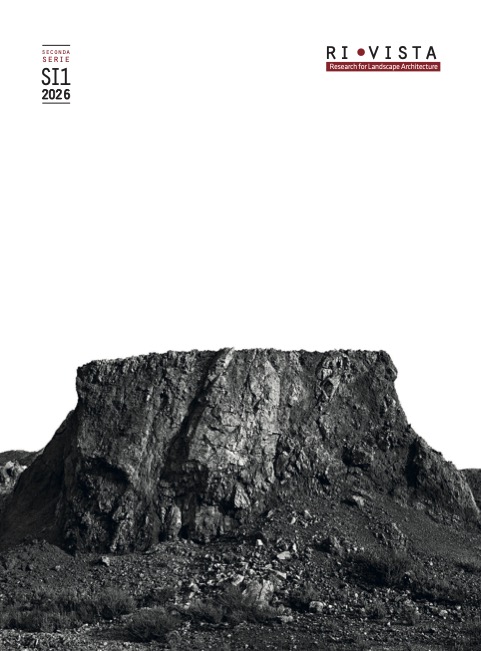
The contribution explores extractive landscapes as fields of design experimentation in the context of climate crisis and energy transition. Extraction is interpreted not only as an economic practice but as a territorial process capable of generating new morphologies, soils, and infrastructures. Two case studies – the Sulcis-Iglesiente in Sardinia and the Alps – provide a comparison between mining legacies and new concessions, highlighting tensions between protection, exploitation, and environmental justice. In Sardinia, technical soils produced by industrial waste are investigated as living layers and opportunities for anthropo-pedogenesis; in the Alps, the return of mining activities prompts reflections on cyclicity, degrowth, and adaptive scenarios. The aim is to outline an operational atlas that overcomes the logic of restoration, embracing instability and transformation as design conditions to imagine new forms of territorial inhabitation.
Il contributo esplora i paesaggi estrattivi come campi di sperimentazione progettuale, alla luce elle sfide poste dalla crisi climatica e dalla transizione energetica. L’estrazione viene interpretata non solo come pratica economica, ma come processo territoriale capace di generare nuove morfologie, suoli e infrastrutture. Due casi studio – il Sulcis-Iglesiente in Sardegna e le Alpi – offrono un confronto tra eredita minerarie e nuove concessioni, mettendo in evidenza le tensioni tra tutela, sfruttamento e giustizia ambientale. Nel primo, i suoli tecnici derivati dagli scarti industriali vengono indagati come spessori vivi e occasioni di antropo-pedogenesi; nei contesti alpini, il ritorno dell’attività mineraria sollecita riflessioni su ciclicità decrescita e scenari adattivi. L’obiettivo e delineare un atlante operativo che superi la logica del restauro, assumendo instabilità e trasformazione come condizioni progettuali per immaginare nuove forme di abitabilità territoriale.
References
- Bachis F. 2017, Ambienti da risanare. Crisi, dismissioni, territorio nelle aree minerarie della Sardegna sud-occidentale, «Antropologia», 4(1).
- Branzi A. 2006, Weak and Diffuse Modernity. The World of Projects at the Beginning of the 21st Century, Skira, Milano.
- Brenner N. 2014, Implosions/Explosions: Towards a Study of Planetary Urbanization, Jovis, Berlin.
- Boi M. E., Sarigu M., Fois M., Casti M., Bacchetta G. 2025, The first inventory of Sardinian mining vascular flora. «Plants», 14(8), 1225. DOI: https://doi.org/10.3390/plants14081225
- Corboz A. 1985, Il territorio come palinsesto, «Casabella», n. 516, pp. 22-27.
- Crutzen P.J. 2006, The “Anthropocene”, in Ehlers E., Krafft T. (a cura di), Earth System Science in the Anthropocene, Springer, Berlino, pp. 13-18. DOI: https://doi.org/10.1007/3-540-26590-2_3
- Davis M. 2006, Planet of Slums, Verso, London-New York. DOI: https://doi.org/10.1111/j.1540-5842.2006.00797.x
- Dryzek J.S. 1987, Rational Ecology: Environment and Political Economy, Basil Blackwell, Oxford-New York.
- Dudal R. 2004, The six factor of soil formation, in International Conference on Soil Classification 2004, Petrozavodsk.
- Escobar A. 1999, After Nature, «Current Anthropology», 40(1), pp. 1-30. DOI: https://doi.org/10.1086/515799
- Escobar A. 2006, Territories of Difference: Place, Movements, Life, Redes, Duke University Press, Durham.
- Gandy M. 2022, Natura Urbana: Ecological Constellations in Urban Space. MIT Press, Cambridge. DOI: https://doi.org/10.7551/mitpress/10658.001.0001
- Girot C. 2005, Four Trace Concepts in Landscape Architecture, in Corner J. (a cura di), Recovering Landscape, Princeton Architectural Press, New York, pp. 59-68.
- Haraway D. 2016, Staying with the Trouble: Making Kin in the Chthulucene, Duke University Press, Durham. DOI: https://doi.org/10.2307/j.ctv11cw25q
- Harvey D. 1989, The Condition of Postmodernity, Blackwell, Oxford.
- Hutton J. 2019, Reciprocal landscapes: Stories of material movements. Routledge, Londra. DOI: https://doi.org/10.4324/9781315737102
- Ingold T. 2011, Being Alive. Essays on Movement, Knowledge and Description, Routledge, Londra.
- Kallis G. 2018, Degrowth, Columbia University Press, New York. DOI: https://doi.org/10.1017/9781911116813
- Keucheyan R. 2019, La natura è un campo di battaglia. Saggio di ecologia politica, Ombre Corte, Bologna.
- Latouche S. 2009, Petit traité de la décroissance sereine, Mille et une nuits, Parigi.
- Latour B. 2017, Facing Gaia: Eight Lectures on the New Climatic Regime, Polity Press, Cambridge.
- Lefebvre H. 1974, La production de l’espace, Anthropos, Parigi. DOI: https://doi.org/10.5565/rev/papers/v3n0.880
- Levin M.J., Kim K.-H.J., Morel J.L., Burghardt W., Charzyński P., Shaw R.K., IUSS Working Group SUITMA (a cura di) 2017, Soils within Cities: Global Approaches to Their Sustainable Management, Catena Soil Sciences, Stoccarda.
- Meulemans G. 2020, Urban Pedogeneses: The Making of City Soils from Hard Surfacing to the Urban Soil Sciences, «Environmental Humanities», 12(1), pp. 250-266. DOI: https://doi.org/10.1215/22011919-8142330
- Mignolo W.D. 2011, The Darker Side of Western Modernity: Global Futures, Decolonial Options, Duke University Press, Durham. DOI: https://doi.org/10.2307/j.ctv125jqbw
- Ostrom E. 1990, Governing the Commons. The Evolution of Institutions for Collective Action, Cambridge University Press, Cambridge. DOI: https://doi.org/10.1017/CBO9780511807763
- Peghin G. (a cura di) 2016, Paesaggi minerari. Tecniche, politiche e progetti per la riqualificazione del Sulcis-Iglesiente, LetteraVentidue, Siracusa.
- Peleman D., Vigano P., Barcelloni Corte M., Ronner E. (a cura di) 2022, The Project of the Soil = De grond van de kwestie, Nai010 publishers, Rotterdam.
- Princen T. 2005, The Logic of Sufficiency, MIT Press, Cambridge.
- Simoni D. 2024, Suoli post-minerari. Verso una metamorfosi dei territori estrattivi in Sardegna, in Formato E., Vingelli F. (a cura di), Strumenti per il governo del valore dei suoli, per un progetto equo e non-estrattivo, Atti della XXV Conferenza Nazionale SIU “Transizioni, giustizia spaziale e progetto di territorio”, Cagliari, 15-16 giugno 2023, Planum, Roma-Milano.
- Tooze A. 2022, Shutdown. How Covid Shook the World’s Economy, Penguin, Londra.
- Waldheim C. 2006, Landscape as Urbanism, in Waldheim C. (a cura di), The Landscape Urbanism Reader, Princeton Architectural Press, New York, pp. 35-53.