External evaluations under quality uncertainty: the market for wine ratings
1 School of Wine & Spirits Business, Université Bourgogne Europe, Burgundy School of Business, CEREN EA 7477, F-21000 Dijon, France
2 Université de Bordeaux, INSEEC School of Business and Economics, France
*Corresponding author. Email: magalie.dubois@bsb-education.com
Abstract. The parallel development of scientific knowledge and technical practices over the last five decades has had a significant impact on sensory wine quality definition and evaluation. We conduct an integrative review of the literature on wine quality evaluation to determine the role of experts in the wine market, considering the recent changes. Following the updated methodology of integrative review proposed by Whittemore & Knafl (2005) [1], we conceptually structure the topic of quality evaluation and valuation in the wine market while critically analyzing the literature. The existence of a market for experts and aggregated peer evaluations is not fully explained by the profitability of the actors involved: wine media and online review aggregators. The residual value necessary for the subsistence of this market seems to be contributed by the wine industry. The present research demonstrates that professional wine evaluation does not meet the demand for quality evaluation and judgment delegation apart from fine wines. Subsequently, with the fall of the search cost for price, information, and expertise, we are witnessing a digital switch toward informal influence. This is to our knowledge the first integrative review spanning the emergence and development of the industry of information and specialized valuation in the major wine markets.
Keywords: information asymmetry, wine ratings, quality evaluation, prescription, digital transformation, online review aggregators, prosumers.
Index
2. Literature analysis: Integrative review approach
2.1 Reasons behind the choice of an integrative literature review approach
3. The market for quality evaluation
3.1.1 Wine experts: only the best rated by only the best
3.1.2 Online review aggregators: all rated by all
3.2.1 Wine consumers: lowering search costs effect
3.2.2 Fine wine investors and collectors: warranty effect
3.2.3 Wine producers and organizations: signaling quality as marketing strategy
3.2.4 Wine distributors and retailers: quality signaling as an intermediate product
6. Limitations of the study and future research directions
The issue of uncertainty concerning a product’s quality represents a significant area of focus within the field of economics. In particular, the seminal work of Akerlof (1970) [2] and Spence (1973) [3] have highlighted the association between information asymmetry, a particular type of market inefficiency, and the necessity for quality signaling through product certification. Under information asymmetry, the advice provided to the less informed agents in the market becomes a valuable service for which a market may emerge. Contrary to the predicted consequences of informational asymmetries under quality uncertainty, the spontaneous emergence of an “intermediate market” for quality assessment by independent evaluators has received scant consideration. In fact, the theoretical foundations for the emergence of such a market without the need for a formal certification-conferring authority are anything but clear.
Compés-López et al. (2018) [4] suggest that an industry of information and specialized valuation has emerged in the major wine markets. Similarly, various papers refer to the existence or the emergence of a wine quality evaluation market, at the crossroads between wine sellers, wine buyers, and wine experts (e.g. [5],[6]). The present research proposes an integrative literature review of 267 papers (including publications from conference proceedings) on wine ratings, reviews and scores published from 1970 onwards retrieved from the Web of Science, Science Direct, Scopus, and Google Scholar databases. The objective of this integrative literature review is to collect and report some features identified so far in the literature, which should be considered in future theoretical and empirical analysis of such spontaneous intermediate quality evaluator markets. More specifically, it aims to provide a comprehensive overview of the existing research on wine ratings.
The review suggests the existence of an expanding two-sided market structure (this can be likened to the case of media, payments systems and matching markets) because the demand for expert opinion from wine consumers does not generate sufficient income to sustain the suppliers. Wine media must therefore subsidize readers (demand side one: customers) and make money out of advertisers or competition entry fees (demand side two: wine trade). Meanwhile, online review aggregators (platforms that gather user-generated reviews on different products into one easy-to-view dashboard, as is the case with Vivino) subsidize the free of charge (zero price) of online prosumer (in this case wine consumers who actively share their product experience participating in the production of wine reviews) reviews by charging commissions on sales (or by selling wine directly to their users) and selling both promotional services and data intelligence to the trade. Our integrative literature review highlights the fact that the survival of both experts and online review aggregators is dependent on the trade.
To the best of our knowledge, our paper represents a pioneering discussion of the complementarity of the two quality signal sources (experts and peers), each associated with a specific demand type. In this respect, it provides useful support for recent developments on (two-step) hedonic functions by type of actor [7]. At a more foundational level, our findings offer a promising avenue for exploring the potential implications of such an information market on the wine market, particularly in terms of marketing, operational and strategic management, and finance.
2. Literature analysis: Integrative review approach
2.1 Reasons behind the choice of an integrative literature review approach
In contrast to systematic literature reviews, integrative literature reviews are more flexible ways to synthesize existing research. It allows for a diverse range of sources, including theoretical, qualitative, and quantitative, to be incorporated in order to develop new frameworks, identify potential research gaps, and provide a comprehensive understanding of a given topic. Because research on wine evaluation is fragmented, originates from different fields (e.g. economics, marketing, sensory sciences, linguistics) and uses multiple study designs and methodologies (e.g. hedonic price function, experimental economics, content analysis, principal component analysis), the use of an integrative literature review is indicated [8]. Integrative literature review methodology proves particularly useful when studying a recent change in the direction of a phenomenon [8] such as the emergence of peer evaluation as the source of a potential paradigm shift in the wine evaluation market identified by Bazen et al. (2022) [9]. Unlike systematic reviews, integrative literature reviews are versatile, they allow the use of “grey literature” such as conference proceedings [10]. We acknowledge that those publications do not offer sufficient guarantees as validated knowledge, but we consider that the importance of the insight they provide in the study of a recent phenomenon is a sufficient justification for their careful consideration.
Following the integrative literature review methodology revised by Whittemore & Knafl (2005) [1], we structure the topic of quality evaluation and valuation in the wine market. A comprehensive literature search is conducted across multiple databases, including empirical studies (e.g. [11]), theoretical papers (e.g. [12]), and grey literature (e.g. [13]) using specific inclusion and exclusion criteria to ensure relevance. Subsequently, the quality and relevance of the selected studies are subjected to critical assessment using staged review. The data analysis phase entails the identification of themes and patterns through thematic analysis, with the findings subsequently organized into coherent themes. Ultimately, the review synthesizes the findings into a coherent narrative, highlighting research gaps.
The vocabulary used to refer to quality evaluation, quality signaling and quality evaluation intermediaries in the wine market is extensive (see Table 1).
| Themes | Keywords | Examples of references |
|---|---|---|
| Experts | expert*, critic*, guru*, connoisseur*, rater*, assessor*, judg*, jur* | Ali et al., 2010 [14] Brien et al., 1987 [15] Gokcekus & Gokcekus, 2019 [16] Honoré-Chedozeau et al. 2015 [17] Parga-Dans et al.,2022 [18] |
| Peers | peer*, apps, crowd-sourced, pannel*, prosumer*, influenc*, opinion, community | Buonanno et al., 2008 [19] Oczkowski & Pawsey, 2019 [20] Thrane, 2019 [21] |
| Quality evaluations | quality, competition*, show*, rat*, scor*, review*, award*, medal*, apprais*, evaluat*, valu*, appreciat*, prescri*, advi*, recommend*, apprais*, assess* | Bessy & Chauvin, 2013 [22] Cicchetti, 2009 [23] D’Alessandro & Pecotich, 2013 [24] Dunphy & Lockshin, 1998 [25] Neuninger et al., 2017 [26] Paroissien & Visser, 2020 [27] |
| Intermediation | intermedia*, mediat*, coordinat*, tier-part*, opinion leader*, | Bessy & Chauvin, 2013 [22] Hsu et al., 2007[28] Karpik, 2007 [29] Sharkey et al. 2022 [30] |
Considering this diversity, we have deliberately opted for broad inclusion criteria to capture the evaluative content produced by experts and peers. Using Boolean logic, the search strings in Web of Science, Science Direct, Scopus, and Google Scholar databases consisted of the terms wine ratings, wine review, and wine scores, including synonyms, and abbreviations. Recently published peer-reviewed articles and earlier literature (from 1970 onwards) published in English were searched. We also reviewed the articles citing the articles obtained through this search as well as their references to identify further potentially relevant studies. The record selection process is displayed in Figure 1.
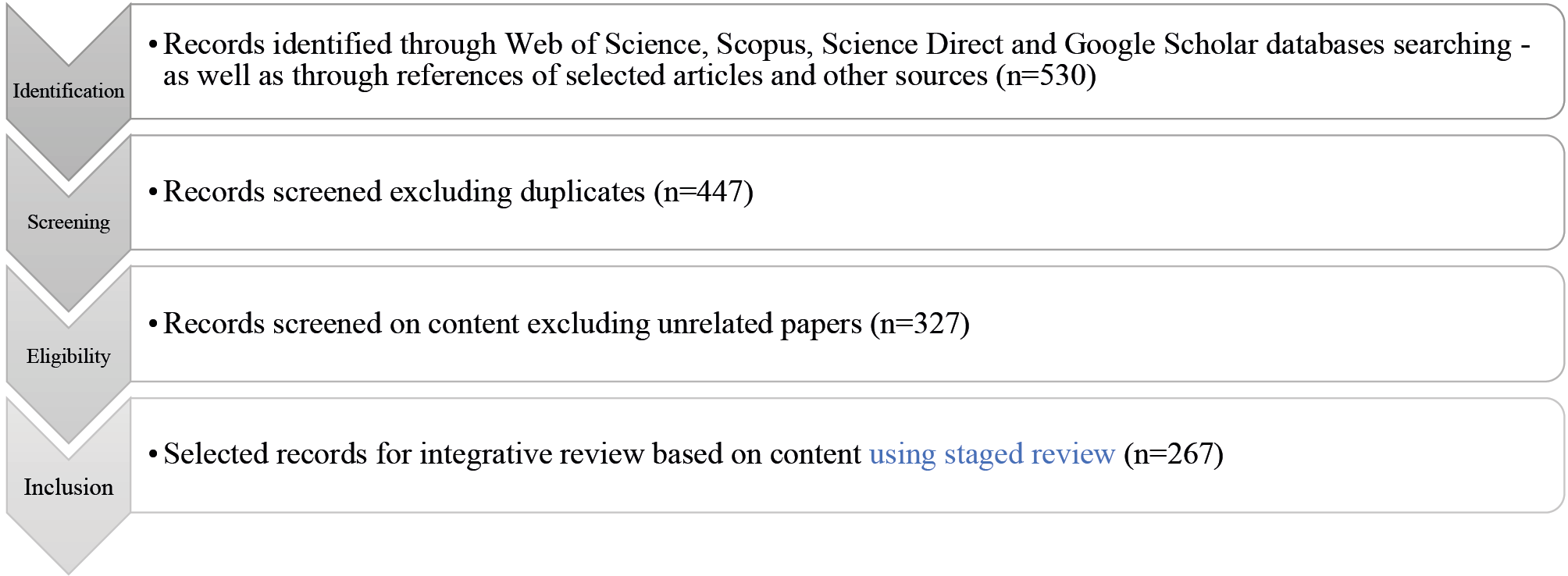
A total of 530 books and papers published prior to July 2023 were identified and 83 duplicate records were removed prior to screening. Subsequently, the remaining records were screened on the basis of content, with 120 papers (in particular, those comparing the sensory performances of experts and consumers) being excluded. Ultimately, 267 papers were selected for the integrative review following detailed analysis using staged review. The number of records per year in the final selection appears in Figure 2.
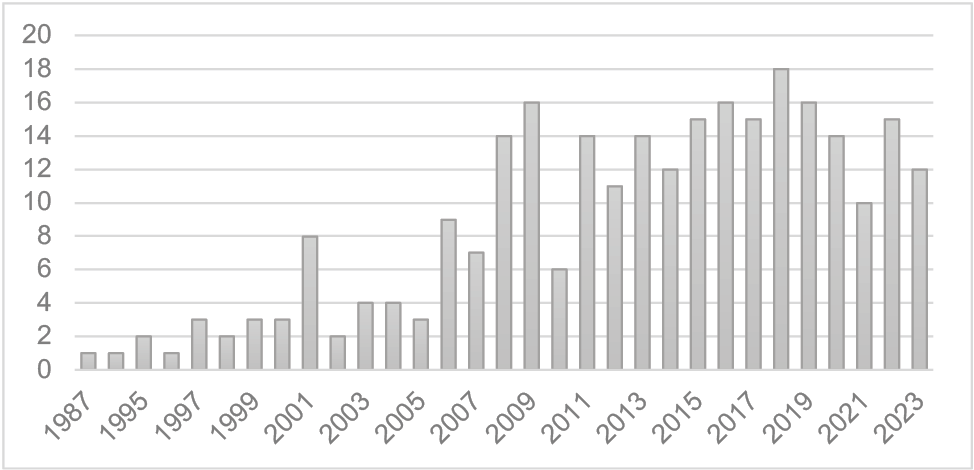
Among the records selected for the integrative review, the Journal of Wine Economics, first published in 2006, is by far the best represented (59), followed by the International Journal of Wine Business Research (16), the Journal of Wine Research (18), and Food Quality and Preference (13). The overview of all final used papers within the scope of the integrative literature review is available in the Appendix.
The analysis of the literature is facilitated by the deconstruction of the topic into the key relationships and interactions between the supply and demand sides of wine quality information.
3. The market for quality evaluation
3.1.1 Wine experts: only the best rated by only the best
Definition
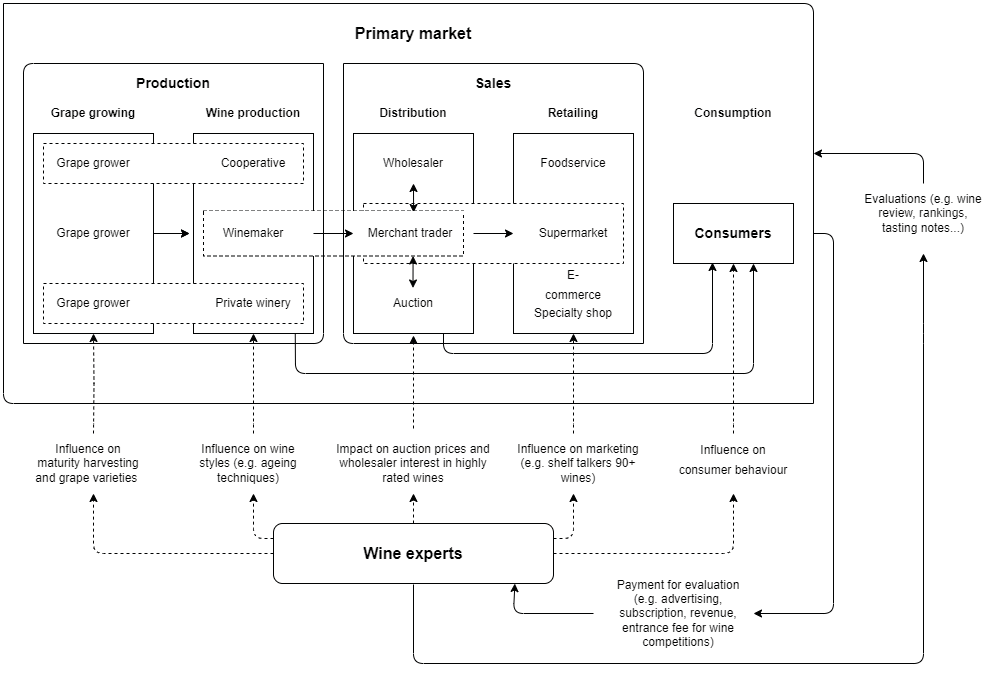
Professional wine experts possess both conceptual knowledge (of terroirs, grape varieties, vintages) and perceptual (sensory) knowledge of wine [31],[32]. While opinion leaders are traditionally difficult to identify, since the 1970s professional wine expert tasters have identified themselves through their public roles [33]. According to Fernandez (2004) [34], in the wine market, the core of wine critics’ activity remains the publication of wine reviews and consumer guides: their opinion is their living. The most influential publications in this field include Decanter, The Wine Spectator, the Wine Advocate and a number of prominent individual critics, such as James Suckling, Jancis Robinson and Tim Atkin. Figure 3 presents the main interactions between wine experts and the stakeholders of the primary market.
Rated wines
Given the constraints on the number of bottles that they are able to taste and evaluate on an annual basis, experts tend to prioritise their prescription work on fine wines, which are characterised by higher prices and superior reputations1. The Wine Spectator tasting team reviews more than 15,000 wines a year, they also exclude thousands of (often non-premium) wines from their selection [35]. The majority of these businesses have come to rely on solicited samples to maintain a sustainable equilibrium within their business models. The reliance on solicited samples might explain the censorship applied to negative reviews by wine experts [36]. A negative rating on one vintage could jeopardize the possibility of receiving samples the following year [34],[37],[38]).
Top critic scores are crucial globally for en primeur [14],[39], however, it is a common practice amongst producers of super-premium wines to decline participation in blind reviews; the potential for an unfavourable assessment to generate adverse publicity is a significant concern in this regard. Nevertheless, quality ratings hold little significance beyond the domain of fine wines [40–42].
Audience
The market structure for experts is complex due to the diversity of their publishing channels2: they can own publications, wine magazines, specialized and general print press, and online channels [43–44]. According to Storchmann, discussing the US wine market fifteen years ago (2012, p. 22 [45]), “The market for expert opinion on wine is large. The seven major U.S. wine magazines have a combined subscribership of more than 500,000, with 350,000 alone for the Wine Spectator; wine magazine sales total more than $25 million”. Today, most of the wine publications mentioned by Storchmann in 2012 (data from 2010) have increased their readership base. The three major U.S wine magazines (Wine Spectator, Wine Enthusiast, and Wine & Spirits) have a combined subscribership of more than 750,000, with 389,000 alone for the Wine Spectator [46]. Online marketplaces also supply wine critics (especially English-speaking ones) with a much wider network of prescriptive channels and reach than ever before [47–48].
Still, researchers deplore the difficulty of determining the area of influence beyond publications and subscribers, as well as the scarce availability of figures on publications and sales of magazines and guides dedicated to wine [49]. We know that wineries are important customers for guidebooks, as they tend to share them among themselves [50]. However, there is no mention made in the literature of the proportion of this subscription or of the purchase of guides actually generated by the trade (e.g., wine producers, distributors, retailers) and not by wine consumers3. Likewise, the subscriptions figures do not reveal possible overlap (especially among professionals) nor the indirect reach of experts (e.g., one magazine can be read by multiple readers, word of mouth).
Business model
The main source of revenue for wine critics and magazines is circulation and advertising revenue as well as subscriptions to access their ratings: their value for advertising increases with the number of readers. When critic’s ratings are not displayed in store or online at zero price, wine consumers are usually charged with positive prices (subscription) to access them.
Criticisms
Wine experts have been found to be less reliable and consistent than experts in fields such as medicine, clinical psychology, business, auditing, personnel management, or meteorology [51]. They have even been charged with opportunistic behavior, grade (rating) inflation, and conflict of interest [22]. The accuracy of wine experts’ judgment has been challenged, particularly by Ashenfelter & Jones (2013, p. 1[52]): “the expert opinions are not efficient, in the sense that they can be easily improved, and that these opinions must be demanded, at least in part, for some purpose other than their accuracy”. In his study of publication bias in Wine Spectator, Reuter (2009) [53] suggests that wine consumers may be more tolerant of review bias than consumers of other product categories, due mainly to the subjectivity of wine tasting
The business model of experts is based on two main revenue streams: subscriptions and the sale of advertising space. Although there is no evidence to suggest that advertising spending directly impacts wine scores, it can be posited that companies which invest in advertising within wine publications are more likely to be chosen by wine critics to have their wines tasted. The wine magazines could be suspected of opportunistic behavior to attract more advertisers (wine sellers). However, Reuter (2009) [53] studying Wine Spectator publication bias (product coverage and review) concluded that advertising influences ratings only on the margin, particularly enhancing retasting of wines rated less than 70 during the first single-blind tasting. According to him, wine media’s readership is a function of both subscription prices and the publication’s reputation for being unbiased [53].
Experts rate, usually blind tasting, both the present and future value of wine, while peers rate it, usually not blind, only through the scope of their current appreciation [54]. This leads Schiefer & Fischer (2008) [55] to question the usefulness of wine experts’ ratings as a predictor of wine consumer liking and to infer that most expert ratings do not reflect consumer taste. Even though the prior knowledge of price, brand and reputation may bias their appreciation [56] peers may be more relevant than experts to super-premium available wines for example, because they may taste them more often than critics. More bankers than wine critics can afford drinking/tasting Domaine de la Romanée Conti.
Future perspectives
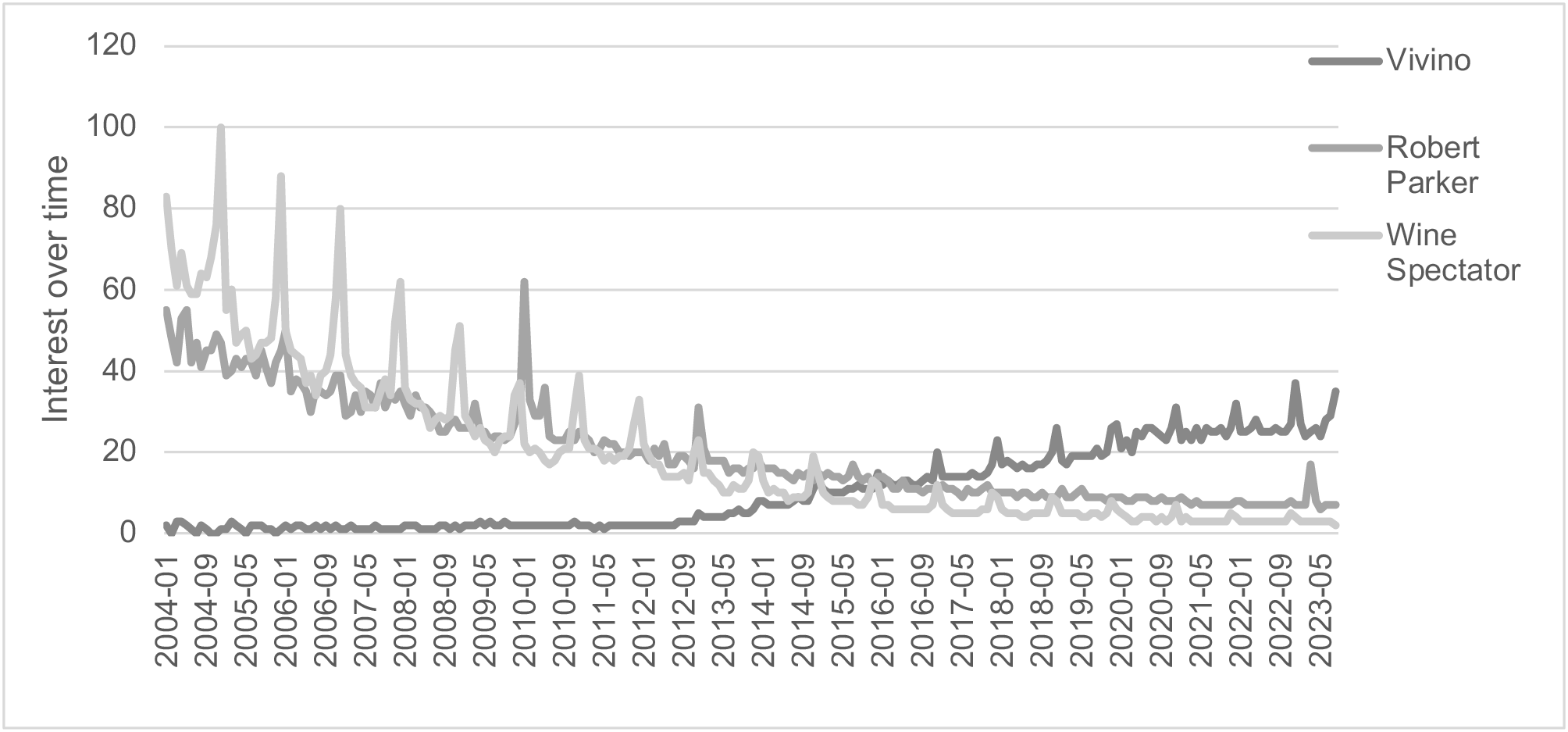
The evolution of other experience goods markets, such as art or hospitality, foresees the disappearance of experts in favor of peer recommendations [57–58]. Cox & Kaimann (2015) [59] predict that the growing influence of word-of-mouth and consumer-generated content in consumer purchase decision-making could decrease consumers’ reliance on the opinions of experts or professional critics. Clauzel et al. (2019) [60] recommend that experts capitalize on the empowerment of consumers by integrating prosumers’ reviews into their content, alongside their own ratings. A similar trend (see Figure 4) might be ongoing in the wine industry [61–62].
3.1.2 Online review aggregators: all rated by all
Definition
A participatory culture is emerging among consumers [63]. Unofficial and informal prescription is gaining importance in the wine market; consumers’ tastes (general hedonic rating) prevail over quality evaluation because the personal taste is simply more relevant than quality when choosing a wine [55]. Experts are no longer the only benchmark for quality, the wisdom of the crowd is gaining prevalence for knowledge construction and evaluation [57]. With the internet and the emergence of online ratings, wine consumers have shifted from passive to active purchase evaluation, and their comments displayed online provide an informative signal of quality [64]. “That is democracy at an organoleptic level; it is subjective individualism raised to a moral principle.” (Shapin, 2012, p. 83 [65]). The wine drinkers who share their wine-tasting experience on platforms like Vivino, CellarTracker or Delectable also produce information about wine quality. Online review aggregators bundle this (prosumers) user-generated content (UGC) to provide quality information to other users, creating what Chan et al. (2022) [66] call “prosumers communities”.
Rated wines
The remarkable sales figures of The Wine Trials [67] indicated a potential demand for more consistent evaluation of everyday wines. Prosumer communities cover all wine categories without discrimination4. Online review aggregators have expanded the market for wine quality evaluation, providing ratings where they were not available before (cheaper wines) and supplying those ratings aggregated at zero price (free of charge).
Audience
The world’s largest online wine rating community and marketplace, Vivino, claims no less than 29.9 million users and 89.4 million ratings. The first academic mention of Vivino in a working paper dates back to 2018 [68]. The evolution of the number of users, wines, wineries, scanned labels, and ratings since 2014 is detailed in Table 2.
| Year | Users | Wines | Scanned labels | Ratings | % of wines rated | Reviews | % of wines reviewed |
|---|---|---|---|---|---|---|---|
| 2014 | 4,762,336 | 1,298,332 | 40,322,319 | 10,496,576 | 26% | 2,329,346 | 6% |
| 2015 | 10,332,744 | 6,826,573 | 147,057,872 | 29,878,575 | 20% | 9,794,912 | 7% |
| 2016 | 17,055,145 | 8,983,693 | 250,731,923 | 45,999,716 | 18% | 15,890,474 | 6% |
| 2017 | 23,012,455 | 10,573,756 | 375,347,597 | 64,499,224 | 17% | 21,731,482 | 6% |
| 2018 | 35,464,050 | 10,573,996 | 834,357,775 | 123,819,828 | 15% | 42,025,965 | 5% |
| 2019 | 36,911,161 | 10,868,691 | 892,534,812 | 130,613,064 | 15% | 44,550,050 | 5% |
| 2021 | 51,880,356 | 13,625,480 | 1,629,548,572 | 207,065,136 | 13% | 73,297,000 | 4% |
| 2022 | 57,881,172 | 15,003,610 | 1,959,609,646 | 234,159,998 | 12% | 83,915,528 | 4% |
| 2023 | 64,582,058 | 16,647,522 | 2,429,210,838 | 272,963,324 | 11% | 95,343,375 | 4% |
Vivino’s wide adoption has been facilitated by the rise of apps use from more than 2.7 billion users [69]. Comparatively, CellarTracker, another online review aggregator and inventory management tool5 mostly used by wine collectors, claims 4.3 million wines and 11.8 million community and professional ratings (compared to 7 million in the summer of 2018).6 Its users (232,000 in 20127) manage more than 164 million bottles in their private cellars and have access to professional experts’ ratings, market value, and inventory management [70–71].
Business model
The business model of online review aggregators revolves around user-generated content, monetized through advertising, premium subscriptions, affiliate marketing, and data analytics. These platforms provide a space for users to review, rate, and discover wines while offering targeted advertising opportunities for wineries and retailers. Premium subscriptions unlock advanced features like cellar management tools, expert recommendations, or exclusive content. Revenue is also generated through affiliate partnerships, directing users to purchase options and earning commissions, as well as by licensing anonymized consumer data to industry stakeholders for market insights.
Criticisms
Online review aggregators declare tackling the negative review censorship issue8. However, they fail to mention three major issues with community ratings. First, the under-reporting bias [72]: prosumers might not be willing to spend (waste) time scanning, rating, or reviewing the wines that they dislike. Under-reporting leads consumers to comment only on the wines they liked or disliked a lot. Second, the acquisition bias [73]: a positive predisposition towards a wine enhances purchase and comment generation likelihood. Ultimately, beyond these two forms of self-selection bias remain the considerable variations in wine knowledge levels of the users, along with the significant problem of fake reviews [74].
Future perspectives
The limitation of expert wine evaluation to fine wine and the complexity of the evocative vocabulary have created an opportunity for peer-reviewing [75]. The importance of crowdsourcing prosumers’ opinions is increasing, and so is their impact on the market [36],[76]. More specifically, hedonic price function estimates suggest that wine prices are better explained by online community rating scores than by expert ratings [20],[77].
To sum up, there are two sources of quality ratings in the wine market, offering heterogeneous information products (experts versus community ratings) at different prices (positive versus zero-price i.e. free of charge). Historically dominated by wine experts (reviewing only fine wines), evaluative intermediation now reaches cheaper wines and a wider audience with online review aggregators (see Table 3). This has the effect of complicating the determination of whether they may be considered substitutes or complements.
| Supplier | Source | Rated wines | Scale | Typology | Main users | Credibility based in | Consumer Price |
|---|---|---|---|---|---|---|---|
| Content review aggregators | Prosumers | All ranges | Over 5 | Inclusion & Algorithmic egalitarianism (synthesis of the ratings) |
Wine consumers | Number of ratings (aggregation) | Free |
| Media | Experts | Fine wines | Over 100 (or over 20) | Selection & reviewer’s singularity or editorial elitism |
Wine consumers, investors & collectors, Producers & organizations, distributors & retailers | Taster’s or media’s reputation of being unbiased |
Free if provided by a seller / positive price in other cases (subscription) |
3.2.1 Wine consumers: lowering search costs effect
Most consumers declare that liking a specific wine they tasted before is the most important reason for their (re)purchase [78],[79]. However, previously purchased wines are not systematically available for purchase (see on-trade for example). Since wine is an experience good, wine quality evaluation only occurs through post-purchase consumption. Wine consumers are subject to information asymmetry. Moreover, unlike in other markets (education, finance), the wine market offers no homogenized institutional quality signaling system at a global level [80]. The high complexity and heterogeneity of existing quality signaling systems (e.g. Geographical Indications in the European Union and the United States) can be perceived as confusing by consumers, who may look for alternative sources of quality information [81–83]. More broadly, the complexity of the wine market is a source of consumer confusion and qualifies wine buying as a risky activity for most wine consumers [84].
When confronted with uncertainty about product quality, consumers often use multiple product quality cues as proxies for quality [85],[86]. Another solution to cope with this confusion is for consumers to rely on better-informed agents when making their decisions [87]. These third parties supply homogenous information mapped on a single rating scale comparable among wines [62]. To reduce perceived risks when selecting a wine and to maximize their satisfaction, wine consumers can delegate quality judgment to others [29]. They seek the advice of wine experts, friends, family members, and clerks who are deemed knowledgeable [88]. There is a wide literature on wine experts focused on perceived risk reduction and subsequent purchase intention stimulation [89],[90],[91]. Although experiential information has the highest informational content, sources of quality evaluation such as peers have not been extensively investigated [92].
3.2.2 Fine wine investors and collectors: warranty effect
The classification presented here is the result of a balanced structure within the paper itself, rather than the result of the preferences of fine wine investors and collectors being homogeneous. However, Masset (2024) [93] suggests that the preferences of investors and collectors are equally influenced by the reputation of wines. Since professional wine experts work as proxies for rating agencies, wine critics’ scores have opened the market for Bordeaux fine wines to investors [94]. The financial indices of Liv-ex.com were built using wines rated 95 and above by Robert Parker [95]. Liv-Ex is nowadays the primary electronic exchange platform for trading fine wine. Merchants, brokers, retailers, and consumers can use the platform to purchase these wine futures in advance of their distribution for retail operations. Along with the process of financialization in the fine wine market, several economic studies have shown the correlation between experts’ ratings, en primeur, and auction prices (e.g. [11],[22],[96]). Wine is the only agricultural market to have reached such a valorization of variability in the premium part of its market [97]. But there might be an interdependency here since in her attempt to identify the macroeconomic determinants of fine wine prices, Jiao (2017) [98] concluded that the increasing volatility of prices triggers demand for expert appraisal from fine wine investors. The influence of expert information on price is subject to variation over time. In a hedonic analysis of fine wines, Faye & Fur (2019) [99] demonstrated that, in contrast to the Parker score, the Quarin (French critic) score exerts a remarkably stable influence on price. Similarly, it may be posited that the influence of peers on valuation is likely to be contingent on price levels [100].
3.2.3 Wine producers and organizations: signaling quality as marketing strategy
The determination of wine prices is no longer solely contingent upon production costs. Instead, they are also influenced by the collective reputation of the region or geographical indication, as well as the individual reputation of the brand [49],[101],[102],[103],[104]. The marketing of quality, a key element of a differentiation strategy for wine producers, involves close contact with critics as part of their communication and reputational strategy [105]. Evidence abounds that reviews of professional critics enhance commercial success, though consumer sensitivity to reputation is higher for premium, super-premium, and icon wines [59],[106]. Wine reputation is positively correlated with expert ratings [20]. Collective reputation is shown to have an impact on consumers’ willingness to pay, which rises in line with the reputation of individual wine producers [102]. The individual reputation of wineries will also enable them to select their retailers and distributors depending on the positioning they wish to reflect: hotels, restaurants, independent wine stores and export for fine wines, and supermarkets for bigger-volume wine producers [107]. This explains why, for high-end wineries, reputation management can become almost as important as revenue management [108]. Organizational reputation has become a strategic intangible asset for firms and is one of the most important drivers of their success [109], which is why some companies place wine critics at the core of their marketing and communication strategy [110].
Wine critics benefit from close contact with wine producers enabling them to publish interesting articles and well-informed reviews. They reciprocate by disseminating products and company messages [111]. “Producers, and intermediaries such as distributors and retailers, often use favorable reviews to promote products, resulting in a multiplier effect for evaluation where the eventual audience can be far broader than the direct audience (e.g., paid subscription).” (Kwon & Easton, 2010, p. 136 [95]).
3.2.4 Wine distributors and retailers: quality signaling as an intermediate product
The academic literature has studied the effect of shelf-talkers (product cards including ratings that appeal in stores) on sales, and shown from early on their positive correlation with sales: scored wines outsell non-scored wines in retail studies (e.g. [112],[113]. Retailers are therefore encouraged to use a wide range of wine experts’ references in shelf talkers that will boost their sales. Distribution networks are increasingly important in the wine evaluation market, reflecting the transformation of economic competition into a more vigorous struggle for attention and visibility [50],[95],[114]. Hsu et al. (2012) [115] and Hennion (2015) [116] underline the importance of evaluative schemata (mental representations of evaluative categories) and procedure clarity, to help both consumers and producers cope with uncertainty, and to allow producers to anticipate quality assessment and adequately adjust their production strategy. Even when distributors, retailers, or sommeliers state that they do not pay attention to ratings, their audience base (customers) might force them to recognize the judgment of critics and to adapt to it, listing iconic 100-point wines, for example [117]. Bazen et al. (2023) [77] additionally highlighted the increasing significance of Vivino ratings for wine importers.
Even though the empowerment of the vox populi in the wine market has been noticed for almost two decades, the existing literature about online consumer-generated content on wine remains scarce outside of the context of wine tourism [118]. In a recent European survey, more than 30% of the 7,324 respondents stated that they had a wine app on their mobile phone9 [119]. Nevertheless, only a limited number of papers have integrated prosumers’ reviews in their reflection (e.g. [62]) or compared their relative influence with experts’ ratings using empirical (e.g. [20],[77]) or experimental methods [19],[21],[120]. Still, part of the literature available on the topic consists of working papers, unpublished in peer-reviewed journals to date [20–21,56,121–123], In 2022 only, more than 10 projects using Vivino data were presented at the three major wine economics and business conferences in 2022 (European Association of Wine Economists, American Association of Wine Economists, Academy of Wine Business Research). The most recent publication available investigates the emotional response to Vivino reviews exposure [124]. As there are to date no published studies that used other methods than hedonic price analysis to compare the influence of peers’ and experts’ ratings in the wine market. The results reported here should be considered as part of a larger effort to develop more empirical research about the wine evaluation market.
Analyzing both sides of the market, this review highlighted the financial reliance of wine experts and online review aggregators on the wine trade. Both expert and consumer assessments of quality are similarly uncertain and susceptible to various biases. This may provide an explanation for the reluctance of consumers to pay a premium for these services. This review highlighted the fact that only a tiny proportion of the ratings users are willing to pay for a subscription to get access to wine evaluations. While the majority of consumers do not disregard the value of ratings when obtained for free, they are not willing to pay for it10 [80]. This is why a vast majority of experts rely on free requested samples and advertisement income to carry out their activities. Without the sale of advertisements (and more recently other side activities like competition or events), most wine publications would not be profitable [53]. Nor would the online review aggregators without the sale of wine promotional services and data [126]. The present integrative literature review reveals that both revenue models are based on two-sided strategies (See Figure 5).
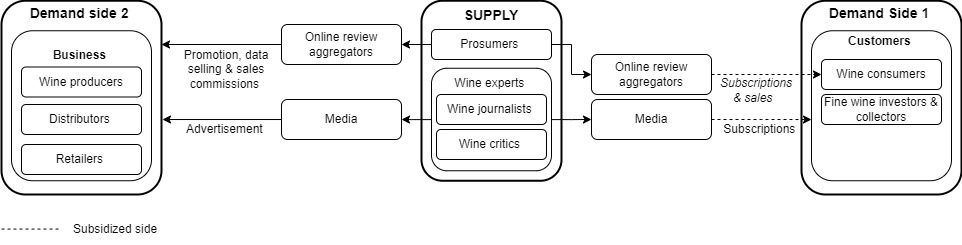
According to Evans (2003) [127] in two-sided markets, the intermediaries must (1) select a price and (2) use a differential pricing structure (not only how much they will charge, but to whom). They usually skew the prices on the less price-sensitive side of their two sets of customers. The wine valuation market behaves like a two-sided market when suppliers subsidize one side of the market to earn profit from the other side.
Experts’ ratings reach three different categories of stakeholders: industry readers, consumer readers and consumers who see scores in the store or online (not to mention word of mouth from any of those three categories of stakeholders). Wine consumers, investors, and collectors can pay to get access to most of the media through which expert reviews are conveyed: Magazines, guides, and online reviews. But information is also made available at zero price (often in exchange for viewing advertisements on the platforms) to consumers: wine ratings and awards are frequently displayed in both online and brick-and-mortar shops.
Meanwhile, online review aggregators provide free ratings to their users. Those free ratings inform the customers of their marketplace, which positively impacts sales (including commissions or sales margin). Wine producers, distributors, and retailers do not pay to have their wines listed by online review aggregators. Prosumers review wines for free through their smartphones or computers. But producers must pay if they want to correct inaccuracies in the information available about their wines on the platform, advertise their production (enhancing their profile or purchasing triggered email campaigns), or purchase data about specific markets and consumers’ preferences (brand awareness, engagement, sales)11. Wine producers, distributors, and retailers also pay fees to list their wines in competitions (and potentially receive an award), and to advertise in the wine media. Based on the review of the literature, Table 4 presents the two-sided strategies for experts and online review aggregators.
| Two-sided market | Side one | Side two | Subsidized side | Cost structure | Source of revenue | Prospect |
|---|---|---|---|---|---|---|
| Online review aggregators | Wine consumers | Wine producers and business | Wine consumers – zero price for ratings | Platform maintenance, Analytics and Insights, Marketing | Wine consumers through direct wine selling | Growth |
| Wine producers and Business through promotional services, data intelligence & sales commission (marketplace) | ||||||
| Wine media | Readers | Wine producers and business | Readers | Content creation, Publication, Distribution and Marketing | Readers subscriptions | Slow decline |
| Advertisements from wine producers & business |
Online review aggregators in the wine market benefit from both positive same-side and cross-side network effects. The increasing number of Vivino users, for example, feeds the platform and increases its utility to other users (same side). At the same time its value as a data provider or as a marketplace for wines increases with the number of potential customers (cross-side). It is possible for new players to enter the evaluation market at a limited cost; however, new online review aggregators will suffer from a competitive disadvantage, as the utility they offer both their users and potential customers of data or marketplace solutions depends on their number of users. Conversely, the path to success for new experts lies in building awareness and establishing credibility which typically takes time,
Two sources of wine ratings coexist on the market: experts and online review aggregators. While the literature on wine experts is extensive, the one on online review aggregators remains scarce. The supply of professional quality evaluation (wine experts) is characterized by its multiplicity and fragmentation over the years whereas online review aggregators offering for-free content are highly concentrated in the market, corroborating the conclusions of Barnett (2018) [128]. In other experience goods markets, such as hospitality, the influence of peer ratings now surpasses the influence of experts’ ratings. In the wine market, their coexistence illustrates two different definitions of quality. Professional wine experts focus on fine wines, charge positive prices to access their ratings (subscription) and impact the entire value chain (production, sales, consumption). In the meantime, peers rate all kinds of wines, for free, across a wider price range. While the Wine Spectator experts claim to produce 15,000 wine ratings a year, the Vivino community produces more than 31 million12. While the Wine Advocate prides itself on the 450,000 ratings housed in their online database, Vivino has 620 times more. If online review aggregators become the dominant evaluation source on the market, they could similarly influence the market and different wines could be favored. Since they rate all wine segments, it may lead to a renewal of the demand for less high-end wines globally.
This integrative literature review of the recent trends underlying the market for wine quality evaluation reveals various interesting patterns. Even though the importance of experts is decreasing, the wine market is likely to sustain both peer and expert quality information sources in the long run (they complement rather than substitute for each other). Their coexistence is likely to sustain and stimulate the E-commerce market for wines in the coming years, including direct-to-consumer (DTC) sales. The literature review has revealed that both sources of ratings base their business models on a two-sided strategy and could not be sustainable without the trade. Online review aggregators offer free access to wine drinkers’ reviews and use the generated data to source and sell popular and high-rated wines to their users. In the meanwhile, they also act as marketplaces, collect sales commissions, and sell promotional services as well as data intelligence to the industry. Based on this review we do not foresee a disappearance but a decline of wine experts (in the limited perimeter of fine wines), and a rise of the importance of online review aggregators in the wine evaluation market globally. Pure content producers such as The Wine Advocate, who employ one-sided structures (subscriptions are their only source of revenue), are likely to remain small13 and be disfavored by competition against online review aggregators as their consumer base grows older. The predictions identified by this literature review are in line with the conclusions of Kwon & Easton (2010) [95] and suggest that the future lies in hybrid internet-based evaluation aggregators, like Vivino, that combine the functions of review aggregator and marketplace.
This review has important implications for managers. With the expansion of the audience of online review aggregators emerges the possibility that the so-called “wisdom of the crowd” (or “preference of the crowd” [62]) channels attention to a limited number of products already favored by other consumers. The importance of a plurality of supply of wine evaluations is therefore of prime importance for the sustainability of the wine market: online review aggregators inform customers, complementing the work of wine experts that attract attention to producers. Online review aggregators contribute to the stabilization of a hierarchy in which professional experts sustain the variability of an artistic fine wine market where no two wines should be perfectly identical, even to two vintages of the same wine (see [97]).
6. Limitations of the study and future research directions
This study has integrated fragmented literature in the domain of wine quality information intermediation following the integrative literature review methodology revised by Whittemore & Knafl (2005) [1]. We acknowledge that combining diverse data sources and methodologies can be challenging. Despite the adoption of an exhaustive data collection strategy, the selection of inclusion criteria might have led to the omission of parts of the literature. For example, the Journal of Wine Economics, the leading outlet of articles related to the scope of the thesis, did not require keywords until 2013, which may have resulted in some missing references. An investigation into the ripple effects that the wine evaluation has on the wine market would have provided valuable insight. However, such an estimate is complicated by the opacity of the transactions (e.g., advertisements, price of promotional services or data intelligence) between stakeholders in the market. Seemingly, the value generated by the wine evaluation market cannot be easily measured through price. In the light of our findings, it would also be interesting to tackle the question of the long-term viability of expert ratings in the wine industry.
The disappearance of the border between the marketplace and prescription is also a central question for the wine industry. The acquisition of prosumer data gives online review aggregators access to valuable knowledge about consumer preferences that may provide them a competitive advantage over traditional competitors (experts). Online review aggregators can, as Vivino does, purchase and sell themselves the wines they have identified as being the most popular or the wines with highest potential according to their users and earn a direct sales margin instead of a commission on sales. Artificial intelligence is set to enhance the worth of this category of data, enabling a more precise targeting of consumers and sales of wine. Similarly, finding out how online review aggregators may affect wine producers’ marketing strategies would be of utmost interest to the industry.
When wine experts supply information on wine quality, online review aggregators also provide their users with a personalized likelihood of liking based on past evaluations. The consumer purchasing path has been fundamentally transformed by recommendation systems, offering customized choices while obviating the requirement for intensive information search [129]. The rating of a wine does not tell you how it tastes, nor if you will like it. How do consumer past evaluations influence their likelihood to adhere to personalized recommendations generated by algorithms? The exploitation of consumer data by wine sellers (sourced from online review aggregators) to mitigate the information asymmetry prevalent in the wine market (by gaining insight into consumer preferences) is likely to emerge as a key research area in the near future.
The authors deeply appreciate the insightful comments provided by Larry Lockshin, Günter Schamel, Robin Goldstein, and Lara Agnoli. Their constructive feedback significantly contributed to the development of this work. We also extend our sincere gratitude to the anonymous reviewers, whose thorough and critical assessment was invaluable in substantially improving the quality of this manuscript.
[1] R. Whittemore, K. Knafl, The integrative review: Updated methodology, J. Adv. Nurs. 52 (2005) 546–553. https://doi.org/10.1111/j.1365-2648.2005.03621.x.
[2] G.A. Akerlof, The Market for ‘Lemons’: Quality Uncertainty and the Market Mechanism, Q. J. Econ. 84 (1970) 488–500. https://doi.org/10.2307/1879431.
[3] M. Spence, Job Market Signaling, Q. J. Econ. 87 (1973) 355–374. https://doi.org/10.2307/1882010.
[4] R. Compés-López, C.I. Font-Julian, E. Orduna-Malea, Has Robert Parker lost his hegemony as a prescriptor in the wine World? A preliminar inquiry through Twitter, in: Proc. 2nd Int. Conf. Advanced Research Methods and Analytics (CARMA 2018), 2018. https://doi.org/10.4995/CARMA2018.2018.8320.
[5] P. Barbe, F. Durrieu, Evaluation of the Quality of the Great Bordeaux Wines: Are There Significant Differences Between Critics?, Int. J. Wine Mark. 17 (2005) 55–66. https://doi.org/10.1108/eb008795.
[6] T. Stenger, La prescription dans le commerce en ligne: Proposition d’un cadre conceptuel issu de la vente de vin par Internet, 1 Rev. Fr. Mark. 27 (2017).
[7] B. Faye, E. Le Fur, Heterogeneous buyer preferences behind rejecting the law of one price in the fine wines market, Econ. Lett. 239 (2024). https://doi.org/10.1016/j.econlet.2024.111744.
[8] R.J. Torraco, Writing Integrative Literature Reviews: Guidelines and Examples, Hum. Resour. Dev. Rev. 4 (2005) 356–367. https://doi.org/10.1177/1534484305278283.
[9] S. Bazen, J.M. Cardebat, M. Dubois, From Gurus to Geeks? The Role of Customer and Expert Ratings in a Hedonic Analysis of French Red Wine Prices, 2022.
[10] A. Paez, Grey literature: An important resource in systematic reviews, J. Evid.-Based Med. (2017). https://doi.org/10.1111/jebm.12265.
[11] G. Schamel, An Empirical Analysis of Online Auction Prices for Bordeaux Wine, 2004.
[12] M. Gibbs, M. Tapia, F. Warzynski, Globalization, Superstars, and the Importance of Reputation: Theory & Evidence from the Wine Industry, Chicago Booth School of Business Research Paper No. 09-13, 2009. https://doi.org/10.2139/ssrn.1343732.
[13] O. Gokcekus, D. Nottebaum, The buyer’s dilemma – To whose rating should a wine drinker pay attention?, American Association of Wine Economists, 2011. [Online]. Available: https://www.wine-economics.org/dt_catalog/working-paper-no-91/.
[14] H.H. Ali, S. Lecocq, M. Visser, The Impact of Gurus: Parker Grades and en primeur Wine Prices, J. Wine Econ. 5 (2010) 22–39. https://doi.org/10.1017/S1931436100001358.
[15] C.J. Brien, P. May, O. Mayo, Analysis of Judge Performance in Wine-Quality Evaluations, J. Food Sci. 52 (1987) 1273–1279. https://doi.org/10.1111/j.1365-2621.1987.tb14061.x.
[16] O. Gokcekus, S. Gokcekus, Empirical evidence of lumping and splitting: Expert ratings’ effect on wine prices, Wine Econ. Policy (2019). https://doi.org/10.1016/j.wep.2019.09.003.
[17] C. Honoré-Chedozeau, J. Ballester, B. Chatelet, V. Lempereur, Wine competition: From between-juries consistency to sensory perception of consumers, BIO Web Conf. 5 (2015). https://doi.org/10.1051/bioconf/20150503009.
[18] E. Parga-Dans, P. Alonso González, R. Otero-Enríquez, The role of expert judgments in wine quality assessment: The mismatch between chemical, sensorial and extrinsic cues, 2 Br. Food J. 124 (2022) 4286–4303. https://doi.org/10.1108/BFJ-04-2021-0373.
[19] P. Buonanno, G. Caggiano, M.M. Galizzi, L. Leonida, P. Vanin, Expert and Peer Pressure in Food and Wine Tasting: Evidence from a Pilot Experiment, 2008.
[20] E. Oczkowski, N. Pawsey, Community and Expert Wine Ratings and Prices, Econ. Pap. 38 (2019) 27–40. https://doi.org/10.1111/1759-3441.12240.
[21] C. Thrane, Expert reviews, peer recommendations and buying red wine: Experimental evidence, J. Wine Res. 30 (2019) 166–177. https://doi.org/10.1080/09571264.2019.1614548.
[22] C. Bessy, P.-M. Chauvin, The Power of Market Intermediaries: From Information to Valuation Processes, Valuat. Stud. 1 (2013) 83–117. https://doi.org/10.3384/vs.2001-5992.131183.
[23] D. Cicchetti, Wine rating scales: Assessing their utility for producers, consumers, and oenologic researchers, Int. J. Wine Res. (2009). https://doi.org/10.2147/IJWR.S4703.
[24] S. D’Alessandro, A. Pecotich, Evaluation of wine by expert and novice consumers in the presence of variations in quality, brand and country of origin cues, Food Qual. 3 Prefer. 28 (2013) 287–303. https://doi.org/10.1016/j.foodqual.2012.10.002.
[25] R. Dunphy, L. Lockshin, A contemporary perspective of the Australian wine show system as a marketing tool, J. Wine Res. 9 (1998) 107–129. https://doi.org/10.1080/09571269808718140.
[26] R. Neuninger, D. Mather, T. Duncan, Consumer’s scepticism of wine awards: A study of consumers’ use of wine awards, J. Retail. Consum. Serv. 35 (2017) 98–105. https://doi.org/10.1016/j.jretconser.2016.12.003.
[27] E. Paroissien, M. Visser, The Causal Impact of Medals on Wine Producers’ Prices and the Gains from Participating in Contests, Am. J. Agric. Econ. 102 (2020) 1135–1153. https://doi.org/10.1002/ajae.12037.
[28] G. Hsu, P.W. Roberts, A. Swaminathan, Standards for quality and the coordinating role of critics, 2007.
[29] L. Karpik, L’économie des singularités, Gallimard, 2007.
[30] A. Sharkey, B. Kovacs, G. Hsu, Expert Critics, Rankings, and Review Aggregators: The Changing Nature of Intermediation and the Rise of Markets with Multiple Intermediaries, 4 Acad. Manage. Ann. (2022). https://doi.org/10.5465/annals.2021.0025.
[31] M.B. Frøst, A.C. Noble, Preliminary Study of the Effect of Knowledge and Sensory Expertise on Liking for Red Wines, 2002.
[32] C. Honoré-Chedozeau, S. Chollet, M. Lelièvre-Desmas, J. Ballester, D. Valentin, From perceptual to conceptual categorization of wines: What is the effect of expertise?, 5 Food Qual. Prefer. 80 (2020). https://doi.org/10.1016/j.foodqual.2019.103806.
[33] F. Edwards, G. Mort, The Expert Wine Taster, Int. Mark. Rev. 8 (1991). https://doi.org/10.1108/EUM0000000001538.
[34] J.-L. Fernandez, La critique vinicole en France: Pouvoir de prescription et construction de la confiance, Harmattan, 2004.
[35] A. Humphreys, G.S. Carpenter, Status Games: Market Driving through Social Influence in the U.S. Wine Industry, J. Mark. 82 (2018) 141–159. https://doi.org/10.1509/jm.16.0179.
[36] M. Steinberger, Every one a critic the future of wine writing, World Fine Wine 18 (2008) 130–135.
[37] J. Gans, S. Kaplan, Survive and Thrive: Winning Against Strategic Threats to Your Business, Dog Ear Publishing, 2017.
[38] S.F. Thode, L.W. Taylor, J.M. Maskulka, Information Asymmetries in the Pricing of Fine Wines, Int. J. Wine Mark. 14 (2002) 5–13. https://doi.org/10.1108/eb008731.
[39] D. Cyr, L. Kwong, L. Sun, Who Will Replace Parker? A Copula Function Analysis of Bordeaux En Primeur Wine Raters, J. Wine Econ. 14 (2019) 133–144. https://doi.org/10.1017/jwe.2019.4.
[40] A.M. Angulo, J.M. Gil, A. Gracia, M. Sánchez, Hedonic prices for Spanish red quality wine, Br. Food J. 102 (2000) 481–493. https://doi.org/10.1108/00070700010336445.
[41] R.S. Jackson, Nature and Origins of Wine Quality, in: Academic Press, 2017, pp. 337–370. https://doi.org/10.1016/B978-0-12-801813-2.00008-2.
[42] E. Paroissien, Essays in Empirical Economics on the Formation of Wine Prices, Theses, Université de Bordeaux, 2017. [Online]. Available: https://tel.archives-ouvertes.fr/tel-01701831.
[43] R. Chocarro, M. Cortiñas, The impact of expert opinion in consumer perception of wines, Int. J. Wine Bus. Res. 25 (2013) 227–248. https://doi.org/10.1108/IJWBR-2012-0014.
[44] D. Marks, Seeking the Veritas about the Vino: Fine wine ratings as wine knowledge, J. Wine Res. 26 (2015) 319–335. https://doi.org/10.1080/09571264.2015.1083953.
[45] K. Storchmann, Wine Economics, J. Wine Econ. 7 (2012) 1–33. https://doi.org/10.1017/jwe.2012.8.
[46] Kantar Media, Kantar Media, Kantar Media, 2020. [Online]. Available: https://www.kantarmedia.com/.
[47] P.-J. Benghozi, T. Paris, De l’intermédiation à la prescription: Le cas de la télévision, Rev. Fr. Gest. 142 (2003) 205–227.
[48] C. Lamour, De la Robertie, A Definition of Shopping Prescription and its Integration into the Decision-Making Process, 2015.
[49] S. Olivesi, Des vins et des hommes: Une économie symbolique du goût, Presses universitaires de Grenoble, 2018.
[50] V. Odorici, R. Corrado, Between Supply and Demand: Intermediaries, Social Networks and the Construction of Quality in the Italian Wine Industry, 6 J. Manage. Gov. 8 (2004) 149–171. https://doi.org/10.1023/B:MAGO.0000026542.18647.48.
[51] R.H. Ashton, Reliability and Consensus of Experienced Wine Judges: Expertise Within and Between?, J. Wine Econ. 7 (2012) 70–87. https://doi.org/10.1017/jwe.2012.6.
[52] O. Ashenfelter, G.V. Jones, The Demand for Expert Opinion: Bordeaux Wine, J. Wine Econ. 8 (2013) 285–293. https://doi.org/10.1017/jwe.2013.22.
[53] J. Reuter, Does Advertising Bias Product Reviews? An Analysis of Wine Ratings, J. Wine Econ. 4 (2009) 125–151. https://doi.org/10.1017/S1931436100000766.
[54] A. Corsi, O. Ashenfelter, Wine Quality: Experts’ Ratings and Weather Determinants, 2001.
[55] J. Schiefer, C. Fischer, The gap between wine expert ratings and consumer preferences: Measures, determinants and marketing implications, Int. J. Wine Bus. Res. 20 (2008) 335–351. https://doi.org/10.1108/17511060810919443.
[56] G. Schamel, G. Gastaldello, Exploring online community wine ratings: Are more popular wines rated higher?, in: Book of Abstracts of First Conference of the EuAWE - European Association of Wine Economists, Vila Real, Portugal, May 2022, vol. 1, no. 1, pp. 156–158.
[57] P. Arora, F. Vermeylen, The end of the art connoisseur? Experts and knowledge production in the visual arts in the digital age, 7 Inf. Commun. Soc. 16 (2012) 194–214. https://doi.org/10.1080/1369118X.2012.687392.
[58] K. Kiatkawsin, H. Han, What drives customers’ willingness to pay price premiums for luxury gastronomic experiences at michelin-starred restaurants?, 8 Int. J. Hosp. Manag. 82 (2019) 209–219. https://doi.org/10.1016/j.ijhm.2019.04.024.
[59] J. Cox, D. Kaimann, How do reviews from professional critics interact with other signals of product quality? Evidence from the video game industry: 9 Interaction of professional critic reviews, J. Consum. Behav. 14 (2015) 366–377. https://doi.org/10.1002/cb.1553.
[60] A. Clauzel, H. Delacour, S. Liarte, When cuisine becomes less haute: The impact of expert ratings on consumers’ legitimacy judgments, J. Bus. Res. 105 (2019) 395–404. https://doi.org/10.1016/j.jbusres.2019.03.038.
[61] A. Albright, P. Pedroni, S. Sheppard, Uncorking Expert Reviews with Social Media: A Case Study Served with Wine, 2018.
[62] B.C. Smith, Getting More Out of Wine: Wine experts, wine apps and sensory science, Curr. Opin. Food Sci. (2019). https://doi.org/10.1016/j.cofs.2019.10.007.
[63] H. Choi, B. Burnes, How consumers contribute to the development and continuity of a cultural market, Consum. Mark. Cult. 19 (2016) 576–596. https://doi.org/10.1080/10253866.2016.1172214.
[64] C.M.K. Cheung, M.K.O. Lee, What drives consumers to spread electronic word of mouth in online consumer-opinion platforms, Decis. Support Syst. 10 53 (2012) 218–225. https://doi.org/10.1016/j.dss.2012.01.015.
[65] S. Shapin, The Tastes of Wine: Towards a Cultural History, Riv. Di Estet. 51 (2012). https://doi.org/10.4000/estetica.1395.
[66] H. Chan, K.J. Zeng, M.X. Yang, Review platforms as prosumer communities: Theory, practices and implications, Eur. J. Mark. 56 (2022) 2698–2720. https://doi.org/10.1108/EJM-10-2021-0819.
[67] A. Herschkowitsch, R. Goldstein, The Wine Trials 2010: The World’s Bestselling Guide to Inexpensive Wines, with the 150 Winning Wines Under $15 from the Latest Vintages, 11 2nd ed., T. Walters, Ed., Fearless Critic Media, 2009.
[68] N. Kotonya, P. De Cristofaro, E. De Cristofaro, Of Wines and Reviews: Measuring and Modeling the Vivino Wine Social Network, in: Proc. 2018 IEEE/ACM Int. Conf. Advances in Social Networks Analysis and Mining (ASONAM), 2018, pp. 387–392. https://doi.org/10.1109/ASONAM.2018.8508776.
[69] K. Akdim, L.V. Casaló, C. Flavián, The role of utilitarian and hedonic aspects in the continuance intention to use social mobile apps, 12 J. Retail. Consum. Serv. 13 66 (2022). https://doi.org/10.1016/j.jretconser.2021.102888.
[70] P. Mastroberardino, G. Calabrese, F. Cortese, M. Petracca, The Internationalization of Business and Their Approach to New Markets: A Focus on US Wine Consumer, Int. J. Bus. Manag. 14 (2019) 14. https://doi.org/10.5539/ijbm.v14n12p14.
[71] E.T. Stuen, J.R. Miller, R.W. Stone, An Analysis of Wine Critic Consensus: A Study of Washington and California Wines, J. Wine Econ. 10 (2015) 47–61. https://doi.org/10.1017/jwe.2015.3.
[72] N.S. Koh, N. Hu, E.K. Clemons, Do online reviews reflect a product’s true perceived quality? An investigation of online movie reviews across cultures, Electron. 14 Commer. Res. Appl. 9 (2010) 374–385. https://doi.org/10.1016/j.elerap.2010.04.001.
[73] Y. Xie, W. Yeoh, J. Wang, How self-selection Bias in online reviews affects buyer satisfaction: A product type perspective, Decis. Support Syst. 181 (2024). https://doi.org/10.1016/j.dss.2024.114199.
[74] S. He, B. Hollenbeck, D. Proserpio, The Market for Fake Reviews, Mark. Sci. 41 (2022) 896–921. https://doi.org/10.1287/mksc.2022.1353.
[75] G. Teil, La production du jugement esthétique sur les vins par la critique vinicole, Sociol. Trav. 43 (2001) 67–89. https://doi.org/10.1016/S0038-0296(01)01122-0.
[76] Z. Zhang, Q. Ye, R. Law, Y. Li, The impact of e-word-of-mouth on the online popularity of restaurants: A comparison of consumer reviews and editor 15 reviews, Int. J. Hosp. Manag. 16 29 (2010) 694–700. https://doi.org/10.1016/j.ijhm.2010.02.002.
[77] S. Bazen, J.-M. Cardebat, M. Dubois, The role of customer and expert ratings in a hedonic analysis of French red wine prices: From gurus to geeks?, Appl. Econ. 0 (2023) 1–17. https://doi.org/10.1080/00036846.2023.2257036.
[78] S. Mueller, P. Osidacz, I.L. Francis, L. Lockshin, Combining discrete choice and informed sensory testing in a two-stage process: Can it predict wine market share?, Food Qual. 17 Prefer. 21 (2010) 741–754. https://doi.org/10.1016/j.foodqual.2010.06.008.
[79] K.-S. Song, Effects of Wine Selection Attributes on Satisfaction and Repurchase Intention -Focused on the Moderating Effect of Wine Involvement-, J. Korea Contents Assoc. 12 18 (2012) 431–446. https://doi.org/10.5392/JKCA.2012.12.05.431.
[80] M. Costanigro, M. Dubois, A. Gracia, J.-M. Cardebat, The Information Value of Geographical Indications, Food Policy 130 (2025). https://doi.org/10.1016/j.foodpol.2024.102769.
[81] J. Castillo-Valero, M.C. García-Cortijo, Price adjustment in world wine markets: A cointegration analysis, Wine Econ. Policy 4 (2015) 128–135. https://doi.org/10.1016/j.wep.2015.05.004.
[82] M. Costanigro, G. Scozzafava, L. Casini, Vertical differentiation via multi-tier geographical indications and the consumer perception of quality: The case of Chianti wines, 19 Food Policy 83 (2019) 246–259. https://doi.org/10.1016/j.foodpol.2019.01.008.
[83] G. Malorgio, L. Camanzi, C. Grazia, Effectiveness of European Appellations of Origin on the International wine market, AgEcon Search, 2007. https://doi.org/10.22004/ag.econ.7896.
[84] T. Atkin, R. Johnson, Appellation as an indicator of quality, Int. J. Wine Bus. Res. 22 (2010) 42–61. https://doi.org/10.1108/17511061011035198.
[85] C. Hjorth-Andersen, Quality indicators: In theory and in fact, Eur. Econ. Rev. 35 (1991) 1491–1505. https://doi.org/10.1016/0014-2921(91)90014-A.
[86] P. Narwal, J.K. Nayak, How consumers form product quality perceptions in absence of fixed posted prices: Interaction of product cues with seller reputation and third-party reviews, 20 J. Retail. Consum. Serv. 52 (2020). https://doi.org/10.1016/j.jretconser.2019.101924.
[87] G. Drummond, G. Rule, Consumer confusion in the UK wine industry, J. Wine Res. 16 (2005) 55–64. https://doi.org/10.1080/09571260500236633.
[88] D. Vigar-Ellis, L. Pitt, A. Caruana, Does objective and subjective knowledge vary between opinion leaders and opinion seekers? Implications for wine marketing, 21 J. Wine Res. 26 (2015) 304–318. https://doi.org/10.1080/09571264.2015.1092120.
[89] C. Aqueveque, Extrinsic cues and perceived risk: The influence of consumption situation, J. Consum. Mark. 23 (2006) 237–247. https://doi.org/10.1108/07363760610681646.
[90] M.J. Bauman, N. Velikova, T. Dodd, T. Blankenship, Generational differences in risk perception and situational uses of wine information sources, Int. J. Wine Bus. Res. 32 (2019) 247–265. https://doi.org/10.1108/IJWBR-03-2019-0022.
[91] S. Lacey, J. Bruwer, E. Li, The role of perceived risk in wine purchase decisions in restaurants, Int. J. Wine Bus. Res. 21 (2009) 99–117. https://doi.org/10.1108/17511060910967962.
[92] J. Lallement, S. Dejean, F. Euzéby, C. Martinez, The interaction between reputation and information search: Evidence of information avoidance and confirmation bias, 22 J. Retail. Consum. Serv. (2019). https://doi.org/10.1016/j.jretconser.2019.03.014.
[93] P. Masset, Market segments and pricing of fine wines over their lifecycle, Econ. Model. 141 (2024). https://doi.org/10.1016/j.econmod.2024.106915.
[94] P. Masset, J.-P. Weisskopf, Wine indices in practice: Nicely labeled but slightly corked, Econ. Model. 68 (2018) 555–569. https://doi.org/10.1016/j.econmod.2017.03.025.
[95] W. Kwon, G. Easton, Conceptualizing the role of evaluation systems in markets: The case of dominant evaluators, Mark. Theory 10 (2010) 123–143. https://doi.org/10.1177/1470593110366907.
[96] B. Faye, E.L. Fur, S. Prat, Dynamics of fine wine and asset prices: Evidence from short- and long-run co-movements, Appl. Econ. 47 (2015) 3059–3077. https://doi.org/10.1080/00036846.2015.1011321.
[97] G. Teil, Wine Diversity: Paradox or Economic Innovation?, J. Cult. Anal. Soc. Chang. 6 (2021) 13. https://doi.org/10.20897/jcasc/11451.
[98] L. Jiao, Macroeconomic determinants of wine prices, Int. J. Wine Bus. Res. (2017). https://doi.org/10.1108/IJWBR-09-2016-0032.
[99] B. Faye, E.L. Fur, On the Constancy of Hedonic Wine Price Coefficients over Time, J. Wine Econ. 14 (2019) 182–207. https://doi.org/10.1017/jwe.2019.24.
[100] G. Gastaldello, I. Schäufele-Elbers, G. Schamel, Factors influencing wine ratings in an online wine community: The case of Trentino–Alto Adige, J. Wine Econ. 19 (2024) 19–40. https://doi.org/10.1017/jwe.2024.2.
[101] J.-M. Cardebat, J.-M. Figuet, Estimation of a hedonic price equation for Alsace, Beaujolais and Provence wines, Appl. Econ. Lett. 16 (2009) 921–927. https://doi.org/10.1080/13504850701222145.
[102] S. Landon, C.E. Smith, The Use of Quality and Reputation Indicators by Consumers: The Case of Bordeaux Wine, J. Consum. Policy 20 (1997) 289–323. https://doi.org/10.1023/A:1006830218392.
[103] B.-H. Ling, L. Lockshin, Components of Wine Prices for Australian Wine: How Winery Reputation, Wine Quality, Region, Vintage, and Winery Size Contribute to the Price of Varietal Wines, Australas. Mark. J. (AMJ) 11 (2003) 19–32. https://doi.org/10.1016/S1441-3582(03)70132-3.
[104] G. Schamel, Individual and collective reputations indicators of wine quality, 2000.
[105] E. Parga-Dans, P. Alonso González, ‘Marketing quality’ in the food sector: Towards a critical engagement with the ‘quality turn’ in wine, Geoforum 85 (2017) 5–8. https://doi.org/10.1016/j.geoforum.2017.07.005.
[106] S. Castriota, M. Delmastro, The Economics of Collective Reputation: Evidence from the Wine Industry, Am. J. Agric. Econ. 97 (2015) 469–489. https://doi.org/10.1093/ajae/aau107.
[107] M.B. Beverland, An Exploration of the Luxury Wine Trade, Int. J. Wine Mark. 16 (2004) 14–28. https://doi.org/10.1108/eb008776.
[108] M. Dressler, The German Wine Market: A Comprehensive Strategic and Economic Analysis, Beverages 4 (2018) 92. https://doi.org/10.3390/beverages4040092.
[109] M.L. Barnett, T.G. Pollock, The Oxford Handbook of Corporate Reputation, OUP Oxford, 2012.
[110] C. Lamour, C. De La Robertie, Prescribed consumption and consumers’ decision-making styles: A cross-cultural comparison between Europe and Asia, Int. J. Retail Distrib. Manag. 44 (2016) 266–283. https://doi.org/10.1108/IJRDM-02-2015-0018.
[111] I.M. Chaney, Opinion leaders as a segment for marketing communications, Mark. Intell. Plan. 19 (2001) 302–308. https://doi.org/10.1108/EUM0000000005647.
[112] T. Atkin, L. Thach, Millennial wine consumers: Risk perception and information search, Wine Econ. Policy 1 (2012) 54–62. https://doi.org/10.1016/j.wep.2012.08.002.
[113] R.L. Gluckman, A Consumer Approach to Branded Wines, Eur. J. Mark. 20 (1986) 21–35. https://doi.org/10.1108/EUM0000000004649.
[114] G. Franck, The economy of attention, J. Sociol. 55 (2019) 8–19. https://doi.org/10.1177/1440783318811778.
[115] G. Hsu, P.W. Roberts, A. Swaminathan, Evaluative Schemas and the Mediating Role of Critics, Organ. Sci. 23 (2012) 83–97. https://doi.org/10.1287/orsc.1100.0630.
[116] A. Hennion, Qu’est-ce qu’un bon vin? ou comment intéresser la sociologie à la valeur des choses..., 2015.
[117] D. Waibel, T. Peetz, F. Meier, Valuation Constellations, Valuat. Stud. 8 (2021) 33–66. https://doi.org/10.3384/VS.2001-5992.2021.8.1.33-66.
[118] A. Vlachvei, O. Notta, E. Koronaki, Effects of content characteristics on stages of customer engagement in social media: Investigating European wine brands, J. Res. Interact. Mark. 16 (2021) 615–632. https://doi.org/10.1108/JRIM-12-2020-0275.
[119] M. Dubois, et al., Did Wine Consumption Change During the COVID-19 Lockdown in France, Italy, Spain, and Portugal?, J. Wine Econ. 16 (2021) 131–168. https://doi.org/10.1017/jwe.2021.19.
[120] A.G. Parsons, A. Thompson, Wine recommendations: Who do I believe?, Br. Food J. 111 (2009) 1003–1015. https://doi.org/10.1108/00070700910992899.
[121] A. Adalja, F. Livat, B. Rickard, A. Susskind, Dissonant Opinions and the Home Bias: Consumer Response to Crowd Sourced Reviews for Wine, 2022.
[122] O. Kopsacheilis, et al., Crowdsourcing the Assessment of Wine Quality—Evidence from Vivino, SSRN Scholarly Paper 4355578, 2023. https://doi.org/10.2139/ssrn.4355578.
[123] E. Mazzoli, L. Palumbo, In Vivino Veritas: An Investigation on Consumers’ Quality Perception and Wine Choice Determinants, SSRN Scholarly Paper 4114012, 2022. [Online]. Available: https://papers.ssrn.com/abstract=4114012.
[124] A. Rizo, A. Bartu, L. Laguna, A. Tarrega, Effect of an opinion app on expectations and emotional responses of young consumers toward white wines, Food Qual. Prefer. 103 (2023) 104706. https://doi.org/10.1016/j.foodqual.2022.104706.
[125] D. O’Brien, C.-M. Wellbrock, N. Kleer, Content for Free? Drivers of Past Payment, Paying Intent and Willingness to Pay for Digital Journalism – A Systematic Literature Review, Digit. Journal. 8 (2020) 643–672. https://doi.org/10.1080/21670811.2020.1770112.
[126] H. Subramanian, S. Mitra, S. Ransbotham, Capturing Value in Platform Business Models That Rely on User-Generated Content, Organ. Sci. 32 (2021) 804–823. https://doi.org/10.1287/orsc.2020.1408.
[127] D.S. Evans, Some Empirical Aspects of Multi-sided Platform Industries, Rev. Netw. Econ. 2 (2003). https://doi.org/10.2202/1446-9022.1026.
[128] J.M. Barnett, The costs of free: Commoditization, bundling and concentration, J. Inst. Econ. 14 (2018) 1097–1120. https://doi.org/10.1017/S1744137418000012.
[129] M.S. Malter, M.B. Holbrook, B.E. Kahn, J.R. Parker, D.R. Lehmann, The past, present, and future of consumer research, Mark. Lett. 31 (2020) 137–149. https://doi.org/10.1007/s11002-020-09526-8.
| Author(s) | Publication year | Article title | Source title | Volume | Issue | Start Page | End Page |
|---|---|---|---|---|---|---|---|
| Abbal P, Sablayrolles JM, Matzner-Lober E, Carbonneau A | 2019 | A Model for Predicting Wine Quality in a Rhone Valley Vineyard | Agnonomy Journal | 111 | 2 | 545 | 554 |
| Adalja A, Livat F, Rickard B, Susskind, A | 2022 | Dissonant Opinions and the Home Bias: Consumer Response to Crowd Sourced Reviews for Wine. | 13th Academy of Wine Business Research Conference - Working Paper | ||||
| Albright A, Pedroni P, Sheppard S | 2018 | Uncorking Expert Reviews with Social Media: A Case Study Served with Wine | Case Study - Williams University | ||||
| Ali H H, Nauges C | 2007 | The Pricing of Experience Goods: The Example of en primeur Wine | American Journal of Agricultural Economics | 89 | 1 | 91 | 103 |
| Ali HH, Lecocq S, Visser M | 2005 | The impact of gurus: Parker grades and en primeur wine prices | Journal of Wine Economics | 5 | 1 | 22 | 39 |
| Allen MP, Germov J | 2011 | Judging taste and creating value The cultural consecration of Australian wines | Journal of Sociology | 47 | 1 | 35 | 51 |
| Amédée-Manesme CO, Faye B, Le Fur E | 2020 | Heterogeneity and fine wine prices: application of the quantile regression approach | Applied Economics | 52 | 26 | 2821 | 2840 |
| Aqueveque C | 2015 | The Influence of Experts’ Positive Word-of-Mouth on a Wine’s Perceived Quality and Value: The Moderator Role of Consumers’ Expertise | Journal of Wine Research | 26 | 3 | 181 | 191 |
| Arias‐Bolzmann L, Sak O, Musalem A, Lodish L, Báez KR, De Sousa LJ | 2003 | Wine Pricing: The Influence of Country of Origin, Variety, and Wine Magazine Ratings | International Journal of Wine Marketing | 15 | 2 | 47 | 57 |
| Ariely D, Lynch JG | 2001 | Wine Online: Search Costs and Competition on Price, Quality, and Distribution | SSRN Electronic Journal | ||||
| Ashenfelter O | 2007 | Predicting the Quality and Prices of Bordeaux Wines | The Economic Journal | 118 | 529 | 174 | 184 |
| Ashenfelter O, Jones GV | 2013 | The Demand for Expert Opinion: Bordeaux Wine | Journal of Wine Economics | 8 | 3 | 285 | 293 |
| Ashenfelter O, Ashmore D, Lalonde R | 1995 | Bordeaux Wine Vintage Quality and the Weather | Chance | 8 | 4 | 7-14 | |
| Ashenfelter O, Quandt R | 1999 | Analyzing a Wine Tasting Statistically | Chance | 12 | 3 | 16 | 20 |
| Ashton RH | 2012 | Reliability and Consensus of Experienced Wine Judges: Expertise Within and Between? | Journal of Wine Economics | 7 | 1 | 70 | 87 |
| Ashton RH | 2017 | Dimensions of Expertise in Wine Evaluation | Journal of Wine Economics | 12 | 1 | 59 | 83 |
| Ashton RH | 2011 | Improving Experts’ Wine Quality Judgments: Two Heads Are Better than One | Journal of Wine Economics | 6 | 2 | 160 | 178 |
| Ashton RH | 2013 | Is There Consensus Among Wine Quality Ratings of Prominent Critics? An Empirical Analysis of Red Bordeaux, 2004-2010 | Journal of Wine Economics | 8 | 2 | 225 | 234 |
| Ashton RH | 2016 | The Value of Expert Opinion in the Pricing of Bordeaux Wine Futures | Journal of Wine Economics | 11 | 2 | 261 | 288 |
| Atkin T, Nowak L, Garcia R | 2007 | Women Wine Consumers: Information Search and Retailing Implications | International Journal of Wine Business Research | 19 | 4 | 327 | 339 |
| Babin BJ, Bushardt C | 2019 | Third-Party Ratings and The US Wine Market | International Journal of Wine Business Research | 31 | 2 | 151 | 162 |
| Baciocco KA, Davis RE, Jones GV | 2014 | Climate and Bordeaux Wine Quality: Identifying the Key Factors that Differentiate Vintages Based on Consensus Rankings | Journal of Wine Research | 25 | 2 | 75 | 90 |
| Barbe P, Durrieu F | 2005 | Evaluation of the Quality of the Great Bordeaux Wines: Are There Significant Differences Between Critics? | International Journal of Wine Marketing | 17 | 3 | 55 | 66 |
| Barber N | 2009 | Wine consumers information search: Gender differences and implications for the hospitality industry | Tourism and Hospitality Research | 9 | 3 | 250 | 269 |
| Barbera S, Bossert W, Moreno-Ternero JD | 2023 | Wine Rankings and the Borda Method | Journal of Wine Economics | 1 | 17 | ||
| Barbos, A; Hartman, J | 2023 | Reputational effects on third-party agents: A study of the market for fine and rare wines | Journal of Economic Behavior & Organization | 359 | 372 | March | |
| Bazen S, Cardebat JM | 2022 | Why have Bordeaux wine prices become so difficult to forecast? | Economics Bulletin | 42 | 1 | ||
| Beckert J, Rössel J, Schenk P | 2014 | Wine as a Cultural Product: Symbolic Capital and Price Formation in the Wine Field | Sociological Perspectives | 60 | 1 | 206 | 222 |
| Benfratello L, Piacenza M, Sacchetto S | 2009 | Taste or reputation: what drives market prices in the wine industry? Estimation of a hedonic model for Italian premium wines | Applied Economics | 41 | 17 | 2197 | 2209 |
| Beninger S, Parent M, Pitt L, Chan A | 2014 | A content analysis of influential wine blogs | International Journal of Wine Business Research | 26 | 3 | 168 | + |
| Benjamin BA, Podolny JM | 1999 | Status, Quality, and Social Order in the California Wine Industry | Administrative Science Quarterly | 44 | 3 | 563 | 589 |
| Bentzen J, Smith V | 2008 | Do expert ratings or economic models explain champagne prices? | International Journal of Wine Business Research | 20 | 3 | 230 | + |
| Berg EC, Mascha M, Capehart KW | 2022 | Judging reliability at wine and water competitions | Journal of Wine Economics | 17 | 4 | 311 | 328 |
| Bessy C, Chauvin PM | 2013 | The Power of Market Intermediaries: From Information to Valuation Processes | Valuation Studies | 1 | 1 | 83 | 117 |
| Bicknell KB, MacDonald IA | 2012 | Regional reputation and expert opinion in the domestic market for New Zealand wine | Journal of Wine Research | 23 | 2 | 172 | 184 |
| Bitter C | 2017 | Wine Competitions: Reevaluating the Gold Standard | Journal of Wine Economics | 12 | 4 | 395 | 404 |
| Boatto V, Defrancesco E, Trestini S | 2011 | The price premium for wine quality signals: does retailers’ information provision matter? | British Food Journal | 113 | 5 | 669 | 679 |
| Bodington JC | 2015 | Testing a Mixture of Rank Preference Models on Judges’ Scores in Paris and Princeton | Journal of Wine Economics | 10 | 2 | 173 | 189 |
| Bodington JC | 2017 | Wine, Women, Men, and Type II Error | Journal of Wine Economics | 12 | 2 | 161 | 172 |
| Bodington JC | 2017 | Disentangling Wine Judges’ Consensus, Idiosyncratic, and Random Expressions of Quality or Preference | Journal of Wine Economics | 12 | 3 | 267 | 281 |
| Bodington JC | 2017 | The Distribution of Ratings Assigned to Blind Replicates | Journal of Wine Economics | 12 | 4 | 363 | 369 |
| Bodington JC | 2020 | Rate the Raters: A Note on Wine Judge Consistency | Journal of Wine Economics | 15 | 4 | 363 | 369 |
| Bodington JC | 2022 | A maximum entropy estimate of uncertainty about a wine rating What can be deduced about the shape of a latent distribution from one observation? | Journal of Wine Economics | 17 | 4 | 296 | 310 |
| Bodington JC | 2022 | Stochastic error and biases remain in blind wine ratings | Journal of Wine Economics | 17 | 4 | 345 | 351 |
| Bodington JC, Malfeito-Ferreira M | 2019 | Should Ties Be Broken in Commercial Wine Competitions? When Yes, What Method Is Practical and Defensible? | Journal of Wine Economics | 14 | 3 | 298 | 308 |
| Bodington JC, Malfeito-Ferreira M | 2018 | Do Female and Male Judges Assign the Same Ratings to the Same Wines? Large Sample Results | Journal of Wine Economics | 13 | 4 | 403 | 408 |
| Bonn MA, Kim WG, Kang S, Choo M | 2016 | Purchasing Wine Online: The Effects of Social Influence, Perceived Usefulness, Perceived Ease of Use, and Wine Involvement | Journal of Hospitality Marketing & Management | 25 | 7 | 841 | 869 |
| Bonnet C, Hilger J, Villas-Boas SB | 2020 | Reduced form evidence on belief updating under asymmetric information-consumers’ response to wine expert opinions | European Review of Agricultural Economics | 47 | 5 | 1668 | 1696 |
| Boon E, Foppiani O | 2019 | An exploratory analysis of cross-country biases in expert wine reviews | Journal of Wine Research | 30 | 2 | 144 | 156 |
| Bouzdine-Chameeva T, Galam S | 2011 | Experts versus word-of-mouth in the wine purchasing dynamics: a model from physics | 6th AWBR International Conference - Working Paper | ||||
| Bouzdine-Chameeva T, Galam S | 2011 | Word-of-Mouth Versus Experts and Reputation in the Individual Dynamics of Wine Purchasing | Advances in Complex Systems | 14 | 06 | 871 | 885 |
| Brand J, Panzeri V, Buica A | 2020 | Wine Quality Drivers: A Case Study on South African Chenin Blanc and Pinotage Wines | Foods | 9 | 6 | ||
| Brien CJ, May P, Mayo O | 1987 | Analysis of Judge Performance in Wine-Quality Evaluations | Journal of Food Science | 52 | 5 | 1273 | 1279 |
| Brunel AA, Kernevez A, Leclere F, Trenteseaux J | 2016 | Quantitative Ranking Evaluation of Wine Quality | International Journal of Nutrition and Food Engineering | 10 | 2 | 101 | 107 |
| Buonanno P, Caggiano G, Galizzi MM, Leonida L, Vanin P | 2008 | Expert and Peer Pressure in Food and Wine Tasting: Evidence from a Pilot Experiment | Enometrica - Working Paper | ||||
| Burnham D, Skilleas OM | 2012 | The Aesthetics of Wine | John Wiley & Sons, Inc | ||||
| Cacchiarelli L, Carbone A, Esti M, Laureti T, Sorrentino A | 2016 | Assessing Italian wine quality and prices: de gustibus non disputandum est | British Food Journal | 118 | 5 | 1006 | 1024 |
| Caldas J, Rebelo J | 2013 | Portuguese wine ratings: An old product a new assessment | Wine Economics and Policy | 2 | 2 | 102 | 110 |
| Cao J, Stokes L | 2010 | Evaluation of Wine Judge Performance through Three Characteristics: Bias, Discrimination, and Variation* | Journal of Wine Economics | 5 | 1 | 132 | 142 |
| Cao J, Stokes L | 2017 | Comparison of Different Ranking Methods in Wine Tasting | Journal of Wine Economics | 12 | 2 | 203 | 210 |
| Cao J, Stokes L | 2014 | Quantifying Randomness Versus Consensus in Wine Quality Ratings | Journal of Wine Economics | 9 | 2 | 202 | 213 |
| Caracciolo F, Cembalo L, Pomarici E | 2013 | The Hedonic Price for an Italian Grape Variety | Italian Journal of Food Science | 25 | 3 | 289 | 294 |
| Carbone A | 2021 | From Flasks to Fine Glasses: Recent Trends in Wine Economics | Italian Economic Journal | 7 | 2 | 187 | 198 |
| Cardebat JM, Livat F | 2016 | Wine experts’ rating: a matter of taste? | International Journal of Wine Business Research | 28 | 1 | 43 | 58 |
| Cardebat JM, Corsinovi P, Gaeta D | 2018 | Do Top 100 wine lists provide consumers with better information? | Economics Bulletin | 38 | 2 | 983 | + |
| Cardebat JM, Figuet JM, Paroissien E | 2014 | Expert Opinion and Bordeaux Wine Prices: An Attempt to Correct Biases in Subjective Judgments | Journal of Wine Economics | 9 | 3 | 282 | 303 |
| Cardebat JM, Figuet JM | 2004 | What explains Bordeaux wine prices? | Applied Economics Letters | 11 | 5 | 293 | 296 |
| Cardebat JM, Paroissien E | 2015 | Standardizing Expert Wine Scores: An Application for Bordeaux en primeur | Journal of Wine Economics | 10 | 3 | 329 | 348 |
| Carollo A, Fong S, Gabrieli G, Mulatti C, Esposito G | 2022 | To wine or not to wine? A scientometric approach to 65+years of wine preference and selection studies | British Food Journal | 124 | 13 | 409 | 431 |
| Castriota S, Corsi S, Frumento P, Ruggeri G | 2022 | Does quality pay off? Superstar wines and the uncertain price premium across quality grades | Journal of Wine Economics | 17 | 2 | 141 | 158 |
| Castriota S, Curzi D, Delmastro M | 2013 | Tasters’ bias in wine guides’ quality evaluations | Applied Economics Letters | 20 | 12 | 1174 | 1177 |
| Castriota S, Delmastro M | 2008 | Individual and Collective Reputation: Lessons from the Wine Market | SSRN Electronic Journal | ||||
| Chaney I | 2000 | A comparative analysis of wine reviews | British Food Journal | 102 | 7 | 470 | 480 |
| Charlin V, Cifuentes A | 2023 | The quality of the Argentinean Malbec and the weather in the Mendoza region | International Journal of Wine Business Research | 35 | 3 | 487 | 503 |
| Charters S, Pettigrew S | 2006 | The relevance of the quality construct to wine consumption | European Advances in Consumer Research | ||||
| Charters S, Pettigrew S | 2007 | The Dimensions of Wine Quality | Food Quality and Preference | 18 | 7 | 997 | 1007 |
| Charters S, Pettigrew S | 2003 | I like it but how do I know if it’s any good? Quality and preference in wine consumption | ECU Publications | 5 | |||
| Chen KJ, McCluskey JJ | 2018 | Impacts of Expert Information on Prices for an Experience Good across Product Segments: Tasting Notes and Wine Prices | Journal of Agricultural and Resource Economics | 43 | 3 | 388 | 402 |
| Chern CC, Wei CP, Shen FY, Fan YN | 2015 | A sales forecasting model for consumer products based on the influence of online word-of-mouth | Information Systems and e-Business Management | 13 | 3 | 445 | 473 |
| Chivu-Draghia C, Antoce AO | 2016 | Consumer Preferences Regarding Sources of Information and Use of Technology for Wine Selection – A Survey of Millennials and Generation X Sample in Romania | Economic Engineering in Agriculture and Rural Development | 16 | 2 | 10 | |
| Chocarro R, Cortinas M | 2013 | The impact of expert opinion in consumer perception of wines | International Journal of Wine Business Research | 25 | 3 | 227 | + |
| Cicchetti D, Cicchetti A | 2013 | As wine experts disagree, consumers’ taste buds flourish: how two experts rate the 2004 Bordeaux vintage | Journal of Wine Research | 24 | 4 | 311 | 317 |
| Cicchetti D, Cicchetti A | 2009 | Wine rating scales: Assessing their utility for producers, consumers, and oenologic researchers | International Journal of Wine Research | 73 | |||
| Cicchetti D, Cicchetti A | 2006 | The Paris 1976 Wine Tastings Revisited Once More: Comparing Ratings of Consistent and Inconsistent Tasters | Journal of Wine Economics | 1 | 2 | 125 | 140 |
| Cicchetti D, Cicchetti A | 2009 | A Proposed System for Awarding Medals at a Major U.S. Wine Competition | Journal of Wine Economics | 4 | 2 | 242 | 247 |
| Cicchetti D, Cicchetti A | 2014 | Two enological titans rate the 2009 Bordeaux wines | Wine Economics and Policy | 3 | 1 | 28 | 36 |
| Cliff MA, King M | 1999 | Use of principal component analysis for the evaluation of judge performance at wine competitions | Journal of Wine Research | 10 | 1 | 25 | 32 |
| Cliff MA, King M | 1996 | A proposed approach for evaluating expert wine judge performance using descriptive statistics | Journal of Wine Research | 7 | 2 | 83 | 90 |
| Cliff MA, King M | 1997 | The evaluation of judges at wine competitions: the application of Eggshell plots | Journal of Wine Research | 8 | 2 | 75 | 80 |
| Colman T | 2008 | Wine Politics: How Governments, Environmentalists, Mobsters, and Critics Influence the Wines We Drink | University of California Press | ||||
| Combris P, Lecocq S, Visser M | 1997 | Estimation of a Hedonic Price Equation for Bordeaux Wine: Does Quality Matter? | The Economic Journal | 107 | March | 390 | 402 |
| Compés-López R, Font-Julian CI, Orduna-Malea E | 2018 | Has Robert Parker lost his hegemony as a prescriptor in the wine World? A preliminar inquiry through Twitter. | CARMA 2018 - 2nd International Conference on Advanced Research Methods and Analytics - Working Paper | ||||
| Conrad JM, Gomez MI, Lamadrid AJ | 2011 | Wine in Your Knapsack? | Journal of Wine Economics | 6 | 1 | 83 | 110 |
| Corsi A, Ashenfelter O | 2019 | Predicting Italian Wine Quality from Weather Data and Expert Ratings | Journal of Wine Economics | 14 | 3 | 234 | 251 |
| Corsi A, Ashenfelter O | 2001 | Wine Quality: Experts’ Ratings and Weather Determinants | 71st EAAE Seminar - Working Paper | ||||
| Cosenza TR, Solomon MR, Kwon WS | 2015 | Credibility in the blogosphere: A study of measurement and influence of wine blogs as an information source: Credibility first: the influence of wine blogs | Journal of Consumer Behaviour | 14 | 2 | 71 | 91 |
| Croijmans I, Majid A | 2016 | Not All Flavor Expertise Is Equal: The Language of Wine and Coffee Experts | Plos One | 11 | 6 | e0155845 | |
| Cruz C, Van CN, Gautier L | 2018 | Word Embeddings for Wine Recommender Systems Using Vocabularies of Experts and Consumers | Open Journal of Web Technologies (OJWT) | 5 | 1 | 23 | 30 |
| Cyr D, Kwong L, Sun L | 2017 | An Examination of Tail Dependence in Bordeaux Futures Prices and Parker Ratings | Journal of Wine Economics | 12 | 3 | 252 | 266 |
| Cyr D, Kwong L, Sun L | 2019 | Who Will Replace Parker? A Copula Function Analysis of Bordeaux En Primeur Wine Raters | Journal of Wine Economics | 14 | 2 | 133 | 144 |
| D’Alessandro S, Pecotich A | 2013 | Evaluation of wine by expert and novice consumers in the presence of variations in quality, brand and country of origin cues | Food Quality and Preference | 28 | 1 | 287 | 303 |
| Danner L, Johnson TE, Ristic R, MeiselmanHL, Bastian SEP | 2017 | I like the sound of that! Wine descriptions influence consumers’ expectations, liking, emotions and willingness to pay for Australian white wines | Food Research International | 99 | 1 | 263 | 274 |
| Davis RE; Dimon RA; Jones GV; Bois B | 2019 | The effect of climate on Burgundy vintage quality rankings | Oeno One | 53 | 1 | 60 | 74 |
| Di Vita G, Caracciolo F, Brun F, D’Amico M | 2019 | Picking out a wine: Consumer motivation behind different quality wines choice | Wine Economics and Policy | 8 | 1 | 16 | 27 |
| Dong ZQ, Atkison T, Chen B | 2021 | Wineinformatics: Using the Full Power of the Computational Wine Wheel to Understand 21st Century Bordeaux Wines from the Reviews | Beverages | 7 | 1 | ||
| Dong ZQ, Guo XW, Rajana S, Chen B | 2020 | Understanding 21st Century Bordeaux Wines from Wine Reviews Using Naive Bayes Classifier | Beverages | 6 | 1 | ||
| Dubois P, Nauges C | 2010 | Identifying the effect of unobserved quality and expert reviews in the pricing of experience goods: Empirical application on Bordeaux wine | International Journal of Industrial Organization | 28 | 3 | 205 | 212 |
| Dunphy R, Lockshin L | 1998 | A contemporary perspective of the Australian wine show system as a marketing tool | Journal of Wine Research | 9 | 2 | 107 | 129 |
| Dunphy R, Lockshin L | 1998 | A history of the Australian wine show system | Journal of Wine Research | 9 | 2 | 87 | 105 |
| Edwards F, Mort M | 1991 | The Expert Wine Taster | International Marketing Review | 8 | 4 | ||
| Eyler R | 2001 | Competing in the US Wine Market: Australian Imports and Tasting Scores | International Journal of Wine Marketing | 13 | 2 | 32 | 42 |
| Ferro G, Amaro IB | 2018 | What factors explain the price of top quality wines? | International Journal of Wine Business Research | 30 | 1 | 117 | 134 |
| Fleming E, Mounter S, Grant B, Griffith G | 2014 | Can we explain variations in winery ratings in Victoria? | Australasian Agribusiness Review | 22 | 1 | 1 | 13 |
| Forbes SL | 2008 | The influence of individual characteristics, product attributes and usage situations on consumer behaviour: An exploratory study of the New Zealand, Australian, UK and US wine markets | PhD Thesis | ||||
| Friberg R, Gronqvist E | 2012 | Do Expert Reviews Affect the Demand for Wine? | American Economic Journal - Applied Economics | 4 | 1 | 193 | 211 |
| Frick B, Simmons R | 2013 | The impact of individual and collective reputation on wine prices: empirical evidence from the Mosel valley | Journal of Business Economics | 83 | 2 | 101 | 119 |
| Frick B, Simmons R | 2020 | The Legacy of Gurus: The Impact of Armin Diel and Joel Payne on Winery Ratings in Germany | Journal of Wine Economics | 15 | 4 | 370 | 377 |
| Fried HO, Tauer LW | 2019 | Efficient Wine Pricing Using Stochastic Frontier Models | Journal of Wine Economics | 14 | 2 | 164 | 181 |
| Galizzi MM | 2013 | Wine Judging and Tasting | Wine Economics: Quantitative Studies and Empirical Applications | ||||
| Gawel R, Godden PW | 2008 | Evaluation of the consistency of wine quality assessments from expert wine tasters | Australian Journal of Grape and Wine Research | 14 | 1 | 1-8 | |
| Gergaud O, Ginsburgh V, Moreno-Ternero JD | 2022 | Tracking the wines of the Judgment of Paris over time: The case of Stag’s Leap Wine Cellars’ Cabernet Sauvignon | Journal of Wine Economics | 17 | 2 | 159 | 166 |
| Gergaud O, Ginsburgh V, Moreno-Ternero JD | 2021 | Wine Ratings: Seeking a Consensus among Tasters via Normalization, Approval, and Aggregation | Journal of Wine Economics | 16 | 3 | 321 | 342 |
| Gergaud O, Livat F, Rickard B, Warzynski F | 2017 | Evaluating the net benefits of collective reputation: The case of Bordeaux wine | Food Policy | 71 | 1 | 8 | 16 |
| Gibbs M, Tapia M, Warzynski F | 2009 | Globalization, Superstars, and Reputation: Theory & Evidence from the Wine Industry | Journal of Wine Economics | 4 | 1 | 46 | 61 |
| Ginsburgh V, Monzak M, Monzak A | 2013 | Red Wines of Médoc: What is Wine Tasting Worth? | Journal of Wine Economics | 8 | 2 | 159 | 188 |
| Gokcekus O; Gokcekus S; Hewstone M | 2023 | A long-term archival analysis of social influence on online wine evaluations: Effects of consensus and expertise | Journal Of Community & Applied Social Psychology | 33 | 4 | 970 | 984 |
| Gokcekus O, Nottebaum D | 2011 | The buyer’s dilemma – To whose rating should a wine drinker pay attention? | American Association of Wine Economists - Working Paper | ||||
| Grifoni D, Mancini M, Maracchi G, Orlandini S, Zipoli G | 2006 | Analysis of Italian Wine Quality Using Freely Available Meteorological Information | American Journal of Enology and Viticulture | 57 | 3 | 339 | 346 |
| Grohmann B, Peña C, Joy A | 2018 | Wine quality and sensory assessments: do distinct local groups of wine experts differ? | Journal of Wine Research | 29 | 4 | 278 | 289 |
| Guidry JA, Babin BJ, GrazianoWG; Schneider WJ | 2009 | Pride and prejudice in the evaluation of wine? | International Journal of Wine Business Research | 21 | 4 | 298 | + |
| Haeger JW, Storchmann K | 2006 | Prices of American Pinot Noir wines: Climate, craftsmanship, critics | Agricultural Economics | 35 | 1 | 67 | 78 |
| Hay C | 2010 | The political economy of price and status formation in the Bordeaux en primeur market: The role of wine critics as rating agencies | Socio-Economic Review | 8 | 4 | 685 | 707 |
| Hekimoglu MH, Kazaz B | 2020 | Analytics for Wine Futures: Realistic Prices | Production and Operations Management | 29 | 9 | 2096 | 2120 |
| Herbst KC, Leary MR, McColskey-Leary CP | 2013 | Social-evaluative influences moderate the relationship between price and perceived quality | Social Influence | 8 | 1 | 54 | 69 |
| Herdenstam APF, Hammarén M, Ahlström R, Wiktorsson PA | 2009 | The Professional Language of Wine: Perception, Training and Dialogue | Journal of Wine Research | 20 | 1 | 53 | 84 |
| Higgins LM, Wolf MM, Wolf MJ | 2016 | Wine on Facebook: A Look at Millennials’ Wine Information Search | Successful Social Media and Ecommerce Strategies in the Wine Industry | ||||
| Higgins LM, Wolf MM, Wolf MJ | 2014 | Technological change in the wine market? The role of QR codes and wine apps in consumer wine purchases | Wine Economics and Policy | 3 | 1 | 19 | 27 |
| Hilger J, Rafert G; Villas-Boas S | 2011 | Expert Opinion and the Demand for Experience Goods: An Experimental Approach in the Retail Wine Market | Review Of Economics and Statistics | 93 | 4 | 1289 | 1296 |
| Hodgson R; Cao J | 2014 | Criteria for Accrediting Expert Wine Judges | Journal of Wine Economics | 9 | 1 | 62 | 74 |
| Hodgson RT | 2009 | An Analysis of the Concordance Among 13 U.S. Wine Competitions* | Journal of Wine Economics | 4 | 1 | 1-9 | |
| Hodgson RT | 2008 | An Examination of Judge Reliability at a major U.S. Wine Competition | Journal of Wine Economics | 3 | 2 | 105 | 113 |
| Hodgson RT | 2008 | On Rating Wines with Unequal Judges | Journal of Wine Economics | 3 | 2 | 226 | 227 |
| Hodgson RT | 2009 | How Expert are “Expert” Wine Judges? | Journal of Wine Economics | 4 | 2 | 233 | 241 |
| Hommerberg C | 2015 | Bringing consumption reviews into relief by combining Appraisal and argumentation analysis | Text & Talk | 35 | 2 | 155 | 175 |
| Honoré-Chedozeau C.; Chollet S.; Lelièvre-Desmas M.; Ballester J.; Valentin D | 2020 | From perceptual to conceptual categorization of wines: What is the effect of expertise? | Food Quality and Preference | 80 | 103806 | ||
| Honoré-Chedozeau C, Ballester J, Chatelet B, Lempereur V | 2015 | Wine competition: from between-juries consistency to sensory perception of consumers | BIO Web of Conferences | ||||
| Honore-Chedozeau C, Desmas M, Ballester J, Parr WV, Chollet S | 2019 | Representation of wine and beer: influence of expertise | Current Opinion in Food Science | 27 | 1 | 104 | 114 |
| Horowitz DM | 2012 | “Cult” Wine? | Journal of Food Products Marketing | 18 | 1 | 50 | 64 |
| Horowitz I, Lockshin L | 2002 | What Price Quality? An Investigation into the Prediction of Wine-quality Ratings | Journal of Wine Research | 13 | 1 | 7-22 | |
| Horverak O | 2009 | Wine Journalism-Marketing or Consumers’ Guide? | Marketing Science | 28 | 3 | 573 | 579 |
| Hsu G, Roberts PW, Swaminathan A | 2007 | Standards for quality and the coordinating role of critics | Enometrics XIII - Working Paper | ||||
| Huber A, Weiß C | 2010 | Quality, Reputation, and the Price of Wine | Enometrics XXII - Working Paper | ||||
| Hughson AL, Boakes RA | 2001 | Perceptual and cognitive aspects of wine expertise | Australian Journal of Psychology | 53 | 2 | 103 | 108 |
| Humphreys A, Carpenter GS | 2018 | Status Games: Market Driving through Social Influence in the U.S. Wine Industry | Journal of Marketing | 82 | 5 | 141 | 159 |
| Jackson RS | 2017 | Nature and Origins of Wine Quality | Wine Tasting | 321 | 383 | ||
| Jaeger SR, Lee PY, Ares G | 2018 | Product involvement and consumer food-elicited emotional associations: Insights from emoji questionnaires | Food Research International | 106 | 1 | 999 | 1011 |
| Jaeger SR; Danaher PJ; Brodie RJ | 2009 | Wine purchase decisions and consumption behaviours: Insights from a probability sample drawn in Auckland, New Zealand | Food Quality and Preference | 20 | 4 | 312 | 319 |
| Jamerson H | 2009 | Intoxicators, educators, and gatekeepers: The enactment of symbolic boundaries in Napa Valley wineries | Poetics | 37 | 4 | 383 | 398 |
| James A | 2018 | How Robert Parker’s 90+ and Ann Noble’s Aroma Wheel Changed the Discourse of Wine Tasting Notes | ILCEA. Revue de l’Institut des langues et cultures d’Europe, Amérique, Afrique, Asie et Australie | ||||
| Jones GV, Storchmann K | 2001 | Wine market prices and investment under uncertainty: an econometric model for Bordeaux Crus Classes | Agricultural Economics | 26 | 2 | 115 | 133 |
| Kamakura WA, Moon S | 2012 | How to Speak ‘Winese’: Learning the Language of Wine Reviews | SSRN Electronic Journal | ||||
| Katumullage D, Yang CY, Barth J, Cao J | 2022 | Using Neural Network Models for Wine Review Classification | Journal of Wine Economics | 17 | 1 | 27 | 41 |
| Khalafyan AA; Temerdashev ZA; Akin’shina VA; Yakuba YF | 2021 | Study of consistency of expert evaluations of wine sensory characteristics by positional analysis | Heliyon | 7 | 2 | ||
| King A | 2008 | Wine quality uncorked | Chemistry & Industry | 24 | 1 | 20 | 22 |
| Kopsacheilis O, Pipergias Analytis P, Kaushik K, Herzog S, Bahrami B, Deroy O | 2023 | Crowdsourcing the Assessment of Wine Quality—Evidence from Vivino | SSRN Electronic Journal | ||||
| Kotonya N, De Cristofaro P, De Cristofaro E | 2018 | Of Wines and Reviews: Measuring and Modeling the Vivino Wine Social Network | 2018 IEEE/ACM International Conference on Advances in Social Networks Analysis and Mining (ASONAM) - Working Paper | ||||
| Kozierkiewicz-Hetmańska A | 2017 | The analysis of expert opinions’ consensus quality | Information Fusion | 34 | 1 | 80 | 86 |
| Kwak YS, Nam YJ, Hong JW | 2021 | Effect of Online Collective Intelligence in Wine Industry: Focus on Correlation between Wine Quality Ratings and On-Premise Prices | Sustainability | 13 | 14 | ||
| Kwong LMK, Sun L | 2018 | On linear wine score aggregators and the preservation of group preferences | International Journal of Wine Business Research | 30 | 3 | 265 | 276 |
| Lallement J, Dejean S, Euzéby F, Martinez C | 2019 | The interaction between reputation and information search: Evidence of information avoidance and confirmation bias | Journal of Retailing and Consumer Services | 53 | |||
| Landon S, Smith CE | 2018 | Quality Expectations, Reputation, and Price | World Scientific Handbook in Financial Economics Series | 2 | 1 | 3 | 31 |
| Landon S, Smith CE | 1997 | The Use of Quality and Reputation Indicators by Consumers: The Case of Bordeaux Wine | Journal of Consumer Policy | 20 | 3 | 289 | 323 |
| Langlois J, Dacremont C, Peyron D, Valentin D, Dubois D | 2011 | Lexicon and types of discourse in wine expertise: The case of vin de garde | Food Quality and Preference | 22 | 6 | 491 | 498 |
| Le Fur E, Outreville JF | 2022 | Do vintage scores by regions matters? The case of French wine regions | Applied Economics Letters | 29 | 14 | 1243 | 1247 |
| Lecocq S, Magnac T, Pichery MC, Visser M | 2005 | The Impact of Information on Wine Auction Prices: Results of an Experiment | Annales d’Économie et de Statistique | 77 | 37 | ||
| Lecocq S, Visser M | 2006 | What Determines Wine Prices: Objective vs. Sensory Characteristics | Journal of Wine Economics | 1 | 1 | 42 | 56 |
| Lee FS | 2012 | Wine and the Consumer Price-perceived Quality Heuristics | International Journal of Marketing Studies | 4 | 3 | p31 | |
| Lefever E, Hendrickx I, Croijmans I, van den Bosch A, Majid A | 2018 | Discovering the Language of Wine Reviews: A Text Mining Account | Proceedings Of The Eleventh International Conference On Language Resources And Evaluation (Lrec 2018) | ||||
| Li M, Liu L, Li CB | 2011 | An approach to expert recommendation based on fuzzy linguistic method and fuzzy text classification in knowledge management systems | Expert Systems with Applications | 38 | 7 | 8586 | 8596 |
| Ling BH, Lockshin L | 2003 | Components of Wine Prices for Australian Wine: How Winery Reputation, Wine Quality, Region, Vintage, and Winery Size Contribute to the Price of Varietal Wines | Australasian Marketing Journal | 11 | 3 | 19 | 32 |
| Lockshin L, Jarvis W, d’Hauteville F, Perrouty JP | 2006 | Using simulations from discrete choice experiments to measure consumer sensitivity to brand, region, price, and awards in wine choice | Food Quality and Preference | 17 | 3-4 | 166 | 178 |
| Loose SM, Szolnoki G | 2012 | Market price differentials for food packaging characteristics | Food Quality and Preference | 25 | 2 | 171 | 182 |
| Luxen MF | 2018 | Consensus between Ratings of Red Bordeaux Wines by Prominent Critics and Correlations with Prices 2004-2010 and 2011-2016: Ashton Revisited and Expanded | Journal of Wine Economics | 13 | 1 | 83 | 91 |
| Malfeito-Ferreira M, Diako C, Ross CF | 2019 | Sensory and chemical characteristics of ‘dry’ wines awarded gold medals in an international wine competition | Journal of Wine Research | 30 | 3 | 204 | 219 |
| Malorgio G, Grazia C | 2007 | Quantity and quality regulation in the wine sector: the Chianti Classico appellation of origin | International Journal of Wine Business Research | 19 | 4 | 298 | + |
| Marks D | 2020 | Erring Experts? A Critique of Wine Ratings as Hedonic Scaling | Journal of Wine Economics | 15 | 4 | 386 | 393 |
| Marks D | 2015 | Seeking the Veritas about the Vino: fine wine ratings as wine knowledge | Journal of Wine Research | 26 | 4 | 319 | 335 |
| Marks D | 2014 | “In Vino Veritas”—But What, In Truth, Is In the Bottle? Experience Goods, Fine Wine Ratings, and Wine Knowledge | Academy of Wine Business Research Conference - Working paper | ||||
| Masset P, Mondoux A, Weisskopf JP | 2023 | Fine wine pricing in a small and highly competitive market | International Journal of Wine Business Research | 35 | 1 | 164 | 186 |
| Masset P, Mondoux A, Weisskopf JP | 2021 | The Pricing of an Experience Good in a Competitive and Opaque Market | SSRN Electronic Journal | ||||
| Masset P, Weiskopf JP, Cardebat JM | 2023 | Efficient pricing of Bordeaux en primeur wines | Journal of Wine Economics | 18 | 1 | 39 | 65 |
| Masset P, Weisskopf JP | 2018 | Wine indices in practice: Nicely labeled but slightly corked | Economic Modelling | 68 | 1 | 555 | 569 |
| Masset P, Weisskopf JP, Cossutta M | 2015 | Wine Tasters, Ratings, and En Primeur Prices | Journal of Wine Economics | 10 | 1 | 75 | 107 |
| Mazzoli E, Palumbo L | 2022 | In Vivino Veritas: An Investigation on Consumers’ Quality Perception and Wine Choice Determinants | American Association of Wine Economists Conference - Working Paper | ||||
| McCannon BC | 2020 | Wine Descriptions Provide Information: A Text Analysis | Journal of Wine Economics | 15 | 1 | 71 | 94 |
| Moon S, Kamakura WA | 2017 | A picture is worth a thousand words: Translating product reviews into a product positioning map | International Journal of Research in Marketing | 34 | 1 | 265 | 285 |
| Moussa S, Touzani M | 2008 | The perceived credibility of quality labels: a scale validation with refinement | International Journal of Consumer Studies | 32 | 5 | 526 | 533 |
| Mueller S, Lockshin L, Louviere JJ | 2010 | What you see may not be what you get: Asking consumers what matters may not reflect what they choose | Marketing Letters | 21 | 4 | 335 | 350 |
| Neuninger R, Mather D, Duncan T | 2017 | Consumer’s scepticism of wine awards: A study of consumers’ use of wine awards | Journal of Retailing and Consumer Services | 35 | 1 | 98 | 105 |
| Neuninger R, Mather D, Duncan T | 2016 | The Effectiveness of Extrinsic Cues on Different Consumer Segments: The Case of Wine Awards | Universal Journal of Management | 4 | 11 | 628 | 638 |
| Neuninger R, Mather D, Duncan T, Aitken R | 2016 | Questioning the Way That We Measure Consumers’ Product Involvement Levels: How Wine Awards Exposed Differing Involvement Levels | Universal Journal of Management | 4 | 11 | 615 | 620 |
| Nishiyama Y | 2023 | Wine quality and pricing in the global wine export market: the case of Chilean wines | Applied Economics Letters | 30 | 7 | 986 | 990 |
| Noparumpa T; Kazaz B; Webster S | 2015 | Wine Futures and Advance Selling Under Quality Uncertainty | M&Som-Manufacturing & Service Operations Management | 17 | 3 | 411 | 426 |
| Oczkowski E | 2018 | Modelling prices and the reputation of individual named wines | Applied Economics | 50 | 32 | 3464 | 3476 |
| Oczkowski E | 2016 | The Effect of Weather on Wine Quality and Prices: An Australian Spatial Analysis | Journal of Wine Economics | 11 | 1 | 48 | 65 |
| Oczkowski E | 2016 | Identifying the Effects of Objective and Subjective Quality on Wine Prices | Journal of Wine Economics | 11 | 2 | 249 | 260 |
| Oczkowski E | 2017 | The preferences and prejudices of Australian wine critics | Journal of Wine Research | 28 | 1 | 56 | 67 |
| Oczkowski E | 2016 | Hedonic wine price functions with different prices | Australian Journal of Agricultural and Resource Economics | 60 | 2 | 196 | 211 |
| Oczkowski E | 2001 | Hedonic wine price functions and measurement error | Economic Record | 77 | 9 | 374 | 382 |
| Oczkowski E, Doucouliagos H | 2015 | Wine Prices and Quality Ratings: A Meta-regression Analysis | American Journal of Agricultural Economics | 97 | 1 | 103 | 121 |
| Oczkowski E, Pawsey N | 2019 | Community and Expert Wine Ratings and Prices | Economic Papers | 38 | 1 | 27 | 40 |
| Odorici V, Corrado R | 2004 | Between Supply and Demand: Intermediaries, Social Networks and the Construction of Quality in the Italian Wine Industry | Journal of Management & Governance | 8 | 2 | 149 | 171 |
| Oleksy P, Czupryna M, Jakubczyk M | 2021 | On Fine Wine Pricing across Different Trading Venues | Journal of Wine Economics | 16 | 2 | 189 | 209 |
| Onur I, Bruwer J, Lockshin L | 2020 | Reducing information asymmetry in the auctioning of non-perishable experience goods: The case of online wine auctions | Journal of Retailing and Consumer Services | 54 | 102060 | ||
| Orth U | 2001 | Quality signals in wine marketing: the role of exhibition awards | The International Food and Agribusiness Management Review | 4 | 4 | 385 | 397 |
| Outreville JF, Le Fur E | 2020 | Hedonic Price Functions and Wine Price Determinants: A Review of Empirical Research | Journal of Agricultural & Food Industrial Organization | 18 | 2 | ||
| Paroissien, E; Visser, M | 2020 | The Causal Impact of Medals on Wine Producers’ Prices and the Gains from Participating in Contests | American Journal of Agricultural Economics | 102 | 4 | 1135 | 1153 |
| Parr WV, Green JA, White KG | 2006 | Wine judging, context and New Zealand Sauvignon Blanc | European Review of Applied Psychology-Revue Européenne de Psychologie Appliquée | 56 | 4 | 231 | 238 |
| Parr WV, Green JA, White KG, Heatherbell DA | 2004 | Exploring the nature of wine expertise: what underlies wine experts’ olfactory recognition memory advantage? | Food Quality and Preference | 15 | 5 | 411 | 420 |
| Parr WV, Mouret M, Blackmore S, Pelquest-Hunt T, Urdapilleta I | 2011 | Representation of complexity in wine: Influence of expertise | Food Quality and Preference | 22 | 7 | 647 | 660 |
| Parsons AG, Thompson AM | 2009 | Wine recommendations: who do I believe? | British Food Journal | 111 | 9 | 1003 | 1015 |
| Pelet JE, Lecat B | 2014 | Smartphones and wine consumers: a study of Gen-Y | International Journal of Wine Business Research | 26 | 3 | 188 | 207 |
| Penagos-Londoño GI, Ruiz Moreno F, Sellers Rubio R, Del Barrio-García S, Casado-Díaz AB | 2022 | Consistency of expert product reviews: An application to wine guides | Wine Economics and Policy | 11 | 1 | 51 | 60 |
| Priilaid D, Feinberg J, Carter O, Ross G | 2009 | Follow the leader: How expert ratings mediate consumer assessments of hedonic quality | South African Journal of Business Management | 40 | 4 | 51 | 58 |
| Priilaid D, Hall D | 2016 | Price-quality heuristic correlation with rates of product consumption | British Food Journal | 118 | 3 | 541 | 559 |
| Ramirez CD | 2008 | Wine Quality, Wine Prices, and the Weather: Is Napa Different? | Journal of Wine Economics | 3 | 2 | 114 | 131 |
| Reuter J | 2009 | Does Advertising Bias Product Reviews? An Analysis of Wine Ratings | Journal of Wine Economics | 4 | 2 | 125 | 151 |
| Ribeiro T, Corsi A, Lockshin L, Louviere J, Loose S | 2020 | Analysis of Consumer Preferences for Information and Expert Opinion Using a Discrete Choice Experiment | Portuguese Economic Journal | 19 | 1 | 67 | 80 |
| Rihn A, Jensen KL, Hughes D | 2023 | Quality assurance program provider’s influence on wine purchases among Tennessee and US consumers: a multiple indicators multiple causes model analysis | International Journal of Wine Business Research | 35 | 1 | 142 | 163 |
| Rizo A, Bartu A, Laguna L, Tarrega A | 2023 | Effect of an opinion app on expectations and emotional responses of young consumers toward white wines | Food Quality and Preference | 103 | 104706 | ||
| Roberts PW, Reagans R | 2007 | Critical Exposure and Price-Quality Relationships for New World Wines in the U.S. Market | Journal of Wine Economics | 2 | 1 | 84 | 97 |
| Rössel J, Beckert J | 2012 | Quality Classifications in Competition: Price Formation in the German Wine Market | MPIfG Discussion Paper 12/3 | ||||
| Saenz-Navajas MP, Avizcuri JM, Echavarri JF, Ferreira V, Fernandez-Zurbano P, Valentin | 2016 | Understanding quality judgements of red wines by experts: Effect of evaluation condition | Food Quality and Preference | 48 | 1 | 216 | 227 |
| Santos JF | 2011 | Promoting Wine on the Internet: An Exploratory Study of the Portuguese Wine Blog Community | International Journal of Online Marketing | 1 | 4 | 48 | 63 |
| Sauvageot F, Urdapilleta I, Peyron D | 2006 | Within and between variations of texts elicited from nine wine experts | Food Quality and Preference | 17 | 6 | 429 | 444 |
| Scaman CH, Dou J, Cliff MA, Yuksel D, King MC | 2001 | Evaluation of wine competition judge performance using principal component similarity analysis | Journal of Sensory Studies | 16 | 3 | 287 | 300 |
| Schamel G | 2000 | Individual and collective reputations indicators of wine quality | CIES Working Paper No. 10 | ||||
| Schamel G | 2004 | An Empirical Analysis of Online Auction Prices for Bordeaux Wine | Zeuthen Workshop 2004 - Working Paper | ||||
| Schamel G, Anderson K | 2003 | Wine quality and varietal, regional and winery reputations: Hedonic prices for Australia and New Zealand | Economic Record | 79 | 246 | 357 | 369 |
| Schamel G, Gastaldello G | 2022 | Exploring online community wine ratings: are more popular wines rated higher? | Book of Abstracts of First Conference of the EuAWE - European Association of Wine Economists, Vila Real, Portugal, May 2022 | 1 | 1 | 156 | 158 |
| Schamel G, Ros A | 2021 | Indicators of Individual Wine Reputation for Friuli Venezia Giulia | Italian Economic Journal | 7 | 2 | 323 | 339 |
| Schiefer J, Fischer C | 2008 | The gap between wine expert ratings and consumer preferences: Measures, determinants and marketing implications | International Journal of Wine Business Research | 20 | 4 | 335 | + |
| Schnabel H, Storchmann K | 2010 | Prices as Quality Signals: Evidence from the Wine Market | Journal of Agricultural & Food Industrial Organization | 8 | 1 | ||
| Shapin S | 2016 | A taste of science: Making the subjective objective in the California wine world | Social Studies of Science | 46 | 3 | 436 | 460 |
| Smith B | 2019 | Getting More Out of Wine: wine experts, wine apps and sensory science | Current Opinion in Food Science | 27 | 1 | 123 | 129 |
| Spence C, Wang QJ | 2019 | Wine expertise: perceptual learning in the chemical senses | Current Opinion in Food Science | 27 | 1 | 49 | 56 |
| Steinberger M | 2008 | Every One a Critic The Future of Wine Writing | World of Fine Wine | 18 | 1 | 130 | 135 |
| Stuen ET; Miller JR; Stone RW | 2015 | An Analysis of Wine Critic Consensus: A Study of Washington and California Wines | Journal of Wine Economics | 10 | 1 | 47 | 61 |
| Thode SF, Taylor LW, Maskulka JM | 2002 | Information Asymmetries in the Pricing of Fine Wines | International Journal of Wine Marketing | 14 | 1 | 5-13 | |
| Thompson GM, Mutkoski SA | 2011 | Reconsidering the 1855 Bordeaux Classification of the Medoc and Graves using Wine Ratings from 1970-2005 | Journal of Wine Economics | 6 | 1 | 15 | 36 |
| Thrane C | 2019 | Expert reviews, peer recommendations and buying red wine: experimental evidence | Journal of Wine Research | 30 | 2 | 166 | 177 |
| Tiwari P, Bhardwaj P, Somin S, Parr WV, Harrison R, Kulasiri | 2022 | Understanding Quality of Pinot Noir Wine: Can Modelling and Machine Learning Pave the Way? | Foods | 11 | 19 | ||
| Tsai CW | 2014 | The specialized wine language: Comparitive study of tasting reviews | Revue Francaise De Linguistique Appliquee | 19 | 1 | 116 | 130 |
| Uniyal X, Barthwal P | 2017 | Wine Quality Evaluation Using Machine Learning Algorithms | Asia-pacific Journal of Convergent Research Interchange | 3 | 4 | 1 | 9 |
| Vaamonde A, Sanchez P, Vilarino F | 2000 | Discrepancies and consistencies in the subjective ratings of wine-tasting committees | Journal of Food Quality | 23 | 4 | 363 | 372 |
| Veale R | 2008 | Sensing or knowing?: Investigating the influence of knowledge and self‐confidence on consumer beliefs regarding the effect of extrinsic cues on wine quality | International Journal of Wine Business Research | 20 | 4 | 352 | 366 |
| Veale R, Quester P. | 2009 | Tasting quality: the roles of intrinsic and extrinsic cues | Asia Pacific Journal of Marketing and Logistics | 21 | 1 | 195 | 207 |
| Vigar-Ellis D, Pitt L, Caruana A | 2015 | Does objective and subjective knowledge vary between opinion leaders and opinion seekers? Implications for wine marketing | Journal of Wine Research | 26 | 4 | 304 | 318 |
| Villas-Boas SB, Bonnet C, Hilger J | 2021 | Random Utility Models, Wine and Experts | American Journal of Agricultural Economics | 103 | 2 | 663 | 681 |
| Visalli M, Dubois M, Schlich P, Ric F, Cardebat JM, Georgantzis N | 2023 | A dataset on the sensory and affective perception of Bordeaux and Rioja red wines collected from French and Spanish consumers at home and international wine students in the lab | Data in Brief | 46 | |||
| Visalli M, Mahieu M, Dubois M, Schlich P | 2023 | Hedonic valence of descriptive sensory terms as an indirect measure of liking: A preliminary study with red wines | Food Quality and Preference | 108 | 104861 | ||
| Vogiatzis D, Pierrakos D, Paliouras G, Jenkyn-Jones S, Possen BJHHA | 2012 | Expert and community based style advice | Expert Systems with Applications | 39 | 12 | 10647 | 10655 |
| Ward DL | 2012 | A Graphical and Statistical Analysis of the Judgment of Princeton Wine Tasting | Journal of Wine Economics | 7 | 2 | 155 | 168 |
| Wei PS, Lu HP | 2013 | An examination of the celebrity endorsements and online customer reviews influence female consumers’ shopping behavior | Computers in Human Behavior | 29 | 1 | 193 | 201 |
| Werdelmann T | 2014 | Quality and Value Creation on the Premium Wine Market | Journal of Applied Leadership and Management | 3 | 1 | 47 | 72 |
| Yang CY, Barth J, Katumullage D, Cao J | 2022 | Wine Review Descriptors as Quality Predictors: Evidence from Language Processing Techniques | Journal of Wine Economics | 17 | 1 | 64 | 80 |
| Zhao W, Zhou XG | 2011 | Status Inconsistency and Product Valuation in the California Wine Market | Organization Science | 22 | 6 | 1435 | 1448 |
1 Although fine wines have no commonly accepted definition in the literature, they are commonly distinguished from so-called “normal wines” by their higher prices and superior reputation (Ben Ameur & Le Fur, 2020; Le Fur & Outreville, 2019).
2 As a matter of fact: “Robert Parker has been profiled in such major magazines as Time, Newsweek, Atlantic Monthly, People, Money, The Traveler, Changing Times, Esquire, GQ, Business Week, Smart Money, The Robb Report, notable newspapers such as The Los Angeles Times, USA Today, The Boston Globe, The New York Times, The Baltimore Sun, The London Sunday Times, The Sunday Telegraphe, The Independent, The Financial Times, Le Journal du Dimanche, and L’Express, and in virtually all of Europe’s leading magazines, including The Economist, Paris Match, and Figaro.” https://www.robertparker.com/about (Consulted March 2020).
3 La Revue du vin de France is one of the most important wine magazines in France, with 40,000 subscribers and 300,000 unique visitors on their website. A recent qualitative survey (n=1736) distributed to their readers gives interesting hints of their profile: from the 87% males and 13% females, 83% are enthusiasts and 17% work in the wine industry (of which 27% are winemakers, 17% sommeliers, 15% wine merchants, 11% salespersons). Their interest goes primarily to tasting notes (source: https://www.larvf.com/qui-sont-les-lecteurs-et-lectrices-de-la-rvf,4667518.asp).
4 “There’s a problem in wine: Over 75% of wines are never rated by experts. This is where crowdsourced ratings on Vivino become useful” https://www.vivino.com/wine-news/vivino-ratings-explained (consulted November 2019).
5 Launched in 2003.
6 https://www.cellartracker.com (consulted January 2023).
7 To the best of our knowledge, number of users are not available.
8 https://www.vivino.com/wine-news/vivino-ratings-explained “Another advantage our ratings have is that our community members are honest, sometimes brutally so, with their ratings. Many experts opt not to publish poor ratings, assuming that wines that are lacking will eventually take themselves out of the running. But with Vivino, you’ll find a wide range of ratings, letting you know what you can buy with confidence and what wine might not be the best fit” https://www.vivino.com/wine-news/vivino-5-star-rating-system (consulted November 2019).
9 Even though having downloaded an app does not necessarily imply that this is used on a regular basis.
10 Reminding us of digital journalism, for a systematic review see O’Brien et al. [125].
11 https://www.vivino.com/partners (consulted October 2023).
12 Source: Vivino internet archive, from September 5, 2021 to September 5, 2022.
13 50,000 paid readers for the Wine Advocate, against 375,000 for the Wine Spectator (Kantar, 2020).