Exploring the Superstar Effect in the Wine Industry: Wine Spectator’s Top 100 List and Price Premiums
School of Diplomacy and International Relations, Seton Hall University, 128 McQuaid Hall, 400 South Orange Avenue, South Orange, NJ 07079, USA
Email: gokcekom@shu.edu; carter.bucken@student.shu.edu
*Corresponding author.
Abstract. This paper investigates the superstar effect in the wine industry by analyzing whether inclusion in Wine Spectator’s annual Top 100 List leads to a significant and persistent price premium. Using a dataset of wines ranked number one between 2010 and 2021 and a panel of the top 10 wines from the 2016 list, we assess the short-term and longitudinal effects of critical recognition on market pricing. Results from a paired t-test reveal that number one wines exhibit an average price premium increase of 85% relative to the previous vintage. Panel regressions further show that top 10 wines experience a substantial and sustained premium that persists across four subsequent vintages. In addition to pricing effects, we analyze producer-level outcomes by comparing changes in release price, quantity sold, and realized revenue before and after inclusion in the Top 100 List. The revenue analysis, disaggregated by ranking tier, indicates that top 10 wines in particular benefit from a disproportionately large increase in total revenue, driven by both expanded volume and elevated resale prices. These findings confirm that media-driven visibility creates durable economic advantages, with the most pronounced effects observed at the very top of the ranking.
Keywords: superstar effect, wine spectator, Top 100 list, price premium.
Index
4.1. Price Premiums for Number One Wines (2010–2021)
4.2. Persistence of Price Premiums for Top 10 Wines (2016 Vintage Panel)
4.3. Revenue Effects by Ranking Tier: Top 100, Top 50, and Top 10
“There are stars, that is, artists that everybody is familiar with, a consumer would be better off patronizing these stars even if their art is not superior to that of others.” (Adler, 1985, p. 212)
The “superstar effect,” whereby a small number of individuals or products attract a disproportionate share of public attention and market success, has been well documented in fields such as entertainment, sports, and technology [1–4]. In these industries, symbolic capital and visibility – often driven by media exposure – play a decisive role in shaping outcomes, frequently beyond what intrinsic quality alone would justify. The wine industry shares many of these characteristics, including scarcity, expert evaluation, and reputation-based consumption, yet remains underexplored in this regard. Although prior studies have demonstrated that critic scores and expert reviews influence wine pricing [5–6], the broader market consequences of critical rankings – especially long-term effects on producer success – are not well understood.
This study seeks to address this gap by extending the concept of the superstar effect to the wine industry, offering new insights into how critical recognition and rankings shape long-term price dynamics. Specifically, we investigate how inclusion in Wine Spectator’s Top 100 List influences price premiums over time, contributing to the broader literature on market visibility and economic outcomes within wine economics.
Since 1988, Wine Spectator – one of the most influential voices in global wine journalism – has annually published a curated list of the Top 100 wines reviewed that year. The selection is based on four editorial criteria: quality (as reflected in score), value (relative to price), availability (volume produced or imported), and the so-called “X-factor,” a subjective marker of distinctiveness or excitement. While inclusion in the list serves as a form of critical endorsement, the format and visibility given to different ranks are far from uniform.
This paper investigates whether such dynamics are observable in the context of Wine Spectator’s Top 100 List by paying particular attention to the upper tier of the ranking – namely, the top 10 wines and the number one wine – where visibility is markedly enhanced by the design of the announcement process. While wines ranked #11 to #100 are revealed all at once with minimal accompanying content, the top 10 are announced individually over ten consecutive days. Each wine is given a dedicated feature page with editorial commentary, high-resolution imagery, background on the winery, and often a video segment featuring a Wine Spectator expert. These daily releases are promoted across the magazine’s website, print platform, and social media channels. The cumulative effect is a curated countdown that amplifies attention and builds anticipation around each new reveal.
This asymmetrical publicity structure suggests that the market impact of being listed in the Top 100 may vary dramatically depending on where a wine is ranked. The top 10 wines – and especially the number one wine – may benefit not only from critical recognition but also from an orchestrated media spotlight that elevates visibility, induces demand, and enhances symbolic status. This anticipatory halo effect, rooted in the format of the ranking itself, provides a theoretical basis for expecting outsized commercial outcomes at the top of the list.
To evaluate these effects, we pursue three related lines of inquiry. First, we test whether the number one wine experiences a statistically significant increase in price premium relative to its previous vintage. Second, we examine whether wines ranked in the top 10 exhibit a durable price premium that persists over subsequent vintages. Third, we expand the analysis to producer-level outcomes – namely, changes in release price, volume sold, and realized revenue – based on a tiered breakdown of the list (Top 100, Top 50, and Top 10). This disaggregation allows us to assess whether commercial gains scale with visibility intensity, with the aim of providing a more nuanced understanding of how rankings may influence economic outcomes.
By examining how structured visibility and critical recognition may influence price dynamics and commercial outcomes, this paper aims to inform broader discussions on symbolic capital, media amplification, and performance in the economics of cultural and experience goods [7]. It offers a case-specific perspective on how reputation, ranking design, and market signaling could interact in shaping outcomes within status-sensitive industries such as wine.
Rosen [1] introduced the concept of the superstar effect, which suggests that small differences in talent or performance can lead to disproportionately large differences in earnings and market success, particularly in industries where visibility and media exposure amplify these differences. His framework emphasizes that consumers in such markets tend to converge on a narrow set of top performers, as fixed costs and scale economies allow minor quality differences to yield major financial disparities. Adler [2] expanded on Rosen’s framework by emphasizing the social dynamics that sustain superstardom. Rather than focusing solely on talent or production efficiency, Adler argued that shared recognition and cultural familiarity play a central role in determining success. As he writes, “Consumers may choose a performer they are familiar with, even if the performance is no better, because they wish to participate in social interaction about this performer” (Adler, 1985, p. 210). This emphasis on the communicative utility of fame – where popularity enhances its own value – introduces the concept of a social feedback loop, whereby demand for well-known figures increases simply because others know them. The result is a “bandwagon effect,” which amplifies visibility over time and can overshadow objective quality. These foundational insights have since been validated across fields such as entertainment [8], sports [9], and chess [4], where visibility and public exposure often outweigh intrinsic talent in determining economic returns.
A second cluster of studies focuses on the role of media exposure and technological change in sustaining superstar dynamics. Hoffman and Opitz [8] offer an influential empirical framework distinguishing between “talent stars,” whose success originates from skill, and “publicity stars,” who owe their prominence largely to media exposure. Analyzing motion picture data, they show that “publicity stars… can maintain market dominance even when talent alone is insufficient” (Hoffman & Opitz, 2017, p. 119). They emphasize the reinforcing nature of media visibility: once an actor becomes prominent, the media continues to circulate their image and narrative, making it easier for them to be cast in future productions, thus perpetuating their dominance. This mechanism is not limited to film; it reflects broader economic dynamics in which visibility substitutes for quality in driving consumer attention. Their findings highlight the complementary relationship between skill and exposure: talent may attract attention, but consistent publicity consolidates and prolongs superstar status. This reciprocal loop also underscores the risks of underestimating media design as a structural input to market inequality.
Koenig [12] further supports this view by using the rollout of television in post-war Germany as a natural experiment. His study found that increased media exposure significantly intensified the concentration of fame and income among a few top performers. Hogue [13] and Giráldez-Cru et al. [14] similarly emphasize the role of mass communication and cumulative exposure in shaping long-term success, noting how public recognition drives economic value through both media and social interactions. Though these studies focus on creative industries, their insights apply directly to the wine market – a domain where reputation, visibility, and symbolic capital similarly shape market outcomes.
In the wine industry, expert evaluations and critical reviews serve as primary conduits for visibility and prestige. Ashenfelter and Jones [5] were among the first to empirically demonstrate that expert scores, particularly for Bordeaux wines, have a measurable impact on market prices. Ali et al. [6] showed that Robert Parker’s en primeur scores significantly influence pricing, with high ratings commanding substantial premiums. These findings mirror the superstar effect: a limited number of influential figures can dramatically shift consumer perceptions and market values.
Building on this empirical base, Cardebat and Figuet [7] found that higher expert scores are associated with sustained price gains, reinforcing the idea that critical acclaim has enduring value. Ashenfelter and Storchmann [17] used a hedonic pricing model to demonstrate that inclusion in prestigious rankings leads to persistent increases in wine prices. This suggests that structured forms of recognition not only affect short-term demand but also elevate producers within longer-term market hierarchies.
Humphreys and Carpenter [11] explore this further, arguing that in wine markets, recognition often supersedes innovation in driving success. They show that status and industry influence function as currencies in their own right, enabling producers to maintain market position even in the absence of product differentiation.
Oczkowski [15] adds to this by emphasizing that objective attributes such as vintage and alcohol content, as well as subjective evaluations like expert scores, are all fundamental to price formation – criteria that are embedded within Wine Spectator’s Top 100 methodology. Gibbs, Tapia, and Warzynski [16] extend this argument into a global context. They model wine consumers as either “naive” or “sophisticated,” with the former relying heavily on external expert reviews like Parker scores. As globalization expands wine markets into less mature regions, the proportion of naive consumers increases, enhancing the market power of critical acclaim. Their findings confirm that Parker score sensitivity has grown over time – particularly for high-reputation wines – and that this effect is magnified when supply is perceived as limited, reinforcing the role of media-driven expertise and perceived scarcity in pricing dynamics.
Wine Spectator’s Top 100 List exemplifies the structured and hierarchical visibility mechanisms discussed in this literature. Unlike traditional reviews, the list functions as both a curated ranking and a media campaign. Particularly notable is the staggered daily release of the top 10 wines, each accompanied by dedicated editorial content and multimedia promotion. This announcement format creates what we term an “anticipatory halo effect,” whereby attention intensifies progressively as the number one wine is revealed. While the effects of critical reviews on immediate demand are well documented [6], relatively little empirical research has addressed whether such orchestrated visibility translates into persistent market advantages.
In summary, the literature establishes strong theoretical and empirical foundations for understanding how visibility, critical acclaim, and media amplification generate superstar effects. Within wine economics, these dynamics have been shown to influence pricing, reputation, and long-term market positioning. However, the role of list-based rankings – and particularly the highly visible upper tiers of such rankings – remains an underexplored yet potentially powerful mechanism. This study aims to address this gap by examining whether inclusion in Wine Spectator’s Top 100 List, especially within the top 10, generates enduring price premiums and revenue gains for wine producers.
This study adopts a quantitative approach to examine whether inclusion in Wine Spectator’s Top 100 List induces a superstar effect – defined here as a statistically and economically significant increase in price premium. The empirical strategy proceeds in three stages. First, we evaluate the short-term price premium for wines ranked number one in the Top 100 List between 2010 and 2021. Second, we assess the persistence of the price premium for wines ranked in the top 10 of the 2016 list using a panel of vintages. Third, we analyze producer-level outcomes – specifically changes in release price, sales volume, and revenue – based on a tiered breakdown of the Top 100 rankings.
The dataset was compiled from two primary sources. Historical ratings, suggested retail prices, scores, and rankings were obtained from Wine Spectator’s publicly available archives [18]. Market price and production volume data were collected from Wine-Searcher, a widely recognized aggregator of global retail wine prices. For each wine, we recorded the release price at the time of inclusion and the current average market price in the United States, which together form the basis for our calculation of the price premium.
Although Wine Spectator’s Top 100 List has existed since 1988, the analysis is limited to the 2010–2021 period. Wines from earlier lists are often no longer actively traded, restricting access to reliable price data. Conversely, wines from more recent lists, particularly those released in the past two years, are frequently still in distribution or lack sufficient market data, making them unsuitable for inclusion.
The key variable in this study is the price premium, defined as the ratio of Wine-Searcher’s average U.S. price to the release price listed by Wine Spectator. Mathematically, it is expressed as:
(1)
This price premium serves as an indicator of how much a wine’s market value has increased relative to its initial release price, representing a key marker of the superstar effect. We conduct two complementary analyses to estimate the price premium effects associated with critical recognition. In the first analysis, we focus on wines ranked number one in the Wine Spectator Top 100 List between 2010 and 2021.
For each wine, we compare the price premium of the listed vintage to that of the previous vintage, using a paired t-test. This allows us to test whether the observed premium is significantly higher after inclusion in the list. The null hypothesis (H₀) posits no difference in price premium between the two vintages, while the alternative hypothesis (H₁) assumes a statistically significant increase in the premium for the ranked vintage:
(2)
where Premiumpost is the price premium for the vintage ranked number one, and Premiumpre is the price premium for the previous year’s vintage.
Second, to further assess the impact of ranking within the Top 100, particularly focusing on the immediate price premium for top 10 wines and its persistence over subsequent vintages, we estimate a regression model to examine the relationship between the price premium and factors such as scores, production volume, and the sustained effect of inclusion in the Top 100 List. Specifically, we test the hypothesis that inclusion in the Top 100 List, particularly being ranked in the top 10, leads to a significantly higher price premium compared to the previous vintage, and that this premium persists over several vintages.
Our focus on the top 10 wines stems from the visibility and publicity they receive in the days leading up to the release of the full Top 100 List. During this period, a countdown begins with the 10th-ranked wine, accompanied by detailed information about each wine. This process generates heightened visibility and publicity for the top 10 wines, making them more prominent compared to the rest of the list.
Our analysis focuses on the top 10 wines from the 2016 Top 100 List. For each wine i, the vintage included in the Top 10 (denoted by j=1) may vary depending on the wine and may not necessarily be from 2016. We take this vintage as the reference point, with j=0 representing the vintage prior to the wine’s inclusion in the Top 10. We also include subsequent vintages, denoted by j=2, 3, 4, 5, to measure the persistence of the price premium over time. This results in a panel dataset consisting of 10 wines, with 6 vintages per wine (one pre-inclusion, one-inclusion, and four post-inclusion), leading to a total of 60 observations. Due to missing price data from the secondary market (Wine-Searcher) for two wine-vintage pairs, the final regression sample includes 58 observations.
Given the panel nature of the data, in addition to pooled Ordinary Least Squares (OLS) model, we estimate both Generalized Least Squares (GLS) random effects (RE) and fixed effects (FE) models to account for unobserved heterogeneity across wines. The model selection is based on the results of the Breusch and Pagan Lagrangian multiplier test and Hausman test, which help to determine the appropriate model by comparing the consistency of the OLS, RE and FE estimators:
(3)
where Premiumij is the price premium for wine i in vintage j; Scoreij represents the Wine Spectator assigned score for wine i in vintage j; Ageij indicates how many years old the wine i is in vintage j as of 2023; Casesij is the number of cases produced for wine i in vintage j; Number1i takes a value of 1 if wine i is ranked number one in the Top 100 List; Top10ij represents the vintage of wine i j vintages after its inclusion in the Top 10 list (with j=1 referring to the vintage included in the Top 10, and j=2,3,…,5 representing subsequent vintages); Top10i0 represents the vintage immediately before the wine’s inclusion in the Top 10 (the benchmark vintage); ui is the individual-specific effect (used in RE models); and εij is the idiosyncratic error term.
This specification allows us to capture both the immediate impact of being ranked in the Top 10 on the price premium for the vintage included in the Top 10 (denoted by j=1) and the persistence of this effect over subsequent vintages (as j increases from 2 to 5). By comparing the pre-inclusion vintage (j=0) and post-inclusion vintages, we can test whether the top 10 ranking generates a sustained price premium over time.
The paired t-test used in the first analysis evaluates whether the average price premium for wines ranked number one in the Wine Spectator Top 100 List is significantly higher than that of the immediately preceding vintage. In the second analysis, the panel regression results assess the significance of each covariate in explaining variation in the price premium, with particular emphasis on the wine’s ranking and its inclusion in the Top 100 List over time.
Finally, as a third component of the empirical strategy, we extend the analysis to examine producer-level revenue outcomes associated with Top 100 List inclusion. This extension compares changes in release price, quantity sold, and realized revenue between the vintage listed in the Top 100 and the subsequent vintage. The analysis is disaggregated across three ranking tiers – Top 100, Top 50, and Top 10 – based on the 2016 list. Expected revenue is defined as the product of the release price and the number of cases sold. Realized revenue adjusts this value by incorporating the observed price premium, calculated as the ratio of Wine-Searcher’s average U.S. market price to the listed release price. This tiered comparison enables a structured assessment of whether the magnitude of revenue effects varies systematically with a wine’s rank within the Top 100.
This section presents the empirical results in three parts. First, we evaluate whether being ranked as the number one wine in Wine Spectator’s Top 100 List generates an immediate price premium relative to the previous vintage. Second, we analyze the persistence of price premiums for the top 10 wines from the 2016 list across multiple vintages. Finally, we extend the analysis to examine changes in release price, quantity sold, and realized revenue, disaggregated by ranking tiers, to assess the broader economic implications of critical recognition.
4.1. Price Premiums for Number One Wines (2010–2021)
For wines ranked as number one in the Top 100 List between 2010 and 2021, the price premium – calculated as the ratio of the current average price to the release price – increased significantly compared to the previous year’s vintage. As shown in Figure 1, the price premium for the number one wines rose from an average of 1.46 (for the previous year’s vintage) to 2.70 (for the Top 100 vintage), representing an 85% increase in value.
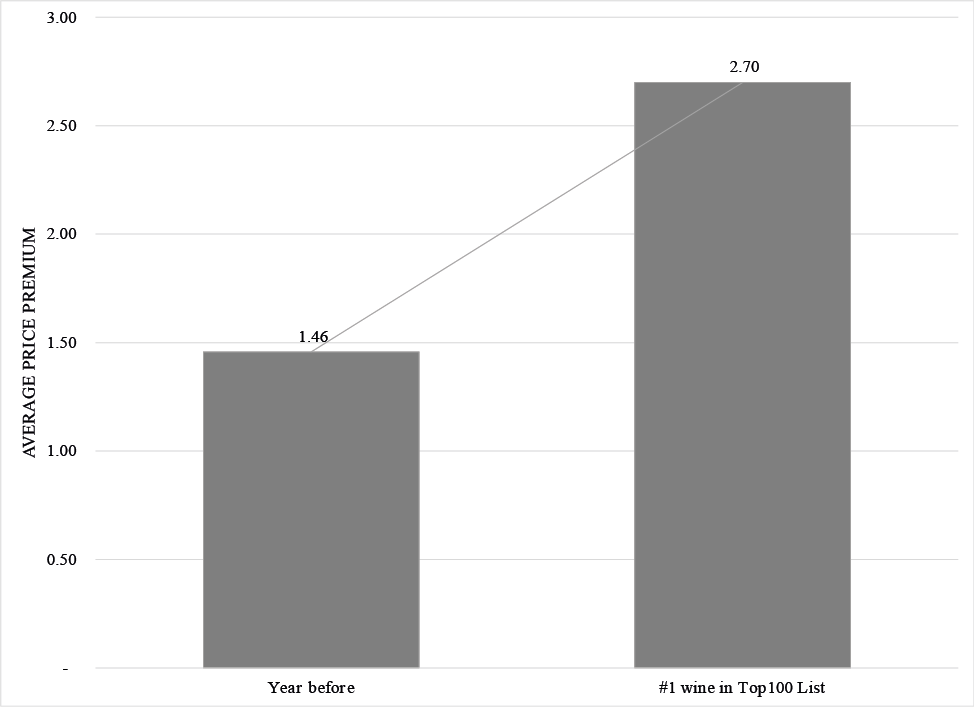
The results of the paired t-test reveal a statistically significant difference between the price premium of the number one wine’s vintage and the previous year’s vintage (t-statistic = 2.517, p=0.02, two-tailed). This indicates that inclusion as the top-ranked wine in Wine Spectator’s Top 100 List is strongly associated with a substantial increase in price premium.
These results suggest that the “superstar effect” extends to the number one wines in Wine Spectator’s rankings. The immediate increase in price premium indicates that the publicity surrounding the top-ranked wine significantly impacts consumer demand, thereby influencing market price.
4.2. Persistence of Price Premiums for Top 10 Wines (2016 Vintage Panel)
To examine the broader impact of being ranked in the Top 10, drawing from a panel dataset of the top 10 wines from Wine Spectator’s 2016 Top 100 List and their associated vintages, we initially conducted both Ordinary Least Squares (OLS) and Generalized Least Squares (GLS) Random Effects (RE) regressions. The results are presented in Table 1. Following this, the Breusch-Pagan Lagrangian multiplier test for random effects ( (1) = 2.00, p = 0.079) suggested that the Random Effects (RE) model might be more appropriate, and a subsequent Hausman test (χ2 (8) = 3.12; p = 0.537) confirmed that the RE model was indeed a better fit than the Fixed Effects (FE) model for this analysis.
| (1) | (2) | (3) | (4) | ||||||||||||||||
|---|---|---|---|---|---|---|---|---|---|---|---|---|---|---|---|---|---|---|---|
| Explanatory variables | OLS | GLS - RE | GLS - FE | ||||||||||||||||
| Age | 0.229 (0.055)*** |
0.258 (0.080)*** |
0.468 (0.183)*** |
||||||||||||||||
| Cases | -0.011 (0.010) |
-0.005 (0.013) |
0.002 (0.023) |
||||||||||||||||
| WS-score | -0.032 (0.029) |
-0.021 (0.031) |
0.008 (0.037) |
||||||||||||||||
| Top101 | 0.733 (0.181)*** |
0.736 (0.179)*** |
0.904 (0.247)*** |
||||||||||||||||
| Top102 | 0.681 (0.204)*** |
0.721 (0.229)*** |
1.136 (0.427)*** |
||||||||||||||||
| Top103 | 0.647 (0.246)*** |
0.709 (0.367)** |
1.322 (0.602)** |
||||||||||||||||
| Top104 | 0.792 (0.285)*** |
0.877 (0.367)** |
1.705 (0.783)** |
||||||||||||||||
| Top105 | 0.980 (0.331)*** |
1.095 (0.441)*** |
2.135 (0.964)*** |
||||||||||||||||
| Number1 | -0.100 (0.153) |
-0.079 (0.249) |
|||||||||||||||||
| Constant | 1.960 (2.625) |
0.548 (2.972) |
-4.448 (4.415) |
||||||||||||||||
| No. of observations | 58 | 58 | 58 | ||||||||||||||||
| R2 | 0.49 | 0.49 | 0.42 | ||||||||||||||||
| Within- R2 | 0.49 | 0.50 | |||||||||||||||||
| Between- R2 | 0.50 | 0.47 | |||||||||||||||||
| Standard errors are in parentheses. *** indicates level of significance at 1% (two-tailed). ** indicates level of significance at 5% (two-tailed). | |||||||||||||||||||
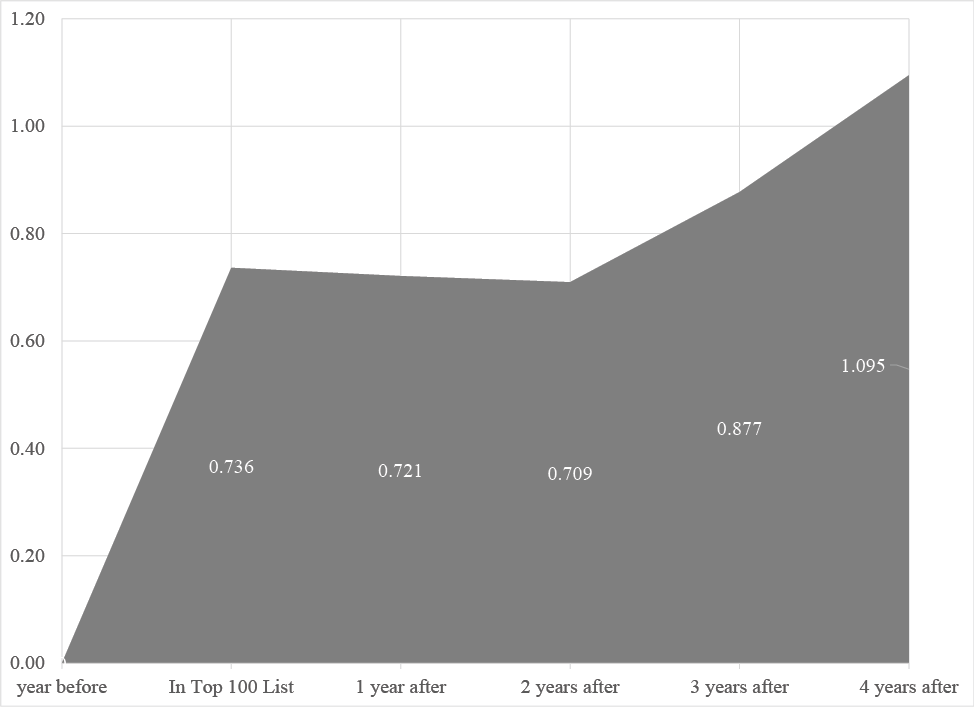
Both the OLS and RE models consistently indicate significant effects for the key variables of interest. In particular, the coefficients for vintage and top 10 rankings across both models are positive and statistically significant. The RE model shows that wines ranked in the top 10 of Wine Spectator’s list experience a substantial price premium relative to previous vintages. Specifically, the coefficient for the “Top10i1” variable is 0.736, with a p-value of less than 0.01, indicating a strong premium for wines ranked in the top 10. Moreover, the coefficients for the variables representing the first through fourth vintages following inclusion in the top 10 (Top10i2, Top10i3, Top10i4, Top10i5) are also statistically significant, with values of 0.721, 0.709, 0.877, and 1.095, respectively, and p-values all below 0.05.
In addition to statistical significance, it is essential to consider the economic significance of these coefficients. For instance, as presented in Figure 2, the coefficient of 0.736 for the top-ranked wine in the top 10 implies a 73.6% increase in the price premium relative to the baseline. Similarly, the coefficients for Top2, Top3, and Top4 reflect price increases ranging from 70% to 109%, indicating substantial market effects. These effect sizes indicate that inclusion in the top 10 ranking not only has a statistically significant impact but also leads to economically meaningful increases in market prices, likely influencing both consumer purchasing behavior and producer strategies. The results suggest that the price premium not only arises immediately following inclusion in the top 10 but also persists for several years.
Additionally, the vintage variable, which captures the age of the wine, shows a positive and significant relationship with the price premium, reinforcing the idea that older wines tend to command higher price premiums. However, the number of cases produced, being ranked as the number one wine, and expert scores did not exhibit a significant effect on the price premium.
In addition to examining the individual significance of these variables, we also tested whether the coefficients for each of the top 10 ranks were statistically different from zero (Ho: β5j = 0, where j=1, 2, 3, 4, 5). The chi-squared tests confirmed that each variable – Top10i1, Top10i2, Top10i3, Top10i4, Top10i5 – had a significant and positive effect on the price premium. For instance, the test for the Top10i1 coefficient yielded a chi-squared value of 17.01 with a p-value of less than 0.01, while Top10i2 showed a chi-squared value of 9.90 with a p-value of less than 0.01. The remaining variables – Top10i3, Top10i4, and Top10i5 – also exhibited significant results, with p-values of less than 0.02, 0.02, and 0.01, respectively. These results confirm that inclusion in the top 10 of the Wine Spectator Top 100 List exerts a significant upward effect on the price premium for these wines.
To further investigate whether the coefficients for the top 10 vintages were different from one another, we conducted a joint hypothesis test to assess whether they were statistically distinguishable (Ho: β51 = β52 = β53 = β54 = β55. The test showed that these coefficients were not statistically different from each other. The chi-squared value for this test was 4.19, with a p-value of 0.3813, indicating no significant difference between these coefficients. This suggests that the price premium effect for wines ranked in the top 10 is relatively uniform across the top 10 vintage and subsequent vintages.
In summary, the regression results and hypothesis tests confirm that wines ranked in the top 10 of Wine Spectator’s Top 100 List experience substantial and persistent price premiums. The premium effect is consistently observed across multiple vintages and is not limited to the number one wine, suggesting that critical acclaim within the Top 10 category has long-term economic consequences for producers. These results offer strong support for the presence of a superstar effect in the wine market, where visibility and third-party validation influence pricing power and consumer perception.
4.3. Revenue Effects by Ranking Tier: Top 100, Top 50, and Top 10
To complement these findings, we next explore whether this ranking-driven recognition translates into broader commercial gains beyond price alone. Specifically, we examine changes in release price, volume, and total revenue across three tiers of ranked wines. This allows us to assess whether the superstar effect also manifests in producer-side outcomes, such as increased sales and revenue multipliers.
We further investigate how inclusion in Wine Spectator’s Top 100 List affects producers’ pricing and revenue strategies by disaggregating the data across three ranking tiers: the full Top 100, Top 50, and Top 10 wines. Table 2 summarizes changes in release price, volume, expected revenue (defined as the product of release price and volume), price premium (measured as the ratio of Wine-Searcher’s U.S. average price to release price), and actual realized revenue.
| Ranking Tier | Δ Release Price | Δ Volume | Δ Expected Revenue | Δ Price Premium |
Δ Actual Revenue |
|---|---|---|---|---|---|
| Change in quantity | Change in (release price * change in quantity) |
Change in |
Change in actual total revenue | ||
| Top 100 | 1.083 | 1.067 | 1.155 | 0.99 | 1.14 |
| Top 50 | 1.095 | 1.120 | 1.226 | 1.02 | 1.25 |
| Top 10 | 1.024 | 1.245 | 1.275 | 1.28 | 1.64 |
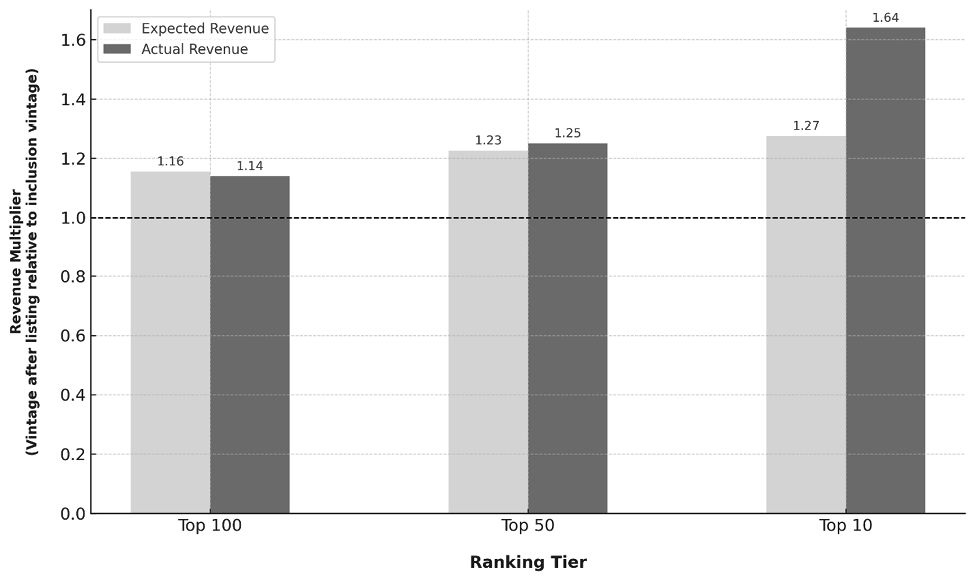
For the full Top 100, the vintage following inclusion saw an 8.3% increase in release price and a 6.7% increase in volume, generating a 15.5% rise in expected revenue. However, these wines sold slightly below their release prices on average (price premium = 0.99), moderating the realized revenue increase to 14%. In the Top 50 subset, the revenue impact becomes more pronounced: a 9.5% increase in release price and a 12% rise in volume produced a 22.6% expected revenue gain, with the slight secondary market premium (1.02) pushing actual revenue up by 25%.The Top 10 wines exhibited a distinct pattern. While release price increased only marginally (2.4%), volume surged by 24.5%, resulting in a 27.5% expected revenue boost. Crucially, these wines sold at a 28% premium over their release prices (price premium = 1.28), driving a 64% increase in realized total revenue.
This substantial discrepancy between expected and actual revenue highlights the outsized economic value conferred by top-tier visibility and critical acclaim. This tiered pattern is visualized in Figure 3, which contrasts expected revenue based solely on price and volume growth with actual realized revenue that incorporates observed price premiums. The divergence between expected and realized outcomes is most pronounced for Top 10 wines, reinforcing the disproportionate economic value of visibility and media amplification at the top of the list.
The empirical findings presented across both the regression analysis and the extended revenue decomposition indicate that inclusion in Wine Spectator’s Top 100 List – particularly within the Top 10 – generates multidimensional economic returns. The persistence of price premiums across multiple vintages confirms the long-term nature of the effect, while the observed gains in sales volume and realized revenue underscore the broader commercial implications of critical acclaim. These results align with theoretical predictions of the superstar effect by illustrating how media-driven recognition can translate into disproportionate and sustained economic advantages for a small subset of producers.
This study provides evidence supporting the presence of a “superstar effect” in the wine industry, particularly for wines included in Wine Spectator’s Top 100 List. The results show that wines ranked in the top 10 experience substantial price premiums that persist across multiple vintages. Specifically, being ranked number one generates a notable price premium, with an average increase of 85% compared to the previous vintage. Additionally, wines ranked in the top 10 continue to enjoy elevated premiums for up to five years following their inclusion in the list, illustrating the long-lasting effects of critical recognition.
These findings align with prior research on the superstar effect in industries such as sports, entertainment, and technology, where heightened visibility and recognition contribute to market dominance [1–2, 4, 8–9]. In the wine industry, inclusion in Wine Spectator’s Top 100 List boosts a wine’s market position by increasing consumer demand and enabling higher price premiums.
A key distinction that emerged from the analysis lies in the difference between short-term and long-term price premiums. The immediate impact of ranking number one on Wine Spectator’s list is particularly striking, with price premiums nearly doubling for the current vintage. The paired t-test results underscore the role of media exposure and publicity in generating consumer interest and driving up prices.
More intriguingly, the persistence of the price premium over time for wines ranked in the top 10 highlights the enduring nature of the superstar effect. The random effects (RE) regression analysis indicates that the price premium remains statistically significant for up to five years following a wine’s inclusion in the Top 10. This suggests that the superstar effect is not merely a short-lived phenomenon but instead provides enduring economic benefits to wine producers. These wines maintain elevated prices long after their initial recognition in the rankings.
The findings of this study further reinforce the broader theory of the superstar effect in markets driven by visibility and recognition. Similar to how top performers in industries like sports and entertainment disproportionately capture income and market share, top-ranking wines in Wine Spectator’s Top 100 List benefit from outsized economic gains. The positive relationship between critical recognition and price premiums aligns with previous studies on wine, which have found that expert opinions significantly influence both wine demand and pricing [5–6, 19–20]. These results underscore that inclusion in a prestigious ranking not only boosts a wine’s market value but also serves as a long-term competitive advantage for producers. The observed price premiums, sustained across multiple vintages, emphasize that the superstar effect in the wine industry delivers prolonged market success.
The analysis also highlights that the age variable shows a positive and significant relationship with price premiums, reflecting the fact that older vintages tend to command higher prices as they become scarcer and more desirable. The negative coefficient for the number of cases produced, although not statistically significant, suggests that scarcity may contribute to upward price pressure. These patterns are consistent with Oczkowski’s [15] findings that both objective product attributes (such as vintage and alcohol content) and subjective evaluations (such as expert scores) play an important role in shaping wine prices. At the same time, they align with Gibbs, Tapia, and Warzynski’s [16] results, which show that perceived scarcity and media-amplified reputation interact to produce durable price premiums, especially in markets with limited supply elasticity and informational asymmetries.
Furthermore, the relatively narrow range of Wine Spectator scores for the wines analyzed likely explains why these scores did not exhibit a significant additional effect on price premiums.
Interestingly, the regression results show that the coefficient for the “Number1” dummy variable was not statistically different from zero, indicating that being ranked number one does not result in a significantly higher price premium compared to other top 10 wines. This unexpected result may be explained by a scenario in which reputational effects and perceived scarcity – both key pricing mechanisms discussed by Gibbs et al. [16] – interact with consumer behavior. Following the rankings announcement, initial demand may drive top-ranked wines to sell out rapidly, prompting consumers to shift attention to adjacent, lower-ranked options. As scarcity intensifies for the most sought-after wines, substitution effects could push up prices for other top 10 entries, thereby flattening the premium gradient. This dynamic may recur annually, contributing to the observed lack of a statistically distinct premium for the number one wine.
In addition to these price-based effects, the third component of the analysis – revenue decomposition by ranking tier – offers further insight into how critical recognition translates into broader commercial gains. While wines in the full Top 100 and Top 50 lists showed modest increases in realized revenue, the Top 10 wines exhibited disproportionately large gains. Specifically, the combination of a 24.5% increase in volume and a 28% resale premium resulted in a 64% increase in realized revenue for top 10 wines. This result indicates that the superstar effect operates not only through price but also via quantity sold, amplifying its commercial impact. The divergence between expected and actual revenue, most pronounced for top 10 wines, suggests that visibility-induced demand can substantially elevate both perceived value and consumer willingness to pay.
The findings of this study extend the understanding of the superstar effect beyond the wine industry and into other markets where visibility and recognition play critical roles in consumer decision-making. Similar effects could be observed in sectors such as luxury goods, fine art, and non-wine beverages like whiskey or craft beer, where reputation and exclusivity drive market demand. Prominent awards and media exposure in these industries may create sustained price premiums, as demonstrated in this study. These insights suggest that in markets where consumers rely heavily on third-party validation, the superstar effect contributes to long-term market advantages, reinforcing the importance of public recognition in shaping product success.
For wine producers, these findings offer strategic insights. Achieving a high ranking on Wine Spectator’s Top 100 List can lead to significant and sustained price premiums, particularly for smaller or emerging producers aiming to establish themselves in the market. The long-term price premiums observed in this study suggest that producers could benefit from aligning their marketing and branding strategies to improve their chances of achieving higher rankings. Furthermore, the findings underscore the importance of scarcity in driving price premiums. Producers might consider leveraging limited production to create exclusivity and elevate the market value of their wines.
While this study provides valuable insights, several limitations warrant attention. First, the analysis focuses solely on Wine Spectator’s Top 100 List, which, while influential, represents only one source of critical acclaim in the global wine industry. Future research could examine other prestigious awards, such as the Decanter World Wine Awards or ratings from additional prominent wine critics, to determine whether similar superstar effects are observed across different platforms.
Second, this study analyzes price premiums in the U.S. market, where Wine Spectator’s influence is particularly strong. Exploring similar effects in other regions, such as Europe, Asia, or Latin America, would provide a broader understanding of the global implications of critical recognition. Differences in cultural, regulatory, and consumer behavior across these markets could reveal new insights into the dynamics of price formation.
Finally, future research could delve deeper into consumer behavior to better understand the mechanisms driving the superstar effect. Investigating factors such as brand loyalty, social status, or personal taste preferences could offer additional insights into how rankings influence consumer decisions. Complementary qualitative research, including interviews or focus groups, could enhance the understanding of how consumers perceive rankings like Wine Spectator’s, adding depth to the quantitative findings.
Moreover, supply-side dynamics, such as production volume and distribution strategies, deserve further exploration. While this study highlights the role of scarcity, additional research could examine how producers strategically balance production and critical acclaim to maximize value. These efforts would provide a more comprehensive understanding of the interplay between recognition, scarcity, and pricing in the wine industry.
In conclusion, this study confirms the existence of a “superstar effect” in the wine industry, driven by inclusion in Wine Spectator’s Top 100 List. The findings reveal that top-ranked wines experience significant and enduring price premiums, with the number one wine achieving an 85% increase in price premium compared to previous vintages. This effect persists for up to five years for wines ranked in the top 10, underscoring the long-lasting impact of critical recognition on market outcomes.
The revenue decomposition further supports the presence of a superstar effect by showing that top 10 wines generate a disproportionately high increase in realized revenue – reaching 64% – through both elevated resale prices and expanded sales volumes. This commercial outcome highlights the economic significance of critical acclaim and media-driven visibility in shaping producer success.
The implications of these results are significant, particularly for wine producers and marketers seeking to leverage visibility and rankings to strengthen their market position. While scarcity plays a role, the superstar effect of high-profile rankings remains a key driver of economic success in the wine industry. Further research is needed to investigate how these effects may vary across different markets and to examine additional factors influencing wine pricing beyond rankings and scarcity.
[1] S. Rosen, The economics of superstars, Am. Econ. Rev. 71 (1981) 845–858. https://www.jstor.org/stable/1803469.
[2] M. Adler, Stardom and talent, Am. Econ. Rev. 75 (1985) 208–212. https://www.jstor.org/stable/1812714.
[3] B. Humphreys, C. Johnson, The effect of superstars on game attendance: Evidence from the NBA, J. Sports Econ. 21 (2020) 152–175. https://doi.org/10.1177/1527002519885441.
[4] E. Bilen, A. Matros, The queen’s gambit: Explaining the superstar effect using evidence from chess, J. Econ. Behav. Organ. 215 (2023) 307–324. https://doi.org/10.1016/j.jebo.2023.09.002.
[5] O. Ashenfelter, G.V. Jones, The demand for expert opinion: Bordeaux wine, J. Wine Econ. 8 (2013) 285–293. https://doi.org/10.1017/jwe.2013.22.
[6] H.H. Ali, S. Lecocq, M. Visser, The impact of gurus: Parker grades and en primeur wine prices, Econ. J. 118 (2008) F158–F173. https://doi.org/10.1111/j.1468-0297.2008.02147.x.
[7] J.M. Cardebat, J.M. Figuet, The superstar effect of expert ratings: Evidence from Bordeaux wine, J. Wine Econ. 14 (2019) 127–146. https://doi.org/10.1017/jwe.2014.23.
[8] K. Hoffman, C. Opitz, Talent and publicity as determinants of superstar incomes: Empirical evidence from the motion picture industry, Appl. Econ. 51 (2019) 1383–1395. https://doi.org/10.1080/00036846.2018.1527452.
[9] C. Deutscher, L. Neuberg, S. Thiem, Who’s afraid of the GOATs? - Shadow effects of tennis superstars, J. Econ. Psychol. 99 (2023) Article 102663. https://doi.org/10.1016/j.joep.2023.102663.
[10] G. Schultze, Chapter 54 Superstars, in: R. Towse, T. Navarrete Hernández (Eds.), Handbook of Cultural Economics, third ed., Edward Elgar Publishing, 2020, pp. 485–493. https://doi.org/10.4337/9781788975803.00060.
[11] A. Humphreys, G. Carpenter, Status games: Market driving through social influence in the U.S. wine industry, J. Mark. 82 (2018) 141–159. https://doi.org/10.1509/jm.16.0179.
[12] F. Koenig, Technical change and superstar effects: Evidence from the rollout of television, Am. Econ. Rev. Insights 5 (2023) 207–223. https://doi.org/10.1257/aeri.20210539.
[13] E. Hogue, Promotional effects of recorded music and superstars on concert financial outcomes, J. Interdiscip. Econ. 36 (2023) 166–203. https://doi.org/10.1177/02601079231168750.
[14] J. Giráldez-Cru, A. Suárez-Vázquez, C. Zarco, O. Cordón, Modeling the opinion dynamics of superstars in the film industry, Expert Syst. Appl. 250 (2024) Article 123750. https://doi.org/10.1016/j.eswa.2024.123750.
[15] E. Oczkowski, Identifying the effects of objective and subjective quality on wine prices, J. Wine Econ. 11 (2016) 249–260. https://doi.org/10.1017/jwe.2016.1.
[16] M. Gibbs, M. Tapia, F. Warzynski, Globalization, superstars, and reputation: Theory & evidence from the wine industry, J. Wine Econ. 4 (2009) 46–61. https://doi.org/10.2139/ssrn.1343732.
[17] O. Ashenfelter, K. Storchmann, Using a hedonic model of solar radiation to assess the economic effect of climate change: The case of Mosel valley vineyards, Rev. Econ. Stat. 92 (2010) 333–349. https://doi.org/10.1162/rest.2010.11377.
[18] Wine Spectator, About us. (n.d.). Retrieved March 9, 2024, from https://www.winespectator.com/pages/about-us.
[19] O. Gokcekus, S. Gokcekus, Empirical evidence of lumping and splitting: Expert ratings’ effect on wine prices, Wine Econ. Policy 8 (2019) 171–179. https://doi.org/10.1016/j.wep.2019.09.003.
[20] S. Castriota, S. Corsi, P. Frumento, G. Ruggeri, Does quality pay off? “Superstar” wines and the uncertain price premium across quality grades, J. Wine Econ. 17 (2022) 141–158. https://doi.org/10.1017/jwe.2022.21.