Barriers and Drivers in the Adoption of New Genomic Techniques for Grapevines
1 Université Bourgogne Europe, Burgundy School of Business, School of Wine & Spirits Business, CEREN EA 7477, Dijon, France
2 Université Bourgogne Europe, Burgundy School of Business, CEREN EA 7477, Dijon, France
3 Council for Agricultural Research and Economics - Agricultural Policies and Bioeconomy Center (CREA- PB), Rome, Italy
Email: lara.agnoli@bsb-education.com; effrosyni.vasileiou@bsb-education.com; lara.agnoli@bsb-education.com
*Corresponding author.
Abstract. Severe climate conditions and fungal diseases have significantly impacted global wine production, bringing it to its lowest levels in decades. The development of resilient grape varieties with strong quality standards becomes therefore essential for the industry’s future. This study examines how European producers perceive New Genomic Techniques (NGTs), innovative methods that enhance plant traits without adding foreign DNA, improving grape resistance to environmental and biological stresses while promoting more sustainable production. Employing qualitative methods, semi-structured interviews were conducted across six major wine-producing countries. Thematic analysis revealed a complex and diverse range of opinions. Growers recognized NGTs’ potential to optimize resource management, enhance climate resilience, and reduce production costs, directly contributing to more sustainable practices. However, significant barriers were identified, including ethical concerns, consumer acceptance, misinformation and fear of new technologies, and legislative uncertainties. Furthermore, farmers’ knowledge gaps and adherence to traditional methods posed internal barriers. The need for transparent communication was highlighted as a critical factor, as well as the importance of addressing these multiple challenges through stakeholder engagement and informed policymaking.
Keywords: New Genomic Techniques, grape growers, producers, technicians, barriers, drivers.
Index
2.1. Traditional Breeding Techniques in socio-economic literature
2.2. New Breeding Techniques in socio-economic literature
4.1. What do you think about biotechnology applied to grape and grape vine?
4.2. What do you think the benefits may be in introducing plants from New Genomic Techniques?
4.3. What could be the main barriers in introducing plants resulting from New Genomic Techniques?
Extreme climatic conditions and widespread fungal diseases have severely affected vineyards worldwide, resulting in a wine production of 225.8 million hectoliters in 2024, the lowest output recorded since 1961 [1]. On the one side wine production is impacted by diseases and climate change, and on the other side the European agricultural policies are undergoing relevant transformation. While earlier frameworks such as the Farm to Fork Strategy (part of the European Green Deal), aimed to reduce pesticide use by 50% by 2030 [2], recent political developments have shifted the EU’s priorities. The proposed Sustainable Use of Pesticides Regulation (SUR) has been withdrawn, and the EU’s new “Vision for Agriculture and Food”, adopted in 2024, marks a clearer political commitment to innovation and biotechnology, including the use of New Genomic Techniques (NGTs) to support sustainable agriculture. To achieve this goal and promote sustainable development in the wine industry, developing and introducing resilient grape varieties with competitive quality is essential. This involves leveraging unexplored grapevine biodiversity and new breeding opportunities. Genetic engineering plays a crucial role in this, with different interventions to the grapevine. Agricultural biotechnology research is focusing on developing New Genomic Techniques (NGT, also called New Breeding Techniques, NBT), encompassing a range of modern methods used to introduce specific traits into plants, without introducing foreign DNA [3]. These techniques include CRISPR/Cas9 (gene editing), cisgenesis, and intragenesis and are able to produce grapes resistant to both biotic and abiotic stresses [4], enabling winegrowers to cope with climate change, pathogens, and water stress while maintaining the quality and characteristics of their wines. However, the short-term practical NGTs application in grapevine breeding is limited by several technical challenges, including the plant’s recalcitrance to genetic transformation and regeneration [5], [6]. Unlike annual crops such as maize or soybean, grapevine is a woody perennial with complex genetics and long generation cycles, which significantly slow down breeding cycles. These technical barriers may limit the immediate deployment of NGT-derived varieties in vineyards, and should be carefully considered alongside their potential. Recent advances suggest that certain characteristics, such as disease resistance, can benefit from targeted changes more quickly. Experimental studies have demonstrated the efficacy of CRISPR/Cas9 in modifying genes that confer susceptibility to blight and powdery mildew, with potential improvements in resistance in vitro and in trials [7], [8]. Similarly, in other woody crops such as apple and pear, editing of the TERMINAL FLOWER 1 (TFL1) gene accelerated flowering with results obtained within one and two years, allowing for the reduction of breeding cycles compared to conventional methods [9]. Furthermore, innovative protocols for the transformation without integration of foreign DNA, based on protoplast editing, have allowed the regeneration of genome-edited plants in a few months into lives, even if multiplication and commercial diffusion require longer times [10]. These technological advances indicate the possibility of concrete results over less than five years in woody crops, while maintaining necessary precautions regarding the genetic complexities and long development times typical of these species.
Notably, grapes obtained through NGT maintain the same sensory properties as ‘natural grapes’, unlike Fungus-Resistant Grape varieties (FRG or PIWI, the abbreviation of pilzwiderstandsfähig, the German term for “fungus resistant”). FRGs have been more extensively studied in socio-economic literature than NGTs due to their longer history. They are hybrids of Vitis Vinifera and primarily North American Vitis species, and are resistant to many diseases, but they present altered sensory properties compared to the original grape.
NGTs are able to preserve sensory characteristics of a grape, but from a legislative perspective, the debate around them is very active at the EU level [11]. Despite the scientific potential of NGTs, resistance to their adoption remains strong, as evidenced by recent acts of vandalism against experimental NGT vineyards in Italy [12]. These actions reflect a broader societal debate extracting from scientific discussions and entering into ethical, economic, and political concerns.
Understanding grape growers’ perspectives on NGTs is crucial for the future of viticulture. As the primary actors in the wine supply chain, their acceptance or rejection of NGTs will significantly influence the adoption and diffusion of these technologies. Studying their views provides insight into the economic, environmental, and social drivers and barriers they perceive. The topic of NGT is relatively new and little explored in literature, particularly in Europe, where, to our knowledge, no socio-economic studies have analyzed the issue from the supply side of the wine market (i.e., grape growers, technicians, wine producers). This paper aims to examine producers’ perceptions of biotechnology applied to grapevines and identify the barriers and drivers influencing the adoption of plants from NGT.
The rest of the paper is structured as follows: Section 2 presents a non-systematic review of the literature, focusing on socio-economic studies of traditional and new genomic techniques. Section 3 explains the methodology used to achieve the research objectives. Section 4 presents the research findings, and Section 5 discusses the results and Section 6 concludes.
2.1. Traditional Breeding Techniques in socio-economic literature
When considering literature on traditional breeding techniques adopted to improve grape resistance to pathogens and sustainability, an increasingly important number of studies focused on Fungus-Resistant Grape (FRG) varieties in the light of consumers’ perception and willingness to pay (WTP) from the one side, and producers and factors influencing their adoption from the other side.
Wines produced from FRG varieties appeal to the increasing consumer demand for sustainability by minimizing the need for fungicides and reducing their carbon footprint [13], [14], [15]. Research highlights the importance of information as a driver of WTP and market acceptance of FRG wines [13], [16], [17], as well as the importance of increasing consumer awareness of the environmental benefits, of using appealing names, and of developing wines with desirable sensory profiles [14], [18]. The regulatory framework also shows to significantly affect the adoption and market acceptance of FRGs, and this is particularly shown in the light of the EU Regulation 2021/2117, allowing the use of FRGs to produce wines with Protected Designations of Origin (PDOs) [19], [20].
A smaller number of studies focus on producers and the adoption of FRG varieties. Finger et al. [21] investigated Swiss grape producers and found that those engaged in shorter supply chains, such as direct marketing, are more likely to adopt FRGs. Zachmann et al. [22] also analyze Swiss producers and highlight that adoption intentions are driven by both farmer and farm characteristics. In particular, grape growers’ positive health perceptions of FRG are able to drive intention to adopt them. Additionally, conventional farmers are especially likely to increase the land devoted to these varieties. Sambucci et al. [23] analyze US grape growers and their preferences for specific varietal traits, emphasizing the high value placed on both the varietal name and the cost savings from reduced fungicide applications.
The literature indicates that consumer acceptance and producer adoption of FRG varieties are influenced by familiarity with breeding techniques, perceived environmental benefits, and effective information and communication strategies. Regulatory frameworks also play a crucial role in shaping the market impact of FRGs [13], [14], [18].
2.2. New Breeding Techniques in socio-economic literature
NGTs represent a set of innovative breeding methods that allow for precise and targeted genetic modifications in plants. Among these, Genome Editing (GE), notably through CRISPR/Cas technologies, has gained significant attention due to its ability to introduce specific, predictable changes in DNA sequences without necessarily inserting foreign genes. This differs substantially from Genetic Modification (GM), which generally involves transgenic methods and the introduction of DNA from unrelated organisms.
This conceptual distinction between GE and GM is essential, as it influences both regulatory frameworks and public perceptions. GE is often seen as more “natural” and acceptable than GM, particularly because the genetic changes it induces could also occur naturally or through conventional breeding.
According to experts, NGTs have great potential for boosting crop yields, enhancing nutritional content of food, and increasing resilience to climate change [24]. They argue that crops from NGTs can significantly contribute to a more sustainable and safe food supply, particularly due to their faster and more cost-effective development compared to traditional breeding methods [11], [25].
Most of the socio-economic literature on NGT focuses on Genome Editing (GE) in comparison with Genome Modification (GM) in food products from the consumers’ and the producers’ eyes [26], [27]. Research reveals a generally low level of awareness among both consumers and farmers regarding both GE and GM [28], [29]. Despite this low awareness, there is a slightly higher familiarity with GM foods [28], [30], [31]. Basinskiene and Seinauskiene [28] found that even with this familiarity, people tend to be more accepting of GE than traditional GM food. This preference is supported by Bearth et al. [30] and Romeo Lironcurti et al. [31], who report that the perceived naturalness and precision of GE contribute to a more favourable public opinion compared to Genetically Modified Organisms (GMOs). Sprink et al. [32] highlight a potential shift towards greater acceptance of GE by the public when the technology delivers clear societal benefits, such as enhanced sustainability or improved nutrition. Research also highlights the importance of perceived benefits, such as prolonged shelf life, in shaping public opinion towards GE [30].
Nawaz and Satterfield [33] investigate public perceptions of GE in agriculture, pointing out that individuals who are critical of industrialized food systems are more likely to oppose GE, while those concerned about climate change were more likely to support it. Research also highlights the importance of considering broader societal concerns like ethical ones, beyond just risks and benefits, when assessing public perceptions of GE [34].
Concerns about NGTs are also tied to the ambiguous and inconsistent regulatory landscape worldwide. Public uncertainty and the influence of advocacy groups have led to stringent regulations in some regions, particularly in the EU, potentially hindering the adoption and beneficial impact of these new technologies [11]
Farmers generally exhibit a lower level of technical knowledge about GE than other stakeholders like researchers and policy makers, emphasizing perceived personal benefits, potential risks concerning naturalness and morality, and uncertainty about the technology when expressing their opinion on the technology [35]. However, at a farmer level, research highlights that subjective knowledge about GE, experience with similar technologies, and perceive low risk drive to positive attitudes towards GE [36].
Research recognizes the need for further investigation into farmers’ perceptions of NGTs and into factors influencing their decisions to adopt them [36].
From a regulatory perspective, the EU Member States have historically adopted a precautionary and restrictive approach to biotechnology. In 2018, the Court of Justice of the EU ruled that organisms obtained by mutagenesis techniques (including CRISPR/Cas) should be subject to GMO legislation [37], which imposes complex authorization procedures. This alignment with GMOs was widely criticized by scientists and industry actors as a barrier to innovation. A major shift occurred in July 2023, when the European Commission presented a legislative proposal to reform the EU regulatory framework for NGTs. This proposal aims to differentiate between two NGT categories: NGT-1 plants (those whose genetic alteration could also occur naturally or through conventional breeding), which would be exempt from the current GMO legislation; and NGT-2 plants, which would remain subject to current GMO rules. As of 2025, the proposal is in trilogue negotiations between the European Commission, the European Parliament, and the Council. If this new view is approved, a transformative impact on the adoption of NGTs in European agriculture, including viticulture, will take place.
Additionally, the International Organisation of Vine and Wine (OIV) has acknowledged the potential of biotechnology and NGTs in viticulture [1]. In its resolutions and strategic documents, the OIV emphasizes the importance of scientific innovation for improving grapevine resistance, promoting sustainability, and maintaining wine quality. It also highlights the need for a balanced approach that can combine regulatory assessment and effective communication with consumers.
In this context, the present paper contributes to the socio-economic debate by exploring the perceived benefits and barriers associated with the adoption of NGTs in viticulture. By focusing on the supply side of the wine sector, the study sheds light on how producers perceive these technologies and how regulatory, technical, and cultural dimensions intersect in shaping future pathways for innovation.
We carried out a qualitative study to develop a comprehensive and detailed understanding of beliefs towards NGTs in viticulture and drivers and barriers in their adoption. The study included eighteen interviews with farmers from six European countries (Italy, France, Spain, Portugal, Greece and Hungary). These countries were chosen for their significance in the wine industry, collectively accounting for 83% of Europe’s wine production and 53% of the world’s wine production in 2024 [38].
Semi-structured interviews were conducted on topics related to biotechnology, GM applied to grape and vine, NGT in viticulture and barriers and drivers to adoption. A common protocol was created in English and shared among the seven interviewers (one for each country, except Spain, where two different wine regions were involved, and two interviewers collected information), including: i) rules to follow to conduct the interviews, and to record, transcribe and translate them; ii) ethical commitments, including the consent form to be signed by each interviewee, and iii) questions to ask. The data collection method was approved by the Data Protection Officer and the ethical committee of the Burgundy School of Business (Approval number: CEREN_BSB2024-69).
Three interviews were conducted in each participating country, for a total of 18 respondents, a sample size sufficient to achieve saturation. The judgment sampling method was employed to select interviewees, ensuring a broad view of the European wine industry’s supply side (Table 1). Interviewees were chosen to reflect different farm sizes in each country and varied perspectives regarding the adoption of technologies in the wine industry, including biotechnology and NGTs. The final sample encompasses a range of grape growers and wine producers, from small operators (3.6 hectares) to large ones (120 hectares), as well as technicians in wineries and cooperatives, and the director of an association of producers. Most respondents are aged between 41 and 60, with only a few younger individuals, reflecting the typical demographics of the primary industry in Europe. Only one respondent is female, which also aligns with the gender distribution in the primary sector.
| Interviewee ID | Country | Role | Gender | Age class (year old) |
|---|---|---|---|---|
| I1-I2-I3 | Greece | -grape grower and wine maker -grape grower and wine maker -grape grower |
Males | 41-50 |
| I4-I5-I6 | Portugal | -grape grower and wine maker -grape grower -grape grower and wine maker |
Males | 41-50 51-60 |
| I7-I8-I9 | France | -vineyard operator -technical director of a winery -technical director of a winery |
1 Female 2 Males |
41-50 51-60 60-70 |
| I10-I11-I12 | Italy | -viticultural consultant -grape grower and wine maker -agronomist technician in a wine cooperative |
Males | 31-40 51-60 61-70 |
| I13-I14-I15 | Spain | -technical director of a winery -grape grower and wine maker -director of an association of wineries |
Males | 41-50 51-60 |
| I16-I17-I18 | Hungary | -grape grower and wine maker -grape grower and wine maker -grape grower and wine maker |
Males | 21-30 31-40 61-70 |
Since the topics of biotechnology and NGT are highly specific and sometimes confusing, the interview protocol included expert-defined explanations to establish a shared knowledge base with interviewees and prevent misunderstandings (Appendix A).
A set of interview questions was designed to assess perception and awareness of NGTs and how they differ from GMOs. The aim was also to identify the barriers to and drivers of applying NGT in viticulture. This paper presents the findings related to perceptions, barriers, and drivers, reporting the analysis of answers to the following questions:
1. What do you think about biotechnology applied to grape and grape vine?
2. What do you think the benefits may be in introducing plants from New Genomic Techniques?
3. What could be the main barriers in introducing plants resulting from New Genomic Techniques?
The interviews were carried out in May and June 2024, and were conducted face-to-face or online via Teams. They lasted approximately 30 minutes on average. They were audio recorded and transcribed using Microsoft Word, with the interviewers verifying the accuracy of the transcriptions. The interviewers also handled translating the interviews into English. The transcripts were analyzed, and responses coded using NVivo 14. Given the limited theoretical foundation of NGT in viticulture, a stepwise thematic analysis was adopted and one researcher carried out the initial coding in an open and inductive manner, without relying on a predetermined framework, but rather based on the frequency of issues emerging in the transcripts [39]. These initial codes were then iteratively refined and grouped into broader categories-Axial Coding (e.g. ‘future-oriented (Pro-Biotech)’, ‘Tradition-Oriented (Skeptical)’, ‘Internal Barriers’, ‘External Barriers’). Finally, these categories were synthesized into higher-level themes that reflect farmers’ perceptions about biotechnology, as well as the barriers and drivers towards NGT plants adoption, mentioned throughout the entire transcript, rather than solely in response to specific questions on the topic. Another researcher verified the initial coding for consistency, and any discrepancies were addressed and resolved through collaboration [40]. Appendix B summarizes information on the adopted coding system, including a short description1.
4.1. What do you think about biotechnology applied to grape and grape vine?
When analyzing perceptions of biotechnology application to vineyard, a mix of awareness of its necessity, skepticism and lack of knowledge and need of information emerges (Figure 1).
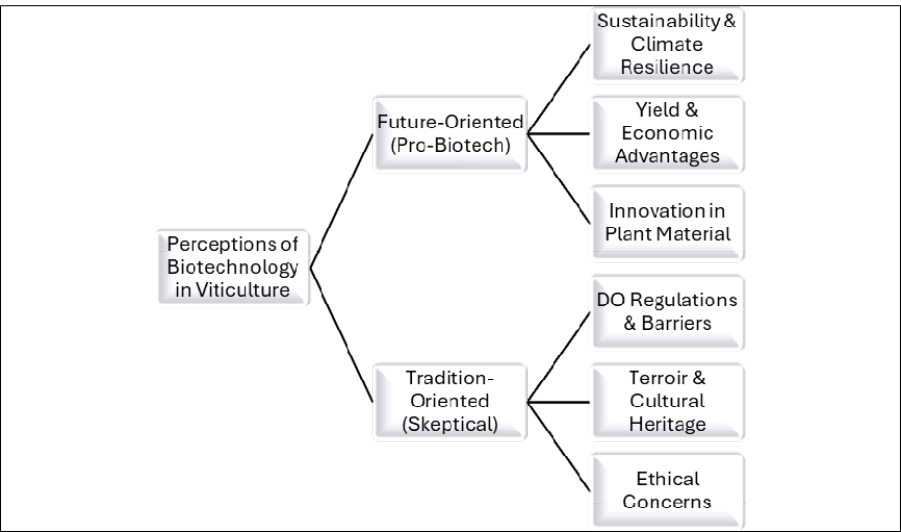
Some interviewees point out that biotechnologies represent the future for viticulture, as they can provide the wine industry with solutions to challenges like climate change and diseases, at the same time protecting the environment. I10, viticultural consultant from Italy, states that “They are the only sustainable thing for the defense for grapevine in the upcoming years”. Another interviewee, I13 from Spain took a general approach, stating that biotechnology is a science “that through knowledge can give solutions to different problems that may be encountered in the productive process”.
Many highlighted the economic advantages and potential revenues that can be derived from biotechnologies. In particular, I4, a grape grower from Portugal mentioned that “biotechnology is the only path to achieve yields”. On the other hand, there is a clear conviction that biotechnology can drive to environmental benefits, as it can play an important role given the challenging climatic changes, and “viticulture is not a field where you can suddenly change from one year to the next one; all kinds of research results should be examined to see how they can help winemakers” (I18, grape grower and winemaker from Hungary).
While some actors in the wine industry support biotechnology and innovation, others remain committed to traditional viticultural methods. They believe that these methods are essential for conserving the cultural heritage and terroir-specific characteristics of wine, and they fear that new technologies might alter the traditional attributes of grape varieties. I12, agronomy technician from Italy says: “I’m a traditionalist because where I was born autochthonous grape varieties are the most popular ones […]. The phenotypes and ecotypes that have developed over hundreds of years in a territory have developed here and it is fair to support them”. I15, director of an association of producers from Spain, talking about the wine sector, states that “a priori it’s difficult to innovate, it’s a traditional sector, and I think that sometimes this also limits the development of skills. In the world of wine, and especially in the Denominations of Origin, there are certain limitations linked to tradition, linked to the typicity of the wines […] our varieties, our soil, our climate, our way of doing things”.
Ethical dilemmas also emerge and there is a demand for a specific ethical framework associated with biotechnological innovations in viticulture. I2 from Greece denounces a “legal loophole” arising from biotechnology applied to viticulture; in particular, he thinks that “there are ethical issues, at least for wine grapes, because there are resistant grapes in America of all cultivated varieties that consider themselves to be mutations but are not considered the same as the original”. I9 from France stats that “if biotechnology leads to changes in DNA characteristics” to improve plant characteristics through a genetic make-up of the plants, “this bothers me a bit”.
Finally, a need for better communication and education has emerged. There is a general feeling that the average person, and even winemakers, know little about these technologies. I16 from Hungary suggests that “we need to communicate more”, as there is significant positive potential in these techniques.
4.2. What do you think the benefits may be in introducing plants from New Genomic Techniques?
A common advantage highlighted in most interviews regarding the adoption of NGTs is the optimization of inputs (Figure 2). Interviewees acknowledge that these new technologies improve the management of water and chemical products, including pesticides. I2 from Greece draws that this will lead to the “exploitation of new terroirs, because we will be able to plant in locations that do not have water and that previously we could not cultivate under grape”. Another concept that emerges from the interviews is time saving, which is connected to reduced costs. These cost reductions are not only due to the decreased use of pesticides but also from the lower consumption of diesel and reduced human labor.
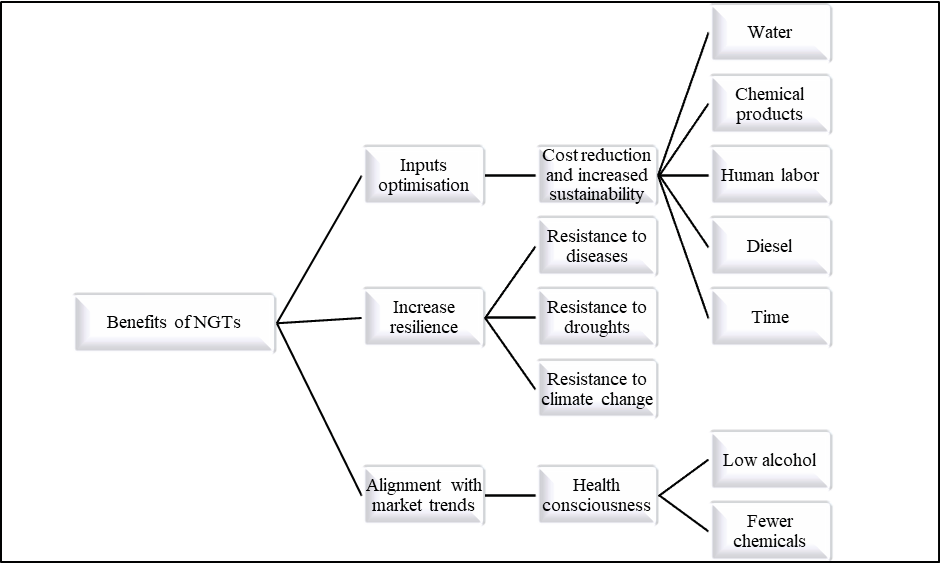
Regarding resistance to climate shocks, interviewees reported that NGTs will enhance disease resistance and produce grapes that are more resilient to drought and climate change. In this regard, for example, I16, a grape grower and wine producer from Hungary, points out that “the main thing is that the vines will be more resistant, not only to fungal diseases, but perhaps more resistant to drought, for example, and therefore more resistant to environmental effects”. I8, technical director of a winery in France, highlights the importance of these new technologies in the light of the actual issues in the industry: “If we identify a gene tomorrow that can be introduced to generate resistance, it would be very interesting. Currently, it’s estimated that our vineyards lose 20% of their volume, which is enormous, so this would be a significant achievement”. Following the same logic, I15, director of an association of producers in Spain, expresses the urgency of interventions, stating that “the negative impacts of climate change must be mitigated by identifying varieties that can adapt to these new conditions”.
Identified benefits of NGTs are also related to economic advantages due to reduced production costs and increased competitiveness. Many interviewees primarily link cost reduction to production costs like pesticides, fuel, and the workforce. This cost reduction will increase competitiveness in the industry and improve quality. In this regards, I16 from Hungary mentions that growers could produce grapes more economically, and the “price of wine would be lower or maintained at a level that would also increase competitiveness against the other alcoholic beverages”. I15, director of an association of producers in Spain, takes a broader view by linking these new technologies to the potential for shaping the wine industry in line with emerging market trends. In particular he recognizes that “there is a much more attention to health from new consumers, and I think that the sector has to reflect on that, and we can look for varieties that generate less alcohol, which is what I think an important part of the new consumers are looking for”. In a similar way, another interviewee from Hungary says that “it would be a huge selling point if the back label also stated that this wine was made from grapes that were not sprayed at all […] because consumers are becoming more and more health conscious”.
Benefits connected to NGT are also related to environmental sustainability and protection. Interviewees recognize that viticulture would become more sustainable due to better management of resources and limited use of chemical substances and pesticides. In these regards, I18 from Hungary argues that “if we have more resistant plants, we don’t pollute the environment” and I12 from Italy says that “nowadays many practices are mechanized and if you can save on processing, the CO2 produced also decreases and emissions and costs for companies are reduced”.
4.3. What could be the main barriers in introducing plants resulting from New Genomic Techniques?
The data reveal two main categories of barriers to implementing New Genomic Techniques: external barriers related to social awareness, legislation, and education, and internal barriers related to farmers’ attitudes, financial costs, and lack of information (Figure 3).
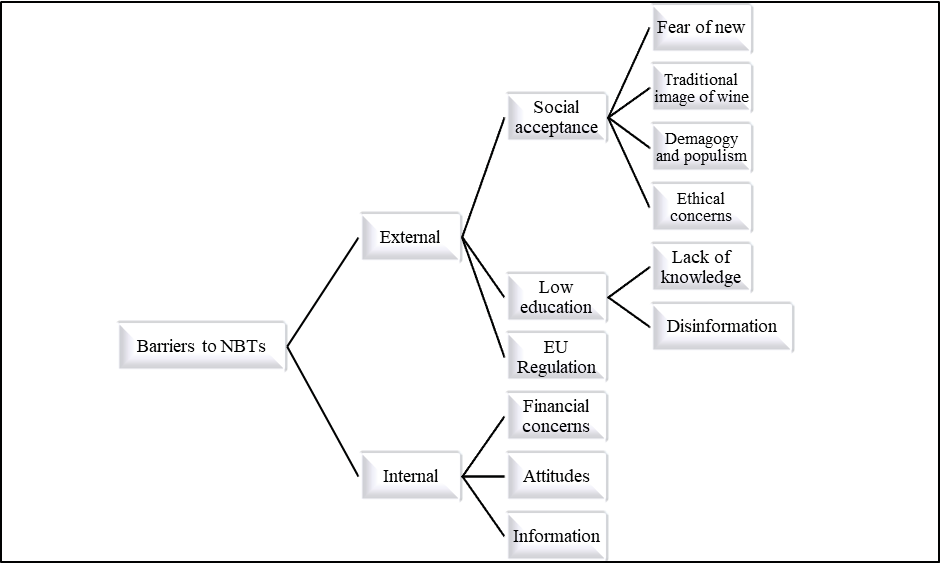
Consumer acceptance of these new biotechnologies and products is crucial, as many interviewees noted that people are generally anxious and resistant to new products and technologies. I7, vineyard operator in France, highlights that “we’re going to have to face up to the fear of new things”, a significant challenge in the wine industry. I15 from Spain points out that “the world of wine depends a lot on the image, and there is also a strong subjective charge. The bad thing is that demagogy and populism sometimes also do a lot more damage than in other places, where everything is much more objective and much clearer” and “consumers are heavily involved in these things” (I1 from Greece). Social awareness could lead to irrational reactions, as highlighted by I9 from France: “another part of society would be against it and would come and destroy the vines that have been planted”.
The role of communication could be fundamental in fighting against disinformation. The need for transparent information to offset fake news and misunderstandings is highlighted. In these regards, I9 from France says “information is good, but sometimes it can also be abusive. You can see it in the news, can’t you, fake news? You hear something, you don’t know the subject. You think it’s true, and then in fact it may not be so true, so it’s not at all obvious”.
In addition, I2 from Greece raised an ethical issue, stating that to properly evaluate these products, an ongoing assessment would be necessary, a process that would take a long time. According to him: “we need to determine whether the product will be comparable to or better than what we currently have. Of course, the evaluation will take 20 years”. Regarding the long-term effects of NGT on the wine industry, another interviewee, I8 from France expresses his concerns: “We’ll have to check that these tools don’t have any disadvantages, I’d say damage, or create collateral damage. They’ll have to be good, they won’t have to be deviant, they won’t have to have any impact on biodiversity”. Considering the time factor, there are also concerns about the ability to resist pests over the long term. Specifically, I2 from Greece states that: “it will be necessary to evaluate how long a variety resistant to powdery mildew will withstand. Because in the long run, other pathogens will adapt to this resilience. And we’re talking about the vine, not crops like potatoes or cotton that you plant every year, and you can constantly change the genome and create new varieties. You will plant it in the vineyard, and you need 30 years until you replant”. I3 from Greece also mentions time as a barrier and trust of producers as a focal aspect, given that “the vine is a perennial crop and things do not change overnight”.
European Union legislation is also mentioned as a strong barrier to NGT; in particular, I11 from Italy highlights that “the legal side of the vine planting […] must be authorized”, and according to I6: “Legislation like is the case in Portugal where it’s forbidden to plant these varieties and farmers mindset that are reluctant to changes represent strong barriers”.
One of the biggest obstacles is farmers’ lack of information about these new techniques. Educating farmers could be crucial for them to appreciate and adopt plants from NGT because as stated by I8 from France, there is a decline in the level of knowledge and this is “catastrophic in viticulture, getting worse all the time”. In line with this, I18 from Hungary says: “I see a very big main barrier is ignorance, not that people are stupid, but that they don’t know, they don’t have enough information. So there would be a big task to educate at least the profession, so […] they would not make decisions based on emotions, but would actually make a decision based on rational arguments”.
The second category of obstacles, deemed internal, is directly linked to farmers’ mindset. Farmers who adhere to traditional farming methods and exhibit strong psychological resistance to new techniques pose significant challenges to adopting NGT. For instance, I6 from Portugal notes that “farmers […] are reluctant to changes”, and I3 from Greece mentions that “the hardest part is for the producer to trust the new techniques”. Consequently, farmers need guidance and support to overcome their reluctance toward these new technologies.
Additionally, financial concerns are cited as significant barriers to the adoption of NGT. The cost of new plants and the financial risks associated with them can be crucial. Market acceptance is essential to offset the additional costs that will emerge. Some interviewees emphasize the importance of ensuring yields to reduce costs. However, I3 from Greece noted that the process would be lengthy, stating, “It takes 3–6 years to generate a financial profit from a new plant”.
In this study, we analyzed the opinions of producers in six EU countries regarding the opportunities and challenges associated with using NGTs in viticulture, enhancing the level of acceptance among experts in the supply chain.
The application of biotechnology, particularly new genetic modification techniques, represents a promising opportunity for the wine sector, offering economic, environmental and technological benefits. However, the results of the interviews highlight a complex landscape. On the one hand, many farmers recognize the potential of new technologies to increase sustainability and address critical challenges such as climate change through reduced chemical use [11], [25], [41], [42]. On the other hand, fears persist about losing traditional wine characteristics and originality, elements central to wine culture [4].
Yet, several technological challenges remain unsolved. As noted in the recent literature, grapevine is a woody perennial species with complex genetics and high recalcitrance to in vitro regeneration, making the application of NGTs technically difficult compared to annual crops [5], [6]. The long breeding cycles and a limited number of efficient transformation protocols hinder the rapid development and commercialization of viable NGT-derived varieties. Moreover, these technical challenges complicate the standardization processes required for certifications and quality controls that are vital to preserving the unique identity of wines. This complexity may delay short-term adoption and raise concerns about scalability within the viticultural sector.
From a policy perspective, the landscape is evolving rapidly. The EU is currently revising its regulatory approach to NGTs through a legislative proposal presented by the European Commission in July 2023, now under trilogue negotiation. This reform signals a clear shift towards fostering innovation and science-based regulation, distinguishing between NGT-1 and NGT-2 plants. These efforts are aligned with the broader European Green Deal objectives, emphasizing sustainability, climate resilience, and biodiversity protection in agriculture. The Farm to Fork strategy remains a cornerstone of this vision, aiming to increase sustainability and resilience in food systems. This is complemented by other strategic frameworks such as the Biodiversity Strategy 2030 and the renewed Common Agricultural Policy (CAP), which also highlights the importance of innovation and environmental stewardship. Moreover, recent initiatives promoting digitalization in agriculture seek to improve traceability, data sharing, and stakeholder engagement, facilitating the adoption of new technologies, including NGTs. Institutional actors such as the OIV are increasingly promoting communication efforts aimed at enhancing knowledge, transparency, and informed decision-making regarding biotechnology in viticulture.
As emerging literature highlights communication and transparency, particularly addressing knowledge gaps, it remains a major barrier to adoption. Many producers frequently lack adequate information about NGTs. This contributes to mistrust and skepticism. Strengthening scientific dissemination and engagement across the entire supply chain, especially through trusted intermediaries such as cooperatives, consortia, and technical advisors, could significantly improve the diffusion of these innovations. Furthermore, uncertainties persist regarding the long-term effects of NGTs, especially concerning food safety and their impact on vine growth and development.
Although scientific dissemination is indeed important to reduce misinformation, it is equally fundamental to recognise that skepticism regarding NGTs is also attributable to other factors and not just to a lack of knowledge. Many producers and consumers recognize and place a high value on traditional practices, as in the case of viticulture, which are closely linked to the cultural identity, regional heritage and skills of producers. These values can persist even in the face of clear scientific evidence to support the safety and usefulness of NGTs. Therefore, the relevance of innovation is important on the one hand, and on the other, the information that is combined can deliver a broader and more reasoned vision of NGTs. Ethical concerns about the modification of natural organisms, as well as the desire to preserve traditional methods of winemaking, reflect deeply held beliefs that should be respected and taken into account. A more balanced approach to innovation in viticulture would therefore involve recognising the potential tensions between sustainability objectives and the preservation of cultural heritage. In some cases, these objectives may not be fully reconcilable, and policy frameworks should leave room for coexistence between innovative and tradition-oriented production systems. This more complex understanding can foster a more open and respectful dialogue between all actors involved, and help develop more responsible innovation paths, which take into account not only the technical benefits but also the cultural values and ethical implications. For these technologies to be effectively woven into existing systems, embracing an inclusive strategy that engages every participant in the supply chain is essential [16], [28]. This includes producers, consumers, stakeholders, and innovative thinkers who play a crucial role in the process. To facilitate this integration, European legislation must undergo a significant transformation, particularly in how it handles bureaucratic procedures and the legal frameworks that must be communicated. The goal of these changes should be to simplify and clarify the existing regulatory landscape, ensuring it is more accessible and navigable for all parties involved.
Another key aspect is scientific dissemination and popularization activities, which must break down the barriers created by unclear information. The passage of knowledge via key stakeholders could incentivize or disseminate supportive policies to dismantle the biases that have been created.
Another important aspect that needs to be considered is the structural decline in wine consumption in Europe, which currently represents a more urgent challenge for the sector than climate change. According to the EU Wine Observatory [43], consumption has fallen steadily over the past decade, due to demographic changes, health concerns and changes in lifestyles. This long-term trend reduces market opportunities, increases competition and makes it more difficult for producers to justify investment in innovation, unless such technologies are clearly in line with consumer preferences and market expectations. To address this trend of decreasing consumption, strategies are needed that integrate innovation with strong communication on sustainability, tradition and product quality.
Finally, wider stakeholder involvement is essential. Current results are limited to the perceptions of winegrowers, but the participation of policy makers, researchers, trade associations and consumers is required to successfully integrate NGTs into wine-growing systems. An inclusive approach will be key to ensuring the social license to operate for these technologies. Moreover, fostering an open dialogue among scientists, producers, policymakers, and consumers at both national and international levels will be crucial to ensure that the deployment of NGTs aligns with market demands and societal values, thus enabling a sustainable future for European viticulture.
Only by systematically addressing these barriers will it be possible to fully exploit the benefits of NGTs and promote informed and sustainable adoption.
This study examined how European wine producers perceive New Genomic Techniques (NGTs), using qualitative semi-structured interviews conducted in six major wine-producing countries to highlight the challenges and opportunities associated with their adoption. Producers recognized the potential of NGTs to optimize resource management, enhance climate resilience, and reduce production costs, thereby contributing directly to more sustainable viticultural practices. However, significant obstacles were also identified, including ethical concerns, consumer acceptance influenced by misinformation and fear of new technologies, and legislative uncertainties, particularly within the EU regulatory framework.
A key limitation of this study is the small number of qualitative interviews that only reflect the producers’ views. To gain a broader perspective, it is essential to involve a larger number of participants who represent a wider variety of stakeholders in the sector, including trade associations, government representatives, and researchers. Including policymakers is particularly important, as their input on regulations and management is crucial for the sector’s development. The same applies to stakeholders whose contributions could further enrich the analytical framework and provide a more comprehensive view of the challenges and opportunities of using new genetic techniques in viticulture.
In terms of future developments, it will be crucial to further investigate aspects such as wine certifications and the maintenance of product traditionality, two closely linked elements. Traditionality is a core value for wine producers, as it ensures respect for local practices and contributes to the maintenance of certifications, which are essential for the sector’s competitiveness, both nationally and internationally. Ensuring that the adoption of NGTs is compatible with these certifications can help producers integrate innovation and sustainability without compromising the reputation and value of their products [44].
Challenges in agriculture and viticulture call for innovative solutions and a progressive approach to overcome current limitations. These prioritizing developments promote sustainable and strategic implementation of NGTs in the wine sector. Additionally, enhanced dissemination of information about NGTs is crucial to improving understanding of their impacts and benefits, particularly in relation to the European Union’s Farm to Fork and Green Deal strategies, as well as the broader New Vision for Agriculture and Food Systems, which collectively aim to foster innovation, sustainability, and resilience within an increasingly complex climate and market landscape. Building trust and fostering collaboration among all stakeholders, scientists, producers, policymakers, and consumers, will be critical for the successful adoption of NGTs and the sustainable development of the European wine sector.
Further research and development should prioritize evaluating the long-term impacts of NGT, including their effects on biodiversity and ecosystem health. Moreover, pilot projects and field trials could provide practical insights to mitigate producer concerns and build confidence in these technologies.
This project has received funding from the European Union’s Horizon Programme (HORIZON-CL6-2023-BIODIV-01) under grant agreement No. 101135088, project Shield4Grape: Breeding and integrated pest management strategies to reduce reliance on chemical pesticides in grapevine. Views and opinions expressed are, however, those of the authors only. Neither the European Union nor the granting authority nor the European Commission can be held responsible for them.
[1] OIV, ‘State of the World Vine and Wine Sector in 2024’, 2025. [Online]. Available: https://www.oiv.int/sites/default/files/2025-04/OIV-State_of_the_World_Vine-and-Wine-Sector-in-2024.pdf
[2] Y. Chen et al., ‘Winegrowers’ decision-making: A pan-European perspective on pesticide use and inter-row management’, J. Rural Stud., vol. 94, pp. 37–53, Aug. 2022, https://doi.org/10.1016/j.jrurstud.2022.05.021.
[3] M. Schmidt, T. Strack, H. Andrews, L. T. Hickey, P. A. Crisp, and K. P. Voss-Fels, ‘A new climate for genomic and epigenomic innovation in grapevine’, Mol. Hortic., vol. 5, no. 1, p. 44, May 2025, https://doi.org/10.1186/s43897-025-00171-1.
[4] E. Pomarici and R. Vecchio, ‘Will sustainability shape the future wine market?’, Wine Econ. Policy, vol. 8, no. 1, pp. 1–4, June 2019, https://doi.org/10.1016/j.wep.2019.05.001.
[5] X. Wang et al., ‘Whole-genome sequencing reveals rare off-target mutations in CRISPR/Cas9-edited grapevine’, Hortic. Res., vol. 8, p. 114, Jan. 2021, https://doi.org/10.1038/s41438-021-00549-4.
[6] Z. Migicovsky and S. Myles, ‘Exploiting Wild Relatives for Genomics-assisted Breeding of Perennial Crops’, Front. Plant Sci., vol. 8, Apr. 2017, https://doi.org/10.3389/fpls.2017.00460.
[7] C. Pirrello et al., ‘Grapevine DMR6-1 Is a Candidate Gene for Susceptibility to Downy Mildew’, Biomolecules, vol. 12, no. 2, p. 182, Feb. 2022, https://doi.org/10.3390/biom12020182.
[8] D.-Y. Wan et al., ‘CRISPR/Cas9-mediated mutagenesis of VvMLO3 results in enhanced resistance to powdery mildew in grapevine (Vitis vinifera)’, Hortic. Res., vol. 7, p. 116, Jan. 2020, https://doi.org/10.1038/s41438-020-0339-8.
[9] A. Charrier, E. Vergne, N. Dousset, A. Richer, A. Petiteau, and E. Chevreau, ‘Efficient Targeted Mutagenesis in Apple and First Time Edition of Pear Using the CRISPR-Cas9 System’, Front. Plant Sci., vol. 10, Feb. 2019, https://doi.org/10.3389/fpls.2019.00040.
[10] S. Najafi, E. Bertini, E. D’Incà, M. Fasoli, and S. Zenoni, ‘DNA-free genome editing in grapevine using CRISPR/Cas9 ribonucleoprotein complexes followed by protoplast regeneration’, Hortic. Res., vol. 10, no. 1, p. uhac240, Jan. 2023, https://doi.org/10.1093/hr/uhac240.
[11] R. Lassoued, P. W. B. Phillips, D. M. Macall, H. Hesseln, and S. J. Smyth, ‘Expert opinions on the regulation of plant genome editing’, Plant Biotechnol. J., vol. 19, no. 6, pp. 1104–1109, 2021, https://doi.org/10.1111/pbi.13597.
[12] A. Meldolesi, ‘Eco-vandals target gene-edited Chardonnay in Italy’, CRISPeR FRENZY. Accessed: Feb. 19, 2025. [Online]. Available: https://mycrispr.blog/2025/02/16/eco-vandals-target-gene-edited-chardonnay-in-italy/
[13] M. Borrello, L. Cembalo, and R. Vecchio, ‘Consumers’ acceptance of fungus resistant grapes: Future scenarios in sustainable winemaking’, J. Clean. Prod., vol. 307, p. 127318, July 2021, https://doi.org/10.1016/j.jclepro.2021.127318.
[14] G. Mian, F. Nassivera, S. Sillani, and L. Iseppi, ‘Grapevine Resistant Cultivars: A Story Review and the Importance on the Related Wine Consumption Inclination’, Sustainability, vol. 15, no. 1, p. 390, Dec. 2022, https://doi.org/10.3390/su15010390.
[15] L. Nesselhauf, R. Fleuchaus, and L. Theuvsen, ‘What about the environment?: A choice-based conjoint study about wine from fungus-resistant grape varieties’, Int. J. Wine Bus. Res., vol. 32, no. 1, pp. 96–121, Aug. 2019, https://doi.org/10.1108/IJWBR-09-2018-0049.
[16] M. Borrello, L. Cembalo, and R. Vecchio, ‘Role of information in consumers’ preferences for eco-sustainable genetic improvements in plant breeding’, PLOS ONE, vol. 16, no. 7, p. e0255130, July 2021, https://doi.org/10.1371/journal.pone.0255130.
[17] R. Vecchio, E. Pomarici, E. Giampietri, and M. Borrello, ‘Consumer acceptance of fungus-resistant grape wines: Evidence from Italy, the UK, and the USA’, PLOS ONE, vol. 17, no. 4, p. e0267198, Apr. 2022, https://doi.org/10.1371/journal.pone.0267198.
[18] C. Kiefer and G. Szolnoki, ‘Consumer Acceptance of Fungus-Resistant Grape Varieties – An Exploratory Study Using Sensory Evaluation Test Among Consumers in Germany’, May 2023, https://doi.org/10.20944/preprints202305.1733.v1.
[19] EU Regulation 2117. 2021. Accessed: July 25, 2024. [Online]. Available: https://eur-lex.europa.eu/eli/reg/2021/2117/oj
[20] S. Sillani, F. Marangon, G. Gallenti, S. Troiano, F. Nassivera, and M. Carzedda, ‘Designation and Certification Strategies for Fungus-Resistant Grape Wines: An Exploratory Study in Italy’, Sustainability, vol. 14, no. 22, p. 14871, Nov. 2022, https://doi.org/10.3390/su142214871.
[21] R. Finger, L. Zachmann, and C. McCallum, ‘Short supply chains and the adoption of fungus‐resistant grapevine varieties’, Appl. Econ. Perspect. Policy, vol. 45, no. 3, pp. 1753–1775, Sept. 2023, https://doi.org/10.1002/aepp.13337.
[22] L. Zachmann, C. McCallum, and R. Finger, ‘Determinants of the adoption of fungus-resistant grapevines: Evidence from Switzerland’, J. Wine Econ., pp. 1–33, Apr. 2024, https://doi.org/10.1017/jwe.2023.36.
[23] O. Sambucci, J. M. Alston, K. B. Fuller, and J. Lusk, ‘The Pecuniary and Nonpecuniary Costs of Powdery Mildew and the Potential Value of Resistant Grape Varieties in California’, Am. J. Enol. Vitic., vol. 70, no. 2, pp. 177–187, Apr. 2019, https://doi.org/10.5344/ajev.2018.18032.
[24] A. Molitorisová et al., ‘New genomic techniques in organic production: Considerations for science-based, effective, and acceptable EU regulation’, Cell Rep. Sustain., vol. 2, no. 6, June 2025, https://doi.org/10.1016/j.crsus.2025.100405.
[25] L. Bartek, N. Sundin, I. Strid, M. Andersson, P.-A. Hansson, and M. Eriksson, ‘Environmental benefits of circular food systems: The case of upcycled protein recovered using genome edited potato’, J. Clean. Prod., vol. 380, p. 134887, Dec. 2022, https://doi.org/10.1016/j.jclepro.2022.134887.
[26] S. Chatzopoulou and S. Chatzopoulos, ‘Livestock farmers’ perceptions towards genetically engineered methods and genetically modified organisms in Denmark and Sweden’, J. Rural Stud., vol. 111, p. 103414, Oct. 2024, https://doi.org/10.1016/j.jrurstud.2024.103414.
[27] M. A. Schnurr and B. Dowd-Uribe, ‘Anticipating farmer outcomes of three genetically modified staple crops in sub-Saharan Africa: Insights from farming systems research’, J. Rural Stud., vol. 88, pp. 377–387, Dec. 2021, https://doi.org/10.1016/j.jrurstud.2021.08.001.
[28] L. Basinskiene and B. Seinauskiene, ‘Gene Editing Versus Gene Modification: Awareness, Attitudes and Behavioral Intentions of Lithuanian Consumers, Producers, and Farmers’, Chem. Eng. Trans., vol. 87, pp. 433–438, July 2021, https://doi.org/10.3303/CET2187073.
[29] E. Woźniak-Gientka et al., ‘Public perception of plant gene technologies worldwide in the light of food security’, GM Crops Food, vol. 13, no. 1, pp. 218–241, Dec. 2022, https://doi.org/10.1080/21645698.2022.2111946.
[30] A. Bearth, G. Kaptan, and S. H. Kessler, ‘Genome-edited versus genetically-modified tomatoes: an experiment on people’s perceptions and acceptance of food biotechnology in the UK and Switzerland’, Agric. Hum. Values, vol. 39, no. 3, pp. 1117–1131, Sept. 2022, https://doi.org/10.1007/s10460-022-10311-8.
[31] S. Romeo Lironcurti, F. Demaria, R. D’Annolfo, and R. Sardone, ‘Consumer Evaluations of and Attitudes towards New Genome Editing Techniques: An Italian Case Study’, Agriculture, vol. 14, no. 1, Art. no. 1, Jan. 2024, https://doi.org/10.3390/agriculture14010051.
[32] T. Sprink, R. Wilhelm, and F. Hartung, ‘Genome editing around the globe: An update on policies and perceptions’, Plant Physiol., vol. 190, no. 3, pp. 1579–1587, Nov. 2022, https://doi.org/10.1093/plphys/kiac359.
[33] S. Nawaz and T. Satterfield, ‘Climate solution or corporate co-optation? US and Canadian publics’ views on agricultural gene editing’, PLOS ONE, vol. 17, no. 3, p. e0265635, Mar. 2022, https://doi.org/10.1371/journal.pone.0265635.
[34] M. M. Andersen et al., ‘Feasibility of new breeding techniques for organic farming’, Trends Plant Sci., vol. 20, no. 7, pp. 426–434, July 2015, https://doi.org/10.1016/j.tplants.2015.04.011.
[35] M. Robbins, C. Calabrese, J. D. Featherstone, and G. A. Barnett, ‘Understanding knowledge and perceptions of genome editing technologies: a textual analysis of major agricultural stakeholder groups’, J. Sci. Commun., vol. 20, no. 5, p. A07, Sept. 2021, https://doi.org/10.22323/2.20050207.
[36] L. Ferrari, ‘Farmers’ attitude toward CRISPR/Cas9: The case of blast resistant rice’, Agribusiness, vol. 38, no. 1, pp. 175–194, 2022, https://doi.org/10.1002/agr.21717.
[37] Directive EU 2001/18/EC. OPOCE. Accessed: July 25, 2024. [Online]. Available: https://eur-lex.europa.eu/legal-content/EN/TXT/HTML/?uri=CELEX%3A32001L0018
[38] OIV, ‘State of the world wine and wine sector in 2023’. 2024. Accessed: July 25, 2024. [Online]. Available: chrome-extension://efaidnbmnnnibpcajpcglclefindmkaj/https://www.oiv.int/sites/default/files/2024-04/OIV_STATE_OF_THE_WORLD_VINE_AND_WINE_SECTOR_IN_2023.pdf
[39] V. Squires, ‘Thematic Analysis’, in Varieties of Qualitative Research Methods: Selected Contextual Perspectives, J. M. Okoko, S. Tunison, and K. D. Walker, Eds, Cham: Springer International Publishing, 2023, pp. 463–468. https://doi.org/10.1007/978-3-031-04394-9_72.
[40] V. Braun and V. Clarke, ‘Using thematic analysis in psychology’, Qual. Res. Psychol., vol. 3, no. 2, pp. 77–101, Jan. 2006, https://doi.org/10.1191/1478088706qp063oa.
[41] E. Kovak, D. Blaustein-Rejto, and M. Qaim, ‘Genetically modified crops support climate change mitigation’, Trends Plant Sci., vol. 27, no. 7, pp. 627–629, July 2022, https://doi.org/10.1016/j.tplants.2022.01.004.
[42] K. Schneider et al., ‘Insights on cisgenic plants with durable disease resistance under the European Green Deal’, Trends Biotechnol., vol. 41, no. 8, pp. 1027–1040, Aug. 2023, https://doi.org/10.1016/j.tibtech.2023.02.005.
[43] EU Wine Market Observatory, ‘Prospects of the EU wine sector’, 2024. [Online]. Available: https://agriculture.ec.europa.eu/document/download/83588b14-0c75-43a4-b8ab-c5718bee6b01_en?filename=future-prospects-of-the-eu-wine-sector-june-2024.pdf&prefLang=hu
[44] T. Reinhardt, Y. Ambrogio, L. Springer, and Tafel, ‘Wine law, sustainable innovation and the emergence of a wine constitution.’, Wine Econ. Policy, vol. 13, no. 2, pp. 1–124, 2024.
In agriculture, biotechnology refers to the application of biological and technological principles to enhance plants, their traits, and the environmental sustainability of crops. Among the most significant techniques are the enhancement of DNA traits through various methods, the production of fertilizers and pesticides based on microorganisms, and the use of enzymes to enhance agricultural processes.
Genetic improvement is one of the main strategies used to improve plants’ tolerance to climate change, pathogens and water stress. In viticulture, however, genetic improvement through traditional breeding can represent a limitation, because the crossing of traditional wine varieties to obtain more resilient plants results in the so called “PIWIs” or “fungus resistant grape varieties” with changes in the characteristics of the wines produced. Sustainable biotechnology is working to develop New Genomics Techniques (applying genome editing and cisgenesis) that can improve traditional wine varieties by increasing their ability to resist pathogens or water stress and maintaining their original sensory characteristics.
| Opinions about the biotechnology | Question: What do you think about biotechnology applied to grape and grape vine? |
|---|---|
| Code: Sustainability-Climate Resilient | Description of the code: Biotechnology is essential for the future of viticulture, because it can be the solution to various challenges such as climate change, disease resistance and environmental protection. Therefore, biotechnology could increase grape yield and quality in demanding environments. |
| Code: Yield and Economic Advantages | Description of the code: Biotechnology could achieve returns on a challenging environment. |
| Code: Innovation in Plant Material | Description of the code: Biotechnology can play an important role, given the challenging climatic changes. |
| Code: Terroir and Cultural Heritage | Description of the code: The world of wine is traditional and conservative due to heavy cultural heritage assuming that innovating techniques could modify the characteristics of traditional grape varieties. |
| Code: Ethical Concerns | Description of the code: Moral or values-based objections about biotechnology. |
| Code: DO Regulations &Barriers | Description of the code: The potential of biotechnology in the wine industry could be realized with permanent research, discussions and education to navigate regulatory constraints and address information barriers. |
| Drivers | Question: What do you think the benefits may be in introducing plants from New Breeding Techniques? |
| Code: Cost reduction and increase sustainability | Description of the code: Reduced inputs due to better management of water, chemicals and pesticides and exploitation of new terroirs and better disease resistance and grapes more resistant to drought and climate change. |
| Code: Resistance to droughts | Description of the code: Reduced inputs due to better management of water, chemicals and pesticides and exploitation of new terroirs and better disease resistance and grapes more resistant to drought and climate change. |
| Code: Resistance to diseases | Description of the code: Reduced inputs due to better management of water, chemicals and pesticides and exploitation of new terroirs and better disease resistance and grapes more resistant to drought and climate change. |
| Code: Resistance to climate change | Description of the code: Reduced inputs due to better management of water, chemicals and pesticides and exploitation of new terroirs and better disease resistance and grapes more resistant to drought and climate change |
| Code: Health consciousness | Description of the code: Reduced production costs due to limited use of pesticides and labor and increasing competitiveness due to lower production costs and improved quality. |
| Barriers | Question: What could be the main barriers in introducing plants resulting from New Breeding Techniques in your opinion? |
| Code: Ethical concerns | Description of the code: External barriers related to ethical concerns |
| Code: Low education | Description of the code: External barriers linked to farmers’ limited knowledge. |
| Code: EU Regulation | Description of the code: External barriers arising from legislative constraints and EU regulation |
| Code: Social acceptance | Description of the code: External barriers related to social acceptability and public awareness. |
| Code: Farmers attitudes | Description of the code: Internal barriers related to farmers’ attitudes who stick to traditional ways of farming. |
| Code: Financial concerns | Description of the code: Internal barriers arising from farmers’ financial concerns |
| Code: Lack of information | Description of the code: Internal barriers related to farmers’ lack of information. |
1 The relative quotations and the full coding process are available at the following link: https://zenodo.org/records/17301662