Wine Quality as a Source of Information Asymmetry: Signals, Screens, and the Role of Emerging Technologies
1 Justus-Liebig-Universität Giessen, Germany, Zeughaus, Senckenbergstraße 3, D-35390 Giessen, Germany
2 Institut für Wein- und Getränkewirtschaft, Geisenheim University, Von-Lade-Straße 1, D-65366 Geisenheim, Germany
Email: jochenheussner@gmail.com; jon.hanf@hs-gm.de
*Corresponding author
Abstract. Wine quality is a multidimensional and contested concept that generates persistent information asymmetries among producers, consumers, experts, and regulators. This review synthesizes multidisciplinary evidence from economics, marketing, sensory science, and digital innovation to examine how wine quality’s intrinsic, extrinsic, institutional, and cultural dimensions interact with mechanisms of signalling and screening. Using a structured conceptual review and systematic evidence mapping of 76 peer-reviewed studies, the paper identifies where traditional mechanisms – such as price, reputation, expert ratings, geographical indications, and certification schemes – mitigate uncertainty and where they merely relocate it along the value chain. The analysis introduces the notion of layered systems of trust, showing that each corrective instrument reduces one type of asymmetry while generating dependencies elsewhere. Emerging digital tools, particularly blockchain and related traceability technologies, offer complementary ways to enhance transparency and governance but also create new informational challenges around data input and interoperability. The paper concludes that wine markets will continue to rely on hybrid constellations of traditional and technological signals, underscoring the need for governance frameworks that integrate digital innovation with the preservation of wine’s sensory, cultural, and institutional complexity.
Keywords: wine quality, information asymmetry, signalling, screening, blockchain, transparency, digital innovation.
Index
3. Wine quality as a multidimensional construct
4. Information asymmetries and mitigation in wine markets
4.1 Information asymmetries in wine markets
4.2 Mitigation of information asymmetries in wine markets
5.1 Layered nature of asymmetries
5.3 Effectiveness of traditional mechanisms
5.5 Research gaps and evolving directions
5.6 Implications for emerging solutions
6. Emerging tools for transparency
6.1 Blockchain as an illustrative case
6.2 Digital innovation beyond blockchain
6.3 Stakeholder implications and mitigation of information asymmetries
Annex I. Wine value chain and stakeholders (source: authors)
Annex 3. List of reviewed articles with data sources, sample size and methods
Wine quality is one of the most debated and least consensual concepts in agri-food research. Scholars, regulators, and practitioners have long recognized that it is not reducible to a single objective measure but is instead the outcome of diverse physical, sensory, cultural, and economic factors. Charters and Pettigrew emphasize its multidimensional nature, noting that intrinsic attributes such as balance or complexity interact with extrinsic ones such as brand reputation, geographical origin, and price [1,2]. Oczkowski shows that these elements influence not only consumer perceptions but also the price formation process in wine markets [3]. More recent studies highlight the growing importance of credence signals, such as sustainability or organic certification, which consumers cannot easily verify on their own [4].
Classic sensory and market studies underscore this multidimensionality and the limits of verification: sensory foundations [5], extrinsic cue effects [6], and the inconsistency of expert systems [7,8]. Price can both reveal and distort perceived quality [9,10].
This multidimensionality creates conditions of information asymmetry, a core concern in economics since Akerlof’s seminal “market for lemons” [11]. Producers typically hold superior information about production practices, vineyard provenance, and cellar techniques, while consumers and even regulators must rely on incomplete or imperfectly verifiable signals. Spence’s theory of signaling and Stiglitz’s work on screening illustrate the mechanisms through which such asymmetries may be mitigated, but in the case of wine these tools rarely eliminate uncertainty altogether [12,13]. Instead, information asymmetries are often relocated along the value chain: reliance on critics, for example, reduces uncertainty for consumers but introduces opacity regarding the independence or consistency of expert evaluations [14]. Evidence of judge inconsistency and expert bias further motivates the need to consider multiple signals rather than a single gatekeeper [15–18].
The persistence of these asymmetries has far-reaching consequences. They can undermine consumer trust, distort market efficiency, and complicate regulatory enforcement. At the same time, they stimulate the emergence of signals and institutional arrangements designed to bridge gaps in knowledge, such as geographical indications [19], expert ratings [20], and certifications [21]. Their effectiveness varies with governance and enforcement [22–25]. More recently, digital innovations such as crowdsourced ratings and blockchain-based traceability systems have been promoted as responses to these enduring challenges [26–28].
The aim of this paper is to advance the understanding of wine quality as a multidimensional construct by examining how its different dimensions may generate information asymmetries, and by critically assessing the effectiveness and limitations of mechanisms designed to mitigate them.
To operationalize this aim, the paper adopts a structured conceptual review with systematic evidence mapping, integrating insights from economics, marketing, sensory science, and digital innovation. Unlike previous studies that typically emphasize a single mechanism or stakeholder perspective, this review develops an integrative framework that connects the dimensions of wine quality to information asymmetries, signals, and mitigation strategies. Blockchain applications in the wine sector are used as illustrative cases to highlight the potential and limits of emerging solutions.
By doing so, the paper contributes to the broader literature on information economics and agri-food systems. It clarifies the conceptual foundations of wine quality, synthesizes evidence on the instruments used to overcome asymmetries, and illustrates how digital innovations reshape – but do not fully resolve – the dynamics of trust and transparency in wine markets.
Although the multidimensionality of wine quality is well established, its analytical relevance lies in the way each dimension generates distinct informational frictions for different stakeholders. By synthesizing how intrinsic, extrinsic, and institutional attributes map onto specific asymmetries, and how mitigation mechanisms interact across the value chain, the paper reduces conceptual complexity and provides a structured foundation for answering the following three exploratory research questions:
1) What is the relationship between different dimensions of wine quality and the occurrence of information asymmetries?
2) Which signals and screening mechanisms mitigate these asymmetries, and with what limitations?
3) How can emerging solutions, particularly blockchain technology, contribute to addressing these challenges?
The rest of this paper is structured as follows. Section 2 introduces the methodology and outlines the review process. Section 3 discusses wine quality as a multidimensional construct. Section 4 applies theories of information asymmetry, signaling, and screening to the wine sector. Section 5 synthesizes findings on how different mechanisms mitigate or relocate asymmetries. Section 6 turns to emerging digital solutions, with blockchain as an illustrative case. Section 7 concludes by summarizing key insights, highlighting limitations, and suggesting directions for future research.
To answer these research questions, the paper adopts a structured conceptual review combined with systematic evidence mapping, following methodological guidance from Snyder [29] and Jaakkola [30]. A structured conceptual review synthesizes diverse theoretical and empirical insights to develop integrative explanations for complex phenomena; in this case, how different dimensions of wine quality generate information asymmetries and how mitigation mechanisms function. It differs from a systematic review or meta-analysis in that the underlying literature spans heterogeneous constructs, disciplinary approaches, and outcome measures.
A formal meta-analysis is therefore not feasible because the underlying studies span heterogeneous constructs, outcome measures, and methodological designs across sensory science, marketing, economics, and digital innovation. These studies do not report commensurable effect sizes or statistical parameters that would allow quantitative aggregation. Instead, systematic evidence mapping was employed to document the scope, characteristics, and thematic patterns of the literature in a transparent and replicable manner, enabling conceptual integration while retaining systematic search, screening, and coding procedures.
The review proceeded in three steps. First, a search strategy was conducted in two leading academic databases, Scopus and Web of Science, complemented by snowballing from reference lists and the author’s ongoing research portfolio. For transparency and replicability, the complete search strings used in the Scopus and Web of Science queries were as follows:
TITLE-ABS-KEY (“wine quality” AND (“information asymmetry” OR “asymmetric information” OR signaling OR screening OR “quality signal*” OR “credence” OR “geographical indication*” OR certification OR “expert rating*” OR “consumer preference*”) )
TS=(“wine quality” AND (“information asymmetry” OR “asymmetric information” OR signaling OR screening OR “credence good*” OR “quality signal*” OR “geographical indication*” OR certification OR “expert rating*” OR “consumer preference*”) )
Inclusion criteria were defined ex ante. A study was included if it met all of the following conditions:
(1) addressed wine quality either directly (intrinsic, extrinsic, institutional, cultural) or as an outcome variable;
(2) examined, explicitly or implicitly, a form of information asymmetry, signaling, or screening relevant to wine markets;
(3) offered empirical or conceptual insights that helped answer at least one of the three research questions;
(4) was published in a peer-reviewed journal, conference proceeding, or recognized scholarly outlet.
Exclusion criteria were: (a) papers focused solely on oenology without informational or economic implications; (b) purely technical chemistry or viticulture studies; (c) duplicate records; and (d) non-scholarly sources.
The initial query yielded five core articles explicitly linking wine quality to information asymmetry. Broader searches identified an additional 21 related studies. A complementary query using the paired terms “wine quality” and “information asymmetry” uncovered 29 further articles. Finally, snowballing and the author’s curated library added 44 unique studies. After removing duplicates, the final dataset consisted of 76 relevant articles, covering disciplines such as agricultural economics, marketing, sensory science, sociology, and food policy (see Annex III – List of Reviewed Articles with Data Sources, Sample Size and Methods).
Second, a screening and inclusion procedure ensured that only studies addressing at least one of the guiding research questions were retained. Titles and abstracts were reviewed to exclude irrelevant material, followed by full-text examination.
Third, all included articles were coded into an evidence matrix that captured bibliographic information, the rationale for inclusion, the specific research question(s) addressed, the type of signal or screening mechanism studied (for example, price, critic ratings, geographical indications, certifications, peer reviews, eco-labels, or weather proxies), the stakeholder perspective emphasized, and any methodological contributions or noted biases. The coded evidence base was analyzed to identify recurring themes, complementarities, and contradictions. Rather than reporting studies individually, the synthesis was organized into thematic clusters corresponding to the types of signals and screening mechanisms. This approach made it possible to visualize relational dynamics across the wine value chain, highlight where mitigation efforts relocate asymmetries rather than eliminate them, and prepare the ground for the results presented.
By structuring the literature in this way, the review ensures transparency and replicability while remaining tailored to the purpose of conceptual integration. The method allows us to map systematically how information asymmetries are addressed in the wine sector and to identify both the effectiveness and limitations of existing mechanisms. This forms the empirical foundation for the synthesis presented in the following chapters.
3. Wine quality as a multidimensional construct
This section provides the analytical foundation for addressing Research Question 1 by showing how intrinsic, extrinsic, and institutional attributes of wine quality give rise to distinct forms of information asymmetry. Among agri-food products, wine stands out for the extent to which its quality resists clear definition, with scholars and practitioners offering diverging interpretations across disciplines and contexts. Unlike commodities with standardized attributes, wine quality is inherently multidimensional: it combines observable characteristics with subjective judgments, cultural codes, and institutional guarantees.
Systematic reviews confirm the absence of a unifying definition and show that researchers apply diverse operationalizations depending on disciplinary perspective and research context [31]. This diversity is not merely academic – it reflects the reality of wine markets where producers, critics, and consumers operate with different, sometimes conflicting, notions of what constitutes quality, further complicated by the number of different actors along the wine value chain (see Annex I).
Economics and marketing studies often approach wine quality through its extrinsic cues and market outcomes. Price is widely studied as a signal because it correlates with some quality attributes but only imperfectly, as hedonic analyses show [3,6]. Blind-tasting evidence demonstrates that higher prices do not necessarily translate into greater sensory enjoyment [8], and price formation often incorporates external influences such as expert ratings [9]. Experimental work also indicates that consumers sometimes treat price as an indicator of expected quality, though this effect varies by experience level and price tier [10].
Reputation, whether of brands, producers, or entire regions, plays a similarly important role. Meta-analyses reveal that reputation effects influence willingness-to-pay across countries and market segments, though explanatory power diminishes in oversaturated or fragmented markets [32]. Expert ratings and wine guides also figure prominently in this literature. Studies document the impact of scores on price formation and consumer choice [33,20], yet the reliability of such ratings is contested. Both Ashton and Dubois highlight inconsistencies within and across experts, while Hodgson demonstrated low repeatability in blind tasting [15, 34, 7]. Marketing studies further show that awards and competitions affect perceived quality but often reflect selective participation rather than objective superiority [24]. As a result, economics and marketing perspectives highlight the importance of extrinsic and reputational signals but also underscore their limitations: they reduce some uncertainties while introducing new forms of opacity.
Sensory science and oenology focus on the intrinsic dimensions of wine quality. Foundational work attempted to systematize sensory evaluation, combining expert panels with statistical analysis [5]. Since then, research has expanded into chemometrics, machine learning, and predictive modeling. Recent work demonstrates how chemical composition and volatile compounds can be linked to sensory outcomes, while other studies show correlations between intrinsic attributes and price formation [35,36]. Despite these advances, sensory-based assessments face two fundamental challenges. First, variability among tasters undermines claims of objectivity [16,17]. Second, even when sensory results are robust, translation into consumer markets is problematic. Most consumers lack the expertise to interpret chemical or sensory datasets, and even expert language requires interpretation within cultural frames. Thus, while oenology and sensory science strengthen the objective measurement of wine quality, their findings do not directly resolve the uncertainties that structure wine markets.
Another body of literature examines the institutional dimensions of wine quality, especially geographical indications (GIs), certification schemes, and cooperative governance. GIs are designed to reduce uncertainty about origin and production methods. Empirical studies suggest they can sustain price premia and consumer trust [37,19]. Yet their effectiveness depends on credible enforcement and on consumer recognition of the label [23]. Weak oversight or label proliferation can dilute their signaling function. Certification schemes (e.g., organic, biodynamic, sustainability, fair trade) extend this logic into credence attributes. While they offer screens for consumers and marketing leverage for producers, they also risk greenwashing if auditing is weak or standards are inconsistent [21]. Cooperative governance adds another institutional dimension: cooperatives can strengthen collective reputation and bargaining power but are vulnerable to principal–agent problems where individual incentives diverge from collective goals [38-40]. Overall, institutional perspectives highlight that wine quality is not only a matter of product attributes but also of rules, governance, and collective organization.
Beyond economics, sensory science, and institutions, cultural and sociological research emphasizes that wine quality is also a socially constructed category. Studies argue that quality is embedded in narratives of authenticity, identity, and heritage [41, 42]. Consumer studies show that perceptions of natural wine, for example, often rest less on sensory characteristics than on symbolic associations of purity and resistance to industrialization [42]. Online platforms amplify these dynamics: peer reviews, influencer endorsements, and social media narratives all contribute to shaping how quality is perceived, often blurring the boundary between intrinsic experience and symbolic meaning [26].
Following Nelson’s typology, wine combines features of search goods (e.g., grape variety, packaging), experience goods (taste and complexity revealed during consumption), and credence goods (origin, sustainability claims not directly verifiable by consumers) [43]. This hybridity explains why uncertainty is structural rather than incidental in wine markets and why wine quality, being multidimensional, contested, and only partially observable, systematically generates information asymmetries between stakeholders. Consumers, regulators, and intermediaries must rely on signals and assurances because quality cannot be fully observed directly. As Akerlof demonstrated, such information problems create conditions for adverse selection, while Nelson’s framework further explains why uncertainty is persistent [11,43]. These product characteristics form the conceptual foundation for the following chapter, which examines how theories of information asymmetry, signaling, and screening apply to wine.
4. Information asymmetries and mitigation in wine markets
4.1 Information asymmetries in wine markets
This section develops the mechanisms through which these asymmetries arise and are mitigated, thereby setting up the structured answer to the first and second research questions. Building on the trust properties outlined above, economic theory provides a formal framework for understanding how wine’s multidimensional quality creates and sustains information asymmetries. Akerlof’s “market for lemons” demonstrated how hidden information about product quality can lead to adverse selection, market inefficiencies, and even collapse [11]. Applied to wine, this dynamic highlights the risk that consumers, unable to distinguish reliably between high- and low-quality bottles, may underpay for superior wines, thereby discouraging producers from investing in quality-enhancing practices. Studies of wine markets confirm this mechanism: for example, Oczkowski shows the limits of price as a reliable indicator of quality, while Schamel demonstrates how competitions and awards function as corrective signals that help counteract adverse selection [3,24].
Nelson distinguished between search goods (attributes observable prior to purchase), experience goods (attributes revealed only through consumption), and credence goods (attributes not verifiable even after use) [43]. Wine combines all three. This classification has been widely applied in wine research, emphasizing the hybrid nature of wine quality and the governance challenges that follow [1,2, 40–42,44–46].
Darby and Karni underscored the specific challenges of credence goods, where even after consumption consumers cannot validate certain claims, leaving asymmetry unresolved [45]. In the case of wine, this applies to attributes such as organic production, sustainability, or terroir authenticity, which cannot be verified without institutional guarantees. Empirical studies highlight both the potential and the fragility of these mechanisms: certification opacity enables greenwashing, while consumers must ultimately place their trust in regulators and auditors, thereby relocating rather than eliminating asymmetry [21,22].
Later contributions emphasized the role of reputation and governance in stabilizing markets. Shapiro and Tirole demonstrated how reputational equilibria can support trust under conditions of repeated interaction and credible sanctioning [46,47]. In wine markets, reputation has been shown to be central in sustaining quality expectations across vintages and regions. Gergaud et al. [20] find that both brand and critic reputation strongly influence price formation, while Frick and Simmons demonstrate, using a dataset of 1,300 Mosel Rieslings, that reputation effects are powerful but vary in strength across different contexts, vintages, and consumer groups [32].
Finally, Spence’s theory of signaling and Stiglitz’s work on screening explain how asymmetries may be mitigated through observable actions or institutional arrangements [12,13]. Producers signal hidden quality by investing in branding, entering competitions, or positioning their wines at higher price points. Consumers and regulators, in turn, rely on screening mechanisms such as certification, audits, or geographical indications to extract information about unobservable attributes. Castriota et al. show that expert scores operate as signals influencing consumer behaviour, while Menapace and Moschini analyse how GIs function as institutional screens that reduce uncertainty about provenance. Together, these studies illustrate the relevance of signalling and screening mechanisms for structuring information flows in wine markets. [33,19].
The multidimensionality of wine quality gives rise to different levels of knowledge amongst actors leading to information asymmetries at multiple stages of the value chain: For instance, vineyard practices (e.g., yields, pesticide use, terroir management) are largely invisible to consumers and difficult for regulators to monitor comprehensively. Cellar processes (fermentation techniques, additives, blending) remain proprietary to producers and are not observable to outsiders. Distribution and logistics (storage, transport, relabelling) create asymmetries between distributors, retailers, and end-users. Consumption and evaluation are mediated by critics and experts, who reduce consumer uncertainty but introduce opacity regarding independence, methodology, and consistency.
These asymmetries are not isolated but layered, as informational advantages shift from one actor to another. Figure 1 provides a schematic overview of examples of how asymmetries manifest across the wine value chain: At the first level the stage and its respective owner (e.g., grape grower at the vineyard or the producer at the cellar stage) along the wine supply chain are located. This connects on the third level with the respective information asymmetry (e.g., superior provenance information of the grape grower or the producer regarding the exact tasting profile of its wine). At the same time, it connects to the affected actors on the second level (grape buying wineries or the wine buying consumer) suffering from inferior knowledge.
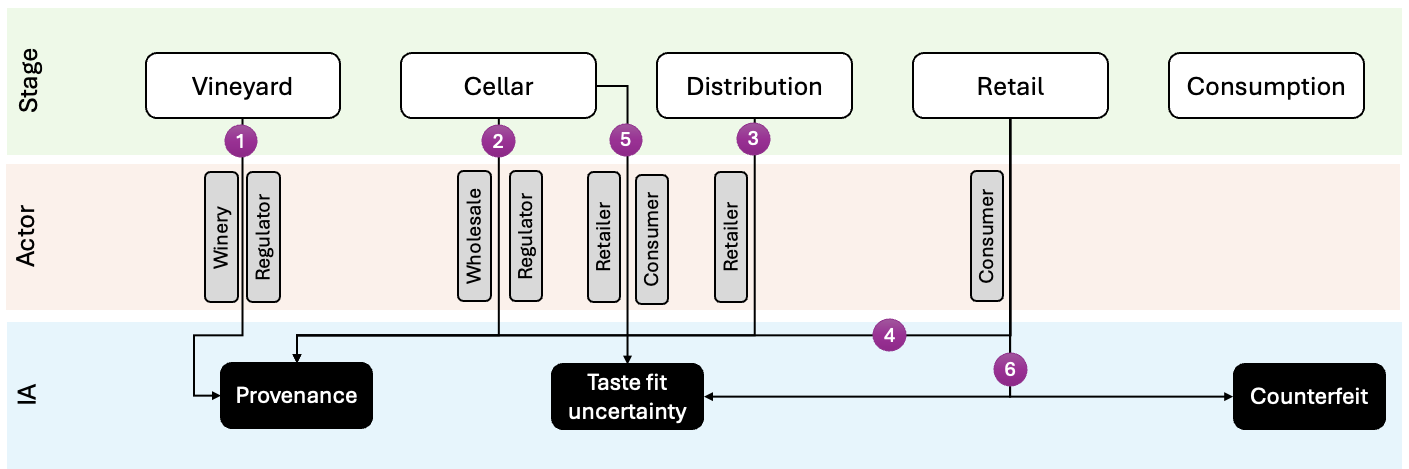
Thus, in answer to the first research question, the analysis shows that the multidimensionality of wine quality systematically gives rise to information asymmetries across all stages of the value chain. These asymmetries are layered, as informational advantages shift from one actor to another, and they affect producers, consumers, regulators, and intermediaries in distinct but interrelated ways.
4.2 Mitigation of information asymmetries in wine markets
This subsection contributes directly to the second research question by evaluating how traditional signals and screening mechanisms reduce, relocate, or exacerbate information asymmetry. To mitigate these information asymmetries, the general theories of signaling and screening take on distinctive forms in wine:
– Signaling: Producers rely on costly strategies such as pricing above the market average, investing in branding, or entering competitions to demonstrate hidden quality attributes. Reputation functions as a cumulative signal across vintages and markets.
– Screening: Regulators and consumers employ institutional mechanisms – certifications, GIs, audits, or sustainability labels – that extract credible information. These mechanisms reduce uncertainty but depend on consumer recognition and trust in enforcement bodies.
While effective in some contexts, both approaches face limitations: signals can be mimicked, and screens can be gamed.
Price has long been considered the most immediate extrinsic signal of wine quality. Empirical studies confirm that higher prices often correlate with higher-rated wines [3], but this relationship is far from perfect. Meta-analyses demonstrate wide variation in explanatory power across regions and vintages [32]. Price is also subject to speculative dynamics, especially in fine wine markets, where it may reflect scarcity or prestige rather than intrinsic quality.
Reputation serves as a stabilizing signal, allowing consumers to rely on accumulated credibility of brands, producers, or regions [46]. Regional reputations, such as Bordeaux or Napa, provide collective benefits but can be undermined by scandals or overproduction. Reputation is slow to build but can be quickly damaged, illustrating both its power and fragility.
Expert ratings remain a cornerstone of wine evaluation. Castriota et al. [33] and Gergaud et al. [20] show that ratings strongly influence consumer choices and price formation. Yet critics themselves are sources of asymmetry. Studies highlight inconsistency across judges [15], low repeatability [7], and biases linked to style preferences or conflicts of interest [34]. Competitions and awards provide additional signals. While they democratize recognition, participation is selective and may favour producers with resources to enter multiple contests. Research on competition outcomes shows they influence consumer willingness-to-pay but are not reliable indicators of intrinsic quality [24]. Sommeliers and wine merchants also act as intermediaries, offering guidance to consumers but introducing asymmetry about their motivations, expertise, and potential commercial bias.
Geographical indications (PDOs, PGIs) and certification schemes (organic, biodynamic, fair trade, sustainability) serve as institutional screens. They reduce uncertainty about provenance or production methods, and studies confirm that they sustain consumer trust and price premia when enforcement is credible [37, 19]. However, weak enforcement or label proliferation undermines their credibility [3]. In secondary markets, platform-level verification at auctions acts as a screen, increasing sale probabilities and prices [48, 49].
Cooperatives represent another form of institutional arrangement. They can enhance collective reputation, stabilize supply, and strengthen bargaining power. Yet they are prone to principal–agent dilemmas: members may have incentives to shirk quality standards while benefiting from collective reputation [38, 39]. Case studies illustrate that cooperative governance structures vary widely in their effectiveness [40]. Thus, institutional mechanisms mitigate some asymmetries but introduce new governance challenges.
Digital platforms such as Vivino expand consumer access to peer evaluations, democratizing wine criticism [26]. They provide real-time data on consumer preferences but also create new asymmetries: algorithms shape visibility, popular wines are disproportionately favoured, and reviews may be manipulated.
Studies of natural wine illustrate how digital discourse reshapes consumer expectations: perceived authenticity often matters more than sensory evaluation [42]. This highlights the tension between symbolic and sensory dimensions in digital peer ratings. While they increase participation, they also amplify herding effects and reinforce existing hierarchies.
Scientific advances allow increasingly detailed measurement of wine attributes. Chemometrics and machine learning models predict sensory outcomes or consumer preferences from chemical data [35]. Structured sensory panels provide robust assessments under controlled conditions [36]. Yet these approaches remain costly, inaccessible to most consumers, and fail to capture subjective or cultural interpretations of quality.
These mechanisms are summarized in Table 1, which maps the major information asymmetries in the wine sector, the corresponding signals and screens, and their effectiveness. In this review, “effectiveness” refers to the extent to which a mitigation mechanism reduces information asymmetry by increasing the credibility, interpretability, or reliability of quality-related information for the relevant stakeholders. The classifications reported in Table 1 are based solely on empirical evidence presented in the reviewed studies.
| Stage | Information Asymmetry | Stakeholders Affected | Description & Examples | Traditional Mitigation Instruments | Effectiveness* | ||||||||||||||
|---|---|---|---|---|---|---|---|---|---|---|---|---|---|---|---|---|---|---|---|
| Vineyard | Vineyard practices | Grape growers ↔ wineries / co-ops | Growers know pruning, soils, treatments; buyers lack full visibility. | Organic / sustainability certifications; audits. | p | ||||||||||||||
| Vineyard | Yield & harvest timing | Grape growers ↔ wineries / co-ops | Overstated yields; altered harvest timing; limited real-time oversight. | Pre-harvest contracts; field inspections; yield monitoring. | p | ||||||||||||||
| Vineyard | Use of inputs (pesticides, irrigation, GMOs) | Grape growers ↔ regulators / consumers | Undocumented inputs undermine health / sustainability claims. | Lab testing; certification; residue checks. | y | ||||||||||||||
| Vineyard | Origin of grapes (parcel / site specificity) | Grape grower ↔ winery | Privileged knowledge of plots / blocks; buyers learn post-harvest. | PDO / harvest records; GI labels; audits. | p | ||||||||||||||
| Vineyard | Origin of grapes (regulatory compliance) | Producer ↔ regulator | Verification of declared source for blends / subregions. | Harvest reports; certification of origin; audit trails. | y | ||||||||||||||
| Vineyard | Origin of grapes (consumer-facing) | Producer ↔ consumers / distributors / experts | Consumers rely on labels; limited independent verification. | PDO / PGI labels; external certification bodies. | n | ||||||||||||||
| Cellar | Sensory quality | Producer ↔ consumer / distributor | Intrinsic quality not fully revealed pre-purchase. | PDO tasting panels; expert reviews; consumer tastings. | n | ||||||||||||||
| Cellar | Winemaking methods (fermentation, additives) | Wineries ↔ distributors / retailers / consumers | Use of additives / stabilizers may be undisclosed. | Labelling laws; ingredient disclosure; lab tests. | y | ||||||||||||||
| Cellar | Aging & maturation | Wineries ↔ critics / consumers | Barrel types and duration selectively disclosed; affects perceived quality. | Technical sheets; PDO rules; certification panels. | p | ||||||||||||||
| Cellar | Microbial / chemical stability | Wineries ↔ distributors / retailers | Spoilage or instability risks not fully revealed. | Lab testing; certification; bottling audits. | y | ||||||||||||||
| Distribution / Wholesale | Storage & transport conditions | Distributors / logistics providers ↔ retailers / wineries / consumers | Temperature shocks / handling degrade quality; documentation rare. | Cold-chain protocols; temperature / shock loggers; logistics documentation. | p | ||||||||||||||
| Distribution / Wholesale | Sustainability compliance | Wineries ↔ regulators / certifiers | Claims may not match actual practices; audit intensity varies. | Third-party certification; periodic audits. | p | ||||||||||||||
| Distribution / Wholesale | Supply-chain traceability | Producers / distributors ↔ retailers / consumers | Opacity on relabelling, repackaging, or alteration in transit. | Batch records; serialisation; track-and-trace systems. | p | ||||||||||||||
| Distribution / Wholesale | Market demand & pricing trends | Distributors / brokers ↔ wineries | Intermediaries may withhold demand / price info from producers. | Transparent brokerage; market research; data-sharing. | n | ||||||||||||||
| Distribution / Wholesale | Counterfeiting & fraud | Distributors / importers ↔ retailers / consumers | Fake wines or misrepresented vintages enter the market. | Tamper-evident packaging; NFC / RFID; authentication seals. | p | ||||||||||||||
| Retail | Tasting uncertainty (experience good) | Consumers (and retailers) | Intrinsic quality unknown pre-purchase. | Competitions; critic scores; in-store tastings; peer reviews. | n | ||||||||||||||
| Retail | Expert / critic opacity | Consumers | Methods, biases, and incentives of experts unclear. | Multiple guides; blind tastings; disclosure norms. | n | ||||||||||||||
| Retail | Branding vs. actual quality | Producers / retailers ↔ consumers | Reputation inflates signals beyond intrinsic quality. | Independent reviews; rating platforms; comparative tastings. | n | ||||||||||||||
| Consumption | Aging potential claims | Wineries / critics ↔ consumers | Longevity claims may be overstated; hard to verify ex ante. | Expert consensus; retrospective evaluations; cellar studies. | n | ||||||||||||||
| Consumption | Resale value & investment risk | Auction houses / collectors ↔ investors / consumers | Secondary market lacks transparency; speculative bubbles. | Price-tracking services; verified histories; condition reports. | p | ||||||||||||||
| *Effectiveness legend: y = largely effective; p = partially effective; n = limited or none. | |||||||||||||||||||
Accordingly, in answer to the second research question, the evidence indicates that while a wide range of signals and screening mechanisms provides partial relief from information asymmetry, none is sufficient on its own. Price and reputation stabilize expectations but are vulnerable to speculation and shocks. Expert ratings and competitions democratize evaluation but suffer from inconsistency and bias. Institutional arrangements such as GIs, certifications, and cooperatives offer governance-based solutions, yet their effectiveness depends on credible enforcement and internal incentive alignment. Digital platforms expand participation but create new algorithmic and symbolic asymmetries. Even scientific measurement leaves unresolved the gap between objective data and subjective experience.
Taken together, these mechanisms form layered systems of trust. They mitigate uncertainty at one level while often generating new dependencies at another. This relocation dynamic will be explored further in the synthesis section.
5.1 Layered nature of asymmetries
The review confirms that information asymmetries in wine are not confined to a single stage of the value chain but occur simultaneously and interactively across vineyard, cellar, distribution, and consumption. Mechanisms designed to mitigate these asymmetries rarely function in isolation. Instead, they form layered arrangements of trust, where consumers, producers, regulators, and experts rely on multiple overlapping signals and screens to stabilize expectations. These dynamics reflect the trust properties of wine: because many quality attributes are credence-based and cannot be directly verified by consumers, asymmetries are layered and persist across the value chain.
A consistent pattern across the literature is that mechanisms intended to reduce asymmetries rarely eliminate uncertainty; rather, they tend to relocate it. For instance, expert ratings reduce consumer uncertainty but create opacity regarding the independence and consistency of critics [34, 15]. Geographical indications reduce uncertainty about provenance but shift reliance onto regulatory bodies and their enforcement capacity [22, 23]. Digital platforms democratize access to consumer evaluations but introduce new risks of manipulation, bias, and herding [26]. This relocation effect is a direct consequence of wine’s hybrid character as a search, experience, and credence good: signals that resolve one dimension of uncertainty inevitably leave others unresolved.
5.3 Effectiveness of traditional mechanisms
Table 2 synthesizes evidence on how different facets of wine quality generate information asymmetries, the signals and screens most often applied to mitigate them, and the consequences documented in the literature.
| Information Asymmetry | Stakeholders Affected | Signals / Screens | Consequences if Unresolved |
|---|---|---|---|
| Provenance of grapes and wine | Wineries, regulators, distributors, consumers | PDO / GI labels, certification, audits, branding | Misrepresentation of origin; dilution of PDO; fraud |
| Tasting uncertainty (sensory quality) | Consumers, retailers | Expert scores, competitions, tastings, peer reviews | Adverse selection; consumer disappointment; reliance on critics |
| Expert / critic opacity | Consumers, wineries, retailers | Multiple guides, blind tastings, aggregation methods | Bias, conflict of interest, loss of credibility |
| Certification opacity (organic, sustainability, fair trade) | Consumers, regulators | Third-party audits, eco-labels, certification schemes | Greenwashing, erosion of trust in sustainability claims |
| Storage and transport conditions | Distributors, retailers, consumers | Logistics documentation, cold-chain protocols, brand reputation | Quality degradation, spoilage, hidden faults |
| Counterfeiting and fraud | Premium producers, regulators, consumers | Authentication seals, bottle design, brand reputation | Market distortion, erosion of consumer trust, reputational damage |
| Market demand and pricing trends | Producers, distributors | Price signals, market reports, branding | Misallocation of supply, speculative bubbles |
| Reputation and peer ratings | Consumers, wineries | Online platforms (e.g., Vivino), consumer reviews | Herding effects, bias toward popular wines, marginalization of niche producers |
| Aging potential and investment value | Consumers, investors, critics | Expert consensus, vintage charts, secondary market data | Overstated longevity claims, speculative risk, loss of value |
This highlights that no single mitigation mechanism is sufficient (see Annex II for the extended matrix underlying this table, which details additional mechanisms and literature coverage). Instead, instruments complement one another, creating layered trust systems. At the same time, this layering explains why asymmetries persist: each solution leaves residual uncertainty or introduces new dependencies. The uneven effectiveness of these mechanisms underlines that they respond to different facets of wine quality: experience attributes such as taste drive reliance on critics, while credence attributes such as provenance or sustainability require institutional validation.
The persistence and relocation of asymmetries affect stakeholder groups in distinct ways. For producers, the challenge lies in balancing traditional extrinsic signals such as price, branding, and awards with institutional and digital mechanisms. These instruments provide credibility and facilitate market access, but they also expose wineries to reputational risks and generate additional compliance costs. Consumers, in turn, benefit from an expanding range of signals yet face ongoing uncertainty about their credibility and consistency. Decision-making is therefore mediated by trust in intermediaries – critics, certifications, or digital platforms – each of which carries its own limitations. Regulators play a pivotal role in institutional screening through geographical indications, certification schemes, and auditing procedures. Their effectiveness, however, is constrained by resources, enforcement capacity, and the degree of consumer trust in oversight institutions; weak enforcement quickly undermines credibility. Finally, experts and intermediaries continue to translate sensory complexity into accessible judgments, but their role is increasingly contested. A lack of transparency in scoring systems undermines their legitimacy, while the rise of digital platforms redistributes evaluative authority to consumer collectives and peer-based reviews. These implications ultimately derive from the trust properties of wine: producers hold privileged knowledge of credence attributes, consumers struggle with experience attributes, and regulators seek institutional solutions to bridge these gaps.
5.5 Research gaps and evolving directions
The synthesis also reveals several important gaps in the existing literature. Conceptually, the link between the multidimensionality of wine quality and the persistence of asymmetries remains insufficiently conceptualized, with few studies offering a formal analytical framework. Although the relocation effect is frequently observed, it is rarely developed into an explicit conceptual framework. Empirically, research has concentrated on consumer-facing mechanisms, while asymmetries arising in vineyards, cellars, and logistics chains are comparatively underexplored. Cross-country comparisons and longitudinal studies are particularly scarce. Methodologically, many contributions isolate single mechanisms, whereas comparative and mixed-method approaches that capture interactions between signals and screens are still rare. Finally, significant governance gaps remain. The effectiveness of geographical indications, certifications, and cooperative arrangements varies across contexts, and while several studies document positive outcomes, empirical evidence remains uneven.
5.6 Implications for emerging solutions
Taken together, the findings show that wine markets operate within layered but fragile architectures of trust. Traditional and modern mechanisms mitigate uncertainty, but their effectiveness is uneven, and their interaction frequently relocates rather than resolves asymmetry.
These limitations have motivated exploration of emerging digital solutions such as blockchain, AI, IoT sensors, and online platforms. These tools promise new forms of transparency and accountability, yet they also raise challenges of governance, adoption, and interoperability. The next chapter turns to blockchain as an illustrative case, situating it within this broader landscape of technological innovation.
6. Emerging tools for transparency
This section addresses the third research question by examining how emerging digital solutions – particularly blockchain – may complement traditional mechanisms in mitigating information asymmetries.
The persistence of information asymmetries, even in the presence of layered trust systems, has stimulated interest in new digital solutions. These tools promise to improve transparency, accountability, and traceability along the wine value chain. While they cannot replace traditional mechanisms, they may complement them by addressing specific weaknesses or by creating new ways of communicating information to consumers and regulators.
6.1 Blockchain as an illustrative case
Among emerging technologies, blockchain has attracted particular attention as a potential tool for addressing information asymmetries in wine and agri-food markets. Originally introduced as the architecture underpinning cryptocurrencies [50], blockchain has since been conceptualized as a distributed ledger technology enabling transparent, tamper-resistant recordkeeping [51]. Management scholars describe it as both a technological and an institutional innovation: it does not simply store data but reconfigures governance by shifting trust from centralized authorities to decentralized networks [52].
In the wine sector, blockchain pilots illustrate how these features can be mobilized to enhance transparency [53,27,28]. Projects have been launched to document vineyard provenance, track cellar practices, and verify distribution and storage conditions. By linking these records to consumer-facing tools such as QR codes or NFC tags, blockchain promises to strengthen the credibility of claims about origin, authenticity, and sustainability. Comparable initiatives in the agri-food sector confirm its potential: Behnke and Janssen [54], for example, show how blockchain improves traceability in supply chains where credence attributes dominate, from organic food to fair-trade coffee.
Yet the technology has clear limitations. It does not address subjective quality assessments such as taste or style, depends heavily on reliable initial data entry (“garbage in, garbage out”), and introduces new challenges around governance, interoperability, and adoption costs. For smaller producers in particular, the financial and technical barriers can be substantial.
Blockchain therefore exemplifies the relocation rather than elimination of information asymmetry: while it enhances trust in provenance and certification, it shifts uncertainty to the reliability of data inputs and the governance of digital infrastructures.
6.2 Digital innovation beyond blockchain
Blockchain is only one part of a wider landscape of digital innovation in wine and agri-food markets. Digital platforms and social media have become highly influential in shaping perceptions of wine quality. Platforms such as Vivino provide consumers with access to peer-based reviews and crowd-sourced ratings, broadening participation but also amplifying herding effects and algorithmic bias [26]. Similar dynamics are evident in wine tourism, where TripAdvisor reviews strongly influence winery image and consumer trust [55]. These studies confirm that digital platforms democratize evaluation processes, but they also introduce new asymmetries regarding visibility, manipulation, and the credibility of user-generated content [14,34].
Artificial intelligence (AI) represents another emerging tool, offering predictive models that link intrinsic attributes to market outcomes. Ferreira et al. [35] demonstrate how chemometric and machine learning techniques can predict sensory quality from chemical composition, while Corsi and Ashenfelter [36] show how intrinsic datasets can be related to price formation. More recent contributions explore AI-based forecasting of wine market demand and consumer preferences [56]. While these applications highlight the potential of AI to generate new forms of knowledge, they also raise concerns about algorithmic transparency, training data biases, and the interpretability of results for non-specialists.
Internet of Things (IoT) sensors are increasingly integrated into vineyard management and logistics chains, enabling real-time monitoring of production and distribution conditions. Pilot studies show that IoT can enhance traceability and quality control in vineyards and cellars, particularly when combined with blockchain infrastructures [27,57]. In broader agri-food contexts, IoT applications are being deployed to strengthen transparency and consumer trust, though they raise questions about data ownership, privacy, and the cost of adoption [54].
Together, these tools demonstrate that digital innovation extends beyond blockchain, offering new opportunities to address asymmetries but also introducing fresh challenges of governance, interpretation, and inclusivity.
6.3 Stakeholder implications and mitigation of information asymmetries
The rise of digital solutions carries implications for all stakeholders. Producers gain new opportunities to signal authenticity and sustainability, but face added accountability and compliance costs. Consumers access more verifiable information but must still navigate a landscape of overlapping and sometimes conflicting signals. Regulators may benefit from more efficient oversight but must also invest in standard-setting, interoperability, and digital literacy. Experts and intermediaries see their roles shifting, as technical verification complements rather than replaces sensory judgment and cultural interpretation.
In answer to the third research question, the review indicates that emerging digital solutions – most notably blockchain – can complement traditional mechanisms by strengthening provenance claims, enhancing traceability, and increasing regulatory oversight. Yet they do not eliminate asymmetries altogether; instead, they relocate them into new domains such as data input, governance, and interoperability.
Taken together, these digital solutions illustrate how both traditional and emerging mechanisms remain anchored in wine’s product characteristics: some address experience attributes through evaluation and scoring, while others target credence attributes through certification and traceability. Yet none can eliminate the structural uncertainties that arise from wine’s multidimensional quality.
Emerging tools illustrate both the promise and the limits of digital innovation in addressing information asymmetries. They enhance transparency, but none provides a definitive solution. Rather, they complement traditional mechanisms within layered systems of trust, while simultaneously relocating uncertainty into new domains such as data governance, algorithmic design, and digital adoption.
This paper set out to advance the understanding of wine quality as a multidimensional construct by examining how it systematically generates information asymmetries and by assessing the effectiveness and limitations of mechanisms – both traditional and emerging – for mitigating them. The analysis was guided by three research questions, which can now be addressed in turn.
First, regarding the relationship between wine quality dimensions and the occurrence of information asymmetries, the review shows that multidimensionality systematically produces asymmetries across all stages of the value chain. These asymmetries are layered and relational, shifting informational advantages between producers, consumers, regulators, and intermediaries.
Second, with respect to signals and screening mechanisms, the review finds that while instruments such as price, reputation, expert ratings, certifications, and geographical indications provide partial relief from asymmetry, none eliminates it fully. Instead, they function as layered trust systems: effective in some contexts but relocating uncertainty to others.
Third, concerning the potential of emerging solutions, the analysis indicates that digital tools – most notably blockchain – can complement traditional mechanisms by strengthening provenance claims, enhancing traceability, and supporting regulatory oversight. Yet these technologies do not eradicate asymmetries; they shift them into new domains of data input, governance, and interoperability.
Taken together, these findings underscore that information asymmetry is not incidental but a structural feature of wine markets. While both traditional and emerging mechanisms contribute to its mitigation, they cannot resolve it entirely. The persistence of asymmetry points to the need for layered systems of trust.
Broader implications follow from this. For researchers, the results highlight the value of integrating information economics with wine studies. Conceptually, the link between multidimensional quality and persistent asymmetry deserves deeper theorization, especially around the relocation effect. Empirically, research remains concentrated on consumer-facing mechanisms, while vineyard, cellar, and logistics asymmetries are underexplored. Methodologically, comparative and longitudinal approaches that capture interactions across signals, screens, and digital tools are needed.
For industry stakeholders, the findings underscore that no single signal suffices. Producers, distributors, and retailers must combine traditional and digital instruments – price and reputation, institutional arrangements, expert systems, and new technologies – into layered trust configurations. For consumers, the practical message is that trust in wine markets is constructed through multiple overlapping signals rather than guaranteed by any single one.
For policymakers and regulators, the persistence of asymmetry calls for supportive governance frameworks. These include credible enforcement of geographical indications and certifications, harmonized standards for digital tools, and capacity-building measures that allow small and medium-sized producers to participate without disproportionate burdens. Promoting digital literacy, interoperability, and transparent auditing processes will be essential to ensure that emerging tools function effectively and equitably.
Ultimately, the findings underline that wine quality cannot be reduced to a single technical or institutional dimension but must be understood as the outcome of interacting intrinsic, extrinsic, institutional, and cultural factors. Emerging technologies may enhance transparency and accountability, yet they cannot substitute for the symbolic and experiential aspects that shape how quality is perceived and valued. For research, this suggests the need to examine how digital and institutional instruments interact with cultural and sensory dimensions; for practice and policy, it points to the challenge of designing governance frameworks that integrate technological innovation with the preservation of wine’s multidimensional character.
[1] S. Charters, S. Pettigrew, The intrinsic dimensions of wine quality, Proceedings of the International Colloquium in Wine Marketing (2003) 1–21.
[2] S. Charters, S. Pettigrew, The dimensions of wine quality, Food Qual. Prefer. 18 (2007) 997–1007.
[3] E. Oczkowski, Identifying the effects of objective and subjective quality on wine prices, J. Wine Econ. 11 (2016) 249–260.
[4] R. Zanchini, S. Blanc, S. Theodorakis, G. Di Vita, V.M. Merlino, F. Brun, S. Massaglia, How European consumers value wine credence attributes: a cross-country comparison of France, Greece and Italy, Wine Econ. Policy 14 (2025) 3–15.
[5] M.A. Amerine, E.B. Roessler, Wines: Their Sensory Evaluation, W.H. Freeman, San Francisco, 1983.
[6] P. Combris, S. Lecocq, M. Visser, Estimation of a hedonic price equation for Bordeaux wine: Does quality matter?, Econ. J. 107 (1997) 390–402.
[7] R.T. Hodgson, An examination of judge reliability at a major U.S. wine competition, J. Wine Econ. 3 (2008) 105–113.
[8] R. Goldstein, J. Almenberg, A. Dreber, J.W. Emerson, A. Herschkowitsch, J. Katz, Do more expensive wines taste better? Evidence from a large sample of blind tastings, J. Wine Econ. 3 (2008) 1–9.
[9] H.H. Ali, S. Lecocq, M. Visser, The impact of gurus: Parker grades and en primeur wine prices, Econ. J. 118 (2008) 158–173.
[10] G. Mastrobuoni, F. Peracchi, A. Tetenov, Price as a signal of product quality: Some experimental evidence, J. Wine Econ. 9 (2014) 135–152.
[11] G.A. Akerlof, The market for lemons: Quality uncertainty and the market mechanism, Q. J. Econ. 84 (1970) 488–500. https://doi.org/10.2307/1879431.
[12] M. Spence, Job market signaling, Q. J. Econ. 87 (1973) 355–374.
[13] J.E. Stiglitz, The theory of “screening,” education, and the distribution of income, Am. Econ. Rev. 65 (1975) 283–300.
[14] P. Dubois, The market for wine quality evaluation: Evolution and future perspectives, J. Wine Econ. 16 (2021) 150–167.
[15] R.H. Ashton, Improving experts’ wine quality judgments: Two heads are better than one, J. Wine Econ. 6 (2011) 160–178.
[16] R.H. Ashton, The value of expert opinion in the pricing of Bordeaux wine futures, J. Wine Econ. 11 (2016) 261–288.
[17] J.C. Bodington, Rate the raters: A note on wine judge consistency, J. Wine Econ. 15 (2020) 363–369.
[18] D. Priilaid, J. Feinberg, O. Carter, G. Ross, Follow the leader: How expert ratings mediate consumer assessments of hedonic quality, S. Afr. J. Bus. Manag. 40 (2009) 51–58.
[19] L. Menapace, G. Moschini, The economics of geographical indications: An update, Annu. Rev. Resour. Econ. 16 (2024) 83–104.
[20] O. Gergaud, F. Livat, S. Resnick, Wine ratings: Seeking a consensus among tasters via normalization, approval, and aggregation, J. Wine Econ. 16 (2021) 321–342.
[21] P. Fanasch, B. Frick, The value of signals: Do self-declaration and certification generate price premiums for organic and biodynamic wines?, J. Clean. Prod. 249 (2020) 119415.
[22] S. López-Bayón, M. González-Díaz, V. Solís-Rodríguez, M. Fernández-Barcala, Influence of governance structure on the effectiveness of quality standards: The case of geographical indications.
[23] P. Mérel, A. Ortiz-Bobea, E. Paroissien, How big is the “lemons” problem? Historical evidence from French appellation wines, AAWE Conf. (2019).
[24] G. Schamel, Dynamic analysis of brand and regional reputation: The case of wine, J. Wine Econ. 4 (2009) 62–80.
[25] T. Whitnall, J.M. Alston, Climate, weather, and collective reputation: Implications for California’s wine prices and quality, J. Wine Econ. 20 (2025) 122–167.
[26] O. Kopsacheilis, E. Bru, D. Kaimann, Crowdsourcing the assessment of wine quality: Vivino ratings, professional critics and the weather, J. Wine Econ. 19 (2024) 285–304.
[27] H. Treiblmaier, C. Garaus, Using blockchain to signal quality in the food supply chain: The impact on consumer purchase intentions and the moderating effect of brand familiarity, Int. J. Information Management 68 (2023) 102514.
[28] M.P. Kramer, N. Adamashvili, D. Vrontis, J.H. Hanf, A. Galati, The dual role of blockchain in mediating credence attributes and moderating sensing capabilities in the wine sector, Int. J. Organ. Anal. (2024).
[29] H. Snyder, Literature review as a research methodology: An overview and guidelines, J. Bus. Res. 104 (2019) 333–339.
[30] E. Jaakkola, Designing conceptual articles: Four approaches, AMS Rev. 10 (2020) 18–26.
[31] A. Castellini, A. Samoggia, Millennial consumers’ wine consumption and purchasing habits and attitude towards wine innovation, Wine Econ. Policy 7 (2018) 128–139.
[32] B. Frick, R. Simmons, The impact of individual and collective reputation on wine prices: empirical evidence from the Mosel valley. Journal of Business Economics, 83(2), 101–119.
[33] S. Castriota, M. Delmastro, G. Palumbo, Tasters’ bias in wine guides’ quality evaluations, Applied economics letters, 20 (2013) 1174–1177.
[34] M. Dubois, J.M. Cardebat, N. Georgantzis, External evaluations under quality uncertainty: The market for wine ratings, Wine Econ. Policy 14 (2025) 131–162.
[35] V. Ferreira, A. Escudero, L. Culleré, Wine aroma vectors and sensory attributes, in: A.G. Reynolds (Ed.), Managing Wine Quality, Woodhead, 2022, pp. 3–39.
[36] A. Corsi, O. Ashenfelter, Predicting Italian wine quality from weather data and expert ratings, J. Wine Econ. 14 (2019) 234–251.
[37] F. Livat, J.M. Alston, J.M., Cardebat Do denominations of origin provide useful quality signals, Economic Modelling 81 (2019) 518–532.
[38] J.H. Hanf, R. Kühl, Branding and its consequences for German agribusiness, Agribusiness 21 (2005) 177–189.
[39] J.H. Hanf, E. Schweickert, Cooperatives in the balance between retail and member interests: the challenges of the German cooperative sector, J. Wine Res. 25(2014) 32–44.
[40] J.H. Hanf, M. Iselborn, How to deal with quality problems of German wine cooperatives, 8th International Conference for Academy of Wine Business Research (2014) 28–30.
[41] P. Gál, The determinants of wine prices: A systematic literature review, Competitio 19 (2020) 84–101.
[42] G. Lo Monaco, J.L. Tavani, C. Codaccioni, Social factors and preference for quality cues: Towards a social construction of wine quality, Food Res. Int. 134 (2020) 109270.
[43] P. Nelson, Information and consumer behavior, J. Polit. Econ. 78 (1970) 311–329.
[44] A.J. Verdú Jover, F.J. Lloréns Montes, M.M. Fuentes Fuentes, Measuring perceptions of quality in food products: The case of wine, Food Qual. Prefer. 15 (2004) 453–469.
[45] M.R. Darby, E. Karni, Free competition and the optimal amount of fraud, J. Law Econ. 16 (1973) 67–88.
[46] C. Shapiro, Premiums for high quality products as returns to reputations, Q. J. Econ. 98 (1983) 659–680.
[47] J. Tirole, A theory of collective reputations (with applications to the persistence of corruption and to firm quality), Rev. Econ. Stud. 63 (1996) 1–22.
[48] I. Onur, J. Bruwer, L. Lockshin, Reducing information asymmetry in the auctioning of non-perishable experience goods: The case of online wine auctions, J. Retail. Consum. Serv. 54 (2020) 102060.
[49] P. Oleksy, M. Czupryna, M. Jakubczyk, On fine wine pricing across different trading venues, J. Wine Econ. 16 (2021) 189–209.
[50] S. Nakamoto, Bitcoin: A peer-to-peer electronic cash system, 2008. https://bitcoin.org/bitcoin.pdf (accessed 27 Oct 2025).
[51] F. Glaser, Pervasive decentralisation of digital infrastructures: A framework for blockchain enabled system and use case analysis, Proc. 50th HICSS (2017).
[52] M. Risius, K. Spohrer, A blockchain research framework, Bus. Inf. Syst. Eng. 59 (2017) 385–409.
[53] R. Spadoni, M. Nanetti, A. Bondanese, S. Rivaroli, Innovative solutions for the wine sector: The role of startups. Wine Economics and Policy 8(2019) 165–170.
[54] K. Behnke, M. Janssen, Boundary conditions for traceability in food supply chains using blockchain technology, Int. J. Inf. Manag. 52 (2020) 101969.
[55] A. Brochado, O. Stoleriu, C. Lupu, Wine tourism: a multisensory experience, Current Issues in Tourism 24 (2021) 597–615.
[56] J. Yang, A dataset on the sensory analyses of 116 New Zealand Pinot Noir wines, Data in Brief (2025) 111638.
[57] B. Malisic, N. Misic, S. Krco, A. Martinovic, S. Tinaj, T. Popovic, Blockchain adoption in the wine supply chain: A systematic literature review, Sustainability 15 (2023) 14408.
Annex I. Wine value chain and stakeholders (source: authors)
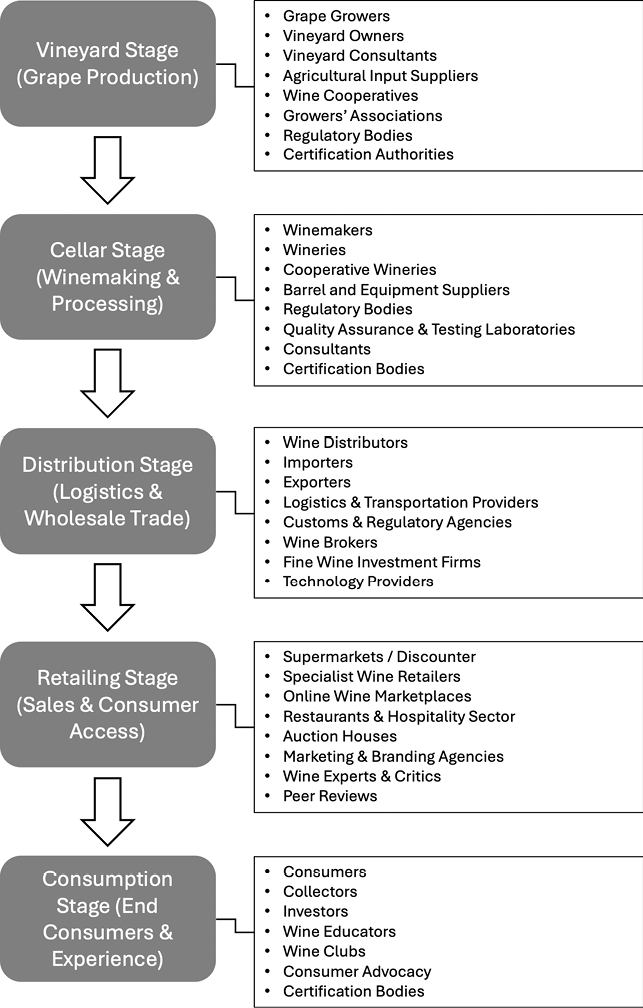
Annex 2. Information asymmetries along the wine value chain: stakeholders, mitigation, effectiveness, and research gaps
| IA (concise) | Where it occurs | Primary stakeholders affected | Existing mitigation instruments (signals / screens) | Effectiveness (why) | What’s missing (practice & research gaps) | Literature coverage |
|---|---|---|---|---|---|---|
| Taste fit uncertainty (experience good) | Pre-purchase | Consumers, retailers | Blind tastings; sampling (by-the-glass / miniatures); style descriptors; lab / sensory metrics; AI palate matching | Medium – Sampling works but is costly; descriptors can be vague; lab metrics not widely understood | Low-cost sampling models; consumer-friendly sensory vocabularies; validation of AI matchers | High |
| Expert panel variability | Competitions, guides | Producers, consumers | Calibration protocols; double-blind panels; rater reliability checks | Medium – Improves consistency but variance remains | Transparent rater reliability reporting; cross-panel benchmarking | Medium |
| Vintage variability signals | Vineyard-consumer | Consumers, traders | Vintage charts; winemaker notes; weather summaries | Low-Medium – Coarse signals; regional averages hide site specifics | Block-level vintage reporting; links to measurable parameters | Low |
| Provenance / origin misrepresentation | Vineyard, cellar, logistics | Consumers, importers, regulators | PDO / PGI rules; audits; pack IDs; tax stamps; geo-tags; QR traceability | Medium – Works where enforcement is strict; weak otherwise | Automated geo-capture; harmonised enforcement; SME-friendly compliance | Medium |
| Single-vineyard / cru claims | Labeling | Consumers, regulators | Site registries; cadastral maps; parcel IDs; certification | Medium – Good where codified; limited elsewhere | Global minimum definitions; parcel-level data sharing | Low |
| Varietal / blend composition opacity | Cellar, label | Consumers, regulators | Label rules; lab tests (isotopes / DNA); audits | Medium – Detectable, but testing is episodic | Routine, randomised lab surveillance; cheaper assays | Medium |
| Process integrity (organic / biodynamic) | Farming & cellar | Consumers, regulators, buyers | Third-party seals; inspections; input logs | Medium – Seal trust varies; audits costly for SMEs | Tiered fees; multi-standard interoperability; longitudinal outcomes | Medium |
| Additives / processing aids transparency | Cellar | Consumers (allergens), regulators | Ingredient / e-label rules; lab certificates | Low-Medium – Info exists but not salient; exemptions apply | Clearer, harmonised e-labels; consumer comprehension studies | Emerging |
| Sulphites / allergen comprehension | Label comprehension | Consumers | Mandatory declarations; QR e-labels | Medium – Present but poorly understood | Risk-communication design; cross-country harmonisation | Low-Medium |
| Sustainability / CO₂ claims (greenwashing risk) | Value chain | Consumers, buyers, regulators | LCA labels; third-party eco-seals; GHG protocols | Low-Medium – Method variance + data gaps | Standardised scopes / boundaries; auditable datasets; SME toolkits | Emerging |
| Cold-chain & storage conditions | Logistics & retail | Importers, retailers, consumers | Temperature loggers; shock sensors; condition clauses; QR logs | Medium – Sensors help; adoption uneven | End-to-end sensor coverage; alerts integrated with trade docs | Low |
| Counterfeit / refill fraud | Secondary markets, horeca | Consumers, brand owners | Tamper seals; NFC / RFID; serialisation; forensic packaging | Medium-High – Works when combined; criminals adapt | Secure consumer verification flows; law-enforcement bridges | Medium |
| Old-vintage authenticity | Auctions / collectors | Collectors, traders | Provenance dossiers; capsule / cork forensics; isotope tests | Medium – Expertise-heavy; testing expensive | Shared provenance registries; lower-cost assays | Low-Medium |
| Rating opacity & pay-to-play risk | Media / platforms | Consumers, producers | Disclosure rules; firewalling ad / editorial; method notes | Low-Medium – Compliance uneven; consumers rarely see methods | Standardised rater transparency; reliability metrics in outputs | Low-Medium |
| Medal proliferation (“vanity awards”) | Competitions | Consumers | Hierarchies of competitions; disclosure of win base size | Low – Signal dilution common | Minimum standards for award use; comparability frameworks | Low |
| Online herding & review manipulation | Marketplaces / apps | Consumers, small producers | Verified-purchase badges; anti-spam ML; median / trimmed means | Medium – Helps, but herding persists | Causal tests of display algorithms; audit trails for review edits | Emerging |
| Price opacity & margins (retail / HoReCa) | Retail / restaurant | Consumers, producers | RRP guidance; menu transparency norms | Low – Wide dispersion; strategic pricing | Transparent reference pricing; fair-pricing guidelines | Low |
| Distributor / private-label opacity | Wholesale / retail | Consumers, producers | PL disclosure rules; lot codes | Low-Medium – Rules vary; branding obscures origin | Clear PL provenance norms; buyer education | Low |
| Aging potential / drinking window claims | Marketing | Consumers | Back-label guidance; critic windows | Low – High uncertainty; bottle variation | Data from cellaring studies; predictive models | Low |
| “Natural / low-intervention” ambiguity | Positioning | Consumers, regulators | Voluntary charters; community seals | Low – No global standard | Baseline definition; cross-market recognition | Emerging |
| No / low-alcohol process disclosure | Tech / process | Consumers, regulators | Process icons; e-labels | Low-Medium – New category; weak familiarity | Clear typology & claims limits; sensory expectations research | Emerging |
| Closure type misinference | Packaging | Consumers, producers | Education; neutral communications | Low – Strong priors / country effects | Cross-cultural guidance; blind-trial communications | Low |
| Health & wellbeing narratives | Marketing | Consumers, regulators | Advertising codes; claim bans | Medium – Enforcement deters extremes | Digital ad enforcement; cross-border consistency | Medium |
| Traceability system integrity (GIGO) | Data governance | All | Blockchain / ERP logs; audits; IoT sensors | Medium – Immutable ≠ truthful | Automated data capture; governance; independent oracles | Emerging |
| Standards & interoperability gaps | Ecosystem | Producers, tech firms, regulators | GS1; EPCIS; data standards initiatives | Low-Medium – Fragmented uptake | Common schemas; open APIs; regulator-backed baselines | Emerging |
| Consumer data / privacy in transparency apps | Apps / UX | Consumers | GDPR / consent tools; privacy policies | Medium – Legal compliance; low literacy | Privacy-by-design patterns; trust labels | Low |
Annex 3. List of reviewed articles with data sources, sample size and methods
| Study | Data sources | Sample size | Methods |
|---|---|---|---|
| Angelini et al. (2025). Cumulative information on quality and willingness to pay: a study on wine evaluation | Experimental tasting data collected from 38 subjects at a public event; evaluations of 6 wines with sequential information disclosure | 38 participants evaluating 6 wines in structured tasting experiment | Bayesian linear mixed models estimated via INLA with random and spatial effects. |
| Bazen et al. (2024). The role of customer and expert ratings in a hedonic analysis of French red wine prices from ‘gurus’ | Hedonic dataset of French red wines with expert scores, Vivino ratings and wine attributes. | 36,970 wines. | Hedonic price regressions with robustness checks and subsamples. |
| Bodington (2020). Rate the Raters: A Note on Wine Judge Consistency | 2019 California State Fair wine competition: judge ratings and wines entered. | 54 judges; 2,811 wines. | Correlation matrices and coefficients of multiple correlation to measure judge consistency. |
| Cai, Ma & Su (2016). Effects of member size and selective incentives of agricultural cooperatives on product quality | Survey of apple marketing cooperatives in Shandong province, China. | 135 cooperatives. | Principal component analysis to build quality index; OLS regressions of quality on member size and selective incentives. |
| Carayol & Jackson (2024). Finding the Wise and the Wisdom in a Crowd: Estimating Underlying Qualities of Reviewers and Items | Over 45,000 Bordeaux en primeur expert reviews plus Judgement of Paris data and prices. | 45,000+ ratings; additional Paris tasting data. | Two-stage weighted least squares to estimate item qualities and reviewer bias/accuracy; Monte Carlo simulations. |
| Carter (2015). Constructing Quality: Producer Power, Market Organization, and the Politics of High Value-Added Markets | Historical documents, regulations and interviews on French and Italian wine sectors. | Not applicable (qualitative case work). | Qualitative institutional and political-economy analysis. |
| Castellano & Khelladi (2015). The influence of the territory on legitimacy and price: application to the French wine sector | Secondary data on French wine prices and AOC/AOP territorial/legitimacy indicators. | Panel of French wines (N not reported in excerpt). | Hedonic price models including territorial legitimacy variables. |
| Castriota, Curzi & Delmastro (2013). Tasters’ bias in wine guides’ quality evaluations | Italian Guida Veronelli ratings 2004–2009 with taster IDs and wine characteristics. | Multi-year panel; exact N not in excerpt. | Fixed-effects regressions and variance decomposition to identify taster generosity and bias. |
| Charters (2011). The territorial brand in wine | Interviews and focus groups with consumers, producers and mediators in Australia. | 105 informants. | Qualitative thematic analysis using NUD*IST; development of perceived quality models. |
| Charters (2004). Perceptions of wine quality | Google Ngram data; British newspaper articles; interviews; Decanter magazine case. | Multiple text corpora; N not given. | Quantitative linguistic analysis and qualitative textual analysis; mixed-method interpretation. |
| Charters & Harding (2024). The irresistible rise of the notion of terroir | Focus groups and interviews with consumers, producers and mediators. | 103 participants. | Qualitative coding of intrinsic quality dimensions; comparison by involvement level. |
| Charters & Pettigrew (2006). Conceptualizing product quality: the wine case | Interviews with wine consumers on quality perceptions. | 60 consumers. | Qualitative thematic analysis; development of interactionist model of quality. |
| Charters & Pettigrew (2007). The dimensions of wine quality | Focus groups and interviews with Australian wine drinkers including tastings. | Sample size not reported (approx. few dozen participants). | Thematic analysis; identification of intrinsic and extrinsic quality dimensions and segments. |
| Charters & Pettigrew (2003). The intrinsic dimensions of wine quality | Case study of Champagne using interviews, internal documents and prior studies. | Not reported (multiple interviews and sources). | Qualitative case study; thematic content analysis; framework for strong territorial brands. |
| Charters & Spielmann (2014). Characteristics of strong territorial brands: The case of Champagne | Authors’ accumulated empirical work and literature on wine regions and branding. | Not applicable (conceptual). | Conceptual framework for territorial brands in wine. |
| Chon, Gergaud & Heo (2025). An empirical investigation of wine sales as a driver of financial performance in restaurants | Proprietary restaurant panel data on wine sales, wine lists and financial outcomes. | Multi-restaurant, multi-period panel (N not reported). | Panel regressions with fixed effects analysing impact of wine sales on restaurant performance. |
| Codron, Montaigne & Rousset (2012). Quality management and contractual incompleteness: grape procurement for high-end wines in Argentina | Field interviews and contract information for high-end wine grape procurement in Argentina. | Several cooperative and producer cases. | Double principal-agent and contract-theory analysis; qualitative case comparison. |
| Corduas, Cinquanta & Ievoli (2013). The importance of wine attributes for purchase decisions: A study of Italian consumers’ perception | Questionnaire on importance of wine attributes (Likert scales) among Italian consumers. | 192 consumers. | CUB models for ordinal responses; analysis of uncertainty/feeling components and covariate effects. |
| Corsi & Ashenfelter (2019). Predicting Italian wine quality from weather data and expert ratings | Regional vintage-level Italian weather variables and expert quality scores. | Multi-decade panel of vintages by region (N not given). | Regression models predicting scores from weather and other controls. |
| Corsinovi & Gaeta (2015). Managing the Quality Wines beyond Policies and Business Strategies | EU GI policy documents and historical development of Super Tuscan wines; literature. | Not applicable. | Conceptual framework combining quality economics, GI regulation and strategic positioning; qualitative analysis. |
| Costanigro, Dubois, Gracia & Cardebat (2025). The Information Value of Geographical Indications | Literature and illustrative GI, price and rating data for wines. | Not applicable (primarily conceptual). | Information-economics modelling of GIs as quality signals; conceptual policy analysis. |
| De Nicoló (2025). Wine ratings and commercial reality | Judgement of Paris data; Bordeaux en primeur scores and prices; Italian ratings database. | Several datasets including JP 21 wines and thousands of Bordeaux/Italian observations. | ANOVA, quantile regressions, finite mixture models and hedonic price regressions; construction of equivalence classes. |
| Delmas (2021). Sustainable practices and product quality: Is there value in eco-label certification? The case of wine | French wine guide ratings matched with organic, biodynamic and other eco-label certifications. | 128,182 wines. | Regression models estimating eco-label effects on expert scores controlling for wine attributes. |
| Dubois (2023). Experience goods and the role of experts: recommendation effects on wine purchasing decision | Bibliographic review of research on wine critics, guides and competitions. | 267 papers (1970–2020). | Integrative literature review; historical and structural analysis of evaluation markets. |
| Dubois (2021). The market for wine quality evaluation: evolution and future perspectives | Theoretical and empirical literature on experience goods and wine. | Not applicable. | Conceptual synthesis and classification of experience goods and expert roles. |
| Dubois, Cardebat & Georgantzis (2025). External evaluations under quality uncertainty: the market for wine ratings | Same 267-paper database plus conceptual information on rating providers. | Not empirical (conceptual). | Integrative review; conceptual modelling of evaluation markets and digital transformation. |
| Fanasch & Frick (2020). The value of signals: Do self-declaration and certification generate price premiums for organic and biodynamic wines? | German wine price data 2010–2017 with organic/biodynamic status, self-declaration, certification and reputation. | 55,500 wines from 1,514 wineries over 8 years. | Hedonic price models and quantile regressions to estimate signaling premia. |
| Fantechi et al. (2025). Sustainable wine – consumer preferences for environmental labels | Discrete choice experiment with Italian wine consumers on environmental labels. | 300 consumers. | Discrete choice models with latent class analysis to identify preference segments. |
| Ferreira, Lourenço-Gomes & Costa Pinto (2022). How does self-reported knowledge influence the effect of extrinsic cues on wine choice? A qualitative approach | Focus groups with red-wine consumers in four Portuguese regions. | 5 focus groups; 45 consumers. | Qualitative content analysis and thematic coding of cue use and knowledge effects. |
| Ferro & Benito Amaro (2018). What factors explain the price of top quality wines? | Wine Spectator Top 100 US lists 2003–2016 with prices, ratings and wine characteristics. | 1,400 wines. | Hedonic OLS regressions of log price on quality scores and wine/producer attributes. |
| Frick (2020). The Legacy of Gurus: The Impact of Armin Diel and Joel Payne on Winery Ratings in Germany | Longitudinal winery ratings from Gault Millau and Vinum guides around editorial changes. | All wineries rated in both guides over key years (hundreds of wineries). | Econometric analysis of rating changes linked to editor/taster changes. |
| Gergaud, Ginsburgh & Moreno-Ternero (2021). Wine Ratings: Seeking a Consensus among Tasters via Normalization, Approval, and Aggregation | Literature from Web of Science, Scopus, JSTOR, ProQuest and ScienceDirect on wine price determinants. | 46 empirical studies (1998–2018). | Systematic literature review and categorisation of determinants (origin, ratings, objective quality, labels, other). |
| Giua, Salvatici, Vaquero-Piñeiro & Solazzo (2025). Do Territories with Geographical Indications Trade Better? | Judgement of Paris ratings; 2018 Bordeaux en primeur expert ratings. | JP: 20 wines × 11 judges; en primeur: dozens of wines rated by five experts. | Normalization, approval voting and aggregation procedures to form consensus scores. |
| Gál (2020). The Determinants of Wine Prices: A Systematic Literature Review | Panel of Italian municipalities with PDO status and export data for wine and agri-food, 2004–2018. | Approx. 8,000 municipalities over 15 years. | Propensity score matching and difference-in-differences to estimate GI impacts on exports. |
| Hanf (1990). Zur Bedeutung von Vertrauenseigenschaften für den Wettbewerb auf Lebensmittelmärkten | Theoretical literature on credence attributes and illustrative food market cases. | Not applicable. | Micro-economic and institutional analysis of credence attributes and vertical contracts; conceptual discussion. |
| Hanf & Iselborn (2014). How to deal with quality problems of German wine cooperatives – A double principal-agent approach | Conceptual discussion supported by examples from German and Austrian wine cooperatives. | Not applicable. | Double principal-agent framework applied to wine cooperatives; qualitative discussion of solutions. |
| Hanf & Kühl (2005). Branding and Its Consequences for German Agribusiness | Literature and industry examples on branding and food safety in German agribusiness. | Not applicable. | Conceptual analysis of branding as governance for credence attributes; discussion of vertical coordination. |
| Hanf & Schweickert (2014). Cooperatives in the balance between retail and member interests | In-depth interviews and survey evidence on German wine cooperatives plus market data. | Qualitative sample of cooperative managers/members (N not specified). | Qualitative analysis of member vs customer orientation; conceptual discussion of branding and territory. |
| Kaimann & Spiess Bru (2024). Sounds too feminine? Blind tastings, phonetic gender scores, and the impact on professional critics | Wine Enthusiast blind-tasting data with wine names, critic gender and attributes. | 18,609 wines; 31,058 tasting observations (2011–2016). | Quasi-experimental design; regressions including phonetic gender scores and interactions. |
| Kaimann, Spiess Bru & Frick (2023). Ratings meet prices: The dynamic relationship of quality signals | Wine Enthusiast ratings and listed prices for worldwide wines over 20 years. | 13,911 tasting observations on 8,444 wines. | Panel regressions and two-stage least squares modelling dynamic relationship between ratings and prices. |
| Kleinhans (2018). Reputation and Status in the High-Quality Wine Industry | Bordeaux high-quality wine prices, Parker scores, classifications and secondary-market data. | Several thousand wine–vintage observations across multiple essays. | Hedonic and panel regressions; event-study analyses of status and reputation effects. |
| Kopsacheilis, Analytis, Kaushik, Herzog, Bahrami & Deroy (2024). Crowdsourcing the assessment of wine quality: Vivino ratings, professional critics and the weather | Vivino ratings for Bordeaux red wines, professional critics’ scores and local weather station data. | Portfolio of Bordeaux reds with many thousands of Vivino ratings (exact N in paper). | Correlation analysis and panel/time-series regressions of Vivino vs critic ratings and weather variables. |
| Kramer, Adamashvili, Vrontis, Hanf & Galati (2024). The dual role of blockchain in mediating credence attributes and moderating sensing capabilities in the wine sector | Longitudinal single-case study of Costaflores Organic Winery using internal data and interviews. | One focal winery; multiple informants over time. | Exploratory longitudinal case study; process tracing and qualitative content analysis framed by dynamic capabilities. |
| Lee (2024). Expert wine reviews: exploring trends in wine quality indicators | Wine Spectator Top 100 lists and online database 1988–2021. | 3,400 wine reviews (Top 100 × 34 years). | Descriptive statistics and regression analysis of trends in style, region, price and quality indicators. |
| Li (2022). Information asymmetry in supply chains and blockchain technology: An empirical examination | Semi-structured interviews with firms in blockchain-enabled and traditional supply chains plus documents. | 13 interviewees across two supply chains. | Qualitative case study with thematic coding; signalling-theory framing of blockchain effects. |
| Livat (2019). Do denominations of origin provide useful quality signals? | Monthly wholesale prices for red wines from 11 Bordeaux denominations plus controls. | Panel of 11 DOs with monthly observations 1999–2014. | Time-series/panel econometric models testing the signalling role of DOs. |
| Lopez-Bayón (2020). In search of agri-food quality for wine: Is it enough to join a geographical indication? | Peñín Spanish Wine Guide 2006 and Ministry of Agriculture data on Spanish PDO wineries. | 327 wineries; 1,951 bottled PDO wines. | Cross-sectional OLS and limited dependent variable models relating governance and GI type to expert scores. |
| López-Bayón et al. (2016). Influence of governance structure on the effectiveness of quality standards: The case of Geographical Indications | Spanish bottled GI wine producers using Peñín Guide scores and administrative data. | Panel/cross-section of GI wineries and their wines (N reported in article). | Econometric models of quality and performance as functions of GI membership and complementary practices. |
| Ma, Mao, Cao, Luo, Gupta & Wang (2024). From Vineyard to Table: Uncovering Wine Quality for Sales Management through Machine Learning | Structured dataset of Portuguese red wines with physicochemical measures and expert scores. | 1,599 wines. | Ensemble machine learning combining SVM, RNN, ELM and Random Forest to predict quality classes. |
| Martínez-Navarro & Sellers-Rubio (2024). Three decades of research on wine marketing | Bibliographic records on wine marketing from Web of Science and Scopus. | 1,135 documents (1990–2022). | Bibliometric performance analysis and science mapping using co-word analysis and bibliographic coupling. |
| Masset et al. (2022). Fine wine pricing in Switzerland | Swiss winery price lists and attributes for fine wines 2014–2018. | 2,454 wines from 149 wineries. | Multivariate OLS hedonic regressions and analysis of currency and expert-coverage shocks. |
| Mastrobuoni, Peracchi & Tetenov (2014). Price as a Signal of Product Quality: Some Experimental Evidence | Wine tasting experiment with non-professional consumers plus Altroconsumo rating-price data. | Experiment: dozens of participants × 4 wines; large observational panel from magazine. | Experimental discrete-choice models and nonlinear price–perceived-quality analysis; comparison with observational data. |
| Migliaccio & Tucci (2020). Economic assets and financial performance of Italian wine companies | Historical French district-level data on prices and quantities for >250 appellation wines around 1935 law. | Panel of districts and appellations over several decades. | Difference-in-differences-style econometrics and welfare calculations of information asymmetry costs. |
| Mérel, Ortiz-Bobea & Paroissien (2019). How Big Is the ‘Lemons’ Problem? Historical Evidence From French Appellation Wines | Balance sheets and income statements of Italian wine firms (Ateco 2007 codes) 2008–2017. | Unbalanced panel: 199–245 firms per year over 10 years. | Financial ratio analysis and time-series graphics of profitability, capital structure and liquidity. |
| Nacka et al. (2016). Young consumers’ preferences for Macedonian wine | Survey of visitors at Skopje Wine Winter Festival 2014. | 420 respondents. | Descriptive statistics and chi-square tests on preferences and quality perceptions by age. |
| Oczkowski (2016). Identifying the Effects of Objective and Subjective Quality on Wine Prices | Australian premium wine prices with expert scores and objective quality proxies (weather, producer). | Cross-section/panel of premium wines (N not reported in excerpt). | Hedonic price models distinguishing objective and subjective quality; OLS and alternative specifications. |
| Oczkowski & Pawsey (2019). Community and Expert Wine Ratings and Prices | Australian wines with matched expert ratings, community online ratings and prices. | Several hundred to a few thousand wines. | Hedonic price regressions comparing explanatory power of expert vs community ratings. |
| Okhunjanov, McCluskey & Mittelhammer (2024). Wine prices and weather: Are cult wines different? | Panel of U.S. cult and non-cult wines with release and secondary-market prices, scores and weather. | Panel of wines across multiple vintages and regions (N not given). | Fixed-effects panel regressions of prices and scores on weather; comparison of cult vs non-cult sensitivity. |
| Oleksy et al. (2021). On Fine Wine Pricing across Different Trading Venues | Liv-ex and related data on Bordeaux fine wine trades across auctions, electronic exchange and OTC. | Large transaction dataset (N not reported). | Hedonic price models by venue; analysis of effects of aging, ratings, bottle size, flaws and volume. |
| Palumbo & Mazzoli (2022). Online Wine Ratings Determinants: The Case of Red Wines From Apulia | Vivino data on Apulian red wines including ratings, prices, vintages, varieties and wineries. | 947 wines; 19 vintages; 165 wineries; 19 grape varieties. | OLS regressions of normalised Vivino ratings on price and wine characteristics. |
| Parga-Dans & Alonso González (2018). From paper to soil: the impact of new EU alcoholic drinks labeling regulations for wine regions | EU policy documents on alcohol labelling, consumption data and literature on wine regions. | Not applicable (conceptual). | Policy and conceptual analysis of labelling, information asymmetries and regional impacts. |
| Parga-Dans, Alonso González & Otero-Enríquez (2022). The role of expert judgments in wine quality assessment: the mismatch between chemical, sensorial and extrinsic cues | 304 Spanish wines in OCU 2020 guide with sensory scores, chemical analysis and extrinsic cues. | 304 wines. | ANOVA and related analyses comparing contributions of chemical, sensory and extrinsic cues. |
| Paroissien & Visser (2020). The Causal Impact of Medals on Wine Producers’ Prices | Producer–wholesaler transaction data for Bordeaux wines matched to medals from 11 competitions. | Thousands of transactions; subset of medal-winning wines. | Transaction-level regression with timing of medals; causal interpretation via pre/post medal comparisons. |
| Priilaid et al. (2009). Follow the leader: How expert ratings mediate consumer assessments of hedonic quality | Tasting-room experiment where subjects rate 7 Merlot wines blind and then sighted with Platter score. | 32 participants; 7 wines; 224 paired blind–sighted observations. | Within-subject experimental analysis; regressions of sighted ratings on blind ratings and expert scores. |
| Psychogiou & Tsoulfas (2024). Critical Factors Affecting Trust in the Wine Supply Chain in Greece: A Grey DEMATEL Approach | Expert questionnaires evaluating 14 trust factors in Greek wine supply chain. | 8 experts. | Grey DEMATEL approach to derive causal structure among trust factors. |
| Schatt-Weisskopf et al. (2025). Unveiling the collective reputation effect of French wines | Financial data for 559 French wine companies 2014–2023 (4,776 firm-year observations). | 559 firms; 4,776 firm-years. | Panel regressions of margins and ROA on region (collective reputation) and firm characteristics. |
| Scozzafava, Gerini, Boncinelli, Contini & Casini (2021). How much is a bottle of conventional, organic or biodynamic wine worth? Results of an experimental auction | Non-hypothetical Vickrey auctions for Chianti DOCG wines plus post-auction questionnaires. | 100 Tuscan wine consumers; 8 sessions; 9 bids each. | Paired t-tests, repeated-measures ANOVA and random-effects Tobit models of WTP. |
| Smith & Bentzen (2011). Which factors influence the quality of wine produced in new cool climate regions? | Danish vineyard data on plots, grapes, grower experience and awards at Danish Wine Contest. | Panel of growers/wines over several years (hundreds of observations). | Econometric models (logit/probit and OLS) linking awards/quality to terroir and management factors. |
| Solis (2024). The Global Wine Glass | Legal and economic texts, antitrust case law, industry statistics on wine production/trade. | Not applicable. | Doctrinal economic–legal analysis of international wine markets and regulation. |
| Troiano et al. (2020). Consumers’ perception of conventional and biodynamic wine as affected by information | Laboratory tasting experiment with Italian consumers evaluating conventional vs biodynamic wines under different information conditions. | 101 consumers. | Descriptive statistics and non-parametric tests (e.g. Wilcoxon) comparing liking across information treatments. |
| Ugochukwu (2015). Essays on Collective Reputation and Authenticity in Agri-Food Markets (PhD Thesis) | Ontario LCBO wine data with VQA status and winery/product characteristics. | 1,023 wines. | Binary probit model of VQA certification decisions with marginal effects and robustness checks. |
| Ugochukwu et al. (2016). Determinants of wineries’ decisions to seek VQA certification in the Canadian wine industry | LCBO Canadian wine retail data including prices, varietals, VQA status and sales volumes plus conceptual chapters. | 1,537 wine observations in main empirical chapter. | Hedonic price models and discrete-choice/probit models for certification decisions; robustness tests. |
| Verdú Jover, Lloréns Montes & Fuentes (2004). Measuring perceptions of quality in food products: the case of red wine | Consumer survey on intrinsic and extrinsic quality perceptions for red wine in Spain. | 161 consumers. | Exploratory factor analysis and structural equation modelling to develop and validate a 7-dimension quality scale. |
| Viviani (2010). Impact of the Certification Process Reliability on Producers and Consumers of Wine | Theoretical model parameters; no observed data. | Not applicable. | Analytical micro-economic modelling of certification with imperfect reliability; comparative statics and welfare analysis. |
| Whitnall & Alston (2025). Climate, weather, and collective reputation: Implications for California’s wine prices and quality | Wine Spectator ratings and K&L auction prices for California wines plus PRISM weather and climate data at AVA level. | 44,570 WS ratings and 47,842 auction price observations. | Semi-log panel regressions of prices and ratings on climate and weather with AVA, variety and vintage fixed effects. |