The Influence of Country of Origin on the Perception of Wine Personality
1 Poznan University of Economics and Business, Department of Market Research and Services, Al. Niepodległości 10, 61-875 Poznań, Poland
2 Poznan University of Economics and Business, Department of Commerce and Marketing, Al. Niepodległości 10, 61-875 Poznań, Poland
3 Czech University of Life Sciences Prague, Faculty of Economics and Management, Kamýcká 29, 165 00 Praha-Suchdol, Czech Republic
4 University of Zagreb, Faculty of Agriculture, Svetošimunska cesta 25, 10000 Zagreb, Croatia
Email: marcin.antoniak@ue.poznan.pl; andrzej.szymkowiak@ue.poznan.pl; mcerjak@agr.hr
*Corresponding author
Abstract. This study examines how the country of origin (COO) influences consumers’ perceptions of wine product personality, using Aaker’s (1997) five-dimensional framework: Sincerity, Excitement, Competence, Sophistication, and Ruggedness. An online survey of 848 UK consumers assessed perceptions of wines from France, Romania, the United States, and China – countries differing in winemaking tradition, historical depth, production scale, regulatory frameworks, market maturity, and international visibility. Results reveal significant cross-country differences in perceived product personality, showing that COO shapes symbolic and emotional perceptions beyond quality judgments. French wines scored highest on Sophistication, Sincerity, Excitement, and Competence, reflecting prestige and heritage, while Chinese and Romanian wines received lower overall scores, indicating less established identities. U.S. wines held an intermediate position, noted for Competence and Ruggedness. Consumer involvement intensified ratings across all dimensions, yet country rankings remained consistent, underscoring the robustness of COO-based associations. These findings demonstrate that COO influences not only perceived quality but also the products’ symbolic and emotional characteristics. By conceptualizing product personality at the country level, the study provides a framework linking geographical cues to anthropomorphic perceptions. The results offer actionable insights for marketers and producers leveraging COO in international positioning and storytelling strategies.
Keywords: wine, product personality, wine personality, brand personality framework, country of origin.
Index
1.1 Country of Origin (COO) effects
1.2 Wine as a product category and COO significance
1.3 Brand and product personality frameworks
1.4 Research gap and objectives
4.1 Differences in brand / product personality
4.2 The Role of Consumer Involvement in Wine Personality Perceptions
Wine is one of the most differentiated products in the food market [1], and its perceived quality is influenced not only by its sensory attributes but also by its symbolic and cultural value. Unlike many fast-moving consumer goods, wine consumption is often associated with tradition, lifestyle, identity, and social status [2,3], making it particularly sensitive to external cues such as origin and reputation.
Country of origin (COO) is one of the main extrinsic cues influencing consumer buying decisions of foreign products [4]. It is well known from the literature that COO plays a central role in shaping consumer perceptions of wine [5], where COO is closely linked to concepts such as terroir, heritage, and authenticity. As a result, consumers often rely on origin as a heuristic when evaluating wine, particularly in situations of uncertainty or limited product knowledge [6]. Wines from different countries therefore tend to evoke distinct associations, expectations, and mental images.
While previous studies have extensively examined the impact of COO on perceived quality, purchase intentions, and willingness to pay [7,8], less attention has been given to its role in shaping the symbolic and emotional dimensions of wine perception, such as personality. The concept of brand personality, introduced by Aaker [9], refers to the extent to which consumers attribute human characteristics to brands and provides a valuable framework for understanding how products are perceived beyond their functional attributes. In the context of wine, this concept can be extended to product personality, as wine – due to its strong symbolic and cultural embeddedness – can be perceived in human-like terms even in the absence of a clearly defined brand.
Given the critical role of country of origin (COO) in shaping consumer perceptions, this study aims to explore its impact on the perception of wine personality. Specifically, it seeks to examine how COO influences the human-like traits and characteristics that consumers attribute to products. While many models have traditionally focused on measuring brand personality, several authors have argued that products themselves may also embody personality traits [10–12]. Unlike brand personality, which is brand-specific, product personality reflects perceived traits of a product category itself, independent of branding. This distinction is particularly important for wine, where consumers rely on origin-level cues such as tradition, terroir, and country reputation rather than individual brands to form personality impressions. Therefore, building on Aaker’s [9] framework, our intention was to measure the personality of the product rather than the brand, emphasizing COO-based symbolic associations.
The UK is the world’s second-largest wine market by value and the fifth largest by volume [13]. Its market size in 2025 was estimated at USD 27.23 billion and was projected to reach USD 37.00 billion by 2034 [14]. The great majority of wine consumed in the UK market is imported. This high dependence on imported wine makes the UK a particularly relevant context for studying country-of-origin effects, as consumers are regularly exposed to wines from a wide range of producing countries and are therefore more likely to rely on origin-based cues when forming perceptions. Wines from certain countries are more strongly represented in the UK market, particularly those from well-established producers such as France and the United States. In contrast, wines from less internationally recognised wine-producing countries, such as Romania, have a more limited presence and are typically found in specialist retailers rather than mainstream distribution channels. This reduced visibility may contribute to weaker and less clearly defined consumer perceptions. The disparity is even more pronounced for wines from emerging regions such as China, which remain highly underrepresented in the UK market, likely resulting in even less developed and more ambiguous consumer perceptions.
1.1 Country of Origin (COO) effects
The global market is a dynamic and highly competitive arena, characterized by a vast array of products originating from various regions worldwide. Among the numerous factors influencing consumer decisions, the country of origin (COO) stands out as pivotal determinant. These factors extend beyond mere geographic labelling, shaping perceptions of quality, symbolic meaning, and the perceived identity of products. Understanding how COO shapes the perception of product or brand personality is essential for producers, marketers, and policymakers, as it offers guidance on how products can be positioned and differentiated in a competitive and increasingly interconnected market. This study therefore focuses on wine, a product category where symbolic and cultural cues strongly influence consumer perception, to examine COO effects at the product personality level.
The concept of country of origin (COO) has long been recognized as a key factor in shaping consumer perceptions and purchasing behaviour. COO describes the influence of a product’s manufacturing location on consumer attitudes, quality judgments, and brand evaluations [15,16]. Consumers frequently rely on COO as a heuristic to gauge the quality, authenticity, and value of a product, particularly when product-specific attributes are unavailable or difficult to evaluate [17–19]. Research shows that consumers typically view products from developed countries as superior in quality to those from less developed economies [20,21]. Furthermore, consumers evaluate products more favourably when they originate from countries with a positive image, indicating that country-of-origin perceptions can shape perceived product quality [22].However, these perceptions are not limited to quality – they also encompass symbolic traits, such as perceived sophistication, competence, or excitement, which contribute to a product’s personality.
The strength of COO effects differs across markets, with developed countries often exhibiting home-country bias and emerging economies favouring foreign products due to their association with prestige [23–25]. In the wine sector, COO effects interact with national wine industry characteristics, including production scale, market presence, regulatory frameworks, and pricing strategies, shaping both perceived quality and product personality. Countries with long-established regulatory systems – such as the European appellation frameworks – reinforce consumer expectations regarding authenticity, quality, and heritage. In contrast, newer or rapidly expanding wine industries may focus on innovation, scale, or competitive pricing as primary positioning strategies, which in turn influence how personality traits are attributed to their wines. These industry-specific differences (e.g., production volumes, average price points, regulatory maturity, and international exposure) represent potential confounding factors in COO-based personality perceptions and are explicitly discussed in the limitations section
1.2 Wine as a product category and COO significance
Regarding wine production, COO carries significant historical weight, with traditional winemaking nations such as France, Italy, and Spain building strong reputations for producing high-quality wines tied to their unique terroir – the interplay of soil, climate, and tradition [26,27]. These deep-rooted cultural associations not only inform perceptions of quality but also contribute to distinct consumer expectations regarding wine personality traits, such as sophistication, elegance, and refinement. Long-standing cultural associations have established a hierarchy of wine-producing countries, where consumers frequently consider wines from venerable regions as exceptional in both craftsmanship and reputation [28–30].
However, while prior research has largely focused on COO effects on perceived wine quality or brand evaluations, there remains limited understanding of how COO shapes consumers’ perceptions of wine personality at the product level. Emerging wine-producing countries, such as those in South America and Oceania, are challenging these perceptions by offering innovative and high-quality products. Despite this shift, COO remains a powerful heuristic, especially for less experienced consumers who depend on established perceptions and brand reputation when making selections [8,31,32].
The countries selected for this study – France, Romania, the United States, and China – were deliberately chosen to represent theoretically meaningful contrasts within the global wine economy, following Villanueva and Ferro’s [33] classification of wine-producing nations. France exemplifies the Old World Traditional Southern European category (developed, major player) with unmatched historical depth (dating back over 2,000 years), strict appellation contrôlée regulations, high average price points in export markets, and dominant symbolic prestige. The United States represents the Anglo-Saxon New World category (developed, major player), characterized by technological innovation, large-scale commercial production (especially California), flexible regulations, and mid-to-premium pricing. China falls into the Newest New World – Emerging Major player category, with extremely rapid recent growth in planted area and domestic consumption, but very limited export volumes, minimal presence in mature markets such as the UK, and generally lower price positioning. Romania belongs to the Old World Eastern European category (developed but non-major player), with a viticultural history extending to antiquity (Roman and medieval monastic influences), among the largest vineyard surfaces in Europe (frequently top 5–6 by area), significant production volumes (often top 10–15 globally), yet limited international brand recognition, lower average export prices, and a reputation for rustic, value-driven wines. These structural, historical, regulatory, and market-position differences allow examination of how unequal familiarity, prestige, and price anchoring may systematically shape personality attributions.
Importantly, COO impacts not only quality perceptions but also symbolic and emotional dimensions of wine consumption. Wine, deeply embedded in cultural and social contexts, often functions as a marker of identity, status, and cultural capital [32,34]. Notably, French wines are associated with sophistication and heritage, while Australian wines may be seen as innovative and approachable. These perceptions are dynamic, continuously shaped by marketing efforts, consumer trends, and global economic shifts [35]. Contemporary research has highlighted the growing importance of sustainability and ethical production practices in shaping COO perceptions, with consumers increasingly drawn to wines from countries with strong environmental regulations, such as New Zealand or South Africa [36].
Within Europe, countries such as Romania represent an interesting case in this context. Although Romania is among the largest wine producers in Eastern Europe and possesses a long-standing viticultural tradition, its wines remain relatively underrepresented in international academic and marketing literature compared to those of Western European countries. This discrepancy between production capacity, historical depth, and global brand visibility makes Romania an ideal case for exploring how COO cues influence perceived wine personality, a perspective that extends traditional brand personality frameworks to the product level.
1.3 Brand and product personality frameworks
Beyond COO effects, brand personality serves as a pivotal factor influencing consumer perceptions across various product categories. Defined as the human-like traits and characteristics that people associate with a brand this concept was expanded by Aaker [37] who built upon her father’s framework by introducing the seminal five-dimension model: Sincerity, Excitement, Competence, Sophistication, and Ruggedness [9]. This model has become fundamental to marketing research. Through anthropomorphizing, brand personality stimulates emotional attachment and guides consumer preferences [38,39]. The framework elucidates how brands establish consumer relationships by employing human metaphors, allowing consumers to envision brands as possessing distinct identities [40].
While Aaker’s model is widely used, it has been criticized for its limited conceptual scope and potential cross-cultural limitations, as some traits may not translate consistently across different national contexts. Nevertheless, it remains a robust and widely validated tool for structured comparisons of anthropomorphic perceptions, particularly in categories with strong symbolic meaning such as wine, where cultural stereotypes and origin cues dominate over brand-specific imagery. Alternative frameworks focusing on product-specific traits or consumer self-congruity [41–43] could have been considered, but they generally lack a multi-dimensional structure suitable for assessing product personality at the country level.
By applying Aaker’s model at the product rather than brand level, we leverage its flexibility to capture anthropomorphic perceptions in a category rich in culture, tradition, and symbolic meaning. This approach balances theoretical rigor with practical applicability, acknowledging limitations while providing a coherent foundation for the study’s objectives. Within the wine industry, brand/product personality is particularly important, enabling consumers to express their self-concept or desired image through product affiliation. For example, wines projecting sophistication and elegance resonate with consumers aspiring to convey refinement, whereas wines embodying adventurous traits appeal to novelty-seeking individuals. This alignment strengthens emotional bonds, a crucial factor in cultivating enduring loyalty [44,45].
Importantly, this section clarifies the conceptual distinction between brand and product personality: brand personality refers to perceptions tied to a specific brand, whereas product personality captures human-like traits attributed to a product category itself, independent of branding. Focusing on product personality allows us to examine how consumers attribute traits based on COO cues, such as country reputation, tradition, and terroir, rather than brand-specific marketing or imagery. Wine is particularly well suited for this analysis because consumers often rely on the country of origin as a heuristic for quality and symbolic meaning, even without familiarity with individual brands. By assessing product-level personality, we capture the broader cultural and symbolic associations consumers hold about wines from different countries, emphasizing how anthropomorphic perceptions operate at the category level.
However, while Aaker’s model has profoundly influenced marketing research, critics contend that it overlooks nuances in cultural and contextual variations in brand or product perception [46]. Previous research has extended Aaker’s framework by exploring the role of cultural dimensions in shaping brand personality perceptions. For example, Hennigs et al. [47] found that brand personality preferences vary by culture, suggesting that brands must adapt their strategies to align with local values. Brand or product personality embodies consumers’ subjective interpretations of various traits and qualities [48], emerging from positive consumer-brand / product interactions [49].
This construct plays a dual role: it forges emotional connections that are decisive in purchase decisions [45], while offering psychological comfort through familiarity [50]. Additionally, as a core symbolic attribute [51], such personality facilitates self-expression, prompting consumers to select products that either mirror their current personality traits [51,52] or represent aspirational identities [53]. A strong alignment between consumer and product personalities leads to improved perception, greater consumer stickiness, and increased purchase intention [54,55].
The relative influence of COO and brand or product personality varies substantially across product categories. For wines specifically, these factors assume heightened importance due to their dual role as cultural artifacts representing tradition, craftsmanship, and social symbolism. Distinct from ordinary consumer goods, wine may carry associations with luxury, connoisseurship, and ceremonial consumption - a context where COO demonstrates particular significance in luxury markets [56,57]. The importance of COO is further amplified in this context, as wine consumers tend to ascribe distinct characteristics to wines from different regions [8,35,58]. Moreover, the aforementioned personality can reinforce or challenge origin-based expectations [59,60]. This effect is especially relevant for product-level personality, where consumer impressions are often shaped more by COO cues than by specific brands.
This dynamic manifests clearly when comparing New World wines, often characterized as dynamic and cutting-edge to attract novelty-seeking consumers, with Bordeaux estates that leverage heritage narratives to embody traditional luxury values. The internationalization of wine markets has added complexity to how COO and brand/product personality shape consumer choices. With the erosion of conventional boundaries between Old World and New World classifications, the competitive landscape is being transformed by non-traditional producing nations like China and India, which deliver premium offerings at attractive price points [61,62]. Contemporary wine consumers demonstrate heightened discernment, demanding greater product integrity, supply chain transparency, and verifiable provenance [63–65]. These shifts create both opportunities and challenges, requiring wines to navigate evolving consumer preferences while maintaining distinct identities.
1.4 Research gap and objectives
Although prior research has examined COO effects in wine and the role of symbolic associations, a specific gap persists in understanding how consumers perceive product personality at the country level (rather than brand level), integrating COO cues with anthropomorphic perceptions in a culturally embedded category such as wine. This study addresses this gap by exploring how wines from countries differing in historical depth, market maturity, international visibility, production scale, regulatory frameworks, and price positioning are attributed human-like traits by UK consumers. By explicitly applying a brand personality framework at the product/category level and focusing on origin-level cues alone, the research advances existing knowledge in three main ways: (1) it extends Aaker’s framework beyond brand-specific evaluations to country-level anthropomorphism, (2) it highlights the symbolic and emotional dimensions of COO in a product category where geographic identity is central, and (3) it examines the robustness of these perceptions across varying levels of consumer involvement.
In doing so, the research extends the application of brand personality frameworks to wine as a culturally embedded product category, highlighting both symbolic and emotional dimensions that have received limited empirical attention. By explicitly focusing on product-level perceptions rather than brand-level evaluations, the study clarifies how consumers interpret wine personality based on country cues alone and contributes to a deeper understanding of how geographic origin shapes the symbolic and emotional dimensions of wine consumption.
Additionally, understanding the interplay between COO and wine personality can provide strategic guidance for producers and marketers seeking to enhance product positioning, develop targeted marketing campaigns, and cater to evolving consumer expectations. To capture meaningful contrasts in the global wine landscape, the study focuses on four countries representing distinct structural positions within the global wine economy: France, Romania, the United States, and China.
France represents a historically dominant and symbolically prestigious Old World producer; the United States represents a technologically advanced New World producer with strong commercial orientation; Romania represents an established European wine-producing country with a long viticultural tradition but limited international visibility; and China represents a rapidly expanding emerging wine industry whose international image is still developing. This contrast allows the study to examine how consumers attribute personality traits to wines from countries occupying different symbolic and market positions, linking theoretical COO considerations with practical consumer perceptions.
Participants were 848 adult wine consumers (UK residents) recruited via Prolific. The sample’s mean age was 44.7 years (SD = 15.0, range 18–85). Women comprised 55% of respondents (45% men, <1% other), and the majority were well-educated (65% held at least a bachelor’s degree). Most participants were employed (51% full-time, 16% part-time, 9% self-employed), with 11% retired, 4% students, and 6% unemployed. All participants reported drinking wine. Participants were included in the final sample after passing attention-check questions and excluding “speeders” (those with unrealistically short completion times).
Each participant evaluated four wine-producing countries – France, Romania, USA, and China. The country classification scheme was adopted from Villanueva and Ferro [33], an updated classification of the world of wine. In our study, France was categorized as Old World Traditional Southern European, Developed, Major player, Romania as Old World Eastern European, Developed but Non-major player, USA as Anglo-Saxon New World, Developed, Major player and China as Newest New World, Emerging, Major player. This classification captures diverse positions within the global wine landscape, including traditional versus emerging producers, developed versus emerging economies, and high- versus lower-recognition international markets. Although consumer familiarity with wines from these origins varies substantially (particularly low for China in the UK market), this design intentionally captures COO effects as heuristic and symbolic cues, including the influence of general country stereotypes when wine-specific knowledge is limited.
The country order was randomized for each participant. For each country, participants rated its perceived product personality using Aaker’s five brand personality dimensions: Excitement, Sincerity, Ruggedness, Sophistication, and Competence. Each dimension was measured by three trait adjectives (e.g., Sincerity included “sincere,” “honest,” “wholesome”; Excitement included “trendy,” “unique,” “exciting”), with items drawn from Aaker’s Brand Personality Scale [9]. Ratings were made on a 5-point Likert scale (1 = strongly disagree that the traits describe the country’s wine image, 5 = strongly agree).
In addition, participants completed the Consumer Involvement Scale [66], indicating how personally involved they are with wine as a product category. This involvement scale included five semantic differential items (“important–unimportant,” “valuable–worthless,” “interesting–boring,” “involving–uninvolving,” “fascinating–mundane”), scored from 1 to 5, with higher scores reflecting greater involvement. Consumer involvement was included because high-involvement consumers process information more deeply (Petty & Cacioppo, 1986), pay greater attention to symbolic cues such as COO, and form stronger, more differentiated perceptions of product personality; it was therefore expected to moderate the intensity (but not necessarily the direction) of COO-based attributions.
To ensure the quality of measures, a confirmatory factor analysis (CFA) was conducted on the multi-item scales. The CFA supported a five-factor structure for brand personality (corresponding to Aaker’s dimensions) and a single-factor structure for involvement. All item loadings were high and significant (p < .001), and model fit was acceptable (CFI = .95, RMSEA = .044). Each construct exhibited good internal reliability and convergent validity: Cronbach’s α values ranged from .78 to .92, and all average variances extracted (AVE = .59–.76) and composite reliabilities (CR = .81–.92) exceeded recommended thresholds (e.g., α ≥ .70, AVE ≥ .50). These results indicate that the product personality dimensions and involvement scale were measured robustly, supporting the validity of subsequent country-level comparisons (Table 1).
| Construct (Country) | Cronbach’s α | CR | AVE | Loading Range |
|---|---|---|---|---|
| Excitement – France | 0.76 | 0.78 | 0.54 | 0.59–0.85 |
| Excitement – USA | 0.83 | 0.83 | 0.62 | 0.74–0.89 |
| Excitement – China | 0.79 | 0.81 | 0.58 | 0.68–0.89 |
| Excitement – Romania | 0.79 | 0.81 | 0.59 | 0.68–0.90 |
| Sincerity – France | 0.88 | 0.88 | 0.71 | 0.83–0.86 |
| Sincerity – USA | 0.91 | 0.91 | 0.77 | 0.85–0.89 |
| Sincerity – China | 0.91 | 0.91 | 0.78 | 0.87–0.90 |
| Sincerity – Romania | 0.89 | 0.89 | 0.74 | 0.84–0.88 |
| Ruggedness – France | 0.88 | 0.89 | 0.73 | 0.74–0.91 |
| Ruggedness – USA | 0.90 | 0.91 | 0.76 | 0.81–0.92 |
| Ruggedness – China | 0.87 | 0.88 | 0.71 | 0.74–0.89 |
| Ruggedness – Romania | 0.89 | 0.90 | 0.75 | 0.77–0.92 |
| Sophistication – France | 0.85 | 0.85 | 0.66 | 0.78–0.85 |
| Sophistication – USA | 0.88 | 0.88 | 0.72 | 0.84–0.85 |
| Sophistication – China | 0.88 | 0.89 | 0.73 | 0.81–0.88 |
| Sophistication – Romania | 0.87 | 0.87 | 0.69 | 0.78–0.87 |
| Competence – France | 0.85 | 0.86 | 0.67 | 0.77–0.87 |
| Competence – USA | 0.86 | 0.86 | 0.67 | 0.76–0.87 |
| Competence – China | 0.90 | 0.90 | 0.76 | 0.85–0.90 |
| Competence – Romania | 0.88 | 0.88 | 0.71 | 0.80–0.90 |
| Consumer Involvement (All) | 0.92 | 0.92 | 0.71 | 0.80–0.88 |
Overall, there were pronounced differences in how respondents perceived the wine product’s personality depending on its country-of-origin. Figure 1 illustrates the mean profiles for the five personality dimensions across the four countries, highlighting the systematic impact of COO on perceived product personality. French wines were generally attributed the most positive product personality traits on four of the five dimensions (Excitement, Sincerity, Sophistication, Competence), whereas Chinese and Romanian wines tended to score lower on those traits. An exception to this pattern was the Ruggedness dimension: Romanian wines were rated highest on Ruggedness, while Chinese wines were rated lowest. U.S. wines consistently fell in the middle of the profiles – generally lower than France on most refined dimensions, but higher than China or Romania on certain traits (notably Competence and Ruggedness). These patterns underscore that COO shapes both symbolic and emotional perceptions of wine, beyond objective product attributes.
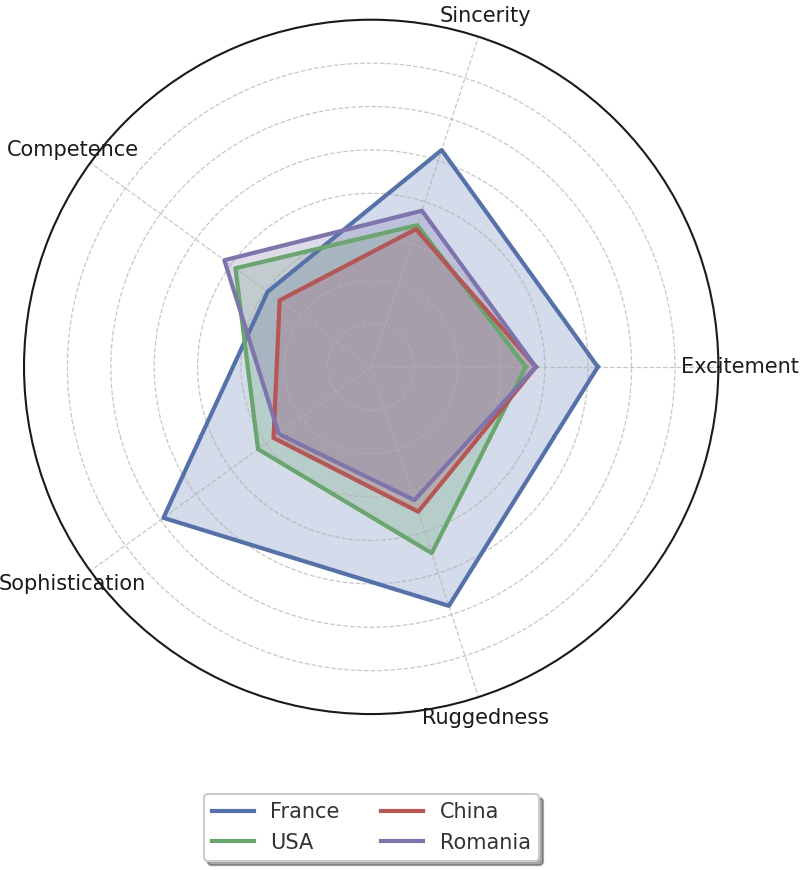
Statistical analysis confirmed significant differences between countries on all five product personality dimensions. To assess these differences statistically, repeated-measures ANOVAs were conducted for each dimension (Table 2). Repeated-measures ANOVAs for each dimension revealed that Country of Origin had a significant main effect on all five Brand Personality dimensions (F tests p < .001 in each case), confirming the robust influence of COO on perceived wine personality. Effect sizes were large for some dimensions (e.g., partial η² = 0.36 for Sophistication) and moderate for others (e.g., η² = 0.11 for Ruggedness).
| Dimension | F Country (df) | p | η² | F Involvement (df) | p | η² | F Country × Involv. (df) | p | η² |
|---|---|---|---|---|---|---|---|---|---|
| Excitement | 195.93 (2.79, 2362) | < .001 | .120 | 49.87 (1, 846) | < .001 | .020 | 4.78 (2.79, 2362) | .003** | .003 |
| Sincerity | 262.91 (2.82, 2383) | < .001 | .155 | 48.25 (1, 846) | < .001 | .019 | 3.12 (2.82, 2383) | .028* | .002 |
| Ruggedness | 183.65 (2.90, 2452) | < .001 | .109 | 24.92 (1, 846) | < .001 | .011 | 1.39 (2.90, 2452) | .244 | <.001 |
| Sophistication | 869.34 (2.87, 2425) | < .001 | .360 | 46.41 (1, 846) | < .001 | .015 | 1.85 (2.87, 2425) | .139 | <.001 |
| Competence | 428.71 (2.73, 2310) | < .001 | .229 | 35.52 (1, 846) | < .001 | .013 | 2.41 (2.73, 2310) | .072 | .001 |
Consumer involvement also had a significant main effect on each dimension’s ratings (all p < .001), such that high-involvement consumers tended to give slightly higher personality ratings overall than low-involvement consumers. However, these involvement effects were relatively small in magnitude (η² ranging from approximately 0.01–0.02), indicating that COO remains the primary driver of perceived wine personality.
Finally, an interaction between Country of Origin and Involvement emerged for two dimensions (Excitement and Sincerity), indicating that country differences were moderated to a minor degree by involvement level. No significant interaction was found for Ruggedness, Sophistication, or Competence (p > .05), further emphasizing the stability of COO-based perceptions across engagement levels.
In the following, we report each dimension’s results in detail, with post-hoc pairwise comparisons (Bonferroni-adjusted) to interpret specific country differences. For brevity, we focus on the key differences and effect sizes (full pairwise statistics are in Table 3).
| Contrast (Country A–B) | Excitement Δ (d) | Sincerity Δ (d) | Ruggedness Δ (d) | Sophistication Δ (d) | Competence Δ (d) |
|---|---|---|---|---|---|
| France – USA | +0.83*** (d = 0.94) | +0.91*** (d = 1.03) | –0.46*** (d = –0.50) | +1.35*** (d = 1.53) | +0.64*** (d = 0.70) |
| France – China | +0.71*** (d = 0.81) | +0.96*** (d = 1.08) | +0.17*** (d = 0.18) | +1.57*** (d = 1.78) | +1.14*** (d = 1.25) |
| France – Romania | +0.71*** (d = 0.81) | +0.73*** (d = 0.83) | +0.62*** (d = 0.68) | +1.64*** (d = 1.87) | +1.28*** (d = 1.40) |
| USA – China | –0.12** (d = –0.14) | +0.05 (d = 0.05) | +0.63*** (d = 0.69) | +0.22*** (d = 0.25) | +0.50*** (d = 0.55) |
| USA – Romania | –0.12** (d = –0.13) | –0.18***(d = –0.20) | +0.16*** (d = 0.17) | +0.30*** (d = 0.34) | +0.64*** (d = 0.71) |
| China – Romania | +0.00 (d = 0.00) | –0.22***(d = –0.25) | +0.79*** (d = 0.86) | +0.08* (d = 0.09) | +0.14*** (d = 0.16) |
For the Excitement dimension, the ANOVA confirmed a significant effect of country (F = 195.93, p<.001) with a large effect size (η² = 0.12). French wines were perceived as the most exciting (M = 3.61), significantly more so than wines from the USA (M = 2.78), China (M = 2.90), or Romania (M = 2.90) (all p < .001). The mean difference between France and other countries on Excitement was substantial: for example, France vs. USA had a mean difference of +0.83 on the 5-point scale (95% CI [0.74, 0.92]), corresponding to a very large effect (d = 0.94). Similarly, France scored about +0.71 higher than China (d = 0.81) and +0.71 higher than Romania (d = 0.81) on Excitement (both p < .001).
By contrast, the USA was rated slightly less exciting than both China and Romania. U.S. wines had a lower Excitement mean than Chinese wines by –0.12 (95% CI [–0.23, –0.01], p = .009, d = –0.14), and similarly lower than Romanian wines by –0.12 (95% CI [–0.22, –0.01], p = .009, d = –0.13). There was no significant difference between Excitement ratings for China vs. Romania (means ~2.90 for both, p = .93). This hierarchy indicates that French wines are strongly associated with dynamic and stimulating traits, whereas U.S. wines are comparatively moderate in perceived Excitement.
High-involvement consumers tended to rate all countries slightly higher on Excitement (overall mean difference high vs. low = +0.27, p < .001, d = 0.31). The Country × Involvement interaction was statistically significant for Excitement (p = .003), but the interaction effect was very small (η² = 0.003). Follow-up comparisons showed that high- and low-involvement groups differed in Excitement ratings for each country in the same direction, with high-involvement participants giving slightly higher Excitement scores for France (+0.36, p < .001, d = 0.41), USA (+0.84, p < .001, d = 0.95), China (+0.84, p < .001, d = 0.96), and Romania (+0.76, p < .001, d = 0.86). Thus, involvement influenced the level of Excitement ratings but did not substantially alter the pattern of country differences – France remained highest and USA lowest in both involvement groups, confirming that COO-driven perceptions are robust across engagement levels.
Ratings of Sincerity (e.g., being sincere, honest, wholesome) also differed markedly by country (F = 262.91, p<.001, η² = 0.16). France again received the highest Sincerity score (M = 3.63), significantly higher than all other countries (p < .001). The mean difference was +0.91 compared to the USA (d = 1.03), +0.96 compared to China (d = 1.08), and +0.73 compared to Romania (d = 0.83), reflecting large effect sizes. These large effect sizes (Cohen’s d ~0.8–1.1) reflect a strongly established perception of French wines as sincere and trustworthy. Among the remaining countries, Romania ranked second (M = 2.89) on Sincerity, significantly above both the USA (M = 2.72, difference = 0.17, 95% CI [0.08, 0.28], p < .001, d = 0.20) and China (M = 2.67, difference = 0.22, 95% CI [0.13, 0.32], p < .001, d = 0.25). Notably, there was no significant difference between the USA and China on Sincerity (USA–China M = +0.05, 95% CI [–0.07, 0.16], p = .27), indicating that British consumers perceive U.S. and Chinese wines as similarly low in sincere/honest personality.
In summary, the Sincerity ordering was France (highest) > Romania > USA = China. Consumer involvement showed a similar pattern as with Excitement: high-involvement individuals gave slightly higher Sincerity ratings overall than low-involvement (mean difference ~+0.26, p < .001, d = 0.30). A small but significant Country × Involvement interaction was observed for Sincerity (F = 3.12, p = .028, η² = 0.002). Inspection of simple effects suggested that high vs. low involvement groups differed most strongly for U.S. wines (high M = 2.90 vs. low M = 2.53; Δ = 0.38, p < .001), whereas their Sincerity ratings for France were more convergent (high M = 3.78 vs. low M = 3.47; Δ = 0.31). Despite this interaction, the rank-order of countries on Sincerity remained the same for both involvement levels, with France highest and USA/China lowest in each group.
The Ruggedness dimension (masculine, tough, outdoorsy traits) yielded a somewhat different pattern from the above: here, Romania achieved the highest scores. The ANOVA showed a significant country effect (F = 183.65, p<.001, η² = 0.11). Romanian wines were rated the most rugged (M = 3.09), significantly higher than all others (p < .001). In fact, every pairwise comparison between countries on Ruggedness was statistically significant (p < .001), indicating all four means differed from one another. Romanian wine was seen as more rugged than U.S. wine by +0.16 (d = 0.17), more than French wine by +0.62 (d = 0.68), and more than Chinese wine by +0.79 (d = 0.86). U.S. wines were the second-highest in Ruggedness (M = 2.93), significantly above France by +0.46 (d = 0.50) and above China by +0.63 (d = 0.69). French wines (somewhat surprisingly) scored low on Ruggedness (M = 2.47), although still slightly higher than Chinese wines (M = 2.30) by +0.17 (p < .001, d = 0.18).
Overall, the rank-order for Ruggedness was Romania > USA > France > China, indicating that Romanian wine carries a comparatively stronger “rugged” or tough persona, whereas Chinese wine is perceived as the least rugged, and French wine – while superior on other traits – is relatively low on this dimension. The influence of involvement on Ruggedness ratings was significant but modest (main effect F = 24.92, p<.001, η² = 0.011). High-involvement consumers tended to ascribe slightly more Ruggedness to wines overall than did low-involvement consumers (mean difference ~+0.30 on the 5-point scale). The interaction of Country × Involvement was not significant for Ruggedness (F = 1.39, p = .24), indicating that the pattern of country differences described above was consistent across involvement levels. Both high- and low-involvement groups saw Romania as highest and China as lowest in Ruggedness, with France and the USA in between.
Sophistication (glamorous, elegant, upper-class personality) exhibited the largest country-of-origin effect of all dimensions. The ANOVA yielded F = 869.34 (df = 2.87, p < .001), with a very large effect size (η² = 0.36). As Figure 1 showed, French wines were perceived as far more sophisticated than wines from any other country. The mean Sophistication rating for France was M = 3.96, near the top of the scale. In contrast, the other three origins all averaged below 2.7 on Sophistication (USA M = 2.61, China M = 2.39, Romania M = 2.32). The differences between France and each of the others were extremely large: France was rated +1.35 higher than the USA (95% CI [1.25, 1.45], p < .001, d = 1.53), +1.57 higher than China (d = 1.78), and +1.64 higher than Romania (d = 1.87). These correspond to very large effect sizes, indicating French wine’s perceived sophistication is dramatically more pronounced in consumers’ minds.
Across the non-French origins, minor differences were observed: U.S. wines were seen as slightly more sophisticated than Romanian wines (difference = +0.30, 95% CI [0.20, 0.39], p < .001, d = 0.34), and also slightly more than Chinese wines (+0.22, 95% CI [0.11, 0.33], p < .001, d = 0.25). There was no meaningful difference between China and Romania on Sophistication (China was ~0.08 points higher; p = .018 after correction, d = 0.09). Overall, the rank-order for Sophistication was France >> USA > (China ≈ Romania), emphasizing the dominance of French wines in consumers’ symbolic and upscale perceptions..
High-involvement individuals tended to give slightly higher Sophistication ratings overall than low-involvement individuals (main effect F = 46.41, p<.001), but again the magnitude was small (mean difference ~+0.25). There was no significant interaction between country and involvement for Sophistication (F = 1.85, p = .14), indicating that while involvement influences the baseline rating, it does not alter the relative positioning. Thus, all groups consistently viewed French wines as the most sophisticated, with the remaining three countries clustered at the lower end of this dimension.
The Competence dimension (representing leader-like, confident, efficient traits) also showed a strong country-of-origin effect (F = 428.71, p<.001, η² = 0.23). France again topped this dimension (M = 3.90), being viewed as significantly more competent than the other origins (all pairwise p < .001). French wine’s perceived Competence was higher than U.S. wine by +0.64 (95% CI [0.53, 0.74], d = 0.70), higher than Chinese wine by +1.14 (d = 1.25), and higher than Romanian wine by +1.28 (d = 1.40). These differences are substantial, particularly highlighting the contrast between France and the two non-Western producers (China and Romania).
Among the other countries, we found a clear descending order: USA was rated second in Competence (M = 3.26), significantly above China (M = 2.75) by about +0.50 (p < .001, d = 0.55). The USA was also higher than Romania (M = 2.61) by +0.64 (p < .001, d = 0.71). Finally, Chinese wines were seen as slightly more competent than Romanian wines (+0.14 on the scale, 95% CI [0.05, 0.23], p < .001), although this difference was relatively modest (d = 0.16). Overall, the Competence ranking can be summarized as France > USA > China > Romania, reflecting both established reputation and perceived technical expertise.
Consumer involvement had a mall but significant impact on Competence perceptions (high-involvement group means were about 0.24 points higher than low-involvement on average, F = 35.52, p<.001, η² = 0.013). The Country × Involvement interaction was not significant (F = 2.41, p = .072), confirming that the relative ranking of countries remained consistent regardless of involvement level. In both involvement groups, France and the USA were viewed as more competent sources of wine than China or Romania, with France firmly at the top. Table 3. Pairwise Comparisons of Country-of-Origin on Brand Personality Dimensions.
Across all five dimensions, high-involvement wine consumers gave significantly higher ratings than low-involvement consumers, reflecting a general tendency for more involved individuals to attribute stronger personalities to wines. However, the magnitude of this effect was relatively small (on average, high-involvement respondents’ ratings were about 0.25–0.35 points higher on the 5-point scale; Cohen’s d ~0.3). Importantly, there were no qualitative reversals in country rankings between involvement groups, which maintained the integrity of the COO-based comparisons.
As reported above, two interactions were statistically significant (for Excitement and Sincerity), but these were minor. In those cases, the country differences were slightly amplified for high-involvement participants. For example, the Excitement gap between France and the USA was somewhat larger in the high-involvement group (Δ = 0.93) than in the low-involvement group (Δ = 0.74). Similarly, high-involvement respondents perceived U.S. wines as marginally more sincere than low-involvement respondents did (narrowing the gap between USA and Romania), while both groups still rated USA and China significantly lower in Sincerity than Romania or France.
In essence, consumer involvement did not change which countries were seen as best or worst on each brand personality trait – it primarily influenced the intensity of all ratings, while the relative COO impressions remained consistent. This suggests that, although highly involved consumers are generally more generous in their brand personality perceptions, the underlying country-of-origin effects are robust and widely shared among UK wine consumers.
Overall, these results reinforce that France’s wines are perceived as having the most exciting, sincere, sophisticated, and competent personalities, whereas Chinese wines (and to a lesser extent Romanian wines) lag on these dimensions. Romania excels only in the niche trait of Ruggedness, surpassing even France in that specific “tough” image, while the USA occupies an intermediate position, generally outperforming China and Romania on competence and ruggedness but falling short of France on prestige-related traits.
This research contributes to the growing body of literature examining the influence of country of origin (COO) on consumer perceptions and wine personality – a product category deeply intertwined with geographic and cultural identity (Harvey et al., 2014). In product categories with strong symbolic meaning, such as wine, discussing product personality at the category level provides deeper insight into consumers’ symbolic and emotional engagement. Consequently, the role of country of origin in shaping the aforementioned personality warrants closer examination.
Interpreting Aaker’s brand personality dimensions in the context of wine provides valuable insight into how consumers symbolically engage with this product category. Among consumable goods, wine, more than many other consumables, carries cultural, emotional, and experiential value, making it particularly well-suited to the application of personality-based frameworks. Several studies have examined the role of wine COO in shaping perceived brand or product personality traits using established frameworks such as Aaker’s [9] five-dimensional model. Heslop et al. [67] demonstrated that COO affects only two dimensions of personality, namely Ruggedness and Creativity, and these associations are weak. Zhou & Gao [8] investigated the impact of COO perceptions on Aaker’s five dimensions of wine brand personality in the Chinese market and found that COO influences Sophistication and Competence. Applying the Aaker Brand Personality Scale to assess wines from multiple countries classified as “Old World” vs. “New World” and “traditional” vs. “non-traditional”, the typologies presented by Rodrigues et al. [28] provide a more nuanced understanding of COO effects on wine perception.
In addition, research on consumer involvement as a moderator complements earlier findings suggesting that involvement intensifies consumer reactions but does not significantly alter patterns of perception [66,68,69].
4.1 Differences in brand / product personality
The findings indicate that wine’s product personality is strongly shaped by the country of origin across all five of Aaker’s [9] dimensions: Excitement, Sincerity, Ruggedness, Sophistication, and Competence. Country of origin accounted for a substantial portion of the variance in personality perceptions – for example, 36% of the variance in Sophistication – highlighting the robust influence of COO-based stereotypes on consumers’ symbolic associations with wine. Some countries conform to widely shared stereotypes, i.e., socially shared beliefs about the characteristics of a particular country, which subsequently influence perceptions and judgments [70]. As stated by Heslop et al. [67], numerous studies have shown that products from low-image countries are perceived as lower quality compared to the same products from high-image countries. France is stereotypically associated with hedonism, leading to perceptions of French products as enjoyable [71], and is known as a prestigious wine producer rich in tradition [58,72,73], a finding confirmed in the present study.
French wines emerged as clear leaders, rated highest on four out of five personality dimensions. The most pronounced difference was in Sophistication, where French wines received a mean score of approximately 3.96, while wines from other countries scored below 2.7. The effect size (Cohen’s d = 1.5–1.9) indicates that these perceptions are not only distinct but deeply entrenched in consumers’ mental representations. In addition to Sophistication, France also led in perceived Sincerity, Excitement, and Competence, further reinforcing its image as the archetypal wine-producing nation.
While French wines consistently outperformed others across most product personality dimensions, notable patterns also emerged in the evaluations of wines from China, Romania, and the United States. Chinese wines were rated the lowest, generally equal to or slightly below Romanian wines on dimensions such as Sincerity, Excitement, and Sophistication. These results are somewhat consistent with Guardato et al. [7], suggesting that consumers perceive Chinese wine as underdeveloped in personality, likely due to limited historical connection to wine culture, international exposure, and scepticism regarding quality or authenticity.
Romanian wines followed a similar pattern, receiving low scores for most personality traits tested. However, these wines received the highest scores of all countries on the Robustness dimension. This indicates that consumers associate Romanian wines with masculinity, toughness, or boldness, potentially reflecting national stereotypes or rural associations, providing opportunities for niche positioning in global markets. Micu et al. [74] highlight that Romania remains relatively unknown in the global wine market, requiring strong branding strategies to enhance perceived value.
American wines occupied an intermediate position. While they did not compete with French wines, they scored higher than China and Romania, particularly in Competence, and in Ruggedness relative to Chinese wines. These findings suggest a pragmatic product image shaped by innovation and technical expertise, consistent with Villanueva and Ferro [33], who argue that the USA is known for mass production and standardization of wine. Furthermore, “New World” producers exhibit greater market orientation, as noted by Rojas-Méndez et al. [75].
Taken together, these findings suggest that consumers do not evaluate wine solely based on intrinsic or sensory attributes, but also through a symbolic and emotional lens shaped by cultural associations. Country of origin functions almost as a brand itself, evoking human-like traits and values. France dominates symbolic and emotional traits, Romania and the USA establish distinct identities through Ruggedness and Competence respectively, while China’s wine image remains underdeveloped.
4.2 The Role of Consumer Involvement in Wine Personality Perceptions
The results show that high-involvement wine consumers rated all countries more positively across all dimensions of product personality than low-involvement consumers. However, the relative ranking of countries remained unchanged: France consistently topped most dimensions, while China and Romania remained lowest, highlighting the robustness of COO-based perceptions.
This suggests that while involvement influences the intensity of responses, it does not alter the underlying perceptions consumers have about wine-producing countries. These findings underscore the persistence and strength of country-of-origin stereotypes, even among highly engaged and knowledgeable consumers. The results align with models of consumer behaviour that conceptualize involvement as a moderator, influencing evaluations without necessarily changing their direction [76–78]. In wine, a high-involvement product category, involvement reflects emotional, cognitive, and behavioural engagement, resulting in stronger, more differentiated personality assessments.
The results of this study can be applied in practice by wine producers, marketers, policymakers, and institutions involved in promoting wine and the national image abroad. French wines, associated with Sophistication and Sincerity, can leverage narratives emphasizing tradition, craftsmanship, and premium positioning. Romanian wines, strong in Ruggedness, could adopt branding highlighting resilience, boldness, or rural authenticity. U.S. wines, high in Competence, might focus on innovation, technical expertise, and reliability. Chinese wines, currently underdeveloped in personality, may benefit from campaigns enhancing heritage credibility and showcasing quality improvements.
Understanding the emotional and symbolic associations linked to wines from specific countries can also guide product storytelling, label design, and promotional campaigns. This is particularly important for high-involvement consumers, who may respond more strongly to rich narratives and detailed accounts of terroir, production methods, sustainability practices, or awards. In contrast, low-involvement consumers may rely more on simplified cues such as origin, label design, or brand / product reputation. Government agencies, export boards, and national wine associations can leverage these insights to shape country-level branding strategies, particularly in global campaigns. For countries with lower perceived wine personality traits, long-term image-building efforts are essential – including promoting quality standards, certification programs, education initiatives, and participation in international wine fairs and competitions.
It is important to note that this research was conducted among consumers in the United Kingdom, a mature wine market with a strong presence of international wines [14,79,80]. UK consumers are generally familiar with wines from a wide range of countries and may hold strong pre-existing stereotypes about origin, particularly in relation to traditional “Old World” producers versus “New World” or emerging markets. Therefore, the conclusions of this study cannot be fully generalized, especially to less developed wine markets where consumer habits, wine culture, and exposure to international products differ significantly. While the general patterns (e.g., the influence of country of origin on product personality) are likely relevant across markets, the specific country rankings and the intensity of perceptions may vary elsewhere. Consequently, practical implications should be applied with caution outside the UK, and additional market-specific studies are recommended.
Furthermore, consumer familiarity with wines from different countries may vary substantially, particularly in the case of emerging producers such as China. Personality ratings may therefore partly reflect broader country stereotypes rather than direct consumption experience. Acknowledging this, our study design and interpretation consistently emphasize the role of symbolic COO associations rather than assuming detailed prior knowledge of specific wines. This methodological alignment ensures that findings are coherent with the theoretical framework and the survey approach employed. Additionally, potential confounding effects of unequal market exposure, price anchoring, and general country image (as noted in the country selection rationale) may have influenced ratings, particularly for low-familiarity origins like China; future research could control for these factors through familiarity measures or experimental designs.
This study demonstrates that the country of origin (COO) significantly influences the perceived personality of wines across all five dimensions defined by Aaker – Excitement, Sincerity, Ruggedness, Sophistication, and Competence. The results indicate that geographic origin not only signals wine quality but also serves as a powerful driver of the emotional and symbolic associations consumers form with various wines. French wines, representing the traditional category, were rated highest in Sophistication, Sincerity, Excitement, and Competence, reinforcing France’s enduring image as a leader in premium wine production. In contrast, wines from newer or less established wine countries, such as China and Romania, generally received lower scores on personality traits, suggesting a relatively underdeveloped wine personality that may pose challenges for global market positioning. The United States occupied a moderate position, reflecting its emerging yet distinct identity characterized by Ruggedness and Competence.
An important finding of this study is the role of consumer involvement: while high-involvement wine consumers tend to give stronger personality ratings overall, the relative rankings of countries remain stable regardless of involvement level. This suggests that perceptions of COO are deeply rooted and culturally informed, remaining consistent despite variations in individual consumer engagement. Consequently, marketers and manufacturers should recognize that while targeting informed consumers can enhance perceptions of wine personality, the underlying country image remains a key factor shaping consumer attitudes.
This research provides valuable guidance for wine producers and marketers aiming to leverage COO effects strategically. Highlighting personality traits that align with a country’s established image can strengthen brand / product differentiation and consumer appeal. For countries with weaker wine personalities, targeted marketing interventions – such as storytelling, quality certifications, and experiential campaigns – may help build stronger and more favourable associations.
Future studies should further explore these dynamics across diverse cultural contexts and product categories, assess the impact of digital marketing on brand / product personality formation, and adopt longitudinal approaches to capture evolving consumer perceptions.
Supported by funds granted by the Minister of Science of the Republic of Poland under the “Regional Initiative for Excellence” Programme for the implementation of the project “The Poznań University of Economics and Business for Economy 5.0: Regional Initiative – Global Effects (RIGE)”.
[1] C. Ferreira, L. Lourenço-Gomes, L.M.C. Pinto, Region of origin and perceived quality of wine: an assimilation-contrast approach, Wine Econ. Policy 10 (2021) 57–71. https://doi.org/10.36253/wep-9418.
[2] A. Spiga, Symbolic representations and wine brands: economics of symbolic production , transfer , and consumption : three multidisciplinary experiences and one model of brand identity analysis for the wine industry, (2025). https://theses.hal.science/tel-05120565v1.
[3] D. Esau, D. Senese, You Taste Who You Are: The Impact of Wine Labeling on The Sensory Taste of Wine, Territ. Du Vin 0 (2021). https://doi.org/10.58335/territoiresduvin.2143.
[4] P.A.P.S. Kumara, K. Canhua, Perceptions of country of origin: An approach to identifying expectations of foreign products, J. Brand Manag. 17 (2010) 343–353. https://doi.org/10.1057/bm.2009.28.
[5] A. Riviezzo, A. Garofano, J. Granata, S. Kakavand, Using terroir to exploit local identity and cultural heritage in marketing strategies: An exploratory study among Italian and French wine producers, Place Brand. Public Dipl. 13 (2017) 136–149. https://doi.org/10.1057/s41254-016-0036-4.
[6] N. Spielmann, Anything but typical: How consumers evaluate origin products based on their cues, Int. J. Wine Bus. Res. 27 (2015) 23–39. https://doi.org/10.1108/IJWBR-07-2014-0031.
[7] A. Guardato, C. Osei, A. Feri, N.C. Tjandra, Message in a Bottle of Wine from Emerging Markets. Is the Country of Origin Still a Relevant Cue in Consumers’ Perceptions?, Transnatl. Bus. Manag. 1 (2023) 1–17. https://doi.org/10.33182/tbm.v1i1.3101.
[8] Y. Zhou, L. Gao, The influence of perceived country of origin image on Chinese consumers’ purchase intention of imported wine, Int. J. Contemp. Hosp. Manag. 36 (2024) 2870–2886. https://doi.org/10.1108/IJCHM-07-2023-1032.
[9] J.L. Aaker, Dimensions of Brand Personality, J. Mark. Res. 34 (1997) 347–357.
[10] P.M.A. Desmet, J.C. Ortíz Nicolás, J.P. Schoormans, Product personality in physical interaction, Des. Stud. 29 (2008) 458–477. https://doi.org/10.1016/j.destud.2008.06.003.
[11] R. Mugge, P.C.M. Govers, J.P.L. Schoormans, The development and testing of a product personality scale, Des. Stud. 30 (2009) 287–302. https://doi.org/10.1016/j.destud.2008.10.002.
[12] P.C.M. Govers, J.P.L. Schoormans, Product personality and its influence on consumer preference, J. Consum. Mark. 22 (2005) 189–197. https://doi.org/10.1108/07363760510605308.
[13] Wine Australia, Market insights – United Kingdom and Europe, (2025). https://www.wineaustralia.com/market-insights/united-kingdom-europe (accessed March 31, 2026).
[14] Imarc, UK Wine Market Size, Share, Trends and Forecast by Product Type, Color, Distribution Channel, and Region, 2026-2034, Imarc.Com (2025). https://www.imarcgroup.com/uk-wine-market (accessed March 31, 2026).
[15] D. Abdelwahab, S. San-Martín, N. Jiménez, Does regional bias matter? Examining the role of regional identification, animosity, and negative emotions as drivers of brand switching: an application in the food and beverage industry, J. Brand Manag. 29 (2022) 111–126. https://doi.org/10.1057/s41262-021-00260-8.
[16] S. Oduro, A. De Nisco, L. Petruzzellis, Country-of-origin image and consumer brand evaluation: a meta-analytic review, J. Prod. Brand Manag. 33 (2024) 108–124. https://doi.org/10.1108/JPBM-01-2023-4328.
[17] K. Motoki, S. Iseki, Diversity in gender and age, but not in race, enhances food purchase intentions in Japan, Food Qual. Prefer. 121 (2024) 105263. https://doi.org/10.1016/j.foodqual.2024.105263.
[18] A. De Nisco, S. Oduro, Partitioned country of origin effect on consumers behavior: a meta-analytic review of the empirical evidence, in: Proc. Eur. Mark. Acad., Univ Zagreb, Fac Economics & Business, 2020: pp. 179–188.
[19] D.N. Coudounaris, Mediation of product design and moderating effects of reference groups in the context of country-of-origin effect of a luxury Brand, Rev. Int. Bus. Strateg. 28 (2018) 169–205. https://doi.org/10.1108/RIBS-05-2017-0044.
[20] J. Thøgersen, S. Pedersen, J. Aschemann-Witzel, The impact of organic certification and country of origin on consumer food choice in developed and emerging economies, Food Qual. Prefer. 72 (2019) 10–30. https://doi.org/10.1016/j.foodqual.2018.09.003.
[21] M. Chen, Y. Wang, S. Yin, W. Hu, F. Han, Chinese consumer trust and preferences for organic labels from different regions: Evidence from real choice experiment, Br. Food J. 121 (2019) 1521–1535. https://doi.org/10.1108/BFJ-02-2018-0128.
[22] S. van Wyk, J.M. Luiz, The liability of emergingness and country-of-origin effect on South African wine, South African J. Bus. Manag. 55 (2024) 1–12. https://doi.org/10.4102/sajbm.v55i1.4146.
[23] F. Esmaeilpour, M.A. Abdolvand, The impact of country-of-origin image on brand loyalty: evidence from Iran, Asia Pacific J. Mark. Logist. 28 (2016) 709–723. https://doi.org/10.1108/APJML-09-2015-0143.
[24] J.A. Dakin, S. Carter, Negative image: developing countries and country of origin – an example from Zimbabwe, Int. J. Econ. Bus. Res. 2 (2010) 166–186.
[25] K. Heine, G. Atwal, J. He, Managing country-of-origin affiliations for luxury brand-building in China, Australas. Mark. J. 27 (2019) 14–23. https://doi.org/10.1016/j.ausmj.2018.09.001.
[26] R. Johnson, J. Bruwer, Regional brand image and perceived wine quality: The consumer perspective, Int. J. Wine Bus. Res. 19 (2007) 276–297. https://doi.org/10.1108/17511060710837427.
[27] N. Passagem, C.F. Crespo, N. Almeida, The Impact of Country of Origin on Brand Equity: An Analysis of Te Wine Sector, Wine Econ. Policy 9 (2020) 63–81. https://doi.org/10.36253/web-8407.
[28] H. Rodrigues, J. Rolaz, E. Franco-Luesma, M.P. Sáenz-Navajas, J. Behrens, D. Valentin, N. Depetris-Chauvin, How the country-of-origin impacts wine traders’ mental representation about wines: A study in a world wine trade fair, Food Res. Int. 137 (2020) 109480. https://doi.org/10.1016/j.foodres.2020.109480.
[29] J. Beckert, J. Rössel, P. Schenk, Wine as a Cultural Product: Symbolic Capital and Price Formation in the Wine Field, Sociol. Perspect. 60 (2017) 206–222. https://doi.org/10.1177/0731121416629994.
[30] U.R. Orth, M.M.G. Wolf, T.H. Dodd, Dimensions of wine region equity and their impact on consumer preferences, J. Prod. Brand Manag. 14 (2005) 88–97. https://doi.org/10.1108/10610420510592563.
[31] L. Lockshin, W. Jarvis, F. d’Hauteville, J.P. Perrouty, Using simulations from discrete choice experiments to measure consumer sensitivity to brand, region, price, and awards in wine choice, Food Qual. Prefer. 17 (2006) 166–178. https://doi.org/10.1016/j.foodqual.2005.03.009.
[32] M. Beverland, The “real thing”: Branding authenticity in the luxury wine trade, J. Bus. Res. 59 (2006) 251–258. https://doi.org/10.1016/j.jbusres.2005.04.007.
[33] E.C. Villanueva, G. Ferro, An update of the worlds of wine: The emerging countries’ influence, Int. J. Econ. Bus. Res. 23 (2022) 113–129. https://doi.org/10.1504/IJEBR.2022.119358.
[34] J. Overton, G. Banks, Conspicuous production: Wine, capital and status, Cap. Cl. 39 (2015) 473–491. https://doi.org/10.1177/0309816815607022.
[35] S. Charters, S. Pettigrew, The dimensions of wine quality, Food Qual. Prefer. 18 (2007) 997–1007. https://doi.org/10.1016/j.foodqual.2007.04.003.
[36] S. Forbes, T. De Silva, A. Gilinsky Jr., Social Sustainability in the Global Wine Industry, Palgrave Pivot, Cham, 2020.
[37] D.A. Aaker, Managing Brand Equity: Capitalizing on the Value of a Brand Name, Australas. Mark. J. 27 (1991) 14–23. https://doi.org/10.1016/j.ausmj.2018.09.001.
[38] V.A. Vieira, R.L. Liu, V.G. de Mello, The mediating role of Brand Engagement in the Self-Concept (BESC) in explaining consumer response: a meta-analytic review, J. Mark. Theory Pract. 31 (2023) 97–114. https://doi.org/10.1080/10696679.2021.2004379.
[39] R. Belk, M. Kniazeva, Morphing anthropomorphism: An update, J. Glob. Sch. Mark. Sci. Bridg. Asia World 28 (2018) 239–247. https://doi.org/10.1080/21639159.2018.1466659.
[40] Y. Sung, S.M. Choi, H. Ahn, Y.-A. Song, Dimensions of Luxury Brand Personality: Scale Development and Validation, Psychol. Mark. 32 (2015) 121–132. https://doi.org/10.1002/mar.20767.
[41] A. d’Astous, L. Boujbel, Positioning countries on personality dimensions: Scale development and implications for country marketing, J. Bus. Res. 60 (2007) 231–239. https://doi.org/10.1016/j.jbusres.2006.11.005.
[42] M. Geuens, B. Weijters, K. De Wulf, A new measure of brand personality, Int. J. Res. Mark. 26 (2009) 97–107. https://doi.org/10.1016/j.ijresmar.2008.12.002.
[43] J.C. Sweeney, C. Brandon, Brand Personality: Exploring the Potential to Move from Factor Analytical to Circumplex Models, Psychol. Mark. 23 (2006) 639–663. https://doi.org/10.1002/mar.20122.
[44] L.Y. Lin, The relationship of consumer personality trait, brand personality and brand loyalty: An empirical study of toys and video games buyers, J. Prod. Brand Manag. 16 (2009) 290–301.
[45] K.L. Keller, Managing the growth tradeoff: Challenges and opportunities in luxury branding, J. Brand Manag. 16 (2009) 290–301. https://doi.org/10.1057/bm.2008.47.
[46] A. Azoulay, Azoulay2003, J. Brand Manag. 11 (2003) 143–155.
[47] N. Hennigs, K.-P. Wiedmann, C. Klarmann, S. Strehlau, B. Godey, D. Pederzoli, A. Neulinger, K. Dave, G. Aiello, R. Donvito, K. Taro, J. Táborecká-Petrovičová, C.R. Santos, J. Jung, H. Oh, What is the Value of Luxury? A Cross-Cultural Consumer Perspective, Psychol. Mark. 29 (2012) 1018–1034. https://doi.org/10.1002/mar.20583.
[48] S.M.C. Loureiro, J. Jiménez-Barreto, J. Romero, Enhancing brand coolness through perceived luxury values: Insight from luxury fashion brands, J. Retail. Consum. Serv. 57 (2020) 102211. https://doi.org/10.1016/j.jretconser.2020.102211.
[49] L.L. (Luke) Chiang, C.S. Yang, Does country-of-origin brand personality generate retail customer lifetime value? A Big Data analytics approach, Technol. Forecast. Soc. Change 130 (2018) 177–187. https://doi.org/10.1016/j.techfore.2017.06.034.
[50] P. Shukla, Impact of interpersonal influences, brand origin and brand image on luxury purchase intentions: Measuring interfunctional interactions and a cross-national comparison, J. World Bus. 46 (2011) 242–252. https://doi.org/10.1016/j.jwb.2010.11.002.
[51] A. Japutra, S. Molinillo, Responsible and active brand personality: On the relationships with brand experience and key relationship constructs, J. Bus. Res. 99 (2019) 464–471. https://doi.org/10.1016/j.jbusres.2017.08.027.
[52] F. Huber, A. Eisele, F. Meyer, The role of actual, ideal, and ought self-congruence in the consumption of hedonic versus utilitarian brands, Psychol. Mark. 35 (2018) 47–63. https://doi.org/10.1002/mar.21070.
[53] S. Mandal, A. Sahay, A. Terron, K. Mahto, How implicit self-theories and dual-brand personalities enhance word-of-mouth, Eur. J. Mark. 55 (2020) 1489–1515. https://doi.org/10.1108/EJM-07-2019-0591.
[54] J.K. Lee, S.S. Hansen, S.Y. Lee, The effect of brand personality self-congruity on brand engagement and purchase intention: The moderating role of self-esteem in Facebook, Curr. Psychol. 39 (2020) 2116–2128. https://doi.org/10.1007/s12144-018-9898-3.
[55] T.A. Holmes, Effects of self-brand congruity and ad duration on online in-stream video advertising, J. Consum. Mark. 38 (2021) 374–385. https://doi.org/10.1108/JCM-07-2019-3333.
[56] B. Godey, D. Pederzoli, G. Aiello, R. Donvito, P. Chan, H. Oh, R. Singh, I.I. Skorobogatykh, J. Tsuchiya, B. Weitz, Brand and country-of-origin effect on consumers’ decision to purchase luxury products, J. Bus. Res. 65 (2012) 1461–1470. https://doi.org/10.1016/j.jbusres.2011.10.012.
[57] I. Cheah, Z. Zainol, I. Phau, Conceptualizing country-of-ingredient authenticity of luxury brands, J. Bus. Res. 69 (2016) 5819–5826. https://doi.org/10.1016/j.jbusres.2016.04.179.
[58] D. Valentin, C. Valente, J. Ballester, R. Symoneaux, I. Smith, F.F. Bauer, H. Nieuwoudt, The impact of “wine country of origin” on the perception of wines by south african and french wine consumers: A cross-cultural comparison, Foods 10 (2021). https://doi.org/10.3390/foods10081710.
[59] V. Swaminathan, K.L. Page, Z. Gürhan-Canli, “My” brand or “our” brand: The effects of brand relationship dimensions and self-construal on brand evaluations, J. Consum. Res. 34 (2007) 248–259. https://doi.org/10.1086/518539.
[60] R.H. Barcelos, D.C. Dantas, S. Sénécal, Watch Your Tone: How a Brand’s Tone of Voice on Social Media Influences Consumer Responses, J. Interact. Mark. 41 (2018) 60–80. https://doi.org/10.1016/j.intmar.2017.10.001.
[61] K. Anderson, S. Nelgen, Global wine markets, 1961 to 2009: a statistical compendium, Glob. Wine Mark. 1961 to 2009 a Stat. Compend. (2012). https://doi.org/10.1017/upo9780987073013.
[62] K. Anderson, S. Nelgen, V. Pinilla, Global wine markets, 1860 to 2016: a statistical compendium, Glob. Wine Mark. 1860 to 2016 a Stat. Compend. (2017). https://doi.org/10.20851/global-wine-markets.
[63] J. Bruwer, R. Johnson, Place-based marketing and regional branding strategy perspectives in the California wine industry, J. Consum. Mark. 27 (2010) 5–16. https://doi.org/10.1108/07363761011012903.
[64] R. Fuentes-Fernández, A. Gilinsky, Coopetition as improvisation: an exploratory comparative case study investigation into Spain’s natural wine industry, Int. J. Wine Bus. Res. 34 (2022) 308–328. https://doi.org/10.1108/IJWBR-12-2020-0062.
[65] P. Alonso González, E. Parga Dans, R. Fuentes Fernández, Certification of Natural Wine: Policy Controversies and Future Prospects, Front. Sustain. Food Syst. 6 (2022) 1–5. https://doi.org/10.3389/fsufs.2022.875427.
[66] J.L. Zaichkowsky, Measuring the Involvement Construct, J. Consum. Res. 12 (1985) 131–352. https://doi.org/10.1300/j047v06n04_05.
[67] L.A. Heslop, D. Cray, A. Armenakyan, Brand and Country-of-Origin Effects in Wine Decision Making: Is Incongruity a Problem in a Wine World Turned Upside Down?, in: ASAC, Niagara Falls, 2016.
[68] P. Magnusson, S. Zdravkovic, S.A. Westjohn, A longitudinal analysis of country image and brand origin effects, Int. Mark. Rev. 39 (2022) 912–930. https://doi.org/10.1108/IMR-07-2021-0228.
[69] A. Diamantopoulos, I. Szőcs, A. Florack, Ž. Kolbl, M. Egger, The bond between country and brand stereotypes: insights on the role of brand typicality and utilitarian/hedonic nature in enhancing stereotype content transfer, Int. Mark. Rev. 38 (2021) 1143–1165. https://doi.org/10.1108/IMR-09-2020-0209.
[70] M.F. Herz, A. Diamantopoulos, Activation of country stereotypes: Automaticity, consonance, and impact, J. Acad. Mark. Sci. 41 (2013) 400–417. https://doi.org/10.1007/s11747-012-0318-1.
[71] F. Leclerc, B.H. Schmitt, L. Dube, Foreign Branding and Its Effects on Product Perceptions and Attitudes, J. Mark. Res. 31 (1994) 263. https://doi.org/10.2307/3152198.
[72] S. Candiago, S. Tscholl, L. Bassani, H. Fraga, L. Egarter Vigl, Quality wines in Italy and France: A dataset of protected designation of origin specifications, Data Br. 54 (2024). https://doi.org/10.1016/j.dib.2024.110408.
[73] S. Fairbairn, J. Brand, A.S. Ferreira, D. Valentin, F. Bauer, Cultural differences in wine conceptualization among consumers in France, Portugal and South Africa, Sci. Rep. 14 (2024) 1–12. https://doi.org/10.1038/s41598-024-66636-3.
[74] D.M. Micu, G.A. Arghiroiu, S. Beciu, The Perception of Romania as a Wine Producing Country – a Perspective of International Wine Specialists, Sci. Pap. Ser. Manag. Econ. Eng. Agric. Rural Dev. 25 (2025) 635–644.
[75] J.I. Rojas-Méndez, M.J. Hine, M. Rod, Brand Personalities of Global Wine Exporters: A Collective Reputation Theory Perspective, J. Int. Food Agribus. Mark. 30 (2018) 88–105. https://doi.org/10.1080/08974438.2017.1387884.
[76] G. Itzchakov, G. Haddock, Attitude strength as a novel predictor of willful ignorance, Curr. Opin. Psychol. 67 (2026) 102182. https://doi.org/10.1016/j.copsyc.2025.102182.
[77] P.J. Palla, E. Kyriacou, A. Zarkada, The effect of involvement on attitude formation and strength in the digital domain, J. Mark. Commun. 29 (2023) 137–160. https://doi.org/10.1080/13527266.2022.2154062.
[78] R.E. Petty, J.J. Siev, P. Briñol, Attitude Strength: What’s New?, Span. J. Psychol. 26 (2023) 1–13. https://doi.org/10.1017/SJP.2023.7.
[79] Statista, Wine in the UK - Statistics & Facts, Statista (2025). https://www.statista.com/topics/8241/wine-in-the-united-kingdom/?utm_source=chatgpt.com#topicOverview (accessed October 4, 2025).
[80] J. Dwyer, N.L. Key, Study on the competitiveness of European wines: executive summary, 2014.