A Bibliometric and Thematic Analysis of Crisis Research in the Wine Industry: Trends and Future Perspectives
Samsun Vocational School, Department of Marketing and Advertising, Ondokuz Mayıs University, Samsun, Türkiye
Email: aybike.ozden@omu.edu.tr
Abstract. This study systematically maps the academic literature on crises in the wine industry and reveals the field’s intellectual structure. Simultaneously, it identifies the dominant themes, trends, and future research directions in crisis-focused studies within the wine industry, thereby providing a reference framework for academics and industry stakeholders. A total of 470 articles published between 1991 and 2026 in the WoS and Scopus databases were included in this analysis. Performance analysis, science mapping, and thematic analysis were conducted using Biblioshiny, an R-based tool. In addition, the types of crises addressed in crisis-focused research in the wine industry and their areas of impact were evaluated using content analysis. The findings indicate that climate crises and pandemics are the most extensively studied crises. Furthermore, based on an evaluation of 146 sampled publications, it is observed that these crises are primarily examined in terms of their impacts on organizational/managerial and production domains. These findings suggest the need to evaluate the interactions between sudden and unexpected crises and slow-onset, long-term crises, such as climate change, as well as the broad impacts of marketing activities across different domains. This study is the first bibliometric analysis of crises in the wine industry. It provides an integrated perspective of the field and offers an original contribution by outlining potential directions for future research.
Keywords: wine industry, wine business, crisis management, bibliometric analysis, research trends.
Index
3.3.1 Types of crises in the wine industry
4. Thematic framework for future research directions
5. Discussion, implications, and limitations
The wine industry is a sector with deeply rooted traditions that have been largely preserved in grape cultivation and wine production processes [1]. Therefore, wine is a product closely intertwined with culture and has high economic value [1–2]. Nevertheless, the wine industry, like all sectors, is affected by crises, global threats, and a challenging competitive environment [3].
In this context, understanding the nature of the crises faced by the wine industry is important. A crisis is a multidimensional and complex phenomenon [4]. In general, crises are urgent, uncertain, and high-risk problems that need to be overcome [5] and can potentially lead to severe operational, financial, and social consequences [6]. Factors such as climate change, population growth, and digitalization indicate that more frequent, intense, and harmful crises will occur than ever before [7-8]. The wine industry, owing to its unique structure, is more vulnerable to natural events such as extreme weather conditions, earthquakes, and volcanic disasters [9]. For example, grapes used in wine production require suitable environmental conditions [10], and issues such as climate change negatively affect the harvest quantity and quality [11]. Moreover, pandemics, economic shocks, and energy crises highlight the need for adaptive strategies in the wine industry.
Crises in the wine industry typically affect both production and market dynamics of wine. Market-related crises generally arise from declining wine consumption in traditional countries, increasing international competition, a lack of global regulation, and insufficient policies in the wine industry [12]. In particular, small businesses are more vulnerable to crises, and their resilience often depends on cooperation between public and private sector actors [9]. These characteristics make the wine industry an important example for examining crisis dynamics, management strategies and sectoral resilience.
Despite the increasing interest in crises in the wine sector, the literature is fragmented. Existing studies have focused on specific types of crises, regional impacts, and particular business strategies. This situation prevents a systematic understanding of the relevant literature on the topic. In particular, no study has been found that comprehensively mapped the evolution of academic research on crises in the wine industry and identified underexplored areas. Addressing this gap is important for both theoretical knowledge and practical guidance for future research. In addition, this gap must be addressed to support stakeholders in developing effective crisis preparedness and response strategies.
To address this gap, the present study is the first to conduct a bibliometric analysis of 470 articles published between 1991 and 2026 and indexed in the Web of Science (WoS) and Scopus databases. In addition, crisis impact areas were comparatively examined based on a selected sample of the identified publications. In this context, trends, thematic clusters, and temporal developments of research on crises in the wine sector were identified. In addition, recommendations for academics and practitioners are provided. This study makes a unique contribution to enhancing the wine industry’s capacity to anticipate, respond to, and recover from crises and serves as a guide for future academic research.
This study employs a bibliometric approach to examine crises in the wine industry, with crisis types systematically classified through content analysis. Bibliometric analysis, when conducted using a validated database, allows a comprehensive and objective evaluation of relevant literature, encompassing both performance analysis and science mapping [13–14].
Performance analysis evaluates productivity within a research field, using outputs such as the number of publications by authors, journals, or years, while science mapping visualizes the intellectual structure of the field, facilitating understanding of its evolution and emerging trends [15–16].
This study addresses the following research questions:
RQ1. What is the bibliometric performance of publications on crises in the wine industry in terms of annual publication trends, core journals identified through Bradford’s Law, and the most influential articles based on local citation values?
RQ2. How are the keyword networks structured in these publications?
RQ3. Which types of crises are addressed in the literature, and how are their impacts distributed across the main functional areas of the wine industry?
RQ4. What are the future research trends in the wine industry crisis literature?
The Web of Science (WoS) and Scopus databases were selected because of their comprehensive coverage of publications related to the wine industry. Both databases serve as primary sources for bibliometric research and continue to evolve while maintaining their leading positions in academic indexing [17].
In this study, keywords were selected based on a thorough review of the literature. The initial search was conducted on October 2, 2025. In the WoS database, a comprehensive search was performed using the keywords (wine* AND crisis*) in all fields. The search was subsequently updated on February 25, 2026, in both WoS and Scopus databases. In both databases, the search was applied to the title, abstract, and keywords using the following query:
(“wine industry” OR “wine sector” OR “winery” OR “wine business” OR “wine tourism”) AND (crisis OR Covid-19 OR pandemic OR “climate change” OR shock*)
These keywords were chosen to capture crises occurring within the wine industry and their impact on the sector, in line with the objectives of this study. The asterisk (*) at the end of a word enables the capture of multiple variants of that term (e.g., crises, shocks, shocking, shockwave, and shocked). These terms were included to ensure the retrieval of studies referring to more specific types of disruptions (e.g., financial crises, political crises, economic crises, or internal and external shocks).
Non-English publications, book chapters, editorials, abstracts, and book reviews were excluded, leaving only English-language journal articles on crises in the wine industry. Early access articles with DOI citations were also included.
Duplicate publications were removed using EndNote, and author names, journal titles, and keywords were standardized. Synonymous keywords, alternative spellings, and singular/plural forms were consolidated to ensure consistency.
Performance analysis and science mapping were conducted with Biblioshiny v.5.2.0, a web interface for the R package Bibliometrix, providing bibliometric functionalities such as network analysis and thematic mapping [18].
In the performance analysis, research trends were evaluated using publication years, the most-cited journals, most-cited authors, and keyword networks. The conceptual structure of crisis-focused publications in the wine industry was mapped using thematic mapping.
A two-stage approach was followed in the content analysis, with Microsoft Excel 2016 used in both stages of the analysis. In the first stage, all reviewed publications were classified according to the type of crisis addressed. In the second stage, for the selected sample, the impact of crises on specific areas of the wine industry was identified using a functional classification of the wine industry based on key operational and managerial areas. Following these steps, the findings were assessed within a comparative and synthesizing framework. The titles, abstracts, and keywords of the publications were examined for both stages.
The reporting of this study follows the PRISMA (Preferred Reporting Items for Systematic Reviews and Meta-Analyses) guidelines [19]. PRISMA provides researchers with a structured framework to ensure transparent and comprehensive reporting of findings (Figure 1).
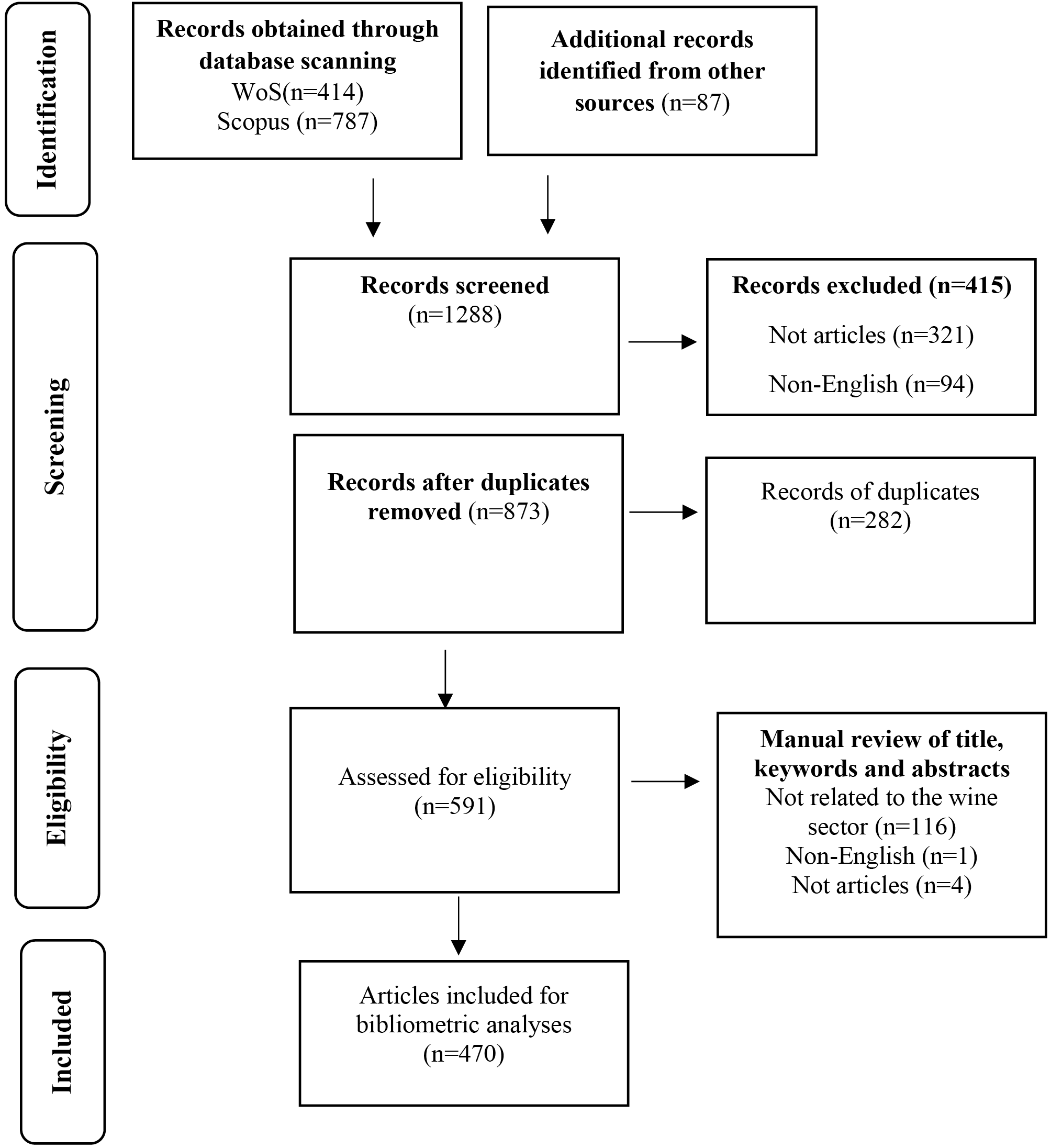
A total of 306 publications from the WoS database and 480 from the Scopus database remained after excluding non-English publications and non-article document types. Subsequently, 87 publications identified through the literature review and the first WoS search were manually added. After combining all records, duplicate publications (n = 282) were removed, leaving 591 articles. The titles, abstracts, and keywords of these articles were screened. At this stage, one publication was found to be non-English and four publications were not articles; these were excluded from the analysis. Subsequently, 116 publications were excluded because they were not related to the wine industry or did not address a crisis situation in the wine industry, leaving 470 articles for the final assessment.
The annual distribution of publications included in this bibliometric analysis is presented in Figure 2.
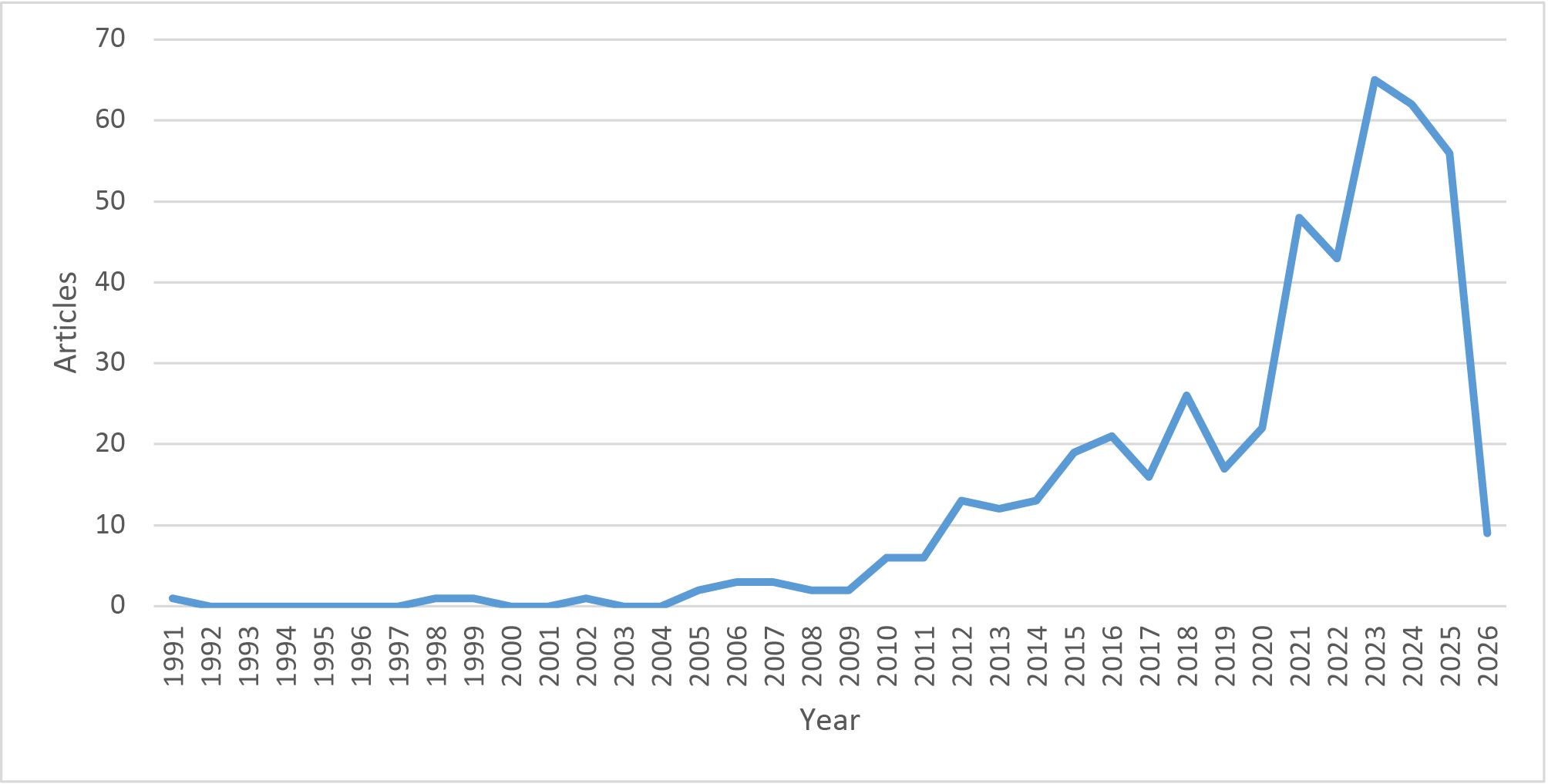
Figure 2 shows the annual number of scientific publications on crises in the wine industry from 1991 to March 2026, which is increasing. The highest number of publications was recorded in 2023 (n = 65), 2024 (n = 62), and 2025 (n = 56). The number of publications has increased noticeably since 2013. Given that the present study includes publications up to March 2026, the number of articles for the full year may be higher. Each publication has received an average of 22.87 citations, indicating a relatively good average citation value.
Using Bradford’s Law of Scattering [21], core journals were identified. Zone 1 includes the most frequently cited journals, and the top five journals are listed in Table 1. The findings highlight the central role of these journals in the wine industry.
| Sources | Rank | Frequency | Cumulative frequency | Zone | |||||||||||||||
|---|---|---|---|---|---|---|---|---|---|---|---|---|---|---|---|---|---|---|---|
| International Journal of Wine Business Research | 1 | 16 | 16 | Zone 1 | |||||||||||||||
| Oeno One | 2 | 16 | 32 | Zone 1 | |||||||||||||||
| Sustainability | 3 | 16 | 48 | Zone 1 | |||||||||||||||
| Wine Economics and Policy | 4 | 16 | 64 | Zone 1 | |||||||||||||||
| Australian Journal of Grape and Wine Research | 5 | 13 | 77 | Zone 1 | |||||||||||||||
| Source: Author. | |||||||||||||||||||
The authors with the highest number of publications in the dataset are listed in Table 2. These authors can be considered the most productive researchers in this field. Simultaneously, they play an important role in the development of literature on the wine industry and crisis-related studies.
| Author | Articles | Most cited publication | Local citations | Articles fractionalized | |||||||||||||||
|---|---|---|---|---|---|---|---|---|---|---|---|---|---|---|---|---|---|---|---|
| Abel Duarte Alonso | 10 | Resilience in the Context of Italian Micro and Small Wineries: an Empirical Study | 59 | 4.48 | |||||||||||||||
| Hélder Fraga | 10 | Modelling Climate Change Impacts on Viticultural Yield, Phenology and Stress Conditions in Europe | 258 | 2.09 | |||||||||||||||
| João A. Santos | 10 | 2.13 | |||||||||||||||||
| João Rebelo | 9 | Did Wine Consumption Change during the Covid-19 Lockdown in France, Italy, Spain, and Portugal? | 27 | 1.83 | |||||||||||||||
| Kym Anderson | 8 | Covid-19 and Global Beverage Markets: Implications for Wine | 18 | 3.83 | |||||||||||||||
| Source: Author. | |||||||||||||||||||
The local citation value shown in the table indicates the number of times a publication was cited by other documents within the analyzed dataset. This value reflects a publication’s influence and significance within a specific research field. The “articles fractionalized” indicator distributes each publication among the authors according to the number of co-authors, providing a more balanced measure of individual research contribution. The most productive authors in the dataset are Abel Duarte Alonso, Hélder Fraga, and João A. Santos, each with 10 publications. However, Fraga and Santos had the highest impact within the dataset, with 258 local citations for their most-cited collaborative publication. This highlights their central role in the wine industry crisis literature.
The keyword co-occurrence network of the 470 publications included in this bibliometric analysis is presented in Figure 3.
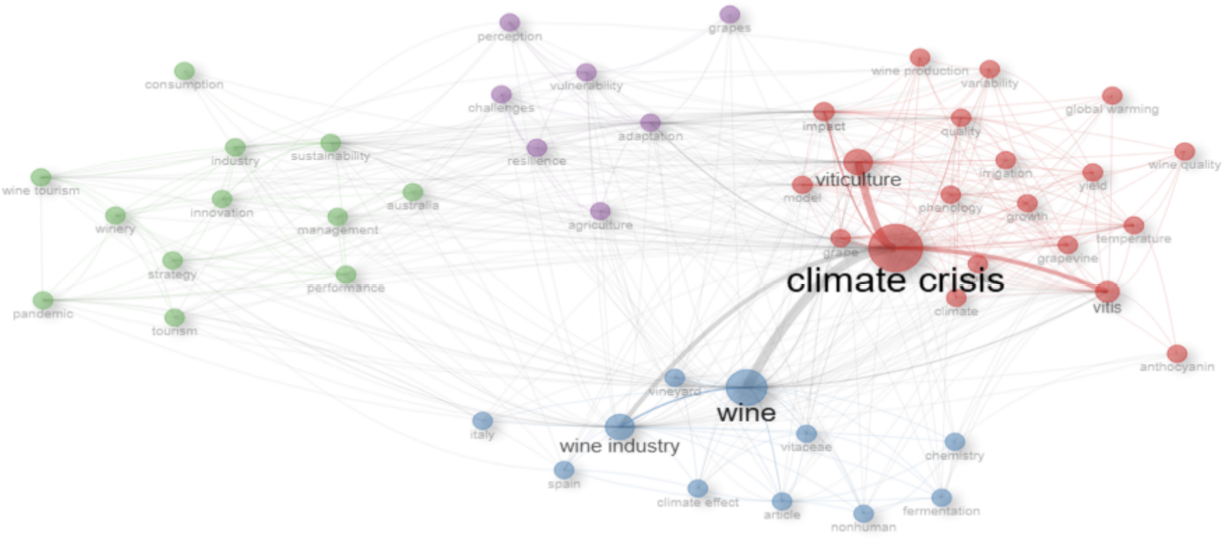
Figure 3 shows the four main thematic keyword clusters identified in the literature on wine industry crises. In the first cluster, the keywords climate crisis, viticulture, Vitis, impact, and quality had the highest connections with other keywords. The climate crisis emerged as the most central term. In the second cluster, wine, wine industry, vineyard, article, and Spain were the most connected keywords. This indicates a focus on the wine industry and shows that wine is a central term linking multiple topics. In the third cluster, sustainability, pandemic, wine tourism, performance and innovation were the keywords with the highest connectivity. This reflects the significant influence of the pandemic and wine tourism in the literature. Finally, in the fourth cluster, adaptation, agriculture, vulnerability, perception, and resilience were the most influential keywords. These terms emphasize adaptive strategies and resilience in agriculture.
3.3.1 Types of crises in the wine industry
This section examines the most frequently studied crisis types in the literature and highlights their relative importance distribution.
The crisis types used in the content analysis were determined based on the nature of the crises frequently addressed in the literature and their impact on the wine industry. To better understand the impact and management of crises, they are commonly classified according to their causes (e.g., pandemics, external shocks, wars, political crises, financial crises, climate change, energy crises, and natural disasters) [14] and their effects (e.g., production shutdowns, demand shocks, and logistical disruptions) [15]. Depending on their causes, crises can be internal or external. External shocks, such as pandemics or rapid technological transitions, occur beyond the control of firms [16]. Internal shocks, including excessive risk-taking, lack of preventive policies, and deficiencies in crisis management, may also lead to crises [17].
Each publication was classified according to the primary crisis type. The classification criteria were as follows:
– Climate change refers to the long-term impact of weather patterns.
– A pandemic refers to an infectious disease outbreak that directly affects human health and society.
– Financial and economic crises encompass economic downturns, financial disruptions, and market contractions.
– Disasters refer to natural events such as earthquakes, floods, wildfires, and epidemic diseases.
– Political crises encompass political instability, elections, protests, and decision-making deadlocks arising from political disputes.
– War refers to national or international armed conflict.
– Internal shocks include management failures originating within organizations, risky decisions, and deficiencies in crisis management processes.
– Terrorism refers to violent acts.
– Multiple crises include publications addressing more than one type of crisis in a single study.
Each article was categorized based on its title, abstract, and keywords. In cases of ambiguity, the full texts were examined to ensure accurate classification. This approach enhanced the reproducibility of the classification process and ensured the methodological transparency.
Table 3 presents the classification of the publications included in the bibliometric analysis according to the types of crises.
| Type of crisis | Number of articles (n) | Representative publicationsa | Overview | ||||||||||||||||
|---|---|---|---|---|---|---|---|---|---|---|---|---|---|---|---|---|---|---|---|
| Climate change | 297 | [11, 22-23] | – Climate change affects grape development, yield, and quality. – It encourages adaptation strategies such as drought-tolerant varieties, irrigation, and canopy management. – Climate change encourages the adoption of environmental sustainability practices. – It impacts economic performance and regional competitiveness. – It shapes growers’ perceptions and policy decisions. |
||||||||||||||||
| Pandemic | 74 | [24-26] | – The COVID-19 pandemic affects wine tourism and consumer behavior. – It drives digital marketing and virtual tasting innovations. – It challenges small and rural wineries’ resilience and crisis management. – It influences production and sales performance. – It shapes industry recovery strategies and stakeholder perceptions. |
||||||||||||||||
| Financial/economic crisis | 52 | [27-29] | – The wine industry is affected by financial markets, which can have positive or negative impacts. – Overproduction and low vineyard prices can further worsen economic crises. – To counter rising foreign competition, the wine industry should emphasize sustainable production, marketing innovation, and supply chain integration. – Developing simple, recognizable, and strong brands while ensuring quality enhances global competitiveness. – For small and medium-sized enterprises, highlighting the country of origin can increase resilience during crises. |
||||||||||||||||
| Multi-Crises | 28 | [30-31] | – The wine industry has faced economic, political, environmental, and cultural challenges. – In a global context, these crises have varying effects in different regions. – Producers have developed strategic responses and resilience policies to address these challenges. – Digital transformation and innovation are employed to mitigate the impact of crises and achieve competitive advantages. |
||||||||||||||||
| Disasters | 8 | [32-33] | – The wine industry is vulnerable to natural disasters, extreme weather, and pest or disease outbreaks. – Historical crises, such as phylloxera epidemics and lead-adulterated wine, have had economic and social impacts. – Resilience depends on enterprise size, ownership, and structure and can be strengthened through preparedness and risk management. – Legal, institutional, and socioecological measures help sustain production during disasters. |
||||||||||||||||
| Political crisis | 5 | [34] | – The wine industry has been a site of economic, cultural, and political crisis. – Colonial relations and state intervention are the primary sources of these crises. – International trade and embargoes have significant economic impacts. – Labor rights, migration, and human rights are directly linked to the wine production process. – Wine also serves as a symbol of cultural identity and is a focal point in political debates. |
||||||||||||||||
| War | 3 | [35] | – War crises negatively impact production, exports, and market access in the wine industry. – Government support, international collaboration, and adherence to standards facilitate recovery and enhance resilience. |
||||||||||||||||
| Internal shocks | 2 | [36] | – Internal shocks arise from factors such as declining consumption, rising competition, price fluctuations, and export challenges, and can be mitigated through flexible stakeholder management. – Scandal-related shocks can be managed using effective media and crisis response strategies. |
||||||||||||||||
| Terrorism | 1 | [37] | – Terrorist incidents can adversely affect the wine industry, given its reliance on tourism. – Between 2010 and 2017, attacks in Paris reduced tourist numbers, though redirection to safer destinations like rural wine tourism partially mitigated these effects. |
||||||||||||||||
| a Representative publications were selected based on citation counts in WoS. For less common types, all publications are included. | |||||||||||||||||||
| Source: Author. | |||||||||||||||||||
Table 3 provides a systematic overview of the scope and impact of the different types of crises in the wine industry. According to the literature, the most frequently addressed crises are climate-related, pandemics, and financial crises, whereas war, terrorism, and internal shocks have been examined less extensively. This pattern reflects the prioritization of crises with broad and global impacts as the primary risks for the sector. Wine producers have developed strategic responses to these crises, focusing on resilience and adopting sustainability-oriented practices. Conversely, less frequently studied crisis types tend to have localized or specific effects, representing potential research gaps for future studies. Furthermore, political and cultural crises affect the industry beyond economic dimensions, influencing labor rights, migration, and cultural identity, thereby highlighting the multi-layered nature of crises in the wine industry.
This section focuses on the main areas affected by crises within the wine industry. A stratified sampling approach was used to assess which areas of the wine industry were affected by crises in the publications examined. Stratified sampling involves dividing the population into categories based on a variable relevant to the research and then randomly selecting units from each category [38]. During content analysis, the analytical framework can be narrowed depending on the study objectives and the theoretical foundations of the presumed effects [39]. In this study, care was taken to ensure that the number of units selected from the subgroups was proportional to the population and that no subgroup was overrepresented compared to the others [40].
Following Olson [39], a stratified random sampling approach was employed. Publications were grouped by crisis type and time period (1991–1999, 2000–2019, and 2020–2026). For each group containing eight or more publications, a random number was assigned to each publication. The publications were then sorted in ascending order according to these numbers, and the first 25% were selected. Groups with fewer than eight publications were fully included to avoid disproportionate sampling in very small groups and to preserve the representation of less frequently studied crisis types. This procedure ensured that the sample represented both the diversity of crisis types and their temporal distribution while also guaranteeing the inclusion of smaller subgroups. Applying this procedure resulted in the selection of 146 publications, representing approximately 31% of the total 470 publications.
The impact levels of crises were coded using a functional categorization of the wine industry, covering key stages such as production, distribution, marketing, tourism, management, and policy. This categorization was informed by prior studies that describe the wine industry as a set of interconnected activities [41-43]. This framework allows for the objective coding of how different crises affect various areas of the wine industry.
Six core categories were defined for the analysis:
– Production encompasses grape cultivation and wine-making. Within this scope, viticulture, grape yield, and quality control processes are included.
– Processing and supply refers to the distribution and logistics processes in the wine industry.
– Marketing and sales include retailing and consumer behaviors. This scope covers brand management, sales channels and customer demand.
– Wine tourism and hospitality involve festival participation, tastings, vineyard tours and tourist experiences.
– The organizational/managerial category includes management strategies and crisis management.
– Finally, policy and regulation encompass regulatory frameworks, policy interventions, and certification requirements.
This classification aims to provide a comprehensive understanding of how crises affect the different dimensions of the wine industry.
Table 4 presents the classification of the publications included in the bibliometric analysis according to the impact areas of crises in the wine industry.
| Crisis Type | Sample Size (n) | Production | Processing & Supply | Marketing & Sales | Wine Tourism & Hospitality |
Organizational / Managerial | Policy & Regulatory |
|---|---|---|---|---|---|---|---|
| Climate Change | 80 | 50 | 4 | 2 | 1 | 22 | 1 |
| Pandemic | 20 | 0 | 0 | 5 | 6 | 9 | 0 |
| Financial/ Economic | 17 | 0 | 0 | 8 | 0 | 8 | 1 |
| Disasters | 8 | 1 | 1 | 1 | 0 | 4 | 1 |
| Multi-Crises | 8 | 0 | 0 | 3 | 0 | 3 | 2 |
| Political | 7 | 0 | 0 | 0 | 0 | 3 | 4 |
| War | 3 | 0 | 0 | 1 | 0 | 2 | 0 |
| Internal Shock | 2 | 0 | 0 | 0 | 1 | 1 | 0 |
| Terrorism | 1 | 0 | 0 | 0 | 1 | 0 | 0 |
| Total | 146 | 51 | 5 | 20 | 9 | 52 | 9 |
In general, crises affecting the wine industry have the potential to impact all functional areas of the sector, from production to consumption. According to Table 4, the publications included in the current research sample indicate that the crises they address affect the production, processing, and supply, marketing and sales, wine tourism and hospitality, organizational/managerial, and policy and regulatory areas. Operational crises, particularly those related to climate change, have emerged as the most influential factors affecting production processes. This highlights the critical risk posed by climate change to grape cultivation and winemaking processes and reflects the efforts of researchers to implement preventive measures in this area. In contrast, global crises, such as pandemics, have significant effects on marketing, tourism, and organizational resilience. Political and war-related crises predominantly impact the organizational/managerial domain. For instance, climate change predominantly affects production (50 out of 80 articles), whereas pandemic crises primarily impact wine “tourism and hospitality” and “organizational management” (6 and 9 out of 20 articles, respectively), highlighting the differential patterns of crisis impact across functional areas. These findings provide a comprehensive understanding of how crises propagate across functional areas in the wine industry and identify critical areas for risk management and future research.
Finally, when examining the impact areas of crises, it is evident that the organizational/managerial and production domains are the most affected areas (out of 146 publications, 52 address organizational/managerial aspects and 51 focus on production). These findings highlight the need for targeted risk management strategies that address both operational vulnerabilities and managerial resilience in the wine industry. The publications sampled within the scope of the current study are presented in Appendix.
The findings presented in Table 3 and Table 4 enable a holistic evaluation of crises in the wine industry and their impacts. Long-term crises, such as the climate crisis, which develop beyond the control of businesses and generally progress slowly, and sudden shock-inducing crises, such as pandemics or war, share the common feature of producing uncertain effects in terms of their local and temporal impacts. Nevertheless, considering the prior effects of crises, they contain effective foresight for strategic approaches that require preparedness. Although they differ in their forms of emergence, these crises can directly or indirectly affect the fundamental areas of the wine industry, such as production processes, market demand, supply chains, management structures, and working conditions. These crises may emerge simultaneously or in overlapping periods, creating cascading effects that trigger each other.
In this context, the effects of crises on the wine industry should not be evaluated only as singular and independent events but as a multilayered structure that is in mutual interaction. For example, production problems arising from the climate crisis can create cascading effects in different areas of the wine industry, from supply chain disruptions to pricing mechanisms and market imbalances to consumer behavior. These findings show that crises in the wine industry can be conceptually grouped according to their internal and external characteristics and areas of impact. However, new approaches are needed to evaluate them within a more holistic framework. Thus, the effects of crises can be evaluated not only as separate outcomes of each individual event but also within a set of processes that feed and transform each other. For example, the impact of climate change on the wine industry can be addressed not only through production loss but also by analyzing the reciprocal relationships between supply chains, prices, and consumer behavior. Indeed, different types of crises can create interconnected effects in the wine industry and generate a systemic risk based on mutual interaction.
4. Thematic framework for future research directions
Figure 4 presents a thematic mapping aimed at understanding the future research agenda related to crises in the wine industry.
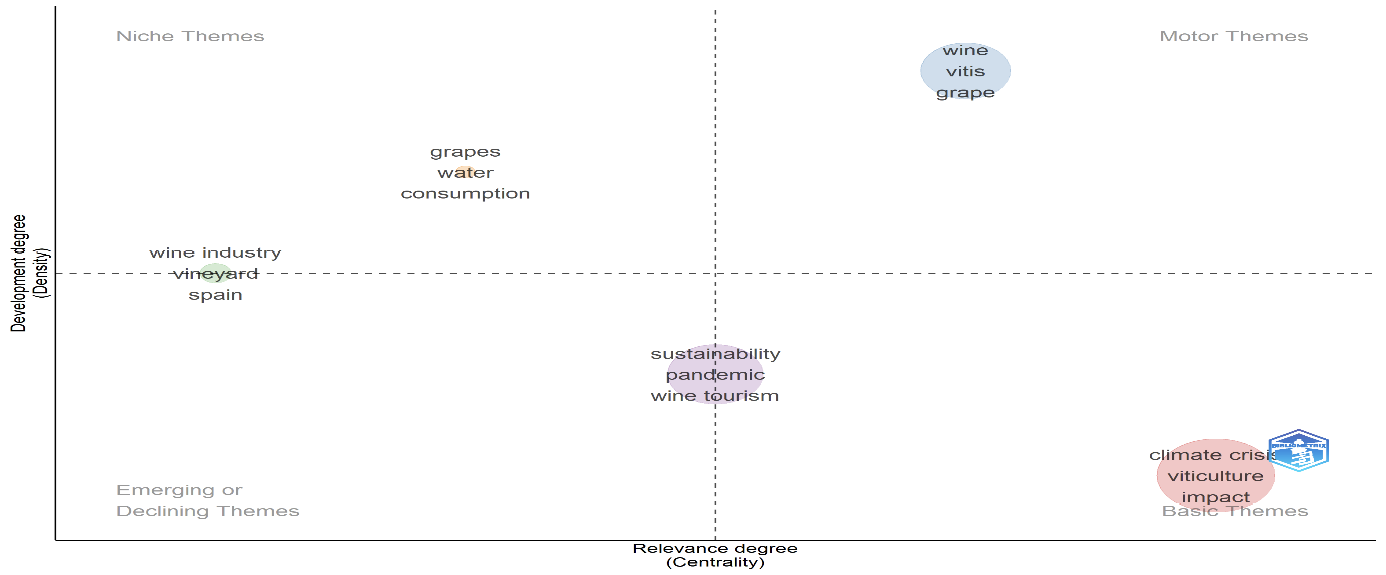
Figure 4 presents a thematic map with two axes: X represents theme significance, and Y represents development level [44]. Clusters form based on keyword co-occurrence or density, creating motor, basic, niche, and emerging/declining themes [45].
The dotted lines divide the thematic map into four quadrants based on the density and centrality [46]:
– Motor Themes (High Density, High Centrality);
– The Niche Themes (High Density, Low Centrality);
– Emerging or Declining Themes (Low Density, Low Centrality);
– The Basic Themes (Low Density, High Centrality).
Motor themes such as wine, vitis, and grapes are highly developed and central, serving as the foundational pillars of the field. In contrast, themes related to the climate crisis, viticulture, and its impact were classified as basic themes. These are central but relatively underdeveloped, indicating a critical area that requires deeper analytical engagement in the future. Niche themes, such as grapes, water, and consumption, represent specialized topics. They exhibit strong internal coherence but are poorly integrated into the broader research network. Emerging or declining themes, such as the wine industry, vineyards, and Spain, reflect areas in transition, gaining attention or losing prominence.
Topics such as pandemics, sustainability, and wine tourism are positioned on the thematic map at the intersection of basic themes and emerging or declining themes along the point where the X and Y axes meet. This placement indicates that these areas are both central and not fully developed. In other words, these themes are gaining importance in the literature while simultaneously requiring more in-depth analyses.
This distribution reveals a literature landscape in which fundamental concepts are well-established. This approach would provide a more comprehensive and cross-cutting understanding of crises in the wine industry. It would also help address existing gaps and support more effective risk management and policy development.
5. Discussion, implications, and limitations
Overall, this study identifies the most influential scientific output outlets through performance evaluation and scientific mapping. Bibliometric analyses generally construct a framework of the existing literature using quantitative methods [47]. In contrast, this study develops a map of the current literature through qualitative and interpretive analyses, while also providing a thematic framework for future research. Furthermore, a comparative and holistic literature framework is established by evaluating the types of crises addressed and their impact domains in these publications through content analysis.
Wine scholarship reflects the evolution of the industry. Research in this domain has progressed from the foundational inquiries of the 1990s to more complex and multidimensional themes, including the rise of e-commerce and wine tourism, an increasing focus on sustainability, and recent global crises [48]. The findings of the present study also indicate that, by its nature, the wine industry is exposed to multiple interacting crises, including climate change, market fluctuations, pandemics, and terrorism. However, despite this progression, the relevant literature appears to focus on specific types of crises, particularly more prominent ones, such as climate crises and pandemics. Indeed, previous research on crises in the wine industry has focused primarily on adaptive responses to climate crises [49]. This suggests that the multiple and interacting crisis structures faced by the industry have not been sufficiently addressed.
When these findings are evaluated theoretically, it is observed that the literature does not display a balanced distribution. This study reveals this imbalance by comparatively examining which types of crises are addressed by crisis-focused publications in the wine industry and in which impact domains these crises are concentrated in. This imbalance may result from sudden and highly visible crises attracting academic attention more rapidly or from certain impact domains that are more difficult to measure. Future research should address different types of crises and impact domains using more integrated theoretical approaches. Additionally, studies should be conducted in this direction to establish a more explanatory and in-depth theoretical foundation.
The findings also have important implications for practitioners. In the present study, it is shown that the crises in the publications included in the analysis focus on their effects on production and organization/management. Therefore, when evaluated in terms of publications within the sample, these publications do not sufficiently address the impact domains of processing and supply, marketing and sales, wine tourism and hospitality, and policy and regulation. Moreover, there is a distinct concentration on certain impact domains for some types of crises. For example, studies addressing the climate crisis clearly focus on its effects on production. These findings reveal that crises produce structural effects specific to the sectoral context while indicating that the comprehensive and multidimensional nature of crises is neglected. Therefore, wine businesses must develop multi-layered and integrated crisis management models that consider crisis type–impact domain matches.
Future research should develop a comparative and integrated perspective that examines the interactive effects of different types of crises. The current literature emphasizes that organizational resilience should be considered a multistage and interactive process involving learning before, during, and after a crisis [50]. Therefore, resilience to crises is fueled by the interaction between the internal and external environments. This perspective supports the view that crisis management research remains fragmented and requires a more integrated theoretical approach that connects the different phases of crisis response.
Second, it should be taken into account that digital technologies such as artificial intelligence, augmented reality, and virtual reality create not only opportunities but also new areas of vulnerability. Indeed, the potential of these technologies to generate crises or deepen existing crises should be examined. Finally, it was observed that more structural and systemic themes, such as the viticulture ecosystem, water resource constraints, and consumption dynamics, are relatively neglected in the crisis literature of the wine industry.
Although this study included a detailed and comprehensive analysis, it had some limitations. First, the inclusion of different databases, such as PubMed or Google Scholar, in addition to WoS and Scopus, would allow for a more comprehensive literature review. Second, examining only English-language publications and excluding non-article publications led to the omission of studies of different types. This study not only maps the existing literature but also provides a basis for deeper and more multidimensional research by making the current limitations of the field visible.
[1] C. Lamoureux, Crisis in the wine industry: The high stakes of cultural intelligence in lending decision-making, Qualitative Research in Financial Markets. ahead-of-print(2025). https://doi.org/10.1108/qrfm-10-2024-0291
[2] S. Charters, M. Demossier, J. Dutton, G. Harding, J.S. Maguire, D. Marks, P. Unwin, The routledge handbook of wine and culture: Routledge London, 2022.
[3] R.M. Castaldi, S. Cholette, A. Frederick, Globalization and the emergence of new business models in the wine industry, International Business & Economics Research Journal (IBER). 4(2005).
[4] J. Bundy, M.D. Pfarrer, C.E. Short, W.T. Coombs, Crises and crisis management: Integration, interpretation, and research development, Journal of management. 43(2017). 1661-1692
[5] E.H. James, L.P. Wooten, K. Dushek, Crisis management: Informing a new leadership research agenda, Academy of management Annals. 5(2011). 455-493 https://doi.org/10.5465/19416520.2011.589594
[6] C. Perrow, Fukushima and the inevitability of accidents, Bulletin of the Atomic Scientists. 67(2011). 44-52
[7] M.D. Collins, M.T. Dasborough, H.R. Gregg, C. Xu, C.M. Deen, Y. He, S.L.D. Restubog, Traversing the storm: An interdisciplinary review of crisis leadership, The Leadership Quarterly. 34(2023). 101661 https://doi.org/10.1016/j.leaqua.2022.101661
[8] G. Szolnoki, S. Bail, M. Tafel, A. Feher, C. Veith, A cross-cultural comparison of new implemented sustainable wine tourism strategies during the covid-19 crisis, Sustainability. 14(2022). 1-16 https://doi.org/10.3390/su14084688
[9] P.J. Woodfield, E. Rasmussen, Weathering the storm: Wine, tourism, and hospitality resilience in the face of extreme events, International Journal of Wine Business Research. 37(2025). 764-789 https://doi.org/10.1108/ijwbr-12-2024-0088
[10] K.L. Christ, R.L. Burritt, Critical environmental concerns in wine production: An integrative review, Journal of Cleaner Production. 53(2013). 232-242 https://doi.org/10.1016/j.jclepro.2013.04.007
[11] C. van Leeuwen, P. Darriet, The impact of climate change on viticulture and wine quality, Journal of Wine Economics. 11(2016). 150-167 https://doi.org/10.1017/jwe.2015.21
[12] F. Duquesnois, C. Gurau, F. Le Roy, Wine producers’ strategic response to a crisis situation, International Journal of Wine Business Research. 22(2010). 251 https://doi.org/10.1108/17511061011075383
[13] H. Kim, K.K.F. So, Two decades of customer experience research in hospitality and tourism: A bibliometric analysis and thematic content analysis, International Journal of Hospitality Management. 100(2022). https://doi.org/10.1016/j.ijhm.2021.103082
[14] I. Passas, Bibliometric analysis: The main steps, Encyclopedia. 4(2024). 1014-10285 https://doi.org/10.3390/encyclopedia4020065
[15] O.J. de Oliveira, F.F. da Silva, F. Juliani, L.C.F.M. Barbosa, T.V. Nunhes,Scientometrics recent advances, in: S. Kunosic and E. Zerem (Eds.), Bibliometric method for mapping the state-of-the-art and identifying research gaps and trends in literature: An essential instrument to support the development of scientific projects, IntechOpen, 2019.
[16] N. Donthu, S. Kumar, D. Mukherjee, N. Pandey, W.M. Lim, How to conduct a bibliometric analysis: An overview and guidelines, Journal of Business Research. 133(2021). 285-296 https://doi.org/10.1016/j.jbusres.2021.04.070
[17] A.D. Sánchez, M. de la Cruz Del Río Rama, J.Á. García, Bibliometric analysis of publications on wine tourism in the databases scopus and wos, European Research on Management and Business Economics. 23(2017). 8-15 https://doi.org/10.1016/j.iedeen.2016.02.001
[18] M. Aria, C. Cuccurullo, Bibliometrix: An r-tool for comprehensive science mapping analysis, Journal of informetrics. 11(2017). 959-975 https://doi.org/10.1016/j.joi.2017.08.007
[19] D. Moher, A. Liberati, J. Tetzlaff, D.G. Altman, Preferred reporting items for systematic reviews and meta-analyses: The prisma statement, BMJ. 339(2009). b2535 https://doi.org/10.1136/bmj.b2535
[20] M.J. Page, J.E. McKenzie, P.M. Bossuyt, I. Boutron, T.C. Hoffmann, C.D. Mulrow, L. Shamseer, J.M. Tetzlaff, E.A. Akl, S.E. Brennan, R. Chou, J. Glanville, J.M. Grimshaw, A. Hróbjartsson, M.M. Lalu, T. Li, E.W. Loder, E. Mayo-Wilson, S. McDonald, L.A. McGuinness, L.A. Stewart, J. Thomas, A.C. Tricco, V.A. Welch, P. Whiting, D. Moher, The prisma 2020 statement: An updated guideline for reporting systematic reviews, BMJ. 372(2021). n71 https://doi.org/10.1136/bmj.n71
[21] B.C. Vickery, Bradford’s law of scattering, Journal of Documentation. 4(1948). 198-203
[22] L. Hannah, P.R. Roehrdanz, M. Ikegami, A.V. Shepard, M.R. Shaw, G. Tabor, L. Zhi, P.A. Marquet, R.J. Hijmans, Climate change, wine, and conservation, Proceedings of the National Academy of Sciences of the United States of America. 110(2013). 6907-6912 https://doi.org/10.1073/pnas.1210127110
[23] S.E. Park, N.A. Marshall, E. Jakku, A.M. Dowd, S.M. Howden, E. Mendham, A. Fleming, Informing adaptation responses to climate change through theories of transformation, Global Environmental Change-Human and Policy Dimensions. 22(2012). 115-126 https://doi.org/10.1016/j.gloenvcha.2011.10.003
[24] M. Alebaki, M. Psimouli, S. Kladou, F. Anastasiadis, Digital winescape and online wine tourism: Comparative insights from crete and santorini, Sustainability. 14(2022). https://doi.org/10.3390/su14148396
[25] J.A.C. Jimenez, M. De la Torre, M.G.D. Millán, Enotourism in southern spain: The montilla-moriles pdo, International Journal of Environmental Research and Public Health. 19(2022). https://doi.org/10.3390/ijerph19063393
[26] J. Rebelo, R. Compés, S. Faria, T. Gonçalves, V. Pinilla, K. Simón-Elorz, Covid-19 lockdown and wine consumption frequency in portugal and spain, Spanish Journal of Agricultural Research. 19(2021). https://doi.org/10.5424/sjar/2021192-17697
[27] A.D. Alonso, A. Bressan, Resilience in the context of italian micro and small wineries: An empirical study, International Journal of Wine Business Research. 27(2015). 40-60 https://doi.org/10.1108/ijwbr-08-2014-0035
[28] J.M. Balogh, A. Jámbor, The global competitiveness of european wine producers, British Food Journal. 119(2017). 2076-2088 https://doi.org/10.1108/bfj-12-2016-0609
[29] K. Simon-Elorz, J.S. Castillo-Valero, M.C. Garcia-Cortijo, Economic performance and the crisis: Strategies adopted by the wineries of castilla-la mancha (spain), Agribusiness. 31(2015). 107-131 https://doi.org/10.1002/agr.21392
[30] D. Marín, J. Armengol, P. Carbonell-Bejerano, J.M. Escalona, D. Gramaje, E. Hernandez-Montes, D.S. Intrigliolo, J.M. Martinez-Zapater, H. Medrano, J.M. Mirás-Avalos, J.E. Palomares-Rius, P. Romero-Azorín, R. Savé, L.G. Santesteban, F. de Herralde, Challenges of viticulture adaptation to global change: Tackling the issue from the roots, Australian Journal of Grape and Wine Research. 27(2021). 8-25 https://doi.org/10.1111/ajgw.12463
[31] J. Tardaguila, M. Stoll, S. Gutiérrez, T. Proffitt, M.P. Diago, Smart applications and digital technologies in viticulture: A review, Smart Agricultural Technology. 1(2021). https://doi.org/10.1016/j.atech.2021.100005
[32] N.A. Cradock-Henry, J. Fountain, Characterising resilience in the wine industry: Insights and evidence from marlborough, new zealand, Environmental Science & Policy. 94(2019). 182-190 https://doi.org/10.1016/j.envsci.2019.01.015
[33] J. Tello, R. Mammerler, M. Cajic, A. Forneck, Major outbreaks in the nineteenth century shaped grape phylloxera contemporary genetic structure in europe, Scientific Reports. 9(2019). https://doi.org/10.1038/s41598-019-54122-0
[34] R. Dubey, Z.L. Yang, S. Puri, The role of geopolitical uncertainty on shaping carbon neutrality policy: Moderating influence of digital transformation, Journal of Environmental Management. 398(2026). https://doi.org/10.1016/j.jenvman.2025.128498
[35] L.K. Häfner, Winegrowing and winemaking in russia: The late nineteenth century to october 1917, Journal of Modern Russian History and Historiography. 15(2022). 5-38 https://doi.org/10.30965/22102388-12340010
[36] J. Valette, P. Amadieu, P. Sentis, Cooperatives versus corporations: Survival in the french wine industry, Journal of Wine Economics. 13(2018). 328-354 https://doi.org/10.1017/jwe.2017.1
[37] H. Song, F. Livat, S. Ye, Effects of terrorist attacks on tourist flows to france: Is wine tourism a substitute for urban tourism?, Journal of Destination Marketing & Management. 14(2019). 1-10 https://doi.org/10.1016/j.jdmm.2019.100385
[38] N. Gheyle, T. Jacobs, Content analysis: A short overview, Internal research note. 10(2017). 1-17
[39] A.B. Jordan, J. Manganello,Media messages and public health, in: A. Jordan, et al. (Eds.), Sampling and content analysis: An overview of the issues, 2010.
[40] A. Koçak, Ö. Arun, İçerik analizi çalışmalarında örneklem sorunu, [The sampling problem in content analysis studies]. Journal of Selcuk Communication. 4(2013). 21-28 https://doi.org/10.18094/si.51496
[41] A.G. Goncharuk, Wine value chains: Challenges and prospects, Journal of Applied Management and Investments. 6(2017). 11-27
[42] G. Lapčević, Value chain model in wine production, The Journal of Bio-based Marketing. 3(2020). 50-61
[43] E. Sanchez-Garcia, J. Martinez-Falco, B. Marco-Lajara, N. Georgantzis, Value creation in the wine industry – a bibliometric analysis, European Food Research and Technology. 250(2024). 1135-1148 https://doi.org/10.1007/s00217-023-04451-2
[44] M. Callon, J.P. Courtial, F. Laville, Co-word analysis as a tool for describing the network of interactions between basic and technological research: The case of polymer chemistry, Scientometrics. 22(1991). 155-205 https://doi.org/10.1007/BF02019280
[45] M.J. Cobo, M.A. Martínez, M. Gutiérrez-Salcedo, H. Fujita, E. Herrera-Viedma, 25 years at knowledge-based systems: A bibliometric analysis, Knowledge-based Systems. 80(2015). 3-13 https://doi.org/10.1016/j.knosys.2014.12.035
[46] A. Rejeb, K. Rejeb, A. Abdollahi, H. Treiblmaier, The big picture on instagram research: Insights from a bibliometric analysis, Telematics and Informatics. 73(2022). 101876 https://doi.org/10.1016/j.tele.2022.101876
[47] I. Passas, Bibliometric analysis: The main steps, Encyclopedia. 4(2024). 1014-1025
[48] G. Ruggeri, S. Corsi, C. Mazzocchi, A bibliometric analysis of wine economics and business research: Insights, trends, and future directions, International Journal of Wine Business Research. 36(2024). 14-39
[49] E. Merloni, L. Camanzi, L. Mulazzani, G. Malorgio, Adaptive capacity to climate change in the wine industry: A bayesian network approach, Wine Economics and Policy. 7(2018). 165-177 https://doi.org/10.1016/j.wep.2018.11.002
[50] A. Gilinsky Jr, A. Sen, J. Ford, S.C. de la Torre, S.K. Newton, Us wine industry preparedness for unforeseen crises and disasters: An empirical test, Wine Economics and Policy. 9(2020). 5-18 https://doi.org/10.14601/web-8054
| Author(s) | Year | Title |
|---|---|---|
| Eisinger | 1991 | Early consumer-protection legislation - a 17th-century law prohibiting lead adulteration of Wines |
| Beverland and Bretherton | 1998 | The evolution of strategy in medium and large Auckland (New Zealand)–based wineries |
| Landsteiner | 1999 | The crisis of wine production in late sixteenth-century Central Europe: Climatic causes and economic consequences |
| Pinilla and Ayuda | 2002 | The political economy of the wine trade: Spanish exports and the international market, 1890-1935 |
| Jones | 2005 | Climate change in the Western United States grape growing regions |
| Pérez-Torrado et al. | 2005 | Monitoring stress-related genes during the process of biomass propagation of Saccharomyces cerevisiae strains used for wine making |
| Kingsbury and Hayter | 2006 | Business associations and local development: The Okanagan wine industry’s response to NAFTA |
| White et al. | 2006 | Extreme heat reduces and shifts United States premium wine production in the 21st century |
| Belliveau et al. | 2006 | Multiple exposures and dynamic vulnerability: Evidence from the grape industry in the Okanagan Valley, Canada |
| Beer and Thomas | 2007 | The politics and policy of economic restructuring in Australia: Understanding government responses to the closure of an automotive plant |
| Strachan | 2007 | The colonial identity of wine: The Leakey Affair” and the Franco-Algerian order of things” |
| Webb et al. | 2008 | Modelling the relationship between climate, winegrape price and winegrape quality in Australia |
| Webb et al. | 2008 | Climate change and winegrape quality in Australia |
| Cardebat and Figuet | 2009 | Estimation of a hedonic price equation for Alsace, Beaujolais and Provence wines |
| Costa-Font et al. | 2009 | Explaining low farm-gate prices in the Catalan wine sector |
| Duquesnois et al. | 2010 | Wine producers’ strategic response to a crisis situation |
| Holland and Smit | 2010 | Climate change and the wine industry: Current research themes and new directions |
| Cavicchi and Santini | 2011 | Brunellopoli: A wine scandal under the tuscan sun |
| Sǎseanu et al. | 2011 | Benchmark models for the wine industry. Recommendations for Republic of Moldova |
| Neacşu and Bobeicǎ | 2011 | Sustainable development of the wine industry on climate changes |
| Duarte Alonso and Liu | 2012 | Coping with changes in a sector in crisis: The case of small Spanish wineries |
| Castillo and García | 2013 | Analysis of international competitive positioning of quality wine from Spain |
| Viers et al. | 2013 | Vinecology: pairing wine with nature |
| Bellia and Pilato | 2014 | Competitiveness of wine business within green economy: Sicilian case |
| Pickering et al. | 2014 | Determining adaptive capacity to climate change in the grape and wine industry |
| Mozell and Thachn | 2014 | The impact of climate change on the global wine industry: Challenges & solutions |
| Holland and Smit | 2014 | Recent climate change in the Prince Edward County winegrowing region, Ontario, Canada: implications for adaptation in a fledgling wine industry |
| Duarte Alonso | 2015 | Resilience in the context of two traditional Spanish rural sectors: an exploratory study |
| De Salvo et al. | 2015 | A spatial micro-econometric approach to estimating climate change impacts on wine firm performance: A case study from Moldavia region, Romania |
| Sánchez-Monedero et al. | 2015 | Strategies to transform organic residues from olive and wine industries: Greenhouse gas emissions and climate change |
| Longbottom and Petrie | 2015 | Role of vineyard practices in generating and mitigating greenhouse gas emissions |
| Fabbrizzi et al. | 2015 | Coping with the economic crisis in agriculture: an analysis of the Tuscany (Italy) premium quality wine area and strategies for impact mitigation |
| Castex et al. | 2015 | Water availability, use and governance in the wine producing region of Mendoza, Argentina |
| Ferrise et al. | 2016 | Climate change and grapevines: A simulation study for the Mediterranean basin |
| Röcker et al. | 2016 | The use of glucose oxidase and catalase for the enzymatic reduction of the potential ethanol content in wine |
| Mosedale et al. | 2016 | Climate change impacts and adaptive strategies: lessons from the grapevine |
| Ashenfelter and Storchmann | 2016 | The economics of wine, weather, and climate change |
| Schultz | 2016 | Global climate change, sustainability, and some challenges for grape and wine production |
| Tissot et al. | 2017 | Modeling environmental impacts on viticultural ecosystems: A first case study in a regulated wine producing area |
| Sacchelli et al. | 2017 | A mix-method model for adaptation to climate change in the agricultural sector: A case study for Italian wine farms |
| Li and Bardají | 2017 | A new wine superpower? An analysis of the Chinese wine industry |
| Zabaniotou et al. | 2018 | Sustainable bioeconomy transitions: Targeting value capture by integrating pyrolysis in a winery waste biorefinery |
| Chen and Juvenal | 2018 | Quality and the Great Trade Collapse |
| Escobar et al. | 2018 | Consumers’ wine preferences in a changing scenario |
| Kool et al. | 2018 | The influence of institutions on the climate change adaptive capacity of winegrowers in Utiel-Requena |
| Lazoglou et al. | 2018 | Climate change projections for Greek viticulture as simulated by a regional climate model |
| Kwon and Constantinides | 2018 | Ideology and moral reasoning: How wine was saved from the 19th century phylloxera epidemic |
| Moreno et al. | 2018 | Climate reconstruction for the Entre-Douro-e-Minho region (NW Portugal) between AD 1626 and AD 1820: synthesis of viticulture data and foraminiferal evidence |
| Garcia-Casarejos et al. | 2018 | Introduction of renewable energy in the Spanish wine sector |
| Valette et al. | 2018 | Cooperatives versus corporations: Survival in the French wine industry |
| Bacenetti | 2019 | Heat and cold production for winemaking using pruning residues: Environmental impact assessment |
| Leitao | 2019 | Branding Port: Crisis, transformation and the advent of modern brands in the Port Wine Trade (1945-1975) |
| Brandano et al. | 2019 | Comparative efficiency of agricultural cooperatives and conventional firms in a sample of quasi-twin companies |
| Cradock-Henry and Fountain | 2019 | Characterising resilience in the wine industry: Insights and evidence from Marlborough, New Zealand |
| Song et al. | 2019 | Effects of terrorist attacks on tourist flows to France: Is wine tourism a substitute for urban tourism? |
| Tello et al. | 2019 | Major outbreaks in the nineteenth century shaped grape phylloxera contemporary genetic structure in Europe |
| Di Giuseppe et al. | 2020 | A natural organic coating to control and minimize late frost damages on wine shoots |
| Gilinsky et al. | 2020 | US wine industry preparedness for unforeseen crises and disasters: An empirical test |
| Saraiva et al. | 2020 | Water footprint sustainability as a tool to address climate change in the wine sector: A methodological approach applied to a Portuguese case study |
| Ben Ameur and Le Fur | 2020 | Volatility transmission to the fine wine market |
| Calle et al. | 2020 | Social economy, environmental proactivity, eco-ınnovation and performance in the Spanish wine sector |
| Ferrer-Alos | 2020 | Commercial structures and the globalisation of viticulture in Catalonia: From brandy to wine and cava (eighteenth-twentieth centuries) |
| Migliaccio and Tucci | 2020 | Economic assets and financial performance of Italian wine companies |
| Ruiz Estrada et al. | 2020 | Measuring wine industry efficiency with wine industry network evaluation model (Wine-model) |
| Králiková et al. | 2021 | Visitors’ happiness and loyalty in the moravian wine region |
| Kudryashova and Casetti | 2021 | The Internet of Things - the nearest future of viticulture |
| Bunting et al. | 2021 | Vitis vinifera production in Michigan: Factors and trends driving cultivation Patterns |
| Szolnoki et al. | 2021 | A cross-cultural analysis of the motivation factors and profitability of online wine tastings during Covid-19 pandemic |
| Pickering et al. | 2021 | Prevalence and management of alkyl-methoxypyrazines in a changing climate: Viticultural and oenological considerations |
| Carrasco Monteagudo et al. | 2021 | Greening wine exports? Changes in the carbon footprint of spanish wine exports |
| Hewer and Gough | 2021 | Climate change impact assessment on grape growth and wine production in the Okanagan Valley (Canada) |
| Zhang and Carboni | 2021 | The sustainable project management utilization in French wineries while adapting to climate change |
| Sottini et al. | 2021 | Impact of climate change on wine tourism: An approach through social media data |
| Cameron et al. | 2021 | Is advancement of grapevine maturity explained by an increase in the rate of ripening or advancement of veraison? |
| Wittwer and Anderson | 2021 | COVID-19 and global beverage markets: Implications for wine |
| Mirabelli-Montan et al. | 2021 | Techniques for mitigating the effects of smoke taint while maintaining quality in wine production: A review |
| Bressan et al. | 2021 | Confronting the unprecedented: micro and small businesses in the age of coronavirus disease 2019 |
| Agnoli and Charters | 2022 | The alcohol consumption of wine drinkers with the onset of Covid-19 |
| Monteiro et al. | 2022 | The role of biostimulants as alleviators of biotic and abiotic stresses in grapevine: A review |
| Sgroi and Sciancalepore | 2022 | Climate change and risk management policies in viticulture |
| Vinci et al. | 2022 | Environmental impact assessment of an organic wine production in central Italy: Case study from Lazio |
| Häfner | 2022 | Winegrowing and winemaking in Russia: The late nineteenth century to October 1917 |
| Vicente et al. | 2022 | Biological management of acidity in wine industry: A review |
| Cava Jimenez et al. | 2022 | Enotourism in Southern Spain: The Montilla-Moriles PDO |
| Galbreath and Tisch | 2022 | Sustainable development in the wine industry: The impact of the natural environment and gender-diverse leadership |
| Curtis and Slocum | 2022 | Firm resiliency post-economic shock: A case study of rural wineries during the COVID-19 Pandemic |
| Simon-Elorz and Castillo-Valero | 2022 | Resilience and performance of wine cooperatives in Castilla La-Mancha (Spain) during a period of financial crisis |
| Davis and Gomez | 2022 | The COVID-19 pandemic, customer satisfaction and sales performance in wine tasting rooms in the Finger Lakes region of New York State |
| Duarte Alonso et al. | 2022 | COVID-19: Impacts and implications for hospitality, tourism and community. The case of Mendoza |
| Ducman et al. | 2023 | Government oversight and economic impacts: sustainability in the vineyard and the evolution of wine regulations, trade and production |
| Bressan et al. | 2023 | Exploring key factors sustaining micro and small food, wine and hospitality firms through the COVID-19 crisis |
| Karalis and Kanakoudis | 2023 | Carbon footprint of products and services: The case of a winery in Greece |
| Miccichè et al. | 2023 | Effects of artificial canopy shading on vegetative growth and ripening processes of cv. Nero d’Avola (Vitis vinifera L.) |
| Modina et al. | 2023 | Alpine viticulture and climate change: Environmental resources and limitations for grapevine ripening in Valtellina, Italy |
| Gaitan et al. | 2023 | Using bioclimatic indicators to assess climate change impacts on the Spanish wine sector |
| Synák | 2023 | Problems and opportunities within the wine industry in terms of the COVID-19 Pandemic |
| Gastaldello et al. | 2023 | Glass half-full? A comprehensive PLS-SEM approach to explore the pandemic’s effect on wine tourism intentions |
| Fraga et al. | 2023 | Vintage Port prediction and climate change scenarios |
| Long et al. | 2023 | Australian red wines made from non-traditional, emerging red grape varieties: distinguishing sensory profiles and consumer perceptions |
| García et al. | 2023 | Feasibility of photovoltaic systems for the agrifood industry in the new energy and climate change context |
| Vicente et al. | 2023 | Microsatellite typing of Lachancea thermotolerans for wine fermentation monitoring |
| Fraboni et al. | 2023 | Outsourcing corporate heritage marketing in the omnichannel context: a process perspective of a small winery |
| Masset et al. | 2023 | Fine wine pricing in a small and highly competitive market |
| Faria et al. | 2023 | Fractional responses with spatial dependence of Portuguese wineries’ domestic market sales to an exogenous shock (Covid-19) |
| Franzoni and Pelizzari | 2023 | Assessment of rainfall risk in a financial perspective: An application to the wine industry |
| Zito et al. | 2023 | Projected impacts of climate change on viticulture over French wine regions using downscaled CMIP6 multi-model data |
| Cruz-Ruiz et al. | 2023 | Managing digital presence in wineries practicing heroic agriculture: The cases of Ribeira Sacra and Lanzarote (Spain) |
| Bitakou et al. | 2024 | Evaluating social media marketing in the Greek winery ındustry |
| Giménez-Romero et al. | 2024 | Global warming significantly increases the risk of Pierce’s disease epidemics in European vineyards |
| Hamon et al. | 2024 | Identification of the best viticultural areas by spatial optimisation. Application in New Zealand South Island in the context of climate change |
| Pascoal et al. | 2024 | A technical survey on practical applications and guidelines for IoT sensors in precision agriculture and viticulture |
| Toma et al. | 2024 | Grapevine plant waste utilization in nanotechnology |
| Micu et al. | 2024 | The development of a brand strategy for the romanian wine industry - a perspective from Romanian wine exporters |
| Tavilli et al. | 2024 | Effective Ethyl Carbamate Prevention in Red Wines by Treatment with Immobilized Acid Urease |
| Banuta et al. | 2024 | The effects of climate change on vines in the main growing countries in Europe |
| Praveen et al. | 2024 | Emergy Analysis and Life Cycle Assessment for Evaluating the Sustainability of Solar-Integrated Ecotechnologies in Winery Wastewater Treatment |
| Dinis et al. | 2024 | Canopy and soil management strategies: Insights to overcome abiotic stresses in grapevine |
| García-Cortijo et al. | 2024 | The proactive role played by sustainable wineries at times of economic crisis |
| Mahdi et al. | 2024 | Entrepreneurial marketing practices and rural wine producers’ performance: The moderating role of competitive intensity in an immediate post crisis period |
| Sujood | 2024 | Uncorking the potential of wine: an empirical prediction of consumers’ intention to visit wine tourism destinations (WTDs) post-COVID-19 |
| Faria et al. | 2024 | Impact of an exogenous shock (COVID-19) on the performance of Portuguese wine firms: a structural break analysis |
| Abinandan et al. | 2024 | Eco-innovation minimizes the carbon footprint of wine production |
| Loose and Del Rey | 2024 | State of the International Wine Markets in 2023. The wine market at a crossroads: Temporary or structural challenges? |
| Gastaldello et al. | 2024 | Consumer behavior toward virtual wine experiences as a technology-based sustainable transformation |
| Martínez-Moreno et al. | 2025 | Medium-term impacts of saline water deficit irrigation on soil, vine nutrient status, yield and grape composition of Vitis vinifera L. cv. Monastrell |
| Honoré-Chedozeau and Valentin | 2025 | Back to the future: will today’s new varietal and free-from” wines shape the wine experience of tomorrow?” |
| Sequeira and Leal | 2025 | Crisis and intervention: the impact of liberal legislation on portwine sector, 1870-1900 |
| Szmania et al. | 2025 | Investigating abiotic stress-ınduced off-flavor in different white wine varieties (Vitis vinifera L.) using a complementary approach of sensory analysis and nontargeted gas chromatography mass spectrometry analysis |
| Bilen et al. | 2025 | Detecting new emerging viruses and phytoplasmas of grapevine in Lebanon for developing future adaptation strategies to climate change |
| Liles et al. | 2025 | Assessment of spatial and temporal trends influencing the occurrence of frost after budburst |
| Chitwood et al. | 2025 | Sí se puede: The enduring legacy of Mexico on wine and politics |
| Grazia et al. | 2025 | Too hot to profit? Climatic stress and farm-level performance in Italian viticulture |
| St Pierre | 2025 | An optimist’s view on the future of wine |
| Tria et al. | 2025 | Sustainability and quality in wine pricing: Insights from the primitivo e-commerce market |
| Alfieri et al. | 2025 | Feasibility assessment of a low-cost near-infrared spectroscopy-based prototype for monitoring polyphenol extraction in fermenting musts |
| Balogh and Maró | 2025 | Impacts of climate change on the global wine sector: the case of cool-climate countries |
| Kingston et al. | 2025 | The potential of integrating biochar and stable isotope technologies for regenerative viticulture under climate change |
| Tymchenko | 2025 | The crisis phenomena of the grape and wine industry under Martial Law |
| Maphosa | 2025 | Phylloxera and the development of rural financial networks in the cape colony |
| Bulled | 2025 | Occupational syndemics in farmworkers in the Cape Winelands, South Africa |
| Santos et al. | 2025 | Crop modelling applied to Portuguese viticulture: a brief overview |
| Pettenuzzo et al. | 2025 | QTL mapping and underlying genes for heat tolerance in grapevine (Rhine Riesling x Cabernet Sauvignon) under field conditions |
| Brinkmann | 2025 | Quality regulation in the global “wine periphery”: The case of late imperial Rio de Janeiro (1880–1889) |
| Gerbi and De Paolis | 2025 | The effects of climate change on wine composition and winemaking processes |
| Dubey et al. | 2026 | The role of geopolitical uncertainty on shaping carbon neutrality policy: Moderating influence of digital transformation |
| Bellanger et al. | 2026 | Biofilm of Oenococcus oeni on yeast derivatives: An innovation to trigger malolactic fermentation and modulate the molecular fingerprint of wines |