A Delphi Analysis of Italian Stakeholders’ Perspectives on Partial Dealcoholization of PDO and PGI Wines: Navigating Innovation and Territorial Identity
1 Department of Land, Environment, Agriculture and Forestry (TESAF), University of Padova, 35020 Legnaro, Italy
2 Interdepartmental Centre for Research in Viticulture and Oenology (CIRVE), University of Padova, 31015 Conegliano, Italy
3 Department of Agronomy, Food, Natural Resources, Animals and Environment (DAFNAE), University of Padova, 35020 Legnaro, Italy
4 Department of Agricultural, Forest and Food Sciences (DISAFA), University of Turin, 10095 Grugliasco, Italy
Email: caterina.fucilefranceschini@unipd.it; elisa.giampietri@unipd.it; eugenio.pomarici@unipd.it; giovanna.sacchi@unito.it
*Corresponding author
Abstract. The growing relevance of No- and Low-alcohol (NoLo) wines, largely produced through post-fermentation dealcoholization techniques, is reshaping the wine sector, driven by evolving consumer preferences and climate-related increases in grape sugar content. Although European Union (EU) legislation permits partial dealcoholization for Protected Designation of Origin (PDO) and Protected Geographical Indication (PGI) wines, national approaches differ, with Italy maintaining a cautious stance. This study explores wine experts’ perspectives on introducing partial dealcoholization into Italian PDO and PGI specifications through a two-round Delphi survey. It examines levels of acceptance, key conditions, and perceived barriers to its inclusion in official production regulations. Results show broad acceptance for PGI wines, while PDO wines, especially higher-tier categories, face strong resistance due to concerns about authenticity, sensory identity, and cultural heritage. Experts favor naturally low-alcohol wines achieved through viticultural and oenological practices, but recognize the limits imposed by climate change and grape composition. A flexible, integrated approach is therefore suggested, using partial dealcoholization as a complementary tool when necessary. Findings underline the importance of governance, protection Consortia, and transparent labeling, framing partial dealcoholization as a “bounded innovation” whose legitimacy depends on preserving territorial identity, regulatory coherence, and consumer trust. This exploratory study maps stakeholder positions and offers insights for future research and policy development on integrating NoLo wines into geographical indication systems.
Keywords: dealcoholized wines, quality wines, Delphi method, wine experts.
Index
3.3 Execution of the Delphi process
4.1 Feasibility of introducing partial dealcoholization into PGI and PDO wines
4.2 Minimum alcohol content for partially dealcoholized PDO/PGI wines
4.3 Key actors shaping the national debate
4.4 Opportunities and risks associated with partial dealcoholization
4.5 Preference for naturally low-alcohol wines
In recent years, the wine sector has faced growing pressure to innovate in response to changing consumer expectations and global market dynamics [1]. Among the most discussed innovations are No- and Low-alcohol (NoLo) wines, which are progressively gaining relevance. Unlike traditional wines, NoLo wines are characterized by reduced or absent alcohol content, achieved through specific technological processes such as nanofiltration, reverse osmosis, and pervaporation [2]. Although alcohol removal techniques have existed since the early 20th century [3], these products remained marginal until recently.
NoLo wines are increasingly perceived as viable alternatives to conventional wines, addressing current challenges facing the global wine sector: rising alcohol levels due to climate change [4], consumer shifts toward moderation and wellness [5,6], and structural decline in alcohol consumption in major markets [7]. According to the 2024 International Organisation of Vine and Wine (OIV) report, global wine consumption fell by 3.3% in 2024 compared to 2023, continuing a downward trend observed since 2018 across both traditional and emerging markets [7]. From a supply perspective, NoLo wines enable product diversification [3] and allow wineries to reach new consumer segments, including health-conscious and culturally or religiously restricted individuals [6,8–11], while supporting stock management and long-term resilience in a highly volatile sector [2]. On the demand side, interest in NoLo wines is driven by health, cultural, and lifestyle factors [12,13]. In particular, the growing global trend toward “mindful drinking” [6,13–15] is increasing interest in lower-alcohol options, associated with reduced health risk, lower calories intake, and broader market and social inclusion [8,16,17]. Increased awareness of alcohol’s negative health effects has expanded the appeal of reduced-alcohol alternatives [18]. Additionally, drivers include religious norms, physical conditions such as pregnancy, and lifestyle choices further support demand [11,19]. Recent evidence confirms the growing relevance of health motivations, sensory expectations, and contextual factors in shaping consumer attitudes toward these products [20].
Market indicators confirm the growing relevance of the sector: the global NoLo wine market reached approximately USD 2.84 billion in 2025 and is expected to grow at annual rates exceeding 10% over the next decade [21]. Among European Union (EU) countries, Germany already represents a significant market for NoLo wines [3]. In 2020, non-alcoholic sparkling wines accounted for about five percent of Germany’s sparkling wine market, while still wines remained below one percent. Together, these dynamics highlight the potential of NoLo wines as both an expanding opportunity and an emerging necessity within the contemporary wine market.
Recent EU legislation [22] has authorized the partial dealcoholization of Protected Designation of Origin (PDO) and Protected Geographical Indication (PGI) wines. This allows these wines to be marketed with alcohol by volume (ABV) levels below the standard EU minimum limits (8.5% in Northern EU Member States and 9% in others). Nevertheless, national implementation varies across Member States: while France has already authorized these practices [23], Italy has not yet done so.
The partial dealcoholization of PDO and PGI wines presents opportunities but also raises concerns regarding their legitimacy. Dealcoholization entails a technological modification that partially deconstructs and reconstructs the wine’s original characteristics [24,25]. Therefore, the EU’s openness to this practice may appear conceptually at odds with the legal foundations of geographical indications (GIs), which are defined as names used to describe a product whose quality and characteristics are linked to its territory of origin [26]. This tension is particularly relevant for PDO wines, whose quality and characteristics are essentially or exclusively due to a particular geographical environment with its inherent natural and human factors. By contrast, PGI wines require a weaker link, as their specific quality, reputation, or other characteristics can only be “attributable” to the area of origin. Even though, the sensory impact of partial dealcoholization might be relatively minor, naturally low-alcohol wines achieved through viticultural and oenological practices could appear more coherent with PDO and PGI principles than wines modified through post-fermentation interventions. However, this technical option is not currently constrained by legal definitions: grape fermentation must reach minimum ABV thresholds for a product to be classified as “wine”. This raises broader questions about whether current minimum alcohol requirements remain appropriate. Since PDO and PGI wines are a strategic component of the EU wine supply, reconciling the legal nature and perceived identity of GI wines with the increasing demand for lower-alcohol products emerges as a key research challenge. This study explores this issue through an investigation of stakeholders in Italy, a topic that has so far received limited scholarly attention, leaving several open questions regarding the opportunities and challenges associated with the risk of eroding PDO and PGI reputation.
This tension between innovation and institutional preservation is not unique to the wine sector. GIs are collective institutional constructions in which reputation functions as a shared asset, co-produced by producers, territory, and governance structures over time [27]. Any technological modification of the product therefore risks affecting this collective reputational good, regardless of its technical merits. At the same time, GI systems are not static: they evolve through incremental adjustments that add new elements alongside existing rules without dismantling the institutional core [28]. Partial dealcoholization can thus be understood as a candidate for institutional layering, a potential addition to the GI regulatory framework that, if properly bounded, need not undermine the identity principles on which these systems rest. Whether and how such an addition would be perceived as legitimate by the actors embedded in this institutional context is precisely the question this study addresses.
Consequently, the study investigates expert opinions on the potential integration of partial dealcoholization into the specification for Italian PDO and PGI wine production. The analysis is guided by the following five research questions: i) Do wine experts in Italy accept the introduction of partial dealcoholization in PDO and PGI wines? (RQ1); ii) What minimum alcohol content should be set for such wines? (RQ2); iii) Who are the key actors in the debate? (RQ3); iv) What opportunities and challenges exist for the Italian wine value chain? (RQ4); v) Are naturally low-alcohol wines currently preferred over partially dealcoholized ones? (RQ5). By analyzing the perspectives of wine industry experts, this research aims to identify the main opportunities, concerns, and future outlook associated with the incorporation of dealcoholization practices within prestigious wine categories. To this end, a Delphi analysis was conducted with a panel of key stakeholders in the Italian wine sector, providing a multi-actor and informed assessment of the issue.
The structure of the article is organized as follows. Section 2 outlines the background considering also the EU regulatory framework for NoLo wines. Section 3 describes materials and methods while section 4 presents the findings. Section 5 discusses the results and draws conclusions, highlighting implications, acknowledging limitations, and suggesting future research directions.
The rapid growth of the NoLo wine sector is driving regulatory innovation at both EU and international levels, progressively redefining production and marketing conditions. First, the OIV updated the International Code of Oenological Practices in 2012. Specifically, Chapter 6, titled “Products derived from grapes, grape must or wine”, now includes two new categories: “beverages obtained through total dealcoholization of wine” and “beverages obtained through partial dealcoholization of wine” [24,25]. These updates restrict the use of the term “wine” to products explicitly labeled as “dealcoholized” or “partially dealcoholized” [29].
Subsequently, Regulation (EU) 2021/2117 [22] amended Regulation (EU) 1308/2013 [26] by including partially or totally dealcoholized versions of all seven wine categories within the EU grapevine product classifications. These products are defined as having an ABV below standard legal thresholds. For PDO and PGI wines, only partial dealcoholization is permitted [22,26]. This extension of dealcoholization, even if only partial, from generic wines to prestigious designation categories represents, as mentioned, a major policy shift.
Implementation, however, remains uneven across Member States. France has already integrated partial dealcoholization into its regulatory system, authorizing PGI wines with alcohol content down to 6% ABV subject to sensory evaluation since April 2024 [23]. Several PGIs are adapting their specifications accordingly. In the Gard area (Languedoc-Roussillon), IGP Cévennes is preparing to allow dealcoholized wines at 6% ABV [30]. Similarly, IGP Atlantique, covering Bordeaux and surrounding regions, has reduced its minimum alcohol level to 9% ABV and is considering a further reduction to 6% ABV [30]. These cases illustrate how the implementation of EU regulations differs not only across Member States, but also within national contexts, as individual PGIs adjust their standards in response to evolving market and policy dynamics. By contrast, Italy has adopted a more conservative stance: national rules still prohibit partial dealcoholization for PDO and PGI wines [31,32], reflecting strong cultural attachment to tradition and institutional concerns over product identity and market positioning. This divergence highlights tensions between regulatory innovation and tradition, as countries like Italy confront issues of wine authenticity and identity.
Beyond dealcoholized wines, naturally low-alcohol wines are emerging as an alternative strategy for reducing alcohol content within PDO and PGI schemes. These wines are already allowed within PDO and PGI frameworks, within the limits set by their specifications, when obtained through agronomic measures, targeted winemaking practices, or the use of naturally low-sugar grape varieties. Spain offers a relevant example: in 2024, a naturally 9% ABV PDO dry wine from Parellada grapes was presented at Barcelona Wine Week and granted PDO status under traditional rules [30]. A similar trend is emerging in Italy, where the Delle Venezie PDO has amended its production specification to introduce a new lower-alcohol wine category ranging from 9% to 11% ABV [33]. This revision formally integrates reduced-alcohol wines into the PDO system without dealcoholization, reinforcing their strategic relevance in response to market and climate pressures. Notably, these examples still comply with current minimum alcohol thresholds, while naturally low-alcohol wines below the legal threshold represent an emerging frontier. The techniques under experimentation in the cases above could, if further advanced, enable such wines to achieve improved sensory quality beyond the standard minimum alcohol level required for wine classification.
Within the EU regulatory framework, Italian PDO wines are marketed as DOC (Denominazione di Origine Controllata) and DOCG (Denominazione di Origine Controllata e Garantita), while Italian PGI wines are classified as IGT (Indicazione Geografica Tipica). Although both PDO categories comply with strict production regulations linked to specific geographical areas, DOCG wines represent the highest quality tier, with more stringent rules, lower yields, and mandatory official chemical-physical analyses prior to market release. Most PDO and PGI designations are governed by Consortia, namely associations of producers, processors, and bottlers, responsible, among other tasks, for updating product specifications. These documents define key parameters such as minimum alcohol content and the required viticultural, oenological, and geographical conditions. Therefore, introducing dealcoholization practices in these schemes would require formal amendments and broad institutional and sectoral consensus.
Italy’s wine sector is heavily oriented toward PDO and PGI wines: Federdoc (2025) reports 77 DOCG, 330 DOC, and 118 IGT wines [34], with about two-thirds of grapes destined for GI wines [35,36]. Economically, this sector generated about €11 billion in 2023, with bottled production of 25.9 million hectoliters, confirming its central role despite a slight contraction in volumes and exports [36].
The possible introduction of partial dealcoholization into the production regulations of Italian PGI and PDO wines is an emerging topic for which no consolidated empirical evidence or prior regulatory experience exists. For this reason, and in line with Delphi applications in the agri-food domain, a qualitative approach was adopted to gather, compare, and synthesize the perspectives of a heterogeneous group of experts operating within the Italian wine sector.
The Delphi approach is a structured expert consultation technique characterized by anonymity, iteration, and controlled feedback [37]. Originally developed to support decision-making under conditions of uncertainty, it is well suited to complex issues that combine regulatory, technical, and value-based dimensions and where empirical data are sparse [38]. Its qualitative nature allows researchers to explore future scenarios, identify opportunities and challenges, and highlight areas of convergence without forcing consensus among participants [39].
Within this study, the Delphi method was used to investigate the potential integration of partial dealcoholization into the PGI and PDO frameworks, drawing on the viewpoints of actors positioned at different levels of the Italian wine value chain.
Experts were selected through purposive sampling. The main criterion was extensive knowledge of the denomination system, oenological practices, and the potential technical, economic, and institutional implications of dealcoholization. Invitations were sent to representatives of wine protection Consortia, professional and trade organizations, certification bodies, institutional and technical authorities, universities and research centers. In total, 162 experts were contacted, 35 of whom participated in the first round; 26 of them also took part in the second round. This heterogeneous participation ensured a broad range of viewpoints, consistent with the exploratory aims of the research. Table 1 summarizes the professional backgrounds of the experts who participated in the Delphi exercise.
| Professional category | First round (n = 35) |
Second round (n = 26) |
|---|---|---|
| Wine protection Consortia | 13 | 8 |
| Trade organizations | 7 | 6 |
| Certification bodies | 4 | 3 |
| Universities or Research Institutions | 10 | 8 |
| Policy makers | 1 | 0 |
The reduction from 35 to 26 participants between rounds represents an attrition rate of approximately 26%, consistent with ranges commonly reported in the Delphi literature [40–42]. Non-participation in round 2 was attributed to scheduling constraints and professional commitments. Dropout was distributed across all professional categories represented in round 1 (Table 1), with no single group disproportionately absent, which limits concerns about systematic non-response bias. Nevertheless, as with any voluntary expert panel, some degree of self-selection cannot be excluded: participants may be more engaged with the topic of dealcoholization than the broader professional community. The limited participation of policymakers (n=1 in round 1, n=0 in round 2) is acknowledged as a limitation, particularly given the regulatory focus of the study, and is discussed further in Section 5.
3.3 Execution of the Delphi process
The Delphi exercise was conducted in two rounds between June and September 2025. In round 1, participants were invited to provide reasoned assessments on several dimensions of the potential inclusion of partial dealcoholization within PGI and PDO specifications. These included: feasibility considerations, expected impacts across the value chain, identification of key actors shaping the debate, and the broader implications for the Italian wine sector. Responses were open-ended and subsequently synthesised by the research team. In round 2, a structured summary of the first round was shared anonymously with all participants, who were asked to reconsider their earlier positions in light of the collective feedback. Prior to distribution, the round 1 questionnaire was piloted with four experts representing the main professional categories included in the panel (academics, Consortia representatives, and policymakers), leading to minor adjustments in question wording and structure. The questionnaire was developed directly from the five research questions guiding the study. The round 2 questionnaire was constructed on the basis of a structured synthesis of round 1 responses, designed to deepen the most salient and divergent themes identified in the first round, in line with standard Delphi practice. The second questionnaire further explored the most salient or divergent issues, to clarify emerging tendencies and identify possible areas of alignment. As for the key actors, in this round respondent evaluated each stakeholder’s level of interest and influence on a four-point Likert-type scale (1 = not at all; 4 = highly), enabling their classification into distinct groups. The combination of a qualitative approach (applied in round 1) and a quantitative one (in round 2) for analyzing key stakeholders proved highly effective in refining the assessment. Indeed, it built on the initial set of actors identified by survey respondents, in line with the expectations of a stakeholder analysis, thereby ensuring consistency in the selection process across the two rounds. Throughout the process, communication was mediated exclusively by the researchers, thereby preserving anonymity and preventing peer-influence effects.
All qualitative material collected across the two rounds was analyzed through thematic analysis, consistent with methodological standards for Delphi studies [43]. The analytical approach was primarily deductive, with themes derived from the five research questions, while remaining open to inductively emerging sub-themes. All four co-authors independently coded the responses; divergences were resolved through iterative discussion among the research team until consensus was reached [44]. Five main thematic areas were identified, corresponding to the subsections presented in Section 4. The analysis aimed not to reach consensus but to map the argumentative landscape around the potential adoption of partial dealcoholization, identifying perceived opportunities, risks, and key conditions for future regulatory developments
This section summarizes the main findings that emerged from the two-round Delphi exercise. The results are organized thematically and reflect areas of convergence and divergence among experts regarding the possible introduction of partial dealcoholization into the PGI and PDO wine regulations in Italy.
4.1 Feasibility of introducing partial dealcoholization into PGI and PDO wines
Experts expressed diverse views on the feasibility of introducing partial dealcoholization into Italian quality wine schemes. A broad consensus identified PGI wines as the most suitable context, seen as a way to meet growing demand for lower-alcohol products, diversify portfolios, and enhance international competitiveness. Some participants also cautioned that, if the regulatory framework remains unchanged, Italy risks falling behind countries such as France, where partial dealcoholization is already permitted for PGI wines.
Despite this general openness, a minority suggested initially limiting the practice to wines without G until clearer evidence on consumer acceptance and market performance emerges. Others recommended prioritizing viticultural and oenological practices that naturally reduce alcohol content, in some cases combined with adjustments to existing PGI regulations, rather than relying on dealcoholization.
Attitudes toward introducing partial dealcoholization into PDO wines were markedly more cautious. A narrow majority opposed their inclusion, citing concerns over authenticity, typicity, sensory identity, and cultural value, with particularly strong resistance for high-tier categories such as DOCG and related special typologies. Some experts viewed dealcoholization as potentially conflicting with the traditional principles of PDO wines and likely to weaken their established reputation, while others proposed gradual solutions, such as allowing Consortia to decide autonomously or creating dedicated PDO categories for partially dealcoholized wines. This resistance appears to be more pronounced among stakeholders more closely linked to institutional and territorial governance (e.g., Consortia, policy makers, and certification bodies), who more frequently express cautious or negative positions. For these actors, PDO wines represent not only an economic asset but also a form of collective heritage to be preserved. These patterns suggest that attitudes toward partial dealcoholization are not solely shaped by technical or market considerations, but are deeply embedded in the institutional positions of the actors involved: those responsible for safeguarding collective reputation are structurally more resistant to changes that may alter the perceived authenticity of the product.
4.2 Minimum alcohol content for partially dealcoholized PDO/PGI wines
Experts expressed highly varied opinions regarding minimum residual alcohol levels, and no clear consensus emerged. While some favored aligning with the French threshold of 6% ABV, which was viewed as a reasonable compromise between market expectations and product integrity, others advocated maintaining higher limits (typically 7-8% ABV) to better safeguard wine structure and sensory profile. A smaller group supported lower thresholds (around 4-5% ABV), particularly for PGI wines. Additional proposals included differentiated thresholds for PGI versus PDO wines, as well as greater case-by-case flexibility, with several participants arguing against the adoption of rigid national limits. Many experts also highlighted the need for further technical and scientific evaluation to better assess the sensory and qualitative implications of different thresholds. These divergent positions reflect, at least partially, differences across stakeholder groups. Actors more directly involved in governance and quality control (e.g., Consortia, certification bodies, and policy makers) tend to favor more cautious approaches and, in some cases, higher or more structured thresholds, in order to safeguard product identity and consistency. By contrast, actors with a more technical or representative role (e.g., research institutions and trade organizations) more frequently express openness toward flexible or differentiated thresholds, while also highlighting the need for case-by-case evaluation.
As regards regulatory governance, most experts favored a decentralized approach, assigning a key role to protection Consortia in defining appropriate limits and conditions for dealcoholization within their respective PDO and PGI product specifications. The preference for more decentralized or hybrid governance arrangements (particularly among stakeholders such as Consortia, trade associations, and, to some extent, research institutions) highlights the importance of local institutional control within GI systems, where legitimacy is closely tied to collective decision-making at the territorial level. Others supported a hybrid model, combining a national baseline threshold (often identified at 6% ABV) with the possibility of more restrictive local rules, while a smaller group preferred a uniform national standard to ensure clarity and prevent regulatory fragmentation.
4.3 Key actors shaping the national debate
In the first round, respondents identified the key stakeholders shaping the debate, resulting in a broad mapping of institutional, economic, scientific, and market actors involved, including wine protection Consortia, wine trade associations and professional agricultural organizations, the Italian Ministry of Agriculture, Food Sovereignty and Forests (MASAF), the National Committee for PDO and PGI Wines, OIV, large wineries and cooperatives, individual wine producers, universities and research institutions, retailers, certification bodies, consumers and their associations, as well as opinion leaders, oenologists, journalists, wine critics, and wine marketing experts. In the second round, stakeholders were classified into the following four groups, as outlined in the influence-interest matrix [45] in Figure 1: “Key actors” (moderate-high interest and influence), “Secondary actors” (low interest and influence), “Market drivers” (moderate-high interest but low influence), and “Public institutions and sector associations” (moderate-high influence but low interest).
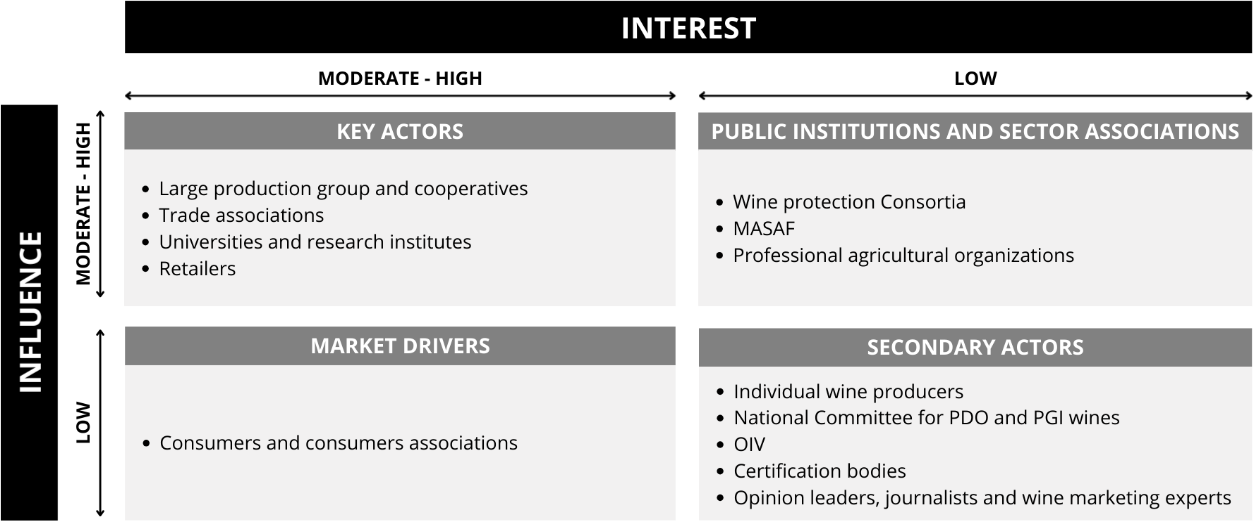
Within the group of “Key actors”, large production groups and cooperatives play a central role due to their capacity to invest in innovation and influence market dynamics and strategic debates. Wine trade associations are also pivotal in representing producers’ interests and exerting political and technical influence at the national level. Universities and research institutes contribute through their scientific and technological expertise, supporting evidence-based decision-making. Retailers complete this group thanks to their strategic position in shaping product offerings, influencing consumer demand, and facilitating the market uptake of innovative wines. “Secondary actors” include stakeholders with more limited involvement in the regulatory debate, such as the National Committee for PDO and PGI Wines, which mainly fulfils technical and advisory functions, and small-scale producers constrained by limited resources and technological capacity to influence national-level discussions. Certification bodies also belong to this group, as they focus primarily on regulatory compliance and the monitoring of standards rather than on shaping policy or innovation pathways. Opinion leaders, journalists, and wine marketing experts are perceived as having a modest impact on formal decision-making, although they contribute to framing public discourse and influencing perceptions of innovation within the wine sector, as in the case of NoLo wines. The OIV is likewise included, exerting indirect influence through international standards and scientific legitimacy that do not necessarily translate into immediate or binding effects on national regulatory processes. The “Market drivers” group includes consumers and their associations, who play a key role in shaping demand and acceptance for innovative products such as partially dealcoholized wines. However, their impact on political and regulatory processes remains limited, and the translation of demand into regulatory change depends on broad market uptake and producers’ strategies, particularly in Italy, where innovation must balance market trends with cultural and heritage considerations. Finally, “Public institutions and sector associations” include wine protection Consortia, MASAF, and professional agricultural organizations, which are characterized by high influence but moderate interest. Their limited focus on partial dealcoholization for PDO and PGI wines may reflect competing priorities within the wine sector, including trade issues (i.e., new tariffs), price volatility, declining production volumes, climate-related risks, and wider market uncertainties.
4.4 Opportunities and risks associated with partial dealcoholization
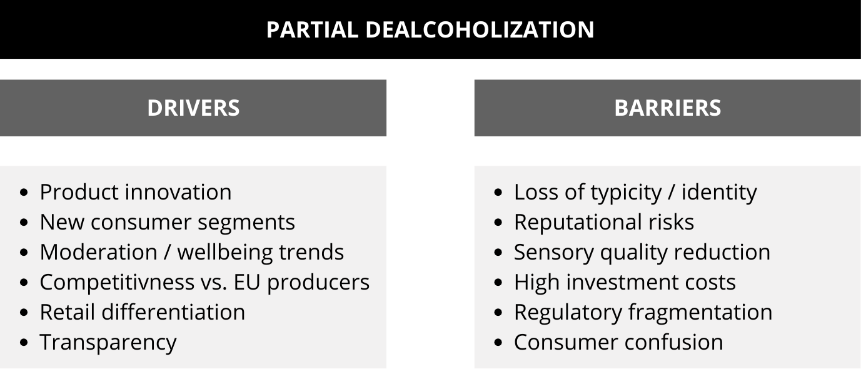
Experts identified a wide range of potential opportunities linked to the introduction of partial dealcoholization. These include the possibility of innovating product portfolios, accessing new markets as well as consumer segments (particularly younger, health-conscious, or alcohol-sensitive groups), and enhancing international competitiveness by better responding to evolving global demand. Dealcoholization may also serve as a strategic response to declining wine consumption and oversupply in several markets. Retailers could benefit from expanded assortments and product differentiation, while consumers may find in these wines a viable alternative that reduces alcohol-related concerns. Overall, transparent labelling requirements were viewed as essential for maintaining consumer trust.
At the same time, important risks and challenges were highlighted. The main concern relates to the potential erosion of quality, typicity, and territorial identity, especially for PDO wines, along with possible cannibalization of traditional products and reputational impacts on quality denominations. Technological limitations were also noted, as current dealcoholization methods may reduce aromatic intensity, structure, and overall sensory balance, potentially affecting consumer satisfaction and willingness to pay. These concerns, particularly those related to quality, typicity, and territorial identity, emerge across different stakeholder groups, but appear especially relevant among actors involved in safeguarding collective reputation and product standards. This pattern suggests that risk perception in the context of GI innovation is not homogeneous but partially shaped by actors’ positions within the governance system: those entrusted with protecting collective reputation and product standards tend to weigh potential threats to identity more heavily than potential market gains.
Experts further emphasized economic and organizational barriers, particularly for small and medium-sized producers, who may face difficulties accessing costly and complex technologies, leading to competitive asymmetries. Additional challenges may arise along the distribution chain due to increased operational complexity (e.g., related to assortment management, logistics, and the need for targeted staff training).
These issues could be exacerbated by regulatory fragmentation and uneven implementation across Member States and the lack of harmonized standards on labelling, controls, and traceability, potentially generating consumer confusion and weakening trust.
Figure 2 summarizes the main drivers and barriers identified across the panel.
4.5 Preference for naturally low-alcohol wines
A recurring theme across both rounds was experts’ strong preference to produce naturally low-alcohol PGI wines, obtained through viticultural and enological practices that limit sugar accumulation or modulate fermentation, rather than through physical dealcoholization. This approach was generally perceived as offering several advantages, including stronger protection of sensory quality, territorial identity, and the distinctive characteristics of PGI wines. It was also regarded as more consistent with traditional production methods, better aligned with consumer expectations of authenticity and naturalness, and easier to communicate, thereby facilitating market acceptance. This preference can also be interpreted as reflecting a compromise between innovation and tradition: it appears to be more strongly supported by actors more closely linked to production and territorial governance (e.g., Consortia and trade associations), while other stakeholder groups express more heterogeneous positions, suggesting different sensitivities to issues of product authenticity and market adaptation.
Moreover, many experts considered naturally low-alcohol wines to be more sustainable from both an environmental and socio-cultural perspective. However, limitations in terms of feasibility also emerged, linked to increasing climatic variability and to the challenges of consistently ensuring sensory balance and stability. In this context, experts pointed to the need for an integrated and flexible approach, combining agronomic and enological practices with partial dealcoholization when necessary.
This study examines stakeholders’ perceptions in the Italian wine sector regarding the EU’s regulatory opening to the partial dealcoholization of PGI and PDO wines, within the framework of the EU policy on GIs. Here, coherence remains an underlying theme. Given the novelty of NoLo wines [21] and their potential application within PGI and PDO regulatory frameworks, existing literature provides limited guidance for interpreting these findings. While technological feasibility, production methods, and the growing market relevance of dealcoholized wines have been increasingly examined in recent contributions [6], the governance implications of their inclusion within GIs schemes remain underexplored. Consequently, this section positions the results within the current regulatory, institutional, and market context, highlighting their conceptual and policy implications.
From the current regulatory and market context, the findings reflect a broader tension in the contemporary European wine sector: the coexistence of increasing pressure for innovation and a strong commitment to the protection of wine identity and territorial authenticity. This pattern reflects the recent evolution of EU wine policy, marked by the introduction of innovations such as the recognition of dealcoholized and partially dealcoholized wines, including the possibility of partial dealcoholization for PDO and PGI wines. It also enables the use of fungus-resistant grapevine varieties, which have long been marginalized due to the traditional emphasis on the genetic purity of Vitis vinifera.
Dealcoholization represents a clear departure from traditional European wine regulation, in which alcohol content has historically been regarded as an essential component of wine identity [46]. At the same time, market analyses highlight how the NoLo wine segment remains structurally sensitive to issues of identity, positioning, and competitive dynamics [3].
This tension is particularly evident in Italy, where the regulatory framework has so far maintained a conservative stance toward dealcoholization within quality wine schemes [31,32], despite the opening introduced at the EU level. The differentiated attitudes observed among experts in our sample toward PGI and PDO wines reflect this underlying institutional asymmetry. The broader acceptance of partial dealcoholization for PGI wines appears consistent with their historically more flexible positioning, whereas the strong resistance observed for PDO wines, especially for higher-tier categories such as DOCG and related special typologies, highlights the strong symbolic and reputational value associated with these designations. In this context, dealcoholization appears to conflict with the very definition of PDO wines, which are intrinsically linked to their territory, as it involves a process of modification and later adjustment of the product that may alter its sensory profile and, in turn, its authenticity and heritage [6]. The comparison implicitly drawn by experts with other national experiences (e.g., France) further reinforces this interpretation. Rather than serving as a model to be replicated, the French case is viewed as a benchmark showing how regulatory openness can coexist with safeguards such as minimum alcohol thresholds and sensory evaluation. Overall, the debate, as reconstructed through this Delphi analysis, focuses less on technical feasibility, which is generally acknowledged, and more on the governance and legitimacy of introducing dealcoholization practices within a deeply institutionalized system of GIs.
From a conceptual standpoint, partial dealcoholization can be considered a form of “bounded innovation”. Stakeholders do not frame dealcoholization as a radical or disruptive change, but rather as a conditional innovation whose acceptability depends on clearly defined limits and safeguards. These boundaries are product-related (greater acceptance for PGI wines), technical (minimum alcohol thresholds), institutional (a central role for Consortia), and temporal (preference for gradual implementation). This framing helps explain why consensus remains elusive: partial dealcoholization is neither rejected outright nor embraced unconditionally but negotiated as an innovation whose legitimacy depends on alignment with territorial identity, regulatory coherence, and market credibility. From a theoretical standpoint, this pattern of conditional acceptance is consistent with what Mahoney and Thelen (2010) [28] describe as institutional layering: rather than displacing existing rules, partial dealcoholization is conceived by stakeholders as an addition to the GI framework – one that must remain subordinate to the core principles of territorial identity and collective reputation [27]. The boundaries that define “bounded innovation” (product-related, technical, institutional, and temporal) can therefore be read as the conditions under which layering is deemed legitimate by institutional actors. Resistance is strongest where the institutional core is most consolidated, as in the case of PDO wines, and weakest where institutional rules are more flexible, as with PGI wines. This confirms that the acceptability of innovation in GI systems is not primarily a technical question, but a governance one.
The Delphi results also underline the central role of governance and actor configuration in shaping potential regulatory change. The prominence of wine protection Consortia, large production groups, trade associations, and public institutions reflects a multi-level governance system in which innovation is mediated by institutional authority, economic capacity, and scientific legitimacy. Consortia emerge as pivotal actors, acting both as guardians of territorial identity and intermediaries between producers, institutions, and markets, a role consistent with the literature identifying collective action among producers as a key determinant of GI system performance [27,47]. Public institutions, particularly the competent Ministry, retain decisive power in enabling or constraining regulatory evolution. Large wineries and retailers appear as potential drivers of innovation, while small producers and certification bodies are perceived as less influential, raising concerns about asymmetries in adoption. Consumers, despite strong interest, remain indirect actors, suggesting that market demand alone is insufficient to legitimize innovation in quality wine schemes without institutional endorsement. A further key insight concerns the strong preference expressed by experts for naturally low-alcohol wines. This preference reflects broader concerns related to authenticity, naturalness, and consistency with traditional production methods, particularly within PGI wines. Accordingly, recent reviews emphasize that both pre-fermentation strategies and post-fermentation technologies contribute to alcohol reduction, but each involves trade-offs affecting sensory properties and sustainability performance [6]. From this perspective, the debate should not be framed as a strict opposition between natural and technological solutions, but rather as a search for governance mechanisms capable of balancing flexibility, identity, and consumer trust.
These findings highlight the need for carefully designed regulatory pathways that acknowledge both the opportunities and sensitivities associated with partial dealcoholization, particularly in light of the recent European Regulation on GIs for wine, spirit drinks and agricultural products [48]. This Regulation reinforces the collective nature of GIs, strengthens the role of producer groups, and emphasizes the protection of reputation, value creation, sustainability, and effective governance. Within this framework, innovation in PGI and PDO schemes is encouraged only when compatible with product identity, consumer trust, and producers’ collective interests. Nevertheless, producing PGI and PDO wines with an alcohol content below the standard threshold inevitably requires regulatory adjustments, though with varying degrees of complexity and trade-offs. For partially dealcoholized products, a relatively simple yet potentially impactful change would be to allow blending between dealcoholized and non-dealcoholized wines. This would increase flexibility along the supply chain (e.g. wineries without dealcoholization equipment could still produce such blends) and could improve the sensory profile of the final product, as the standard wine component may help preserve the product quality. However, this option may raise concerns about product authenticity and transparency, particularly within GI systems. Notably, this issue is currently under discussion at the OIV, and the EU may move ahead independently if progress is delayed. For naturally low-alcohol wines, two main regulatory pathways can be identified. The first is to introduce a new wine category with an alcohol range below the current minimum threshold (i.e., currently set to 8.5 - 9% ABV). While this would provide clarity and formal recognition, it entails significant institutional and political constraints, including misalignment with OIV standards, the need to revise EU legislation, and potential consumer confusion. The second option is to lower the minimum alcohol threshold for wines, either generally or specifically for GI wines. This approach appears more feasible within the current framework and more consistent with OIV provisions (as some EU examples already exist, such as PDO Moscato d’Asti). However, extending this possibility more broadly, especially below thresholds such as 7%, would remain challenging under current OIV rules and would require a strong justification to ensure consistency with the traditional definition of wine and to preserve the credibility of GI systems. Overall, these options highlight a fundamental trade-off between regulatory flexibility and the protection of product identity, suggesting that gradual and context-specific adjustments may be the most viable path forward.
From a sustainability perspective, dealcoholization partly aligns with the Regulation’s social objectives by supporting more inclusive consumption contexts where alcohol intake is discouraged [1]. However, the process remains energy-intensive, potentially conflicting with environmental goals. In this regard, naturally low-alcohol wines may represent, at least within PGI schemes, a more coherent pathway, as they better align with both social and environmental sustainability while preserving territorial identity. Experimental and differentiated approaches, supported by robust sensory evaluation and transparent communication, may therefore help reconcile innovation with the core principles of GIs. However, further regulatory adjustments are needed to enable the production of naturally low-alcohol wines. From a research perspective, the limited empirical evidence on dealcoholized designation wines highlights the need for additional studies on consumer perception, willingness to pay, and long-term reputational effects. In this sense, the present study represents an initial exploratory step, providing a structured map of stakeholder positions that can inform future empirical, experimental, and policy-oriented research on geographical indication NoLo wines. However, future research should integrate demand-side analyses to complement the stakeholder-based approach adopted here, allowing for a more comprehensive understanding of the market acceptance and legitimacy of these innovations.
While the literature has increasingly acknowledged the potential impacts of dealcoholized wines across health, social, environmental, and market dimensions, dedicated and systematic analyses of their sustainability, especially within PDO and PGI schemes, remain largely lacking and therefore constitute a promising avenue for future research. This study is not without limitations. First, although the research design aimed to involve all relevant actors across the sector, the findings reflect the perspectives of those who agreed to contribute and may not fully capture the diversity of positions within the Italian wine system. Second, the absence of a direct demand-side perspective represents a limitation of the study, as consumer attitudes may differ from expert expectations and could play a crucial role in shaping the future acceptance of dealcoholized PDO and PGI wines. Addressing this gap represents a key direction for future research. A further limitation concerns the limited participation of policymakers in the panel, which may have constrained the representation of institutional and regulatory perspectives, particularly relevant given the policy focus of the study. However, the reasons underlying the limited participation of this group of respondents remain unclear. Future research should seek to more systematically engage policy actors, whose positions are likely to play a decisive role in shaping the regulatory evolution of partial dealcoholization within Italian GI frameworks.
Conceptualization idea: E.G., E.P., C.F.F.
Methodology: G.S., C.F.F., E.G.
Formal analysis: G.S., C.F.F., E.G.
Investigation: G.S., C.F.F., E.G.
Data curation: C.F.F., E.G.
Writing – original draft: G.S., C.F.F., E.G., E.P.
Writing – review, editing: G.S., C.F.F., E.G., E.P.
Supervision: E.G., E.P.
This study was carried out within the RESEARCH PROJECTS OF RELEVANT NATIONAL INTEREST (PRIN)-2022 Call (Prot. 2022HYXBFK) “DEalcoholised and low-alcohol WINEs: market perspectives, social and environmental impacts - DEWINE”.
[1] H. Ford, R. Dolan, S. Goodman, S. Bastian, W. Pearson, A.M. Corsi, Exploring consumers’ drinking behaviour regarding no-, low- and mid- alcohol wines: a systematic scoping review and guiding framework, Journal of Marketing Management 41 (2025) 703–733. https://doi.org/10.1080/0267257x.2025.2499101.
[2] Y. Kumar, A. Ricci, G.P. Parpinello, A. Versari, Dealcoholized Wine: A Scoping Review of Volatile and Non-Volatile Profiles, Consumer Perception, and Health Benefits, Food. Bioprocess Technol. 17 (2024) 3525–3545. https://doi.org/10.1007/s11947-024-03336-w.
[3] F.N. Schulz, A.A. Kugel, J.H. Hanf, Balancing Gains and Losses – A Research Note on Tradeoffs in the Case of Non-Alcoholic Wines in Germany, Sustainability 16 (2024) 2451. https://doi.org/10.3390/su16062451.
[4] M. Catarino, A. Mendes, Dealcoholizing wine by membrane separation processes, Innovative Food Science & Emerging Technologies 12 (2011) 330–337. https://doi.org/10.1016/j.ifset.2011.03.006.
[5] N. Ohana-Levi, Y. Netzer, Long-Term Trends of Global Wine Market, Agriculture 13 (2023) 224. https://doi.org/10.3390/agriculture13010224.
[6] P. Silva, Low-Alcohol and Nonalcoholic Wines: From Production to Cardiovascular Health, along with Their Economic Effects, Beverages 10 (2024) 49. https://doi.org/10.3390/beverages10030049.
[7] OIV. State of the World Vine and Wine Sector in 2024, (2025). https://www.oiv.int/sites/default/files/documents/OIV-State_of_the_World_Vine-and-Wine-Sector-in-2024.pdf (accessed 18 September 2025).
[8] T. Bucher, K. Deroover, C. Stockley, Low-Alcohol Wine: A Narrative Review on Consumer Perception and Behaviour, Beverages 4 (2018) 82. https://doi.org/10.3390/beverages4040082.
[9] R. Fuentes-Fernández, J.L. Del Campo-Villares, Exploring the Market for Dealcoholized Wine in Spain: Health Trends, Demographics, and the Role of Emerging Consumer Preferences, Beverages 11 (2025) 41. https://doi.org/10.3390/beverages11020041.
[10] S. Mueller Loose, R. Del Rey, State of the International Wine Markets in 2023. The wine market at a crossroads: Temporary or structural challenges?, WEP 13 (2024) 3–14. https://doi.org/10.36253/wep-16395.
[11] J.A. Piornos, D.P. Balagiannis, L. Methven, E. Koussissi, E. Brouwer, J.K. Parker, Elucidating the Odor-Active Aroma Compounds in Alcohol-Free Beer and Their Contribution to the Worty Flavor, J. Agric. Food Chem. 68 (2020) 10088–10096. https://doi.org/10.1021/acs.jafc.0c03902.
[12] J. Bruwer, V. Jiranek, L. Halstead, A. Saliba, Lower alcohol wines in the UK market: some baseline consumer behaviour metrics, British Food Journal 116 (2014) 1143–1161. https://doi.org/10.1108/BFJ-03-2013-0077.
[13] K. Deroover, M. Siegrist, K. Brain, J. McIntyre, T. Bucher, A scoping review on consumer behaviour related to wine and health, Trends in Food Science & Technology 112 (2021) 559–580. https://doi.org/10.1016/j.tifs.2021.03.057.
[14] L. Lockshin, A.M. Corsi, Consumer behaviour for wine 2.0: A review since 2003 and future directions, Wine Economics and Policy 1 (2012) 2–23. https://doi.org/10.1016/j.wep.2012.11.003.
[15] C. Stockley, A.W. Taylor, A. Montgomerie, E. Dal Grande, Changes in wine consumption are influenced most by health: results from a population survey of South Australians in 2013, IJWR Volume 9 (2017) 13–22. https://doi.org/10.2147/IJWR.S126417.
[16] P. Anderson, D. Kokole, E.J. Llopis, Production, Consumption, and Potential Public Health Impact of Low- and No-Alcohol Products: Results of a Scoping Review, Nutrients 13 (2021) 3153. https://doi.org/10.3390/nu13093153.
[17] K.E. Thompson, A. Vourvachis, Social and Attitudinal Influences on the Intention to Drink Wine, International Journal of Wine Marketing 7 (1995) 35–45. https://doi.org/10.1108/eb008643.
[18] H. Rumgay, N. Murphy, P. Ferrari, I. Soerjomataram, Alcohol and Cancer: Epidemiology and Biological Mechanisms, Nutrients 13 (2021) 3173. https://doi.org/10.3390/nu13093173.
[19] S.M. Chan, N.M. Adzahan, M.S. Ab Karim, R. Karim, O. Lasekan, J.M. Regenstein, Consumer Preferences and Perceptions on Dealcoholised Wine, Journal of Food Products Marketing 18 (2012) 65–77. https://doi.org/10.1080/10454446.2012.627292.
[20] C. Fucile Franceschini, E. Giampietri, E. Pomarici, A systematic review of consumer research on dealcoholized wines: reviewing the evidence, shaping the future of research. Agric Econ 14, 38 (2026). https://doi.org/10.1186/s40100-026-00483-w.
[21] Fact.MR, Non-Alcoholic Wine Market Outlook (2025 to 2035), (2025). https://www.factmr.com/report/4532/non-alcoholic-wine-market (accessed 18 September 2025).
[22] Regulation (EU) 2021/2117, (2021). https://eur-lex.europa.eu/eli/reg/2021/2117/oj (accessed 18 September 2025).
[23] INAO, Le comité vins IGP de l’INAO se prononce pour la possibilité de désalcooliser des vins IGP sous conditions, (2024). https://www.inao.gouv.fr/cp-vins-igp-desalcoolisation (accessed 18 September 2025).
[24] Resolution OIV-ECO 432-2012, (2012). https://www.oiv.int/public/medias/1901/oiv-eco-432-2012-en.pdf (accessed 18 September 2025).
[25] Resolution OIV-ECO 433-2012, (2012). https://www.oiv.int/public/medias/1902/oiv-eco-433-2012-en.pdf (accessed 18 September 2025).
[26] Regulation (EU) 1308/2013, (2013). https://eur-lex.europa.eu/eli/reg/2013/1308/oj/eng (accessed 18 September 2025).
[27] G. Belletti, A. Marescotti, J.-M. Touzard, Geographical Indications, Public Goods, and Sustainable Development: The Roles of Actors’ Strategies and Public Policies, World Development 98 (2017) 45–57. https://doi.org/10.1016/j.worlddev.2015.05.004.
[28] J. Mahoney, K. Thelen, A Theory of Gradual Institutional Change, in: Explaining Institutional Change, Cambridge University Press, 2009: pp. 1–37.
[29] Resolution 523-2016, (2016). https://www.oiv.int/node/3221 (accessed 18 September 2025).
[30] A Breakthrough Year for Low-Alcohol Wines, SevenFifty Daily (2025). https://daily.sevenfifty.com/a-breakthrough-year-for-low-alcohol-wines/ (accessed 29 September 2025).
[31] MASAF, 2024, (2024). https://www.masaf.gov.it/flex/cm/pages/ServeBLOB.php/L/IT/IDPagina/22522 (accessed 18 September 2025).
[32] MASAF, 2025, (2025). https://www.masaf.gov.it/flex/cm/pages/ServeBLOB.php/L/IT/IDPagina/23355 (accessed 18 September 2025).
[33] Il Pinot Grigio delle Venezie introduce la versione leggera sotto gli 11 gradi, Gambero Rosso (2025). https://www.gamberorosso.it/notizie/vino/pinot-grigio-venezie-bassa-gradazione/ (accessed 29 September 2025).
[34] Federdoc. Vini italiani a denominazione di origine 2025, (2025). https://www.federdoc.com/new/wp-content/uploads/2025/04/Booklet-2025_WEB.pdf (accessed 29 September 2025).
[35] E. Pomarici, A. Corsi, S. Mazzarino, R. Sardone, The Italian Wine Sector: Evolution, Structure, Competitiveness and Future Challenges of an Enduring Leader, Ital Econ J 7 (2021) 259–295. https://doi.org/10.1007/s40797-021-00144-5.
[36] Rapporto Ismea-Qualivita 2024. Produzioni agroalimentari e vitivinicole italiane DOP, IGP e STG, (2025). https://www.qualivita.it/rapporto-ismea-qualivita-2024/#toggle-id-1 (accessed 29 September 2025).
[37] G. Rowe, G. Wright, The Delphi technique as a forecasting tool: issues and analysis, International Journal of Forecasting 15 (1999) 353–375. https://doi.org/10.1016/s0169-2070(99)00018-7.
[38] N. Dalkey, O. Helmer, An Experimental Application of the DELPHI Method to the Use of Experts, Management Science 9 (1963) 458–467. https://doi.org/10.1287/mnsc.9.3.458.
[39] G. Sacchi, L. Romanello, M. Canavari, The future of organic certification: potential impacts of the inclusion of Participatory Guarantee Systems in the European organic regulation, Agric Econ 12 (2024) 2. https://doi.org/10.1186/s40100-023-00294-3.
[40] A.M. Manyara, A. Purvis, O. Ciani, G.S. Collins, R.S. Taylor, Sample size in multistakeholder Delphi surveys: at what minimum sample size do replicability of results stabilize?, Journal of Clinical Epidemiology 174 (2024) 111485. https://doi.org/10.1016/j.jclinepi.2024.111485.
[41] L.J. Frewer, A.R.H. Fischer, M.T.A. Wentholt, H.J.P. Marvin, B.W. Ooms, D. Coles, G. Rowe, The use of Delphi methodology in agrifood policy development: Some lessons learned, Technological Forecasting and Social Change 78 (2011) 1514–1525. https://doi.org/10.1016/j.techfore.2011.05.005.
[42] N. Mukherjee, J. Hugé, W.J. Sutherland, J. McNeill, M. Van Opstal, F. Dahdouh‐Guebas, N. Koedam, The Delphi technique in ecology and biological conservation: applications and guidelines, Methods Ecol Evol 6 (2015) 1097–1109. https://doi.org/10.1111/2041-210X.12387.
[43] D. Beiderbeck, N. Frevel, H.A. Von Der Gracht, S.L. Schmidt, V.M. Schweitzer, Preparing, conducting, and analyzing Delphi surveys: Cross-disciplinary practices, new directions, and advancements, MethodsX 8 (2021) 101401. https://doi.org/10.1016/j.mex.2021.101401.
[44] R.C. De Loë, N. Melnychuk, D. Murray, R. Plummer, Advancing the State of Policy Delphi Practice: A Systematic Review Evaluating Methodological Evolution, Innovation, and Opportunities, Technological Forecasting and Social Change 104 (2016) 78–88. https://doi.org/10.1016/j.techfore.2015.12.009.
[45] G. Johnson, K. Scholes, Exploring Corporate Strategy, Prentice Hall Europe, 1999. https://books.google.it/books?id=MXuFngEACAAJ.
[46] E. Pomarici, R. Sardone, Is a new EU wine policy coming? The unexpected role of regulatory measures, WEP 11 (2022) 75–82. https://doi.org/10.36253/wep-13189.
[47] D. Barjolle, B. Sylvander, Some factors of success for «Origin labelled Products» in agro-food supply chains in Europe: Market, internal resources and institutions, Esag 36 (2002) 1441–1461. https://doi.org/10.3406/esag.2002.1752.
[48] Regulation (EU) 2024/1143, (2024). https://eur-lex.europa.eu/legal-content/EN/TXT/PDF/?uri=OJ:L_202401143 (accessed 30 September 2025).