

Herpetofaunal diversity in the Upper Guinean rainforest: a baseline survey from the Dugbe region, Liberia
 Ryan Van Huyssteen
- Melissa Petford
- Marius Burger
- Jerome Gaugris
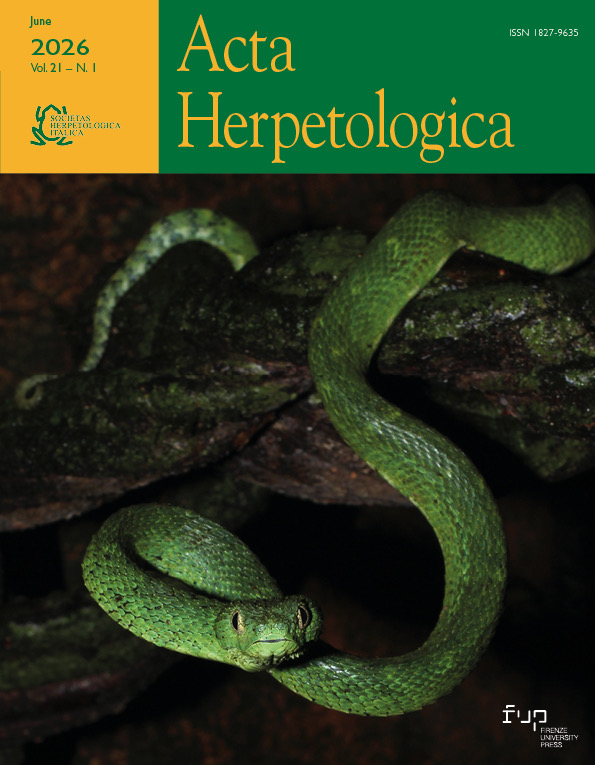
Published 2026-01-17
Keywords
- Reptiles,
- Amphians,
- West Africa,
- Field Survey,
- Herpetology
- Tropical Forest Ecology ...More
How to Cite
Copyright (c) 2026 Ryan van Huyssteen, Melissa Petford, Marius Burger, Trokon Superior Grimes, Jerome Gaugris

This work is licensed under a Creative Commons Attribution 4.0 International License.




Abstract
The Upper Guinean rainforest biome is a poorly studied, yet hyper-biodiverse region facing severe fragmentation due to ongoing habitat transformation. We conducted a herpetological baseline survey in the Dugbe region during 2021 using passive trapping and active searching. Our survey resulted in 1,145 herpetofauna observations, representing 71 taxa (38 amphibians and 33 reptiles), with active searching yielding 47.8% of the species richness. Nearly half (54.9%) of the documented species are West African endemics. Rarefaction/extrapolation sampling curves indicated incomplete overall sampling of herpetofauna diversity, though amphibian sampling completeness was high. Reptile diversity metrics revealed significant sampling deficiencies, largely explained by the high proportion of singleton observations (60.6% of reptile records). When compared to the IUCN predictive distribution maps, our survey documented 51.2% of the 123 species predicted for the region, with moderate overall Jaccard similarity (48.09%). Taxonomic groups showed varied patterns of congruence: amphibians displayed relatively high Jaccard similarity (59.26%), while reptiles showed lower similarity (40.26%). Notably, our survey documented substantially higher herpetofauna species richness than benchmark surveys from nearby areas, particularly for reptiles (33 species compared to 14 and 5 species in Krahn-Bassa proposed protected area and Grebo National Forest surveys, respectively). Several amphibian observations were not assignable to species using morphological characteristics alone, highlighting the need for further taxonomic research on West African herpetofauna.
References
- Allen, K.E., Greenbaum, E., Welton, L.J., Bauer, A.M. (2019): High levels of hidden phylogenetic structure within Central and West African Trachylepis skinks. Salamandra 55: 231-241.
- Angel, F. (1943): Description d’un nouvel Anoure ovovivipare de la Haute Guinée français. Bull. Mus. Paris 15: 167-169.
- Barbour, T., Loveridge, A. (1927): Some undescribed frogs and a new gecko from Liberia. Proc. New England Zool. Club 10: 13-18.
- Barej, M.F., Schmitz, A., Günther, R., Loader, S.P., Mahlow, K., Rödel, M.-O. (2014): The first endemic West African vertebrate family–a new anuran family highlighting the uniqueness of the Upper Guinean biodiversity hotspot. Front. Zool. 11: 1-11. DOI: https://doi.org/10.1186/1742-9994-11-8
- Blackburn, D.C., Kosuch, J., Schmitz, A., Burger, M., Wagner, P., Gonwouo, N.L., Hillers, A., Rödel, M.-O. (2008): A new species of Cardioglossa (Anura: Arthroleptidae) from the Upper Guinean forests of West Africa. Copeia 2008: 603-612. DOI: https://doi.org/10.1643/CH-06-233
- Boulenger, G.A. (1905): Descriptions of new West-African frogs of the genera Petropedetes and Bulua. Ann. Mag. Nat. Hist. 15: 281-283. DOI: https://doi.org/10.1080/03745480509443042
- Bourgeron, P.S., Humphries, H.C., Jensen, M.E. (2001): Representativeness assessments. In: A guidebook for integrated ecological assessment, pp. 292-306. Jensen, M.E., Bourgeron, P.S., Eds, New York, Springer-Verlag. DOI: https://doi.org/10.1007/978-1-4419-8620-7_21
- Chabanaud, P. (1921): Contributions a l’etude de la faune herpetologique de l’Afrique occidentale. II. Deuxième note. Bull. Comité Études Hist. Sci. Afr. Occid. Fr. 1921: 445-472.
- Channing, A., Rödel, M.-O. (2019): Field guide to the frogs & other amphibians of Africa. Cape Town, Penguin Random House South Africa.
- Chippaux, J.P. (2006): Les serpents d’Afrique occidentale et centrale. Paris, IRD éditions.
- Cope, E.D. (1861): List of the recent species of emydosaurian reptiles in the Museum of the Academy of Natural Sciences. Proc. Acad. Nat. Sci. Phila. 12: 549-550.
- Cushing, W.M., Cotillon, S.E., Hutchinson, J.A., Pengra, B., Alfari, I., Botoni, E., Soulé, A., Herrmann, S.M., Tappan, G.G. (2016): Landscapes of West Africa: A window on a changing world. Garretson, United States Geological Survey. DOI: https://doi.org/10.3133/fs20173005
- de Sousa, C., Fatoyinbo, L., Honzák, M., Wright, T.M., Murillo Sandoval, P.J., Whapoe, Z.E., Yonmah, J., Olatunji, E.T., Garteh, J., Stovall, A., Neigh, C.S., Portela, R., Gaddis, K.D., Larsen, T., Juhn, D. (2023): Two decades of land cover change and forest fragmentation in Liberia: Consequences for the contribution of nature to people. Conserv. Sci. Pract. 5: e12933. DOI: https://doi.org/10.1111/csp2.12933
- Deikumah, J.P., McAlpine, C.A., Maron, M. (2014): Biogeographical and taxonomic biases in tropical forest fragmentation research. Conserv. Biol. 28: 1522-1531. DOI: https://doi.org/10.1111/cobi.12348
- Durso, A.M., Seigel, R.A. (2015): A snake in the hand is worth 10,000 in the bush. J. Herpetol. 49: 503-506. DOI: https://doi.org/10.1670/15-49-04.1
- Ernst, M., Rödel, M.-O., Blom, M.P. (2025): Towards a comprehensive view on evolutionary refugia in West African rainforests. Front. Biogeogr. 18: e139537. DOI: https://doi.org/10.21425/fob.18.139537
- Eskew, E.A., Todd, B.D. (2017): Too cold, too wet, too bright, or just right? Environmental predictors of snake movement and activity. Copeia 105: 584-591. DOI: https://doi.org/10.1643/CH-16-513
- Falaschi, M. (2021): Phenology and temperature are the main drivers shaping the detection probability of the common wall lizard. Amphib.-Reptil. 42: 297-303. DOI: https://doi.org/10.1163/15685381-bja10051
- Forskål, P. (1775): Descriptiones animalium, avium, amphibiorum, piscium, insectorum, vermium: Quae in itinere orientali observavit. Copenhagen, ex officina Mölleri. DOI: https://doi.org/10.5962/bhl.title.2154
- Frost, D.R. (2025): Amphibian species of the World: an online reference. Version 6.2. American Museum of Natural History, New York. https://amphibiansoftheworld.amnh.org/index.php [Accessed 15 October 2025].
- Griesbaum, F., Jongsma, G.F., Penner, J., Kouamé, N.G.G., Doumbia, J., Gonwouo, N.L., Hillers, A., Glos, J., Blackburn, D.C., Rödel, M.-O. (2023): The smallest of its kind: Description of a new cryptic Amnirana species (Amphibia, Anura, Ranidae) from West African rainforests. Zootaxa 5254: 301-339. DOI: https://doi.org/10.11646/zootaxa.5254.3.1
- Guibé, J., Lamotte, M. (1958): Une espèce nouvelle de batracien du Mont Nimba (Guinée Française) appartenant au genre Phrynobatrachus: Ph. maculiventris n. sp. Bull. Mus. Natl. Hist. Nat., 2e Sér. 30: 255-257.
- Hepner, S., Agonvonon, G.A., Ehbrecht, M., Iheaturu, C., Azihou, A.F., Ifejika Speranza, C. (2025): Degradation and fragmentation effects on structural complexity in West‐African forest patches. Biotropica 57: e70012. DOI: https://doi.org/10.1111/btp.70012
- Hillers, A., Rödel, M.-O. (2007): Rapid survey of amphibians and reptiles of North Lorma, Gola and Grebo National Forests. In: A rapid biological assessment of North Lorma, Gola and Grebo National Forests, Liberia, pp. 29–33. Hoke, P., Demey, R., Peal, A., Eds, Arlington, Conservation International, Center for Applied Biodiversity Science.
- Hoke, P., Demey, R., Peal, A. (2007): A rapid biological assessment of north Lorma, Gola and Grebo national forests, Liberia. Arlington, Conservation International, Center for Applied Biodiversity Science.
- Ineich, I. (2003): Contribution à la connaissance de la biodiversité des régions afro‐montagnardes: Les Reptiles du Mont Nimba. In: Le peuplement animal du Mont Nimba (Guinée, Côte d’Ivoire, Liberia). Mém. Mus. nat. Hist. Nat. 190: 597-637. Lamotte, M., Roy, R., Eds, Paris, Muséum national d’Histoire naturelle.
- IUCN (2024): The IUCN Red List of Threatened Species. Version 2024-2. [Accessed 05 February 2025].
- IUCN SSC Amphibian Specialist Group (2013): Phrynobatrachus tokba. The IUCN Red List of Threatened Species 2013: e.T58145A18396312.
- IUCN SSC Amphibian Specialist Group (2014a): Leptopelis macrotis. The IUCN Red List of Threatened Species 2014: e.T56263A16925323.
- IUCN SSC Amphibian Specialist Group (2014b): Leptopelis occidentalis. The IUCN Red List of Threatened Species 2014: e.T56271A16925453.
- Jensen, M.E., Bourgeron, P.S., Eds (2012): A guidebook for integrated ecological assessments. New York, Springer Science & Business Media.
- Jordaan, A., Heideman, N.J., Buschke, F.T. (2021): Topography‐derived variables provide insight into habitat occupancy of a cryptic snake, Bitis atropos. Austral Ecol. 46(8): 1287-1297. DOI: https://doi.org/10.1111/aec.13057
- Lamotte, M. (1998): Panorama d’une fauna ouest africaine d’amphibiens: Le peuplement du Mont Nimba. Bull. Soc. Herp. Fr. 87–88: 5-23.
- Lewin, A., Feldman, A., Bauer, A.M., Belmaker, J., Broadley, D.G., Chirio, L., Itescu, Y., LeBreton, M., Maza, E., Meirte, D., Meiri, S. (2016): Patterns of species richness, endemism and environmental gradients of African reptiles. J. Biogeogr. 43: 2380-2390. DOI: https://doi.org/10.1111/jbi.12848
- Loveridge, A. (1941): Report on the Smithsonian-Firestone expedition’s collection of reptiles and amphibians from Liberia. Proc. U.S. Natl. Mus. 91: 113-140. DOI: https://doi.org/10.5479/si.00963801.91-3128.113
- Luiselli, L., Diagne, T. (2014): Kinixys erosa (Schweigger 1812)–forest hinge-back tortoise, serrated hinge-back tortoise, serrated hinged tortoise. Chelonian Res. Monogr. 5: 1-13. DOI: https://doi.org/10.3854/crm.5.084.erosa.v1.2014
- Luiselli, L., Dendi, D., Eniang, E.A., Fakae, B.B., Akani, G.C., Fa, J.E. (2019): State of knowledge of research in the Guinean forests of West Africa region. Acta Oecol. 94: 3-11. DOI: https://doi.org/10.1016/j.actao.2017.08.006
- Magurran, A.E. (2004): Measuring biological diversity. Oxford, John Wiley & Sons.
- Mendes, D.M., de Freitas Leão, R., Toledo, L.F. (2015): Drift fences in traps: theoretical evidence of effectiveness of the two most common arrays applied to terrestrial tetrapods. Nat. Conserv. 13: 60-66. DOI: https://doi.org/10.1016/j.ncon.2015.05.002
- Mottram, P., van Huyssteen, R., Okoue, E.A., Petford, M., Gaugris, J. (2025): Mammal diversity in southern Gabon: Grid-based vs. semi-random camera trapping. Afr. J. Wildl. Res. 55: 258-265. DOI: https://doi.org/10.3957/056.055.0258
- Myers, N., Mittermeier, R.A., Mittermeier, C.G., Da Fonseca, G.A., Kent, J. (2000): Biodiversity hotspots for conservation priorities. Nature 403: 853-858. DOI: https://doi.org/10.1038/35002501
- Nneji, L.M., Azevedo, J.A., Oyebanji, O.O., Ma, L., Elsen, P.R., Oladipo, S.O., Salako, G., Puschendorf, R., Pringle, R.M. (2023): Patterns of species richness and turnover in endemic amphibians of the Guineo‐Congolian rain forest. Divers. Distrib. 29: 1035-1051. DOI: https://doi.org/10.1111/ddi.13717
- Penner, J., Augustin, M., Rödel, M.-O. (2019): Modelling the spatial baseline for amphibian conservation in West Africa. Acta Oecol. 94: 31-40. DOI: https://doi.org/10.1016/j.actao.2017.11.018
- Penner, J., Rödel, M.-O., Luiselli, L., Trape, J.-F., Spawls, S., Malonza, P.K., Beraduccii, J., Chippaux, J.-P., LeBreton, M., Kusamba, C., Gonwouo, N.L. (2021): Bitis nasicornis. The IUCN Red List of Threatened Species 2021: e.T13300910A13300919.
- Penner, J., Wegmann, M., Hillers, A., Schmidt, M., Rödel, M.-O. (2011): A hotspot revisited–a biogeographical analysis of West African amphibians. Divers. Distrib. 17: 1077-1088. DOI: https://doi.org/10.1111/j.1472-4642.2011.00801.x
- Rödel, M.-O., Doumbia, J., Johnson, A.T., Hillers, A. (2009): A new small Arthroleptis (Amphibia: Anura: Arthroleptidae) from the Liberian part of Mount Nimba, West Africa. Zootaxa 2302: 19-30. DOI: https://doi.org/10.11646/zootaxa.2302.1.2
- Rödel, M.-O., Ernst, R. (2002): A new reproductive mode for the genus Phrynobatrachus: Phrynobatrachus alticola has nonfeeding, nonhatching tadpoles. J. Herpetol. 36: 121-125. DOI: https://doi.org/10.1670/0022-1511(2002)036[0121:ANRMFT]2.0.CO;2
- Rödel, M.-O., Glos, J. (2019): Herpetological surveys in two proposed protected areas in Liberia, West Africa. Zoosyst. Evol. 95: 15-35. DOI: https://doi.org/10.3897/zse.95.31726
- Rödel, M.-O., Adum, G.B., Aruna, E., Assemian, N.E., Barej, M.F., Bell, R.C., Burger, M., Demare, G., Doherty-Bone, T., Doumbia, J., Ernst, R., Gonwouo, N.L., Hillers, A., Hirschfeld, M., Jongsma, G.F.M., Kouamé, N.G., Kpan, T.F., Mohneke, M., Nago, S.G.A., Ofori-Boateng, C., Onadeko, A., Pauwels, O.S.G., Sandberger-Loua, L., Segniagbeto, G.H., Tchassem Fokoua, A.M., Tobi, E., Tohé, B., Zimkus, B.M., Penner, J. (2021): Diversity, threats and conservation of western and central African amphibians (Senegal, The Gambia, Guinea Bissau, Mali, Guinea, Sierra Leone, Liberia, Ivory Coast, Burkina Faso, Ghana, Togo, Benin, Nigeria, Niger, Cameroon, Gabon, São Tome & Principe, Equatorial Guinea, Central African Republic, Chad, Republic of the Congo, Democratic Republic of the Congo, northern Angola). In: Status and threats of Afrotropical Amphibians – Sub-Saharan Africa, Madagascar, Western Indian Ocean Islands. Amphibian Biology, Volume 11, Part 7, pp. 11–101. Heatwole, H., Rödel, M.-O., Eds, Frankfurt am Main, Edition Chimaira.
- Sandberger, L., Hillers, A., Doumbia, J., Loua, N.S., Brede, C., Rödel, M.-O. (2010): Rediscovery of the Liberian Nimba toad, Nimbaphrynoides liberiensis (Xavier, 1978) (Amphibia: Anura: Bufonidae), and reassessment of its taxonomic status. Zootaxa 2355: 56-68. DOI: https://doi.org/10.11646/zootaxa.2355.1.3
- Schiøtz, A. (1963): The amphibians of Nigeria. Vidensk. Medd. Dansk Naturhist. Foren. Kjøbenh. 125: 1-92.
- Schiøtz, A. (1967): The treefrogs (Rhacophoridae) of West Africa. Spolia Zool. Mus. Haun. 25: 1-346.
- Schiøtz, A. (1999): The treefrogs of Africa. Frankfurt am Main, Edition Chimaira.
- Schweigger, A.F. (1812): Prodromus monographia Cheloniorum auctore Schweigger. Königsberg. Arch. Naturwiss. Mathem. 1: 271-368, 406-458.
- Tolley, K., Conradie, W., Pietersen, D., Weeber, J., Burger, M., Alexander, G.J., Eds (2023): Conservation status of the reptiles of South Africa, Eswatini and Lesotho. Pretoria, South African National Biodiversity Institute.
- Tolley, K.A., Alexander, G.J., Branch, W.R., Bowles, P., Maritz, B. (2016): Conservation status and threats for African reptiles. Biol. Conserv. 204: 63-71. DOI: https://doi.org/10.1016/j.biocon.2016.04.006
- Tortoise & Freshwater Turtle Specialist Group (1996): Kinixys erosa. The IUCN Red List of Threatened Species 1996: e.T11002A3238083.
- Trape, J.F., Mané, Y. (2006): Le genre Dasypeltis Wagler (Serpentes: Colubridae) en Afrique de l’Ouest: description de trois espèces et d’une sous-espèce nouvelles. Bull. Soc. Herpetol. Fr. 119: 27-56.
- Trape, J.F., Trape, S., Chirio, L. (2012): Lézards, crocodiles et tortues d’Afrique occidentale et du Sahara. Paris, IRD éditions. DOI: https://doi.org/10.4000/books.irdeditions.37699
- Uetz, P. (2025): The Reptile Database. http://www.reptile-database.org [Accessed 23 May 2025].
- Wüster, W., Chirio, L., Trape, J.F., Ineich, I., Jackson, K., Greenbaum, E., Barron, C., Kusamba, C., Nagy, Z.T., Storey, R., Hall, C. (2018): Integration of nuclear and mitochondrial gene sequences and morphology reveals unexpected diversity in the forest cobra (Naja melanoleuca) species complex in Central and West Africa (Serpentes: Elapidae). Zootaxa 4455: 68-98. DOI: https://doi.org/10.11646/zootaxa.4455.1.3
- Xavier, F. (1978): Une espéce nouvelle de Nectophrynoides (Anoure, Bufonidae) des Monts Nimba, N. liberiensis. 1.‐ Description de l’espéce. Bull. Soc. Zool. France 103: 431-441.