

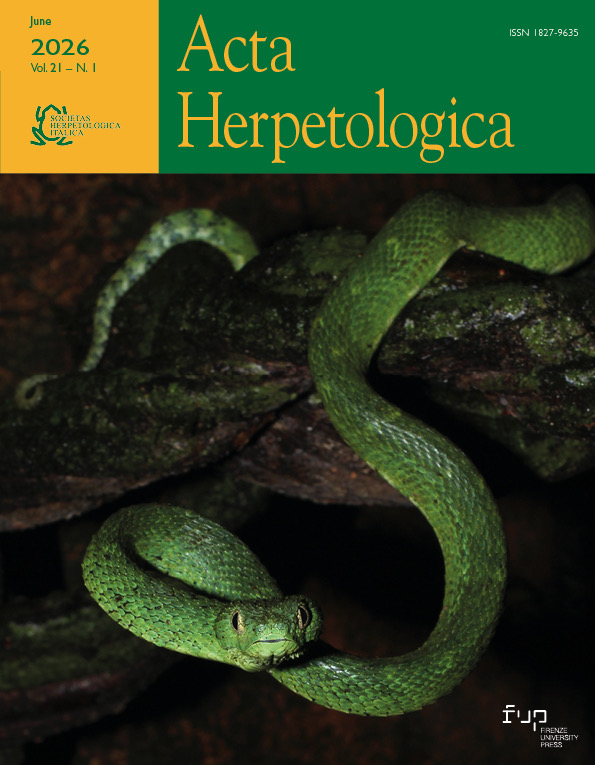
Published 2026-03-10
Keywords
- anuran conservation,
- rainforest,
- Reproductive biology,
- spatial ecology
How to Cite
Copyright (c) 2026 João Bachur, Karoline Ceron, Luis Felipe Toledo, Edelcio Muscat

This work is licensed under a Creative Commons Attribution 4.0 International License.




Abstract
Phasmahyla cruzi is an endemic treefrog species from the Brazilian Atlantic Forest for which basic natural history information is still lacking. In this study, we monitored two populations over a 12-month period in Ubatuba, São Paulo, Brazil, to investigate the species’ ecology, home range, and reproductive patterns. We used non-invasive photographic identification combined with minimum convex polygon (MCP) analysis to estimate home ranges. Based on the monthly sampling, we assessed the influence of abiotic factors (temperature and humidity) on activity patterns. We recorded 920 adult, 2,142 tadpole, and 22 egg clutch encounters. Males vocalized from September to April and showed territorial behaviour. Reproduction occurred through axillary amplexus, with oviposition on folded leaves suspended over streams. Mean home range for P. cruzi males was estimated at 460 m2, with individuals in higher elevations using significantly larger areas. A positive relationship was found between humidity and temperature with both individual abundance and clutch frequency. This study presents the first detailed data on habitat use, reproduction, and spatial ecology of P. cruzi, providing essential information for conservation efforts targeting this poorly known species endemic to the Atlantic Rainforest.
References
- Aichinger, M. (1987): Annual activity patterns of anurans in a seasonal neotropical environment. Oecologia 71: 583-592.
- Altig, R., McDiarmid, R.W. (1999): Body plan: Development and morphology. In: Tadpoles: The biology of anuran larvae, pp. 24–51. McDiarmid, R.W., Altig, R., Eds. Chicago, IL, Univ. Chicago Press.
- Bardier, C., Székely, D., Augusto-Alves, G., Matínez-Latorraca, N., Schmidt, B.R., Cruickshank, S.S. (2020): Performance of visual vs. software-assisted photo-identification in mark-recapture studies: A case study examining different life stages of the Pacific horned frog (Ceratophrys stolzmanni). Amphib.-Reptil. 42: 17-28.
- Bokermann, W., Sazima, I. (1978): Anfíbios da Serra do Cipó, Minas Gerais, Brasil. 4: Descrição de Phyllomedusa jandaia sp. n. (Anura, Hylidae). Rev. Bras. Biol. 38: 927-930.
- Botelho, L.M., Barbosa, A.C.F., Prado, J.S., Pedrozo, M., De Toledo Moroti, M., Toledo, L.F., Muscat, E. (2023): Reproductive biology, tadpole description, and natural history of Dendrophryniscus haddadi (Anura: Bufonidae). J. Nat. Hist. 57: 596-607.
- Brooks, M.E., Kristensen, K., van Benthem, K.J., Magnusson, A., Berg, C.W., Nielsen, A., Skaug, H.J., Mächler, M., Bolker, B.M. (2017): glmmTMB balances speed and flexibility among packages for zero-inflated generalized linear mixed modeling. R J. 9: 378.
- Calenge, C. (2011): Home range estimation in R: The adehabitatHR package.
- Carvalho-e-Silva, A.M.P.T., Da Silva, G.R., Carvalho-e-Silva, S.P. (2009): A new species of Phasmahyla Cruz, 1990 from the Atlantic Forest in the state of Rio de Janeiro, Brazil (Amphibia, Hylidae, Phyllomedusinae). Zootaxa 2120: 15-26.
- Ceron, K., Santana, D.J., Lucas, E.M., Zocche, J.J., Provete, D.B. (2020): Climatic variables influence the temporal dynamics of an anuran metacommunity in a nonstationary way. Ecology and Evolution, 10: 4630-4639.
- Crump, M.L. (1974): Reproductive strategies in a tropical anuran community. Kansas, Museum of Natural History.
- Cruz, C. (1990): Sobre as relações intergenéricas de Phyllomedusinae da floresta Atlântica (Amphibia, Anura, Hylidae). Rev. Bras. Biol. 50: 709-726.
- Cruz, C.A., Feio, R., Nascimento, L. (2008a): A new species of Phasmahyla Cruz, 1990 (Anura: Hylidae) from the Atlantic Rain Forest of the States of Minas Gerais and Bahia, Brazil. Amphib. Reptil. 29: 311-318.
- Cruz, C.A.G., Napoli, M.F., Fonseca, P.M. (2008b): A new species of Phasmahyla Cruz, 1990 (Anura: Hylidae) from the State of Bahia, Brazil. S. Am. J. Herpetol. 3: 187-195.
- Dias, P.H.D.S., Mongin-Aquino, M., Candioti, F.V., Carvalho-e-Silva, A.M.P.T.D., Baêta, D. (2018): Internal larval morphology of two species of shining leaf frogs (Anura: Phyllomedusidae: Phasmahyla). S. Am. J. Herpetol. 13: 44.
- Downs, J.A., Horner, M.W. (2008): Effects of point pattern shape on home-range estimates. J. Wildl. Manage. 72: 1813-1818.
- Duellman, W.E., Trueb, L. (1994): Biology of Amphibians. Baltimore, Johns Hopkins Univ. Press.
- Faivovich, J., Haddad, C.F.B., Garcia, P.C.A., Frost, D.R., Campbell, J.A., Wheeler, W.C. (2005): Systematic review of the frog family Hylidae, with special reference to Hylinae: Phylogenetic analysis and taxonomic revision. Bull. Am. Mus. Nat. Hist. 294: 1.
- Faivovich, J., Haddad, C.F.B., Baêta, D., Jungfer, K., Álvares, G.F.R., Brandão, R.A., Sheil, C., Barrientos, L.S., Barrio-Amoròs, C.L., Cruz, C.A.G., Wheeler, W.G. (2010): The phylogenetic relationships of the charismatic poster frogs, Phyllomedusinae (Anura, Hylidae). Cladistics 26: 227-261.
- Frost, D.R. (2024): Amphibian species of the world: An online reference. Version 5.4.
- Gosner, K.L. (1960): A simplified table for staging anuran embryos and larvae with notes on identification.
- Hartig, F. (2016): DHARMa: Residual diagnostics for hierarchical (multi-level/mixed) regression models. CRAN: Contributed Packages.
- Lima-Araujo, F., Brasileiro, A.C., Carvalho, E.F.F., Passos, D.C. (2021): Efficiency of photo identification of inguinal color patterns of Pithecopus gonzagai (Anura: Phyllomedusidae) from northeastern Brazil. Phyllomedusa 20: 67-74.
- Moroti, M., Severgnini, M.R., Bolovon, J.P., Toledo, L.F., Muscat, E. (2022): Filling the knowledge gaps of Paratelmatobius mantiqueira (Anura: Leptodactylidae): Tadpole, acoustic repertoire, and life history traits. J. Nat. Hist. 56: 1563-1584.
- Moser, C.F., Olmedo, G.M., Oliveira, M., Tozetti, A.M. (2019): Movement ecology and habitat use in males of two species of Boana (Anura: Hylidae) during the breeding season. Herpetol. Notes 12: 885-893.
- Muscat, E., Menegucci, R.C., Tanaka, R.M., Rotenberg, E., Moroti, M.D.T., Pedrozo, M., Stuginski, D.S., Sazima, I. (2020): Natural history of the marsupial frog Gastrotheca albolineata (Anura: Hemiphractidae) in lowland Brazilian Atlantic Forest. Phyllomedusa 19: 189-200.
- Nanglu, K., de Carle, D., Cullen, T.M., Anderson, E.B., Arif, S., Castañeda, R.A., Chang, L.M., Iwama, R.E., Fellin, E., Manglicmot, R.C., Massey, M.D., Astudillo-Clavijo, V., (2023): The nature of science: The fundamental role of natural history in ecology, evolution, conservation, and education. Ecol. Evol. 13: e10621.
- Navas, C.A. (1996): Metabolic physiology, locomotor performance, and thermal niche breadth in Neotropical anurans. Physiol. Zool. 69: 1481-1501.
- Nipko, R.B., Holcombe, B.E., Kelly, M.J. (2020): Identifying individual jaguars and ocelots via pattern-recognition software: Comparing HotSpotter and Wild-ID. Wildl. Soc. Bull. 44: 424-433.
- Oliveira, F.F.R., Nogueira, P.A.G., Eterovick, P.C. (2012): Natural history of Phyllomedusa megacephala (Miranda-Ribeiro, 1926) (Anura: Hylidae) in southeastern Brazil, with descriptions of its breeding biology and male territorial behaviour. J. Nat. Hist. 46: 117-129.
- Oseen, K.L., Wassersug, R.J. (2002): Environmental factors influencing calling in sympatric anurans. Oecologia 133: 616-625.
- Pedro, V.A.S., Feio, R.N. (2010): Distribuição espacial e sazonal de anuros em três ambientes na Serra do Ouro Branco, extremo sul da Cadeia do Espinhaço, Minas Gerais, Brasil.
- Pedrozo, M., Botelho, L.M., Moroti, M.D.T., Rotenberg, E.L., Toledo, L.F., Muscat, E. (2023): Natural history of the flattened waterfall frog Cycloramphus boraceiensis (Anura, Cycloramphidae). Caldasia 46: 167-178.
- Pereira, E.A., Rocha, L.C.L., Folly, H., Da Silva, H.R., Santana, D.J. (2018): A new species of spotted leaf frog, genus Phasmahyla (Amphibia, Phyllomedusidae) from Southeast Brazil. PeerJ 6: e4900.
- R Core Team. (2024): R: A language and environment for statistical computing, v. 4.4.0. R Foundation for Statistical Computing.
- Rolim, G.D.S., Camargo, M.B.P., Lania, D.G., Moraes, J.F.L. (2007): Classificação climática de Köppen e de Thornthwaite e sua aplicabilidade na determinação de zonas agroclimáticas para o estado de São Paulo. Bragantia 66: 711-720.
- Row, J.R., Blouin-Demers, G. (2006): Kernels are not accurate estimators of home-range size for herpetofauna. Copeia 2006: 797-802.
- Saenz, D., Fitzgerald, L.A., Baum, K.A., Conner, R.N. (2006): Abiotic correlates of anuran calling phenology: The importance of rain, temperature, and season. Herpetol. Monogr. 20: 64.
- Da Silva, F.R., Almeida-Neto, M., Do Prado, V.H.M., Haddad, C.F.B., De Cerqueira Rossa-Feres, D. (2012): Humidity levels drive reproductive modes and phylogenetic diversity of amphibians in the Brazilian Atlantic Forest. J. Biogeogr. 39: 1720-1732.
- Toledo, L.F., Becker, C.G., Haddad, C.F.B., Zamudio, K.R. (2014): Rarity as an indicator of endangerment in neotropical frogs. Biol. Conserv. 179: 54-62.
- Tozetti, A.M., Toledo, L.F. (2005): Short-term movement and retreat sites of Leptodactylus labyrinthicus (Anura: Leptodactylidae) during the breeding season: A spool-and-line tracking study. J. Herpetol. 39: 640-644.
- Volenec, Z.M., Dobson, A.P. (2020): Conservation value of small reserves. Conserv. Biol. 34: 66-79.
- Wells, K.D. (2007): The ecology and behavior of amphibians. Chicago, Univ. Chicago Press.