

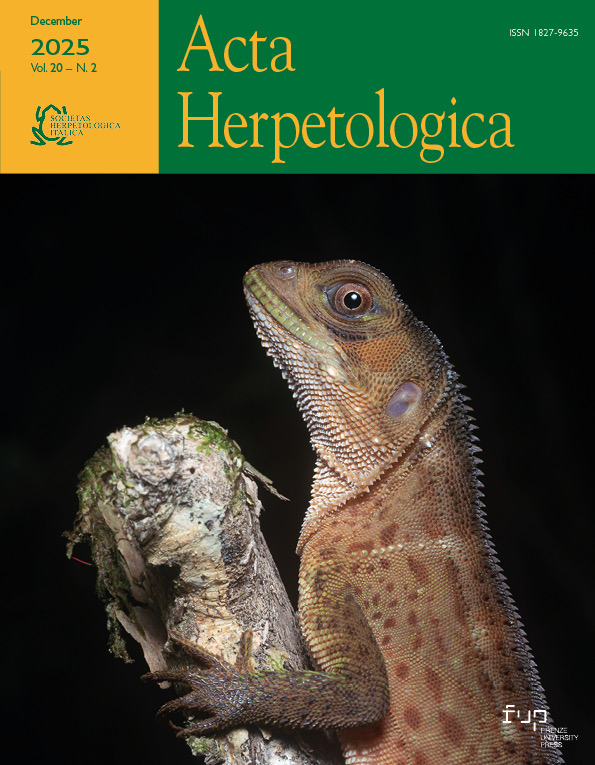
Published 2025-09-03
Keywords
- Amphibians,
- Herpetology,
- Journal Citation Report,
- Impact factor,
- Reptiles
- Zoological journals ...More
How to Cite
Copyright (c) 2025 Sebastiano Salvidio

This work is licensed under a Creative Commons Attribution 4.0 International License.




Abstract
Herpetological journals publish papers dealing with the study and conservation of amphibians and non-avian reptiles. Journals in this field are listed under the “Zoology” subject category of the Journal Citation Reports (JCR) and are assigned a two-year and a five-year impact factor (IF2 and IF5, respectively). These are among the most widely used indicators for bibliometric and academic evaluation. In this study, I present an overview of some general and bibliometric characteristics of the 18 herpetological journals listed in the 2025 JCR database. Specifically, I analysed the temporal trends of the IF2 over the 2013-2024 period. The analysis showed that most of these journals (78%) maintained a relatively constant IF2 during the study period, while four (22%) exhibited an increasing trend. I also tested if a relationship between the IF5 and the number of issues, the number of citable items, or the percentage of gold open access items per year was present. However, no significant relation was observed at least for these 2024 bibliometric indexes. Finally, journals published by scientific societies showed a significantly higher IF5 (P < 0.03), in comparison to other journals. Therefore, choosing these journals when submitting herpetological-focused manuscripts should be more considered.
References
- Chytrý, M., Pillar, V.D., Price, J.N., Wagner, V., Wiser, S.K., Zelený, D. (2023): The benefits of publishing in society-owned scientific journals. Appl. Veg. Sci. 26: e12705. DOI: https://doi.org/10.1111/avsc.12705
- Dodd, C.K. (2010): Amphibian ecology and conservation: A handbook of techniques. Oxford University Press, UK. DOI: https://doi.org/10.1093/oso/9780199541188.001.0001
- Dodd, C.K. (2016): Reptile ecology and conservation: A handbook of techniques. Oxford University Press, UK. DOI: https://doi.org/10.1093/acprof:oso/9780198726135.001.0001
- Dolan, S.k., Banks, L.D., Yu, W. (2024). Why should early-career scientists publish in society journals. mBio 15: e01994-23. DOI: https://doi.org/10.1128/mbio.01994-23
- Garfield, E. (2006): The history and meaning of the journal impact factor. JAMA 295: 90-93. DOI: https://doi.org/10.1001/jama.295.1.90
- Hammer, Ø., Harper, D.A.T., Ryan P.D. (2001): PAST: Paleontological statistics software package for education and gata analysis. Palaeont. Elect. 4: 9. http://palaeo-electronica.org/2001_1/past/issue1_01.htm.
- Hubbard, S.C., McVeigh, M.E. (2011): Casting a wide net: The journal impact factor numerator. Learn. Publ. 24: 133-137. DOI: https://doi.org/10.1087/20110208
- Lazarides, M-K., Lazaridou, I-Z., Papanas, N. (2023): Bibliometric analysis: Bridging informatics with science. Int. J. Low. Extrem. Wounds 24: 515-517. DOI: https://doi.org/10.1177/15347346231153538
- Marshall, M.B., Strine, C.T. (2021): Make like a glass frog: In support of increased transparency in herpetology. Herpetol. J. 31: 35-45. DOI: https://doi.org/10.33256/31.1.3545
- Pajic, D. (2015): On the stability of citation-based journal rankings. J. Inf. 9: 990-1006. DOI: https://doi.org/10.1016/j.joi.2015.08.005
- Pinto, A.P., Mejdalani, G., Mounce, R., Silveira, L.F., Marinoni, L., Rafael, J.A. (2021): Are publications on zoological taxonomy under attack? R. Soc. Open Sci., 8: 201617. DOI: https://doi.org/10.1098/rsos.201617
- Schlesinger, K. (1911): Serpent. Enciclopedia Britannica 24. 1911 Encyclopædia Britannica/Serpent. Consulted online May 5th 2025.
- Shine, R. (2014): Foreward. ix-x. In: Vitt, L.J., Caldwell, J.P. (eds) Herpetology: An Introductory Biology of Amphibians and Reptiles. Academic Press, London.
- Zhang, T. (2021): Will the increase in publication volumes “dilute” prestigious journals’ impact factors? A trend analysis of the FT50 journals. Scintometrics 126: 863-869. DOI: https://doi.org/10.1007/s11192-020-03736-7