

The combined inoculation of Trichoderma harzianum and Pseudomonas putida as a microbila consortium enhances the growth and yield of pepper (Capsicum annuum L.)
 A. Torres
- N. Pastor
Published 2026-04-07
Keywords
- Field assays,
- microbial consortium,
- pepper,
- Pseudomonas putida,
- Trichoderma harzianum
- yield ...More
How to Cite
Copyright (c) 2026 Ing. Cejas, Dr. Guiñazu, Dr. Rovera, Dr. Andres, Dr. Torres, Dr. Pastor

This work is licensed under a Creative Commons Attribution 4.0 International License.




Abstract
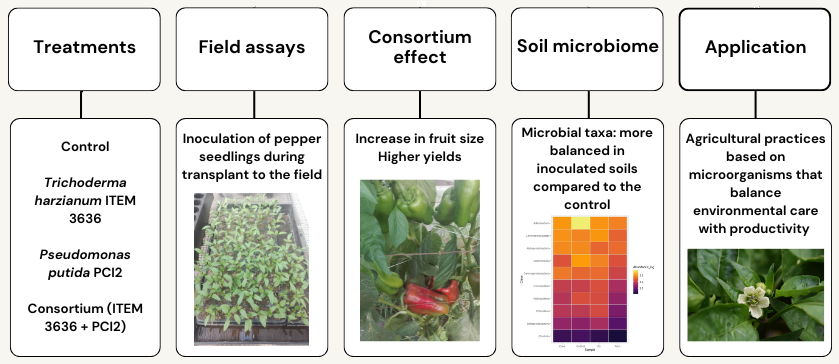
A sustainable agricultural method to increase crop yield and reduce dependence on chemical inputs is the use of beneficial microbial species as bioinoculants, especially Trichoderma spp., Pseudomonas spp. and microbial consortia. This study evaluated the impact of single and combined inoculations of Trichoderma harzianum ITEM 3636 and Pseudomonas putida PCI2 on pepper plants in field assays. Fruits from consortium-inoculated plants were larger than those from single-strain treatments or uninoculated controls, showing pronounced increases in fruit width and fruit length. Additionally, yield gains were highest under consortium inoculation, whereas individual strain inoculations resulted in intermediate responses. These results suggest the potential use of the consortium as an effective bioinoculant for increasing pepper yield. An initial qualitative assessment of soil microbial taxonomic profiles was carried out. Results showed that root-associated soil from individual inoculations showed higher abundances of one dominant fungal taxon compared to the remaining taxa, in contrast to dual inoculation that displayed a more balanced fungal distribution. Also, bacterial taxa were more balanced in inoculated soils compared to the control. Overall, our work reports on a useful microbiological tool to improve sustainability in horticultural systems.
References
- BDULLAH N.S., DONI F., MISPAN M.S., SAIMAN M.Z., YUSUF Y.M., OKE M.A., SUHAIMI N.S.M., 2021 - Harnessing Trichoderma in agriculture for productivity and sustainability. - Agronomy, 11: 2559. DOI: https://doi.org/10.3390/agronomy11122559
- ADEDAYO A.A., BABALOLA O.O., 2023 - Fungi that promote plant growth in the rhizosphere boost crop growth. - J. Fungi, 9: 239. DOI: https://doi.org/10.3390/jof9020239
- AGUILAR-PAREDES A., VALDÉS G., NUTI M., 2020 - Ecosystem functions of microbial consortia in sustainable agriculture. - Agronomy, 10: 1902. DOI: https://doi.org/10.3390/agronomy10121902
- BADER A.N., SALERNO G.L., COVACEVICH F., CONSOLO V.F., 2020 - Native Trichoderma harzianum strains from Argentina produce indole-3 acetic acid and phosphorus solubilization, promote growth and control wilt disease on tomato (Solanum lycopersicum L.). - J. King Saud Univ. - Sci., 32: 867-873. DOI: https://doi.org/10.1016/j.jksus.2019.04.002
- BARIK S., PONNAM N., REDDY A.C., REDDY DC L., SAHA K., ACHARYA G., REDDY M., 2022 - Breeding peppers for industrial uses: Progress and prospects. - Ind. Crop. Prod., 178: 114626. DOI: https://doi.org/10.1016/j.indcrop.2022.114626
- BASU A., PRASAD P., DAS S.N., KALAM S., SAYYED R.Z., REDDY M.S., EL ENSHASY H., 2021 - Plant growth promoting rhizobacteria (PGPR) as green bioinoculants: Recent developments, constraints, and prospects. - Sustainability, 13: 1140. DOI: https://doi.org/10.3390/su13031140
- BOLYEN E., RIDEOUT J.R., DILLON M.R., BOKULICH N.A., ABNET C.C., AL-GHALITH G.A., ALEXANDER H., ALM E.J., ARUMUGAM M., ASNICAR F., BAI Y., BISANZ J.E., BITTINGER K., BREJNROD A., BRISLAWN C.J., BROWN C.T., CALLAHAN B.J., CARABALLO-RODRÍGUEZ A.M., CHASE J., CAPORASO J.G., 2019 - Reproducible, interactive, scalable and extensible microbiome data science using QIIME2. - Nat. Biotechnol., 37: 852-857.
- CHEMELTORIT P.P., MUTAQIN K.H., WIDODO W., 2017 - Combining Trichoderma hamatum THSW13 and Pseudomonas aeruginosa BJ10-86: a synergistic chili pepper seed treatment for Phytophthora capsici infested soil. - Eur. J. Plant Pathol., 147: 157-166. DOI: https://doi.org/10.1007/s10658-016-0988-5
- DERESA D., GIRMA S., ASSEFA G., 2023 - Genetic variability, heritability, genetic advance, and association of characters in small pod hot pepper (Capsicum annuum L.) landraces in West Hararghe, Eastern Ethiopia. - Int. J. Bot. Hor. Res., 1: 31-37. DOI: https://doi.org/10.21203/rs.3.rs-3018971/v1
- DORJEY S., DOLKAR D., SHARMA R., 2017 - Plant growth promoting rhizobacteria Pseudomonas: A Review. - Int. J. Curr. Microbiol. Appl. Sci., 6: 1335-1344. DOI: https://doi.org/10.20546/ijcmas.2017.607.160
- DUC N., MAYER Z., PÉK Z., HELYES L., POSTA K., 2017 - Combined inoculation of arbuscular mycorrhizal fungi, Pseudomonas fluorescens and Trichoderma spp. for enhancing defense enzymes and yield of three pepper cultivars. - Appl. Ecol. Environ. Res., 15: 1815-1829. DOI: https://doi.org/10.15666/aeer/1503_18151829
- ESTAKI M., JIANG L., BOKULICH N.A., McDONALD D., GONZÁLEZ A., KOSCIOLEK T., MARTINO C., ZHU Q., BIRMINGHAM A., VÁZQUEZ-BAEZA Y., DILLON M.R., BOLYEN E., CAPORASO J.G., KNIGHT R., 2020 - QIIME 2 enables comprehensive end-to-end analysis of diverse microbiome data and comparative studies with publicly available data. - Curr. Protoc. Bioinform., 70: e100. DOI: https://doi.org/10.1002/cpbi.100
- FUSCO G.M., BURATO A., PENTANGELO A., CARDARELLI M., NICASTRO R., CARILLO P., PARISI M., 2023 - Can microbial consortium applications affect yield and quality of conventionally managed processing tomato? - Plants, 12: 14. DOI: https://doi.org/10.3390/plants12010014
- GANUZA M., PASTOR N., BOCCOLINI M., ERAZO J., PALACIOS S., ODDINO C., REYNOSO M.M., ROVERA M., TORRES A.M., 2019 - Evaluating the impact of the biocontrol agent Trichoderma harzianum ITEM 3636 on indigenous microbial communities from field soils. - J. Appl. Microbiol., 126(2): 608-623. DOI: https://doi.org/10.1111/jam.14147
- GANUZA M., PASTOR N., ERAZO J., ANDRÉS J., REYNOSO M.M., ROVERA M., TORRE A.M., 2018 - Efficacy of
- the biocontrol agent Trichoderma harzianum ITEM 3636 against peanut smut, an emergent disease caused by Thecaphora frezii. - Eur. J. Plant Pathol., 151: 257-262.
- HE Y., PANTIGOSO H.A., WU Z., VIVANCO J.M., 2019 - Co-inoculation of Bacillus sp. and Pseudomonas putida at different development stages acts as a biostimulant to promote growth, yield and nutrient uptake of tomato. - J. Appl. Microbiol., 127: 196-207. DOI: https://doi.org/10.1111/jam.14273
- KAUSHAL M., MANDYAL P., KAUSHAL R., 2019 - Field based assessment of Capsicum annuum performance with inoculation of rhizobacterial consortia. - Microorganisms, 7: 89. DOI: https://doi.org/10.3390/microorganisms7030089
- KING E.O., WARD M.K., RANEY D.E., 1954 - Two simple media for the demonstration of pyocyanin and fluorescin. - J. Lab. Clin. Med., 44: 301-307.
- KRISHNA R., JAISWAL D.K., ANSARI W.A., SINGH S., SOUMIA P.S., SINGH A.K.,·KUMARI B., SINGH M., VERMA J.P., 2022 - Potential microbial consortium mitigates drought stress in tomato (Solanum lycopersicum L.) plant by up-regulating stress-responsive genes and improving fruit yield and soil properties. - J. Soil Sci. Plant Nutr., 22: 4598-4615. DOI: https://doi.org/10.1007/s42729-022-00929-2
- KUMAR S.M., CHOWDAPPA P., KRISHNA V., 2015 - Development of seed coating formulation using consortium of Bacillus subtilis OTPB1 and Trichoderma harzianum OTPB3 for plant growth promotion and induction of systemic resistance in field and horticultural crops. - Indian Phytopathol., 68: 25-31.
- MABOKO M., DU PLOOY C., CHILOANE S., 2012 - Effect of plant population, stem and flower pruning on hydroponically grown sweet pepper in a shadenet structure. - Afr. J. Agric. Res., 7: 1742-1748. DOI: https://doi.org/10.5897/AJAR11.2078
- PASTOR N., CARLIER E., ANDRÉS J., ROSAS S.B., ROVERA M., 2012 - Characterization of rhizosphere bacteria for control of phytopathogenic fungi of tomato. - J. Environ. Manage., 95: S332-S337. DOI: https://doi.org/10.1016/j.jenvman.2011.03.037
- PASTOR N., PALACIOS S., TORRES A.M., 2023 - Microbial consortia containing fungal biocontrol agents, with emphasis on Trichoderma spp.: Current applications for plant protection and effects on soil microbial communities. - Eur. J. Plant Pathol., 167: 593-620. DOI: https://doi.org/10.1007/s10658-023-02773-1
- PASTOR N., ROSAS S., LUNA V., ROVERA M., 2014 - Inoculation with Pseudomonas putida PCI2, a phosphate solubilizing rhizobacterium, stimulates the growth of tomato plants. - Symbiosis, 62: 157-167. DOI: https://doi.org/10.1007/s13199-014-0281-3
- PASTOR N.A., CEJAS L.G., GUIÑAZÚ L.B., ROVERA M., TORRES A.M., 2024 - Inoculation of tomato roots with single and mixed suspensions of Trichoderma harzianum ITEM 3636 conidia and Pseudomonas putida PCI2 cells. - Int. J. Veg. Sci., 30: 56-73. DOI: https://doi.org/10.1080/19315260.2023.2298007
- ROJO F.G., REYNOSO M.M., FEREZ M., CHULZE S.N., TORRES A.M., 2007 - Biological control by Trichoderma species of Fusarium solani causing peanut brown root rot under field conditions. - Crop Prot., 26: 549-555. DOI: https://doi.org/10.1016/j.cropro.2006.05.006
- SHARMA A., KUMAR M., KUMAR N., DOGRA R., KUMARI S., 2019 - Studies on interrelationships among yield and yield contributing traits in bell pepper (Capsicum annuum L. var. grossum). - J. Pharmacogn. Phytochem., 8: 646-649.
- SINGH S., TRIPATHI A., MAJI D., AWASTHIA A., VAJPAYEEB P., KALRAA A., 2019 - Evaluating the potential of combined inoculation of Trichoderma harzianum and Brevibacterium halotolerans for increased growth and oil yield in Mentha arvensis under greenhouse and field conditions. - Ind. Crops Prod., 131: 173-181. DOI: https://doi.org/10.1016/j.indcrop.2019.01.039
- STEWART A., HILL R., 2014 - Applications of Trichoderma in plant growth promotion, pp. 415-428. - In: GUPTA V.K., M. SCHMOLL, A. HERRERA-ESTRELLA, R.S. UPADHYAY, I. DRUZHININA, and M.G. TUOHY (EDS.) Biotechnology and biology of Trichoderma. Elsevier, Amsterdam, The Netherlands, pp. 549. DOI: https://doi.org/10.1016/B978-0-444-59576-8.00031-X
- TABACCHIONI S., PASSATO S., AMBROSINO P., HUANG L., CALDARA M., CANTALE C., HETT J., DEL FIORE A., FIORE A., SCHLÜTER A., SCZYRBA A., MAESTRI E., MARMIROLI N., NEUHOFF D., NESME J., SØRENSEN S.J., APREA G., NOBILI C., PRESENTI O., GIOVANNETTI G., GIOVANNETTI C., PIHLANTO A., BRUNORI A., BEVIVINO A., 2021 - Identification of beneficial microbial consortia and bioactive compounds with potential as plant biostimulants for sustainable agriculture. - Microorganisms, 9: 426. DOI: https://doi.org/10.3390/microorganisms9020426
- TYŚKIEWICZ R., NOWAK A., OZIMEK E., JAROSZUK-ŚCISEŁ J., 2022 - Trichoderma: The current status of its application in agriculture for the biocontrol of fungal phytopathogens and stimulation of plant growth. - Int. J. Mol. Sci., 23: 2329. DOI: https://doi.org/10.3390/ijms23042329
- USMAN M.G., RAFII M.Y., MARTINI M.Y., OLADOSU Y., KASHIANI P., 2017 - Genotypic character relationship and phenotypic path coefficient analysis in chili pepper genotypes grown under tropical condition. - J. Sci. Food Agric., 97: 1164-1171. DOI: https://doi.org/10.1002/jsfa.7843
- VISHWAKARMA K., KUMAR N., SHANDILYA C., MOHAPATRA S., BHAYANA S., VARMA A., 2020 - Revisiting plant-microbe interactions and microbial consortia application for enhancing sustainable agriculture: A review. - Front. Microbiol., 11: 560406. DOI: https://doi.org/10.3389/fmicb.2020.560406