

Genotype x environment effects on yield and fruit quality in cherry tomato (Solanum lycopersicum var. cerasiforme)
 M. Khedri
- A. Hesami
- H. Nooryazdan
Published 2025-12-31
Keywords
- Antioxidant pigments,
- hydroponic cultivation,
- lycopene,
- soil-based cultivation,
- total soluble solids (TSS)
- vitamin C ...More
How to Cite
Copyright (c) 2025 Abdolali hesami

This work is licensed under a Creative Commons Attribution 4.0 International License.




Abstract
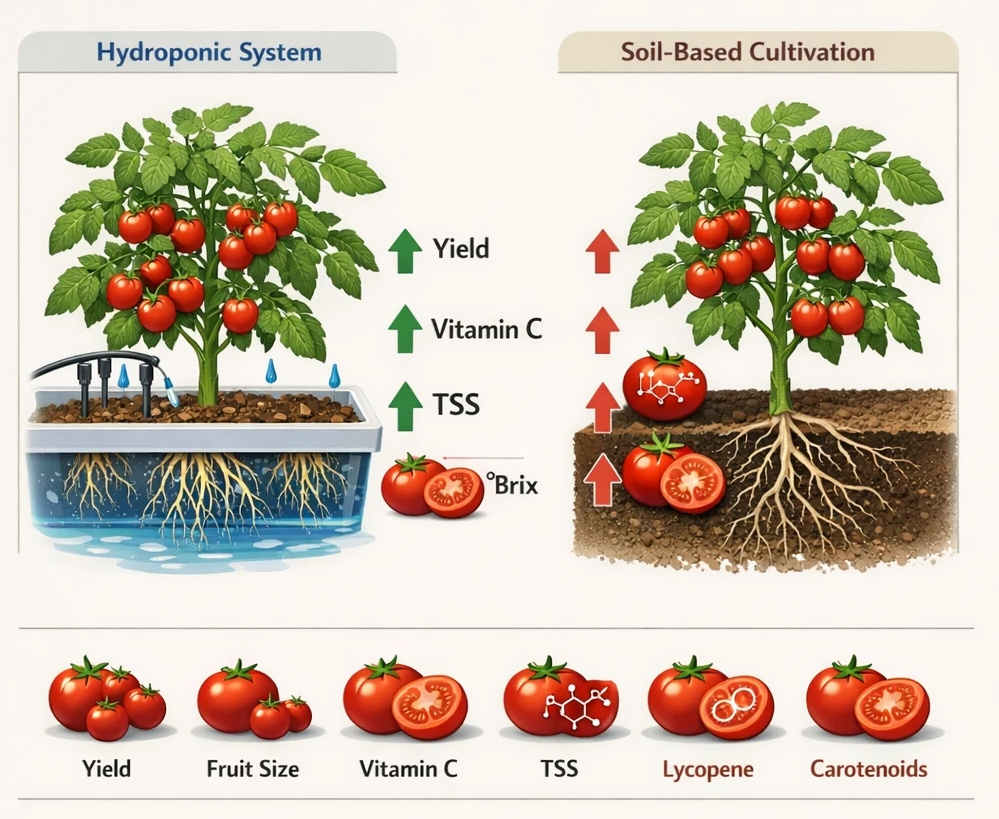
This study compared six cherry tomato (Solanum lycopersicum var. cerasiforme) lines - ‘Yellow pear’, ‘Red pear’, ‘Yellow lamp’, ‘Red olive’, ‘Big red orbicular’, and ‘Small yellow orbicular’ - grown under hydroponic and soil-based greenhouse conditions to identify superior genotypes for yield and fruit quality. The experiment was conducted during the 2023 winter-spring season in Borazjan, Iran, using a factorial experiment arranged in a completely randomized design with four replicates. Hydroponic plants (perlite:cocopeat, 40:60) received Hoagland solution, while soil-grown plants were supplied with a mixture of organic and inorganic fertilizers. Yield components (fruit weight, fruit volume, fruit set, and yield), growth (plant height), and biochemical attributes (vitamin C, total soluble solids, citric acid, carotenoids, lycopene, chlorophyll a, and chlorophyll b) were measured. Significant effects (p<0.01) of genotype, cultivation system, and their interaction were observed for all traits. ‘Big red orbicular’ recorded the highest fruit weight, fruit volume, yield, chlorophyll b, and carotenoid contents, while ‘Red pear’ showed the greatest vitamin C and chlorophyll a, and ‘Small yellow orbicular’ had the highest total soluble solids and citric acid. Hydroponic cultivation enhanced yield, vitamin C, and soluble solids, whereas soil cultivation favored carotenoid and lycopene accumulation. Overall, ‘Big red orbicular’ under hydroponic culture emerged as the most promising genotype for high-yield greenhouse production, while soil-grown tomatoes may be preferable for maximizing pigment content. These results provide practical guidance for genotype selection and cultivation system optimization in cherry tomato production.
References
- ARNON D.I., 1949 - Copper enzymes in isolated chloroplasts: Polyphenoloxidase in Beta vulgaris. - Plant Physiol., 24: 1-15. DOI: https://doi.org/10.1104/pp.24.1.1
- CASALS J., RIVERA A., SABATÉ J., ROMERO DEL CASTILLO R., SIMÓ J., 2018 - Cherry and fresh market tomatoes: Differences in chemical, morphological and sensory traits and their implications for consumer acceptance. - Agronomy, 9: 9. DOI: https://doi.org/10.3390/agronomy9010009
- DORAIS M., EHRET D.L., PAPADOPOULOS A.P., 2008 - Tomato (Solanum lycopersicum) health components: From the seed to the consumer. - Hortic. Rev., 34: 229-276.
- FERNANDES I., LECA J.M., AGUIAR R., FERNANDES T., MARQUES J.C., CORDEIRO N., 2021 - Influence of crop system on fruit quality, carotenoids, fatty acids and phenolic compounds in cherry tomatoes. - Agric. Res., 10: 56-65. DOI: https://doi.org/10.1007/s40003-020-00478-z
- GRUDA N., 2009 - Do soilless culture systems influence product quality of vegetables? - Eur. J. Hortic. Sci., 4: 135-144.
- HERNANDEZ-PEREZ O.I., VALDEZ-AGUILAR L.A., ALIA-TEJACAL I., CARTMILL A.D., CARTMILL D.L., 2020 - Tomato fruit yield, quality and nutrient status in response to potassium-calcium balance and electrical conductivity in the nutrient solution. - J. Soil Sci. Plant Nutr., 20: 484-492. DOI: https://doi.org/10.1007/s42729-019-00133-9
- ILAHY R., TLILI I., SIDDIQUI M.W., HDIDER C., LENUCCI M.S., 2019 - Inside and beyond color: Comparative overview of functional quality of tomato and watermelon fruits. - Food Res. Int. 126: 108658. DOI: https://doi.org/10.3389/fpls.2019.00769
- KHAN M.A.,. BUTT S.J, KHAN K.A., NADEEM F., YOUSAF B., JAVED H.U., 2017 - Morphological and physico-biochemical characterization of tomato cultivars in simplified soilless media. - Ann. Agric. Sci., 62: 139-143. DOI: https://doi.org/10.1016/j.aoas.2017.10.001
- KUMAR K., ACHARYA S., VERMA V.C., TSEWANG T.,. TIWARI V.K, AVANTIKA A., CHAURASIA O., 2022 - Comparative evaluation of physico-chemical responses of tomato varieties under hydroponic vs soil cultivation in naturally ventilated greenhouses. - Vegetos, 35: 1-8. DOI: https://doi.org/10.1007/s42535-022-00443-x
- LIU X., ZHANG Y., CHEN L., LI J., 2022 - Regulation of lycopene biosynthesis in tomato under abiotic stress: Hormonal signaling, phytoene synthase activity and antioxidant response. - Sci. Hortic., 293: 110707.
- LONDOÑO-GIRALDO L.M., RESTREPO-DÍAZ J.C., FISCHER G., 2020 - Influence of growing system on antioxidant capacity and quality of cherry tomato fruits. - Agronomy, 10: 1260.
- MABOKO M.M., DU PLOOY C.P., BERTLING I., 2009 - Comparative performance of tomato cultivars in soilless vs in-soil systems. - Acta Hortiulturae, 843: 91-98. DOI: https://doi.org/10.17660/ActaHortic.2009.843.42
- MARTÍ R., ROSELLÓ S., CEBOLLA-CORNEJO J., 2016 - Tomato as a source of carotenoids and polyphenols targeted to cancer prevention. - Cancers, 8:58. DOI: https://doi.org/10.3390/cancers8060058
- MOHAMED A.A., ABDELRAHMAN S.A., HASSAN M.E., 2023 - Effects of cultivation systems on yield, quality and bioactive compounds of cherry tomato. - Horticulturae, 9: 312.
- MOZOS I., STOIAN D., CARABA A., MALAINER C., HORBAŃCZUK J.O., ATANASOV A.G., 2018 - Lycopene and vascular health. - Front. Pharmacol., 9: 521. DOI: https://doi.org/10.3389/fphar.2018.00521
- OECD, 1998 - OECD guidelines for testing chemicals: Determination of titratable acidity in plant-derived foods. - OECD Publ., Paris.
- OLLE M., NGOUAJIO M., SIOMOS A., 2012 - Vegetable quality and productivity as influenced by growing medium: A review. - Zemdirbyste-Agric., 99: 399-408.
- PÉK Z., SZUVANDZSIEV P., NEMÉNYI A., HELYES L., 2014 - Effect of irrigation on yield and soluble solids of processing tomatoes. - Sci. Hortic., 172: 30-38.
- PEARSON D., 1976 - The chemical analysis of foods. - 7th Edition, Churchill Livingstone, Edimburgh, New Yoork, USA, pp. 575.
- PESTORIC M., POŠTIĆ D., PETROVIĆ I., STIKIĆ R., 2021 - Cultivation system-dependent variation in tomato fruit quality and antioxidant potential. - Agronomy, 11: 1894.
- PETROVIĆ I., MARJANOVIĆ M., PEĆINAR I., SAVIĆ S., JOVANOVIĆ Z., STIKIĆ R., 2022 - Chemical characterization of different colored tomatoes using biochemical and spectroscopic tools. - Biol. Life Sci. Forum, 16: 32. DOI: https://doi.org/10.3390/IECHo2022-12482
- RASHEED R., IQBAL M., ASHRAF M.A., HUSSAIN I., SHAFIQ F., YOUSAF A., ZAHEER A., 2018 - Glycine betaine mitigates waterlogging effects on growth, pigments, oxidative defense and fruit quality in tomato. - J. Hortic. Sci. Biotechnol., 93: 385-391. DOI: https://doi.org/10.1080/14620316.2017.1373037
- RAVELO-PÉREZ, L.M., HERNÁNDEZ-BORGES J., RODRÍGUEZ-DELGADO M., GARCÍA-MONTELONGO F.J., 2008 - Spectrophotometric determination of lycopene in tomato using acetone-hexane extraction. - J. Food Compos. Anal., 21: 125-131.
- RENNA M., D’IMPERIO M., GONNELLA M., DURANTE M., PARENTE A., MITA G., SANTAMARIA P., SERIO F., 2019 - Morphological and chemical profile of tomato landraces in semi-arid Mediterranean climate. - Plants 8: 273. DOI: https://doi.org/10.3390/plants8080273
- SINGH B., SINGH J.P., KAUR A., SINGH N., 2020 - Bioactive compounds in banana and health benefits: A review. - Food Chem., 339: 127751.
- TAVALLALI V., ESMAILI S., KARIMI S., 2018 - Nitrogen and potassium requirements for optimizing fruit quality and antioxidative capacity of tomato. - J. Food Meas. Charact., 12: 755-762. DOI: https://doi.org/10.1007/s11694-017-9689-9
- VERDOLIVA S.G., GWYN-JONES D., DETHERIDGE A., ROBSON P., 2021 - Hydroponically grown tomatoes show increased water-use efficiency and higher lycopene and β-carotene contents. - Sci. Hortic., 279: 109896. DOI: https://doi.org/10.1016/j.scienta.2021.109896
- WOLDEMARIAM S.HLAL., S., ZELELEW D.Z., SOLOMON M.T., 2018 - Effect of potassium levels on productivity and fruit quality of tomato. - J. Agric. Stud., 6: 104-116.